

Image Super-Resolution Via Iterative Refinement
Open accessThe DOI matches its Crossref record; 81 of the 85 references it cites were found in a registry or an index.
Abstract
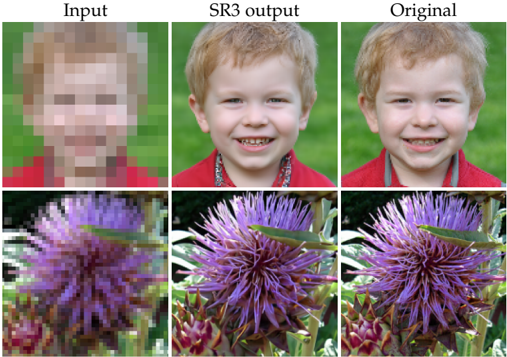
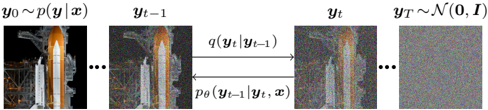
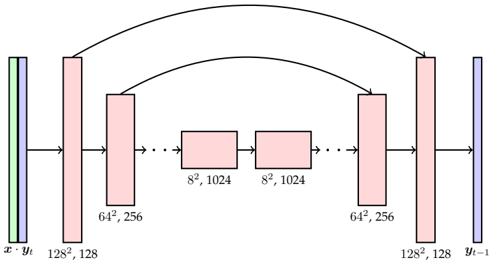
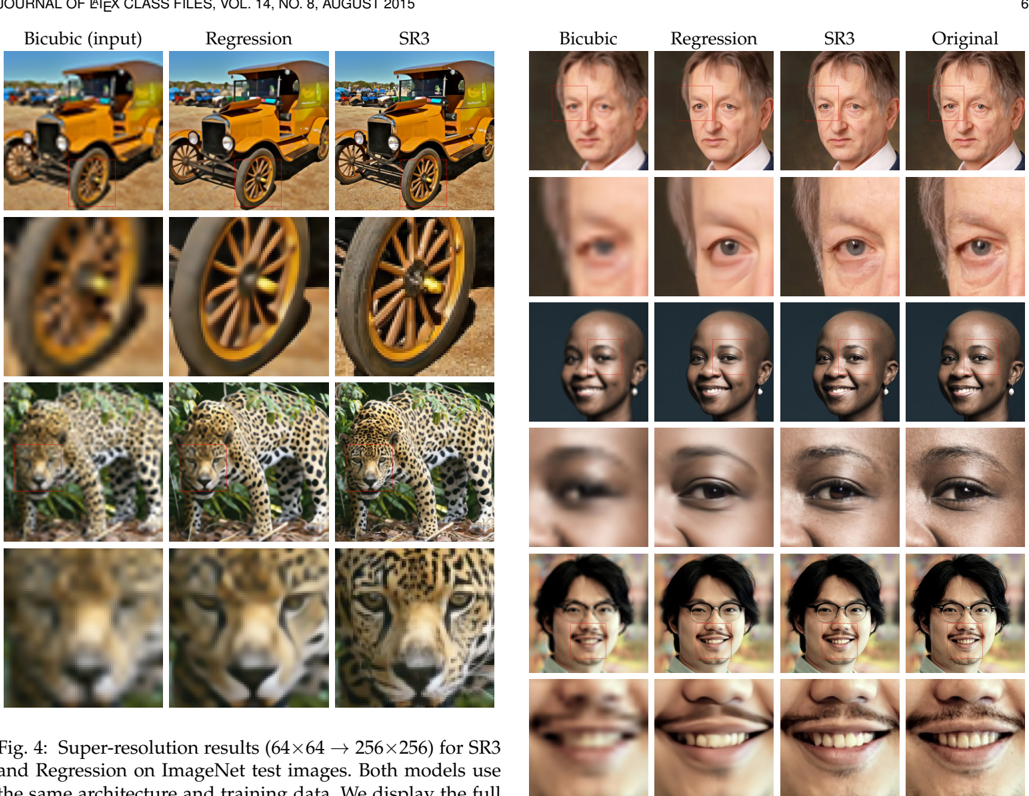
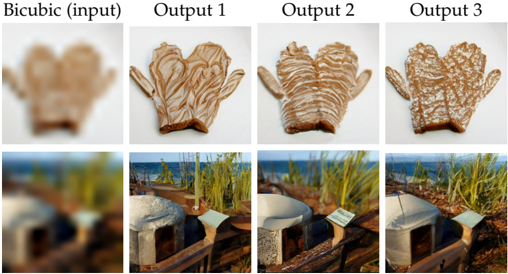
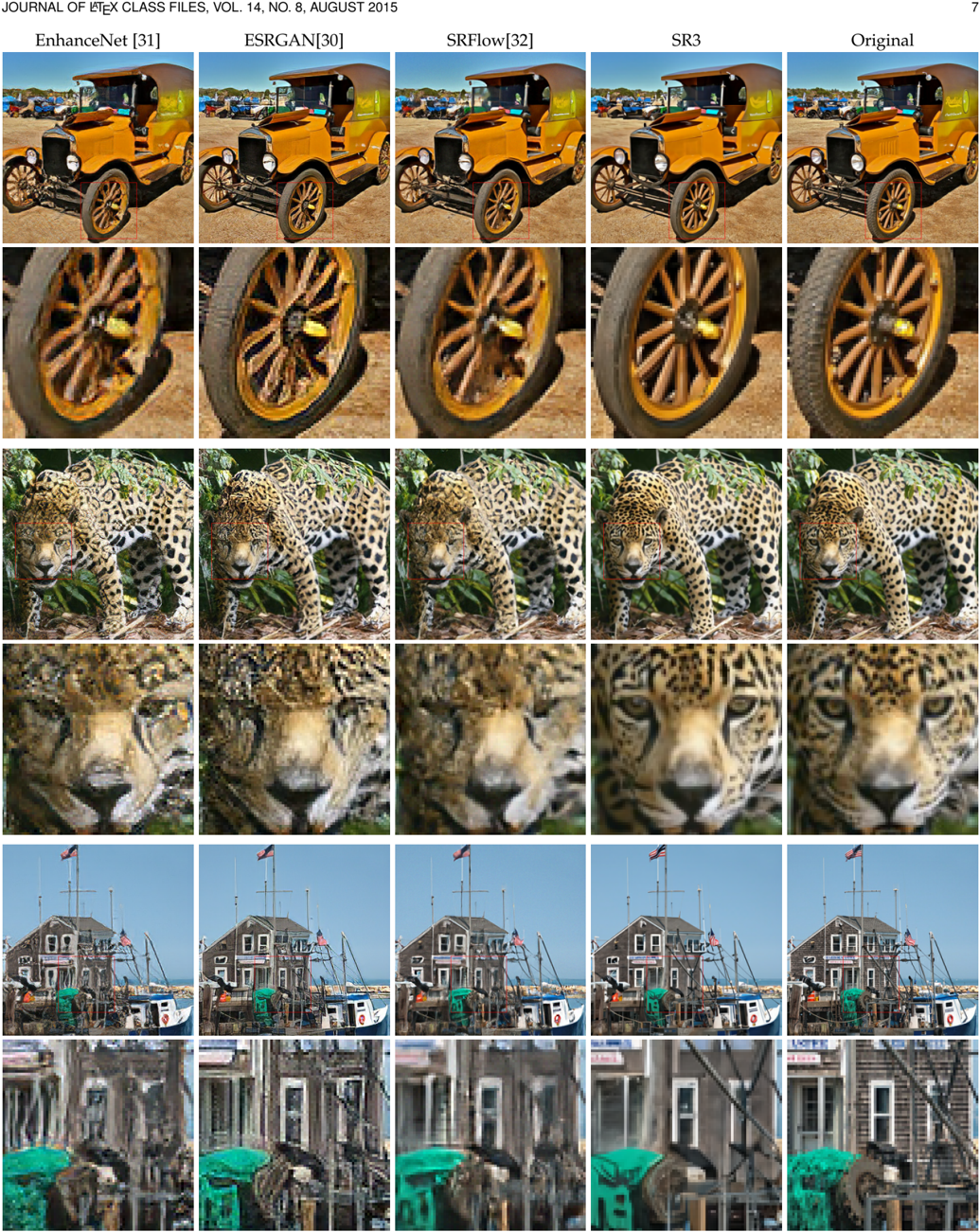
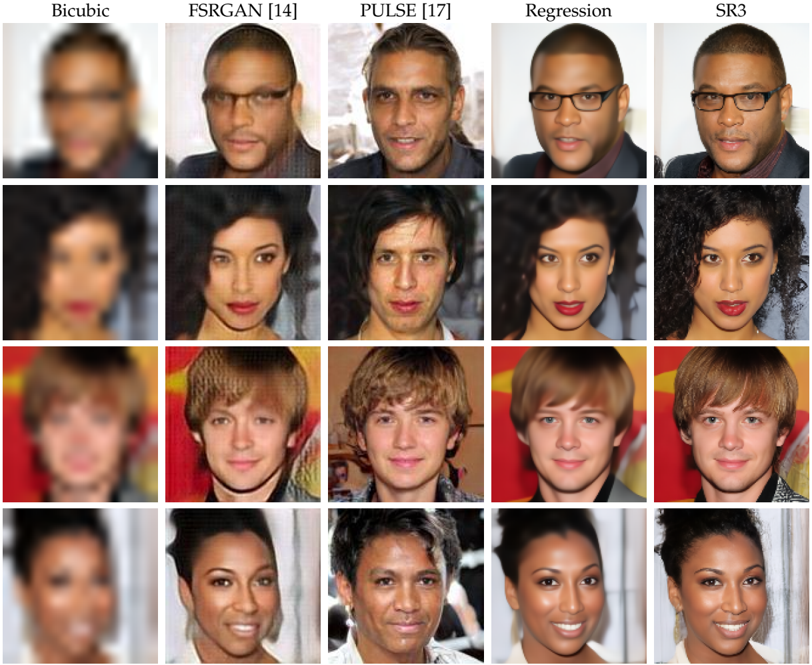
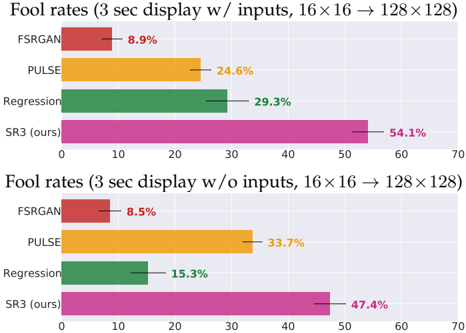
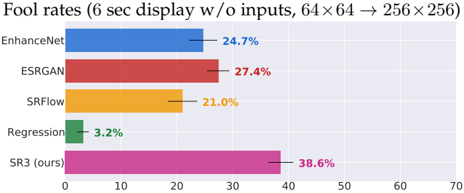
We present SR3, an approach to image Super-Resolution via Repeated Refinement. SR3 adapts denoising diffusion probabilistic models (Ho et al. 2020), (Sohl-Dickstein et al. 2015) to image-to-image translation, and performs super-resolution through a stochastic iterative denoising process. Output images are initialized with pure Gaussian noise and iteratively refined using a U-Net architecture that is trained on denoising at various noise levels, conditioned on a low-resolution input image. SR3 exhibits strong performance on super-resolution tasks at different magnification factors, on faces and natural images. We conduct human evaluation on a standard 8× face super-resolution task on CelebA-HQ for which SR3 achieves a fool rate close to 50%, suggesting photo-realistic outputs, while GAN baselines do not exceed a fool rate of 34%. We evaluate SR3 on a 4× super-resolution task on ImageNet, where SR3 outperforms baselines in human evaluation and classification accuracy of a ResNet-50 classifier trained on high-resolution images. We further show the effectiveness of SR3 in cascaded image generation, where a generative model is chained with super-resolution models to synthesize high-resolution images with competitive FID scores on the class-conditional 256×256 ImageNet generation challenge.
Overview
The claims and statistics of this paper haven’t been checked yet.
Free: it reads the open-access text and checks the first 5 claims that cite a source we can check. Create a free account to check every claim.
Integrity signals
Registry
Cites
Statistics
Figures



















Verification
Claims the paper makes
The claims and statistics of this paper haven’t been checked yet.
Free: it reads the open-access text and checks the first 5 claims that cite a source we can check. Create a free account to check every claim.
Claims other papers make about this one
Each is checked against this paper’s own text: does it say what the citing paper says it does?
The source backs part of the claim, not all of it — or backs it for a different population, condition or comparison.
In the citing paper
“Both the SR3 and CDM directly apply the diffusion process to input images, which leads to larger evaluation steps.”
From Diffusion Models: A Comprehensive Survey of Methods and Applications (2024) · cites this paper as [200]
Experimental — accuracy not yet measuredThe source backs part of the claim, not all of it — or backs it for a different population, condition or comparison.
In the citing paper
“Low-light face videos suffer from severe noise and detail loss, limiting their use in surveillance and photography applications.”
From Temporally consistent low-light face video enhancement via video-to-video conditional diffusion (2026) · cites this paper as [5]
Experimental — accuracy not yet measuredThe source backs part of the claim, not all of it — or backs it for a different population, condition or comparison.
In the citing paper
“This greatly improves FID on ImageNet 256×256, but does not reach the same performance as state-of-the-art models like BigGAN-deep [43, 53], as seen in Table 5.”
From Diffusion Models Beat GANs on Image Synthesis (2021) · cites this paper as [53]
Experimental — accuracy not yet measuredIn the citing paper
“Super-Resolution via Repeated Refinement (SR3) [200] uses DDPM to enable conditional image generation.”
From Diffusion Models: A Comprehensive Survey of Methods and Applications (2024) · cites this paper as [200]
In the citing paper
“SR3 conducts super-resolution through a stochastic, iterative denoising process.”
From Diffusion Models: A Comprehensive Survey of Methods and Applications (2024) · cites this paper as [200]
2 more claims about this paper
Create a free account to see every claim other papers make about this one.
Self-check
Percentages, sums and reported differences re-computed from the paper’s own numbers.
The self-check needs the paper’s full text.
Citations
Cites
Deep Residual Learning for Image Recognition
He, K., Zhang, X., Ren, S., & Sun, J. (2016) · 2016 IEEE Conference on Computer Vision and Pattern Recognition (CVPR) · doi:10.1109/cvpr.2016.90 · Cited by 235,474 · cited 1×
“Then, we report classification accuracy of a pre-trained ResNet50 [65] model.”
MethodVaswani, A., Shazeer, N., Parmar, N., Uszkoreit, J., Jones, L., Gomez, A. N., Kaiser, L., & Polosukhin, I. (2017) · arXiv · doi:10.48550/arxiv.1706.03762 · Cited by 120,404
U-Net: Convolutional Networks for Biomedical Image Segmentation
Ronneberger, O., Fischer, P., & Brox, T. (2015) · Lecture notes in computer science · doi:10.1007/978-3-319-24574-4_28 · Cited by 99,404
Exploiting Generative AI to Scale up Intelligent Tutoring Systems
Jakubův, J., Chvalovský, K., Goertzel, Z., Kaliszyk, C., Olšák, M., Piotrowski, B., Schulz, S., Suda, M., & Urban, J. (2023) · DROPS (Schloss Dagstuhl – Leibniz Center for Informatics) · doi:10.4230/lipics.itp.2023.19 · Cited by 76,658
Image quality assessment: from error visibility to structural similarity
Wang, Z., Bovik, A. C., Sheikh, H. R., & Simoncelli, E. P. (2004) · IEEE Transactions on Image Processing · doi:10.1109/tip.2003.819861 · Cited by 57,892 · cited 10×
“Table 2 shows the PSNR, SSIM [63] and Consistency scores for 16 16 !”
BackgroundInfluentialImageNet Large Scale Visual Recognition Challenge
Russakovsky, O., Deng, J., Su, H., Krause, J., Satheesh, S., Ma, S., Huang, Z., Karpathy, A., Khosla, A., Bernstein, M., et al. (2015) · International Journal of Computer Vision · doi:10.1007/s11263-015-0816-y · Cited by 39,380 · cited 2×
“on ImageNet 1K [62] and use the dev split for evaluation.”
BackgroundMethodAuto-Encoding Variational Bayes
Kingma, D. P., & Welling, M. (2013) · arXiv · doi:10.48550/arxiv.1312.6114 · Cited by 20,067 · cited 2×
“VAEs [7], [46] offer fast sampling, but tend to underperform GANs”
BackgroundGenerative adversarial networks
Goodfellow, I., Pouget-Abadie, J., Mirza, M., Xu, B., Warde-Farley, D., Ozair, S., Courville, A., & Bengio, Y. (2020) · Communications of the ACM · doi:10.1145/3422622 · Cited by 18,384
Sequence to Sequence Learning with Neural Networks
Sutskever, I., Vinyals, O., & Le, Q. V. (2014) · arXiv · doi:10.48550/arxiv.1409.3215 · Cited by 17,766
Photo-Realistic Single Image Super-Resolution Using a Generative Adversarial Network
Ledig, C., Theis, L., Huszar, F., Caballero, J., Cunningham, A., Acosta, A., Aitken, A., Tejani, A., Totz, J., Wang, Z., et al. (2017) · 2017 IEEE Conference on Computer Vision and Pattern Recognition (CVPR) · doi:10.1109/cvpr.2017.19 · Cited by 12,696
Research works printed but not linked: 2
- 11. I. J. Goodfellow, J. Pouget-Abadie, M. Mirza, B. Xu, D. Warde- Farley, S. Ozair, A. Courville, and Y. Bengio, "Generative Adver- sarial Networks," NIPS, 2014.
- 46. D. J. Rezende, S. Mohamed, and D. Wierstra, "Stochastic back- propagation and approximate inference in deep generative mod- els," in ICML, 2014, pp. 1278-1286.
Cited by
Items 801–900 of 1,005
Inverse problem regularization with hierarchical variational autoencoders
Prost, J., Houdard, A., Almansa, A., & Papadakis, N. (2023) · IEEE/CVF International Conference on Computer Vision (ICCV) · doi:10.1109/iccv51070.2023.02093 · Cited by 17
“However, this implies highly non-convex problems (2) due to the complexity of the generator and the obtained solutions may lack of consistency with the degraded observation [47].”
BackgroundMethodCFMDM: Coarse-to-Fine Meta-Diffusion Model for Scale-Arbitrary Hyperspectral Super-Resolution
Cui, J., Dong, W., Qu, J., Wu, X., Xiao, S., & Li, Y. (2024) · IEEE Geoscience and Remote Sensing Letters · doi:10.1109/lgrs.2024.3369026 · Cited by 11
“Additionally, the super-resolution method SR3 [22] based on the diffusion model was chosen.”
MethodIterative Token Evaluation and Refinement for Real-World Super-resolution
Chen, C., Zhou, S., Liao, L., Wu, H., Sun, W., Yan, Q., & Lin, W. (2024) · Proceedings of the AAAI Conference on Artificial Intelligence · doi:10.1609/aaai.v38i2.27861 · Cited by 15
Liu, Y., Wright, D. B., & Lorenz, D. J. (2024) · Water Resources Research · doi:10.1029/2023wr036826 · Cited by 12
DiffVein: A Unified Diffusion Network for Finger Vein Segmentation and Authentication
Liu, Y., Yang, W., & Liao, Q. (2024) · IEEE Transactions on Circuits and Systems for Video Technology · doi:10.1109/tcsvt.2024.3404865 · Cited by 11
“Originally applied in generative tasks without groundtruth data, diffusion models have also proven exceptionally effective in supervised settings, exemplified by their applications in super-resolution [10] and medical image segmentation [11], [12].”
BackgroundZhang, W., Sun, R., Li, Z., Gao, L., Li, J., Zhao, B., & Zhang, B. (2024) · IEEE Transactions on Geoscience and Remote Sensing · doi:10.1109/tgrs.2024.3459894 · Cited by 11
“Autoencoder (AE) [8], [9], generative adversarial networks (GANs) [10], [11], and diffusion [12], [13] are all generative models.”
BackgroundShadow-Enlightened Image Outpainting
Yu, H., Li, R., Xie, S., & Qiu, J. (2024) · IEEE Computer Society Conference on Computer Vision and Pattern Recognition/Proceedings - IEEE Computer Society Conference on Computer Vision and Pattern Recognition/Proceedings · doi:10.1109/cvpr52733.2024.00750 · Cited by 19
“…models that have proven to be state-of-the-art sample quality for a variety of image generation benchmarks [8, 61, 70], including class-conditional image generation [10, 75], text-to-image generation [27, 51, 53, 71], image-to-image translation [24, 38, 54], layout-to-image generation [6, 76].”
Zhu, J., Ma, H., Chen, J., & Yuan, J. (2024) · IEEE Transactions on Visualization and Computer Graphics · doi:10.1109/tvcg.2024.3506992 · Cited by 15
“Our approach fixes the concept bleeding problem of SDXL. Diffusion [17], [18] optimize numerous parameters using billions of training data and demonstrate unparalleled capabilities to produce high-quality and diverse samples given unfettered text prompts.”
Semantically accurate super-resolution Generative Adversarial Networks
Frizza, T., Dansereau, D. G., Seresht, N. M., & Bewley, M. (2022) · Computer Vision and Image Understanding · doi:10.1016/j.cviu.2022.103464 · Cited by 11
Non-Iterative Recovery from Nonlinear Observations using Generative Models
Liu, J., & Liu, Z. (2022) · IEEE Computer Society Conference on Computer Vision and Pattern Recognition/Proceedings - IEEE Computer Society Conference on Computer Vision and Pattern Recognition/Proceedings · doi:10.1109/cvpr52688.2022.00033 · Cited by 19
“realizations of N (0, In); 3) training generative models [17,27,54,55] that are more advanced compared to the DCGAN.”
BackgroundNeural Maximum a Posteriori Estimation on Unpaired Data for Motion Deblurring
Zhang, Y., Wang, C., & Tao, D. (2023) · IEEE Transactions on Pattern Analysis and Machine Intelligence · doi:10.1109/tpami.2023.3303450 · Cited by 12
“On the contrary, our method tends to synthesize misaligned highfrequency details which may be penalized by PSNR/SSIM [55], [56], [57].”
MethodInfluentialFast Diffusion Probabilistic Model Sampling through the lens of Backward Error AnalysisPreprint
Gao, Y., Pan, Z., Zhou, X., Kang, L., & Chaudhari, P. (2023) · arXiv (Cornell University) · doi:10.48550/arxiv.2304.11446 · Cited by 11
“Recently, DDPMs have achieved impressive performances on a variety of applications, including unconditional and conditional image generation [31, 23, 5, 11], video generation [12], 3D point cloud generation [22], text to speech [3, 15], and image super-resolution [25, 18].”
BackgroundNetwork architecture for single image super‐resolution: A comprehensive review and comparison
Zhang, Z., Han, Y. D., Zhu, L., Xi, X., Li, L., Liu, M., Tan, S., & Yan, B. (2024) · IET Image Processing · doi:10.1049/ipr2.13100 · Cited by 11
Beyond traditional visual object tracking: a survey
Abdelaziz, O., Shehata, M., & Mohamed, M. (2024) · International Journal of Machine Learning and Cybernetics · doi:10.1007/s13042-024-02345-7 · Cited by 12
Huang, L., Zheng, C., Chen, Y., Xu, W., & Yang, F. (2024) · Physics of Fluids · doi:10.1063/5.0225657 · Cited by 12
Tian, J., Wu, J., Chen, H., & Ma, M. (2024) · Remote Sensing · doi:10.3390/rs16193716 · Cited by 10
Denoiser Learning for Infrared and Visible Image Fusion
Liu, J., Shutao Li, A., Tan, L., & Dian, R. (2024) · IEEE Transactions on Neural Networks and Learning Systems · doi:10.1109/tnnls.2024.3454811 · Cited by 11
“Firstly, the noise with different intensities is injected to the fusion images, respectively [55], [56], [57], namely, N vi and N ir .”
DERO: Diffusion-Model-Erasure Robust Watermarking
Fang, H., Chen, K., Qiu, Y., Ma, Z., Zhang, W., & Chang, E. (2024) · ACM International Conference on Multimedia (ACM MM) · doi:10.1145/3664647.3681220 · Cited by 17
“Diffusion models as well as the latent diffusion models [9, 20, 22, 24] have demonstrated remarkable performance in generative tasks, fitting applications across various computer vision domains, including inpainting, super-resolution, and even text-to-image generation [2, 4, 23].”
Consistency Guided Diffusion Model with Neural Syntax for Perceptual Image Compression
Kuang, H., Ma, Y., Yang, W., Guo, Z., & Liu, J. (2024) · ACM International Conference on Multimedia (ACM MM) · doi:10.1145/3664647.3681336 · Cited by 17
Blind Face Video Restoration with Temporal Consistent Generative Prior and Degradation-Aware Prompt
Tan, J., Park, H., Zhang, Y., Wang, T., Zhang, K., Kong, X., Dai, P., Liu, Z., & Luo, W. (2024) · ACM International Conference on Multimedia (ACM MM) · doi:10.1145/3664647.3680917 · Cited by 15
“Some meth-ods [14, 46, 58] train a diffusion model conditioned on low-quality images and perform restoration through a stochastic denoising process.”
3D Priors-Guided Diffusion for Blind Face Restoration
Lu, X., Hu, X., Luo, J., Zhu, B., Ruan, Y., & Ren, W. (2024) · ACM International Conference on Multimedia (ACM MM) · doi:10.1145/3664647.3681611 · Cited by 16
Accelerating Multiphase Simulations With Denoising Diffusion Model Driven Initializations
Chung, J., Marcato, A., Guiltinan, E., Mukerji, T., Viswanathan, H., Lin, Y. T., & Santos, J. E. (2024) · Journal of Geophysical Research Machine Learning and Computation · doi:10.1029/2024jh000293 · Cited by 10
PSDiff: Diffusion Model for Person Search With Iterative and Collaborative Refinement
Jia, C., Luo, M., Dang, Z., Dai, G., Chang, X., & Wang, J. (2024) · IEEE Transactions on Circuits and Systems for Video Technology · doi:10.1109/tcsvt.2024.3524733 · Cited by 11
“Especially, the forward process is independent of the given condition c as [49], [56], [57].”
InfluentialDBNDiff: Dual-branch network-based diffusion model for infrared ship image super-resolution
Gan, C., Li, C., Zhang, G., & Fu, G. (2025) · Displays · doi:10.1016/j.displa.2025.103005 · Cited by 12
Underwater optical image enhancement via an unsupervised contrastive learning-guided diffusion model
Li, Y., Mi, Z., Lin, P., & Fu, X. (2025) · Optics and Lasers in Engineering · doi:10.1016/j.optlaseng.2025.109144 · Cited by 10
Learning Efficient and Effective Trajectories for Differential Equation-Based Image Restoration
Zhu, Z., Hou, J., Liu, H., Zeng, H., & Hou, J. (2025) · IEEE Transactions on Pattern Analysis and Machine Intelligence · doi:10.1109/tpami.2025.3584921 · Cited by 13
“In particular, the formulation based on DDPM [21], [22] constructs the PF connecting P ( X ) and a standard Gaussian distribution N ( 0 , I ) , where the forward process is formulated as a diffusion process gradually substituting the data component with Gaussiannoise,expressedas (cid:2) with its…”
DeepSpace: Super Resolution Powered Efficient and Reliable Satellite Image Data Acquistion
Sun, C., Zhang, Y., Tao, Y., Vasisht, D., & Marina, M. K. (2025) · ACM SIGCOMM Conference (SIGCOMM) · doi:10.1145/3718958.3750523 · Cited by 17
“While there exist methods for deep learning based image super-resolution from the computer vision (CV) domain [49, 56, 75, 76], as shown in Table 1 and through our evaluations (§6), their straight-forward application to our satellite image data acquisition setting yields CRs that are only…”
Wavelet-based dual discriminator GAN for image super-resolution
Xu, Y., Zhou, Y., Ma, H., Yang, H., Wang, H., Zhang, S., & Li, X. (2025) · Knowledge-Based Systems · doi:10.1016/j.knosys.2025.113383 · Cited by 10
PAGER: Progressive Attribute-Guided Extendable Robust Image Generation
Azizi, Z., & Kuo, C. ‐. J. (2022) · APSIPA Transactions on Signal and Information Processing · doi:10.1561/116.00000034 · Cited by 13
A General Paradigm of Knowledge-driven and Data-driven Fusion
Hu, F., Zhong, W., Ye, L., Duan, D.-T., & Zhang, Q. (2023) · International Conference on Advanced Computational Intelligence (ICACI) · doi:10.1109/icaci58115.2023.10146138 · Cited by 10
“Task refinement [51]–[53]and feature decoupling [54]–[56]both belong to this category.”
BackgroundDuan, Z., Wang, C., Chen, C., Huang, J., & Qian, W. (2023) · ACM International Conference on Information and Knowledge Management (CIKM) · doi:10.1145/3583780.3614999 · Cited by 17
“In addition to image synthesis, diffusion models have also been applied to image super-resolution [29], music synthesis [16] and video synthesis [4].”
MethodDiffusion Models for Document Image Generation
Tanveer, N., Ul-Hasan, A., & Shafait, F. (2023) · Lecture notes in computer science · doi:10.1007/978-3-031-41682-8_27 · Cited by 11
Li, G., Zheng, Y., Cui, J., Gai, W., & Qi, M. (2024) · Biomedical Signal Processing and Control · doi:10.1016/j.bspc.2024.106026 · Cited by 10
Reference-Free Isotropic 3D EM Reconstruction Using Diffusion Models
Lee, K., & Jeong, W. (2024) · Lecture notes in computer science · doi:10.1007/978-3-031-53767-7_23 · Cited by 10
PixRevive: Latent Feature Diffusion Model for Compressed Video Quality Enhancement
Wang, W., Jing, M., Fan, Y., & Weng, W. (2024) · Sensors · doi:10.3390/s24061907 · Cited by 11
“Recently, DDPM [32] has shown state-of-the-art performance across various tasks, including image super-resolution [33,34], restoration [35,36], and translation tasks (restoration, colorization, etc.) [37,38].”
BackgroundQi, J., & Ma, H. (2024) · Mathematics · doi:10.3390/math12071028 · Cited by 10
HiCDiff: single-cell Hi-C data denoising with diffusion models
Wang, Y., & Cheng, J. (2024) · Briefings in Bioinformatics · doi:10.1093/bib/bbae279 · Cited by 10
“The conventional diffusion models including DDPM, DDRM or SR3 [28] used to denoise data in other domains all employed U-Net architectures with small modifications to parameterize the Markov chain model in the reverse diffusion process.”
MethodWang, J., Li, B., Zhou, T., Liu, C., Lu, M., Gu, W., Liu, X., & Ta, D. (2024) · Ultrasound in Medicine & Biology · doi:10.1016/j.ultrasmedbio.2024.05.027 · Cited by 10
Image Dehazing Method Based on Diffusion Model
Guan, F., Lai, H., Zang, H., & Huang, J. (2024) · IEEE International Conference on Mechatronics and Automation (ICMA) · doi:10.1109/icma61710.2024.10633062 · Cited by 10
“Due to the specificity of the diffusion model, the model was first applied to image generation tasks, but with the improvement work of related scholars [5-8], the application of the diffusion model was expanded to the field of image restoration.”
MethodBenjdira, B., Ali, A. M., Koubâa, A., Ammar, A., & Boulila, W. (2024) · Cancers · doi:10.3390/cancers16172947 · Cited by 12
“The DM–AHR model incorporates a sophisticated conditional denoising diffusion process inspired by prominent diffusion model advancements [11,13,29].”
MethodForeground Harmonization and Shadow Generation for Composite Image
Zhou, J., Yu, Z., Bao, Z., Fu, G., He, W., Liang, C., & Xiao, C. (2024) · ACM International Conference on Multimedia (ACM MM) · doi:10.1145/3664647.3681355 · Cited by 16
“Diffusion-based generative models recently produced amazing re-sults with improvements adopted in denoising diffusion probabilistic models [18], which becomes increasingly influential in the field of low-level vision tasks, such as superresolution [40], inpainting [31], and colorization [39].”
QNCD: Quantization Noise Correction for Diffusion Models
Chu, H., Wu, W., Zang, C., & Yuan, K. (2024) · ACM International Conference on Multimedia (ACM MM) · doi:10.1145/3664647.3681451 · Cited by 17
“Recently, diffusion models have achieved remarkable progress in various synthesizing tasks, such as image generating [11], super-resolution [21], image editing and in-panting [27], image translation [23] etc. Compared to traditional SOTA generative adversarial networks (GANs [7]), diffusion models…”
BackgroundHifiDiff: High-fidelity diffusion model for face hallucination from tiny non-frontal faces
Wang, W., Wang, X., Shi, Y., & Lu, X. (2024) · Neurocomputing · doi:10.1016/j.neucom.2024.128882 · Cited by 10
Amano, N., Lei, B., Müller, M. J., Mücklich, F., & Holm, E. A. (2024) · Materials Characterization · doi:10.1016/j.matchar.2024.114600 · Cited by 10
Elucidating Optimal Reward-Diversity Tradeoffs in Text-to-Image Diffusion Models
Jena, R., Taghibakhshi, A., Jain, S., Shen, G., Tajbakhsh, N., & Vahdat, A. (2025) · IEEE Winter Conference on Applications of Computer Vision · doi:10.1109/wacv61041.2025.00033 · Cited by 16
OSMamba: Omnidirectional Spectral Mamba with Dual-Domain Prior Generator for Exposure Correction
Li, G., Chen, B., Zhao, C. X., Zhang, L., & Zhang, J. (2025) · IEEE Computer Society Conference on Computer Vision and Pattern Recognition/Proceedings - IEEE Computer Society Conference on Computer Vision and Pattern Recognition/Proceedings · doi:10.1109/cvpr52734.2025.00701 · Cited by 17
Audio-Driven Talking Head Video Generation with Diffusion Model
Zhua, Y., Zhanga, C., Liub, Q., & Zhoub, X. (2023) · IEEE International Conference on Acoustics Speech and Signal Processing · doi:10.1109/icassp49357.2023.10094937 · Cited by 18
A Diffusion‐Based Uncertainty Quantification Method to Advance E3SM Land Model Calibration
Lu, D., Liu, Y., Zhang, Z., Bao, F., & Zhang, G. (2024) · Journal of Geophysical Research Machine Learning and Computation · doi:10.1029/2024jh000234 · Cited by 18
Neural Network based Power Flow Model
Pham, T. Q., & Li, X. (2021) · Figshare · doi:10.48550/arxiv.2112.08418 · Cited by 10
“In addition, super-resolution enhancement of pictures is an interesting subject for machine learning [15].”
BackgroundTowards diffusion models for large-scale sea-ice modellingPreprint
Finn, T. S., Durand, C., Farchi, A., Bocquet, M., & Brajard, J. (2024) · arXiv (Cornell University) · doi:10.48550/arxiv.2406.18417 · Cited by 12
PiD: Fast and High-Resolution Latent Decoding with Pixel DiffusionPreprint
Lu, Y., Wu, Q., Wu, J. Z., Wang, Z., Ling, H., Fidler, S., & Ren, X. (2026) · arXiv (Cornell University) · doi:10.48550/arxiv.2605.23902 · Cited by 10
Wang, Z., Feng, R., Mao, J., Tao, X., Zhang, D., Shan, X., & Zhou, J. (2024) · IEEE Transactions on Instrumentation and Measurement · doi:10.1109/tim.2024.3351247 · Cited by 16
“We compared SRFS with several SR methods including interpolation-based method Bicubic [36], PSNR-oriented network RCAN [10] and SwinIR [11], GAN-driven network SRGAN [12] and enhanced super-resolution generative adversarial networks (ESRGAN) [13], and diffusion-based network SR3 [29].”
MethodInfluentialCortés-Mendez, C., & Hayet, J.-B. (2024) · IEEE/CVF Conference on Computer Vision and Pattern Recognition Workshops (CVPRW) · doi:10.1109/cvprw63382.2024.00318 · Cited by 9
“In [13], the DDIM diffusion scheme is used with a few technical modifications to produce the SR3 architecture.”
MethodSigger, N., Nguyen, T. T., & Tozzi, G. (2024) · Journal of Microscopy · doi:10.1111/jmi.13372 · Cited by 11
IFDepth: Iterative fusion network for multi-frame self-supervised monocular depth estimation
Lizhe, W., Liang, Q., Che, Y., Wang, L., & Wang, G. (2025) · Knowledge-Based Systems · doi:10.1016/j.knosys.2025.113467 · Cited by 9
GenAI-enhanced 4D nano-tomography for advanced battery microstructure analysis
Häusler, M., Wilhelmer, R., Sinojiya, R. J., Stamati, O., Villanova, J., Stangl, C., Koller, S., & Brunner, R. (2025) · Journal of Materials Chemistry A · doi:10.1039/d5ta03471j · Cited by 9
Hadji, I., Noroozi, M., Escorcia, V. A., Zaganidis, A., Martínez, B., & Tzimiropoulos, G. (2025) · IEEE Computer Society Conference on Computer Vision and Pattern Recognition/Proceedings - IEEE Computer Society Conference on Computer Vision and Pattern Recognition/Proceedings · doi:10.1109/cvpr52734.2025.01193 · Cited by 16
“Early work [19] adopted SD for SR in some constrained settings like face and class-constrained SR. General formulations for in-the-wild images were later proposed, e.g .”
Decouple-Then-Merge: Finetune Diffusion Models as Multi-Task Learning
Ma, Q., Ning, X., Liu, D., Niu, L., & Zhang, L. (2025) · IEEE Computer Society Conference on Computer Vision and Pattern Recognition/Proceedings - IEEE Computer Society Conference on Computer Vision and Pattern Recognition/Proceedings · doi:10.1109/cvpr52734.2025.02168 · Cited by 21
“…models have been developed in several applications, including text-to-image generation [39, 41, 44], video generation [2, 16], image restoration [45], natural language generation [24], audio synthesis [22], 3D content generation [37], ai4science such as protein structure generation [55], among…”
Latent diffusion model for quantitative precipitation estimation and forecast at km scale
Li, W., Pan, B., Li, T., Nai, C., Li, Z., Chao, J., Lü, B., Duan, Q., & Pan, M. (2025) · Environmental Modelling & Software · doi:10.1016/j.envsoft.2025.106701 · Cited by 12
Stop-and-go wave super-resolution reconstruction via iterative refinement
Ji, J., Richardson, A., Gloudemans, D., Zachár, G., Nice, M. W., Barbour, W., Sprinkle, J. M., Piccoli, B., & Work, D. B. (2025) · Transportation Research Part C Emerging Technologies · doi:10.1016/j.trc.2025.105313 · Cited by 9
“Neural denosing model choice : the UNet [64] architecture is a popular choice for diffusion denoising model regression [28; 62] because its encoder-decoder structure with skip connections effectively captures multi-scale features and preserves high-resolution details throughout the denoising…”
InfluentialLiu, Y., Sun, H., Zhang, X., Liu, Q., Chen, Z., & Xiao, C. (2025) · IEEE Transactions on Geoscience and Remote Sensing · doi:10.1109/tgrs.2025.3626248 · Cited by 11
“We compare our TTRD3 with SOTA SR methods, including EDSR [66], RCAN [30], SwinIR [32], ESRGAN [41] , LDL [45], SR3 [56], ResShift [58], and two RS-specific SOTA methods: EDiffSR [60] and TTST [39].”
DADSR: Degradation-Aware Diffusion Super-Resolution Model for Object-Level SAR Image
Chen, Z., Zhang, C., Wan, C., Zhang, S., & Xiong, B. (2025) · IEEE Journal of Selected Topics in Applied Earth Observations and Remote Sensing · doi:10.1109/jstars.2025.3590421 · Cited by 10
Shaahid, A., & Behzad, M. (2026) · Pattern Recognition · doi:10.1016/j.patcog.2026.113573 · Cited by 12
Identity-Aware and Shape-Aware Propagation of Face Editing in Videos
Jiang, Y.-R., Chen, S., Fu, H., & Gao, L. (2023) · IEEE Transactions on Visualization and Computer Graphics · doi:10.1109/tvcg.2023.3235364 · Cited by 15
Topology-Preserving Computed Tomography Super-Resolution Based on Dual-Stream Diffusion Model
Chu, Y., Zhou, L., Luo, G., Qiu, Z., & Gao, X. (2023) · Lecture notes in computer science · doi:10.1007/978-3-031-43999-5_25 · Cited by 9
Zhang, L., Luo, X., Li, S., & Shi, X. (2023) · IEEE International Geoscience and Remote Sensing Symposium (IGARSS) · doi:10.1109/igarss52108.2023.10281589 · Cited by 12
“[7] presented an image super-resolution method based on DDPM.”
MethodPETformer network enables ultra-low-dose total-body PET imaging without structural prior
Li, Y., & Li, Y. (2024) · Physics in Medicine and Biology · doi:10.1088/1361-6560/ad2e6f · Cited by 10
Denker, A., Kereta, Ž., Singh, I. R., Freudenberg, T., Kluth, T., Maaß, P., & Arridge, S. (2024) · Applied Mathematics for Modern Challenges · doi:10.3934/ammc.2024005 · Cited by 9
“The KTC2023 challenge provided an opportunity to evaluate state-of-the-art methods on the problem of reconstructing segmentation maps from EIT measurements.”
Enhancing Hi-C contact matrices for loop detection with Capricorn: a multiview diffusion model
Fang, T., Liu, Y., Woicik, A., Lu, M., Jha, A., Wang, X., Li, G., Hristov, B. H., Liu, Z., Xu, H., et al. (2024) · Bioinformatics · doi:10.1093/bioinformatics/btae211 · Cited by 9
“Diffusion models are easier to train than the generative adversarial networks and recently have been shown to excel in image generation tasks (Li et al. 2022, Gao et al. 2023, Saharia et al. 2023).”
DehazeDiff: When Conditional Guidance Meets Diffusion Models for Image Dehazing
Cheng, L., Ba, X., & Qu, Y. (2024) · IEEE International Symposium on Circuits and Systems proceedings · doi:10.1109/iscas58744.2024.10558580 · Cited by 14
“Saharia et al. [23] optimized the diffusion model through iterative training, and Li et al. [24] achieved image super-resolution by incorporating an image encoder into the diffusion model.”
MethodPan, X., Yang, Z., Jia, R., Ren, G., & Peng, Q. (2024) · Optics Express · doi:10.1364/oe.530187 · Cited by 9
Li, H., Yang, J., Xu, Y., & Wang, R. (2024) · IEEE Journal of Selected Topics in Applied Earth Observations and Remote Sensing · doi:10.1109/jstars.2024.3429491 · Cited by 9
“How to obtain general rules for the existence of targets from a global perspective?”
BackgroundA Denoising Method Based on DDPM for Radar Emitter Signal Intra-Pulse Modulation Classification
Yuan, S., Li, P., Zhou, X., Chen, Y., & Wu, B. (2024) · Remote Sensing · doi:10.3390/rs16173215 · Cited by 9
DiffLense: a conditional diffusion model for super-resolution of gravitational lensing data
Reddy, P., Toomey, M. W., Parul, H., & Gleyzer, S. V. (2024) · Machine Learning Science and Technology · doi:10.1088/2632-2153/ad76f8 · Cited by 14
Ship in Sight: Diffusion Models for Ship-Image Super Resolution
Sigillo, L., Gramaccioni, R. F., Nicolosi, A., & Comminiello, D. (2024) · International Joint Conference on Neural Networks (IJCNN) · doi:10.1109/ijcnn60899.2024.10650042 · Cited by 9
“Among the conditional diffusion models adopted for image super resolution, the SR3 [37] model has exhibited remarkable performance.”
BackgroundMethodResultInfluentialLearning to Visually Localize Sound Sources from Mixtures without Prior Source Knowledge
Kim, D.-J., Um, S. J., Lee, S., & Kim, J. U. (2024) · IEEE Computer Society Conference on Computer Vision and Pattern Recognition/Proceedings - IEEE Computer Society Conference on Computer Vision and Pattern Recognition/Proceedings · doi:10.1109/cvpr52733.2024.02499 · Cited by 21
“Iterative techniques have been applied to various research fields [1, 4, 5, 19, 23, 29, 37, 42, 43, 45, 47] because they provide a refining solutions through repetitive cycles.”
MethodKishore Kumar, M., Ramanarayanan, S., Sadhana, S., Sarkar, A., Gayathri, M. N., Ram, K., & Sivaprakasam, M. (2024) · IEEE/CVF Conference on Computer Vision and Pattern Recognition Workshops (CVPRW) · doi:10.1109/cvprw63382.2024.00525 · Cited by 9
“Conditional diffusion models [25] are extended upon these by conditioning on inputs such as images, text, and audio.”
BackgroundMulti-Feature Aggregation in Diffusion Models for Enhanced Face Super-Resolution
dos Santos, M., Laroca, R., Ribeiro, R. O., Neves, J. C., & Menotti, D. (2024) · SIBGRAPI Conference on Graphics, Patterns and Images (SIBGRAPI) · doi:10.1109/sibgrapi62404.2024.10716316 · Cited by 9
Kernel Diffusion: An Alternate Approach to Blind Deconvolution
Sanghvi, Y., Chi, Y., & Chan, S. H. (2024) · Lecture notes in computer science · doi:10.1007/978-3-031-73202-7_1 · Cited by 17
“As a result, the former has been widely used in image restoration tasks such as deblur-ring [76], super-resolution [42, 58], and low-light enhancement [31, 74].”
MethodResultLiu, Z., Ma, C., She, W., & Xie, M. (2024) · Scientific Reports · doi:10.1038/s41598-024-78688-6 · Cited by 10
LFSRDiff: Light Field Image Super-Resolution via Diffusion Models
Chao, W., Zhao, J., Duan, F., & Wang, G. (2025) · IEEE International Conference on Acoustics Speech and Signal Processing · doi:10.1109/icassp49660.2025.10889642 · Cited by 9
“Since LF images contain both spatial information and angle information that are entangled with each other, the original U-Nets in the existing diffusion models [23], [25], [27] are designed for general images and cannot adeptly handle LF images.”
4CNet: A Diffusion Approach to Map Prediction for Decentralized Multirobot Exploration
Tan, A. H., Narasimhan, S., & Nejat, G. (2026) · IEEE Transactions on Robotics · doi:10.1109/tro.2026.3666133 · Cited by 9
“Each robot explores the environment in a decentralized manner and operates under constrained communication capabilities and a limited energy budget.”
Li, Y., Li, X. J., Zhou, C. W., Xing, S., Amirpour, H., Hao, X., Yue, G., Zhao, B., Liu, W., Yang, X., et al. (2025) · IEEE International Conference on Computer Vision Workshops · doi:10.1109/iccvw69036.2025.00354 · Cited by 13
“…used to generate the images, including 4 GAN-based (i.e., ESRGAN [34], Real-ESRGAN [35], BSRGAN [44], and SeD [11]), 5 diffusion-based (i.e., SR3 [26], IDM [4], SRDiff [13], CDFormer [20], and SAM-DiffSR [33]), 4 transformer-based (i.e., SRNO [38], ATD-SR [45], SwinIR [18], and CAMixerSR [36]),…”
CTIS-GAN: computed tomography imaging spectrometry based on a generative adversarial network
Wu, L., & Cai, W. (2023) · Applied Optics · doi:10.1364/ao.478230 · Cited by 9
DiffGAR: Model-Agnostic Restoration from Generative Artifacts Using Image-to-Image Diffusion Models
Yin, Y., Huang, L., Liu, Y., & Huang, K. (2022) · doi:10.1145/3577530.3577539 · Cited by 12
“Recently, the Denoising Diffusion Probabilistic Model(DDPM) has achieved great success in image generation, audio synthesis [2], [22], image super-resolution [15], [34] and image editing [24], [36] tasks.”
BackgroundDiscrete residual diffusion model for high-resolution prostate MRI synthesis
Han, Z., & Huang, W. (2024) · Physics in Medicine and Biology · doi:10.1088/1361-6560/ad229e · Cited by 9
A Constrained Diffusion Model for Deep GPR Image Enhancement
Lan, T., Luo, X., Yang, X., Gong, J., Li, X., & Qu, X. (2024) · IEEE Geoscience and Remote Sensing Letters · doi:10.1109/lgrs.2024.3433481 · Cited by 9
“The denoising diffusion probabilistic model, which is called the “diffusion model” (DM) for brevity, is one of the most advanced probabilistic generative model [11], [12], [13], [14].”
MethodReverse Stable Diffusion: What prompt was used to generate this image?
Croitoru, F.-A., Hondru, V., Ionescu, R. T., & Shah, M. A. (2024) · Computer Vision and Image Understanding · doi:10.1016/j.cviu.2024.104210 · Cited by 15
Star-Shaped Denoising Diffusion Probabilistic Models
Okhotin, A., Molchanov, D., Vladimir, A. V., Bartosh, G., Ohanesian, V., Alanov, A., & Vetrov, D. (2023) · neural information processing systems · doi:10.52202/075280-0439 · Cited by 22
Progressive Text-to-Image GenerationPreprint
Fei, Z., Fan, M., Zhu, L., & Huang, J. (2022) · arXiv (Cornell University) · doi:10.48550/arxiv.2210.02291 · Cited by 10
“Another related work for text-to-image generation is deep diffusion model, which is first proposed in [53] and achieved strong results on audio [26,31], image [11,22,23,39,50], video [24] generation, and super super-resolution [52].”
BackgroundImage Generation with Multimodal Priors using Denoising Diffusion Probabilistic ModelsPreprint
Nair, N. G., Bandara, W. G. C., & Patel, V. M. (2022) · arXiv (Cornell University) · doi:10.48550/arxiv.2206.05039 · Cited by 9
“Saharia et al[11] proposed that the conditonal generation of samples according to a particular distribution p(z|x) could be performed by adding the same condition to the denoising network with the condition x at each timestep during training and inference The conditional distribution during the reverse time process an…”
BackgroundMethodInfluentialTowards Real-time Text-driven Image Manipulation with Unconditional Diffusion ModelsPreprint
Starodubcev, N., Baranchuk, D., Khrulkov, V., & Babenko, A. (2023) · arXiv (Cornell University) · doi:10.48550/arxiv.2304.04344 · Cited by 9
“After their initial success, diffusion models have seen use in many related applications, including object detection [7], semantic segmentation [5], image processing [37, 26] and many others.”
BackgroundGlyphDiffusion: Text Generation as Image GenerationPreprint
Li, J., Zhao, W. X., Nie, J., & Wen, J.-R. (2023) · arXiv (Cornell University) · doi:10.48550/arxiv.2304.12519 · Cited by 12
“, 2022b), a low-resolution image for super-resolution (Saharia et al., 2021), or a text prompt in text-guided generation (Ramesh et al.”
Efficient 3D Shape Generation via Diffusion Mamba with Bidirectional SSMsPreprint
Mo, S. (2024) · arXiv (Cornell University) · doi:10.48550/arxiv.2406.05038 · Cited by 9
“Diffusion models [1, 2, 3] have emerged as powerful tools in generative tasks across various domains, including image generation [16, 17], image restoration [18], audio generation [19, 20, 21], and video generation [22].”
BackgroundLaplacian-guided Entropy Model in Neural Codec with Blur-dissipated Synthesis
Khoshkhahtinat, A., Zafari, A., Mehta, P. M., & Nasrabadi, N. M. (2024) · IEEE Computer Society Conference on Computer Vision and Pattern Recognition/Proceedings - IEEE Computer Society Conference on Computer Vision and Pattern Recognition/Proceedings · doi:10.1109/cvpr52733.2024.00294 · Cited by 8
“Diffusion models are adopted in various domains, including image and video generation [18, 19, 34], super-resolution [36], inpainting [27], deblurring [41], compression [11, 39, 42] .”
BackgroundGraspDiff: Grasping Generation for Hand-Object Interaction With Multimodal Guided Diffusion
Zuo, B., Zhao, Z., Sun, W., Yuan, X., Yu, Z., & Wang, Y. (2024) · IEEE Transactions on Visualization and Computer Graphics · doi:10.1109/tvcg.2024.3466190 · Cited by 17
Viar‐Hernandez, D., Molina‐Maza, J. M., Pan, S., Salari, E., Chang, C., Eidex, Z., Zhou, J., Sanchez, J. A. V., Rodríguez-Vila, B., Malpica, N., et al. (2024) · Physics in Medicine and Biology · doi:10.1088/1361-6560/ad8547 · Cited by 9
“(5) The optimization of variance is supervised using the variational lower bound (VLB) loss: where VLB loss is defined by Prafulla et al ‘s (Dhariwal and Nichol 2021) and Ho et al ’s (Ho et al 2022).”
Toward Real-World Remote Sensing Image Super-Resolution: A New Benchmark and an Efficient Model
Wang, J., Xiang, L., Liu, L., Xu, J., Li, P., Xu, Q., & He, Z. (2024) · IEEE Transactions on Geoscience and Remote Sensing · doi:10.1109/tgrs.2024.3516538 · Cited by 8
NeurOp-Diff: Continuous Remote Sensing Image Super-Resolution via Neural Operator Diffusion
Xu, Z., Tang, Y., Xu, B., & Li, Q. (2025) · IEEE/CVF International Conference on Computer Vision (ICCV) · doi:10.1109/iccv51701.2025.01161 · Cited by 18
“In the context of image super-resolution, methods like SR3 [34] iteratively refine high-resolution images by progressively denoising from noisy inputs, achieving excellent reconstruction re-sults.”
InfluentialRetaining spatial resolution multifocal confocal fluorescence microscopy with deep learning
Suresh, S. A., Vyas, S., Yeh, J.-L. A., & Luo, Y. (2025) · Optics Express · doi:10.1364/oe.546724 · Cited by 8
Metadata
- Authors
- Saharia, C., Ho, J., Chan, W., Salimans, T., Fleet, D. J., & Norouzi, M.
- Affiliations
- Google (United States) (US)
- Venue
- IEEE Transactions on Pattern Analysis and Machine Intelligence
- Published
- 2022
- Volume
- 45
- Issue
- 4
- Pages
- 1-14
- ISSN
- 0162-8828 (ISSN-L)
- 2160-9292
- 1939-3539
- OpenAlex
- W3155072588
- Cited by
- 1,829
- References
- 85
- Citations by year
- 2026: 234 · 2025: 580 · 2024: 662 · 2023: 301 · 2022: 40
- FWCI
- 129.48
- Type
- journal article
- Language
- en
- Open access
- hybrid
- doi.org
- Locations
- IEEE Transactions on Pattern Analysis and Machine Intelligence (publishedVersion, cc-by)
- PubMed (publishedVersion)
- arXiv (Cornell University) (submittedVersion)
- arXiv (Cornell University)
- Topics
- Physical Sciences › Computer Science › Computer Vision and Pattern Recognition › Advanced Image Processing Techniques
- Physical Sciences › Computer Science › Computer Vision and Pattern Recognition › Generative Adversarial Networks and Image Synthesis
- Physical Sciences › Computer Science › Computer Vision and Pattern Recognition › Image and Signal Denoising Methods
- Keywords
- image super-resolution, iterative refinement, denoising diffusion probabilistic models, image-to-image translation, U-Net, face super-resolution, high-resolution image generation, human evaluation, image classification accuracy
About these checks
Registry, retraction, Cites and statistics results are computed, not judged, with one exception: a printed reference that no index lists is read once by a model before it counts as a citation error. Claims are extracted by a model and kept only when their quote appears verbatim in the text; each cited source is then checked, with a model’s help, for whether it says what the claim relies on. Those verdicts can be wrong — read the claim’s quote and the cited source before relying on one.
Statistics and arithmetic are recomputed, not judged.
Confidence bands are shown only for fields calibrated on our annotated test set. None is calibrated yet, so no band is shown.
What counts as a claim ›How we measure confidence ›How we check this ›
Are you an author, or do you see a problem with this page? Request a review
Data sources
Bibliographic data: Semantic Scholar, OpenAlex, Crossref.
Contains information from the Semantic Scholar Academic Graph Datasets, made available under the ODC Attribution License (ODC-BY 1.0).
Semantic Scholar’s data is described in: Kinney, R., et al. (2023). The Semantic Scholar Open Data Platform. arXiv:2301.10140.
