

Image Super-Resolution Via Iterative Refinement
Open accessThe DOI matches its Crossref record; 81 of the 85 references it cites were found in a registry or an index.
Abstract
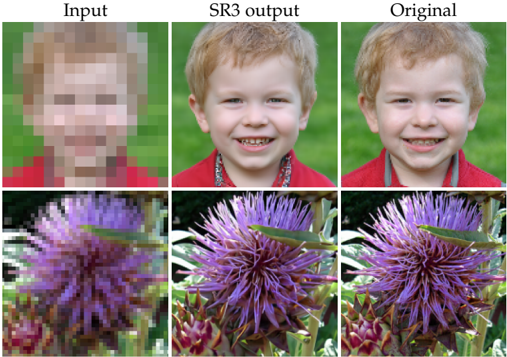
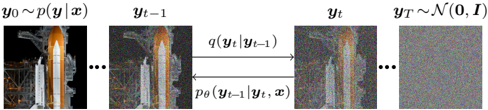
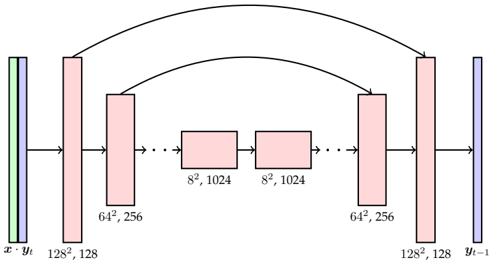
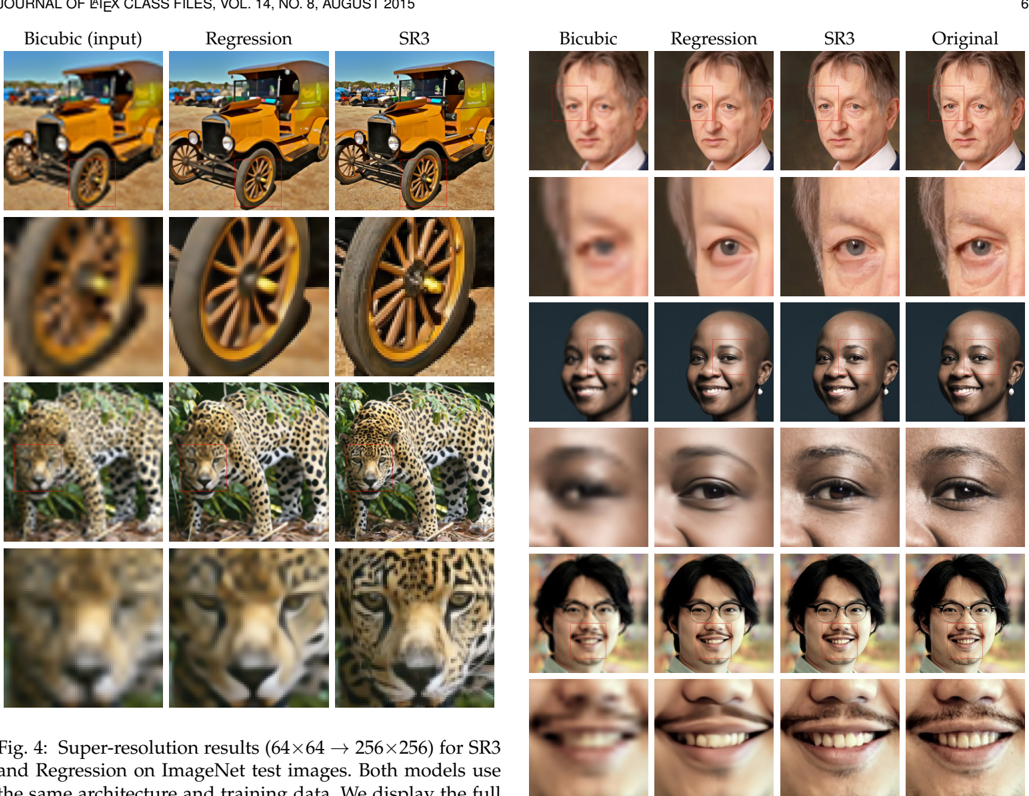
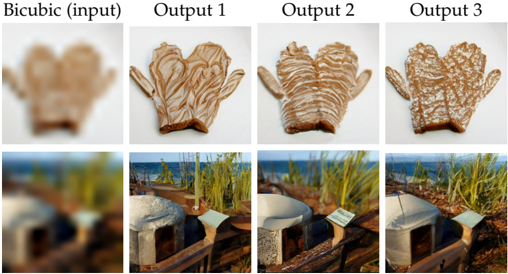
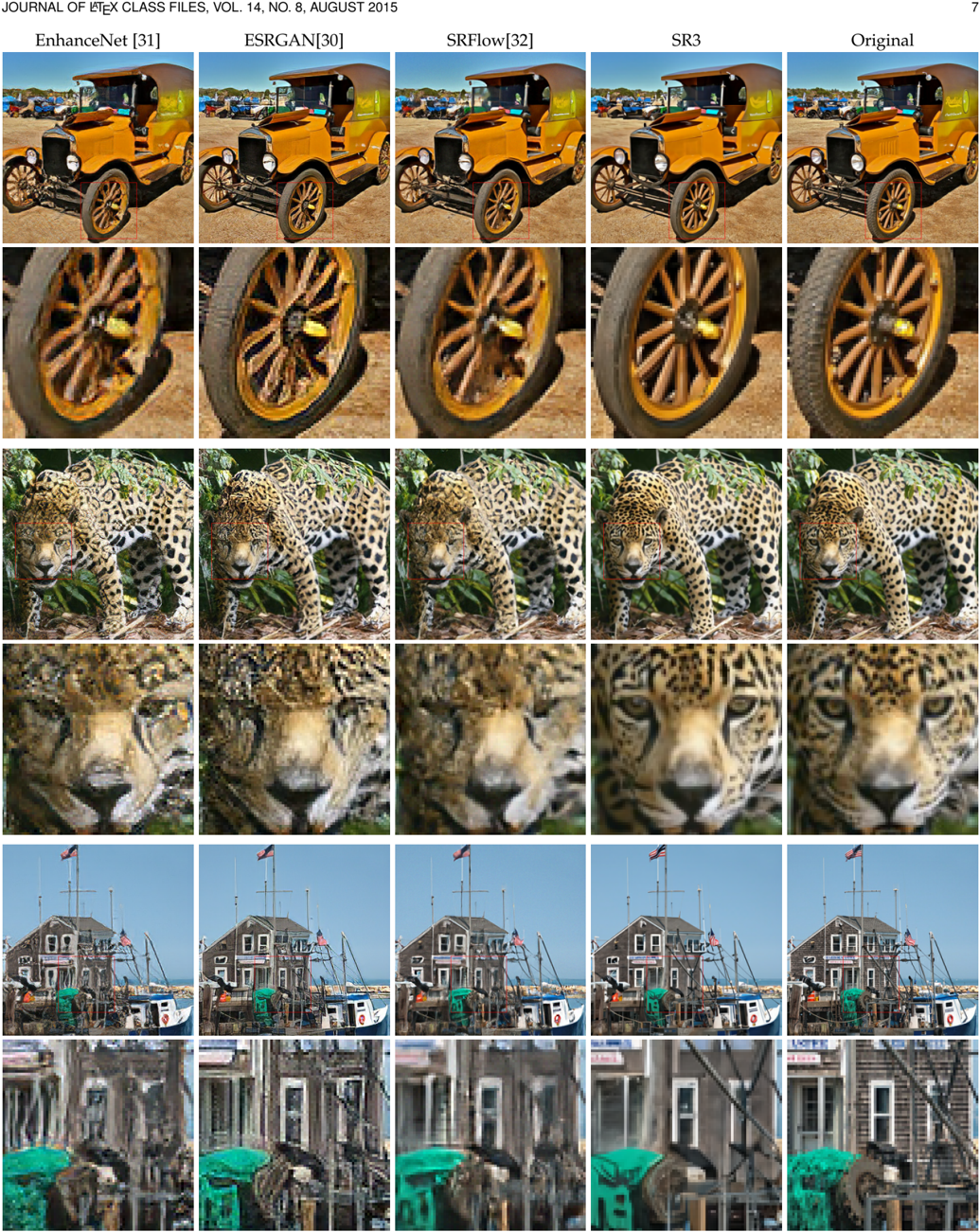
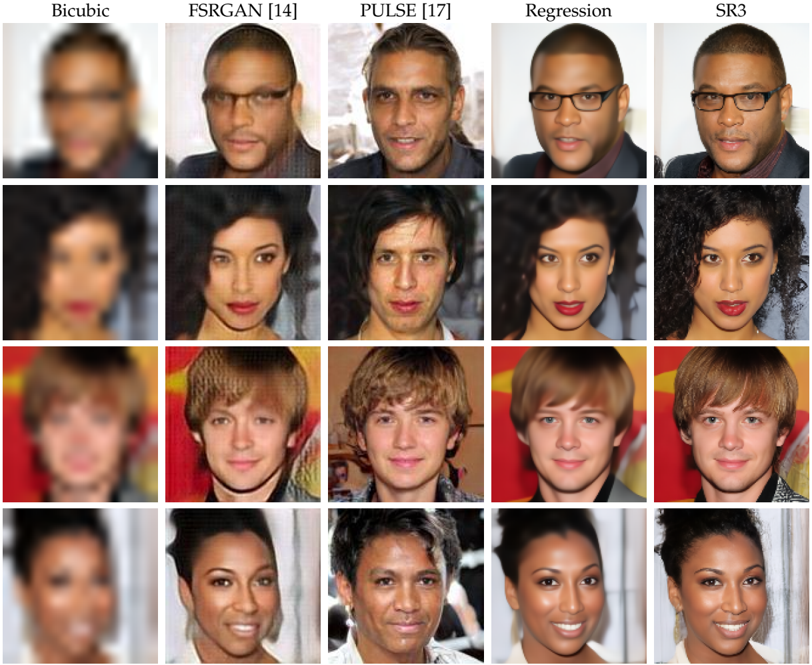
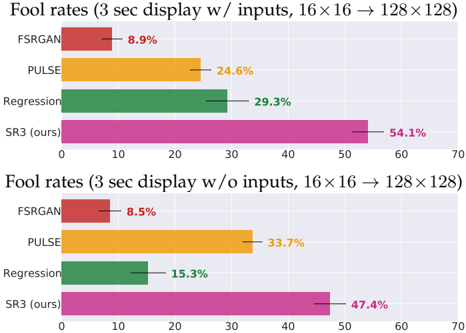
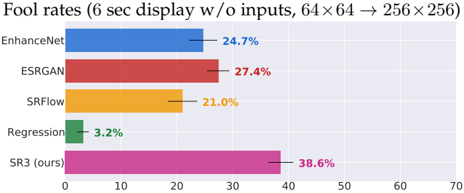
We present SR3, an approach to image Super-Resolution via Repeated Refinement. SR3 adapts denoising diffusion probabilistic models (Ho et al. 2020), (Sohl-Dickstein et al. 2015) to image-to-image translation, and performs super-resolution through a stochastic iterative denoising process. Output images are initialized with pure Gaussian noise and iteratively refined using a U-Net architecture that is trained on denoising at various noise levels, conditioned on a low-resolution input image. SR3 exhibits strong performance on super-resolution tasks at different magnification factors, on faces and natural images. We conduct human evaluation on a standard 8× face super-resolution task on CelebA-HQ for which SR3 achieves a fool rate close to 50%, suggesting photo-realistic outputs, while GAN baselines do not exceed a fool rate of 34%. We evaluate SR3 on a 4× super-resolution task on ImageNet, where SR3 outperforms baselines in human evaluation and classification accuracy of a ResNet-50 classifier trained on high-resolution images. We further show the effectiveness of SR3 in cascaded image generation, where a generative model is chained with super-resolution models to synthesize high-resolution images with competitive FID scores on the class-conditional 256×256 ImageNet generation challenge.
Overview
The claims and statistics of this paper haven’t been checked yet.
Free: it reads the open-access text and checks the first 5 claims that cite a source we can check. Create a free account to check every claim.
Integrity signals
Registry
Cites
Statistics
Figures




















Verification
Claims the paper makes
The claims and statistics of this paper haven’t been checked yet.
Free: it reads the open-access text and checks the first 5 claims that cite a source we can check. Create a free account to check every claim.
Claims other papers make about this one
Each is checked against this paper’s own text: does it say what the citing paper says it does?
The source backs part of the claim, not all of it — or backs it for a different population, condition or comparison.
In the citing paper
“Both the SR3 and CDM directly apply the diffusion process to input images, which leads to larger evaluation steps.”
From Diffusion Models: A Comprehensive Survey of Methods and Applications (2024) · cites this paper as [200]
Experimental — accuracy not yet measuredThe source backs part of the claim, not all of it — or backs it for a different population, condition or comparison.
In the citing paper
“Low-light face videos suffer from severe noise and detail loss, limiting their use in surveillance and photography applications.”
From Temporally consistent low-light face video enhancement via video-to-video conditional diffusion (2026) · cites this paper as [5]
Experimental — accuracy not yet measuredThe source backs part of the claim, not all of it — or backs it for a different population, condition or comparison.
In the citing paper
“This greatly improves FID on ImageNet 256×256, but does not reach the same performance as state-of-the-art models like BigGAN-deep [43, 53], as seen in Table 5.”
From Diffusion Models Beat GANs on Image Synthesis (2021) · cites this paper as [53]
Experimental — accuracy not yet measuredIn the citing paper
“Super-Resolution via Repeated Refinement (SR3) [200] uses DDPM to enable conditional image generation.”
From Diffusion Models: A Comprehensive Survey of Methods and Applications (2024) · cites this paper as [200]
In the citing paper
“SR3 conducts super-resolution through a stochastic, iterative denoising process.”
From Diffusion Models: A Comprehensive Survey of Methods and Applications (2024) · cites this paper as [200]
2 more claims about this paper
Create a free account to see every claim other papers make about this one.
Self-check
Percentages, sums and reported differences re-computed from the paper’s own numbers.
The self-check needs the paper’s full text.
Citations
Cites
Deep Residual Learning for Image Recognition
He, K., Zhang, X., Ren, S., & Sun, J. (2016) · 2016 IEEE Conference on Computer Vision and Pattern Recognition (CVPR) · doi:10.1109/cvpr.2016.90 · Cited by 235,474 · cited 1×
“Then, we report classification accuracy of a pre-trained ResNet50 [65] model.”
MethodVaswani, A., Shazeer, N., Parmar, N., Uszkoreit, J., Jones, L., Gomez, A. N., Kaiser, L., & Polosukhin, I. (2017) · arXiv · doi:10.48550/arxiv.1706.03762 · Cited by 120,404
U-Net: Convolutional Networks for Biomedical Image Segmentation
Ronneberger, O., Fischer, P., & Brox, T. (2015) · Lecture notes in computer science · doi:10.1007/978-3-319-24574-4_28 · Cited by 99,404
Exploiting Generative AI to Scale up Intelligent Tutoring Systems
Jakubův, J., Chvalovský, K., Goertzel, Z., Kaliszyk, C., Olšák, M., Piotrowski, B., Schulz, S., Suda, M., & Urban, J. (2023) · DROPS (Schloss Dagstuhl – Leibniz Center for Informatics) · doi:10.4230/lipics.itp.2023.19 · Cited by 76,658
Image quality assessment: from error visibility to structural similarity
Wang, Z., Bovik, A. C., Sheikh, H. R., & Simoncelli, E. P. (2004) · IEEE Transactions on Image Processing · doi:10.1109/tip.2003.819861 · Cited by 57,892 · cited 10×
“Table 2 shows the PSNR, SSIM [63] and Consistency scores for 16 16 !”
BackgroundInfluentialImageNet Large Scale Visual Recognition Challenge
Russakovsky, O., Deng, J., Su, H., Krause, J., Satheesh, S., Ma, S., Huang, Z., Karpathy, A., Khosla, A., Bernstein, M., et al. (2015) · International Journal of Computer Vision · doi:10.1007/s11263-015-0816-y · Cited by 39,380 · cited 2×
“on ImageNet 1K [62] and use the dev split for evaluation.”
BackgroundMethodAuto-Encoding Variational Bayes
Kingma, D. P., & Welling, M. (2013) · arXiv · doi:10.48550/arxiv.1312.6114 · Cited by 20,067 · cited 2×
“VAEs [7], [46] offer fast sampling, but tend to underperform GANs”
BackgroundGenerative adversarial networks
Goodfellow, I., Pouget-Abadie, J., Mirza, M., Xu, B., Warde-Farley, D., Ozair, S., Courville, A., & Bengio, Y. (2020) · Communications of the ACM · doi:10.1145/3422622 · Cited by 18,384
Sequence to Sequence Learning with Neural Networks
Sutskever, I., Vinyals, O., & Le, Q. V. (2014) · arXiv · doi:10.48550/arxiv.1409.3215 · Cited by 17,766
Photo-Realistic Single Image Super-Resolution Using a Generative Adversarial Network
Ledig, C., Theis, L., Huszar, F., Caballero, J., Cunningham, A., Acosta, A., Aitken, A., Tejani, A., Totz, J., Wang, Z., et al. (2017) · 2017 IEEE Conference on Computer Vision and Pattern Recognition (CVPR) · doi:10.1109/cvpr.2017.19 · Cited by 12,696
Research works printed but not linked: 2
- 11. I. J. Goodfellow, J. Pouget-Abadie, M. Mirza, B. Xu, D. Warde- Farley, S. Ozair, A. Courville, and Y. Bengio, "Generative Adver- sarial Networks," NIPS, 2014.
- 46. D. J. Rezende, S. Mohamed, and D. Wierstra, "Stochastic back- propagation and approximate inference in deep generative mod- els," in ICML, 2014, pp. 1278-1286.
Cited by
Items 701–800 of 1,005
Land-cover prior diffusion probabilistic model for remote sensing image super resolution
Zhang, Z., Shao, Z., Ma, J., Zhang, J., Wang, Y., Liao, Z., Cheng, G., Liu, J., Guo, M., & Wu, L. (2025) · Pattern Recognition · doi:10.1016/j.patcog.2025.112577 · Cited by 18
Guiding diffusion models to reconstruct flow fields from sparse data
Trepat, M. A., Medrano-Navarro, L., Liu, Q., Guastoni, L., & Thuerey, N. (2026) · Physics of Fluids · doi:10.1063/5.0304492 · Cited by 24
“A direct approach to achieve this goal is to give the low-resolution image as an input to the model, and train it to map the high-resolution counterpart 43,44 .”
AI-empowered super-resolution microscopy: a revolution in nanoscale cellular imaging
Li, S., Meng, X., Zhou, B., Tian, W., Chen, L., & Zhang, Y. (2025) · Nature Methods · doi:10.1038/s41592-025-02871-4 · Cited by 13
“16) model pioneered image super-resolution, incrementally reconstructing super-resolution images through its iterative noise reduction process (Fig.”
Superresolution Image Reconstruction: Selective milestones and open problems
Li, X., Dong, W., Wu, J., Li, L., & Shi, G. (2023) · IEEE Signal Processing Magazine · doi:10.1109/msp.2023.3271438 · Cited by 13
“(b) The latest advances achieve SR via U-Net-based iterative residue refinement using denoising diffusion probabilistic models [29].”
BackgroundMethodInfluentialFalahatnejad, S., Karami, A., & Nezamabadi–pour, H. (2023) · International Journal of Electrical Power & Energy Systems · doi:10.1016/j.ijepes.2023.109607 · Cited by 14
Restoration of Bone-Conducted Speech With U-Net-Like Model and Energy Distance Loss
Li, C., Yang, F., & Yang, J. J. (2023) · IEEE Signal Processing Letters · doi:10.1109/lsp.2023.3347149 · Cited by 13
Radar-SR3: A Weather Radar Image Super-Resolution Generation Model Based on SR3
Shi, Z., Geng, H., Wu, F., Geng, L., & Zhuang, X. (2023) · Atmosphere · doi:10.3390/atmos15010040 · Cited by 13
Exceeding the limit for microscopic image translation with a deep learning-based unified framework
Dai, W., Wong, I. H. M., & Wong, T. T. W. (2024) · PNAS Nexus · doi:10.1093/pnasnexus/pgae133 · Cited by 13
“Diffusion models, which are inspired by nonequilibrium thermodynamics (30), have recently demonstrated their superior results on various image processing tasks (31 – 35).”
BackgroundShan, W., Zhang, Y., Zhang, X., Wang, S., Zhou, X., Ma, S., & Gao, W. (2024) · IEEE Transactions on Circuits and Systems for Video Technology · doi:10.1109/tcsvt.2024.3415348 · Cited by 13
“Examples of DDPMs’ applications include SR3 [19] for super-resolution, DiffusionDet [20] for object detection, and Pix2Seq-D [21] for panoptic segmentation.”
DSR-Diff: Depth map super-resolution with diffusion model
Shi, Y. J., Cao, H., Xia, B., Zhu, R., Liao, Q., & Yang, W. (2024) · Pattern Recognition Letters · doi:10.1016/j.patrec.2024.06.025 · Cited by 15
Restoration by Generation with Constrained Priors
Ding, Z., Zhang, X., Tu, Z., & Xia, Z. (2024) · IEEE Computer Society Conference on Computer Vision and Pattern Recognition/Proceedings - IEEE Computer Society Conference on Computer Vision and Pattern Recognition/Proceedings · doi:10.1109/cvpr52733.2024.00248 · Cited by 23
“Typically, these image pairs are synthetically generated, depicting a single type of degradation, leading to task-specific models for denoising [13, 41, 49, 54, 56], deblurring [2, 24, 25, 48], or super-resolution [27, 37, 44].”
BackgroundAttention Guidance Distillation Network for Efficient Image Super-Resolution
Wang, H., Wei, Z., Tang, Q., Cheng, S., Wang, L., & Li, Y. (2024) · IEEE/CVF Conference on Computer Vision and Pattern Recognition Workshops (CVPRW) · doi:10.1109/cvprw63382.2024.00632 · Cited by 20
“Beginning from the early convolutional neural networks [7] and progressing through residual networks [13], to trans-former models [4] and diffusion models [26], the field of SR has witnessed a flourishing development.”
BackgroundMethodCross-sensor super-resolution of irregularly sampled Sentinel-2 time series
Okabayashi, A., Audebert, N., Donike, S., & Pelletier, C. (2024) · IEEE/CVF Conference on Computer Vision and Pattern Recognition Workshops (CVPRW) · doi:10.1109/cvprw63382.2024.00055 · Cited by 26
“Diffusion models are already very popular in SISR applied to synthetic data, such as the two DDPM models: SR3 [26] and SRDiff [19].”
BackgroundMethodInfluentialLi, Z., Lin, J., Wang, Y., Li, J., Cao, Y., Liu, X., Wan, W., Liu, Q., & Song, X. (2024) · Photoacoustics · doi:10.1016/j.pacs.2024.100670 · Cited by 13
Barth, A., Brajard, J., Azcarate, A. A., Mohamed, B., Troupin, C., & Beckers, J.-M. (2024) · Ocean science · doi:10.5194/os-20-1567-2024 · Cited by 17
“Denoising diffusion models have also been used for increasing the resolution (Saharia et al., 2021) and for in-painting.”
Li, W., Li, L., Peng, M., & Tao, R. (2025) · Remote Sensing · doi:10.3390/rs17010145 · Cited by 13
Demosaicking customized diffusion model for snapshot polarization imaging
Li, C., Luo, Y., Wu, C., Zhang, J., Yang, D., & Zhao, D. (2025) · Optics & Laser Technology · doi:10.1016/j.optlastec.2025.112868 · Cited by 17
Dynamic Attention-Guided Diffusion for Image Super-Resolution
Moser, B. B., Frolov, S., Raue, F., Palacio, S., & Dengel, A. (2025) · IEEE Winter Conference on Applications of Computer Vision · doi:10.1109/wacv61041.2025.00054 · Cited by 18
“Note that DiffBIR uses diffusion after an initial, regression-based predictor with only 50 sampling steps.”
InfluentialDLCR: A Generative Data Expansion Framework via Diffusion for Clothes-Changing Person Re-Id
Siddiqui, N., Croitoru, F.-A., Nayak, G. K., Ionescu, R. T., & Shah, M. (2025) · IEEE Winter Conference on Applications of Computer Vision · doi:10.1109/wacv61041.2025.00164 · Cited by 21
“On the other hand, diffusion models [33] have recently overtaken GANs in a multitude of other vision domains [5,8,39,40] as a superior class of generative models, yet have not been applied to the CC-ReID domain.”
Seismic denoising diffusion restoration model for seismic data processing
Li, K., Ma, J., Dou, Y., Zhao, Y., Yang, Z., & Li, Z. (2025) · Engineering Applications of Artificial Intelligence · doi:10.1016/j.engappai.2025.111068 · Cited by 13
Diffusion-Based Surrogate Modeling and Multi-Fidelity Calibration
Shi, N., Yan, H., Guo, S., & Kontar, R. A. (2025) · IEEE Transactions on Automation Science and Engineering · doi:10.1109/tase.2025.3582171 · Cited by 19
“We introduce the basics of DDMs, their conditional and constrained counterparts, the use of physics surrogates to enhance performance, and the embedding of physics knowledge into the di ff usion process to highlight our framework’s methodology and benefits.”
Diffusion-based Event Generation for High-Quality Image Deblurring
Xie, X., Zhang, Q., & Zheng, W. (2025) · IEEE Computer Society Conference on Computer Vision and Pattern Recognition/Proceedings - IEEE Computer Society Conference on Computer Vision and Pattern Recognition/Proceedings · doi:10.1109/cvpr52734.2025.00210 · Cited by 19
“Recently, diffusion models have demonstrated impressive performance in various low-level vision tasks including image/video deblurring [13, 26, 37, 51].”
Face Super-Resolution Using Stochastic Differential Equations
dos Santos, M., Laroca, R., Ribeiro, R. O., Neves, J. C., Proença, H. P. M. C., & Menotti, D. (2022) · SIBGRAPI Conference on Graphics, Patterns and Images (SIBGRAPI) · doi:10.1109/sibgrapi55357.2022.9991799 · Cited by 16
“This is in line with the regression model of [13], which provides blurry and less detailed images than SR3, but with better results for PSNR and SSIM.”
BackgroundResultInfluentialProgressive scene text erasing with self-supervision
Du, X., Zhou, Z., Zheng, Y., Wu, X., Ma, T., & Jin, C. (2023) · Computer Vision and Image Understanding · doi:10.1016/j.cviu.2023.103712 · Cited by 18
Bayesian Dumbbell Diffusion Model for RGBT Object Tracking With Enriched Priors
Fan, S., He, C., Wei, C., Zheng, Y., & Chen, X. (2023) · IEEE Signal Processing Letters · doi:10.1109/lsp.2023.3295758 · Cited by 13
“ᾱt = ∏t s=0 αs = ∏t s=0(1− βs) and βs represents the noise variance schedule [14].”
BackgroundMethodInfluentialDWA: Differential Wavelet Amplifier for Image Super-Resolution
Moser, B. B., Frolov, S., Raue, F., Palacio, S., & Dengel, A. R. (2023) · Lecture notes in computer science · doi:10.1007/978-3-031-44210-0_19 · Cited by 13
“Influenced by achievements on other CV tasks, recent research focused on trending approaches like Transformer-based networks [16,27,28], Denoising Diffusion Probabilistic Models [15,23,24] or Generative Adversarial Networks [29,30].”
BackgroundMethodA Multiscale Generalized Shrinkage Threshold Network for Image Blind Deblurring in Remote Sensing
Feng, Y., Yang, Y., Fan, X., Zhang, Z., & Zhang, J. (2024) · IEEE Transactions on Geoscience and Remote Sensing · doi:10.1109/tgrs.2024.3368760 · Cited by 15
“Saharia et al. [58] presented a super resolution through repeated refinement (SR3), adapted DDPM and used the stochastic and iterative denoising process to super resolution.”
MethodJung, Y., Park, E.-G., Jeong, S.-H., & Kim, J. H. (2024) · Aerospace · doi:10.3390/aerospace11070509 · Cited by 16
Impact of Raindrops on Camera-Based Detection in Software-Defined Vehicles
Luo, Y., Xu, D., Zhou, G., Sun, Y., & Lu, S. (2024) · IEEE International Conference on Mobility, Operations, Services and Technologies (MOST) · doi:10.1109/most60774.2024.00028 · Cited by 14
Perez-Torres, W. I., Uman-Flores, D. A., Quispe-Quispe, A. B., Palomino-Quispe, F., Bezerra, E. S., Leher, Q. O., Paixão, T., & Alvarez, A. B. (2024) · Sensors · doi:10.3390/s24165177 · Cited by 13
“Although diffusion models have been primarily used in image generation [41,42], as well as for inpainting problems [43,44], they have recently been used for semantic segmentation problems [45,46].”
MethodHui, M., Wei, Z., Zhu, H., Xia, F., & Zhou, Y. (2024) · IEEE Computer Society Conference on Computer Vision and Pattern Recognition/Proceedings - IEEE Computer Society Conference on Computer Vision and Pattern Recognition/Proceedings · doi:10.1109/cvpr52733.2024.01089 · Cited by 23
“Recent studies demonstrate the versatility of diffusion models in creating content guidance from a variety of sources, including images, text, depth, video, and their combinations [1, 11, 20, 29, 31, 33].”
BackgroundA ground-based dataset and diffusion model for on-orbit low-light image enhancement
Zhu, Y., Wang, L., Yuan, J., & Guo, Y. (2025) · Frontiers of Information Technology & Electronic Engineering · doi:10.1631/fitee.2400261 · Cited by 13
DiffusionCT: Latent Diffusion Model for CT Image StandardizationPreprint
Selim, M., Zhang, J., Brooks, M., Wang, G., & Chen, J. (2023) · PubMed Central · doi:10.48550/arxiv.2301.08815 · Cited by 18
Neural Diffusion ModelsPreprint
Bartosh, G., Vetrov, D., & Naesseth, C. A. (2023) · UvA-DARE (University of Amsterdam) · doi:10.48550/arxiv.2310.08337 · Cited by 13
“Despite success in various domains (Sohl-Dickstein et al., 2015; Ho et al., 2020; Saharia et al., 2021; Popov et al., 2021; Watson et al., 2022; Trippe et al., 2023), a key limitation of most existing diffusion models is that they rely on a fixed and pre-specified forward process that is unable to…”
BackgroundTerDiT: Ternary Diffusion Models with TransformersPreprint
Lu, X., Zhou, A., Lin, Z., Liu, Q., Xu, Y., Zhang, R., Yang, X., Yan, J., Gao, P., & Li, H. (2024) · arXiv (Cornell University) · doi:10.48550/arxiv.2405.14854 · Cited by 17
“DDPMs have been applied to a wide range of domains, including unconditional image generation [1], image inpainting [26], and image super-resolution [27].”
BackgroundConditional diffusion model-based generation of speckle patterns for digital image correlation
Wang, X., Yue, Q., & Liu, X. (2024) · Optics and Lasers in Engineering · doi:10.1016/j.optlaseng.2023.107997 · Cited by 13
Steered Diffusion: A Generalized Framework for Plug-and-Play Conditional Image Synthesis
Nair, N. G., Cherian, A., Lohit, S., Wang, Y., Koike–Akino, T., Patel, V. M., & Marks, T. K. (2023) · IEEE/CVF International Conference on Computer Vision (ICCV) · doi:10.1109/iccv51070.2023.01906 · Cited by 27
“, ImagGen [36], Stable Diffusion [34]) have demonstrated outstanding synthesis results in conditional generation tasks, such as textconditioned image synthesis [2,33] and image reconstruction [31, 35, 38].”
BackgroundA novel aspect of automatic vlog content creation using generative modeling approaches
Kumar, L., & Singh, D. K. (2024) · Digital Signal Processing · doi:10.1016/j.dsp.2024.104462 · Cited by 12
Patch-based Selection and Refinement for Early Object Detection
Zhang, T., Kasichainula, K., Zhuo, Y., Li, B., Seo, J.-S., & Cao, Y. (2024) · IEEE Winter Conference on Applications of Computer Vision · doi:10.1109/wacv57701.2024.00078 · Cited by 15
“For instance, Saharia et al . proposed SR3 [30], which demonstrates improved SR performance based on CDM. Similarly, Jonathan et al . introduced Cascaded Diffusion Models [14], which further advances the field of SR.”
BackgroundMethodInfluentialVerma, A., Badal, T., & Bansal, A. (2024) · Computer Vision and Image Understanding · doi:10.1016/j.cviu.2024.104077 · Cited by 12
Wang, X., Kontkanen, J., Curless, B., Seitz, S. M., Kemelmacher-Shlizerman, I., Mildenhall, B., Srinivasan, P. P., Verbin, D., & Holynski, A. (2024) · IEEE Computer Society Conference on Computer Vision and Pattern Recognition/Proceedings - IEEE Computer Society Conference on Computer Vision and Pattern Recognition/Proceedings · doi:10.1109/cvpr52733.2024.00685 · Cited by 22
“Existing text-to-image based super resolution models [1, 22] and outpainting models [1, 16, 20, 27] can be adapted to the zoom task as autoregressive processes, i.e ., by progressively outpaint-ing a zoomed-in image, or progressively super-resolving a zoomed-out image.”
Dong, S., Cai, Z., Hangel, G. J., Bogner, W., Widhalm, G., Huang, Y., Liang, Q., You, C., Kumaragamage, C., Fulbright, R. K., et al. (2024) · Medical Image Analysis · doi:10.1016/j.media.2024.103358 · Cited by 17
“Di ff usion models can be used to learn conditional image distributions for image-to-image translation tasks, such as image super-resolution (Saharia et al., 2022; Li et al., 2022a) and MRI reconstruction (Chung and Ye, 2022; Peng et al., 2022; Kazerouni et al., 2022).”
NExpR: Neural Explicit Representation for fast arbitrary-scale medical image super-resolution
Pang, K., Zhao, K., Hung, A. L. Y., Zheng, H., Yan, R., & Sung, K. (2024) · Computers in Biology and Medicine · doi:10.1016/j.compbiomed.2024.109354 · Cited by 12
FedSR: Federated Learning for Image Super-Resolution via detail-assisted contrastive learning
Yang, Y., Ren, X., & Ke, L. (2024) · Knowledge-Based Systems · doi:10.1016/j.knosys.2024.112778 · Cited by 12
SymSwin: Multi-Scale-Aware Super-Resolution of Remote Sensing Images Based on Swin Transformers
Jiao, D., Su, N., Yan, Y., Liang, Y., Feng, S., Zhao, C., & He, G. (2024) · Remote Sensing · doi:10.3390/rs16244734 · Cited by 12
“…traditional methods and algorithms based on deep learning-based models, such as convolutional neural networks (CNNs) [6,7] and transformers [8,9], while the second category primarily involves generative models, including generative adversarial networks (GANs) [10–12] and diffusion models [13,14].”
A mask guided cross data augmentation method for industrial defect detection
Wang, X., Li, W., & Lu, C. H. (2024) · Future Generation Computer Systems · doi:10.1016/j.future.2024.107676 · Cited by 13
Wahid, R. D. I., Yudistira, N., Dewi, C., Sari, I. N., Pradhikta, D., & Fatmawati, F. (2024) · IEEE Access · doi:10.1109/access.2024.3523494 · Cited by 15
A survey of super-resolution image quality assessment
Shu, L., Zhu, Q., He, Y., Chen, W., & Yan, J.-B. (2024) · Neurocomputing · doi:10.1016/j.neucom.2024.129279 · Cited by 14
He, X., Xu, G., Zhang, B., Chen, H., Cui, Y., & Guo, D. (2025) · Proceedings of the AAAI Conference on Artificial Intelligence · doi:10.1609/aaai.v39i3.32355 · Cited by 19
Augmentation framework for HVAC fault diagnosis based on denoising diffusion models
Zhang, X., Zhang, W., Wen, S., & Ding, Q. (2025) · Journal of Building Engineering · doi:10.1016/j.jobe.2025.112646 · Cited by 20
DATDM: Dynamic attention transformer diffusion model for underwater image enhancement
Hu, W., Chen, S., Luo, T., Zhang, L., Zhang, H., Liu, Z., Zhang, S., & Xu, J. (2025) · Alexandria Engineering Journal · doi:10.1016/j.aej.2025.04.078 · Cited by 13
PIDSR: Complementary Polarized Image Demosaicing and Super-Resolution
Zhou, S., Zhou, C., Lyu, Y., Guo, H., Ma, Z., Shi, B., & Sato, I. (2025) · IEEE Computer Society Conference on Computer Vision and Pattern Recognition/Proceedings - IEEE Computer Society Conference on Computer Vision and Pattern Recognition/Proceedings · doi:10.1109/cvpr52734.2025.01499 · Cited by 27
“Unlike the SR methods designed for conventional RGB images [3, 27, 29, 30] that focus solely on resolution enhancement, the methods designed for PISR aim to not only improve the resolution of multiple polarized images but also preserve polarization properties in them, making the task much more…”
Multi-level Priors-Guided Diffusion-based Remote Sensing Image Super-Resolution
Lu, L., Huang, Z., Bao, Y., Wan, L., & Li, Z. (2025) · ISPRS Journal of Photogrammetry and Remote Sensing · doi:10.1016/j.isprsjprs.2025.07.020 · Cited by 12
Conditional Diffusion Models: A Survey of Techniques, Applications, and Challenges
Panagiotakopoulos, T., Kotsiantis, S. B., Γκίλλας, Α., & Lalos, A. S. (2025) · IEEE Access · doi:10.1109/access.2025.3625094 · Cited by 14
“Later milestones include class/text-conditional denising and iterative refinement for restoration and super-resolution (e.g., SR3) [4] and modular conditioning mechanisms that extend text prompts with image prompts through lightweight adapters The associate editor coordinating the review of this…”
Consistency Trajectory Matching for One-Step Generative Super-Resolution
You, W., Zhang, M., Zhang, L., Zhou, X., Shi, K., & Gu, S. (2025) · IEEE/CVF International Conference on Computer Vision (ICCV) · doi:10.1109/iccv51701.2025.01184 · Cited by 24
“Our main contributions are summarized as follows: [16, 24, 25] condition the diffusion model on LR images and train it the same way as a conventional diffusion model.”
MambaX: Image Super-Resolution With State Predictive Control
Li, C., Hong, D., Zhang, B., Pan, Z., Yokoya, N., & Chanussot, J. (2026) · IEEE Transactions on Pattern Analysis and Machine Intelligence · doi:10.1109/tpami.2026.3721958 · Cited by 18
“See https://www.ieee.org/publications/rights/index.html for more information.”
GH-DDM: the generalized hybrid denoising diffusion model for medical image generation
Zhang, S., Liu, J., Hu, B., & Mao, Z. (2023) · Multimedia Systems · doi:10.1007/s00530-023-01059-0 · Cited by 16
“…models which as a new class of likelihood-base models have been shown the impressive ability to generate natural images with high validity [28–31], while offering desirable properties compared with GAN-based methods such as distribution coverage, a stationary training objective, and easy…”
BackgroundSong, Y., Li, J., Hu, Z., & Cheng, L. (2023) · IEEE Geoscience and Remote Sensing Letters · doi:10.1109/lgrs.2023.3266325 · Cited by 12
“Several methods make use of diffusion models for super-resolution tasks [8], [9].”
BackgroundMethodInfluentialDeep learning-based RGB-thermal image denoising: review and applications
Yu, Y., Lee, B. G., Pike, M., Zhang, Q., & Chung, W. (2023) · Multimedia Tools and Applications · doi:10.1007/s11042-023-15916-7 · Cited by 12
Look ATME: The Discriminator Mean Entropy Needs Attention
Solano‐Carrillo, E., Rodríguez, Á. B., Carrillo-Perez, B., Steiniger, Y., & Stoppe, J. (2023) · IEEE/CVF Conference on Computer Vision and Pattern Recognition Workshops (CVPRW) · doi:10.1109/cvprw59228.2023.00086 · Cited by 14
ColDBin: Cold Diffusion for Document Image Binarization
Saifullah, S., Agne, S., Dengel, A. R., & Ahmed, S. (2023) · Lecture notes in computer science · doi:10.1007/978-3-031-41734-4_13 · Cited by 14
Adv-BDPM: Adversarial attack based on Boundary Diffusion Probability Model
Zhang, D., & Dong, Y. (2023) · Neural Networks · doi:10.1016/j.neunet.2023.08.048 · Cited by 13
A Complete Recipe for Diffusion Generative Models
Pandey, K., & Mandt, S. (2023) · IEEE/CVF International Conference on Computer Vision (ICCV) · doi:10.1109/iccv51070.2023.00393 · Cited by 22
“…models [15, 50, 53, 56], there has been much recent progress in advancing un-conditional [7, 9, 18, 19, 36, 42, 46, 58] and conditional [4, 38, 42, 44, 56] diffusion models for a variety of downstream tasks like text-to-image synthesis [37, 40], image super-resolution [27, 44] and video…”
TCDM: Effective Large-Factor Image Super-Resolution via Texture Consistency Diffusion
Zhang, Y., Liu, H., Li, Z., Gao, X., Shi, G., & Jiang, J. (2024) · IEEE Transactions on Geoscience and Remote Sensing · doi:10.1109/tgrs.2024.3358913 · Cited by 17
“SR3 [23] generated factual images from LR images through repeated refinement, which interpolated conditional images in the UNet architecture of the DM. SR3 inspired many researchers and resulted in many extensions [48], [49].”
BackgroundMethodInfluentialDiffWA: Diffusion Models for Watermark Attack
Li, X. (2023) · International Conference on Integrated Intelligence and Communication Systems (ICIICS) · doi:10.1109/iciics59993.2023.10420918 · Cited by 20
“Also, guided diffusion models and conditional diffusion models were proposed by Dhariwal & Nichol [9] and Saharia et al. [10] to make the diffusion model generate images that meet certain requirements.”
MethodChen, Z., Han, X., & Ma, X. (2024) · IEEE Transactions on Geoscience and Remote Sensing · doi:10.1109/tgrs.2024.3423716 · Cited by 12
“8) Super-Resolution via Repeated Refinement (SR3) [52]: SR3 is a state-of-the-art SR model based on DDPMs.”
MethodLi, J., Wu, Q., Wang, Y., Zhou, S., Zhang, L., Wei, J. W., & Zhao, D. (2024) · Signal Image and Video Processing · doi:10.1007/s11760-024-03409-5 · Cited by 14
“The denoising diffusion probabilistic model (DDPM) [23, 24] has recently demonstrated exceptional performance in various tasks, including image coloring [25], super-resolution [26], inpainting [27], and image generation [28].”
DREAM: Diffusion Rectification and Estimation-Adaptive Models
Zhou, J., Ding, T., Chen, T., Jiang, J., Zharkov, I., Zhu, Z., & Liang, L. (2024) · IEEE Computer Society Conference on Computer Vision and Pattern Recognition/Proceedings - IEEE Computer Society Conference on Computer Vision and Pattern Recognition/Proceedings · doi:10.1109/cvpr52733.2024.00797 · Cited by 21
“We present the findings in Figure 3a, where both MSE and LPIPS exhibit a decline with a smaller t , as expected, since the network can reconstruct more accurate HR signal from less noisy input.”
BackgroundMethodResultInfluentialEEGCiD: EEG Condensation Into Diffusion Model
Chen, J., Pi, D., Jiang, X., Gao, F., Bi, W., & Chen, Y. (2024) · IEEE Transactions on Automation Science and Engineering · doi:10.1109/tase.2024.3486203 · Cited by 14
“They are notably advantageous in handling a multitude of intricate visual tasks, including image drawing [24], image editing [18], [19], image fusion [25] and image super resolution [26].”
Generative adversarial models for extreme geospatial downscaling
Li, G., & Cao, G. (2025) · International Journal of Applied Earth Observation and Geoinformation · doi:10.1016/j.jag.2025.104541 · Cited by 16
“The SR3 (Saharia et al., 2022) method employs denoising diffusion probabilistic models (DDPM) (Ho et al., 2020) to perform image super-resolution through a stochastic iterative denoising process.”
Improving multi-focus image fusion through Noisy image and feature difference network
Pan, X., Zhai, H., Yang, Y.-F., Chen, L., & Li, A. (2023) · Image and Vision Computing · doi:10.1016/j.imavis.2023.104891 · Cited by 14
Grounded-Instruct-Pix2Pix: Improving Instruction Based Image Editing with Automatic Target Grounding
Shagidanov, A., Poghosyan, H., Gong, X., Wang, Z., Navasardyan, S., & Shi, H. (2024) · IEEE International Conference on Acoustics Speech and Signal Processing · doi:10.1109/icassp48485.2024.10446377 · Cited by 17
“This consequently led to a plethora of scientific research that made significant advancements in related downstream tasks such as image editing[5, 3], inpainting[14], super-resolution[15] and even segmentation[16].”
BackgroundChen, C., Wang, Y., Zhang, Y., Zhao, Z., & Feng, H. (2024) · IEEE Transactions on Geoscience and Remote Sensing · doi:10.1109/tgrs.2024.3388531 · Cited by 13
“Although the development of natural image SR technology based on DL has entered a relatively mature stage [19], [20], [21], [22], the methods for HSIs are still very limited.”
BackgroundColor and Luminance Separated Enhancement for Low-Light Images with Brightness Guidance
Zhang, F. S., Liu, X., Gao, C., & Sang, N. (2024) · Sensors · doi:10.3390/s24092711 · Cited by 13
“Conditional diffusion models are commonly used in image enhancement [13,71,72].”
Single-sample image-fusion upsampling of fluorescence lifetime images
Kapitány, V., Fatima, A., Žičkus, V., Whitelaw, J., McGhee, E. J., Insall, R. H., Machesky, L. M., & Faccio, D. (2024) · Science Advances · doi:10.1126/sciadv.adn0139 · Cited by 11
“However, learning-based schemes traditionally need large, diverse training datasets, which can pose a bottleneck in niche fields like FLIM; further, different fluorophores behave differently, hampering generalisation in traditional machine learning methods [51].”
BackgroundLD-CSNet: A latent diffusion-based architecture for perceptual Compressed Sensing
Zheng, B., Sun, G., Dong, L., & Wang, S. (2024) · Neural Networks · doi:10.1016/j.neunet.2024.106541 · Cited by 12
Region gradient-guided diffusion model for underwater image enhancement
Shao, J., Zhang, H., & Miao, J. (2025) · Machine Vision and Applications · doi:10.1007/s00138-024-01647-8 · Cited by 11
“Recent advancements in diffusion models have witnessed a paradigm shift towards the adoption of CNN-based U-Net architectures, as exemplified by frameworks such as SR3 [ 40] and guided diffusion [41 ].”
Small aerial object detection through GAN-integrated feature pyramid networks
Ahmad, U., Liang, J., Ma, T., Yu, K., Mehmood, F., & Banoori, F. (2025) · Applied Soft Computing · doi:10.1016/j.asoc.2025.112834 · Cited by 13
DiffusionClusNet: Deep Clustering-Driven Diffusion Models for Ultrasound Image Enhancement
Chen, N., Zhang, Y., Fan, C., Zhao, W., Wang, C., & Wang, H. (2025) · IEEE Transactions on Consumer Electronics · doi:10.1109/tce.2025.3540502 · Cited by 11
Adaptive prompt guided unified image restoration with latent diffusion model
Lv, X., Shao, M., Wan, Y., Qiao, Y., & Wang, C. (2025) · Engineering Applications of Artificial Intelligence · doi:10.1016/j.engappai.2025.110267 · Cited by 13
Pan, C., Jiang, Q., Zheng, H., Wang, P., Jin, X., Yao, S., & Zhou, W. (2025) · IEEE Transactions on Instrumentation and Measurement · doi:10.1109/tim.2025.3548806 · Cited by 21
“It is modeled after the U-Net architecture employed in SR3, as referenced in [39].”
DX2CT: Diffusion Model for 3D CT Reconstruction from Bi or Mono-planar 2D X-ray(s)
Jeong, Y. S., Yoo, H. B., & Chun, I. Y. (2025) · IEEE International Conference on Acoustics Speech and Signal Processing · doi:10.1109/icassp49660.2025.10888986 · Cited by 18
DiffSR: Learning Radar Reflectivity Synthesis via Diffusion Model from Satellite Observations
He, X., Zhou, Z., Zhang, W., Zhao, X., Chen, H., Chen, S., & Bai, L. (2025) · IEEE International Conference on Acoustics Speech and Signal Processing · doi:10.1109/icassp49660.2025.10888161 · Cited by 18
“Inspired by [27], [30], we use a conditional denoising diffusion model in the second stage to reconstruct composite radar reflectivity.”
Denoising Diffusion Models for High-Resolution Microscopy Image Restoration
Osuna-Vargas, P., Wehrheim, M. H., Zinz, L., Rahm, J. V., Balakrishnan, A., Kaminer, A., Heilemann, M., & Kaschube, M. (2025) · IEEE Winter Conference on Applications of Computer Vision · doi:10.1109/wacv61041.2025.00424 · Cited by 18
Variational Bayes Image Restoration With Compressive Autoencoders
Biquard, M., Chabert, M., Genin, F., Latry, C., & Oberlin, T. (2025) · IEEE Transactions on Image Processing · doi:10.1109/tip.2025.3564829 · Cited by 11
“As a second contribution, we introduce the Variational Bayes Latent Estimation (VBLE) algorithm, which performs latent estimation within the framework of variational inference.”
InfluentialA Comprehensive Review of Image Restoration Research Based on Diffusion Models
Li, J., Wang, H., Li, Y., & Zhang, H. (2025) · Mathematics · doi:10.3390/math13132079 · Cited by 20
Research on Cross-Sensor Remote Sensing Image Super-Resolution Method Based on Diffusion Models
Miao, R., Yang, K., Zhou, K., Song, J., Fu, S., Liu, C., & Wang, Y. (2025) · IEEE Journal of Selected Topics in Applied Earth Observations and Remote Sensing · doi:10.1109/jstars.2025.3590687 · Cited by 12
CacheQuant: Comprehensively Accelerated Diffusion Models
Liu, X., Li, Z., & Gu, Q. (2025) · IEEE Computer Society Conference on Computer Vision and Pattern Recognition/Proceedings - IEEE Computer Society Conference on Computer Vision and Pattern Recognition/Proceedings · doi:10.1109/cvpr52734.2025.02167 · Cited by 26
“Numerous compelling applications have been implemented with diffusion models, including but not limited to image editing [2, 20, 46], image enhancing [10, 24, 61], image-to-image translation [5, 59, 71], text-to-image generation [51, 56, 60, 80] and text-to-3D generation [34, 43, 55].”
DiET-GS: Diffusion Prior and Event Stream-Assisted Motion Deblurring 3D Gaussian Splatting
Lee, S., & Lee, G. H. (2025) · IEEE Computer Society Conference on Computer Vision and Pattern Recognition/Proceedings - IEEE Computer Society Conference on Computer Vision and Pattern Recognition/Proceedings · doi:10.1109/cvpr52734.2025.02025 · Cited by 24
“Diffusion models have been successfully repurposed for image restoration tasks such as super-resolution (SR) [8, 22, 44, 53, 57, 62], deblurring [5, 39, 56] and JPEG restoration [13, 43].”
DAP-LED: Learning Degradation-Aware Priors with Clip for Joint Low-Light Enhancement and Deblurring
Wang, L., Wu, C., & Wang, L. (2025) · Proceedings - IEEE International Conference on Robotics and Automation/Proceedings · doi:10.1109/icra55743.2025.11128232 · Cited by 11
Structure-Guided Diffusion Transformer for Low-Light Image Enhancement
Yin, X., Yu, Z., Jiang, L., Gao, X., Sun, X. N., Liu, Z., & Yang, X. (2025) · IEEE Transactions on Multimedia · doi:10.1109/tmm.2025.3613117 · Cited by 17
Meng, F., Wu, S., Zhang, L., Jing, H., Chen, Y., Yan, Y., Feng, T., Liu, R., & Du, Z. (2025) · IEEE Journal of Selected Topics in Applied Earth Observations and Remote Sensing · doi:10.1109/jstars.2025.3645789 · Cited by 13
United Filter for Jointly Estimating State and Parameters of Stochastic Dynamical Systems
Bao, F., Zhang, Z., & Zhang, G. (2026) · Communications in Computational Physics · doi:10.4208/cicp.oa-2024-0009 · Cited by 13
Ghost-Free HDR Imaging via Latent Low-Frequency Priors and Deformable Attention Alignment
Hu, T., Yan, Q., Jin, J., Dong, W., Wu, P., Qi, Y., Lin, W., & Zhang, Y. (2026) · IEEE Transactions on Image Processing · doi:10.1109/tip.2026.3671656 · Cited by 12
A Deep‐Learning Approach for Low‐Spatial‐Coherence Imaging in Computer‐Generated Holography
Tong, X., Xu, R., Liu, K., Zhao, L., Zhu, W., & Zhao, D. (2022) · Advanced Photonics Research · doi:10.1002/adpr.202200264 · Cited by 11
Song, W. G., Ma, W., Ma, Y., Zhao, X., & Lin, G. (2022) · The Astrophysical Journal Supplement Series · doi:10.3847/1538-4365/ac9a4d · Cited by 11
DiracDiffusion: Denoising and Incremental Reconstruction with Assured Data-Consistency
Fabian, Z., Tınaz, B., & Soltanolkotabi, M. (2023) · PubMed · doi:10.48550/arxiv.2303.14353 · Cited by 19
“The unconditional score function learned by diffusion models has been successfully leveraged to solve inverse problems without any task-specific training [22, 21, 39].”
BackgroundFew-Shot Depth Completion Using Denoising Diffusion Probabilistic Model
Ran, W., Yuan, W., & Shibasaki, R. (2023) · IEEE/CVF Conference on Computer Vision and Pattern Recognition Workshops (CVPRW) · doi:10.1109/cvprw59228.2023.00697 · Cited by 11
“This kind of model has been proven powerful in many computer vision tasks, including image segmentation [2], change detection [1], and image super-resolution [26].”
MethodAtmospheric Turbulence Correction via Variational Deep Diffusion
Wang, X., López-Tapia, S., & Katsaggelos, A. K. (2023) · IEEE International Conference on Multimedia Information Processing and Retrieval (MIPR) · doi:10.1109/mipr59079.2023.00022 · Cited by 11
Li, Y., Xu, Q., Kong, Z., & Li, W. (2023) · IEEE Transactions on Geoscience and Remote Sensing · doi:10.1109/tgrs.2023.3326613 · Cited by 13
“Additionally, many researchers have made many efforts in the field of image preprocessing, including image enhancement [14], [15], [16], image super-resolution [17], [18], image super-pixels [19], and others.”
Background
Metadata
- Authors
- Saharia, C., Ho, J., Chan, W., Salimans, T., Fleet, D. J., & Norouzi, M.
- Affiliations
- Google (United States) (US)
- Venue
- IEEE Transactions on Pattern Analysis and Machine Intelligence
- Published
- 2022
- Volume
- 45
- Issue
- 4
- Pages
- 1-14
- ISSN
- 0162-8828 (ISSN-L)
- 2160-9292
- 1939-3539
- OpenAlex
- W3155072588
- Cited by
- 1,829
- References
- 85
- Citations by year
- 2026: 234 · 2025: 580 · 2024: 662 · 2023: 301 · 2022: 40
- FWCI
- 129.48
- Type
- journal article
- Language
- en
- Open access
- hybrid
- doi.org
- Locations
- IEEE Transactions on Pattern Analysis and Machine Intelligence (publishedVersion, cc-by)
- PubMed (publishedVersion)
- arXiv (Cornell University) (submittedVersion)
- arXiv (Cornell University)
- Topics
- Physical Sciences › Computer Science › Computer Vision and Pattern Recognition › Advanced Image Processing Techniques
- Physical Sciences › Computer Science › Computer Vision and Pattern Recognition › Generative Adversarial Networks and Image Synthesis
- Physical Sciences › Computer Science › Computer Vision and Pattern Recognition › Image and Signal Denoising Methods
- Keywords
- image super-resolution, iterative refinement, denoising diffusion probabilistic models, image-to-image translation, U-Net, face super-resolution, high-resolution image generation, human evaluation, image classification accuracy
About these checks
Registry, retraction, Cites and statistics results are computed, not judged, with one exception: a printed reference that no index lists is read once by a model before it counts as a citation error. Claims are extracted by a model and kept only when their quote appears verbatim in the text; each cited source is then checked, with a model’s help, for whether it says what the claim relies on. Those verdicts can be wrong — read the claim’s quote and the cited source before relying on one.
Statistics and arithmetic are recomputed, not judged.
Confidence bands are shown only for fields calibrated on our annotated test set. None is calibrated yet, so no band is shown.
What counts as a claim ›How we measure confidence ›How we check this ›
Are you an author, or do you see a problem with this page? Request a review
Data sources
Bibliographic data: Semantic Scholar, OpenAlex, Crossref.
Contains information from the Semantic Scholar Academic Graph Datasets, made available under the ODC Attribution License (ODC-BY 1.0).
Semantic Scholar’s data is described in: Kinney, R., et al. (2023). The Semantic Scholar Open Data Platform. arXiv:2301.10140.
