

Image Super-Resolution Via Iterative Refinement
Open accessThe DOI matches its Crossref record; 81 of the 85 references it cites were found in a registry or an index.
Abstract
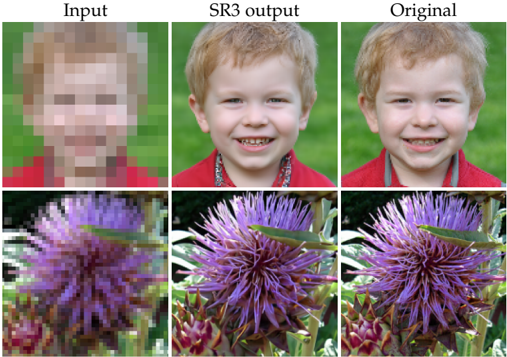
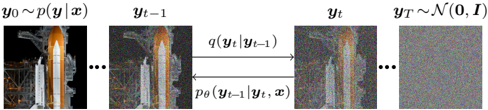
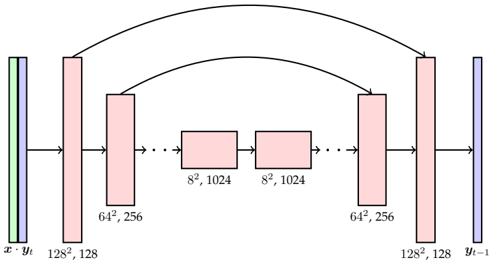
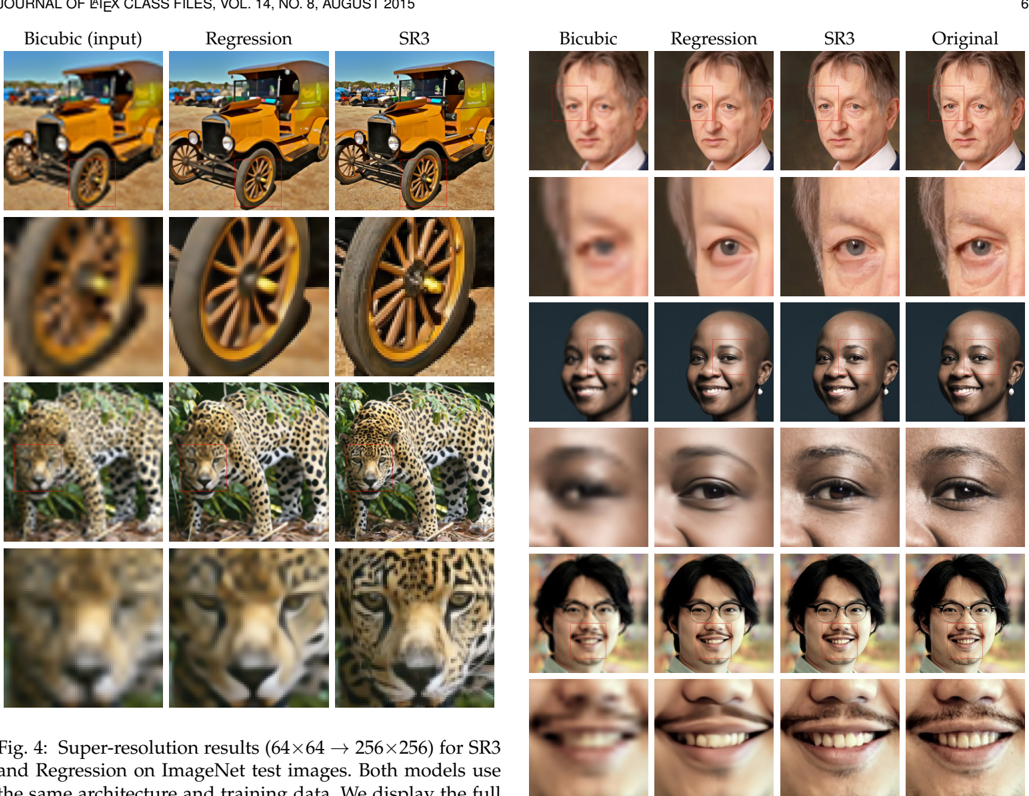
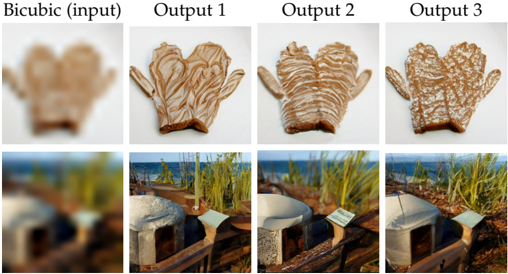
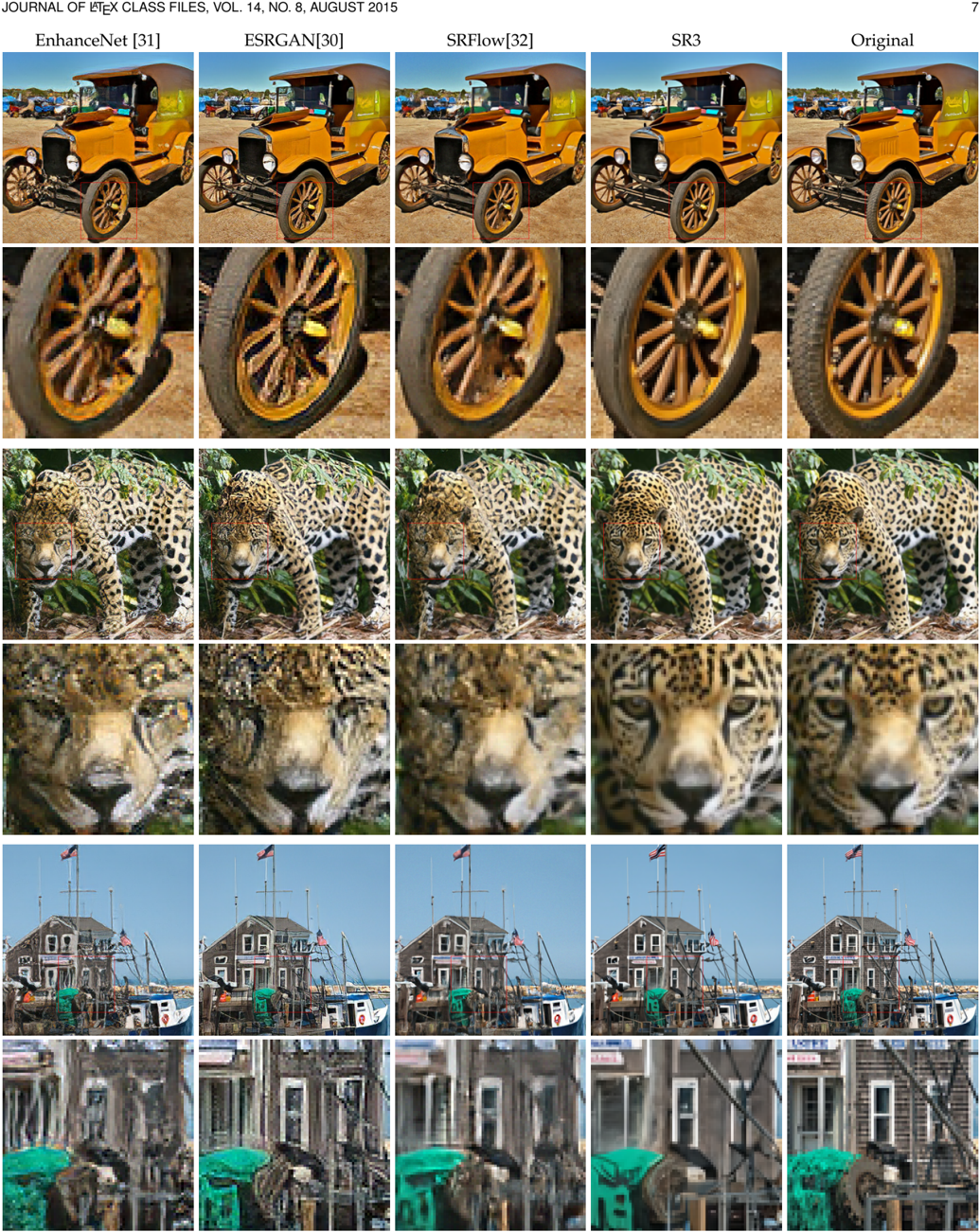
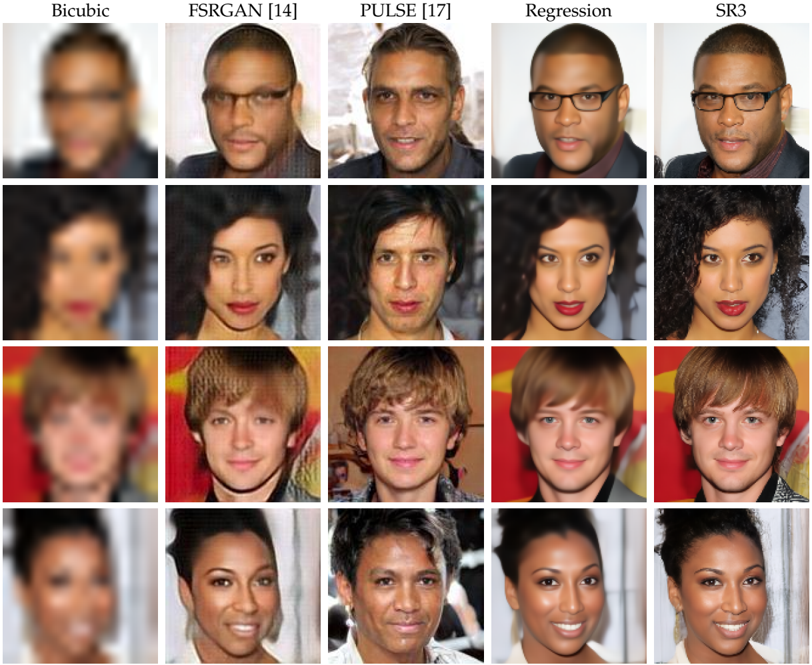
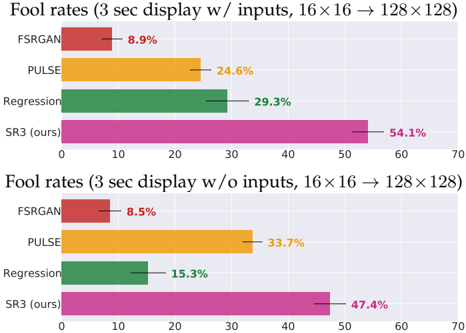
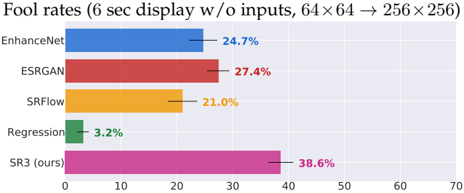
We present SR3, an approach to image Super-Resolution via Repeated Refinement. SR3 adapts denoising diffusion probabilistic models (Ho et al. 2020), (Sohl-Dickstein et al. 2015) to image-to-image translation, and performs super-resolution through a stochastic iterative denoising process. Output images are initialized with pure Gaussian noise and iteratively refined using a U-Net architecture that is trained on denoising at various noise levels, conditioned on a low-resolution input image. SR3 exhibits strong performance on super-resolution tasks at different magnification factors, on faces and natural images. We conduct human evaluation on a standard 8× face super-resolution task on CelebA-HQ for which SR3 achieves a fool rate close to 50%, suggesting photo-realistic outputs, while GAN baselines do not exceed a fool rate of 34%. We evaluate SR3 on a 4× super-resolution task on ImageNet, where SR3 outperforms baselines in human evaluation and classification accuracy of a ResNet-50 classifier trained on high-resolution images. We further show the effectiveness of SR3 in cascaded image generation, where a generative model is chained with super-resolution models to synthesize high-resolution images with competitive FID scores on the class-conditional 256×256 ImageNet generation challenge.
Overview
The claims and statistics of this paper haven’t been checked yet.
Free: it reads the open-access text and checks the first 5 claims that cite a source we can check. Create a free account to check every claim.
Integrity signals
Registry
Cites
Statistics
Figures




















Verification
Claims the paper makes
The claims and statistics of this paper haven’t been checked yet.
Free: it reads the open-access text and checks the first 5 claims that cite a source we can check. Create a free account to check every claim.
Claims other papers make about this one
Each is checked against this paper’s own text: does it say what the citing paper says it does?
The source backs part of the claim, not all of it — or backs it for a different population, condition or comparison.
In the citing paper
“Both the SR3 and CDM directly apply the diffusion process to input images, which leads to larger evaluation steps.”
From Diffusion Models: A Comprehensive Survey of Methods and Applications (2024) · cites this paper as [200]
Experimental — accuracy not yet measuredThe source backs part of the claim, not all of it — or backs it for a different population, condition or comparison.
In the citing paper
“Low-light face videos suffer from severe noise and detail loss, limiting their use in surveillance and photography applications.”
From Temporally consistent low-light face video enhancement via video-to-video conditional diffusion (2026) · cites this paper as [5]
Experimental — accuracy not yet measuredThe source backs part of the claim, not all of it — or backs it for a different population, condition or comparison.
In the citing paper
“This greatly improves FID on ImageNet 256×256, but does not reach the same performance as state-of-the-art models like BigGAN-deep [43, 53], as seen in Table 5.”
From Diffusion Models Beat GANs on Image Synthesis (2021) · cites this paper as [53]
Experimental — accuracy not yet measuredIn the citing paper
“Super-Resolution via Repeated Refinement (SR3) [200] uses DDPM to enable conditional image generation.”
From Diffusion Models: A Comprehensive Survey of Methods and Applications (2024) · cites this paper as [200]
In the citing paper
“SR3 conducts super-resolution through a stochastic, iterative denoising process.”
From Diffusion Models: A Comprehensive Survey of Methods and Applications (2024) · cites this paper as [200]
2 more claims about this paper
Create a free account to see every claim other papers make about this one.
Self-check
Percentages, sums and reported differences re-computed from the paper’s own numbers.
The self-check needs the paper’s full text.
Citations
Cites
Deep Residual Learning for Image Recognition
He, K., Zhang, X., Ren, S., & Sun, J. (2016) · 2016 IEEE Conference on Computer Vision and Pattern Recognition (CVPR) · doi:10.1109/cvpr.2016.90 · Cited by 235,474 · cited 1×
“Then, we report classification accuracy of a pre-trained ResNet50 [65] model.”
MethodVaswani, A., Shazeer, N., Parmar, N., Uszkoreit, J., Jones, L., Gomez, A. N., Kaiser, L., & Polosukhin, I. (2017) · arXiv · doi:10.48550/arxiv.1706.03762 · Cited by 120,404
U-Net: Convolutional Networks for Biomedical Image Segmentation
Ronneberger, O., Fischer, P., & Brox, T. (2015) · Lecture notes in computer science · doi:10.1007/978-3-319-24574-4_28 · Cited by 99,404
Exploiting Generative AI to Scale up Intelligent Tutoring Systems
Jakubův, J., Chvalovský, K., Goertzel, Z., Kaliszyk, C., Olšák, M., Piotrowski, B., Schulz, S., Suda, M., & Urban, J. (2023) · DROPS (Schloss Dagstuhl – Leibniz Center for Informatics) · doi:10.4230/lipics.itp.2023.19 · Cited by 76,658
Image quality assessment: from error visibility to structural similarity
Wang, Z., Bovik, A. C., Sheikh, H. R., & Simoncelli, E. P. (2004) · IEEE Transactions on Image Processing · doi:10.1109/tip.2003.819861 · Cited by 57,892 · cited 10×
“Table 2 shows the PSNR, SSIM [63] and Consistency scores for 16 16 !”
BackgroundInfluentialImageNet Large Scale Visual Recognition Challenge
Russakovsky, O., Deng, J., Su, H., Krause, J., Satheesh, S., Ma, S., Huang, Z., Karpathy, A., Khosla, A., Bernstein, M., et al. (2015) · International Journal of Computer Vision · doi:10.1007/s11263-015-0816-y · Cited by 39,380 · cited 2×
“on ImageNet 1K [62] and use the dev split for evaluation.”
BackgroundMethodAuto-Encoding Variational Bayes
Kingma, D. P., & Welling, M. (2013) · arXiv · doi:10.48550/arxiv.1312.6114 · Cited by 20,067 · cited 2×
“VAEs [7], [46] offer fast sampling, but tend to underperform GANs”
BackgroundGenerative adversarial networks
Goodfellow, I., Pouget-Abadie, J., Mirza, M., Xu, B., Warde-Farley, D., Ozair, S., Courville, A., & Bengio, Y. (2020) · Communications of the ACM · doi:10.1145/3422622 · Cited by 18,384
Sequence to Sequence Learning with Neural Networks
Sutskever, I., Vinyals, O., & Le, Q. V. (2014) · arXiv · doi:10.48550/arxiv.1409.3215 · Cited by 17,766
Photo-Realistic Single Image Super-Resolution Using a Generative Adversarial Network
Ledig, C., Theis, L., Huszar, F., Caballero, J., Cunningham, A., Acosta, A., Aitken, A., Tejani, A., Totz, J., Wang, Z., et al. (2017) · 2017 IEEE Conference on Computer Vision and Pattern Recognition (CVPR) · doi:10.1109/cvpr.2017.19 · Cited by 12,696
Research works printed but not linked: 2
- 11. I. J. Goodfellow, J. Pouget-Abadie, M. Mirza, B. Xu, D. Warde- Farley, S. Ozair, A. Courville, and Y. Bengio, "Generative Adver- sarial Networks," NIPS, 2014.
- 46. D. J. Rezende, S. Mohamed, and D. Wierstra, "Stochastic back- propagation and approximate inference in deep generative mod- els," in ICML, 2014, pp. 1278-1286.
Cited by
Items 501–600 of 1,005
Ocean Satellite Data Fusion for High-Resolution Surface Current Maps
Kugusheva, A., Bull, H., Moschos, E., Ioannou, A., Vu, B. L., & Stegner, A. (2024) · Remote Sensing · doi:10.3390/rs16071182 · Cited by 24
Park, C., Palakonda, V., Yun, S., Kim, I., & Kang, J. (2024) · IEEE Internet of Things Journal · doi:10.1109/jiot.2024.3390700 · Cited by 23
Generating Urban Road Networks with Conditional Diffusion Models
Gu, X., Zhang, M., Lyu, J., & Ge, Q. (2024) · ISPRS International Journal of Geo-Information · doi:10.3390/ijgi13060203 · Cited by 27
PSC diffusion: patch-based simplified conditional diffusion model for low-light image enhancement
Wan, F., Xu, B., Pan, W., & Liu, H. (2024) · Multimedia Systems · doi:10.1007/s00530-024-01391-z · Cited by 25
“(7):”
Superresolution emulation of large cosmological fields with a 3D conditional diffusion model
Rouhiainen, A., Münchmeyer, M., Shiu, G., Gira, M., & Lee, K. (2024) · Physical review. D/Physical review. D. · doi:10.1103/physrevd.109.123536 · Cited by 26
“First row in First column First plane’s first plane first plane main volume”
BackgroundDiffBlender: Composable and versatile multimodal text-to-image diffusion models
Kim, S., Lee, J., Hong, K., Kim, D., & Ahn, N. (2025) · Expert Systems with Applications · doi:10.1016/j.eswa.2025.129345 · Cited by 28
Wasserstein Patch Prior for Image Superresolution
Hertrich, J., Houdard, A., & Redenbach, C. (2022) · IEEE Transactions on Computational Imaging · doi:10.1109/tci.2022.3199600 · Cited by 30
Du, Y., Zhao, Z., Su, S., Golluri, S., Zheng, H., Yao, R., & Wang, C. (2025) · IEEE Computer Society Conference on Computer Vision and Pattern Recognition/Proceedings - IEEE Computer Society Conference on Computer Vision and Pattern Recognition/Proceedings · doi:10.1109/cvpr52734.2025.01580 · Cited by 39
“The diffusion model, as evidenced by several studies [33, 49, 55], has shown significant capabilities in image synthesis, prompting its application in 3D point cloud challenges.”
Curriculum Direct Preference Optimization for Diffusion and Consistency Models
Croitoru, F.-A., Hondru, V., Ionescu, R. T., Sebe, N., & Shah, M. (2025) · IEEE Computer Society Conference on Computer Vision and Pattern Recognition/Proceedings - IEEE Computer Society Conference on Computer Vision and Pattern Recognition/Proceedings · doi:10.1109/cvpr52734.2025.00269 · Cited by 51
“…from the usage of various modalities for guidance ( e.g . text [3, 17, 49, 52], image [5, 39, 53] or specific class [8, 21, 56]) to the application in many visual tasks, such as inpainting [35, 42] and super-resolution [12, 55], as well as different domains, such as medical imaging [10, 76].”
Latent Space Super-Resolution for Higher-Resolution Image Generation with Diffusion Models
Jeong, J., Han, S., Kim, J., & Kim, S. J. (2025) · IEEE Computer Society Conference on Computer Vision and Pattern Recognition/Proceedings - IEEE Computer Society Conference on Computer Vision and Pattern Recognition/Proceedings · doi:10.1109/cvpr52734.2025.00225 · Cited by 43
“Latent Diffusion Models (LDMs) [40] further revolutionized the field by reducing computational costs through operating in a lower-dimensional latent space.”
Humayun, A. I., Balestriero, R., & Baraniuk, R. G. (2022) · IEEE Computer Society Conference on Computer Vision and Pattern Recognition/Proceedings - IEEE Computer Society Conference on Computer Vision and Pattern Recognition/Proceedings · doi:10.1109/cvpr52688.2022.01038 · Cited by 33
Learning to Schedule in Diffusion Probabilistic Models
Wang, Y., Wang, X., Dinh, A.-D., Du, B., & Xu, C. (2023) · ACM SIGKDD Conference on Knowledge Discovery and Data Mining (KDD) · doi:10.1145/3580305.3599412 · Cited by 45
“Diffusion models have been effectively employed in a diverse range of generative modeling tasks, including image generation [11, 35, 37, 42], image super-resolution [21, 44], image-to-image translation [43, 67] and image purification [65].”
BackgroundDiffusionVID: Denoising Object Boxes With Spatio–Temporal Conditioning for Video Object Detection
Roh, S.-D., & Chung, K. (2023) · IEEE Access · doi:10.1109/access.2023.3328341 · Cited by 25
“Recently, diffusion models have been applied to various vision domains [12], [13], [20], [21], [22], [23], [24], [25], [26], [27], [28], [29].”
BackgroundMethodDownscaled Representation Matters: Improving Image Rescaling with Collaborative Downscaled Images
Xu, B., Guo, Y. X., Jiang, L., Yu, M., & Chen, J. (2023) · IEEE/CVF International Conference on Computer Vision (ICCV) · doi:10.1109/iccv51070.2023.01124 · Cited by 29
“Interestingly, unlike super-resolution (SR) [3, 43, 54] methods that consider a fixed downscaling kernel, e.”
BackgroundYou, J., Huang, Y. M., Ouyang, L., Zhang, X., Chen, P., Wu, X., Jin, Z., Shen, H., Zhang, L., Chen, Q., et al. (2024) · EClinicalMedicine · doi:10.1016/j.eclinm.2024.102499 · Cited by 22
Efficient Conditional Diffusion Model with Probability Flow Sampling for Image Super-resolution
Yuan, Y., & Yuan, C. (2024) · Proceedings of the AAAI Conference on Artificial Intelligence · doi:10.1609/aaai.v38i7.28511 · Cited by 27
Sui, J., Wu, Q., & Pun, M.-O. (2024) · Remote Sensing · doi:10.3390/rs16071219 · Cited by 23
Air target intent recognition method combining graphing time series and diffusion models
Chenghai, L. I., Wang, K., Song, Y., Wang, P., & Li, L. (2024) · Chinese Journal of Aeronautics · doi:10.1016/j.cja.2024.08.008 · Cited by 22
One-Shot Structure-Aware Stylized Image Synthesis
Cho, H., Lee, J., Chang, S., & Jeong, Y. (2024) · IEEE Computer Society Conference on Computer Vision and Pattern Recognition/Proceedings - IEEE Computer Society Conference on Computer Vision and Pattern Recognition/Proceedings · doi:10.1109/cvpr52733.2024.00793 · Cited by 36
“Recently, diffusion models (DMs) have shown remarkable performance in various image-related tasks, including high-fidelity image generation [28, 29], super resolution [30], and text-driven image manipulation [15, 17, 19].”
BackgroundAccDiffusion: An Accurate Method for Higher-Resolution Image Generation
Lin, Z., Lin, M., Zhao, M. Y., & Ji, R. (2024) · Lecture notes in computer science · doi:10.1007/978-3-031-72658-3_3 · Cited by 44
PEAN: A Diffusion-Based Prior-Enhanced Attention Network for Scene Text Image Super-Resolution
Zhao, Z., Xue, H., Fang, P., & Zhu, S. (2024) · ACM International Conference on Multimedia (ACM MM) · doi:10.1145/3664647.3680974 · Cited by 32
“Then we present the proposed Text Prior Enhancement Module (TPEM), Attention-based Modulation Module (AMM) and the Multi-Task Learning (MTL) paradigm.”
Charkaoui, A., & Ben-Loghfyry, A. (2024) · Nonlinear Analysis Real World Applications · doi:10.1016/j.nonrwa.2024.104259 · Cited by 23
Shi, Z., Fan, J., Du, Y., Zhou, Y., & Zhang, Y. (2024) · Remote Sensing · doi:10.3390/rs16234573 · Cited by 21
Unraveling the Smoothness Properties of Diffusion Models: A Gaussian Mixture Perspective
Liang, Y., Sha, Z., Shi, Z., Song, Z., Wan, M., & Zhou, Y. (2025) · IEEE/CVF International Conference on Computer Vision (ICCV) · doi:10.1109/iccv51701.2025.01064 · Cited by 27
“Diffusion models have been applied to various domains beyond image generation, achieving impressive results, e.g., text-to-image synthesis [12], audio synthesis [33], image super-resolution [51], and so on.”
Unlimited-Size Diffusion Restoration
Wang, Y., Yu, J., Yu, R., & Zhang, J. (2023) · IEEE/CVF Conference on Computer Vision and Pattern Recognition Workshops (CVPRW) · doi:10.1109/cvprw59228.2023.00123 · Cited by 31
“Recent progress in diffusion models [26, 28, 10, 24, 8, 2] has enlightened a lot works in solving Image Restoration (IR) tasks [33, 4, 27, 13, 12, 17, 25, 6, 7, 5, 23, 21, 34].”
BackgroundMethodConditional Simulation Using Diffusion Schrödinger BridgesPreprint
Shi, Y., Bortoli, V. D., Deligiannidis, G., & Arnaud Doucet, B. (2022) · arXiv (Cornell University) · doi:10.48550/arxiv.2202.13460 · Cited by 51
Decoder Denoising Pretraining for Semantic Segmentation
Asiedu, E. B., Kornblith, S., Chen, T., Parmar, N., Minderer, M., & Norouzi, M. (2022) · Transactions on machine learning research · doi:10.48550/arxiv.2205.11423 · Cited by 25
“We then propose several modifications of the standard formulation that are motivated by the recent success of diffusion models in image generation (Ho et al., 2020; Nichol & Dhariwal, 2021; Saharia et al., 2021b).”
BackgroundMethodResultSelf-citationOFTSR: One-Step Flow for Image Super-Resolution with Tunable Fidelity-Realism Trade-offsPreprint
Zhu, Y., Wang, R., Lu, S., Li, J., Yan, H., & Zhang, K. (2024) · arXiv (Cornell University) · doi:10.48550/arxiv.2412.09465 · Cited by 23
“On the other hand, training-based methods directly model the conditional probability using paired data, either by training from scratch [10, 48] or by incorporating additional control modules [29, 61, 73] into existing generative priors [46].”
Chen, Z., Sun, H., Zhang, L., & Zhang, F. (2024) · IEEE Journal on Emerging and Selected Topics in Circuits and Systems · doi:10.1109/jetcas.2024.3403524 · Cited by 22
“DDPMs have also inspired super-resolution approaches such as SR3 (Super-Resolution via Repeated Refinement) [229] and SRDiff [230].”
MethodDiffuX2CT: Diffusion Learning to Reconstruct CT Images from Biplanar X-Rays
Liu, X., Qiao, Z., Liu, R., Li, H., Zhang, J., Zhen, X., Qian, Z., & Zhang, B. (2024) · Lecture notes in computer science · doi:10.1007/978-3-031-72775-7_26 · Cited by 32
Efficient End-to-End Diffusion Model for One-Step SAR-to-Optical Translation
Qin, J., Zou, B., Li, H., & Zhang, L. (2024) · IEEE Geoscience and Remote Sensing Letters · doi:10.1109/lgrs.2024.3506566 · Cited by 34
“So far, the majority of research on S2O translation is based on conditional generative adversarial networks (GANs) [4], [5], [6] and conditional diffusion models (DMs) [7], [8].”
Gu, L., Xu, J., Ke, D., Deng, Y., Hua, X., & Yu, Y. (2024) · Sustainability · doi:10.3390/su162410936 · Cited by 20
Shan, H., Vimieiro, R. D. B., Borges, L. R. A. P., Vieira, M. A. C., & Wang, G. (2023) · Artificial Intelligence in Medicine · doi:10.1016/j.artmed.2023.102555 · Cited by 20
DiffPhase: Generative Diffusion-Based STFT Phase Retrieval
Peer, T., Welker, S., & Gerkmann, T. (2023) · IEEE International Conference on Acoustics Speech and Signal Processing · doi:10.1109/icassp49357.2023.10095396 · Cited by 26
“Diffusion-based generative models are a recent innovation that has already been shown to be very effective on various computer vision tasks, including inpainting [11], super-resolution [12], text-toimage mapping [13] and more [14].”
BackgroundCyber Vaccine for Deepfake Immunity
Chang, C., Nguyen, H. H., Yamagishi, J., & Echizen, I. (2023) · IEEE Access · doi:10.1109/access.2023.3311461 · Cited by 26
“…and neutraliser, we use the U-Net as the backbone architecture and apply a state-of-the-art version by OpenAI with residual connection and multi-head attention mechanisms [67], which has been widely used as a diffusion probabilistic model for various computer vision tasks [68], [69], [70].”
MethodEvent-Diffusion: Event-Based Image Reconstruction and Restoration with Diffusion Models
Liang, Q., Zheng, X., Huang, K., Zhang, Y., Chen, J., & Tian, Y. (2023) · ACM International Conference on Multimedia (ACM MM) · doi:10.1145/3581783.3612462 · Cited by 30
“Our denoise model is mainly inspired by SR3 [40], the overall framework and the size of each layer are depicted in Figure 2.”
BackgroundMethodInfluentialControllable Inversion of Black-Box Face Recognition Models via Diffusion
Kansy, M., Raël, A., Mignone, G., Naruniec, J., Schroers, C., Groß, M. H., & Weber, R. M. (2023) · IEEE International Conference on Computer Vision Workshops · doi:10.1109/iccvw60793.2023.00341 · Cited by 34
“A number of approaches for solving inverse problems in a more general setting using conditional [57, 55] ditional [26, 30, 62, 6, 7, 20, 5, 8, 3, 41, 63] exist; however, they mostly focus on image-to-image tasks such as inpainting and super-resolution whereas we focus on a vector-to-image task.”
BackgroundDOVE: Doodled vessel enhancement for photoacoustic angiography super resolution
Ma, Y., Zhou, W., Ma, R., Wang, E., Yang, S., Tang, Y., Zhang, X.-P. S., & Guan, X. (2024) · Medical Image Analysis · doi:10.1016/j.media.2024.103106 · Cited by 21
IRDM: A Generative Diffusion Model for Indoor Radio Map Interpolation
Qiu, K., Bakirtzis, S., Wassell, I. J., Song, H., Lin, K., & Zhang, J. (2023) · Globecom · doi:10.1109/globecom54140.2023.10436970 · Cited by 27
“To achieve this, we employ a conditional diffusion model known as the radio diffusion model (RDM), which is adapted from the SR3 model proposed by Saharia et al. [18] for image super-resolution.”
BackgroundMethodRecognition-Guided Diffusion Model for Scene Text Image Super-Resolution
Zhou, Y., Gao, L., Tang, Z., & Wei, B. (2024) · IEEE International Conference on Acoustics Speech and Signal Processing · doi:10.1109/icassp48485.2024.10447585 · Cited by 30
“Diffusion models have emerged as the fore-front of generative models recently, not only achieving SOTA performance in general SISR tasks[8, 9], but also exhibiting notable power in integrating cross-modal information in large text-to-image diffusion models such as GLIDE [10] and Imagen [11].”
BackgroundTrade-Offs in Fine-Tuned Diffusion Models between Accuracy and Interpretability
Dombrowski, M., Reynaud, H., Müller, J. P., Baugh, M., & Kainz, B. (2024) · Proceedings of the AAAI Conference on Artificial Intelligence · doi:10.1609/aaai.v38i19.30095 · Cited by 24
“Additionally, since their recent popularization by Ho, Jain, and Abbeel (2020), diffusion models have propelled the performance of generative models (Dhariwal and Nichol 2021; Saharia et al. 2021, 2022).”
BackgroundFSRDiff: A fast diffusion-based super-resolution method using GAN
Tang, N., Zhang, D., Gao, J., & Qu, Y. (2024) · Journal of Visual Communication and Image Representation · doi:10.1016/j.jvcir.2024.104164 · Cited by 24
Diffusion Illusions: Hiding Images in Plain Sight
Burgert, R., Li, X., Leite, A., Ranasinghe, K., & Ryoo, M. S. (2024) · ACM SIGGRAPH Conference (SIGGRAPH) · doi:10.1145/3641519.3657500 · Cited by 33
Gao, Y., Qiu, R. L. J., Xie, H., Chang, C., Wang, T., Ghavidel, B. B., Roper, J. R., Zhou, J., & Yang, X. (2024) · Physics in Medicine and Biology · doi:10.1088/1361-6560/ad67a1 · Cited by 21
Empower Generalizability for Pansharpening Through Text-Modulated Diffusion Model
Xing, Y., Qu, L., Zhang, S., Feng, J., Zhang, X., & Zhang, Y. (2024) · IEEE Transactions on Geoscience and Remote Sensing · doi:10.1109/tgrs.2024.3434431 · Cited by 29
“Our model builds upon the conditional denoising DPM [6].”
BackgroundMethodDeep Equilibrium Diffusion Restoration with Parallel Sampling
Cao, J., Shi, Y., Zhang, K., Zhang, Y., Timofte, R., & Gool, L. V. (2024) · IEEE Computer Society Conference on Computer Vision and Pattern Recognition/Proceedings - IEEE Computer Society Conference on Computer Vision and Pattern Recognition/Proceedings · doi:10.1109/cvpr52733.2024.00273 · Cited by 39
“The supervised methods aim to train a conditional diffusion model in the image space [54, 55, 65, 74] or the latent space [45, 53, 58, 67].”
MethodDiffInDScene: Diffusion-Based High-Quality 3D Indoor Scene Generation
Ju, X., Huang, Z., Li, Y., Zhang, G., Qiao, Y., & Li, H. (2024) · IEEE Computer Society Conference on Computer Vision and Pattern Recognition/Proceedings - IEEE Computer Society Conference on Computer Vision and Pattern Recognition/Proceedings · doi:10.1109/cvpr52733.2024.00433 · Cited by 42
“They have shown impressive visual quality in diverse applications of 2D image synthesis, encompassing image inpainting [21], super-resolution [13, 34], editing [23], text-to-image synthesis [25, 33], and video generation [12, 14].”
BackgroundUncertainty-Aware Source-Free Adaptive Image Super-Resolution with Wavelet Augmentation Transformer
Ai, Y., Zhou, X., Huang, H., Zhang, L., & He, R. (2024) · IEEE Computer Society Conference on Computer Vision and Pattern Recognition/Proceedings - IEEE Computer Society Conference on Computer Vision and Pattern Recognition/Proceedings · doi:10.1109/cvpr52733.2024.00778 · Cited by 28
“Some other works [1, 11, 28, 43, 44, 54] adopted diffusion models [20] to generate highly realistic images for image restoration.”
Text-Guided Explorable Image Super-Resolution
Gandikota, K. V., & Chandramouli, P. (2024) · IEEE Computer Society Conference on Computer Vision and Pattern Recognition/Proceedings - IEEE Computer Society Conference on Computer Vision and Pattern Recognition/Proceedings · doi:10.1109/cvpr52733.2024.02447 · Cited by 29
“…Image Super-resolution One could utilize diffusion models for image super-resolution and other restoration tasks either by training a conditional diffusion model for specific tasks [42, 69, 82, 88], or by leveraging diffusion models for zero-shot image recovery [9– 11, 29, 34, 37, 38, 48, 56, 81].”
MethodWan, F., Xu, B., Yao, J., Zeng, L., Pan, W., & Liu, H. (2024) · IET Image Processing · doi:10.1049/ipr2.13259 · Cited by 22
SSP-IR: Semantic and Structure Priors for Diffusion-Based Realistic Image Restoration
Zhang, Y., Zhang, H., Cheng, Z., Xie, R., Song, L., & Zhang, W. (2025) · IEEE Transactions on Circuits and Systems for Video Technology · doi:10.1109/tcsvt.2025.3538772 · Cited by 26
Taming diffusion models for image restoration: a review
Luo, Z., Gustafsson, F. K., Zhao, Z. M., Sjölund, J., & Schön, T. B. (2025) · Philosophical Transactions of the Royal Society A Mathematical Physical and Engineering Sciences · doi:10.1098/rsta.2024.0358 · Cited by 33
“As a result, the generated image can be of very high visual quality (it looks re‑ alistic), but often has limited consistency with the original HQ image [16], as can be observed for the examples in the right‑hand part of figure 4.”
Unsupervised Learning of Intrinsic Semantics With Diffusion Model for Person Re-Identification
Tao, X., Kong, J., Jiang, M., Lu, M., & Mian, A. S. (2024) · IEEE Transactions on Image Processing · doi:10.1109/tip.2024.3514360 · Cited by 19
“Diffusion models are generative models that can produce realistic and diverse images from random noise [31], [32].”
Gai, J., Chen, H. M., Wang, Z., Zhou, H., Zhao, W., Lane, N. D., & Fan, H. (2025) · Asia and South Pacific Design Automation Conference (ASP-DAC) · doi:10.1145/3658617.3697616 · Cited by 36
“In the field of Generative AI (GenAI), significant strides have been made in producing complex and creative content across various domains such as text [4], image [2, 22], and video [33].”
Efficient High-Frequency Texture Recovery Diffusion Model for Remote Sensing Image Super-Resolution
Weng, W.-D., Zheng, C.-W., Su, J.-N., Chen, G., & Gan, M. (2025) · IEEE Transactions on Instrumentation and Measurement · doi:10.1109/tim.2025.3556898 · Cited by 21
“In recent years, DMs have garnered increasing attention in the task of image SR. SR3 [38] was pioneering in using LR images as input conditions for DMs, directly reconstructing corresponding HR images from Gaussian noise.”
ORSIDiff: Diffusion Model for Salient Object Detection in Optical Remote Sensing Images
Han, J., Sun, J., Wang, F., Sun, F., & Li, H. (2025) · IEEE Transactions on Geoscience and Remote Sensing · doi:10.1109/tgrs.2025.3579272 · Cited by 27
“In recent years, DM [25], [26] has emerged as a powerful class of deep generative models, achieving SOTA performance across various domains, including images [27], [28], videos [29], [30], [31], and audio [32].”
OSCAR: One-Step Diffusion Codec Across Multiple Bit-rates
Guo, J., Ji, Y., Chen, Z., Liu, K., Liu, M., Rao, W., Li, W., Guo, Y., & Zhang, Y. (2025) · neural information processing systems · doi:10.52202/085713-2857 · Cited by 34
Arbitrary Style Guidance for Enhanced Diffusion-Based Text-to-Image Generation
Pan, Z., Zhou, X., & Tian, H. (2023) · IEEE Winter Conference on Applications of Computer Vision · doi:10.1109/wacv56688.2023.00444 · Cited by 27
“For the most popular image generation task, it has been utilized in a broad range of applications, including image-to-image translation [45, 1], image super-resolution [47, 56], image editing [33] and image inpainting [31, 44].”
BackgroundUnite and Conquer: Plug & Play Multi-Modal Synthesis Using Diffusion Models
Nair, N. G., Bandara, W. G. C., & Patel, V. M. (2023) · IEEE Computer Society Conference on Computer Vision and Pattern Recognition/Proceedings - IEEE Computer Society Conference on Computer Vision and Pattern Recognition/Proceedings · doi:10.1109/cvpr52729.2023.00588 · Cited by 34
“In regular conditional denoising diffusion models [30], the input image (i.”
BackgroundBuilding Bridge Across the Time: Disruption and Restoration of Murals In the Wild
Shao, H., Xu, Q., Wen, P., Gao, P., Yang, Z., & Huang, Q. (2023) · IEEE/CVF International Conference on Computer Vision (ICCV) · doi:10.1109/iccv51070.2023.01853 · Cited by 24
Modality Cycles with Masked Conditional Diffusion for Unsupervised Anomaly Segmentation in MRI
Liang, Z., Anthony, H., Wagner, F., & Kamnitsas, K. (2023) · Lecture Notes in Computer Science · doi:10.1007/978-3-031-47425-5_16 · Cited by 18
Diffusion Generative Model-Based Learning for Smart Layer-Wise Monitoring of Additive Manufacturing
Yangue, E., Fullington, D., Smith, O., Tian, W., & Liu, C. (2024) · Journal of Computing and Information Science in Engineering · doi:10.1115/1.4065092 · Cited by 21
Low-Light Face Super-resolution via Illumination, Structure, and Texture Associated Representation
Wang, C., Jiang, J., Jiang, K., & Liu, X. (2024) · Proceedings of the AAAI Conference on Artificial Intelligence · doi:10.1609/aaai.v38i6.28339 · Cited by 22
“Towards the DENet, the backbone is UNet and other settings follow (Saharia et al. 2021).”
BackgroundSphereDiffusion: Spherical Geometry-Aware Distortion Resilient Diffusion Model
Wu, T., Li, X., Qi, Z., Hu, D., Wang, X., Shan, Y., & Xi, L. (2024) · Proceedings of the AAAI Conference on Artificial Intelligence · doi:10.1609/aaai.v38i6.28429 · Cited by 31
Diffusion Model With Gradient Descent Module Guiding Reconstruction for Single-Pixel Imaging
Huang, C., Yan, Q., Yan, J., Li, Y., Luo, X., & Wang, H. (2024) · IEEE photonics journal · doi:10.1109/jphot.2024.3434972 · Cited by 19
Leng, H., Gao, Y., & Zhou, Y. (2024) · Journal of Building Engineering · doi:10.1016/j.jobe.2024.111373 · Cited by 29
Deep Equilibrium Approaches to Diffusion Models
Pokle, A., Geng, Z., & Kolter, J. Z. (2022) · neural information processing systems · doi:10.52202/068431-2752 · Cited by 59
Entropy-Driven Sampling and Training Scheme for Conditional Diffusion Generation
Zheng, G., Li, S., Wang, H., Yao, T., Chen, Y., Ding, S., & Li, X. (2022) · Lecture notes in computer science · doi:10.1007/978-3-031-20047-2_43 · Cited by 34
Spatial Downscaling of Sea Surface Temperature Using Diffusion Model
Wang, S., Li, X., Zhu, X., Li, J., & Guo, S. (2024) · Remote Sensing · doi:10.3390/rs16203843 · Cited by 21
A Super-Resolution Diffusion Model for Recovering Bone Microstructure from CT Images
Chan, T. J., & Rajapakse, C. S. (2023) · Radiology Artificial Intelligence · doi:10.1148/ryai.220251 · Cited by 23
Incomplete multi-view clustering via diffusion completion
Fang, S., Yang, Z., & Chen, J. (2023) · Multimedia Tools and Applications · doi:10.1007/s11042-023-17669-9 · Cited by 20
“In recent years, diffusion models [21], [22], [23] have achieved success in many fields of generation, such as image synthesis [24], [25], audio synthesis [26], [27], text-to-image translation [28], [29], image super-resolution [30], [31], etc.”
A diffusion probabilistic model for traditional Chinese landscape painting super-resolution
Lyu, Q., Zhao, N., Yang, Y., Gong, Y., & Gao, J. (2024) · Heritage Science · doi:10.1186/s40494-023-01123-y · Cited by 19
“Saharia et al. [16] proposed a repeated refinement image super-resolution diffusion model, which achieves high-quality image super-resolution effects through an iterative refinement process.”
BackgroundA generic plug & play diffusion-based denosing module for medical image segmentation
Li, G., Jin, D., Zheng, Y., Cui, J., Gai, W., & Qi, M. (2024) · Neural Networks · doi:10.1016/j.neunet.2024.106096 · Cited by 19
DiffusionEMIS: Diffusion Model for 3-D Electromagnetic Inverse Scattering
Bi, X., Chen, Y., & Li, L. (2024) · IEEE Transactions on Geoscience and Remote Sensing · doi:10.1109/tgrs.2024.3349681 · Cited by 21
“…great success in extensive generation tasks [36], [40], [41], [42], [43], [44], [45], [46], [47], [48] and start to be explored in perception tasks like image segmentation [49], [50], [51], object detection [38], image super-resolution [52], [53], and inverse problems [54], [55], [56], [57].”
BackgroundSemantic-Preserving Image Coding Based on Conditional Diffusion Models
Pezone, F., Musa, O., Caire, G., & Barbarossa, S. (2024) · IEEE International Conference on Acoustics Speech and Signal Processing · doi:10.1109/icassp48485.2024.10447279 · Cited by 22
“As stated before, the idea builds on the very foundation of DDPM and, more specifically, on the concept of SR Diffusion Models [20], properly modified to guarantee the dual conditioning used in our strategy.”
MethodLiu, X., Zhao, Y. F., Wang, S., & Wei, J. J. (2024) · Applied Intelligence · doi:10.1007/s10489-024-05496-w · Cited by 19
“The DPM is capable of generating highly diverse, high-quality synthetic images with the best processing results in terms of image repair, editing, conversion, super-resolution, etc [24–28].”
Text-guided small molecule generation via diffusion model
Luo, Y., Fang, J., Li, S., Liu, Z., Wu, J., Zhang, A., Du, W., & Wang, X. (2024) · iScience · doi:10.1016/j.isci.2024.110992 · Cited by 32
Learning to reconstruct accelerated MRI through K-space cold diffusion without noise
Shen, G., Li, M., Farris, C. W., Anderson, S. W., & Zhang, X. (2024) · Scientific Reports · doi:10.1038/s41598-024-72820-2 · Cited by 22
WaveFace: Authentic Face Restoration with Efficient Frequency Recovery
Miao, Y., Deng, J., & Han, J. (2024) · IEEE Computer Society Conference on Computer Vision and Pattern Recognition/Proceedings - IEEE Computer Society Conference on Computer Vision and Pattern Recognition/Proceedings · doi:10.1109/cvpr52733.2024.00629 · Cited by 33
“State-of-the-art DMs [11] have revealed the potential in CV tasks, such as image de-blurring [4, 16] and image super-resolution [25, 26].”
BackgroundFuXi-Extreme: 利用扩散模型改进极端降雨和风速预报
仲, 晓., 陈, 磊., 刘, 俊., 林, 晨., 漆, 远., & 李, 昊. (2024) · SCIENTIA SINICA Terrae · doi:10.1360/n072023-0274 · Cited by 18
Enhancing License Plate Super-Resolution: A Layout-Aware and Character-Driven Approach
Nascimento, V., Laroca, R., Ribeiro, R. O., Schwartz, W. R., & Menotti, D. (2024) · SIBGRAPI Conference on Graphics, Patterns and Images (SIBGRAPI) · doi:10.1109/sibgrapi62404.2024.10716303 · Cited by 19
“From top to bottom: LP reconstructions by SR3 [35], PLNET [9], our method, and a reference HR image from a different frame. by introducing shared weights and integrating deformable convolutions, leading to improved feature extraction.”
BackgroundMethodInfluentialSWDiff: Stage-Wise Hyperspectral Diffusion Model for Hyperspectral Image Classification
Chen, L., He, J., Shi, H., Yang, H. J., & Li, W. (2024) · IEEE Transactions on Geoscience and Remote Sensing · doi:10.1109/tgrs.2024.3485483 · Cited by 23
“Apart from data generation tasks, DM is innovatively applied in other tasks, including super-resolution [55], image editing [56], inpainting [33], image segmentation [57], and medical analysis [58], among others.”
MethodLi, Q., Gao, X., Lu, H., Li, B., Zhai, F., Wang, T., Meng, Z., & Yu, H. (2024) · Information Fusion · doi:10.1016/j.inffus.2024.102843 · Cited by 19
DomainStudio: Fine-Tuning Diffusion Models for Domain-Driven Image Generation Using Limited Data
Zhu, J., Ma, H., Chen, J., & Yuan, J. (2025) · International Journal of Computer Vision · doi:10.1007/s11263-025-02498-0 · Cited by 23
“Applications DDPMs have already been applied to many aspects of applications such as image super-resolution [45, 75, 71, 26], image translation [73, 62], semantic segmentation [3, 1], few-shot generation for unseen classes [17, 76], and natural language processing [2, 47, 8].”
InfluentialAI Royalties -- an IP Framework to Compensate Artists & IP Holders for AI-Generated ContentPreprint
Ducru, P., Raiman, J., Lemos, R., Garner, C., He, G., Balcha, H., Souto, G., Branco, S., & Bottino, C. (2024) · arXiv (Cornell University) · doi:10.48550/arxiv.2406.11857 · Cited by 19
Virtual staining of label-free tissue in imaging mass spectrometry
Zhang, Y., Huang, L., Pillar, N., Li, Y., Li, Y., Migas, L. G., de Plas, R. V., Spraggins, J. M., & Özcan, A. (2025) · Science Advances · doi:10.1126/sciadv.adv0741 · Cited by 18
“However, recent advancements 50,51 in the field have revealed that GANs might struggle with highly challenging image reconstruction problems, especially at extreme super-resolution factors (e.g., >8 ).”
Diffusion-based heterogeneous network for ancient mural restoration
Zhao, F., Ren, H., Su, Z., Zhu, X., & Zhang, C. (2025) · npj Heritage Science · doi:10.1038/s40494-025-01719-6 · Cited by 19
DMMD4SR: Diffusion Model-based Multi-level Multimodal Denoising for Sequential Recommendation
Lu, W., & Li, Y. (2025) · ACM International Conference on Multimedia (ACM MM) · doi:10.1145/3746027.3755861 · Cited by 41
“Diffusion Models (DMs), originating from non-equilibrium statistical physics, have recently showcased remarkable generative capabilities in tasks such as super-resolution [40], conditional image generation [38], and time series imputation [45].”
InstanceRSR: Real-World Super-Resolution via Instance-Aware Representation Alignment
Guo, Z., Zhao, K., & Zhang, L. (2026) · IEEE International Conference on Acoustics Speech and Signal Processing · doi:10.1109/icassp55912.2026.11462690 · Cited by 41
“These conditions can be introduced internally (similar to SR3 [8]) or externally via prior injection (e.g., StableSR [9]), which enforces the integration of global information and prior knowledge to improve perceptual reconstruction.”
Assigned MURA Defect Generation Based on Diffusion Model
Liu, W., Liu, C., Liu, Q., & Yu, D. (2023) · IEEE/CVF Conference on Computer Vision and Pattern Recognition Workshops (CVPRW) · doi:10.1109/cvprw59228.2023.00462 · Cited by 20
DLL-GAN: Degradation-level-based learnable adversarial loss for image enhancement
Kas, M., Chahi, A., Kajo, I., & Ruichek, Y. (2023) · Expert Systems with Applications · doi:10.1016/j.eswa.2023.121666 · Cited by 18
Chen, G., Weng, W.-D., Su, J.-N., Gan, M., & Chen, C. L. P. (2023) · IEEE Transactions on Circuits and Systems for Video Technology · doi:10.1109/tcsvt.2023.3331883 · Cited by 19
“Compared with conventional super-resolution (SR) meth-ods [12], [31], [37], [46], the distribution and categories of degradation in the real-world are complex and diverse, which pose great challenging for BlindSR.”
BackgroundInnovating Real Fisheye Image Correction with Dual Diffusion Architecture
Yang, S., Lin, C., Liao, K., & Zhao, Y. (2023) · IEEE/CVF International Conference on Computer Vision (ICCV) · doi:10.1109/iccv51070.2023.01166 · Cited by 20
LAW-Diffusion: Complex Scene Generation by Diffusion with Layouts
Yang, B., Luo, Y., Chen, Z., Wang, G., Liang, X., & Lin, L. (2023) · IEEE/CVF International Conference on Computer Vision (ICCV) · doi:10.1109/iccv51070.2023.02072 · Cited by 28
“Diffusion Models Diffusion models [34, 13, 21, 20, 32] recently emerges as powerful image generators due to their”
BackgroundDiffusion Posterior Proximal Sampling for Image Restoration
Wu, H., He, L., Zhang, M., Chen, D., Luo, K., Luo, M., Zhou, J.-Z., Chen, H., & Lv, J. (2024) · ACM International Conference on Multimedia (ACM MM) · doi:10.1145/3664647.3681556 · Cited by 35
Towards Automated Chinese Ancient Character Restoration: A Diffusion-Based Method with a New Dataset
Li, H., Du, C., Jiang, Z., Zhang, Y., Ma, J., & Ye, C. (2024) · Proceedings of the AAAI Conference on Artificial Intelligence · doi:10.1609/aaai.v38i4.28090 · Cited by 24
“We introduce the forced-choice method of selecting the better of two options (2AFC) to assess the professionality of our synthetic masks mentioned in Subsection Professional Mask Synthesis, which has been widely applied in psychophysics, neuroscience, and cognitive science (Saharia et al. 2022b).”
MethodFedST: Federated Style Transfer Learning for Non-IID Image Segmentation
Ma, B., Yin, X., Tan, J., Chen, Y., Huang, H., Wang, H. H., Xue, W., & Ban, X. (2024) · Proceedings of the AAAI Conference on Artificial Intelligence · doi:10.1609/aaai.v38i5.28199 · Cited by 24
“Conditional diffusion models (Saharia et al. 2022b) permit the conditional signal as an input to the denoising process.”
BackgroundFrequency-Controlled Diffusion Model for Versatile Text-Guided Image-to-Image Translation
Gao, X., Xu, Z., Zhao, J., & Liu, J. (2024) · Proceedings of the AAAI Conference on Artificial Intelligence · doi:10.1609/aaai.v38i3.27951 · Cited by 36
“Then, efforts have been made to explore their potential in various vision problems such as super-resolution (Saharia et al. 2022b), I2I (Saharia et al. 2022a), image inpainting (Lugmayr et al. 2022), etc. Boosted by vision-language multimodal technologies, large-scale text-to-image diffusion models…”
BackgroundSkipDiff: Adaptive Skip Diffusion Model for High-Fidelity Perceptual Image Super-resolution
Luo, X., Xie, Y., Qu, Y., & Fu, Y. (2024) · Proceedings of the AAAI Conference on Artificial Intelligence · doi:10.1609/aaai.v38i5.28195 · Cited by 28
Conditional Denoising Diffusion Probabilistic Model for Seismic Diffraction Separation and Imaging
Zhang, H., Li, Y., & Huang, J. (2024) · IEEE Transactions on Geoscience and Remote Sensing · doi:10.1109/tgrs.2024.3381193 · Cited by 31
“Since Ho et al. [29], [36], [37], [40] have made efforts to improve the U-Net architecture in DDPMs.”
BackgroundMethodInfluential
Metadata
- Authors
- Saharia, C., Ho, J., Chan, W., Salimans, T., Fleet, D. J., & Norouzi, M.
- Affiliations
- Google (United States) (US)
- Venue
- IEEE Transactions on Pattern Analysis and Machine Intelligence
- Published
- 2022
- Volume
- 45
- Issue
- 4
- Pages
- 1-14
- ISSN
- 0162-8828 (ISSN-L)
- 2160-9292
- 1939-3539
- OpenAlex
- W3155072588
- Cited by
- 1,829
- References
- 85
- Citations by year
- 2026: 234 · 2025: 580 · 2024: 662 · 2023: 301 · 2022: 40
- FWCI
- 129.48
- Type
- journal article
- Language
- en
- Open access
- hybrid
- doi.org
- Locations
- IEEE Transactions on Pattern Analysis and Machine Intelligence (publishedVersion, cc-by)
- PubMed (publishedVersion)
- arXiv (Cornell University) (submittedVersion)
- arXiv (Cornell University)
- Topics
- Physical Sciences › Computer Science › Computer Vision and Pattern Recognition › Advanced Image Processing Techniques
- Physical Sciences › Computer Science › Computer Vision and Pattern Recognition › Generative Adversarial Networks and Image Synthesis
- Physical Sciences › Computer Science › Computer Vision and Pattern Recognition › Image and Signal Denoising Methods
- Keywords
- image super-resolution, iterative refinement, denoising diffusion probabilistic models, image-to-image translation, U-Net, face super-resolution, high-resolution image generation, human evaluation, image classification accuracy
About these checks
Registry, retraction, Cites and statistics results are computed, not judged, with one exception: a printed reference that no index lists is read once by a model before it counts as a citation error. Claims are extracted by a model and kept only when their quote appears verbatim in the text; each cited source is then checked, with a model’s help, for whether it says what the claim relies on. Those verdicts can be wrong — read the claim’s quote and the cited source before relying on one.
Statistics and arithmetic are recomputed, not judged.
Confidence bands are shown only for fields calibrated on our annotated test set. None is calibrated yet, so no band is shown.
What counts as a claim ›How we measure confidence ›How we check this ›
Are you an author, or do you see a problem with this page? Request a review
Data sources
Bibliographic data: Semantic Scholar, OpenAlex, Crossref.
Contains information from the Semantic Scholar Academic Graph Datasets, made available under the ODC Attribution License (ODC-BY 1.0).
Semantic Scholar’s data is described in: Kinney, R., et al. (2023). The Semantic Scholar Open Data Platform. arXiv:2301.10140.
