

Image Super-Resolution Via Iterative Refinement
Open accessThe DOI matches its Crossref record; 81 of the 85 references it cites were found in a registry or an index.
Abstract
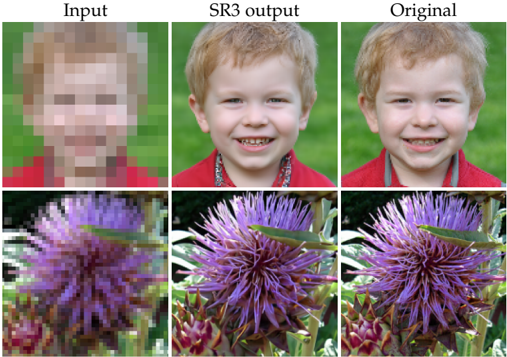
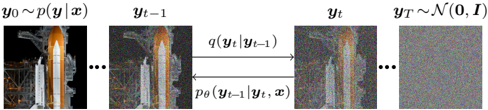
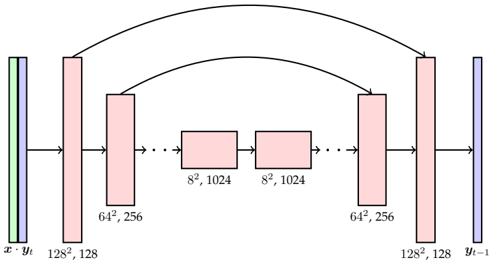
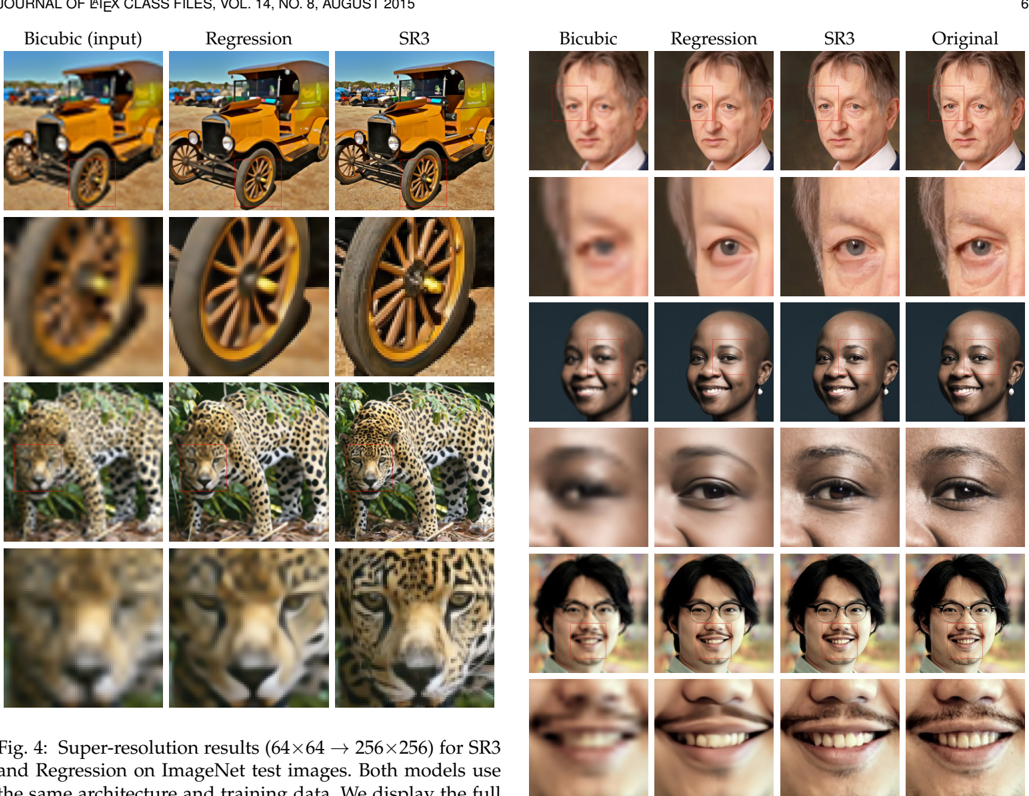
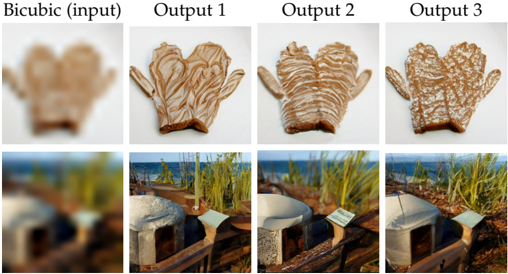
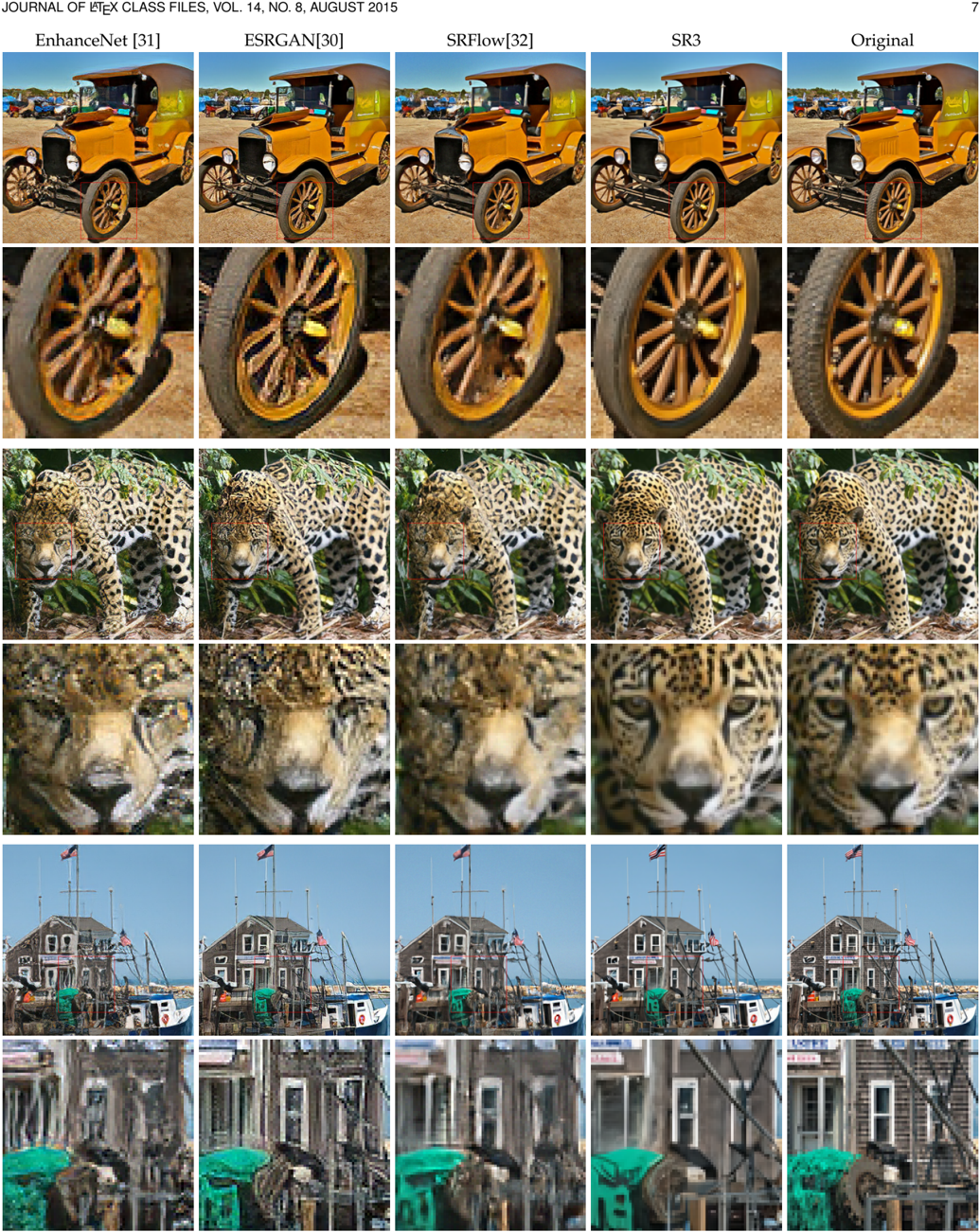
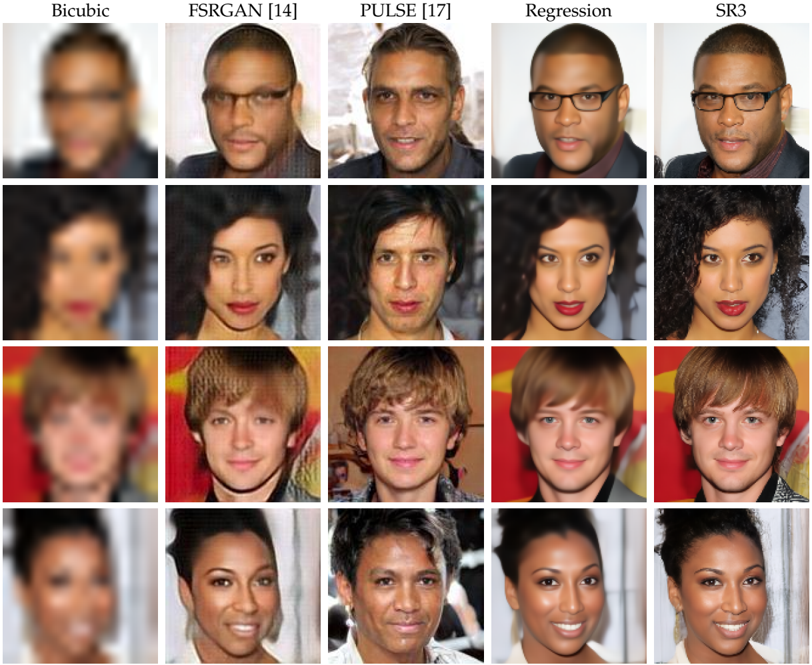
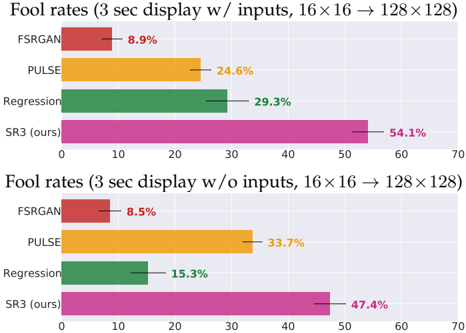
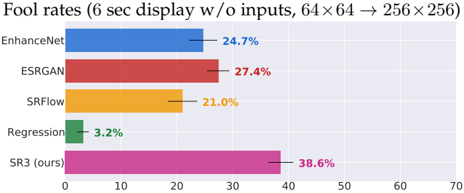
We present SR3, an approach to image Super-Resolution via Repeated Refinement. SR3 adapts denoising diffusion probabilistic models (Ho et al. 2020), (Sohl-Dickstein et al. 2015) to image-to-image translation, and performs super-resolution through a stochastic iterative denoising process. Output images are initialized with pure Gaussian noise and iteratively refined using a U-Net architecture that is trained on denoising at various noise levels, conditioned on a low-resolution input image. SR3 exhibits strong performance on super-resolution tasks at different magnification factors, on faces and natural images. We conduct human evaluation on a standard 8× face super-resolution task on CelebA-HQ for which SR3 achieves a fool rate close to 50%, suggesting photo-realistic outputs, while GAN baselines do not exceed a fool rate of 34%. We evaluate SR3 on a 4× super-resolution task on ImageNet, where SR3 outperforms baselines in human evaluation and classification accuracy of a ResNet-50 classifier trained on high-resolution images. We further show the effectiveness of SR3 in cascaded image generation, where a generative model is chained with super-resolution models to synthesize high-resolution images with competitive FID scores on the class-conditional 256×256 ImageNet generation challenge.
Overview
The claims and statistics of this paper haven’t been checked yet.
Free: it reads the open-access text and checks the first 5 claims that cite a source we can check. Create a free account to check every claim.
Integrity signals
Registry
Cites
Statistics
Figures


















Verification
Claims the paper makes
The claims and statistics of this paper haven’t been checked yet.
Free: it reads the open-access text and checks the first 5 claims that cite a source we can check. Create a free account to check every claim.
Claims other papers make about this one
Each is checked against this paper’s own text: does it say what the citing paper says it does?
The source backs part of the claim, not all of it — or backs it for a different population, condition or comparison.
In the citing paper
“Both the SR3 and CDM directly apply the diffusion process to input images, which leads to larger evaluation steps.”
From Diffusion Models: A Comprehensive Survey of Methods and Applications (2024) · cites this paper as [200]
Experimental — accuracy not yet measuredThe source backs part of the claim, not all of it — or backs it for a different population, condition or comparison.
In the citing paper
“Low-light face videos suffer from severe noise and detail loss, limiting their use in surveillance and photography applications.”
From Temporally consistent low-light face video enhancement via video-to-video conditional diffusion (2026) · cites this paper as [5]
Experimental — accuracy not yet measuredThe source backs part of the claim, not all of it — or backs it for a different population, condition or comparison.
In the citing paper
“This greatly improves FID on ImageNet 256×256, but does not reach the same performance as state-of-the-art models like BigGAN-deep [43, 53], as seen in Table 5.”
From Diffusion Models Beat GANs on Image Synthesis (2021) · cites this paper as [53]
Experimental — accuracy not yet measuredIn the citing paper
“Super-Resolution via Repeated Refinement (SR3) [200] uses DDPM to enable conditional image generation.”
From Diffusion Models: A Comprehensive Survey of Methods and Applications (2024) · cites this paper as [200]
In the citing paper
“SR3 conducts super-resolution through a stochastic, iterative denoising process.”
From Diffusion Models: A Comprehensive Survey of Methods and Applications (2024) · cites this paper as [200]
2 more claims about this paper
Create a free account to see every claim other papers make about this one.
Self-check
Percentages, sums and reported differences re-computed from the paper’s own numbers.
The self-check needs the paper’s full text.
Citations
Cites
Deep Residual Learning for Image Recognition
He, K., Zhang, X., Ren, S., & Sun, J. (2016) · 2016 IEEE Conference on Computer Vision and Pattern Recognition (CVPR) · doi:10.1109/cvpr.2016.90 · Cited by 235,474 · cited 1×
“Then, we report classification accuracy of a pre-trained ResNet50 [65] model.”
MethodVaswani, A., Shazeer, N., Parmar, N., Uszkoreit, J., Jones, L., Gomez, A. N., Kaiser, L., & Polosukhin, I. (2017) · arXiv · doi:10.48550/arxiv.1706.03762 · Cited by 120,404
U-Net: Convolutional Networks for Biomedical Image Segmentation
Ronneberger, O., Fischer, P., & Brox, T. (2015) · Lecture notes in computer science · doi:10.1007/978-3-319-24574-4_28 · Cited by 99,404
Exploiting Generative AI to Scale up Intelligent Tutoring Systems
Jakubův, J., Chvalovský, K., Goertzel, Z., Kaliszyk, C., Olšák, M., Piotrowski, B., Schulz, S., Suda, M., & Urban, J. (2023) · DROPS (Schloss Dagstuhl – Leibniz Center for Informatics) · doi:10.4230/lipics.itp.2023.19 · Cited by 76,658
Image quality assessment: from error visibility to structural similarity
Wang, Z., Bovik, A. C., Sheikh, H. R., & Simoncelli, E. P. (2004) · IEEE Transactions on Image Processing · doi:10.1109/tip.2003.819861 · Cited by 57,892 · cited 10×
“Table 2 shows the PSNR, SSIM [63] and Consistency scores for 16 16 !”
BackgroundInfluentialImageNet Large Scale Visual Recognition Challenge
Russakovsky, O., Deng, J., Su, H., Krause, J., Satheesh, S., Ma, S., Huang, Z., Karpathy, A., Khosla, A., Bernstein, M., et al. (2015) · International Journal of Computer Vision · doi:10.1007/s11263-015-0816-y · Cited by 39,380 · cited 2×
“on ImageNet 1K [62] and use the dev split for evaluation.”
BackgroundMethodAuto-Encoding Variational Bayes
Kingma, D. P., & Welling, M. (2013) · arXiv · doi:10.48550/arxiv.1312.6114 · Cited by 20,067 · cited 2×
“VAEs [7], [46] offer fast sampling, but tend to underperform GANs”
BackgroundGenerative adversarial networks
Goodfellow, I., Pouget-Abadie, J., Mirza, M., Xu, B., Warde-Farley, D., Ozair, S., Courville, A., & Bengio, Y. (2020) · Communications of the ACM · doi:10.1145/3422622 · Cited by 18,384
Sequence to Sequence Learning with Neural Networks
Sutskever, I., Vinyals, O., & Le, Q. V. (2014) · arXiv · doi:10.48550/arxiv.1409.3215 · Cited by 17,766
Photo-Realistic Single Image Super-Resolution Using a Generative Adversarial Network
Ledig, C., Theis, L., Huszar, F., Caballero, J., Cunningham, A., Acosta, A., Aitken, A., Tejani, A., Totz, J., Wang, Z., et al. (2017) · 2017 IEEE Conference on Computer Vision and Pattern Recognition (CVPR) · doi:10.1109/cvpr.2017.19 · Cited by 12,696
Research works printed but not linked: 2
- 11. I. J. Goodfellow, J. Pouget-Abadie, M. Mirza, B. Xu, D. Warde- Farley, S. Ozair, A. Courville, and Y. Bengio, "Generative Adver- sarial Networks," NIPS, 2014.
- 46. D. J. Rezende, S. Mohamed, and D. Wierstra, "Stochastic back- propagation and approximate inference in deep generative mod- els," in ICML, 2014, pp. 1278-1286.
Cited by
Items 101–200 of 1,005
Unsupervised Surface Anomaly Detection with Diffusion Probabilistic Model
Zhang, X., Li, N., Li, J., Dai, T., Jiang, Y., & Xia, S. (2023) · IEEE/CVF International Conference on Computer Vision (ICCV) · doi:10.1109/iccv51070.2023.00624 · Cited by 213
“Denoising Diffusion Probabilistic Models (DDPM) [11] have recently achieved state-of-the-art results in various image generation tasks and are also widely developed in other applications [25, 5].”
BackgroundMethodGaussianEditor: Editing 3D Gaussians Delicately with Text Instructions
Wang, J., Fang, J., Zhang, X., Xie, L., & Tian, Q. (2024) · IEEE Computer Society Conference on Computer Vision and Pattern Recognition/Proceedings - IEEE Computer Society Conference on Computer Vision and Pattern Recognition/Proceedings · doi:10.1109/cvpr52733.2024.01975 · Cited by 257
“Harnessing the robust semantic comprehension and image generation capabilities of foundational diffusion models, an escalating number of research explorations are currently employing diffusion models as a fundamental framework for implementing text-based image editing functionalities [33, 37, 38,…”
Wang, T., Zhang, K., Zhang, Y., Luo, W., Stenger, B., Lu, T., Kim, T.-K., & Liu, W. (2025) · Pattern Recognition · doi:10.1016/j.patcog.2025.111628 · Cited by 150
Conversion Between CT and MRI Images Using Diffusion and Score-Matching ModelsPreprint
Lyu, Q., & Wang, G. (2022) · arXiv (Cornell University) · doi:10.48550/arxiv.2209.12104 · Cited by 187
“[40] from working within the same imaging mode (photographs) to mapping across different imaging modes (CT and MRI) so that we can build diffusion and score-matching models conditioned on T2w images.”
BackgroundDiffusion Models in Low-Level Vision: A Survey
He, C., Shen, Y., Fang, C., Xiao, F., Tang, L., Zhang, Y., Zuo, W., Guo, Z., & Li, X. (2025) · IEEE Transactions on Pattern Analysis and Machine Intelligence · doi:10.1109/tpami.2025.3545047 · Cited by 203
“Enabling reconstructed images to better serve downstream tasks is a continuous endeavor in low-level vision research [41].”
Learning to Efficiently Sample from Diffusion Probabilistic Models
Watson, D., Ho, J., Norouzi, M., & Chan, W. (2021) · arXiv (Cornell University) · doi:10.48550/arxiv.2106.03802 · Cited by 48
“…including unconditional image generation [Song and Ermon, 2019, Ho et al., 2020, Song et al., 2021, Nichol and Dhariwal, 2021], shape generation [Cai et al., 2020], text-to-speech [Chen et al., 2021, Kong et al., 2020] and single image super-resolution [Saharia et al., 2021, Li et al., 2021].”
BackgroundSelf-citationNotice of Removal: VideoFusion: Decomposed Diffusion Models for High-Quality Video Generation
Luo, Z., Chen, D., Zhang, Y., Huang, Y., Wang, L., Shen, Y., Zhao, D., Zhou, J., & Tan, T. (2023) · 2023 IEEE/CVF Conference on Computer Vision and Pattern Recognition (CVPR) · doi:10.1109/cvpr52729.2023.00984 · Cited by 144
CBCT‐Based synthetic CT image generation using conditional denoising diffusion probabilistic model
Peng, J., Qiu, R. L. J., Wynne, J. F., Chang, C., Pan, S., Wang, T., Roper, J. R., Liu, T., Patel, P. R., Yu, D. S., et al. (2023) · Medical Physics · doi:10.1002/mp.16704 · Cited by 167
Toward High-Quality HDR Deghosting With Conditional Diffusion Models
Yan, Q., Hu, T., Sun, Y., Tang, H., Zhu, Y., Dong, W. F., Gool, L. V., & Zhang, Y. (2023) · IEEE Transactions on Circuits and Systems for Video Technology · doi:10.1109/tcsvt.2023.3326293 · Cited by 147
“First , since the large motion exists in LDR images, concatenating condition ( i . e ., LDR images) to the noisy image, as was done in SR3 [30], undoubtedly causes ghosting artifacts in HDR images.”
BackgroundMethodResultInfluentialDiffuseVAE: Efficient, Controllable and High-Fidelity Generation from Low-Dimensional Latents
Pandey, K., Mukherjee, A., Rai, P., & Kumar, A. (2022) · Transactions on machine learning research · doi:10.48550/arxiv.2201.00308 · Cited by 201
“…in both unconditional (Nichol & Dhariwal, 2021; Dhariwal & Nichol, 2021; Kingma et al., 2021) and conditional diffusion models (Ho et al., 2021; Saharia et al., 2021; Choi et al., 2021; Chen et al., 2020) (including score-based models (Song et al., 2021b; Song & Ermon, 2020a)) for a variety…”
BackgroundMethodInfluentialDiffWater: Underwater Image Enhancement Based on Conditional Denoising Diffusion Probabilistic Model
Guan, M., Xu, H., Jiang, G., Yu, M., Chen, Y., Luo, T., & Zhang, X. (2023) · IEEE Journal of Selected Topics in Applied Earth Observations and Remote Sensing · doi:10.1109/jstars.2023.3344453 · Cited by 154
RF-Diffusion: Radio Signal Generation via Time-Frequency Diffusion
Chi, G., Yang, Z., Wu, C., Xu, J., Gao, Y., Liu, Y., & Han, T. X. (2024) · ACM Annual International Conference on Mobile Computing and Networking (MobiCom) · doi:10.1145/3636534.3649348 · Cited by 182
DifFace: Blind Face Restoration With Diffused Error Contraction
Yue, Z., & Loy, C. C. (2024) · IEEE Transactions on Pattern Analysis and Machine Intelligence · doi:10.1109/tpami.2024.3432651 · Cited by 179
“IDM [33] introduces an extrinsic pre-cleaning process to further improve the BFR performance on the basis of SR3.”
BackgroundInfluentialUniTune: Text-Driven Image Editing by Fine Tuning a Diffusion Model on a Single Image
Valevski, D., Kalman, M., Molad, E., Segalis, E., Matias, Y., & Leviathan, Y. (2023) · ACM Transactions on Graphics · doi:10.1145/3592451 · Cited by 166
“Revolutionary text-to-image models like Dall-E [Ramesh et al. 2022], Imagen [Saharia et al. 2022, 2021] and Stable Diffusion [Rom-bach et al. 2021] excel at creating images from scratch, or at filling manually-removed parts of existing images in a context-aware fashion.”
MethodAccelerating Diffusion Models via Early Stop of the Diffusion ProcessPreprint
Lyu, Z., Xudong, X. U., Yang, C., Lin, D., & Dai, B. (2022) · arXiv (Cornell University) · doi:10.48550/arxiv.2205.12524 · Cited by 155
“…(Ho et al., 2020; Dhariwal & Nichol, 2021; Nichol et al., 2021), image manipulation and restoration (Nichol et al., 2021; Meng et al., 2021; Saharia et al., 2021b,a), audio generation (Chen et al., 2020; Kong et al., 2020), as well as 3D shape generation and completion (Luo & Hu, 2021;…”
BackgroundPalette: Image-to-Image Diffusion ModelsPreprint
Saharia, C., Chan, W., Chang, H., Lee, C. A., Ho, J., Salimans, T., Fleet, D. J., & Norouzi, M. (2021) · arXiv (Cornell University) · doi:10.48550/arxiv.2111.05826 · Cited by 175
“Conditional diffusion models [Chen et al. 2021a; Saharia et al. 2021] make the denoising process conditional on an input signal.”
BackgroundMethodInfluentialSelf-citationFast-DDPM: Fast Denoising Diffusion Probabilistic Models for Medical Image-to-Image Generation
Jiang, H., Imran, M. A., Zhang, T., Zhou, Y., Liang, M., Gong, K., & Shao, W. (2025) · IEEE Journal of Biomedical and Health Informatics · doi:10.1109/jbhi.2025.3565183 · Cited by 156
“Image-guided diffusion models, including SR3 [42], Palette [40], and Srdiff [22], specialize in transforming or enhancing existing images through super-resolution, inpainting, and style transfer.”
Hertz, A., Aberman, K., & Cohen‐Or, D. (2023) · IEEE/CVF International Conference on Computer Vision (ICCV) · doi:10.1109/iccv51070.2023.00221 · Cited by 219
“The prior of large generative diffusion models, like Stable Diffusion [31], DALLE-2 [30] and Imagen [35] is particularly rich and expressive and has been demonstrated to be highly effective in generating visually stunning assets across various domains, including images and 3D models, among others.”
BackgroundAdvancing High-Resolution Video-Language Representation with Large-Scale Video Transcriptions
Xue, H., Hang, T., Zeng, Y., Sun, Y., Liu, B., Yang, H., Fu, J., & Guo, B. (2022) · 2022 IEEE/CVF Conference on Computer Vision and Pattern Recognition (CVPR) · doi:10.1109/cvpr52688.2022.00498 · Cited by 127
“As shown in the second case of Figure 5, SR3 [42] and pSp [40] can not reconstruct high-quality faces by only using visual information.”
BackgroundMethodResultInfluentialEfficient Diffusion Model for Image Restoration by Residual Shifting
Yue, Z., Wang, J., & Loy, C. C. (2024) · IEEE Transactions on Pattern Analysis and Machine Intelligence · doi:10.1109/tpami.2024.3461721 · Cited by 170
“Existing acceleration sampling techniques, though seeking to expedite the process, inevitably sacrifice performance to some extent, resulting in over-blurry restored outcomes.”
ReF-DDPM: A novel DDPM-based data augmentation method for imbalanced rolling bearing fault diagnosis
Tian, Y., Li, C., Huang, J., Xiao, X., Zhang, X., Li, Y., & Fu, B. (2024) · Reliability Engineering & System Safety · doi:10.1016/j.ress.2024.110343 · Cited by 133
Xie, Y., & Li, Q. (2022) · Lecture notes in computer science · doi:10.1007/978-3-031-16446-0_62 · Cited by 169
MMIF-INet: Multimodal medical image fusion by invertible network
He, D., Li, W., Wang, G., Huang, Y., & Liu, S. (2024) · Information Fusion · doi:10.1016/j.inffus.2024.102666 · Cited by 133
DiffuseMorph: Unsupervised Deformable Image Registration Using Diffusion Model
Kim, B., Han, I., & Ye, J. C. (2022) · Lecture notes in computer science · doi:10.1007/978-3-031-19821-2_20 · Cited by 171
“SR3 [32] presents a method to train the DDPM with a conditioned image for the super-resolution task.”
BackgroundMethodInfluentialVectorFusion: Text-to-SVG by Abstracting Pixel-Based Diffusion Models
Jain, A., Xie, A., & Abbeel, P. (2023) · IEEE Computer Society Conference on Computer Vision and Pattern Recognition/Proceedings - IEEE Computer Society Conference on Computer Vision and Pattern Recognition/Proceedings · doi:10.1109/cvpr52729.2023.00190 · Cited by 206
Inversion by Direct Iteration: An Alternative to Denoising Diffusion for Image Restoration
Delbracio, M., & Milanfar, P. (2023) · Transactions on machine learning research · doi:10.48550/arxiv.2303.11435 · Cited by 231
“In all our restoration experiments we use a U-Net-like architecture (Ronneberger et al., 2015) similar to the one in SR3 (Saharia et al., 2021) and DvSR (Whang et al., 2022).”
MethodInfluentialDenoising Pretraining for Semantic Segmentation
Brempong, E. A., Kornblith, S., Chen, T., Parmar, N., Minderer, M., & Norouzi, M. (2022) · 2022 IEEE/CVF Conference on Computer Vision and Pattern Recognition Workshops (CVPRW) · doi:10.1109/cvprw56347.2022.00462 · Cited by 120
Self-citationHSR-Diff: Hyperspectral Image Super-Resolution via Conditional Diffusion Models
Wu, C., Wang, D., Bai, Y., Mao, H., Li, Y., & Shen, Q. (2023) · IEEE/CVF International Conference on Computer Vision (ICCV) · doi:10.1109/iccv51070.2023.00652 · Cited by 150
“However, alternative outstanding diffusion models [15, 27] that are also excellent for conditional image generation are equipped with CNNbased U-Nets, where degenerated images are concatenated with noisy high-resolution output images.”
BackgroundMultiscale Structure Guided Diffusion for Image Deblurring
Ren, M., Delbracio, M., Talebi, H., Gerig, G., & Milanfar, P. (2023) · IEEE/CVF International Conference on Computer Vision (ICCV) · doi:10.1109/iccv51070.2023.00984 · Cited by 186
“A conditional DPM Gθ([xt,y], t) is used, where the image conditioning is typically implemented via concatenation of y and xt at input-level [72, 88, 70].”
BackgroundMethodInfluentialDiffusion Models, Image Super-Resolution, and Everything: A Survey
Moser, B. B., Shanbhag, A. S., Raue, F., Frolov, S., Palacio, S., & Dengel, A. (2025) · IEEE Transactions on Neural Networks and Learning Systems · doi:10.1109/tnnls.2024.3476671 · Cited by 117
“It represents the ratio between the maximum pixel value L and the mean squared error (MSE) between the SR image ˆ y and the HR image y Despite being one of the most popular IQA methods, it does not accurately match human perception [15].”
InfluentialA review of deep-learning-based super-resolution: From methods to applications
Su, H., Li, Y., Xu, Y., Fu, X., & Liu, S. (2024) · Pattern Recognition · doi:10.1016/j.patcog.2024.110935 · Cited by 133
SpectralDiff: A Generative Framework for Hyperspectral Image Classification With Diffusion Models
Chen, N., Yue, J., Fang, L., & Xia, S. (2023) · IEEE Transactions on Geoscience and Remote Sensing · doi:10.1109/tgrs.2023.3310023 · Cited by 161
“image super-resolution [74], [75], [76].”
MethodInfluentialExpressive 3D Facial Animation Generation Based on Local-to-Global Latent Diffusion
Song, W., Wang, X., Jiang, Y., Li, S., Hao, A., Hou, X., & Qin, H. (2024) · IEEE Transactions on Visualization and Computer Graphics · doi:10.1109/tvcg.2024.3456213 · Cited by 119
“In other aspects, Saharia et al. [48] utilized diffusion models to achieve image super-resolution, achieving state-of-the-art results on a benchmark.”
BackgroundDiffuScene: Denoising Diffusion Models for Generative Indoor Scene Synthesis
Tang, J., Nie, Y., Markhasin, L., Dai, A., Thies, J., & Nießner, M. (2023) · arXiv · doi:10.48550/arxiv.2303.14207 · Cited by 110
ExposureDiffusion: Learning to Expose for Low-light Image Enhancement
Wang, Y., Yu, Y., Yang, W., Guo, L., Chau, L., Kot, A. C., & Wen, B. (2023) · IEEE/CVF International Conference on Computer Vision (ICCV) · doi:10.1109/iccv51070.2023.01143 · Cited by 143
DiffCR: A Fast Conditional Diffusion Framework for Cloud Removal From Optical Satellite Images
Zou, X., Li, K., Xing, J., Zhang, Y., Wang, S., Jin, L., & Tao, P. (2024) · IEEE Transactions on Geoscience and Remote Sensing · doi:10.1109/tgrs.2024.3365806 · Cited by 148
“2) Condition Encoder: Existing conditional diffusion models [52], [53] directly concatenate the conditional input and noisy input along the channel dimension and feed them into the denoising model, which increases the difficulty of model training.”
BackgroundMethodInfluentialDiffusion Schrödinger Bridge with Applications to Score-Based Generative ModelingPreprint
Bortoli, V. D., Thornton, J., Heng, J., & Doucet, A. (2021) · arXiv (Cornell University) · doi:10.48550/arxiv.2106.01357 · Cited by 137
“…et al. (2021b); Ho et al. (2020); Song and Ermon (2020); Song et al. (2020, 2021); Niu et al. (2020); Durkan and Song (2021); Hoogeboom et al. (2021); Saharia et al. (2021); Luhman and Luhman (2021, 2020); Nichol and Dhariwal (2021); Popov et al. (2021); Dhariwal and Nichol (2021).”
Data synthesis and adversarial networks: A review and meta-analysis in cancer imaging
Osuala, R. O., Kushibar, K., Garrucho, L., Linardos, A., Szafranowska, Z., Klein, S., Glocker, B., Díaz, O., & Lekadir, K. (2022) · Medical Image Analysis · doi:10.1016/j.media.2022.102704 · Cited by 131
Upscale-A-Video: Temporal-Consistent Diffusion Model for Real-World Video Super-Resolution
Zhou, S., Yang, P., Wang, J., Luo, Y., & Loy, C. C. (2024) · IEEE Computer Society Conference on Computer Vision and Pattern Recognition/Proceedings - IEEE Computer Society Conference on Computer Vision and Pattern Recognition/Proceedings · doi:10.1109/cvpr52733.2024.00245 · Cited by 213
Fourier Priors-Guided Diffusion for Zero-Shot Joint Low-Light Enhancement and Deblurring
Lv, X., Zhang, S., Wang, C., Zheng, Y., Zhong, B., Li, C., & Nie, L. (2024) · IEEE Computer Society Conference on Computer Vision and Pattern Recognition/Proceedings - IEEE Computer Society Conference on Computer Vision and Pattern Recognition/Proceedings · doi:10.1109/cvpr52733.2024.02398 · Cited by 171
A Pathway Towards Responsible AI Generated Content
Lyu, L. (2023) · International Joint Conference on Artificial Intelligence · doi:10.24963/ijcai.2023/803 · Cited by 119
Differentially Private Diffusion Models
Dockhorn, T., Cao, T., Vahdat, A., & Kreis, K. (2023) · Transactions on machine learning research · doi:10.48550/arxiv.2210.09929 · Cited by 148
DOLCE: A Model-Based Probabilistic Diffusion Framework for Limited-Angle CT Reconstruction
Liu, J., Anirudh, R., Thiagarajan, J. J., He, S., Mohan, K. A., Kamilov, U. S., & Kim, H. (2023) · 2023 IEEE/CVF International Conference on Computer Vision (ICCV) · doi:10.1109/iccv51070.2023.00963 · Cited by 106
“To make it work on 512 × 512 images, given the pre-trained CTNet on 128 × 128 images, we additionally train a super-resolution diffusion model presented in [8] to super-resolve the low-resolution outputs of CTNet to the same 512 × 512 dimension as other methods.”
MethodWavelet-Improved Score-Based Generative Model for Medical Imaging
Wu, W., Wang, Y., Liu, Q., Wang, G., & Zhang, J. (2024) · IEEE Transactions on Medical Imaging · doi:10.1109/tmi.2023.3325824 · Cited by 105
“S CORE-BASED generative model (SGM) has made significant contributions across various domains, including classification [1], super-resolution [2], adversarial interference [3], and medical image reconstructions [4], [5].”
BackgroundStable Video Diffusion: Scaling Latent Video Diffusion Models to Large Datasets
Blattmann, A., Dockhorn, T., Kulal, S., Mendelevitch, D., Kilian, M., Lorenz, D., Levi, Y., English, Z., Voleti, V., Letts, A., et al. (2023) · arXiv · doi:10.48550/arxiv.2311.15127 · Cited by 105
“Diffusion models implement an iterative refinement process by learning to gradually denoise a sample from a normal distribution and have been successfully applied to high-resolution text-to-image [13, 64, 68, 71, 75] and video synthesis [9, 29, 41, 82, 95].”
MethodDR2: Diffusion-Based Robust Degradation Remover for Blind Face Restoration
Wang, Z., Zhang, Z., Zhang, X., Zheng, H., Zhou, M., Zhang, Y., & Wang, Y. (2023) · IEEE Computer Society Conference on Computer Vision and Pattern Recognition/Proceedings - IEEE Computer Society Conference on Computer Vision and Pattern Recognition/Proceedings · doi:10.1109/cvpr52729.2023.00170 · Cited by 174
Diffusion model with disentangled modulations for sharpening multispectral and hyperspectral images
Cao, Z., Cao, S., Deng, L.-J., Wu, X., Hou, J., & Vivone, G. (2023) · Information Fusion · doi:10.1016/j.inffus.2023.102158 · Cited by 125
TexFusion: Synthesizing 3D Textures with Text-Guided Image Diffusion Models
Cao, T., Kreis, K., Fidler, S., Sharp, N., & Yin, K. (2023) · IEEE/CVF International Conference on Computer Vision (ICCV) · doi:10.1109/iccv51070.2023.00385 · Cited by 183
“This makes our method versatile”
CRS-Diff: Controllable Remote Sensing Image Generation With Diffusion Model
Tang, D., Cao, X., Hou, X., Jiang, Z., Liu, J., & Meng, D. (2024) · IEEE Transactions on Geoscience and Remote Sensing · doi:10.1109/tgrs.2024.3453414 · Cited by 157
“research topic since the generated images exhibit high quality, e.g., generating realistic images [3], [4], [5], [6], transforming art styles [11], [12], image superresolution [13], [14], [15], and video generation [16].”
BackgroundSuper-resolution of brain MRI images based on denoising diffusion probabilistic model
Wu, Z., Chen, X., Xie, S., Shen, J. G., & Zeng, Y. (2023) · Biomedical Signal Processing and Control · doi:10.1016/j.bspc.2023.104901 · Cited by 112
Advances in artificial intelligence: a review for the creative industries
Anantrasirichai, N., Zhang, F., & Bull, D. (2026) · Artificial Intelligence Review · doi:10.1007/s10462-026-11494-w · Cited by 107
Restore-RWKV: Efficient and Effective Medical Image Restoration With RWKV
Yang, Z., Li, J., Zhang, H., Zhao, D., Wei, B., & Xu, Y. L. (2025) · IEEE Journal of Biomedical and Health Informatics · doi:10.1109/jbhi.2025.3588555 · Cited by 141
A Survey on All-in-One Image Restoration: Taxonomy, Evaluation and Future Trends
Jiang, J., Zuo, Z., Wu, G., Jiang, K., & Liu, X. (2025) · IEEE Transactions on Pattern Analysis and Machine Intelligence · doi:10.1109/tpami.2025.3598132 · Cited by 145
“This section enables a thorough evaluation of AiOIR methods.”
Diffusion Deformable Model for 4D Temporal Medical Image Generation
Kim, B., & Ye, J. C. (2022) · Lecture notes in computer science · doi:10.1007/978-3-031-16431-6_51 · Cited by 149
He, J., Zhang, L. M., Xiao, T., Wang, H., & Luo, H. (2023) · Water Research · doi:10.1016/j.watres.2023.120057 · Cited by 112
A Systematic Survey of Deep Learning-Based Single-Image Super-Resolution
Li, J., Pei, Z., Li, W., Gao, G., Wang, L., Wang, Y., & Zeng, T. (2024) · ACM Computing Surveys · doi:10.1145/3659100 · Cited by 110
“This type of unsupervised method no longer uses paired LR-HR images for training but uses unpaired LR-HR images (GAN-based method) or itself (self-supervised learning method) for training.”
MethodInfluentialZero-Shot Contrastive Loss for Text-Guided Diffusion Image Style Transfer
Yang, S., Hwang, H., & Ye, J. C. (2023) · IEEE/CVF International Conference on Computer Vision (ICCV) · doi:10.1109/iccv51070.2023.02091 · Cited by 141
“For example, [33, 34] proposed conditional diffusion models that require paired dataset for image-to-image style transfer.”
BackgroundScore-Based Diffusion Models as Principled Priors for Inverse Imaging
Feng, B. T., Smith, J., Rubinstein, M., Chang, H., Bouman, K. L., & Freeman, W. T. (2023) · IEEE/CVF International Conference on Computer Vision (ICCV) · doi:10.1109/iccv51070.2023.00965 · Cited by 182
“One could train a neural network on a paired dataset of images and measurements [56, 35, 79, 81, 80, 78, 62, 19, 18], but this requires re-training for new tasks, and uncertainty cannot be analyzed under the learned prior.”
BackgroundRenAIssance: A Survey Into AI Text-to-Image Generation in the Era of Large Model
Bie, F., Yang, Y., Zhou, Z., Ghanem, A., Zhang, M., Yao, Z., Wu, X., Holmes, C., Golnari, P. A., Clifton, D. A., et al. (2024) · IEEE Transactions on Pattern Analysis and Machine Intelligence · doi:10.1109/tpami.2024.3522305 · Cited by 141
“Apart from TTI generation, diffusion model also achieves impressive results in image segmentation [55, 61, 76–78], super-resolution [79, 80], natural language processing [81–84], or even in the field of reinforcement learning [85, 86].”
MethodResultPriorGrad: Improving Conditional Denoising Diffusion Models with Data-Dependent Adaptive PriorPreprint
Lee, S.-G., Kim, H., Shin, C., Tan, X., Liu, C., Meng, Q., Qin, T., Chen, W., Yoon, S., & Liu, T. (2021) · arXiv (Cornell University) · doi:10.48550/arxiv.2106.06406 · Cited by 125
“Consequently, there have been a variety of applications based on DDPM or SM (Saharia et al., 2021; Kawar et al., 2021).”
BackgroundMethodAnalog Bits: Generating Discrete Data using Diffusion Models with Self-Conditioning
Chen, T., Zhang, R., & Hinton, G. (2022) · arXiv · doi:10.48550/arxiv.2208.04202 · Cited by 97
“However, a typical conditioning variable is either from some external sources, such as class labels (Nichol & Dhariwal, 2021) or low-resolution images from another network (Nichol & Dhariwal, 2021; Saharia et al., 2021; Ho et al., 2022).”
BackgroundUnsupervised hyperspectral pansharpening via low-rank diffusion model
Rui, X., Cao, X., Pang, L., Zhu, Z., Yue, Z., & Meng, D. (2024) · Information Fusion · doi:10.1016/j.inffus.2024.102325 · Cited by 113
Generative Modelling With Inverse Heat DissipationPreprint
Rissanen, S., Heinonen, M., & Solin, A. (2022) · arXiv (Cornell University) · doi:10.48550/arxiv.2206.13397 · Cited by 132
“Recent ideas introduced for diffusion models also include training diffusion models on different levels of resolution and cascading them together to improve the model performance [18, 64, 25].”
BackgroundMethodGenerative Semantic Communication: Diffusion Models Beyond Bit Recovery
Grassucci, E., Barbarossa, S., & Comminiello, D. (2026) · IEEE Transactions on Cognitive Communications and Networking · doi:10.1109/tccn.2026.3689849 · Cited by 122
“This setup ensures that the generative process remains anchored to semantically informative signals even under extreme noise conditions, theoretically supporting the robustness of semantic generation.”
Diffusion probabilistic model based accurate and high‐degree‐of‐freedom metasurface inverse design
Zhang, Z., Yang, C., Qin, Y., Feng, H., Feng, J., & Li, H. (2023) · Nanophotonics · doi:10.1515/nanoph-2023-0292 · Cited by 105
“Consequently, it has been successfully applied to text-to-image generation, including OpenAI’s DALLE [40], Google’s IMAGEN [41], and image super-resolution [42].”
Compositional 3D Scene Generation using Locally Conditioned Diffusion
Po, R., & Wetzstein, G. (2024) · International Conference on 3D Vision (3DV) · doi:10.1109/3dv62453.2024.00026 · Cited by 132
“Most successful models [7, 16, 40] train their models using a simplified variant of the variational lower bound on the data distribution: with t uniformly sampled from { 1 , . . . , T } .”
He, Z., Wang, Y.-H., & Zhang, J. (2024) · Information Fusion · doi:10.1016/j.inffus.2024.102654 · Cited by 105
“To solve this kind of controllable generation problem, conventional DMs are extended to conditional diffusion models (CDMs) [27][28][66].”
InfluentialAvatarCraft: Transforming Text into Neural Human Avatars with Parameterized Shape and Pose Control
Jiang, R., Wang, C., Zhang, J., Chai, M., He, M., Chen, D., & Liao, J. (2023) · IEEE/CVF International Conference on Computer Vision (ICCV) · doi:10.1109/iccv51070.2023.01322 · Cited by 119
“In addition to directly converting Gaussian noise into images with learned data distributions through iterative denoising, these models can also generate desired images conditioned on the guidance like class labels, text, and low-resolution images [6, 43, 44, 46].”
Astronomia ex machina: a history, primer and outlook on neural networks in astronomy
Smith, M. J., & Geach, J. E. (2023) · Royal Society Open Science · doi:10.1098/rsos.221454 · Cited by 112
“SBGMs can super-resolve images [174,175], translate between image domains [176], separate superimposed images [177], and in-paint information [170,174].”
BackgroundConsistent View Synthesis with Pose-Guided Diffusion Models
Tseng, H.-Y., Li, Q., Kim, C., Alsisan, S., Huang, J., & Kopf, J. (2023) · IEEE Computer Society Conference on Computer Vision and Pattern Recognition/Proceedings - IEEE Computer Society Conference on Computer Vision and Pattern Recognition/Proceedings · doi:10.1109/cvpr52729.2023.01609 · Cited by 165
“Recently, diffusion models have demonstrated remarkable performance on a variety of 2D content creation tasks, including image super-resolution [22, 41, 46, 64], image in-painting [27, 44], image de-blurring [21, 68], and text-to-image [2, 36, 45].”
BackgroundStyleAdapter: A Unified Stylized Image Generation Model
Wang, Z., Wang, X., Xie, L., Qi, Z., Shan, Y., Wang, W., & Luo, P. (2024) · International Journal of Computer Vision · doi:10.1007/s11263-024-02253-x · Cited by 109
“Subsequently, DALL-E [27], Cogview [8], Make-a-scene [10], Stable Diffusion [29], and Imagen [33] significantly improved the performance in T2I generation.”
DDPM-CD: Denoising Diffusion Probabilistic Models as Feature Extractors for Change DetectionPreprint
Bandara, W. G. C., Nair, N. G., & Patel, V. M. (2022) · arXiv (Cornell University) · doi:10.48550/arxiv.2206.11892 · Cited by 112
“Following the practices in [49], [57], we utilize the Adam optimizer with a linear warm-up schedule over 10 , 000 training steps, followed by a fixed learning rate of 1 × 10 − 5 .”
InfluentialDDS2M: Self-Supervised Denoising Diffusion Spatio-Spectral Model for Hyperspectral Image Restoration
Miao, Y., Zhang, L., Zhang, L., & Tao, D. (2023) · IEEE/CVF International Conference on Computer Vision (ICCV) · doi:10.1109/iccv51070.2023.01110 · Cited by 113
“Remarkably, diffusion models can go beyond image synthesis [11, 32, 20], and have been widely utilized in image restoration tasks, such as super-resolution [16, 46, 34, 6], inpainting [16, 46, 33, 21, 39, 41], denoising [16], and so on.”
BackgroundMethodInfluentialOpen-vocabulary Object Segmentation with Diffusion Models
Li, Z., Zhou, Q., Zhang, X., Zhang, Y., Wang, Y., & Xie, W. (2023) · IEEE/CVF International Conference on Computer Vision (ICCV) · doi:10.1109/iccv51070.2023.00705 · Cited by 129
UIEDP: Boosting underwater image enhancement with diffusion prior
Du, D., Li, E., Si, L., Zhai, W., Xu, F., Niu, J., & Sun, F. (2024) · Expert Systems with Applications · doi:10.1016/j.eswa.2024.125271 · Cited by 96
Efficient Image Enhancement With a Diffusion-Based Frequency Prior
Yan, Q., Hu, T., Wu, P., Dai, D., Gu, S., Dong, W., & Zhang, Y. (2025) · IEEE Transactions on Circuits and Systems for Video Technology · doi:10.1109/tcsvt.2025.3549351 · Cited by 95
“Currently, Diffusion Models (DMs) [23], [24] have exhibited impressive performance in image synthesis [25], [26] and image reconstruction tasks [27], [28], [29], which generate high-fidelity images through a stochastic iterative denoising process from pure Gaussian noise.”
Improving Diffusion Inverse Problem Solving with Decoupled Noise Annealing
Zhang, B., Chu, W., Berner, J., Meng, C., Anandkumar, A., & Song, Y. (2025) · IEEE Computer Society Conference on Computer Vision and Pattern Recognition/Proceedings - IEEE Computer Society Conference on Computer Vision and Pattern Recognition/Proceedings · doi:10.1109/cvpr52734.2025.01946 · Cited by 218
Uncovering the Disentanglement Capability in Text-to-Image Diffusion Models
Wu, Q., Liu, Y., Zhao, H., Kale, A., Bui, T., Yu, T., Lin, Z., Zhang, Y., & Chang, S. (2023) · IEEE Computer Society Conference on Computer Vision and Pattern Recognition/Proceedings - IEEE Computer Society Conference on Computer Vision and Pattern Recognition/Proceedings · doi:10.1109/cvpr52729.2023.00189 · Cited by 165
“Diffusion Models: Diffusion models [23,71–73] are a family of generative models that have achieved state-of-the-art performance in image synthesis and have advanced research in super-resolution [24, 66], inpainting [49, 64], density estimation [38], video synthesis [22, 26], and areas beyond computer vision [6,11,27,4…”
BackgroundReVersion: Diffusion-Based Relation Inversion from Images
Huang, Z., Wu, T., Jiang, Y., Chan, K. C. K., & Liu, Z. (2024) · SIGGRAPH Asia Conference Papers · doi:10.1145/3680528.3687658 · Cited by 103
“Diffusion models [15, 42, 44, 34, 12, 43] have become a mainstream approach for image synthesis [5, 6, 28] apart from GANs [10], and have shown success in various domains such as video generation [13, 48, 41, 17], image restoration [38, 16], and many more [3, 11, 1, 2].”
FusionDiff: Multi-focus image fusion using denoising diffusion probabilistic models
Li, M., Pei, R., Zheng, T., Zhang, Y., & Fu, W. (2023) · Expert Systems with Applications · doi:10.1016/j.eswa.2023.121664 · Cited by 123
FedDiff: Diffusion Model Driven Federated Learning for Multi-Modal and Multi-Clients
Li, D., Xie, W., Wang, Z., Lü, Y., Li, Y., & Fang, L. (2024) · IEEE Transactions on Circuits and Systems for Video Technology · doi:10.1109/tcsvt.2024.3407131 · Cited by 105
“The noise prediction model employed in this study is built upon the U-Net [42] network structure, as illustrated in Fig.”
MethodRethinking Diffusion Model for Multi-Contrast MRI Super-Resolution
Li, G., Rao, C., Mo, J., Zhang, Z., Xing, W., & Zhao, L. (2024) · IEEE Computer Society Conference on Computer Vision and Pattern Recognition/Proceedings - IEEE Computer Society Conference on Computer Vision and Pattern Recognition/Proceedings · doi:10.1109/cvpr52733.2024.01080 · Cited by 119
“While these approaches enhance the performance of SR reconstruction, they tend to yield images that lack detail [35], and for MR images with complicated anatomical structures, they fail to reconstruct some high-frequency details satisfactorily.”
BackgroundDiffusion Model with Detail Complement for Super-Resolution of Remote Sensing
Liu, J., Yuan, Z., Pan, Z., Fu, Y., Liu, L., & Lu, B. (2022) · Remote Sensing · doi:10.3390/rs14194834 · Cited by 93
HIR-Diff: Unsupervised Hyperspectral Image Restoration Via Improved Diffusion Models
Pang, L., Rui, X., Cui, L., Hóngzhōng, W., Meng, D., & Cao, X. (2024) · IEEE Computer Society Conference on Computer Vision and Pattern Recognition/Proceedings - IEEE Computer Society Conference on Computer Vision and Pattern Recognition/Proceedings · doi:10.1109/cvpr52733.2024.00290 · Cited by 112
“Recently, extensive diffusion-based models have emerged for image restoration tasks such as de-noising [18], super-resolution [5, 18, 40, 49] and inpainting [18, 28, 39, 45, 49].”
BackgroundSTFDiff: Remote sensing image spatiotemporal fusion with diffusion models
Huang, H., He, W. P., Zhang, H., Xia, Y., & Zhang, L. (2024) · Information Fusion · doi:10.1016/j.inffus.2024.102505 · Cited by 91
SeD: Semantic-Aware Discriminator for Image Super-Resolution
Li, B., Li, X., Zhu, H., Jin, Y., Feng, R., Zhang, Z., & Chen, Z. (2024) · IEEE Computer Society Conference on Computer Vision and Pattern Recognition/Proceedings - IEEE Computer Society Conference on Computer Vision and Pattern Recognition/Proceedings · doi:10.1109/cvpr52733.2024.02436 · Cited by 105
“Section 1 includes two recently proposed large-scale high-quality benchmarks here for classical image SR evaluation: LSDIR [6] and HQ-50K [16].”
Diffusion Adversarial Representation Learning for Self-supervised Vessel SegmentationPreprint
Kim, B., Oh, Y., & Ye, J. C. (2022) · arXiv (Cornell University) · doi:10.48550/arxiv.2209.14566 · Cited by 102
“Through this stochastic process, DDPM provides diverse realistic samples and has been exploited in many applications, including super-resolution (Chung et al., 2022; Saharia et al., 2021), inpainting (Lugmayr et al., 2022), and colorization (Song et al., 2020; Saharia et al., 2022).”
BackgroundCLE Diffusion: Controllable Light Enhancement Diffusion Model
Yin, Y., Xu, D., Tan, C., Liu, P., Zhao, Y., & Wei, Y. (2023) · ACM International Conference on Multimedia (ACM MM) · doi:10.1145/3581783.3612145 · Cited by 114
“Similar to existing attempts to utilize diffusion model for image restoration [46, 48], we implement our CLE Diffusion by adapting the original DDPM [18] model to accept additional condition information.”
BackgroundMethodBlind Super-Resolution via Meta-Learning and Markov Chain Monte Carlo Simulation
Xia, J., Yang, Z., Li, S., Zhang, S., Fu, Y., Gündüz, D., & Li, X. (2024) · IEEE Transactions on Pattern Analysis and Machine Intelligence · doi:10.1109/tpami.2024.3400041 · Cited by 87
“Nevertheless, thesemethodsarestillrestrictedbyhighdatadependencyon trainingsamplesanddedicatedtime-consumptionformodel-traininginreal-worldapplications.”
A Variational Perspective on Diffusion-Based Generative Models and Score Matching
Huang, C.-W., Lim, J. H., & Courville, A. C. (2021) · arXiv (Cornell University) · doi:10.48550/arxiv.2106.02808 · Cited by 39
“This line of work has been successfully applied to modeling high dimensional natural images (Dhariwal & Nichol, 2021; Saharia et al., 2021), audio (Kong et al.”
MethodDiffusionRig: Learning Personalized Priors for Facial Appearance Editing
Ding, Z., Zhang, X., Xia, Z., Jebe, L., Tu, Z., & Zhang, X. (2023) · IEEE Computer Society Conference on Computer Vision and Pattern Recognition/Proceedings - IEEE Computer Society Conference on Computer Vision and Pattern Recognition/Proceedings · doi:10.1109/cvpr52729.2023.01225 · Cited by 134
Speed-Up DDPM for Real-Time Underwater Image Enhancement
Lu, S., Guan, F., Zhang, H., & Lai, H. (2023) · IEEE Transactions on Circuits and Systems for Video Technology · doi:10.1109/tcsvt.2023.3314767 · Cited by 87
“Saharia et al. [17] produced super-resolution images using an iterative stochastic denoising process that performed robustly on a variety of datasets.”
BackgroundMethodInfluentialDeep diffusion models for seismic processing
Durall, R., Ghanim, A., Fernandez, M., Ettrich, N., & Keuper, J. (2023) · Computers & Geosciences · doi:10.1016/j.cageo.2023.105377 · Cited by 89
“To that end, we employ as a baseline a conditional diffusion models proposed by [22].”
MethodFrequency compensated diffusion model for real-scene dehazing
Wang, J., Wu, S., Yuan, Z., Tong, Q., & Xu, K. (2024) · Neural Networks · doi:10.1016/j.neunet.2024.106281 · Cited by 86
Conditional Diffusion for SAR to Optical Image Translation
Bai, X., Pu, X., & Xu, F. (2023) · IEEE Geoscience and Remote Sensing Letters · doi:10.1109/lgrs.2023.3337143 · Cited by 94
“Diffusion models have been used for various I2I translation tasks, such as superresolution [11].”
BackgroundMethodSinDiffusion: Learning a Diffusion Model From a Single Natural Image
Wang, W., Bao, J., Zhou, W., Chen, D., Chen, D., Yuan, L., & Li, H. (2025) · IEEE Transactions on Pattern Analysis and Machine Intelligence · doi:10.1109/tpami.2025.3532956 · Cited by 89
“[33] achieve success in super-resolution with diffusion models.”
DocDiff: Document Enhancement via Residual Diffusion Models
Yang, Z., Liu, B., Xiong, Y., Yi, L., Wu, G., Tang, X., Liu, Z., Zhou, J., & Zhang, X. (2023) · ACM International Conference on Multimedia (ACM MM) · doi:10.1145/3581783.3611730 · Cited by 99
“[35] present SR3, which adapts diffusion models to image super-resolution.”
BackgroundMethodInfluentialACDMSR: Accelerated Conditional Diffusion Models for Single Image Super-Resolution
Niu, A., Pham, T. X., Zhang, K., Sun, J., Zhu, Y., Yan, Q., Kweon, I. S., & Zhang, Y. (2024) · IEEE Transactions on Broadcasting · doi:10.1109/tbc.2024.3374122 · Cited by 90
“They directly account for the ill-posed problem with an invertible encoder [48], [49].”
BackgroundMethodInfluentialYan, J., Wang, Q., Cheng, Y., Su, Z., Zhang, F., Zhong, M., Liu, L., Jin, B., & Zhang, W. (2024) · Engineering Applications of Artificial Intelligence · doi:10.1016/j.engappai.2024.108496 · Cited by 76
Diff-Retinex++: Retinex-Driven Reinforced Diffusion Model for Low-Light Image Enhancement
Yi, X., Xu, H., Zhang, H., Tang, L., & Ma, J. (2025) · IEEE Transactions on Pattern Analysis and Machine Intelligence · doi:10.1109/tpami.2025.3563612 · Cited by 91
Metadata
- Authors
- Saharia, C., Ho, J., Chan, W., Salimans, T., Fleet, D. J., & Norouzi, M.
- Affiliations
- Google (United States) (US)
- Venue
- IEEE Transactions on Pattern Analysis and Machine Intelligence
- Published
- 2022
- Volume
- 45
- Issue
- 4
- Pages
- 1-14
- ISSN
- 0162-8828 (ISSN-L)
- 2160-9292
- 1939-3539
- OpenAlex
- W3155072588
- Cited by
- 1,829
- References
- 85
- Citations by year
- 2026: 234 · 2025: 580 · 2024: 662 · 2023: 301 · 2022: 40
- FWCI
- 129.48
- Type
- journal article
- Language
- en
- Open access
- hybrid
- doi.org
- Locations
- IEEE Transactions on Pattern Analysis and Machine Intelligence (publishedVersion, cc-by)
- PubMed (publishedVersion)
- arXiv (Cornell University) (submittedVersion)
- arXiv (Cornell University)
- Topics
- Physical Sciences › Computer Science › Computer Vision and Pattern Recognition › Advanced Image Processing Techniques
- Physical Sciences › Computer Science › Computer Vision and Pattern Recognition › Generative Adversarial Networks and Image Synthesis
- Physical Sciences › Computer Science › Computer Vision and Pattern Recognition › Image and Signal Denoising Methods
- Keywords
- image super-resolution, iterative refinement, denoising diffusion probabilistic models, image-to-image translation, U-Net, face super-resolution, high-resolution image generation, human evaluation, image classification accuracy
About these checks
Registry, retraction, Cites and statistics results are computed, not judged, with one exception: a printed reference that no index lists is read once by a model before it counts as a citation error. Claims are extracted by a model and kept only when their quote appears verbatim in the text; each cited source is then checked, with a model’s help, for whether it says what the claim relies on. Those verdicts can be wrong — read the claim’s quote and the cited source before relying on one.
Statistics and arithmetic are recomputed, not judged.
Confidence bands are shown only for fields calibrated on our annotated test set. None is calibrated yet, so no band is shown.
What counts as a claim ›How we measure confidence ›How we check this ›
Are you an author, or do you see a problem with this page? Request a review
Data sources
Bibliographic data: Semantic Scholar, OpenAlex, Crossref.
Contains information from the Semantic Scholar Academic Graph Datasets, made available under the ODC Attribution License (ODC-BY 1.0).
Semantic Scholar’s data is described in: Kinney, R., et al. (2023). The Semantic Scholar Open Data Platform. arXiv:2301.10140.
