

Machine learning unifies the modeling of materials and molecules
Open accessThe DOI matches its Crossref record; 70 of the 71 references it cites were found in a registry or an index.
Abstract
Statistical learning based on a local representation of atomic structures provides a universal model of chemical stability.
Overview
The claims and statistics of this paper haven’t been checked yet.
Free: it reads the open-access text and checks the first 5 claims that cite a source we can check. Create a free account to check every claim.
Integrity signals
Registry
Cites
Statistics
Figures
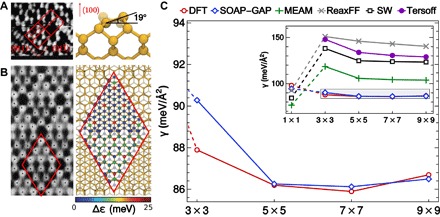
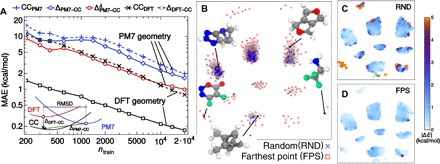
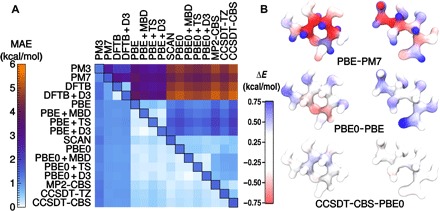
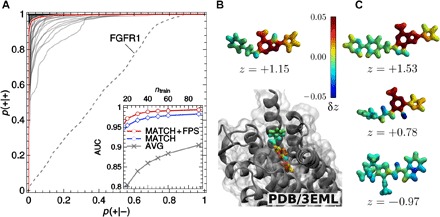
Verification
Claims the paper makes
The claims and statistics of this paper haven’t been checked yet.
Free: it reads the open-access text and checks the first 5 claims that cite a source we can check. Create a free account to check every claim.
Claims other papers make about this one
Each is checked against this paper’s own text: does it say what the citing paper says it does?
The cited source says what the claim attributes to it.
In the citing paper
“A critical assessment of the model performance as a function of the hyperparameters makes it possible to gauge the range of interactions 104 , or the locality of the physical phenomena underlying structure-property relations 105,106 for that system.”
From Unsupervised machine learning in atomistic simulations, between predictions and understanding (2019) · cites this paper as [104]
The cited source says what the claim attributes to it.
In the citing paper
“A low-dimensional representation of a dataset can help when it comes to identifying problematic regions, and understanding how a given representation 'sees' a set of structures 58,104,111 .”
From Unsupervised machine learning in atomistic simulations, between predictions and understanding (2019) · cites this paper as [104]
In the citing paper
“Gaussian process regression (GPR) was used to generate very accurate Gaussian atomic potentials (GAP) and then to train a SOAP–GAP model within a ML framework (GPR) that achieved a 99% accurate atomic-scale properties for Si surface reconstruction, stability of molecules, and protein ligands.209”
From QSAR without borders (2020) · cites this paper as [209]
In the citing paper
“To mitigate this limitation, read-across techniques are increasingly used to estimate the properties of nanomaterials.231”
From QSAR without borders (2020) · cites this paper as [231]
Self-check
Percentages, sums and reported differences re-computed from the paper’s own numbers.
The self-check needs the paper’s full text.
Citations
Cites
Density-functional thermochemistry. III. The role of exact exchange
Becke, A. D. (1993) · The Journal of Chemical Physics · doi:10.1063/1.464913 · Cited by 103,767
Self-Consistent Equations Including Exchange and Correlation Effects
Kohn, W., & Sham, L. J. (1965) · Physical Review · doi:10.1103/physrev.140.a1133 · Cited by 64,135
Hohenberg, P., & Kohn, W. (1964) · Physical Review · doi:10.1103/physrev.136.b864 · Cited by 53,541
Stephens, P. J., Devlin, F. J., Chabalowski, C. F., & Frisch, M. J. (1994) · The Journal of Physical Chemistry · doi:10.1021/j100096a001 · Cited by 23,248
Perdew, J. P., Chevary, J. A., Vosko, S. H., Jackson, K. A., Pederson, M. R., Singh, D. J., & Fiolhais, C. (1992) · Physical Review B · doi:10.1103/physrevb.46.6671 · Cited by 22,269
Development and testing of a general amber force field
Wang, J., Wolf, R. M., Caldwell, J. W., Kollman, P. A., & Case, D. A. (2004) · Journal of Computational Chemistry · doi:10.1002/jcc.20035 · Cited by 19,506
Self-consistent molecular orbital methods. XX. A basis set for correlated wave functions
Krishnan, R., Binkley, J. S., Seeger, R., & Pople, J. A. (1980) · The Journal of Chemical Physics · doi:10.1063/1.438955 · Cited by 17,772
Perdew, J. P., Chevary, J. A., Vosko, S. H., Jackson, K. A., Pederson, M. R., Singh, D. J., & Fiolhais, C. (1993) · Physical Review B · doi:10.1103/physrevb.48.4978.2 · Cited by 17,144
First principles methods using CASTEP
Clark, S. J., Segall, M. D., Pickard, C. J., Hasnip, P. J., Probert, M. I. J., Refson, K., & Payne, M. C. (2005) · Zeitschrift für Kristallographie - Crystalline Materials · doi:10.1524/zkri.220.5.567.65075 · Cited by 14,633
The Hungarian method for the assignment problem
Kuhn, H. W. (1955) · Naval Research Logistics Quarterly · doi:10.1002/nav.3800020109 · Cited by 13,120
Cited by
Items 501–600 of 846
Sun, J., Cheng, L., & Miller, T. F. (2022) · The Journal of Chemical Physics · doi:10.1063/5.0101280 · Cited by 11
Zhang, L., Hu, W., He, M., Xu, K., & Pan, Z. (2022) · The Journal of Physical Chemistry C · doi:10.1021/acs.jpcc.2c00859 · Cited by 11
State-of-the-art practices to upgrade biomass fast pyrolysis derived bio-oil
Ansari, K. B., Banerjee, A., Danish, M., Hassan, S. Z., Sahayaraj, D. V., Khan, M. S., Phan, T. T. N., & Trịnh, Q. T. (2022) · Elsevier eBooks · doi:10.1016/b978-0-323-85586-0.00003-2 · Cited by 11
Superconductor Discovery in the Emerging Paradigm of Materials Informatics
Huan, T. D., Dam, H., Künneth, C., Tuoc, V. N., & Kino, H. (2024) · Chemistry of Materials · doi:10.1021/acs.chemmater.4c01757 · Cited by 11
Fast proper orthogonal descriptors for many-body interatomic potentials
Nguyen, N. C. (2023) · Physical review. B./Physical review. B · doi:10.1103/physrevb.107.144103 · Cited by 11
Coarse-Graining and Forecasting Atomic Material Simulations with Descriptors
Swinburne, T. D. (2023) · Physical Review Letters · doi:10.1103/physrevlett.131.236101 · Cited by 11
A Perspective on Deep Learning for Molecular Modeling and Simulations
Zhang, J., Lei, Y.-K., Zhang, Z., Chang, J., Li, M., Han, X., Yang, L., Yang, Y., & Gao, Y. Q. (2020) · The Journal of Physical Chemistry B · doi:10.1021/acs.jpcb.0c04473 · Cited by 11
Fonseca, G., Poltavsky, I., & Tkatchenko, A. (2023) · Journal of Chemical Theory and Computation · doi:10.1021/acs.jctc.3c00985 · Cited by 11
Operator Quantum Machine Learning: Navigating the Chemical Space of Response Properties
Christensen, A. S., & von Lilienfeld, O. A. (2019) · CHIMIA International Journal for Chemistry · doi:10.2533/chimia.2019.1028 · Cited by 11
Conte, R., Botti, G., & Ceotto, M. (2019) · Vibrational Spectroscopy · doi:10.1016/j.vibspec.2019.103015 · Cited by 11
GradNav: Accelerated Exploration of Potential Energy Surfaces with Gradient-Based Navigation
Ock, J., Mollaei, P., & Farimani, A. B. (2024) · Journal of Chemical Theory and Computation · doi:10.1021/acs.jctc.4c00316 · Cited by 10
Bardiani, J., Sbarufatti, C., & Manes, A. (2025) · Archives of Computational Methods in Engineering · doi:10.1007/s11831-025-10318-4 · Cited by 10
Supervised learning of few dirty bosons with variable particle number
Mujal, P., Miguel, À. M., Polls, A., Juliá-Díaz, B., & Pilati, S. (2021) · SciPost Physics · doi:10.21468/scipostphys.10.3.073 · Cited by 10
Learning Protein-Ligand Binding Affinity with Atomic Environment VectorsPreprint
Meli, R., Anighoro, A., Bodkin, M. J., Morris, G. M., & Biggin, P. C. (2020) · ChemRxiv · doi:10.26434/chemrxiv.13469625 · Cited by 10
Ultrahigh Throughput Protein–Ligand Docking with Deep Learning
Clyde, A. (2021) · Methods in molecular biology · doi:10.1007/978-1-0716-1787-8_13 · Cited by 10
Chang, C.-M. (2024) · Modelling and Simulation in Materials Science and Engineering · doi:10.1088/1361-651x/ad2540 · Cited by 10
Predicting polarizabilities of silicon clusters using local chemical environments
Zauchner, M. G., Forno, S. D., Cśanyi, G., Horsfield, A. P., & Lischner, J. (2021) · Machine Learning Science and Technology · doi:10.1088/2632-2153/ac2cfe · Cited by 10
Yasuda, I., Kobayashi, Y., Endo, K., Hayakawa, Y., Fujiwara, K., Yajima, K., Arai, N., & Yasuoka, K. (2023) · ACS Applied Materials & Interfaces · doi:10.1021/acsami.2c16366 · Cited by 10
Grazioli, G., Roy, S., & Butts, C. T. (2019) · Journal of Chemical Information and Modeling · doi:10.1021/acs.jcim.9b00134 · Cited by 10
Chen, K., Wu, Y., Li, H., Ma, L., Ye, J., Zhang, X., Rong, J., Yu, X., & Yang, Y. (2026) · Journal of Materials Chemistry A · doi:10.1039/d5ta08910g · Cited by 10
Towards exact molecular dynamics simulations with invariant machine-learned models
Chmiela, S. (2019) · DepositOnce · doi:10.14279/depositonce-8635 · Cited by 10
Thürlemann, M., Pultar, F., Gordiy, I., Ruijsenaars, E., & Riniker, S. (2026) · ChemRxiv · doi:10.26434/chemrxiv-2026-kx9w0 · Cited by 10
Nishio, K., Shibata, K., & Mizoguchi, T. (2024) · Applied Physics Express · doi:10.35848/1882-0786/ad2a06 · Cited by 9
Machine Learning Transition Temperatures from 2D Structure
Sifain, A. E., Rice, B. M., Yalkowsky, S. H., & Barnes, B. C. (2019) · Journal of Molecular Graphics and Modelling · doi:10.1016/j.jmgm.2021.107848 · Cited by 9
Fabregat, R., Fabrizio, A., Engel, E. A., Meyer, B., Jurásková, V., Ceriotti, M., & Corminbœuf, C. (2022) · Journal of Chemical Theory and Computation · doi:10.1021/acs.jctc.1c00813 · Cited by 9
Self-citationElectronic Descriptors for Supervised Spectroscopic Predictions
de Armas-Morejón, C. M., Montero, L. A., Rubio, Á., & Jornet-Somoza, J. (2023) · Journal of Chemical Theory and Computation · doi:10.1021/acs.jctc.2c01039 · Cited by 9
Mapping the Room-Temperature Dynamic Stabilities of Inorganic Halide Double Perovskites
Yang, J., Fan, J., & Li, S. (2022) · Chemistry of Materials · doi:10.1021/acs.chemmater.2c01779 · Cited by 9
Understanding Nanoscale Topology–Adhesion Relationships Via Support Vector Regression
Khatri, N. R., Ji, X., Minsky, H. K., & Jiang, Y. (2021) · Advanced Materials Interfaces · doi:10.1002/admi.202100175 · Cited by 9
Fu, W., Mo, Y., Yi, X., Liu, C., Zhou, F., Wang, Y., Zhou, J., & Zhang, Y. (2024) · Journal of Chemical Theory and Computation · doi:10.1021/acs.jctc.3c01181 · Cited by 9
Investigating the Hydroxyl Reorientation in Hydroxyapatite Using Machine Learning Potentials
Wang, J., Wang, X., Zhu, H., & Xu, D. (2023) · The Journal of Physical Chemistry C · doi:10.1021/acs.jpcc.3c02426 · Cited by 9
Trajectory-based machine learning method and its application to molecular dynamics
Han, R., & Luber, S. (2020) · Molecular Physics · doi:10.1080/00268976.2020.1788189 · Cited by 9
Maximizing efficiency of dataset compression for machine learning potentials with information theory
Yu, B., Lordi, V., & Schwalbe‐Koda, D. (2026) · The Journal of Chemical Physics · doi:10.1063/5.0312057 · Cited by 9
Chemically Transferable Electronic Coarse Graining for Polythiophenes
Yu, Z., & Jackson, N. E. (2024) · Journal of Chemical Theory and Computation · doi:10.1021/acs.jctc.4c00804 · Cited by 9
Dézaphie, A., Lapointe, C., Goryaeva, A. M., Creuze, J., & Marinica, M. (2024) · Computational Materials Science · doi:10.1016/j.commatsci.2024.113459 · Cited by 9
Active Learning for Conditional Inverse Design with Crystal Generation and Foundation Atomic ModelsPreprint
Li, Z., Liu, S., Ye, B., Srolovitz, D. J., & Wen, T. (2025) · arXiv (Cornell University) · doi:10.48550/arxiv.2502.16984 · Cited by 9
Li, Z., Han, L., Ouyang, T., Cao, J., Yao, Y., & Wei, X. (2025) · Physical Review Materials · doi:10.1103/physrevmaterials.9.033804 · Cited by 9
Learning radical excited states from sparse data
Shen, J., Walker, L. E., Ma, K., Green, J. D., Bronstein, H. A., Butler, K. T., & Hele, T. J. H. (2025) · Chemical Science · doi:10.1039/d5sc04276c · Cited by 9
Insight into Quantum Computing and Deep Learning Approach for Drug Design
Paliwal, D., Gudhanti, S. N. K. R., Yadav, D., & Raj, P. (2023) · Letters in Drug Design & Discovery · doi:10.2174/1570180820666230427151812 · Cited by 8
Consistent wide-range equation of state of silicon by a unified first-principles method
Gao, C., Liu, X., Zhang, S., Kang, W., Zhang, P., & He, X. T. (2023) · Physical review. B./Physical review. B · doi:10.1103/physrevb.107.165150 · Cited by 8
Lin, J., Tamura, R., Futamura, Y., Sakurai, T., & Miyazaki, T. (2023) · Physical Chemistry Chemical Physics · doi:10.1039/d3cp01922e · Cited by 8
Machine Learning at the Atomic Scale
Musil, F., & Ceriotti, M. (2019) · CHIMIA International Journal for Chemistry · doi:10.2533/chimia.2019.972 · Cited by 8
Self-citationGraph-based descriptors for condensed matter
Wang, A., & Sosso, G. C. (2025) · Physical review. E · doi:10.1103/physreve.111.064302 · Cited by 8
Advancing descriptor search in materials science: feature engineering and selection strategies
Hoock, B., Rigamonti, S., & Draxl, C. (2022) · New Journal of Physics · doi:10.1088/1367-2630/aca49c · Cited by 8
Poelking, C. R., Faber, F. A., & Cheng, B. (2022) · Machine Learning Science and Technology · doi:10.1088/2632-2153/ac4d11 · Cited by 8
Self-citationDiscovery of New Plasmonic Metals via High‐Throughput Machine Learning
Shapera, E. P., & Schleife, A. (2022) · Advanced Optical Materials · doi:10.1002/adom.202200158 · Cited by 8
Woodley, S. M., Lazauskas, T., Illingworth, M., Carter, A. C., & Sokol, A. A. (2018) · Faraday Discussions · doi:10.1039/c8fd00060c · Cited by 8
Choi, J., Jun, B., & Jung, Y. (2025) · Chemical Engineering Journal · doi:10.1016/j.cej.2025.163847 · Cited by 8
Boulangeot, N., Brix, F., Sur, F., & Gaudry, É. (2024) · Journal of Chemical Theory and Computation · doi:10.1021/acs.jctc.4c00367 · Cited by 8
Exploring parameter dependence of atomic minima with implicit differentiation
Maliyov, I., Grigorev, P., & Swinburne, T. D. (2025) · npj Computational Materials · doi:10.1038/s41524-024-01506-0 · Cited by 8
Poelking, C. R., Chessari, G., Murray, C. W., Hall, R. J., Colwell, L. J., & Verdonk, M. L. (2022) · arXiv (Cornell University) · doi:10.48550/arxiv.2204.06348 · Cited by 8
Self-citationSymmetry Breaking in the Superionic Phase of Silver Iodide
Hajibabaei, A., Baldwin, W. J., Cśanyi, G., & Cox, S. J. (2025) · Physical Review Letters · doi:10.1103/physrevlett.134.026306 · Cited by 8
Nagai, T., Kikkawa, N., Jinnouchi, R., Kimura, M., & Okazaki, S. (2025) · Journal of Chemical Theory and Computation · doi:10.1021/acs.jctc.4c01552 · Cited by 7
Water Phase Diagram from a General-Purpose Atomic Cluster Expansion Potential
Ibrahim, E., Lysogorskiy, Y. V., Drautz, R., & Piaggi, P. M. (2026) · Journal of Chemical Theory and Computation · doi:10.1021/acs.jctc.6c00094 · Cited by 7
Thermal transport in C6N7 monolayer: a machine learning based molecular dynamics study
Wan, J., Li, G., Guo, Z., & Qin, H. (2024) · Journal of Physics Condensed Matter · doi:10.1088/1361-648x/ad81a6 · Cited by 7
Fong, A., McPherson, A., Rossi, M. S., & Rajan, K. (2024) · MRS Energy & Sustainability · doi:10.1557/s43581-024-00122-1 · Cited by 7
Rapid discovery of stable materials by coordinate-free coarse graining
Goodall, R. E. A., Parackal, A. S., Faber, F. A., Armiento, R., & Lee, A. A. (2022) · Zenodo (CERN European Organization for Nuclear Research) · doi:10.5281/zenodo.6344994 · Cited by 7
Lifelong Machine Learning Potentials for Chemical Reaction Network Explorations
Eckhoff, M., & Reiher, M. (2025) · Journal of Chemical Theory and Computation · doi:10.1021/acs.jctc.5c01127 · Cited by 7
A fuzzy classification framework to identify equivalent atoms in complex materials and molecules
Lai, K. C., Matera, S., Scheurer, C., & Reuter, K. (2023) · The Journal of Chemical Physics · doi:10.1063/5.0160369 · Cited by 7
Liu, Y., Liu, X., & Cao, B. (2024) · Journal of Physics Condensed Matter · doi:10.1088/1361-648x/ad2584 · Cited by 7
Many-Body Basis Set Amelioration Method for Incremental Full Configuration Interaction
Hatch, J., Rask, A. E., Dang, D., & Zimmerman, P. M. (2025) · The Journal of Physical Chemistry A · doi:10.1021/acs.jpca.5c01521 · Cited by 7
Locally spontaneous dynamic oxygen migration on biphenylene: a DFT study
Situ, B., Yan, Z., Huo, R., Wang, K., Chen, L., Zhang, Z., Zhao, L. R., & Tu, Y. (2023) · Physical Chemistry Chemical Physics · doi:10.1039/d3cp00925d · Cited by 7
Hao, S., Xia, T., Zhang, R., & Guo, M. C. (2024) · Scientific Reports · doi:10.1038/s41598-024-79126-3 · Cited by 7
Representing spherical tensors with scalar-based machine-learning models
Domina, M., Bigi, F., Pegolo, P., & Ceriotti, M. (2025) · The Journal of Chemical Physics · doi:10.1063/5.0284802 · Cited by 7
Self-citationPhysics-Guided Descriptors for Prediction of Structural Polymorphs
Grosso, B. F., Spaldin, N. A., & Tehrani, A. M. (2022) · The Journal of Physical Chemistry Letters · doi:10.1021/acs.jpclett.2c01876 · Cited by 7
Goswami, R. R., & Jónsson, H. (2026) · ChemPhysChem · doi:10.1002/cphc.202500730 · Cited by 7
Quantifying local point-group-symmetry order in complex particle systems
Fijan, D., Rashidi, M. R. W., Bradley, J., & Glotzer, S. C. (2026) · The Journal of Chemical Physics · doi:10.1063/5.0312579 · Cited by 7
From GAP to ACE to MACEPreprint
Bernstein, N. (2024) · arXiv (Cornell University) · doi:10.25950/67c762ea · Cited by 7
Self-citationAdvancements in characterization of protein dynamics with machine learning
Madani, M., & Tarakanova, A. (2026) · npj Soft Matter · doi:10.1038/s44431-026-00025-w · Cited by 6
Artificial intelligence–enabled fuel design
Yalamanchi, K. K., Nicolle, A., & Sarathy, S. M. (2022) · Elsevier eBooks · doi:10.1016/b978-0-323-88457-0.00011-4 · Cited by 6
Ishimoto, T., Tsukada, S., Wakitani, S., Sato, K., Saito, D., Nakanishi, Y., Takase, S., Hamada, T., Ohshita, J., & Kai, H. (2020) · RSC Advances · doi:10.1039/d0ra02909b · Cited by 6
Andritsos, E. I., & Rossi, K. (2022) · International Journal of Quantum Chemistry · doi:10.1002/qua.26956 · Cited by 6
Structure-driven prediction of magnetic order in uranium compounds
Broyles, C., Charles, W., & Ran, S. (2024) · Physical Review Materials · doi:10.1103/physrevmaterials.8.114405 · Cited by 6
Lee, S., Ermanis, K., & Goodman, J. M. (2022) · Chemical Science · doi:10.1039/d1sc06324c · Cited by 6
Deep-learning atomistic semi-empirical pseudopotential model for nanomaterials
Lin, K., O’Rourke, M. J., & Rabani, E. (2025) · npj Computational Materials · doi:10.1038/s41524-025-01862-5 · Cited by 6
Active learning of molecular data for task-specific objectives
Ghosh, K., Todorović, M., Vehtari, A., & Rinke, P. (2025) · The Journal of Chemical Physics · doi:10.1063/5.0229834 · Cited by 6
Qi, R., Zhang, P., Ma, H., Qin, Y., & Wang, X. (2025) · Applied Surface Science · doi:10.1016/j.apsusc.2025.165199 · Cited by 6
Quantum Machine Learning with Response Operators in Chemical Compound Space
Faber, F. A., Christensen, A. S., & von Lilienfeld, O. A. (2020) · Lecture notes in physics · doi:10.1007/978-3-030-40245-7_8 · Cited by 6
Optimizing the architecture of Behler–Parrinello neural network potentials
Kývala, L., & Dellago, C. (2023) · The Journal of Chemical Physics · doi:10.1063/5.0167260 · Cited by 6
Black box vs gray box: Comparing GAP and GPrep-DFTB for ruthenium and ruthenium oxide
Panosetti, C., Lee, Y., Samtsevich, A. I., & Scheurer, C. (2023) · The Journal of Chemical Physics · doi:10.1063/5.0141233 · Cited by 6
Wróbel, J. S., Zhong, A., Goryaeva, A. M., Manh, D. N., Poisvert, A. E., Athènes, M., & Marinica, M. (2025) · Physical review. B./Physical review. B · doi:10.1103/6xkw-m6s3 · Cited by 6
Large-scale simulation of thermal conductivity in CaSiO3 perovskite with neuroevolution potential
Xu, F., Wang, D., Li, Z., Song, H. K., Liu, L., Geng, H.-Y., Hu, J., & Chen, X.-R. (2024) · Applied Physics Letters · doi:10.1063/5.0217468 · Cited by 6
Modeling prebiotic chemistries with quantum accuracy at classical costs
Tiwary, P. (2024) · Proceedings of the National Academy of Sciences · doi:10.1073/pnas.2408742121 · Cited by 6
Abriata, L. A. (2018) · arXiv (Cornell University) · doi:10.48550/arxiv.1806.08332 · Cited by 6
Deep learning of spatial densities in inhomogeneous correlated quantum systemsPreprint
Blania, A., Herbig, S., Dechent, F., van Nieuwenburg, E., & Marquardt, F. (2022) · arXiv (Cornell University) · doi:10.48550/arxiv.2211.09050 · Cited by 6
Quantum dynamics through a handful of semiclassical trajectories
Aieta, C., Cazzaniga, M., Moscato, D., Lanzi, C., Bocchi, L., Costanza, M. M., Ceotto, M., & Conte, R. (2025) · RENDICONTI LINCEI · doi:10.1007/s12210-025-01326-4 · Cited by 6
Kürten, L., Castagnède, A., Smallenburg, F., & Royall, C. P. (2026) · Science Advances · doi:10.1126/sciadv.aec8906 · Cited by 6
How Robust Is the Reversible Steric Shielding Strategy for Photoswitchable Organocatalysts?
Gallarati, S., Fabregat, R., Jurásková, V., Inizan, T. J., & Corminbœuf, C. (2022) · The Journal of Organic Chemistry · doi:10.1021/acs.joc.1c02991 · Cited by 6
Utility-Scale Quantum Computational Chemistry
Castaldo, D., & Reiher, M. (2026) · The Journal of Physical Chemistry Letters · doi:10.1021/acs.jpclett.6c00888 · Cited by 5
Hoffmann, R., & Malrieu, J. (2020) · Angewandte Chemie · doi:10.1002/ange.201910283 · Cited by 5
Machine learning S-wave scattering phase shifts bypassing the radial Schrödinger equation
Romualdi, A., & Marchetti, G. (2021) · The European Physical Journal B · doi:10.1140/epjb/s10051-021-00261-1 · Cited by 5
Ibrahim, A., Wines, D., & Ataca, C. (2024) · The Journal of Physical Chemistry C · doi:10.1021/acs.jpcc.3c06168 · Cited by 5
Surrogate-Based Black-Box Optimization Method for Costly Molecular Properties
Leguy, J., Duval, B., Mota, B. D., & Cauchy, T. (2021) · IEEE International Conference on Tools with Artificial Intelligence (ICTAI) · doi:10.1109/ictai52525.2021.00124 · Cited by 5
Impact of Static Distortion Waves on Superlubricity
Hörmann, L., Cartus, J. J., & Hofmann, O. T. (2023) · ACS Omega · doi:10.1021/acsomega.3c05044 · Cited by 5
Neyyathala, A., Fako, E., De, S., Gashnikova, D., Maurer, F., Grunwaldt, J., Schunk, S. A., & Hanf, S. (2024) · Small Structures · doi:10.1002/sstr.202400260 · Cited by 5
Self-citationMachine Learning Guided the Discovery of Superionic Delafossite AgFeO 2
Zhang, Z., Li, J., Lv, Y., Liu, Y., Yuan, J., Lin, J., & Wang, X. (2025) · Inorganic Chemistry · doi:10.1021/acs.inorgchem.5c01235 · Cited by 5
Colloidal systems as experimental platforms for physics-informed machine learning
Kang, N., Joo, Y., An, H., & Hwang, H. (2025) · Nanoscale Horizons · doi:10.1039/d5nh00568j · Cited by 5
In silico investigation of Cu(In,Ga)Se 2 -based solar cells
Mirhosseini, H., Raghupathy, R. K. M., Sahoo, S. K., Wiebeler, H., Chugh, M., & Kühne, T. D. (2020) · Physical Chemistry Chemical Physics · doi:10.1039/d0cp04712k · Cited by 5
Machine learning for materials classifications from images
Zhang, L., & Li, Z. (2022) · Journal of Physics Conference Series · doi:10.1088/1742-6596/2369/1/012081 · Cited by 5
Scalable learning of potentials to predict time-dependent Hartree–Fock dynamics
Bhat, H. S., Gupta, P., & Isborn, C. M. (2024) · APL Machine Learning · doi:10.1063/5.0232683 · Cited by 5
Zhang, P., Liu, Z., Wang, X., Mi, R., Pang, Y., Pan, F., Li, J., Wang, Z., Wang, W., & Luo, K. H. (2026) · Chemical Engineering Journal · doi:10.1016/j.cej.2026.176856 · Cited by 5
Metadata
- Authors
- Bartók, A. P., De, S., Poelking, C., Bernstein, N., Kermode, J. R., Csányi, G., & Ceriotti, M.
- Affiliations
- Rutherford Appleton Laboratory (GB)
- École Polytechnique Fédérale de Lausanne (CH)
- University of Cambridge (GB)
- United States Naval Research Laboratory (US)
- University of Warwick (GB)
- Engineering Laboratory, University of Cambridge, Cambridge, UK.
- Corresponding author
- Ceriotti, Michele
- ORCID
- Venue
- Science Advances
- Published
- 2017-12
- Volume
- 3
- Issue
- 12
- Pages
- e1701816-e1701816
- ISSN
- 2375-2548 (ISSN-L)
- PMC
- PMC5729016
- OpenAlex
- W2620687153
- Cited by
- 764
- References
- 71
- Citations by year
- 2026: 43 · 2025: 79 · 2024: 67 · 2023: 91 · 2022: 96 · 2021: 114 · 2020: 130 · 2019: 90 · 2018: 52 · 2017: 2
- FWCI
- 31.56
- Type
- journal article
- Language
- en
- Open access
- gold
- doi.org
- Licence
- cc-by-nc
- Locations
- Science Advances (publishedVersion, cc-by-nc)
- PubMed Central (publishedVersion, cc-by-nc)
- PubMed (publishedVersion)
- Warwick Research Archive Portal (University of Warwick) (acceptedVersion)
- arXiv (Cornell University) (submittedVersion)
- Apollo (University of Cambridge) (submittedVersion, cc-by-nc)
- Cambridge University Engineering Department Publications Database (submittedVersion)
- Infoscience (Ecole Polytechnique Fédérale de Lausanne) (submittedVersion)
- Infoscience (Ecole Polytechnique Fédérale de Lausanne) (submittedVersion, cc-by-nc-nd)
- Science and Technology Facilities Council (submittedVersion)
- arXiv (Cornell University)
- Apollo
- Funders
- Office of Naval Research (award361580, U.S. Naval Research Laboratory, core basic research program)
- Engineering and Physical Sciences Research Council (award324327, EP/L014742/1, EP/J010847/1 and EP/J022012/1, award324329, EP/L014742/1, EP/P002188/1, award361574, EP/M022501/1, award361582, EP/K013564/1, EP/P022561/1)
- Swiss National Science Foundation (award324328, NCCR MARVEL)
- Leverhulme Trust (award361572, Leverhulme Early Career Fellowship)
- Isaac Newton Trust (award361573)
- European Research Council (award324326, 677013-HBMAP, award324330, 67658 - NOMAD)
- Topics
- Physical Sciences › Materials Science › Materials Chemistry › Machine Learning in Materials Science
- Physical Sciences › Physics and Astronomy › Atomic and Molecular Physics, and Optics › Advanced Chemical Physics Studies
- Life Sciences › Pharmacology, Toxicology and Pharmaceutics › Drug Discovery › Computational Drug Discovery Methods
- Keywords
- machine learning, molecular stability, atomistic modeling, local chemical environment, silicon surface reconstruction, protein-ligand binding, potential energy surface, quantum effects
About these checks
Registry, retraction, Cites and statistics results are computed, not judged, with one exception: a printed reference that no index lists is read once by a model before it counts as a citation error. Claims are extracted by a model and kept only when their quote appears verbatim in the text; each cited source is then checked, with a model’s help, for whether it says what the claim relies on. Those verdicts can be wrong — read the claim’s quote and the cited source before relying on one.
Statistics and arithmetic are recomputed, not judged.
Confidence bands are shown only for fields calibrated on our annotated test set. None is calibrated yet, so no band is shown.
What counts as a claim ›How we measure confidence ›How we check this ›
Are you an author, or do you see a problem with this page? Request a review
Data sources
Bibliographic data: Semantic Scholar, OpenAlex, Crossref.
Contains information from the Semantic Scholar Academic Graph Datasets, made available under the ODC Attribution License (ODC-BY 1.0).
Semantic Scholar’s data is described in: Kinney, R., et al. (2023). The Semantic Scholar Open Data Platform. arXiv:2301.10140.
