

Brain neural patterns and the memory function of sleep
Open accessThe DOI matches its Crossref record; 48 of the 48 references it cites were found in a registry or an index.
Abstract
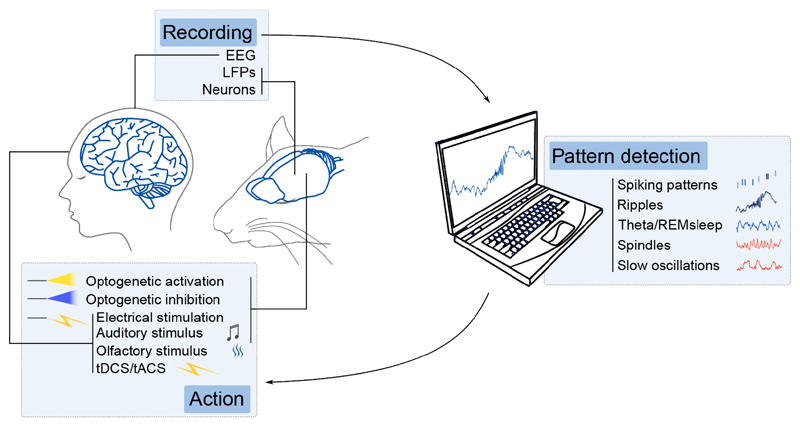
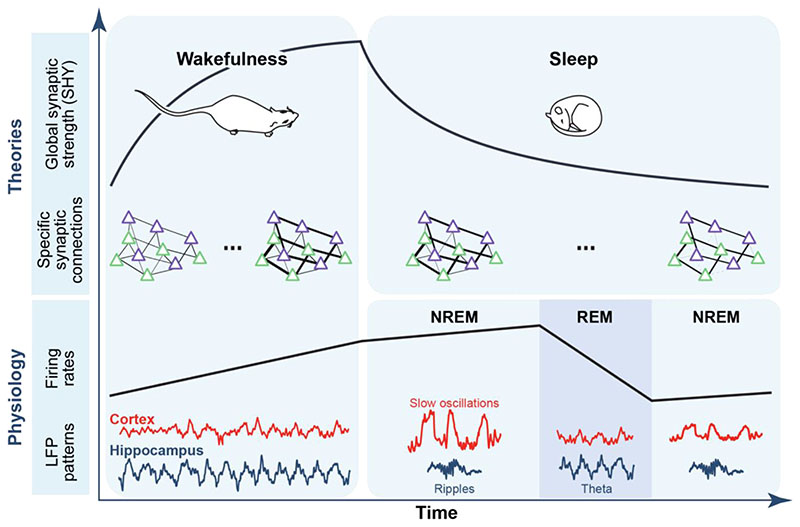
Sleep is crucial for healthy cognition, including memory. The two main phases of sleep, REM (rapid eye movement) and non-REM sleep, are associated with characteristic electrophysiological patterns that are recorded using surface and intracranial electrodes. These patterns include sharp-wave ripples, cortical slow oscillations, delta waves, and spindles during non-REM sleep and theta oscillations during REM sleep. They reflect the precisely timed activity of underlying neural circuits. Here, we review how these electrical signatures have been guiding our understanding of the circuits and processes sustaining memory consolidation during sleep, focusing on hippocampal theta oscillations and sharp-wave ripples and how they coordinate with cortical patterns. Finally, we highlight how these brain patterns could also sustain sleep-dependent homeostatic processes and evoke several potential future directions for research on the memory function of sleep.
Overview
The claims and statistics of this paper haven’t been checked yet.
Free: it reads the open-access text and checks the first 5 claims that cite a source we can check. Create a free account to check every claim.
Integrity signals
Registry
Cites
Statistics
Figures

Verification
Claims the paper makes
The claims and statistics of this paper haven’t been checked yet.
Free: it reads the open-access text and checks the first 5 claims that cite a source we can check. Create a free account to check every claim.
Self-check
Percentages, sums and reported differences re-computed from the paper’s own numbers.
The self-check needs the paper’s full text.
Citations
Cites
Reactivation of hippocampal ensemble memories during sleep
Wilson, M. A., & McNaughton, B. L. (1994) · Science · doi:10.1126/science.8036517 · Cited by 3,118
Boosting slow oscillations during sleep potentiates memory
Marshall, L., Helgadóttir, H., Mölle, M., & Born, J. (2006) · Nature · doi:10.1038/nature05278 · Cited by 1,792
Hippocampal sharp wave-ripple: A cognitive biomarker for episodic memory and planning
Buzsáki, G. (2015) · Hippocampus · doi:10.1002/hipo.22488 · Cited by 1,759
Two-stage model of memory trace formation: A role for “noisy” brain states
Buzsáki, G. (1989) · Neuroscience · doi:10.1016/0306-4522(89)90423-5 · Cited by 1,709
Selective suppression of hippocampal ripples impairs spatial memory
Girardeau, G., Benchenane, K., Wiener, S. I., Buzsáki, G., & Zugaro, M. B. (2009) · Nature Neuroscience · doi:10.1038/nn.2384 · Cited by 1,560
Self-citationMechanisms of systems memory consolidation during sleep
Klinzing, J. G., Niethard, N., & Born, J. (2019) · Nature Neuroscience · doi:10.1038/s41593-019-0467-3 · Cited by 1,176
Temporally structured replay of awake hippocampal ensemble activity during rapid eye movement sleep
Louie, K., & Wilson, M. A. (2001) · Neuron · doi:10.1016/s0896-6273(01)00186-6 · Cited by 1,148
Disruption of ripple‐associated hippocampal activity during rest impairs spatial learning in the rat
Ego‐Stengel, V., & Wilson, M. A. (2010) · Hippocampus · doi:10.1002/hipo.20707 · Cited by 842
Cortical firing and sleep homeostasis
Vyazovskiy, V. V., Olcese, U., Lazimy, Y. M., Faraguna, U., Esser, S. K., Williams, J. C., Cirelli, C., & Tononi, G. (2009) · Neuron · doi:10.1016/j.neuron.2009.08.024 · Cited by 740
Causal evidence for the role of REM sleep theta rhythm in contextual memory consolidation
Boyce, R., Glasgow, S. D., Williams, S., & Adamantidis, A. (2016) · Science · doi:10.1126/science.aad5252 · Cited by 696
Hippocampo-cortical coupling mediates memory consolidation during sleep
Maingret, N., Girardeau, G., Todorova, R., Goutierre, M., & Zugaro, M. (2016) · Nature Neuroscience · doi:10.1038/nn.4304 · Cited by 667
Self-citationUltrastructural evidence for synaptic scaling across the wake/sleep cycle
de Vivo, L., Bellesi, M., Marshall, W., Bushong, E. A., Ellisman, M. H., Tononi, G., & Cirelli, C. (2017) · Science · doi:10.1126/science.aah5982 · Cited by 574
Latchoumane, C.-F. V., Ngo, H.-V. V., Born, J., & Shin, H.-S. (2017) · Neuron · doi:10.1016/j.neuron.2017.06.025 · Cited by 561
REM sleep selectively prunes and maintains new synapses in development and learning
Li, W., Ma, L., Yang, G., & Gan, W.-B. (2017) · Nature Neuroscience · doi:10.1038/nn.4479 · Cited by 543
Hippocampus leads ventral striatum in replay of place-reward information
Lansink, C. S., Goltstein, P. M., Lankelma, J. V., McNaughton, B. L., & Pennartz, C. M. A. (2009) · PLoS Biology · doi:10.1371/journal.pbio.1000173 · Cited by 400
A cortical-hippocampal-cortical loop of information processing during memory consolidation
Rothschild, G., Eban, E., & Frank, L. M. (2017) · Nature Neuroscience · doi:10.1038/nn.4457 · Cited by 387
Theta and gamma coordination of hippocampal networks during waking and rapid eye movement sleep.
Montgomery, S. M., Sirota, A., & Buzsaki, G. (2008) · Journal of Neuroscience · doi:10.1523/jneurosci.1227-08.2008 · Cited by 371
REM sleep reorganizes hippocampal excitability
Grosmark, A. D., Mizuseki, K., Pastalkova, E., Diba, K., & Buzsáki, G. (2012) · Neuron · doi:10.1016/j.neuron.2012.08.015 · Cited by 344
Coherent amygdalocortical theta promotes fear memory consolidation during paradoxical sleep
Popa, D., Duvarci, S., Popescu, A. T., Léna, C., & Paré, D. (2010) · Proceedings of the National Academy of Sciences · doi:10.1073/pnas.0913016107 · Cited by 338
van de Ven, G. M., Trouche, S., McNamara, C. G., Allen, K., & Dupret, D. (2016) · Neuron · doi:10.1016/j.neuron.2016.10.020 · Cited by 320
Internally organized mechanisms of the head direction sense
Peyrache, A., Lacroix, M. M., Petersen, P. C., & Buzsáki, G. (2015) · Nature Neuroscience · doi:10.1038/nn.3968 · Cited by 285
Hippocampal CA2 sharp-wave ripples reactivate and promote social memory
Oliva, A., Fernández-Ruiz, A., Leroy, F., & Siegelbaum, S. A. (2020) · Nature · doi:10.1038/s41586-020-2758-y · Cited by 268
Reactivations of emotional memory in the hippocampus-amygdala system during sleep
Girardeau, G., Inema, I., & Buzsáki, G. (2017) · Nature Neuroscience · doi:10.1038/nn.4637 · Cited by 266
Self-citationHippocampal ripples down-regulate synapses
Norimoto, H., Makino, K., Gao, M., Shikano, Y., Okamoto, K., Ishikawa, T., Sasaki, T., Hioki, H., Fujisawa, S., & Ikegaya, Y. (2018) · Science · doi:10.1126/science.aao0702 · Cited by 262
REM sleep-active MCH neurons are involved in forgetting hippocampus-dependent memories
Izawa, S., Chowdhury, S., Miyazaki, T., Mukai, Y., Ono, D., Inoue, R., Ohmura, Y., Mizoguchi, H., Kimura, K., Yoshioka, M., et al. (2019) · Science · doi:10.1126/science.aax9238 · Cited by 224
Detecting cell assemblies in large neuronal populations
Lopes-dos-Santos, V., Ribeiro, S., & Tort, A. B. L. (2013) · Journal of Neuroscience Methods · doi:10.1016/j.jneumeth.2013.04.010 · Cited by 184
Self-citationLopes-dos-Santos, V., van de Ven, G. M., Morley, A., Trouche, S., Campo-Urriza, N., & Dupret, D. (2018) · Neuron · doi:10.1016/j.neuron.2018.09.031 · Cited by 180
Self-citationThe content of hippocampal “replay”
Pfeiffer, B. E. (2020) · Hippocampus · doi:10.1002/hipo.22824 · Cited by 178
Assembly-specific disruption of hippocampal replay leads to selective memory deficit
Gridchyn, I., Schoenenberger, P., O’Neill, J., & Csicsvari, J. (2020) · Neuron · doi:10.1016/j.neuron.2020.01.021 · Cited by 178
Sadowski, J. H. L. P., Jones, M. W., & Mellor, J. R. (2016) · Cell Reports · doi:10.1016/j.celrep.2016.01.061 · Cited by 153
Closed-loop all-optical interrogation of neural circuits in vivo
Zhang, Z., Russell, L. E., Packer, A. M., Gauld, O. M., & Häusser, M. (2018) · Nature Methods · doi:10.1038/s41592-018-0183-z · Cited by 149
Kumar, D., Koyanagi, I., Carrier-Ruiz, A., Vergara, P., Srinivasan, S., Sugaya, Y., Kasuya, M., Yu, T.-S., Vogt, K. E., Muratani, M., et al. (2020) · Neuron · doi:10.1016/j.neuron.2020.05.008 · Cited by 141
Regulation of Hippocampal Firing by Network Oscillations during Sleep
Miyawaki, H., & Diba, K. (2016) · Current Biology · doi:10.1016/j.cub.2016.02.024 · Cited by 132
Isolated cortical computations during delta waves support memory consolidation
Todorova, R., & Zugaro, M. (2019) · Science · doi:10.1126/science.aay0616 · Cited by 130
Poe, G. R. (2017) · The Journal of Neuroscience · doi:10.1523/jneurosci.0820-16.2017 · Cited by 124
Neural reactivations during sleep determine network credit assignment
Gulati, T., Guo, L., Ramanathan, D. S., Bodepudi, A., & Ganguly, K. (2017) · Nature Neuroscience · doi:10.1038/nn.4601 · Cited by 114
Nested sequences of hippocampal assemblies during behavior support subsequent sleep replay
Drieu, C., Todorova, R., & Zugaro, M. (2018) · Science · doi:10.1126/science.aat2952 · Cited by 114
Dorsal and Ventral Hippocampal Sharp-Wave Ripples Activate Distinct Nucleus Accumbens Networks
Sosa, M., Joo, H. R., & Frank, L. M. (2020) · Neuron · doi:10.1016/j.neuron.2019.11.022 · Cited by 112
Sleep regulation of the distribution of cortical firing rates
Levenstein, D., Watson, B. O., Rinzel, J., & Buzsáki, G. (2017) · Current Opinion in Neurobiology · doi:10.1016/j.conb.2017.02.013 · Cited by 105
Hippocampal reactivation extends for several hours following novel experience
Giri, B., Miyawaki, H., Mizuseki, K., Cheng, S., & Diba, K. (2019) · The Journal of Neuroscience · doi:10.1523/jneurosci.1950-18.2018 · Cited by 99
How Targeted Memory Reactivation Promotes the Selective Strengthening of Memories in Sleep
Lewis, P. A., & Bendor, D. (2019) · Current Biology · doi:10.1016/j.cub.2019.08.019 · Cited by 91
Hippocampal coupling with cortical and subcortical structures in the context of memory consolidation
Skelin, I., Kilianski, S., & McNaughton, B. L. (2019) · Neurobiology of Learning and Memory · doi:10.1016/j.nlm.2018.04.004 · Cited by 83
Electrophysiological signatures of memory reactivation in humans
Schreiner, T., & Staudigl, T. (2020) · Philosophical Transactions of the Royal Society B: Biological Sciences · doi:10.1098/rstb.2019.0293 · Cited by 76
Coupling of hippocampal theta and ripples with pontogeniculooccipital waves
Ramirez-Villegas, J. F., Besserve, M., Murayama, Y., Evrard, H. C., Oeltermann, A., & Logothetis, N. K. (2021) · Nature · doi:10.1038/s41586-020-2914-4 · Cited by 62
de Almeida-Filho, D. G., Koike, B. D. V., Billwiller, F., Farias, K. S., de Sales, I. R. P., Luppi, P.-H., Ribeiro, S., & Queiroz, C. M. (2021) · Scientific Reports · doi:10.1038/s41598-021-91659-5 · Cited by 56
On the methods for reactivation and replay analysis
Tingley, D., & Peyrache, A. (2020) · Philosophical Transactions of the Royal Society B: Biological Sciences · doi:10.1098/rstb.2019.0231 · Cited by 48
Skelin, I., Zhang, H., Zheng, J., Ma, S., Mander, B., Kim-Mcmanus, O., Vadera, S., Knight, R., McNaughton, B., & Lin, J. J. (2021) · Proceedings of the National Academy of Sciences of the United States of America · doi:10.1073/pnas.2012075118 · Cited by 42
Lensu, S., Waselius, T., Penttonen, M., & Nokia, M. S. (2018) · Journal of Neurophysiology · doi:10.1152/jn.00696.2018 · Cited by 23
Cited by
Sleep—A brain-state serving systems memory consolidation
Brodt, S., Inostroza, M., Niethard, N., & Born, J. (2023) · Neuron · doi:10.1016/j.neuron.2023.03.005 · Cited by 343
The sleep–circadian interface: A window into mental disorders
Meyer, N., Lok, R., Schmidt, C., Kyle, S. D., McClung, C. A., Cajochen, C., Scheer, F. A. J. L., Jones, M. W., & Chellappa, S. L. (2024) · Proceedings of the National Academy of Sciences · doi:10.1073/pnas.2214756121 · Cited by 214
Sleep and circadian rhythmicity as entangled processes serving homeostasis
Franken, P., & Dijk, D.-J. (2024) · Nature Reviews Neuroscience · doi:10.1038/s41583-023-00764-z · Cited by 147
“…structure, alterations in brain oscillations during sleep, sleeping too short or too long or changes in the timing of sleep have all been associated with negative physical and mental health outcomes such as obesity, diabetes, cardiovascular disease, depression, cognitive decline and dementia 1–4 .”
Geva‐Sagiv, M., Mankin, E. A., Eliashiv, D. S., Epstein, S., Cherry, N., Kalender, G., Tchemodanov, N., Nir, Y., & Fried, I. (2023) · Nature Neuroscience · doi:10.1038/s41593-023-01324-5 · Cited by 152
The role of the hippocampus in the consolidation of emotional memories during sleep
Pronier, É., Morici, J. F., & Girardeau, G. (2023) · Trends in Neurosciences · doi:10.1016/j.tins.2023.08.003 · Cited by 109
Self-citation
Metadata
- Authors
- Girardeau, G., & Lopes-dos-Santos, V.
- Affiliations
- Inserm (FR)
- Medical Research Council Brain Network Dynamics Unit, Nuffield Department of Clinical Neurosciences, University of Oxford, Oxford OX1 3TH, UK.
- Corresponding author
- Girardeau, Gabrielle
- ORCID
- Girardeau, Gabrielle
- Venue
- Science
- Published
- 2021-10-29
- Volume
- 374
- Issue
- 6567
- Pages
- 560-564
- ISSN
- 0036-8075 (ISSN-L)
- 1095-9203
- PMC
- PMC7611961
- OpenAlex
- W3201690972
- Cited by
- 293
- References
- 48
- Citations by year
- 2026: 45 · 2025: 79 · 2024: 83 · 2023: 58 · 2022: 27 · 2021: 1
- FWCI
- 6.24
- Type
- journal article
- Language
- en
- Open access
- hybrid
- doi.org
- Licence
- cc-by
- Locations
- Science (publishedVersion, cc-by)
- PubMed (publishedVersion)
- Europe PMC (PubMed Central) (acceptedVersion, cc-by)
- PubMed Central (acceptedVersion, cc-by)
- HAL (submittedVersion, other-oa)
- Funders
- Schlumberger Foundation
- National Alliance for Research on Schizophrenia and Depression
- Fondation Fyssen
- Medical Research Council (MC_UU_00003, MC_UU_00003/4)
- Topics
- Life Sciences › Neuroscience › Cognitive Neuroscience › Sleep and Wakefulness Research
- Life Sciences › Neuroscience › Cognitive Neuroscience › Memory and Neural Mechanisms
- Life Sciences › Neuroscience › Cognitive Neuroscience › Neural dynamics and brain function
- Keywords
- sleep and memory, memory consolidation, REM sleep, NREM sleep, hippocampal theta oscillations, sharp-wave ripples, sleep spindles, delta oscillations, neural circuits, sleep homeostasis
- MeSH terms
- Memory Consolidation, Animals, Cerebral Cortex, Hippocampus, Homeostasis, Humans, Neural Pathways, Sleep Stages, Sleep, REM, Theta Rhythm, Brain Waves
About these checks
Registry, retraction, Cites and statistics results are computed, not judged, with one exception: a printed reference that no index lists is read once by a model before it counts as a citation error. Claims are extracted by a model and kept only when their quote appears verbatim in the text; each cited source is then checked, with a model’s help, for whether it says what the claim relies on. Those verdicts can be wrong — read the claim’s quote and the cited source before relying on one.
Statistics and arithmetic are recomputed, not judged.
Confidence bands are shown only for fields calibrated on our annotated test set. None is calibrated yet, so no band is shown.
What counts as a claim ›How we measure confidence ›How we check this ›
Are you an author, or do you see a problem with this page? Request a review
Data sources
Bibliographic data: Semantic Scholar, OpenAlex, Crossref.
Contains information from the Semantic Scholar Academic Graph Datasets, made available under the ODC Attribution License (ODC-BY 1.0).
Semantic Scholar’s data is described in: Kinney, R., et al. (2023). The Semantic Scholar Open Data Platform. arXiv:2301.10140.
