

Sleep deprivation and obesity in adults: a brief narrative review
Open accessThe DOI matches its Crossref record; 38 of the 38 references it cites were found in a registry or an index.
Abstract
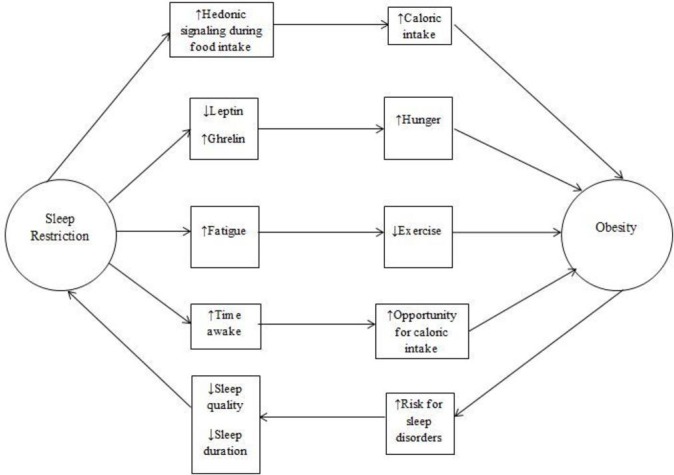
Background/aims: Obesity and sleep deprivation are two epidemics that pervade developed nations. Their rates have been steadily rising worldwide, especially in the USA. This short communication will explore the link between the two conditions and outline the proposed mechanisms behind their relationship. Methods: Studies on the topic of sleep and obesity were reviewed, and findings were used to develop a theoretical model for the biological link between short sleep duration and obesity. Results: Individuals who regularly slept less than 7 hours per night were more likely to have higher average body mass indexes and develop obesity than those who slept more. Studies showed that experimental sleep restriction was associated with increased levels of ghrelin, salt retention and inflammatory markers as well as decreased levels of leptin and insulin sensitivity. Conclusions: There may be a link between obesity and sleep deprivation. We recommend further investigations are to elucidate the potential mechanisms.
Overview
The claims and statistics of this paper haven’t been checked yet.
Free: it reads the open-access text and checks the first 5 claims that cite a source we can check. Create a free account to check every claim.
Integrity signals
Registry
Cites
Statistics
Figures
Verification
Claims the paper makes
The claims and statistics of this paper haven’t been checked yet.
Free: it reads the open-access text and checks the first 5 claims that cite a source we can check. Create a free account to check every claim.
Claims other papers make about this one
Each is checked against this paper’s own text: does it say what the citing paper says it does?
In the citing paper
“Available publications indicate that sleep may influence appetite regulation, food preferences, and the ability to maintain behaviors supporting weight reduction in individuals with excess body weight [115].”
From Dietary and Behavioral Strategies for Weight Loss and Weight Loss Maintenance: A Narrative Review (2025) · cites this paper as [115]
In the citing paper
“Shortened sleep has been associated with decreased leptin levels, increased ghrelin levels, increased appetite, and a greater tendency to choose high calorie foods [115,117,118].”
From Dietary and Behavioral Strategies for Weight Loss and Weight Loss Maintenance: A Narrative Review (2025) · cites this paper as [115]
Self-check
Percentages, sums and reported differences re-computed from the paper’s own numbers.
The self-check needs the paper’s full text.
Citations
Cites
Trends in Obesity Among Adults in the United States, 2005 to 2014
Flegal, K. M., Kruszon-Moran, D., Carroll, M. D., Fryar, C. D., & Ogden, C. L. (2016) · JAMA · doi:10.1001/jama.2016.6458 · Cited by 2,803 · cited 1×
“7% in 2013–2014.(1) By 2014, the rate of obesity had reached 35.”
Spiegel, K., Tasali, E., Penev, P., & Cauter, E. V. (2004) · Annals of Internal Medicine · doi:10.7326/0003-4819-141-11-200412070-00008 · Cited by 2,459 · cited 2×
“These changes were associated with increased hunger and appetite, especially for calorie-dense foods with high carbohydrate content.(18) Both the decrease in leptin and the increase in ghrelin seen with sleep deprivation could potentially increase food intake and contribute to weight gain.”
BackgroundObesity and Kidney Disease: Hidden Consequences of the Epidemic
Kovesdy, C. P., Furth, S. L., Zoccali, C., & on behalf of the World Kidney Day Steering Committee (2017) · American Journal of Nephrology · doi:10.1159/000458467 · Cited by 2,217
Cappuccio, F. P., Cooper, D., D'Elia, L., Strazzullo, P., & Miller, M. A. (2011) · European Heart Journal · doi:10.1093/eurheartj/ehr007 · Cited by 2,146
Meta-Analysis of Short Sleep Duration and Obesity in Children and Adults
Cappuccio, F. P., Taggart, F. M., Kandala, N.-B., Currie, A., Peile, E., Stranges, S., & Miller, M. A. (2008) · Sleep · doi:10.1093/sleep/31.5.619 · Cited by 2,076
The role of leptin and ghrelin in the regulation of food intake and body weight in humans: a review
Klok, M. D., Jakobsdottir, S., & Drent, M. L. (2007) · Obesity Reviews · doi:10.1111/j.1467-789x.2006.00270.x · Cited by 1,442 · cited 1×
“Mechanistic studies Experimental studies have shown sleep restriction to influence two important hormones, leptin and ghrelin, that regulate metabolism and energy expenditure.(16) Leptin is released from adipose tissue (fat) and acts on receptors in the hypothalamus of the brain where it inhibits appetite and promotes…”
BackgroundGangwisch, J. E., Heymsfield, S. B., Boden-Albala, B., Buijs, R. M., Kreier, F., Pickering, T. G., Rundle, A. G., Zammit, G. K., & Malaspina, D. (2006) · Hypertension · doi:10.1161/01.hyp.0000217362.34748.e0 · Cited by 1,284
Sleep loss: a novel risk factor for insulin resistance and type 2 diabetes
Spiegel, K., Knutson, K., Leproult, R., Tasali, E., & Cauter, E. V. (2005) · Journal of Applied Physiology · doi:10.1152/japplphysiol.00660.2005 · Cited by 1,175
Spiegel, K., Leproult, R., L’Hermite-Balériaux, M., Copinschi, G., Penev, P. D., & Van Cauter, E. (2004) · The Journal of Clinical Endocrinology & Metabolism · doi:10.1210/jc.2004-1003 · Cited by 1,006
Prevalence of healthy sleep duration among adults – United States, 2014
Liu, Y., Wheaton, A. G., Chapman, D. P., Cunningham, T. J., Lu, H., & Croft, J. B. (2016) · MMWR. Morbidity and Mortality Weekly Report · doi:10.15585/mmwr.mm6506a1 · Cited by 914
Panel, C. C., Watson, N. F., Badr, M. S., Belenky, G., Bliwise, D. L., Buxton, O. M., Buysse, D., Dinges, D. F., Gangwisch, J., Grandner, M. A., et al. (2015) · Sleep · doi:10.5665/sleep.4886 · Cited by 906
Self-citationInadequate Sleep as a Risk Factor for Obesity: Analyses of the NHANES I
Gangwisch, J. E., Malaspina, D., Boden-Albala, B., & Heymsfield, S. B. (2005) · Sleep · doi:10.1093/sleep/28.10.1289 · Cited by 905
A prospective study of self-reported sleep duration and incident diabetes in women
Ayas, N. T., White, D. P., Al-Delaimy, W. K., Manson, J. E., Stampfer, M. J., Speizer, F. E., Patel, S., & Hu, F. B. (2003) · Diabetes Care · doi:10.2337/diacare.26.2.380 · Cited by 883
Hasler, G., Buysse, D. J., Klaghofer, R., Gamma, A., Ajdacic, V., Eich, D., Rössler, W., & Angst, J. (2004) · Sleep · doi:10.1093/sleep/27.4.661 · Cited by 672 · cited 1×
“Additionally, prolonged short sleep durations could lead to hypertension through chronically raised blood pressure over the 24-hour period, increased salt retention and structural adaptations of the cardiovascular system.(34) In a report from the Cleveland Family Study, 614 individuals completed questionnaires about s…”
BackgroundA Prospective Study of Sleep Duration and Mortality Risk in Women
Patel, S. R., Ayas, N. T., Malhotra, M. R., White, D. P., Schernhammer, E. S., Speizer, F. E., Stampfer, M. J., & Hu, F. B. (2004) · Sleep · doi:10.1093/sleep/27.3.440 · Cited by 663
Association between Reduced Sleep and Weight Gain in Women
Patel, S. R., Malhotra, A., White, D. P., Gottlieb, D. J., & Hu, F. B. (2006) · American Journal of Epidemiology · doi:10.1093/aje/kwj280 · Cited by 617
Sleep Duration and Biomarkers of Inflammation
Patel, S. R., Zhu, X., Storfer-Isser, A., Mehra, R., Jenny, N. S., Tracy, R., & Redline, S. (2009) · Sleep · doi:10.1093/sleep/32.2.200 · Cited by 615 · cited 1×
“The conclusion of these authors was that activation of proinflammatory pathways may represent a mechanism by which sleep habits affect health.(35) While this has not been systematically studied, an additional consideration might be that sleepiness (from insufficient sleep) may lead to decreased physical activity, ther…”
BackgroundShort sleep duration and dietary intake: epidemiologic evidence, mechanisms, and health implications
Dashti, H. S., Scheer, F. A., Jacques, P. F., Lamon-Fava, S., & Ordovás, J. M. (2015) · Advances in Nutrition · doi:10.3945/an.115.008623 · Cited by 503 · cited 2×
“Considering that components of metabolism can differ depending on the time of day, it is reasonable to believe that caloric intake during these periods may result in altered metabolic responses.(23) Furthermore, women may respond differently to disruptions in sleep duration and metabolism than men, but little research…”
BackgroundSleep duration and obesity among adults: a meta-analysis of prospective studies
Wu, Y., Zhai, L., & Zhang, D. (2014) · Sleep Medicine · doi:10.1016/j.sleep.2014.07.018 · Cited by 480 · cited 1×
“These results were echoed by a meta-analysis of 11 prospective studies (197 906 participants) that also found a significant association in both sexes between short sleep duration (defined as less than 5–6 hours per night) and the risk for developing obesity.(9) The prospect of future weight gain with restricted sleep…”
ResultIs sleep duration related to obesity? A critical review of the epidemiological evidence
Marshall, N. S., Glozier, N., & Grunstein, R. R. (2008) · Sleep Medicine Reviews · doi:10.1016/j.smrv.2008.03.001 · Cited by 415 · cited 1×
“Reviewed longitudinal studies yielded similar mixed results.(15)”
Nielsen, L. S., Danielsen, K. V., & Sørensen, T. I. A. (2011) · Obesity Reviews · doi:10.1111/j.1467-789x.2010.00724.x · Cited by 338 · cited 1×
“Mixed studies One review reported that short sleep duration was consistently linked with the development of obesity in children and young adults; findings in older adults were mixed.(12) A meta-analysis of 12 studies (18 720 patients with metabolic syndrome and 70 833 healthy controls) found a significant association…”
BackgroundThe Impact of Daily Sleep Duration on Health: A Review of the Literature
Alvarez, G. G., & Ayas, N. T. (2004) · Progress in Cardiovascular Nursing · doi:10.1111/j.0889-7204.2004.02422.x · Cited by 334
The epidemiology of sleep and obesity
Ogilvie, R. P., & Patel, S. R. (2017) · Sleep Health · doi:10.1016/j.sleh.2017.07.013 · Cited by 323
Luckhaupt, S. E., Tak, S., & Calvert, G. M. (2010) · Sleep · doi:10.1093/sleep/33.2.149 · Cited by 272
Epidemiological evidence for the links between sleep, circadian rhythms and metabolism
Gangwisch, J. E. (2009) · Obesity Reviews · doi:10.1111/j.1467-789x.2009.00663.x · Cited by 262
Short sleep duration predicts risk of metabolic syndrome: A systematic review and meta-analysis
Xi, B., He, D., Zhang, M., Xue, J., & Zhou, D. (2014) · Sleep Medicine Reviews · doi:10.1016/j.smrv.2013.06.001 · Cited by 252
Bayon, V., Leger, D., Gomez-Merino, D., Vecchierini, M.-F., & Chennaoui, M. (2014) · Annals of Medicine · doi:10.3109/07853890.2014.931103 · Cited by 242
St-Onge, M.-P. (2013) · Journal of Clinical Sleep Medicine · doi:10.5664/jcsm.2348 · Cited by 220 · cited 2×
“Furthermore, women may respond differently to disruptions in sleep duration and metabolism than men, but little research exists on this topic.(21) Cross-sectional and longitudinal epidemiological studies have also shown associations between short sleep duration and diabetes,(24) 25 hypertension,(26) 27 cardiovascular…”
BackgroundWilliams, C. J., Hu, F. B., Patel, S. R., & Mantzoros, C. S. (2007) · Diabetes Care · doi:10.2337/dc06-2107 · Cited by 169
Tasali, E., Chapotot, F., Wroblewski, K., & Schoeller, D. (2014) · Appetite · doi:10.1016/j.appet.2014.05.021 · Cited by 135
Xiao, Q., Arem, H., Moore, S. C., Hollenbeck, A. R., & Matthews, C. E. (2013) · American Journal of Epidemiology · doi:10.1093/aje/kwt180 · Cited by 132 · cited 1×
“A different epidemiological study of older adults concluded that sleep duration of less than 5 hours, compared with sleeping 7–8 hours, increased the likelihood of developing obesity by 40%.(8) These results were echoed by a meta-analysis of 11 prospective studies (197 906 participants) that also found a significant a…”
ResultReduced Sleep Duration or Quality: Relationships With Insulin Resistance and Type 2 Diabetes
Tasali, E., Leproult, R., & Spiegel, K. (2009) · Progress in Cardiovascular Diseases · doi:10.1016/j.pcad.2008.10.002 · Cited by 129
Cedernaes, J., Schiöth, H. B., & Benedict, C. (2015) · Diabetes · doi:10.2337/db14-1475 · Cited by 103
Theorell‐Haglöw, J., Berglund, L., Berne, C., & Lindberg, E. (2014) · Sleep Medicine · doi:10.1016/j.sleep.2014.02.014 · Cited by 82
Implications of Sleep Restriction and Recovery on Metabolic Outcomes
Killick, R., Banks, S., & Liu, P. Y. (2012) · The Journal of Clinical Endocrinology & Metabolism · doi:10.1210/jc.2012-1845 · Cited by 77
Changes in serum TSH and free T4 during human sleep restriction
Kessler, L., Nedeltcheva, A., Imperial, J., & Penev, P. D. (2010) · SLEEP · doi:10.1093/sleep/33.8.1115 · Cited by 68
Sleep deprivation and energy metabolism: to sleep, perchance to eat?
Penev, P. D. (2007) · Current Opinion in Endocrinology, Diabetes & Obesity · doi:10.1097/med.0b013e3282be9093 · Cited by 64
Andreeva, V. A., Torres, M. J., Léger, D., Bayon, V., Gonzalez, P., de Edelenyi, F. S., Herçberg, S., & Galan, P. (2017) · International Journal of Behavioral Medicine · doi:10.1007/s12529-017-9635-6 · Cited by 17
Cited by
Gut microbiota in overweight and obesity: crosstalk with adipose tissue
Cani, P. D., & Van Hul, M. (2024) · Nature Reviews Gastroenterology & Hepatology · doi:10.1038/s41575-023-00867-z · Cited by 194
An Overview of Epigenetics in Obesity: The Role of Lifestyle and Therapeutic Interventions
Mahmoud, A. M. (2022) · International Journal of Molecular Sciences · doi:10.3390/ijms23031341 · Cited by 189
Goldstein, B. I., Baune, B. T., Bond, D. J., Chen, P., Eyler, L., Fagiolini, A., Gomes, F., Hajek, T., Hatch, J., McElroy, S. L., et al. (2020) · Bipolar Disorders · doi:10.1111/bdi.12921 · Cited by 112
40 years of actigraphy in sleep medicine and current state of the art algorithms
Patterson, M. R., Nunes, A. A. S., Gerstel, D., Pilkar, R., Guthrie, T., Neishabouri, A., & Guo, C. C. (2023) · npj Digital Medicine · doi:10.1038/s41746-023-00802-1 · Cited by 91
Zhao, X., Wang, Y., Li, J., Liu, W., Yang, Y., Qiao, Y., Liao, J., Chen, M., Li, D., Wu, B., et al. (2025) · Journal of Affective Disorders · doi:10.1016/j.jad.2025.02.063 · Cited by 87
Metadata
- Authors
- Cooper, C. B., Neufeld, E. V., Dolezal, B. A., & Martin, J. L.
- Affiliations
- University of California, Los Angeles (US)
- Corresponding author
- Cooper, Christopher B
- Venue
- BMJ Open Sport & Exercise Medicine
- Publisher
- BMJ
- Published
- 2018-10
- Volume
- 4
- Issue
- 1
- Pages
- e000392
- ISSN
- 2055-7647 (ISSN-L)
- PMC
- PMC6196958
- OpenAlex
- W2894633600
- Cited by
- 145
- References
- 38
- Citations by year
- 2026: 11 · 2025: 24 · 2024: 31 · 2023: 25 · 2022: 21 · 2021: 17 · 2020: 10 · 2019: 6
- FWCI
- 1.31
- Type
- journal article
- Language
- en
- Open access
- gold
- doi.org
- Licence
- cc-by-nc
- Locations
- BMJ Open Sport & Exercise Medicine (publishedVersion, cc-by-nc)
- Europe PMC (PubMed Central) (publishedVersion, other-oa)
- PubMed Central (publishedVersion, cc-by-nc)
- PubMed (publishedVersion)
- DOAJ (DOAJ: Directory of Open Access Journals) (submittedVersion)
- eScholarship (California Digital Library) (submittedVersion, cc-by-nc)
- Topics
- Social Sciences › Psychology › Experimental and Cognitive Psychology › Sleep and related disorders
- Social Sciences › Psychology › Experimental and Cognitive Psychology › Sleep and Work-Related Fatigue
- Life Sciences › Neuroscience › Cognitive Neuroscience › Sleep and Wakefulness Research
- Keywords
- sleep deprivation, obesity, short sleep duration, body mass index, ghrelin, leptin, insulin sensitivity, salt retention, inflammation, sleep restriction, biological mechanisms
About these checks
Registry, retraction, Cites and statistics results are computed, not judged, with one exception: a printed reference that no index lists is read once by a model before it counts as a citation error. Claims are extracted by a model and kept only when their quote appears verbatim in the text; each cited source is then checked, with a model’s help, for whether it says what the claim relies on. Those verdicts can be wrong — read the claim’s quote and the cited source before relying on one.
Statistics and arithmetic are recomputed, not judged.
Confidence bands are shown only for fields calibrated on our annotated test set. None is calibrated yet, so no band is shown.
What counts as a claim ›How we measure confidence ›How we check this ›
Are you an author, or do you see a problem with this page? Request a review
Data sources
Bibliographic data: Semantic Scholar, OpenAlex, Crossref.
Contains information from the Semantic Scholar Academic Graph Datasets, made available under the ODC Attribution License (ODC-BY 1.0).
Semantic Scholar’s data is described in: Kinney, R., et al. (2023). The Semantic Scholar Open Data Platform. arXiv:2301.10140.
