

Adiposity, fat-free mass and incident heart failure in 500 000 individuals
Open accessThe DOI matches its Crossref record; 140 of the 140 references it cites were found in a registry or an index.
Abstract
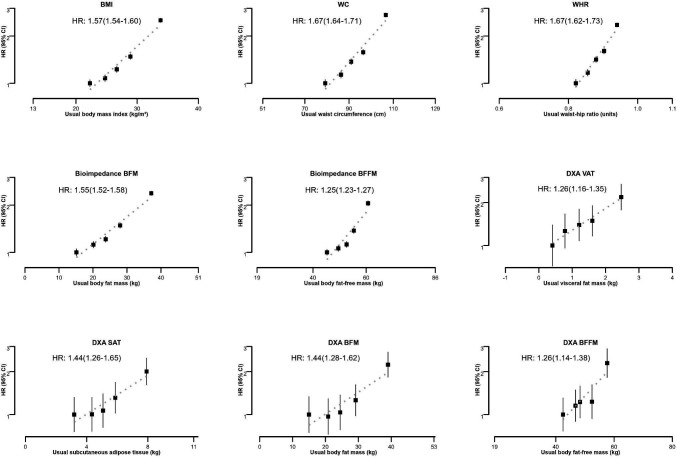
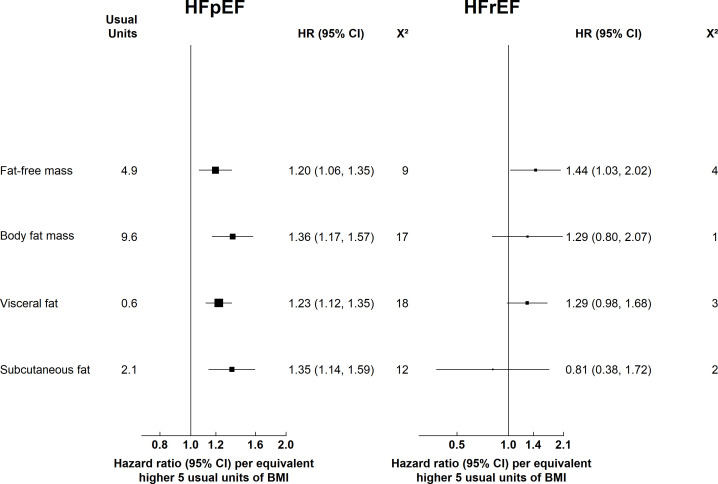
Background and aims: The independent role of body fat distribution and fat-free mass in heart failure (HF) risk is unclear. We investigated the role of different body composition compartments in risk of HF. Methods: Present analyses include 428 087 participants (mean age 55.9 years, 44% male) from the UK Biobank. Associations of long-term average levels of body composition measures with incident HF were determined using adjusted Cox proportional hazards regression models. Results: Over a median follow-up of 13.8 years, there were 10 455 first-ever incident HF events. Overall, HF risk was more strongly associated with central adiposity (waist circumference (WC) adjusted for body mass index (BMI); HR 1.38, 95% CI 1.32 to 1.45) than general adiposity (BMI adjusted for WC; HR 1.22, 95% CI 1.16 to 1.27). Although dual X-ray absorptiometry-derived body fat remained positively related to HF after adjustment for fat-free mass (HR 1.37, 95% CI 1.18 to 1.59), the association of fat-free mass with HF was substantially attenuated by fat mass (HR 1.12, 95% CI 1.01 to 1.26) while visceral fat (VAT) remained associated with HF independent of subcutaneous fat (HR 1.20, 95% CI 1.09 to 1.33). In analyses of HF subtypes, HF with preserved ejection fraction was independently associated with all fat measures (eg, VAT: HR 1.23, 95% CI 1.12 to 1.35; body fat: HR 1.36, 95% CI 1.17 to 1.57) while HF with reduced ejection fraction was not independently associated with fat measures (eg, VAT: HR 1.29, 95% CI 0.98 to 1.68; body fat: HR 1.29, 95% CI 0.80 to 2.07). Conclusions: This large-scale study shows that excess adiposity and fat mass are associated with higher HF risk while the association of fat-free mass with HF could be explained largely by its correlation with fat mass. The study also describes the independent relevance of body fat distribution to HF subtypes, suggesting different mechanisms may be driving their aetiopathogenesis.
Overview
The claims and statistics of this paper haven’t been checked yet.
Free: it reads the open-access text and checks the first 5 claims that cite a source we can check. Create a free account to check every claim.
Integrity signals
Registry
Cites
Statistics
Figures
Verification
Claims the paper makes
The claims and statistics of this paper haven’t been checked yet.
Free: it reads the open-access text and checks the first 5 claims that cite a source we can check. Create a free account to check every claim.
Claims other papers make about this one
Each is checked against this paper’s own text: does it say what the citing paper says it does?
The source backs part of the claim, not all of it — or backs it for a different population, condition or comparison.
In the citing paper
“None of the medications developed for HFpEF target obesity, one of the primary mechanisms that drive the development of HFpEF.13–15”
From Effects of Tirzepatide on the Clinical Trajectory of Patients With Heart Failure, Preserved Ejection Fraction, and Obesity (2025) · cites this paper as [14]
Experimental — accuracy not yet measuredThe source backs part of the claim, not all of it — or backs it for a different population, condition or comparison.
In the citing paper
“The evolution and progression of HFpEF are enhanced as body mass index (BMI) increases,14,16”
From Effects of Tirzepatide on the Clinical Trajectory of Patients With Heart Failure, Preserved Ejection Fraction, and Obesity (2025) · cites this paper as [14]
Experimental — accuracy not yet measured
Self-check
Percentages, sums and reported differences re-computed from the paper’s own numbers.
The self-check needs the paper’s full text.
Citations
Cites
2021 ESC guidelines for the diagnosis and treatment of acute and chronic heart failure
McDonagh, T. A., Metra, M., Adamo, M., Gardner, R. S., Baumbach, A., Böhm, M., Burri, H., Butler, J., Čelutkienė, J., Chioncel, O., et al. (2021) · European Heart Journal · doi:10.1093/eurheartj/ehab368 · Cited by 13,344
Vandenbroucke, J. P., von Elm, E., Altman, D. G., Gøtzsche, P. C., Mulrow, C. D., Pocock, S. J., Poole, C., Schlesselman, J. J., Egger, M., & Initiative, F. T. S. (2007) · PLoS Medicine · doi:10.1371/journal.pmed.0040297 · Cited by 8,613
Chen, X., Xiu, M., Xing, J., Yu, S., Min, D., & Guo, F. (2017) · Cellular Physiology and Biochemistry · doi:10.1159/000479439 · Cited by 5,742
Heidenreich, P. A., Bozkurt, B., Aguilar, D., Allen, L. A., Byun, J. J., Colvin, M. M., Deswal, A., Drazner, M. H., Dunlay, S. M., Evers, L. R., et al. (2022) · Circulation · doi:10.1161/cir.0000000000001063 · Cited by 4,922
Prospective Studies Collaboration (2009) · The Lancet · doi:10.1016/s0140-6736(09)60318-4 · Cited by 4,807
Fry, A., Littlejohns, T. J., Sudlow, C., Doherty, N., Adamska, L., Sprosen, T., Collins, R., & Allen, N. E. (2017) · American Journal of Epidemiology · doi:10.1093/aje/kwx246 · Cited by 3,979 · cited 1×
“18 Briefly, the UKB is a prospective cohort of 502 000 adults (aged 40–70 years) recruited from the general population of the UK between 2006 and 2010.”
BackgroundObesity and the risk of heart failure
Kenchaiah, S., Evans, J. C., Levy, D., Wilson, P. W. F., Benjamin, E. J., Larson, M. G., Kannel, W. B., & Vasan, R. S. (2002) · New England Journal of Medicine · doi:10.1056/nejmoa020245 · Cited by 3,093
Vandenbroucke, J. P., von Elm, E., Altman, D. G., Gøtzsche, P. C., Mulrow, C. D., Pocock, S. J., Poole, C., Schlesselman, J. J., & Egger, M. (2014) · International Journal of Surgery · doi:10.1016/j.ijsu.2014.07.014 · Cited by 2,969 · cited 1×
“17 The design and data collection procedures of UKB have been previously described.”
MethodLimb proportions show developmental plasticity in response to embryo movement
Pollard, A. S., Charlton, B. G., Hutchinson, J. R., Gustafsson, T., McGonnell, I. M., Timmons, J. A., & Pitsillides, A. A. (2017) · Scientific Reports · doi:10.1038/srep41926 · Cited by 2,364
Body-mass index and mortality among 1.46 million white adults
Berrington de Gonzalez, A., Hartge, P., Cerhan, J. R., Flint, A. J., Hannan, L., MacInnis, R. J., Moore, S. C., Tobias, G. S., Anton-Culver, H., Freeman, L. B., et al. (2010) · New England Journal of Medicine · doi:10.1056/nejmoa1000367 · Cited by 2,317
D’Hulst, G., Soro-Arnaiz, I., Masschelein, E., Veys, K., Fitzgerald, G., Smeuninx, B., Kim, S., Deldicque, L., Blaauw, B., Carmeliet, P., et al. (2020) · Nature Communications · doi:10.1038/s41467-019-13889-6 · Cited by 2,310
Adipose Tissue, Inflammation, and Cardiovascular Disease
Berg, A. H., & Scherer, P. E. (2005) · Circulation Research · doi:10.1161/01.res.0000163635.62927.34 · Cited by 2,113 · cited 1×
“These findings point to the deleterious effects of both weight gain (both fat and fat-free mass) and weight loss for cardiovascular risk.”
Feiner, N., Motone, F., Meyer, A., & Kuraku, S. (2019) · Scientific Reports · doi:10.1038/s41598-019-40055-1 · Cited by 1,987
Makki, K., Froguel, P., & Wolowczuk, I. (2013) · ISRN Inflammation · doi:10.1155/2013/139239 · Cited by 1,085 · cited 1×
“By demonstrating an independent relevance of fat distribution in addition to BMI on HF risk, our findings suggest that body fat imaging could be used for HF risk prediction in the general population.”
BackgroundRandhawa, G. S., Soltysiak, M. P. M., El Roz, H., de Souza, C. P. E., Hill, K. A., & Kari, L. (2020) · PLOS ONE · doi:10.1371/journal.pone.0232391 · Cited by 1,023
Pro-inflammatory cytokines and adipose tissue
Coppack, S. W. (2001) · Proceedings of the Nutrition Society · doi:10.1079/pns2001110 · Cited by 1,006
Clarke, R., Shipley, M., Lewington, S., Youngman, L., Collins, R., Marmot, M., & Peto, R. (1999) · American Journal of Epidemiology · doi:10.1093/oxfordjournals.aje.a010013 · Cited by 877 · cited 1×
“25 26 As such, in this analysis, RDRs were calculated using the age-adjusted and sex-adjusted Pearson partial correlations (r) between baseline and resurvey measures (4.3 years after baseline visit) in 17 450 individuals of the present analysis who attended both visits (online supplemental table…”
MethodInfluentialSelf-citationLittlejohns, T. J., Holliday, J., Gibson, L. M., Garratt, S., Oesingmann, N., Alfaro-Almagro, F., Bell, J. D., Boultwood, C., Collins, R., Conroy, M. C., et al. (2020) · Nature Communications · doi:10.1038/s41467-020-15948-9 · Cited by 812
Brouwers, F. P., de Boer, R. A., van der Harst, P., Voors, A. A., Gansevoort, R. T., Bakker, S. J., Hillege, H. L., van Veldhuisen, D. J., & van Gilst, W. H. (2013) · European Heart Journal · doi:10.1093/eurheartj/eht066 · Cited by 610
Ashwell, M., & Gibson, S. (2016) · BMJ Open · doi:10.1136/bmjopen-2015-010159 · Cited by 609
Sympathetic Neural Activation in Visceral Obesity
Alvarez, G. E., Beske, S. D., Ballard, T. P., & Davy, K. P. (2002) · Circulation · doi:10.1161/01.cir.0000041244.79165.25 · Cited by 557 · cited 14×
“Excess VAT and SAT were significantly associated with HFpEF risk (23% and 35% higher risk respectively) but were not associated with HFrEF risk.”
InfluentialVolgman, A. S., Palaniappan, L. S., Aggarwal, N. T., Gupta, M., Khandelwal, A., Krishnan, A. V., Lichtman, J. H., Mehta, L. S., Patel, H. N., Shah, K. S., et al. (2018) · Circulation · doi:10.1161/cir.0000000000000580 · Cited by 552
Azevedo, P. S., Polegato, B. F., Minicucci, M. F., Paiva, S. A. R., & Zornoff, L. A. M. (2016) · Arquivos Brasileiros de Cardiologia · doi:10.5935/abc.20160005 · Cited by 475
Newman, A. B., Lee, J. S., Visser, M., Goodpaster, B. H., Kritchevsky, S. B., Tylavsky, F. A., Nevitt, M., & Harris, T. B. (2005) · The American Journal of Clinical Nutrition · doi:10.1093/ajcn/82.4.872 · Cited by 445
Larsson, S. C., Bäck, M., Rees, J. M. B., Mason, A. M., & Burgess, S. (2020) · European Heart Journal · doi:10.1093/eurheartj/ehz388 · Cited by 436
Easton, D. F., Peto, J., & Babiker, A. G. A. G. (1991) · Statistics in Medicine · doi:10.1002/sim.4780100703 · Cited by 433 · cited 1×
“27 28 Associations were corrected for regression dilution bias by dividing the beta coefficients (and standard errors) by the RDR and described as association with usual (long-term average) body composition measures.”
MethodProfile for Estimating Risk of Heart Failure
Kannel, W. B., D'Agostino, R. B., Silbershatz, H., Belanger, A. J., Wilson, P. W. F., & Levy, D. (1999) · Archives of Internal Medicine · doi:10.1001/archinte.159.11.1197 · Cited by 422
Relationship between physical activity, body mass index, and risk of heart failure
Pandey, A., LaMonte, M., Klein, L., Ayers, C., Psaty, B. M., Eaton, C. B., Allen, N. B., de Lemos, J. A., Carnethon, M., Greenland, P., et al. (2017) · Journal of the American College of Cardiology · doi:10.1016/j.jacc.2016.11.081 · Cited by 398
Aune, D., Sen, A., Norat, T., Janszky, I., Romundstad, P., Tonstad, S., & Vatten, L. J. (2016) · Circulation · doi:10.1161/circulationaha.115.016801 · Cited by 376 · cited 1×
“3 However, BMI is an imprecise measure as it does not differentiate between body fat (and its distribution in different body compartments) and fat-free mass. 9 Anthropometric measures do not directly measure fat mass and fat-free mass and the use of other fat quantification measures like…”
Ho, J. E., Enserro, D., Brouwers, F. P., Kizer, J. R., Shah, S. J., Psaty, B. M., Bartz, T. M., Santhanakrishnan, R., Lee, D. S., Chan, C., et al. (2016) · Circulation: Heart Failure · doi:10.1161/circheartfailure.115.003116 · Cited by 362
Swainson, M. G., Batterham, A. M., Tsakirides, C., Rutherford, Z. H., & Hind, K. (2017) · PLOS ONE · doi:10.1371/journal.pone.0177175 · Cited by 344
Correcting for Regression Dilution Bias: Comparison of Methods for a Single Predictor Variable
Frost, C., & Thompson, S. G. (2000) · Journal of the Royal Statistical Society Series A: Statistics in Society · doi:10.1111/1467-985x.00164 · Cited by 314 · cited 1×
“25 26 As such, in this analysis, RDRs were calculated using the age-adjusted and sex-adjusted Pearson partial correlations (r) between baseline and resurvey measures (4.3 years after baseline visit) in 17 450 individuals of the present analysis who attended both visits (online supplemental table…”
MethodInfluentialDiabetes and Cause-Specific Mortality in Mexico City
Alegre-Díaz, J., Herrington, W., López-Cervantes, M., Gnatiuc, L., Ramirez, R., Hill, M., Baigent, C., McCarthy, M. I., Lewington, S., Collins, R., et al. (2016) · New England Journal of Medicine · doi:10.1056/nejmoa1605368 · Cited by 283
Self-citationTillin, T., Hughes, A. D., Mayet, J., Whincup, P., Sattar, N., Forouhi, N. G., McKeigue, P. M., & Chaturvedi, N. (2013) · Journal of the American College of Cardiology · doi:10.1016/j.jacc.2012.12.046 · Cited by 274
Agarwal, S. K., Chambless, L. E., Ballantyne, C. M., Astor, B., Bertoni, A. G., Chang, P. P., Folsom, A. R., He, M., Hoogeveen, R. C., Ni, H., et al. (2012) · Circulation: Heart Failure · doi:10.1161/circheartfailure.111.964841 · Cited by 266
Relation of muscle mass and fat mass to cardiovascular disease mortality
Srikanthan, P., Horwich, T. B., & Tseng, C. H. (2016) · The American Journal of Cardiology · doi:10.1016/j.amjcard.2016.01.033 · Cited by 260 · cited 1×
“These findings point to the deleterious effects of both weight gain (both fat and fat-free mass) and weight loss for cardiovascular risk.”
BackgroundTaylor, A. E., Ebrahim, S., Ben-Shlomo, Y., Martin, R. M., Whincup, P. H., Yarnell, J. W., Wannamethee, S. G., & Lawlor, D. A. (2010) · The American Journal of Clinical Nutrition · doi:10.3945/ajcn.2009.28757 · Cited by 259 · cited 1×
“These findings point to the deleterious effects of both weight gain (both fat and fat-free mass) and weight loss for cardiovascular risk.”
BackgroundObesity and subtypes of incident cardiovascular disease
Ndumele, C. E., Matsushita, K., Lazo, M., Bello, N., Blumenthal, R. S., Gerstenblith, G., Nambi, V., Ballantyne, C. M., Solomon, S. D., Selvin, E., et al. (2016) · Journal of the American Heart Association · doi:10.1161/jaha.116.003921 · Cited by 259
Incident Heart Failure Prediction in the Elderly: The Health ABC Heart Failure Score
Butler, J., Kalogeropoulos, A., Georgiopoulou, V., Belue, R., Rodondi, N., Garcia, M., Bauer, D. C., Satterfield, S., Smith, A. L., Vaccarino, V., et al. (2008) · Circulation: Heart Failure · doi:10.1161/circheartfailure.108.768457 · Cited by 255
Mechanisms of heart failure in obesity
Ebong, I. A., Goff, D. C., Rodriguez, C. J., Chen, H., & Bertoni, A. G. (2014) · Obesity Research & Clinical Practice · doi:10.1016/j.orcp.2013.12.005 · Cited by 251 · cited 1×
“We did not find a significant association between VAT or any of the other fat measures and HFrEF despite significant associations of these measures with HFpEF.”
Obesity and heart failure: epidemiology, pathophysiology, clinical manifestations, and management
Alpert, M. A., Lavie, C. J., Agrawal, H., Aggarwal, K. B., & Kumar, S. A. (2014) · Translational Research · doi:10.1016/j.trsl.2014.04.010 · Cited by 247
Risk of Myocardial Infarction and Heart Failure Among Metabolically Healthy But Obese Individuals
Mørkedal, B., Vatten, L. J., Romundstad, P. R., Laugsand, L. E., & Janszky, I. (2014) · Journal of the American College of Cardiology · doi:10.1016/j.jacc.2013.11.035 · Cited by 235
Abdominal Obesity Is Associated With an Increased Risk of All-Cause Mortality in Patients With HFpEF
Tsujimoto, T., & Kajio, H. (2017) · Journal of the American College of Cardiology · doi:10.1016/j.jacc.2017.09.1111 · Cited by 228
Eaton, C. B., Pettinger, M., Rossouw, J., Martin, L. W., Foraker, R., Quddus, A., Liu, S., Wampler, N. S., Hank Wu, W.-C., Manson, J. E., et al. (2016) · Circulation: Heart Failure · doi:10.1161/circheartfailure.115.002883 · Cited by 219
Patel, A. P., Wang, M., Kartoun, U., Ng, K., & Khera, A. V. (2021) · Circulation · doi:10.1161/circulationaha.120.052430 · Cited by 205
Adiposity and Incident Heart Failure and its Subtypes
Rao, V. N., Zhao, D., Allison, M. A., Guallar, E., Sharma, K., Criqui, M. H., Cushman, M., Blumenthal, R. S., & Michos, E. D. (2018) · JACC: Heart Failure · doi:10.1016/j.jchf.2018.07.009 · Cited by 202
Hu, G., Jousilahti, P., Antikainen, R., Katzmarzyk, P. T., & Tuomilehto, J. (2010) · Circulation · doi:10.1161/circulationaha.109.887893 · Cited by 198
Abdominal Obesity Is an Independent Risk Factor for Chronic Heart Failure in Older People
Nicklas, B. J., Cesari, M., Penninx, B. W. J. H., Kritchevsky, S. B., Ding, J., Newman, A., Kitzman, D. W., Kanaya, A. M., Pahor, M., & Harris, T. B. (2006) · Journal of the American Geriatrics Society · doi:10.1111/j.1532-5415.2005.00624.x · Cited by 197 · cited 1×
“These findings point to the deleterious effects of both weight gain (both fat and fat-free mass) and weight loss for cardiovascular risk.”
Background10-Year Risk Equations for Incident Heart Failure in the General Population
Khan, S. S., Ning, H., Shah, S. J., Yancy, C. W., Carnethon, M., Berry, J. D., Mentz, R. J., O’Brien, E., Correa, A., Suthahar, N., et al. (2019) · Journal of the American College of Cardiology · doi:10.1016/j.jacc.2019.02.057 · Cited by 196
Relation of Regional Fat Distribution to Left Ventricular Structure and Function
Neeland, I. J., Gupta, S., Ayers, C. R., Turer, A. T., Rame, J. E., Das, S. R., Berry, J. D., Khera, A., McGuire, D. K., Vega, G. L., et al. (2013) · Circulation: Cardiovascular Imaging · doi:10.1161/circimaging.113.000532 · Cited by 191
Rao, G., Powell-Wiley, T. M., Ancheta, I., Hairston, K., Kirley, K., Lear, S. A., North, K. E., Palaniappan, L., & Rosal, M. C. (2015) · Circulation · doi:10.1161/cir.0000000000000223 · Cited by 176
Lean Mass Abnormalities in Heart Failure: The Role of Sarcopenia, Sarcopenic Obesity, and Cachexia
Carbone, S., Billingsley, H. E., Rodriguez-Miguelez, P., Kirkman, D. L., Garten, R., Franco, R. L., Lee, D.-C., & Lavie, C. J. (2020) · Current Problems in Cardiology · doi:10.1016/j.cpcardiol.2019.03.006 · Cited by 169
Sympathetic nervous system behavior in human obesity
Davy, K. P., & Orr, J. S. (2009) · Neuroscience & Biobehavioral Reviews · doi:10.1016/j.neubiorev.2008.05.024 · Cited by 166
Franssen, F. M. E., Rutten, E. P. A., Groenen, M. T. J., Vanfleteren, L. E. G. W., Wouters, E. F. �., & Spruit, M. A. (2014) · Journal of the American Medical Directors Association · doi:10.1016/j.jamda.2014.03.012 · Cited by 158
Manifestations and mechanisms of myocardial lipotoxicity in obesity
Sletten, A. C., Peterson, L. R., & Schaffer, J. E. (2018) · Journal of Internal Medicine · doi:10.1111/joim.12728 · Cited by 142 · cited 2×
“These findings point to the deleterious effects of both weight gain (both fat and fat-free mass) and weight loss for cardiovascular risk.”
BackgroundMolecular Mechanisms of Obesity-Linked Cardiac Dysfunction: An Up-Date on Current Knowledge
Gutiérrez‐Cuevas, J., Sandoval-Rodriguez, A. S., Meza-Ríos, A., Monroy-Ramírez, H. C., Galicia‐Moreno, M., Garcia-Bañuelos, J. J., Santos, A., & Armendáriz‐Borunda, J. (2021) · Cells · doi:10.3390/cells10030629 · Cited by 141
Unraveling Cell Death Pathways during Malaria Infection: What Do We Know So Far?
Sena-dos-Santos, C., Braga-da-Silva, C., Marques, D., Pinheiro, J. A. D. S., Ribeiro‐dos‐Santos, Â., & Cavalcante, G. C. (2021) · Cells · doi:10.3390/cells10020479 · Cited by 135
Wannamethee, S. G., Shaper, A. G., Whincup, P. H., LENNON, L. T., & Sattar, N. A. (2011) · Journal of the American College of Cardiology · doi:10.1016/j.jacc.2011.06.057 · Cited by 131
Silverio, A., Maio, M. D., Citro, R., Esposito, L., Iuliano, G., Bellino, M., Baldi, C., Luca, G. D., Ciccarelli, M., Vecchione, C., et al. (2021) · BMC Cardiovascular Disorders · doi:10.1186/s12872-020-01816-3 · Cited by 130
MUSCLE DISUSE AS A PIVOTAL PROBLEM IN SARCOPENIA-RELATED MUSCLE LOSS AND DYSFUNCTION
BELL, K. E., VON ALLMEN, M. T., DEVRIES, M. C., & PHILLIPS, S. M. (2016) · The Journal of Frailty & Aging · doi:10.14283/jfa.2016.78 · Cited by 125
Sedlmeier, A. M., Baumeister, S. E., Weber, A., Fischer, B., Thorand, B., Ittermann, T., Dörr, M., Felix, S. B., Völzke, H., Peters, A., et al. (2021) · The American Journal of Clinical Nutrition · doi:10.1093/ajcn/nqaa339 · Cited by 121
Race and Ethnicity in Heart Failure
Piña, I. L., Jimenez, S., Lewis, E. F., Morris, A. A., Onwuanyi, A., Tam, E., & Ventura, H. O. (2021) · Journal of the American College of Cardiology · doi:10.1016/j.jacc.2021.06.058 · Cited by 120 · cited 1×
“Our findings provide insight into the potential role of fat and fat-free mass measurement in HF risk prediction in contemporary clinical practice.”
BackgroundPathogenetic Aspects of Systemic Sclerosis: A View Through the Prism of B Cells
Melissaropoulos, K., Iliopoulos, G., Sakkas, L. I., & Daoussis, D. (2022) · Frontiers in Immunology · doi:10.3389/fimmu.2022.925741 · Cited by 119
Loehr, L. R., Rosamond, W. D., Poole, C., Marie McNeill, A., Chang, P. P., Folsom, A. R., Chambless, L. E., & Heiss, G. (2009) · Circulation: Heart Failure · doi:10.1161/circheartfailure.108.813782 · Cited by 115
Heart failure risk prediction in the Multi-Ethnic Study of Atherosclerosis
Chahal, H., Bluemke, D. A., Wu, C. O., McClelland, R., Liu, K., Shea, S. J., Burke, G., Balfour, P., Herrington, D., Shi, P., et al. (2015) · Heart · doi:10.1136/heartjnl-2014-305697 · Cited by 103
Nauta, J. F., Hummel, Y. M., Tromp, J., Ouwerkerk, W., van der Meer, P., Jin, X., Lam, C. S. P., Bax, J. J., Metra, M., Samani, N. J., et al. (2019) · European Journal of Heart Failure · doi:10.1002/ejhf.1632 · Cited by 103
Levitan, E. B., Yang, A. Z., Wolk, A., & Mittleman, M. A. (2009) · Circulation: Heart Failure · doi:10.1161/circheartfailure.108.794099 · Cited by 99 · cited 1×
“…in those with more than 8% decrease in fat-free mass. Cheng et al 100 in an analysis of four US cohorts (MESA, ARIC, CHS and Framingham Heart Study) have reported a significant higher risk of HF with significant weight loss and weight gain which became noticeable 10 years before incident events.”
Hulsegge, G., Looman, M., Smit, H. A., Daviglus, M. L., van der Schouw, Y. T., & Verschuren, W. M. M. (2016) · Journal of the American Heart Association · doi:10.1161/jaha.115.002432 · Cited by 99
Lean Body Mass Is the Predominant Anthropometric Risk Factor for Atrial Fibrillation
Fenger‐Grøn, M., Overvad, K., Tjønneland, A. M., & Frost, L. (2017) · Journal of the American College of Cardiology · doi:10.1016/j.jacc.2017.03.558 · Cited by 99
Cardiometabolic risk: a Framingham perspective
Wilson, P. W. F., & Meigs, J. B. (2008) · International Journal of Obesity · doi:10.1038/ijo.2008.30 · Cited by 91
Pandey, A., Cornwell, W. K., Willis, B. L., Neeland, I. J., Gao, A., Leonard, D. S., DeFina, L. F., & Berry, J. D. (2017) · JACC Heart Failure · doi:10.1016/j.jchf.2016.12.021 · Cited by 91
Waist-to-height ratio is an effective indicator for comprehensive cardiovascular health
Shen, S., Lu, Y., Qi, H., Li, F., Shen, Z., Wu, L., Yang, C., Wang, L., Shui, K., Yao, W., et al. (2017) · Scientific Reports · doi:10.1038/srep43046 · Cited by 87
Rayner, J. J., Banerjee, R., Holloway, C. J., Lewis, A. J. M., Peterzan, M. A., Francis, J. M., Neubauer, S., & Rider, O. J. (2018) · International Journal of Obesity · doi:10.1038/ijo.2017.239 · Cited by 81
Inflammatory Markers and Risk of Heart Failure With Reduced to Preserved Ejection Fraction
Albar, Z., Albakri, M. M., Hajjari, J., Karnib, M., Janus, S. E., & Al-Kindi, S. G. (2022) · The American Journal of Cardiology · doi:10.1016/j.amjcard.2021.11.045 · Cited by 77 · cited 1×
“Findings from such studies could contribute to HF risk prediction models by integrating fat imaging into current HF risk scores.”
BackgroundWilliams, E. S., Shah, S. J., Ali, S., Na, B. Y., Schiller, N. B., & Whooley, M. A. (2008) · European Journal of Heart Failure · doi:10.1016/j.ejheart.2007.11.003 · Cited by 75
Suthahar, N., Meems, L. M. G., Withaar, C., Gorter, T. M., Kieneker, L. M., Gansevoort, R. T., Bakker, S. J. L., van Veldhuisen, D. J., & de Boer, R. A. (2022) · Scientific Reports · doi:10.1038/s41598-021-02409-6 · Cited by 73 · cited 1×
“The present study was not adequately powered to investigate the ethnic differences in the associations of body composition measures with incident HF.”
BackgroundBenn, M., Marott, S. C. W., Tybjærg‐Hansen, A., & Nordestgaard, B. G. (2021) · Cardiovascular Research · doi:10.1093/cvr/cvab368 · Cited by 70
Patel, K. V., Bahnson, J. L., Gaussoin, S. A., Johnson, K. C., Pi-Sunyer, X., White, U., Olson, K. L., Bertoni, A. G., Kitzman, D. W., Berry, J. D., et al. (2020) · Circulation · doi:10.1161/circulationaha.120.050941 · Cited by 69 · cited 1×
“…BMI is an imprecise measure as it does not differentiate between body fat (and its distribution in different body compartments) and fat-free mass. 9 Anthropometric measures do not directly measure fat mass and fat-free mass and the use of other fat quantification measures like bioelectrical…”
BackgroundBoth lean and fat body mass associate with blood pressure
Korhonen, P. E., Mikkola, T. M., Kautiainen, H., & Eriksson, J. G. (2021) · European Journal of Internal Medicine · doi:10.1016/j.ejim.2021.04.025 · Cited by 67 · cited 1×
“These findings point to the deleterious effects of both weight gain (both fat and fat-free mass) and weight loss for cardiovascular risk.”
BackgroundFontvieille, E., Viallon, V., Recalde, M., Córdova, R., Jansana, A., Peruchet‐Noray, L., Lennon, H., Heath, A. K., Aune, D., Christakoudi, S., et al. (2023) · BMC Medicine · doi:10.1186/s12916-023-03114-z · Cited by 65
Head‐to‐head comparison of contemporary heart failure risk scores
Codina, P., Lupón, J., Borrellas, A., Spitaleri, G., Cediel, G., Domingo, M., Simpson, J., Levy, W. C., Santiago‐Vacas, E., Zamora, E., et al. (2021) · European Journal of Heart Failure · doi:10.1002/ejhf.2352 · Cited by 62
McTigue, K. M., Chang, Y., Eaton, C., Garcia, L., Johnson, K. C., Lewis, C. E., Liu, S., Mackey, R. H., Robinson, J., Rosal, M. C., et al. (2014) · Obesity · doi:10.1002/oby.20224 · Cited by 61
Malden, D. E., Lacey, B., Emberson, J., Karpe, F., Allen, N. E., Bennett, D., & Lewington, S. (2019) · Obesity · doi:10.1002/oby.22509 · Cited by 61 · cited 1×
“19 All UKB participants have given written informed consent for the use of their data for health research.”
BackgroundSelf-citationObesity and Cardiovascular Disease: The Emerging Role of Inflammation
Khafagy, R., & Dash, S. (2021) · Frontiers in Cardiovascular Medicine · doi:10.3389/fcvm.2021.768119 · Cited by 60 · cited 1×
“103 Many of these studies have far fewer events than the UKB and the reported estimates are, therefore, more imprecise than UKB.”
ResultBiomarkers of inflammation predict both vascular and non-vascular mortality in older men
Clarke, R., Emberson, J. R., Breeze, E., Casas, J. P., Parish, S., Hingorani, A. D., Fletcher, A., Collins, R., & Smeeth, L. (2008) · European Heart Journal · doi:10.1093/eurheartj/ehn049 · Cited by 59 · cited 1×
“27 28 Associations were corrected for regression dilution bias by dividing the beta coefficients (and standard errors) by the RDR and described as association with usual (long-term average) body composition measures.”
MethodWaist-Height Ratio as a Predictor of Coronary Heart Disease Among Women
Page, J. H., Rexrode, K. M., Hu, F., Albert, C. M., Chae, C. U., & Manson, J. E. (2009) · Epidemiology · doi:10.1097/ede.0b013e31819f38f1 · Cited by 58
Li, C., Qin, D., Hu, J., Yang, Y., Hu, D., & Yu, B. (2022) · Frontiers in Immunology · doi:10.3389/fimmu.2022.947147 · Cited by 58
Excess coronary heart disease in South Asians in the United Kingdom
Kuppuswamy, V., & Gupta, S. (2005) · BMJ · doi:10.1136/bmj.330.7502.1223 · Cited by 57
Role of Cardiac Steatosis and Lipotoxicity in Obesity Cardiomyopathy
Zhang, Y., & Ren, J. T. (2011) · Hypertension · doi:10.1161/hypertensionaha.110.164178 · Cited by 57 · cited 1×
“These findings point to the deleterious effects of both weight gain (both fat and fat-free mass) and weight loss for cardiovascular risk.”
Lu, Y., Hajifathalian, K., Rimm, E. B., Ezzati, M., & Danaei, G. (2015) · Epidemiology · doi:10.1097/ede.0000000000000234 · Cited by 57
Farrell, S. W., Finley, C. E., Radford, N. B., & Haskell, W. L. (2013) · Circulation: Heart Failure · doi:10.1161/circheartfailure.112.000088 · Cited by 54
Regional Adiposity and Risk of Heart Failure and Mortality: The Jackson Heart Study
Rao, V. N., Bush, C. G., Mongraw‐Chaffin, M., Hall, M. E., Clark, D. M., Fudim, M., Correa, A., Hammill, B. G., O'Brien, E. C., Min, Y., et al. (2021) · Journal of the American Heart Association · doi:10.1161/jaha.121.020920 · Cited by 54 · cited 1×
“These findings point to the deleterious effects of both weight gain (both fat and fat-free mass) and weight loss for cardiovascular risk.”
BackgroundObesity as a risk factor for cardiac arrhythmias
Patel, K. H. K., Reddy, R. K., Sau, A., Sivanandarajah, P., Ardissino, M., & Ng, F. S. (2022) · BMJ Medicine · doi:10.1136/bmjmed-2022-000308 · Cited by 54
Fliotsos, M., Zhao, D., Rao, V. N., Ndumele, C. E., Guallar, E., Burke, G. L., Vaidya, D., Delaney, J. (. A., & Michos, E. D. (2018) · Journal of the American Heart Association · doi:10.1161/jaha.118.009599 · Cited by 52
Lind, L., Ingelsson, M., Sundström, J., & Ärnlöv, J. (2021) · Open Heart · doi:10.1136/openhrt-2021-001735 · Cited by 52
Bell, M., Hergens, M., Fors, S., Tynelius, P., de León, A. P., & Lager, A. (2022) · BMC Medicine · doi:10.1186/s12916-022-02715-4 · Cited by 46
Alshamiri, M. Q., Habbab, F. M. A., AL-Qahtani, S. S., Alghalayini, K., Al-Qattan, O. M., & Elshaer, F. (2020) · Cardiology Research and Practice · doi:10.1155/2020/4250793 · Cited by 44
van Hout, M. J., Dekkers, I. A., Westenberg, J. J. M., Schalij, M. J., Scholte, A. J. H. A., & Lamb, H. J. (2019) · European Heart Journal - Cardiovascular Imaging · doi:10.1093/ehjci/jez279 · Cited by 43
Marín‐Royo, G., Ortega‐Hernández, A., Martínez‐Martínez, E., Jurado-López, R., Luaces, M., Islas, F., Gómez‐Garré, D., Delgado‐Valero, B., Lagunas, E., Ramchandani, B., et al. (2019) · Scientific Reports · doi:10.1038/s41598-018-36914-y · Cited by 42 · cited 1×
“These findings point to the deleterious effects of both weight gain (both fat and fat-free mass) and weight loss for cardiovascular risk.”
Xu, C., Guo, Y., Zhang, S., Lai, Y., Huang, M., Zhan, R., Liu, M., Xiong, Z., Huang, Y., Huang, R., et al. (2023) · European Journal of Preventive Cardiology · doi:10.1093/eurjpc/zwad099 · Cited by 40 · cited 1×
“These findings point to the deleterious effects of both weight gain (both fat and fat-free mass) and weight loss for cardiovascular risk.”
BackgroundCorden, B., de Marvao, A., Dawes, T. J. W., Shi, W., Rueckert, D., Cook, S. A., & O’Regan, D. P. (2016) · Journal of Cardiovascular Magnetic Resonance · doi:10.1186/s12968-016-0251-4 · Cited by 39
Campbell, D. J., Gong, F. F., Jelinek, M. V., Castro, J. M., Coller, J. M., McGrady, M., Boffa, U., Shiel, L. M., Liew, D., Stewart, S., et al. (2019) · European Journal of Preventive Cardiology · doi:10.1177/2047487319851298 · Cited by 39 · cited 1×
“These findings point to the deleterious effects of both weight gain (both fat and fat-free mass) and weight loss for cardiovascular risk.”
Backgroundde Ritter, R., Sep, S. J. S., van Greevenbroek, M. M. J., Kusters, Y. H. A. M., Vos, R. C., Bots, M. L., Kooi, M. E., Dagnelie, P. C., Eussen, S. J. P. M., Schram, M. T., et al. (2023) · Diabetologia · doi:10.1007/s00125-023-05880-0 · Cited by 39
Structural and Metabolic Effects of Obesity on the Myocardium and the Aorta
Rider, O. J., Lewis, A., & Neubauer, S. (2014) · Obesity Facts · doi:10.1159/000368429 · Cited by 38
Adiposity and Incident Heart Failure in Older Adults: the Cardiovascular Health Study
Djoussé, L., Bartz, T. M., Ix, J. H., Zieman, S. J., Delaney, J. A., Mukamal, K. J., Gottdiener, J. S., Siscovick, D. S., & Kizer, J. R. (2012) · Obesity · doi:10.1038/oby.2011.320 · Cited by 37
Pandey, A., Kondamudi, N., Patel, K. V., Ayers, C. R., Simek, S. C., Hall, M. E., Musani, S. K., Blackshear, C. T., Mentz, R. J., Khan, H. M., et al. (2018) · Circulation Heart Failure · doi:10.1161/circheartfailure.118.005629 · Cited by 36
The Association of Percent Body Fat and Lean Mass With HbA1c in US Adults
Bower, J. K., Meadows, R. J., Foster, M. C., Foraker, R. E., & Shoben, A. B. (2017) · Journal of the Endocrine Society · doi:10.1210/js.2017-00046 · Cited by 35
Heart Failure With Preserved Ejection Fraction and Adipose Tissue: A Story of Two Tales
Oh, A., Okazaki, R. A., Sam, F., & Valero‐Muñoz, M. (2019) · Frontiers in Cardiovascular Medicine · doi:10.3389/fcvm.2019.00110 · Cited by 35
Cheng, Y., Chen, Z., Wu, S., Mei, W., Yao, F., Zhang, M., & Luo, D. (2021) · EClinicalMedicine · doi:10.1016/j.eclinm.2021.100790 · Cited by 34
Impact of Obesity-Related Inflammation on Cardiac Metabolism and Function
Larsen, T. S., & Jansen, K. M. (2021) · Journal of Lipid and Atherosclerosis · doi:10.12997/jla.2021.10.1.8 · Cited by 33 · cited 1×
“These findings point to the deleterious effects of both weight gain (both fat and fat-free mass) and weight loss for cardiovascular risk.”
BackgroundChen, J., Li, M., Hao, B., Cai, Y., Li, H., Zhou, W., Song, Y., Wang, S., & Liu, H. (2021) · BMC Cardiovascular Disorders · doi:10.1186/s12872-021-02080-9 · Cited by 32
Knudsen, N., Kjærulff, T. M., Ward, L. C., Sæbye, D., Holst, C., & Heitmann, B. L. (2014) · PLoS ONE · doi:10.1371/journal.pone.0087466 · Cited by 29 · cited 1×
“These findings point to the deleterious effects of both weight gain (both fat and fat-free mass) and weight loss for cardiovascular risk.”
BackgroundGaziano, L., Cho, K., Djoussé, L., Schubert, P. L., Galloway, A., Ho, Y.-L. A., Kurgansky, K. E., GAGNON, D. R., Russo, J. P., Angelantonio, E. D., et al. (2021) · ESC Heart Failure · doi:10.1002/ehf2.13429 · Cited by 28 · cited 1×
“The present study was not adequately powered to investigate the ethnic differences in the associations of body composition measures with incident HF.”
BackgroundLam, C. S. P., & Chandramouli, C. (2018) · JACC Heart Failure · doi:10.1016/j.jchf.2018.06.006 · Cited by 25
Borné, Y., Hedblad, B., Essén, B., & Engström, G. (2012) · European Journal of Public Health · doi:10.1093/eurpub/cks161 · Cited by 24
Shetty, S., Kapoor, N., Thomas, N., & Paul, T. V. (2020) · Journal of Clinical Densitometry · doi:10.1016/j.jocd.2020.06.001 · Cited by 23
Development and Validation of a Long-Term Incident Heart Failure Risk Model
Khan, S. S., Ning, H., Allen, N. B., Carnethon, M. R., Yancy, C. W., Shah, S. J., Wilkins, J. T., Tian, L., & Lloyd‐Jones, D. M. (2021) · Circulation Research · doi:10.1161/circresaha.121.319595 · Cited by 22
Xu, Y., Hu, T., Shen, Y., Wang, Y., Bao, Y., & Ma, X. (2023) · European Journal of Internal Medicine · doi:10.1016/j.ejim.2023.05.007 · Cited by 20
Sawada, N., Daimon, M., Kawata, T., Nakao, T., Kimura, K., Nakanishi, K., Kurano, M., Hirokawa, M., Xu, B., Yamanaka, Y., et al. (2019) · Scientific Reports · doi:10.1038/s41598-018-37137-x · Cited by 19
Takase, M., Nakamura, T., Hirata, T., Tsuchiya, N., Kogure, M., Itabashi, F., Nakaya, N., Hamanaka, Y., Sugawara, J., Suzuki, K., et al. (2021) · Journal of Diabetes Investigation · doi:10.1111/jdi.13729 · Cited by 19
Body Composition and Incident Heart Failure in Older Adults: Results From 2 Prospective Cohorts
Zhang, L., Bartz, T. M., Santanasto, A. J., Djoussé, L., Mukamal, K. J., Forman, D. E., Hirsch, C. H., Newman, A. B., Gottdiener, J. S., & Kizer, J. R. (2021) · Journal of the American Heart Association · doi:10.1161/jaha.121.023707 · Cited by 19 · cited 1×
“These findings point to the deleterious effects of both weight gain (both fat and fat-free mass) and weight loss for cardiovascular risk.”
BackgroundPérez‐Pevida, B., Díaz‐Gutiérrez, J., Miras, A. D., Silva, C., Romero, S., Salvador, J., Escalada, J., & Frühbeck, G. (2018) · Obesity · doi:10.1002/oby.22147 · Cited by 18
Zhang, D., Spiropoulos, K. A., Wijayabahu, A. T., Christou, D. D., Karanth, S. D., Anton, S. D., Leeuwenburgh, C., Liang, M., Wheeler, M., Yang, D., et al. (2022) · Nutrition · doi:10.1016/j.nut.2022.111934 · Cited by 18
Body Composition Analysis in Patients with Acute Heart Failure: The Scale Heart Failure Trial
Ieso, F. D., Mutke, M. R., Brasier, N., Raichle, C. J., Keller, B., Sucker, C., Abdelhamid, K., Bloch, T., Reissenberger, P., Schönenberg, L., et al. (2021) · ESC Heart Failure · doi:10.1002/ehf2.13641 · Cited by 16
Hu, T., Shen, Y., Cao, W., Xu, Y., Wang, Y., Ma, X., & Bao, Y. (2023) · Nutrition & Metabolism · doi:10.1186/s12986-023-00727-2 · Cited by 16 · cited 1×
“83 Visceral adipose tissue, epicardial fat and vascular tissue secrete proinflammatory cytokines for example, TNF α , IL-1 and IL-6 which contribute to microvascular endothelial dysfunction and reduced vascular compliance.”
BackgroundSEVERE MITRAL STENOSIS AND PULMONARY HYPERTENSION IN PREGNANCY: WHEN TO ACT
Erinne, I., Alam, A., Huang, M. S., Mody, K. P., Ghaly, A., & Iyer, D. B. (2019) · Journal of the American College of Cardiology · doi:10.1016/s0735-1097(19)32994-8 · Cited by 14
Zhen, J., Liu, S., Zhao, G., Peng, H., Samaranayake, N., Xu, A., Li, C., Wu, J., & Cheung, B. M. Y. (2022) · Internal and Emergency Medicine · doi:10.1007/s11739-022-03072-z · Cited by 14
The role of lipotoxicity in cardiovascular disease
Li, C., Liu, H., Xu, F., & Chen, Y. (2022) · Emergency and Critical Care Medicine · doi:10.1097/ec9.0000000000000024 · Cited by 13 · cited 1×
“These findings point to the deleterious effects of both weight gain (both fat and fat-free mass) and weight loss for cardiovascular risk.”
BackgroundLong-Term Risk Prediction for Heart Failure, Disparities, and Early Prevention
Shea, S., & Blaha, M. J. (2022) · Circulation Research · doi:10.1161/circresaha.121.320598 · Cited by 12
Halldin, A.-K., Lissner, L., Lernfelt, B., & Björkelund, C. (2020) · Scandinavian Journal of Primary Health Care · doi:10.1080/02813432.2020.1717083 · Cited by 11 · cited 1×
“…in those with more than 8% decrease in fat-free mass. Cheng et al 100 in an analysis of four US cohorts (MESA, ARIC, CHS and Framingham Heart Study) have reported a significant higher risk of HF with significant weight loss and weight gain which became noticeable 10 years before incident events.”
BackgroundLin, S., Fan, Y., Chou, C.-C., Pan, W.-H., & Bai, C. (2020) · PLoS ONE · doi:10.1371/journal.pone.0241121 · Cited by 11
Measures of body composition and risk of heart failure in the elderly: The Rotterdam study
Lieshout, M. A. W. V., Verwoert, G. C., Mattace-Raso, F. U. S., Zillikens, M. C., Sijbrands, E. J. G., Deckers, J. W., Hofman, A., & Witteman, J. C. M. (2010) · The journal of nutrition health & aging · doi:10.1007/s12603-010-0288-2 · Cited by 10
Hatani, Y., Tanaka, H., Mochizuki, Y., Suto, M., Yokota, S., Mukai, J., Takada, H., Soga, F., Hatazawa, K., Matsuzoe, H., et al. (2019) · Journal of Cardiology · doi:10.1016/j.jjcc.2019.07.013 · Cited by 9
Lumbers, R. T., Katsoulis, M., Henry, A., Mordi, I. R., Lang, C. C., Hemingway, H., Langenberg, C., Holmes, M. V., & Sattar, N. A. (2020) · medRxiv · doi:10.1101/2020.09.23.20200360 · Cited by 8
Body Fat Distribution, Fat-Free Mass and Cardiovascular Function in the UK Biobank
Oguntade, A. S., Lacey, B., Taylor, H., & Lewington, S. (2023) · Artery Research · doi:10.1007/s44200-023-00039-z · Cited by 6 · cited 1×
“These findings point to the deleterious effects of both weight gain (both fat and fat-free mass) and weight loss for cardiovascular risk.”
BackgroundSelf-citationEditorial: Improving Early Detection and Risk Prediction in Heart Failure
Tragante, V., Pilbrow, A. P., & Poppe, K. (2022) · Frontiers in Cardiovascular Medicine · doi:10.3389/fcvm.2022.930935 · Cited by 2
Wong, J., O’Neill, S., Beck, B. R., Forwood, M. R., & Khoo, S. K. (2023) · Maturitas · doi:10.1016/j.maturitas.2023.107845 · Cited by 2
Research works printed but not linked: 3
- Malden DE. Adiposity and coronary heart disease in the uk biobank: a prospective cohort study of 500 000 adults. University of Oxford, 2020.
- Majili Z, Kinabo J. Science C. Body fat content, distribution and blood glucose concentration among adults population in Ilala municipality, Dar es Salaam. Tanz 2015; 14: 119– 28.
- 10.1038/s41598-019-40055-1 · DOI · Paper page
Cited by
Tirzepatide for Heart Failure with Preserved Ejection Fraction and Obesity
Packer, M., Zile, M. R., Kramer, C. M., Baum, S. J., Litwin, S. E., Menon, V., Ge, J., Weerakkody, G. J., Ou, Y., Bunck, M. C., et al. (2025) · New England Journal of Medicine · doi:10.1056/nejmoa2410027 · Cited by 1,009
The Adipokine Hypothesis of Heart Failure With a Preserved Ejection Fraction
Packer, M. (2025) · JACC · doi:10.1016/j.jacc.2025.06.055 · Cited by 173
Peikert, A., Vaduganathan, M., Claggett, B. L., Kulac, I. J., Litwin, S. E., Zile, M. R., Desai, A. S., Jhund, P. S., Butt, J. H., Lam, C. S. P., et al. (2025) · European Heart Journal · doi:10.1093/eurheartj/ehaf057 · Cited by 132
“The WHtR was shown to be superior to BMI in predicting adverse outcomes in patients with HF and a reduced ejection fraction, 48 and WHtR has been associated with adverse outcomes in a small non-diverse group with HFpEF; yet, its comparative utility (vs. BMI) in patients with HFpEF has not been fully evaluated.”
Zile, M. R., Borlaug, B. A., Kramer, C. M., Baum, S. J., Litwin, S. E., Menon, V., Ou, Y., Weerakkody, G. J., Hurt, K. C., Kanu, C., et al. (2025) · Circulation · doi:10.1161/circulationaha.124.072679 · Cited by 74
Artificial Intelligence–Enabled Prediction of Heart Failure Risk From Single-Lead Electrocardiograms
Dhingra, L. S., Aminorroaya, A., Pedroso, A. F., Khunte, A., Sangha, V., McIntyre, D., Chow, C. K., Asselbergs, F. W., Brant, L. C. C., Barreto, S. M., et al. (2025) · JAMA Cardiology · doi:10.1001/jamacardio.2025.0492 · Cited by 65
Metadata
- Authors
- Oguntade, A. S., Taylor, H., Lacey, B., & Lewington, S.
- Affiliations
- University of Hull (GB)
- University of Oxford (GB)
- Corresponding author
- Oguntade, Ayodipupo S
- Venue
- Open Heart
- Publisher
- BMJ
- Published
- 2024-07
- Volume
- 11
- Issue
- 2
- Pages
- e002711
- ISSN
- 2053-3624 (ISSN-L)
- PMC
- PMC11227841
- OpenAlex
- W4400313856
- Cited by
- 31
- References
- 140
- Citations by year
- 2026: 19 · 2025: 9 · 2024: 2
- FWCI
- 9.03
- Type
- journal article
- Language
- en
- Open access
- gold
- doi.org
- Locations
- Open Heart (publishedVersion, cc-by)
- PubMed Central (publishedVersion, cc-by)
- PubMed (publishedVersion)
- DOAJ (DOAJ: Directory of Open Access Journals) (submittedVersion, cc-by-sa)
- Funders
- UK Medical Research Council
- the Nuffield Department of Population Health (NDPH), University of Oxford
- Wellcome Trust
- Topics
- Health Sciences › Medicine › Cardiology and Cardiovascular Medicine › Heart Failure Treatment and Management
- Health Sciences › Medicine › Cardiology and Cardiovascular Medicine › Cardiovascular Disease and Adiposity
- Health Sciences › Medicine › Cardiology and Cardiovascular Medicine › Cardiovascular Function and Risk Factors
- Keywords
- heart failure, body composition, fat-free mass, abdominal obesity, visceral fat, subcutaneous adiposity, fat mass, waist circumference, body mass index, heart failure with preserved ejection fraction, heart failure with reduced ejection fraction, incident heart failure risk, dual-energy X-ray absorptiometry, UK Biobank
- MeSH terms
- Adult, Aged, Female, Follow-Up Studies, United Kingdom, Heart Failure, Humans, Male, Middle Aged, Prospective Studies, Risk Factors, Time Factors, Absorptiometry, Photon, Body Mass Index, Incidence, Risk Assessment, Adiposity
About these checks
Registry, retraction, Cites and statistics results are computed, not judged, with one exception: a printed reference that no index lists is read once by a model before it counts as a citation error. Claims are extracted by a model and kept only when their quote appears verbatim in the text; each cited source is then checked, with a model’s help, for whether it says what the claim relies on. Those verdicts can be wrong — read the claim’s quote and the cited source before relying on one.
Statistics and arithmetic are recomputed, not judged.
Confidence bands are shown only for fields calibrated on our annotated test set. None is calibrated yet, so no band is shown.
What counts as a claim ›How we measure confidence ›How we check this ›
Are you an author, or do you see a problem with this page? Request a review
Data sources
Bibliographic data: Semantic Scholar, OpenAlex, Crossref.
Contains information from the Semantic Scholar Academic Graph Datasets, made available under the ODC Attribution License (ODC-BY 1.0).
Semantic Scholar’s data is described in: Kinney, R., et al. (2023). The Semantic Scholar Open Data Platform. arXiv:2301.10140.
