

Interrater reliability: the kappa statistic
Open accessThe DOI matches its Crossref record; 10 of the 10 references it cites were found in a registry or an index.
Abstract
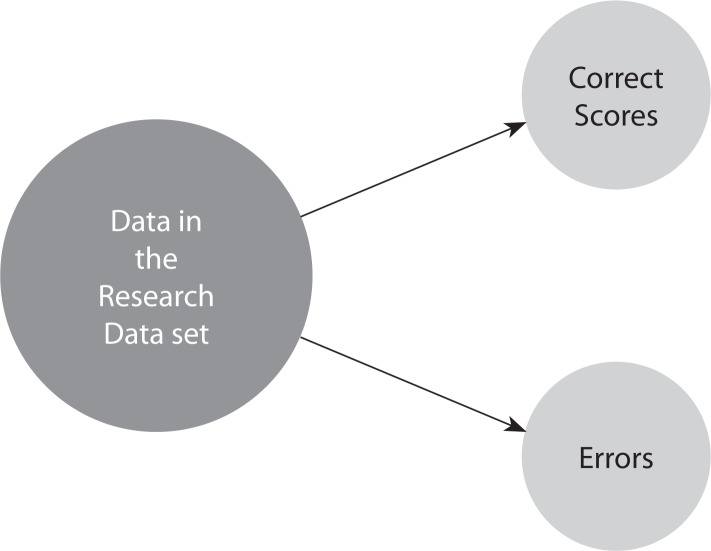
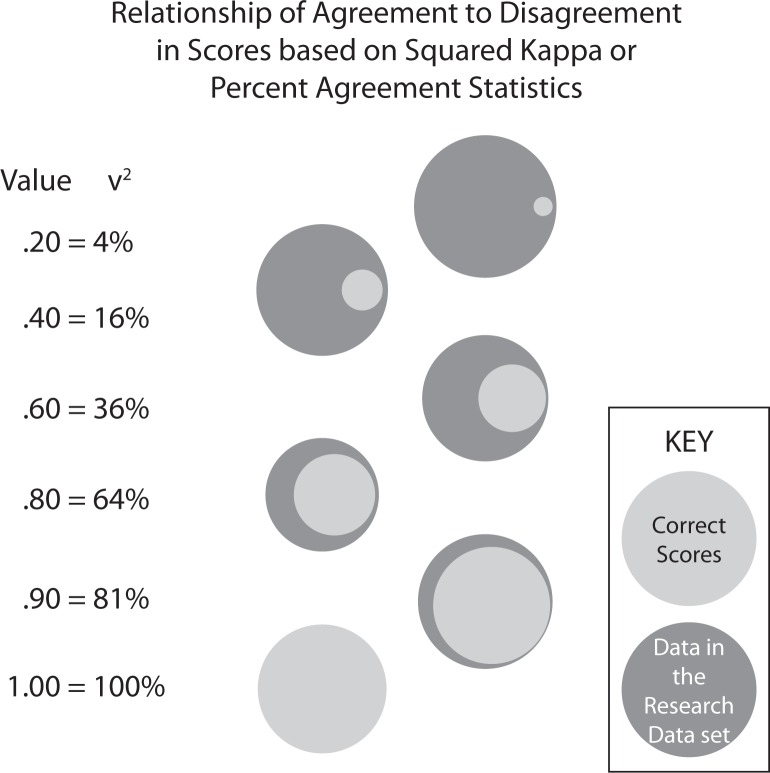
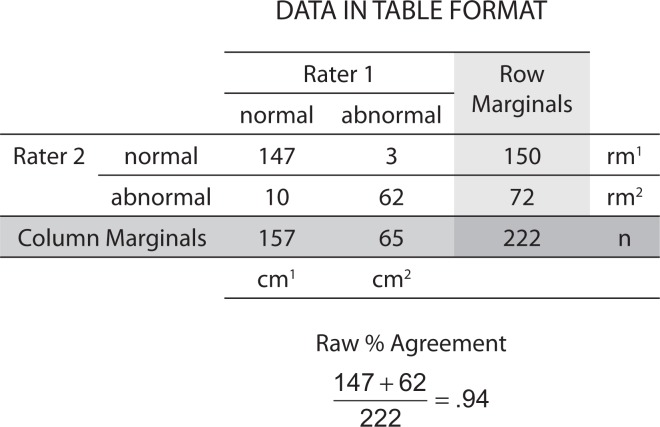
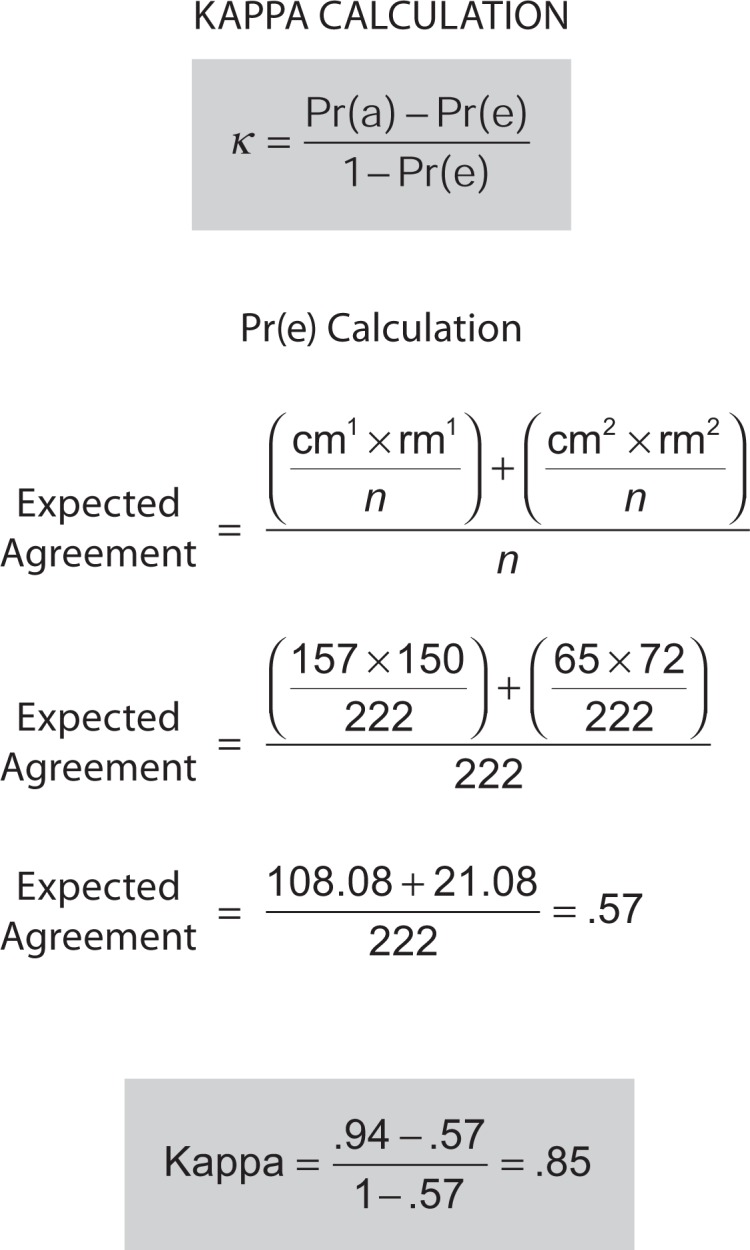
The kappa statistic is frequently used to test interrater reliability. The importance of rater reliability lies in the fact that it represents the extent to which the data collected in the study are correct representations of the variables measured. Measurement of the extent to which data collectors (raters) assign the same score to the same variable is called interrater reliability. While there have been a variety of methods to measure interrater reliability, traditionally it was measured as percent agreement, calculated as the number of agreement scores divided by the total number of scores. In 1960, Jacob Cohen critiqued use of percent agreement due to its inability to account for chance agreement. He introduced the Cohen's kappa, developed to account for the possibility that raters actually guess on at least some variables due to uncertainty. Like most correlation statistics, the kappa can range from -1 to +1. While the kappa is one of the most commonly used statistics to test interrater reliability, it has limitations. Judgments about what level of kappa should be acceptable for health research are questioned. Cohen's suggested interpretation may be too lenient for health related studies because it implies that a score as low as 0.41 might be acceptable. Kappa and percent agreement are compared, and levels for both kappa and percent agreement that should be demanded in healthcare studies are suggested.
Overview
The claims and statistics of this paper haven’t been checked yet.
Free: it reads the open-access text and checks the first 5 claims that cite a source we can check. Create a free account to check every claim.
Integrity signals
Registry
Cites
Statistics
Figures
Verification
Claims the paper makes
The claims and statistics of this paper haven’t been checked yet.
Free: it reads the open-access text and checks the first 5 claims that cite a source we can check. Create a free account to check every claim.
Claims other papers make about this one
Each is checked against this paper’s own text: does it say what the citing paper says it does?
The cited source doesn’t support the claim as written.
In the citing paper
“All raters met the minimum threshold for very good interrater reliability, defined as Cohen’s kappa statistic > 0.75 (McHugh 2012), and percentage agreement with criterion ratings was high (> 80%).”
From Evaluating the quality, safety, and functionality of commonly used smartphone apps for bipolar disorder mood and sleep self-management (2022) · cites this paper as McHugh 2012
Checked by a reasoning model — may be wrong.
Experimental — accuracy not yet measuredThe source backs part of the claim, not all of it — or backs it for a different population, condition or comparison.
In the citing paper
“Codes were compared to determine inter-coder agreement, which was calculated as the percentage of total agreed-upon selected codes compared with the total selected codes. This process was repeated until greater than eighty percent agreement was reached (McHugh, 2012).”
From "It Just Makes It Feel Like You're Not Alone": A Qualitative Study of a Social Support Group for High-Achieving, Low-Income STEM Majors (2024) · cites this paper as McHugh, 2012
Experimental — accuracy not yet measuredThe source backs part of the claim, not all of it — or backs it for a different population, condition or comparison.
In the citing paper
“They then labeled a second batch of 500 tweets, which resulted in an average Cohen’s kappa score of 0.77, indicating substantial interrater agreement (61).”
From Dynamics of cross-platform attention to retracted papers (2022) · cites this paper as [61]
Experimental — accuracy not yet measuredThe source backs part of the claim, not all of it — or backs it for a different population, condition or comparison.
In the citing paper
“The inferred sleep architecture estimates had a fair agreement (κ = 0.37) with the polysomnography ground truth on the internal validation12.”
From Self-supervised learning of accelerometer data provides new insights for sleep and its association with mortality (2024) · cites this paper as [12]
Experimental — accuracy not yet measuredThe source backs part of the claim, not all of it — or backs it for a different population, condition or comparison.
In the citing paper
“The inter-rater agreement for the combined screening process was 83%, indicating strong agreement between the two authors (McHugh, 2012).”
From Unraveling the Complexities of Offender Strategies as Part of Online Sexual Grooming and Technology-Assisted Child Sexual Abuse: A Systematic Review (2026) · cites this paper as McHugh, 2012
Experimental — accuracy not yet measured
35 more claims about this paper
Create a free account to see every claim other papers make about this one.
Self-check
Percentages, sums and reported differences re-computed from the paper’s own numbers.
The self-check needs the paper’s full text.
Citations
Cites
A Coefficient of Agreement for Nominal Scales
Cohen, J. (1960) · Educational and Psychological Measurement · doi:10.1177/001316446002000104 · Cited by 42,398
Stemler, S. E. (2020) · Scholarworks (University of Massachusetts Amherst) · doi:10.7275/96jp-xz07 · Cited by 992
Meta-analysis of Pap Test Accuracy
Fahey, M. T., Irwig, L., & Macaskill, P. (1995) · American Journal of Epidemiology · doi:10.1093/oxfordjournals.aje.a117485 · Cited by 684
Pressure ulcers: prevention, evaluation, and management.
Bluestein, D. A., & Javaheri, A. (2008) · PubMed · Cited by 201
Comparing groups for statistical differences: how to choose the right statistical test?
Marusteri, M., & Bacarea, V. (2010) · Biochemia Medica · doi:10.11613/bm.2010.004 · Cited by 184
Bonnyman, A. M., Webber, C. E., Stratford, P. W., & MacIntyre, N. J. (2012) · Journal of Clinical Densitometry · doi:10.1016/j.jocd.2012.03.005 · Cited by 176
Simundic, A.-M., Nikolac, N., Ivankovic, V., Ferenec-Ruzic, D., Magdic, B., Kvaternik, M., & Topic, E. (2009) · Clinical Chemistry and Laboratory Medicine · doi:10.1515/cclm.2009.306 · Cited by 113
Introductory Statistics for Health and Nursing Using SPSS
Marston, L. (2010) · SAGE Publications Ltd eBooks · doi:10.4135/9781446221570 · Cited by 80
Kottner, J., Halfens, R. J. G., & Dassen, T. W. N. (2009) · International Journal of Nursing Studies · doi:10.1016/j.ijnurstu.2009.03.014 · Cited by 77
de la Morena, E., Martinez, J., Rio, G. D., Latour, J., & Cabrera, P. (1978) · Biochemical Medicine · doi:10.1016/0006-2944(78)90045-5 · Cited by 19
Research works printed but not linked: 2
- [8]8. Marston, L . Introductory Statistics for Health and Nursing Using SPSS . Thousand Oaks, California: Sage Publications, Ltd . 2010 .
- [10]10. Simundic AM . Confidence interval . Biochem Med 2008;18:154-61 .
Cited by
Chicco, D., & Jurman, G. (2020) · BMC Genomics · doi:10.1186/s12864-019-6413-7 · Cited by 6,143
Intercoder Reliability in Qualitative Research: Debates and Practical Guidelines
O’Connor, C., & Joffe, H. (2020) · International Journal of Qualitative Methods · doi:10.1177/1609406919899220 · Cited by 3,871
“The procedure becomes even more complex if there are more than two coders (McHugh, 2012).”
BackgroundCoudray, N., Ocampo, P. S., Sakellaropoulos, T., Narula, N., Snuderl, M., Fenyö, D., Moreira, A. L., Razavian, N., & Tsirigos, A. (2018) · Nature Medicine · doi:10.1038/s41591-018-0177-5 · Cited by 2,930
Global threat of arsenic in groundwater
Podgorski, J., & Berg, M. (2020) · Science · doi:10.1126/science.aba1510 · Cited by 1,566
Lane, M. M., Gamage, E., Du, S., Ashtree, D. N., McGuinness, A. J., Gauci, S., Baker, P., Lawrence, M., Rebholz, C. M., Srour, B., et al. (2024) · BMJ · doi:10.1136/bmj-2023-077310 · Cited by 1,153
“93-96 In contrast, more recent assessments show acceptable construct validity and strong agreement among coders, 97 98 with the definitions and examples provided by the Nova system deemed adequate in classifying more than 70% of the food items reported in food frequency questionnaires from various…”
Game-based Learning and 21st century skills: A review of recent research
Qian, M., & Clark, K. R. (2016) · Computers in Human Behavior · doi:10.1016/j.chb.2016.05.023 · Cited by 1,111
Application and theory gaps during the rise of artificial intelligence in education
Chen, X., Xie, H., Zou, D., & Hwang, G.-J. (2020) · Computers and Education: Artificial Intelligence · doi:10.1016/j.caeai.2020.100002 · Cited by 1,003
Student Motivation and Associated Outcomes: A Meta-Analysis From Self-Determination Theory
Howard, J. L., Bureau, J., Guay, F., Chong, J. X. Y., & Ryan, R. M. (2021) · Perspectives on Psychological Science · doi:10.1177/1745691620966789 · Cited by 1,001
Teachers’ Perception of STEM Integration and Education: A Systematic Literature Review
Margot, K. C., & Kettler, T. (2019) · International Journal of STEM Education · doi:10.1186/s40594-018-0151-2 · Cited by 992
“Interrater reliability on those three articles was calculated using a percent agreement metric (McHugh 2012) with both raters assigning the text segment to the same category 42 out of 45 times for an agreement rate of .”
MethodRueger, S. Y., Malecki, C. K., Pyun, Y., Aycock, C., & Coyle, S. (2016) · Psychological Bulletin · doi:10.1037/bul0000058 · Cited by 946
Browning, M. H. E. M., Larson, L. R., Sharaievska, I., Rigolon, A., McAnirlin, O., Mullenbach, L., Cloutier, S., Vu, T. M., Thomsen, J., Reigner, N., et al. (2021) · PLOS ONE · doi:10.1371/journal.pone.0245327 · Cited by 888
Prevalence of prolonged grief disorder in adult bereavement: A systematic review and meta-analysis
Lundorff, M., Holmgren, H., Zachariae, R., Farver-Vestergaard, I., & O’Connor, M. (2017) · Journal of Affective Disorders · doi:10.1016/j.jad.2017.01.030 · Cited by 876
“Applying common benchmarks for Cohen's Kappa on observer agreement for categorical data, this corresponds to a strong level of agreement (McHugh, 2012).”
BackgroundMethodInfluentialBond, M., Khosravi, H., De Laat, M., Bergdahl, N., Negrea, V., Oxley, E., Pham, P., Chong, S. W., & Siemens, G. (2024) · International Journal of Educational Technology in Higher Education · doi:10.1186/s41239-023-00436-z · Cited by 852
“…reliability between members of the research team, following lengthy discussion and agreement on the inclusion and exclusion criteria by all authors, two members of the team (MB and PP) double screened the first 100 items, resulting in almost perfect agreement (Cohen’s k = 0.89) (McHugh, 2012).”
BackgroundInfluentialTsao, M. S., Kerr, K. M., Kockx, M., Beasley, M.-B., Borczuk, A. C., Botling, J., Bubendorf, L., Chirieac, L., Chen, G., Chou, T.-Y., et al. (2018) · Journal of Thoracic Oncology · doi:10.1016/j.jtho.2018.05.013 · Cited by 794
Belur, J., Tompson, L., Thornton, A., & Simon, M. (2021) · Sociological Methods & Research · doi:10.1177/0049124118799372 · Cited by 753
“Thus, reliability across multiple coders is measured by IRR and reliability over time for the same coder is measured by intrarater reliability (McHugh 2012).”
MethodChatEval: Towards Better LLM-based Evaluators through Multi-Agent Debate
Chan, C.-M., Chen, W., Su, Y., Yu, J., Xue, W., Zhang, S., Fu, J., & Liu, Z. (2023) · arXiv · doi:10.48550/arxiv.2308.07201 · Cited by 725
“(McHugh, 2012) which gauges the agreement between results from models and human annotators while taking into account the possibility of agreement occurring by chance.”
BackgroundLarge Language Model Influence on Diagnostic Reasoning: A Randomized Clinical Trial
Goh, E., Gallo, R., Hom, J., Strong, E., Weng, Y., Kerman, H., Cool, J. A., Kanjee, Z., Parsons, A. S., Ahuja, N., et al. (2024) · JAMA Network Open · doi:10.1001/jamanetworkopen.2024.40969 · Cited by 724
Domain-Specific Physical Activity and Mental Health: A Meta-analysis
White, R. L., Babic, M. J., Parker, P. D., Lubans, D. R., Astell-Burt, T., & Lonsdale, C. (2017) · American Journal of Preventive Medicine · doi:10.1016/j.amepre.2016.12.008 · Cited by 715
Churruca, K., Pomare, C., Ellis, L. A., Long, J. C., Henderson, S. B., Murphy, L. E. D., Leahy, C. J., & Braithwaite, J. (2021) · Health Expectations · doi:10.1111/hex.13254 · Cited by 713
Current advances in ischemic stroke research and therapies
Barthels, D., & Das, H. (2020) · Biochimica et Biophysica Acta (BBA) - Molecular Basis of Disease · doi:10.1016/j.bbadis.2018.09.012 · Cited by 709
Personality and prosocial behavior: A theoretical framework and meta-analysis.
Thielmann, I., Spadaro, G., & Balliet, D. (2020) · Psychological Bulletin · doi:10.1037/bul0000217 · Cited by 689
Engagement in language learning: a systematic review of 20 years of research methods and definitions
Hiver, P., Al-Hoorie, A. H., Vitta, J. P., & Wu, J. (2024) · Language Teaching Research · doi:10.1177/13621688211001289 · Cited by 677
“%) approached the conventional 80% threshold (McHugh, 2012) and the observed kappa ( κ = .612, p < .001) was within a magnitude range (.60 ⩽ κ ⩽ .79) considered to be either substantial (Landis & Koch, 1977) or moderate (McHugh, 2012).”
BackgroundMadigan, D. J., & Kim, L. E. (2021) · Teaching and Teacher Education · doi:10.1016/j.tate.2021.103425 · Cited by 665
Universality and diversity in human song
Mehr, S. A., Singh, M., Knox, D., Ketter, D. M., Pickens-Jones, D., Atwood, S., Lucas, C., Jacoby, N., Egner, A. A., Hopkins, E. J., et al. (2019) · Science · doi:10.1126/science.aax0868 · Cited by 660
The cost of work-related stress to society: A systematic review
Hassard, J., Teoh, K. R. H., Visockaite, G., Dewe, P., & Cox, T. (2018) · Journal of Occupational Health Psychology · doi:10.1037/ocp0000069 · Cited by 652
Cipriano, C., Strambler, M. J., Naples, L. H., Ha, C., Kirk, M., Wood, M., Sehgal, K., Zieher, A. K., Eveleigh, A., McCarthy, M., et al. (2023) · Child Development · doi:10.1111/cdev.13968 · Cited by 636
AI-based pathology predicts origins for cancers of unknown primary
Lu, M. Y., Chen, T. Y., Williamson, D. F. K., Zhao, M., Shady, M., Lipkova, J., & Mahmood, F. (2021) · Nature · doi:10.1038/s41586-021-03512-4 · Cited by 636
Ewert, S., Plettig, P., Li, N., Chakravarty, M. M., Collins, D. L., Herrington, T. M., Kühn, A. A., & Horn, A. (2018) · NeuroImage · doi:10.1016/j.neuroimage.2017.05.015 · Cited by 602
Li, H., Zhang, R., Lee, Y.-C., Kraut, R. E., & Mohr, D. C. (2023) · npj Digital Medicine · doi:10.1038/s41746-023-00979-5 · Cited by 598
“Inter-rater reliability, assessed using Cohen ’ s Kappa 63 , indicated near-perfect agreement for title/abstract screening (0.9) and full-text review (0.83).”
MethodInfluentialAdult mental health outcomes of adolescent depression: A systematic review
Johnson, D., Dupuis, G., Piche, J., Clayborne, Z., & Colman, I. (2018) · Depression and Anxiety · doi:10.1002/da.22777 · Cited by 563
Association between organisational and workplace cultures, and patient outcomes: systematic review
Braithwaite, J., Herkes, J., Ludlow, K., Testa, L., & Lamprell, G. (2017) · BMJ Open · doi:10.1136/bmjopen-2017-017708 · Cited by 532
Does ChatGPT enhance student learning? A systematic review and meta-analysis of experimental studies
Deng, R., Jiang, M., Yu, X., Lu, Y., & Liu, S. (2025) · Computers & Education · doi:10.1016/j.compedu.2024.105224 · Cited by 531
Sáez-López, J.-M., Román-González, M., & Vázquez-Cano, E. (2016) · Computers & Education · doi:10.1016/j.compedu.2016.03.003 · Cited by 530
Emergency remote teaching in higher education: mapping the first global online semester
Bond, M., Bedenlier, S., Marín, V. I., & Händel, M. (2021) · International Journal of Educational Technology in Higher Education · doi:10.1186/s41239-021-00282-x · Cited by 527
Key ingredients for evaluating Industry 4.0 readiness for organizations: a literature review
Sony, M., & Naik, S. (2019) · Benchmarking: An International Journal · doi:10.1108/bij-09-2018-0284 · Cited by 526
Penninkilampi, R., Casey, A.-N., Singh, M. F., & Brodaty, H. (2018) · Journal of Alzheimer's Disease · doi:10.3233/jad-180439 · Cited by 520
“Inter-rater reliability for study selection was calculated using Cohen’s kappa ( κ ) statistic, using McHugh’s guidelines to interpret strength of agreement [21].”
Social media engagement behavior: A framework for engaging customers through social media content
Dolan, R., Conduit, J., Frethey-Bentham, C., Fahy, J., & Goodman, S. (2019) · European Journal of Marketing · doi:10.1108/ejm-03-2017-0182 · Cited by 519
A systematic review and meta-analysis of psychological interventions to improve mental wellbeing
van Agteren, J., Iasiello, M., Lo, L., Bartholomaeus, J., Kopsaftis, Z., Carey, M., & Kyrios, M. (2021) · Nature Human Behaviour · doi:10.1038/s41562-021-01093-w · Cited by 510
Wong, Y. J., Ho, M.-H. R., Wang, S.-Y., & Miller, I. S. K. (2017) · Journal of Counseling Psychology · doi:10.1037/cou0000176 · Cited by 507
Risk and protective factors of drug abuse among adolescents: a systematic review
Nawi, A. M., Ismail, R., Ibrahim, F., Hassan, M. R., Manaf, M. R. A., Amit, N., Ibrahim, N., & Shafurdin, N. S. (2021) · BMC Public Health · doi:10.1186/s12889-021-11906-2 · Cited by 506
“77, indicating moderate agreement [23].”
Madigan, D. J., & Kim, L. E. (2021) · International Journal of Educational Research · doi:10.1016/j.ijer.2020.101714 · Cited by 481
Jin, Y., Yan, L., Echeverria, V., Gašević, D., & Martinez-Maldonado, R. (2025) · Computers and Education Artificial Intelligence · doi:10.1016/j.caeai.2024.100348 · Cited by 452
Suboptimal reliability of liver biopsy evaluation has implications for randomized clinical trials
Davison, B. A., Harrison, S. A., Cotter, G., Alkhouri, N., Sanyal, A., Edwards, C., Colca, J. R., Iwashita, J., Koch, G. G., & Dittrich, H. C. (2020) · Journal of Hepatology · doi:10.1016/j.jhep.2020.06.025 · Cited by 448
Testing a continuum structure of self-determined motivation: A meta-analysis.
Howard, J. L., Gagné, M., & Bureau, J. S. (2017) · Psychological Bulletin · doi:10.1037/bul0000125 · Cited by 447
Jin, Y., Yan, L., Echeverria, V., Gašević, D., & Martinez-Maldonado, R. (2024) · arXiv · doi:10.48550/arxiv.2405.11800 · Cited by 447
“Themes with a Cohen’s Kappa score below 0.61, indicative of less than substantial agreement (McHugh, 2012), were subjected to further discussion.”
BackgroundInfluentialVisual attentional orienting by eye gaze: A meta-analytic review of the gaze-cueing effect.
McKay, K. T., Grainger, S. A., Coundouris, S. P., Skorich, D. P., Phillips, L. H., & Henry, J. D. (2021) · Psychological Bulletin · doi:10.1037/bul0000353 · Cited by 435
Sexual orientation concealment and mental health: A conceptual and meta-analytic review.
Pachankis, J. E., Mahon, C. P., Jackson, S. D., Fetzner, B. K., & Bränström, R. (2020) · Psychological Bulletin · doi:10.1037/bul0000271 · Cited by 433
Robust fine-tuning of zero-shot models
Wortsman, M., Ilharco, G., Kim, J. W., Li, M., Kornblith, S., Roelofs, R., Lopes, R. G., Hajishirzi, H., Farhadi, A., Namkoong, H., et al. (2022) · 2022 IEEE/CVF Conference on Computer Vision and Pattern Recognition (CVPR) · doi:10.1109/cvpr52688.2022.00780 · Cited by 428
“Cohen’s kappa coefficient is a measure of agreement between two annotators (McHugh, 2012).”
BackgroundSAMSum Corpus: A Human-annotated Dialogue Dataset for Abstractive Summarization
Gliwa, B., Mochol, I., Biesek, M., & Wawer, A. (2019) · Proceedings of the 2nd Workshop on New Frontiers in Summarization · doi:10.18653/v1/d19-5409 · Cited by 424
“For the rest, we calculated the linear weighted Cohen’s kappa coefficient (McHugh, 2012) between annotators’ scores.”
MethodHeidari, M., Mirniaharikandehei, S., Khuzani, A. Z., Danala, G., Qiu, Y., & Zheng, B. (2020) · International Journal of Medical Informatics · doi:10.1016/j.ijmedinf.2020.104284 · Cited by 423
“Then, for the three-class classification, a confusion matrix is generated from which several evaluation indices, including precision, recall, F1-score, and Cohen’s Kappa [27] values are computed to evaluate CAD performance.”
Marciano, L., Ostroumova, M., Schulz, P. J., & Camerini, A.-L. (2022) · Frontiers in Public Health · doi:10.3389/fpubh.2021.793868 · Cited by 420
Artificial intelligence in teaching and teacher professional development: A systematic review
Tan, X., Cheng, G., & Ling, M. H. (2025) · Computers and Education: Artificial Intelligence · doi:10.1016/j.caeai.2024.100355 · Cited by 420
Bureau, J. S., Howard, J. L., Chong, J. X. Y., & Guay, F. (2022) · Review of Educational Research · doi:10.3102/00346543211042426 · Cited by 414
“Interrater agreement was very high (Cohen’s κ = .95; McHugh, 2012), and disagreements were discussed by the second and third authors.”
BackgroundSociodemographic determinants of digital health literacy: A systematic review and meta-analysis
Estrela, M., Semedo, G., Roque, F., Ferreira, P. L., & Herdeiro, M. T. (2023) · International Journal of Medical Informatics · doi:10.1016/j.ijmedinf.2023.105124 · Cited by 414
Does gratitude enhance prosociality?: A meta-analytic review.
Ma, L. K., Tunney, R. J., & Ferguson, E. (2017) · Psychological Bulletin · doi:10.1037/bul0000103 · Cited by 412
Salas‐Pilco, S. Z., Yang, Y., & Zhang, Z. (2022) · British Journal of Educational Technology · doi:10.1111/bjet.13190 · Cited by 411
“Next, the two authors coded 20 percent of the selected articles (5 out of 23 articles), and Cohen's kappa coefficient (1960) was used to measure intercoder reliability: moderate agreement = 0.60– 0.79, substantial agreement = 0.80– 0.90 and almost perfect agreement = 0.91– 1.00 (McHugh, 2012).”
MethodInfluentialVan den Broeck, A., Howard, J. L., Van Vaerenbergh, Y., Leroy, H., & Gagné, M. (2021) · Organizational Psychology Review · doi:10.1177/20413866211006173 · Cited by 409
Tauber, N. M., O’Toole, M. S., Dinkel, A., Galica, J., Humphris, G., Lebel, S., Maheu, C., Ozakinci, G., Prins, J., Sharpe, L., et al. (2019) · Journal of Clinical Oncology · doi:10.1200/jco.19.00572 · Cited by 402
Djelantik, A. A. A. M. J., Smid, G. E., Mroz, A., Kleber, R. J., & Boelen, P. A. (2020) · Journal of Affective Disorders · doi:10.1016/j.jad.2020.01.034 · Cited by 395
Prevalence of COVID-19 Vaccine Side Effects among Healthcare Workers in the Czech Republic
Riad, A., Pokorná, A., Attia, S., Klugarová, J., Koščík, M., & Klugar, M. (2021) · Journal of Clinical Medicine · doi:10.3390/jcm10071428 · Cited by 395
Henkelmann, J.-R., de Best, S., Deckers, C., Jensen, K., Shahab, M., Elzinga, B., & Molendijk, M. (2020) · BJPsych Open · doi:10.1192/bjo.2020.54 · Cited by 388
Exploring the idiographic dynamics of mood and anxiety via network analysis
Fisher, A. J., Reeves, J. W., Lawyer, G., Medaglia, J. D., & Rubel, J. A. (2017) · Journal of Abnormal Psychology · doi:10.1037/abn0000311 · Cited by 385
Automatic detection of cyberbullying in social media text
Van Hee, C., Jacobs, G., Emmery, C., Desmet, B., Lefever, E., Verhoeven, B., De Pauw, G., Daelemans, W., & Hoste, V. (2018) · PLOS ONE · doi:10.1371/journal.pone.0203794 · Cited by 385
Reliability of the National Institutes of Health Stroke Scale
McLoughlin, A., Olive, P., & Lightbody, C. E. (2022) · British Journal of Neuroscience Nursing · doi:10.12968/bjnn.2022.18.sup5.s3 · Cited by 383
Pasomsub, E., Watcharananan, S. P., Boonyawat, K., Janchompoo, P., Wongtabtim, G., Suksuwan, W., Sungkanuparph, S., & Phuphuakrat, A. (2021) · Clinical Microbiology and Infection · doi:10.1016/j.cmi.2020.05.001 · Cited by 380
Risk Factors for Postpartum Depression: An Umbrella Review
Hutchens, B. F., & Kearney, J. (2020) · Journal of Midwifery & Women's Health · doi:10.1111/jmwh.13067 · Cited by 372
Deep learning and big data technologies for IoT security
Amanullah, M. A., Habeeb, R. A. A., Nasaruddin, F. H., Gani, A., Ahmed, E., Nainar, A. S. M., Akim, N. M., & Imran, M. (2020) · Computer Communications · doi:10.1016/j.comcom.2020.01.016 · Cited by 358
Methodologies for teaching-learning critical thinking in higher education: The teacher’s view
Bezanilla, M. J., Fernández-Nogueira, D., Poblete, M., & Galindo-Domínguez, H. (2019) · Thinking Skills and Creativity · doi:10.1016/j.tsc.2019.100584 · Cited by 356
The hateful memes challenge: Detecting hate speech in multimodal memes
Kiela, D., Firooz, H., Mohan, A., Goswami, V., Singh, A., Ringshia, P., & Testuggine, D. (2020) · arXiv · doi:10.48550/arxiv.2005.04790 · Cited by 352
“4 which indicates “moderate” agreement [55].”
Manterola, C., Grande, L., Otzen, T., García, N., Salazar, P., & Quiroz, G. (2018) · Revista chilena de infectología · doi:10.4067/s0716-10182018000600680 · Cited by 352
Thakkar, A., & Lohiya, R. (2022) · Artificial Intelligence Review · doi:10.1007/s10462-021-10037-9 · Cited by 350
Effect of land‐use and land‐cover change on mangrove blue carbon: A systematic review
Sasmito, S. D., Taillardat, P., Clendenning, J. N., Cameron, C., Friess, D. A., Murdiyarso, D., & Hutley, L. B. (2019) · Global Change Biology · doi:10.1111/gcb.14774 · Cited by 349
SleepTransformer: Automatic Sleep Staging With Interpretability and Uncertainty Quantification
Phan, H., Mikkelsen, K., Chen, O. Y., Koch, P., Mertins, A., & De Vos, M. (2022) · IEEE Transactions on Biomedical Engineering · doi:10.1109/tbme.2022.3147187 · Cited by 343
Evaluation of Water Indices for Surface Water Extraction in a Landsat 8 Scene of Nepal
Acharya, T. D., Subedi, A., & Lee, D. H. (2018) · Sensors · doi:10.3390/s18082580 · Cited by 342
Bhadra, P., Yan, J., Li, J., Fong, S., & Siu, S. W. I. (2018) · Scientific Reports · doi:10.1038/s41598-018-19752-w · Cited by 339
Kozanitis, A., & Nenciovici, L. (2022) · Higher Education · doi:10.1007/s10734-022-00977-8 · Cited by 328
Vilar-Compte, M., Burrola-Méndez, S., Lozano-Marrufo, A., Ferré-Eguiluz, I., Flores, D., Gaitán-Rossi, P., Teruel, G., & Pérez-Escamilla, R. (2021) · International Journal for Equity in Health · doi:10.1186/s12939-020-01330-0 · Cited by 323
Tangirala, S. (2020) · International Journal of Advanced Computer Science and Applications · doi:10.14569/ijacsa.2020.0110277 · Cited by 317
Interobserver agreement issues in radiology
Benchoufi, M., Matzner-Lober, E., Molinari, N., Jannot, A.-S., & Soyer, P. (2020) · Diagnostic and Interventional Imaging · doi:10.1016/j.diii.2020.09.001 · Cited by 317
Wang, Y., Wang, H., Wang, S., Wind, S. A., & Gill, C. (2024) · Learning and Motivation · doi:10.1016/j.lmot.2024.102015 · Cited by 322
Weaver, N. A., Kuijf, H. J., Aben, H. P., Abrigo, J., Bae, H.-J., Barbay, M., Best, J. G., Bordet, R., Chappell, F. M., Chen, C. P. L. H., et al. (2021) · The Lancet Neurology · doi:10.1016/s1474-4422(21)00060-0 · Cited by 313
Huckvale, K., Torous, J., & Larsen, M. E. (2019) · JAMA Network Open · doi:10.1001/jamanetworkopen.2019.2542 · Cited by 312
The Hidden Curricula of Medical Education: A Scoping Review
Lawrence, C., Mhlaba, T., Stewart, K. A., Moletsane, R., Gaede, B., & Moshabela, M. (2018) · Academic Medicine · doi:10.1097/acm.0000000000002004 · Cited by 312
Hoffimann, E., Barros, H., & Ribeiro, A. (2017) · International Journal of Environmental Research and Public Health · doi:10.3390/ijerph14080916 · Cited by 310
du Plooy, E., Casteleijn, D., & Franzsen, D. (2024) · Heliyon · doi:10.1016/j.heliyon.2024.e39630 · Cited by 310
Wei, J. W., Tafe, L. J., Linnik, Y. A., Vaickus, L. J., Tomita, N., & Hassanpour, S. (2019) · Scientific Reports · doi:10.1038/s41598-019-40041-7 · Cited by 306
Perez-Cornago, A., Pollard, Z., Young, H., van Uden, M., Andrews, C., Piernas, C., Key, T. J., Mulligan, A., & Lentjes, M. (2021) · European Journal of Nutrition · doi:10.1007/s00394-021-02558-4 · Cited by 306
Creating and detecting fake reviews of online products
Salminen, J., Kandpal, C., Kamel, A. M., Jung, S.-G., & Jansen, B. J. (2022) · Journal of Retailing and Consumer Services · doi:10.1016/j.jretconser.2021.102771 · Cited by 306
Roles, Users, Benefits, and Limitations of Chatbots in Health Care: Rapid Review
Laymouna, M., Ma, Y., Lessard, D., Schuster, T., Engler, K., & Lebouché, B. (2024) · Journal of Medical Internet Research · doi:10.2196/56930 · Cited by 305
Roles, Users, Benefits, and Limitations of Chatbots in Health Care: Rapid Review (Preprint)
Laymouna, M., Ma, Y., Lessard, D., Schuster, T., Engler, K., & Lebouché, B. (2024) · doi:10.2196/preprints.56930 · Cited by 302
Kruse, C., Betancourt, J., Ortiz, S., Valdes Luna, S. M., Bamrah, I. K., & Segovia, N. (2019) · Journal of Medical Internet Research · doi:10.2196/13263 · Cited by 299
“78, which reflects a moderate agreement between the reviewers [25,26].”
BackgroundHow to conduct a Narrative Policy Framework study
Shanahan, E. A., Jones, M. D., & McBeth, M. K. (2018) · The Social Science Journal · doi:10.1016/j.soscij.2017.12.002 · Cited by 298
GPT is an effective tool for multilingual psychological text analysis
Rathje, S., Mirea, D.-M., Sucholutsky, I., Marjieh, R., Robertson, C. E., & Van Bavel, J. J. (2024) · Proceedings of the National Academy of Sciences · doi:10.1073/pnas.2308950121 · Cited by 297
“To test this, we compared two different runs of GPT - 4 Turbo on the Indonesian discrete emotion dataset.”
The reliability of the Glasgow Coma Scale: a systematic review
Reith, F. C. M., Van den Brande, R., Synnot, A., Gruen, R., & Maas, A. I. R. (2016) · Intensive Care Medicine · doi:10.1007/s00134-015-4124-3 · Cited by 297
Chang, H.-Y., Binali, T., Liang, J.-C., Chiou, G.-L., Cheng, K.-H., Lee, S. W.-Y., & Tsai, C.-C. (2022) · Computers & Education · doi:10.1016/j.compedu.2022.104641 · Cited by 297
Kruse, C., Fohn, J., Wilson, N., Nunez Patlan, E., Zipp, S., & Mileski, M. (2020) · JMIR Medical Informatics · doi:10.2196/20359 · Cited by 295
Klarin, A. (2024) · International Journal of Consumer Studies · doi:10.1111/ijcs.13031 · Cited by 292
Multi-Temporal Land Cover Classification with Sequential Recurrent Encoders
Rußwurm, M., & Körner, M. (2018) · ISPRS International Journal of Geo-Information · doi:10.3390/ijgi7040129 · Cited by 286
Teacher burnout and physical health: A systematic review
Madigan, D. J., Kim, L. E., Glandorf, H. L., & Kavanagh, O. V. (2023) · International Journal of Educational Research · doi:10.1016/j.ijer.2023.102173 · Cited by 286
The added value of inclusive research
Walmsley, J., Strnadová, I., & Johnson, K. (2018) · Journal of Applied Research in Intellectual Disabilities · doi:10.1111/jar.12431 · Cited by 282
Metadata
- Authors
- McHugh, M. L.
- Affiliations
- National University (US)
- Corresponding author
- McHugh, Marry L.
- Venue
- Biochemia Medica
- Published
- 2012
- Volume
- 22
- Issue
- 3
- Pages
- 276-282
- ISSN
- 1330-0962 (ISSN-L)
- 1846-7482
- PMC
- PMC3900052
- OpenAlex
- W4294214983
- Semantic Scholar
- bf3a7271860b1667e3ceb84e5bc400d2635ff8b7
- Cited by
- 19,877
- References
- 10
- Citations by year
- 2026: 2370 · 2025: 2905 · 2024: 2853 · 2023: 2576 · 2022: 2417 · 2021: 2359 · 2020: 1703 · 2019: 1050 · 2018: 748 · 2017: 468 · 2016: 228 · 2015: 63 · 2014: 39 · 2013: 8 · 2012: 5
- FWCI
- 41.68
- Type
- journal article
- Language
- en
- Open access
- diamond
- doi.org
- Licence
- cc-by
- Locations
- Biochemia Medica (publishedVersion, cc-by)
- Europe PMC (PubMed Central) (publishedVersion, other-oa)
- PubMed Central (publishedVersion, cc-by-nc)
- PubMed (publishedVersion)
- University of Zagreb University Computing Centre (SRCE) (submittedVersion, other-oa)
- PubMed
- Topics
- Social Sciences › Decision Sciences › Statistics, Probability and Uncertainty › Reliability and Agreement in Measurement
- Physical Sciences › Mathematics › Statistics and Probability › Statistical Methods in Epidemiology
- Social Sciences › Decision Sciences › Statistics, Probability and Uncertainty › Meta-analysis and systematic reviews
- Keywords
- inter-rater reliability, Cohen's kappa, percent agreement, chance-corrected agreement, rater agreement, interobserver variability
- MeSH terms
- Data Interpretation, Statistical, Reproducibility of Results, Observer Variation
About these checks
Registry, retraction, Cites and statistics results are computed, not judged, with one exception: a printed reference that no index lists is read once by a model before it counts as a citation error. Claims are extracted by a model and kept only when their quote appears verbatim in the text; each cited source is then checked, with a model’s help, for whether it says what the claim relies on. Those verdicts can be wrong — read the claim’s quote and the cited source before relying on one.
Statistics and arithmetic are recomputed, not judged.
Confidence bands are shown only for fields calibrated on our annotated test set. None is calibrated yet, so no band is shown.
What counts as a claim ›How we measure confidence ›How we check this ›
Are you an author, or do you see a problem with this page? Request a review
Data sources
Bibliographic data: Semantic Scholar, OpenAlex, Crossref.
Contains information from the Semantic Scholar Academic Graph Datasets, made available under the ODC Attribution License (ODC-BY 1.0).
Semantic Scholar’s data is described in: Kinney, R., et al. (2023). The Semantic Scholar Open Data Platform. arXiv:2301.10140.
