

The Regulation of Entry
Open accessThe DOI matches its Crossref record, with a small difference in title or year; 39 of the 39 references it cites were found in a registry or an index; none of the 13 sources its claims cite is checked for support yet.
Abstract
1%(5 :25.,1* 3$3(5 6(5,(6 7+( 5(*8/$7,21 2) (175< 6LPHRQ 'MDQNRY 5DIDHO /D 3RUWD )ORUHQ.LR /RSH]GH6LODQHV $QGUHL 6KOHLIHU :RUNLQJ 3DSHU KWWSZZZQEHURUJSDSHUVZ 1$7,21$/ %85($8 2) (&2120,& 5(6($5&+ 0DVVD.KXVHWWV $YHQXH &DPEULGJH 0$ 6HSWHPEHU :H WKDQN 2OJD ,RIIH 7DWLDQD 1HQRYD DQG (NDWHULQD 7UL]ORYD IRU DEOH UHVHDU.K DVVLVWDQ.H DQG +DPLG $ODYL ,ULQD $VWUDNKDQ $EKLMLW %DQHUMHH 5L.KDUG &DYHV -D.TXHOLQH &RROLGJH -DPHV (PHU\ 1LKDO (O0DJKDUEHO -HDQ 3DXO *DXWKLHU (G *ODHVHU 6LPRQ -RKQVRQ /DZUHQ.H .DW] 3HWHU .X.HUD 'DYLG /DLEVRQ ,UD /LHEHUPDQ 'DYLQ 0D.NLQ]LH 0DULH )UDQ.RLVH 0DULH1HOO\ 0DU.HOR 2ODUUHDJD *X\ 3IHIIHUPDQQ 6DQWLDJR 6HGD.D /HLOD :HEVWHU 3HWHU :ULJKW DQG VHPLQDU SDUWL.LSDQWV DW WKH 8QLYHUVLW\ RI 0DU\ODQG DW &ROOHJH 3DUN IRU KHOSIXO .RPPHQWV 7KH .ROOH.WLRQ RI GDWD IRU WKLV SDSHU ZDV RUJDQL]HG DQG ILQDQ.HG E\ WKH :RUOG %DQN $Q DSSHQGL[ GHV
Overview
CoChat Summary
TL;DR
This paper assembles a new cross-country dataset on business entry regulation in 75 countries and uses it to compare the helping-hand, capture, and tollbooth theories of regulation. The evidence is most consistent with the tollbooth view: heavier entry regulation is associated with more corruption, a larger unofficial economy, and less representative, more autocratic governments.
Key findings
- Across the 75-country sample, the number of entry procedures ranges from 2 in Canada to 20 in Bolivia, with a sample average of 10.17 procedures; the average official time is 63.05 business days and the average cost is 0.34 of GDP per capita.
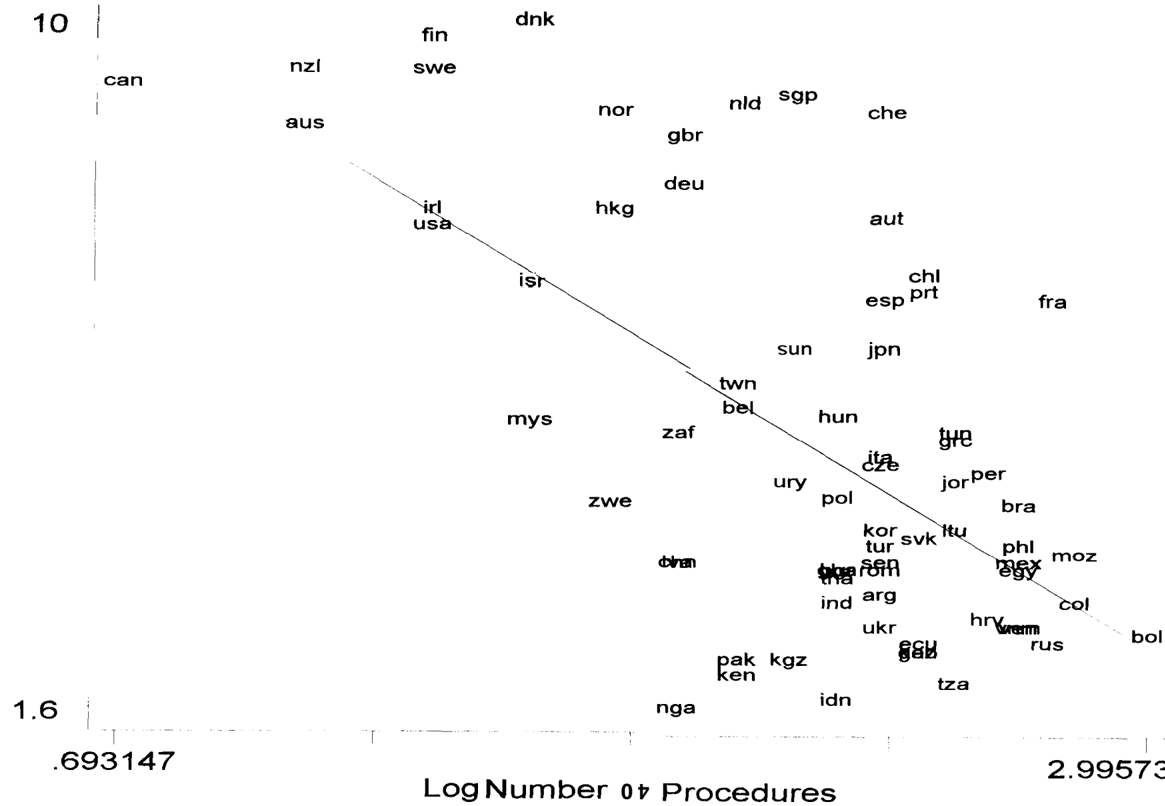
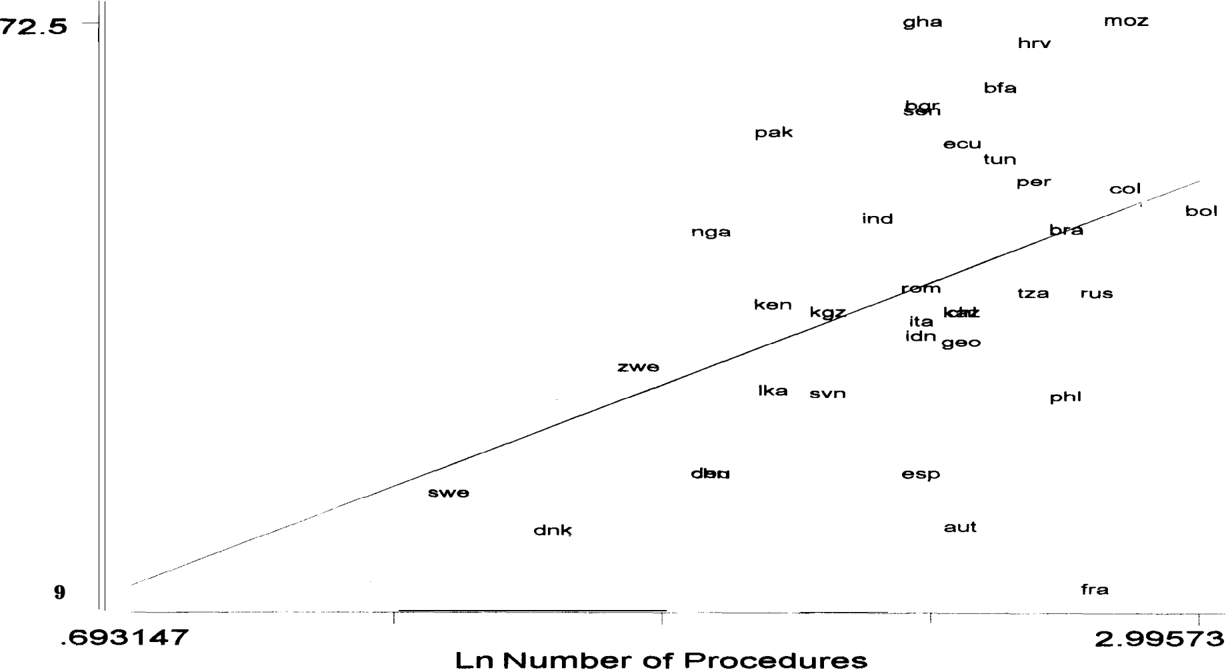
- The number of procedures is strongly correlated with time and cost: the paper reports correlations of 0.75 with log time and 0.62 with log cost.
- The helping-hand tests do not support a beneficial-regulation story: in Table IV, more procedures are associated with lower ISO quality standards (e.g. coefficient -0.2646) and larger unofficial economy measures (e.g. coefficient 13.6277 for size of unofficial economy; 19.8763 for employment in the unofficial economy), while pollution and health outcomes do not improve.
- The tollbooth evidence is stronger: Table VI reports that more procedures are associated with worse corruption scores, with a coefficient of -3.2809 (and -1.7249 with GDP per capita controls) for the corruption regressions.
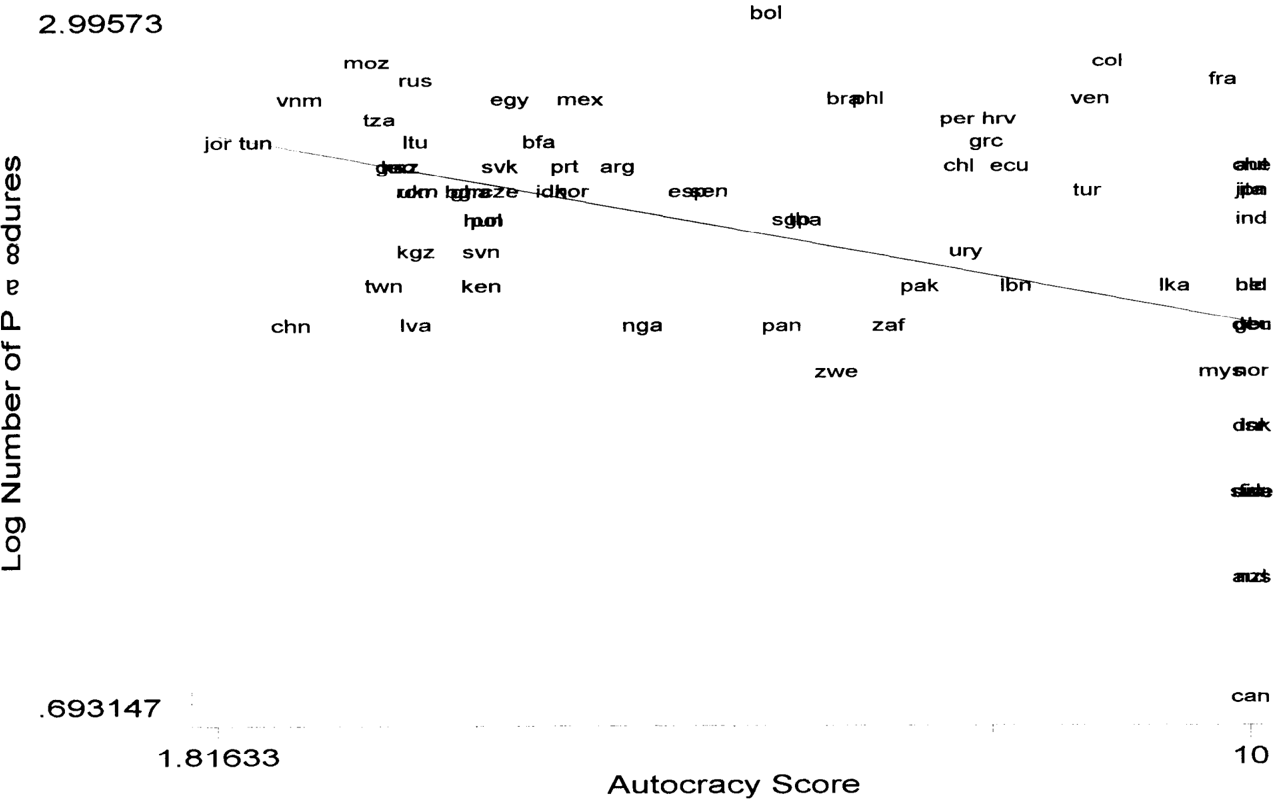
- In Table VIII, better government is associated with lighter regulation; the paper states that countries with more limited and representative governments have statistically significantly fewer procedures using 5 out of 6 measures of better government, and that more autocratic countries regulate more heavily.
Methods
- The paper builds a new database on entry regulation for 75 countries, focusing on the legal requirements, official time, and official cost for a standardized start-up firm.
- Data were gathered from written government sources, World Bank- and USAID-sponsored studies, government web pages, direct contacts with agencies, and independent double-checks in 73 countries via local consulting reports; the remaining 2 countries were double-checked through government contacts.
- The main analysis uses cross-country OLS regressions relating entry regulation measures to outcomes such as quality, pollution, unofficial economy, corruption, political institutions, legal origin, and GDP per capita; the paper also reports correlations and test-of-means comparisons across income quartiles.
Limitations
- The paper itself notes that the capture-theory tests are based on crude measures and that the data are probably least suited to test the capture hypothesis.
- The authors say the data almost surely underestimate the cost and complexity of entry because they focus on the capital city, omit industry-specific requirements and foreign-ownership steps, and ignore some informal delays and bribes.
- Evident from the text: the study is cross-sectional and based on official procedures/costs, so causal interpretation is limited and informal corruption/bureaucratic delays are not directly measured except indirectly through correlations.
Model-written summary. Check it against the paper before relying on it.
Integrity signals
Registry
Cites
Statistics
Figures
Verification
Claims the paper makes
0 Valid · 3 Not valid · 13 Not checked · 114 Own results and interpretations
A result the paper reports from its own data — it cites no other source for it, so there is none to check. The quote shows it is in the paper.
In the paper
“Very few entry regulations cover tax and labor issues.”
plain- Asserted: passes — The authors put it forward as true.
- Checkable: passes — It can be checked against evidence.
- Load-bearing: unclear — It is unclear whether the paper’s conclusions depend on it.
- Based: passes — The paper gives a reason why it holds.
In the paper
“The data show that the numbers of entry and of labor market regulations are positively correlated across countries, contrary to the substitutes hypothesis.”
What the sources say
- Not matchedcites Djankov et al., 2000
An author–year citation the paper’s reference list doesn’t settle. We don’t search these by name.
plainstates an association- Asserted: passes — The authors put it forward as true.
- Checkable: passes — It can be checked against evidence.
- Load-bearing: unclear — It is unclear whether the paper’s conclusions depend on it.
- Based: passes — The paper gives a reason why it holds.
- Not matched
A result the paper reports from its own data — it cites no other source for it, so there is none to check. The quote shows it is in the paper.
In the paper
“It often takes the form of screening procedures.”
- Also stated in: § III. Basic Results. · plain
“Instead, much of what governments do to regulate entry falls into the category of screening procedures.”
plain- Asserted: passes — The authors put it forward as true.
- Checkable: passes — It can be checked against evidence.
- Load-bearing: unclear — It is unclear whether the paper’s conclusions depend on it.
- Based: passes — The paper gives a reason why it holds.
- Also stated in: § III. Basic Results. · plain
A result the paper reports from its own data — it cites no other source for it, so there is none to check. The quote shows it is in the paper.
In the paper
“First, the cost-to-per-capita-GDP ratio decreases uniformly with GDP per capita.”
plainstates an association- Asserted: passes — The authors put it forward as true.
- Checkable: passes — It can be checked against evidence.
- Load-bearing: unclear — It is unclear whether the paper’s conclusions depend on it.
- Based: passes — The paper gives a reason why it holds.
A result the paper reports from its own data — it cites no other source for it, so there is none to check. The quote shows it is in the paper.
In the paper
“In contrast, countries in the other three quartiles of per capita income are not statistically different from each other in terms of the number of procedures and the time required to fulfill them.”
plain- Asserted: passes — The authors put it forward as true.
- Checkable: passes — It can be checked against evidence.
- Load-bearing: passes — The paper’s conclusions depend on it.
- Based: passes — The paper gives a reason why it holds.
49 more claims
Create a free account to see all 130 claims and every source verdict.
- Probably not a substantial claim. 21
- It may state two separate claims as one. 54
- The quote only partly states this claim. 26
Claims other papers make about this one
Each is checked against this paper’s own text: does it say what the citing paper says it does?
The source backs part of the claim, not all of it — or backs it for a different population, condition or comparison.
In the citing paper
“Our findings suggest an explanation for the low level of incorporation in Italy: the average direct cost associated with fulfilling the bureaucratic regulations for registering a new corporation in Italy is 20% of per capita GNP compared to 10% of per capita GNP on average for other G-7 European countries.”
From Entry regulation as a barrier to entrepreneurship (2006) · cites this paper as Djankov et al. (2002)
Experimental — accuracy not yet measuredThe cited source says what the claim attributes to it.
In the citing paper
“Given the explicit link made by Djankov et al . (2002) between the speed and ease with which businesses may be established in a country and its economic performance - and the enthusiasm with which this link has been grasped by European Union policy makers - our findings imply this link needs reconsidering.”
From The Effect of Business Regulations on Nascent and Young Business Entrepreneurship (2007) · cites this paper as Djankov et al . (2002)
Citations
Cites
La Porta, R., Lopez‐de‐Silanes, F., Shleifer, A., & Vishny, R. W. (1998) · Journal of Political Economy · doi:10.1086/250042 · Cited by 18,025
Self-citationThe Theory of Economic Regulation
Stigler, G. J. (1971) · The Bell Journal of Economics and Management Science · doi:10.2307/3003160 · Cited by 8,098
Journal of Economic Literature
(2019) · AEA Papers and Proceedings · doi:10.1257/pandp.109.633 · Cited by 7,468
The Quarterly Journal of Economics
Kuznets, S. (2024) · Business Cycle Theory, Part I Volume 4 · doi:10.4324/9781003549741-8 · Cited by 7,176
La Porta, R. (1999) · Journal of Law, Economics, and Organization · doi:10.1093/jleo/15.1.222 · Cited by 5,699 · cited 2×
“Legal origin has been viewed as a proxy for the government’s proclivity to intervene in the economy and the stance of the law toward the security of property rights in a country [La Porta et al. 1999].”
The Theory of Economic Regulation
Stigler, G. J. (2021) · The Political Economy · doi:10.4324/9781315495811-8 · Cited by 5,483
Pigou, A. C. (1933) · The Economic Journal · doi:10.2307/2224491 · Cited by 5,137
Toward a More General Theory of Regulation
Peltzman, S. (1976) · The Journal of Law and Economics · doi:10.1086/466865 · Cited by 4,729
Moffitt, R. A. (2009) · American Economic Review · doi:10.1257/aer.99.2.660 · Cited by 4,694
Shleifer, A., & Vishny, R. W. (1993) · The Quarterly Journal of Economics · doi:10.2307/2118402 · Cited by 3,778
Self-citation
Research works printed but not linked: 7
- McLiesh Caralee, 2001, NBER Working Paper No., 8288
- Kasnako lu, Zehra, and Münür Yayla, 'Unrecorded Economy in Turkey: A Monetary Approach', 1999. "Unrecorded Economy in Turkey (A Monetary Approach)" in Informal Sector in Turkey (I), Tuncer Bulutay (ed.), SIS, Ankara, forthcoming.
- Fred, 1987, Journal of Legal Studies, 101
- Olson, Mancur, 1991, 'Autocracy, Democracy, and Prosperity,' in Richard Zeckhauser, ed., Strategy of Choice, Cambridge, MA: MIT Press.
- 1967, Western Economic Journal, 232
- World Economic Forum (1999), The Global Competitiveness Report 1999 , Schwab, Klaus et al., eds., New York: Oxford University Press.
- World Economic Forum, The Global Competitiveness Report 2001, Klaus Schwab et al., eds. (New York, NY: Oxford University Press, 2001).
Cited by
Items 3,001–3,100 of 3,986
Krammer, M. S. (2008) · SMARTech Repository (Georgia Institute of Technology) · Cited by 1
Understanding and improving data on entrepreneurship and active companies
Coolidge, J., Hornberger, K., & Luttikhuizen, R. (2008) · Cited by 1
Uncoordinated Corruption as an Equilibrium Phenomenon
Zenger, H. (2011) · Journal of Institutional and Theoretical Economics JITE · doi:10.1628/093245611796589988 · Cited by 1
Competition among the elites, property rights protection and economic performance
Pan, S. (2011) · Journal of Economics · doi:10.1007/s00712-011-0198-8 · Cited by 1
Regulatory delay and growth: a cross country analysis
Marneffe, W., van Aarle, B., & Vereeck, L. (2011) · European Journal of Law and Economics · doi:10.1007/s10657-011-9295-y · Cited by 1
Comment on "Regulations, Market Structure, Institutions, and the Cost of Financial Intermediation"
Strahan, P. E. (2004) · Journal of money credit and banking · doi:10.1353/mcb.2004.0051 · Cited by 1
Regulatory reform in five western Balkan countries: Evidence and perspectives
Penev, S., & Marušić, A. (2009) · Economic Annals · doi:10.2298/eka0982040p · Cited by 1
The Debt Choices of the Firms in Developed Countries: Evidence from G-7
Luca, P. D. (2015) · International Journal of Economics and Finance · doi:10.5539/ijef.v7n4p122 · Cited by 3
“They have investigated the effects of the economic, financial and institutional system of the country’s reference on the firm’s debt choices (Fan et al., 2012; Frank & Goyal, 2009; Masulis & Nahata, 2009; De Jong et al., 2008; Davydenko & Franks, 2008; Dinc, 2005; Degryse & Ongena, 2005; Johnson & Mitton, 2003; Beck e…”
Secured transactions law reform, UNCITRAL and the export of foreign legal models
McCormack, G. (2013) · Cambridge University Press eBooks · doi:10.1017/cbo9781139226363.005 · Cited by 1
Fujiwara, H., & Kimura, H. (2012) · The Journal of Private Equity · doi:10.3905/jpe.2012.15.3.045 · Cited by 1
Licensing Procedures in Developing Countries: Should They Be Part of the Set-up Process?
Qing, Z., & Ogus, A. I. (2006) · International Journal of Public Administration · doi:10.1080/01900690600854738 · Cited by 1
Quality Traps in Localized Competition
Gangopadhyay, P., Rahman, M. A., & Elkanj, N. (2011) · Modern Applied Science · doi:10.5539/mas.v5n5p3 · Cited by 1
Harding, M., O’Connell, A., & Stewart, M. (2014) · Cambridge University Press eBooks · doi:10.1017/cbo9781107282117.018 · Cited by 1
Does regulation promote small business performance? A critical realist informed approach
Kitching, J., Hart, M., Wilson, N., et al. (2008) · Research Repository (Kingston University London) · Cited by 1
Determinants of Access to Credit in Microenterprises of Turkey
Duman, A. (2009) · Cited by 1
Águila-Real, J. A. (2004) · European Business Organization Law Review · doi:10.1017/s1566752904004495 · Cited by 1
van Witteloostuijn, A. C., & Ced, A. (2011) · Cited by 3
Unbundling Canada's Weak Productivity Performance: A Review of the Issues
Basu, S. (2010) · Cited by 1
Firm Dynamics, Labor Mobility, and Specific Human Capital
Morita, H. (2007) · Cited by 1
Tuan, B. A., & Tas, N. F. (2006) · Cited by 1
McGregor‐Lowndes, M. (2014) · Cambridge University Press eBooks · doi:10.1017/cbo9781107282117.021 · Cited by 1
Firm heterogeneity and political economy of international trade
Ergul, E. (2010) · Illinois Digital Environment for Access to Learning and Scholarship (University of Illinois at Urbana-Champaign) · Cited by 1
Pellegata, A. (2009) · Cited by 1
Does policy reform promote FDI in developing economies? a firm-level simulation approach
Tanaka, K., & Arita, S. (2015) · Journal of Economic Policy Reform · doi:10.1080/17487870.2015.1100083 · Cited by 2
“A comparable measure of business restrictions on domestic firms is approximated by the days for starting a business from the Doing Business Indicator (DBI) of the World Bank.10 Djankov et al. (2002) use this data-set to demonstrate a wide variation in entry regulations across countries.”
of Goods and Labor Markets Deregulation
Cacciatore, M., Montr, H., & Fiori, G. (2015) · Cited by 1
Strategy and performance of family firms : an institutional embeddedness perspective
Durán, P. (2015) · Medical Entomology and Zoology · Cited by 4
COOPERATION OR PUNISHMENT The Effects of Trust on Government Regulation and Taxation
Harring, N. (2016) · Gothenburg University Publications Electronic Archive (Gothenburg University) · Cited by 2
DO INSTITUTIONS MATTER FOR REGIONAL GROWTH AND DEVELOPMENT? THE CASE OF TURKEY
Değirmenci, S. (2011) · Cited by 1
Raddatz, C. E. (2013) · World Bank, Washington, DC eBooks · doi:10.1596/978-0-8213-9828-9_ch6 · Cited by 1
A Portrait of the Chinese Entrepreneur
Djankov, S., Qian, Y., Roland, G., & Zhuravskaya, E. V. (2009) · Palgrave Macmillan UK eBooks · doi:10.1057/9780230242173_5 · Cited by 1
Self-citationBusiness Bankruptcies across Countries and the Law
Papillon, B. M. (2012) · International Finance · doi:10.1093/acprof:oso/9780199754656.003.0025 · Cited by 1
Theoretical Aspects of Banking Regulation
Sum, K. (2016) · Springer eBooks · doi:10.1007/978-3-319-41378-5_1 · Cited by 1
Drivers of national innovation in transition: Evidence from an eastern European panel
Krammer, M. (2008) · SMARTech Repository (Georgia Institute of Technology) · Cited by 1
Courts' Decision Making without Commitment: a Comparative Analysis
Riboni, A. (2005) · Cited by 1
Impacts of tax and firing costs on size of the informal sector and unemployment
Dell’Anno, R., & Solomon, O. H. (2016) · The Journal of developing areas · doi:10.1353/jda.2016.0172 · Cited by 1
Modeling economic growth with tourism for small open economies
Stauvermann, P. J., & Kumar, R. R. (2017) · Metroeconomica · doi:10.1111/meca.12161 · Cited by 1
Private benefits of control in the banking industry: A cross-country analysis
Gianfrate, G., Santangelo, E., & Zanetti, L. (2012) · Corporate Ownership and Control · doi:10.22495/cocv10i1c5art1 · Cited by 1
Egbetokun, A., Ekperiware, M. C., Oladipo, O. G., Adepoju, A. O., Adelowo, C. M., Isola, O. O., & Olamade, O. O. (2011) · Journal of Emerging Trends in Economics and Management Science · Cited by 1
The UK general anti abuse rule : lessons for Australia?
Kujinga, B. T. (2016) · UpSpace Institutional Repository (University of Pretoria) · Cited by 1
Views Linking Colonialism with Institutions
Oto‐Peralías, D., & Romero‐Ávila, D. (2017) · Contributions to economics · doi:10.1007/978-3-319-54127-3_2 · Cited by 2
Entry costs and regional productivity disparity in an open economy
Peng, G. (2017) · Economics Letters · doi:10.1016/j.econlet.2017.09.033 · Cited by 1
Ease of Doing Business and Wealth Creation
Mongay, J. (2017) · Advances in public policy and administration (APPA) book series · doi:10.4018/978-1-5225-3117-3.ch002 · Cited by 1
Reddy, C. D. (2019) · Problems and Perspectives in Management · doi:10.21511/ppm.17(1).2019.26 · Cited by 1
“Other formal incentives include less procedures, short times and low costs of starting a business (Djankov, La Porta, Lopez de Silanes, & Shleifer, 2002), as well as less arduous labor regulations in labor-intensive industries (Klapper et al., 2006).”
The Lucas Paradox: Review of Marginal Product of Capital and Net Versus Gross Capital Flows
Akhtaruzzaman, M. (2019) · Springer eBooks · doi:10.1007/978-981-13-9069-2_3 · Cited by 1
Food Processing: The Bihar Trajectory
Saha, D. (2020) · Springer eBooks · doi:10.1007/978-981-13-8554-4_4 · Cited by 1
Shen, J., & Lee, C. (2019) · IEEE International Symposium on Innovation and Entrepreneurship (TEMS-ISIE) · doi:10.1109/tems-isie46312.2019.9074326 · Cited by 2
“Numerous studies have found that stronger entry controls and government interventions hinder the emergence of new businesses ([34]).”
The Social Construction of the Regulatory Burden: Methodological and Substantive Considerations
Kurtz, M. J., & Schrank, A. M. (2020) · Social Forces · doi:10.1093/sf/soaa049 · Cited by 1
Louati, S., & Boujelbène, Y. (2020) · Journal of African Business · doi:10.1080/15228916.2020.1770041 · Cited by 3
Assessing the Europe 2020 strategy
Pasimeni, P. (2018) · Routledge eBooks · doi:10.4324/9781315641829-7 · Cited by 1
Shen, G., & Philipsen, N. J. (2014) · China-EU law series · doi:10.1007/978-3-662-48273-5_8 · Cited by 7
Malinowska, A. P. (2021) · Acta Oeconomica · doi:10.1556/032.2021.00006 · Cited by 1
Menyah, M. V., Zhuang, J., Sappor, E., & Akrashei, R. (2021) · International Journal of Scientific Research in Science Engineering and Technology · doi:10.32628/ijsrset218524 · Cited by 1
Imperfect Competition, Real Estate Prices and New Stylized Facts
Kumar, R. R., & Stauvermann, P. J. (2022) · Journal of risk and financial management · doi:10.3390/jrfm15030099 · Cited by 1
The problem of corruption in the contracting out of public services - the case of Slovakia
Meričková, B. M., Majerík, M., & Lendvorský, M. (2021) · Acta Universitatis Bohemiae Meridionalis · doi:10.32725/acta.2021.008 · Cited by 1
“The correlation between the monopoly market environment and extensive state intervention regulating the environment and corruption has been confirmed by several studies (Kligaard 1998; Broadman and Recanatini 1999; Djankov et al. 2002; Treisman 1999; Lambsdorff et al. 2000; Ades and di Tella 1999).”
Fujiwara, H. (2013) · The Journal of Private Equity · doi:10.3905/jpe.2013.2013.1.031 · Cited by 1
Corruption, governance, institutional quality, and underground economy in Nigeria
Okon, E. O. (2022) · Journal of Sustainable Business Economics and Finance · doi:10.31039/josbef.2022.1.2.20 · Cited by 2
Interaction of corruption, governance, institutional quality and underground economy in Nigeria
Okon, E. O. (2022) · Global Journal of Business Economics and Management Current Issues · doi:10.18844/gjbem.v12i3.6416 · Cited by 2
Davidescu, A. A., & Manta, E. M. (2023) · Springer eBooks · doi:10.1007/978-981-19-5149-7_5 · Cited by 1
Going Underground: The impact of deterrence on the landlords' decision to operate informally
Samuel, A., & Schwartz, J. (2023) · Applied Economics · doi:10.1080/00036846.2023.2169244 · Cited by 1
“Djankov et al. (2002) confirms that greater regulations are associated with a larger informal sector by showing that countries with more regulatory procedures for firms have larger underground economies.”
Challenges for the New Generation of Female Entrepreneurs: An Assessment of the Studies
Arena, C., Catuogno, S., Paoloni, P., & Pastore, P. (2023) · SIDREA series in accounting and business administration · doi:10.1007/978-3-031-21932-0_1 · Cited by 2
Supervisory power and insurer financial stability: the role of institutional quality
Rubio‐Misas, M. (2023) · The Geneva Papers on Risk and Insurance Issues and Practice · doi:10.1057/s41288-023-00309-6 · Cited by 6
“For instance, they can use their power to favour local constituencies (Shleifer and Vishny 1998), attract campaign donations (Djankov et al. 2002) or delay regulatory actions against failing financial institutions before elections (Leverty and Grace 2018), which, in turn, could accelerate the…”
Kandoğan, Y. (2023) · Applied Economics · doi:10.1080/00036846.2023.2296373 · Cited by 1
Economic Vulnerability and Resilience to Shocks – An Attempt to Measure
Topolewski, Ł., Moszyński, M., & Guo, Y. (2023) · Studies in Logic Grammar and Rhetoric · doi:10.2478/slgr-2023-0025 · Cited by 1
Do Red States Have a Comparative Advantage in Generating Green Power?
Huang, R., & Kahn, M. E. (2024) · Environmental and Energy Policy and the Economy · doi:10.1086/727882 · Cited by 3
“20 Local regulations deter renewable developers from entering the market (Djankov et al. 2002; Mulligan and Shleifer 2005).”
From the paper age to the electronic age: an electronic business registry reform in Ecuador
Camino‐Mogro, S. (2024) · Economics of Innovation and New Technology · doi:10.1080/10438599.2024.2317303 · Cited by 1
“It is well known that high entry costs create barriers to business creation (Djankov 2009; Djankov et al. 2002; Djankov, McLiesh, and Ramalho 2006) and could increase informality (Ulyssea 2018, 2020).”
InfluentialFerreira, L. G. V., & Medeiros, C. R. D. O. (2024) · Cadernos EBAPE BR · doi:10.1590/1679-395120230009 · Cited by 3
Vavoura, C. (2024) · Mathematics · doi:10.3390/math12101576 · Cited by 1
What is the relationship between industry‐specific regulation and technology startups?
Palagashvili, L., & Suarez, P. A. (2024) · Economic Affairs · doi:10.1111/ecaf.12674 · Cited by 1
Ease of Doing Business and Entrepreneurship: Evidence from a Tax Administration Reform in China
Pan, H., Wang, Y., & Zhang, Y. (2026) · International Tax and Public Finance · doi:10.1007/s10797-026-09968-2 · Cited by 4
“More - over, reducing tax-induced distortions enhances the allocation efficiency of resources and encourages market entry (Black, 1974; Djankov et al., 2002).”
Nam, N. K. T., Luu, T. M. N., Hung, T. H., & Huong, N. T. M. (2025) · Procedia Computer Science · doi:10.1016/j.procs.2025.01.090 · Cited by 1
How does cultural diversity impact entrepreneurship? Evidence from dialect diversity in China
Wang, T., Lei, Z., & Wang, Y. (2025) · Post-Communist Economies · doi:10.1080/14631377.2025.2463266 · Cited by 1
Vargas-Hernández, J. G., & Vargas-González, O. C. (2025) · IGI Global eBooks · doi:10.4018/979-8-3373-0710-7.ch017 · Cited by 2
Impact of Ease of Doing Business Rank on Economic Performance
Sharma, R., Agarwal, B., Rastogi, S., et al. (2024) · doi:10.1109/iipem62726.2024.10925826 · Cited by 1
Measuring the Costs and Benefits of Regulation
Bombardini, M., Trebbi, F., & Zhang, M. B. (2025) · Annual Review of Economics · doi:10.1146/annurev-economics-081224-104518 · Cited by 5
The effects of imperfect competition and antitrust measures in a three-sector OLG model
Stauvermann, P. J., Hu, J., & Kumar, R. R. (2025) · Journal of Economics · doi:10.1007/s00712-025-00912-2 · Cited by 1
“Although Djankov et al (2002) note that the latter mechanism does not necessarily lead to inefficiencies, it often does in practice.”
Generational imprints: A contingency approach to corruption and entrepreneurship
Wei, Y., Wang, M. S., & Liu, J. (2025) · Strategic Entrepreneurship Journal · doi:10.1002/sej.1548 · Cited by 3
Accounting Transparency and Foreign Market Entry Mode Choices
Huang, S. X., Li, Y., & Luo, S. (2026) · Journal of Management Accounting Research · doi:10.2308/jmar-2023-003 · Cited by 1
Cracking the Corruption Code: The Case of Afghanistan
Mr., A., & Khan, Q. (2013) · Cited by 1
Nazir, R., Shahzad, K., & Nadeem, M. (2013) · European Journal of Business and Management · Cited by 1
The underlying mechanism of related party transactions disclosure across countries
ElKelish, W. W. (2011) · Corporate Ownership and Control · doi:10.22495/cocv8i4p2 · Cited by 1
“Electronic copy available at: https://ssrn.com/abstract=2149403 47 In the same context, Djankov et al. (2002) presented evidence that government intervention in the economy in the form of more entry regulations reflects the Public Choice theory (De Soto, 1990, and Stigler, 1971).”
InfluentialFinancial Integration, Financial Dependence and Employment Growth
Gür, N. (2015) · International Journal of Economics and Financial Issues · Cited by 1
Social policy preferences from a comparative perspective
Berens, S. (2015) · Cited by 1
Xu, W. (2014) · Applied Economics Letters · doi:10.1080/13504851.2013.861580 · Cited by 1
“The regression specification follows the one employed in Table 6 of Djankov et al. (2008). The t-statistics is reported in the parentheses. *, ** and *** stand for 10%, 5% and 1% significance levels, respectively. 2 See Leamer (1983) for discussion about the terminologies for the focus, free and doubtful variables.”
AGGLOMERATION VERSUS PRODUCT VARIETY: IMPLICATIONS FOR REGIONAL INEQUALITIES*
Behrens, K., & Thisse, J. (2006) · Journal of Regional Science · doi:10.1111/j.1467-9787.2006.00487.x · Cited by 1
Gold, the State and Market Actors: Legal vs. Illegal Practices of Interaction
Ryzhova, N., & Lee, E. (2013) · Inner Asia · doi:10.1163/22105018-90000053 · Cited by 1
The role of skills acquisition centres in entrepreneurial growth and job creation in Nigeria
Mmadu, B. A. (2014) · International Journal of Entrepreneurship and Innovation Management · doi:10.1504/ijeim.2014.064714 · Cited by 1
The condition of entrepreneurship process in Mazandaran sport organizations
Ashouri, T., Boroumand, M. R., & Darzi, A. F. (2014) · European Online Journal of Natural and Social Sciences · Cited by 1
Institutions, socio-économic models and development: an overview of the literature and a methodology
Rougier, É., & Combarnous, F. (2010) · HAL · Cited by 8
Militarization as a Socio-Political Context for Entrepreneurial Innovation
Inouye, T. M. (2016) · Proceedings of the ... Annual Hawaii International Conference on System Sciences/Proceedings of the Annual Hawaii International Conference on System Sciences · doi:10.1109/hicss.2016.508 · Cited by 1
The Government’s Attitude Toward the Informal Sector and Piracy
Ballano, V. O. (2015) · Springer eBooks · doi:10.1007/978-981-287-922-6_3 · Cited by 1
Joarder, M. A. M., Hasanuzzaman, S., & Saleh, U. (2016) · The Journal of Developing Areas · doi:10.1353/jda.2016.0087 · Cited by 2
Krivogorsky, V., Jc, C., & Black, E. L. (2016) · International Journal of Accounting Research · doi:10.4172/2472-114x.1000125 · Cited by 1
Free Market Institutions and FDI Performance in Emerging Asian Economies
Vogiatzoglou, K. (2016) · International Journal of Management and Economics · doi:10.1515/ijme-2016-0026 · Cited by 3
Giacomelli, S., & Tonello, M. (2017) · European Journal of Political Economy · doi:10.1016/j.ejpoleco.2017.02.005 · Cited by 13
Challenges to Venture Growth in Emerging Economies
Almobaireek, W. N., Alshumaimeri, A. A., & Manolova, T. S. (2017) · SAGE Publications Ltd eBooks · doi:10.4135/9781473984080.n24 · Cited by 6
Research on the Influence of Commercial System Reform and Enterprise Development
Luo, P. (2018) · Modern Economy · doi:10.4236/me.2018.95063 · Cited by 1
“Using data on the commercial systems of 46 countries from 2005 to 2008, the study found that the procedures needed to start a business are more tedious and Higher minimum capital requirements will significantly reduce the number of new companies entering [16].”
Merger Control and Economic Growth of LDCs: Some Observations and Recommendations
Begović, B., & Popović, D. V. (2018) · Review of Industrial Organization · doi:10.1007/s11151-018-9642-z · Cited by 1
Public Funds and Entrepreneurship: A Cognitive Economics Approach
Gaudens-Omer, K. T. (2018) · Journal of Business & Economic Policy · doi:10.30845/jbep.v5n2a9 · Cited by 3
Geographic Endowment, Corruption, and Economic Development
Arefin, S. (2018) · Business and Economic Research · doi:10.5296/ber.v9i1.14080 · Cited by 1
Aggregate Productivity Growth Decomposition: an Overview
Murao, T. (2017) · RePEc: Research Papers in Economics · Cited by 1
Metadata
- Authors
- Djankov, S., La Porta, R., Lopez-de-Silanes, F., & Shleifer, A.
- Affiliations
- World Bank (US)
- National Bureau of Economic Research (US)
- ORCID
- Djankov, S.
- Venue
- The Quarterly Journal of Economics
- Publisher
- Oxford University Press (OUP)
- Published
- 2002-02-01
- Volume
- 117
- Issue
- 1
- Pages
- 1-37
- ISSN
- 0033-5533
- 1531-4650
- OpenAlex
- W2139896179
- Cited by
- 3,956
- References
- 30
- Citations by year
- 2026: 223 · 2025: 185 · 2024: 157 · 2023: 120 · 2022: 140 · 2021: 150 · 2020: 151 · 2019: 161 · 2018: 157 · 2017: 162 · 2016: 166 · 2015: 193 · 2014: 200 · 2013: 183 · 2012: 193
- Type
- report
- Language
- en
- Open access
- green
- doi.org
- Licence
- other-oa
- Locations
- World Bank, Washington, DC eBooks (publishedVersion)
- The Quarterly Journal of Economics (publishedVersion)
- The World Bank Open Knowledge Repository (World Bank) (publishedVersion)
- National Bureau of Economic Research (publishedVersion, other-oa)
- RePEc: Research Papers in Economics (submittedVersion)
- Digital Access to Scholarship at Harvard (DASH) (Harvard University) (submittedVersion, cc-by)
- SSRN Electronic Journal (submittedVersion)
- OpenGrey (Institut de l'Information Scientifique et Technique) (submittedVersion)
- The World Bank Open Knowledge Repository (World Bank) (submittedVersion, cc-by)
- Topics
- Social Sciences › Sociology and Political Science › Corruption and Economic Development
- Social Sciences › Economics, Econometrics and Finance › Economics and Econometrics › Taxation and Compliance Studies
- Social Sciences › Business, Management and Accounting › Strategy and Management › Political Influence and Corporate Strategies
- Keywords
- start-up firms, bureaucratic procedures, corruption, informal economy, democracy, government size, public choice theory, public interest theory
About these checks
Registry, retraction, Cites and statistics results are computed, not judged, with one exception: a printed reference that no index lists is read once by a model before it counts as a citation error. Claims are extracted by a model and kept only when their quote appears verbatim in the text; each cited source is then checked, with a model’s help, for whether it says what the claim relies on. Those verdicts can be wrong — read the claim’s quote and the cited source before relying on one.
A language model drew the claims from the paper on 2026-10-01, under version 3 of the claim definition (model deepseek-v4.1-flash, prompt extract-v3).
A second model labelled each claim on 2026-10-01 (model jev-1.13-20260917, definition revision gold-guideline-v0.2).
Statistics and arithmetic are recomputed, not judged.
Confidence bands are shown only for fields calibrated on our annotated test set. None is calibrated yet, so no band is shown.
What counts as a claim ›How we measure confidence ›How we check this ›
Are you an author, or do you see a problem with this page? Request a review
Data sources
Bibliographic data: Semantic Scholar, OpenAlex, Crossref.
Contains information from the Semantic Scholar Academic Graph Datasets, made available under the ODC Attribution License (ODC-BY 1.0).
Semantic Scholar’s data is described in: Kinney, R., et al. (2023). The Semantic Scholar Open Data Platform. arXiv:2301.10140.
