

The Regulation of Entry
Open accessThe DOI matches its Crossref record, with a small difference in title or year; 39 of the 39 references it cites were found in a registry or an index; none of the 13 sources its claims cite is checked for support yet.
Abstract
1%(5 :25.,1* 3$3(5 6(5,(6 7+( 5(*8/$7,21 2) (175< 6LPHRQ 'MDQNRY 5DIDHO /D 3RUWD )ORUHQ.LR /RSH]GH6LODQHV $QGUHL 6KOHLIHU :RUNLQJ 3DSHU KWWSZZZQEHURUJSDSHUVZ 1$7,21$/ %85($8 2) (&2120,& 5(6($5&+ 0DVVD.KXVHWWV $YHQXH &DPEULGJH 0$ 6HSWHPEHU :H WKDQN 2OJD ,RIIH 7DWLDQD 1HQRYD DQG (NDWHULQD 7UL]ORYD IRU DEOH UHVHDU.K DVVLVWDQ.H DQG +DPLG $ODYL ,ULQD $VWUDNKDQ $EKLMLW %DQHUMHH 5L.KDUG &DYHV -D.TXHOLQH &RROLGJH -DPHV (PHU\ 1LKDO (O0DJKDUEHO -HDQ 3DXO *DXWKLHU (G *ODHVHU 6LPRQ -RKQVRQ /DZUHQ.H .DW] 3HWHU .X.HUD 'DYLG /DLEVRQ ,UD /LHEHUPDQ 'DYLQ 0D.NLQ]LH 0DULH )UDQ.RLVH 0DULH1HOO\ 0DU.HOR 2ODUUHDJD *X\ 3IHIIHUPDQQ 6DQWLDJR 6HGD.D /HLOD :HEVWHU 3HWHU :ULJKW DQG VHPLQDU SDUWL.LSDQWV DW WKH 8QLYHUVLW\ RI 0DU\ODQG DW &ROOHJH 3DUN IRU KHOSIXO .RPPHQWV 7KH .ROOH.WLRQ RI GDWD IRU WKLV SDSHU ZDV RUJDQL]HG DQG ILQDQ.HG E\ WKH :RUOG %DQN $Q DSSHQGL[ GHV
Overview
CoChat Summary
TL;DR
This paper assembles a new cross-country dataset on business entry regulation in 75 countries and uses it to compare the helping-hand, capture, and tollbooth theories of regulation. The evidence is most consistent with the tollbooth view: heavier entry regulation is associated with more corruption, a larger unofficial economy, and less representative, more autocratic governments.
Key findings
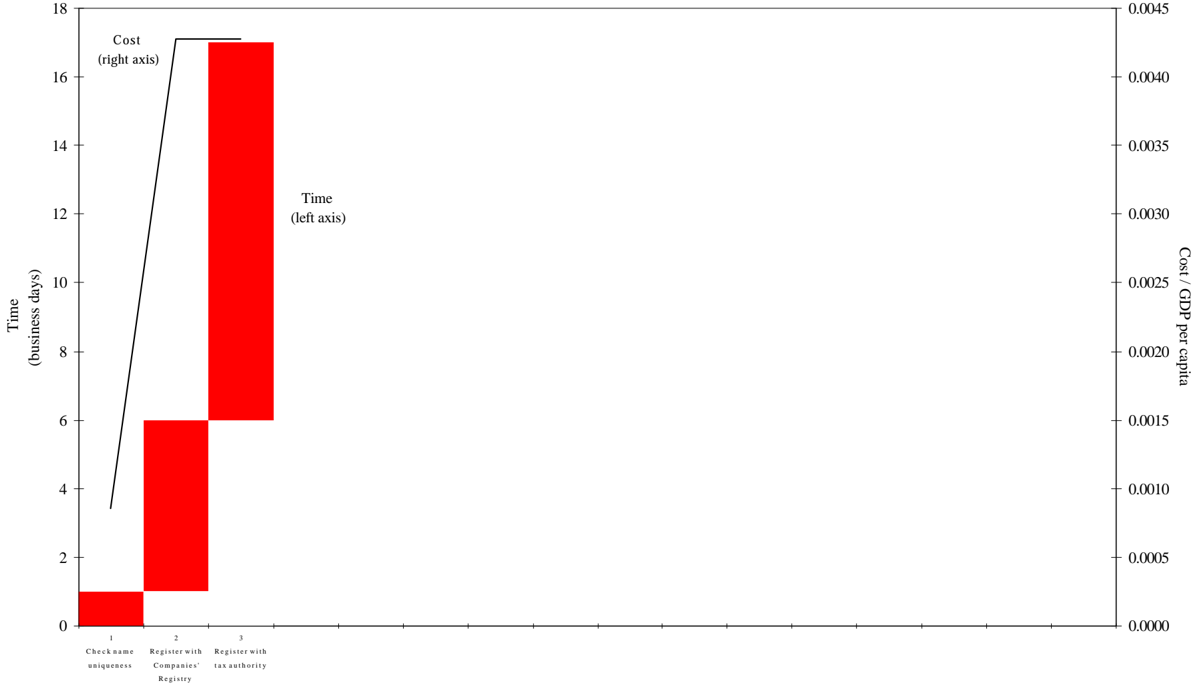
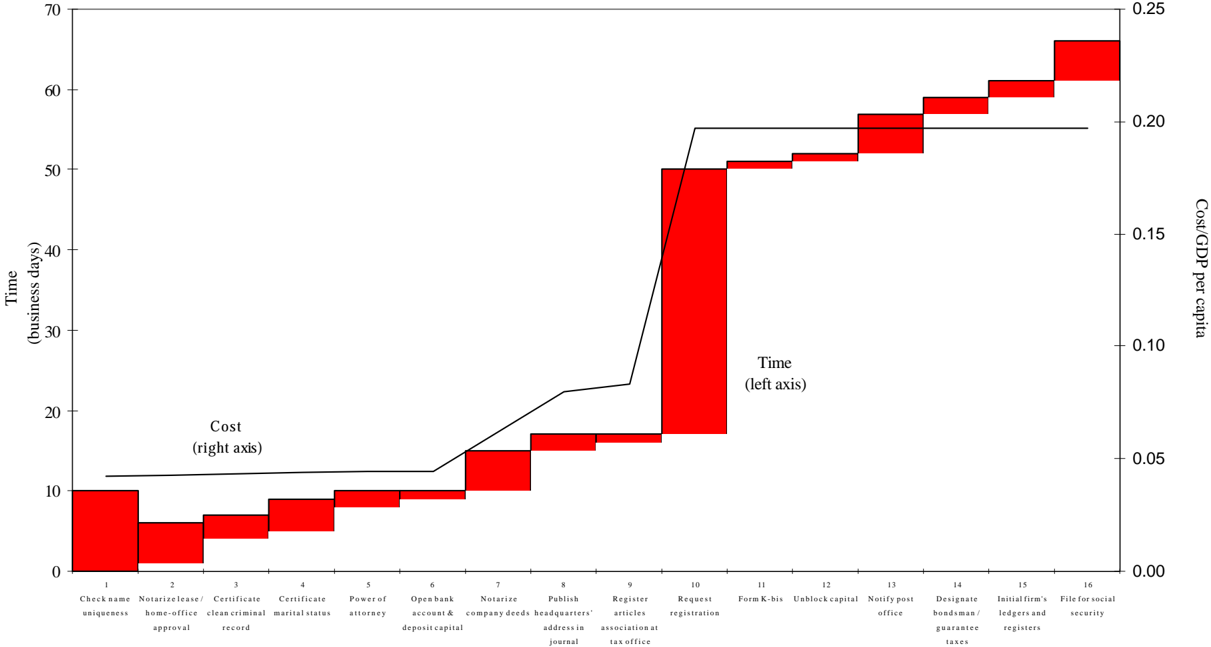
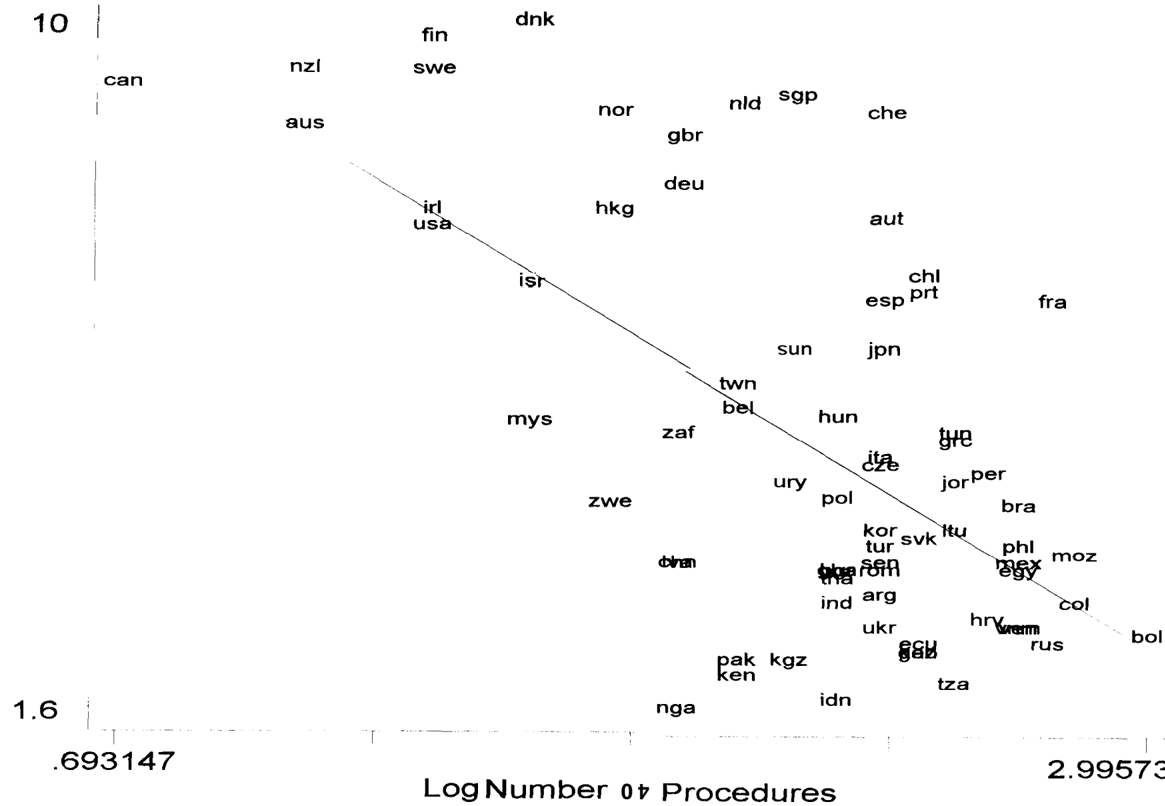
- Across the 75-country sample, the number of entry procedures ranges from 2 in Canada to 20 in Bolivia, with a sample average of 10.17 procedures; the average official time is 63.05 business days and the average cost is 0.34 of GDP per capita.
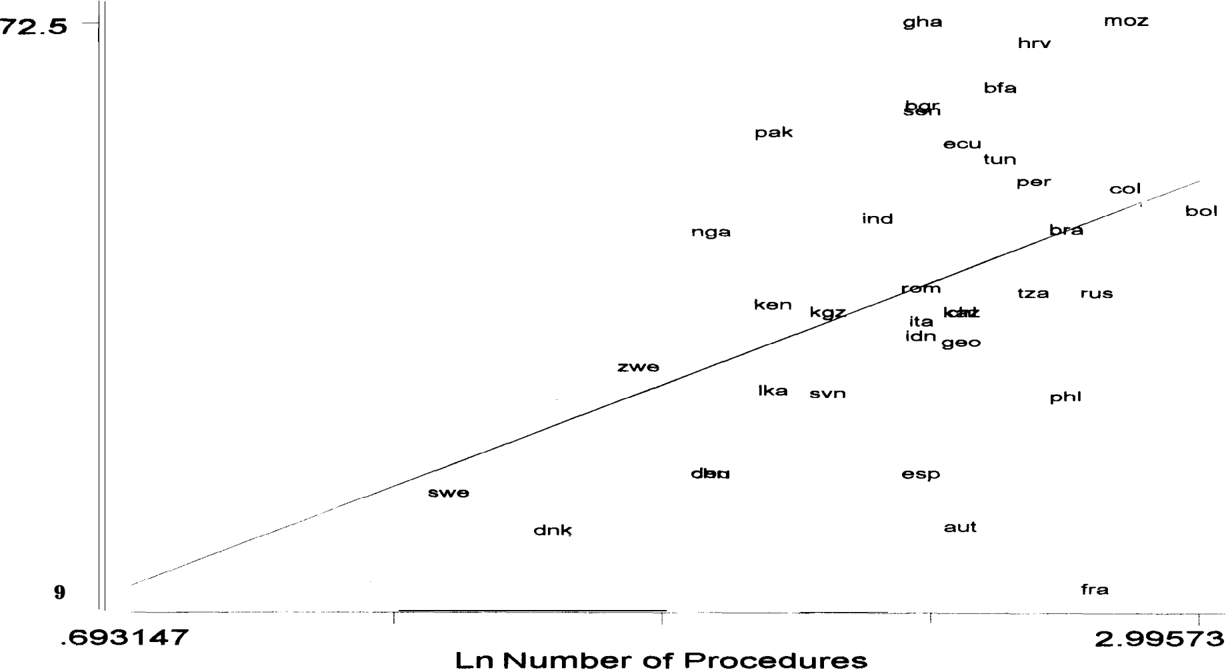
- The number of procedures is strongly correlated with time and cost: the paper reports correlations of 0.75 with log time and 0.62 with log cost.
- The helping-hand tests do not support a beneficial-regulation story: in Table IV, more procedures are associated with lower ISO quality standards (e.g. coefficient -0.2646) and larger unofficial economy measures (e.g. coefficient 13.6277 for size of unofficial economy; 19.8763 for employment in the unofficial economy), while pollution and health outcomes do not improve.
- The tollbooth evidence is stronger: Table VI reports that more procedures are associated with worse corruption scores, with a coefficient of -3.2809 (and -1.7249 with GDP per capita controls) for the corruption regressions.
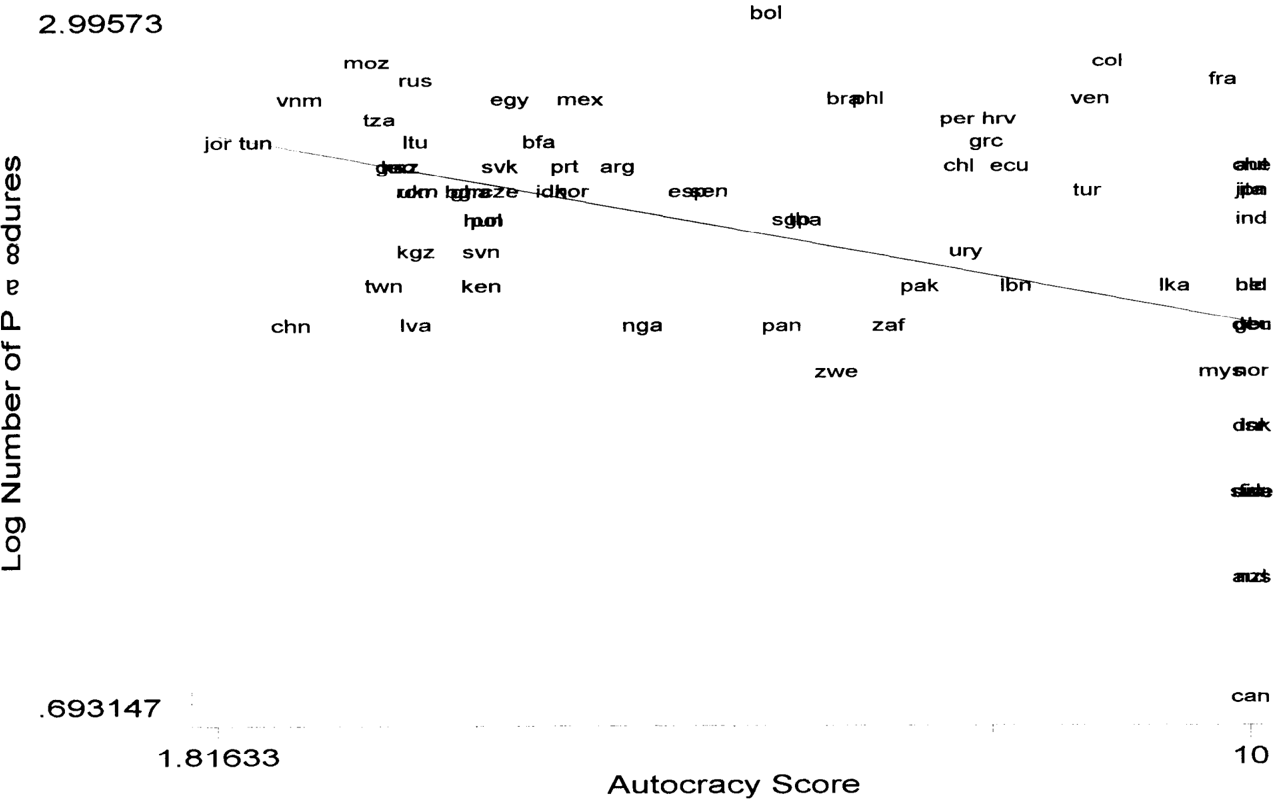
- In Table VIII, better government is associated with lighter regulation; the paper states that countries with more limited and representative governments have statistically significantly fewer procedures using 5 out of 6 measures of better government, and that more autocratic countries regulate more heavily.
Methods
- The paper builds a new database on entry regulation for 75 countries, focusing on the legal requirements, official time, and official cost for a standardized start-up firm.
- Data were gathered from written government sources, World Bank- and USAID-sponsored studies, government web pages, direct contacts with agencies, and independent double-checks in 73 countries via local consulting reports; the remaining 2 countries were double-checked through government contacts.
- The main analysis uses cross-country OLS regressions relating entry regulation measures to outcomes such as quality, pollution, unofficial economy, corruption, political institutions, legal origin, and GDP per capita; the paper also reports correlations and test-of-means comparisons across income quartiles.
Limitations
- The paper itself notes that the capture-theory tests are based on crude measures and that the data are probably least suited to test the capture hypothesis.
- The authors say the data almost surely underestimate the cost and complexity of entry because they focus on the capital city, omit industry-specific requirements and foreign-ownership steps, and ignore some informal delays and bribes.
- Evident from the text: the study is cross-sectional and based on official procedures/costs, so causal interpretation is limited and informal corruption/bureaucratic delays are not directly measured except indirectly through correlations.
Model-written summary. Check it against the paper before relying on it.
Integrity signals
Registry
Cites
Statistics
Figures
Verification
Claims the paper makes
0 Valid · 3 Not valid · 13 Not checked · 114 Own results and interpretations
A result the paper reports from its own data — it cites no other source for it, so there is none to check. The quote shows it is in the paper.
In the paper
“Very few entry regulations cover tax and labor issues.”
plain- Asserted: passes — The authors put it forward as true.
- Checkable: passes — It can be checked against evidence.
- Load-bearing: unclear — It is unclear whether the paper’s conclusions depend on it.
- Based: passes — The paper gives a reason why it holds.
In the paper
“The data show that the numbers of entry and of labor market regulations are positively correlated across countries, contrary to the substitutes hypothesis.”
What the sources say
- Not matchedcites Djankov et al., 2000
An author–year citation the paper’s reference list doesn’t settle. We don’t search these by name.
plainstates an association- Asserted: passes — The authors put it forward as true.
- Checkable: passes — It can be checked against evidence.
- Load-bearing: unclear — It is unclear whether the paper’s conclusions depend on it.
- Based: passes — The paper gives a reason why it holds.
- Not matched
A result the paper reports from its own data — it cites no other source for it, so there is none to check. The quote shows it is in the paper.
In the paper
“It often takes the form of screening procedures.”
- Also stated in: § III. Basic Results. · plain
“Instead, much of what governments do to regulate entry falls into the category of screening procedures.”
plain- Asserted: passes — The authors put it forward as true.
- Checkable: passes — It can be checked against evidence.
- Load-bearing: unclear — It is unclear whether the paper’s conclusions depend on it.
- Based: passes — The paper gives a reason why it holds.
- Also stated in: § III. Basic Results. · plain
A result the paper reports from its own data — it cites no other source for it, so there is none to check. The quote shows it is in the paper.
In the paper
“First, the cost-to-per-capita-GDP ratio decreases uniformly with GDP per capita.”
plainstates an association- Asserted: passes — The authors put it forward as true.
- Checkable: passes — It can be checked against evidence.
- Load-bearing: unclear — It is unclear whether the paper’s conclusions depend on it.
- Based: passes — The paper gives a reason why it holds.
A result the paper reports from its own data — it cites no other source for it, so there is none to check. The quote shows it is in the paper.
In the paper
“In contrast, countries in the other three quartiles of per capita income are not statistically different from each other in terms of the number of procedures and the time required to fulfill them.”
plain- Asserted: passes — The authors put it forward as true.
- Checkable: passes — It can be checked against evidence.
- Load-bearing: passes — The paper’s conclusions depend on it.
- Based: passes — The paper gives a reason why it holds.
49 more claims
Create a free account to see all 130 claims and every source verdict.
- Probably not a substantial claim. 21
- It may state two separate claims as one. 54
- The quote only partly states this claim. 26
Claims other papers make about this one
Each is checked against this paper’s own text: does it say what the citing paper says it does?
The source backs part of the claim, not all of it — or backs it for a different population, condition or comparison.
In the citing paper
“Our findings suggest an explanation for the low level of incorporation in Italy: the average direct cost associated with fulfilling the bureaucratic regulations for registering a new corporation in Italy is 20% of per capita GNP compared to 10% of per capita GNP on average for other G-7 European countries.”
From Entry regulation as a barrier to entrepreneurship (2006) · cites this paper as Djankov et al. (2002)
Experimental — accuracy not yet measuredThe cited source says what the claim attributes to it.
In the citing paper
“Given the explicit link made by Djankov et al . (2002) between the speed and ease with which businesses may be established in a country and its economic performance - and the enthusiasm with which this link has been grasped by European Union policy makers - our findings imply this link needs reconsidering.”
From The Effect of Business Regulations on Nascent and Young Business Entrepreneurship (2007) · cites this paper as Djankov et al . (2002)
Citations
Cites
La Porta, R., Lopez‐de‐Silanes, F., Shleifer, A., & Vishny, R. W. (1998) · Journal of Political Economy · doi:10.1086/250042 · Cited by 18,025
Self-citationThe Theory of Economic Regulation
Stigler, G. J. (1971) · The Bell Journal of Economics and Management Science · doi:10.2307/3003160 · Cited by 8,098
Journal of Economic Literature
(2019) · AEA Papers and Proceedings · doi:10.1257/pandp.109.633 · Cited by 7,468
The Quarterly Journal of Economics
Kuznets, S. (2024) · Business Cycle Theory, Part I Volume 4 · doi:10.4324/9781003549741-8 · Cited by 7,176
La Porta, R. (1999) · Journal of Law, Economics, and Organization · doi:10.1093/jleo/15.1.222 · Cited by 5,699 · cited 2×
“Legal origin has been viewed as a proxy for the government’s proclivity to intervene in the economy and the stance of the law toward the security of property rights in a country [La Porta et al. 1999].”
The Theory of Economic Regulation
Stigler, G. J. (2021) · The Political Economy · doi:10.4324/9781315495811-8 · Cited by 5,483
Pigou, A. C. (1933) · The Economic Journal · doi:10.2307/2224491 · Cited by 5,137
Toward a More General Theory of Regulation
Peltzman, S. (1976) · The Journal of Law and Economics · doi:10.1086/466865 · Cited by 4,729
Moffitt, R. A. (2009) · American Economic Review · doi:10.1257/aer.99.2.660 · Cited by 4,694
Shleifer, A., & Vishny, R. W. (1993) · The Quarterly Journal of Economics · doi:10.2307/2118402 · Cited by 3,778
Self-citation
Research works printed but not linked: 7
- McLiesh Caralee, 2001, NBER Working Paper No., 8288
- Kasnako lu, Zehra, and Münür Yayla, 'Unrecorded Economy in Turkey: A Monetary Approach', 1999. "Unrecorded Economy in Turkey (A Monetary Approach)" in Informal Sector in Turkey (I), Tuncer Bulutay (ed.), SIS, Ankara, forthcoming.
- Fred, 1987, Journal of Legal Studies, 101
- Olson, Mancur, 1991, 'Autocracy, Democracy, and Prosperity,' in Richard Zeckhauser, ed., Strategy of Choice, Cambridge, MA: MIT Press.
- 1967, Western Economic Journal, 232
- World Economic Forum (1999), The Global Competitiveness Report 1999 , Schwab, Klaus et al., eds., New York: Oxford University Press.
- World Economic Forum, The Global Competitiveness Report 2001, Klaus Schwab et al., eds. (New York, NY: Oxford University Press, 2001).
Cited by
Law, finance, and economic growth in China
ALLEN, F., QIAN, J., & QIAN, M. (2005) · Journal of Financial Economics · doi:10.1016/j.jfineco.2004.06.010 · Cited by 4,446
Faccio, M. (2006) · American Economic Review · doi:10.1257/000282806776157704 · Cited by 4,059
The law and economics of self-dealing
Djankov, S., La Porta, R., Lopez-de-Silanes, F., & Shleifer, A. (2008) · Journal of Financial Economics · doi:10.1016/j.jfineco.2007.02.007 · Cited by 3,486
Self-citationThe great reversals: the politics of financial development in the twentieth century
Rajan, R. G., & Zingales, L. (2003) · Journal of Financial Economics · doi:10.1016/s0304-405x(03)00125-9 · Cited by 3,327
“1, we graph the Djankov et al. (2002) measure of the number of procedures in different countries to start a business (a measure of the direct barriers to entry) against the size of equity markets relative to GDP in that country.”
An institution-based view of international business strategy: A focus on emerging economies
Peng, M. W., Wang, D. Y. L., & Jiang, Y. (2008) · Journal of International Business Studies · doi:10.1057/palgrave.jibs.8400377 · Cited by 3,286
“…Perspective paper has: (1) suggested that an institution-based view of IB strategy has emerged; (2) argued that this view complements the existing industry-and resource-based views to collectively sustain a strategy tripod; and (3) outlined as exemplars four diverse areas of research on emerging…”
The Economic Consequences of Legal Origins
Porta, R. L., Lopez-de-Silanes, F., & Shleifer, A. (2008) · Journal of Economic Literature · doi:10.1257/jel.46.2.285 · Cited by 3,220
“Djankov et al. (2002) look at the number of steps an entrepreneur must complete in order to begin operating a business legally, a number that in 1999 ranged from 2 in Australia and Canada to 21 in the Dominican Republic.”
InfluentialSelf-citationInstitutions as the Fundamental Cause of Long-Run Growth
Acemoglu, D., Johnson, S., & Robinson, J. (2004) · National Bureau of Economic Research · doi:10.3386/w10481 · Cited by 3,101
La Porta, R., Lopez‐De‐Silanes, F., & Shleifer, A. (2002) · The Journal of Finance · doi:10.1111/1540-6261.00422 · Cited by 2,511
Self-citationChapter 6 Institutions as a Fundamental Cause of Long-Run Growth
(2005) · Handbook of Economic Growth · doi:10.1016/s1574-0684(05)01006-3 · Cited by 2,472
Estimating Trade Flows: Trading Partners and Trading Volumes *
Helpman, E., Melitz, M., & Rubinstein, Y. (2008) · Quarterly Journal of Economics · doi:10.1162/qjec.2008.123.2.441 · Cited by 2,436
Financial accounting information and corporate governance
Bushman, R. M., & Smith, A. J. (2001) · Journal of Accounting and Economics · doi:10.1016/s0165-4101(01)00027-1 · Cited by 2,283
“For example, Djankov et al. (2000) document significant differences in the way countries regulate the entry of new business enterprises.”
Acemoglu, D., & Johnson, S. (2005) · Journal of Political Economy · doi:10.1086/432166 · Cited by 2,385
“Djankov et al. (2002, 2003), building on work by La Porta et al. (1997, 1998) and by legal scholars such as Dawson (1960) and Merryman (1985), show that the “legal origin” of a country has an important effect on the degree of legal formalism, and, most relevant for our sample, countries with a…”
Bank regulation and supervision: what works best?
Barth, J. R., Caprio, G., & Levine, R. (2004) · Journal of Financial Intermediation · doi:10.1016/j.jfi.2003.06.002 · Cited by 2,296
“As we show below, we find no evidence for the proposition that official regulatory restrictions ameliorate the risk-taking incentives produced by generous deposit insurance.”
Hausmann, R., Hwang, J., & Rodrik, D. (2007) · Journal of Economic Growth · doi:10.1007/s10887-006-9009-4 · Cited by 2,333
Botero, J. C., Djankov, S., Porta, R. L., Lopez-de-Silanes, F., & Shleifer, A. (2004) · The Quarterly Journal of Economics · doi:10.1162/0033553042476215 · Cited by 2,124
Self-citationWhat Determines Corporate Transparency?
BUSHMAN, R. M., PIOTROSKI, J. D., & SMITH, A. J. (2004) · Journal of Accounting Research · doi:10.1111/j.1475-679x.2004.00136.x · Cited by 2,176
The Social Dimensions of Entrepreneurship
Licht, A. N., & Siegel, J. I. (2009) · The Oxford Handbook of Entrepreneurship · doi:10.1093/oxfordhb/9780199546992.003.0019 · Cited by 2,072
“Moreover, in most emerging economies, even just registering the firm and getting a business license is a long and cumbersome process (Djankov et al. 2002).”
InfluentialCorporate Governance, Economic Entrenchment, and Growth
Morck, R., Wolfenzon, D., & Yeung, B. (2005) · Journal of Economic Literature · doi:10.1257/002205105774431252 · Cited by 1,863
Global Entrepreneurship Monitor: Data Collection Design and Implementation 1998?2003
Reynolds, P., Bosma, N., Autio, E., Hunt, S., De Bono, N., Servais, I., Lopez-Garcia, P., & Chin, N. (2005) · Small Business Economics · doi:10.1007/s11187-005-1980-1 · Cited by 1,780
Entry regulation as a barrier to entrepreneurship
Klapper, L., Laeven, L., & Rajan, R. (2006) · Journal of Financial Economics · doi:10.1016/j.jfineco.2005.09.006 · Cited by 1,723
“While Djankov et al. (2002) find that countries with higher entry costs have more corruption and larger unofficial economies—suggesting that the motivation for these regulations is not entirely benign—they do not measure the direct impact or entry costs, which is our focus.”
InfluentialEight Questions about Corruption
Svensson, J. (2005) · Journal of Economic Perspectives · doi:10.1257/089533005774357860 · Cited by 1,699
Fighting Poverty in the US and Europe: A World of Difference
Alesina, A., & Glaeser, E. (2004) · doi:10.1093/0199267669.001.0001 · Cited by 1,509
Alesina, A., & Giuliano, P. (2015) · Journal of Economic Literature · doi:10.1257/jel.53.4.898 · Cited by 1,475
Distance to Frontier, Selection, and Economic Growth
Acemoglu, D., Aghion, P., & Zilibotti, F. (2006) · Journal of the European Economic Association · doi:10.1162/jeea.2006.4.1.37 · Cited by 1,507
“The independent variable Barriers in panel (B) is the “procedure measure” from Djankov et al. (2002), which measures the number of procedures necessary to open a business.”
InfluentialTreisman, D. (2007) · Annual Review of Political Science · doi:10.1146/annurev.polisci.10.081205.095418 · Cited by 1,477
“To capture the effect of state regulation on perceived corruption, I tried using several measures of intervention created by Djankov et al. (2002).”
La Porta, R., & Shleifer, A. (2014) · Journal of Economic Perspectives · doi:10.1257/jep.28.3.109 · Cited by 1,474
“This push began with De Soto’s (1989) emphasis on the costs of registration, which in turn encouraged systematic data collection of entry costs around the world by Djankov et al. (2002). Their approach was in turn adopted by the 8”
Self-citationEntrepreneurial innovation: The importance of context
Autio, E., Kenney, M., Mustar, P., Siegel, D., & Wright, M. (2014) · Research Policy · doi:10.1016/j.respol.2014.01.015 · Cited by 1,456
“Salient formal institutional influences include, for example, property protection (Autio and Acs, 2010); regulation of entry (Djankov et al., 2002), the rule of law (Djankov et al., 2002; Levie and Autio, 2011), rules regarding competition with former employers (e.g., Marx et al., 2009).”
What Is Quality of Government? A Theory of Impartial Government Institutions
ROTHSTEIN, B., & TEORELL, J. (2008) · Governance · doi:10.1111/j.1468-0491.2008.00391.x · Cited by 1,446
“Moreover, the “tollbooth” theory of corruption developed by Shleifer and Vishny (1993), supported by empirical evidence in Djankov et al. (2002), suggests that inefficient procedures are deliberately crafted by corrupt bureaucrats in order to maximize opportunities for bribery.”
Can Labor Regulation Hinder Economic Performance? Evidence from India
Besley, T., & Burgess, R. (2004) · The Quarterly Journal of Economics · doi:10.1162/003355304772839533 · Cited by 1,394
Why Have Americans Become More Obese?
Cutler, D. M., Glaeser, E. L., & Shapiro, J. M. (2003) · Journal of Economic Perspectives · doi:10.1257/089533003769204371 · Cited by 1,312
National systems of entrepreneurship: measurement issues and policy implications
Ács, Z. J., Autio, E., & Szerb, L. (2014) · Research Policy · doi:10.1016/j.respol.2013.08.016 · Cited by 1,301
“Another limitation is that the data is restricted to a ‘standardized’ company that, among others, is registered, employs from 5 to 50 employees within the first month of operation, and has sales turnover of up to 10 times start-up capital (Djankov et al., 2002).”
Djankov, S., Glaeser, E., La Porta, R., Lopez-de-Silanes, F., & Shleifer, A. (2003) · Journal of Comparative Economics · doi:10.1016/j.jce.2003.08.005 · Cited by 1,204
Self-citationCredit Constraints, Heterogeneous Firms, and International Trade
Manova, K. (2013) · The Review of Economic Studies · doi:10.1093/restud/rds036 · Cited by 1,176
Rethinking Bank Regulation: Till Angels Govern
Barth, J. R., Honohan, P., & Levine, R. E. (2005) · Cited by 1,074
An International Comparison of Capital Structure and Debt Maturity Choices
Fan, J. P. H., Titman, S., & Twite, G. (2012) · Journal of Financial and Quantitative Analysis · doi:10.1017/s0022109011000597 · Cited by 1,081
The Effects of Entry on Incumbent Innovation and Productivity
Aghion, P., Blundell, R., Griffith, R., Howitt, P., & Prantl, S. (2009) · Review of Economics and Statistics · doi:10.1162/rest.91.1.20 · Cited by 1,071
“This debate underlies the consideration of costs and benefits of globalization and the discussion on entry regulation in different countries and industries (Ace-moglu et al., 2006; Bertrand & Kramarz, 2002; Djankov et al., 2002; Nicoletti & Scarpetta, 2003).”
Small and Medium Enterprises Across the Globe
Ayyagari, M., Beck, T., & Demirguc-Kunt, A. (2007) · Small Business Economics · doi:10.1007/s11187-006-9002-5 · Cited by 1,067
“Entry Costs are the costs of registration relative to income per capita that a startup must bear before it becomes legally operational (Djankov et al., 2002).”
Who Must Pay Bribes and How Much? Evidence from a Cross Section of Firms
Svensson, J. (2003) · The Quarterly Journal of Economics · doi:10.1162/00335530360535180 · Cited by 1,036
Finance and Development: A Tale of Two Sectors
Buera, F. J., Kaboski, J. P., & Shin, Y. (2011) · American Economic Review · doi:10.1257/aer.101.5.1964 · Cited by 976
“The former evolves stochasJones (1994), Eaton and Kortum (2001), and Herrendorf and Valentinyi (2006) are recent contributions.”
Johnson, S., McMillan, J., & Woodruff, C. (2002) · American Economic Review · doi:10.1257/000282802762024539 · Cited by 980
Information technology and economic performance: A critical review of the empirical evidence
Dedrick, J., Gurbaxani, V., & Kraemer, K. L. (2003) · ACM Computing Surveys · doi:10.1145/641865.641866 · Cited by 955
The Economic Consequences of Legal Origins
Porta, R. L., Lopez-de-Silanes, F., & Shleifer, A. (2007) · National Bureau of Economic Research · doi:10.3386/w13608 · Cited by 892
Self-citationEnterprise Restructuring in Transition: A Quantitative Survey
Djankov, S., & Murrell, P. (2002) · Journal of Economic Literature · doi:10.1257/jel.40.3.739 · Cited by 544
Self-citationJackson, G., & Deeg, R. (2008) · Journal of International Business Studies · doi:10.1057/palgrave.jibs.8400375 · Cited by 920
“For example, regulative institutions are often measured in terms of the severity of legal restrictions on business activity in different countries, either as perceived by business (Brouthers, 2002) or ranked based on objective criteria (Djankov et al., 2002).”
Enterprise Restructuring in Transition: A Quantitative Survey
Djankov, S., & Murrell, P. (2002) · Journal of Economic Literature · doi:10.1257/002205102760273788 · Cited by 908
Self-citationEntrepreneurship in Russia and China: The Impact of Formal Institutional Voids
Puffer, S. M., McCarthy, D. J., & Boisot, M. (2010) · Entrepreneurship Theory and Practice · doi:10.1111/j.1540-6520.2009.00353.x · Cited by 875
Financial Accounting Information and Corporate Governance
Bushman, R. M., & Smith, A. J. (2002) · SSRN Electronic Journal · doi:10.2139/ssrn.253302 · Cited by 849
Governance Matters III: Governance Indicators for 1996, 1998, 2000, and 2002
Kaufmann, D. (2004) · The World Bank Economic Review · doi:10.1093/wber/lhh041 · Cited by 857
Probing theoretically into Central and Eastern Europe: transactions, resources, and institutions
Meyer, K. E., & Peng, M. W. (2005) · Journal of International Business Studies · doi:10.1057/palgrave.jibs.8400167 · Cited by 845
“A major World Bank project has identified the costs and time associated with establishing a new firm (Djankov et al., 2002).”
InfluentialSMEs, Growth, and Poverty: Cross-Country Evidence
Beck, T., Demirguc-Kunt, A., & Levine, R. (2005) · Journal of Economic Growth · doi:10.1007/s10887-005-3533-5 · Cited by 833
“Data are from Djankov et al. (2003). Cost of entry measures the cost in terms of legal fees to formally register a new firm relative to GNI per capita.”
The Great Reversals: The Politics of Financial Development in the 20th Century
Rajan, R., & Zingales, L. (2001) · National Bureau of Economic Research · doi:10.3386/w8178 · Cited by 823
The Effect of Business Regulations on Nascent and Young Business Entrepreneurship
van Stel, A., Storey, D. J., & Thurik, A. R. (2007) · Small Business Economics · doi:10.1007/s11187-006-9014-1 · Cited by 813
Institutions and entrepreneurship development in Russia: A comparative perspective
Aidis, R., Estrin, S., & Mickiewicz, T. (2008) · Journal of Business Venturing · doi:10.1016/j.jbusvent.2008.01.005 · Cited by 801
Which institutions encourage entrepreneurial growth aspirations?
Estrin, S., Korosteleva, J., & Mickiewicz, T. (2013) · Journal of Business Venturing · doi:10.1016/j.jbusvent.2012.05.001 · Cited by 792
“While other studies used World Bank data to explore some related hypotheses (e.g. Desai et al., 2003; Djankov et al., 2002), we favour the Heritage Foundation dataset because it covers more years, and therefore matches more closely the variation by country and time in our GEM sample (see McMullen et al.”
The Central Role of Entrepreneurs in Transition Economies
McMillan, J., & Woodruff, C. (2002) · Journal of Economic Perspectives · doi:10.1257/089533002760278767 · Cited by 785
Greasing the wheels? The impact of regulations and corruption on firm entry
Dreher, A., & Gassebner, M. (2013) · Public Choice · doi:10.1007/s11127-011-9871-2 · Cited by 746
“Dreher and Siemers (2009) show that more corruption is associated with more restrictions on the capital account, while Djankov et al. (2002) find that entry regulations are more stringent as corruption among public officials becomes wider and deeper.”
The Rise of the Regulatory State
Glaeser, E. L., & Shleifer, A. (2001) · Journal of Economic Literature · doi:10.1257/.41.2.401 · Cited by 754
Self-citationUrbano, D., Aparicio, S., & Audretsch, D. (2019) · Small Business Economics · doi:10.1007/s11187-018-0038-0 · Cited by 736
“Therefore, these formal institutions can help the market work more efficiently by removing market imperfections and rigid administrative regulations (Djankov et al. 2002).”
Exploring country-level institutional arrangements on the rate and type of entrepreneurial activity
Stenholm, P., Acs, Z. J., & Wuebker, R. (2013) · Journal of Business Venturing · doi:10.1016/j.jbusvent.2011.11.002 · Cited by 729
“A wealth of empirical work demonstrates that bureaucratic, taxation, or legal overhead has a deleterious effect on entrepreneurial activity (European Commission, 2007a) and discourages entrepreneurially-oriented individuals from registering their business (Acs et al., 2008b; Djankov et al., 2002; Webb et al., 2009).”
Corruption, institutions, and economic development
Aidt, T. S. (2009) · Oxford Review of Economic Policy · doi:10.1093/oxrep/grp012 · Cited by 713
The Importance of History for Economic Development
Nunn, N. (2009) · Annual Review of Economics · doi:10.1146/annurev.economics.050708.143336 · Cited by 698
“…relationship exists between a country’s legal origin and the quality of its contracting environment today [consistent with the previous findings by Djankov et al. (2002), Djankov et al. (2003) and Lerner & Schoar (2005)], legal origin is not correlated with measures of property rights…”
Djankov, S., McLiesh, C., Nenova, T., & Shleifer, A. (2003) · The Journal of Law and Economics · doi:10.1086/377116 · Cited by 679
“2 Vladimir Lenin, On the Freedom of the Press, 7 Lab. Mon. 35 (1925). 3 R.”
Self-citationThe Great Reversals: The Politics of Financial Development in the 20th CenturyPreprint
Rajan, R. G., & Zingales, L. (2000) · SSRN Electronic Journal · doi:10.2139/ssrn.236100 · Cited by 698
Why not a political Coase theorem? Social conflict, commitment, and politics
Acemoglu, D. (2003) · Journal of Comparative Economics · doi:10.1016/j.jce.2003.09.003 · Cited by 666
The Effect of Corporate Taxes on Investment and Entrepreneurship
Djankov, S., Ganser, T., McLiesh, C., Ramalho, R. M., & Shleifer, A. (2009) · SSRN Electronic Journal · doi:10.2139/ssrn.1091238 · Cited by 354
Self-citationFinance, Firm Size, and Growth
BECK, T., DEMIRGUC‐KUNT, A., LAEVEN, L., & LEVINE, R. (2008) · Journal of Money, Credit and Banking · doi:10.1111/j.1538-4616.2008.00164.x · Cited by 682
Openness can be good for growth: The role of policy complementarities
Chang, R., Kaltani, L., & Loayza, N. V. (2009) · Journal of Development Economics · doi:10.1016/j.jdeveco.2008.06.011 · Cited by 687
What Drives New Ventures to Internationalize from Emerging to Developed Economies?
Yamakawa, Y., Peng, M. W., & Deeds, D. L. (2008) · Entrepreneurship Theory and Practice · doi:10.1111/j.1540-6520.2007.00216.x · Cited by 684
Alesina, A., Ardagna, S., Nicoletti, G., & Schiantarelli, F. (2005) · Journal of the European Economic Association · doi:10.1162/1542476054430834 · Cited by 667
Institutional factors, opportunity entrepreneurship and economic growth: Panel data evidence
Aparicio, S., Urbano, D., & Audretsch, D. (2016) · Technological Forecasting and Social Change · doi:10.1016/j.techfore.2015.04.006 · Cited by 678
“…is selected, monitored and replaced; the capacity of the government to formulate and implement sound policies effectively; and the respect of citizens and the state for the institutions that govern the economic and social interactions among them (Djankov et al., 2002; Kaufmann et al., 2008).”
Being Independent is a Great Thing: Subjective Evaluations of Self‐Employment and Hierarchy
BENZ, M., & FREY, B. S. (2008) · Economica · doi:10.1111/j.1468-0335.2007.00594.x · Cited by 674
La Porta, R., López‐de‐Silanes, F., Pop‐Eleches, C., & Shleifer, A. (2004) · Journal of Political Economy · doi:10.1086/381480 · Cited by 678
“The second is the number of different steps that a start-up business has to comply with in order to begin operating as a legal entity (Djankov et al. 2002).”
InfluentialSelf-citationPolitical connections of newly privatized firms
Boubakri, N., Cosset, J.-C., & Saffar, W. (2008) · Journal of Corporate Finance · doi:10.1016/j.jcorpfin.2008.08.003 · Cited by 655
“For instance, Dinç (2005), Cull and Xu (2005), and Khwaja and Mian (2005) show that politicallyconnected private firms benefit from a preferential access to credit, while Faccio et al. (2006) show that, whenever needed, they can also count on the government to bail them out.”
InfluentialEntrepreneurship and well-being: Past, present, and future
Wiklund, J., Nikolaev, B., Shir, N., Foo, M.-D., & Bradley, S. (2019) · Journal of Business Venturing · doi:10.1016/j.jbusvent.2019.01.002 · Cited by 675
Do Democracies Have Different Public Policies than Nondemocracies?
Mulligan, C. B., Gil, R., & Sala-i-Martin, X. (2004) · Journal of Economic Perspectives · doi:10.1257/089533004773563430 · Cited by 661
The Mystery of Economic Growth
Cooper, R. N., & Helpman, E. (2004) · Foreign Affairs · doi:10.2307/20034157 · Cited by 665
Djankov, S., Freund, C., & Pham, C. S. (2010) · Review of Economics and Statistics · doi:10.1162/rest.2009.11498 · Cited by 646
Self-citationCorruption and the shadow economy: an empirical analysis
Dreher, A., & Schneider, F. (2010) · Public Choice · doi:10.1007/s11127-009-9513-0 · Cited by 646
Stephan, U., & Uhlaner, L. M. (2010) · Journal of International Business Studies · doi:10.1057/jibs.2010.14 · Cited by 640
Family Control and the Rent–Seeking Society
Morck, R., & Yeung, B. (2004) · Entrepreneurship Theory and Practice · doi:10.1111/j.1540-6520.2004.00053.x · Cited by 635
“(2000), Nenova (2000), Faccio et al. (2001), Rajan and Zinglaes (2001), Johnson and Mitton (2002), Claessens et al.”
Institutional determinants of capital structure adjustment speeds
Öztekin, Ö., & Flannery, M. J. (2012) · Journal of Financial Economics · doi:10.1016/j.jfineco.2011.08.014 · Cited by 616
Governance regimes, corruption and growth: Theory and evidence
Aidt, T., Dutta, J., & Sena, V. (2008) · Journal of Comparative Economics · doi:10.1016/j.jce.2007.11.004 · Cited by 595
The Unofficial Economy and Economic Development
Porta, R. L., & Shleifer, A. (2008) · National Bureau of Economic Research · doi:10.3386/w14520 · Cited by 588
Self-citationInternational business responses to institutional voids
Doh, J., Rodrigues, S., Saka-Helmhout, A., & Makhija, M. (2017) · Journal of International Business Studies · doi:10.1057/s41267-017-0074-z · Cited by 596
Local Corruption and Global Capital Flows
Wei, S.-J. (2000) · Brookings Papers on Economic Activity · doi:10.1353/eca.2000.0021 · Cited by 582
The Law and Economics of Self-Dealing
Djankov, S., Lopez de Silanes, F., La Porta, R., & Shleifer, A. (2005) · SSRN Electronic Journal · doi:10.2139/ssrn.864645 · Cited by 497
Self-citationDemocracy and Economic Growth: A Meta‐Analysis
Doucouliagos, H., & Ulubaşoğlu, M. A. (2008) · American Journal of Political Science · doi:10.1111/j.1540-5907.2007.00299.x · Cited by 584
Cuervo‐Cazurra, A. (2012) · Global Strategy Journal · doi:10.1111/j.2042-5805.2012.01039.x · Cited by 588
Socio-cultural factors and entrepreneurial activity: An overview
Thornton, P. H., Ribeiro-Soriano, D., & Urbano, D. (2011) · International Small Business Journal: Researching Entrepreneurship · doi:10.1177/0266242610391930 · Cited by 584
“…error continues to erode in the face of increasing evidence showing that individuals and entrepreneurship are socially embedded in network structures (Aldrich and Zimmer, 1986; Casson and Della Giusta, 2007; Johannisson, 1988) which are situated within a specific cultural context (Hofstede,…”
A systematic literature review of entrepreneurial ecosystems in advanced and emerging economies
Cao, Z., & Shi, X. (2021) · Small Business Economics · doi:10.1007/s11187-020-00326-y · Cited by 581
Hausmann, R., Hwang, J., & Rodrik, D. (2005) · SSRN Electronic Journal · doi:10.2139/ssrn.896243 · Cited by 579
Credit constraints as a barrier to the entry and post-entry growth of firms
Aghion, P., Fally, T., & Scarpetta, S. (2007) · Economic Policy · doi:10.1111/j.1468-0327.2007.00190.x · Cited by 572
Finance and inequality: Channels and evidence
Claessens, S., & Perotti, E. (2007) · Journal of Comparative Economics · doi:10.1016/j.jce.2007.07.002 · Cited by 604
Firms, Informality, and Development: Theory and Evidence from Brazil
Ulyssea, G. (2018) · American Economic Review · doi:10.1257/aer.20141745 · Cited by 565
“…Persson 2013). as they imply that regulations generate wasteful, fixed costs that are associated to formalization, which is in line with the existing literature (e.g., De Soto 1989; Djankov et al. 2002; Bertrand and Kramarz 2002; Kaplan, Piedra, and Seira 2011; De Mel, McKenzie, and Woodruff 2013).”
The Role of Government Policy on Entrepreneurial Activity: Productive, Unproductive, or Destructive?
Minniti, M. (2008) · Entrepreneurship Theory and Practice · doi:10.1111/j.1540-6520.2008.00255.x · Cited by 560
What Do We Know About The Patterns and Determinants of Female Entrepreneurship Across Countries?
Minniti, M., & Naudé, W. (2010) · The European Journal of Development Research · doi:10.1057/ejdr.2010.17 · Cited by 559
“…(A ˚ stebro and Bernhardt, 2005), relative returns to entrepreneurship (Murphy et al, 1991), capital constraints (Banerjee and Newman, 1993), entry costs (Djankov et al, 2002) and factors that influence the opportunity costs of becoming self-employed such as social security (Fonseca et al, 2007).”
The Unequal Effects of Liberalization: Evidence from Dismantling the License Raj in India
Aghion, P., Burgess, R., Redding, S. J., & Zilibotti, F. (2008) · American Economic Review · doi:10.1257/aer.98.4.1397 · Cited by 556
Institutional Environments for Entrepreneurship: Evidence from Emerging Economies in Eastern Europe
Manolova, T. S., Eunni, R. V., & Gyoshev, B. S. (2008) · Entrepreneurship Theory and Practice · doi:10.1111/j.1540-6520.2007.00222.x · Cited by 551
Rodriguez, P., Siegel, D. S., Hillman, A., & Eden, L. (2006) · Journal of International Business Studies · doi:10.1057/palgrave.jibs.8400229 · Cited by 585
Do bank regulation, supervision and monitoring enhance or impede bank efficiency?
Barth, J. R., Lin, C., Ma, Y., Seade, J., & Song, F. M. (2013) · Journal of Banking & Finance · doi:10.1016/j.jbankfin.2013.04.030 · Cited by 528
“Moreover, the private interest view would generally argue that the restrictions can be structured so as to give discretion to the regulators, and thus their bargaining power for rent seeking (Djankov et al., 2002).”
Metadata
- Authors
- Djankov, S., La Porta, R., Lopez-de-Silanes, F., & Shleifer, A.
- Affiliations
- World Bank (US)
- National Bureau of Economic Research (US)
- ORCID
- Djankov, S.
- Venue
- The Quarterly Journal of Economics
- Publisher
- Oxford University Press (OUP)
- Published
- 2002-02-01
- Volume
- 117
- Issue
- 1
- Pages
- 1-37
- ISSN
- 0033-5533
- 1531-4650
- OpenAlex
- W2139896179
- Cited by
- 3,956
- References
- 30
- Citations by year
- 2026: 223 · 2025: 185 · 2024: 157 · 2023: 120 · 2022: 140 · 2021: 150 · 2020: 151 · 2019: 161 · 2018: 157 · 2017: 162 · 2016: 166 · 2015: 193 · 2014: 200 · 2013: 183 · 2012: 193
- Type
- report
- Language
- en
- Open access
- green
- doi.org
- Licence
- other-oa
- Locations
- World Bank, Washington, DC eBooks (publishedVersion)
- The Quarterly Journal of Economics (publishedVersion)
- The World Bank Open Knowledge Repository (World Bank) (publishedVersion)
- National Bureau of Economic Research (publishedVersion, other-oa)
- RePEc: Research Papers in Economics (submittedVersion)
- Digital Access to Scholarship at Harvard (DASH) (Harvard University) (submittedVersion, cc-by)
- SSRN Electronic Journal (submittedVersion)
- OpenGrey (Institut de l'Information Scientifique et Technique) (submittedVersion)
- The World Bank Open Knowledge Repository (World Bank) (submittedVersion, cc-by)
- Topics
- Social Sciences › Sociology and Political Science › Corruption and Economic Development
- Social Sciences › Economics, Econometrics and Finance › Economics and Econometrics › Taxation and Compliance Studies
- Social Sciences › Business, Management and Accounting › Strategy and Management › Political Influence and Corporate Strategies
- Keywords
- start-up firms, bureaucratic procedures, corruption, informal economy, democracy, government size, public choice theory, public interest theory
About these checks
Registry, retraction, Cites and statistics results are computed, not judged, with one exception: a printed reference that no index lists is read once by a model before it counts as a citation error. Claims are extracted by a model and kept only when their quote appears verbatim in the text; each cited source is then checked, with a model’s help, for whether it says what the claim relies on. Those verdicts can be wrong — read the claim’s quote and the cited source before relying on one.
A language model drew the claims from the paper on 2026-10-01, under version 3 of the claim definition (model deepseek-v4.1-flash, prompt extract-v3).
A second model labelled each claim on 2026-10-01 (model jev-1.13-20260917, definition revision gold-guideline-v0.2).
Statistics and arithmetic are recomputed, not judged.
Confidence bands are shown only for fields calibrated on our annotated test set. None is calibrated yet, so no band is shown.
What counts as a claim ›How we measure confidence ›How we check this ›
Are you an author, or do you see a problem with this page? Request a review
Data sources
Bibliographic data: Semantic Scholar, OpenAlex, Crossref.
Contains information from the Semantic Scholar Academic Graph Datasets, made available under the ODC Attribution License (ODC-BY 1.0).
Semantic Scholar’s data is described in: Kinney, R., et al. (2023). The Semantic Scholar Open Data Platform. arXiv:2301.10140.
