

The Regulation of Entry
Open accessThe DOI matches its Crossref record, with a small difference in title or year; 39 of the 39 references it cites were found in a registry or an index; none of the 13 sources its claims cite is checked for support yet.
Abstract
1%(5 :25.,1* 3$3(5 6(5,(6 7+( 5(*8/$7,21 2) (175< 6LPHRQ 'MDQNRY 5DIDHO /D 3RUWD )ORUHQ.LR /RSH]GH6LODQHV $QGUHL 6KOHLIHU :RUNLQJ 3DSHU KWWSZZZQEHURUJSDSHUVZ 1$7,21$/ %85($8 2) (&2120,& 5(6($5&+ 0DVVD.KXVHWWV $YHQXH &DPEULGJH 0$ 6HSWHPEHU :H WKDQN 2OJD ,RIIH 7DWLDQD 1HQRYD DQG (NDWHULQD 7UL]ORYD IRU DEOH UHVHDU.K DVVLVWDQ.H DQG +DPLG $ODYL ,ULQD $VWUDNKDQ $EKLMLW %DQHUMHH 5L.KDUG &DYHV -D.TXHOLQH &RROLGJH -DPHV (PHU\ 1LKDO (O0DJKDUEHO -HDQ 3DXO *DXWKLHU (G *ODHVHU 6LPRQ -RKQVRQ /DZUHQ.H .DW] 3HWHU .X.HUD 'DYLG /DLEVRQ ,UD /LHEHUPDQ 'DYLQ 0D.NLQ]LH 0DULH )UDQ.RLVH 0DULH1HOO\ 0DU.HOR 2ODUUHDJD *X\ 3IHIIHUPDQQ 6DQWLDJR 6HGD.D /HLOD :HEVWHU 3HWHU :ULJKW DQG VHPLQDU SDUWL.LSDQWV DW WKH 8QLYHUVLW\ RI 0DU\ODQG DW &ROOHJH 3DUN IRU KHOSIXO .RPPHQWV 7KH .ROOH.WLRQ RI GDWD IRU WKLV SDSHU ZDV RUJDQL]HG DQG ILQDQ.HG E\ WKH :RUOG %DQN $Q DSSHQGL[ GHV
Overview
CoChat Summary
TL;DR
This paper assembles a new cross-country dataset on business entry regulation in 75 countries and uses it to compare the helping-hand, capture, and tollbooth theories of regulation. The evidence is most consistent with the tollbooth view: heavier entry regulation is associated with more corruption, a larger unofficial economy, and less representative, more autocratic governments.
Key findings
- Across the 75-country sample, the number of entry procedures ranges from 2 in Canada to 20 in Bolivia, with a sample average of 10.17 procedures; the average official time is 63.05 business days and the average cost is 0.34 of GDP per capita.
- The number of procedures is strongly correlated with time and cost: the paper reports correlations of 0.75 with log time and 0.62 with log cost.
- The helping-hand tests do not support a beneficial-regulation story: in Table IV, more procedures are associated with lower ISO quality standards (e.g. coefficient -0.2646) and larger unofficial economy measures (e.g. coefficient 13.6277 for size of unofficial economy; 19.8763 for employment in the unofficial economy), while pollution and health outcomes do not improve.
- The tollbooth evidence is stronger: Table VI reports that more procedures are associated with worse corruption scores, with a coefficient of -3.2809 (and -1.7249 with GDP per capita controls) for the corruption regressions.
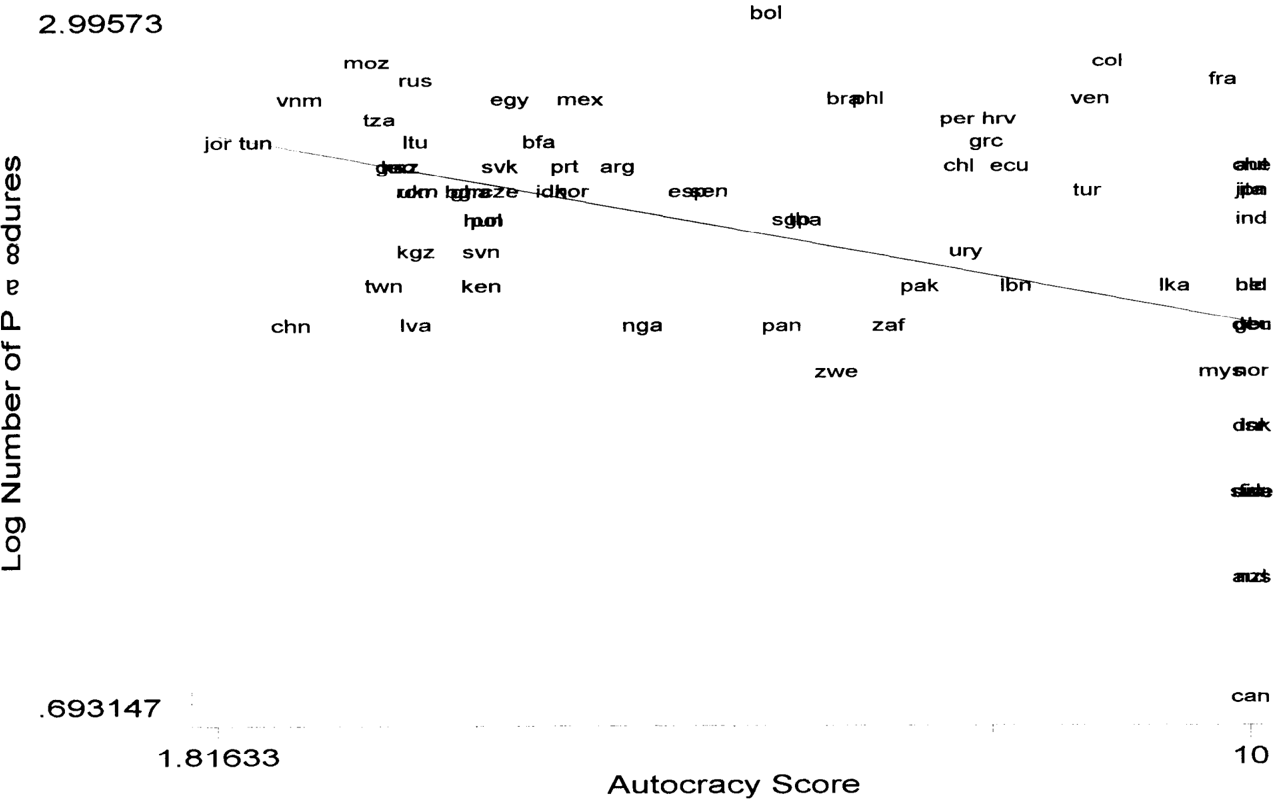
- In Table VIII, better government is associated with lighter regulation; the paper states that countries with more limited and representative governments have statistically significantly fewer procedures using 5 out of 6 measures of better government, and that more autocratic countries regulate more heavily.
Methods
- The paper builds a new database on entry regulation for 75 countries, focusing on the legal requirements, official time, and official cost for a standardized start-up firm.
- Data were gathered from written government sources, World Bank- and USAID-sponsored studies, government web pages, direct contacts with agencies, and independent double-checks in 73 countries via local consulting reports; the remaining 2 countries were double-checked through government contacts.
- The main analysis uses cross-country OLS regressions relating entry regulation measures to outcomes such as quality, pollution, unofficial economy, corruption, political institutions, legal origin, and GDP per capita; the paper also reports correlations and test-of-means comparisons across income quartiles.
Limitations
- The paper itself notes that the capture-theory tests are based on crude measures and that the data are probably least suited to test the capture hypothesis.
- The authors say the data almost surely underestimate the cost and complexity of entry because they focus on the capital city, omit industry-specific requirements and foreign-ownership steps, and ignore some informal delays and bribes.
- Evident from the text: the study is cross-sectional and based on official procedures/costs, so causal interpretation is limited and informal corruption/bureaucratic delays are not directly measured except indirectly through correlations.
Model-written summary. Check it against the paper before relying on it.
Integrity signals
Registry
Cites
Statistics
Figures
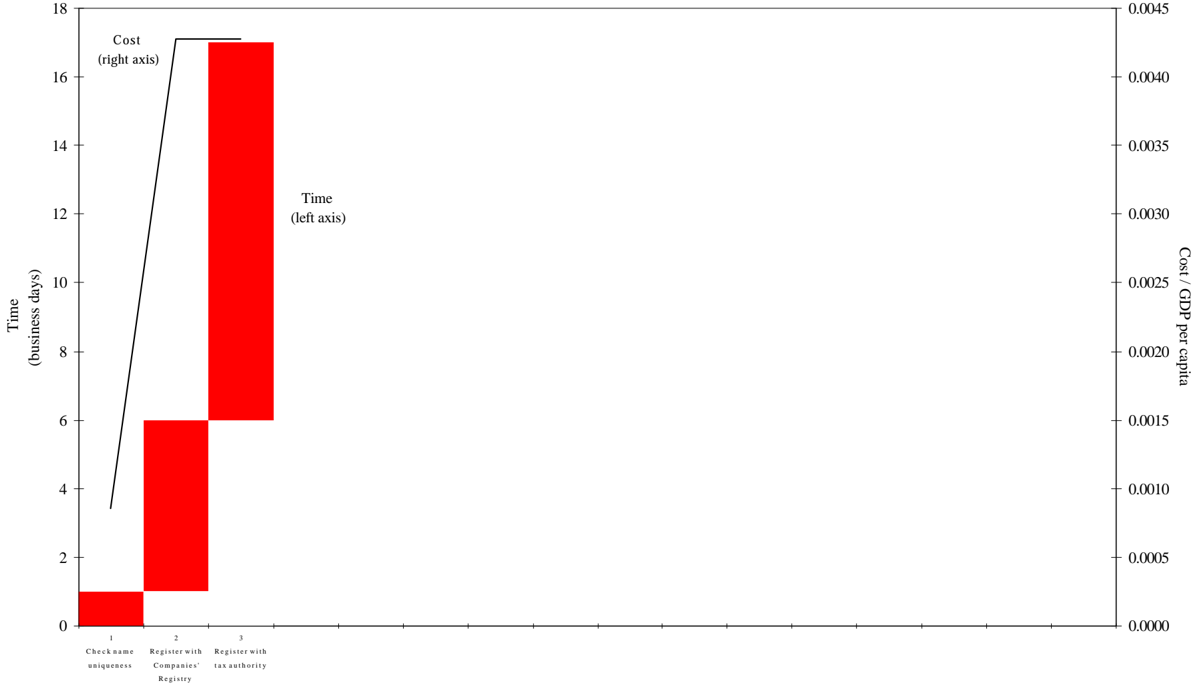
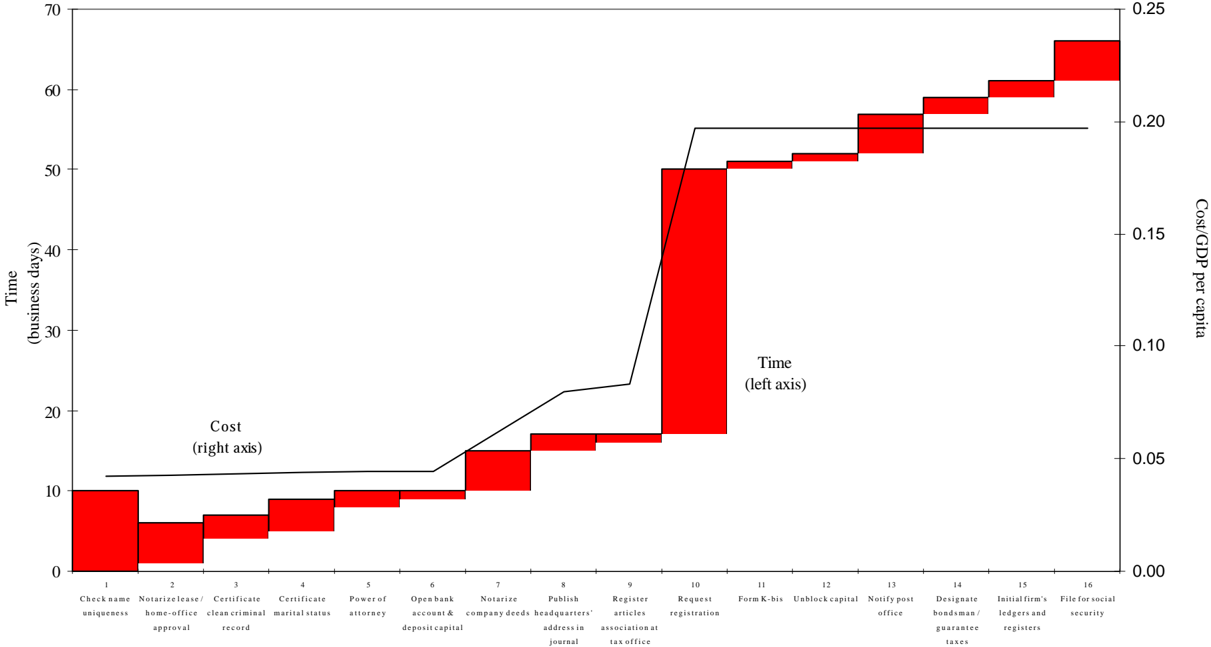
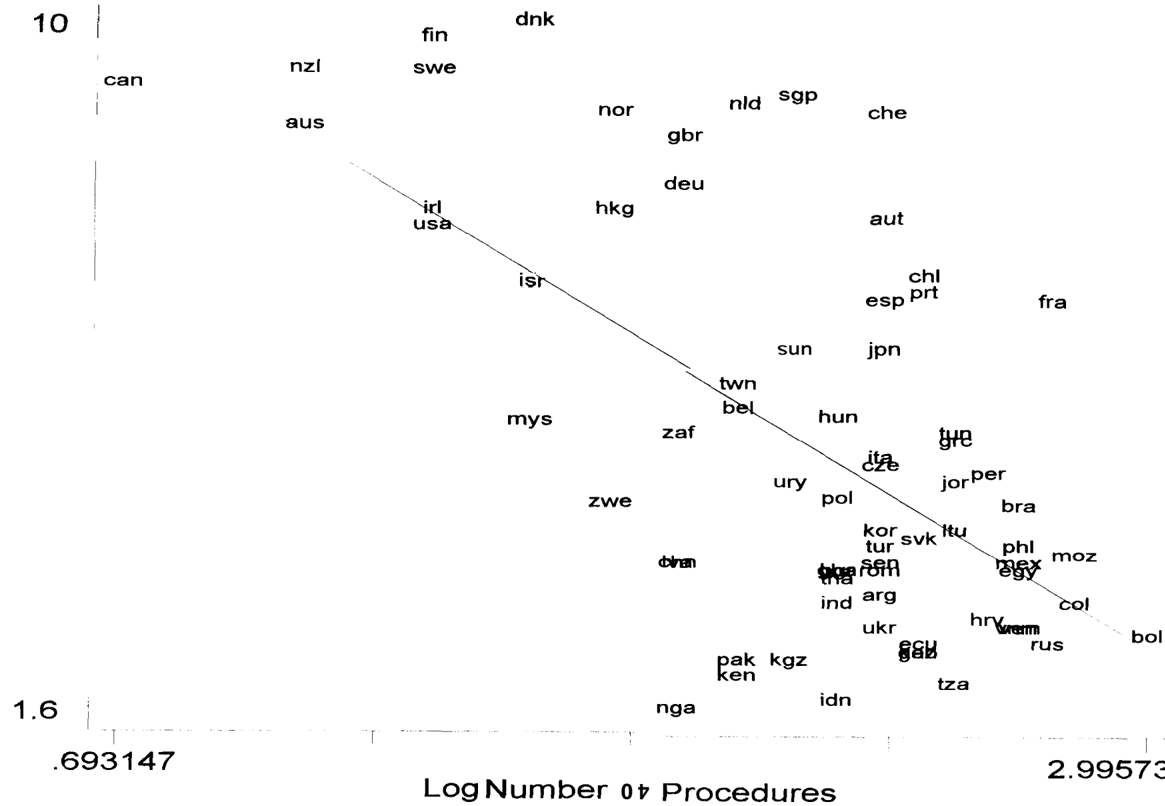
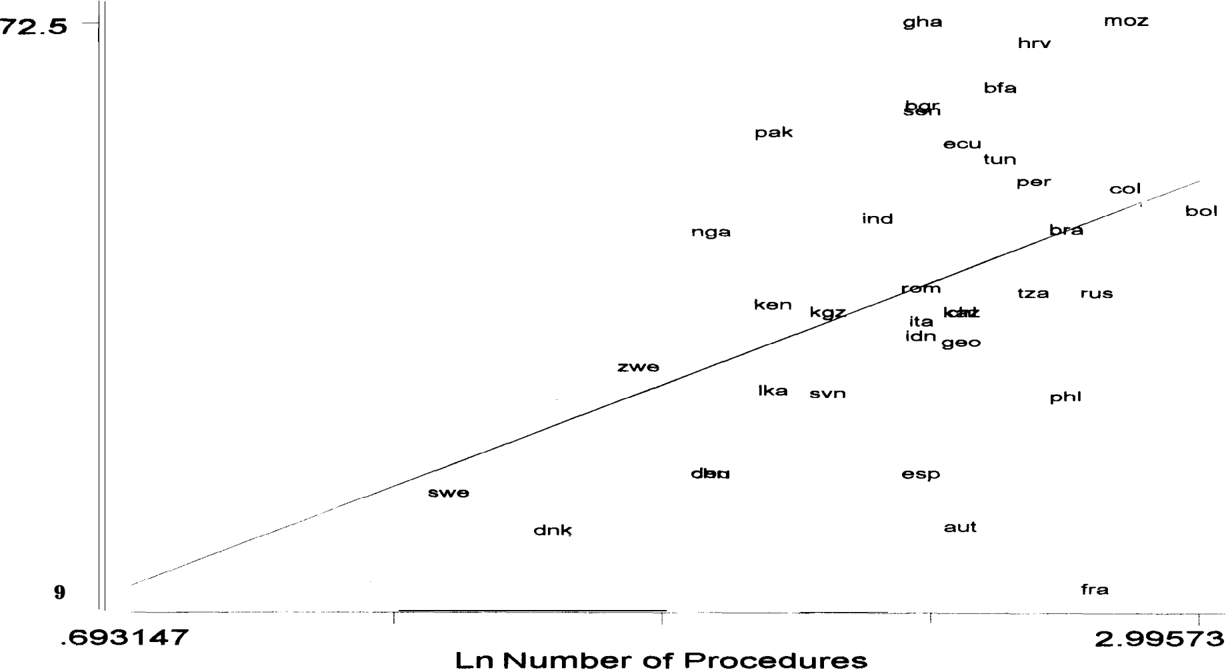
Verification
Claims the paper makes
0 Valid · 3 Not valid · 13 Not checked · 114 Own results and interpretations
A result the paper reports from its own data — it cites no other source for it, so there is none to check. The quote shows it is in the paper.
In the paper
“Very few entry regulations cover tax and labor issues.”
plain- Asserted: passes — The authors put it forward as true.
- Checkable: passes — It can be checked against evidence.
- Load-bearing: unclear — It is unclear whether the paper’s conclusions depend on it.
- Based: passes — The paper gives a reason why it holds.
In the paper
“The data show that the numbers of entry and of labor market regulations are positively correlated across countries, contrary to the substitutes hypothesis.”
What the sources say
- Not matchedcites Djankov et al., 2000
An author–year citation the paper’s reference list doesn’t settle. We don’t search these by name.
plainstates an association- Asserted: passes — The authors put it forward as true.
- Checkable: passes — It can be checked against evidence.
- Load-bearing: unclear — It is unclear whether the paper’s conclusions depend on it.
- Based: passes — The paper gives a reason why it holds.
- Not matched
A result the paper reports from its own data — it cites no other source for it, so there is none to check. The quote shows it is in the paper.
In the paper
“It often takes the form of screening procedures.”
- Also stated in: § III. Basic Results. · plain
“Instead, much of what governments do to regulate entry falls into the category of screening procedures.”
plain- Asserted: passes — The authors put it forward as true.
- Checkable: passes — It can be checked against evidence.
- Load-bearing: unclear — It is unclear whether the paper’s conclusions depend on it.
- Based: passes — The paper gives a reason why it holds.
- Also stated in: § III. Basic Results. · plain
A result the paper reports from its own data — it cites no other source for it, so there is none to check. The quote shows it is in the paper.
In the paper
“First, the cost-to-per-capita-GDP ratio decreases uniformly with GDP per capita.”
plainstates an association- Asserted: passes — The authors put it forward as true.
- Checkable: passes — It can be checked against evidence.
- Load-bearing: unclear — It is unclear whether the paper’s conclusions depend on it.
- Based: passes — The paper gives a reason why it holds.
A result the paper reports from its own data — it cites no other source for it, so there is none to check. The quote shows it is in the paper.
In the paper
“In contrast, countries in the other three quartiles of per capita income are not statistically different from each other in terms of the number of procedures and the time required to fulfill them.”
plain- Asserted: passes — The authors put it forward as true.
- Checkable: passes — It can be checked against evidence.
- Load-bearing: passes — The paper’s conclusions depend on it.
- Based: passes — The paper gives a reason why it holds.
49 more claims
Create a free account to see all 130 claims and every source verdict.
- Probably not a substantial claim. 21
- It may state two separate claims as one. 54
- The quote only partly states this claim. 26
Claims other papers make about this one
Each is checked against this paper’s own text: does it say what the citing paper says it does?
The source backs part of the claim, not all of it — or backs it for a different population, condition or comparison.
In the citing paper
“Our findings suggest an explanation for the low level of incorporation in Italy: the average direct cost associated with fulfilling the bureaucratic regulations for registering a new corporation in Italy is 20% of per capita GNP compared to 10% of per capita GNP on average for other G-7 European countries.”
From Entry regulation as a barrier to entrepreneurship (2006) · cites this paper as Djankov et al. (2002)
Experimental — accuracy not yet measuredThe cited source says what the claim attributes to it.
In the citing paper
“Given the explicit link made by Djankov et al . (2002) between the speed and ease with which businesses may be established in a country and its economic performance - and the enthusiasm with which this link has been grasped by European Union policy makers - our findings imply this link needs reconsidering.”
From The Effect of Business Regulations on Nascent and Young Business Entrepreneurship (2007) · cites this paper as Djankov et al . (2002)
Citations
Cites
La Porta, R., Lopez‐de‐Silanes, F., Shleifer, A., & Vishny, R. W. (1998) · Journal of Political Economy · doi:10.1086/250042 · Cited by 18,025
Self-citationThe Theory of Economic Regulation
Stigler, G. J. (1971) · The Bell Journal of Economics and Management Science · doi:10.2307/3003160 · Cited by 8,098
Journal of Economic Literature
(2019) · AEA Papers and Proceedings · doi:10.1257/pandp.109.633 · Cited by 7,468
The Quarterly Journal of Economics
Kuznets, S. (2024) · Business Cycle Theory, Part I Volume 4 · doi:10.4324/9781003549741-8 · Cited by 7,176
La Porta, R. (1999) · Journal of Law, Economics, and Organization · doi:10.1093/jleo/15.1.222 · Cited by 5,699 · cited 2×
“Legal origin has been viewed as a proxy for the government’s proclivity to intervene in the economy and the stance of the law toward the security of property rights in a country [La Porta et al. 1999].”
The Theory of Economic Regulation
Stigler, G. J. (2021) · The Political Economy · doi:10.4324/9781315495811-8 · Cited by 5,483
Pigou, A. C. (1933) · The Economic Journal · doi:10.2307/2224491 · Cited by 5,137
Toward a More General Theory of Regulation
Peltzman, S. (1976) · The Journal of Law and Economics · doi:10.1086/466865 · Cited by 4,729
Moffitt, R. A. (2009) · American Economic Review · doi:10.1257/aer.99.2.660 · Cited by 4,694
Shleifer, A., & Vishny, R. W. (1993) · The Quarterly Journal of Economics · doi:10.2307/2118402 · Cited by 3,778
Self-citation
Research works printed but not linked: 7
- McLiesh Caralee, 2001, NBER Working Paper No., 8288
- Kasnako lu, Zehra, and Münür Yayla, 'Unrecorded Economy in Turkey: A Monetary Approach', 1999. "Unrecorded Economy in Turkey (A Monetary Approach)" in Informal Sector in Turkey (I), Tuncer Bulutay (ed.), SIS, Ankara, forthcoming.
- Fred, 1987, Journal of Legal Studies, 101
- Olson, Mancur, 1991, 'Autocracy, Democracy, and Prosperity,' in Richard Zeckhauser, ed., Strategy of Choice, Cambridge, MA: MIT Press.
- 1967, Western Economic Journal, 232
- World Economic Forum (1999), The Global Competitiveness Report 1999 , Schwab, Klaus et al., eds., New York: Oxford University Press.
- World Economic Forum, The Global Competitiveness Report 2001, Klaus Schwab et al., eds. (New York, NY: Oxford University Press, 2001).
Cited by
Items 3,101–3,200 of 3,986
Corruption and Entry Deterrence
Emran, M. S., Shilpi, F. J., & Bank, W. (2000) · The Bangladesh Development Studies · doi:10.57138/xaqb1593 · Cited by 1
Zafirovski, M. Z. (2019) · The American Sociologist · doi:10.1007/s12108-019-9412-x · Cited by 4
What Facilitates New Firm Formation in China?
He, C., & Zhu, S. (2019) · Economic geography · doi:10.1007/978-981-13-3447-4_5 · Cited by 1
Monetary Policy, Privileges and Economic Development: Ordoliberal Lessons for the EMU
Duarte, P. (2018) · ORDO · doi:10.1515/ordo-2019-0010 · Cited by 1
“As (Easterly 2013, 201) documents, the goals are usually some national goals which prioritize an entity such as the nation state before the individuals and their own needs. This way, technocratic experts can rely on the achievement of such a goal to justify privileges, which gives them and the autocratic ruler a power…”
How Political Systems and Social Welfare Policies Affect Well-being
MacCulloch, R. (2018) · ResearchSpace (University of Auckland) · Cited by 1
Winners and Losers of Immigration
Fiaschi, D., & Tealdi, C. (2020) · Journal of Human Capital · doi:10.1086/741640 · Cited by 4
Revisiting and Revising World-Wide Neoliberalism
Plehwe, D. (2020) · Staat - Souveränität - Nation · doi:10.1007/978-3-658-30512-3_7 · Cited by 2
Institutions and Entrepreneurial Activity: A Quantitative Empirical Analysis
Schlattau, M. (2020) · Societies and political orders in transition · doi:10.1007/978-3-030-54909-1_5 · Cited by 3
Pension scheme trustees as surrogate decision makers
Weiss‐Cohen, L., Ayton, P., Clacher, I., & Thoma, V. (2021) · Finance research letters · doi:10.1016/j.frl.2021.102043 · Cited by 2
Evaluating Starting a Business Indicators Innovation in the World
Niyungeko, A. (2021) · Management & Economics Research Journal · doi:10.48100/merj.2022.172 · Cited by 1
Tourism Industry Business Contracts
Landini, S. (2021) · Springer eBooks · doi:10.1007/978-3-030-83140-0_11 · Cited by 1
Alesina, A., & Glaeser, E. L. (2004) · Oxford University Press eBooks · doi:10.1093/0199267669.003.0008 · Cited by 1
Some evidence of regulatory convergence
Djankov, S., Lukšić, I., & Zhang, E. (. (2022) · Economics Letters · doi:10.1016/j.econlet.2022.110522 · Cited by 1
“We study four areas of regulation – paying corporate taxes, obtaining building permits, registering property and starting a business - as they have been subject to previous research using the same dataset (Djankov et al 2002; 2010; 2022; World Bank 2020).”
Self-citationFactors Stimulating Entrepreneurship
Puia, G. M., Affholter, J. A., & Potts, M. D. (2015) · IGI Global eBooks · doi:10.4018/978-1-4666-8468-3.ch045 · Cited by 1
Bank, W. (2018) · World Bank, Washington, DC eBooks · doi:10.1596/978-1-4648-1328-3_ch5 · Cited by 1
Venture Capital and Technology Entrepreneurship in Latin America: A Comparative Approach
Huamaní, G. Z., & López, S. F. (2022) · Contributions to management science · doi:10.1007/978-3-030-97699-6_2 · Cited by 4
The Business Climate and the Commodification of Place: The Making of a Market for Location
Phelps, N. A., & Wood, A. (2022) · Annals of the American Association of Geographers · doi:10.1080/24694452.2022.2080635 · Cited by 1
Politikversagen und Lobbyismus
Stadelmann, D., & Frank, M. (2023) · Springer eBooks · doi:10.1007/978-3-658-32320-2_8 · Cited by 1
A Dynamic Approach to Managing Corruption: Exploring the Optimal Path of Oversight
Hansen, J., & McNab, R. M. (2017) · Public Finance and Management · doi:10.1177/152397211701700101 · Cited by 1
Optimal Trade Policy in a Ricardian Model with Labor-Market Search-and-Matching Frictions
Suwanprasert, W. (2024) · The B E Journal of Theoretical Economics · doi:10.1515/bejte-2023-0120 · Cited by 1
The business cycle consequences of informal labor markets
Shapiro, A. F. (2013) · University Libraries (University of Maryland) · Cited by 2
Macro Prudential Governance and Central Banks: Facts and DriversPreprint
Masciandaro, D., & Volpicella, A. (2014) · SSRN Electronic Journal · doi:10.2139/ssrn.2418194 · Cited by 1
From Rags to Riches: How Robust is the Influence of Culture on Entrepreneurial Activity?Preprint
Busch, C., & Lassmann, A. (2011) · SSRN Electronic Journal · doi:10.3929/ethz-a-010703539 · Cited by 4
Regulatory Entry Barriers and TradePreprint
Tobal, M. (2011) · RePEc: Research Papers in Economics · Cited by 1
Institutions, policies and economic development. What are the causes of the shadow economy?
Tirelli, P., & Onnis, L. (2011) · BOA (University of Milano-Bicocca) · Cited by 1
Celo, S. (2011) · FIU - Digital Commons (Florida International University) · doi:10.25148/etd.fi11050302 · Cited by 1
Banking Entrepreneurship in Eritrea - An Empirical Analysis (1985-2005)Preprint
Georgiou, M. N. (2009) · SSRN Electronic Journal · doi:10.2139/ssrn.1514027 · Cited by 1
Regional Determinants of New Firm Formation in a Transition Economy: The Case of Uzbekistan
Kan, V. (2010) · Institutional Repositories DataBase (IRDB) · Cited by 1
Germani, A. R. (2007) · RePEc: Research Papers in Economics · Cited by 1
Entry Costs, Intermediation, and Capital Flows ¤Preprint
Kumar, K. B. (2003) · RePEc: Research Papers in Economics · Cited by 1
De-Industrialisation, Entrepreneurial Industries and WelfarePreprint
Schweinberger, A. G., & Suedekum, J. (2009) · SSRN Electronic Journal · doi:10.2139/ssrn.1392153 · Cited by 1
When Does Legal Origin Matter?Preprint
Amin, M., & Jha, P. (2008) · SSRN Electronic Journal · doi:10.2139/ssrn.1314312 · Cited by 4
“The estimated coefficient of our main interaction term is negative and significant at the 5% level or less for both measures of entry regulation, with or without the various controls.(9)”
HETEROGENEOUS FIRMS AND THE INFORMAL ECONOMY
Prado, J. M. (2006) · Cited by 1
Property Rights and Income InequalityPreprint
Haidar, J. I., & Velasquez, M. E. (2009) · SSRN Electronic Journal · doi:10.2139/ssrn.1386923 · Cited by 1
What has been the Role of Investment in Turkey's Growth Performance?Preprint
Zenginobuz, Ü., & Altug, S. G. (2009) · RePEc: Research Papers in Economics · Cited by 1
Essays on political dynasties: evidence from empirical investigations
Rahman, A. (2013) · London School of Economics and Political Science Theses Online (London School of Economics and Political Science) · Cited by 7
Determining the Choice of Entry Mode of Multinationals: My 6 Million RegressionsPreprint
Ramada-Sarasola, M. (2009) · SSRN Electronic Journal · doi:10.2139/ssrn.1445422 · Cited by 1
Pollution Haven and Corruption ParadisePreprint
Candau, F., & Dienesch, E. (2011) · SSRN Electronic Journal · doi:10.2139/ssrn.1864170 · Cited by 1
Evolutionary Views on Entrepreneurial Processes: Managerial and Policy ImplicationsPreprint
Delmar, F., & Wennberg, K. J. (2012) · SSRN Electronic Journal · doi:10.2139/ssrn.2111202
Small firms captive in a box like lobstersPreprint
Kox, H. L. M., van Leeuwen, G., & van der Wiel, H. (2010) · RePEc: Research Papers in Economics · Cited by 1
WHY IS THE TAX EVASION SO PERSISTENTPreprint
Bovi, M., & Cerqueti, R. (2009) · RePEc: Research Papers in Economics · Cited by 1
An Interest Group Theory of Financial Development
Richardson, N. T. (2005) · University Libraries (University of Maryland) · Cited by 1
Hart, M., Anyadike‐Danes, M., D'elia, J. L. I., et al. (2008) · Research Repository (Kingston University London) · Cited by 1
Essays on corruption and corporate finance
Kim, T.-Y. (., Garner, J. L., & Walkling, R. A. (2014) · iDEA - Drexel University Institutional Repository · doi:10.17918/etd-6035 · Cited by 3
Mrsik, J., Lazarevski, D., & Smokvarski, E. (2012) · SSRN Electronic Journal · doi:10.2139/ssrn.2137033 · Cited by 1
“Djankov et al. (2002) investigate the role of several societal burdens for startups in different countries.”
Sautet, F. (2006) · SSRN Electronic Journal · Cited by 1
Krishnamurthy, P. (2010) · SSRN Electronic Journal · doi:10.2139/ssrn.1646461 · Cited by 1
Leitão, J. C. C., & Ferreira, J. J. (2007) · SSRN Electronic Journal · doi:10.2139/ssrn.1029490 · Cited by 1
“3 regulations (Djankov et al., 2002); and (ii) the presence of governmental support or financial assistance. In the study of Djankov et al. (2002) about the regulation of entry of start-up firms in 85 countries, the main results have pointed out that regulation is not in the public interest, suggesting a lighter busin…”
InfluentialFinancial Supervision as Economic Policy: Importance, Key Facts and DriversPreprint
Masciandaro, D., & Quintyn, M. (2013) · SSRN Electronic Journal · doi:10.2139/ssrn.2319852 · Cited by 1
Economic growth, inequality and technology adoption in transitional economies
Ratnasiri, N. G. S. C. (2009) · QUT Business School · Cited by 1
Asymmetric Information and Inefficient Regulation of Firms Under the Threat of Revolution
Dorsch, M., Dunz, K., & Maarek, P. (2012) · Munich Personal RePEc Archive (Ludwig Maximilian University of Munich) · Cited by 1
Measuring the law: Sécurité juridique as a watermark
Raynouard, A., & Kerhuel, A.-J. (2011) · International Journal of Disclosure and Governance · doi:10.1057/jdg.2011.9 · Cited by 3
Chen, V. Z. (2012) · SSRN Electronic Journal · doi:10.2139/ssrn.2062736 · Cited by 1
Analysis of Characteristics Motivating Firms’ IFRS Adoption: Evidence from the European UnionPreprint
Krivogorsky, V., Chang, J., & Black, E. L. (2009) · SSRN Electronic Journal · doi:10.2139/ssrn.1488336 · Cited by 4
Studying The Impact Of Regulation On Entrepreneurship: How To Overcome Current Conflicting Results?
Jacquemin, A., & Janssen, F. (2009) · Digital Access to Libraries · Cited by 1
A Theory of Entry and Exit with Embodied Technical Change
Samaniego, R. M. (2005) · Cited by 1
Badinger, H. (2008) · Applied Economics Letters · doi:10.1080/13504850600722112 · Cited by 1
Small Firms and Formality: The Influence of Judicial Efficiency and Regulation CostsPreprint
Nugent, J. B., & Sukiassyan, G. (2009) · SSRN Electronic Journal · doi:10.2139/ssrn.1369302 · Cited by 1
Economic reforms as a tool to attract foreign direct investment: is it a chimera?
Bhaumik, S. K., & Dimova, R. D. (2008) · Applied Economics Letters · doi:10.1080/13504850701222087 · Cited by 1
“For example, it is now stylized that regulatory barriers to entry are created to facilitate rent seeking (Shleifer and Vishny, 1993), and that political freedom that is synonymous with democracy leads to reduction of regulatory barriers and hence, greater economic freedom (Djankov et al., 2002; Perotti and Volpin, 200…”
Regulatory Barriers & Entry in Developing EconomiesPreprint
Bennett, J. R., Jr., & Estrin, S. (2006) · SSRN Electronic Journal · doi:10.2139/ssrn.918086 · Cited by 2
“As is common in developing economies (see Djankov et al., 2002), it also requires the payment of a fee f ≥ 0 for a licence.”
InfluentialThe Determinants and Consequences of IPOs in a Regulated Economy: Evidence from ChinaPreprint
Fang, J., Shi, H., & Xu, H. (2010) · SSRN Electronic Journal · doi:10.2139/ssrn.1723014 · Cited by 1
Argentina is Down! Bulgaria to Follow? Assessing the Stability of the Bulgarian Currency BoardPreprint
Arsenis, K. I. (2004) · SSRN Electronic Journal · doi:10.2139/ssrn.624181 · Cited by 1
Shareholder Democracy in CanadaPreprint
Mørck, R. (2010) · SSRN Electronic Journal · doi:10.2139/ssrn.1710905 · Cited by 2
“Sophisticated financial systems appear to augment economy growth primarily by letting new firms list and tap the nation‘s savings (Schumpeter, 1911; Djankov et al. 2002), not by catering to old firms‘ insiders (Fogel et al. 2008). Rajan and Zingales (2003) go further, presenting evidence of entrenched elites in the mi…”
An End to Consensus? The (Non) Impact of Legal Reforms on Financial Development
Deakin, S. F., Sarkar, P., & Singh, A. (2010) · Munich Personal RePEc Archive (Ludwig Maximilian University of Munich) · Cited by 1
Bosworth, B., Collins, S. M., & Flaaen, A. B. (2010) · Oxford University Press eBooks · doi:10.1093/acprof:oso/9780199575077.003.0002 · Cited by 1
Polishchuk, L. (2014) · Palgrave Macmillan eBooks · doi:10.1057/9780230361836.0013 · Cited by 1
How to address regional and sector-specific regulatory issues? A case study from Mozambique
Kaufmann, F. K. F., & Krause, M. K. M. (2008) · Enterprise Development and Microfinance · doi:10.3362/1755-1986.2008.020 · Cited by 1
Corporatism and the Ghost of the Third WayPreprint
Morck, R. K., & Yeung, B. Y. (2010) · SSRN Electronic Journal · doi:10.2139/ssrn.1722350 · Cited by 1
Macro Shocks, Regulatory Quality and Costly Political ActionPreprint
Dorsch, M., Dunz, K., & Maarek, P. (2012) · RePEc: Research Papers in Economics · Cited by 1
NUS Entrepreneurship Centre Working PapersPreprint
Wong, P. K. (2005) · SSRN Electronic Journal · Cited by 1
Szabályozási koherencia és gazdaság növekedés
Czeglédi, P. (2007) · Competitio · doi:10.21845/comp/2007/1/3 · Cited by 2
Rougier, É. (2015) · RePEc: Research Papers in Economics · Cited by 3
Bank Capital Ratios and the Structure of Nonfinancial IndustriesPreprint
Stebunovs, V., & Lee, S. J. (2012) · SSRN Electronic Journal · doi:10.2139/ssrn.2024705 · Cited by 1
Méndez, C. H. (2011) · SSRN Electronic Journal · doi:10.2139/ssrn.1785913 · Cited by 1
Three essays on the influence of formal institutions on entrepreneurship.
Crum, M. (2011) · ThinkIR: The University of Louisville's Institutional Repository (University of Louisville) · doi:10.18297/etd/294 · Cited by 1
Driving Urban Economic Growth Evidence from Transition EconomiesPreprint
Belitski, M. (2010) · RePEc: Research Papers in Economics · Cited by 1
Competitiveness and the Employment Relationship in the 21st Century: A European Perspective ReturnsPreprint
Allard, G. J., & Simón, C. (2007) · SSRN Electronic Journal · doi:10.2139/ssrn.1015545 · Cited by 1
REGIONAL INSTITUTIONS AND ECONOMIC GROWTH OF REGIONSPreprint
Zaucha, J. (2014) · RePEc: Research Papers in Economics · Cited by 1
The Twin Agency Problems in Corporate Finance - On the basis of Stulz's theory
Du, J. (2009) · Digital Repository of the BTU Cottbus – Senftenberg (Brandenburg University of Technology) · Cited by 1
Xu, W., & Xu, G. (2014) · SSRN Electronic Journal · doi:10.2139/ssrn.2542802 · Cited by 1
Culture and the Regulation of EntryPreprint
Davis, L., & Williamson, C. R. (2014) · SSRN Electronic Journal · doi:10.2139/ssrn.2532546 · Cited by 1
“For example, the regulation of entry is well known to increase the size of the informal sector, and social ties may be particularly valuable to informal sector participants (Johnson et al., 1998; Friedman et al., 2000; Schneider and Enste, 2000; Djankov et al., 2002).”
William Baumol und die institutionelle Allokation unternehmerischen Handelns
Döring, T. (2011) · doi:10.46850/sofia.9783941627048 · Cited by 1
Nicoara, O. (2010) · SSRN Electronic Journal · Cited by 1
How to Analyse Firm Dynamics in European Countries? Methodology and Results of a Comparative StudyPreprint
Koch, A. (2008) · SSRN Electronic Journal · Cited by 1
Private Equity Growth in International and Emerging MarketsPreprint
Groh, A. P. (2014) · SSRN Electronic Journal · doi:10.2139/ssrn.2437451 · Cited by 1
Eberhart, R. N. (2016) · SSRN Electronic Journal · doi:10.2139/ssrn.2466858 · Cited by 1
Political Institutions, Conflict, Entrepreneurship and Economic Development in Sub-Saharan AfricaPreprint
Adeolu, A. M. (2016) · SSRN Electronic Journal · doi:10.2139/ssrn.2787554 · Cited by 1
CUSTOS DE LEGALIZAÇÃO, CUMPRIMENTO DE CONTRATOS E O SECTOR INFORMAL*
Antunes, A., & Cavalcanti, T. V. D. V. (2006) · Cited by 1
Khomenko, M. (2014) · Lund University Publications Student Papers (Lund University) · Cited by 2
National differences in entrepreneurial activity:an institutional perspective
Zegel, S. S. (2011) · TU/e Research Portal · Cited by 1
Informal sector taxation : the case of Zimbabwe.
Dube, G. (2014) · ResearchSpace (University of KwaZulu-Natal) · Cited by 3
Staying Clean: Do Non-Implicated Peer Firms Necessarily Benefit from Anti-Corruption Policies?Preprint
Stanfield, J. R., Zhang, B., & Zhang, L. (2017) · SSRN Electronic Journal · doi:10.2139/ssrn.2845004 · Cited by 1
Politics and Entrepreneurial Activity in the U.S.Preprint
Beland, L., Eren, Ö., & Unel, B. (n.d.) · RePEc: Research Papers in Economics · Cited by 1
Entry barriers and their macroeconomic impact in the EU: an assessment using QUEST IIIPreprint
Cristiana, B. F., Miguel, S. M., Peder, C., et al. (2017) · RePEc: Research Papers in Economics · doi:10.2760/722488 · Cited by 1
Twin Peaks and Central Banks: Economics, Political Economy and Comparative AnalysisPreprint
Masciandaro, D., & Romelli, D. (2018) · SSRN Electronic Journal · doi:10.2139/ssrn.3098098 · Cited by 1
Workplace Flexibility and EntrepreneurshipPreprint
Agarwal, S. D., Sing, T. F., Song, C., & Zhang, J. (2018) · SSRN Electronic Journal · doi:10.2139/ssrn.3136792 · Cited by 1
A korrupció mint destruktív vállalkozás
Varga, S. (2017) · CUB Ph.D. Dissertations (Corvinus University of Budapest) · doi:10.14267/phd.2017039 · Cited by 1
Public procurement : award mechanisms and implementation process
He, C. (2018) · Loughborough University Institutional Repository (Loughborough University) · Cited by 2
Deregulation, Economic Growth and Growth AccelerationPreprint
Stankov, P. (2010) · SSRN Electronic Journal · doi:10.2139/ssrn.1699197 · Cited by 1
The Impact of Entrepreneurship on Community Integration: Evidence from a Quasi-Natural Experiment
Rocha, V. C. (2019) · Academy of Management Proceedings · doi:10.5465/ambpp.2019.163 · Cited by 1
Metadata
- Authors
- Djankov, S., La Porta, R., Lopez-de-Silanes, F., & Shleifer, A.
- Affiliations
- World Bank (US)
- National Bureau of Economic Research (US)
- ORCID
- Djankov, S.
- Venue
- The Quarterly Journal of Economics
- Publisher
- Oxford University Press (OUP)
- Published
- 2002-02-01
- Volume
- 117
- Issue
- 1
- Pages
- 1-37
- ISSN
- 0033-5533
- 1531-4650
- OpenAlex
- W2139896179
- Cited by
- 3,956
- References
- 30
- Citations by year
- 2026: 223 · 2025: 185 · 2024: 157 · 2023: 120 · 2022: 140 · 2021: 150 · 2020: 151 · 2019: 161 · 2018: 157 · 2017: 162 · 2016: 166 · 2015: 193 · 2014: 200 · 2013: 183 · 2012: 193
- Type
- report
- Language
- en
- Open access
- green
- doi.org
- Licence
- other-oa
- Locations
- World Bank, Washington, DC eBooks (publishedVersion)
- The Quarterly Journal of Economics (publishedVersion)
- The World Bank Open Knowledge Repository (World Bank) (publishedVersion)
- National Bureau of Economic Research (publishedVersion, other-oa)
- RePEc: Research Papers in Economics (submittedVersion)
- Digital Access to Scholarship at Harvard (DASH) (Harvard University) (submittedVersion, cc-by)
- SSRN Electronic Journal (submittedVersion)
- OpenGrey (Institut de l'Information Scientifique et Technique) (submittedVersion)
- The World Bank Open Knowledge Repository (World Bank) (submittedVersion, cc-by)
- Topics
- Social Sciences › Sociology and Political Science › Corruption and Economic Development
- Social Sciences › Economics, Econometrics and Finance › Economics and Econometrics › Taxation and Compliance Studies
- Social Sciences › Business, Management and Accounting › Strategy and Management › Political Influence and Corporate Strategies
- Keywords
- start-up firms, bureaucratic procedures, corruption, informal economy, democracy, government size, public choice theory, public interest theory
About these checks
Registry, retraction, Cites and statistics results are computed, not judged, with one exception: a printed reference that no index lists is read once by a model before it counts as a citation error. Claims are extracted by a model and kept only when their quote appears verbatim in the text; each cited source is then checked, with a model’s help, for whether it says what the claim relies on. Those verdicts can be wrong — read the claim’s quote and the cited source before relying on one.
A language model drew the claims from the paper on 2026-10-01, under version 3 of the claim definition (model deepseek-v4.1-flash, prompt extract-v3).
A second model labelled each claim on 2026-10-01 (model jev-1.13-20260917, definition revision gold-guideline-v0.2).
Statistics and arithmetic are recomputed, not judged.
Confidence bands are shown only for fields calibrated on our annotated test set. None is calibrated yet, so no band is shown.
What counts as a claim ›How we measure confidence ›How we check this ›
Are you an author, or do you see a problem with this page? Request a review
Data sources
Bibliographic data: Semantic Scholar, OpenAlex, Crossref.
Contains information from the Semantic Scholar Academic Graph Datasets, made available under the ODC Attribution License (ODC-BY 1.0).
Semantic Scholar’s data is described in: Kinney, R., et al. (2023). The Semantic Scholar Open Data Platform. arXiv:2301.10140.
