

The Regulation of Entry
Open accessThe DOI matches its Crossref record, with a small difference in title or year; 39 of the 39 references it cites were found in a registry or an index; none of the 13 sources its claims cite is checked for support yet.
Abstract
1%(5 :25.,1* 3$3(5 6(5,(6 7+( 5(*8/$7,21 2) (175< 6LPHRQ 'MDQNRY 5DIDHO /D 3RUWD )ORUHQ.LR /RSH]GH6LODQHV $QGUHL 6KOHLIHU :RUNLQJ 3DSHU KWWSZZZQEHURUJSDSHUVZ 1$7,21$/ %85($8 2) (&2120,& 5(6($5&+ 0DVVD.KXVHWWV $YHQXH &DPEULGJH 0$ 6HSWHPEHU :H WKDQN 2OJD ,RIIH 7DWLDQD 1HQRYD DQG (NDWHULQD 7UL]ORYD IRU DEOH UHVHDU.K DVVLVWDQ.H DQG +DPLG $ODYL ,ULQD $VWUDNKDQ $EKLMLW %DQHUMHH 5L.KDUG &DYHV -D.TXHOLQH &RROLGJH -DPHV (PHU\ 1LKDO (O0DJKDUEHO -HDQ 3DXO *DXWKLHU (G *ODHVHU 6LPRQ -RKQVRQ /DZUHQ.H .DW] 3HWHU .X.HUD 'DYLG /DLEVRQ ,UD /LHEHUPDQ 'DYLQ 0D.NLQ]LH 0DULH )UDQ.RLVH 0DULH1HOO\ 0DU.HOR 2ODUUHDJD *X\ 3IHIIHUPDQQ 6DQWLDJR 6HGD.D /HLOD :HEVWHU 3HWHU :ULJKW DQG VHPLQDU SDUWL.LSDQWV DW WKH 8QLYHUVLW\ RI 0DU\ODQG DW &ROOHJH 3DUN IRU KHOSIXO .RPPHQWV 7KH .ROOH.WLRQ RI GDWD IRU WKLV SDSHU ZDV RUJDQL]HG DQG ILQDQ.HG E\ WKH :RUOG %DQN $Q DSSHQGL[ GHV
Overview
CoChat Summary
TL;DR
This paper assembles a new cross-country dataset on business entry regulation in 75 countries and uses it to compare the helping-hand, capture, and tollbooth theories of regulation. The evidence is most consistent with the tollbooth view: heavier entry regulation is associated with more corruption, a larger unofficial economy, and less representative, more autocratic governments.
Key findings
- Across the 75-country sample, the number of entry procedures ranges from 2 in Canada to 20 in Bolivia, with a sample average of 10.17 procedures; the average official time is 63.05 business days and the average cost is 0.34 of GDP per capita.
- The number of procedures is strongly correlated with time and cost: the paper reports correlations of 0.75 with log time and 0.62 with log cost.
- The helping-hand tests do not support a beneficial-regulation story: in Table IV, more procedures are associated with lower ISO quality standards (e.g. coefficient -0.2646) and larger unofficial economy measures (e.g. coefficient 13.6277 for size of unofficial economy; 19.8763 for employment in the unofficial economy), while pollution and health outcomes do not improve.
- The tollbooth evidence is stronger: Table VI reports that more procedures are associated with worse corruption scores, with a coefficient of -3.2809 (and -1.7249 with GDP per capita controls) for the corruption regressions.
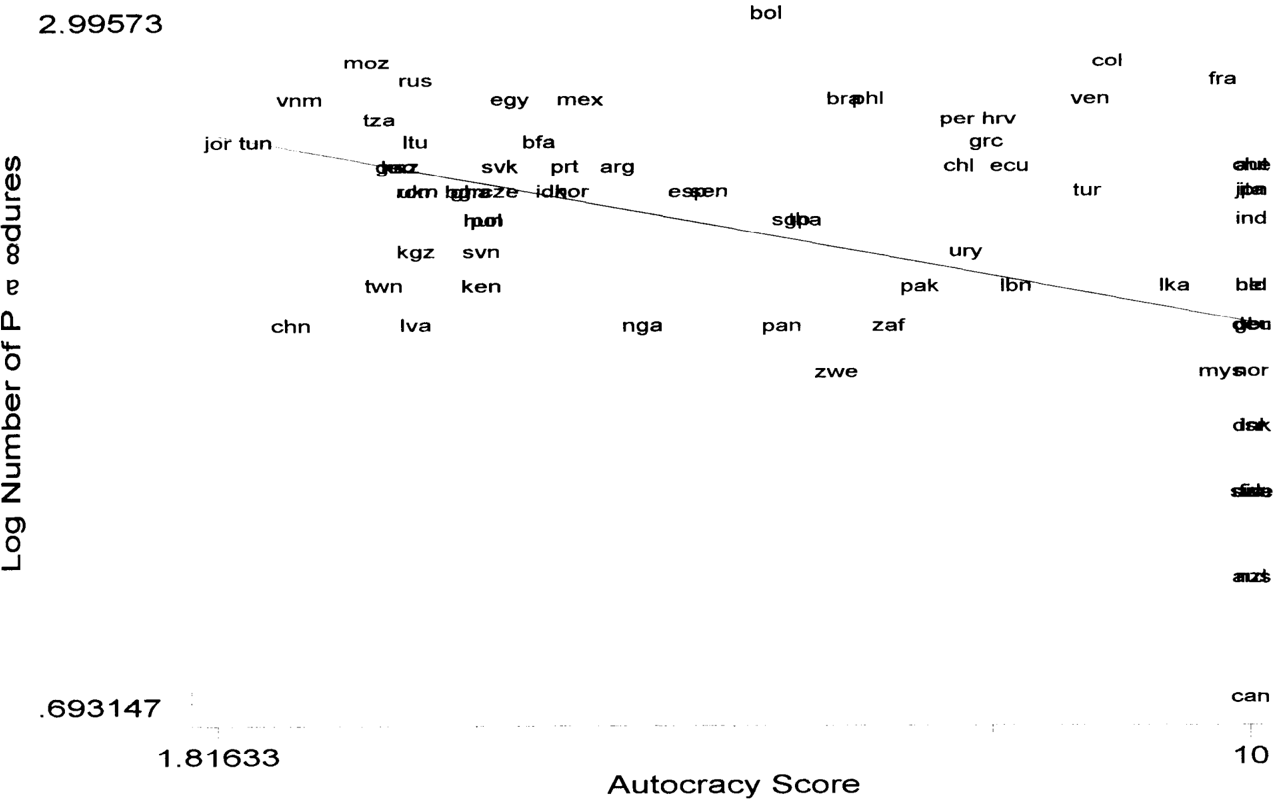
- In Table VIII, better government is associated with lighter regulation; the paper states that countries with more limited and representative governments have statistically significantly fewer procedures using 5 out of 6 measures of better government, and that more autocratic countries regulate more heavily.
Methods
- The paper builds a new database on entry regulation for 75 countries, focusing on the legal requirements, official time, and official cost for a standardized start-up firm.
- Data were gathered from written government sources, World Bank- and USAID-sponsored studies, government web pages, direct contacts with agencies, and independent double-checks in 73 countries via local consulting reports; the remaining 2 countries were double-checked through government contacts.
- The main analysis uses cross-country OLS regressions relating entry regulation measures to outcomes such as quality, pollution, unofficial economy, corruption, political institutions, legal origin, and GDP per capita; the paper also reports correlations and test-of-means comparisons across income quartiles.
Limitations
- The paper itself notes that the capture-theory tests are based on crude measures and that the data are probably least suited to test the capture hypothesis.
- The authors say the data almost surely underestimate the cost and complexity of entry because they focus on the capital city, omit industry-specific requirements and foreign-ownership steps, and ignore some informal delays and bribes.
- Evident from the text: the study is cross-sectional and based on official procedures/costs, so causal interpretation is limited and informal corruption/bureaucratic delays are not directly measured except indirectly through correlations.
Model-written summary. Check it against the paper before relying on it.
Integrity signals
Registry
Cites
Statistics
Figures
Verification
Claims the paper makes
0 Valid · 3 Not valid · 13 Not checked · 114 Own results and interpretations
A result the paper reports from its own data — it cites no other source for it, so there is none to check. The quote shows it is in the paper.
In the paper
“Very few entry regulations cover tax and labor issues.”
plain- Asserted: passes — The authors put it forward as true.
- Checkable: passes — It can be checked against evidence.
- Load-bearing: unclear — It is unclear whether the paper’s conclusions depend on it.
- Based: passes — The paper gives a reason why it holds.
In the paper
“The data show that the numbers of entry and of labor market regulations are positively correlated across countries, contrary to the substitutes hypothesis.”
What the sources say
- Not matchedcites Djankov et al., 2000
An author–year citation the paper’s reference list doesn’t settle. We don’t search these by name.
plainstates an association- Asserted: passes — The authors put it forward as true.
- Checkable: passes — It can be checked against evidence.
- Load-bearing: unclear — It is unclear whether the paper’s conclusions depend on it.
- Based: passes — The paper gives a reason why it holds.
- Not matched
A result the paper reports from its own data — it cites no other source for it, so there is none to check. The quote shows it is in the paper.
In the paper
“It often takes the form of screening procedures.”
- Also stated in: § III. Basic Results. · plain
“Instead, much of what governments do to regulate entry falls into the category of screening procedures.”
plain- Asserted: passes — The authors put it forward as true.
- Checkable: passes — It can be checked against evidence.
- Load-bearing: unclear — It is unclear whether the paper’s conclusions depend on it.
- Based: passes — The paper gives a reason why it holds.
- Also stated in: § III. Basic Results. · plain
A result the paper reports from its own data — it cites no other source for it, so there is none to check. The quote shows it is in the paper.
In the paper
“First, the cost-to-per-capita-GDP ratio decreases uniformly with GDP per capita.”
plainstates an association- Asserted: passes — The authors put it forward as true.
- Checkable: passes — It can be checked against evidence.
- Load-bearing: unclear — It is unclear whether the paper’s conclusions depend on it.
- Based: passes — The paper gives a reason why it holds.
A result the paper reports from its own data — it cites no other source for it, so there is none to check. The quote shows it is in the paper.
In the paper
“In contrast, countries in the other three quartiles of per capita income are not statistically different from each other in terms of the number of procedures and the time required to fulfill them.”
plain- Asserted: passes — The authors put it forward as true.
- Checkable: passes — It can be checked against evidence.
- Load-bearing: passes — The paper’s conclusions depend on it.
- Based: passes — The paper gives a reason why it holds.
49 more claims
Create a free account to see all 130 claims and every source verdict.
- Probably not a substantial claim. 21
- It may state two separate claims as one. 54
- The quote only partly states this claim. 26
Claims other papers make about this one
Each is checked against this paper’s own text: does it say what the citing paper says it does?
The source backs part of the claim, not all of it — or backs it for a different population, condition or comparison.
In the citing paper
“Our findings suggest an explanation for the low level of incorporation in Italy: the average direct cost associated with fulfilling the bureaucratic regulations for registering a new corporation in Italy is 20% of per capita GNP compared to 10% of per capita GNP on average for other G-7 European countries.”
From Entry regulation as a barrier to entrepreneurship (2006) · cites this paper as Djankov et al. (2002)
Experimental — accuracy not yet measuredThe cited source says what the claim attributes to it.
In the citing paper
“Given the explicit link made by Djankov et al . (2002) between the speed and ease with which businesses may be established in a country and its economic performance - and the enthusiasm with which this link has been grasped by European Union policy makers - our findings imply this link needs reconsidering.”
From The Effect of Business Regulations on Nascent and Young Business Entrepreneurship (2007) · cites this paper as Djankov et al . (2002)
Citations
Cites
La Porta, R., Lopez‐de‐Silanes, F., Shleifer, A., & Vishny, R. W. (1998) · Journal of Political Economy · doi:10.1086/250042 · Cited by 18,025
Self-citationThe Theory of Economic Regulation
Stigler, G. J. (1971) · The Bell Journal of Economics and Management Science · doi:10.2307/3003160 · Cited by 8,098
Journal of Economic Literature
(2019) · AEA Papers and Proceedings · doi:10.1257/pandp.109.633 · Cited by 7,468
The Quarterly Journal of Economics
Kuznets, S. (2024) · Business Cycle Theory, Part I Volume 4 · doi:10.4324/9781003549741-8 · Cited by 7,176
La Porta, R. (1999) · Journal of Law, Economics, and Organization · doi:10.1093/jleo/15.1.222 · Cited by 5,699 · cited 2×
“Legal origin has been viewed as a proxy for the government’s proclivity to intervene in the economy and the stance of the law toward the security of property rights in a country [La Porta et al. 1999].”
The Theory of Economic Regulation
Stigler, G. J. (2021) · The Political Economy · doi:10.4324/9781315495811-8 · Cited by 5,483
Pigou, A. C. (1933) · The Economic Journal · doi:10.2307/2224491 · Cited by 5,137
Toward a More General Theory of Regulation
Peltzman, S. (1976) · The Journal of Law and Economics · doi:10.1086/466865 · Cited by 4,729
Moffitt, R. A. (2009) · American Economic Review · doi:10.1257/aer.99.2.660 · Cited by 4,694
Shleifer, A., & Vishny, R. W. (1993) · The Quarterly Journal of Economics · doi:10.2307/2118402 · Cited by 3,778
Self-citation
Research works printed but not linked: 7
- McLiesh Caralee, 2001, NBER Working Paper No., 8288
- Kasnako lu, Zehra, and Münür Yayla, 'Unrecorded Economy in Turkey: A Monetary Approach', 1999. "Unrecorded Economy in Turkey (A Monetary Approach)" in Informal Sector in Turkey (I), Tuncer Bulutay (ed.), SIS, Ankara, forthcoming.
- Fred, 1987, Journal of Legal Studies, 101
- Olson, Mancur, 1991, 'Autocracy, Democracy, and Prosperity,' in Richard Zeckhauser, ed., Strategy of Choice, Cambridge, MA: MIT Press.
- 1967, Western Economic Journal, 232
- World Economic Forum (1999), The Global Competitiveness Report 1999 , Schwab, Klaus et al., eds., New York: Oxford University Press.
- World Economic Forum, The Global Competitiveness Report 2001, Klaus Schwab et al., eds. (New York, NY: Oxford University Press, 2001).
Cited by
Items 3,901–3,986 of 3,986
Thị, M. H. N., Nguyễn, H. T., Thị, H. N. N., et al. (2026) · Tạp chí Khoa học Thương mại · doi:10.54404/jts.2026.210v.08
Shen, Z., Li, W., He, M., & Wen, X. (2026) · Economic Modelling · doi:10.1016/j.econmod.2026.107662 · Cited by 1
Ge, J., Liu, R.-M., & Zhou, B. (2026) · Economic Modelling · doi:10.1016/j.econmod.2026.107677
When regulations recede: Corporate governance and the divergent performance of firms
Zhu, Y., Zhu, X., & Luo, Y.-X. (2026) · Pacific-Basin Finance Journal · doi:10.1016/j.pacfin.2026.103209
How Business Environment Constraints Shape Firm Performance: Evidence From Global Micro-Level Data
Gıovanıs, E., & Özdamar, Ö. (2025) · Review of Economic Perspectives · doi:10.2478/revecp-2025-0008
“Hallward-Driemeier and Pritchett (2015) and Jiang et al. (2024) show that firms facing fewer bureaucratic barriers experience greater efficiency, while Djankov et al. (2002) find that excessive regulation deters firm entry and growth.”
Effects of Information Asymmetry and Political Governance on Investment in the WAEMU
Ouedraogo, A., & Ouédraogo, I. M. (2026) · American Journal of Industrial and Business Management · doi:10.4236/ajibm.2026.165026
Hockmann, M., & Thomsen, M. (2026) · Strategic Change · doi:10.1002/jsc.70073 · Cited by 2
The effects of fiscal rules on building permits and economic activity: quasi-experimental evidence
Fregoni, M., Leonardi, M., & Mocetti, S. (2026) · The Journal of Law Economics and Organization · doi:10.1093/jleo/ewag015
Utilizing AI and data analytics for enhancing inclusion in developing economies
Basani, M. A. R., & Kaushal, R. K. (2026) · AIP conference proceedings · doi:10.1063/5.0329356
The impact of firm size distribution on digital lending development: A pre-registered report
Xu, S., & Huang, Y. (2026) · Pacific-Basin Finance Journal · doi:10.1016/j.pacfin.2026.103224
Does EU regulation stifle innovation?In search for a “Brussels Innovation Effect”Preprint
Tomić, S., & Dragicevic, O. (2026) · SSRN Electronic Journal · doi:10.2139/ssrn.6835480
Liang, Y., Zhou, C., Shen, Y., & Wang, Y. (2026) · International Journal of Emerging Markets · doi:10.1108/ijoem-08-2025-1802
Reddy, B. A. K., & Harish, K. (2026) · International Journal of Research -GRANTHAALAYAH · doi:10.29121/granthaalayah.v14.i5.2026.6930
Tran, P. P., & Le, M. (2026) · Research Square · doi:10.21203/rs.3.rs-9754394/v1
Reallocation without Expansion: How MiCA Reshapes Euro Stablecoin Market StructurePreprint
Huang, C., & Zhang, J. (2026) · SSRN Electronic Journal · doi:10.2139/ssrn.6869646
Formalizing microentrepreneurs through targeted tax systems: Evidence from Brazil
de Farias, A., & Rocha, R. H. (2026) · Journal of Public Economics · doi:10.1016/j.jpubeco.2026.105677 · Cited by 1
Darnihamedani, P., & Murphy, P. J. (2026) · International Journal of Entrepreneurial Behaviour & Research · doi:10.1108/ijebr-08-2025-1247 · Cited by 1
Evaluating crypto regulation stringency and its impact on digital asset market adoption
Ivasenko, M., Фролов, С. М., Datsenko, V., TERESHCHENKO, T., & Pavlova, N. (2026) · Banks and Bank Systems · doi:10.21511/bbs.21(2).2026.10 · Cited by 1
“The most relevant counterparts in the field of finance are the Doing Business ranking (Djankov et al., 2002, 2003), the IMF Financial Development Index (Svirydzenka, 2016), as well as approaches based on computer-assisted textual analysis (Hassan et al., 2019; Manela & Moreira, 2017).”
Taipe, L. E. S., Morales-Urrutia, X., Guajala, M. R., et al. (2026) · Frontiers in Political Science · doi:10.3389/fpos.2026.1775095
Who Controls the Algorithm? Data Sovereignty, Digital Extractivism, and AI Governance Gaps in AfricaPreprint
Okediji, S., & Oyinkansola, G. (2026) · Research Square · doi:10.21203/rs.3.rs-9997871/v1
Operational efficiency and firm-level regulatory intensity
Yulin, L., & Liu, X. (2026) · Finance research letters · doi:10.1016/j.frl.2026.110341
Biodiversity Risk and Liquidity in Global Tourism Firms
Gözgör, G., Li, J., Mousavi, M., et al. (2026) · Journal of Travel Research · doi:10.1177/00472875261460094
Good intentions, costly outcomes: The unintended effects of board reforms on earnings management
Tunyi, A. A., & Machokoto, M. (2026) · Journal of Accounting Literature · doi:10.1108/jal-10-2025-0572
Tax Enforcement on Informal Businesses and Formalization: Evidence from VietnamPreprint
Ralaimidona, T., Razafindrakoto, M., & Roubaud, F. (2026) · SSRN Electronic Journal · doi:10.2139/ssrn.6996379
Creative destruction in economic growth
Akcigit, U. (2026) · Scandinavian Journal of Economics · doi:10.1111/sjoe.70037 · Cited by 1
The Digital Shock Absorber: Internet Access and New Business Creation after COVID 19
Li, C. (2026) · International Journal of Global Economics and Management · doi:10.62051/ijgem.v10n6.15
“This reading is consistent with the institutional literature, which stresses that business creation responds to the wider environment of regulation, education and economic conditions [18, 17, 7, 19].”
From informality to zombification: formalization duration as the missing link in Sub-Saharan Africa
Fambeu, A. H. (2026) · Journal of Evolutionary Economics · doi:10.1007/s00191-026-00969-2
“Cross-country evidence documents that the number of procedures and the official monetary cost required to start a firm are substantial, plausibly exogenous frictions shaping the business entry margin (Djankov et al. 2002).”
Cross‐Border Data Flow and Knowledge Diffusion: Evidence From China
Hu, Z., Zhan, J., Wen, X., & Yu, Z. (2026) · Review of International Economics · doi:10.1111/roie.70067
Maree, A. M., Aldallal, R. A., & Halim, Y. T. (2026) · SAGE Open · doi:10.1177/21582440261459638
Zhou, S., He, Z., & Song, L. (2026) · International Review of Economics & Finance · doi:10.1016/j.iref.2026.105607
Kostis, P. C., & Petrakis, P. E. (2026) · Economic Change and Restructuring · doi:10.1007/s10644-026-10030-8
“Djankov et al. (2002) show that bur-densome regulation slows economic activity.”
Rosli, M. F. (2026) · Advanced International Journal of Business Entrepreneurship and SMEs · doi:10.35631/aijbes.828023
Innovation and competition perception: evidence from Egyptian manufacturing firms
Ezzat, R. A. (2026) · Journal of Innovation and Entrepreneurship · doi:10.1186/s13731-026-00656-3
“By contrast, the negative effects identified in more traditional or cost-based industries show same patterns documented in several developing-country settings, where financial constraints may limit innovative investment (Hashmi, 2013; Djankov et al., 2002).”
Bonaparte, Y., Wan, F., Jin, L., et al. (2026) · Finance research letters · doi:10.1016/j.frl.2026.110479
Stuetzer, M., Wyrwich, M., Brodeur, A., Obschonka, M., Audretsch, D. B., Rentfrow, P. J., Potter, J., & Gosling, S. D. (2026) · Journal of Business Venturing · doi:10.1016/j.jbusvent.2026.106626
A practical guide to maximizing the benefits of experimental vignette methodology
Obenauer, W. G., & Kreamer, L. M. (2026) · Journal of Business and Psychology · doi:10.1007/s10869-026-10138-8 · Cited by 2
Corruption and Entrepreneurship in Central Asia
Ashyrov, G., & Fernandez, C. N. (2026) · International political economy series · doi:10.1007/978-3-032-28163-0_10
Suing the leviathan: The effect of trans-regional jurisdiction reform on corporate investment
Geng, J., Jiao, Y., Ke, J., Lu, M., & Shan, Y. (2026) · Journal of Development Economics · doi:10.1016/j.jdeveco.2026.103880 · Cited by 2
Huraira, M. R. A. A. (2026) · SSRN Electronic Journal · doi:10.2139/ssrn.7163964
Yao, X., Huang, J., Zhong, Y., et al. (2026) · Agriculture · doi:10.3390/agriculture16151575
The Architecture of Creative Compliance: A Judgment-Based View of Regulatory BricolagePreprint
Paranaiba, A., & D'Andrea, F. A. M. C. (2026) · SSRN Electronic Journal · doi:10.2139/ssrn.7199571
EU Anti-corruption Policies: Methods, Results, and Challenges
Tóth, I. J., Hajdu, M., & Vida, M. (2026) · Studies in economic transition · doi:10.1007/978-3-032-20186-7_8 · Cited by 1
ENVIRONMENTAL LOGIC OF FIRM LOCATION DECISIONS: VERTICAL MANAGEMENT REFORM AND LOW-CARBON FIRM ENTRY
Hong, Y., Zhang, S., & Gao, C. (2026) · The Singapore Economic Review · doi:10.1142/s0217590826500359
Opportunities and Barriers in Global AI Adoption
Magni, D. (2026) · Innovation, technology and knowledge management · doi:10.1007/978-3-032-35262-0_10
Economic complexity and firm dynamics: Evidence from European industries
Bueno, A. M., Pyka, A., & Ferraz, D. E. (2026) · Journal of Evolutionary Economics · doi:10.1007/s00191-026-00980-7
“…(see appendix A), we employed a series of control variables commonly found in the firm dynamics literature, including total tax and contribution rate (Djankov et al. 2002, 2010; Sutton 1991; Tomasi et al. 2023), starting a business minimum capital (Ciccone and Papaioannou 2007; Djankov et al. 2002;…”
InfluentialJamali, A., Fathi, M. R., Sobhani, S. M., et al. (2026) · Rajagiri Management Journal · doi:10.1108/ramj-07-2025-0133
On the dynamics of coordinated hierarchies: Economic growth versus poverty traps
Gubar, E., Owen, L., Carrera, E. J. S., et al. (2026) · Journal of Mathematical Economics · doi:10.1016/j.jmateco.2026.103287
Zhang, X. (2026) · Contemporary Economic Policy · doi:10.1111/coep.70053
Does urbanization formalize the economy? The role of local governance in Vietnam
Huynh, C. M., & Tran, N. H. (2026) · Cities · doi:10.1016/j.cities.2026.107492
Long, C. X., Chen, J., Liu, J., & Li, N. (2026) · Review of World Economics · doi:10.1007/s10290-026-00664-1
Liu, T., Huang, L., Wang, Y., & Peng, G. (2026) · International Review of Financial Analysis · doi:10.1016/j.irfa.2026.105352
Chất lượng quản trị địa phương và kinh tế ngầm: bằng chứng thực nghiệm cấp tỉnh từ Việt Nam
Huynh, C. M. (2026) · Tạp chí Khoa học Thương mại · doi:10.54404/jts.2026.215v.03
Artificial intelligence and productivity gains: An empirical analysis of industry heterogeneity
Park, E. Y., & Yi, S. (2026) · International Review of Economics & Finance · doi:10.1016/j.iref.2026.105726
A non-compensatory multidimensional framework for regional attractiveness and peripherality
Corrente, S., Torrisi, B., & Torrisi, G. (2026) · Spatial Economic Analysis · doi:10.1080/17421772.2026.2704856
Entrepreneurial Ecosystems and Economic Development in NigeriaPreprint
Ukpong, U. J. (2026) · Research Square · doi:10.21203/rs.3.rs-10651374/v1
(2007) · Journal of Economic Literature · doi:10.1257/jel.45.2.429.r14
(2007) · Journal of Economic Literature · doi:10.1257/jel.45.2.429.r15
Marino, D. (2026) · Dynamic Games and Applications · doi:10.1007/s13235-026-00714-1
Trinh, K. A. (2026) · Asian Development Review · doi:10.1142/s0116110526500101
Enforcement, Market Distortion, and the Danger of Reforming Fundamental Rights Under Pressure
Sullivan, M. (2026) · Lecture notes in computer science · doi:10.1007/978-3-032-35899-8_8
Kim, S., & Hong, S. (2026) · Administrative Sciences · doi:10.3390/admsci16090417
Kanwal, P., & Sharma, A. (2026) · IGI Global eBooks · doi:10.4018/979-8-3373-9038-3.ch004
Mukherjee, V., & Bhattacharya, P. (2026) · Economics of Governance · doi:10.1007/s10101-026-00402-1
“While the papers like Lui (1985), Beck and Maher (1986) support the ‘greasing the wheel’ role, the papers like Djankov et al. (2002), Mauro (1995) support the ‘sanding the wheel’ role.”
Krammer, S. M. S., Jiménez, A., & Bahl, M. (2026) · Management International Review · doi:10.1007/s11575-026-00646-3
WHAT DRIVES DEVELOPMENT SUCCESS? NEW INSTITUTIONAL ECONOMICS VERSUS NEW STRUCTURAL ECONOMICS
Lin, J. Y. (2026) · The Singapore Economic Review · doi:10.1142/s0217590826500402
Capital Unbound: The Effect of China's Subscribed Capital Reform on Entrepreneurship and InnovationPreprint
Ji, Z., Hua, S., & Liang, H. (2026) · SSRN Electronic Journal · doi:10.2139/ssrn.7493628
Yang, M., & Ling-ze, M. (2026) · Economic Analysis and Policy · doi:10.1016/j.eap.2026.09.051
Shock amplification and delayed recovery in resource economies: The role of fiscal policy reform
Boko, L. S. G., & Dessy, S. (2026) · Energy Economics · doi:10.1016/j.eneco.2026.109607
El-Haddad, A., El-Shal, A., & Loewe, M. (2026) · Review of Middle East Economics and Finance · doi:10.1515/rmeef-2025-0035 · Cited by 2
“…broader evidence that interacting with the state from outside formality multiplies transaction costs and raises the e ff ective “ price ” of compliance (Djankov et al. 2002; McKenzie and Sakho 2010; La Porta and Shleifer 2014), and with capability-based mechanisms whereby fi rms with weaker…”
Awdeh, A., ElMoussaoui, A. A., Moussawi, C. E., & Hamadi, H. (2026) · Research in International Business and Finance · doi:10.1016/j.ribaf.2026.103640
From bureaucracy to dashboard: How digital government reshapes corporate liquidity
Li, D., & Feng, Y. (2026) · Pacific-Basin Finance Journal · doi:10.1016/j.pacfin.2026.103395
Cœurderoy, R., & Murray, G. (2014) · Palgrave Macmillan UK eBooks · doi:10.1057/9781137472311_8 · Cited by 15
The Enabling Effects of Digital Governance: Digital Government and Firm Capacity Utilization
Chen, X., He, L., Liu, J., & Wang, W. (2026) · Managerial and Decision Economics · doi:10.1002/mde.70164
Choi, H. (2026) · Asian Journal of Technology Innovation · doi:10.1080/19761597.2026.2738904
Pepe, J. (2026) · Journal of Business Venturing Insights · doi:10.1016/j.jbvi.2026.e00672
Domestic credit and new business density in low-income countries: A threshold and nonlinearity study
Khyareh, M. M. (2026) · Journal of the International Council for Small Business · doi:10.1080/26437015.2026.2741584
The impact of mandatory non-financial disclosure on international portfolio allocation
Wenrui, C., Hu, W., & Xiao, L. (2026) · Research in International Business and Finance · doi:10.1016/j.ribaf.2026.103651
Macroeconomic implications of accounting standards
Hwang, H. Y., Kim, E., & Laux, V. (2026) · Journal of Accounting and Economics · doi:10.1016/j.jacceco.2026.101953
On the Dynamics of the Business Environment
Dogruel, A. S., & Karahasan, C. (2010) · Loyola eCommons (Loyola University of Chicago)
Essays on macroeconomics, self-employment and small business in cities
Belitski, M. (2011) · OpenGrey (Institut de l'Information Scientifique et Technique)
Property rights, contracting institutions and the distribution of income
Velasquez, M. E. (2010) · DigitalGeorgetown (Georgetown University Library)
Investigation into Market Abuse in the UAE Financial Markets: A Comparative Legal Study
Shamisi, A., & Musallem, H. S. M. (2010)
Does Corruption Affect Social and Commercial Entrepreneurs Differently
Duraliev, P. (2015) · Cited by 1
Fundamental Variables in the Analysis of Economic Growth in Latin America
Fuentes, P., & Stefania, G. (2013) · UEA Digital Repository (University of East Anglia) · Cited by 1
Metadata
- Authors
- Djankov, S., La Porta, R., Lopez-de-Silanes, F., & Shleifer, A.
- Affiliations
- World Bank (US)
- National Bureau of Economic Research (US)
- ORCID
- Djankov, S.
- Venue
- The Quarterly Journal of Economics
- Publisher
- Oxford University Press (OUP)
- Published
- 2002-02-01
- Volume
- 117
- Issue
- 1
- Pages
- 1-37
- ISSN
- 0033-5533
- 1531-4650
- OpenAlex
- W2139896179
- Cited by
- 3,956
- References
- 30
- Citations by year
- 2026: 223 · 2025: 185 · 2024: 157 · 2023: 120 · 2022: 140 · 2021: 150 · 2020: 151 · 2019: 161 · 2018: 157 · 2017: 162 · 2016: 166 · 2015: 193 · 2014: 200 · 2013: 183 · 2012: 193
- Type
- report
- Language
- en
- Open access
- green
- doi.org
- Licence
- other-oa
- Locations
- World Bank, Washington, DC eBooks (publishedVersion)
- The Quarterly Journal of Economics (publishedVersion)
- The World Bank Open Knowledge Repository (World Bank) (publishedVersion)
- National Bureau of Economic Research (publishedVersion, other-oa)
- RePEc: Research Papers in Economics (submittedVersion)
- Digital Access to Scholarship at Harvard (DASH) (Harvard University) (submittedVersion, cc-by)
- SSRN Electronic Journal (submittedVersion)
- OpenGrey (Institut de l'Information Scientifique et Technique) (submittedVersion)
- The World Bank Open Knowledge Repository (World Bank) (submittedVersion, cc-by)
- Topics
- Social Sciences › Sociology and Political Science › Corruption and Economic Development
- Social Sciences › Economics, Econometrics and Finance › Economics and Econometrics › Taxation and Compliance Studies
- Social Sciences › Business, Management and Accounting › Strategy and Management › Political Influence and Corporate Strategies
- Keywords
- start-up firms, bureaucratic procedures, corruption, informal economy, democracy, government size, public choice theory, public interest theory
About these checks
Registry, retraction, Cites and statistics results are computed, not judged, with one exception: a printed reference that no index lists is read once by a model before it counts as a citation error. Claims are extracted by a model and kept only when their quote appears verbatim in the text; each cited source is then checked, with a model’s help, for whether it says what the claim relies on. Those verdicts can be wrong — read the claim’s quote and the cited source before relying on one.
A language model drew the claims from the paper on 2026-10-01, under version 3 of the claim definition (model deepseek-v4.1-flash, prompt extract-v3).
A second model labelled each claim on 2026-10-01 (model jev-1.13-20260917, definition revision gold-guideline-v0.2).
Statistics and arithmetic are recomputed, not judged.
Confidence bands are shown only for fields calibrated on our annotated test set. None is calibrated yet, so no band is shown.
What counts as a claim ›How we measure confidence ›How we check this ›
Are you an author, or do you see a problem with this page? Request a review
Data sources
Bibliographic data: Semantic Scholar, OpenAlex, Crossref.
Contains information from the Semantic Scholar Academic Graph Datasets, made available under the ODC Attribution License (ODC-BY 1.0).
Semantic Scholar’s data is described in: Kinney, R., et al. (2023). The Semantic Scholar Open Data Platform. arXiv:2301.10140.
