

The Regulation of Entry
Open accessThe DOI matches its Crossref record, with a small difference in title or year; 39 of the 39 references it cites were found in a registry or an index; none of the 13 sources its claims cite is checked for support yet.
Abstract
1%(5 :25.,1* 3$3(5 6(5,(6 7+( 5(*8/$7,21 2) (175< 6LPHRQ 'MDQNRY 5DIDHO /D 3RUWD )ORUHQ.LR /RSH]GH6LODQHV $QGUHL 6KOHLIHU :RUNLQJ 3DSHU KWWSZZZQEHURUJSDSHUVZ 1$7,21$/ %85($8 2) (&2120,& 5(6($5&+ 0DVVD.KXVHWWV $YHQXH &DPEULGJH 0$ 6HSWHPEHU :H WKDQN 2OJD ,RIIH 7DWLDQD 1HQRYD DQG (NDWHULQD 7UL]ORYD IRU DEOH UHVHDU.K DVVLVWDQ.H DQG +DPLG $ODYL ,ULQD $VWUDNKDQ $EKLMLW %DQHUMHH 5L.KDUG &DYHV -D.TXHOLQH &RROLGJH -DPHV (PHU\ 1LKDO (O0DJKDUEHO -HDQ 3DXO *DXWKLHU (G *ODHVHU 6LPRQ -RKQVRQ /DZUHQ.H .DW] 3HWHU .X.HUD 'DYLG /DLEVRQ ,UD /LHEHUPDQ 'DYLQ 0D.NLQ]LH 0DULH )UDQ.RLVH 0DULH1HOO\ 0DU.HOR 2ODUUHDJD *X\ 3IHIIHUPDQQ 6DQWLDJR 6HGD.D /HLOD :HEVWHU 3HWHU :ULJKW DQG VHPLQDU SDUWL.LSDQWV DW WKH 8QLYHUVLW\ RI 0DU\ODQG DW &ROOHJH 3DUN IRU KHOSIXO .RPPHQWV 7KH .ROOH.WLRQ RI GDWD IRU WKLV SDSHU ZDV RUJDQL]HG DQG ILQDQ.HG E\ WKH :RUOG %DQN $Q DSSHQGL[ GHV
Overview
CoChat Summary
TL;DR
This paper assembles a new cross-country dataset on business entry regulation in 75 countries and uses it to compare the helping-hand, capture, and tollbooth theories of regulation. The evidence is most consistent with the tollbooth view: heavier entry regulation is associated with more corruption, a larger unofficial economy, and less representative, more autocratic governments.
Key findings
- Across the 75-country sample, the number of entry procedures ranges from 2 in Canada to 20 in Bolivia, with a sample average of 10.17 procedures; the average official time is 63.05 business days and the average cost is 0.34 of GDP per capita.
- The number of procedures is strongly correlated with time and cost: the paper reports correlations of 0.75 with log time and 0.62 with log cost.
- The helping-hand tests do not support a beneficial-regulation story: in Table IV, more procedures are associated with lower ISO quality standards (e.g. coefficient -0.2646) and larger unofficial economy measures (e.g. coefficient 13.6277 for size of unofficial economy; 19.8763 for employment in the unofficial economy), while pollution and health outcomes do not improve.
- The tollbooth evidence is stronger: Table VI reports that more procedures are associated with worse corruption scores, with a coefficient of -3.2809 (and -1.7249 with GDP per capita controls) for the corruption regressions.
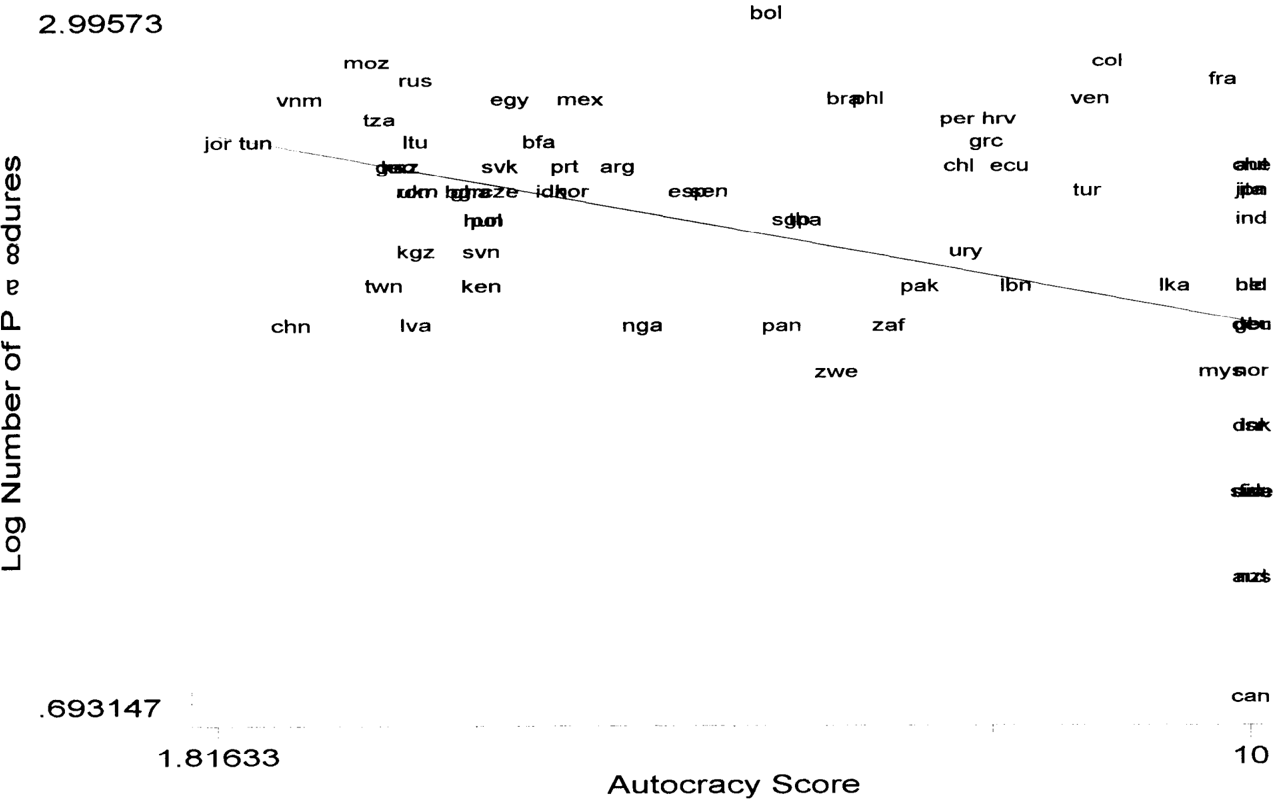
- In Table VIII, better government is associated with lighter regulation; the paper states that countries with more limited and representative governments have statistically significantly fewer procedures using 5 out of 6 measures of better government, and that more autocratic countries regulate more heavily.
Methods
- The paper builds a new database on entry regulation for 75 countries, focusing on the legal requirements, official time, and official cost for a standardized start-up firm.
- Data were gathered from written government sources, World Bank- and USAID-sponsored studies, government web pages, direct contacts with agencies, and independent double-checks in 73 countries via local consulting reports; the remaining 2 countries were double-checked through government contacts.
- The main analysis uses cross-country OLS regressions relating entry regulation measures to outcomes such as quality, pollution, unofficial economy, corruption, political institutions, legal origin, and GDP per capita; the paper also reports correlations and test-of-means comparisons across income quartiles.
Limitations
- The paper itself notes that the capture-theory tests are based on crude measures and that the data are probably least suited to test the capture hypothesis.
- The authors say the data almost surely underestimate the cost and complexity of entry because they focus on the capital city, omit industry-specific requirements and foreign-ownership steps, and ignore some informal delays and bribes.
- Evident from the text: the study is cross-sectional and based on official procedures/costs, so causal interpretation is limited and informal corruption/bureaucratic delays are not directly measured except indirectly through correlations.
Model-written summary. Check it against the paper before relying on it.
Integrity signals
Registry
Cites
Statistics
Figures
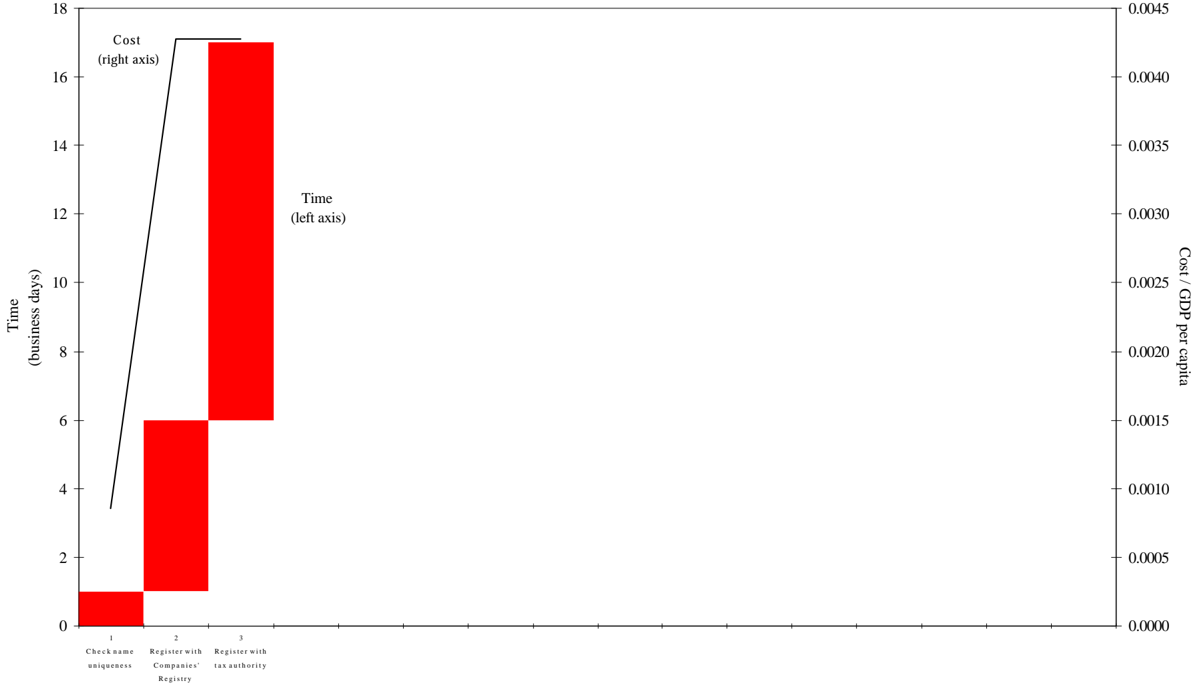
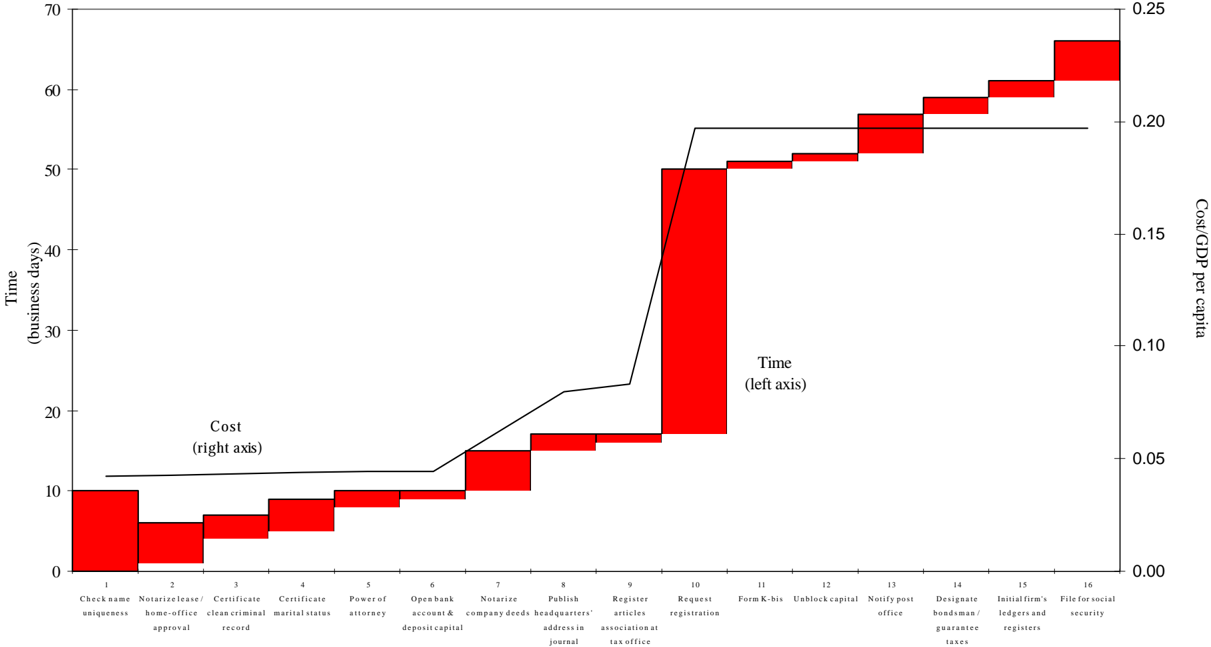
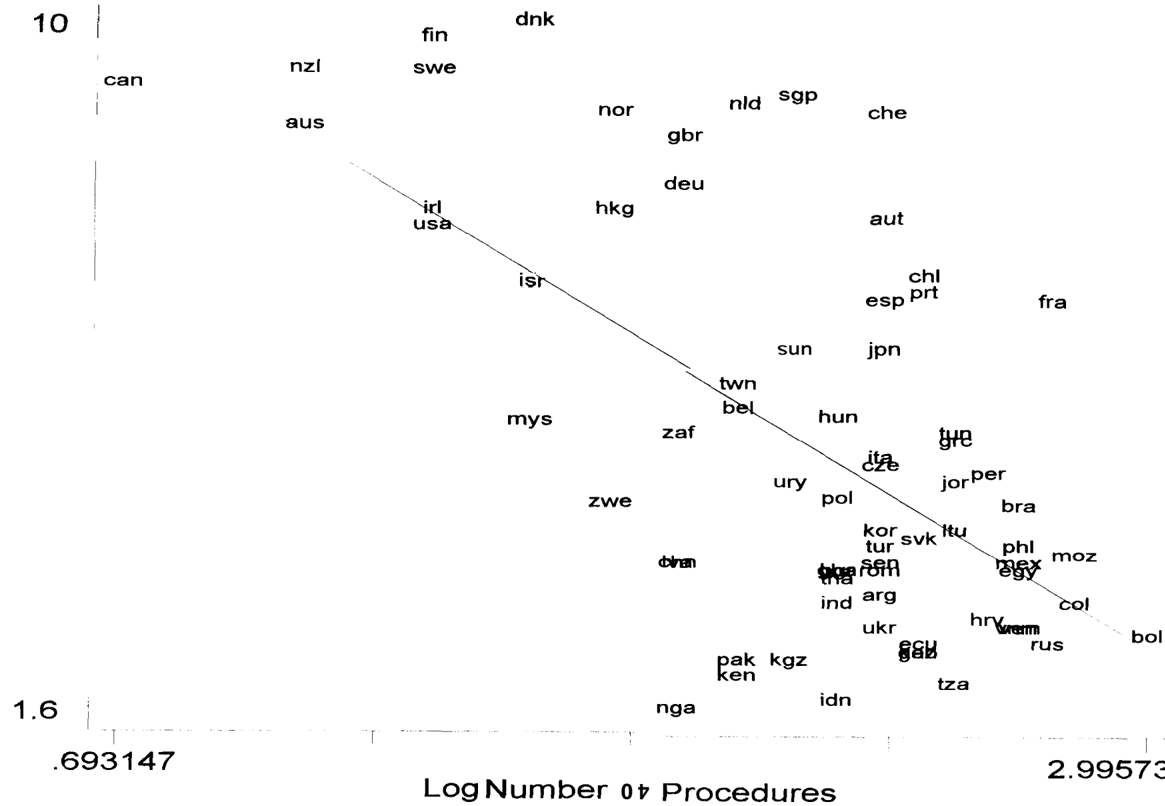
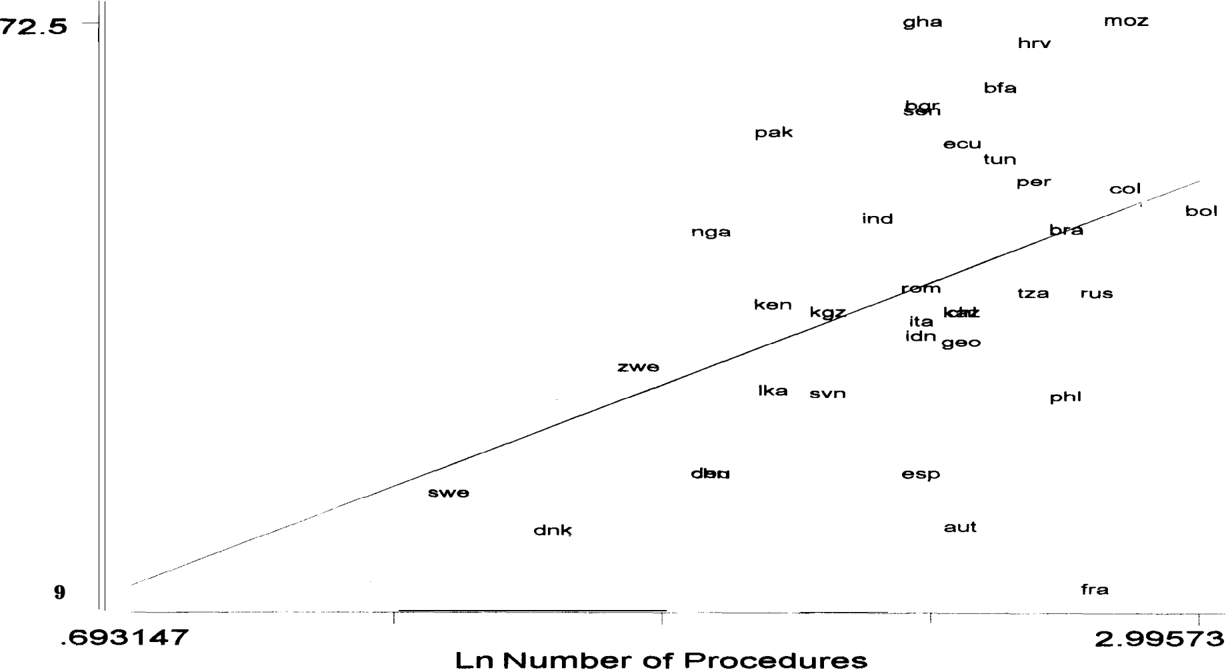
Verification
Claims the paper makes
0 Valid · 3 Not valid · 13 Not checked · 114 Own results and interpretations
A result the paper reports from its own data — it cites no other source for it, so there is none to check. The quote shows it is in the paper.
In the paper
“Very few entry regulations cover tax and labor issues.”
plain- Asserted: passes — The authors put it forward as true.
- Checkable: passes — It can be checked against evidence.
- Load-bearing: unclear — It is unclear whether the paper’s conclusions depend on it.
- Based: passes — The paper gives a reason why it holds.
In the paper
“The data show that the numbers of entry and of labor market regulations are positively correlated across countries, contrary to the substitutes hypothesis.”
What the sources say
- Not matchedcites Djankov et al., 2000
An author–year citation the paper’s reference list doesn’t settle. We don’t search these by name.
plainstates an association- Asserted: passes — The authors put it forward as true.
- Checkable: passes — It can be checked against evidence.
- Load-bearing: unclear — It is unclear whether the paper’s conclusions depend on it.
- Based: passes — The paper gives a reason why it holds.
- Not matched
A result the paper reports from its own data — it cites no other source for it, so there is none to check. The quote shows it is in the paper.
In the paper
“It often takes the form of screening procedures.”
- Also stated in: § III. Basic Results. · plain
“Instead, much of what governments do to regulate entry falls into the category of screening procedures.”
plain- Asserted: passes — The authors put it forward as true.
- Checkable: passes — It can be checked against evidence.
- Load-bearing: unclear — It is unclear whether the paper’s conclusions depend on it.
- Based: passes — The paper gives a reason why it holds.
- Also stated in: § III. Basic Results. · plain
A result the paper reports from its own data — it cites no other source for it, so there is none to check. The quote shows it is in the paper.
In the paper
“First, the cost-to-per-capita-GDP ratio decreases uniformly with GDP per capita.”
plainstates an association- Asserted: passes — The authors put it forward as true.
- Checkable: passes — It can be checked against evidence.
- Load-bearing: unclear — It is unclear whether the paper’s conclusions depend on it.
- Based: passes — The paper gives a reason why it holds.
A result the paper reports from its own data — it cites no other source for it, so there is none to check. The quote shows it is in the paper.
In the paper
“In contrast, countries in the other three quartiles of per capita income are not statistically different from each other in terms of the number of procedures and the time required to fulfill them.”
plain- Asserted: passes — The authors put it forward as true.
- Checkable: passes — It can be checked against evidence.
- Load-bearing: passes — The paper’s conclusions depend on it.
- Based: passes — The paper gives a reason why it holds.
49 more claims
Create a free account to see all 130 claims and every source verdict.
- Probably not a substantial claim. 21
- It may state two separate claims as one. 54
- The quote only partly states this claim. 26
Claims other papers make about this one
Each is checked against this paper’s own text: does it say what the citing paper says it does?
The source backs part of the claim, not all of it — or backs it for a different population, condition or comparison.
In the citing paper
“Our findings suggest an explanation for the low level of incorporation in Italy: the average direct cost associated with fulfilling the bureaucratic regulations for registering a new corporation in Italy is 20% of per capita GNP compared to 10% of per capita GNP on average for other G-7 European countries.”
From Entry regulation as a barrier to entrepreneurship (2006) · cites this paper as Djankov et al. (2002)
Experimental — accuracy not yet measuredThe cited source says what the claim attributes to it.
In the citing paper
“Given the explicit link made by Djankov et al . (2002) between the speed and ease with which businesses may be established in a country and its economic performance - and the enthusiasm with which this link has been grasped by European Union policy makers - our findings imply this link needs reconsidering.”
From The Effect of Business Regulations on Nascent and Young Business Entrepreneurship (2007) · cites this paper as Djankov et al . (2002)
Citations
Cites
La Porta, R., Lopez‐de‐Silanes, F., Shleifer, A., & Vishny, R. W. (1998) · Journal of Political Economy · doi:10.1086/250042 · Cited by 18,025
Self-citationThe Theory of Economic Regulation
Stigler, G. J. (1971) · The Bell Journal of Economics and Management Science · doi:10.2307/3003160 · Cited by 8,098
Journal of Economic Literature
(2019) · AEA Papers and Proceedings · doi:10.1257/pandp.109.633 · Cited by 7,468
The Quarterly Journal of Economics
Kuznets, S. (2024) · Business Cycle Theory, Part I Volume 4 · doi:10.4324/9781003549741-8 · Cited by 7,176
La Porta, R. (1999) · Journal of Law, Economics, and Organization · doi:10.1093/jleo/15.1.222 · Cited by 5,699 · cited 2×
“Legal origin has been viewed as a proxy for the government’s proclivity to intervene in the economy and the stance of the law toward the security of property rights in a country [La Porta et al. 1999].”
The Theory of Economic Regulation
Stigler, G. J. (2021) · The Political Economy · doi:10.4324/9781315495811-8 · Cited by 5,483
Pigou, A. C. (1933) · The Economic Journal · doi:10.2307/2224491 · Cited by 5,137
Toward a More General Theory of Regulation
Peltzman, S. (1976) · The Journal of Law and Economics · doi:10.1086/466865 · Cited by 4,729
Moffitt, R. A. (2009) · American Economic Review · doi:10.1257/aer.99.2.660 · Cited by 4,694
Shleifer, A., & Vishny, R. W. (1993) · The Quarterly Journal of Economics · doi:10.2307/2118402 · Cited by 3,778
Self-citation
Research works printed but not linked: 7
- McLiesh Caralee, 2001, NBER Working Paper No., 8288
- Kasnako lu, Zehra, and Münür Yayla, 'Unrecorded Economy in Turkey: A Monetary Approach', 1999. "Unrecorded Economy in Turkey (A Monetary Approach)" in Informal Sector in Turkey (I), Tuncer Bulutay (ed.), SIS, Ankara, forthcoming.
- Fred, 1987, Journal of Legal Studies, 101
- Olson, Mancur, 1991, 'Autocracy, Democracy, and Prosperity,' in Richard Zeckhauser, ed., Strategy of Choice, Cambridge, MA: MIT Press.
- 1967, Western Economic Journal, 232
- World Economic Forum (1999), The Global Competitiveness Report 1999 , Schwab, Klaus et al., eds., New York: Oxford University Press.
- World Economic Forum, The Global Competitiveness Report 2001, Klaus Schwab et al., eds. (New York, NY: Oxford University Press, 2001).
Cited by
Items 2,901–3,000 of 3,986
Home Market Effect and Regulation Costs— Homogeneous Firm and Heterogeneous Firm Trade ModelsPreprint
Okubo, T. (2006) · RePEc: Research Papers in Economics · Cited by 2
Regulation and the MacroeconomyPreprint
Dawson, J. W., & Seater, J. J. (2004) · SSRN Electronic Journal · doi:10.2139/ssrn.495682 · Cited by 2
Firms and FlexibilityPreprint
Hobijn, B., & Şahin, A. (2008) · SSRN Electronic Journal · doi:10.2139/ssrn.1077590 · Cited by 2
Kox, H. L. M., & van Leeuwen, G. (2011) · Munich Personal RePEc Archive (Ludwig Maximilian University of Munich) · Cited by 2
Entrepreneurship and bribery in a transition economy: theory and firm-level evidence in Vietnam
Tú, P. A. (2012) · University of Groningen research database (University of Groningen / Centre for Information Technology) · Cited by 3
The Effect of Stalin's Deportations on Distrust in Central AuthorityPreprint
Levkin, R. (2014) · SSRN Electronic Journal · doi:10.2139/ssrn.2484925 · Cited by 2
Trade and Migration: Firm-Level Evidence (LONG VERSION)Preprint
Hatzigeorgiou, A., & Lodefalk, M. (2011) · RePEc: Research Papers in Economics · Cited by 3
Karp, J. F. (2011) · RePEc: Research Papers in Economics · Cited by 2
Lecciones a partir de experimentos de formalización empresarial
Galiani, S., & Arjona, M. M. (2013) · doi:10.18235/0012179 · Cited by 2
Labor share, informal sector and development
Maarek, P. (2012) · Munich Personal RePEc Archive (Ludwig Maximilian University of Munich) · Cited by 13
Firm Turnover and Inflation DynamicsPreprint
Uuskkla, L. (2016) · SSRN Electronic Journal · doi:10.2139/ssrn.2830427 · Cited by 2
Does location matter for disclosure ? Evidence from geographical segmentsPreprint
Leung, E. (2014) · SSRN Electronic Journal · doi:10.2139/ssrn.2707019
Essays on household employment, trade liberalisation, and income in developing countries
Ajefu, J. B. (2015) · Figshare · Cited by 3
Reputation and Entry in ProcurementPreprint
Butler, J. V., Carbone, E., Conzo, P., & Spagnolo, G. (2013) · SSRN Electronic Journal · Cited by 6
Matching Ability - Elites in Partnerships: The Economics of Organizing Entrepreneurial ActivityPreprint
Fabel, O., & Weber, T. A. (2005) · SSRN Electronic Journal · doi:10.2139/ssrn.870407 · Cited by 2
Máté, D. (2014) · SSRN Electronic Journal · doi:10.2139/ssrn.2526778 · Cited by 2
Property Rights, Growth, and ConflictPreprint
Lawson-Remer, T. (2012) · SSRN Electronic Journal · doi:10.2139/ssrn.2000036 · Cited by 4
Working Paper 184 - Does Oil Wealth Affect Democracy in Africa?Preprint
Anyanwu, J. C., & Erhijakpor, A. E. O. (2013) · RePEc: Research Papers in Economics · Cited by 7
Informality: The Doorstep of the Legal SystemPreprint
Russo, F. F. (2010) · SSRN Electronic Journal · doi:10.2139/ssrn.1537886 · Cited by 2
What's Law Got to Do with It: A Systems Approach to ManagementPreprint
Bagley, C. E. (2006) · SSRN Electronic Journal · doi:10.2139/ssrn.898652 · Cited by 7
Doing It Under the Table: Unreported Sales in India's Manufacturing SectorPreprint
Smith, M. (2013) · SSRN Electronic Journal · doi:10.2139/ssrn.2208223 · Cited by 1
Lazarevski, D., Mrsik, J., & Smokvarski, E. (2013) · SSRN Electronic Journal · Cited by 2
Corruption - Can Brazil win this war?
de Queiroz, J. W. (2015) · NORA - Norwegian Open Research Archives · Cited by 2
Last Minute Deals: Rent Seeking in IPO MarketPreprint
Ding, Y., Yu, F., & Zhang, H. (2015) · SSRN Electronic Journal · doi:10.2139/ssrn.2597452 · Cited by 2
The Rise of NGO ActivismPreprint
Daubanes, J., & Rochet, J.-C. M. (2016) · SSRN Electronic Journal · doi:10.2139/ssrn.2765400 · Cited by 2
Krammer, S. M. S. (2014) · SSRN Electronic Journal · doi:10.2139/ssrn.2486087 · Cited by 2
Gómez‐Galvarriato, A., & Musacchio, A. (2006) · Cited by 2
Hoxha, D. (2013) · LA Referencia (Red Federada de Repositorios Institucionales de Publicaciones Científicas) · Cited by 6
Individual Characteristics, Contextual Factors and Entrepreneurial Behavior
Darnihamedani, P. (2012) · RePub (Erasmus University Rotterdam) · Cited by 79
Hampel-Milagrosa, A., Loewe, M., & Reeg, C. (2014) · RePEc: Research Papers in Economics · Cited by 2
Globalization and Insider Trading: Evidence from Cross-Border Mergers and AcquisitionsPreprint
Guo, L., & Zhang, S. (2015) · SSRN Electronic Journal · doi:10.2139/ssrn.2691967 · Cited by 2
Institutional Drivers of Informal EntrepreneurshipPreprint
Ács, Z. J., Desai, S., Stenholm, P., & Wuebker, R. J. (2014) · SSRN Electronic Journal · doi:10.2139/ssrn.2449963 · Cited by 2
Bateman, M. (2017) · SSRN Electronic Journal · doi:10.2139/ssrn.3075417 · Cited by 3
Business Corruption and Economic ProsperityPreprint
Amir, E., Danziger, S., & Levi, S. (2017) · SSRN Electronic Journal · doi:10.2139/ssrn.3002227 · Cited by 2
Corruption Perceptions and Capital Fragility: Evidence from Hedge Funds Around the WorldPreprint
Aragon, G. O., Nanda, V. K., & Zhao, H. (2018) · SSRN Electronic Journal · doi:10.2139/ssrn.3207064 · Cited by 2
“performance because these environments are typically associated with inefficient and weak legal systems (Djankov et al., 2002; Leuz, Nanda, and Wysocki, 2003; Svensson, 2005).”
The Historical Roots of Firm Access to Finance: Evidence from the African Slave Trade
Pierce, L., & Snyder, J. A. (2013) · Academy of Management Proceedings · doi:10.5465/ambpp.2013.148 · Cited by 2
“Many of these measurements are based off of published research, including getting credit (Djankov, McLiesh, and Shleifer 2007), starting a business (Djankov et al. 2002), and protecting investors (Djankov et al.”
InfluentialEndogenous Enforcement InstitutionsPreprint
Aldashev, G., & Zanarone, G. (2012) · SSRN Electronic Journal · doi:10.2139/ssrn.1990583 · Cited by 2
Jerbashian, V., & Kochanova, A. (2012) · SSRN Electronic Journal · doi:10.2139/ssrn.2101961 · Cited by 2
Peña-Mir, J. L. (2020) · Tesis Doctorals en Xarxa (Consorci de Serveis Universitaris de Catalunya) · Cited by 2
Corruption and Development - Why Does Corruption Still Affect Growth?Preprint
Delabarre, M. (2021) · SSRN Electronic Journal · doi:10.2139/ssrn.3768790 · Cited by 3
Entrepreneurship facilitators and their role in poverty alleviation
Aziz, O. (2021) · doi:10.32920/14652711.v1 · Cited by 5
Yang, T., Lim, J. J., & Kanamori, T. (2008) · Econstor (Econstor) · Cited by 2
Out with the sleaze, in with the ease
Naudé, W. A. (2009) · Cited by 3
ESSAYS ON BUSINESS GROUPS AND THE JUDICIARY IN SOUTH KOREA
Choi, H. (2014) · D-Scholarship@Pitt (University of Pittsburgh) · Cited by 4
Miao, M., Wang, W., & Zuo, Z. (2026) · American Economic Journal Economic Policy · doi:10.2139/ssrn.4059255 · Cited by 6
The Capital Flow from Institutional Investors to EntrepreneursPreprint
Groh, A. (2010) · SSRN Electronic Journal · doi:10.2139/ssrn.1547791 · Cited by 7
Formality Cost, Registration and Development of Microentreprenuers: Evidence From BrazilPreprint
Rocha, R. H., & de Farias, A. (2021) · SSRN Electronic Journal · doi:10.2139/ssrn.3969404 · Cited by 2
(2011) · Journal of Economic Literature · doi:10.1257/jel.49.4.1230 · Cited by 2
Bank Supervision and Liquidity CreationPreprint
Yasar, S. (2021) · SSRN Electronic Journal · doi:10.2139/ssrn.3914132 · Cited by 2
The Trade Comovement Puzzle and the Margins of International TradePreprint
Hong Kong Institute for Monetary and Financial Research (2012) · SSRN Electronic Journal · doi:10.2139/ssrn.2015867 · Cited by 2
Corruption, Political Connection, and Firm InvestmentsPreprint
Nguyen, H. Q. (2023) · SSRN Electronic Journal · doi:10.2139/ssrn.4387890 · Cited by 2
How Selling Online is Affecting Informal Firms in South Asia
Bussolo, M., Dixit, A., Golla, A. M., Kotia, A., Lee, J. N., Narasimhan, P., & Sharma, S. (2023) · World Bank, Washington, DC eBooks · doi:10.1596/1813-9450-10306 · Cited by 2
Entrepreneurship and Innovation in AfricaPreprint
Assenova, V., & Agarwal, A. (2023) · SSRN Electronic Journal · doi:10.2139/ssrn.4540399 · Cited by 2
Economic Development and Environmental Quality Nexus in Developing and Transition Economies
Purcel, A.-A. (2020) · theses.fr (ABES) · doi:10.70675/f3962ed6z4e7az4aeaza631zc78cdb0ec7b2 · Cited by 5
Petrostates and Private Sectors: Regulating Business and Markets in Resource-Rich CountriesPreprint
Mazaheri, N. (2010) · SSRN Electronic Journal · doi:10.2139/ssrn.1542362 · Cited by 2
Scott, E. L. (2013) · SSRN Electronic Journal · doi:10.2139/ssrn.2334629 · Cited by 2
The Nigerian informal economy : a regional analysis
Igudia, E. (2014) · Nottingham Trent University's Institutional Repository (Nottingham Trent Repository) · Cited by 5
The Impact of Maximum Markup Regulation on Prices
Genakos, C., Koutroumpis, P., & Pagliero, M. (2018) · Journal of Industrial Economics · doi:10.1111/joie.12175 · Cited by 19
Bank, W. (2022) · The World Bank Open Knowledge Repository (World Bank) · doi:10.1596/37935 · Cited by 1
Czeglédi, P. (2022) · Public Choice · doi:10.1007/s11127-022-01013-0 · Cited by 3
“It might not be for the public interest that elected officials regulate but for some rent or “toll” (Djankov et al., 2002), and elected officials might use regulation as a threat to extract such rents (McChesney 2001).”
Legal institutions, perceptions and entrepreneurship: an empirical investigation
Dove, J. A., & Dove, L. (2023) · Journal of Public Finance and Public Choice · doi:10.1332/251569121x16740293882620 · Cited by 1
Operation Mode Choices of Multinational Banks AbroadPreprint
Kowalewski, O. (2022) · SSRN Electronic Journal · doi:10.1016/j.gfj.2023.100863 · Cited by 1
CAPITAL DEPRECIATION AND INDUSTRY COMPETITION: EVIDENCE AND THEORY
Dang, A. H., & Samaniego, R. M. (2023) · International Economic Review · doi:10.1111/iere.12683 · Cited by 1
Grabiszewski, K., & Horenstein, A. R. (2024) · Review of Law & Economics · doi:10.1515/rle-2023-0104 · Cited by 1
Contractual Requirements and Bidding Behavior in Public Procurement With Entry
Drake, S., & Xu, F. (2025) · Journal of Public Economic Theory · doi:10.1111/jpet.70019 · Cited by 1
“Djankov et al. (2002) present empirical evidence showing that stringent entry regulations prolong the entry process and deter potential entrants.”
Contracting with Public Authorities: Recent Developments
Beuve, J., & Saussier, S. (2025) · Springer eBooks · doi:10.1007/978-3-031-50810-3_26 · Cited by 1
The Empirics of Relational Contracts: The Good, the Bad, and the Ugly
Macchiavello, R. (2025) · Springer eBooks · doi:10.1007/978-3-031-50810-3_24 · Cited by 1
Wen, Y., Yu, H., & Chen, Z. (2025) · Cities · doi:10.1016/j.cities.2025.105923 · Cited by 1
THE IMPACT OF MACRO FACTORS ON ENTREPRENEURSHIP AT THE PROVINCIAL LEVEL IN A DEVELOPING COUNTRY
BUI, H.-D., Vu, M. C., PHAN, T.-T., et al. (2025) · Journal of Developmental Entrepreneurship · doi:10.1142/s1084946725500037 · Cited by 1
The role of accounting in the informal economy
Aguilar, M., Lind, G., & Ramesh, K. (2026) · Journal of Accounting and Economics · doi:10.1016/j.jacceco.2026.101934 · Cited by 7
Unveiling the veil: Identifying potential shell firms using machine learning approaches
Cheng, Z., Li, T., & Liu, Z. F. (2025) · Pacific-Basin Finance Journal · doi:10.1016/j.pacfin.2025.102798 · Cited by 2
Li, C., Hong, T., Ma, T., & Yang, H. (2025) · Kyklos · doi:10.1111/kykl.12467 · Cited by 1
“In a market economy, the level of marketization influences key factors such as labor and capital mobility, industry entry barriers, and the efficiency of resource allocation, which in turn determine the evolutionary path of the local economic structure (Djankov et al. 2002).”
Monetary policy and bank risk-taking: what role for regulatory and macroprudential policies?
Ghosh, S. (2025) · Macroeconomics and Finance in Emerging Market Economies · doi:10.1080/17520843.2025.2517926 · Cited by 1
Deregulation derailed: evidence from services markets liberalization in Croatia
Grajzl, P., Ćorić, B., & Srhoj, S. (2025) · Public Choice · doi:10.1007/s11127-025-01305-1 · Cited by 3
“When excessive regulation is a consequence of rent-seeking (Djankov et al. 2002), those benefiting from the corresponding rents will naturally resist reforms that threaten their interests—congruent with our conceptualization in Sect.”
Text readability of regulatory policies and bank profit efficiency
Duan, Y., Fan, X., & Wang, Z. (2025) · Research in International Business and Finance · doi:10.1016/j.ribaf.2025.103096 · Cited by 3
Measuring Technology Entrepreneurship at the EU Level
Kilintzis, P., Samara, E. T., Avlogiaris, G., & Kaleli, Z. (2025) · Journal of the Knowledge Economy · doi:10.1007/s13132-025-02844-0 · Cited by 1
“Djankov et al. (2002) argue that for entrepreneurs, legal entry is extremely cumbersome, time-consuming, and expensive indicating that they pay a steep price in terms of fees and delays, directly affecting the development potential of their business.”
Vietnam in Transition: The Nexus of Institutions, Entrepreneurship, and Economic Growth
Tran, T. T., Pham, N. K., & Le, Q. V. (2025) · SAGE Open · doi:10.1177/21582440251369579 · Cited by 1
“An increase in startup regulations leads to a decrease in new business creation (Djankov et al., 2000; Klapper et al., 2006).”
Yubin, W., Jiachuang, C., Zhujun, S., & Hu, H. (2025) · Finance research letters · doi:10.1016/j.frl.2025.108487 · Cited by 2
Product Market Monopolies and Labour Market Monopsonies
Cali, M. A., & Presidente, G. C. (2025) · The Economic Journal · doi:10.1093/ej/ueaf095 · Cited by 1
The employment effects of VAT rebate efficiency: Evidence from SMEs in China
Lu, B., Ma, H., Hu, J., et al. (2025) · China Economic Review · doi:10.1016/j.chieco.2025.102561 · Cited by 1
Decolonising Entrepreneurship by Embracing the Global Dichotomy
Abosede, A. J., Ebie, S., Somoye, R. O., & Ashidi, J. S. (2025) · Springer eBooks · doi:10.1007/978-3-031-92310-4_22 · Cited by 1
Braune, É., Omenguele, R. G., Cédric, M. Y., Boncori, A., & Dana, L. (2025) · Journal of Small Business & Entrepreneurship · doi:10.1080/08276331.2025.2591533 · Cited by 3
Curbing stock price crash: The bright side of regulatory fragmentation
Gu, M., Li, D., & Xiong, Z. (2026) · Journal of Corporate Finance · doi:10.1016/j.jcorpfin.2026.102950 · Cited by 9
Understanding regulatory fragmentation: Firm-level evidence from China: A pre-registered report
Liu, X., Xu, Y., & Wang, J. (2026) · Pacific-Basin Finance Journal · doi:10.1016/j.pacfin.2026.103101 · Cited by 3
Market integration in the digital era: can public data openness break market segmentation?
Li, P., Li, L., Liu, X., & Zhou, H. (2026) · Empirical Economics · doi:10.1007/s00181-026-02895-5 · Cited by 7
“In contrast, improving government efficiency, optimizing the business environment, and reducing institutional transaction costs can effectively attract firms to enter new markets, promote MI, and break down MS (Djankov et al. 2002; Qiu and Yu 2020).”
Taherdoost, H., Le, T., & Slimani, K. (2026) · Journal of Control Science and Engineering · doi:10.1155/jcse/9001391 · Cited by 2
Governance, Entrepreneurship, and the Path to Sustainable Development in BRICS Economies
Navin, Y., Ayyagari, L. R., & rajan, A. A. (2026) · Journal of the Knowledge Economy · doi:10.1007/s13132-026-03161-w · Cited by 1
Xie, M., & Liao, X. (2026) · Journal of Asian Public Policy · doi:10.1080/17516234.2026.2648066 · Cited by 1
Institutional dimensions of scaling technology-based SMEs: the role of governance and regulation
Löfsten, H. (2026) · Journal of Science and Technology Policy Management · doi:10.1108/jstpm-02-2025-0048 · Cited by 2
Gupta, R., & Singh, B. P. (2026) · Journal of Innovation and Entrepreneurship · doi:10.1186/s13731-026-00642-9 · Cited by 6
“Further, the theory of regulatory arbitrage suggests that informal firms, by evading taxes, labour regulations, and environmental standards, create an uneven playing field that weakens formal firms’ incentives to invest in productivity-enhancing technologies (Djankov et al., 2002).”
Domestic credit effect on new business density in the high- and middle-income countries
Gani, A. (2026) · Journal of Financial Economic Policy · doi:10.1108/jfep-10-2025-0441 · Cited by 3
Does family matter for women’s entrepreneurship in emerging economies? Yes!
Boonyaphen, J., Song, H., Chung, S. H. D., & Kim, N. K. (2026) · Asia Pacific Journal of Management · doi:10.1007/s10490-026-10136-7 · Cited by 5
Vartanyan, A., Galstyan, E., Grigoryan, V., et al. (2026) · BULLETIN OF HIGH TECHNOLOGY · doi:10.56243/18294898-2026.1-63 · Cited by 1
Khan, R., & Taqi, M. (2026) · IGI Global eBooks · doi:10.4018/979-8-3373-8964-6.ch002 · Cited by 1
Fayed, A. A. (2013) · Cited by 1
Jin, C., & Tan, B. C. Y. (2011) · AIS Electronic Library (AISeL) · Cited by 2
Hasan, M. N., & Huda, H. A. E. (2012) · Developing Country Studies · Cited by 1
Exports versus Foreign Direct Investments: Evidence from Cross-Country Industry Data
(2013) · The MIT Press eBooks · doi:10.7551/mitpress/9716.003.0006 · Cited by 1
Veracierto, M. (2008) · RePEc: Research Papers in Economics · Cited by 38
Benefits of entry control: the Russian case
Олейник, А. (2015) · Post-Communist Economies · doi:10.1080/14631377.2015.1026695 · Cited by 1
Metadata
- Authors
- Djankov, S., La Porta, R., Lopez-de-Silanes, F., & Shleifer, A.
- Affiliations
- World Bank (US)
- National Bureau of Economic Research (US)
- ORCID
- Djankov, S.
- Venue
- The Quarterly Journal of Economics
- Publisher
- Oxford University Press (OUP)
- Published
- 2002-02-01
- Volume
- 117
- Issue
- 1
- Pages
- 1-37
- ISSN
- 0033-5533
- 1531-4650
- OpenAlex
- W2139896179
- Cited by
- 3,956
- References
- 30
- Citations by year
- 2026: 223 · 2025: 185 · 2024: 157 · 2023: 120 · 2022: 140 · 2021: 150 · 2020: 151 · 2019: 161 · 2018: 157 · 2017: 162 · 2016: 166 · 2015: 193 · 2014: 200 · 2013: 183 · 2012: 193
- Type
- report
- Language
- en
- Open access
- green
- doi.org
- Licence
- other-oa
- Locations
- World Bank, Washington, DC eBooks (publishedVersion)
- The Quarterly Journal of Economics (publishedVersion)
- The World Bank Open Knowledge Repository (World Bank) (publishedVersion)
- National Bureau of Economic Research (publishedVersion, other-oa)
- RePEc: Research Papers in Economics (submittedVersion)
- Digital Access to Scholarship at Harvard (DASH) (Harvard University) (submittedVersion, cc-by)
- SSRN Electronic Journal (submittedVersion)
- OpenGrey (Institut de l'Information Scientifique et Technique) (submittedVersion)
- The World Bank Open Knowledge Repository (World Bank) (submittedVersion, cc-by)
- Topics
- Social Sciences › Sociology and Political Science › Corruption and Economic Development
- Social Sciences › Economics, Econometrics and Finance › Economics and Econometrics › Taxation and Compliance Studies
- Social Sciences › Business, Management and Accounting › Strategy and Management › Political Influence and Corporate Strategies
- Keywords
- start-up firms, bureaucratic procedures, corruption, informal economy, democracy, government size, public choice theory, public interest theory
About these checks
Registry, retraction, Cites and statistics results are computed, not judged, with one exception: a printed reference that no index lists is read once by a model before it counts as a citation error. Claims are extracted by a model and kept only when their quote appears verbatim in the text; each cited source is then checked, with a model’s help, for whether it says what the claim relies on. Those verdicts can be wrong — read the claim’s quote and the cited source before relying on one.
A language model drew the claims from the paper on 2026-10-01, under version 3 of the claim definition (model deepseek-v4.1-flash, prompt extract-v3).
A second model labelled each claim on 2026-10-01 (model jev-1.13-20260917, definition revision gold-guideline-v0.2).
Statistics and arithmetic are recomputed, not judged.
Confidence bands are shown only for fields calibrated on our annotated test set. None is calibrated yet, so no band is shown.
What counts as a claim ›How we measure confidence ›How we check this ›
Are you an author, or do you see a problem with this page? Request a review
Data sources
Bibliographic data: Semantic Scholar, OpenAlex, Crossref.
Contains information from the Semantic Scholar Academic Graph Datasets, made available under the ODC Attribution License (ODC-BY 1.0).
Semantic Scholar’s data is described in: Kinney, R., et al. (2023). The Semantic Scholar Open Data Platform. arXiv:2301.10140.
