

The Regulation of Entry
Open accessThe DOI matches its Crossref record, with a small difference in title or year; 39 of the 39 references it cites were found in a registry or an index; none of the 13 sources its claims cite is checked for support yet.
Abstract
1%(5 :25.,1* 3$3(5 6(5,(6 7+( 5(*8/$7,21 2) (175< 6LPHRQ 'MDQNRY 5DIDHO /D 3RUWD )ORUHQ.LR /RSH]GH6LODQHV $QGUHL 6KOHLIHU :RUNLQJ 3DSHU KWWSZZZQEHURUJSDSHUVZ 1$7,21$/ %85($8 2) (&2120,& 5(6($5&+ 0DVVD.KXVHWWV $YHQXH &DPEULGJH 0$ 6HSWHPEHU :H WKDQN 2OJD ,RIIH 7DWLDQD 1HQRYD DQG (NDWHULQD 7UL]ORYD IRU DEOH UHVHDU.K DVVLVWDQ.H DQG +DPLG $ODYL ,ULQD $VWUDNKDQ $EKLMLW %DQHUMHH 5L.KDUG &DYHV -D.TXHOLQH &RROLGJH -DPHV (PHU\ 1LKDO (O0DJKDUEHO -HDQ 3DXO *DXWKLHU (G *ODHVHU 6LPRQ -RKQVRQ /DZUHQ.H .DW] 3HWHU .X.HUD 'DYLG /DLEVRQ ,UD /LHEHUPDQ 'DYLQ 0D.NLQ]LH 0DULH )UDQ.RLVH 0DULH1HOO\ 0DU.HOR 2ODUUHDJD *X\ 3IHIIHUPDQQ 6DQWLDJR 6HGD.D /HLOD :HEVWHU 3HWHU :ULJKW DQG VHPLQDU SDUWL.LSDQWV DW WKH 8QLYHUVLW\ RI 0DU\ODQG DW &ROOHJH 3DUN IRU KHOSIXO .RPPHQWV 7KH .ROOH.WLRQ RI GDWD IRU WKLV SDSHU ZDV RUJDQL]HG DQG ILQDQ.HG E\ WKH :RUOG %DQN $Q DSSHQGL[ GHV
Overview
CoChat Summary
TL;DR
This paper assembles a new cross-country dataset on business entry regulation in 75 countries and uses it to compare the helping-hand, capture, and tollbooth theories of regulation. The evidence is most consistent with the tollbooth view: heavier entry regulation is associated with more corruption, a larger unofficial economy, and less representative, more autocratic governments.
Key findings
- Across the 75-country sample, the number of entry procedures ranges from 2 in Canada to 20 in Bolivia, with a sample average of 10.17 procedures; the average official time is 63.05 business days and the average cost is 0.34 of GDP per capita.
- The number of procedures is strongly correlated with time and cost: the paper reports correlations of 0.75 with log time and 0.62 with log cost.
- The helping-hand tests do not support a beneficial-regulation story: in Table IV, more procedures are associated with lower ISO quality standards (e.g. coefficient -0.2646) and larger unofficial economy measures (e.g. coefficient 13.6277 for size of unofficial economy; 19.8763 for employment in the unofficial economy), while pollution and health outcomes do not improve.
- The tollbooth evidence is stronger: Table VI reports that more procedures are associated with worse corruption scores, with a coefficient of -3.2809 (and -1.7249 with GDP per capita controls) for the corruption regressions.
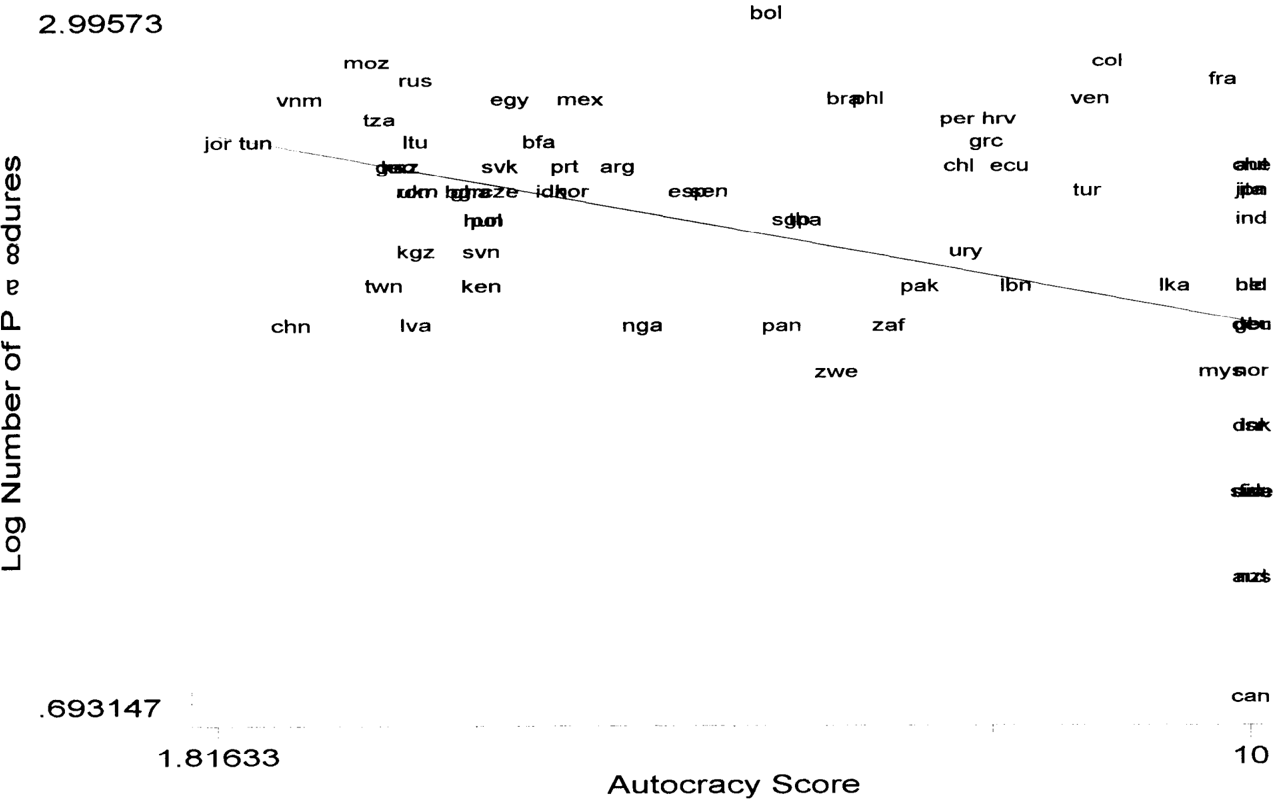
- In Table VIII, better government is associated with lighter regulation; the paper states that countries with more limited and representative governments have statistically significantly fewer procedures using 5 out of 6 measures of better government, and that more autocratic countries regulate more heavily.
Methods
- The paper builds a new database on entry regulation for 75 countries, focusing on the legal requirements, official time, and official cost for a standardized start-up firm.
- Data were gathered from written government sources, World Bank- and USAID-sponsored studies, government web pages, direct contacts with agencies, and independent double-checks in 73 countries via local consulting reports; the remaining 2 countries were double-checked through government contacts.
- The main analysis uses cross-country OLS regressions relating entry regulation measures to outcomes such as quality, pollution, unofficial economy, corruption, political institutions, legal origin, and GDP per capita; the paper also reports correlations and test-of-means comparisons across income quartiles.
Limitations
- The paper itself notes that the capture-theory tests are based on crude measures and that the data are probably least suited to test the capture hypothesis.
- The authors say the data almost surely underestimate the cost and complexity of entry because they focus on the capital city, omit industry-specific requirements and foreign-ownership steps, and ignore some informal delays and bribes.
- Evident from the text: the study is cross-sectional and based on official procedures/costs, so causal interpretation is limited and informal corruption/bureaucratic delays are not directly measured except indirectly through correlations.
Model-written summary. Check it against the paper before relying on it.
Integrity signals
Registry
Cites
Statistics
Figures
Verification
Claims the paper makes
0 Valid · 3 Not valid · 13 Not checked · 114 Own results and interpretations
A result the paper reports from its own data — it cites no other source for it, so there is none to check. The quote shows it is in the paper.
In the paper
“Very few entry regulations cover tax and labor issues.”
plain- Asserted: passes — The authors put it forward as true.
- Checkable: passes — It can be checked against evidence.
- Load-bearing: unclear — It is unclear whether the paper’s conclusions depend on it.
- Based: passes — The paper gives a reason why it holds.
In the paper
“The data show that the numbers of entry and of labor market regulations are positively correlated across countries, contrary to the substitutes hypothesis.”
What the sources say
- Not matchedcites Djankov et al., 2000
An author–year citation the paper’s reference list doesn’t settle. We don’t search these by name.
plainstates an association- Asserted: passes — The authors put it forward as true.
- Checkable: passes — It can be checked against evidence.
- Load-bearing: unclear — It is unclear whether the paper’s conclusions depend on it.
- Based: passes — The paper gives a reason why it holds.
- Not matched
A result the paper reports from its own data — it cites no other source for it, so there is none to check. The quote shows it is in the paper.
In the paper
“It often takes the form of screening procedures.”
- Also stated in: § III. Basic Results. · plain
“Instead, much of what governments do to regulate entry falls into the category of screening procedures.”
plain- Asserted: passes — The authors put it forward as true.
- Checkable: passes — It can be checked against evidence.
- Load-bearing: unclear — It is unclear whether the paper’s conclusions depend on it.
- Based: passes — The paper gives a reason why it holds.
- Also stated in: § III. Basic Results. · plain
A result the paper reports from its own data — it cites no other source for it, so there is none to check. The quote shows it is in the paper.
In the paper
“First, the cost-to-per-capita-GDP ratio decreases uniformly with GDP per capita.”
plainstates an association- Asserted: passes — The authors put it forward as true.
- Checkable: passes — It can be checked against evidence.
- Load-bearing: unclear — It is unclear whether the paper’s conclusions depend on it.
- Based: passes — The paper gives a reason why it holds.
A result the paper reports from its own data — it cites no other source for it, so there is none to check. The quote shows it is in the paper.
In the paper
“In contrast, countries in the other three quartiles of per capita income are not statistically different from each other in terms of the number of procedures and the time required to fulfill them.”
plain- Asserted: passes — The authors put it forward as true.
- Checkable: passes — It can be checked against evidence.
- Load-bearing: passes — The paper’s conclusions depend on it.
- Based: passes — The paper gives a reason why it holds.
49 more claims
Create a free account to see all 130 claims and every source verdict.
- Probably not a substantial claim. 21
- It may state two separate claims as one. 54
- The quote only partly states this claim. 26
Claims other papers make about this one
Each is checked against this paper’s own text: does it say what the citing paper says it does?
The source backs part of the claim, not all of it — or backs it for a different population, condition or comparison.
In the citing paper
“Our findings suggest an explanation for the low level of incorporation in Italy: the average direct cost associated with fulfilling the bureaucratic regulations for registering a new corporation in Italy is 20% of per capita GNP compared to 10% of per capita GNP on average for other G-7 European countries.”
From Entry regulation as a barrier to entrepreneurship (2006) · cites this paper as Djankov et al. (2002)
Experimental — accuracy not yet measuredThe cited source says what the claim attributes to it.
In the citing paper
“Given the explicit link made by Djankov et al . (2002) between the speed and ease with which businesses may be established in a country and its economic performance - and the enthusiasm with which this link has been grasped by European Union policy makers - our findings imply this link needs reconsidering.”
From The Effect of Business Regulations on Nascent and Young Business Entrepreneurship (2007) · cites this paper as Djankov et al . (2002)
Citations
Cites
La Porta, R., Lopez‐de‐Silanes, F., Shleifer, A., & Vishny, R. W. (1998) · Journal of Political Economy · doi:10.1086/250042 · Cited by 18,025
Self-citationThe Theory of Economic Regulation
Stigler, G. J. (1971) · The Bell Journal of Economics and Management Science · doi:10.2307/3003160 · Cited by 8,098
Journal of Economic Literature
(2019) · AEA Papers and Proceedings · doi:10.1257/pandp.109.633 · Cited by 7,468
The Quarterly Journal of Economics
Kuznets, S. (2024) · Business Cycle Theory, Part I Volume 4 · doi:10.4324/9781003549741-8 · Cited by 7,176
La Porta, R. (1999) · Journal of Law, Economics, and Organization · doi:10.1093/jleo/15.1.222 · Cited by 5,699 · cited 2×
“Legal origin has been viewed as a proxy for the government’s proclivity to intervene in the economy and the stance of the law toward the security of property rights in a country [La Porta et al. 1999].”
The Theory of Economic Regulation
Stigler, G. J. (2021) · The Political Economy · doi:10.4324/9781315495811-8 · Cited by 5,483
Pigou, A. C. (1933) · The Economic Journal · doi:10.2307/2224491 · Cited by 5,137
Toward a More General Theory of Regulation
Peltzman, S. (1976) · The Journal of Law and Economics · doi:10.1086/466865 · Cited by 4,729
Moffitt, R. A. (2009) · American Economic Review · doi:10.1257/aer.99.2.660 · Cited by 4,694
Shleifer, A., & Vishny, R. W. (1993) · The Quarterly Journal of Economics · doi:10.2307/2118402 · Cited by 3,778
Self-citation
Research works printed but not linked: 7
- McLiesh Caralee, 2001, NBER Working Paper No., 8288
- Kasnako lu, Zehra, and Münür Yayla, 'Unrecorded Economy in Turkey: A Monetary Approach', 1999. "Unrecorded Economy in Turkey (A Monetary Approach)" in Informal Sector in Turkey (I), Tuncer Bulutay (ed.), SIS, Ankara, forthcoming.
- Fred, 1987, Journal of Legal Studies, 101
- Olson, Mancur, 1991, 'Autocracy, Democracy, and Prosperity,' in Richard Zeckhauser, ed., Strategy of Choice, Cambridge, MA: MIT Press.
- 1967, Western Economic Journal, 232
- World Economic Forum (1999), The Global Competitiveness Report 1999 , Schwab, Klaus et al., eds., New York: Oxford University Press.
- World Economic Forum, The Global Competitiveness Report 2001, Klaus Schwab et al., eds. (New York, NY: Oxford University Press, 2001).
Cited by
Items 2,801–2,900 of 3,986
Entry costs and quality of business environment: a critical analysis
Zylbersztajn, D. (2010) · RAM. Revista de Administração Mackenzie · doi:10.1590/s1678-69712010000500008 · Cited by 2
New Institutional Economics and Agrocredit Markets in Agrarian Economies: A Theoretical Perspective
Ngaruko, D. (2012) · Huria Journal of the Open University of Tanzania · Cited by 3
Protection of Domestic Investors under the WTO and International Investment Regimes
Lubambo, M. (2020) · World Trade Review · doi:10.1017/s1474745620000142 · Cited by 2
“The academic literature on political economy has highlighted that states may have incentives to raise or maintain barriers to foreign investments and investors in face of political pay-offs (Grossman and Helpman, 1996: 216, 220; Djankov et al., 2002).”
Krauß, A. (2015) · IZA Journal of Labor & Development · doi:10.1186/s40175-015-0032-8 · Cited by 2
Barseghyan, L., & Guerdjikova, A. (2008) · 2008 Meeting Papers · Cited by 1
To Wait or Not to Wait: Swiss EU-Membership as an Investment under Uncertainty
Spirig, B., & Weder, R. (2008) · Zeitschrift für schweizerische Statistik und Volkswirtschaft/Schweizerische Zeitschrift für Volkswirtschaft und Statistik/Swiss journal of economics and statistics · doi:10.1007/bf03399250 · Cited by 7
Existing practices on anticorruption
Forgues‐Puccio, G. F. (2013) · Cited by 3
Employment protection and income inequality: is there a role for the informal sector?
Gkinni, E., & Vasilaki, E. (2013) · Undergraduate Economic Review · Cited by 4
≪Informalidad≫, Estado y contrato social en América Latina. Estudio preliminar
Saavedra, J., & Tommasi, M. (2007) · Revista Internacional del Trabajo · doi:10.1111/j.1564-9148.2007.00016.x · Cited by 11
Corruption, Delays and the Pattern of Trade
Do, Q.-A. (2008) · Cited by 2
Mrożewski, M. J. (2014) · International Journal of Management and Economics · doi:10.2478/ijme-2014-0043 · Cited by 2
“, 2002] to aggregated macro studies on the cultural and institutional determinants of entrepreneurial activity across countries [e.g., Aidis et al., 2012; Aldrich, 1990; Baumol, 1990; Djankov et al., 2002; Douhan, Henrekson, 2010; Estrin, Mickiewicz, 2011; Freytag, Thurik 2007; Johnson et al., 2002; Tonoyan et al., 20…”
Georgiou, M. N., & Kyriazis, N. C. (2012) · Credit and Capital Markets – Kredit und Kapital · doi:10.3790/kuk.45.4.531 · Cited by 2
Regulatory reform and bureaucracy in Southeast Asia: variations and consequences
Jones, D. S. (2008) · Research in public policy analysis and management · doi:10.1016/s0732-1317(08)17007-5 · Cited by 2
Vision for a Canada Strong and Free
Harris, M., & Manning, P. (2007) · Cited by 2
Lashitew, A. A. (2012) · Cited by 2
Wirtschaftspolitik, A. (2006) · Cited by 2
Building Prosperity in a Canada Strong and Free
Harris, M., & Manning, P. (2006) · Cited by 2
Keuschnigg, C., Egger, P. H., & Winner, H. (2011) · Alexandria (UniSG) (University of St.Gallen) · Cited by 2
SINGLE MARKET NON-COMPLIANCE: HOW RELEVANT IS THE INSTITUTIONAL SETTING?
Barbosa, N., Guimarães, M. H., & Faria, A. P. (2015) · The Singapore Economic Review · doi:10.1142/s0217590815500861 · Cited by 2
The effects of firm entry and exit on macroeconomic fluctuations and monetary policy
Vilmi, L. (2009) · Cited by 2
The hidden burden of the income tax
Blaufus, K., Eichfelder, S., & Hundsdoerfer, J. (2011) · Refubium (Universitätsbibliothek der Freien Universität Berlin) · doi:10.17169/fudocs_document_000000010321 · Cited by 2
Manolova, T. S., & Eunni, R. V. (2012) · Business and management · doi:10.3846/bm.2012.074 · Cited by 2
“…Honig 2003); family support and role models (Carsrud et al. 1987); or the country’s level of macroeconomic, technological, and institutional development (Djankov et al. 2002; Bowen, DeClercq 2008; Wong et al. 2005) have been extensively studied in prior theoretical treatments and empirical work.”
DOES THE LOCAL ECONOMIC GOVERNANCE IN INDONESIAPERFORM AN IMPROVEMENT?
Kuncoro, H. (2012) · Bulletin of Monetary Economics and Banking · doi:10.21098/bemp.v15i1.417 · Cited by 4
The Demand for, and Consequences of, Formalization among Informal Firms
Lanka, S. S. (2013) · Cited by 2
Wießner, F., Evers, K., & Schleinkofer, M. (2016) · Sozialer Fortschritt · doi:10.3790/sfo.65.7.171 · Cited by 2
The Sub-federal Administrative Regulation in Russia
Kolomak, E. A. (2008) · The International Journal of Interdisciplinary Social Sciences Annual Review · doi:10.18848/1833-1882/cgp/v03i04/52581 · Cited by 2
4 The Cost Competitiveness of Manufacturing in China and India: An Industry and Regional Perspective
van Ark, B., Erumban, A. A., Chen, V., & Kumar, U. (2010) · Oxford University Press eBooks · doi:10.1093/acprof:oso/9780199575077.003.0004 · Cited by 2
Sun, Z., Zhu, Y., Li, Y., et al. (2016) · Cluster Computing · doi:10.1007/s10586-016-0660-z · Cited by 2
Gago‐Rodríguez, S., & Nickel, M. N. (2016) · Business Ethics A European Review · doi:10.1111/beer.12133 · Cited by 2
Entrepreneurship and Innovation in the Middle East: Current Challenges and Recommended Policies
Sharpe, N. R., & Schroeder, C. M. (2016) · Palgrave Macmillan UK eBooks · doi:10.1057/9781137480293_5 · Cited by 2
Method for Diagnostics, Assessment, and Analysis of Investment Climate and Risks
Alexandrov, G., Владимировна, В. И., & Skvortsova, G. (2017) · Asian Social Science · doi:10.5539/ass.v13n2p10 · Cited by 2
Political Federalism and Innovation: Are de jure Labor Regulations Absolute?
Ghosh, S. (2017) · Asian Journal of Law and Economics · doi:10.1515/ajle-2016-0014 · Cited by 2
Blast from the Past? A Comparative Analysis of Broadcast Licensing in the Digital Era
Schweizer, C., Puppis, M., Künzler, M., et al. (2014) · Journal of Information Policy · doi:10.5325/jinfopoli.4.2014.0507 · Cited by 2
Challenges in the Era of Globalization
Salinas, H. A. (2010) · Cited by 2
Giving across Borders: Philanthropy or Business as Usual?
Hornstein, A. S., & Zhao, M. (2011) · ScholarlyCommons (University of Pennsylvania) · Cited by 2
The Role of the State in the Turkish Economy
Gür, N. (2018) · Springer eBooks · doi:10.1007/978-3-319-70380-0_2 · Cited by 3
The Real Eect of Foreign Banks
Bruno, V. G., & Hauswald, R. B. H. (2009) · Cited by 2
Aki, H. M. (2018) · Open Journal of Political Science · doi:10.4236/ojps.2019.91002 · Cited by 2
“…to establish and choose economic reforms that have fast and profound socioeconomic im- DOI: 10.4236/ojps.2019.91002 19 Open Journal of Political Science pacts (Djankov et al., 2002; Klapper et al., 2006; Ndzana Olomo, 2011; Devarajan & Fengler, 2013), and also reforms promoting industrialization.”
InfluentialPolicy inertia, self-defeating expectations and structural reforms: can policy modeling cope?
Bonatti, L., & Fracasso, A. (2019) · Journal of Policy Modeling · doi:10.1016/j.jpolmod.2019.04.004 · Cited by 3
Corrupt Practices in Public Procurement: Evidence from Poland
Borowiec, A. (2019) · Eurasian studies in business and economics · doi:10.1007/978-3-030-18565-7_6 · Cited by 2
Protecting the entrepreneurial poor: A human rights approach
Queralt, J. (2019) · Politics Philosophy & Economics · doi:10.1177/1470594x19860235 · Cited by 7
“See de Soto (1990), Djankov et al. (2002), and Stigler (1971).”
Innovation, Value Creation, and Entrepreneurship by Opportunity: An Analysis of European Countries
Martínez, M. S. C. (2019) · Advances in business strategy and competitive advantage book series · doi:10.4018/978-1-7998-1169-5.ch003 · Cited by 2
IMRPs and Advancing International Marketing Education
Rana, S., Salwan, P., & Anand, A. (2017) · Journal of international business education · Cited by 2
Zhong, Y., Zhong, Y., & Zhang, L. (2021) · Mathematical Problems in Engineering · doi:10.1155/2021/8867446 · Cited by 2
OPTIMAL GOVERNMENT REGULATIONS AND RED TAPE IN AN ECONOMY WITH CORRUPTION
Méndez, F., & Sepúlveda, F. (2006) · Institutional Repositories DataBase (IRDB) · doi:10.15057/25774 · Cited by 2
Nakabugo, M. J., Muathe, S. M., & Mwasiaji, E. (2021) · International Journal of Business and Management · doi:10.5539/ijbm.v16n4p1 · Cited by 5
“Complexity and costly business registration requirements limit entrepreneurs to operate their businesses legally and this limits their prosperity (Djankov et al., 2002).”
EVALUATING THE DETERMINANTS OF FORMAL ENTREPRENEURSHIP: AN INSTITUTIONAL ASYMMETRY PERSPECTIVE
Makhdoom, H. U. R., Li, C., Asim, S., & Murad, M. (2021) · Journal of Developmental Entrepreneurship · doi:10.1142/s1084946721500060 · Cited by 3
Олейник, А. (2011) · Voprosy Ekonomiki · doi:10.32609/0042-8736-2011-5-19-33 · Cited by 8
Fay, S. (2021) · Sociological Perspectives · doi:10.1177/07311214211021127 · Cited by 2
The Impact of Regulations on Small Firm Characteristics
Kaya, H. D. (2021) · Business Ethics and Leadership · doi:10.21272/bel.5(2).66-77.2021 · Cited by 4
“Djankov et al. (2002) examine 85 countries and show that the countries with stricter entry regulations are more likely to have more corruption.”
Bank Competition, Regulation, and Efficiency
Li, S. (2021) · Contributions to finance and accounting · doi:10.1007/978-981-16-3509-0_5 · Cited by 2
Roeger, W., Varga, J., & Veld, J. I. ’. (2021) · International Economic Association Series · doi:10.1007/978-3-030-71457-4_6 · Cited by 2
Entrepreneurship Factors Among Developed Countries and Emerging Regions
Potts, M. D., Affholter, J. A., & Harless, S. (2021) · South East European Journal of Economics and Business · doi:10.2478/jeb-2021-0016 · Cited by 6
Vershinina, N. A., Rodionova, Y., Kitching, J., & Barrett, R. (2014) · DMU Open Research Archive (De Montfort University) · Cited by 4
Entrepreneurship and conflict generating product price changes
Schweinberger, A. G., & Woodland, A. D. (2015) · European Economic Review · doi:10.1016/j.euroecorev.2015.04.008 · Cited by 2
Bank Audit Regulations and Reporting Quality
Khurana, I. K., & Zhong, R. (2021) · Journal of International Accounting Research · doi:10.2308/jiar-2021-066 · Cited by 3
A failure to impose control: PRIVATE SECURITY AND THE MEXICAN STATE
Puck, L. (2021) · Lua Nova Revista de Cultura e Política · doi:10.1590/0102-029068/114 · Cited by 2
Alesina, A., & Glaeser, E. L. (2004) · Oxford University Press eBooks · doi:10.1093/0199267669.003.0001 · Cited by 3
Innovation versus technology imitation development strategy: what influences government decision?
Sabry, M. I. (2021) · Innovation and Development · doi:10.1080/2157930x.2021.1954361 · Cited by 2
“The literature on regulation of entry (e.g. Djankov et al. 2002) suggests that higher (and arguably bad) regulation of entry correlates with high corruption and cronyism since it limits competition to politically connected firms.”
InfluentialInstitutional factors as determinants of subnational economic growth in Ecuador
Jiménez, D. D. O., & Muñoz, L. R. M. (2022) · Revista de Economía del Caribe · doi:10.14482/ecoca.27.124.523 · Cited by 4
The constitution of ambiguity: The effects of constitutions on economic freedom
Murphy, R. (2022) · Economic Affairs · doi:10.1111/ecaf.12523 · Cited by 2
Sorens, J. (2022) · Publius The Journal of Federalism · doi:10.1093/publius/pjac024 · Cited by 2
Financial development and declining market dynamics: Another dark side of “too much finance”?
Zhu, X. (2022) · Empirical Economics · doi:10.1007/s00181-022-02327-0 · Cited by 4
“…Wichita State University, Wichita, KS, USA The reduction of financial restrictions lowers barriers to entry for newfirms,which is essential to foster market dynamics and competition (Djankov et al. 2002; Michelacci and Suarez 2004; Klapper et al. 2006; Arellano et al. 2012; Ye et al. 2019).”
Red Tape Reduction, More New Firms? Saving Time and Money: Evidence from an Ecuadorian Reform
Camino‐Mogro, S., & Armijos-Bravo, G. (2022) · The Journal of Development Studies · doi:10.1080/00220388.2022.2154149 · Cited by 4
“This result is also found by Fisman and Sarria-Allende (2010), who analyze a sample of 57 countries. Likewise, Fonseca, Lopez-Garcia, and Pissarides (2001) and Dreher and Gassebner (2013) argue that institutional entry barriers limit entrepreneurship and, by extension, firm creation. Moreover, Loayza, Oviedo, and Serv…”
InfluentialDove, J. A. (2023) · Journal of Regulatory Economics · doi:10.1007/s11149-023-09457-y · Cited by 5
“However, there is also evidence of a link between decreased entrepreneurial activity and with it reduced growth as regulation increases beyond some optimum level (DeSoto, 2000; Djankov et al., 2002; Dreher & Gassebner, 2013; Klapper et al., 2006).”
Yaya, S., Shen, Q., & Mintah, C. (2023) · Open Journal of Business and Management · doi:10.4236/ojbm.2023.113060 · Cited by 3
Double jeopardy: FCPA enforcement and MNC risk-mitigation strategies
Xu, J. X. (2024) · Asian Review of Political Economy · doi:10.1007/s44216-023-00021-1 · Cited by 2
“…is decreased and the amount of profits to be shared among market incum-bents increases (Djankov 2009; Blanchard and Giavazzi 2003; Hillman 2013; Alder et al. 2014; Maijoor and Van Witteloostuijn 1996; Rose 1987; Djankov et al. 2002; Degryse and Ongena 2008; Black and Strahan 2001; McChesney 1987).”
The Causes for Corruption and the Effectiveness of Anti-Corruption Strategies
Goczek, Ł. (2007) · Gospodarka Narodowa · doi:10.33119/gn/101381 · Cited by 7
Corporate Law and Small Business Finance: Mandatory v. Enabling Rules
Hyytinen, A., & Takalo, T. (2005) · European Business Organization Law Review · doi:10.1017/s1566752905004490 · Cited by 2
R&D: Italy and Poland Compared
Fino, V., & Rosiek, J. (2016) · Argumenta Oeconomica Cracoviensia · doi:10.15678/aoc.2016.1507 · Cited by 2
Does democratization lower consumer prices? Regime type, prices, and the consumer–producer tradeoff
Baker, A., & Wojcik, S. (2017) · International Political Science Review · doi:10.1177/0192512117731264 · Cited by 2
“For example, foreign direct investment increases in the wake of democratization (Jensen, 2006), and democracies have lower licensing and other red-tape barriers to potential domestic entrants (Djankov et al., 2002).”
Ённи, Р. Б., & Manolova, T. S. (2013) · RePEc: Research Papers in Economics · Cited by 4
OECD ÜLKELERİNİN İŞ YAPMA KOLAYLIĞI AÇISINDAN ÇOK KRİTERLİ KARAR ANALİZİ İLE SIRALANMASI
ÖNALMIŞ, Ç., Ulucan, A., & Atici, K. B. (2019) · Hacettepe Üniversitesi İktisadi ve İdari Bilimler Fakültesi Dergisi · doi:10.17065/huniibf.378541 · Cited by 4
Consumption Propensity and Entrepreneurship: Evidence from China
Hu, M., Liu, J., & Wang, X. (2019) · Emerald Group Publishing Limited eBooks · doi:10.1108/s1571-038620190000026013 · Cited by 3
González-Blanco, J., Vila-Alonso, M., & Guisado‐González, M. (2019) · Sustainability · doi:10.3390/su11205778 · Cited by 3
“However, in Europe, programs that promote entrepreneurship are often too bureaucratized [3].”
Types of Corruption in Small and Micro Enterprises (SMEs) in Ibadan, Nigeria
Onyeonoru, I. P., Omolawal, S. A., & Okunola, R. A. (2019) · The Nigerian Journal of Sociology and Anthropology · doi:10.36108/njsa/9102/71(0290 · Cited by 2
Does Entry Regulation Translate into Comparative (Dis)Advantage?Preprint
Pang, J., Wu, H., & Xu, Y. (2008) · SSRN Electronic Journal · doi:10.2139/ssrn.1318827 · Cited by 2
Wafubwa, M. A. (2013) · Cited by 2
THE PROBLEM OF TAXING PEASANTS IN CHINA
Lin, J. Y., Tao, R., & Liu, M. (2002) · Cited by 3
Inequality, Fiscal Capacity and the Political Regime: Lessons from the Post-Communist TransitionPreprint
Mickiewicz, T. M., & Gerry, C. J. (2006) · SSRN Electronic Journal · doi:10.2139/ssrn.920678 · Cited by 2
Are De Jure Labor Laws Absolute? Formal Manufacturing in India
Ghumman, G. S. (2008) · UPT. Syiah Kuala University Library (Syiah Kuala University) · Cited by 2
Hahn, R., & Nayır, D. Z. (2013) · SSRN Electronic Journal · Cited by 2
Corruption and Competition: Toward Economic Theory of CorruptionPreprint
Otáhal, T., & Wawrosz, P. (2012) · SSRN Electronic Journal · doi:10.2139/ssrn.2160836 · Cited by 2
Entry Barriers, Property Rights, and R&D Activities: Evidence from OECD CountriesPreprint
Wu, H. (2009) · SSRN Electronic Journal · doi:10.2139/ssrn.1338926 · Cited by 2
Modelando informalidad voluntaria e involuntaria
Montes, B. A. (2009) · Cited by 2
Resource Wealth and Entrepreneurship: A Blessing or a Curse?Preprint
Farzanegan, M. R. (2012) · RePEc: Research Papers in Economics · doi:10.17192/es2024.0138 · Cited by 5
The Art and Science of Innovation Policy: IntroductionPreprint
Hall, B. H. (2011) · RePEc: Research Papers in Economics · Cited by 2
Unternehmensdynamik in forschungs- und wissensintensiven Wirtschaftszweigen in DeutschlandPreprint
Metzger, G., & Rammer, C. (2009) · RePEc: Research Papers in Economics · Cited by 2
Leveraged Buyout Activity: A Tale of Developed and Developing EconomiesPreprint
Reddy, N., & Blenman, L. P. (2014) · SSRN Electronic Journal · Cited by 2
Nonlinear effect of corruption, uncertainty, and growth
Ratbek, R. (2010) · Munich Personal RePEc Archive (Ludwig Maximilian University of Munich) · Cited by 3
Unequal effects of liberalisation on diversification of Russia's regionsPreprint
Yakovlev, E., & Zhuravskaya, E. V. (2011) · RePEc: Research Papers in Economics · Cited by 2
Regulation, Institutions, and Productivity Growth
Silva, O., & María, A. (2006) · University Libraries (University of Maryland) · Cited by 2
Modeling global pricing and launching of new drugs
Lorenzo, B. G. (2014) · Economía y salud: boletín informativo · Cited by 2
Interacting Product and Labor Market Regulation and the Impact of Immigration on Native WagesPreprint
Prantl, S., & Spitz‐Oener, A. (2013) · SSRN Electronic Journal · doi:10.2139/ssrn.2373058 · Cited by 4
The Political Economy of Trans-Pacific Business Linkages
Henisz, W. J. (2004) · Business and Politics · doi:10.2202/1469-3569.1083 · Cited by 2
Aghion, P., & Pisani‐Ferry, J. (2004) · Revue de l'OFCE/La Revue de l'OFCE · doi:10.3917/reof.088.0219 · Cited by 2
Institutions and ConcentrationPreprint
Mitton, T. (2006) · SSRN Electronic Journal · doi:10.2139/ssrn.885396 · Cited by 2
The Factors Determining the Duration of Legal Disputes: An Empirical Analysis with Micro DataPreprint
DiVita, G. (2011) · SSRN Electronic Journal · doi:10.2139/ssrn.1830275 · Cited by 2
Opportunities to Divert, Firm Value, and Taxation: Theory and Evidence from European FirmsPreprint
Krämer, R., & Lipatov, V. (2011) · SSRN Electronic Journal · doi:10.2139/ssrn.1932606 · Cited by 2
Economic Development in the Middle EastPreprint
Shachmurove, Y. (2004) · SSRN Electronic Journal · doi:10.2139/ssrn.548362 · Cited by 2
Metadata
- Authors
- Djankov, S., La Porta, R., Lopez-de-Silanes, F., & Shleifer, A.
- Affiliations
- World Bank (US)
- National Bureau of Economic Research (US)
- ORCID
- Djankov, S.
- Venue
- The Quarterly Journal of Economics
- Publisher
- Oxford University Press (OUP)
- Published
- 2002-02-01
- Volume
- 117
- Issue
- 1
- Pages
- 1-37
- ISSN
- 0033-5533
- 1531-4650
- OpenAlex
- W2139896179
- Cited by
- 3,956
- References
- 30
- Citations by year
- 2026: 223 · 2025: 185 · 2024: 157 · 2023: 120 · 2022: 140 · 2021: 150 · 2020: 151 · 2019: 161 · 2018: 157 · 2017: 162 · 2016: 166 · 2015: 193 · 2014: 200 · 2013: 183 · 2012: 193
- Type
- report
- Language
- en
- Open access
- green
- doi.org
- Licence
- other-oa
- Locations
- World Bank, Washington, DC eBooks (publishedVersion)
- The Quarterly Journal of Economics (publishedVersion)
- The World Bank Open Knowledge Repository (World Bank) (publishedVersion)
- National Bureau of Economic Research (publishedVersion, other-oa)
- RePEc: Research Papers in Economics (submittedVersion)
- Digital Access to Scholarship at Harvard (DASH) (Harvard University) (submittedVersion, cc-by)
- SSRN Electronic Journal (submittedVersion)
- OpenGrey (Institut de l'Information Scientifique et Technique) (submittedVersion)
- The World Bank Open Knowledge Repository (World Bank) (submittedVersion, cc-by)
- Topics
- Social Sciences › Sociology and Political Science › Corruption and Economic Development
- Social Sciences › Economics, Econometrics and Finance › Economics and Econometrics › Taxation and Compliance Studies
- Social Sciences › Business, Management and Accounting › Strategy and Management › Political Influence and Corporate Strategies
- Keywords
- start-up firms, bureaucratic procedures, corruption, informal economy, democracy, government size, public choice theory, public interest theory
About these checks
Registry, retraction, Cites and statistics results are computed, not judged, with one exception: a printed reference that no index lists is read once by a model before it counts as a citation error. Claims are extracted by a model and kept only when their quote appears verbatim in the text; each cited source is then checked, with a model’s help, for whether it says what the claim relies on. Those verdicts can be wrong — read the claim’s quote and the cited source before relying on one.
A language model drew the claims from the paper on 2026-10-01, under version 3 of the claim definition (model deepseek-v4.1-flash, prompt extract-v3).
A second model labelled each claim on 2026-10-01 (model jev-1.13-20260917, definition revision gold-guideline-v0.2).
Statistics and arithmetic are recomputed, not judged.
Confidence bands are shown only for fields calibrated on our annotated test set. None is calibrated yet, so no band is shown.
What counts as a claim ›How we measure confidence ›How we check this ›
Are you an author, or do you see a problem with this page? Request a review
Data sources
Bibliographic data: Semantic Scholar, OpenAlex, Crossref.
Contains information from the Semantic Scholar Academic Graph Datasets, made available under the ODC Attribution License (ODC-BY 1.0).
Semantic Scholar’s data is described in: Kinney, R., et al. (2023). The Semantic Scholar Open Data Platform. arXiv:2301.10140.
