

The Regulation of Entry
Open accessThe DOI matches its Crossref record, with a small difference in title or year; 39 of the 39 references it cites were found in a registry or an index; none of the 13 sources its claims cite is checked for support yet.
Abstract
1%(5 :25.,1* 3$3(5 6(5,(6 7+( 5(*8/$7,21 2) (175< 6LPHRQ 'MDQNRY 5DIDHO /D 3RUWD )ORUHQ.LR /RSH]GH6LODQHV $QGUHL 6KOHLIHU :RUNLQJ 3DSHU KWWSZZZQEHURUJSDSHUVZ 1$7,21$/ %85($8 2) (&2120,& 5(6($5&+ 0DVVD.KXVHWWV $YHQXH &DPEULGJH 0$ 6HSWHPEHU :H WKDQN 2OJD ,RIIH 7DWLDQD 1HQRYD DQG (NDWHULQD 7UL]ORYD IRU DEOH UHVHDU.K DVVLVWDQ.H DQG +DPLG $ODYL ,ULQD $VWUDNKDQ $EKLMLW %DQHUMHH 5L.KDUG &DYHV -D.TXHOLQH &RROLGJH -DPHV (PHU\ 1LKDO (O0DJKDUEHO -HDQ 3DXO *DXWKLHU (G *ODHVHU 6LPRQ -RKQVRQ /DZUHQ.H .DW] 3HWHU .X.HUD 'DYLG /DLEVRQ ,UD /LHEHUPDQ 'DYLQ 0D.NLQ]LH 0DULH )UDQ.RLVH 0DULH1HOO\ 0DU.HOR 2ODUUHDJD *X\ 3IHIIHUPDQQ 6DQWLDJR 6HGD.D /HLOD :HEVWHU 3HWHU :ULJKW DQG VHPLQDU SDUWL.LSDQWV DW WKH 8QLYHUVLW\ RI 0DU\ODQG DW &ROOHJH 3DUN IRU KHOSIXO .RPPHQWV 7KH .ROOH.WLRQ RI GDWD IRU WKLV SDSHU ZDV RUJDQL]HG DQG ILQDQ.HG E\ WKH :RUOG %DQN $Q DSSHQGL[ GHV
Overview
CoChat Summary
TL;DR
This paper assembles a new cross-country dataset on business entry regulation in 75 countries and uses it to compare the helping-hand, capture, and tollbooth theories of regulation. The evidence is most consistent with the tollbooth view: heavier entry regulation is associated with more corruption, a larger unofficial economy, and less representative, more autocratic governments.
Key findings
- Across the 75-country sample, the number of entry procedures ranges from 2 in Canada to 20 in Bolivia, with a sample average of 10.17 procedures; the average official time is 63.05 business days and the average cost is 0.34 of GDP per capita.
- The number of procedures is strongly correlated with time and cost: the paper reports correlations of 0.75 with log time and 0.62 with log cost.
- The helping-hand tests do not support a beneficial-regulation story: in Table IV, more procedures are associated with lower ISO quality standards (e.g. coefficient -0.2646) and larger unofficial economy measures (e.g. coefficient 13.6277 for size of unofficial economy; 19.8763 for employment in the unofficial economy), while pollution and health outcomes do not improve.
- The tollbooth evidence is stronger: Table VI reports that more procedures are associated with worse corruption scores, with a coefficient of -3.2809 (and -1.7249 with GDP per capita controls) for the corruption regressions.
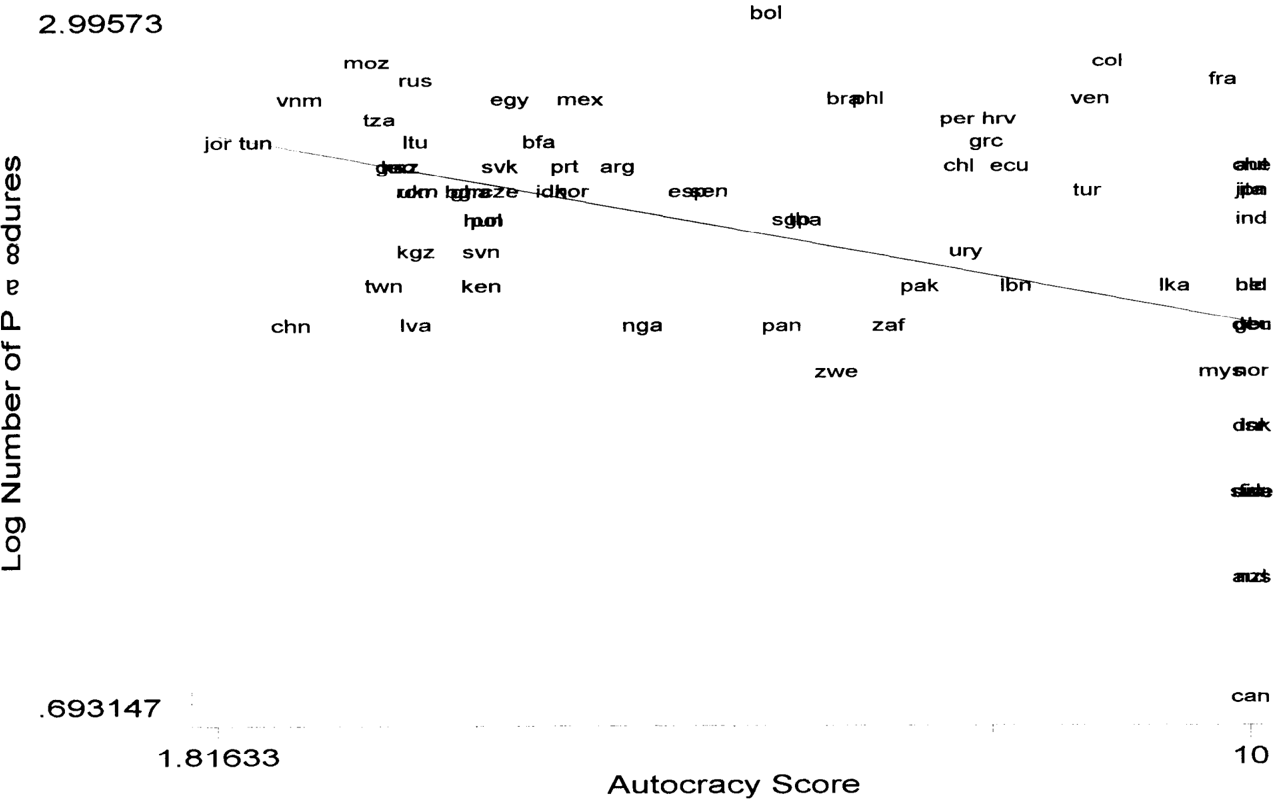
- In Table VIII, better government is associated with lighter regulation; the paper states that countries with more limited and representative governments have statistically significantly fewer procedures using 5 out of 6 measures of better government, and that more autocratic countries regulate more heavily.
Methods
- The paper builds a new database on entry regulation for 75 countries, focusing on the legal requirements, official time, and official cost for a standardized start-up firm.
- Data were gathered from written government sources, World Bank- and USAID-sponsored studies, government web pages, direct contacts with agencies, and independent double-checks in 73 countries via local consulting reports; the remaining 2 countries were double-checked through government contacts.
- The main analysis uses cross-country OLS regressions relating entry regulation measures to outcomes such as quality, pollution, unofficial economy, corruption, political institutions, legal origin, and GDP per capita; the paper also reports correlations and test-of-means comparisons across income quartiles.
Limitations
- The paper itself notes that the capture-theory tests are based on crude measures and that the data are probably least suited to test the capture hypothesis.
- The authors say the data almost surely underestimate the cost and complexity of entry because they focus on the capital city, omit industry-specific requirements and foreign-ownership steps, and ignore some informal delays and bribes.
- Evident from the text: the study is cross-sectional and based on official procedures/costs, so causal interpretation is limited and informal corruption/bureaucratic delays are not directly measured except indirectly through correlations.
Model-written summary. Check it against the paper before relying on it.
Integrity signals
Registry
Cites
Statistics
Figures
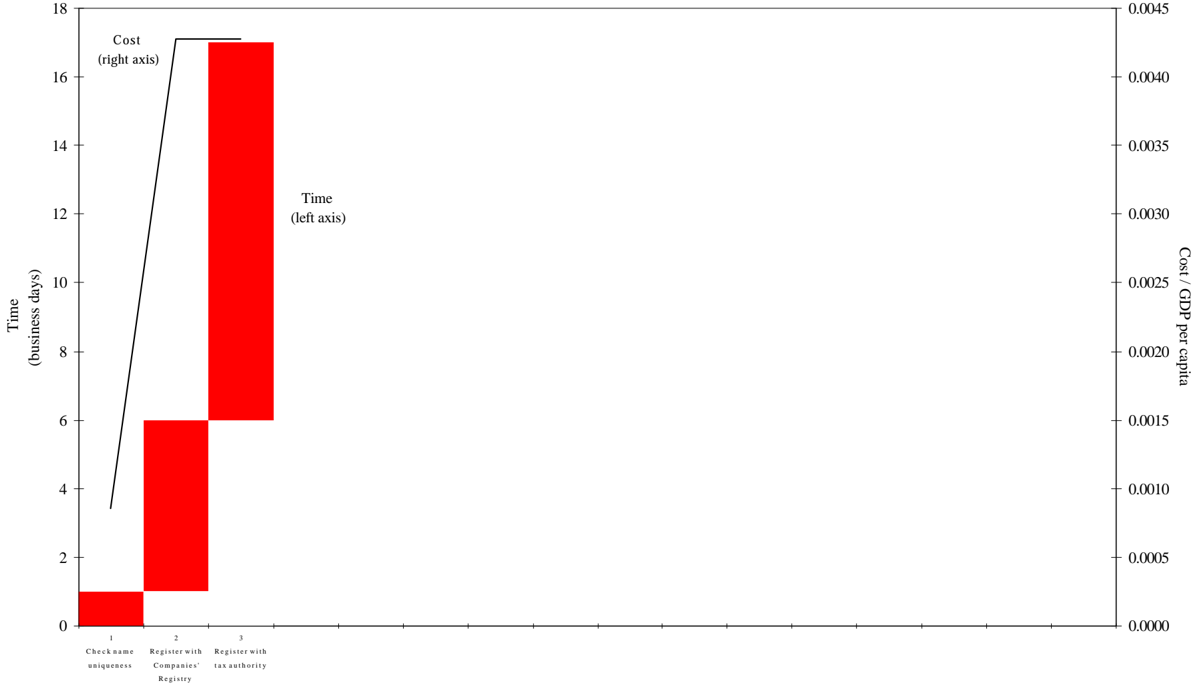
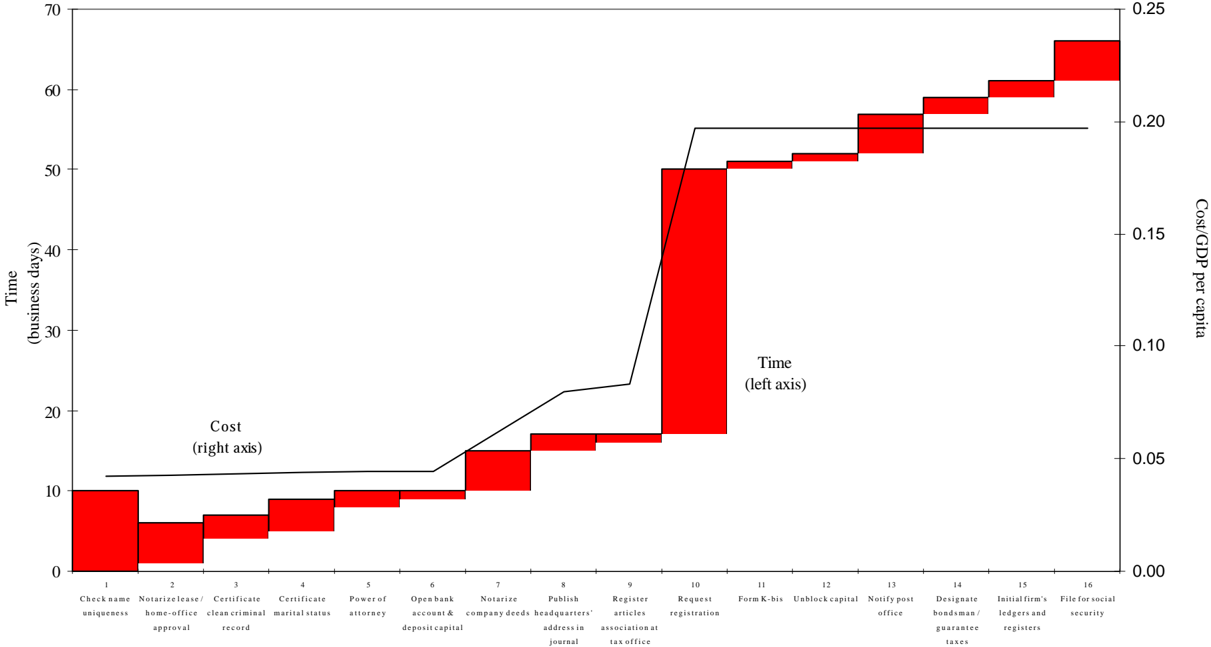
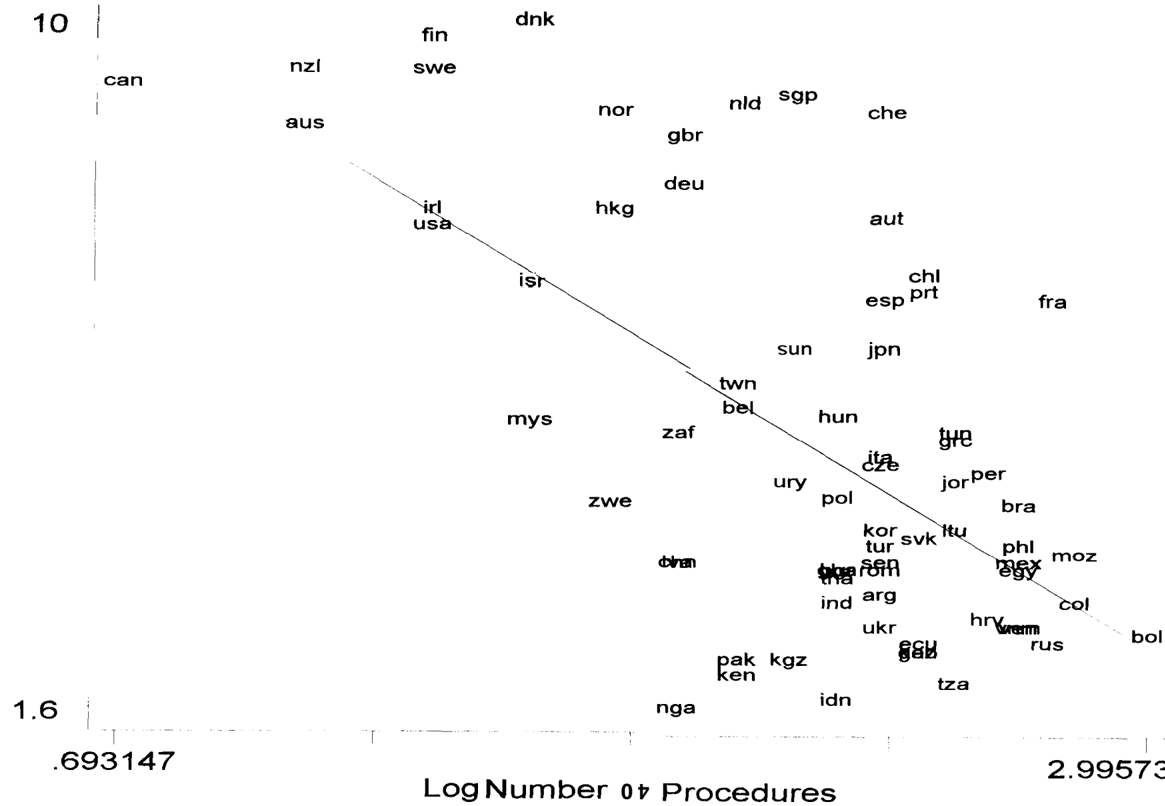
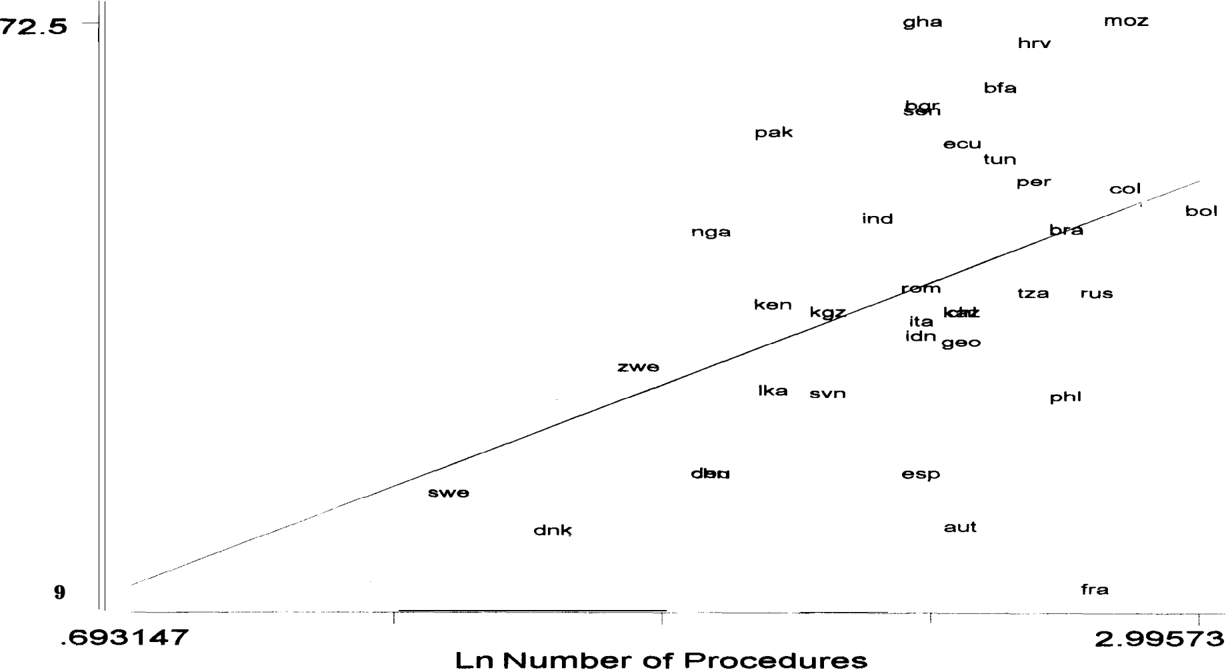
Verification
Claims the paper makes
0 Valid · 3 Not valid · 13 Not checked · 114 Own results and interpretations
A result the paper reports from its own data — it cites no other source for it, so there is none to check. The quote shows it is in the paper.
In the paper
“Very few entry regulations cover tax and labor issues.”
plain- Asserted: passes — The authors put it forward as true.
- Checkable: passes — It can be checked against evidence.
- Load-bearing: unclear — It is unclear whether the paper’s conclusions depend on it.
- Based: passes — The paper gives a reason why it holds.
In the paper
“The data show that the numbers of entry and of labor market regulations are positively correlated across countries, contrary to the substitutes hypothesis.”
What the sources say
- Not matchedcites Djankov et al., 2000
An author–year citation the paper’s reference list doesn’t settle. We don’t search these by name.
plainstates an association- Asserted: passes — The authors put it forward as true.
- Checkable: passes — It can be checked against evidence.
- Load-bearing: unclear — It is unclear whether the paper’s conclusions depend on it.
- Based: passes — The paper gives a reason why it holds.
- Not matched
A result the paper reports from its own data — it cites no other source for it, so there is none to check. The quote shows it is in the paper.
In the paper
“It often takes the form of screening procedures.”
- Also stated in: § III. Basic Results. · plain
“Instead, much of what governments do to regulate entry falls into the category of screening procedures.”
plain- Asserted: passes — The authors put it forward as true.
- Checkable: passes — It can be checked against evidence.
- Load-bearing: unclear — It is unclear whether the paper’s conclusions depend on it.
- Based: passes — The paper gives a reason why it holds.
- Also stated in: § III. Basic Results. · plain
A result the paper reports from its own data — it cites no other source for it, so there is none to check. The quote shows it is in the paper.
In the paper
“First, the cost-to-per-capita-GDP ratio decreases uniformly with GDP per capita.”
plainstates an association- Asserted: passes — The authors put it forward as true.
- Checkable: passes — It can be checked against evidence.
- Load-bearing: unclear — It is unclear whether the paper’s conclusions depend on it.
- Based: passes — The paper gives a reason why it holds.
A result the paper reports from its own data — it cites no other source for it, so there is none to check. The quote shows it is in the paper.
In the paper
“In contrast, countries in the other three quartiles of per capita income are not statistically different from each other in terms of the number of procedures and the time required to fulfill them.”
plain- Asserted: passes — The authors put it forward as true.
- Checkable: passes — It can be checked against evidence.
- Load-bearing: passes — The paper’s conclusions depend on it.
- Based: passes — The paper gives a reason why it holds.
49 more claims
Create a free account to see all 130 claims and every source verdict.
- Probably not a substantial claim. 21
- It may state two separate claims as one. 54
- The quote only partly states this claim. 26
Claims other papers make about this one
Each is checked against this paper’s own text: does it say what the citing paper says it does?
The source backs part of the claim, not all of it — or backs it for a different population, condition or comparison.
In the citing paper
“Our findings suggest an explanation for the low level of incorporation in Italy: the average direct cost associated with fulfilling the bureaucratic regulations for registering a new corporation in Italy is 20% of per capita GNP compared to 10% of per capita GNP on average for other G-7 European countries.”
From Entry regulation as a barrier to entrepreneurship (2006) · cites this paper as Djankov et al. (2002)
Experimental — accuracy not yet measuredThe cited source says what the claim attributes to it.
In the citing paper
“Given the explicit link made by Djankov et al . (2002) between the speed and ease with which businesses may be established in a country and its economic performance - and the enthusiasm with which this link has been grasped by European Union policy makers - our findings imply this link needs reconsidering.”
From The Effect of Business Regulations on Nascent and Young Business Entrepreneurship (2007) · cites this paper as Djankov et al . (2002)
Citations
Cites
La Porta, R., Lopez‐de‐Silanes, F., Shleifer, A., & Vishny, R. W. (1998) · Journal of Political Economy · doi:10.1086/250042 · Cited by 18,025
Self-citationThe Theory of Economic Regulation
Stigler, G. J. (1971) · The Bell Journal of Economics and Management Science · doi:10.2307/3003160 · Cited by 8,098
Journal of Economic Literature
(2019) · AEA Papers and Proceedings · doi:10.1257/pandp.109.633 · Cited by 7,468
The Quarterly Journal of Economics
Kuznets, S. (2024) · Business Cycle Theory, Part I Volume 4 · doi:10.4324/9781003549741-8 · Cited by 7,176
La Porta, R. (1999) · Journal of Law, Economics, and Organization · doi:10.1093/jleo/15.1.222 · Cited by 5,699 · cited 2×
“Legal origin has been viewed as a proxy for the government’s proclivity to intervene in the economy and the stance of the law toward the security of property rights in a country [La Porta et al. 1999].”
The Theory of Economic Regulation
Stigler, G. J. (2021) · The Political Economy · doi:10.4324/9781315495811-8 · Cited by 5,483
Pigou, A. C. (1933) · The Economic Journal · doi:10.2307/2224491 · Cited by 5,137
Toward a More General Theory of Regulation
Peltzman, S. (1976) · The Journal of Law and Economics · doi:10.1086/466865 · Cited by 4,729
Moffitt, R. A. (2009) · American Economic Review · doi:10.1257/aer.99.2.660 · Cited by 4,694
Shleifer, A., & Vishny, R. W. (1993) · The Quarterly Journal of Economics · doi:10.2307/2118402 · Cited by 3,778
Self-citation
Research works printed but not linked: 7
- McLiesh Caralee, 2001, NBER Working Paper No., 8288
- Kasnako lu, Zehra, and Münür Yayla, 'Unrecorded Economy in Turkey: A Monetary Approach', 1999. "Unrecorded Economy in Turkey (A Monetary Approach)" in Informal Sector in Turkey (I), Tuncer Bulutay (ed.), SIS, Ankara, forthcoming.
- Fred, 1987, Journal of Legal Studies, 101
- Olson, Mancur, 1991, 'Autocracy, Democracy, and Prosperity,' in Richard Zeckhauser, ed., Strategy of Choice, Cambridge, MA: MIT Press.
- 1967, Western Economic Journal, 232
- World Economic Forum (1999), The Global Competitiveness Report 1999 , Schwab, Klaus et al., eds., New York: Oxford University Press.
- World Economic Forum, The Global Competitiveness Report 2001, Klaus Schwab et al., eds. (New York, NY: Oxford University Press, 2001).
Cited by
Items 2,501–2,600 of 3,986
Bayar, Y., & Diaconu, L. C. (2020) · Labor History · doi:10.1080/0023656x.2020.1841125 · Cited by 4
DEREGULATION, ECONOMIC GROWTH AND GROWTH ACCELERATION
Stankov, P. (2018) · Journal of Economic Development · doi:10.35866/caujed.2018.43.4.002 · Cited by 5
Examining the public interest rationale for regulating whiskey with the pure food and drugs act
Smith, D. J., & Scheck, M. (2023) · Public Choice · doi:10.1007/s11127-023-01061-0 · Cited by 3
Mexican Deregulation: Smart Tape on Red Tape
Salas, F. J. (2004) · World Bank, Washington, DC eBooks · doi:10.1596/9169 · Cited by 4
International and Cultural Views
Salzmann, A. J. (2012) · Wiley eBooks · doi:10.1002/9781118524015.ch6 · Cited by 3
Does Pervasive Corruption Matter For Firm's Demand for Good Governance in Developing Countries?Preprint
Diarra, G., & Marchand, S. (2011) · RePEc: Research Papers in Economics · Cited by 4
Accounting for the Hidden Economy: Barriers to Legality and Legal FailuresPreprint
Antunes, A., & Cavalcanti, T. V. D. V. (2004) · RePEc: Research Papers in Economics · Cited by 5
Entry Barriers, Competition, and Technology AdoptionPreprint
Fang, L. (2009) · SSRN Electronic Journal · doi:10.2139/ssrn.1433128 · Cited by 4
Tax Morale and Tax Evasion in Latin American CountriesPreprint
Alm, J. R., & Martínez-Vázquez, J. (2007) · RePEc: Research Papers in Economics · Cited by 8
Kilvits, K., & Purju, A. (2005) · RePEc: Research Papers in Economics · Cited by 4
Growth, Poverty, Reduction and Governance in Developing Countries: a SurveyPreprint
Cagé, J. (2009) · RePEc: Research Papers in Economics · Cited by 9
Externalities, Endogenous Productivity, and Poverty TrapsPreprint
Barseghyan, L., & DiCecio, R. (2008) · SSRN Electronic Journal · doi:10.2139/ssrn.1156370 · Cited by 4
Consumer Cooperatives and Liberal Idea in RussiaPreprint
Menyashev, R. (2012) · SSRN Electronic Journal · doi:10.2139/ssrn.2002129 · Cited by 4
“Djankov et al. (2002) introduce the concept of the ”institutional possibility frontier”(IPF) to explain why some countries choose a more liberal regime, while others authoritarian.”
Law and Finance in India - an OverviewPreprint
Chakrabarti, R. (2006) · SSRN Electronic Journal · doi:10.2139/ssrn.924323 · Cited by 3
Future Orientation and Taxes: Evidence from Big DataPreprint
Petutschnig, M. (2015) · SSRN Electronic Journal · doi:10.2139/ssrn.2563548 · Cited by 4
Simplification of Labor Registration in Argentina: Achievements and Pending Issues
Ronconi, L., & Colina, J. (2011) · doi:10.18235/0011358 · Cited by 4
Trust, Perceptions of Corruption, and Demand for Regulation: Evidence from Post-Socialist CountriesPreprint
Dimitrova-Grajzl, V. P., Grajzl, P., & Guse, A. J. (2011) · SSRN Electronic Journal · doi:10.2139/ssrn.1849224 · Cited by 4
The Political Economy of Financial FragilityPreprint
Perotti, E. C., & Feyen, E. H. B. (2005) · SSRN Electronic Journal · doi:10.2139/ssrn.686661 · Cited by 9
Shareholder Protection and Stock Market Development in France (1852-2007)Preprint
Serpoul, F. (2010) · SSRN Electronic Journal · doi:10.2139/ssrn.1529271 · Cited by 5
Development Through Empowerment: Delivering Effective Public Services — A Literature ReviewPreprint
Xu, G. (2014) · SSRN Electronic Journal · doi:10.2139/ssrn.2479140 · Cited by 5
“Among those, the World Bank’s Doing Business indicator (Djankov et al. 2002) considerably improves on the methodology.”
Central Banks, Regulatory Capture and Banking Supervision ReformsPreprint
Boyer, P., & Ponce, J. (2010) · SSRN Electronic Journal · doi:10.2139/ssrn.1722529 · Cited by 5
Optimal Government Regulations and Red Tape in an Economy with CorruptionPreprint
Sepúlveda, F., & Méndez, F. (2005) · SSRN Electronic Journal · doi:10.2139/ssrn.830405 · Cited by 4
Institutional Flexibility and Economic GrowthPreprint
Davis, L. (2005) · SSRN Electronic Journal · doi:10.2139/ssrn.871759 · Cited by 4
Constructing a Governance Index for Cook Islands, 1985-2005
Gani, A., & Duncan, R. (2007) · ANU Open Research (Australian National University) · Cited by 4
Institutional Barriers to Growth: Entrepreneurship, Human Capital and Institutional ChangePreprint
Eesley, C. E. (2009) · SSRN Electronic Journal · doi:10.2139/ssrn.1497062 · Cited by 4
Regulation, Trade and Economic GrowthPreprint
Koeniger, J., & Silberberger, M. (2015) · SSRN Electronic Journal · doi:10.2139/ssrn.2635507 · Cited by 4
“…(2004), Botero et al. (2004), Crafts (2006), Conway et al. (2006), Micco and Pagés (2006), Klapper et al. (2006), Viviano (2008), Poschke (2010), Bourlès et al. (2010) and Buccirossi et al. (2013). that countries with low-quality institutions (bottom 20 or 30 per cent) cannot reap the benefits…”
Does Institutional Quality Impact Firm Performance? Evidence from Emerging and Transition Economies
Bülow, J. (2015) · Lund University Publications Student Papers (Lund University) · Cited by 14
The Role of Fiscal Policy in the Achievement of Social Cohesion. Tax Mix and Public Social SpendingPreprint
Ceano-Vivas, M. S.-S., Rivera‐Lirio, J. M., & Muñoz-Torres, M. (2014) · SSRN Electronic Journal · doi:10.2139/ssrn.2521328 · Cited by 6
Red Tape Reduction and Firm Entry: Evidence from an Italian ReformPreprint
Amici, M., Giacomelli, S., Manaresi, F., et al. (2016) · SSRN Electronic Journal · doi:10.2139/ssrn.2728301 · Cited by 4
Labor Market Policies and Self-Employment Transitions of Older WorkersPreprint
Christelis, D., & Fonseca, R. (2016) · SSRN Electronic Journal · doi:10.2139/ssrn.2837804 · Cited by 4
Carvalho, V. M. C. (2009) · Portuguese National Funding Agency for Science, Research and Technology (RCAAP Project by FCT) · doi:10.34626/5345-xc55 · Cited by 6
Corruption and InformalityPreprint
Mishra, A. K., & Ray, R. (2014) · SSRN Electronic Journal · doi:10.2139/ssrn.2401858 · Cited by 4
Lieser, K., & Groh, A. P. (2011) · SSRN Electronic Journal · doi:10.2139/ssrn.1833606 · Cited by 6
Mishra, A. K., & Ray, R. (2013) · Econstor (Econstor) · Cited by 4
Do Place-Based Policies Promote Local Innovation and Entrepreneurship?Preprint
Tian, X., & Xu, J. (2018) · SSRN Electronic Journal · doi:10.2139/ssrn.3118661 · Cited by 4
Targeted Economic Incentives: An Analysis of State Fiscal Policy and Regulatory ConditionsPreprint
Calcagno, P. T., & Hefner, F. (2018) · SSRN Electronic Journal · doi:10.2139/ssrn.3169394 · Cited by 4
Reducing Bureaucratic Corruption: Interdisciplinary Perspectives on What WorksPreprint
Gans‐Morse, J., Borges, M., Makarin, A., et al. (2017) · SSRN Electronic Journal · doi:10.2139/ssrn.2930520 · Cited by 4
Bank Capital Ratios and the Structure of Nonfinancial IndustriesPreprint
Lee, S. J., & Stebunovs, V. (2012) · SSRN Electronic Journal · doi:10.2139/ssrn.2193891 · Cited by 4
Medieval European Traditions in Representation and State Capacity TodayPreprint
Pavlik, J. B., & Young, A. T. (2018) · SSRN Electronic Journal · doi:10.2139/ssrn.3251355 · Cited by 4
Evaluating Explanations for StagnationPreprint
Kumar, K., & Caucutt, E. M. (2005) · RePEc: Research Papers in Economics · Cited by 4
Productivity Dynamics and the Role of 'Big-Box' Entrants in RetailingPreprint
Maican, F. G., & Orth, M. (2008) · SSRN Electronic Journal · doi:10.2139/ssrn.1286041 · Cited by 5
Small Business Tax Policy, Informality, and Tax Evasion – Evidence from GeorgiaPreprint
Bruhn, M., & Loeprick, J. (2014) · SSRN Electronic Journal · doi:10.2139/ssrn.2500783 · Cited by 5
Institutional Foundations of Inequality and GrowthPreprint
Davis, L., & Hopkins, M. R. (2008) · SSRN Electronic Journal · doi:10.2139/ssrn.1223762 · Cited by 5
Inequality, Persistence of the Informal Economy, and Club ConvergencePreprint
Gutiérrez‐Romero, R. (2020) · SSRN Electronic Journal · doi:10.2139/ssrn.3592049 · Cited by 4
Market Institutions and Judicial RulemakingPreprint
Arruñada, B., & Andonova, V. (2005) · SSRN Electronic Journal · doi:10.2139/ssrn.849366 · Cited by 4
Entrepreneurship by and for Disadvantaged Populations: Global EvidencePreprint
Renko, M., & Freeman, M. (2018) · SSRN Electronic Journal · doi:10.2139/ssrn.3233727 · Cited by 6
Sometimes, always, never: Regulatory clarity and the development of digital financingPreprint
Ran, Z., Rau, P. R., & Ziegler, T. (2021) · SSRN Electronic Journal · doi:10.2139/ssrn.3797886 · Cited by 7
The Relationship between Political Connections and the Financial Performance of Industries & FirmsPreprint
Sobel, R. S., & Graefe-Anderson, R. (2018) · SSRN Electronic Journal · doi:10.2139/ssrn.3211630 · Cited by 10
“… 10 This literature mostly falls into the “capture theory of regulation” literature; see, for examples, Stigler (1971), Laffont and Tirole (1991), McChesney (1987), Shleifer and Vishny (1998), Frye and Shleifer (1997), and Djankov et al. (2002).”
InfluentialCallais, J. T. (2020) · SSRN Electronic Journal · doi:10.2139/ssrn.3647221 · Cited by 4
Pangerl, S. (2014) · DigitalGeorgetown (Georgetown University Library) · Cited by 4
A Cross-Country Study of Peer Effects on Working Capital ManagementPreprint
Machokoto, M., Sikochi, A., & Gyimah, D. (2022) · SSRN Electronic Journal · doi:10.2139/ssrn.4020577 · Cited by 4
Legalizing EntrepreneurshipPreprint
Bahar, D., Cowgill, B., & Guzmán, J. (2022) · SSRN Electronic Journal · doi:10.2139/ssrn.4155358 · Cited by 5
Cui, W., & Wei, M. (2022) · SSRN Electronic Journal · doi:10.2139/ssrn.3914483 · Cited by 6
The determinants of SMEs’ internationalisation among MEDA transitional economiesPreprint
Scalamonti, F. (2025) · SSRN Electronic Journal · doi:10.2139/ssrn.5084116 · Cited by 6
Development Strategy and Economic Institutions in Less Developed Countries
Lin, J. Y., & Zhang, P. (2007) · Digital Access to Scholarship at Harvard (DASH) (Harvard University) · Cited by 4
Normative complexity and the length of administrative disputes: evidence from Italian regions
DiVita, G. (2010) · European Journal of Law and Economics · doi:10.1007/s10657-010-9182-y · Cited by 25
Female Ownership of Firms and Regulation Experience
Bastos, J. P., & Pavlik, J. B. (2024) · The Journal of Development Studies · doi:10.1080/00220388.2024.2348552 · Cited by 4
Suliman, L. A. A., & Adedokun, M. W. (2025) · Sustainability · doi:10.3390/su17031173 · Cited by 6
Prateeppornnarong, D. (2025) · Journal of Social Entrepreneurship · doi:10.1080/19420676.2025.2538226 · Cited by 6
Revisiting the Default Risk‐ ESG Relationship: New Evidence in European Markets
Saona, P., & Martín, P. S. (2025) · Corporate Social Responsibility and Environmental Management · doi:10.1002/csr.70172 · Cited by 7
Digital institutions and virtual involvement of born-digital firms
Tang, Y., Shen, Y., Bu, J., & Feng, D. (2025) · Journal of International Business Studies · doi:10.1057/s41267-025-00825-8 · Cited by 7
Institutional Quality, Economic Growth and Welfare: Empirical Evidence from Africa
Kunawotor, M. E., Osei, B., Dziwornu, R. K., et al. (2026) · Journal of the Knowledge Economy · doi:10.1007/s13132-025-03079-9 · Cited by 3
“…quality institutions promote growth by inducing economic activities such as improving efficiency, protecting property rights, increas - ing consumption and investment, and promoting economic freedom (Zhang, 2016; Lucifora & Moriconi, 2015; Park, 2012; Dal Bó & Rossi, 2007; Djankov et al., 2002).”
Public perception, government support, and the formation of AI startups: An institution-based view
Gholipour, H. F., Andargoli, A., Tajaddini, R., Farzanegan, M. R., & Chege, F. (2026) · Technovation · doi:10.1016/j.technovation.2026.103523 · Cited by 4
Manishimwe, T., Akahome, J. E., Uwagaba, J., & Raimi, L. (2026) · Journal of Management Development · doi:10.1108/jmd-02-2025-0102 · Cited by 3
Literature Review on the Effect of the Ease of Doing Business on Economic and Financial Outcomes
Oto‐Peralías, D., & Romero‐Ávila, D. (2017) · Contributions to economics · doi:10.1007/978-3-319-67041-6_4 · Cited by 4
How formal institutional antecedents affect Tunisian venture creation decision scripts
Brahim, A. H., Morched, S., & Boujelbène, Y. (2021) · Journal of global entrepreneurship research · doi:10.1007/s40497-021-00267-0 · Cited by 5
Dampak Pinjaman Mikro terhadap Kesejahteraan Rumah Tangga Perempuan Pengusaha Mikro dan Kecil
Program Studi S1 Ilmu Ekonomi, D. I. E., Martokoesoemo, D. R. S., Sinaga, B. M., Kusnadi, N., & Syaukat, Y. (2022) · Jurnal Ekonomi dan Pembangunan Indonesia · doi:10.21002/jepi.2022.11 · Cited by 3
Paule-Vianez, J., Portillo, A. F., Miotto, G., & Coca-Pérez, J. L. (2023) · American Behavioral Scientist · doi:10.1177/00027642231191750 · Cited by 3
Ramli, K., & Williams, N. (2024) · The International Journal of Entrepreneurship and Innovation · doi:10.1177/14657503241229689 · Cited by 11
“Consequently, government intervention may not effectively support entrepreneurial action as intended (Djankov et al., 2002).”
Trading permits and informal entrepreneurship: evidence from South Africa
Baldé, R. (2024) · Oxford Economic Papers · doi:10.1093/oep/gpae013 · Cited by 3
A Values-Complementarity Model of Social Movement Influence on Entrepreneurship
Gish, J. J., Lanahan, L., & Beck, J. T. (2024) · Journal of Management · doi:10.1177/01492063241237226 · Cited by 6
The influence of political power on models of industrial organization: institutional approach
Fedorov, S. I. (2023) · Obshchestvennye nauki i sovremennost · doi:10.31857/s0869049923010070 · Cited by 3
Is bribery a conscious, strategic and rational choice? Impact on firms’ growth in India
Chhetri, P. C., & Natarajan, R. R. (2024) · Journal of Policy Modeling · doi:10.1016/j.jpolmod.2024.06.001 · Cited by 3
Occupational Licensing restrictions and early-stage entrepreneurship: a US state-level analysis
Dove, J. A., & Trudeau, N. J. (2024) · Applied Economics Letters · doi:10.1080/13504851.2024.2395464 · Cited by 3
“However, it is possible for that regulatory apparatus to become exceedingly bur-densome or captured by particular interests, creating advantages for incumbents at the expense of potential competitors (Djankov et al. 2002).”
The effects of time-to-build and regulation on investment timing and size
Jeon, H. (2024) · International Review of Financial Analysis · doi:10.1016/j.irfa.2024.103741 · Cited by 3
Ownership and state-based underpinnings of financial distress among successful entrepreneurial firms
Sharma, A., & Singh, K. (2024) · Journal of Small Business and Enterprise Development · doi:10.1108/jsbed-07-2024-0379 · Cited by 3
The influence of regulatory intensity on corporate trade credit
Nguyen, L. Q. T. (2025) · Finance research letters · doi:10.1016/j.frl.2025.107172 · Cited by 6
The High and Falling Price of Cement in Africa
Leone, F., Macchiavello, R., & Reed, T. (2025) · American Economic Journal Applied Economics · doi:10.1257/app.20230352 · Cited by 5
Institutional Fragility and Entrepreneurial Activities
Hu, M., Su, Y., Ye, W., & Yang, Y. (2025) · Asia & the Pacific Policy Studies · doi:10.1002/app5.70026 · Cited by 6
Papaioannou, E. (2025) · Scandinavian Journal of Economics · doi:10.1111/sjoe.12599 · Cited by 7
Autopoietic social systems theory: the co-evolution of law and the economy
Lourenço, A. (2010) · Portuguese National Funding Agency for Science, Research and Technology (RCAAP Project by FCT) · Cited by 3
Hassan, S. S. (2015) · Review of Economics and Institutions · doi:10.5202/rei.v6i1.139 · Cited by 7
“The limited evidence suggests that the time it takes to start a business in a host country and the regulations on supply mechanisms affect the location choices of foreign investors (Djankov et al., 2002; Botero et al., 2004).”
InfluentialTammi, T. (2013) · Journal of Financial Economic Policy · doi:10.1108/jfep-10-2012-0042 · Cited by 6
Maiti, D., Dasgupta, P., & Paul, A. (2014) · Review of Market Integration · doi:10.1177/0974929214566126 · Cited by 4
“…that the rigid regulation in labour market restricts capital formation and entry in the industry, leading to an unfavourable impact on the overall welfare of labour market (Bertrand and Kramarz, 2002; Besley and Burgess, 2004; Blanchard and Giavazzi, 2003; Djankov et al., 2002; Holmes, 1998).”
Competitiveness and Growth in Brazilian Cities: Local Policies and Actions for Innovation
Zhang, M. (2009) · World Bank, Washington, DC eBooks · doi:10.1596/978-0-8213-8157-1 · Cited by 27
“It has been found, for example, that countries that regulate market entry more heavily have more corruption and larger unofficial economies, without the compensation of a better quality of public or private goods (Djankov et al. 2002).”
Competition among officials and the abuse of power
Priks, M. (2010) · Public Choice · doi:10.1007/s11127-010-9709-3 · Cited by 3
Can Market Failure Cause Political Failure?
Aney, M. S., Ghatak, M., & Morelli, M. (2012) · London School of Economics and Political Science Research Online (London School of Economics and Political Science) · doi:10.7916/d8bk1mj0 · Cited by 4
Competitiveness and the employment relationship in Europe: Is there a global missing link in HRM?
Simón, C., & Allard, G. J. (2008) · Advances in international management · doi:10.1016/s1571-5027(08)00001-6 · Cited by 3
Impact of regulation and supervision on European banks’ stability
Bouheni, F. B. (2014) · Risk Governance and Control Financial Markets & Institutions · doi:10.22495/rgcv4i1art3 · Cited by 3
New Governance and Digital Platform Companies: The Case of Uber
Bilbil, E. T. (2019) · International Journal of Public Administration in the Digital Age · doi:10.4018/ijpada.2019040104 · Cited by 5
Analyzing the topography of financial regulation
Vighneswara Swamy, P. M. (2017) · Journal of Financial Economic Policy · doi:10.1108/jfep-06-2017-0058 · Cited by 3
Jang, H. (2018) · Social Sciences · doi:10.3390/socsci7060100 · Cited by 3
“Since the early 2000s, many studies have dealt with the relationship between regulations and labor demands (Krueger and Pischke 1998; Djankov et al. 2002).”
Alves, D. G. (2018) · Revista de Doutrina Jurídica · doi:10.22477/rdj.v109i2.212 · Cited by 4
Savings and the informal sector
Dobson, S., Ramlogan‐Dobson, C., & Strobl, E. (2020) · International Review of Applied Economics · doi:10.1080/02692171.2019.1707783 · Cited by 5
“Djankov et al. (2002) points out that the principal beneficiaries of regulation are bureaucrats and politicians so to the extent that growth of the informal sector reduces this cost, output will rise.”
Business Environment and Start-Up in Indonesia:Empirical Evidence from Province-level Data
Igamo, A. M., Putra, A. R., Khamisah, N., & Kurniawan, A. (2020) · Journal of Economic Development Environment and People · doi:10.26458/jedep.v9i4.680 · Cited by 5
The determinants and consequences of IPOs in a regulated economy: Evidence from China
Fang, J., Shi, H., & Xu, H. (2012) · Journal of Multinational Financial Management · doi:10.1016/j.mulfin.2012.06.002 · Cited by 3
Housing supply and local political influence
Gabbe, C. J., & Kahn, M. E. (2021) · Journal of Urban Affairs · doi:10.1080/07352166.2021.1890608 · Cited by 3
OK Computer? The digital turn in legal history: a methodological retrospective
Volkaert, F. (2021) · Tijdschrift voor Rechtsgeschiedenis / Revue d Histoire du Droit / The Legal History Review · doi:10.1163/15718190-12340011 · Cited by 4
Is the Aurora Borealis an Inspiration to the Performance of Nordic Economic Sustainability?
Nogueira, M. C., & Madaleno, M. (2021) · Sustainability · doi:10.3390/su13179961 · Cited by 3
Ochieng, H. K., & Park, B. (2021) · East Asian Economic Review · doi:10.11644/kiep.eaer.2021.25.3.398 · Cited by 5
Metadata
- Authors
- Djankov, S., La Porta, R., Lopez-de-Silanes, F., & Shleifer, A.
- Affiliations
- World Bank (US)
- National Bureau of Economic Research (US)
- ORCID
- Djankov, S.
- Venue
- The Quarterly Journal of Economics
- Publisher
- Oxford University Press (OUP)
- Published
- 2002-02-01
- Volume
- 117
- Issue
- 1
- Pages
- 1-37
- ISSN
- 0033-5533
- 1531-4650
- OpenAlex
- W2139896179
- Cited by
- 3,956
- References
- 30
- Citations by year
- 2026: 223 · 2025: 185 · 2024: 157 · 2023: 120 · 2022: 140 · 2021: 150 · 2020: 151 · 2019: 161 · 2018: 157 · 2017: 162 · 2016: 166 · 2015: 193 · 2014: 200 · 2013: 183 · 2012: 193
- Type
- report
- Language
- en
- Open access
- green
- doi.org
- Licence
- other-oa
- Locations
- World Bank, Washington, DC eBooks (publishedVersion)
- The Quarterly Journal of Economics (publishedVersion)
- The World Bank Open Knowledge Repository (World Bank) (publishedVersion)
- National Bureau of Economic Research (publishedVersion, other-oa)
- RePEc: Research Papers in Economics (submittedVersion)
- Digital Access to Scholarship at Harvard (DASH) (Harvard University) (submittedVersion, cc-by)
- SSRN Electronic Journal (submittedVersion)
- OpenGrey (Institut de l'Information Scientifique et Technique) (submittedVersion)
- The World Bank Open Knowledge Repository (World Bank) (submittedVersion, cc-by)
- Topics
- Social Sciences › Sociology and Political Science › Corruption and Economic Development
- Social Sciences › Economics, Econometrics and Finance › Economics and Econometrics › Taxation and Compliance Studies
- Social Sciences › Business, Management and Accounting › Strategy and Management › Political Influence and Corporate Strategies
- Keywords
- start-up firms, bureaucratic procedures, corruption, informal economy, democracy, government size, public choice theory, public interest theory
About these checks
Registry, retraction, Cites and statistics results are computed, not judged, with one exception: a printed reference that no index lists is read once by a model before it counts as a citation error. Claims are extracted by a model and kept only when their quote appears verbatim in the text; each cited source is then checked, with a model’s help, for whether it says what the claim relies on. Those verdicts can be wrong — read the claim’s quote and the cited source before relying on one.
A language model drew the claims from the paper on 2026-10-01, under version 3 of the claim definition (model deepseek-v4.1-flash, prompt extract-v3).
A second model labelled each claim on 2026-10-01 (model jev-1.13-20260917, definition revision gold-guideline-v0.2).
Statistics and arithmetic are recomputed, not judged.
Confidence bands are shown only for fields calibrated on our annotated test set. None is calibrated yet, so no band is shown.
What counts as a claim ›How we measure confidence ›How we check this ›
Are you an author, or do you see a problem with this page? Request a review
Data sources
Bibliographic data: Semantic Scholar, OpenAlex, Crossref.
Contains information from the Semantic Scholar Academic Graph Datasets, made available under the ODC Attribution License (ODC-BY 1.0).
Semantic Scholar’s data is described in: Kinney, R., et al. (2023). The Semantic Scholar Open Data Platform. arXiv:2301.10140.
