

The Regulation of Entry
Open accessThe DOI matches its Crossref record, with a small difference in title or year; 39 of the 39 references it cites were found in a registry or an index; none of the 13 sources its claims cite is checked for support yet.
Abstract
1%(5 :25.,1* 3$3(5 6(5,(6 7+( 5(*8/$7,21 2) (175< 6LPHRQ 'MDQNRY 5DIDHO /D 3RUWD )ORUHQ.LR /RSH]GH6LODQHV $QGUHL 6KOHLIHU :RUNLQJ 3DSHU KWWSZZZQEHURUJSDSHUVZ 1$7,21$/ %85($8 2) (&2120,& 5(6($5&+ 0DVVD.KXVHWWV $YHQXH &DPEULGJH 0$ 6HSWHPEHU :H WKDQN 2OJD ,RIIH 7DWLDQD 1HQRYD DQG (NDWHULQD 7UL]ORYD IRU DEOH UHVHDU.K DVVLVWDQ.H DQG +DPLG $ODYL ,ULQD $VWUDNKDQ $EKLMLW %DQHUMHH 5L.KDUG &DYHV -D.TXHOLQH &RROLGJH -DPHV (PHU\ 1LKDO (O0DJKDUEHO -HDQ 3DXO *DXWKLHU (G *ODHVHU 6LPRQ -RKQVRQ /DZUHQ.H .DW] 3HWHU .X.HUD 'DYLG /DLEVRQ ,UD /LHEHUPDQ 'DYLQ 0D.NLQ]LH 0DULH )UDQ.RLVH 0DULH1HOO\ 0DU.HOR 2ODUUHDJD *X\ 3IHIIHUPDQQ 6DQWLDJR 6HGD.D /HLOD :HEVWHU 3HWHU :ULJKW DQG VHPLQDU SDUWL.LSDQWV DW WKH 8QLYHUVLW\ RI 0DU\ODQG DW &ROOHJH 3DUN IRU KHOSIXO .RPPHQWV 7KH .ROOH.WLRQ RI GDWD IRU WKLV SDSHU ZDV RUJDQL]HG DQG ILQDQ.HG E\ WKH :RUOG %DQN $Q DSSHQGL[ GHV
Overview
CoChat Summary
TL;DR
This paper assembles a new cross-country dataset on business entry regulation in 75 countries and uses it to compare the helping-hand, capture, and tollbooth theories of regulation. The evidence is most consistent with the tollbooth view: heavier entry regulation is associated with more corruption, a larger unofficial economy, and less representative, more autocratic governments.
Key findings
- Across the 75-country sample, the number of entry procedures ranges from 2 in Canada to 20 in Bolivia, with a sample average of 10.17 procedures; the average official time is 63.05 business days and the average cost is 0.34 of GDP per capita.
- The number of procedures is strongly correlated with time and cost: the paper reports correlations of 0.75 with log time and 0.62 with log cost.
- The helping-hand tests do not support a beneficial-regulation story: in Table IV, more procedures are associated with lower ISO quality standards (e.g. coefficient -0.2646) and larger unofficial economy measures (e.g. coefficient 13.6277 for size of unofficial economy; 19.8763 for employment in the unofficial economy), while pollution and health outcomes do not improve.
- The tollbooth evidence is stronger: Table VI reports that more procedures are associated with worse corruption scores, with a coefficient of -3.2809 (and -1.7249 with GDP per capita controls) for the corruption regressions.
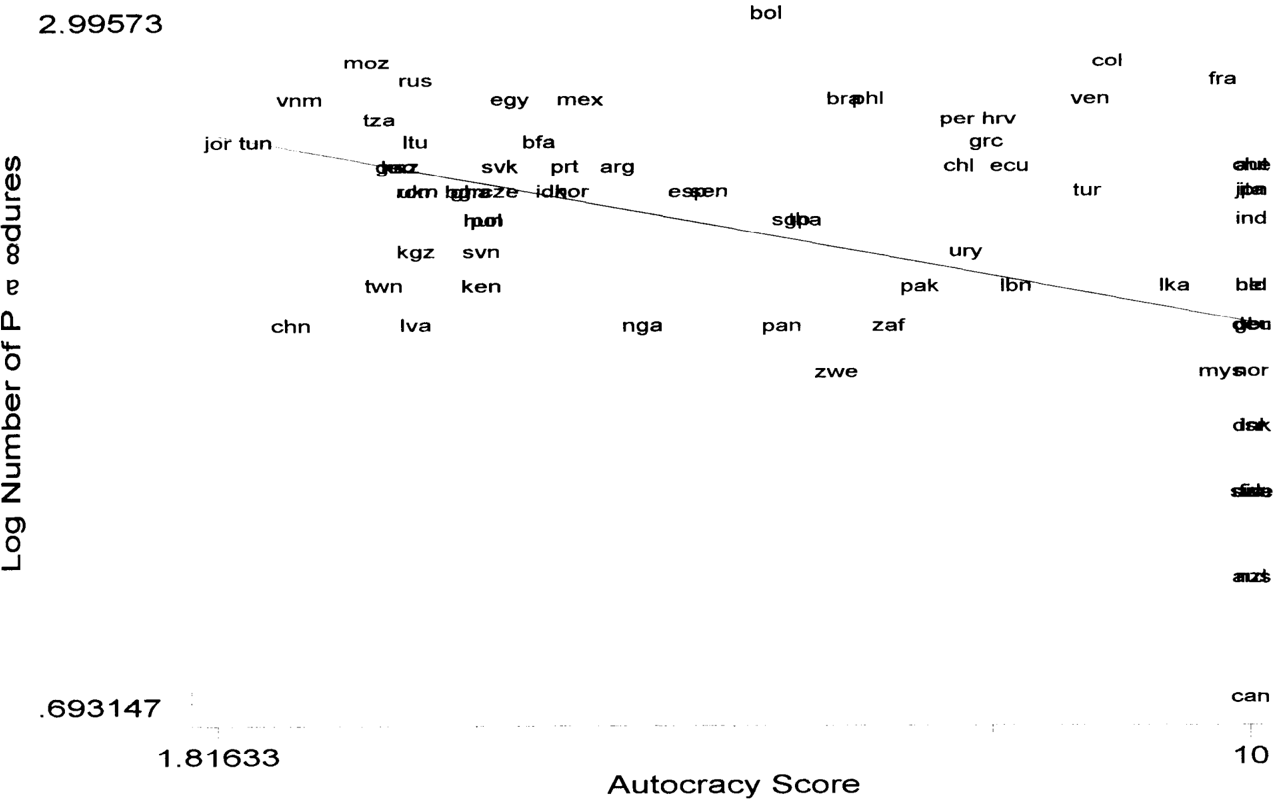
- In Table VIII, better government is associated with lighter regulation; the paper states that countries with more limited and representative governments have statistically significantly fewer procedures using 5 out of 6 measures of better government, and that more autocratic countries regulate more heavily.
Methods
- The paper builds a new database on entry regulation for 75 countries, focusing on the legal requirements, official time, and official cost for a standardized start-up firm.
- Data were gathered from written government sources, World Bank- and USAID-sponsored studies, government web pages, direct contacts with agencies, and independent double-checks in 73 countries via local consulting reports; the remaining 2 countries were double-checked through government contacts.
- The main analysis uses cross-country OLS regressions relating entry regulation measures to outcomes such as quality, pollution, unofficial economy, corruption, political institutions, legal origin, and GDP per capita; the paper also reports correlations and test-of-means comparisons across income quartiles.
Limitations
- The paper itself notes that the capture-theory tests are based on crude measures and that the data are probably least suited to test the capture hypothesis.
- The authors say the data almost surely underestimate the cost and complexity of entry because they focus on the capital city, omit industry-specific requirements and foreign-ownership steps, and ignore some informal delays and bribes.
- Evident from the text: the study is cross-sectional and based on official procedures/costs, so causal interpretation is limited and informal corruption/bureaucratic delays are not directly measured except indirectly through correlations.
Model-written summary. Check it against the paper before relying on it.
Integrity signals
Registry
Cites
Statistics
Figures
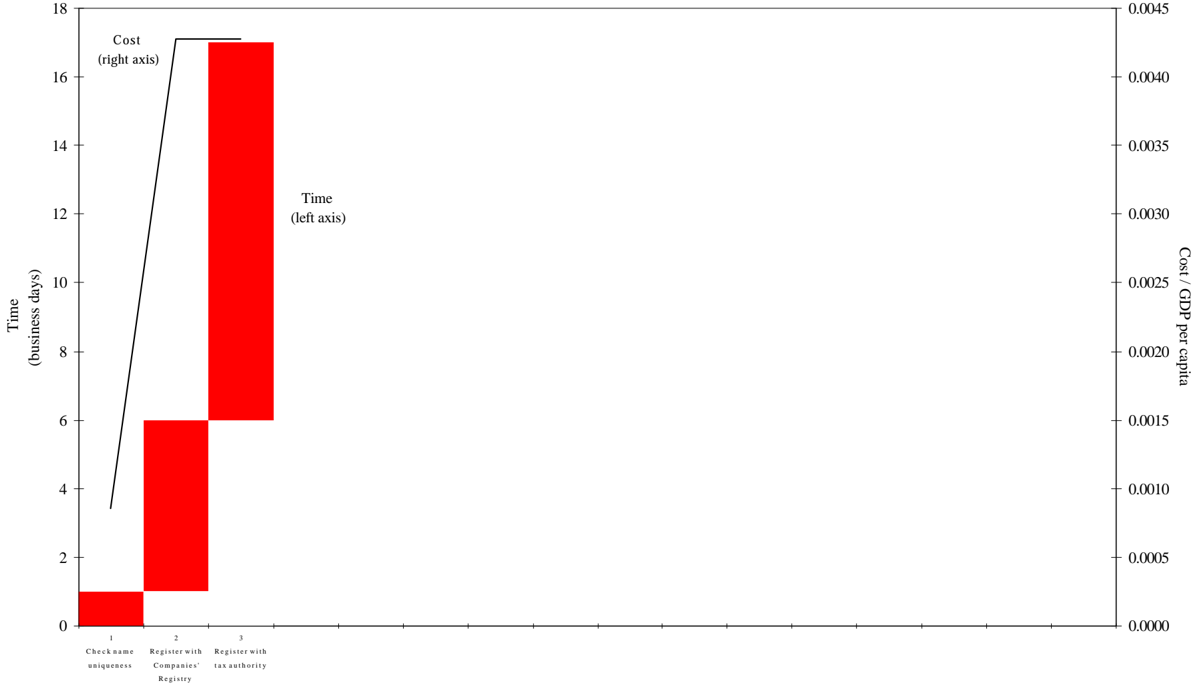
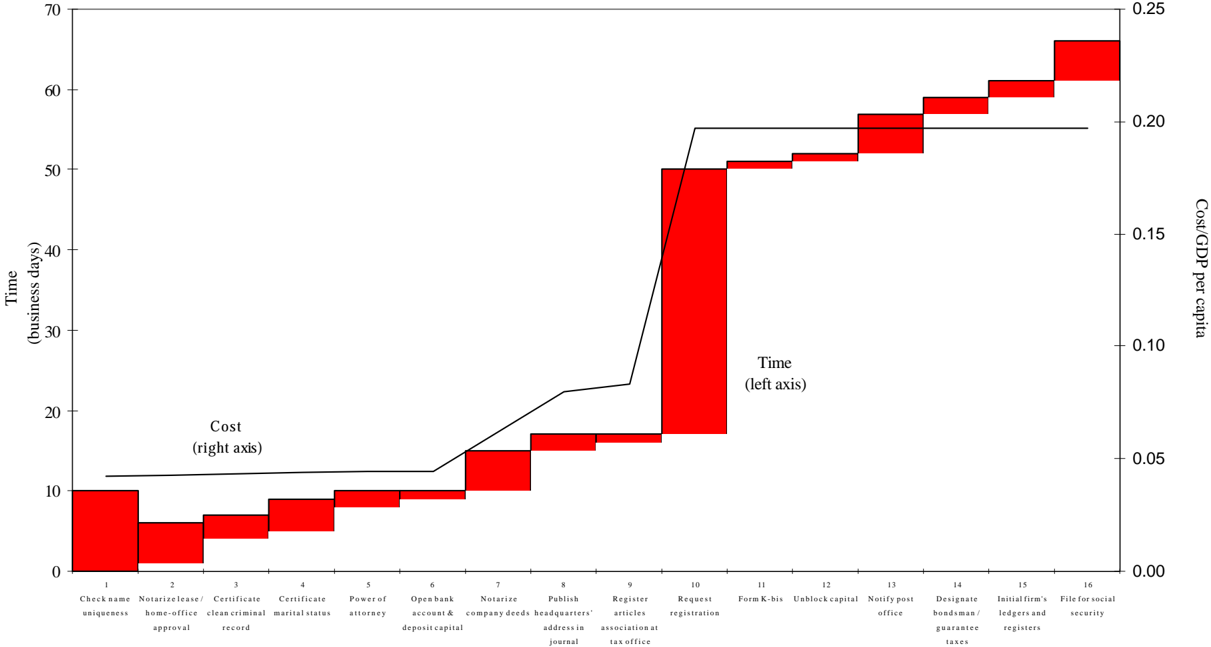
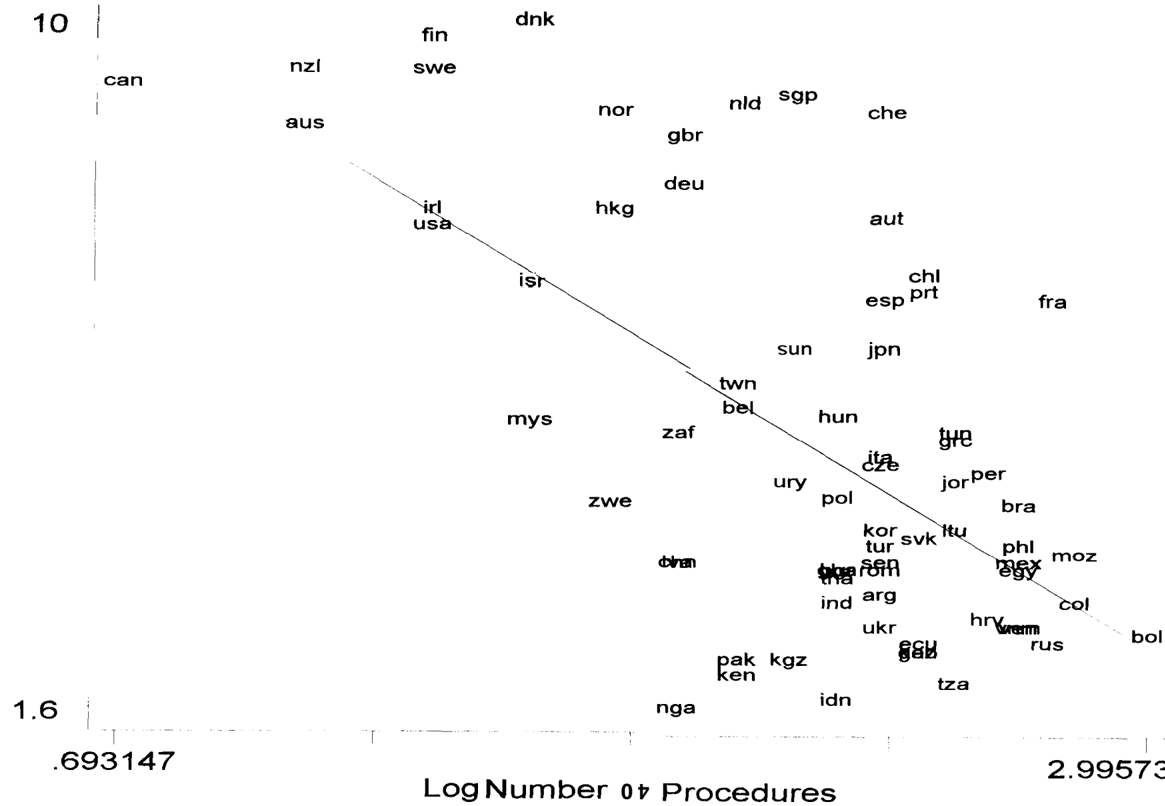
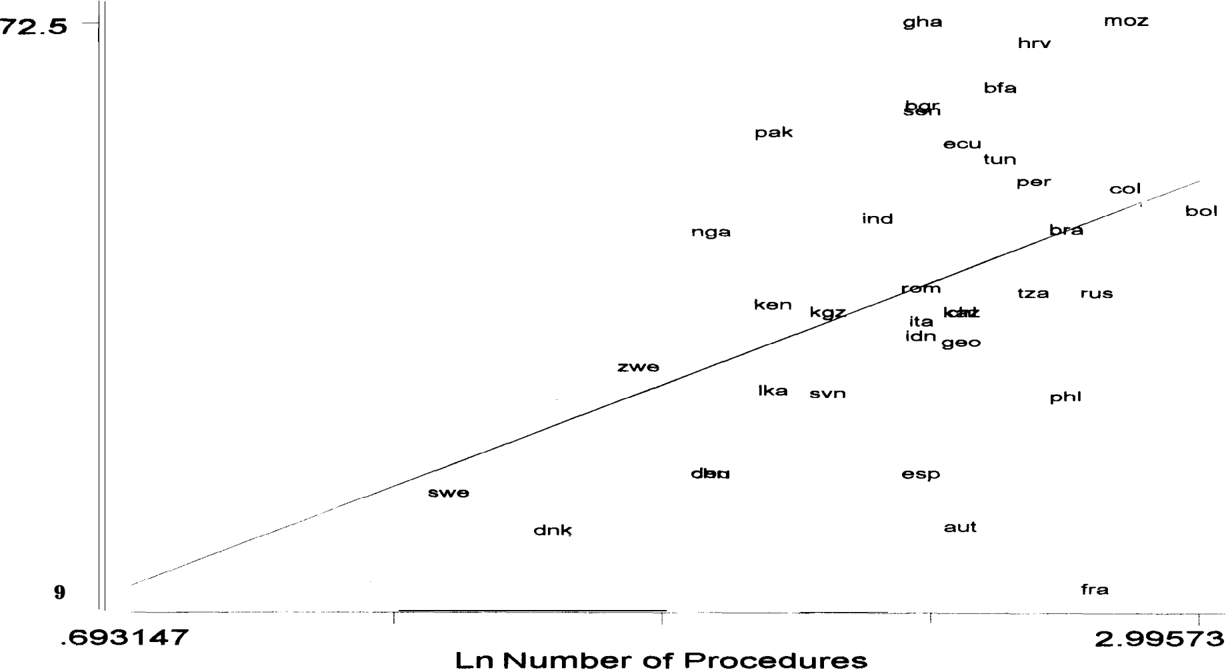
Verification
Claims the paper makes
0 Valid · 3 Not valid · 13 Not checked · 114 Own results and interpretations
A result the paper reports from its own data — it cites no other source for it, so there is none to check. The quote shows it is in the paper.
In the paper
“Very few entry regulations cover tax and labor issues.”
plain- Asserted: passes — The authors put it forward as true.
- Checkable: passes — It can be checked against evidence.
- Load-bearing: unclear — It is unclear whether the paper’s conclusions depend on it.
- Based: passes — The paper gives a reason why it holds.
In the paper
“The data show that the numbers of entry and of labor market regulations are positively correlated across countries, contrary to the substitutes hypothesis.”
What the sources say
- Not matchedcites Djankov et al., 2000
An author–year citation the paper’s reference list doesn’t settle. We don’t search these by name.
plainstates an association- Asserted: passes — The authors put it forward as true.
- Checkable: passes — It can be checked against evidence.
- Load-bearing: unclear — It is unclear whether the paper’s conclusions depend on it.
- Based: passes — The paper gives a reason why it holds.
- Not matched
A result the paper reports from its own data — it cites no other source for it, so there is none to check. The quote shows it is in the paper.
In the paper
“It often takes the form of screening procedures.”
- Also stated in: § III. Basic Results. · plain
“Instead, much of what governments do to regulate entry falls into the category of screening procedures.”
plain- Asserted: passes — The authors put it forward as true.
- Checkable: passes — It can be checked against evidence.
- Load-bearing: unclear — It is unclear whether the paper’s conclusions depend on it.
- Based: passes — The paper gives a reason why it holds.
- Also stated in: § III. Basic Results. · plain
A result the paper reports from its own data — it cites no other source for it, so there is none to check. The quote shows it is in the paper.
In the paper
“First, the cost-to-per-capita-GDP ratio decreases uniformly with GDP per capita.”
plainstates an association- Asserted: passes — The authors put it forward as true.
- Checkable: passes — It can be checked against evidence.
- Load-bearing: unclear — It is unclear whether the paper’s conclusions depend on it.
- Based: passes — The paper gives a reason why it holds.
A result the paper reports from its own data — it cites no other source for it, so there is none to check. The quote shows it is in the paper.
In the paper
“In contrast, countries in the other three quartiles of per capita income are not statistically different from each other in terms of the number of procedures and the time required to fulfill them.”
plain- Asserted: passes — The authors put it forward as true.
- Checkable: passes — It can be checked against evidence.
- Load-bearing: passes — The paper’s conclusions depend on it.
- Based: passes — The paper gives a reason why it holds.
49 more claims
Create a free account to see all 130 claims and every source verdict.
- Probably not a substantial claim. 21
- It may state two separate claims as one. 54
- The quote only partly states this claim. 26
Claims other papers make about this one
Each is checked against this paper’s own text: does it say what the citing paper says it does?
The source backs part of the claim, not all of it — or backs it for a different population, condition or comparison.
In the citing paper
“Our findings suggest an explanation for the low level of incorporation in Italy: the average direct cost associated with fulfilling the bureaucratic regulations for registering a new corporation in Italy is 20% of per capita GNP compared to 10% of per capita GNP on average for other G-7 European countries.”
From Entry regulation as a barrier to entrepreneurship (2006) · cites this paper as Djankov et al. (2002)
Experimental — accuracy not yet measuredThe cited source says what the claim attributes to it.
In the citing paper
“Given the explicit link made by Djankov et al . (2002) between the speed and ease with which businesses may be established in a country and its economic performance - and the enthusiasm with which this link has been grasped by European Union policy makers - our findings imply this link needs reconsidering.”
From The Effect of Business Regulations on Nascent and Young Business Entrepreneurship (2007) · cites this paper as Djankov et al . (2002)
Citations
Cites
La Porta, R., Lopez‐de‐Silanes, F., Shleifer, A., & Vishny, R. W. (1998) · Journal of Political Economy · doi:10.1086/250042 · Cited by 18,025
Self-citationThe Theory of Economic Regulation
Stigler, G. J. (1971) · The Bell Journal of Economics and Management Science · doi:10.2307/3003160 · Cited by 8,098
Journal of Economic Literature
(2019) · AEA Papers and Proceedings · doi:10.1257/pandp.109.633 · Cited by 7,468
The Quarterly Journal of Economics
Kuznets, S. (2024) · Business Cycle Theory, Part I Volume 4 · doi:10.4324/9781003549741-8 · Cited by 7,176
La Porta, R. (1999) · Journal of Law, Economics, and Organization · doi:10.1093/jleo/15.1.222 · Cited by 5,699 · cited 2×
“Legal origin has been viewed as a proxy for the government’s proclivity to intervene in the economy and the stance of the law toward the security of property rights in a country [La Porta et al. 1999].”
The Theory of Economic Regulation
Stigler, G. J. (2021) · The Political Economy · doi:10.4324/9781315495811-8 · Cited by 5,483
Pigou, A. C. (1933) · The Economic Journal · doi:10.2307/2224491 · Cited by 5,137
Toward a More General Theory of Regulation
Peltzman, S. (1976) · The Journal of Law and Economics · doi:10.1086/466865 · Cited by 4,729
Moffitt, R. A. (2009) · American Economic Review · doi:10.1257/aer.99.2.660 · Cited by 4,694
Shleifer, A., & Vishny, R. W. (1993) · The Quarterly Journal of Economics · doi:10.2307/2118402 · Cited by 3,778
Self-citation
Research works printed but not linked: 7
- McLiesh Caralee, 2001, NBER Working Paper No., 8288
- Kasnako lu, Zehra, and Münür Yayla, 'Unrecorded Economy in Turkey: A Monetary Approach', 1999. "Unrecorded Economy in Turkey (A Monetary Approach)" in Informal Sector in Turkey (I), Tuncer Bulutay (ed.), SIS, Ankara, forthcoming.
- Fred, 1987, Journal of Legal Studies, 101
- Olson, Mancur, 1991, 'Autocracy, Democracy, and Prosperity,' in Richard Zeckhauser, ed., Strategy of Choice, Cambridge, MA: MIT Press.
- 1967, Western Economic Journal, 232
- World Economic Forum (1999), The Global Competitiveness Report 1999 , Schwab, Klaus et al., eds., New York: Oxford University Press.
- World Economic Forum, The Global Competitiveness Report 2001, Klaus Schwab et al., eds. (New York, NY: Oxford University Press, 2001).
Cited by
Items 3,201–3,300 of 3,986
Reducing Informality Using Two-Sided Incentives: Theory and ExperimentPreprint
Galarza, F. B. (2019) · RePEc: Research Papers in Economics · Cited by 1
Teeranutranont, C. (2018) · SSRN Electronic Journal · doi:10.2139/ssrn.3128899 · Cited by 1
Here Comes the Bribe: The Relationship between Bribery and SME PerformancePreprint
Caboverde, C. E., Abad, J. U., & Francisco, J. P. (2019) · SSRN Electronic Journal · doi:10.2139/ssrn.3389196 · Cited by 1
Innovation Versus Technology Imitation Development Strategy: What Influences Government Decision?Preprint
Sabry, M. I. (2019) · SSRN Electronic Journal · doi:10.2139/ssrn.3380021 · Cited by 1
Regulatory IntensityPreprint
Kalmenovitz, J. (2019) · Social Science Research Network · doi:10.2139/ssrn.3451344 · Cited by 50
The Environmental Regulation Paradox for Clean Tech VenturesPreprint
Stam, E., Thompson, N., Herrmann, A., et al. (2012) · RePEc: Research Papers in Economics · Cited by 1
The Macroeconomic Effects of Federal RegulationPreprint
Seater, J. J., & Dawson, J. W. (2008) · RePEc: Research Papers in Economics · Cited by 1
Values versus Regulations: How Culture Plays Its RolePreprint
Jing, R. (2010) · SSRN Electronic Journal · doi:10.2139/ssrn.1632072 · Cited by 1
Galloppo, G., Mundula, L., & Previati, D. A. (2013) · SSRN Electronic Journal · doi:10.2139/ssrn.2332652 · Cited by 1
Labor Institutions and Their Impact on Shadow Economies in EuropePreprint
Fialová, K., & Schneider, O. (2010) · RePEc: Research Papers in Economics · Cited by 2
Entry Cost, Financial Friction, and Cross-Country Differences in Income and TFPPreprint
Fang, L. (2010) · SSRN Electronic Journal · doi:10.2139/ssrn.2481179 · Cited by 1
Will Money Talk? Firm Bribery and Credit AccessPreprint
Qi, S. (2016) · SSRN Electronic Journal · doi:10.2139/ssrn.2870315 · Cited by 1
Promoting global financial development: vive la différence!
Trimbath, S. (2003) · Progress in Development Studies · doi:10.1191/1464993404ps077pr · Cited by 1
“…(1997), the legal tradition suggested by La Porta et al. (1998), the cultural factors used in La Porta et al. (1999), media openness suggested by Djankov et al. (2002), etc., etc. Finally, while they present strong evidence that generous deposit insurance schemes tend to destabilize banking…”
Bonini, S., & Capizzi, V. (2018) · SSRN Electronic Journal · doi:10.2139/ssrn.3315566 · Cited by 1
“…BAs and entrepreneurs play a significant role in offsetting some major issues affecting many capital markets across nations: the lack of legal protection for minority shareholders and, consequently, the thinness of such markets (La Porta et al., 1998; 2000; 2013; Djankov et al., 2002; 2008).”
Entrepreneurial Innovations, Entrepreneurship Policy and GlobalizationPreprint
Douhan, R., Norbäck, P., & Persson, L. (2009) · RePEc: Research Papers in Economics · Cited by 2
Single Market Non-Compliance: How Relevant is the Institutional Setting?Preprint
Barbosa, N., Guimarães, M. H., & de Faria, A. P. R. P. (2014) · SSRN Electronic Journal · doi:10.2139/ssrn.2406497 · Cited by 1
Carbonara, E., & Santarelli, E. (2015) · SSRN Electronic Journal · doi:10.2139/ssrn.2559675 · Cited by 2
The Firm Size Distribution Across Countries and Skill-Biased Change in Entrepreneurial TechnologyPreprint
Poschke, M. (2014) · RePEc: Research Papers in Economics · Cited by 5
Kox, H. L. M., van Leeuwen, G., & van der Wiel, H. (2011) · Munich Personal RePEc Archive (Ludwig Maximilian University of Munich) · doi:10.2139/ssrn.3787424 · Cited by 1
Opportunistic Behavior in Public Procurement
Yakovlev, A. A., Tkachenko, A., & Rodionova, Y. D. (2020) · Springer eBooks · doi:10.1007/978-3-319-31816-5_3982-1 · Cited by 1
Street-Level Responsiveness of City Governments in China, Germany, and the United StatesPreprint
Köhler, E. A., Matsusaka, J. G., & Wu, Y. (2021) · SSRN Electronic Journal · doi:10.2139/ssrn.3907862 · Cited by 1
What Is the Extent of Misallocation?Preprint
Pellegrino, B., & Zheng, G. (2017) · SSRN Electronic Journal · doi:10.2139/ssrn.3055973 · Cited by 1
Pan, B. (2021) · White Rose eTheses Online (University of Leeds, The University of Sheffield, University of York) · Cited by 1
Informal Competition in Kazakhstan
Sarsenbayeva, A. (2017) · Nazarbayev University Repository (Nazarbayev University) · doi:10.13140/rg.2.2.17802.11204 · Cited by 1
Enhancing the Ease of Doing Business in APEC Countries: A Comprehensive Review of LiteraturePreprint
Canare, T. A., Ang, A. P., & Mendoza, R. U. (2015) · SSRN Electronic Journal · doi:10.2139/ssrn.2599112 · Cited by 1
Lee, D., Lee, J., & Choe, J. (2015) · SSRN Electronic Journal · doi:10.2139/ssrn.2592786 · Cited by 1
Royer, A. (2009) · HAL · Cited by 22
Kerhuel, A.-J., & Raynouard, A. (2010) · Cited by 5
An International Study of Peer Effects on Corporate InvestmentsPreprint
Machokoto, M., Gyimah, D., & Tunyi, A. A. (2022) · SSRN Electronic Journal · doi:10.2139/ssrn.4003736 · Cited by 1
FDI and Trade Outcomes at the Industry Level—A Data-Driven Approach
Maur, J., Nedeljkovic, M., & von Uexküll, E. (2022) · World Bank, Washington, DC eBooks · doi:10.1596/1813-9450-9901 · Cited by 1
Building networks: Investigating the quid pro quo between local politicians & developersPreprint
Tandel, V., Gandhi, S., & Tabarrok, A. T. (2022) · SSRN Electronic Journal · doi:10.2139/ssrn.4050184 · Cited by 1
Brouwer, M. T. (2016) · Springer eBooks · doi:10.1007/978-1-4614-7883-6_199-1 · Cited by 1
Europe's Revolving Doors: Import Competition and Endogenous Firm Entry InstitutionsPreprint
Lastauskas, P. (2013) · SSRN Electronic Journal · doi:10.2139/ssrn.2332486 · Cited by 1
Méndez, C. H. (2011) · SSRN Electronic Journal · doi:10.2139/ssrn.1928799 · Cited by 1
Legal OriginsPreprint
Glaeser, E. L., & Shleifer, A. (2001) · SSRN Electronic Journal · doi:10.2139/ssrn.267852 · Cited by 1
Self-citationMarkets and GrowthPreprint
Jurajda, Š., & Mitchell, J. (2010) · SSRN Electronic Journal · doi:10.2139/ssrn.1514455 · Cited by 2
Efficient RegulationPreprint
Shleifer, A. (2010) · SSRN Electronic Journal · doi:10.2139/ssrn.1532802 · Cited by 1
Self-citationCorruption distance and FDI location choice.
Rodina, Z. (2022) · Open Access Victoria University of Wellington | Te Herenga Waka (Figshare) · doi:10.26686/wgtn.21191554 · Cited by 1
Amoroso, S., Herrmann, B., & Kritikos, A. S. (2023) · SSRN Electronic Journal · doi:10.2139/ssrn.4619700 · Cited by 1
Time-to-build, Regulation, and InvestmentPreprint
Jeon, H. (2023) · SSRN Electronic Journal · doi:10.2139/ssrn.4593122 · Cited by 1
Drake, S., Lundberg, S., & Lundberg, J. (2024) · SSRN Electronic Journal · doi:10.2139/ssrn.4760976 · Cited by 1
Autio, E., Jinjarak, Y., Komlosi, E. S., et al. (2024) · SSRN Electronic Journal · doi:10.2139/ssrn.4795921 · Cited by 1
The Effect of Firm-Specific Exposure to Regulatory Intensity on Earnings ManagementPreprint
Jory, S. R., Ngo, T., & Susnjara, J. (2024) · SSRN Electronic Journal · doi:10.2139/ssrn.4838388 · Cited by 1
Land use regulations and informal land use in cities *Preprint
Dutta, A., Goytia, C., & Heikkila, E. J. (2024) · SSRN Electronic Journal · doi:10.2139/ssrn.4851927 · Cited by 1
Unveiling the Fog of Law: Judicial Transparency and EntrepreneurshipPreprint
Liu, X., Tian, X., & Zhu, Z. (2025) · SSRN Electronic Journal · doi:10.2139/ssrn.5040447 · Cited by 1
Text Readability of Regulatory Policies and Bank Profit EfficiencyPreprint
Duan, Y., Fan, X., & Wang, Z. (2025) · SSRN Electronic Journal · doi:10.2139/ssrn.5197641 · Cited by 1
Venture Capital and Private Equity Country Attractiveness Index
Groh, A. P., Liechtenstein, H., Lieser, K., & Biesinger, M. (2025) · Springer eBooks · doi:10.1007/978-3-031-81653-6_94 · Cited by 1
Shareholderism around the World: Corporate Purpose, Culture, and LawPreprint
Adams, R. B., & Licht, A. N. (2025) · SSRN Electronic Journal · doi:10.2139/ssrn.5245952 · Cited by 1
Legal Origins and Corporate Social Responsibility (CSR) in the Financial SectorPreprint
Bitar, M., Dadoukis, A., & Tarazi, A. (2025) · SSRN Electronic Journal · doi:10.2139/ssrn.5551419 · Cited by 1
Oligarchikus és demokratikus társadalmak
Acemoğlu, D. (2008) · Közgazdasági Szemle · Cited by 3
The Economic Effects of Employment Protection: Evidence from International Industry-Level DataPreprint
Pagés, C., & Micco, A. (2011) · SSRN Electronic Journal · doi:10.2139/ssrn.1820068 · Cited by 1
“16 business in a given country using the cost associated with complying with the regulation of entry (as a percentage of the GDP per capita) constructed by Djankov et al. (2002) and the intrinsic entry rate in each sector in absence of entry or labor regulations, with a measure of the entry rate in U.S. industries con…”
Why It Matters What People Think: Colonization, Legal Origins and the Deep Roots of TrustPreprint
Wahl, F. (2014) · SSRN Electronic Journal · doi:10.2139/ssrn.2499528 · Cited by 1
“The economic legal origins literature (e.g. Botero et al. 2004; Djankov et al. 2002; La Porta et al. 1999; La Porta et al. 2004 and La Porta et al. 2008) typically investigates the relation of legal origins to three different areas of the institutional continuum: • The effect of different legal origins on the regulati…”
Supply-Side Policy and British Relative Economic Decline
Crafts, N. F. R. (2000) · Cited by 2
¿Se puede dinamizar el sector servicios?: un análisis del sector y posibles vías de reforma
Rodríguez, C. M. (2007) · Documentos de trabajo ( Laboratorio de alternativas ) · Cited by 1
Tella, R. D., & Dubra, J. (2008) · Scandinavian Journal of Economics · doi:10.1111/sjoe.12068 · Cited by 10
Foreign Direct Investors as Change AgentsPreprint
Fogel, K., Lee, K. K., & Lee, W. (2012) · SSRN Electronic Journal · doi:10.2139/ssrn.2177722
Pozycja Polski w rankingach międzynarodowej konkurencji
Cienkus, K. (2013) · Wiadomości Statystyczne The Polish Statistician · doi:10.59139/ws.2013.06.6
Start-up financing: a comparative perspective
Korosteleva, J. A., & Mickiewicz, T. M. (2008) · Aston Publications Explorer (Aston University)
Institutions and Credit Ratings: Establishing the Relationship
Larson, B. (2011) · DukeSpace (Duke University)
Legal Structures and the Informal Economy in Sub-Saharan Africa
Dougall, S. M. (2014)
Instituciones de mercado: una revisión crítica de la literatura
Fernández, F. M. (2006) · Principios: estudios de economía política
Schammo, P. (2011) · Cambridge University Press eBooks · doi:10.1017/cbo9780511862700.014
Investor Protection and Ownership DecentralizationPreprint
Jie, Z., Ding, X., Han, L., & Gu, Z. (2010) · SSRN Electronic Journal · doi:10.2139/ssrn.1569992
Corruption in international business and double standards of multinational corporations
Perumadan, J. (2011) · University of Vienna · doi:10.25365/thesis.14862
ICTs, Business Regulation and Economic Development : A Cross-country Examination
Simpson, G. E. (2008) · Journal of the Association for Information Systems
Институциональные особенности рыночных и нерыночных трансакций / интеракций
Ерзнкян, Б. А. (2013) · CyberLeninK (CyberLeninka)
Kelleher, L. (2013) · RMIT Research Repository (RMIT University Library) · doi:10.25439/rmt.27333534
Curruption, Endogenous Fertiltity and Growth
Cinyabuguma, M. M. (2011) · RePEc: Research Papers in Economics
Productivity and Investment Climate in Developing Countries: How Do MENA Industries Perform?
Véganzonès‐Varoudakis, M., Plane, P., & Kinda, T. (2009) · HAL (Le Centre pour la Communication Scientifique Directe)
Corruption in Entry Regulation: A Game-theoretic Analysis with a Track of BureaucratsPreprint
Mizoguchi, T., & Quyen, N. X. (2008) · RePEc: Research Papers in Economics
Regulation and Decision Making: Three Essays
Böhme, U. (2011)
Regulatory design under asymmetric information about demandPreprint
Sarmento, P., & Brandão, A. (2008) · RePEc: Research Papers in Economics
A Post-Liberal AgendaPreprint
Pinheiro, A. C. (2004) · SSRN Electronic Journal · doi:10.2139/ssrn.482821
Cross-National Heterogeneity in Retail Spending: Evidence from Longitudinal Country-Level Data
Kshetri, N. (2014) · NC Digital Online Collection of Knowledge and Scholarship (The University of North Carolina at Greensboro)
Structural unemployment and the regulation of product marketPreprint
Janiak, A. (2010) · RePEc: Research Papers in Economics · Cited by 1
Two Quantitative Scenarios for the Future of Manufacturing in EuropePreprint
Lejour, A., & Verweij (2008) · RePEc: Research Papers in Economics
The Trader, the Market Maker, his Guru and her InformationPreprint
Melissas, N. (2007) · RePEc: Research Papers in Economics
Contract Enforcement and Firms'd5 FinancingContract Enforcement and Firms'd5 FinancingPreprint
Arellano, C., Bai, Y., & Zhang, J. (2007) · RePEc: Research Papers in Economics
Labor Regulation, Employment and Informality: Evidence from the Retail Sector in IndiaPreprint
Amin, M. (2008) · SSRN Electronic Journal · doi:10.2139/ssrn.1101490
Administrative barriers encountered in South Africa by foreign investors
Mpofu, I. (2012) · Cited by 2
Enforcement, Incomplete Contracts, and Firm Dynamics
Arellano, C., Bai, Y., & Zhang, J. (2006)
Czynniki warunkujące napływ bezpośrednich inwestycji zagranicznych w Polsce
Przychodzeń, W. (2012) · Handel Wewnętrzny
Democratization and Barriers to Entry in a Two-Dimensional Voting ModelPreprint
Veselov, D. (2015) · SSRN Electronic Journal · doi:10.2139/ssrn.2739269
“Barriers to entry can be measured simply as costs of creating a new firm (Djankov et al., 2002).”
Democracy and Regulatory ReformsPreprint
Amin, M., & Djankov, S. (2013) · SSRN Electronic Journal · doi:10.2139/ssrn.2349979
Self-citationThe Monetary Phoenix: Central Bank Independence from the Great Inflation to the Great RecessionPreprint
Masciandaro, D. (2013) · SSRN Electronic Journal · doi:10.2139/ssrn.2370273
Kirkpatrick, C. H. (2012) · SSRN Electronic Journal · doi:10.2139/ssrn.2633566
“Entrepreneurship and the growth of the enterprise sector are key drivers for the development of the market economy, and the entry of new businesses can foster competition, employment and economic growth (Klapper et al. 2006; Djankov et al. 2002).”
Essays on tax policies and international trade.
Tuzova, Y. (2009) · University of Minnesota Digital Conservancy (University of Minnesota)
Preferences for Rigid Versus Individualized Wage SettingPreprint
Boeri, T., & Burda, M. C. (2004) · SSRN Electronic Journal
Robust investment climate effects on alternative firm-level productivity measuresPreprint
Guasch, J. L., & Escribano, Á. (2012) · RePEc: Research Papers in Economics
Pfeiffer, F. (2005) · RePEc: Research Papers in Economics
Why it matters what people think : beliefs, legal origins and the deep roots of trustPreprint
Wahl, F. (2012) · RePEc: Research Papers in Economics · Cited by 1
Ekonomiczne przesłanki tworzenia sieci bezpieczeństwa pośredników finansowych
Janusz, A. (2008) · Prace Naukowe Uniwersytetu Ekonomicznego we Wrocławiu
Koçi, D. (2013) · European Scientific Journal ESJ
Du, X. (2010) · International Conference on Management and Service Science (MASS) · doi:10.1109/icmss.2010.5576597
“[7] Simeon Djankov,Rafael La Porta,Florencio Lopez de Silanes,Andrei Shleifer, “The regulation of entry,” The Quarterly Journal of Economics ,vol.”
Living With Corruption: Threshold Effects in Red Tape and Rent SeekingPreprint
Blackburn, K., Bosey, N., & Capasso, S. (2008) · RePEc: Research Papers in Economics
Embedding Culture and Finance: Divorce or a Fresh Start?Preprint
Reuter, C. H. J. (2010) · SSRN Electronic Journal · doi:10.2139/ssrn.1700253 · Cited by 1
Informal Firms, Investment Incentives and FormalizationPreprint
Fredriksson, A. (2009) · RePEc: Research Papers in Economics
Freedom and the Taste for TerrorismPreprint
MacCulloch, R., & Pezzini, S. (2005) · SSRN Electronic Journal · doi:10.2139/ssrn.754985
Heterogeneous Firms, Productivity and Poverty TrapsPreprint
Barseghyan, L., & DiCecio, R. (2005) · SSRN Electronic Journal · doi:10.2139/ssrn.840144
Metadata
- Authors
- Djankov, S., La Porta, R., Lopez-de-Silanes, F., & Shleifer, A.
- Affiliations
- World Bank (US)
- National Bureau of Economic Research (US)
- ORCID
- Djankov, S.
- Venue
- The Quarterly Journal of Economics
- Publisher
- Oxford University Press (OUP)
- Published
- 2002-02-01
- Volume
- 117
- Issue
- 1
- Pages
- 1-37
- ISSN
- 0033-5533
- 1531-4650
- OpenAlex
- W2139896179
- Cited by
- 3,956
- References
- 30
- Citations by year
- 2026: 223 · 2025: 185 · 2024: 157 · 2023: 120 · 2022: 140 · 2021: 150 · 2020: 151 · 2019: 161 · 2018: 157 · 2017: 162 · 2016: 166 · 2015: 193 · 2014: 200 · 2013: 183 · 2012: 193
- Type
- report
- Language
- en
- Open access
- green
- doi.org
- Licence
- other-oa
- Locations
- World Bank, Washington, DC eBooks (publishedVersion)
- The Quarterly Journal of Economics (publishedVersion)
- The World Bank Open Knowledge Repository (World Bank) (publishedVersion)
- National Bureau of Economic Research (publishedVersion, other-oa)
- RePEc: Research Papers in Economics (submittedVersion)
- Digital Access to Scholarship at Harvard (DASH) (Harvard University) (submittedVersion, cc-by)
- SSRN Electronic Journal (submittedVersion)
- OpenGrey (Institut de l'Information Scientifique et Technique) (submittedVersion)
- The World Bank Open Knowledge Repository (World Bank) (submittedVersion, cc-by)
- Topics
- Social Sciences › Sociology and Political Science › Corruption and Economic Development
- Social Sciences › Economics, Econometrics and Finance › Economics and Econometrics › Taxation and Compliance Studies
- Social Sciences › Business, Management and Accounting › Strategy and Management › Political Influence and Corporate Strategies
- Keywords
- start-up firms, bureaucratic procedures, corruption, informal economy, democracy, government size, public choice theory, public interest theory
About these checks
Registry, retraction, Cites and statistics results are computed, not judged, with one exception: a printed reference that no index lists is read once by a model before it counts as a citation error. Claims are extracted by a model and kept only when their quote appears verbatim in the text; each cited source is then checked, with a model’s help, for whether it says what the claim relies on. Those verdicts can be wrong — read the claim’s quote and the cited source before relying on one.
A language model drew the claims from the paper on 2026-10-01, under version 3 of the claim definition (model deepseek-v4.1-flash, prompt extract-v3).
A second model labelled each claim on 2026-10-01 (model jev-1.13-20260917, definition revision gold-guideline-v0.2).
Statistics and arithmetic are recomputed, not judged.
Confidence bands are shown only for fields calibrated on our annotated test set. None is calibrated yet, so no band is shown.
What counts as a claim ›How we measure confidence ›How we check this ›
Are you an author, or do you see a problem with this page? Request a review
Data sources
Bibliographic data: Semantic Scholar, OpenAlex, Crossref.
Contains information from the Semantic Scholar Academic Graph Datasets, made available under the ODC Attribution License (ODC-BY 1.0).
Semantic Scholar’s data is described in: Kinney, R., et al. (2023). The Semantic Scholar Open Data Platform. arXiv:2301.10140.
