

The Regulation of Entry
Open accessThe DOI matches its Crossref record, with a small difference in title or year; 39 of the 39 references it cites were found in a registry or an index; none of the 13 sources its claims cite is checked for support yet.
Abstract
1%(5 :25.,1* 3$3(5 6(5,(6 7+( 5(*8/$7,21 2) (175< 6LPHRQ 'MDQNRY 5DIDHO /D 3RUWD )ORUHQ.LR /RSH]GH6LODQHV $QGUHL 6KOHLIHU :RUNLQJ 3DSHU KWWSZZZQEHURUJSDSHUVZ 1$7,21$/ %85($8 2) (&2120,& 5(6($5&+ 0DVVD.KXVHWWV $YHQXH &DPEULGJH 0$ 6HSWHPEHU :H WKDQN 2OJD ,RIIH 7DWLDQD 1HQRYD DQG (NDWHULQD 7UL]ORYD IRU DEOH UHVHDU.K DVVLVWDQ.H DQG +DPLG $ODYL ,ULQD $VWUDNKDQ $EKLMLW %DQHUMHH 5L.KDUG &DYHV -D.TXHOLQH &RROLGJH -DPHV (PHU\ 1LKDO (O0DJKDUEHO -HDQ 3DXO *DXWKLHU (G *ODHVHU 6LPRQ -RKQVRQ /DZUHQ.H .DW] 3HWHU .X.HUD 'DYLG /DLEVRQ ,UD /LHEHUPDQ 'DYLQ 0D.NLQ]LH 0DULH )UDQ.RLVH 0DULH1HOO\ 0DU.HOR 2ODUUHDJD *X\ 3IHIIHUPDQQ 6DQWLDJR 6HGD.D /HLOD :HEVWHU 3HWHU :ULJKW DQG VHPLQDU SDUWL.LSDQWV DW WKH 8QLYHUVLW\ RI 0DU\ODQG DW &ROOHJH 3DUN IRU KHOSIXO .RPPHQWV 7KH .ROOH.WLRQ RI GDWD IRU WKLV SDSHU ZDV RUJDQL]HG DQG ILQDQ.HG E\ WKH :RUOG %DQN $Q DSSHQGL[ GHV
Overview
CoChat Summary
TL;DR
This paper assembles a new cross-country dataset on business entry regulation in 75 countries and uses it to compare the helping-hand, capture, and tollbooth theories of regulation. The evidence is most consistent with the tollbooth view: heavier entry regulation is associated with more corruption, a larger unofficial economy, and less representative, more autocratic governments.
Key findings
- Across the 75-country sample, the number of entry procedures ranges from 2 in Canada to 20 in Bolivia, with a sample average of 10.17 procedures; the average official time is 63.05 business days and the average cost is 0.34 of GDP per capita.
- The number of procedures is strongly correlated with time and cost: the paper reports correlations of 0.75 with log time and 0.62 with log cost.
- The helping-hand tests do not support a beneficial-regulation story: in Table IV, more procedures are associated with lower ISO quality standards (e.g. coefficient -0.2646) and larger unofficial economy measures (e.g. coefficient 13.6277 for size of unofficial economy; 19.8763 for employment in the unofficial economy), while pollution and health outcomes do not improve.
- The tollbooth evidence is stronger: Table VI reports that more procedures are associated with worse corruption scores, with a coefficient of -3.2809 (and -1.7249 with GDP per capita controls) for the corruption regressions.
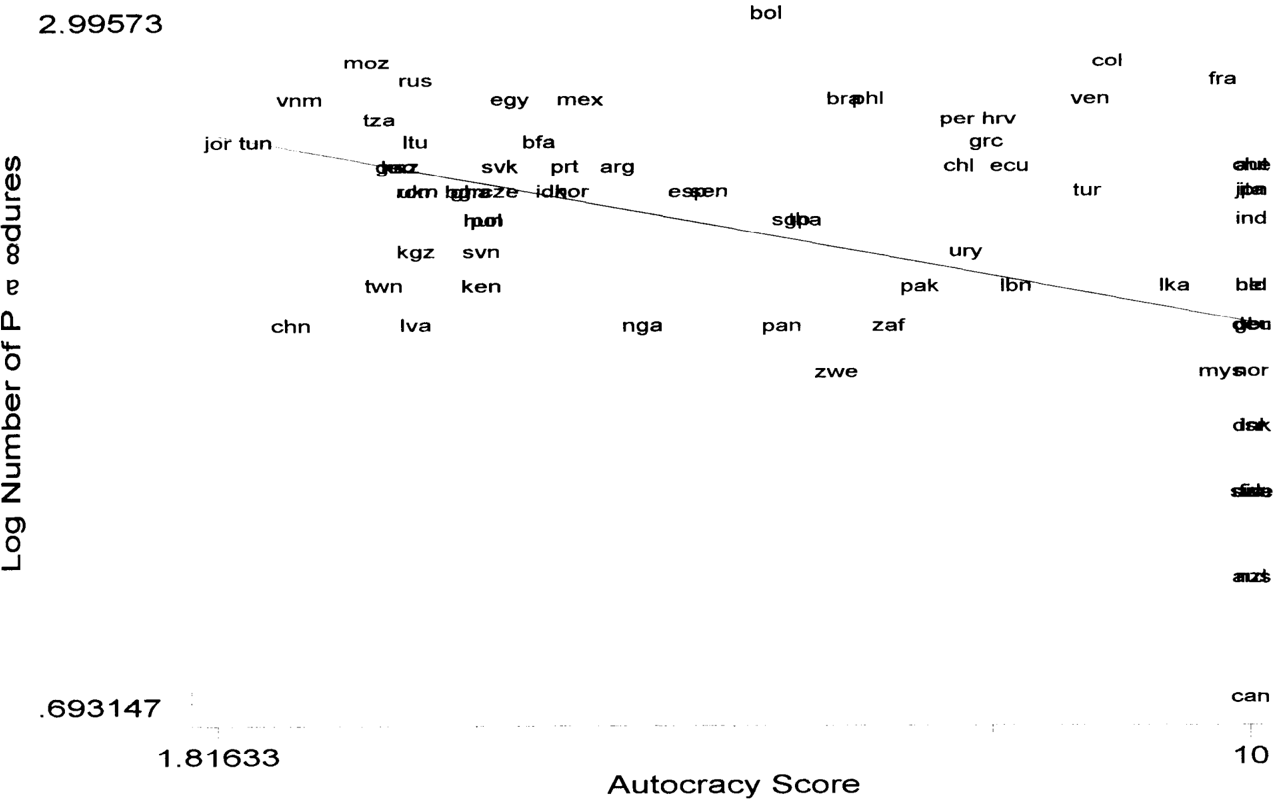
- In Table VIII, better government is associated with lighter regulation; the paper states that countries with more limited and representative governments have statistically significantly fewer procedures using 5 out of 6 measures of better government, and that more autocratic countries regulate more heavily.
Methods
- The paper builds a new database on entry regulation for 75 countries, focusing on the legal requirements, official time, and official cost for a standardized start-up firm.
- Data were gathered from written government sources, World Bank- and USAID-sponsored studies, government web pages, direct contacts with agencies, and independent double-checks in 73 countries via local consulting reports; the remaining 2 countries were double-checked through government contacts.
- The main analysis uses cross-country OLS regressions relating entry regulation measures to outcomes such as quality, pollution, unofficial economy, corruption, political institutions, legal origin, and GDP per capita; the paper also reports correlations and test-of-means comparisons across income quartiles.
Limitations
- The paper itself notes that the capture-theory tests are based on crude measures and that the data are probably least suited to test the capture hypothesis.
- The authors say the data almost surely underestimate the cost and complexity of entry because they focus on the capital city, omit industry-specific requirements and foreign-ownership steps, and ignore some informal delays and bribes.
- Evident from the text: the study is cross-sectional and based on official procedures/costs, so causal interpretation is limited and informal corruption/bureaucratic delays are not directly measured except indirectly through correlations.
Model-written summary. Check it against the paper before relying on it.
Integrity signals
Registry
Cites
Statistics
Figures
Verification
Claims the paper makes
0 Valid · 3 Not valid · 13 Not checked · 114 Own results and interpretations
A result the paper reports from its own data — it cites no other source for it, so there is none to check. The quote shows it is in the paper.
In the paper
“Very few entry regulations cover tax and labor issues.”
plain- Asserted: passes — The authors put it forward as true.
- Checkable: passes — It can be checked against evidence.
- Load-bearing: unclear — It is unclear whether the paper’s conclusions depend on it.
- Based: passes — The paper gives a reason why it holds.
In the paper
“The data show that the numbers of entry and of labor market regulations are positively correlated across countries, contrary to the substitutes hypothesis.”
What the sources say
- Not matchedcites Djankov et al., 2000
An author–year citation the paper’s reference list doesn’t settle. We don’t search these by name.
plainstates an association- Asserted: passes — The authors put it forward as true.
- Checkable: passes — It can be checked against evidence.
- Load-bearing: unclear — It is unclear whether the paper’s conclusions depend on it.
- Based: passes — The paper gives a reason why it holds.
- Not matched
A result the paper reports from its own data — it cites no other source for it, so there is none to check. The quote shows it is in the paper.
In the paper
“It often takes the form of screening procedures.”
- Also stated in: § III. Basic Results. · plain
“Instead, much of what governments do to regulate entry falls into the category of screening procedures.”
plain- Asserted: passes — The authors put it forward as true.
- Checkable: passes — It can be checked against evidence.
- Load-bearing: unclear — It is unclear whether the paper’s conclusions depend on it.
- Based: passes — The paper gives a reason why it holds.
- Also stated in: § III. Basic Results. · plain
A result the paper reports from its own data — it cites no other source for it, so there is none to check. The quote shows it is in the paper.
In the paper
“First, the cost-to-per-capita-GDP ratio decreases uniformly with GDP per capita.”
plainstates an association- Asserted: passes — The authors put it forward as true.
- Checkable: passes — It can be checked against evidence.
- Load-bearing: unclear — It is unclear whether the paper’s conclusions depend on it.
- Based: passes — The paper gives a reason why it holds.
A result the paper reports from its own data — it cites no other source for it, so there is none to check. The quote shows it is in the paper.
In the paper
“In contrast, countries in the other three quartiles of per capita income are not statistically different from each other in terms of the number of procedures and the time required to fulfill them.”
plain- Asserted: passes — The authors put it forward as true.
- Checkable: passes — It can be checked against evidence.
- Load-bearing: passes — The paper’s conclusions depend on it.
- Based: passes — The paper gives a reason why it holds.
49 more claims
Create a free account to see all 130 claims and every source verdict.
- Probably not a substantial claim. 21
- It may state two separate claims as one. 54
- The quote only partly states this claim. 26
Claims other papers make about this one
Each is checked against this paper’s own text: does it say what the citing paper says it does?
The source backs part of the claim, not all of it — or backs it for a different population, condition or comparison.
In the citing paper
“Our findings suggest an explanation for the low level of incorporation in Italy: the average direct cost associated with fulfilling the bureaucratic regulations for registering a new corporation in Italy is 20% of per capita GNP compared to 10% of per capita GNP on average for other G-7 European countries.”
From Entry regulation as a barrier to entrepreneurship (2006) · cites this paper as Djankov et al. (2002)
Experimental — accuracy not yet measuredThe cited source says what the claim attributes to it.
In the citing paper
“Given the explicit link made by Djankov et al . (2002) between the speed and ease with which businesses may be established in a country and its economic performance - and the enthusiasm with which this link has been grasped by European Union policy makers - our findings imply this link needs reconsidering.”
From The Effect of Business Regulations on Nascent and Young Business Entrepreneurship (2007) · cites this paper as Djankov et al . (2002)
Citations
Cites
La Porta, R., Lopez‐de‐Silanes, F., Shleifer, A., & Vishny, R. W. (1998) · Journal of Political Economy · doi:10.1086/250042 · Cited by 18,025
Self-citationThe Theory of Economic Regulation
Stigler, G. J. (1971) · The Bell Journal of Economics and Management Science · doi:10.2307/3003160 · Cited by 8,098
Journal of Economic Literature
(2019) · AEA Papers and Proceedings · doi:10.1257/pandp.109.633 · Cited by 7,468
The Quarterly Journal of Economics
Kuznets, S. (2024) · Business Cycle Theory, Part I Volume 4 · doi:10.4324/9781003549741-8 · Cited by 7,176
La Porta, R. (1999) · Journal of Law, Economics, and Organization · doi:10.1093/jleo/15.1.222 · Cited by 5,699 · cited 2×
“Legal origin has been viewed as a proxy for the government’s proclivity to intervene in the economy and the stance of the law toward the security of property rights in a country [La Porta et al. 1999].”
The Theory of Economic Regulation
Stigler, G. J. (2021) · The Political Economy · doi:10.4324/9781315495811-8 · Cited by 5,483
Pigou, A. C. (1933) · The Economic Journal · doi:10.2307/2224491 · Cited by 5,137
Toward a More General Theory of Regulation
Peltzman, S. (1976) · The Journal of Law and Economics · doi:10.1086/466865 · Cited by 4,729
Moffitt, R. A. (2009) · American Economic Review · doi:10.1257/aer.99.2.660 · Cited by 4,694
Shleifer, A., & Vishny, R. W. (1993) · The Quarterly Journal of Economics · doi:10.2307/2118402 · Cited by 3,778
Self-citation
Research works printed but not linked: 7
- McLiesh Caralee, 2001, NBER Working Paper No., 8288
- Kasnako lu, Zehra, and Münür Yayla, 'Unrecorded Economy in Turkey: A Monetary Approach', 1999. "Unrecorded Economy in Turkey (A Monetary Approach)" in Informal Sector in Turkey (I), Tuncer Bulutay (ed.), SIS, Ankara, forthcoming.
- Fred, 1987, Journal of Legal Studies, 101
- Olson, Mancur, 1991, 'Autocracy, Democracy, and Prosperity,' in Richard Zeckhauser, ed., Strategy of Choice, Cambridge, MA: MIT Press.
- 1967, Western Economic Journal, 232
- World Economic Forum (1999), The Global Competitiveness Report 1999 , Schwab, Klaus et al., eds., New York: Oxford University Press.
- World Economic Forum, The Global Competitiveness Report 2001, Klaus Schwab et al., eds. (New York, NY: Oxford University Press, 2001).
Cited by
Items 3,501–3,600 of 3,986
Winkler, I., & Gomes, A. T. (2017) · Elsevier eBooks · doi:10.1016/b978-0-12-809316-0.00008-7
Product Market and Competition
Rougier, É. (2017) · Springer eBooks · doi:10.1007/978-3-319-49947-5_6
Enterprising Cities: Regulatory Climate Index 2014Preprint
Hendrix, M., Pham, N. D., Badlam, J. M., Sarda, A., & Sonzogni, D. (2017) · SSRN Electronic Journal · doi:10.2139/ssrn.2917502
countriEs: a proposal from thE institutional pErspEctivE
Morales-Urrutia, D., & Marzábal, Ó. R. (2015)
CENTRE FOR THE STUDY OF ECONOMIC & SOCIAL CHANGE IN EUROPE (CSESCE)
Aidis, R., & Adachi, Y. (2006)
Franco, C., Sampaio, G. R., & Vaz, P. H. (2017) · SSRN Electronic Journal · doi:10.2139/ssrn.2969041
Country Benchmarking for Setting Up a New Business
Avram, B., & Brad, S. (2017) · Springer eBooks · doi:10.1007/978-3-319-54454-0_1
Wang, Z. (2016) · YorkSpace (York University)
Sanday, H. (2017) · SSRN Electronic Journal · doi:10.2139/ssrn.2633189
“Those findings inspired Djankov et al. (2002) to develop a methodology for assessing the procedures, cost and time for registering a business that in turn influenced the World Bank into launching the Doing Business surveys in 2003 on the presumption that fewer, simpler and more cost-efficient…”
Analysis of corruption and foreign direct investment in Africa
Abotsi, A. K. (2014) · NRCT Data Center · doi:10.14457/nida.the.2014.14
The effect of labor unions and labor market regulation on the rate of entrepreneurship
Ollikainen, P. (2014) · Helda - University of Helsinki Institutional Repository
Efficiency and market share in the banking sector in south east European countries
Atanasovska, V. (2015) · Staffordshire Online Repository (Staffordshire University) · Cited by 2
Mécanismes et instruments anticorruption : pistes de réflexion émergentes de la littérature
Goyette, J. (2017) · L Actualité économique · doi:10.7202/1040503ar · Cited by 2
International Competitiveness: Product Deregulation and Internal Devaluation
Patureau, L. (2015)
The Impact of Collusion on Corporate Behaviors and Political Performance Assessment
Nie, H. (2017) · Springer eBooks · doi:10.1007/978-981-10-5059-6_6
Corruption, Regulatory Regime, and Entrepreneurship
Chowdhury, F., Desai, S., & Audretsch, D. B. (2017) · SpringerBriefs in entrepreneurship and innovation · doi:10.1007/978-3-319-64916-0_5 · Cited by 2
Stankov, P. (2017) · Springer eBooks · doi:10.1007/978-3-319-62497-6_5
Virtual Entrepreneurship: Explicating the Antecedents of Firm Performance
Chandna, V. (2016) · University of North Texas Digital Library (University of North Texas) · doi:10.12794/metadc849704
Reglugerðarumhverfi frumkvöðla á Íslandi: Greining á stöðu og tækifærum til úrbóta
Óskarsson, G., & Þráinsson, H. Þ. (2017) · Tímarit um viðskipti og efnahagsmál · doi:10.24122/tve.a.2017.14.2.3 · Cited by 2
Future Orientation and Taxes: Evidence from Big DataPreprint
Petutschnig, M. (2014) · SSRN Electronic Journal · doi:10.2139/ssrn.2523392
Calle, G. C. F., Díaz‐Casero, J. C., Mogollón, R. H., Portillo, A. F., & Rodriguez-Preciado, R. (2018) · Small Business International Review · doi:10.26784/sbir.v2i1.91 · Cited by 1
A Trio of Perspectives on Corruption
Kenny, C. J., Klein, M. U., & Sztajerowska, M. (2011)
Resolving Insolvency: The challenges of successfully implementing insolvency reforms
Bank, W. (2017) · Doing business in ... · doi:10.1596/978-1-4648-1146-3_case4
The Divergence of Entrepreneurial Landscapes in the European Union
Potts, M. D., & Puia, G. M. (2018) · Advances in logistics, operations, and management science book series · doi:10.4018/978-1-5225-5014-3.ch015
Essays on Governance and Economic Performance
Kochanova, A. (2013) · ASEP
Exposing institutional influences on entrepreneurship among Kuwaiti youth
Almethen, A. K. M. K. (2015) · Bradford Scholars (University of Bradford)
Trump, Regulation and Stock ReturnsPreprint
Kundu, S. (2018) · SSRN Electronic Journal · doi:10.2139/ssrn.3143454
Strengthening Regulatory Governance: The Case of Serbia
Marušić, A., & Penev, S. (2014) · Springer eBooks · doi:10.1007/978-94-017-9346-9_6
Entrepreneurial growth aspirations and the role of institutions: A multilevel approach
Martin‐Sanchez, V., & Aparicio, S. (2018) · Academy of Management Proceedings · doi:10.5465/ambpp.2018.18544abstract · Cited by 1
“Similarly, previous studies highlighted the negative influence that regulation (i.e., number of procedures) has on entrepreneurial activity in general (Djankov et al., 2002; van Stel et al., 2007).”
InfluentialNuhu, H. M. (2016) · Bradford Scholars (University of Bradford)
Evaluation and Prediction of Urban Entrepreneurship Environment in China: A Case of Guangzhou City
Kuang, Y., & Bu, Y. (2018) · Journal of Service Science and Management · doi:10.4236/jssm.2018.114029
“Some scholars are paying more attention to the overall study of the entrepreneurship environment, or only to study high-growth entrepreneurship [2] [3] [4].”
Simplicity of Running Business in Georgia – Present and Future Development
Masurashvili, I. (2018) · Modern Management Review · doi:10.7862/rz.2018.mmr.16
이강원, 정미진, Lee, J., & Jinha, K. (2017) · Public Policy Review · doi:10.17327/ippa.2017.31.3.004
Oh, S., & Sopraseuth, T. (2017) · RePEc: Research Papers in Economics
Political connections and entrepreneurial finance in an emerging market: the China case
Zhou, W. (2011) · Figshare · doi:10.25916/sut.26269390
Challenges of venture capital funding process in Malaysia
Aris, S. M. (2015)
Mazaheri, T., Shirkavnd, S., & Jamali, A. (2018) · Journal of International Business and Economics · doi:10.15640/jibe.v6n2a3
The Role of Institutions and Networks in Firms' Offshoring DecisionsPreprint
Moriconi, S., Peri, G., & Pozzoli, D. (2018) · RePEc: Research Papers in Economics
Red Tape Asset PricingPreprint
Souza, T. D. O. (2018) · SSRN Electronic Journal · doi:10.2139/ssrn.3297430
Entry and Exit: Creating Experimental Societies
Cusolito, A. P., & Maloney, W. F. (2018) · World Bank, Washington, DC eBooks · doi:10.1596/978-1-4648-1334-4_ch4
Does the Shadow Economy Kuznets Curve Exist for Russian Regions?
Киреенко, А. П., Nevzorova, E. N., & Alekseev, D. (2019) · Springer proceedings in business and economics · doi:10.1007/978-3-030-11851-8_15
Lucas, D. S., & Boudreaux, C. J. (2019) · RePEc: Research Papers in Economics · doi:10.48550/arxiv.1903.02924
“, 1993; Tullock, 1967) and to create entry barriers (Dean & Brown, 1995; Djankov et al., 2002).”
Globalization and Insider Trading: Evidence from Cross-Border Mergers and AcquisitionsPreprint
Guo, L., & Zhang, S. (2017) · SSRN Electronic Journal · doi:10.2139/ssrn.3281446
Did the colonial powers pick the economic winnersPreprint
Jones, P. (2007) · RePEc: Research Papers in Economics
What liberals should tolerate internationally
Cohen, A. J. (2019) · Critical Review of International Social and Political Philosophy · doi:10.1080/13698230.2019.1616880 · Cited by 1
Réforme de la structure fiscale et Intégration régionale
Nguimkeu, P. (2017) · Interventions économiques · doi:10.4000/interventionseconomiques.5858
Starting a Business in the Caribbean
Schmid, J. P., & Zegarra, M. A. (2019) · doi:10.18235/0001717
“Like de Soto’s work, the publication of Djankov et al. (2002) called attention to the difficulties that businesses face in terms of regulations.”
Estimating the Determinants of Capital Inflows Using Cross Sectional Data
Akhtaruzzaman, M. (2019) · Springer eBooks · doi:10.1007/978-981-13-9069-2_4
Political Institutions and the Governmental Burden on BusinessesPreprint
Zhong, R., & Zhong, W. (2017) · SSRN Electronic Journal · doi:10.2139/ssrn.3086603
Witte, C., & Larsen, M. M. (2019)
Niemann, C. (2019) · Springer eBooks · doi:10.1007/978-3-658-25700-2_4
Sector-Level Competition and Export: Evidence from Exporter Dynamics Database
Babuşçu, Ş., Hazar, A., Solakoğlu, M. N., & Tunç, C. (2019) · Journal of International Commerce Economics and Policy · doi:10.1142/s1793993319500133 · Cited by 1
The Challenges of American Indian Land Tenure and the Vastness of Entrepreneurial Potential
Shoemaker, J. A. (2019) · Cambridge University Press eBooks · doi:10.1017/9781108646208.004
Consumption, Government Failure, and Asset PricesPreprint
Souza, T. D. O. (2018) · SSRN Electronic Journal · doi:10.2139/ssrn.3194190
CAGLE, M. N. (2019) · Dokuz Eylul Universitesi Iktisadi ve Idari Bilimler Dergisi · doi:10.24988/ije.2019343849
Hidden Costs of Control: Consequences of Over Application of Rigid Control
Sultana, R., & Arifa-Tun-Naim (2016) · Journals & Books Hosting (International Knowledge Sharing Platform)
(Review of Empirical Studies of Factors of Entrepreneurial Activity)Preprint
Баринова, В. А., Земцов, С. П., & Tsareva, Y. (2018) · SSRN Electronic Journal · doi:10.2139/ssrn.3152260
Entrepreneurship Visited In Ideological Paradigms and Social Contexts
Khan, M. I. (2015) · International journal of applied research
PROJECT INFORMATION DOCUMENT (PID) PRE-APPRAISAL STAGE
Bendana, R., Bolivar, A., & Nicaragua, C. (2006)
Analysis of the Impact of Supply Restriction Policy on Commercial Vehicles
LIM, J. (2017) · Journal of Shipping and Logistics · doi:10.37059/tjosal.2017.33..497
Procedural Utility: An Economics Beyond Outcomes
Benz, M. (2004) · eScholarship (California Digital Library)
Foreign Aid and Long Term Prospects of RecipientsPreprint
Kant, C. (2018) · SSRN Electronic Journal · doi:10.2139/ssrn.3277203
Evidence on the Determinants of Productivity in Brazil, 2004-2014
de Souza, T. A. A., & da Cunha, M. S. (2020) · Revista Brasileira de Economia · doi:10.5935/0034-7140.20200011
“Regarding the business environment, Fontes and Pero (2012) affirmed that a good business environment would be related to formalization conditions in the labor market, and Djankov et al. (2002) stated that the higher cost and time spent opening a new business would be associated with an increase in…”
Economic Perspectives: implications for policy
Worrall, L., Spoehr, J., Roos, G., et al. (2017)
On the Ease of Doing Business in APEC
Mendoza, R. U., Ang, A. P., & Canare, T. A. (2014) · Cited by 1
Rise of the 'Quants' in Financial Services: Regulation and Crowding Out of Routine JobsPreprint
Makridis, C. A., & Rossi, A. G. (2018) · SSRN Electronic Journal · doi:10.2139/ssrn.3218031
Institutions and Immutable Causes of Human Capital
Mabeu, M. C. (2020) · uO Research (University of Ottawa) · doi:10.20381/ruor-24911
“…many empirical studies show that the common law system is associated with more secure property rights, higher quality of government, greater political freedom, and better financial development in the present-day (La Porta et al. (1998), Djankov et al. (2002), Glaeser and Shleifer (2002)).”
Contract institution and differentiated exports
Xu, X., Voon, J. P., & Shang, Y. (2020) · Journal of the Asia Pacific Economy · doi:10.1080/13547860.2020.1807673
“The colonial history has been identified, as in Djankov et al. (2002, 2003), Acemoglu and Johnson (2005), and Acemoglu, Johnson, and Robinson (2001, 2002), to be an important exogenous source of variations affecting the development of contract institution.”
Romiti, A., Santini, C., & Simoni, C. (2008) · Florence Research (University of Florence)
The Determinants of Economic CompetitivenessPreprint
Kluge, J., Lappöhn, S., & Plank, K. (2020) · RePEc: Research Papers in Economics · Cited by 3
Brexit – A Shattering Event or Unremarkable Episode for Private Equity Activity?Preprint
Dietlmeier, S. F. (2018) · SSRN Electronic Journal · doi:10.2139/ssrn.3316383
Silicon Valley vs. Main Street: Regulatory Impact on Entrepreneurial Ventures
Palagashvili, L. (2020) · Springer eBooks · doi:10.1007/978-3-030-42408-4_8
Institution and multinational investment
Xu, X., Voon, J. P., & Shang, Y. (2015) · PolyU Institutional Research Archive (Hong Kong Polytechnic University)
How Institutional Development News Moves an Emerging MarketPreprint
Guzmán, A., Mehrotra, V., Morck, R. K., et al. (2019) · SSRN Electronic Journal · doi:10.2139/ssrn.3336178
Financial Development, Labor and Market Regulations and Growth
Utrero-González, N., & Fonseca, R. (2005)
What Firms KnowPreprint
Amin, M. (2008) · SSRN Electronic Journal · doi:10.2139/ssrn.1142820
“a 1-6 scale: fully disagree (1), disagree in most cases (2), tend to disagree (3), tend to agree (4), agree in most cases (5) and fully agree (6).”
Corporation as a Crucial Ally Against Corruption
Calderón, R., Álvarez, J. L., & Mayoral, S. (2008) · Springer eBooks · doi:10.1007/978-94-007-0818-1_22
Competition among the Elites, Property Rights Protection and Economic PerformancePreprint
Pan, S. (2008) · SSRN Electronic Journal · doi:10.2139/ssrn.1287180
“Public choice theory (e.g., McChesney 1987; De Soto 1990; Shleifer and Vishny 1998 )a lso shows that regulation is pursued for the benefit of politicians and bureaucrats.”
Corruption, Inequality and Fairness
Alesina, A., & Angeletos, G.-M. (2005) · National Bureau of Economic Research · doi:10.3386/w11399 · Cited by 59
Kim, J.-G., Choi, B. Y., Lee, B., & Lee, M. (2015) · SSRN Electronic Journal · doi:10.2139/ssrn.2622303
Xu, W., & Xu, G. (2016) · RePEc: Research Papers in Economics
Rui, H., Cuervo-Cazurra, Á., & Un, C. A. (2017) · SSRN Electronic Journal · doi:10.2139/ssrn.2968001
Does Competition Spur Innovation in Developing Countries
Espinoza, R. Á., & Campusano, R. (2014) · Serie Documentos de trabajo/Serie documentos de trabajo
Opportunities to Divert, Firm Value, and Taxation: Theory and Evidence from European Firms
Krämer, R., & Lipatov, V. (2012) · FinanzArchiv Public Finance Analysis · doi:10.1628/001522112x632005
Duanmu, J., & Gűney, Y. (2012) · SSRN Electronic Journal · doi:10.2139/ssrn.1986018
The Impact of Firm Entry Regulation on Long-Living EntrantsPreprint
Prantl, S. (2010) · SSRN Electronic Journal · doi:10.2139/ssrn.1645211
Evolutionary Views on Entrepreneurial Processes: Managerial and Policy ImplicationsPreprint
Wennberg, K. J., & Delmar, F. (2011) · RePEc: Research Papers in Economics
Impediments on the Way to Entrepreneurship: Some New Evidence from the EU’s Post-Socialist WorldPreprint
Batsakis, G. K. (2012) · SSRN Electronic Journal · doi:10.2139/ssrn.2071175
Role of Regulation in Facilitating Entrepreneurship: A Study of Incubation in BelgiumPreprint
Jaquemin, A., & Janssen, F. (2013) · SSRN Electronic Journal
Decentralized Bribery: The Costs, The Benefits, and The Taming
Vladimirovich, P. S. (2013) · Scandinavian Journal of Economics
Property Rights in Sequential ExchangePreprint
Arruñada, B., Zanarone, G., & Garoupa, N. M. (2017) · SSRN Electronic Journal · doi:10.2139/ssrn.3075131
“By advocating a comparative analysis of the costs and benefits of publicity mechanisms, our paper also sheds new light on the debate on property and business institutions initiated by De Soto (1989) and Djankov et al. (2002), and reflected in policy initiatives like the Doing Business Project.”
Corporation as Crucial Ally Against CorruptionPreprint
Calderón, R., Álvarez, J. L., & Mayoral, S. (2014) · SSRN Electronic Journal · doi:10.2139/ssrn.2542082
Monetary Transmission Mechanism with Firm TurnoverPreprint
Uusküla, L. (2016) · SSRN Electronic Journal · doi:10.2139/ssrn.2830423
Sáez, Á. E., & Guasch, J. L. (2008) · Documentos de trabajo. Economic series ( Universidad Carlos III. Departamento de Economía )
Start-up banks� default and the role of capitalPreprint
Libertucci, M., & Piersante, F. (2012) · RePEc: Research Papers in Economics
Informality Among Multi-Product FirmsPreprint
Becker, D. (2014) · SSRN Electronic Journal · doi:10.2139/ssrn.2524656
“(2)Several subsequent papers confirm firm registration cost and complex registration procedures as main drivers of informality (Djankov et al., 2002; Auriol and Warlters, 2005; Antunes and de V. Cavalcanti, 2007; Ulyssea, 2010).”
The Nexus of Judicial Efficiency, Social Burden and Default Risk: Cross-Country EvidencePreprint
Zhu, X., Peng, H., & Zhang, Z. (2018) · SSRN Electronic Journal · doi:10.2139/ssrn.3177921
Bank Capital Pressures, Loan Substitutability, and Nonfinancial Employment
Lee, S. J., & Stebunovs, V. (2016) · International Finance Discussion Paper · doi:10.17016/ifdp.2016.1161
Balineau, G., Bauer, A., Kessler, M., & Madariaga, N. (2021) · World Bank, Washington, DC eBooks · doi:10.1596/978-1-4648-1588-1_ch3
Promoting Rwanda’s Business Environment: Drivers of Change and Factuality of ReformsPreprint
Bernatzki, T., Busse, M., & Hoekstra, R. (2020) · SSRN Electronic Journal · doi:10.2139/ssrn.3686211
“Recent academic research and indices, inter alia the World Economic Forum’s Global Competitiveness Report, have built upon Djankov et al.’s (2002) entry regulation indicators, which found that an easier regulation of new businesses is indeed associated with increased competition and economic growth.”
Influential
Metadata
- Authors
- Djankov, S., La Porta, R., Lopez-de-Silanes, F., & Shleifer, A.
- Affiliations
- World Bank (US)
- National Bureau of Economic Research (US)
- ORCID
- Djankov, S.
- Venue
- The Quarterly Journal of Economics
- Publisher
- Oxford University Press (OUP)
- Published
- 2002-02-01
- Volume
- 117
- Issue
- 1
- Pages
- 1-37
- ISSN
- 0033-5533
- 1531-4650
- OpenAlex
- W2139896179
- Cited by
- 3,956
- References
- 30
- Citations by year
- 2026: 223 · 2025: 185 · 2024: 157 · 2023: 120 · 2022: 140 · 2021: 150 · 2020: 151 · 2019: 161 · 2018: 157 · 2017: 162 · 2016: 166 · 2015: 193 · 2014: 200 · 2013: 183 · 2012: 193
- Type
- report
- Language
- en
- Open access
- green
- doi.org
- Licence
- other-oa
- Locations
- World Bank, Washington, DC eBooks (publishedVersion)
- The Quarterly Journal of Economics (publishedVersion)
- The World Bank Open Knowledge Repository (World Bank) (publishedVersion)
- National Bureau of Economic Research (publishedVersion, other-oa)
- RePEc: Research Papers in Economics (submittedVersion)
- Digital Access to Scholarship at Harvard (DASH) (Harvard University) (submittedVersion, cc-by)
- SSRN Electronic Journal (submittedVersion)
- OpenGrey (Institut de l'Information Scientifique et Technique) (submittedVersion)
- The World Bank Open Knowledge Repository (World Bank) (submittedVersion, cc-by)
- Topics
- Social Sciences › Sociology and Political Science › Corruption and Economic Development
- Social Sciences › Economics, Econometrics and Finance › Economics and Econometrics › Taxation and Compliance Studies
- Social Sciences › Business, Management and Accounting › Strategy and Management › Political Influence and Corporate Strategies
- Keywords
- start-up firms, bureaucratic procedures, corruption, informal economy, democracy, government size, public choice theory, public interest theory
About these checks
Registry, retraction, Cites and statistics results are computed, not judged, with one exception: a printed reference that no index lists is read once by a model before it counts as a citation error. Claims are extracted by a model and kept only when their quote appears verbatim in the text; each cited source is then checked, with a model’s help, for whether it says what the claim relies on. Those verdicts can be wrong — read the claim’s quote and the cited source before relying on one.
A language model drew the claims from the paper on 2026-10-01, under version 3 of the claim definition (model deepseek-v4.1-flash, prompt extract-v3).
A second model labelled each claim on 2026-10-01 (model jev-1.13-20260917, definition revision gold-guideline-v0.2).
Statistics and arithmetic are recomputed, not judged.
Confidence bands are shown only for fields calibrated on our annotated test set. None is calibrated yet, so no band is shown.
What counts as a claim ›How we measure confidence ›How we check this ›
Are you an author, or do you see a problem with this page? Request a review
Data sources
Bibliographic data: Semantic Scholar, OpenAlex, Crossref.
Contains information from the Semantic Scholar Academic Graph Datasets, made available under the ODC Attribution License (ODC-BY 1.0).
Semantic Scholar’s data is described in: Kinney, R., et al. (2023). The Semantic Scholar Open Data Platform. arXiv:2301.10140.
