

The Regulation of Entry
Open accessThe DOI matches its Crossref record, with a small difference in title or year; 39 of the 39 references it cites were found in a registry or an index; none of the 13 sources its claims cite is checked for support yet.
Abstract
1%(5 :25.,1* 3$3(5 6(5,(6 7+( 5(*8/$7,21 2) (175< 6LPHRQ 'MDQNRY 5DIDHO /D 3RUWD )ORUHQ.LR /RSH]GH6LODQHV $QGUHL 6KOHLIHU :RUNLQJ 3DSHU KWWSZZZQEHURUJSDSHUVZ 1$7,21$/ %85($8 2) (&2120,& 5(6($5&+ 0DVVD.KXVHWWV $YHQXH &DPEULGJH 0$ 6HSWHPEHU :H WKDQN 2OJD ,RIIH 7DWLDQD 1HQRYD DQG (NDWHULQD 7UL]ORYD IRU DEOH UHVHDU.K DVVLVWDQ.H DQG +DPLG $ODYL ,ULQD $VWUDNKDQ $EKLMLW %DQHUMHH 5L.KDUG &DYHV -D.TXHOLQH &RROLGJH -DPHV (PHU\ 1LKDO (O0DJKDUEHO -HDQ 3DXO *DXWKLHU (G *ODHVHU 6LPRQ -RKQVRQ /DZUHQ.H .DW] 3HWHU .X.HUD 'DYLG /DLEVRQ ,UD /LHEHUPDQ 'DYLQ 0D.NLQ]LH 0DULH )UDQ.RLVH 0DULH1HOO\ 0DU.HOR 2ODUUHDJD *X\ 3IHIIHUPDQQ 6DQWLDJR 6HGD.D /HLOD :HEVWHU 3HWHU :ULJKW DQG VHPLQDU SDUWL.LSDQWV DW WKH 8QLYHUVLW\ RI 0DU\ODQG DW &ROOHJH 3DUN IRU KHOSIXO .RPPHQWV 7KH .ROOH.WLRQ RI GDWD IRU WKLV SDSHU ZDV RUJDQL]HG DQG ILQDQ.HG E\ WKH :RUOG %DQN $Q DSSHQGL[ GHV
Overview
CoChat Summary
TL;DR
This paper assembles a new cross-country dataset on business entry regulation in 75 countries and uses it to compare the helping-hand, capture, and tollbooth theories of regulation. The evidence is most consistent with the tollbooth view: heavier entry regulation is associated with more corruption, a larger unofficial economy, and less representative, more autocratic governments.
Key findings
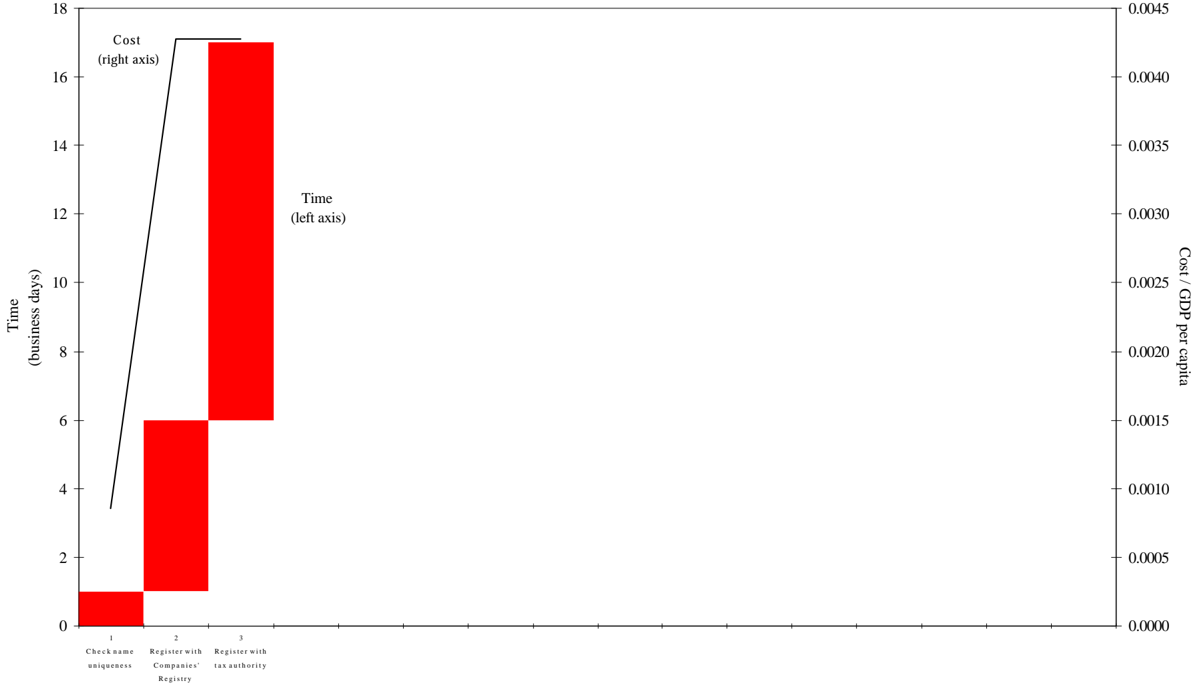
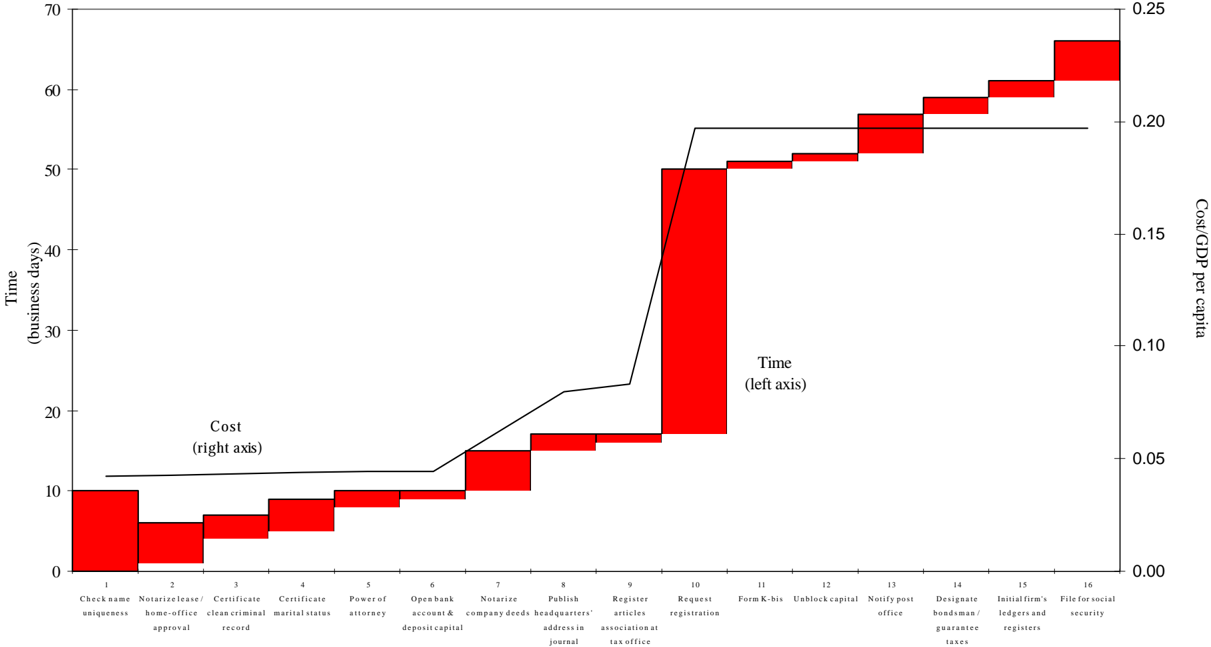
- Across the 75-country sample, the number of entry procedures ranges from 2 in Canada to 20 in Bolivia, with a sample average of 10.17 procedures; the average official time is 63.05 business days and the average cost is 0.34 of GDP per capita.
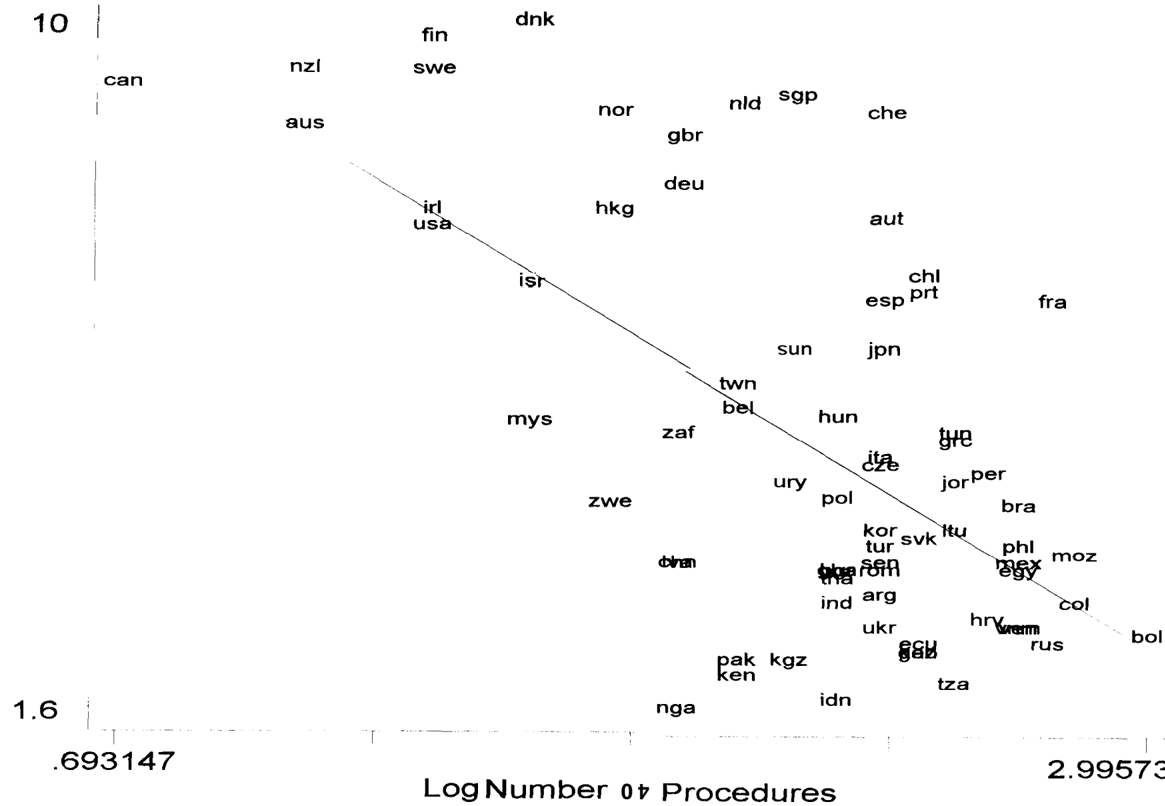
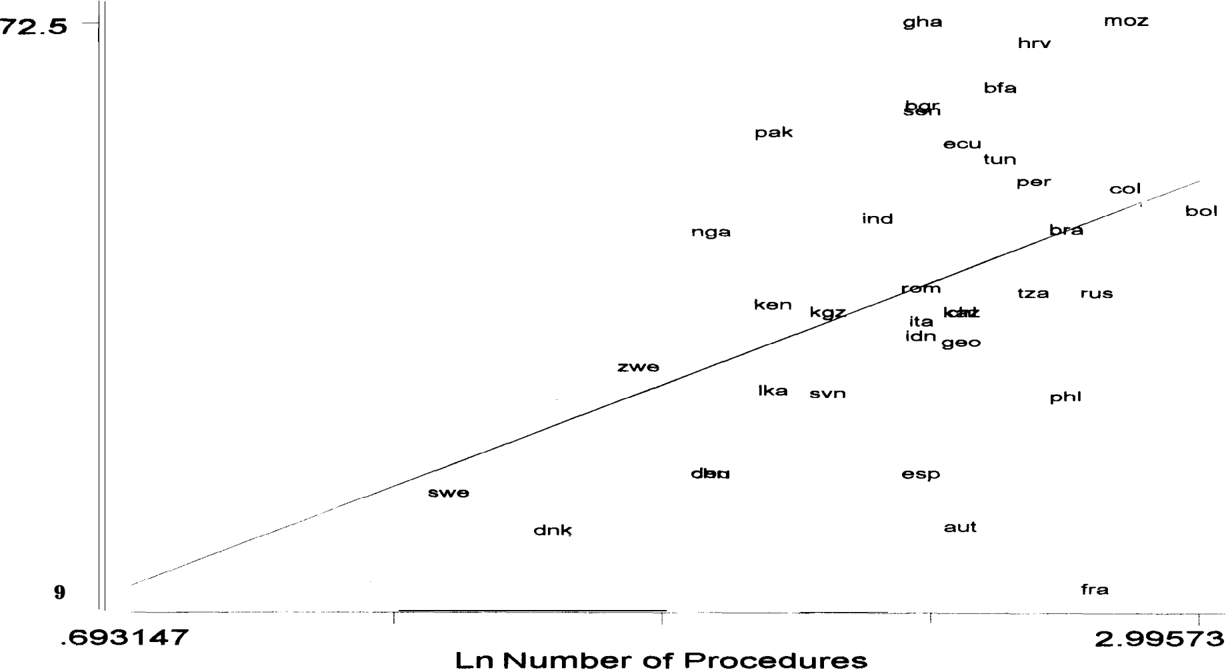
- The number of procedures is strongly correlated with time and cost: the paper reports correlations of 0.75 with log time and 0.62 with log cost.
- The helping-hand tests do not support a beneficial-regulation story: in Table IV, more procedures are associated with lower ISO quality standards (e.g. coefficient -0.2646) and larger unofficial economy measures (e.g. coefficient 13.6277 for size of unofficial economy; 19.8763 for employment in the unofficial economy), while pollution and health outcomes do not improve.
- The tollbooth evidence is stronger: Table VI reports that more procedures are associated with worse corruption scores, with a coefficient of -3.2809 (and -1.7249 with GDP per capita controls) for the corruption regressions.
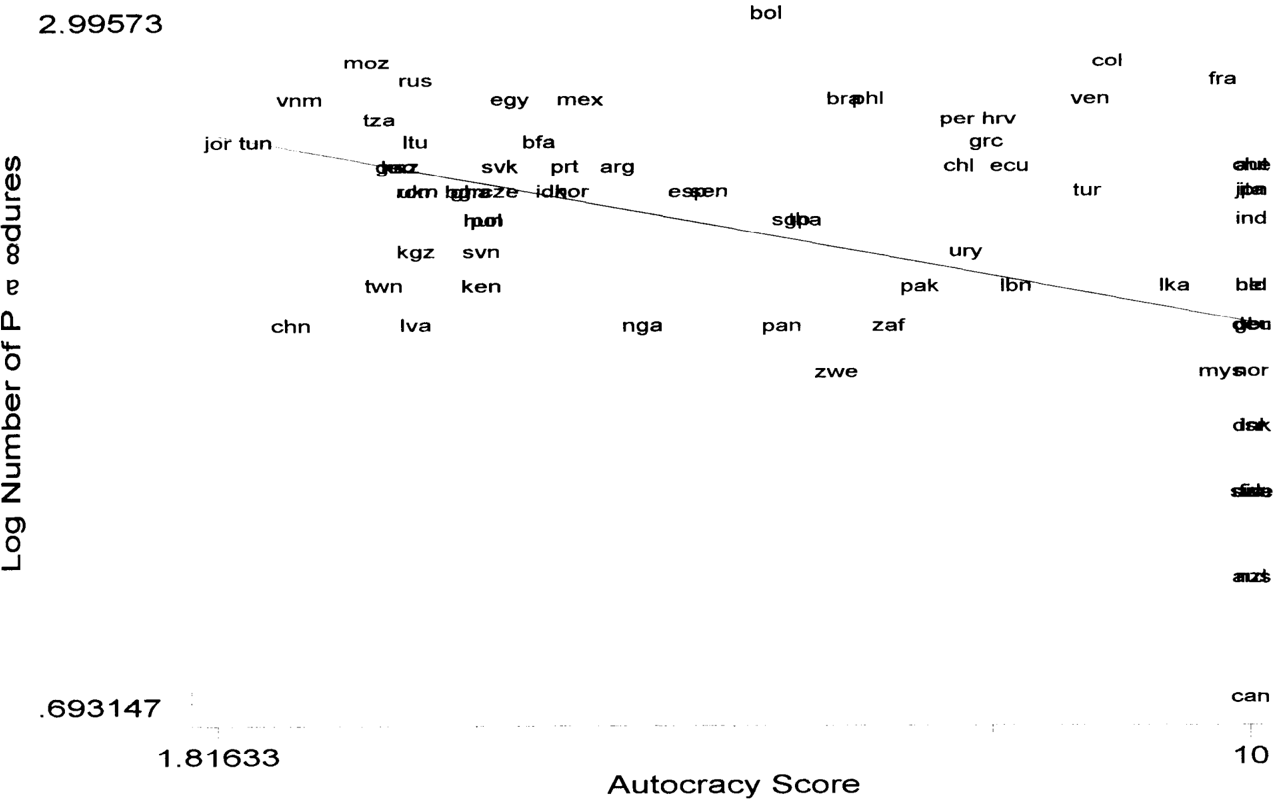
- In Table VIII, better government is associated with lighter regulation; the paper states that countries with more limited and representative governments have statistically significantly fewer procedures using 5 out of 6 measures of better government, and that more autocratic countries regulate more heavily.
Methods
- The paper builds a new database on entry regulation for 75 countries, focusing on the legal requirements, official time, and official cost for a standardized start-up firm.
- Data were gathered from written government sources, World Bank- and USAID-sponsored studies, government web pages, direct contacts with agencies, and independent double-checks in 73 countries via local consulting reports; the remaining 2 countries were double-checked through government contacts.
- The main analysis uses cross-country OLS regressions relating entry regulation measures to outcomes such as quality, pollution, unofficial economy, corruption, political institutions, legal origin, and GDP per capita; the paper also reports correlations and test-of-means comparisons across income quartiles.
Limitations
- The paper itself notes that the capture-theory tests are based on crude measures and that the data are probably least suited to test the capture hypothesis.
- The authors say the data almost surely underestimate the cost and complexity of entry because they focus on the capital city, omit industry-specific requirements and foreign-ownership steps, and ignore some informal delays and bribes.
- Evident from the text: the study is cross-sectional and based on official procedures/costs, so causal interpretation is limited and informal corruption/bureaucratic delays are not directly measured except indirectly through correlations.
Model-written summary. Check it against the paper before relying on it.
Integrity signals
Registry
Cites
Statistics
Figures
Verification
Claims the paper makes
0 Valid · 3 Not valid · 13 Not checked · 114 Own results and interpretations
A result the paper reports from its own data — it cites no other source for it, so there is none to check. The quote shows it is in the paper.
In the paper
“Very few entry regulations cover tax and labor issues.”
plain- Asserted: passes — The authors put it forward as true.
- Checkable: passes — It can be checked against evidence.
- Load-bearing: unclear — It is unclear whether the paper’s conclusions depend on it.
- Based: passes — The paper gives a reason why it holds.
In the paper
“The data show that the numbers of entry and of labor market regulations are positively correlated across countries, contrary to the substitutes hypothesis.”
What the sources say
- Not matchedcites Djankov et al., 2000
An author–year citation the paper’s reference list doesn’t settle. We don’t search these by name.
plainstates an association- Asserted: passes — The authors put it forward as true.
- Checkable: passes — It can be checked against evidence.
- Load-bearing: unclear — It is unclear whether the paper’s conclusions depend on it.
- Based: passes — The paper gives a reason why it holds.
- Not matched
A result the paper reports from its own data — it cites no other source for it, so there is none to check. The quote shows it is in the paper.
In the paper
“It often takes the form of screening procedures.”
- Also stated in: § III. Basic Results. · plain
“Instead, much of what governments do to regulate entry falls into the category of screening procedures.”
plain- Asserted: passes — The authors put it forward as true.
- Checkable: passes — It can be checked against evidence.
- Load-bearing: unclear — It is unclear whether the paper’s conclusions depend on it.
- Based: passes — The paper gives a reason why it holds.
- Also stated in: § III. Basic Results. · plain
A result the paper reports from its own data — it cites no other source for it, so there is none to check. The quote shows it is in the paper.
In the paper
“First, the cost-to-per-capita-GDP ratio decreases uniformly with GDP per capita.”
plainstates an association- Asserted: passes — The authors put it forward as true.
- Checkable: passes — It can be checked against evidence.
- Load-bearing: unclear — It is unclear whether the paper’s conclusions depend on it.
- Based: passes — The paper gives a reason why it holds.
A result the paper reports from its own data — it cites no other source for it, so there is none to check. The quote shows it is in the paper.
In the paper
“In contrast, countries in the other three quartiles of per capita income are not statistically different from each other in terms of the number of procedures and the time required to fulfill them.”
plain- Asserted: passes — The authors put it forward as true.
- Checkable: passes — It can be checked against evidence.
- Load-bearing: passes — The paper’s conclusions depend on it.
- Based: passes — The paper gives a reason why it holds.
49 more claims
Create a free account to see all 130 claims and every source verdict.
- Probably not a substantial claim. 21
- It may state two separate claims as one. 54
- The quote only partly states this claim. 26
Claims other papers make about this one
Each is checked against this paper’s own text: does it say what the citing paper says it does?
The source backs part of the claim, not all of it — or backs it for a different population, condition or comparison.
In the citing paper
“Our findings suggest an explanation for the low level of incorporation in Italy: the average direct cost associated with fulfilling the bureaucratic regulations for registering a new corporation in Italy is 20% of per capita GNP compared to 10% of per capita GNP on average for other G-7 European countries.”
From Entry regulation as a barrier to entrepreneurship (2006) · cites this paper as Djankov et al. (2002)
Experimental — accuracy not yet measuredThe cited source says what the claim attributes to it.
In the citing paper
“Given the explicit link made by Djankov et al . (2002) between the speed and ease with which businesses may be established in a country and its economic performance - and the enthusiasm with which this link has been grasped by European Union policy makers - our findings imply this link needs reconsidering.”
From The Effect of Business Regulations on Nascent and Young Business Entrepreneurship (2007) · cites this paper as Djankov et al . (2002)
Citations
Cites
La Porta, R., Lopez‐de‐Silanes, F., Shleifer, A., & Vishny, R. W. (1998) · Journal of Political Economy · doi:10.1086/250042 · Cited by 18,025
Self-citationThe Theory of Economic Regulation
Stigler, G. J. (1971) · The Bell Journal of Economics and Management Science · doi:10.2307/3003160 · Cited by 8,098
Journal of Economic Literature
(2019) · AEA Papers and Proceedings · doi:10.1257/pandp.109.633 · Cited by 7,468
The Quarterly Journal of Economics
Kuznets, S. (2024) · Business Cycle Theory, Part I Volume 4 · doi:10.4324/9781003549741-8 · Cited by 7,176
La Porta, R. (1999) · Journal of Law, Economics, and Organization · doi:10.1093/jleo/15.1.222 · Cited by 5,699 · cited 2×
“Legal origin has been viewed as a proxy for the government’s proclivity to intervene in the economy and the stance of the law toward the security of property rights in a country [La Porta et al. 1999].”
The Theory of Economic Regulation
Stigler, G. J. (2021) · The Political Economy · doi:10.4324/9781315495811-8 · Cited by 5,483
Pigou, A. C. (1933) · The Economic Journal · doi:10.2307/2224491 · Cited by 5,137
Toward a More General Theory of Regulation
Peltzman, S. (1976) · The Journal of Law and Economics · doi:10.1086/466865 · Cited by 4,729
Moffitt, R. A. (2009) · American Economic Review · doi:10.1257/aer.99.2.660 · Cited by 4,694
Shleifer, A., & Vishny, R. W. (1993) · The Quarterly Journal of Economics · doi:10.2307/2118402 · Cited by 3,778
Self-citation
Research works printed but not linked: 7
- McLiesh Caralee, 2001, NBER Working Paper No., 8288
- Kasnako lu, Zehra, and Münür Yayla, 'Unrecorded Economy in Turkey: A Monetary Approach', 1999. "Unrecorded Economy in Turkey (A Monetary Approach)" in Informal Sector in Turkey (I), Tuncer Bulutay (ed.), SIS, Ankara, forthcoming.
- Fred, 1987, Journal of Legal Studies, 101
- Olson, Mancur, 1991, 'Autocracy, Democracy, and Prosperity,' in Richard Zeckhauser, ed., Strategy of Choice, Cambridge, MA: MIT Press.
- 1967, Western Economic Journal, 232
- World Economic Forum (1999), The Global Competitiveness Report 1999 , Schwab, Klaus et al., eds., New York: Oxford University Press.
- World Economic Forum, The Global Competitiveness Report 2001, Klaus Schwab et al., eds. (New York, NY: Oxford University Press, 2001).
Cited by
Items 3,801–3,900 of 3,986
Becoming formal or informal entrepreneurs: How institutions matter
Raveloharimisy, J. (2011) · ScholarWorks - WMU (Western Michigan University) · Cited by 2
Transnational ties and performance of immigrant entrepreneurs: the case of IT industry in ItalyPreprint
Brzozowski, J., Cucculelli, M., & Surdej, A. (2014) · RePEc: Research Papers in Economics
Economic Freedom and the Process of Economic Growth: An Empirical Analysis Based on a New Measure
Kapás, J., & Czeglédi, P. (2010) · Competitio · doi:10.21845/comp/2010/1/1
“It is a compelling question because many argue (e.g., Djankov et al. 2002, Djankov, McLiesh and Ramalho 2006) that regulatory variables matter for growth and other welfare measures, which clearly opposes our result.”
oes Cooperativeness Promote Happiness? Cross-country EvidencePreprint
Bruni, L., & Ferri, G. (2015) · RePEc: Research Papers in Economics
Business entry rates across Europe and the factors of influence.
Didenco, P. (2010)
Institutional Context and Energy-Efficient Innovation: Are SMEs Flying Under the Radar?Preprint
Mrkajic, B., Grilli, L., & Garrone, P. (2014) · SSRN Electronic Journal · doi:10.2139/ssrn.2527940 · Cited by 1
Democratizing intellectual property systems : how corruption hinders equal opportunities for firmsPreprint
Paunov, C. (2014) · RePEc: Research Papers in Economics · Cited by 1
List of Acronyms and Abbreviations
(2008) · Oxford University Press eBooks · doi:10.1093/acprof:oso/9780199548880.002.0011
The effects of structural reforms on gross capital inflows in OECD countries
Μαυρόγιαννης, Χ., & Tagkalakis, A. (2025) · Journal of International Financial Markets Institutions and Money · doi:10.1016/j.intfin.2025.102221
Comparative Studies of Global IFCs Performance: Empirical Analysis from Law-Finance Perspectives
Zhao, S. X. B., Bo, Y., & Chan, N. Y. M. (2025) · Springer eBooks · doi:10.1007/978-981-95-0728-3_6
Institutional Theory: The Underlying Structure of Innovation-Driven Entrepreneurship
Dai, S. (2025) · Springer eBooks · doi:10.1007/978-981-96-3133-9_6
Chahine, S., McCahery, J. A., & Pudschedl, P. (2025) · SSRN Electronic Journal · doi:10.2139/ssrn.5892510
Regulation versus Courts: The Equity Market's ViewPreprint
Ngo, P. T. H., Parajuli, B. R., & Smith, T. (2025) · SSRN Electronic Journal · doi:10.2139/ssrn.5897082
Legal origins, labor regulations, and labor market outcomes
Estephane, P. F., & Haidar, J. I. (2025) · Labor History · doi:10.1080/0023656x.2025.2595078
Impact of Societal Secrecy on Eco-InnovationPreprint
Ibrahim, M., Tingbani, I., & Bassyouny, H. (2025) · SSRN Electronic Journal · doi:10.2139/ssrn.5936822
Erdoğan, N., & Ertuğrul, İ. (2025) · Pamukkale Üniversitesi İşletme Araştırmaları Dergisi · doi:10.47097/piar.1690488
Mahmutaj, L. R., & Zylfijaj, K. (2025) · Journal of East European Management Studies · doi:10.31083/jeems49269
What Motivates Participation in Corruption and How Does Such Participation Affect Firm Performance?
Greppin, C., & Wang, Y. (2026) · IntechOpen eBooks · doi:10.5772/intechopen.1012440 · Cited by 1
Bank CSR Engagement, Institutional Environments, and Corruption
Bitar, M., Obeid, H., Ouadghiri, I. E., & Peillex, J. (2026) · International Journal of Finance & Economics · doi:10.1002/ijfe.70136
How entrepreneurial ecosystems adjust: Evidence on the dynamics of new firm entryPreprint
Thej Swaroop Reddy, K. (2026) · SSRN Electronic Journal · doi:10.2139/ssrn.6056976
DOES LINGUISTIC TIME REFERENCE MATTER FOR ENTREPRENEURSHIP? INTERNATIONAL EVIDENCE
Ghosh, S. (2025) · Journal of Developmental Entrepreneurship · doi:10.1142/s1084946725500244
Islamaj, E., Le, D. T., & Pham, T. M. (2026) · The World Bank Economic Review · doi:10.1093/wber/lhaf038
Ceballos, E. P., Huertas, H. A. M., & Rendón, L. F. M. (2026) · RHS-Revista Humanismo y Sociedad · doi:10.22209/rhs.v14n1a01
Vu, T. N. Q., Nguyen, K. H., Pham, V. K., et al. (2026) · SAGE Open · doi:10.1177/21582440251415275
“…their entrepreneurship process, entrepreneurs encounter challenges related to capital sources, other resources, and regulations, administrative procedures, and the time needed for new business establishment (Chambers & Munemo, 2019; Djankov et al., 2002; Harraf et al., 2021; Van Stel et al., 2007).”
The impact of extreme temperature on firm entry: Evidence from Guangdong
Zhang, J., & Zhang, X. (2026) · Research in International Business and Finance · doi:10.1016/j.ribaf.2026.103314
Tan, X., Xie, H., & Cheng, J. (2026) · Economic Analysis and Policy · doi:10.1016/j.eap.2026.01.049 · Cited by 3
Government Data Governance Reform and Urban Entrepreneurial Activity: Evidence from ChinaPreprint
Wang, X., & Huang, X. (2026) · SSRN Electronic Journal · doi:10.2139/ssrn.6138574 · Cited by 1
Brouwer, M. T. (2025) · Springer eBooks · doi:10.1007/978-3-031-76422-6_199
Boukari, W., & Liu, W. (2026) · SSRN Electronic Journal · doi:10.2139/ssrn.6156129
Forgone innovation: regulation as pruning of the adjacent possible
Podemska-Mikluch, M. (2026) · European Economic Review · doi:10.1016/j.euroecorev.2026.105283
Digital government construction and corporate cash holdings: evidence from China
Yang, H., & Cai, C. (2026) · Applied Economics · doi:10.1080/00036846.2026.2622562 · Cited by 1
Boukari, W., & Liu, W. (2026) · SSRN Electronic Journal · doi:10.2139/ssrn.6175813
Do initial public offerings reduce the cost of debt? Evidence from China
Lv, J. R., Ye, C., Tang, F., et al. (2026) · Asia Pacific Journal of Innovation and Entrepreneurship · doi:10.1108/apjie-10-2024-0211
The impact of state regulations on foreign direct investment flows in the Western Balkans
Dragusha, B., Bejleri, E., Ulqinaku, S., & Memaj, G. (2026) · Journal of Governance and Regulation · doi:10.22495/jgrv15i1art23 · Cited by 3
Politically Naked Industries: A Study on Industry Political Profiles and Return PerformancePreprint
Douidar, S., Pantzalis, C., & Park, J. C. (2026) · SSRN Electronic Journal · doi:10.2139/ssrn.6214600
Deregulation: From Theory to Practice
Sturzenegger, F. (2026) · Economía · doi:10.31389/eco.552
Sabry, M. I. (2025) · Research Square · doi:10.21203/rs.3.rs-8779037/v1
Geography, institutions, and entrepreneurship: a new international perspective
Farzanegan, M. R., Goel, R. K., & Saunoris, J. W. (2026) · Applied Economics · doi:10.1080/00036846.2026.2631768 · Cited by 1
Mideksa, J. G., & Bogale, M. (2026) · SSRN Electronic Journal · doi:10.2139/ssrn.6260385
Threads of Freedom, Codes of Innovation: Governance’s Loom in the G20’s Sustainability Tapestry
Navin, Y., Ayyagari, L. R., rajan, A. A., & Marak, N. R. (2026) · Journal of the Knowledge Economy · doi:10.1007/s13132-026-03176-3 · Cited by 2
“Governance is consistently identified as a cornerstone of entrepreneurship and sustainability, ensuring property rights, contract enforcement, and accountability (Djankov et al., 2000; Oana-Ramona et al., 2021).”
InfluentialZeng, X., Su, Y., Zhong, S., et al. (2026) · Journal of Asian Economics · doi:10.1016/j.asieco.2026.102145
Institutional trust and the confiscation of real estate assets from organised crime
Fiorillo, D., Mosca, M., & Pennacchio, L. (2026) · Journal of Institutional Economics · doi:10.1017/s1744137426100459 · Cited by 3
Gilles Limnyuy, Y., & Mignamissi, D. (2026) · Politics & Policy · doi:10.1111/polp.70116
“These regulations are mostly those concerned with the ease at which business is carried out, ameliorating the business atmosphere and fighting for better intellectual property rights protection within the local economy (Djankov et al. 2002).”
Experiential learning and portfolio diversification: evidence from VC firms in India
Roy, S., Mani, D., & Bairy, G. G. (2026) · Asia Pacific Journal of Management · doi:10.1007/s10490-026-10112-1
Are Corruption and Regulation Less Burdensome in Special Economic Zones?
Clarke, G. R. G. (2026) · Economies · doi:10.3390/economies14020069
“Similarly, bribes are more common in countries where registering a business takes longer (Djankov et al., 2002; Svensson, 2005).”
Less Red Tape more Green Shoots? Idaho's regulatory reforms and Entrepreneurial DynamismPreprint
Goldt, N. (2026) · Research Square · doi:10.21203/rs.3.rs-8752627/v1
Business licensing and local business dynamics: Evidence from Chicago
Koh, Y. (2026) · Economics Letters · doi:10.1016/j.econlet.2026.112893
Dadheech, R. (2026) · International Journal of Sociology and Social Policy · doi:10.1108/ijssp-02-2025-0122
Justice, Growth, and Governance: Causal Evidence on How Courts Shape Economic Outcomes and Conflict
Ramos-Maqueda, M., & Chen, D. L. (2026) · Journal of Economic Surveys · doi:10.1111/joes.70085 · Cited by 1
Infrastructure bundles and business entry: evidence from China
Chen, J., Wang, C., & Gao, Z. (2026) · Finance research letters · doi:10.1016/j.frl.2026.109800
Chen, W., Tu, G., & Zhang, M. (2026) · International Business Review · doi:10.1016/j.ibusrev.2026.102578 · Cited by 1
Regulatory Stringency and Industry Performance: Evidence from RegData U.S. 6.0Preprint
Makridis, C. A., & McLaughlin, P. A. (2026) · SSRN Electronic Journal · doi:10.2139/ssrn.6304218
Clan culture, surname diversity and labor mobility
Lei, D., & Huang, L. (2026) · Journal of Asian Economics · doi:10.1016/j.asieco.2026.102159
Creating businesses in the least developed countries: the relevance of the regulatory environment
Afonso, A., & Blanco‐Arana, M. C. (2026) · Applied Economics · doi:10.1080/00036846.2026.2646329 · Cited by 1
Shared identity and entrepreneurship
Bhalla, M., Chatterjee, I., Goel, M., et al. (2026) · Journal of Economic Behavior & Organization · doi:10.1016/j.jebo.2026.107451
Ramawat, I., & Nayak, N. C. (2026) · Journal of Financial Economic Policy · doi:10.1108/jfep-09-2024-0282 · Cited by 1
Lưu, T. D., & Binh, N. T. (2026) · Journal of Entrepreneurship in Emerging Economies · doi:10.1108/jeee-09-2025-0551 · Cited by 1
The Aggregate Costs of Political Connections
Gathen, J. (2026) · Journal of Political Economy Macroeconomics · doi:10.1086/741547
Gouvernance et institutions dans les décisions d'investissement privé dans les pays en développement
Ntouko, C. N. (2012) · theses.fr (ABES) · doi:10.70675/4b78ebc0z0a24z4576zbd33zd3b452252065
Institutions and deforestation in developing countries
Marchand, S. (2011) · theses.fr (ABES) · doi:10.70675/7b52f49dz27a6z43b3z84d0z0b04554879e8
“, 2002), the burden of entry regulations (Djankov et al., 2002), regulation of labor markets (Botero et al.”
InfluentialEltaief, G. (2013) · theses.fr (ABES) · doi:10.70675/f3710624z3060z4724zaaaezea1d54db910b · Cited by 1
Les deux formes d' IDE et l'investissement productif : l'impact du taux de change réel
de Prost, B. (2012) · theses.fr (ABES) · doi:10.70675/4223ed7az1bffz4d46z8f87z1222214bd73c · Cited by 5
Stabilité financière des banques et régulation
Bernoussi, K. E. (2011) · theses.fr (ABES) · doi:10.70675/0953ebeaz7f7bz47a3z889fzc7fc1b969bfa · Cited by 2
Four essays on understanding the matching between entrepreneurs and European Venture capitalists
Auad, S. F. F. (2013) · theses.fr (ABES) · doi:10.70675/42c8867bzc46bz4961zadadzaeb62a466804
Ashrafi, M. (2026) · Asia-Pacific Journal of Accounting & Economics · doi:10.1080/16081625.2026.2649833
Legal Origins and Corporate Social Responsibility: Implications for Bank Governance and RegulationPreprint
Bitar, M., Dadoukis, A., & Amine Tarazi, A. (2026) · SSRN Electronic Journal · doi:10.2139/ssrn.6508271
Entrepreneurship, Local Governance Quality, and Shadow Economy: Insights From an Emerging Economy
Trinh, Q. L., & Huynh, C. M. (2026) · Bulletin of Economic Research · doi:10.1111/boer.70055 · Cited by 1
Njoya, N. A. N. (2017) · theses.fr (ABES) · doi:10.70675/90e2120dz65c1z468bz98cdz4885f1d6a3ec · Cited by 9
Essais sur la dynamique des firmes, l'innovation et la productivité
Bergeaud, A. (2017) · theses.fr (ABES) · doi:10.70675/a5e7318ez01d9z4500zb1d9z284baa9df69c
Trois essais en économie de l'innovation
Kouakou, D. (2020) · theses.fr (ABES) · doi:10.70675/3c66155dza697z4eeez9cd7zf9e1363ddce3 · Cited by 2
Three essays on individual responses to taxation systems and benefits
Ouali, L. A. B. (2018) · theses.fr (ABES) · doi:10.70675/84494103z2b5fz4db0za4e4zafd05b7fc72a
Protection sociale, informalité et pauvreté en Tunisie
Cheikh, N. B. (2021) · theses.fr (ABES) · doi:10.70675/266a6ce2zaad5z4457zb2bczaae1097ccb83
Klebaner, S. (2018) · theses.fr (ABES) · doi:10.70675/17332f51z5b5dz45edza876z77a73727aea3 · Cited by 5
Three essays on labor market frictions, international trade, and uncertainty
Oh, S. (2018) · theses.fr (ABES) · doi:10.70675/dbd4cc0cz6f1ez425aza4f6z560fc94a3836
Essays in public economics : multi-layer tax structure and Implications
Vincent, R. C. (2020) · theses.fr (ABES) · doi:10.70675/da928d53zcabdz4db9z951ezcc7e03b3918d · Cited by 2
Social trust and markets: does regulation undermine the social foundation of exchange?
Calcagno, P. T., & Jackson, J. J. (2026) · Journal of Regulatory Economics · doi:10.1007/s11149-026-09512-4
Stice, D., Luo, T. H., Schabus, M., & Shi, W. (2026) · SSRN Electronic Journal · doi:10.2139/ssrn.6501240
Ren, J. (2026) · SSRN Electronic Journal · doi:10.2139/ssrn.6450240
Firms, Territories and Inequality
Nimier-David, E. (2023) · theses.fr (ABES) · doi:10.70675/a9ab2f0ez93f0z4273z8e94zfcee39c631ce
Pressures and protocols: customer concentration and the dual dynamics of employee health
Qu, J. C. (2026) · Journal of Business Research · doi:10.1016/j.jbusres.2026.116188 · Cited by 1
The Financial Burden of Regulation: Impact of Regulatory Intensity on the Cost of EquityPreprint
Ghoul, S. E., Guedhami, O., Kuang, H., & Zheng, Y. (2026) · SSRN Electronic Journal · doi:10.2139/ssrn.6442800
Sakariyahu, R., Lawal, R., Ajide, F. M., Oladipupo, S. A., & Danso, A. (2026) · Journal of Business Research · doi:10.1016/j.jbusres.2026.116187
Gnangnon, S. K. (2026) · Open Economies Review · doi:10.1007/s11079-026-09866-4
Granata, M. (2026) · SSRN Electronic Journal · doi:10.2139/ssrn.6554169
Regulatory Simplification, Formalization, and Local Economic Activity: Evidence from BrazilPreprint
Barros, F., & Rodrigues, V. R. D. S. (2026) · SSRN Electronic Journal · doi:10.2139/ssrn.6569392
Finding predictors of corruption from European firm level survey data: a random forest approach
Vučković, V., & Družić, M. (2026) · Journal of Business Economics and Management · doi:10.3846/jbem.2026.25748
“…access to public services (Glaeser et al., 2004; Uslaner, 2017; Gupta et al., 2002; Egger & Winner, 2005; Khan, 2022); hindering financial results of firms (Fisman et al., 2024; Audretsch et al., 2022; Shleifer & Vishny, 1993; Djankov et al., 2002; Campos et al., 2010; Belitski et al., 2021).”
Dipierro, S., & Valdinoci, E. (2026) · Quantitative Finance and Economics · doi:10.3934/qfe.2026010
ML Forecasting of Tunisia's Regulatory Freedom Index
Driss, A., & Mathlouthi, Y. (2025) · IEEE Afro-Mediterranean Conference on Artificial Intelligence (AMCAI) · doi:10.1109/amcai66110.2025.11474350
“Regulation’s cumbersome, rigid, and difficult to reform limitations economic freedom and entrepreneurship, resulting in a gap that hampers human capital development and economic growth (Djankov et al., 2002).”
Deregulation, corruption, and banks failure in the US
Attila, J. G., & Lare-Lantone, K. (2026) · International Review of Economics & Finance · doi:10.1016/j.iref.2026.105310
Tang, D.-P., Prasad, R. R., Tang, X.-Y., & Wang, J.-Y. (2026) · Pacific Accounting Review · doi:10.1108/par-03-2025-0051 · Cited by 2
Where Innovation Goes to Die: An Exact Theory of Frictions, Innovation and GrowthPreprint
Bravo‐Ortega, C. (2026) · SSRN Electronic Journal · doi:10.2139/ssrn.6660738
Ospina, L. C. V., & Torres, J. C. G. (2026) · Gestión y Ambiente · doi:10.15446/ga.v28n2.120336
Metadata
- Authors
- Djankov, S., La Porta, R., Lopez-de-Silanes, F., & Shleifer, A.
- Affiliations
- World Bank (US)
- National Bureau of Economic Research (US)
- ORCID
- Djankov, S.
- Venue
- The Quarterly Journal of Economics
- Publisher
- Oxford University Press (OUP)
- Published
- 2002-02-01
- Volume
- 117
- Issue
- 1
- Pages
- 1-37
- ISSN
- 0033-5533
- 1531-4650
- OpenAlex
- W2139896179
- Cited by
- 3,956
- References
- 30
- Citations by year
- 2026: 223 · 2025: 185 · 2024: 157 · 2023: 120 · 2022: 140 · 2021: 150 · 2020: 151 · 2019: 161 · 2018: 157 · 2017: 162 · 2016: 166 · 2015: 193 · 2014: 200 · 2013: 183 · 2012: 193
- Type
- report
- Language
- en
- Open access
- green
- doi.org
- Licence
- other-oa
- Locations
- World Bank, Washington, DC eBooks (publishedVersion)
- The Quarterly Journal of Economics (publishedVersion)
- The World Bank Open Knowledge Repository (World Bank) (publishedVersion)
- National Bureau of Economic Research (publishedVersion, other-oa)
- RePEc: Research Papers in Economics (submittedVersion)
- Digital Access to Scholarship at Harvard (DASH) (Harvard University) (submittedVersion, cc-by)
- SSRN Electronic Journal (submittedVersion)
- OpenGrey (Institut de l'Information Scientifique et Technique) (submittedVersion)
- The World Bank Open Knowledge Repository (World Bank) (submittedVersion, cc-by)
- Topics
- Social Sciences › Sociology and Political Science › Corruption and Economic Development
- Social Sciences › Economics, Econometrics and Finance › Economics and Econometrics › Taxation and Compliance Studies
- Social Sciences › Business, Management and Accounting › Strategy and Management › Political Influence and Corporate Strategies
- Keywords
- start-up firms, bureaucratic procedures, corruption, informal economy, democracy, government size, public choice theory, public interest theory
About these checks
Registry, retraction, Cites and statistics results are computed, not judged, with one exception: a printed reference that no index lists is read once by a model before it counts as a citation error. Claims are extracted by a model and kept only when their quote appears verbatim in the text; each cited source is then checked, with a model’s help, for whether it says what the claim relies on. Those verdicts can be wrong — read the claim’s quote and the cited source before relying on one.
A language model drew the claims from the paper on 2026-10-01, under version 3 of the claim definition (model deepseek-v4.1-flash, prompt extract-v3).
A second model labelled each claim on 2026-10-01 (model jev-1.13-20260917, definition revision gold-guideline-v0.2).
Statistics and arithmetic are recomputed, not judged.
Confidence bands are shown only for fields calibrated on our annotated test set. None is calibrated yet, so no band is shown.
What counts as a claim ›How we measure confidence ›How we check this ›
Are you an author, or do you see a problem with this page? Request a review
Data sources
Bibliographic data: Semantic Scholar, OpenAlex, Crossref.
Contains information from the Semantic Scholar Academic Graph Datasets, made available under the ODC Attribution License (ODC-BY 1.0).
Semantic Scholar’s data is described in: Kinney, R., et al. (2023). The Semantic Scholar Open Data Platform. arXiv:2301.10140.
