

The Regulation of Entry
Open accessThe DOI matches its Crossref record, with a small difference in title or year; 39 of the 39 references it cites were found in a registry or an index; none of the 13 sources its claims cite is checked for support yet.
Abstract
1%(5 :25.,1* 3$3(5 6(5,(6 7+( 5(*8/$7,21 2) (175< 6LPHRQ 'MDQNRY 5DIDHO /D 3RUWD )ORUHQ.LR /RSH]GH6LODQHV $QGUHL 6KOHLIHU :RUNLQJ 3DSHU KWWSZZZQEHURUJSDSHUVZ 1$7,21$/ %85($8 2) (&2120,& 5(6($5&+ 0DVVD.KXVHWWV $YHQXH &DPEULGJH 0$ 6HSWHPEHU :H WKDQN 2OJD ,RIIH 7DWLDQD 1HQRYD DQG (NDWHULQD 7UL]ORYD IRU DEOH UHVHDU.K DVVLVWDQ.H DQG +DPLG $ODYL ,ULQD $VWUDNKDQ $EKLMLW %DQHUMHH 5L.KDUG &DYHV -D.TXHOLQH &RROLGJH -DPHV (PHU\ 1LKDO (O0DJKDUEHO -HDQ 3DXO *DXWKLHU (G *ODHVHU 6LPRQ -RKQVRQ /DZUHQ.H .DW] 3HWHU .X.HUD 'DYLG /DLEVRQ ,UD /LHEHUPDQ 'DYLQ 0D.NLQ]LH 0DULH )UDQ.RLVH 0DULH1HOO\ 0DU.HOR 2ODUUHDJD *X\ 3IHIIHUPDQQ 6DQWLDJR 6HGD.D /HLOD :HEVWHU 3HWHU :ULJKW DQG VHPLQDU SDUWL.LSDQWV DW WKH 8QLYHUVLW\ RI 0DU\ODQG DW &ROOHJH 3DUN IRU KHOSIXO .RPPHQWV 7KH .ROOH.WLRQ RI GDWD IRU WKLV SDSHU ZDV RUJDQL]HG DQG ILQDQ.HG E\ WKH :RUOG %DQN $Q DSSHQGL[ GHV
Overview
CoChat Summary
TL;DR
This paper assembles a new cross-country dataset on business entry regulation in 75 countries and uses it to compare the helping-hand, capture, and tollbooth theories of regulation. The evidence is most consistent with the tollbooth view: heavier entry regulation is associated with more corruption, a larger unofficial economy, and less representative, more autocratic governments.
Key findings
- Across the 75-country sample, the number of entry procedures ranges from 2 in Canada to 20 in Bolivia, with a sample average of 10.17 procedures; the average official time is 63.05 business days and the average cost is 0.34 of GDP per capita.
- The number of procedures is strongly correlated with time and cost: the paper reports correlations of 0.75 with log time and 0.62 with log cost.
- The helping-hand tests do not support a beneficial-regulation story: in Table IV, more procedures are associated with lower ISO quality standards (e.g. coefficient -0.2646) and larger unofficial economy measures (e.g. coefficient 13.6277 for size of unofficial economy; 19.8763 for employment in the unofficial economy), while pollution and health outcomes do not improve.
- The tollbooth evidence is stronger: Table VI reports that more procedures are associated with worse corruption scores, with a coefficient of -3.2809 (and -1.7249 with GDP per capita controls) for the corruption regressions.
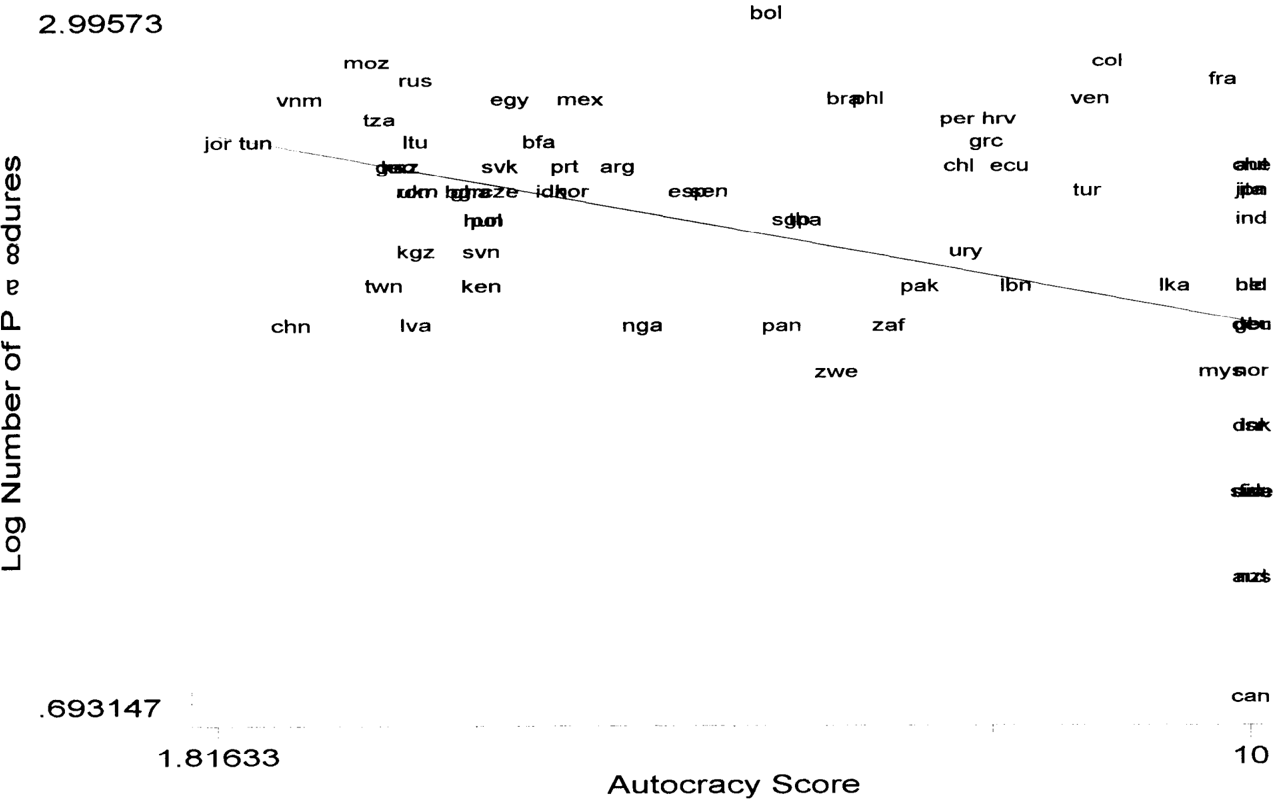
- In Table VIII, better government is associated with lighter regulation; the paper states that countries with more limited and representative governments have statistically significantly fewer procedures using 5 out of 6 measures of better government, and that more autocratic countries regulate more heavily.
Methods
- The paper builds a new database on entry regulation for 75 countries, focusing on the legal requirements, official time, and official cost for a standardized start-up firm.
- Data were gathered from written government sources, World Bank- and USAID-sponsored studies, government web pages, direct contacts with agencies, and independent double-checks in 73 countries via local consulting reports; the remaining 2 countries were double-checked through government contacts.
- The main analysis uses cross-country OLS regressions relating entry regulation measures to outcomes such as quality, pollution, unofficial economy, corruption, political institutions, legal origin, and GDP per capita; the paper also reports correlations and test-of-means comparisons across income quartiles.
Limitations
- The paper itself notes that the capture-theory tests are based on crude measures and that the data are probably least suited to test the capture hypothesis.
- The authors say the data almost surely underestimate the cost and complexity of entry because they focus on the capital city, omit industry-specific requirements and foreign-ownership steps, and ignore some informal delays and bribes.
- Evident from the text: the study is cross-sectional and based on official procedures/costs, so causal interpretation is limited and informal corruption/bureaucratic delays are not directly measured except indirectly through correlations.
Model-written summary. Check it against the paper before relying on it.
Integrity signals
Registry
Cites
Statistics
Figures
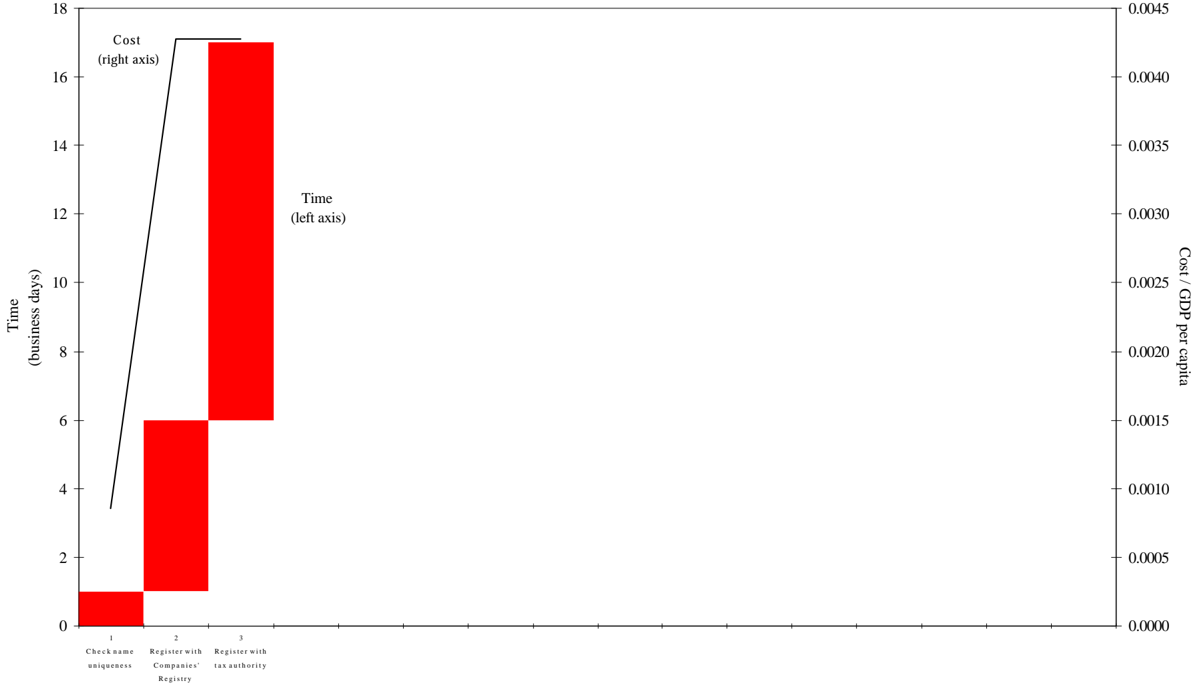
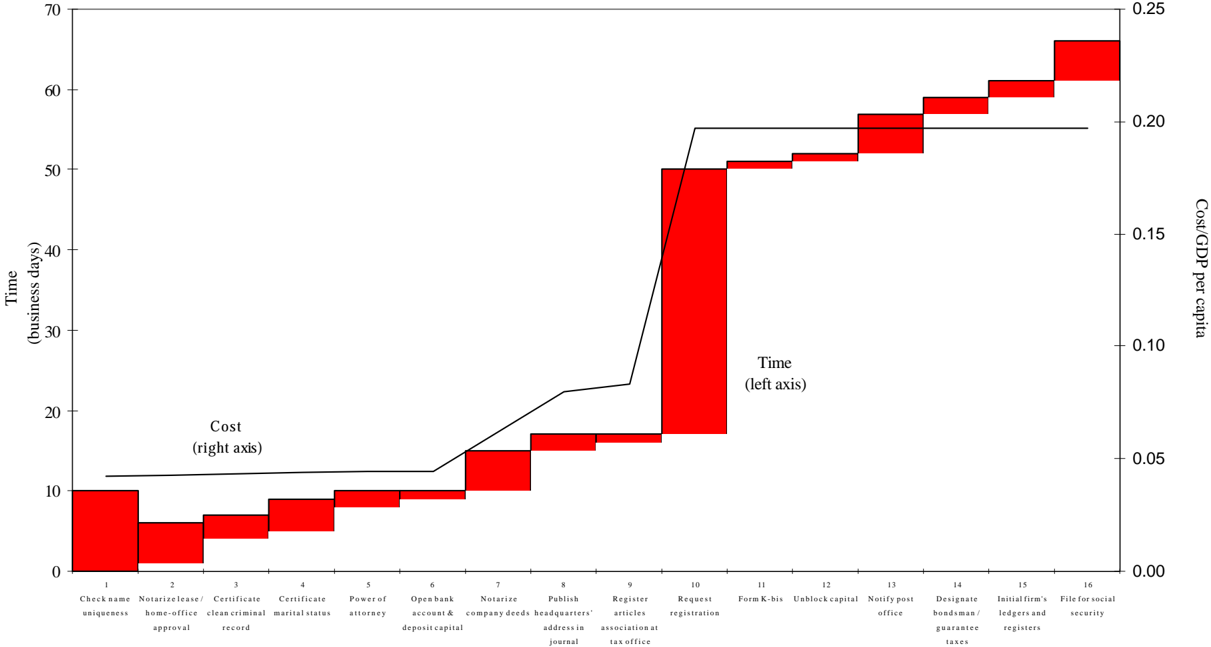
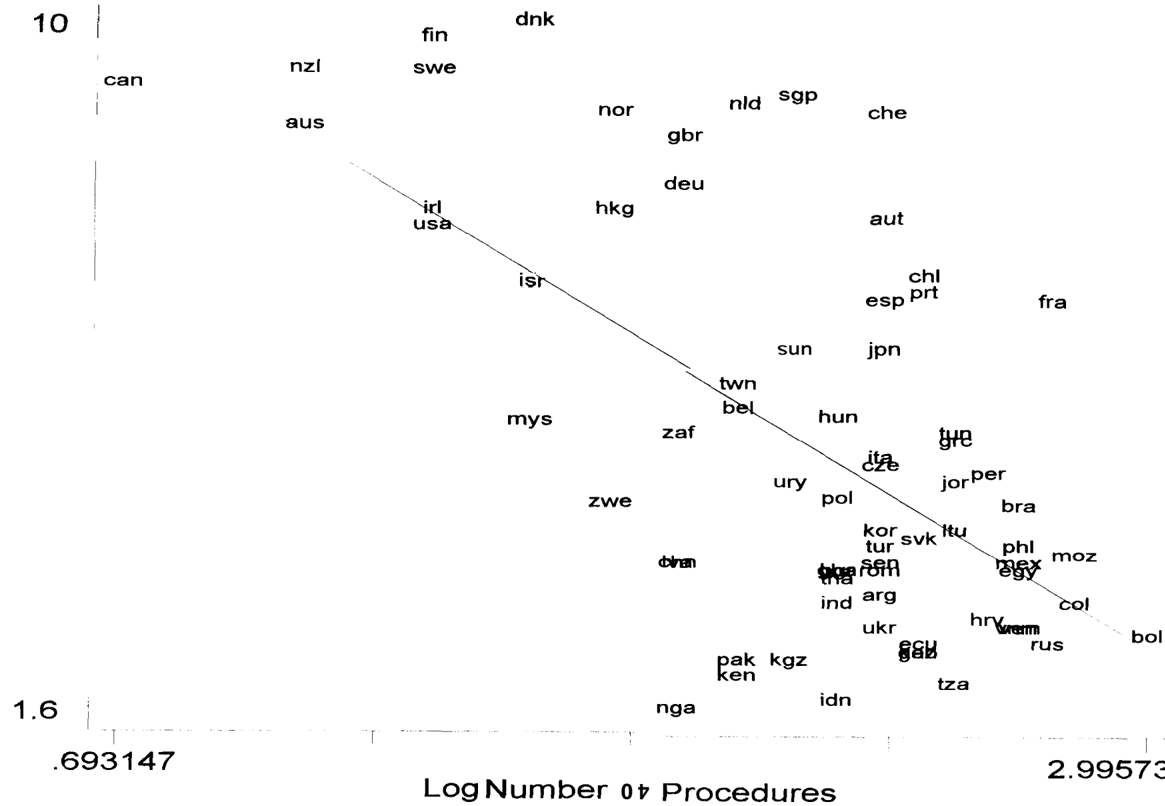
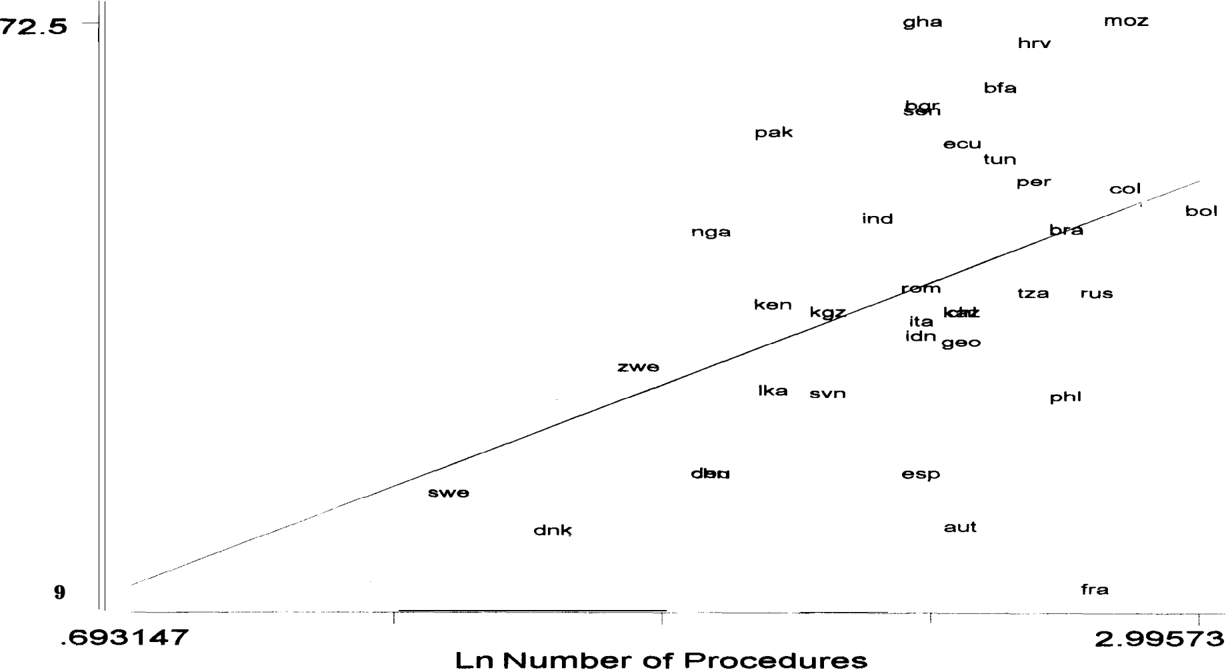
Verification
Claims the paper makes
0 Valid · 3 Not valid · 13 Not checked · 114 Own results and interpretations
A result the paper reports from its own data — it cites no other source for it, so there is none to check. The quote shows it is in the paper.
In the paper
“Very few entry regulations cover tax and labor issues.”
plain- Asserted: passes — The authors put it forward as true.
- Checkable: passes — It can be checked against evidence.
- Load-bearing: unclear — It is unclear whether the paper’s conclusions depend on it.
- Based: passes — The paper gives a reason why it holds.
In the paper
“The data show that the numbers of entry and of labor market regulations are positively correlated across countries, contrary to the substitutes hypothesis.”
What the sources say
- Not matchedcites Djankov et al., 2000
An author–year citation the paper’s reference list doesn’t settle. We don’t search these by name.
plainstates an association- Asserted: passes — The authors put it forward as true.
- Checkable: passes — It can be checked against evidence.
- Load-bearing: unclear — It is unclear whether the paper’s conclusions depend on it.
- Based: passes — The paper gives a reason why it holds.
- Not matched
A result the paper reports from its own data — it cites no other source for it, so there is none to check. The quote shows it is in the paper.
In the paper
“It often takes the form of screening procedures.”
- Also stated in: § III. Basic Results. · plain
“Instead, much of what governments do to regulate entry falls into the category of screening procedures.”
plain- Asserted: passes — The authors put it forward as true.
- Checkable: passes — It can be checked against evidence.
- Load-bearing: unclear — It is unclear whether the paper’s conclusions depend on it.
- Based: passes — The paper gives a reason why it holds.
- Also stated in: § III. Basic Results. · plain
A result the paper reports from its own data — it cites no other source for it, so there is none to check. The quote shows it is in the paper.
In the paper
“First, the cost-to-per-capita-GDP ratio decreases uniformly with GDP per capita.”
plainstates an association- Asserted: passes — The authors put it forward as true.
- Checkable: passes — It can be checked against evidence.
- Load-bearing: unclear — It is unclear whether the paper’s conclusions depend on it.
- Based: passes — The paper gives a reason why it holds.
A result the paper reports from its own data — it cites no other source for it, so there is none to check. The quote shows it is in the paper.
In the paper
“In contrast, countries in the other three quartiles of per capita income are not statistically different from each other in terms of the number of procedures and the time required to fulfill them.”
plain- Asserted: passes — The authors put it forward as true.
- Checkable: passes — It can be checked against evidence.
- Load-bearing: passes — The paper’s conclusions depend on it.
- Based: passes — The paper gives a reason why it holds.
49 more claims
Create a free account to see all 130 claims and every source verdict.
- Probably not a substantial claim. 21
- It may state two separate claims as one. 54
- The quote only partly states this claim. 26
Claims other papers make about this one
Each is checked against this paper’s own text: does it say what the citing paper says it does?
The source backs part of the claim, not all of it — or backs it for a different population, condition or comparison.
In the citing paper
“Our findings suggest an explanation for the low level of incorporation in Italy: the average direct cost associated with fulfilling the bureaucratic regulations for registering a new corporation in Italy is 20% of per capita GNP compared to 10% of per capita GNP on average for other G-7 European countries.”
From Entry regulation as a barrier to entrepreneurship (2006) · cites this paper as Djankov et al. (2002)
Experimental — accuracy not yet measuredThe cited source says what the claim attributes to it.
In the citing paper
“Given the explicit link made by Djankov et al . (2002) between the speed and ease with which businesses may be established in a country and its economic performance - and the enthusiasm with which this link has been grasped by European Union policy makers - our findings imply this link needs reconsidering.”
From The Effect of Business Regulations on Nascent and Young Business Entrepreneurship (2007) · cites this paper as Djankov et al . (2002)
Citations
Cites
La Porta, R., Lopez‐de‐Silanes, F., Shleifer, A., & Vishny, R. W. (1998) · Journal of Political Economy · doi:10.1086/250042 · Cited by 18,025
Self-citationThe Theory of Economic Regulation
Stigler, G. J. (1971) · The Bell Journal of Economics and Management Science · doi:10.2307/3003160 · Cited by 8,098
Journal of Economic Literature
(2019) · AEA Papers and Proceedings · doi:10.1257/pandp.109.633 · Cited by 7,468
The Quarterly Journal of Economics
Kuznets, S. (2024) · Business Cycle Theory, Part I Volume 4 · doi:10.4324/9781003549741-8 · Cited by 7,176
La Porta, R. (1999) · Journal of Law, Economics, and Organization · doi:10.1093/jleo/15.1.222 · Cited by 5,699 · cited 2×
“Legal origin has been viewed as a proxy for the government’s proclivity to intervene in the economy and the stance of the law toward the security of property rights in a country [La Porta et al. 1999].”
The Theory of Economic Regulation
Stigler, G. J. (2021) · The Political Economy · doi:10.4324/9781315495811-8 · Cited by 5,483
Pigou, A. C. (1933) · The Economic Journal · doi:10.2307/2224491 · Cited by 5,137
Toward a More General Theory of Regulation
Peltzman, S. (1976) · The Journal of Law and Economics · doi:10.1086/466865 · Cited by 4,729
Moffitt, R. A. (2009) · American Economic Review · doi:10.1257/aer.99.2.660 · Cited by 4,694
Shleifer, A., & Vishny, R. W. (1993) · The Quarterly Journal of Economics · doi:10.2307/2118402 · Cited by 3,778
Self-citation
Research works printed but not linked: 7
- McLiesh Caralee, 2001, NBER Working Paper No., 8288
- Kasnako lu, Zehra, and Münür Yayla, 'Unrecorded Economy in Turkey: A Monetary Approach', 1999. "Unrecorded Economy in Turkey (A Monetary Approach)" in Informal Sector in Turkey (I), Tuncer Bulutay (ed.), SIS, Ankara, forthcoming.
- Fred, 1987, Journal of Legal Studies, 101
- Olson, Mancur, 1991, 'Autocracy, Democracy, and Prosperity,' in Richard Zeckhauser, ed., Strategy of Choice, Cambridge, MA: MIT Press.
- 1967, Western Economic Journal, 232
- World Economic Forum (1999), The Global Competitiveness Report 1999 , Schwab, Klaus et al., eds., New York: Oxford University Press.
- World Economic Forum, The Global Competitiveness Report 2001, Klaus Schwab et al., eds. (New York, NY: Oxford University Press, 2001).
Cited by
Items 3,701–3,800 of 3,986
The Customary Atlas of Ancien Régime FrancePreprint
Gay, V., Gobbi, P. E., & Goñi, M. (2023) · SSRN Electronic Journal · doi:10.2139/ssrn.4675919
Culture and Wealth Creation: Evidence from World Stock MarketsPreprint
Eun, C. S., Jang, E., & Wang, L. (2024) · SSRN Electronic Journal · doi:10.2139/ssrn.4679538
Stadelmann, D., & Frank, M. (2023) · Studies in Public Choice · doi:10.1007/978-3-031-44393-0_4 · Cited by 1
Private Equity in Emerging Markets
Sannajust, A., & Groh, A. P. (2023) · Springer eBooks · doi:10.1007/978-3-030-38738-9_19-1 · Cited by 2
Kostenwahrheit und Kostenscheinwahrheit: Eine politisch-ökonomische Analyse
Stadelmann, D., & Eichenberger, R. (2023) · ORDO · doi:10.1515/ordo-2023-2036
Environmental disclosure in high information asymmetry mining development firmsPreprint
Ferguson, A. (2024) · SSRN Electronic Journal · doi:10.2139/ssrn.4717666
Deepening of the Licensing Reform: Since 2012
Liang, Y. (2024) · State Governance · doi:10.1007/978-981-99-9714-5_6
Exploring the Horizon of Innovation - Lessons from Student Entrepreneurship for Norway's FuturePreprint
Hole, G. A. (2024) · SSRN Electronic Journal · doi:10.2139/ssrn.4750575
Li, H., & Yu, D. (2024) · Research Square · doi:10.21203/rs.3.rs-4008313/v1
Ferreira, L. G. V., & Medeiros, C. R. D. O. (2024) · Cadernos EBAPE BR · doi:10.1590/1679-395120230009x
Tác động của chất lượng thể chế đến năng suất yếu tố tổng hợp của các doanh nghiệp ở Việt Nam
Thu, H. N. T. (2024) · Tạp chí Khoa học Thương mại · doi:10.54404/jts.2024.187v.03
The Effects of Time-to-Build and Regulation on Investment Timing and SizePreprint
Jeon, H. (2024) · SSRN Electronic Journal · doi:10.2139/ssrn.4747939
Alonso, M. N. I., & Arias, F. (2024) · SSRN Electronic Journal · doi:10.2139/ssrn.4751505
Fohlin, C., & Gregg, A. (2024) · The Economic History Review · doi:10.1111/ehr.13342
Ghulam, Y., & Collins, A. (2024) · SSRN Electronic Journal · doi:10.2139/ssrn.4802842
Regulatory Burdens and Entrepreneurship: Evidence from Sales Tax ComplexityPreprint
Kenchington, D. G., Paparcuri, C. S., Smith, J. D., & White, R. M. (2024) · SSRN Electronic Journal · doi:10.2139/ssrn.4801079 · Cited by 2
Pinto, K. (2024) · SSRN Electronic Journal · doi:10.2139/ssrn.4818321
Rules and Regulations, Managerial Time and Economic Development
Tamkoç, M. N., & Ventura, G. (2024) · World Bank, Washington, DC eBooks · doi:10.1596/1813-9450-10761 · Cited by 4
Regulatory capture on emergency due process of law-making
Chandranegara, I. S., & Marfungah, L. (2024) · Cogent Social Sciences · doi:10.1080/23311886.2024.2356382
Do U.S. multinationals use income shifting to facilitate and hide corruption?
Demeré, P., Gramlich, J. D., & Nam, Y. (2024) · Journal of Accounting and Public Policy · doi:10.1016/j.jaccpubpol.2024.107213 · Cited by 3
Insolvency Systems Around the World
Gurrea‐Martínez, A. (2024) · Cambridge University Press eBooks · doi:10.1017/9781009431743.008
Features and Challenges of Insolvency Law in Emerging Economies
Gurrea‐Martínez, A. (2024) · Cambridge University Press eBooks · doi:10.1017/9781009431743.006
The Darkside of Board Reforms: Evidence from Firms’ Earnings Management BehaviourPreprint
Tunyi, A. A., Machokoto, M., & Gyimah, D. (2024) · SSRN Electronic Journal · doi:10.2139/ssrn.4863233
The Effect of Firm-Specific Exposure to Regulatory Intensity on Earnings ManagementPreprint
Jory, S. R., Ngo, T., & Susnjara, J. (2024) · SSRN Electronic Journal · doi:10.2139/ssrn.4863235 · Cited by 1
Koven, S. G. (2024) · Springer eBooks · doi:10.1007/978-3-030-87624-1_406-1
Huňady, J., & Demeová, E. (2024) · Ekonomika a spoločnosť · doi:10.24040/eas.2024.25.1.61-78
Multinational entry and exit, technology transfer, and international business cycles
Udupa, G. (2024) · Journal of Economic Dynamics and Control · doi:10.1016/j.jedc.2024.104914
Dolfsma, W. A., Daniel, G. O., Aalbers, R., Fu, K., & Materia, V. C. (2024) · SSRN Electronic Journal · doi:10.2139/ssrn.4891500
Learning from Neighbors and Differentiating Export Quality
Liu, Q., Qiu, B., Edwards, T. H., et al. (2024) · China & World Economy · doi:10.1111/cwe.12539
Mapping Institutional Resilience: Locating Regulatory and Growth Frameworks in Central Asia
Khudaykulov, A. (2024) · International political economy series · doi:10.1007/978-3-031-55341-7_6
Brand Name Strategies and Risk Management Selecting a Brand Name in a Foreign MarketPreprint
Domínguez, B., Garrido, E., González, M., & Maícas, J. P. (2024) · SSRN Electronic Journal · doi:10.2139/ssrn.4908006
The Impact of Economic Policies on Creating Restaurant Startups
Mao-Clark, X., Koh, Y., Defranco, A. L., & Back, K. (2024) · Journal of Hospitality & Tourism Research · doi:10.1177/10963480241292025 · Cited by 3
“Increased taxation acts as a deterrent for individuals in society who may otherwise be inclined to pursue entrepreneurial ventures, leading them to choose higher-paying jobs instead (Djankov et al., 2002).”
Saydullayev, A. (2024) · International Journal of Economics and Innovative Technologies · doi:10.55439/eit/vol12_iss2/a23
Who funds whose infrastructure? Country dyadic analysis of global project finance loans
Lai, R., Karaca, I., & Hong, J. Y. (2024) · Review of International Political Economy · doi:10.1080/09692290.2024.2421515
Birhanu, T., & Bisset, T. (2024) · Journal of the Knowledge Economy · doi:10.1007/s13132-024-02409-7
“Accordingly, advocators of this school preach less state regulation and the legalization of informal property rights as a proper policy prescriptions (Friedman et al., 2000; Djankov et al., 2002; Loayza et al. 2005; Schneider, 2005; Acemoglu et al., 2001; and North et al., 2005).”
A macroeconomic assessment of the Italian Recovery and Resilience Plan from administrative data
Bartolomeo, G. D., & D’Imperio, P. (2024) · Economia Politica · doi:10.1007/s40888-024-00350-1 · Cited by 12
Corporate Debt Structure Around the WorldPreprint
Aghaee, A., Bretscher, L., & Rossi, S. (2024) · SSRN Electronic Journal · doi:10.2139/ssrn.5016807
Moutinho, V., de Oliveira, H. V. E., de Oliveira, H. M. S., & Vaz, F. V. (2024) · World-systems evolution and global futures · doi:10.1007/978-3-031-67583-6_7
Does Complex Regulation Create Insider Trading Opportunities?Preprint
Campbell, J. L., Davidson, O., Goldman, N. C., & Holt, M. (2024) · SSRN Electronic Journal · doi:10.2139/ssrn.5061737 · Cited by 3
Colonial Experiences and Contemporary LawsPreprint
Chang, Y., Chilton, A. S., Garoupa, N. M., et al. (2024) · SSRN Electronic Journal · doi:10.2139/ssrn.5027957
Taheri, M., & SHojashafiee, P. (2024) · quarterly journal of fiscal and Economic policies · doi:10.61186/qjfep.12.47.127 · Cited by 1
Analysis of Factors Influencing Entrepreneurial Activity in the Context of Digital Transformation
张, 园. (2025) · E-Commerce Letters · doi:10.12677/ecl.2025.141128
Formal and Informal Entrepreneurship: The Consequences of Weak Formal InstitutionsPreprint
Junaid, D., Masood, A., St-Jean, É., & Usman, M. (2025) · SSRN Electronic Journal · doi:10.2139/ssrn.5132787
Hamid, A., & Silvana, N. (2025) · International Journal of Business Ecosystem and Strategy (2687-2293) · doi:10.36096/ijbes.v7i1.737 · Cited by 6
“Djankov et.al.”
Law Enforcement Quality and Venture Capital Efficiency: Evidence from ChinaPreprint
Guo, Y., Fengyuan, L., & Li, J. (2025) · SSRN Electronic Journal · doi:10.2139/ssrn.5179007
Licit and Illicit Responses to Regulation: Revisited
Benham, L. (2025) · Springer eBooks · doi:10.1007/978-3-031-50810-3_17
Raimi, L., & Bamiro, N. B. (2025) · European Business Review · doi:10.1108/ebr-05-2024-0171 · Cited by 2
The Destructive Impact of Business-Related Terrorism on Start-Up Rates
Ijaz, A. (2025) · Springer eBooks · doi:10.1007/978-981-96-0112-7_12
Silva, R., & Gerwe, O. (2025) · Contributions to management science · doi:10.1007/978-3-031-81233-0_14
Private Equity in Emerging Markets
Sannajust, A., & Groh, A. P. (2025) · Springer eBooks · doi:10.1007/978-3-031-81653-6_19
Paulite, S., & Espiritu, M. (2025) · Psychology and Education A Multidisciplinary Journal · doi:10.70838/pemj.360309
Land Use Regulations and Informal Land UsePreprint
Goytia, C., Heikkila, E. J., & Dutta, A. (2025) · SSRN Electronic Journal · doi:10.2139/ssrn.5233568
Liang, S., Lin, S., Gu, X., Cao, B., Song, D., & Shi, Y. (2025) · Post-Communist Economies · doi:10.1080/14631377.2025.2496849
Regulatory Risk and Firm Decision-making: Evidence from the Waters of the United States and US FarmsPreprint
Hoxie, P. G., & Armentano, V. (2025) · SSRN Electronic Journal · doi:10.2139/ssrn.5199716
Are Strong Neighbors Good Neighbors?“Doing Business” Spatial Spillover Effects and Policy LearningPreprint
Guo, S., Xu, Z., & Ruanzhou, Y. (2025) · SSRN Electronic Journal · doi:10.2139/ssrn.5240882
Transactional Impediments to Entrepreneurship: A Cross Nation ComparisonPreprint
Shah, P. (2025) · SSRN Electronic Journal · doi:10.2139/ssrn.5228842
Young Firms and Financial Access: The Role Informal InstitutionsPreprint
Reddy, K., Cavoli, T., & Gopalan, S. (2025) · SSRN Electronic Journal · doi:10.2139/ssrn.5275987
Ociepa-Kicińska, E., Czyżycki, R., Skica, T., et al. (2025) · Sustainability · doi:10.3390/su17135774
Fiscal Origin of Selective Enforcement: Evidence from China's Administrative PenaltiesPreprint
Zu, Z., & Lin, S. (2025) · SSRN Electronic Journal · doi:10.2139/ssrn.5297864 · Cited by 1
Breaking barriers: investigating the effects of 100% foreign ownership on business entry in Dubai
Rashad, A. S. (2025) · Journal of Entrepreneurship and Public Policy · doi:10.1108/jepp-02-2024-0022 · Cited by 2
Regulating Entrepreneurship: The Case of Capital RequirementsPreprint
Ring, M. A. K., Fagereng, A., & Wold, E. G. (2025) · SSRN Electronic Journal · doi:10.2139/ssrn.5333332
Deregulation, Corruption, and Bank Failures in the UsPreprint
Attila, J. G., & Lare-Lantone, K. (2025) · SSRN Electronic Journal · doi:10.2139/ssrn.5349290
falsificación de datos del Informe Doing Business del Banco Mundial
Sánchez, L. A. P. (2025) · Cuadernos de Coyuntura · doi:10.48204/j.cc.n2.a7607
Moon, Y., Noh, S., Kim, S.-B., & Park, J. H. (2025) · International Review of Public Administration · doi:10.1080/12294659.2025.2530810
“However, inadequate regulation can also lead to corrupt practices if proper oversight mechanisms are not in place (Djankov et al., 2002).”
Experimentelle Ansätze in der empirischen Korruptionsforschung
Kubbe, I. (2025) · Springer eBooks · doi:10.1007/978-3-658-42592-0_65-1
Signaling and Conflict in the Formation of State CapacityPreprint
Jia, C., Wang, M., & Wei, F. (2025) · SSRN Electronic Journal · doi:10.2139/ssrn.5375564
Shukla, A. P., & Dangi, H. K. (2025) · Emerald Group Publishing Limited eBooks · doi:10.1108/978-1-83662-252-920251009
Project Management Maturity in Zambia’s Petroleum Sector: A Comparative Study
Shinina, A., & Ndovi, L. (2025) · European Modern Studies Journal · doi:10.59573/emsj.9(3).2025.04
Tong, Z., Chen, J., Qi, Y., Fu, H., & Xu, Y. (2025) · Cities · doi:10.1016/j.cities.2025.106351 · Cited by 1
Regulation and entrepreneurship in the U.S. child care market
Flowers, A. C. (2025) · The Review of Austrian Economics · doi:10.1007/s11138-025-00693-3
Mumuni, S., & Mwimba, T. (2025) · SN Business & Economics · doi:10.1007/s43546-025-00901-z
Effects of entrepreneurial experience and feedback acceptance on legitimacy attainment
Nayır, D. Z., Nagy, B. G., & Atılgan, Ö. (2025) · Asian Business & Management · doi:10.1057/s41291-025-00306-8
“…country-wide dispositions, financial risks, and looming costs often are the antecedents and contributors to high failure rates among new ventures in emerging and underdeveloped nations (Del Pilar et al., 2020; Djankov et al., 2002) and low-growth market orientations (Batjargal et al., 2013).”
Politically Naked Industries: A Study on Industry Political Profiles and Return PerformancePreprint
Douidar, S., Park, J. C., & Pantzalis, C. (2025) · SSRN Electronic Journal · doi:10.2139/ssrn.5433961
Dong, L., Hidthiir, M. H., Mansur, M., & Mohammed, N. (2025) · Economies · doi:10.3390/economies13090259 · Cited by 4
“Research by Djankov et al. (2002) indicates that excessive institutional standardization may reduce enterprises’ operational flexibility, particularly for those ac-customed to operating under relatively lenient institutional conditions.”
A Practical Measure of Red Tape
Chambers, D., & O’Reilly, C. (2025) · Regulation & Governance · doi:10.1111/rego.70079 · Cited by 1
Structural Reforms S աnd Structural Changes. Comparative Analysis
Petrosyan, N. B. (2025) · Регион и мир / Region and the World · doi:10.58587/18292437-2025.4-171
Why are Manufacturing Plants Smaller in Developing Countries? Theory and Evidence from IndiaPreprint
Jain, A., & Kothari, S. (2025) · SSRN Electronic Journal · doi:10.2139/ssrn.5502341
Zhao, S. X. B., Bo, Y., & Chan, N. Y. M. (2025) · Springer eBooks · doi:10.1007/978-981-95-0728-3_4 · Cited by 1
Link Between Informal Competition and Innovations in Formal Firms
Bayraktar, N., & Bhosale, T. V. (2025) · Eurasian studies in business and economics · doi:10.1007/978-3-031-98398-6_7
Effects of Informal Competition on Formal Firm Revenue Quantiles
Ezeibekwe, O. F. (2025) · Journal of African Business · doi:10.1080/15228916.2025.2564484
AI Industrial Policy and Entrepreneurial Dynamics: Evidence from China's Pilot ZonesPreprint
Zhou, Y. (2025) · SSRN Electronic Journal · doi:10.2139/ssrn.5496279 · Cited by 2
Does internationalization trigger digital innovation?
Zhang, Y., Xue, W., Liu, C., & Roelfsema, H. J. (2025) · Review of World Economics · doi:10.1007/s10290-025-00613-4 · Cited by 2
“To measure the level of competition in export destinations, we use the “Start a Business”index from the World Bank’s Doing Business database (Djankov et al., 2002 ).”
Ease of doing business and economic growth: does foreign direct investment matter?Preprint
Awwad, M. S. (2025) · SSRN Electronic Journal · doi:10.2139/ssrn.5573935
Corporate lobbying, political action committees, and market concentration
Bickmore, E., Blau, B. M., Griffith, T. G., & Whitby, R. J. (2025) · Public Choice · doi:10.1007/s11127-025-01337-7
Huang, S., & Zhou, Z. (2025) · Finance research letters · doi:10.1016/j.frl.2025.108745
The Economic Freedom Law and labor market dynamics: sectoral and regional impacts in Brazil
Vechi, A., Wink, M. V., Paese, L. H. Z., et al. (2025) · International Review of Public Administration · doi:10.1080/12294659.2025.2575525
“More broadly, regulatory complexity is often associated with informality, corruption, and inefficiency (De Soto, 2000; Djankov et al., 2002).”
Corruption, firm performance, and innovation: Evidence from Gulf Cooperation Council countriesPreprint
Laing, E., Han, X., & Al-Nasser, Z. (2025) · SSRN Electronic Journal · doi:10.2139/ssrn.5667867
Mbassi, C. M. (2025) · Open Economies Review · doi:10.1007/s11079-025-09839-z
Acemoğlu, D. (2008) · The New Palgrave Dictionary of Economics · doi:10.1007/978-1-349-58802-2_686
Loison, S. A., Liverpool‐Tasie, L. S. O., Belton, B., et al. (2025) · doi:10.12688/verixiv.2359.1
Sun, S., Ma, X., & Chen, J. (2025) · Cliometrica · doi:10.1007/s11698-025-00324-8
“As agents of the state, bureaucrats do not necessarily pursue public welfare as their primary objective (Tullock 1965; Stigler 1971; Peltzman 1976; Djankov et al. 2002; Besley et al. 2022).”
Labor Informality and Market Segmentation in Senegal
Rodríguez‐Castelán, C., & Vázquez, E. (2025) · Review of Development Economics · doi:10.1111/rode.70079
Understanding the drivers of informal economy of coal mining
Bhat, D. A., & Thakur, N. (2025) · Cogent Social Sciences · doi:10.1080/23311886.2025.2591415
How does entry deregulation affect employment: Evidence from China
Su, Y., Xu, B., & Zeng, X. (2025) · Economic Analysis and Policy · doi:10.1016/j.eap.2025.11.016
Tax sharing and urban entrepreneurship: an analysis based on China's VAT revenue sharing reformPreprint
Pang, Y., Chen, S., & Zhang, Y. (2025) · Research Square · doi:10.21203/rs.3.rs-8226335/v1
Education and market liberal preferences
Nye, J. V. C., Bryukhanov, M., Litman, C., & Polyachenko, S. S. (2025) · Journal of Economic Behavior & Organization · doi:10.1016/j.jebo.2025.107387
Unternehmensgründungen in Deutschland: bürokratische Spießrutenläufe?
Kriehn, C. (2004) · RePEc: Research Papers in Economics
Investor protection and agency problems in family firms: evidence from China
Zhou, J. (2015) · RMIT Research Repository (RMIT University Library) · doi:10.25439/rmt.27589542
Essays on Corruption and Preferences
Viceisza, A. (2008) · Digital Archive @ GSU · doi:10.57709/1061481
Metadata
- Authors
- Djankov, S., La Porta, R., Lopez-de-Silanes, F., & Shleifer, A.
- Affiliations
- World Bank (US)
- National Bureau of Economic Research (US)
- ORCID
- Djankov, S.
- Venue
- The Quarterly Journal of Economics
- Publisher
- Oxford University Press (OUP)
- Published
- 2002-02-01
- Volume
- 117
- Issue
- 1
- Pages
- 1-37
- ISSN
- 0033-5533
- 1531-4650
- OpenAlex
- W2139896179
- Cited by
- 3,956
- References
- 30
- Citations by year
- 2026: 223 · 2025: 185 · 2024: 157 · 2023: 120 · 2022: 140 · 2021: 150 · 2020: 151 · 2019: 161 · 2018: 157 · 2017: 162 · 2016: 166 · 2015: 193 · 2014: 200 · 2013: 183 · 2012: 193
- Type
- report
- Language
- en
- Open access
- green
- doi.org
- Licence
- other-oa
- Locations
- World Bank, Washington, DC eBooks (publishedVersion)
- The Quarterly Journal of Economics (publishedVersion)
- The World Bank Open Knowledge Repository (World Bank) (publishedVersion)
- National Bureau of Economic Research (publishedVersion, other-oa)
- RePEc: Research Papers in Economics (submittedVersion)
- Digital Access to Scholarship at Harvard (DASH) (Harvard University) (submittedVersion, cc-by)
- SSRN Electronic Journal (submittedVersion)
- OpenGrey (Institut de l'Information Scientifique et Technique) (submittedVersion)
- The World Bank Open Knowledge Repository (World Bank) (submittedVersion, cc-by)
- Topics
- Social Sciences › Sociology and Political Science › Corruption and Economic Development
- Social Sciences › Economics, Econometrics and Finance › Economics and Econometrics › Taxation and Compliance Studies
- Social Sciences › Business, Management and Accounting › Strategy and Management › Political Influence and Corporate Strategies
- Keywords
- start-up firms, bureaucratic procedures, corruption, informal economy, democracy, government size, public choice theory, public interest theory
About these checks
Registry, retraction, Cites and statistics results are computed, not judged, with one exception: a printed reference that no index lists is read once by a model before it counts as a citation error. Claims are extracted by a model and kept only when their quote appears verbatim in the text; each cited source is then checked, with a model’s help, for whether it says what the claim relies on. Those verdicts can be wrong — read the claim’s quote and the cited source before relying on one.
A language model drew the claims from the paper on 2026-10-01, under version 3 of the claim definition (model deepseek-v4.1-flash, prompt extract-v3).
A second model labelled each claim on 2026-10-01 (model jev-1.13-20260917, definition revision gold-guideline-v0.2).
Statistics and arithmetic are recomputed, not judged.
Confidence bands are shown only for fields calibrated on our annotated test set. None is calibrated yet, so no band is shown.
What counts as a claim ›How we measure confidence ›How we check this ›
Are you an author, or do you see a problem with this page? Request a review
Data sources
Bibliographic data: Semantic Scholar, OpenAlex, Crossref.
Contains information from the Semantic Scholar Academic Graph Datasets, made available under the ODC Attribution License (ODC-BY 1.0).
Semantic Scholar’s data is described in: Kinney, R., et al. (2023). The Semantic Scholar Open Data Platform. arXiv:2301.10140.
