

A Meta-Analysis of Organizational Complaint Handling and Customer Responses
Open accessThe DOI matches its Crossref record; 83 of the 83 references it cites were found in a registry or an index; 2 of the 79 sources its claims cite were checked for support.
Abstract
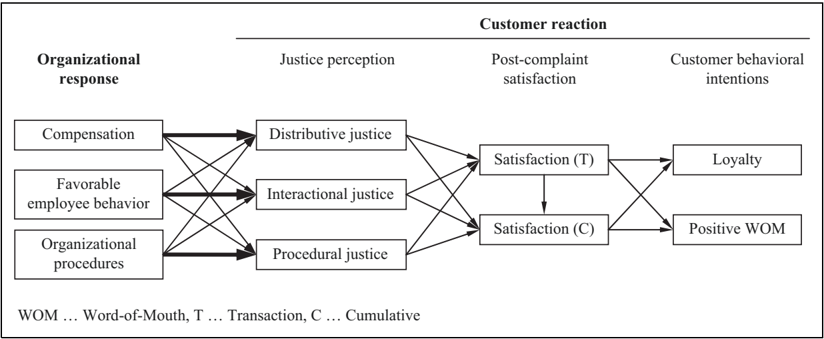
Service recovery is a crucial success factor for organizations. Thus, many studies have addressed the issue of post-complaint behavior. Conducting a meta-analysis, the authors test the following path model: ‘‘organizational responses (compensation, favorable employee behavior, and organizational procedures) → justice perceptions (distributive, interactional, and procedural justice) → post-complaint satisfaction (transaction-specific and cumulative satisfaction) → customer behavioral intentions (loyalty and positive word of mouth [WOM]).’’ The results confirm this model as well as the mediating role of justice perceptions and post-complaint satisfaction. Surprisingly, the results also show that the common contention of distributive justice as the salient driver of service recovery is only true for transaction-specific satisfaction, which in turn reinforces positive WOM. Cumulative satisfaction, however, which is the primary antecedent of customer loyalty, even slightly more depends on interactional justice than on distributive justice. Further, the results show that the relationships between justice perceptions and satisfaction constructs depend on several moderators such as target group, industry, and complaint type. A major managerial implication is the fact that organizations should pay particular attention to distributive justice when complainants are students and to interactional justice when failure is nonmonetary or occurs in service industries. The authors discuss theoretical implications and provide suggestions for future research.
Overview
CoChat Summary
## TL;DR
This meta-analysis synthesizes 87 studies (95 independent samples; total N = 28,826) on complaint handling and tests a path model linking organizational responses to justice perceptions, satisfaction, and behavioral intentions. It finds that the full chain is broadly supported, but that distributive justice is mainly the key driver for transaction-specific satisfaction, while interactional justice matters more for cumulative satisfaction and for some contexts.
## Key findings
- The literature search identified 142 empirical articles; 55 were excluded for insufficient statistics, leaving 87 studies and 477 effects for analysis.
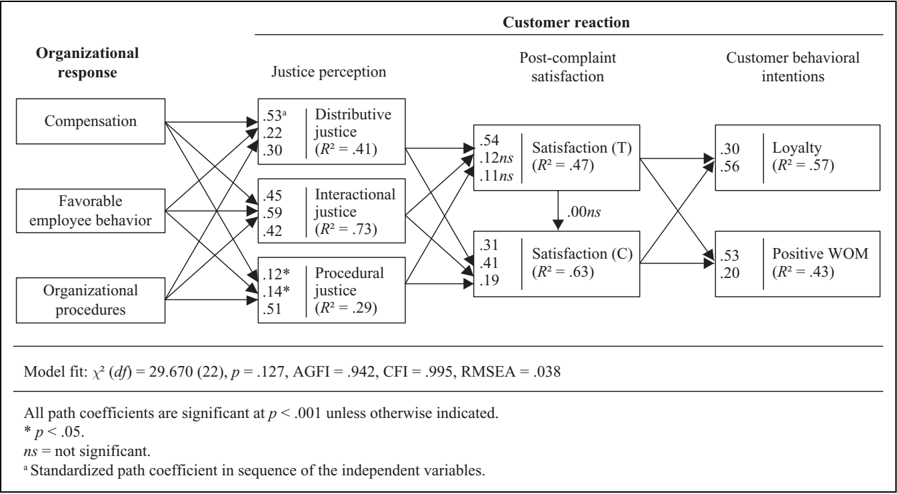
- The hypothesized model fit was excellent: χ²[22] = 29.670, p = .127; AGFI = .942; CFI = .995; RMSEA = .038.
- The model explained 41% of distributive justice, 73% of interactional justice, 29% of procedural justice, 47% of transaction-specific satisfaction, 63% of cumulative satisfaction, 57% of loyalty, and 43% of positive WOM.
- Of 20 estimated path coefficients, 17 were significant at the .05 level; the nonsignificant paths were interactional justice → transaction-specific satisfaction (b = .12, p = .067), procedural justice → transaction-specific satisfaction (b = .11, p = .098), and transaction-specific satisfaction → cumulative satisfaction (b = .00, p = .942).
- Relative effects showed compensation was strongest for distributive justice (χ² diff = 10.454 vs. organizational procedures; 18.844 vs. favorable employee behavior), favorable employee behavior for interactional justice (8.193 vs. compensation; 12.521 vs. organizational procedures), and organizational procedures for procedural justice (21.949 vs. favorable employee behavior; 23.626 vs. compensation).
- Transaction-specific satisfaction was the stronger predictor of positive WOM, while cumulative satisfaction was the stronger predictor of loyalty; the paper reports that transaction-specific satisfaction had a larger effect on positive WOM than cumulative satisfaction (χ² diff = 10.733, p < .001), and cumulative satisfaction had a larger effect on loyalty than transaction-specific satisfaction (χ² diff = 8.831, p < .003).
## Methods
- Meta-analysis of empirical studies from 1980 to June 2009 on relationships among organizational responses, justice perceptions, post-complaint satisfaction, and behavioral intentions.
- Search covered Business Source Complete, Science Direct, Emerald Management Xtra, ABI/Inform, PsycINFO, and the Social Science Citation Index; 142 articles were found, 87 included.
- Effect sizes were correlations; missing correlations were approximated from other statistics, reliability-corrected, weighted by sample size, and pooled. The main analysis used SEM in AMOS 7.0 with maximum likelihood estimation, plus univariate statistics, indirect effects, competing models, and moderator analyses.
- Coding was done by two independent coders; intercoder reliability was .93. Outliers were removed when correlation coefficients exceeded three times the standard error; 5.5% of correlation data points were eliminated.
## Limitations
- The paper says cumulative post-complaint satisfaction is conceptualized as an overall assessment of the entire product/service or organization, but future research should distinguish satisfaction with recovery, with product/service, and with the entire organization.
- It notes compensation level is hard to determine in process failures, so failure type and compensation level should be examined more closely.
- The authors state results may be biased by omitted variables, especially emotions, whose role in the framework remains unclear.
- Evident from the text: some moderator analyses were limited by sparse data, so failure magnitude, switching barriers, online vs. offline complaint handling, relationship quality, and culture could not be examined in detail.
Model-written summary. Check it against the paper before relying on it.
Integrity signals
Registry
Cites
Statistics
Figures

Verification
Claims the paper makes
2 Valid · 2 Not valid · 45 Not checked · 124 Own results and interpretations
The cited sources support only part of this claim — read each source’s verdict below.
In the paper
“It is argued and empirically shown that justice perceptions (distributive, procedural, and interactional justice) completely mediate the relationship between organizational responses and post-complaint satisfaction (Karande, Magnini, and Tam 2007; Maxham III and Netemeyer 2003; Smith, Bolton, and Wagner 1999).”
What the sources say
- Partly supportedcites Karande, Magnini, and Tam 2007 matched to “Recovery Voice and Satisfaction After Service Failure: An Experimental Investigation of Mediating and Moderating Factors” (2007) sourceExperimental — accuracy not yet measured
The Mediation Analysis reports that procedural justice fully mediated the effect of recovery voice on postfailure satisfaction in the airline scenario, but only partially mediated it in the hotel scenario. The study did not test distributive or interactional justice as mediators, or organizational responses beyond recovery voice; the broader claim of complete mediation is therefore not supported. (LLM, conf=0.94)
- Not matchedcites Maxham III and Netemeyer 2003
An author–year citation the paper’s reference list doesn’t settle. We don’t search these by name.
- Not checked — no full text of the sourcecites Smith, Bolton, and Wagner 1999 matched to “A Model of Customer Satisfaction with Service Encounters Involving Failure and Recovery” (1999) source
boostedstates a cause- Asserted: passes — The authors put it forward as true.
- Checkable: passes — It can be checked against evidence.
- Load-bearing: passes — The paper’s conclusions depend on it.
- Based: passes — The paper gives a reason why it holds.
- Partly supported
A result the paper states — it cites no source for it, so there is none to check. The quote shows it is in the paper.
In the paper
“Cumulative satisfaction has a larger impact on loyalty than transaction-specific satisfaction ( w 2 diff[1] ¼ 8.831, p < .003).”
- Also stated in: § Theoretical Implications · plain
“cumulative satisfaction is a stronger predictor of loyalty than transaction-specific satisfaction.”
plainstates an association- Asserted: passes — The authors put it forward as true.
- Checkable: passes — It can be checked against evidence.
- Load-bearing: passes — The paper’s conclusions depend on it.
- Based: passes — The paper gives a reason why it holds.
- Also stated in: § Theoretical Implications · plain
A result the paper reports from its own data — it cites no other source for it, so there is none to check. The quote shows it is in the paper.
In the paper
“The results confirm this model as well as the mediating role of justice perceptions and post-complaint satisfaction.”
boostedstates a cause- Asserted: passes — The authors put it forward as true.
- Checkable: passes — It can be checked against evidence.
- Load-bearing: passes — The paper’s conclusions depend on it.
- Based: passes — The paper gives a reason why it holds.
A result the paper reports from its own data — it cites no other source for it, so there is none to check. The quote shows it is in the paper.
In the paper
“Surprisingly, the results also show that the common contention of distributive justice as the salient driver of service recovery is only true for transaction-specific satisfaction, which in turn reinforces positive WOM.”
plainstates a cause- Asserted: passes — The authors put it forward as true.
- Checkable: passes — It can be checked against evidence.
- Load-bearing: passes — The paper’s conclusions depend on it.
- Based: passes — The paper gives a reason why it holds.
A result the paper reports from its own data — it cites no other source for it, so there is none to check. The quote shows it is in the paper.
In the paper
“Further, the results show that the relationships between justice perceptions and satisfaction constructs depend on several moderators such as target group, industry, and complaint type.”
plainstates an association- Asserted: passes — The authors put it forward as true.
- Checkable: passes — It can be checked against evidence.
- Load-bearing: passes — The paper’s conclusions depend on it.
- Based: passes — The paper gives a reason why it holds.
85 more claims
Create a free account to see all 173 claims and to verify the 5 references still open.
- It may state two separate claims as one. 60
- Borderline: one of the tests for a substantial claim is unclear. 2
- Probably not a substantial claim. 28
Citations
Cites
Statistical Power Analysis for the Behavioral Sciences
Muller, K. (1989) · Technometrics · doi:10.1080/00401706.1989.10488618 · Cited by 99,167
Baron, R. M., & Kenny, D. A. (1986) · Journal of Personality and Social Psychology · doi:10.1037/0022-3514.51.6.1173 · Cited by 91,532
A Cognitive Model of the Antecedents and Consequences of Satisfaction Decisions
Oliver, R. L. (1980) · Journal of Marketing Research · doi:10.1177/002224378001700405 · Cited by 14,494
Adams, J. S. (1965) · Advances in Experimental Social Psychology · doi:10.1016/s0065-2601(08)60108-2 · Cited by 10,818
(2000) · Cited by 9,198
The file drawer problem and tolerance for null results.
Rosenthal, R. (1979) · Psychological Bulletin · doi:10.1037/0033-2909.86.3.638 · Cited by 9,068
The Social Psychology of Procedural Justice
Lind, E. A., & Tyler, T. R. (1988) · Critical Issues in Social Justice · doi:10.1007/978-1-4899-2115-4 · Cited by 6,585
Satisfaction: a behavioral perspective on the consumer
(2010) · Choice Reviews Online · doi:10.5860/choice.47-6963 · Cited by 6,042
Akaike, H. (1987) · Psychometrika · doi:10.1007/bf02294359 · Cited by 5,264
On the dimensionality of organizational justice: A construct validation of a measure.
Colquitt, J. A. (2001) · Journal of Applied Psychology · doi:10.1037/0021-9010.86.3.386 · Cited by 4,114
Research works printed but not linked: 7
- Bagozzi, Richard P. and Hans Baumgartner (1996), ''The Evaluation of Structural Equation Models and Hypothesis Testing,'' in Principles of Marketing Research , 1st reprint, Richard P. Bagozzi, ed. Cambridge, UK: Blackwell, 386-422.
- Blodgett, Jeffrey G. and Stephen S. Tax (1993), ''The Effects of Distributive and Interactional Justice on Complainants' Repatronage Intentions and Negative Word-of-Mouth Intentions,'' Journal of Consumer Satisfaction, Dissatisfaction and Complaining Behavior, 6, 100-110.
- Customer Care Alliance (2003), Customer Care-The Multibillion Dollar Sinkhole. http://www.ccareall.org/
- de Ruyter, Ko, 2000, Inter
- Goodwin, Cathy and Ivan Ross (1989), ''Salient Dimensions of Perceived Fairness in Resolution of Service Complaints,'' Journal of Consumer Satisfaction, Dissatisfaction and Complaining Behavior , 2, 87-98.
- Jain, Dipak C. ( 1996), ‘‘Regression Analysis for Marketing Decisions,’’ in Principles of Marketing Research, 1st reprint, Richard P. Bagozzi, ed. Cambridge, UK: Blackwell, 162-194.
- TARP (1981), Measuring the Grapevine-Consumer Response and Word of Mouth. Atlanta, GA: Coca Cola.
Cited by
Items 101–200 of 471
Meyer, N., Schwede, M., Hammerschmidt, M., & Weiger, W. H. (2022) · Electronic Markets · doi:10.1007/s12525-022-00613-4 · Cited by 51
Examining stealing thunder as a new service recovery strategy: impact on customer loyalty
Guchait, P., Han, R., Wang, X., Abbott, J., & Liu, Y. (2019) · International Journal of Contemporary Hospitality Management · doi:10.1108/ijchm-02-2018-0127 · Cited by 56
Nazifi, A., Gelbrich, K., Grégoire, Y., Koch, S., El-Manstrly, D. A., & Wirtz, J. (2020) · Journal of Service Research · doi:10.1177/1094670520933683 · Cited by 52
Self-citationColmekcioglu, N., Marvi, R., Foroudi, P., & Okumuş, F. (2022) · Journal of Business Research · doi:10.1016/j.jbusres.2022.08.033 · Cited by 59
Retail "Save the Sale" tactics: Consumer perceptions of in‐store logistics service recovery
Peinkofer, S. T., Esper, T. L., Smith, R. J., & Williams, B. D. (2021) · Journal of Business Logistics · doi:10.1111/jbl.12294 · Cited by 47
Joint effect of service recovery types and times on customer satisfaction in lodging
Jin, D., Nicely, A., Fan, A., & Adler, H. (2019) · Journal of Hospitality and Tourism Management · doi:10.1016/j.jhtm.2019.01.005 · Cited by 53
de Matos, C. A., Vieira, V. A., & Veiga, R. T. (2011) · Service Industries Journal · doi:10.1080/02642069.2011.582497 · Cited by 60
“Although relationships between these variables are well established in the research literature (see Gelbrich & Roschk, 2011; Orsingher, Valentini, & de Angelis, 2010), most studies have failed to integrate important contextual factors and consequently use them as control variables in analyses.”
BackgroundBone, S. A., Lemon, K. N., Voorhees, C. M., Liljenquist, K. A., Fombelle, P. W., DeTienne, K. B., & Money, R. B. (2016) · Journal of Marketing Research · doi:10.1509/jmr.14.0232 · Cited by 51
Vieira, V. A., Wolter, J. S., Araújo, C. F., & Frio, R. S. (2022) · International Journal of Research in Marketing · doi:10.1016/j.ijresmar.2022.09.002 · Cited by 57
Cambra‐Fierro, J., Melero‐Polo, I., & Sese, J. (2014) · Service Business · doi:10.1007/s11628-013-0228-4 · Cited by 54
Managing the face in service failure: the moderation effect of social presence
Qiu, S., Li, M., Mattila, A. S., & Yang, W. (2018) · International Journal of Contemporary Hospitality Management · doi:10.1108/ijchm-06-2016-0315 · Cited by 43
Sugathan, P., Rossmann, A., & Ranjan, K. R. (2018) · European Journal of Marketing · doi:10.1108/ejm-04-2016-0228 · Cited by 53
The effect of flight delay on customer loyalty intention: The moderating role of emotion regulation
Li, S., Jiang, Y., Cheng, B., & Scott, N. (2021) · Journal of Hospitality and Tourism Management · doi:10.1016/j.jhtm.2021.03.004 · Cited by 47
Timing and compensation strategies in service recovery
Tang, X., Chang, E.-C., Huang, X., & Zhang, M. (2018) · Journal of Services Marketing · doi:10.1108/jsm-04-2017-0126 · Cited by 54
Gaining satisfaction: the role of brand equity orientation and failure type in service recovery
Ma, K., Zhong, X., & Hou, G. (2020) · European Journal of Marketing · doi:10.1108/ejm-06-2019-0542 · Cited by 43
Nazifi, A., Murdy, S., Marder, B. L., Gäthke, J., & Shabani, B. (2020) · Journal of Business Research · doi:10.1016/j.jbusres.2020.11.012 · Cited by 44
From dissatisfied customers to evangelists of the firm: A study of the Spanish mobile service sector
Fierro, J. C., Polo, I. M., & Sesé, F. J. (2013) · BRQ Business Research Quarterly · doi:10.1016/j.cede.2013.10.001 · Cited by 49
“Additionally, in line with groundbreaking recent work Orsingher et al., 2009; Gelbrich and Roschk, 2011) we ropose that satisfaction plays a mediating role for the ntecedents of service recovery (perceived effort and jusice) and word-of-mouth; but that loyalty and commitment ill partially mediate…”
ResultZou, S. S., & Migacz, S. J. (2020) · Cornell Hospitality Quarterly · doi:10.1177/1938965520967921 · Cited by 42
Yesiloglu, S., Memery, J., & Chapleo, C. (2021) · Internet Research · doi:10.1108/intr-01-2020-0038 · Cited by 50
Wang, D., Zha, Y., Bi, G., & Chen, Y. (2018) · Wireless Personal Communications · doi:10.1007/s11277-018-5488-9 · Cited by 43
The value disruption of uncivil other-customers during online service recovery
Bacile, T. J., Krallman, A., Wolter, J. S., & Beachum, N. D. (2020) · Journal of Services Marketing · doi:10.1108/jsm-05-2019-0209 · Cited by 41
The role of human interaction in complaint handling
Jeanpert, S., Jacquemier-Paquin, L., & Claye-Puaux, S. (2021) · Journal of Retailing and Consumer Services · doi:10.1016/j.jretconser.2021.102670 · Cited by 61
Kim, Y. S., & Baker, M. A. (2019) · Cornell Hospitality Quarterly · doi:10.1177/1938965519857539 · Cited by 46
How to boost frontline employee service recovery performance: the role of cultural intelligence
Costers, A., Vaerenbergh, Y. V., & den Broeck, A. V. (2019) · Service Business · doi:10.1007/s11628-019-00396-3 · Cited by 41
Profiling (un-)committed online complainants: Their characteristics and post-webcare reactions
Weitzl, W., & Einwiller, S. A. (2019) · Journal of Business Research · doi:10.1016/j.jbusres.2019.05.035 · Cited by 46
Piehler, R., Schade, M., Hanisch, I., & Burmann, C. (2019) · Journal of Service Theory and Practice · doi:10.1108/jstp-10-2018-0227 · Cited by 46
Kude, T., Hoehle, H., & Sykes, T. A. (2017) · International Journal of Operations & Production Management · doi:10.1108/ijopm-03-2015-0156 · Cited by 51
Roschk, H., Müller, J., & Gelbrich, K. (2012) · Journal of Retailing and Consumer Services · doi:10.1016/j.jretconser.2012.11.002 · Cited by 40
Self-citationHuang, M. C.-J., Wu, H. C., Chuang, S., & Lin, W. H. (2013) · International Journal of Hospitality Management · doi:10.1016/j.ijhm.2013.10.008 · Cited by 42
Why didn’t it work out? The effects of attributions on the efficacy of recovery strategies
Argüelles, V. I., Neira, C. V., & Vázquez‐Casielles, R. (2015) · Journal of Service Theory and Practice · doi:10.1108/jstp-04-2014-0073 · Cited by 38
Herck, R. E. V., Decock, S., & Fastrich, B. (2021) · English for Specific Purposes · doi:10.1016/j.esp.2021.08.001 · Cited by 49
Who is talking, who is listening? Service recovery through online customer-to-customer interactions
Xu, Y., Yap, S. F., & Hyde, K. F. (2016) · Marketing Intelligence & Planning · doi:10.1108/mip-03-2015-0053 · Cited by 39
Consumer control in service recovery: beyond decisional control
Joosten, H., Bloemer, J. M. M., & Hillebrand, B. (2017) · Journal of service management · doi:10.1108/josm-07-2016-0192 · Cited by 43
A Customer Scorned: Effects of Employee Reprimands in Frontline Service Encounters
Pugh, H. B., Brady, M. K., & Hopkins, L. M. (2018) · Journal of Service Research · doi:10.1177/1094670517746777 · Cited by 36
The Routledge Handbook of Hospitality Marketing
Gürsoy, D. (2017) · Routledge eBooks · doi:10.4324/9781315445526 · Cited by 39
‘Explain, but make no excuses’: service recovery after public service failures
Döring, M. (2020) · Public Management Review · doi:10.1080/14719037.2020.1864013 · Cited by 43
“A meta-analysis by Gelbrich and Roschk (2011) distinguishes between three types of post-complaint responses: compensations (monetary as well as psychological), favourable employee behaviour (explaining reasons for failure, active listening, careful communication), and promptness (smooth…”
Redress procedures expected by consumers during a business-to-consumer e-commerce dispute
Ong, C. E., & Teh, D. (2016) · Electronic Commerce Research and Applications · doi:10.1016/j.elerap.2016.04.006 · Cited by 41
Fota, A., Wagner, K., Roeding, T., & Schramm‐Klein, H. (2022) · Hawaii International Conference on System Sciences (HICSS) · doi:10.24251/hicss.2022.522 · Cited by 35
“Both tangible and intangible elements can be utilized as redress in complaint management situations [58, 59].”
Can a CEO's YouTube apology following a service failure win customers' hearts?
Manika, D., Papagiannidis, S., & Bourlakis, M. (2014) · Technological Forecasting and Social Change · doi:10.1016/j.techfore.2013.12.021 · Cited by 33
Hotel Guests’ Responses to Service Recovery: How Loyalty Influences Guest Behavior
Zoghbi‐Manrique‐de‐Lara, P., Suárez-Acosta, M. A., & Aguiar-Quintana, T. (2013) · Cornell Hospitality Quarterly · doi:10.1177/1938965513513348 · Cited by 36
Harun, A., Rokonuzzaman, M., Prybutok, G. T., & Prybutok, V. R. (2019) · International Journal of Bank Marketing · doi:10.1108/ijbm-01-2018-0001 · Cited by 33
Exploring the effect of AI warm response on consumer reuse intention in service failure
Wang, C., Ni, L., Yuan, B., & Tang, M. (2025) · Computers in Human Behavior · doi:10.1016/j.chb.2025.108606 · Cited by 35
Muhammad, L., Mahadi, B., & Hussin, N. (2017) · Asia Pacific Journal of Marketing and Logistics · doi:10.1108/apjml-10-2016-0193 · Cited by 34
Decock, S., Clerck, B. D., Lybaert, C., & Plevoets, K. (2020) · Journal of Internet Commerce · doi:10.1080/15332861.2020.1848060 · Cited by 32
Online service failure: how consumers from emerging countries react and complain
Rohden, S. F., & de Matos, C. A. (2022) · Journal of Consumer Marketing · doi:10.1108/jcm-01-2021-4366 · Cited by 31
The relative impact of gratitude and transactional satisfaction on post-complaint consumer response
Simon, F. L., Tossan, V., & Ghesquiere, C. C. (2013) · Marketing Letters · doi:10.1007/s11002-013-9271-0 · Cited by 33
What recovery options to offer for loyalty reward program members: Dollars vs. Miles?
Hwang, Y., Gao, L., & Mattila, A. S. (2020) · International Journal of Hospitality Management · doi:10.1016/j.ijhm.2020.102496 · Cited by 34
The role of meta-perceptions in customer complaining behavior
Tojib, D., & Khajehzadeh, S. (2014) · European Journal of Marketing · doi:10.1108/ejm-11-2012-0638 · Cited by 34
“, 2008) and, consequently, increase customers’ repurchase intentions (Liao, 2007) or maintain their customer loyalty (Gelbrich and Roschk, 2011).”
BackgroundFrom service failure to brand loyalty: evidence of service recovery paradox
Lim, W. M., Saha, V., & Das, M. (2025) · Journal of Brand Management · doi:10.1057/s41262-025-00380-5 · Cited by 59
“These perceptions are influenced by the brand’s recovery actions, encompassing the procedures, outcomes, and interpersonal interactions during the service recovery process (de Mesquita et al. 2023; Ha & Jang 2009; Gelbrich & Roschk 2011; Orsingher et al. 2010).”
Task‐Relationship‐Self: A Framework for Understanding Service Encounter Behaviors
Bradley, G. L., Sparks, B., Zapf, D., McColl‐Kennedy, J. R., & Jimmieson, N. L. (2013) · Psychology and Marketing · doi:10.1002/mar.20624 · Cited by 30
“…2008; Drach-Zahavy, 2010), service encounter (e.g., Beverland et al., 2010; Bitner et al., 1990, 1994; Rafaeli et al., 2008; Sideman Goldberg & Grandey, 2007), and service recovery (e.g., Davidow, 2003; Gelbrich & Roschk, 2011; Wirtz & Mattila, 2004) literature supports the following conclusions.”
ResultPreferential treatment in the service encounter
Söderlund, M., Liljander, V., Gummerus, J. K., Hellman, P., Lipkin, M., Oikarinen, E.-L., Sepp, M., & Liljedal, K. T. (2014) · Journal of service management · doi:10.1108/josm-02-2014-0048 · Cited by 34
Difficulty is a possibility: turning service recovery into e-WOM
Luong, D. B., Wu, K., & Vo, T. H. G. (2021) · Journal of Services Marketing · doi:10.1108/jsm-12-2019-0487 · Cited by 36
Mazhar, M., Ting, D. H., Hussain, A., Nadeem, M. A., Ali, M. A., & Tariq, U. (2022) · Frontiers in Psychology · doi:10.3389/fpsyg.2021.786603 · Cited by 37
Beyond anger: A neutralization perspective of customer revenge
Yang, C., Sun, Y., & Shen, X. (2022) · Journal of Business Research · doi:10.1016/j.jbusres.2022.03.076 · Cited by 32
Goudarzi, K., Borges, A. A., Jr., & Chebat, J. (2012) · Journal of Business Research · doi:10.1016/j.jbusres.2012.02.042 · Cited by 31
Consumer Brand Bullying Behaviour in Online Communities of Service Firms
Breitsohl, J., Roschk, H., & Feyertag, C. (2018) · Springer eBooks · doi:10.1007/978-3-658-22424-0_13 · Cited by 32
Self-citationAntonetti, P., Crisafulli, B., & Maklan, S. (2018) · Journal of Service Research · doi:10.1177/1094670518793534 · Cited by 29
Changes and evolution in the intellectual structure of consumer dissatisfaction
Nebreda, L. P., Diéz‐Martín, F., & Blanco‐González, A. (2020) · Journal of Consumer Behaviour · doi:10.1002/cb.1864 · Cited by 38
Developing a Consumer Complaining and Recovery Effort Scale
Lu, L., Gürsoy, D., Chi, C. G.-Q., & Xiao, G. (2015) · Journal of Hospitality & Tourism Research · doi:10.1177/1096348015597033 · Cited by 35
“As a consequence, effectively reducing consumer efforts may significantly decrease consumers’ negative WOM and switching behavior.”
BackgroundInfluentialHow to Succeed with Cloud Services? A Dedication-Constraint Model of Cloud Success
Trenz, M., Huntgeburth, J., & Veit, D. J. (2017) · Business & Information Systems Engineering · doi:10.1007/s12599-017-0494-0 · Cited by 30
Kamath, P. R., Pai, Y. P., & Prabhu, N. K. P. (2020) · Journal of Service Theory and Practice · doi:10.1108/jstp-12-2019-0251 · Cited by 32
Ashtar, S., Yom‐Tov, G. B., Rafaeli, A., & Wirtz, J. (2023) · Journal of Service Research · doi:10.1177/10946705231194076 · Cited by 31
“…completion of an interaction, allowing managers to identify dissatis fi ed customers who may not necessarily complain, and fi rms could potentially take corrective action swiftly to avoid an escalation of customer dissatisfaction (Gelbrich and Roschk 2011; Orsingher, Valentini, and de Angelis 2010).”
Let’s Talk About This in Public: Consumer Expectations for Online Review Response
Zhang, L., Gao, Y. L., & Zheng, X. (2019) · Cornell Hospitality Quarterly · doi:10.1177/1938965519864864 · Cited by 34
“TRA also suggests that external variables such as characteristics or types of the task influence individual’s attitude and behaviors (Fishbein & Ajzen, 1975).”
BackgroundResultTrust recovery tactics after double deviation: better sooner than later?
Pacheco, N. A., dos Santos, C. P., Basso, K., & Vaerenbergh, Y. V. (2018) · Journal of service management · doi:10.1108/josm-02-2017-0056 · Cited by 29
Harun, A., & Rokonuzzaman, M. (2021) · Journal of Retailing and Consumer Services · doi:10.1016/j.jretconser.2021.102601 · Cited by 28
Responding to service failures with prevention framed donations
Alhouti, S., Wright, S. A., & Baker, T. L. (2019) · Journal of Services Marketing · doi:10.1108/jsm-09-2018-0263 · Cited by 26
Kim, S. H., Cha, J., Singh, A. J., & Knutson, B. J. (2013) · International Journal of Hospitality Management · doi:10.1016/j.ijhm.2013.05.004 · Cited by 34
Lopes, A. I., Malthouse, E. C., Dens, N., & Pelsmacker, P. D. (2024) · Journal of service management · doi:10.1108/josm-05-2023-0219 · Cited by 32
Complaint Management- Review And Additional Insights
Kumar, A., & Kaur, A. (2020) · International journal of scientific and technology research · Cited by 38
“You keep saying you are sorry”. Exploring the use of sorry in customer communication on Twitter
Lutzky, U. (2020) · Discourse Context & Media · doi:10.1016/j.dcm.2020.100463 · Cited by 25
Do they see the signs? Organizational response behavior to customer complaint messages
von Janda, S., Polthier, A., & Kuester, S. (2021) · Journal of Business Research · doi:10.1016/j.jbusres.2021.08.017 · Cited by 38
Labrecque, L. I., Markos, E., Yuksel, M., & Khan, T. A. (2022) · Journal of Interactive Marketing · doi:10.1177/10949968221075820 · Cited by 35
Yijiang, L., Yinghong, W., & Su, X. (2019) · Expert Systems with Applications · doi:10.1016/j.eswa.2019.04.063 · Cited by 23
Li, C., Li, F., Fan, P., & Chen, K. (2019) · International Journal of Hospitality Management · doi:10.1016/j.ijhm.2019.102361 · Cited by 31
When in Rome! Complaint contagion effect in multi-actor service ecosystems
Chen, K., Chen, J., Wu, Z., & Sharma, P. (2020) · Journal of Business Research · doi:10.1016/j.jbusres.2020.01.051 · Cited by 28
Elahi, F., & Ilyas, M. (2019) · The TQM Journal · doi:10.1108/tqm-11-2018-0173 · Cited by 33
The effects of relationship length on customer profitability after a service recovery
Béal, M., Sabadie, W., & Grégoire, Y. (2019) · Marketing Letters · doi:10.1007/s11002-019-09505-8 · Cited by 25
Colliander, J., Söderlund, M., & Szugalski, S. (2016) · Journal of Consumer Marketing · doi:10.1108/jcm-03-2015-1349 · Cited by 30
Lunardo, R., Cusin, J., & Flacandji, M. (2023) · Journal of Business Research · doi:10.1016/j.jbusres.2023.114088 · Cited by 30
The Role of Customer Relationship Vulnerability in Service Recovery
Cénophat, S., Eisend, M., Bayón, T., & Haas, A. (2023) · Journal of Service Research · doi:10.1177/10946705231195008 · Cited by 24
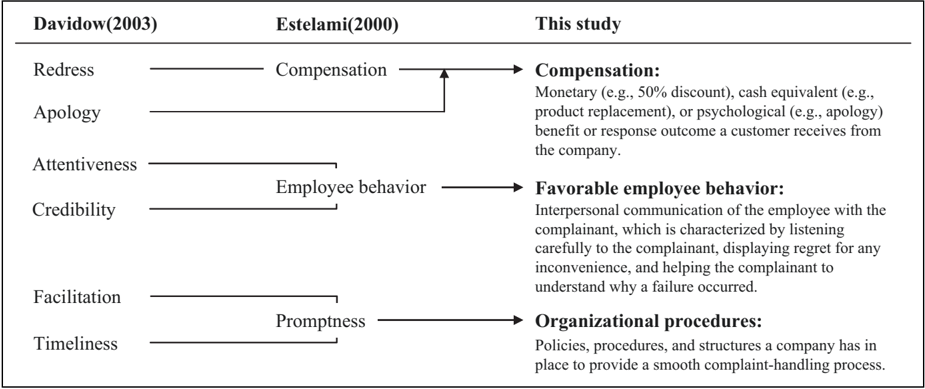
“Service research categorizes these initiatives into three types of organizational response: compensation, organizational procedures, and favorable employee behavior (Gelbrich and Roschk 2011; Van Vaerenbergh et al. 2019).”
BackgroundIs service recovery of equal importance for private vs public complainers?
Béal, M., Suri, A., Nguyen, N., Grégoire, Y., & Sénécal, S. (2022) · Journal of Business Research · doi:10.1016/j.jbusres.2022.08.049 · Cited by 21
Nazione, S. A., & Perrault, E. K. (2019) · Corporate Reputation Review · doi:10.1057/s41299-019-00064-2 · Cited by 25
Moving Toward Collaborative Service Recovery: A Multiactor Orientation
Arsenovic, J. F., Edvardsson, B., & Tronvoll, B. (2019) · Service Science · doi:10.1287/serv.2019.0241 · Cited by 27
“These studies typically analyze how a firm can coordinate its resources for service recovery in a way that makes the customer feel that he or she has been fairly treated (Gelbrich and Roschk 2011).”
BackgroundRelationship quality matters: How restaurant businesses can optimize complaint management
Meyer‐Waarden, L., & Sabadie, W. (2022) · Tourism Management · doi:10.1016/j.tourman.2022.104709 · Cited by 27
Measuring and managing service productivity: a meta-analysis
Hofmeister, J., Kanbach, D. K., & Hogreve, J. (2023) · Review of Managerial Science · doi:10.1007/s11846-023-00620-5 · Cited by 38
“Moreover, adjacent meta-analyses in services marketing research have used similar limitation criteria (Gelbrich and Roschk 2011).”
Sreejesh, S., Anusree, M. R., & Ponnam, A. (2018) · Journal of Hospitality Marketing & Management · doi:10.1080/19368623.2019.1544958 · Cited by 28
Song, J., Wen, C., & Huang, Y. (2024) · International Journal of Hospitality Management · doi:10.1016/j.ijhm.2024.104031 · Cited by 26
Lee, L. (2021) · Journal of Hospitality & Tourism Research · doi:10.1177/1096348020986840 · Cited by 20
“Customer compensation is a frequently used service recovery strategy (Gelbrich & Roschk, 2011) that is often left to service workers’ discretion.”
BackgroundCarrillo, I. M., Svensson, G., & Neira, M. D. C. O. (2019) · International Journal of Quality and Service Sciences · doi:10.1108/ijqss-12-2017-0115 · Cited by 24
Min, K. S., Jung, J. M., Ryu, K., Haugtvedt, C. P., Mahesh, S., & Overton, J. (2020) · Marketing Letters · doi:10.1007/s11002-020-09522-y · Cited by 21
Why Platforms Become Scapegoats: Extending Attribution Theory in Multi-Actor Service Contexts
Fu, X., Bai, L., & Gu, F. F. (2025) · Journal of Service Research · doi:10.1177/10946705251324611 · Cited by 24
“We methodically analyze how failure characteristics (severity and type; Gelbrich and Roschk 2011; McQuilken and Robertson 2011) moderate consumers’ attributions of responsibility toward platforms and their subsequent inclinations to lodge complaints.”
Colliander, J., Söderlund, M., & Marder, B. L. (2018) · Journal of Travel Research · doi:10.1177/0047287518798491 · Cited by 19
“In addition, studies on the effects of service failure have argued for a positive association between perceived justice and customer satisfaction (Gelbrich and Roschk 2011; Maxham and Netemeyer 2002).”
BackgroundKnow your guests’ preferences before they arrive at your hotel: evidence from TripAdvisor
Rahimi, R., Thelwall, M. A., Okumuş, F., & Bilgihan, A. (2022) · Consumer Behavior in Tourism and Hospitality · doi:10.1108/cbth-06-2021-0148 · Cited by 33
An integrated service recovery process for service failures: insights from systematic review
Anwar, S., & Ozuem, W. (2022) · Qualitative Market Research An International Journal · doi:10.1108/qmr-12-2021-0147 · Cited by 22
Coalitions and Their Negative Consequences: An Examination in Service Failure-Recovery Situations
Roschk, H., Hosseinpour, M., & Breitsohl, J. (2023) · Journal of Service Research · doi:10.1177/10946705231163884 · Cited by 22
Self-citationConsumer suggestion sharing: helpful, pragmatic and conditional
Burnham, T. A., Ridinger, G., Carpenter, A., & Choi, L. (2020) · European Journal of Marketing · doi:10.1108/ejm-10-2019-0806 · Cited by 20
Fall and redemption: Monitoring and engaging in social media conversations during a crisis
Canhoto, A. I., Lehn, D. V., Kerrigan, F., Yalkın, Ç., Braun, M., & Steinmetz, N. (2015) · Cogent Business & Management · doi:10.1080/23311975.2015.1084978 · Cited by 23
“In turn, the organisation’s response can amplify the virality of the message (Kietzmann & Canhoto, 2013) and influence referrals and purchase intentions (Gelbrich & Roschk, 2011).”
BackgroundJustice (is not the same) for all: The role of relationship activity for post-recovery outcomes
Arsenovic, J. F., Keyser, A. D., Edvardsson, B., Tronvoll, B., & Gruber, T. (2021) · Journal of Business Research · doi:10.1016/j.jbusres.2021.05.031 · Cited by 18
Explanation information and source in service recovery initiatives
Baker, T. L., & Meyer, T. (2014) · Journal of Services Marketing · doi:10.1108/jsm-12-2012-0249 · Cited by 20
Hall, K. K. L., Jaramillo, S., Baker, T. L., & Bachrach, D. G. (2023) · Psychology and Marketing · doi:10.1002/mar.21809 · Cited by 19
Metadata
- Authors
- Gelbrich, K., & Roschk, H.
- Affiliations
- Technische Universität Ilmenau (DE)
- Corresponding author
- Roschk, Holger
- Venue
- Journal of Service Research
- Publisher
- SAGE Publications
- Published
- 2010-12-03
- Volume
- 14
- Issue
- 1
- Pages
- 24-43
- ISSN
- 1094-6705 (ISSN-L)
- 1552-7379
- OpenAlex
- W2128616827
- Cited by
- 481
- References
- 82
- Citations by year
- 2026: 37 · 2025: 32 · 2024: 24 · 2023: 45 · 2022: 43 · 2021: 37 · 2020: 44 · 2019: 42 · 2018: 32 · 2017: 29 · 2016: 20 · 2015: 27 · 2014: 26 · 2013: 21 · 2012: 12
- FWCI
- 3.00
- Type
- journal article
- Language
- en
- Open access
- green
- uri.gbv.de
- Licence
- other-oa
- journals.sagepub.com/page/policies/text-and-data-mining-license (tdm)
- Locations
- Journal of Service Research (publishedVersion, public-domain)
- Common Library Network (Der Gemeinsame Bibliotheksverbund) (submittedVersion, other-oa)
- Topics
- Social Sciences › Business, Management and Accounting › Marketing › Customer Service Quality and Loyalty
- Social Sciences › Business, Management and Accounting › Marketing › Service and Product Innovation
- Social Sciences › Business, Management and Accounting › Organizational Behavior and Human Resource Management › Job Satisfaction and Organizational Behavior
- Keywords
- complaint handling, service recovery, distributive justice, interactional justice, procedural justice, customer loyalty, word of mouth, compensation, employee behavior, perceived justice, consumer behavioral intention, students as customers, service sector
About these checks
Registry, retraction, Cites and statistics results are computed, not judged, with one exception: a printed reference that no index lists is read once by a model before it counts as a citation error. Claims are extracted by a model and kept only when their quote appears verbatim in the text; each cited source is then checked, with a model’s help, for whether it says what the claim relies on. Those verdicts can be wrong — read the claim’s quote and the cited source before relying on one.
The claim verdicts this report counts are experimental: their accuracy is not yet measured.
A language model drew the claims from the paper on 2026-10-10, under version 3 of the claim definition (model deepseek-v4.1-flash, prompt extract-v3).
A second model labelled each claim on 2026-10-10 (model jev-1.13-20260917, definition revision gold-guideline-v0.2).
Cited sources are checked with a language model’s help (gpt-6-sol).
Statistics and arithmetic are recomputed, not judged.
Confidence bands are shown only for fields calibrated on our annotated test set. None is calibrated yet, so no band is shown.
What counts as a claim ›How we measure confidence ›How we check this ›
Are you an author, or do you see a problem with this page? Request a review
Data sources
Bibliographic data: Semantic Scholar, OpenAlex, Crossref.
Contains information from the Semantic Scholar Academic Graph Datasets, made available under the ODC Attribution License (ODC-BY 1.0).
Semantic Scholar’s data is described in: Kinney, R., et al. (2023). The Semantic Scholar Open Data Platform. arXiv:2301.10140.
