

A Meta-Analysis of Organizational Complaint Handling and Customer Responses
Open accessThe DOI matches its Crossref record; 83 of the 83 references it cites were found in a registry or an index; 2 of the 79 sources its claims cite were checked for support.
Abstract
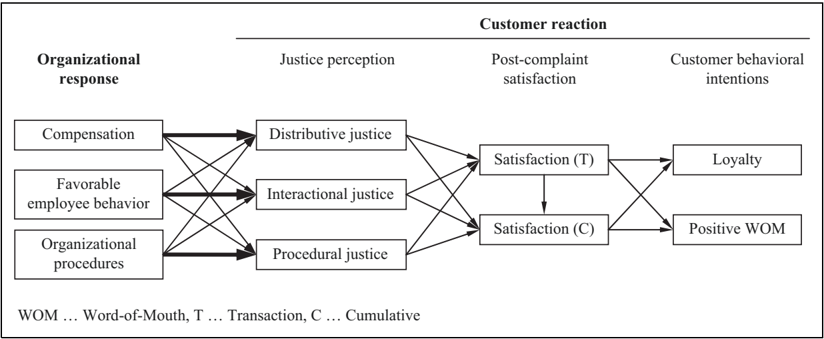
Service recovery is a crucial success factor for organizations. Thus, many studies have addressed the issue of post-complaint behavior. Conducting a meta-analysis, the authors test the following path model: ‘‘organizational responses (compensation, favorable employee behavior, and organizational procedures) → justice perceptions (distributive, interactional, and procedural justice) → post-complaint satisfaction (transaction-specific and cumulative satisfaction) → customer behavioral intentions (loyalty and positive word of mouth [WOM]).’’ The results confirm this model as well as the mediating role of justice perceptions and post-complaint satisfaction. Surprisingly, the results also show that the common contention of distributive justice as the salient driver of service recovery is only true for transaction-specific satisfaction, which in turn reinforces positive WOM. Cumulative satisfaction, however, which is the primary antecedent of customer loyalty, even slightly more depends on interactional justice than on distributive justice. Further, the results show that the relationships between justice perceptions and satisfaction constructs depend on several moderators such as target group, industry, and complaint type. A major managerial implication is the fact that organizations should pay particular attention to distributive justice when complainants are students and to interactional justice when failure is nonmonetary or occurs in service industries. The authors discuss theoretical implications and provide suggestions for future research.
Overview
CoChat Summary
## TL;DR
This meta-analysis synthesizes 87 studies (95 independent samples; total N = 28,826) on complaint handling and tests a path model linking organizational responses to justice perceptions, satisfaction, and behavioral intentions. It finds that the full chain is broadly supported, but that distributive justice is mainly the key driver for transaction-specific satisfaction, while interactional justice matters more for cumulative satisfaction and for some contexts.
## Key findings
- The literature search identified 142 empirical articles; 55 were excluded for insufficient statistics, leaving 87 studies and 477 effects for analysis.
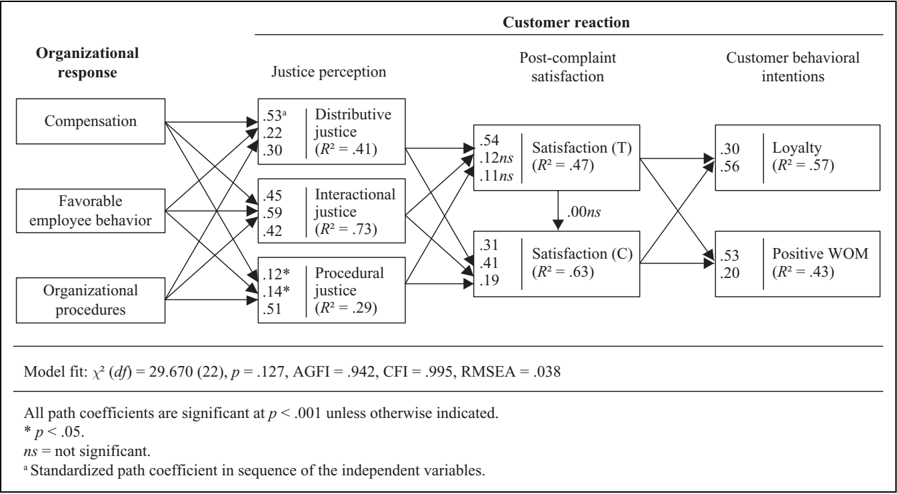
- The hypothesized model fit was excellent: χ²[22] = 29.670, p = .127; AGFI = .942; CFI = .995; RMSEA = .038.
- The model explained 41% of distributive justice, 73% of interactional justice, 29% of procedural justice, 47% of transaction-specific satisfaction, 63% of cumulative satisfaction, 57% of loyalty, and 43% of positive WOM.
- Of 20 estimated path coefficients, 17 were significant at the .05 level; the nonsignificant paths were interactional justice → transaction-specific satisfaction (b = .12, p = .067), procedural justice → transaction-specific satisfaction (b = .11, p = .098), and transaction-specific satisfaction → cumulative satisfaction (b = .00, p = .942).
- Relative effects showed compensation was strongest for distributive justice (χ² diff = 10.454 vs. organizational procedures; 18.844 vs. favorable employee behavior), favorable employee behavior for interactional justice (8.193 vs. compensation; 12.521 vs. organizational procedures), and organizational procedures for procedural justice (21.949 vs. favorable employee behavior; 23.626 vs. compensation).
- Transaction-specific satisfaction was the stronger predictor of positive WOM, while cumulative satisfaction was the stronger predictor of loyalty; the paper reports that transaction-specific satisfaction had a larger effect on positive WOM than cumulative satisfaction (χ² diff = 10.733, p < .001), and cumulative satisfaction had a larger effect on loyalty than transaction-specific satisfaction (χ² diff = 8.831, p < .003).
## Methods
- Meta-analysis of empirical studies from 1980 to June 2009 on relationships among organizational responses, justice perceptions, post-complaint satisfaction, and behavioral intentions.
- Search covered Business Source Complete, Science Direct, Emerald Management Xtra, ABI/Inform, PsycINFO, and the Social Science Citation Index; 142 articles were found, 87 included.
- Effect sizes were correlations; missing correlations were approximated from other statistics, reliability-corrected, weighted by sample size, and pooled. The main analysis used SEM in AMOS 7.0 with maximum likelihood estimation, plus univariate statistics, indirect effects, competing models, and moderator analyses.
- Coding was done by two independent coders; intercoder reliability was .93. Outliers were removed when correlation coefficients exceeded three times the standard error; 5.5% of correlation data points were eliminated.
## Limitations
- The paper says cumulative post-complaint satisfaction is conceptualized as an overall assessment of the entire product/service or organization, but future research should distinguish satisfaction with recovery, with product/service, and with the entire organization.
- It notes compensation level is hard to determine in process failures, so failure type and compensation level should be examined more closely.
- The authors state results may be biased by omitted variables, especially emotions, whose role in the framework remains unclear.
- Evident from the text: some moderator analyses were limited by sparse data, so failure magnitude, switching barriers, online vs. offline complaint handling, relationship quality, and culture could not be examined in detail.
Model-written summary. Check it against the paper before relying on it.
Integrity signals
Registry
Cites
Statistics
Figures

Verification
Claims the paper makes
2 Valid · 2 Not valid · 45 Not checked · 124 Own results and interpretations
The cited sources support only part of this claim — read each source’s verdict below.
In the paper
“It is argued and empirically shown that justice perceptions (distributive, procedural, and interactional justice) completely mediate the relationship between organizational responses and post-complaint satisfaction (Karande, Magnini, and Tam 2007; Maxham III and Netemeyer 2003; Smith, Bolton, and Wagner 1999).”
What the sources say
- Partly supportedcites Karande, Magnini, and Tam 2007 matched to “Recovery Voice and Satisfaction After Service Failure: An Experimental Investigation of Mediating and Moderating Factors” (2007) sourceExperimental — accuracy not yet measured
The Mediation Analysis reports that procedural justice fully mediated the effect of recovery voice on postfailure satisfaction in the airline scenario, but only partially mediated it in the hotel scenario. The study did not test distributive or interactional justice as mediators, or organizational responses beyond recovery voice; the broader claim of complete mediation is therefore not supported. (LLM, conf=0.94)
- Not matchedcites Maxham III and Netemeyer 2003
An author–year citation the paper’s reference list doesn’t settle. We don’t search these by name.
- Not checked — no full text of the sourcecites Smith, Bolton, and Wagner 1999 matched to “A Model of Customer Satisfaction with Service Encounters Involving Failure and Recovery” (1999) source
boostedstates a cause- Asserted: passes — The authors put it forward as true.
- Checkable: passes — It can be checked against evidence.
- Load-bearing: passes — The paper’s conclusions depend on it.
- Based: passes — The paper gives a reason why it holds.
- Partly supported
A result the paper states — it cites no source for it, so there is none to check. The quote shows it is in the paper.
In the paper
“Cumulative satisfaction has a larger impact on loyalty than transaction-specific satisfaction ( w 2 diff[1] ¼ 8.831, p < .003).”
- Also stated in: § Theoretical Implications · plain
“cumulative satisfaction is a stronger predictor of loyalty than transaction-specific satisfaction.”
plainstates an association- Asserted: passes — The authors put it forward as true.
- Checkable: passes — It can be checked against evidence.
- Load-bearing: passes — The paper’s conclusions depend on it.
- Based: passes — The paper gives a reason why it holds.
- Also stated in: § Theoretical Implications · plain
A result the paper reports from its own data — it cites no other source for it, so there is none to check. The quote shows it is in the paper.
In the paper
“The results confirm this model as well as the mediating role of justice perceptions and post-complaint satisfaction.”
boostedstates a cause- Asserted: passes — The authors put it forward as true.
- Checkable: passes — It can be checked against evidence.
- Load-bearing: passes — The paper’s conclusions depend on it.
- Based: passes — The paper gives a reason why it holds.
A result the paper reports from its own data — it cites no other source for it, so there is none to check. The quote shows it is in the paper.
In the paper
“Surprisingly, the results also show that the common contention of distributive justice as the salient driver of service recovery is only true for transaction-specific satisfaction, which in turn reinforces positive WOM.”
plainstates a cause- Asserted: passes — The authors put it forward as true.
- Checkable: passes — It can be checked against evidence.
- Load-bearing: passes — The paper’s conclusions depend on it.
- Based: passes — The paper gives a reason why it holds.
A result the paper reports from its own data — it cites no other source for it, so there is none to check. The quote shows it is in the paper.
In the paper
“Further, the results show that the relationships between justice perceptions and satisfaction constructs depend on several moderators such as target group, industry, and complaint type.”
plainstates an association- Asserted: passes — The authors put it forward as true.
- Checkable: passes — It can be checked against evidence.
- Load-bearing: passes — The paper’s conclusions depend on it.
- Based: passes — The paper gives a reason why it holds.
85 more claims
Create a free account to see all 173 claims and to verify the 4 references still open.
- It may state two separate claims as one. 60
- Borderline: one of the tests for a substantial claim is unclear. 2
- Probably not a substantial claim. 28
Citations
Cites
Statistical Power Analysis for the Behavioral Sciences
Muller, K. (1989) · Technometrics · doi:10.1080/00401706.1989.10488618 · Cited by 99,167
Baron, R. M., & Kenny, D. A. (1986) · Journal of Personality and Social Psychology · doi:10.1037/0022-3514.51.6.1173 · Cited by 91,532
A Cognitive Model of the Antecedents and Consequences of Satisfaction Decisions
Oliver, R. L. (1980) · Journal of Marketing Research · doi:10.1177/002224378001700405 · Cited by 14,494
Adams, J. S. (1965) · Advances in Experimental Social Psychology · doi:10.1016/s0065-2601(08)60108-2 · Cited by 10,818
(2000) · Cited by 9,198
The file drawer problem and tolerance for null results.
Rosenthal, R. (1979) · Psychological Bulletin · doi:10.1037/0033-2909.86.3.638 · Cited by 9,068
The Social Psychology of Procedural Justice
Lind, E. A., & Tyler, T. R. (1988) · Critical Issues in Social Justice · doi:10.1007/978-1-4899-2115-4 · Cited by 6,585
Satisfaction: a behavioral perspective on the consumer
(2010) · Choice Reviews Online · doi:10.5860/choice.47-6963 · Cited by 6,042
Akaike, H. (1987) · Psychometrika · doi:10.1007/bf02294359 · Cited by 5,264
On the dimensionality of organizational justice: A construct validation of a measure.
Colquitt, J. A. (2001) · Journal of Applied Psychology · doi:10.1037/0021-9010.86.3.386 · Cited by 4,114
Akaike, H. (1987) · Springer Series in Statistics · doi:10.1007/978-1-4612-1694-0_29 · Cited by 4,027
Meta-analysis in social research
(1982) · Evaluation and Program Planning · doi:10.1016/0149-7189(82)90011-8 · Cited by 3,853
Hunter, J., & Schmidt, F. (2004) · doi:10.4135/9781412985031 · Cited by 3,023
Satisfaction: A Behavioral Perspective on the Consumer
Oliver, R. L. (2014) · Routledge eBooks · doi:10.4324/9781315700892 · Cited by 2,996
Procedural Justice: A Psychological Analysis
Caldeira, G. A., Thibaut, J., Walker, L., & Nagel, S. S. (1976) · The Western Political Quarterly · doi:10.2307/448155 · Cited by 2,907
Customer Evaluations of Service Complaint Experiences: Implications for Relationship Marketing
Tax, S. S., Brown, S. W., & Chandrashekaran, M. (1998) · Journal of Marketing · doi:10.2307/1252161 · Cited by 2,723
Factors Influencing the Effectiveness of Relationship Marketing: A Meta-Analysis
Palmatier, R. W., Dant, R. P., Grewal, D., & Evans, K. R. (2006) · Journal of Marketing · doi:10.1509/jmkg.70.4.136 · Cited by 2,601
Kirca, A. H., Jayachandran, S., & Bearden, W. O. (2005) · Journal of Marketing · doi:10.1509/jmkg.69.2.24.60761 · Cited by 2,182
A Model of Customer Satisfaction with Service Encounters Involving Failure and Recovery
Smith, A. K., Bolton, R. N., & Wagner, J. (1999) · Journal of Marketing Research · doi:10.2307/3152082 · Cited by 2,058
Customer Satisfaction: A Meta-Analysis of the Empirical Evidence
Szymanski, D. M., & Henard, D. H. (2001) · Journal of the Academy of Marketing Science · doi:10.1177/0092070301291002 · Cited by 2,002
Factors Influencing the Effectiveness of Relationship Marketing: A Meta-Analysis
Palmatier, R. W., Dant, R. P., Grewal, D., & Evans, K. R. (2006) · SSRN Electronic Journal · doi:10.2139/ssrn.904647 · Cited by 1,996
New directions in equity research.
Walster, E., Berscheid, E., & Walster, G. W. (1973) · Journal of Personality and Social Psychology · doi:10.1037/h0033967 · Cited by 1,649
On the Use of Beta Coefficients in Meta-Analysis.
Peterson, R. A., & Brown, S. P. (2005) · Journal of Applied Psychology · doi:10.1037/0021-9010.90.1.175 · Cited by 1,643
Reliability of Nominal Data Based on Qualitative Judgments
Perreault, W. D., & Leigh, L. E. (1989) · Journal of Marketing Research · doi:10.2307/3172601 · Cited by 1,575
The effects of distributive, procedural, and interactional justice on postcomplaint behavior
Blodgett, J. G., Hill, D. J., & Tax, S. S. (1997) · Journal of Retailing · doi:10.1016/s0022-4359(97)90003-8 · Cited by 1,394
Meta-Analysis: Cumulating Research Findings across Studies
Feldman, J. M., Hunter, J. E., Schmidt, F. L., & Jackson, G. B. (1984) · The Academy of Management Review · doi:10.2307/258247 · Cited by 1,199
Hennig-Thurau, T., Groth, M., Paul, M., & Gremler, D. D. (2006) · Journal of Marketing · doi:10.1509/jmkg.70.3.058 · Cited by 1,049
An Empirical Investigation of Customer Satisfaction after Service Failure and Recovery
McCollough, M. A., Berry, L. L., & Yadav, M. S. (2000) · Journal of Service Research · doi:10.1177/109467050032002 · Cited by 1,029
Maxham, J. G., & Netemeyer, R. G. (2002) · Journal of Retailing · doi:10.1016/s0022-4359(02)00100-8 · Cited by 973
Service Failure and Recovery: The Impact of Relationship Factors on Customer Satisfaction
Hess Jr., R. L., Ganesan, S., & Klein, N. M. (2003) · Journal of the Academy of Marketing Science · doi:10.1177/0092070302250898 · Cited by 959
Customer betrayal and retaliation: when your best customers become your worst enemies
Grégoire, Y., & Fisher, R. J. (2008) · Journal of the Academy of Marketing Science · doi:10.1007/s11747-007-0054-0 · Cited by 806
Meta-Analysis: Cumulating Research Findings across Studies
Hunter, J. E., Schmidt, F. L., & Jackson, G. B. (1986) · Educational Researcher · doi:10.2307/1175263 · Cited by 792
Interactional fairness judgments: The influence of causal accounts
Bies, R. J., & Shapiro, D. L. (1987) · Social Justice Research · doi:10.1007/bf01048016 · Cited by 780
Homburg, C., & Fürst, A. (2005) · Journal of Marketing · doi:10.1509/jmkg.69.3.95.66367 · Cited by 768
Consumer responses to compensation, speed of recovery and apology after a service failure
Wirtz, J., & Mattila, A. S. (2004) · International Journal of Service Industry Management · doi:10.1108/09564230410532484 · Cited by 725
Field, A. P. (2001) · Psychological Methods · doi:10.1037/1082-989x.6.2.161 · Cited by 725
Chebat, J.-C., & Slusarczyk, W. (2005) · Journal of Business Research · doi:10.1016/j.jbusres.2003.09.005 · Cited by 685
Fournier, S., & Mick, D. G. (1999) · Journal of Marketing · doi:10.1177/002224299906300403 · Cited by 683
Service recovery: Impact on satisfaction and intentions
Spreng, R. A., Harrell, G. D., & Mackoy, R. D. (1995) · Journal of Services Marketing · doi:10.1108/08876049510079853 · Cited by 652
Maxham, J. G., & Netemeyer, R. G. (2003) · Journal of Marketing · doi:10.1509/jmkg.67.1.46.18591 · Cited by 647
Kim, T. (., Kim, W. G., & Kim, H.-B. (2009) · Tourism Management · doi:10.1016/j.tourman.2008.04.003 · Cited by 635
Blodgett, J. G., Granbois, D. H., & Walters, R. G. (1993) · Journal of Retailing · doi:10.1016/0022-4359(93)90015-b · Cited by 624
Organizational Responses to Customer Complaints: What Works and What Doesn’t
Davidow, M. (2003) · Journal of Service Research · doi:10.1177/1094670502238917 · Cited by 615
Rational and Adaptive Performance Expectations in a Customer Satisfaction Framework
Johnson, M. D., Anderson, E. W., & Fornell, C. (1995) · Journal of Consumer Research · doi:10.1086/209428 · Cited by 588
Weun, S., Beatty, S. E., & Jones, M. A. (2004) · Journal of Services Marketing · doi:10.1108/08876040410528737 · Cited by 581
Liao, H. (2007) · Journal of Applied Psychology · doi:10.1037/0021-9010.92.2.475 · Cited by 550
On the Meaning of within-Factor Correlated Measurement Errors
Gerbing, D. W., & Anderson, J. C. (1984) · Journal of Consumer Research · doi:10.1086/208993 · Cited by 526
Patterson, P. G., Cowley, E., & Prasongsukarn, K. (2006) · International Journal of Research in Marketing · doi:10.1016/j.ijresmar.2006.02.004 · Cited by 525
Kau, A., & Wan‐Yiun Loh, E. (2006) · Journal of Services Marketing · doi:10.1108/08876040610657039 · Cited by 507
A Meta-Analysis of Satisfaction in Marketing Channel Relationships
Geyskens, I., Steenkamp, J.-B. E. M., & Kumar, N. (1999) · Journal of Marketing Research · doi:10.1177/002224379903600207 · Cited by 474
Service Equity, Satisfaction, and Loyalty: From Transaction-Specific to Cumulative Evaluations
Olsen, L. L., & Johnson, M. D. (2003) · Journal of Service Research · doi:10.1177/1094670502238914 · Cited by 473
Service Failure in Online Retailing: A Recovery Opportunity
Holloway, B. B., & Beatty, S. E. (2003) · Journal of Service Research · doi:10.1177/1094670503254288 · Cited by 470
Exploring Customer Loyalty Following Service Recovery: The Mediating Effects of Trust and Emotions
DeWitt, T., Nguyen, D. T., & Marshall, R. (2008) · Journal of Service Research · doi:10.1177/1094670507310767 · Cited by 453
Subjective Construal, Social Inference, and Human Misunderstanding
Griffin, D. W., & Ross, L. (1991) · Advances in Experimental Social Psychology · doi:10.1016/s0065-2601(08)60333-0 · Cited by 404
A meta-analysis of satisfaction with complaint handling in services
Orsingher, C., Valentini, S., & de Angelis, M. (2010) · Journal of the Academy of Marketing Science · doi:10.1007/s11747-009-0155-z · Cited by 375
Service Recovery and Fairness Perceptions in Collectivist and Individualist Contexts
Mattila, A. S., & Patterson, P. G. (2004) · Journal of Service Research · doi:10.1177/1094670503262947 · Cited by 325
Fournier, S. M., & Mick, D. G. (1999) · Journal of Marketing · doi:10.2307/1251971 · Cited by 322
Issues in the Application of Covariance Structure Analysis: A Comment
Fornell, C. (1983) · Journal of Consumer Research · doi:10.1086/208938 · Cited by 321
Post-Purchase Consumer Processes and the Complaining Consumer
Gilly, M. C., & Gelb, B. D. (1982) · Journal of Consumer Research · doi:10.1086/208927 · Cited by 314
Customer equity considerations in service recovery: a cross‐industry perspective
de Ruyter, K., & Wetzels, M. (2000) · International Journal of Service Industry Management · doi:10.1108/09564230010310303 · Cited by 294
The Bottom Line Impact of Organizational Responses to Customer Complaints
Davidow, M. (2000) · Journal of Hospitality & Tourism Research · doi:10.1177/109634800002400404 · Cited by 292
Service consumption criticality in failure recovery
Webster, C., & Sundaram, D. S. (1998) · Journal of Business Research · doi:10.1016/s0148-2963(97)00004-0 · Cited by 250
Davidow, M. (2003) · The Journal of Consumer Satisfaction, Dissatisfaction & Complaining Behavior · Cited by 239
A Bayesian Network Model of the Consumer Complaint Process
Blodgett, J. G., & Anderson, R. D. (2000) · Journal of Service Research · doi:10.1177/109467050024002 · Cited by 203
The Role of Gender in Reactions to Service Failure and Recovery
McColl-Kennedy, J. R., Daus, C. S., & Sparks, B. A. (2003) · Journal of Service Research · doi:10.1177/1094670503254286 · Cited by 195
Competitive and Procedural Determinants of Delight and Disappointment in Consumer Complaint Outcomes
Estelami, H. (2000) · Journal of Service Research · doi:10.1177/109467050023006 · Cited by 195
Distributive and procedural justice in the workplace
Folger, R. (1987) · Social Justice Research · doi:10.1007/bf01048013 · Cited by 183
Karande, K., Magnini, V. P., & Tam, L. (2007) · Journal of Service Research · doi:10.1177/1094670507309607 · Cited by 176
The Influence of Angry Customer Outbursts on Service Providers' Facial Displays and Affective States
Dallimore, K. S., Sparks, B. A., & Butcher, K. (2007) · Journal of Service Research · doi:10.1177/1094670507304694 · Cited by 176
A Service Perspective on the Drivers of Complaint Intentions
Voorhees, C. M., & Brady, M. K. (2005) · Journal of Service Research · doi:10.1177/1094670505279702 · Cited by 166
Internal service recovery: developing a new construct
Bowen, D. E., & Johnston, R. (1999) · International Journal of Service Industry Management · doi:10.1108/09564239910264307 · Cited by 162
Postcomplaint Processes: From Organizational Response to Repurchase Behavior
Gilly, M. C. (1987) · Journal of Consumer Affairs · doi:10.1111/j.1745-6606.1987.tb00204.x · Cited by 161
Issues in the Application of Covariance Structure Analysis: A Further Comment
Bagozzi, R. P. (1983) · Journal of Consumer Research · doi:10.1086/208939 · Cited by 146
The power of explanations in mitigating the ill‐effects of service failures
Mattila, A. S. (2006) · Journal of Services Marketing · doi:10.1108/08876040610704856 · Cited by 122
Schoefer, K. (2008) · Journal of Consumer Behaviour · doi:10.1002/cb.246 · Cited by 117
Development and test of a new model for validity generalization.
Callender, J. C., & Osburn, H. G. (1980) · Journal of Applied Psychology · doi:10.1037/0021-9010.65.5.543 · Cited by 112
Varela-Neira, C., Vázquez-Casielles, R., & Iglesias-Argüelles, V. (2008) · The Service Industries Journal · doi:10.1080/02642060801917612 · Cited by 103 · cited 1×
“…is, satisfaction with handling the problem (e.g., Tax, Brown, and Chandrashekaran 1998) or cumulative satisfaction, that is, overall satisfaction with the organization (e.g., Varela-Neira, Vázquez-Casielles, and Iglesias-Argüelles 2008) or service (e.g., Worsfold, Worsfold, and Bradley 2007).”
BackgroundSchmidt, F. L., & Hunter, J. E. (1999) · Journal of Applied Psychology · doi:10.1037//0021-9010.84.1.144 · Cited by 61
Choice, Perceived Control, and Customer Satisfaction: The Psychology of Online Service Recovery
Chang, C.-C. (2008) · CyberPsychology & Behavior · doi:10.1089/cpb.2007.0059 · Cited by 58
Mattila, A. S., Cho, W., & Ro, H. (2009) · Journal of Travel & Tourism Marketing · doi:10.1080/10548400902862002 · Cited by 49
Worsfold, K., Worsfold, J., & Bradley, G. (2007) · Journal of Applied Social Psychology · doi:10.1111/j.1559-1816.2007.00267.x · Cited by 45
Mount, D. J., & Mattila, A. (2000) · Journal of Hospitality & Tourism Research · doi:10.1177/109634800002400406 · Cited by 42
Influence of Switching Barriers on Service Recovery Evaluation
Valenzuela, F.-R., Pearson, D., & Epworth, R. (2005) · RUNE (Research UNE) · Cited by 15
Research works printed but not linked: 7
- Bagozzi, Richard P. and Hans Baumgartner (1996), ''The Evaluation of Structural Equation Models and Hypothesis Testing,'' in Principles of Marketing Research , 1st reprint, Richard P. Bagozzi, ed. Cambridge, UK: Blackwell, 386-422.
- Blodgett, Jeffrey G. and Stephen S. Tax (1993), ''The Effects of Distributive and Interactional Justice on Complainants' Repatronage Intentions and Negative Word-of-Mouth Intentions,'' Journal of Consumer Satisfaction, Dissatisfaction and Complaining Behavior, 6, 100-110.
- Customer Care Alliance (2003), Customer Care-The Multibillion Dollar Sinkhole. http://www.ccareall.org/
- de Ruyter, Ko, 2000, Inter
- Goodwin, Cathy and Ivan Ross (1989), ''Salient Dimensions of Perceived Fairness in Resolution of Service Complaints,'' Journal of Consumer Satisfaction, Dissatisfaction and Complaining Behavior , 2, 87-98.
- Jain, Dipak C. ( 1996), ‘‘Regression Analysis for Marketing Decisions,’’ in Principles of Marketing Research, 1st reprint, Richard P. Bagozzi, ed. Cambridge, UK: Blackwell, 162-194.
- TARP (1981), Measuring the Grapevine-Consumer Response and Word of Mouth. Atlanta, GA: Coca Cola.
Cited by
A meta-analysis of mobile commerce adoption and the moderating effect of culture
Zhang, L., Zhu, J., & Liu, Q. (2012) · Computers in Human Behavior · doi:10.1016/j.chb.2012.05.008 · Cited by 541
Voorhees, C. M., Fombelle, P. W., Gregoire, Y., Bone, S., Gustafsson, A., Sousa, R., & Walkowiak, T. (2017) · Journal of Business Research · doi:10.1016/j.jbusres.2017.04.014 · Cited by 489
Khamitov, M., Grégoire, Y., & Suri, A. (2020) · Journal of the Academy of Marketing Science · doi:10.1007/s11747-019-00679-1 · Cited by 381
Choi, B., & La, S. (2013) · Journal of Services Marketing · doi:10.1108/08876041311330717 · Cited by 343
The Service Recovery Journey: Conceptualization, Integration, and Directions for Future Research
Van Vaerenbergh, Y., Varga, D., De Keyser, A., & Orsingher, C. (2019) · Journal of Service Research · doi:10.1177/1094670518819852 · Cited by 322
Metadata
- Authors
- Gelbrich, K., & Roschk, H.
- Affiliations
- Technische Universität Ilmenau (DE)
- Corresponding author
- Roschk, Holger
- Venue
- Journal of Service Research
- Publisher
- SAGE Publications
- Published
- 2010-12-03
- Volume
- 14
- Issue
- 1
- Pages
- 24-43
- ISSN
- 1094-6705 (ISSN-L)
- 1552-7379
- OpenAlex
- W2128616827
- Cited by
- 481
- References
- 82
- Citations by year
- 2026: 37 · 2025: 32 · 2024: 24 · 2023: 45 · 2022: 43 · 2021: 37 · 2020: 44 · 2019: 42 · 2018: 32 · 2017: 29 · 2016: 20 · 2015: 27 · 2014: 26 · 2013: 21 · 2012: 12
- FWCI
- 3.00
- Type
- journal article
- Language
- en
- Open access
- green
- uri.gbv.de
- Licence
- other-oa
- journals.sagepub.com/page/policies/text-and-data-mining-license (tdm)
- Locations
- Journal of Service Research (publishedVersion, public-domain)
- Common Library Network (Der Gemeinsame Bibliotheksverbund) (submittedVersion, other-oa)
- Topics
- Social Sciences › Business, Management and Accounting › Marketing › Customer Service Quality and Loyalty
- Social Sciences › Business, Management and Accounting › Marketing › Service and Product Innovation
- Social Sciences › Business, Management and Accounting › Organizational Behavior and Human Resource Management › Job Satisfaction and Organizational Behavior
- Keywords
- complaint handling, service recovery, distributive justice, interactional justice, procedural justice, customer loyalty, word of mouth, compensation, employee behavior, perceived justice, consumer behavioral intention, students as customers, service sector
About these checks
Registry, retraction, Cites and statistics results are computed, not judged, with one exception: a printed reference that no index lists is read once by a model before it counts as a citation error. Claims are extracted by a model and kept only when their quote appears verbatim in the text; each cited source is then checked, with a model’s help, for whether it says what the claim relies on. Those verdicts can be wrong — read the claim’s quote and the cited source before relying on one.
The claim verdicts this report counts are experimental: their accuracy is not yet measured.
A language model drew the claims from the paper on 2026-10-10, under version 3 of the claim definition (model deepseek-v4.1-flash, prompt extract-v3).
A second model labelled each claim on 2026-10-10 (model jev-1.13-20260917, definition revision gold-guideline-v0.2).
Cited sources are checked with a language model’s help (gpt-6-sol).
Statistics and arithmetic are recomputed, not judged.
Confidence bands are shown only for fields calibrated on our annotated test set. None is calibrated yet, so no band is shown.
What counts as a claim ›How we measure confidence ›How we check this ›
Are you an author, or do you see a problem with this page? Request a review
Data sources
Bibliographic data: Semantic Scholar, OpenAlex, Crossref.
Contains information from the Semantic Scholar Academic Graph Datasets, made available under the ODC Attribution License (ODC-BY 1.0).
Semantic Scholar’s data is described in: Kinney, R., et al. (2023). The Semantic Scholar Open Data Platform. arXiv:2301.10140.
