

A Meta-Analysis of Organizational Complaint Handling and Customer Responses
Open accessThe DOI matches its Crossref record; 83 of the 83 references it cites were found in a registry or an index; 2 of the 79 sources its claims cite were checked for support.
Abstract
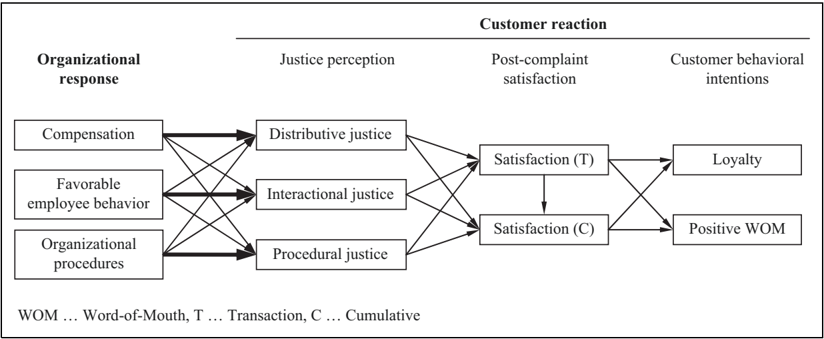
Service recovery is a crucial success factor for organizations. Thus, many studies have addressed the issue of post-complaint behavior. Conducting a meta-analysis, the authors test the following path model: ‘‘organizational responses (compensation, favorable employee behavior, and organizational procedures) → justice perceptions (distributive, interactional, and procedural justice) → post-complaint satisfaction (transaction-specific and cumulative satisfaction) → customer behavioral intentions (loyalty and positive word of mouth [WOM]).’’ The results confirm this model as well as the mediating role of justice perceptions and post-complaint satisfaction. Surprisingly, the results also show that the common contention of distributive justice as the salient driver of service recovery is only true for transaction-specific satisfaction, which in turn reinforces positive WOM. Cumulative satisfaction, however, which is the primary antecedent of customer loyalty, even slightly more depends on interactional justice than on distributive justice. Further, the results show that the relationships between justice perceptions and satisfaction constructs depend on several moderators such as target group, industry, and complaint type. A major managerial implication is the fact that organizations should pay particular attention to distributive justice when complainants are students and to interactional justice when failure is nonmonetary or occurs in service industries. The authors discuss theoretical implications and provide suggestions for future research.
Overview
CoChat Summary
## TL;DR
This meta-analysis synthesizes 87 studies (95 independent samples; total N = 28,826) on complaint handling and tests a path model linking organizational responses to justice perceptions, satisfaction, and behavioral intentions. It finds that the full chain is broadly supported, but that distributive justice is mainly the key driver for transaction-specific satisfaction, while interactional justice matters more for cumulative satisfaction and for some contexts.
## Key findings
- The literature search identified 142 empirical articles; 55 were excluded for insufficient statistics, leaving 87 studies and 477 effects for analysis.
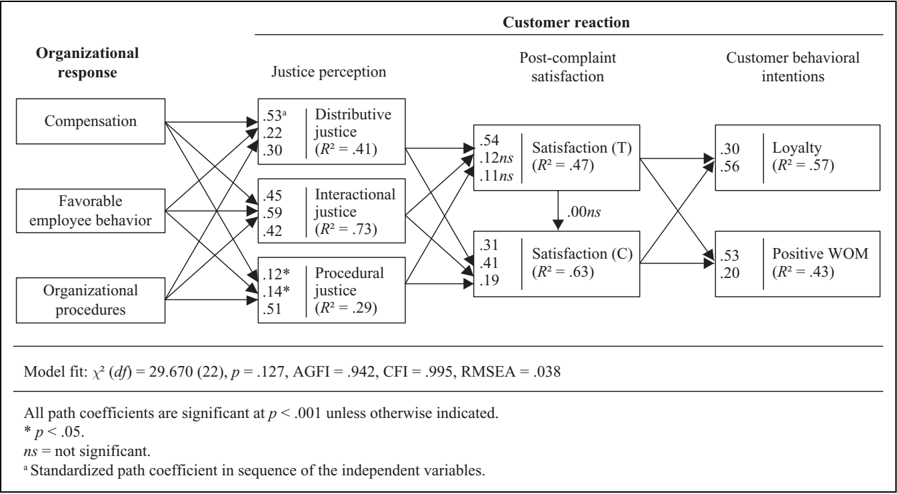
- The hypothesized model fit was excellent: χ²[22] = 29.670, p = .127; AGFI = .942; CFI = .995; RMSEA = .038.
- The model explained 41% of distributive justice, 73% of interactional justice, 29% of procedural justice, 47% of transaction-specific satisfaction, 63% of cumulative satisfaction, 57% of loyalty, and 43% of positive WOM.
- Of 20 estimated path coefficients, 17 were significant at the .05 level; the nonsignificant paths were interactional justice → transaction-specific satisfaction (b = .12, p = .067), procedural justice → transaction-specific satisfaction (b = .11, p = .098), and transaction-specific satisfaction → cumulative satisfaction (b = .00, p = .942).
- Relative effects showed compensation was strongest for distributive justice (χ² diff = 10.454 vs. organizational procedures; 18.844 vs. favorable employee behavior), favorable employee behavior for interactional justice (8.193 vs. compensation; 12.521 vs. organizational procedures), and organizational procedures for procedural justice (21.949 vs. favorable employee behavior; 23.626 vs. compensation).
- Transaction-specific satisfaction was the stronger predictor of positive WOM, while cumulative satisfaction was the stronger predictor of loyalty; the paper reports that transaction-specific satisfaction had a larger effect on positive WOM than cumulative satisfaction (χ² diff = 10.733, p < .001), and cumulative satisfaction had a larger effect on loyalty than transaction-specific satisfaction (χ² diff = 8.831, p < .003).
## Methods
- Meta-analysis of empirical studies from 1980 to June 2009 on relationships among organizational responses, justice perceptions, post-complaint satisfaction, and behavioral intentions.
- Search covered Business Source Complete, Science Direct, Emerald Management Xtra, ABI/Inform, PsycINFO, and the Social Science Citation Index; 142 articles were found, 87 included.
- Effect sizes were correlations; missing correlations were approximated from other statistics, reliability-corrected, weighted by sample size, and pooled. The main analysis used SEM in AMOS 7.0 with maximum likelihood estimation, plus univariate statistics, indirect effects, competing models, and moderator analyses.
- Coding was done by two independent coders; intercoder reliability was .93. Outliers were removed when correlation coefficients exceeded three times the standard error; 5.5% of correlation data points were eliminated.
## Limitations
- The paper says cumulative post-complaint satisfaction is conceptualized as an overall assessment of the entire product/service or organization, but future research should distinguish satisfaction with recovery, with product/service, and with the entire organization.
- It notes compensation level is hard to determine in process failures, so failure type and compensation level should be examined more closely.
- The authors state results may be biased by omitted variables, especially emotions, whose role in the framework remains unclear.
- Evident from the text: some moderator analyses were limited by sparse data, so failure magnitude, switching barriers, online vs. offline complaint handling, relationship quality, and culture could not be examined in detail.
Model-written summary. Check it against the paper before relying on it.
Integrity signals
Registry
Cites
Statistics
Figures

Verification
Claims the paper makes
2 Valid · 2 Not valid · 45 Not checked · 124 Own results and interpretations
The cited sources support only part of this claim — read each source’s verdict below.
In the paper
“It is argued and empirically shown that justice perceptions (distributive, procedural, and interactional justice) completely mediate the relationship between organizational responses and post-complaint satisfaction (Karande, Magnini, and Tam 2007; Maxham III and Netemeyer 2003; Smith, Bolton, and Wagner 1999).”
What the sources say
- Partly supportedcites Karande, Magnini, and Tam 2007 matched to “Recovery Voice and Satisfaction After Service Failure: An Experimental Investigation of Mediating and Moderating Factors” (2007) sourceExperimental — accuracy not yet measured
The Mediation Analysis reports that procedural justice fully mediated the effect of recovery voice on postfailure satisfaction in the airline scenario, but only partially mediated it in the hotel scenario. The study did not test distributive or interactional justice as mediators, or organizational responses beyond recovery voice; the broader claim of complete mediation is therefore not supported. (LLM, conf=0.94)
- Not matchedcites Maxham III and Netemeyer 2003
An author–year citation the paper’s reference list doesn’t settle. We don’t search these by name.
- Not checked — no full text of the sourcecites Smith, Bolton, and Wagner 1999 matched to “A Model of Customer Satisfaction with Service Encounters Involving Failure and Recovery” (1999) source
boostedstates a cause- Asserted: passes — The authors put it forward as true.
- Checkable: passes — It can be checked against evidence.
- Load-bearing: passes — The paper’s conclusions depend on it.
- Based: passes — The paper gives a reason why it holds.
- Partly supported
A result the paper states — it cites no source for it, so there is none to check. The quote shows it is in the paper.
In the paper
“Cumulative satisfaction has a larger impact on loyalty than transaction-specific satisfaction ( w 2 diff[1] ¼ 8.831, p < .003).”
- Also stated in: § Theoretical Implications · plain
“cumulative satisfaction is a stronger predictor of loyalty than transaction-specific satisfaction.”
plainstates an association- Asserted: passes — The authors put it forward as true.
- Checkable: passes — It can be checked against evidence.
- Load-bearing: passes — The paper’s conclusions depend on it.
- Based: passes — The paper gives a reason why it holds.
- Also stated in: § Theoretical Implications · plain
A result the paper reports from its own data — it cites no other source for it, so there is none to check. The quote shows it is in the paper.
In the paper
“The results confirm this model as well as the mediating role of justice perceptions and post-complaint satisfaction.”
boostedstates a cause- Asserted: passes — The authors put it forward as true.
- Checkable: passes — It can be checked against evidence.
- Load-bearing: passes — The paper’s conclusions depend on it.
- Based: passes — The paper gives a reason why it holds.
A result the paper reports from its own data — it cites no other source for it, so there is none to check. The quote shows it is in the paper.
In the paper
“Surprisingly, the results also show that the common contention of distributive justice as the salient driver of service recovery is only true for transaction-specific satisfaction, which in turn reinforces positive WOM.”
plainstates a cause- Asserted: passes — The authors put it forward as true.
- Checkable: passes — It can be checked against evidence.
- Load-bearing: passes — The paper’s conclusions depend on it.
- Based: passes — The paper gives a reason why it holds.
A result the paper reports from its own data — it cites no other source for it, so there is none to check. The quote shows it is in the paper.
In the paper
“Further, the results show that the relationships between justice perceptions and satisfaction constructs depend on several moderators such as target group, industry, and complaint type.”
plainstates an association- Asserted: passes — The authors put it forward as true.
- Checkable: passes — It can be checked against evidence.
- Load-bearing: passes — The paper’s conclusions depend on it.
- Based: passes — The paper gives a reason why it holds.
85 more claims
Create a free account to see all 173 claims and to verify the 5 references still open.
- It may state two separate claims as one. 60
- Borderline: one of the tests for a substantial claim is unclear. 2
- Probably not a substantial claim. 28
Citations
Cites
Statistical Power Analysis for the Behavioral Sciences
Muller, K. (1989) · Technometrics · doi:10.1080/00401706.1989.10488618 · Cited by 99,167
Baron, R. M., & Kenny, D. A. (1986) · Journal of Personality and Social Psychology · doi:10.1037/0022-3514.51.6.1173 · Cited by 91,532
A Cognitive Model of the Antecedents and Consequences of Satisfaction Decisions
Oliver, R. L. (1980) · Journal of Marketing Research · doi:10.1177/002224378001700405 · Cited by 14,494
Adams, J. S. (1965) · Advances in Experimental Social Psychology · doi:10.1016/s0065-2601(08)60108-2 · Cited by 10,818
(2000) · Cited by 9,198
The file drawer problem and tolerance for null results.
Rosenthal, R. (1979) · Psychological Bulletin · doi:10.1037/0033-2909.86.3.638 · Cited by 9,068
The Social Psychology of Procedural Justice
Lind, E. A., & Tyler, T. R. (1988) · Critical Issues in Social Justice · doi:10.1007/978-1-4899-2115-4 · Cited by 6,585
Satisfaction: a behavioral perspective on the consumer
(2010) · Choice Reviews Online · doi:10.5860/choice.47-6963 · Cited by 6,042
Akaike, H. (1987) · Psychometrika · doi:10.1007/bf02294359 · Cited by 5,264
On the dimensionality of organizational justice: A construct validation of a measure.
Colquitt, J. A. (2001) · Journal of Applied Psychology · doi:10.1037/0021-9010.86.3.386 · Cited by 4,114
Research works printed but not linked: 7
- Bagozzi, Richard P. and Hans Baumgartner (1996), ''The Evaluation of Structural Equation Models and Hypothesis Testing,'' in Principles of Marketing Research , 1st reprint, Richard P. Bagozzi, ed. Cambridge, UK: Blackwell, 386-422.
- Blodgett, Jeffrey G. and Stephen S. Tax (1993), ''The Effects of Distributive and Interactional Justice on Complainants' Repatronage Intentions and Negative Word-of-Mouth Intentions,'' Journal of Consumer Satisfaction, Dissatisfaction and Complaining Behavior, 6, 100-110.
- Customer Care Alliance (2003), Customer Care-The Multibillion Dollar Sinkhole. http://www.ccareall.org/
- de Ruyter, Ko, 2000, Inter
- Goodwin, Cathy and Ivan Ross (1989), ''Salient Dimensions of Perceived Fairness in Resolution of Service Complaints,'' Journal of Consumer Satisfaction, Dissatisfaction and Complaining Behavior , 2, 87-98.
- Jain, Dipak C. ( 1996), ‘‘Regression Analysis for Marketing Decisions,’’ in Principles of Marketing Research, 1st reprint, Richard P. Bagozzi, ed. Cambridge, UK: Blackwell, 162-194.
- TARP (1981), Measuring the Grapevine-Consumer Response and Word of Mouth. Atlanta, GA: Coca Cola.
Cited by
A meta-analysis of mobile commerce adoption and the moderating effect of culture
Zhang, L., Zhu, J., & Liu, Q. (2012) · Computers in Human Behavior · doi:10.1016/j.chb.2012.05.008 · Cited by 541
Voorhees, C. M., Fombelle, P. W., Gregoire, Y., Bone, S., Gustafsson, A., Sousa, R., & Walkowiak, T. (2017) · Journal of Business Research · doi:10.1016/j.jbusres.2017.04.014 · Cited by 489
Khamitov, M., Grégoire, Y., & Suri, A. (2020) · Journal of the Academy of Marketing Science · doi:10.1007/s11747-019-00679-1 · Cited by 381
Choi, B., & La, S. (2013) · Journal of Services Marketing · doi:10.1108/08876041311330717 · Cited by 343
The Service Recovery Journey: Conceptualization, Integration, and Directions for Future Research
Van Vaerenbergh, Y., Varga, D., De Keyser, A., & Orsingher, C. (2019) · Journal of Service Research · doi:10.1177/1094670518819852 · Cited by 322
A Meta-Analysis of Relationships Linking Service Failure Attributions to Customer Outcomes
Van Vaerenbergh, Y., Orsingher, C., Vermeir, I., & Larivière, B. (2014) · Journal of Service Research · doi:10.1177/1094670514538321 · Cited by 277
“In line with prior meta-analyses (de Matos, Henrique, and Rossi 2007; Gelbrich and Roschk 2011; Orsingher, Valentini, and de Angelis 2010), we develop predictions on whether contextual factors (cultural values), methodological factors (research method, subjects, and type of failure) and measurement…”
BackgroundMethodResultInfluentialBolton, L. E., & Mattila, A. S. (2015) · Journal of Retailing · doi:10.1016/j.jretai.2014.10.001 · Cited by 268
Roschk, H., Loureiro, S. M. C., & Breitsohl, J. (2017) · Journal of Retailing · doi:10.1016/j.jretai.2016.10.001 · Cited by 267
Self-citationJung, N. Y., & Seock, Y.-K. (2017) · Journal of Retailing and Consumer Services · doi:10.1016/j.jretconser.2017.01.012 · Cited by 230
“…Maxham and Netemeyer, 2002; Schoefer, 2008; Smith et al., 1999; Tax et al., 1998; Wirtz and Mattila, 2004) as well as the mediating role of perceived justice between service recovery activities and post-recovery satisfaction (Gelbrich and Roschk, 2011; Homburg and Fürst, 2005; Smith et al., 1999).”
BackgroundA “Triple A” Typology of Responding to Negative Consumer-Generated Online Reviews
Sparks, B. A., & Bradley, G. L. (2017) · Journal of Hospitality & Tourism Research · doi:10.1177/1096348014538052 · Cited by 228
“…theory and research pertaining to service failure and recovery (e.g., Bitner, Booms, & Tetreault, 1990; Bradley & Sparks, 2009, 2012; Davidow, 2003; Gelbrich & Roschk, 2011; Liao, 2007; McColl-Kennedy & Sparks, 2003; Michel, Bowen, & Johnston, 2009; Smith, Bolton, & Wagner, 1999; Wirtz & Mattila,…”
Breitsohl, J., & Garrod, B. (2016) · Tourism Management · doi:10.1016/j.tourman.2015.11.004 · Cited by 217
“The competing model did not, however, indicate a better fit, since the Akaike Information Criterion (AIC) increased from 946 to 1264 (Akaike, 1987), the RMSEA increased to .56 and the x2/df increased to 4.99 (Gelbrich & Roschk, 2011; Kumar & Sharma, 1999).”
BackgroundInfluentialThe nature of an apology: An experimental study on how to apologize after a service failure
Roschk, H., & Kaiser, S. (2013) · Marketing Letters · doi:10.1007/s11002-012-9218-x · Cited by 205
Self-citationBittersweet! Understanding and Managing Electronic Word of Mouth
Kietzmann, J., & Canhoto, A. (2013) · Journal of Public Affairs · doi:10.1002/pa.1470 · Cited by 200
“…choices (e.g., different SM platforms) can be influenced by people’s perceived ease of access to a competent contact person (Stauss, 2002), the firm’s expected ability to handle feedback efficiently (Gelbrich and Roschk, 2011), or degree of comfort and experience with a platform (Johnston, 2001).”
BackgroundInfluentialMigacz, S. J., Zou, S. (., & Petrick, J. F. (2018) · Journal of Travel Research · doi:10.1177/0047287516684979 · Cited by 197
“When a service goes wrong and leaves customers feeling less than positive about the experience, a service failure has occurred (Gelbrich and Roschk 2011).”
BackgroundService Recovery: An Integrative Framework and Research Agenda
Van Vaerenbergh, Y., & Orsingher, C. (2016) · Academy of Management Perspectives · doi:10.5465/amp.2014.0143 · Cited by 187
“Orsingher et al. (2010) analyze 50 studies dedicated to service recovery; Gelbrich and Roschk (2011) analyze 87 studies examining the role of perceived justice in service recovery.”
BackgroundInfluentialRoschk, H., & Gelbrich, K. (2014) · Journal of Service Research · doi:10.1177/1094670513507486 · Cited by 183
Self-citationCo-creating service recovery after service failure: The role of brand equity
Hazée, S., Van Vaerenbergh, Y., & Armirotto, V. (2017) · Journal of Business Research · doi:10.1016/j.jbusres.2017.01.014 · Cited by 178
“While justice theory has been the dominant framework in explaining customer reactions to (co-created) service recovery, Gelbrich and Roschk's (2011) meta-analysis shows justice only partially explains customer outcomes. Drawing on prior research in decision-making (e.g., Skitka et al., 2003), this study shows that co-…”
BackgroundResultInfluentialCo-creation of service recovery: Utilitarian and hedonic value and post-recovery responses
Park, J., & Ha, S. (2016) · Journal of Retailing and Consumer Services · doi:10.1016/j.jretconser.2015.01.003 · Cited by 160
Blue and Red Voices: Effects of Political Ideology on Consumers’ Complaining and Disputing Behavior
Jung, K., Garbarino, E., Briley, D. A., & Wynhausen, J. (2017) · Journal of Consumer Research · doi:10.1093/jcr/ucx037 · Cited by 150
Bhandari, M., & Rodgers, S. (2017) · International Journal of Advertising · doi:10.1080/02650487.2017.1349030 · Cited by 211
Javornik, A., Filieri, R., & Gumann, R. (2020) · Journal of Interactive Marketing · doi:10.1016/j.intmar.2020.02.002 · Cited by 175
Vaerenbergh, Y. V., Larivière, B., & Vermeir, I. (2012) · Journal of Service Research · doi:10.1177/1094670512442786 · Cited by 159
“Customer complaints are driven by a dissatisfying experience with a service provider due to a service failure; therefore, companies should use complaint information to identify the root cause and improve their processes to avoid the occurrence of similar failures in the future (Johnston and Michel 2008). When companie…”
Bacile, T. J., Wolter, J. S., Allen, A. M., & Xu, P. (2018) · Journal of Interactive Marketing · doi:10.1016/j.intmar.2018.04.002 · Cited by 153
Understanding Money-Back Guarantees: Cognitive, Affective, and Behavioral Outcomes
Suwelack, T., Hogreve, J., & Hoyer, W. D. (2011) · Journal of Retailing · doi:10.1016/j.jretai.2011.09.002 · Cited by 138
Toward a deeper understanding of service marketing: The past, the present, and the future
Kunz, W. H., & Hogreve, J. (2011) · International Journal of Research in Marketing · doi:10.1016/j.ijresmar.2011.03.002 · Cited by 168
Xing, X., Song, M., Duan, Y., & Mou, J. (2022) · Technology in Society · doi:10.1016/j.techsoc.2022.102049 · Cited by 142
Service Recovery via Social Media: The Social Influence Effects of Virtual Presence
Schaefers, T., & Schamari, J. (2015) · Journal of Service Research · doi:10.1177/1094670515606064 · Cited by 154
“Two commonly measured responses are changes in satisfaction with the complaint handling and purchase intentions (e.g., Bitner, Booms, and Tetreault 1990; Gelbrich and Roschk 2011; Van Vaerenbergh, Larivie`re, and Vermeir 2012).”
BackgroundAnxiety and Ephemeral Social Media Use in Negative eWOM Creation
Wakefield, L. T., & Wakefield, R. L. (2018) · Journal of Interactive Marketing · doi:10.1016/j.intmar.2017.09.005 · Cited by 137
Pleasant Ambient Scents: A Meta-Analysis of Customer Responses and Situational Contingencies
Roschk, H., & Hosseinpour, M. (2019) · Journal of Marketing · doi:10.1177/0022242919881137 · Cited by 144
Self-citationMorgeson, F. V., Hult, G. T. M., Mithas, S., Keiningham, T. L., & Fornell, C. (2020) · Journal of Marketing · doi:10.1177/0022242920929029 · Cited by 194
Akarsu, T. N., Marvi, R., & Foroudi, P. (2022) · International Journal of Contemporary Hospitality Management · doi:10.1108/ijchm-11-2021-1441 · Cited by 136
Gelbrich, K., Gäthke, J., & Grégoire, Y. (2014) · Journal of Service Research · doi:10.1177/1094670514543149 · Cited by 131
Self-citationCustomer forgiveness following service failures
Joireman, J. A., Grégoire, Y., & Tripp, T. M. (2015) · Current Opinion in Psychology · doi:10.1016/j.copsyc.2015.11.005 · Cited by 145
Grégoire, Y., Ghadami, F., Laporte, S., Sénécal, S., & Larocque, D. (2018) · Journal of the Academy of Marketing Science · doi:10.1007/s11747-018-0597-2 · Cited by 137
“For instance, Gelbrich and Roschk (2011) show that compensation influences all justice dimensions.”
BackgroundInfluentialHe, H., & Harris, L. C. (2014) · Annals of Tourism Research · doi:10.1016/j.annals.2013.10.002 · Cited by 116
“…the impacts of a number of factors, such as attribution (Hess, Ganesan & Klein, 2007; Laczniak, DeCarlo & Ramaswami, 2001), perceived justice (Gelbrich & Roschk, 2011; Grégoire and Fisher, 2008; Kim et al., 2009), social comparison (Bonifield & Cole, 2007), consumer power (Grégoire et al.,…”
BackgroundLiu, H., Jayawardhena, C., Dibb, S., & Ranaweera, C. (2019) · Tourism Management · doi:10.1016/j.tourman.2019.05.008 · Cited by 130
Grégoire, Y., & Mattila, A. S. (2020) · Journal of Service Research · doi:10.1177/1094670520958073 · Cited by 118
Leveraging service recovery strategies to reduce customer churn in an emerging market
Borah, S. B., Prakhya, S., & Sharma, A. (2019) · Journal of the Academy of Marketing Science · doi:10.1007/s11747-019-00634-0 · Cited by 114
Managing online service recovery: procedures, justice and customer satisfaction
Singh, J., & Crisafulli, B. (2016) · Journal of Service Theory and Practice · doi:10.1108/jstp-01-2015-0013 · Cited by 119
Customers’ emotions in service failure and recovery: a meta-analysis
Valentini, S., Orsingher, C., & Polyakova, A. (2020) · Marketing Letters · doi:10.1007/s11002-020-09517-9 · Cited by 121
“Research in the complaint-handling domain has investigated the incremental effect of overcompensation on post-complaint satisfaction (see Gelbrich and Roschk 2011), but without considering emotions in their empirical studies.”
BackgroundResultGijsenberg, M. J., van Heerde, H. J., & Verhoef, P. C. (2015) · Journal of Marketing Research · doi:10.1509/jmr.14.0140 · Cited by 116
Evanschitzky, H., Brock, C., & Blut, M. (2011) · Journal of Service Research · doi:10.1177/1094670511423956 · Cited by 113
Simon, F. L. (2013) · Journal of Retailing and Consumer Services · doi:10.1016/j.jretconser.2013.05.003 · Cited by 103
Customer service 140 characters at a time: The users' perspective
Canhoto, A. I., & Clark, M. K. (2013) · Journal of Marketing Management · doi:10.1080/0267257x.2013.777355 · Cited by 126
Service crisis recovery and firm performance: insights from information breach announcements
Rasoulian, S., Grégoire, Y., Legoux, R., & Sénécal, S. (2017) · Journal of the Academy of Marketing Science · doi:10.1007/s11747-017-0543-8 · Cited by 100
“Gelbrich and Roschk (2011) in their meta-analysis found the greatest effect size between compensation and distributive justice.”
InfluentialManaging Complaints to Improve Customer Profitability
Cambra‐Fierro, J., Melero, I., & Sesé, F. J. (2014) · Journal of Retailing · doi:10.1016/j.jretai.2014.09.004 · Cited by 121
Can complaint-handling efforts promote customer engagement?
Cambra‐Fierro, J., Melero‐Polo, I., & Sesé, F. J. (2015) · Service Business · doi:10.1007/s11628-015-0295-9 · Cited by 106
A customer-dominant logic on service recovery and customer satisfaction
Cheung, M. F. Y., & To, W. M. (2016) · Management Decision · doi:10.1108/md-03-2016-0165 · Cited by 97
How do firms benefit from customer complaints?
Yılmaz, C., Varnalı, K., & Kasnakoğlu, B. T. (2015) · Journal of Business Research · doi:10.1016/j.jbusres.2015.08.038 · Cited by 123
Söderlund, M., & Colliander, J. (2015) · Journal of Retailing and Consumer Services · doi:10.1016/j.jretconser.2015.03.005 · Cited by 114
“The existence of the first link is the basis for our Hypothesis 1, while the second link has been identified by several researchers in terms of a positive association between perceived justice and customer satisfaction in service failure situations (Gelbrich and Roschk, 2011; Maxham and Netemeyer, 2002; Smith et al.,…”
BackgroundCai, R., & Qu, H. (2017) · Journal of Hospitality Marketing & Management · doi:10.1080/19368623.2018.1385434 · Cited by 90
“The theory of justice (Adams, 1963) has been adopted as a powerful vehicle for explaining customers’ reactions during the service recovery process (e.g., Gelbrich & Roschk, 2011; Orsingher et al., 2010; Van Vaerenbergh & Orsingher, 2016).”
BackgroundMethodInfluentialIntellectual structure of consumer complaining behavior (CCB) research: A bibliometric analysis
Arora, S. D., & Chakraborty, A. (2020) · Journal of Business Research · doi:10.1016/j.jbusres.2020.08.043 · Cited by 96
Jha, S., Balaji, M. S., Yavaş, U., & Babakus, E. (2017) · European Journal of Marketing · doi:10.1108/ejm-01-2015-0009 · Cited by 107
Customer participation in service recovery: a meta-analysis
Van Vaerenbergh, Y., Hazée, S., & Costers, A. (2018) · Marketing Letters · doi:10.1007/s11002-018-9470-9 · Cited by 80
Mediating role of customer forgiveness between perceived justice and satisfaction
Muhammad, L., & Gul-e-Rana, G.-E.-R. (2019) · Journal of Retailing and Consumer Services · doi:10.1016/j.jretconser.2019.101886 · Cited by 94
Convenience and satisfaction: mediation of fairness and quality
Roy, S. K., Lassar, W. M., & Shekhar, V. (2016) · Service Industries Journal · doi:10.1080/02642069.2016.1186657 · Cited by 103
“According to justice theory, customers’ perception of service fairness leads to customer satisfaction (Gelbrich & Roschk, 2010; Maxham & Netemeyer, 2002; Smith et al., 1999).”
BackgroundRoschk, H., & Gelbrich, K. (2017) · Journal of Service Research · doi:10.1177/1094670517716333 · Cited by 95
Self-citationNikbin, D., Hyun, S. S., Iranmanesh, M., Maghsoudi, A., & Jeong, C. (2015) · Asia Pacific Journal of Tourism Research · doi:10.1080/10941665.2015.1048265 · Cited by 89
“Successful service recovery can lead to a variety of positive outcomes, including customer satisfaction, repurchase intention, and positive word-of-mouth communication (Gelbrich & Roschk, 2011; Maxham & Netemeyer, 2002; Orsingher, Valentini, & de Angelis, 2010).”
BackgroundA bibliometric investigation of service failure literature and a research agenda
Fouroudi, P., Kitchen, P. J., Marvi, R., Akarsu, T. N., & Uddin, H. (2020) · European Journal of Marketing · doi:10.1108/ejm-07-2019-0588 · Cited by 92
Huang, Y., Meng, Z., Gürsoy, D., & Shi, S. (2020) · International Journal of Contemporary Hospitality Management · doi:10.1108/ijchm-01-2020-0028 · Cited by 90
Hosseinpour, M., & Terlutter, R. (2019) · Sports Medicine · doi:10.1007/s40279-019-01128-3 · Cited by 91
“Later, and in a second step, quantitative investigations would provide the opportunity to meta-analytically integrate the research findings, which would allow for a better calibration of the strengths of effects [146].”
BackgroundWhat drives consumers to shop on mobile devices? Insights from a Meta-Analysis
Luceri, B., Bijmolt, T. H. A., Bellini, S., & Aiolfi, S. (2022) · Journal of Retailing · doi:10.1016/j.jretai.2022.02.002 · Cited by 104
Do ongoing relationships buffer the effects of service recovery on customers' trust and loyalty?
dos Santos, C. P., & Basso, K. (2012) · International Journal of Bank Marketing · doi:10.1108/02652321211222540 · Cited by 100
Honora, A., Chih, W., & Wang, K. (2021) · Journal of Retailing and Consumer Services · doi:10.1016/j.jretconser.2021.102814 · Cited by 94
Rasouli, N., Rasoolimanesh, S. M., Rahmani, A. K., Momayez, A., & Torabi, M. A. (2022) · Journal of Hospitality Marketing & Management · doi:10.1080/19368623.2022.2043800 · Cited by 89
Dens, N., Pelsmacker, P. D., & Purnawirawan, N. (2015) · Journal of service management · doi:10.1108/josm-03-2014-0082 · Cited by 91
The Effects of Apologies for Service Failures in the Global Online Retail
Sengupta, S., Ray, D., Trendel, O., & Vaerenbergh, Y. V. (2018) · International Journal of Electronic Commerce · doi:10.1080/10864415.2018.1462951 · Cited by 81
Fan, Y., & Niu, R. H. (2016) · International Journal of Operations & Production Management · doi:10.1108/ijopm-10-2013-0461 · Cited by 81
The dark side of CRM: advantaged and disadvantaged customers
Nguyen, B., & Simkin, L. P. (2013) · Journal of Consumer Marketing · doi:10.1108/07363761311290812 · Cited by 100
“well as their service recovery efforts (Gelbrich and Roschk, 2011).”
Vázquez‐Casielles, R., Argüelles, V. I., & Neira, C. V. (2016) · Service Business · doi:10.1007/s11628-016-0311-8 · Cited by 75
Albrecht, A. K., Schaefers, T., Walsh, G., & Beatty, S. E. (2018) · Journal of Service Research · doi:10.1177/1094670518802059 · Cited by 77
The Routledge Companion to the Future of Marketing
Moutinho, L., Bigné, E., & Manrai, A. K. (2014) · Routledge eBooks · doi:10.4324/9780203103036 · Cited by 76
“The results from another meta-analysis by Gelbrich and Roschk (2011) support the following paths: “organizational responses (compensation, favorable employee behavior, and organizational procedures) → justice perceptions (distributive, interactional, and procedural justice) → post-complaint…”
BackgroundResultToo busy to help: Antecedents and outcomes of interactional justice in web-based service encounters
Turel, O., & Connelly, C. E. (2013) · International Journal of Information Management · doi:10.1016/j.ijinfomgt.2013.03.005 · Cited by 101
Shams, G., Rather, R. A., Rehman, M. A., & Lodhi, R. N. (2020) · International Journal of Culture Tourism and Hospitality Research · doi:10.1108/ijcthr-04-2020-0079 · Cited by 78
Sugathan, P., Ranjan, K. R., & Mulky, A. G. (2017) · Journal of Interactive Marketing · doi:10.1016/j.intmar.2017.01.002 · Cited by 81
How to influence consumer mindset: A perspective from service recovery
Harun, A., Rokonuzzaman, M., Prybutok, G. T., & Prybutok, V. R. (2018) · Journal of Retailing and Consumer Services · doi:10.1016/j.jretconser.2018.01.012 · Cited by 73
“…voluntary remedial measures, excuse, apology, justification, empathy, discount, coupons, no response, and explanation (Hart et al., 1990; Greenberg, 1990; Conlon and Murray, 1996; Smith et al., 1999; Bhandari et al., 2007; Gelbrich and Roschk, 2011; Bradley and Sparks, 2012; Mostafa et al., 2015).”
BackgroundInfluentialPost‐recovery customer relationships and customer partnerships in a restaurant setting
Kim, T. T., Yoo, J., & Lee, G. (2012) · International Journal of Contemporary Hospitality Management · doi:10.1108/09596111211217879 · Cited by 79
“While it the three dimensions of justice are independent of one another, their combination determines a customer’s perception of justice and his/her subsequent attitude and behavior (Gelbrich and Roschk, 2011).”
BackgroundSuri, A., Huang, B., & Sénécal, S. (2019) · The Journal of Marketing Theory and Practice · doi:10.1080/10696679.2019.1644958 · Cited by 74
Managerial response strategies to eWOM: A framework and research agenda for webcare
Lopes, A. I., Dens, N., Pelsmacker, P. D., & Malthouse, E. C. (2023) · Tourism Management · doi:10.1016/j.tourman.2023.104739 · Cited by 84
van Noort, G., Willemsen, L. M., Kerkhof, P., & Verhoeven, J. W. M. (2015) · Palgrave Macmillan UK eBooks · doi:10.1057/9781137388551_4 · Cited by 86
“A recent meta-analysis of 87 empirical studies on complaint handling by Gelbrich and Roschk (2011) shows that indeed all three justice dimensions play a role in restoring customer satisfaction.”
BackgroundInfluentialZhou, Y., Huang, M., Tsang, A. S. L., & Zhou, N. (2013) · European Journal of Marketing · doi:10.1108/03090561311324255 · Cited by 79
“Producing a fair impression is an effective way of deflecting a consumer’s negative conjecture (Gelbrich and Roschk, 2011; McColl-Kennedy and Sparks, 2003; Sparks and McColl-Kennedy, 1998, 2001; Van den Bos et al., 1997).”
BackgroundInfluentialLee, L., & Madera, J. M. (2021) · International Journal of Hospitality Management · doi:10.1016/j.ijhm.2021.102907 · Cited by 66
Mafael, A., Raithel, S., & Hock, S. J. (2021) · Journal of the Academy of Marketing Science · doi:10.1007/s11747-021-00802-1 · Cited by 73
“However, the existing literature on product recalls largely neglects the role of compensation (Cleeren et al. 2017), even though other related streams of literature provide evidence that compensation is crucial for satisfaction recovery (Gelbrich and Roschk 2011).”
BackgroundA meta-analysis of the effect of chatbot anthropomorphism on the customer journey
Cheng, Y., Shijia, Z., & Yuyang, X. (2023) · Marketing Intelligence & Planning · doi:10.1108/mip-03-2023-0103 · Cited by 76
Jeong, M., & Lee, S. A. (2017) · Journal of Hospitality and Tourism Technology · doi:10.1108/jhtt-09-2016-0049 · Cited by 82
How a firm's best versus normal customers react to compensation after a service failure
Gelbrich, K., Gäthke, J., & Grégoire, Y. (2016) · Journal of Business Research · doi:10.1016/j.jbusres.2016.04.010 · Cited by 72
“Based on these curve progressions, we identify the optimal compensation for each group, which is the level of compensation that provides the best increase or return in satisfaction (Gelbrich & Roschk, 2011b).”
BackgroundMethodInfluentialSelf-citationAli, F., El-Manstrly, D. A., & Abbasi, G. A. (2023) · Journal of Business Research · doi:10.1016/j.jbusres.2023.114138 · Cited by 73
Meta-analysis selection bias in marketing research
Eisend, M., & Tarrahi, F. (2014) · International Journal of Research in Marketing · doi:10.1016/j.ijresmar.2014.03.006 · Cited by 60
The CURE scale: a multidimensional measure of service recovery strategy
Mostafa, R. B., Lages, C. R., & Sääksjärvi, M. (2014) · Journal of Services Marketing · doi:10.1108/jsm-09-2012-0166 · Cited by 71
“A thorough review of the literature indicates that apology, compensation, speed of response, facilitation, explanation, courtesy, problem-solving, effort and follow-up are effective organizational responses (Bell and Zemke, 1987; Gelbrich and Roschk, 2011; Johnston, 2001; Karatepe and Ekiz, 2004; Karatepe, 2006; Liao,…”
BackgroundService failure and service recovery: A hybrid review and research agenda
Sahaf, T. M., & Fazili, A. I. (2023) · International Journal of Consumer Studies · doi:10.1111/ijcs.12974 · Cited by 72
Service recovery for moderate and high involvement services
Bambauer-Sachse, S., & Rabeson, L. E. (2015) · Journal of Services Marketing · doi:10.1108/jsm-05-2014-0155 · Cited by 64
van Gils, S., & Horton, K. E. (2018) · Journal of Business Research · doi:10.1016/j.jbusres.2018.07.042 · Cited by 59
Akıncı, S., & Aksoy, Ş. (2019) · Tourism Management Perspectives · doi:10.1016/j.tmp.2019.05.002 · Cited by 68
Fu, H., Wu, D. C., Huang, S. S., Song, H., & Gong, J. (2015) · International Journal of Hospitality Management · doi:10.1016/j.ijhm.2015.01.006 · Cited by 69
Instructor Responses to Rhetorical Dissent: Student Perceptions of Justice and Classroom Outcomes
Holmgren, J. L., & Bolkan, S. (2013) · Communication Education · doi:10.1080/03634523.2013.833644 · Cited by 65
“In fact, researchers have argued that justice offers a comprehensive framework for understanding organizational responses to complaint episodes across a variety of contexts (Gelbrich & Roschk, 2011).”
BackgroundResultInfluentialZhao, H., Jiang, L., & Su, C. (2020) · Journal of Interactive Marketing · doi:10.1016/j.intmar.2019.11.001 · Cited by 61
Bhandari, M., Rodgers, S., & Pan, P. (2020) · Telematics and Informatics · doi:10.1016/j.tele.2020.101522 · Cited by 67
Lee, L., Guchait, P., & Madera, J. M. (2020) · International Journal of Hospitality Management · doi:10.1016/j.ijhm.2020.102532 · Cited by 53
The impact of switching costs on customer complaint behavior and service recovery evaluation
Bergel, M., & Brock, C. (2018) · Journal of Service Theory and Practice · doi:10.1108/jstp-02-2017-0035 · Cited by 60
What drives customer engagement after a service failure? The moderating role of customer trust
Honora, A., Chih, W., & Ortiz, J. (2023) · International Journal of Consumer Studies · doi:10.1111/ijcs.12939 · Cited by 71
Metadata
- Authors
- Gelbrich, K., & Roschk, H.
- Affiliations
- Technische Universität Ilmenau (DE)
- Corresponding author
- Roschk, Holger
- Venue
- Journal of Service Research
- Publisher
- SAGE Publications
- Published
- 2010-12-03
- Volume
- 14
- Issue
- 1
- Pages
- 24-43
- ISSN
- 1094-6705 (ISSN-L)
- 1552-7379
- OpenAlex
- W2128616827
- Cited by
- 481
- References
- 82
- Citations by year
- 2026: 37 · 2025: 32 · 2024: 24 · 2023: 45 · 2022: 43 · 2021: 37 · 2020: 44 · 2019: 42 · 2018: 32 · 2017: 29 · 2016: 20 · 2015: 27 · 2014: 26 · 2013: 21 · 2012: 12
- FWCI
- 3.00
- Type
- journal article
- Language
- en
- Open access
- green
- uri.gbv.de
- Licence
- other-oa
- journals.sagepub.com/page/policies/text-and-data-mining-license (tdm)
- Locations
- Journal of Service Research (publishedVersion, public-domain)
- Common Library Network (Der Gemeinsame Bibliotheksverbund) (submittedVersion, other-oa)
- Topics
- Social Sciences › Business, Management and Accounting › Marketing › Customer Service Quality and Loyalty
- Social Sciences › Business, Management and Accounting › Marketing › Service and Product Innovation
- Social Sciences › Business, Management and Accounting › Organizational Behavior and Human Resource Management › Job Satisfaction and Organizational Behavior
- Keywords
- complaint handling, service recovery, distributive justice, interactional justice, procedural justice, customer loyalty, word of mouth, compensation, employee behavior, perceived justice, consumer behavioral intention, students as customers, service sector
About these checks
Registry, retraction, Cites and statistics results are computed, not judged, with one exception: a printed reference that no index lists is read once by a model before it counts as a citation error. Claims are extracted by a model and kept only when their quote appears verbatim in the text; each cited source is then checked, with a model’s help, for whether it says what the claim relies on. Those verdicts can be wrong — read the claim’s quote and the cited source before relying on one.
The claim verdicts this report counts are experimental: their accuracy is not yet measured.
A language model drew the claims from the paper on 2026-10-10, under version 3 of the claim definition (model deepseek-v4.1-flash, prompt extract-v3).
A second model labelled each claim on 2026-10-10 (model jev-1.13-20260917, definition revision gold-guideline-v0.2).
Cited sources are checked with a language model’s help (gpt-6-sol).
Statistics and arithmetic are recomputed, not judged.
Confidence bands are shown only for fields calibrated on our annotated test set. None is calibrated yet, so no band is shown.
What counts as a claim ›How we measure confidence ›How we check this ›
Are you an author, or do you see a problem with this page? Request a review
Data sources
Bibliographic data: Semantic Scholar, OpenAlex, Crossref.
Contains information from the Semantic Scholar Academic Graph Datasets, made available under the ODC Attribution License (ODC-BY 1.0).
Semantic Scholar’s data is described in: Kinney, R., et al. (2023). The Semantic Scholar Open Data Platform. arXiv:2301.10140.
