

A Meta-Analysis of Organizational Complaint Handling and Customer Responses
Open accessThe DOI matches its Crossref record; 83 of the 83 references it cites were found in a registry or an index; 2 of the 79 sources its claims cite were checked for support.
Abstract
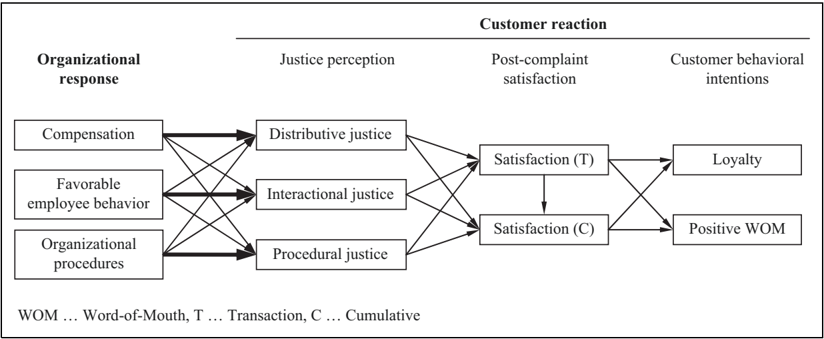
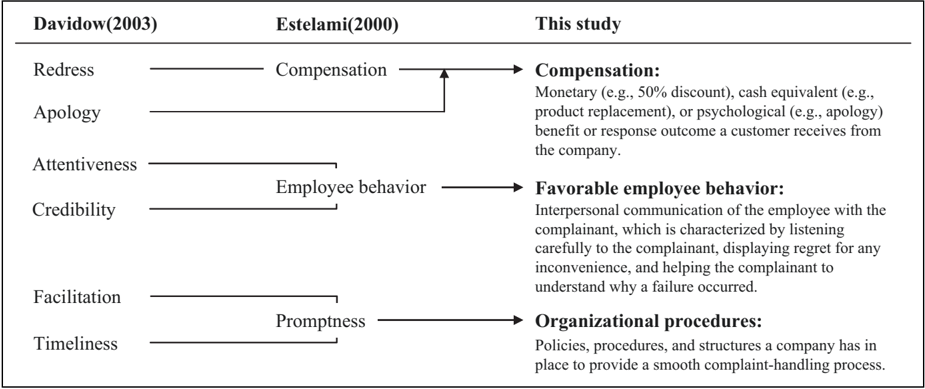
Service recovery is a crucial success factor for organizations. Thus, many studies have addressed the issue of post-complaint behavior. Conducting a meta-analysis, the authors test the following path model: ‘‘organizational responses (compensation, favorable employee behavior, and organizational procedures) → justice perceptions (distributive, interactional, and procedural justice) → post-complaint satisfaction (transaction-specific and cumulative satisfaction) → customer behavioral intentions (loyalty and positive word of mouth [WOM]).’’ The results confirm this model as well as the mediating role of justice perceptions and post-complaint satisfaction. Surprisingly, the results also show that the common contention of distributive justice as the salient driver of service recovery is only true for transaction-specific satisfaction, which in turn reinforces positive WOM. Cumulative satisfaction, however, which is the primary antecedent of customer loyalty, even slightly more depends on interactional justice than on distributive justice. Further, the results show that the relationships between justice perceptions and satisfaction constructs depend on several moderators such as target group, industry, and complaint type. A major managerial implication is the fact that organizations should pay particular attention to distributive justice when complainants are students and to interactional justice when failure is nonmonetary or occurs in service industries. The authors discuss theoretical implications and provide suggestions for future research.
Overview
CoChat Summary
## TL;DR
This meta-analysis synthesizes 87 studies (95 independent samples; total N = 28,826) on complaint handling and tests a path model linking organizational responses to justice perceptions, satisfaction, and behavioral intentions. It finds that the full chain is broadly supported, but that distributive justice is mainly the key driver for transaction-specific satisfaction, while interactional justice matters more for cumulative satisfaction and for some contexts.
## Key findings
- The literature search identified 142 empirical articles; 55 were excluded for insufficient statistics, leaving 87 studies and 477 effects for analysis.
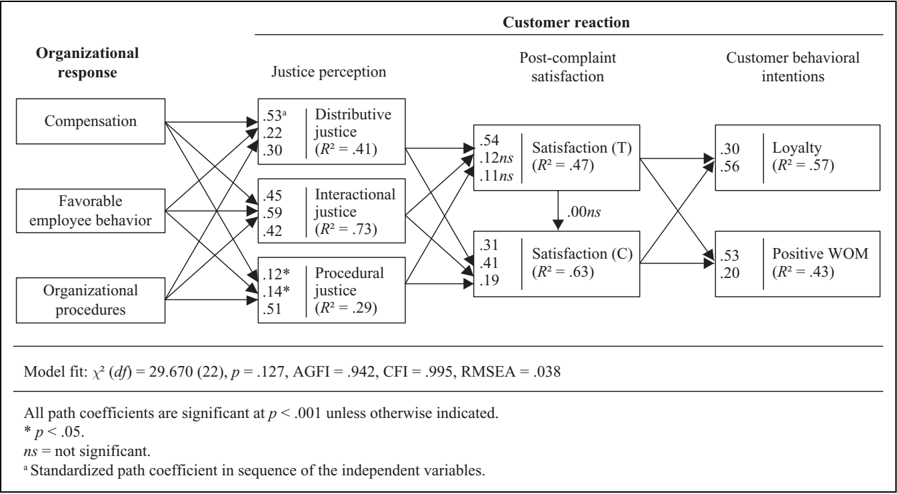
- The hypothesized model fit was excellent: χ²[22] = 29.670, p = .127; AGFI = .942; CFI = .995; RMSEA = .038.
- The model explained 41% of distributive justice, 73% of interactional justice, 29% of procedural justice, 47% of transaction-specific satisfaction, 63% of cumulative satisfaction, 57% of loyalty, and 43% of positive WOM.
- Of 20 estimated path coefficients, 17 were significant at the .05 level; the nonsignificant paths were interactional justice → transaction-specific satisfaction (b = .12, p = .067), procedural justice → transaction-specific satisfaction (b = .11, p = .098), and transaction-specific satisfaction → cumulative satisfaction (b = .00, p = .942).
- Relative effects showed compensation was strongest for distributive justice (χ² diff = 10.454 vs. organizational procedures; 18.844 vs. favorable employee behavior), favorable employee behavior for interactional justice (8.193 vs. compensation; 12.521 vs. organizational procedures), and organizational procedures for procedural justice (21.949 vs. favorable employee behavior; 23.626 vs. compensation).
- Transaction-specific satisfaction was the stronger predictor of positive WOM, while cumulative satisfaction was the stronger predictor of loyalty; the paper reports that transaction-specific satisfaction had a larger effect on positive WOM than cumulative satisfaction (χ² diff = 10.733, p < .001), and cumulative satisfaction had a larger effect on loyalty than transaction-specific satisfaction (χ² diff = 8.831, p < .003).
## Methods
- Meta-analysis of empirical studies from 1980 to June 2009 on relationships among organizational responses, justice perceptions, post-complaint satisfaction, and behavioral intentions.
- Search covered Business Source Complete, Science Direct, Emerald Management Xtra, ABI/Inform, PsycINFO, and the Social Science Citation Index; 142 articles were found, 87 included.
- Effect sizes were correlations; missing correlations were approximated from other statistics, reliability-corrected, weighted by sample size, and pooled. The main analysis used SEM in AMOS 7.0 with maximum likelihood estimation, plus univariate statistics, indirect effects, competing models, and moderator analyses.
- Coding was done by two independent coders; intercoder reliability was .93. Outliers were removed when correlation coefficients exceeded three times the standard error; 5.5% of correlation data points were eliminated.
## Limitations
- The paper says cumulative post-complaint satisfaction is conceptualized as an overall assessment of the entire product/service or organization, but future research should distinguish satisfaction with recovery, with product/service, and with the entire organization.
- It notes compensation level is hard to determine in process failures, so failure type and compensation level should be examined more closely.
- The authors state results may be biased by omitted variables, especially emotions, whose role in the framework remains unclear.
- Evident from the text: some moderator analyses were limited by sparse data, so failure magnitude, switching barriers, online vs. offline complaint handling, relationship quality, and culture could not be examined in detail.
Model-written summary. Check it against the paper before relying on it.
Integrity signals
Registry
Cites
Statistics
Figures

Verification
Claims the paper makes
2 Valid · 2 Not valid · 45 Not checked · 124 Own results and interpretations
The cited sources support only part of this claim — read each source’s verdict below.
In the paper
“It is argued and empirically shown that justice perceptions (distributive, procedural, and interactional justice) completely mediate the relationship between organizational responses and post-complaint satisfaction (Karande, Magnini, and Tam 2007; Maxham III and Netemeyer 2003; Smith, Bolton, and Wagner 1999).”
What the sources say
- Partly supportedcites Karande, Magnini, and Tam 2007 matched to “Recovery Voice and Satisfaction After Service Failure: An Experimental Investigation of Mediating and Moderating Factors” (2007) sourceExperimental — accuracy not yet measured
The Mediation Analysis reports that procedural justice fully mediated the effect of recovery voice on postfailure satisfaction in the airline scenario, but only partially mediated it in the hotel scenario. The study did not test distributive or interactional justice as mediators, or organizational responses beyond recovery voice; the broader claim of complete mediation is therefore not supported. (LLM, conf=0.94)
- Not matchedcites Maxham III and Netemeyer 2003
An author–year citation the paper’s reference list doesn’t settle. We don’t search these by name.
- Not checked — no full text of the sourcecites Smith, Bolton, and Wagner 1999 matched to “A Model of Customer Satisfaction with Service Encounters Involving Failure and Recovery” (1999) source
boostedstates a cause- Asserted: passes — The authors put it forward as true.
- Checkable: passes — It can be checked against evidence.
- Load-bearing: passes — The paper’s conclusions depend on it.
- Based: passes — The paper gives a reason why it holds.
- Partly supported
A result the paper states — it cites no source for it, so there is none to check. The quote shows it is in the paper.
In the paper
“Cumulative satisfaction has a larger impact on loyalty than transaction-specific satisfaction ( w 2 diff[1] ¼ 8.831, p < .003).”
- Also stated in: § Theoretical Implications · plain
“cumulative satisfaction is a stronger predictor of loyalty than transaction-specific satisfaction.”
plainstates an association- Asserted: passes — The authors put it forward as true.
- Checkable: passes — It can be checked against evidence.
- Load-bearing: passes — The paper’s conclusions depend on it.
- Based: passes — The paper gives a reason why it holds.
- Also stated in: § Theoretical Implications · plain
A result the paper reports from its own data — it cites no other source for it, so there is none to check. The quote shows it is in the paper.
In the paper
“The results confirm this model as well as the mediating role of justice perceptions and post-complaint satisfaction.”
boostedstates a cause- Asserted: passes — The authors put it forward as true.
- Checkable: passes — It can be checked against evidence.
- Load-bearing: passes — The paper’s conclusions depend on it.
- Based: passes — The paper gives a reason why it holds.
A result the paper reports from its own data — it cites no other source for it, so there is none to check. The quote shows it is in the paper.
In the paper
“Surprisingly, the results also show that the common contention of distributive justice as the salient driver of service recovery is only true for transaction-specific satisfaction, which in turn reinforces positive WOM.”
plainstates a cause- Asserted: passes — The authors put it forward as true.
- Checkable: passes — It can be checked against evidence.
- Load-bearing: passes — The paper’s conclusions depend on it.
- Based: passes — The paper gives a reason why it holds.
A result the paper reports from its own data — it cites no other source for it, so there is none to check. The quote shows it is in the paper.
In the paper
“Further, the results show that the relationships between justice perceptions and satisfaction constructs depend on several moderators such as target group, industry, and complaint type.”
plainstates an association- Asserted: passes — The authors put it forward as true.
- Checkable: passes — It can be checked against evidence.
- Load-bearing: passes — The paper’s conclusions depend on it.
- Based: passes — The paper gives a reason why it holds.
85 more claims
Create a free account to see all 173 claims and to verify the 5 references still open.
- It may state two separate claims as one. 60
- Borderline: one of the tests for a substantial claim is unclear. 2
- Probably not a substantial claim. 28
Citations
Cites
Statistical Power Analysis for the Behavioral Sciences
Muller, K. (1989) · Technometrics · doi:10.1080/00401706.1989.10488618 · Cited by 99,167
Baron, R. M., & Kenny, D. A. (1986) · Journal of Personality and Social Psychology · doi:10.1037/0022-3514.51.6.1173 · Cited by 91,532
A Cognitive Model of the Antecedents and Consequences of Satisfaction Decisions
Oliver, R. L. (1980) · Journal of Marketing Research · doi:10.1177/002224378001700405 · Cited by 14,494
Adams, J. S. (1965) · Advances in Experimental Social Psychology · doi:10.1016/s0065-2601(08)60108-2 · Cited by 10,818
(2000) · Cited by 9,198
The file drawer problem and tolerance for null results.
Rosenthal, R. (1979) · Psychological Bulletin · doi:10.1037/0033-2909.86.3.638 · Cited by 9,068
The Social Psychology of Procedural Justice
Lind, E. A., & Tyler, T. R. (1988) · Critical Issues in Social Justice · doi:10.1007/978-1-4899-2115-4 · Cited by 6,585
Satisfaction: a behavioral perspective on the consumer
(2010) · Choice Reviews Online · doi:10.5860/choice.47-6963 · Cited by 6,042
Akaike, H. (1987) · Psychometrika · doi:10.1007/bf02294359 · Cited by 5,264
On the dimensionality of organizational justice: A construct validation of a measure.
Colquitt, J. A. (2001) · Journal of Applied Psychology · doi:10.1037/0021-9010.86.3.386 · Cited by 4,114
Research works printed but not linked: 7
- Bagozzi, Richard P. and Hans Baumgartner (1996), ''The Evaluation of Structural Equation Models and Hypothesis Testing,'' in Principles of Marketing Research , 1st reprint, Richard P. Bagozzi, ed. Cambridge, UK: Blackwell, 386-422.
- Blodgett, Jeffrey G. and Stephen S. Tax (1993), ''The Effects of Distributive and Interactional Justice on Complainants' Repatronage Intentions and Negative Word-of-Mouth Intentions,'' Journal of Consumer Satisfaction, Dissatisfaction and Complaining Behavior, 6, 100-110.
- Customer Care Alliance (2003), Customer Care-The Multibillion Dollar Sinkhole. http://www.ccareall.org/
- de Ruyter, Ko, 2000, Inter
- Goodwin, Cathy and Ivan Ross (1989), ''Salient Dimensions of Perceived Fairness in Resolution of Service Complaints,'' Journal of Consumer Satisfaction, Dissatisfaction and Complaining Behavior , 2, 87-98.
- Jain, Dipak C. ( 1996), ‘‘Regression Analysis for Marketing Decisions,’’ in Principles of Marketing Research, 1st reprint, Richard P. Bagozzi, ed. Cambridge, UK: Blackwell, 162-194.
- TARP (1981), Measuring the Grapevine-Consumer Response and Word of Mouth. Atlanta, GA: Coca Cola.
Cited by
Items 301–400 of 471
Steven, & Fuyane, N. (2020) · International Journal of Economics and Business Administration · doi:10.35808/ijeba/428 · Cited by 4
Customers’ positive WOM toward m-banking: a standpoint of extended fairness theory and value-in-use
Lê, X. C. (2023) · Journal of Science and Technology Policy Management · doi:10.1108/jstpm-07-2022-0105 · Cited by 5
Boakye, K. G., Prybutok, V. R., Randall, W. S., & Ofori, K. S. (2023) · Quality Management Journal · doi:10.1080/10686967.2023.2211285 · Cited by 10
Understanding the role of webcare in the online buying service recovery context
Chen, Y., & Wu, I.-J. (2021) · Enterprise Information Systems · doi:10.1080/17517575.2021.1943761 · Cited by 7
“Therefore, companies must not only capture the preferences of individual customers but provide service recovery in the event of service failure in which customers have bad perceive (Gelbrich and Roschk 2011; McCollough, Berry, and Yadav 2000; Webster and Sundaram 1998).”
BackgroundMoving Towards Successful Complaint Management
Garding, S., & Bruns, A. (2015) · SpringerBriefs in business · doi:10.1007/978-3-319-18179-0_2 · Cited by 3
Kewei, F. H., Weber, K., & Jin, X. (2019) · Journal of Convention & Event Tourism · doi:10.1080/15470148.2018.1564409 · Cited by 3
Fairness and Customer Responses in the Process of Service Recovery
정용길 (2017) · Journal of Korea Service Management Society · doi:10.15706/jksms.2017.18.4.002 · Cited by 3
The Role of Employee Aff ective Delivery and Customer Perceived Control in Service Recovery
Kenesei, Z., & Kolos, K. (2018) · Market-Tržište · doi:10.22598/mt/2018.30.1.7 · Cited by 4
“After a decade of testing, there is plenty of empirical evidence (Gelbrich & Roschk, 2011; Orsingher et al., 2010) that consumer justice perceptions predict both satisfaction with service recovery and overall satisfaction.”
BackgroundOGONU, G. C., Nwokah, N. G., & Acee-Eke, B. C. (2019) · American Journal of Industrial and Business Management · doi:10.4236/ajibm.2019.92026 · Cited by 4
“Procedural fairness may include speed as indicated by [8] or quick action on the complaint, fair treatment of customers and absence of hassle [9].”
BackgroundSchwab, P.-N. (2015) · RePEc: Research Papers in Economics · Cited by 3
Yesiloglu, S. (2018) · Bournemouth University Research Online (Bournemouth University) · Cited by 3
Procedural Justice and Police Legitimacy: Evidence from a Vignette Experiment in Central America
Perez-Vincent, S. M., & Puebla, D. (2024) · doi:10.18235/0013056 · Cited by 4
Ali, A. A., Andrei, A. G., Moreno, F. R., & Bagnato, G. (2025) · Business Process Management Journal · doi:10.1108/bpmj-12-2024-1247 · Cited by 7
Bambauer-Sachse, S., & Stuhldreier, S. M. (2026) · Journal of Services Marketing · doi:10.1108/jsm-03-2025-0215 · Cited by 6
Rao, A. S., & Suar, D. (2026) · International Journal of Quality and Service Sciences · doi:10.1108/ijqss-12-2025-0345 · Cited by 7
Drivers of frontline employees’ service recovery performance across cultures: A meta-analysis
Vaerenbergh, Y. V., den Broeck, A. V., & Larivière, B. (2014) · Lirias · Cited by 3
Bank Service Complaint Handling: Effects on Bank Customers’ Satisfaction in Nigeria
Obasi, O., Abugu, J. O., & Chukwu, A. M. (2020) · Journal of Marketing and Consumer Research · doi:10.7176/jmcr/67-05 · Cited by 5
Cusin, J., & Flacandji, M. (2021) · Management international · doi:10.7202/1077354ar · Cited by 2
Service Failure and Complaints Management: An Overview
Orsingher, C., Keyser, A. D., Varga, D., & Vaerenbergh, Y. V. (2022) · Springer eBooks · doi:10.1007/978-3-030-91828-6_39 · Cited by 5
Taketani, K., & Terasaki, S. (2022) · International Journal of Marketing & Distribution · doi:10.5844/ijmd.5.2_37 · Cited by 2
Su, L., Liang, R., Luo, Q., & Liu-Lastres, B. (2024) · Journal Of Vacation Marketing · doi:10.1177/13567667231223552 · Cited by 3
A Rejection-Based Model of Partial Service Termination and its Impact on Unprofitable Customers
Béal, M., Lécuyer, C., Bayart, C., & Clot, D. (2025) · Journal of Service Research · doi:10.1177/10946705241304191 · Cited by 3
“As explained earlier, monetary compensation should be sufficient to cover the client’s financial loss (Gelbrich and Roschk 2011; Valentini, Orsingher, and Polyakova 2020), and the provision of explanations and support in finding alternatives can complement this monetary effort by alleviating the…”
Bozpolat, C., & Çopur, F. (2021) · Journal of Business Research - Turk · doi:10.20491/isarder.2021.1246 · Cited by 7
Guests’ perceptions of hotels’ (un)fair treatment of staff: their impact on service recovery
Zoghbi‐Manrique‐de‐Lara, P., Suárez-Acosta, M. A., & Febles, J. M. A. (2014) · European Journal of Tourism Research · doi:10.54055/ejtr.v8i.149 · Cited by 4
Fox, A. K., & Cowley, S. (2015) · Advances in marketing, customer relationship management, and e-services book series · doi:10.4018/978-1-4666-8408-9.ch006 · Cited by 2
Supporting Complaint Management with Artificial Intelligence
Roschk, H., Hosseinpour, M., & Rezai, G. (2021) · Forum Dienstleistungsmanagement · doi:10.1007/978-3-658-34326-2_8 · Cited by 3
Self-citationBeschwerden als Quelle organisationalen Lernens
Jacobs, G., Horton, K. E., & Bayerl, P. S. (2022) · Springer eBooks · doi:10.1007/978-3-658-34394-1_78-1 · Cited by 2
The Impact of Listening on Tourist Satisfaction and Trust in Tour Guides
Nam, V., Hoang, T. H. L., & Hien, L. T. D. (2023) · Journal of Law and Sustainable Development · doi:10.55908/sdgs.v11i12.1602 · Cited by 2
The impact of salesperson listening: A multi-faceted research approach
Goad, E. A. (2014) · UTA ResearchCommons (University of Texas Arlington) · Cited by 8
Customer’s repurchase intensions following service recovery: A conceptual model
Mazhar, M., & Ting, D. H. (2021) · SHS Web of Conferences · doi:10.1051/shsconf/202112409006 · Cited by 4
How Does Culture Impact Customer Evaluation in Online Complaining? Evidence from Germany and India
Sengupta, S. (2022) · IGI Global eBooks · doi:10.4018/978-1-6684-6287-4.ch083 · Cited by 3
CUSTOMER REACTIONS TO SERVICE FAILURE AND RECOVERY ENCOUNTERS
Vaerenbergh, Y. V. (2012) · Ghent University Academic Bibliography (Ghent University) · Cited by 2
AN EVALUATION OF ONLINE SERVICE FAILURES AND RECOVERY STRATEGIES IN THE UK FASHION INDUSTRY
Ayertey, S. (2018) · PEARL (University of Plymouth) · doi:10.24382/1064 · Cited by 6
Oentoro, W. (2018) · SSRN Electronic Journal · doi:10.2139/ssrn.3226588 · Cited by 2
Retaining Complaining Customers: Understanding Equity–Trust Trade-OffsPreprint
Hajihashemi, B. (2023) · SSRN Electronic Journal · doi:10.2139/ssrn.4422671 · Cited by 2
Dewar, J. (2011) · Open Access Victoria University of Wellington | Te Herenga Waka (Figshare) · doi:10.26686/wgtn.16999228.v1 · Cited by 6
Mardumyan, A., & Sabadie, W. (2023) · Recherche et Applications en Marketing (English Edition) · doi:10.1177/20515707231175390 · Cited by 3
“…concept that includes the (1) fairness of the decision-making outcome (i.e. distributive justice), (2) fairness of recovery procedures (i.e. procedural justice), and (3) interpersonal communication during service recovery (i.e. interactional justice; Gelbrich and Roschk, 2011; Tax et al., 1998).”
BackgroundResultInfluentialAnalyzing the online word of mouth dynamics: A novel approach
Cao, X., Folta, T. B., Li, H., & Zhu, R. (2024) · Decision Support Systems · doi:10.1016/j.dss.2024.114306 · Cited by 3
Post-recovery behavioral outcome in service recovery: a conditional mediation perspective
Rokonuzzaman, M., Mollah, M. M. H., & Harun, A. (2024) · Marketing Intelligence & Planning · doi:10.1108/mip-01-2024-0039 · Cited by 1
Understanding heterogeneity in service research: a meta-analytic perspective
Ladeira, W. J., Rasul, T., Santini, F. D. O., Rice, J., & Shaheen, M. (2025) · Service Industries Journal · doi:10.1080/02642069.2025.2523269 · Cited by 2
Piao, Z., Nguyen, N. T. K., Song, H. J., & Park, J. (2025) · Journal of Business Research · doi:10.1016/j.jbusres.2025.115679 · Cited by 4
Köcher, S., Köcher, S., Chatterjee, R., & Shukla, Y. S. (2025) · Journal of service management · doi:10.1108/josm-02-2025-0063 · Cited by 3
Textual or visual: consumer responses to compensation after AISA service failure
Xie, C., Zhao, M., Yang, C., & Chang, E.-C. (2025) · European Journal of Marketing · doi:10.1108/ejm-07-2023-0524 · Cited by 2
Kong, X., & Dong, B. (2025) · Information Processing & Management · doi:10.1016/j.ipm.2025.104438 · Cited by 2
Yeh, C., Duong, N. T., Lin, H., Chen, Y.-S., & Wang, Y. (2025) · Enterprise Information Systems · doi:10.1080/17517575.2025.2579990 · Cited by 2
“Moreover, service failures were grouped into outcome and process failures (Smith and Bolton 1998) as well as monetary and nonmonetary failures (Gelbrich and Roschk 2011).”
The impact of interactional justice on service evaluations in the banking context
Liu, J., Yang, G., Lyu, Y., & Wei, Q. (2025) · Acta Psychologica · doi:10.1016/j.actpsy.2025.105805 · Cited by 5
Kittur, P. V., Goswami, R., & Chatterjee, S. (2025) · European Journal of Marketing · doi:10.1108/ejm-05-2024-0426 · Cited by 4
Fan, L., Li, S., Wang, C., & Zhang, X. (2026) · Journal of theoretical and applied electronic commerce research · doi:10.3390/jtaer21010035 · Cited by 4
“Effective service recovery strategies, such as apologies, compensation, explanations, and humor-based communication, can mitigate the negative effects of service failure, which is crucial for enhancing consumer satisfaction and loyalty [6–8].”
Song, S., Ma, B., Bai, R., & Wang, H. (2026) · Journal of Services Marketing · doi:10.1108/jsm-10-2024-0538 · Cited by 2
Exploring the process of consumer empowerment: The role of perceived control in consumer power
Akhavannasab, S., & Roschk, H. (2026) · Journal of Retailing and Consumer Services · doi:10.1016/j.jretconser.2026.104811 · Cited by 1
Self-citationKiiko, Y. (2026) · Innovative Marketing · doi:10.21511/im.22(1).2026.22 · Cited by 1
Alsaid, K. N., Hammami, S. M., Jedidi, H., Hakimi, M., & Almotairi, M. (2026) · Journal of Service Theory and Practice · doi:10.1108/jstp-04-2025-0124 · Cited by 4
Antecedents, outcomes, and contingencies of customer engagement: a meta-analytic review
Ranjan, K. R., Rohit, S., & Wetzels, M. G. M. (2026) · Journal of Business Research · doi:10.1016/j.jbusres.2026.116335 · Cited by 1
Relationship fading in business-to-consumer context
Pokorska, J. (2016) · Aston Publications Explorer (Aston University) · doi:10.48780/publications.aston.ac.uk.00028879 · Cited by 3
Bacile, T. J. (2013) · Cited by 1
Rahman, M. K. A., Jaafar, N., Paim, L., Osman, S., & Haron, S. A. (2017) · International Journal of ADVANCED AND APPLIED SCIENCES · doi:10.21833/ijaas.2017.03.013 · Cited by 3
“0/) perceptions of the justice dimensions to post complaint outcomes (Tax et al., 1998; Gelbrich and Roschk, 2011).”
BackgroundInfluentialTandon, M. S., Sharma, N. N., & Bhulal, V. K. (2017) · Global Journal of Enterprise Information System · doi:10.18311/gjeis/2017/15924 · Cited by 2
Seghers, M., Clerck, B. D., & Lybaert, C. (2022) · Lingua · doi:10.1016/j.lingua.2022.103310 · Cited by 4
Tahir, Z., & Goudarzi, K. (2022) · Developments in marketing science: proceedings of the Academy of Marketing Science · doi:10.1007/978-3-030-89883-0_82 · Cited by 2
Angelovska, N., Josimovski, S., & Ivanovska, L. P. (2022) · Management · doi:10.30924/mjcmi.27.1.9 · Cited by 9
Girsang, M., Rini, E. S., & Fadli, F. (2022) · International Journal of Research and Review · doi:10.52403/ijrr.20220632 · Cited by 1
Other customers' service failure and recovery encounters: a qualitative exploration
Gupta, N., & Verma, H. V. (2022) · Asia-Pacific Journal of Business Administration · doi:10.1108/apjba-09-2021-0462 · Cited by 2
EMOTIONAL RESPONSES TO SERVICE RECOVERY INITIATIVES IN THE BANKING INDUSTRY
ATTIA, A. A. (2024) · Journal of Public Administration Finance and Law · doi:10.47743/jopafl-2024-31-39 · Cited by 2
“The theories of justice and cognitive assessment are pertinent in Service Recovery situations, given that consumers often feel different levels of unfairness throughout the process (Gelbrich & Roschk, 2011; Maxham, 2001; Orsingher et al., 2010).”
BackgroundAstira, A. A., Yulianto, E., & Rahimah, A. (2025) · Jurnal Manajemen Teori dan Terapan | Journal of Theory and Applied Management · doi:10.20473/jmtt.v18i1.66154 · Cited by 2
“These recalls impose substantial costs on companies, both directly — through repair and replacement expenses — and indirectly, by damaging brand reputation and consumer trust (Gelbrich & Roschk, 2011; Hora et al., 2011).”
Khattak, A. J. B. A. K. (2015) · Journal of Marketing and Consumer Research · Cited by 2
Rai, D., & Ozuem, W. (2019) · Insight (University of Cumbria) · Cited by 1
Instrumente des Geschäftsbeziehungsmanagements
Geiger, I., & Kleinaltenkamp, M. (2011) · Gabler Verlag eBooks · doi:10.1007/978-3-8349-6928-6_6 · Cited by 1
Odekerken-Schröder (2011) · Research Publications (Maastricht University) · doi:10.26481/spe.20110325go · Cited by 2
“In the service settings, many complaints relate to perceptions of fairness of the behavior that the –call center-employee exhibits towards the complaint, which is called interactional justice (Gelbrich and Roschk 2011).”
BackgroundKalagbor, A. N. (2021) · Advances in finance, accounting, and economics book series · doi:10.4018/978-1-7998-7499-7.ch010 · Cited by 1
Kucuk, S. U. (2018) · Springer eBooks · doi:10.1007/978-3-030-00380-7_7 · Cited by 1
Ismagilova, E., Dwivedi, Y. K., Slade, E. L., et al. (2017) · SpringerBriefs in business · doi:10.1007/978-3-319-52459-7_7 · Cited by 1
Dewar, J. (2011) · Open Access Victoria University of Wellington | Te Herenga Waka (Figshare) · doi:10.26686/wgtn.16999228 · Cited by 6
“The success of an organisation’s complaint handling is determined largely by customers’ ex-post justice perceptions: whether they perceive the organisational response as equitable along distributive, procedural, and interactional lines (Gelbrich & Roschk, 2011).”
BackgroundSoares, R. R. (2015) · Portuguese National Funding Agency for Science, Research and Technology (RCAAP Project by FCT) · doi:10.34626/geq6-5q51 · Cited by 6
La contribution de la propriété légale des clients aux comportements d'engagement
Béal, M. (2018) · theses.fr (ABES) · doi:10.70675/085d422ezdf59z4e4fz8a71z6e98a4bf7644 · Cited by 1
An exploratory study of collinearity effects between antecedents of post-complaint satisfactionPreprint
Schwab, P.-N. (2015) · RePEc: Research Papers in Economics
Aziz, R. B. H. A. (2016) · University of Birmingham Institutional Research Archive (University of Birmingham) · Cited by 10
Apology Strategies for Informal Complaints in Service Recovery and CRM Systems
Kellogg, D. L., & Cunningham, L. F. (2014) · International Journal of Information Systems and Social Change · doi:10.4018/ijissc.2014070103 · Cited by 1
Mayombo, M. B. (2014) · University of Nairobi Research Archive (University of Nairobi) · Cited by 3
How can a firm evaluate customer satisfaction with a service recovery in a B2B market
Rita, A., & Magalhães, F. (2014)
Tolon, M., Yeniçeri, T., & Zengin, A. Y. (2014) · RePEc: Research Papers in Economics
Customer Centricity and Adoption of Environmental Management Practices
Peković, S., Gatignon, H., & Rolland, S. E. (2013) · Base Institutionnelle de Recherche de l'université Paris-Dauphine (BIRD) (University Paris-Dauphine)
Canhoto, A. I., Lehn, D. V., Kerrigan, F., et al. (2015)
The Effects of Justice on Marketing Channels: The Case of Franchaise Chains
Komoto, K. (2013) · International Journal of Marketing & Distribution · doi:10.5844/jsmd.16.1_5 · Cited by 1
S.Phabmixay, C. S. P. (2015) · UVaDOC UVaDOC University of Valladolid Documentary Repository (University of Valladolid) · doi:10.35376/10324/16798 · Cited by 6
Ji, H.-J. (2015) · Journal of the Korea Academia-Industrial cooperation Society · doi:10.5762/kais.2015.16.6.3829
“기업의 절차는 불만 처리를 제공하기 위한 정책(규정) 및 실무적인 시스템으로 Gelbrich와 Roschk(2011), Estelarni(2000)의 선행연구를 근거로 15 개 항목을 측정하였다[4,5].”
WITHDRAWN: Redress procedures expected by consumers during an B2C e-commerce dispute
Ong, C. E., & Teh, D. (2016) · Electronic Commerce Research and Applications · doi:10.1016/j.elerap.2016.03.006
Kucuk, S. U. (2016) · Springer eBooks · doi:10.1007/978-3-319-41519-2_7
Customer evaluation of managers' responses to online complaints
Olson, E. D. (2014) · STARS (University of Central Florida)
Az érzelmek és az észlelt kontroll szerepe a vállalati panaszkezelés során
Kenesei, Z., & Kolos, K. (2016) · Vezetéstudomány / Budapest Management Review · doi:10.14267/veztud.2016.09.02 · Cited by 2
Customer conflict styles in service recovery: An empirical analysis
Mandl, L. (2017) · Springer eBooks · doi:10.1007/978-3-658-16464-5_5
Pomen zaznane pravičnosti pri reševanju pritožb v telekomunikacijah
Gidaković, P., & Čater, B. (2018) · Economic and business review · doi:10.15458/85451.54 · Cited by 1
“Čeravno dve metaanalizi (Gelbrich & Roschk, 2011; Orsingher et al., 2010) ugotavljata, da zaznana pravičnost na zvestobo vpliva zgolj posredno, tj. skozi zadovoljstvo, Davidow (2014) odkrije tudi neposreden vpliv proceduralne pravičnosti na širjenje govoric in distributivne pravičnosti na namero…”
BackgroundInfluentialA szolgáltatáskivezetés hatása az ügyfelekre a telekommunikációs szektorban
Somosi, Á. (2018) · CUB Ph.D. Dissertations (Corvinus University of Budapest) · doi:10.14267/phd.2018017
“…válasz (kompenzáció, kedvező alkalmazotti magatartás, szervezeti folyamatok), és emellett hatással van a panaszt követő elégedettségre is, amely befolyással van az ügyfél viselkedési szándékára (lojalitás és pozitív 57 szájreklám), ahogyan azt 7. ábra is mutatja (Gelbrich & Roschk, 2011).”
Rescuing Relationships: Toward an Understanding of Exchange Relationship Disruption and Recovery
Lastner, M. M. (2017) · Louisiana State University · doi:10.31390/gradschool_dissertations.4364
Customer-to-Customer Interactional Justice: A New Challenge for Service Recovery via Social Media
Bacile, T. J., Wolter, J. S., Allen, A. M., Xu, P., & Mariano, T. L. (2018) · Developments in marketing science: proceedings of the Academy of Marketing Science · doi:10.1007/978-3-319-99181-8_176
Competing Through Online Service Failures and Recovery Strategies
Rai, D., & Appiah, D. (2019) · Advances in marketing, customer relationship management, and e-services book series · doi:10.4018/978-1-5225-7344-9.ch013
Engaging Reciprocity from the Complainant Customer in the Digital Age
Simon, F. L. (2019) · Wiley eBooks · doi:10.1002/9781119618324.ch10 · Cited by 1
Nuansi, P., & Ngamcharoenmongkol, P. (2019)
Study on Improving the Service Quality of E-commerce in Liaoning Province
Wang, X., & Zhao, Y. (2019) · 2019 9th International Conference on Education and Social Science
Metadata
- Authors
- Gelbrich, K., & Roschk, H.
- Affiliations
- Technische Universität Ilmenau (DE)
- Corresponding author
- Roschk, Holger
- Venue
- Journal of Service Research
- Publisher
- SAGE Publications
- Published
- 2010-12-03
- Volume
- 14
- Issue
- 1
- Pages
- 24-43
- ISSN
- 1094-6705 (ISSN-L)
- 1552-7379
- OpenAlex
- W2128616827
- Cited by
- 481
- References
- 82
- Citations by year
- 2026: 37 · 2025: 32 · 2024: 24 · 2023: 45 · 2022: 43 · 2021: 37 · 2020: 44 · 2019: 42 · 2018: 32 · 2017: 29 · 2016: 20 · 2015: 27 · 2014: 26 · 2013: 21 · 2012: 12
- FWCI
- 3.00
- Type
- journal article
- Language
- en
- Open access
- green
- uri.gbv.de
- Licence
- other-oa
- journals.sagepub.com/page/policies/text-and-data-mining-license (tdm)
- Locations
- Journal of Service Research (publishedVersion, public-domain)
- Common Library Network (Der Gemeinsame Bibliotheksverbund) (submittedVersion, other-oa)
- Topics
- Social Sciences › Business, Management and Accounting › Marketing › Customer Service Quality and Loyalty
- Social Sciences › Business, Management and Accounting › Marketing › Service and Product Innovation
- Social Sciences › Business, Management and Accounting › Organizational Behavior and Human Resource Management › Job Satisfaction and Organizational Behavior
- Keywords
- complaint handling, service recovery, distributive justice, interactional justice, procedural justice, customer loyalty, word of mouth, compensation, employee behavior, perceived justice, consumer behavioral intention, students as customers, service sector
About these checks
Registry, retraction, Cites and statistics results are computed, not judged, with one exception: a printed reference that no index lists is read once by a model before it counts as a citation error. Claims are extracted by a model and kept only when their quote appears verbatim in the text; each cited source is then checked, with a model’s help, for whether it says what the claim relies on. Those verdicts can be wrong — read the claim’s quote and the cited source before relying on one.
The claim verdicts this report counts are experimental: their accuracy is not yet measured.
A language model drew the claims from the paper on 2026-10-10, under version 3 of the claim definition (model deepseek-v4.1-flash, prompt extract-v3).
A second model labelled each claim on 2026-10-10 (model jev-1.13-20260917, definition revision gold-guideline-v0.2).
Cited sources are checked with a language model’s help (gpt-6-sol).
Statistics and arithmetic are recomputed, not judged.
Confidence bands are shown only for fields calibrated on our annotated test set. None is calibrated yet, so no band is shown.
What counts as a claim ›How we measure confidence ›How we check this ›
Are you an author, or do you see a problem with this page? Request a review
Data sources
Bibliographic data: Semantic Scholar, OpenAlex, Crossref.
Contains information from the Semantic Scholar Academic Graph Datasets, made available under the ODC Attribution License (ODC-BY 1.0).
Semantic Scholar’s data is described in: Kinney, R., et al. (2023). The Semantic Scholar Open Data Platform. arXiv:2301.10140.
