

A Meta-Analysis of Organizational Complaint Handling and Customer Responses
Open accessThe DOI matches its Crossref record; 83 of the 83 references it cites were found in a registry or an index; 2 of the 79 sources its claims cite were checked for support.
Abstract
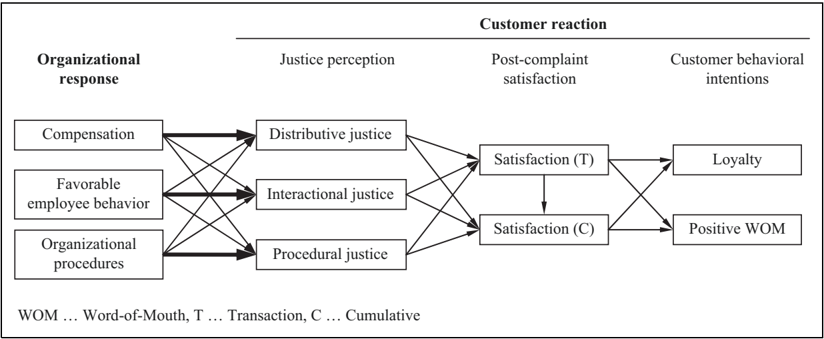
Service recovery is a crucial success factor for organizations. Thus, many studies have addressed the issue of post-complaint behavior. Conducting a meta-analysis, the authors test the following path model: ‘‘organizational responses (compensation, favorable employee behavior, and organizational procedures) → justice perceptions (distributive, interactional, and procedural justice) → post-complaint satisfaction (transaction-specific and cumulative satisfaction) → customer behavioral intentions (loyalty and positive word of mouth [WOM]).’’ The results confirm this model as well as the mediating role of justice perceptions and post-complaint satisfaction. Surprisingly, the results also show that the common contention of distributive justice as the salient driver of service recovery is only true for transaction-specific satisfaction, which in turn reinforces positive WOM. Cumulative satisfaction, however, which is the primary antecedent of customer loyalty, even slightly more depends on interactional justice than on distributive justice. Further, the results show that the relationships between justice perceptions and satisfaction constructs depend on several moderators such as target group, industry, and complaint type. A major managerial implication is the fact that organizations should pay particular attention to distributive justice when complainants are students and to interactional justice when failure is nonmonetary or occurs in service industries. The authors discuss theoretical implications and provide suggestions for future research.
Overview
CoChat Summary
## TL;DR
This meta-analysis synthesizes 87 studies (95 independent samples; total N = 28,826) on complaint handling and tests a path model linking organizational responses to justice perceptions, satisfaction, and behavioral intentions. It finds that the full chain is broadly supported, but that distributive justice is mainly the key driver for transaction-specific satisfaction, while interactional justice matters more for cumulative satisfaction and for some contexts.
## Key findings
- The literature search identified 142 empirical articles; 55 were excluded for insufficient statistics, leaving 87 studies and 477 effects for analysis.
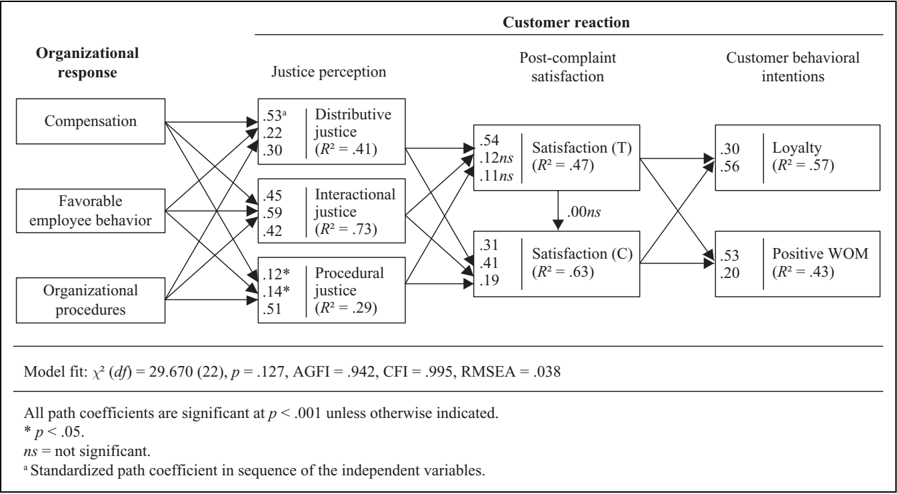
- The hypothesized model fit was excellent: χ²[22] = 29.670, p = .127; AGFI = .942; CFI = .995; RMSEA = .038.
- The model explained 41% of distributive justice, 73% of interactional justice, 29% of procedural justice, 47% of transaction-specific satisfaction, 63% of cumulative satisfaction, 57% of loyalty, and 43% of positive WOM.
- Of 20 estimated path coefficients, 17 were significant at the .05 level; the nonsignificant paths were interactional justice → transaction-specific satisfaction (b = .12, p = .067), procedural justice → transaction-specific satisfaction (b = .11, p = .098), and transaction-specific satisfaction → cumulative satisfaction (b = .00, p = .942).
- Relative effects showed compensation was strongest for distributive justice (χ² diff = 10.454 vs. organizational procedures; 18.844 vs. favorable employee behavior), favorable employee behavior for interactional justice (8.193 vs. compensation; 12.521 vs. organizational procedures), and organizational procedures for procedural justice (21.949 vs. favorable employee behavior; 23.626 vs. compensation).
- Transaction-specific satisfaction was the stronger predictor of positive WOM, while cumulative satisfaction was the stronger predictor of loyalty; the paper reports that transaction-specific satisfaction had a larger effect on positive WOM than cumulative satisfaction (χ² diff = 10.733, p < .001), and cumulative satisfaction had a larger effect on loyalty than transaction-specific satisfaction (χ² diff = 8.831, p < .003).
## Methods
- Meta-analysis of empirical studies from 1980 to June 2009 on relationships among organizational responses, justice perceptions, post-complaint satisfaction, and behavioral intentions.
- Search covered Business Source Complete, Science Direct, Emerald Management Xtra, ABI/Inform, PsycINFO, and the Social Science Citation Index; 142 articles were found, 87 included.
- Effect sizes were correlations; missing correlations were approximated from other statistics, reliability-corrected, weighted by sample size, and pooled. The main analysis used SEM in AMOS 7.0 with maximum likelihood estimation, plus univariate statistics, indirect effects, competing models, and moderator analyses.
- Coding was done by two independent coders; intercoder reliability was .93. Outliers were removed when correlation coefficients exceeded three times the standard error; 5.5% of correlation data points were eliminated.
## Limitations
- The paper says cumulative post-complaint satisfaction is conceptualized as an overall assessment of the entire product/service or organization, but future research should distinguish satisfaction with recovery, with product/service, and with the entire organization.
- It notes compensation level is hard to determine in process failures, so failure type and compensation level should be examined more closely.
- The authors state results may be biased by omitted variables, especially emotions, whose role in the framework remains unclear.
- Evident from the text: some moderator analyses were limited by sparse data, so failure magnitude, switching barriers, online vs. offline complaint handling, relationship quality, and culture could not be examined in detail.
Model-written summary. Check it against the paper before relying on it.
Integrity signals
Registry
Cites
Statistics
Figures

Verification
Claims the paper makes
2 Valid · 2 Not valid · 45 Not checked · 124 Own results and interpretations
The cited sources support only part of this claim — read each source’s verdict below.
In the paper
“It is argued and empirically shown that justice perceptions (distributive, procedural, and interactional justice) completely mediate the relationship between organizational responses and post-complaint satisfaction (Karande, Magnini, and Tam 2007; Maxham III and Netemeyer 2003; Smith, Bolton, and Wagner 1999).”
What the sources say
- Partly supportedcites Karande, Magnini, and Tam 2007 matched to “Recovery Voice and Satisfaction After Service Failure: An Experimental Investigation of Mediating and Moderating Factors” (2007) sourceExperimental — accuracy not yet measured
The Mediation Analysis reports that procedural justice fully mediated the effect of recovery voice on postfailure satisfaction in the airline scenario, but only partially mediated it in the hotel scenario. The study did not test distributive or interactional justice as mediators, or organizational responses beyond recovery voice; the broader claim of complete mediation is therefore not supported. (LLM, conf=0.94)
- Not matchedcites Maxham III and Netemeyer 2003
An author–year citation the paper’s reference list doesn’t settle. We don’t search these by name.
- Not checked — no full text of the sourcecites Smith, Bolton, and Wagner 1999 matched to “A Model of Customer Satisfaction with Service Encounters Involving Failure and Recovery” (1999) source
boostedstates a cause- Asserted: passes — The authors put it forward as true.
- Checkable: passes — It can be checked against evidence.
- Load-bearing: passes — The paper’s conclusions depend on it.
- Based: passes — The paper gives a reason why it holds.
- Partly supported
A result the paper states — it cites no source for it, so there is none to check. The quote shows it is in the paper.
In the paper
“Cumulative satisfaction has a larger impact on loyalty than transaction-specific satisfaction ( w 2 diff[1] ¼ 8.831, p < .003).”
- Also stated in: § Theoretical Implications · plain
“cumulative satisfaction is a stronger predictor of loyalty than transaction-specific satisfaction.”
plainstates an association- Asserted: passes — The authors put it forward as true.
- Checkable: passes — It can be checked against evidence.
- Load-bearing: passes — The paper’s conclusions depend on it.
- Based: passes — The paper gives a reason why it holds.
- Also stated in: § Theoretical Implications · plain
A result the paper reports from its own data — it cites no other source for it, so there is none to check. The quote shows it is in the paper.
In the paper
“The results confirm this model as well as the mediating role of justice perceptions and post-complaint satisfaction.”
boostedstates a cause- Asserted: passes — The authors put it forward as true.
- Checkable: passes — It can be checked against evidence.
- Load-bearing: passes — The paper’s conclusions depend on it.
- Based: passes — The paper gives a reason why it holds.
A result the paper reports from its own data — it cites no other source for it, so there is none to check. The quote shows it is in the paper.
In the paper
“Surprisingly, the results also show that the common contention of distributive justice as the salient driver of service recovery is only true for transaction-specific satisfaction, which in turn reinforces positive WOM.”
plainstates a cause- Asserted: passes — The authors put it forward as true.
- Checkable: passes — It can be checked against evidence.
- Load-bearing: passes — The paper’s conclusions depend on it.
- Based: passes — The paper gives a reason why it holds.
A result the paper reports from its own data — it cites no other source for it, so there is none to check. The quote shows it is in the paper.
In the paper
“Further, the results show that the relationships between justice perceptions and satisfaction constructs depend on several moderators such as target group, industry, and complaint type.”
plainstates an association- Asserted: passes — The authors put it forward as true.
- Checkable: passes — It can be checked against evidence.
- Load-bearing: passes — The paper’s conclusions depend on it.
- Based: passes — The paper gives a reason why it holds.
85 more claims
Create a free account to see all 173 claims and to verify the 5 references still open.
- It may state two separate claims as one. 60
- Borderline: one of the tests for a substantial claim is unclear. 2
- Probably not a substantial claim. 28
Citations
Cites
Statistical Power Analysis for the Behavioral Sciences
Muller, K. (1989) · Technometrics · doi:10.1080/00401706.1989.10488618 · Cited by 99,167
Baron, R. M., & Kenny, D. A. (1986) · Journal of Personality and Social Psychology · doi:10.1037/0022-3514.51.6.1173 · Cited by 91,532
A Cognitive Model of the Antecedents and Consequences of Satisfaction Decisions
Oliver, R. L. (1980) · Journal of Marketing Research · doi:10.1177/002224378001700405 · Cited by 14,494
Adams, J. S. (1965) · Advances in Experimental Social Psychology · doi:10.1016/s0065-2601(08)60108-2 · Cited by 10,818
(2000) · Cited by 9,198
The file drawer problem and tolerance for null results.
Rosenthal, R. (1979) · Psychological Bulletin · doi:10.1037/0033-2909.86.3.638 · Cited by 9,068
The Social Psychology of Procedural Justice
Lind, E. A., & Tyler, T. R. (1988) · Critical Issues in Social Justice · doi:10.1007/978-1-4899-2115-4 · Cited by 6,585
Satisfaction: a behavioral perspective on the consumer
(2010) · Choice Reviews Online · doi:10.5860/choice.47-6963 · Cited by 6,042
Akaike, H. (1987) · Psychometrika · doi:10.1007/bf02294359 · Cited by 5,264
On the dimensionality of organizational justice: A construct validation of a measure.
Colquitt, J. A. (2001) · Journal of Applied Psychology · doi:10.1037/0021-9010.86.3.386 · Cited by 4,114
Research works printed but not linked: 7
- Bagozzi, Richard P. and Hans Baumgartner (1996), ''The Evaluation of Structural Equation Models and Hypothesis Testing,'' in Principles of Marketing Research , 1st reprint, Richard P. Bagozzi, ed. Cambridge, UK: Blackwell, 386-422.
- Blodgett, Jeffrey G. and Stephen S. Tax (1993), ''The Effects of Distributive and Interactional Justice on Complainants' Repatronage Intentions and Negative Word-of-Mouth Intentions,'' Journal of Consumer Satisfaction, Dissatisfaction and Complaining Behavior, 6, 100-110.
- Customer Care Alliance (2003), Customer Care-The Multibillion Dollar Sinkhole. http://www.ccareall.org/
- de Ruyter, Ko, 2000, Inter
- Goodwin, Cathy and Ivan Ross (1989), ''Salient Dimensions of Perceived Fairness in Resolution of Service Complaints,'' Journal of Consumer Satisfaction, Dissatisfaction and Complaining Behavior , 2, 87-98.
- Jain, Dipak C. ( 1996), ‘‘Regression Analysis for Marketing Decisions,’’ in Principles of Marketing Research, 1st reprint, Richard P. Bagozzi, ed. Cambridge, UK: Blackwell, 162-194.
- TARP (1981), Measuring the Grapevine-Consumer Response and Word of Mouth. Atlanta, GA: Coca Cola.
Cited by
Items 401–471 of 471
Current Status and Future Issues in Research on Co-Creation in Service Recovery (CCSR)
Ko, Y. (2020) · Quarterly Journal of Marketing · doi:10.7222/marketing.2020.021
McBurnie, G., Gill, C., & Williams, J. H. (2021) · International Journal of Business Governance and Ethics · doi:10.1504/ijbge.2021.10035729 · Cited by 2
Analysis of Complaint and Suggestion value at Public Services for Organizational Success
Madyaningarum, N., & Sayid, G. H. (2020) · doi:10.4108/eai.7-11-2019.2295247
“Previous literature provided support that handling public complaints related to customer satisfaction and loyalty [14][16][17], service quality [7] and organizational performance [2][3][4].”
BackgroundThe impact of Perceived Justice on Students’ Negative Emotional Responses during Service Recovery
Msosa, S. K. (2020) · International Journal of Higher Education · doi:10.5430/ijhe.v9n5p230 · Cited by 1
Examining e-satisfaction after service recovery
Bakar, A. Y. A., & Zakiah, S. (2019) · Universiti Utara Malaysia Institutional Repository (Universiti Utara Malaysia)
Service Recovery and Continuity in Emerging Markets
Bapat, D. M. (2020) · Springer eBooks · doi:10.1007/978-981-15-8787-0_13
The Passenger Loyalty of National Ships on the Routes Along the Java Sea, Indonesia
Ricardianto, P., Bimantara, B., Sembiring, H. F. A., Sari, M., & Lesmini, L. (2021) · Advances in economics, business and management research/Advances in Economics, Business and Management Research · doi:10.2991/aebmr.k.210220.038
“Another research informed that the most effective complaint handling is to avoid losing dissatisfied customers [16].”
BackgroundFakhrudin, F., Indradewa, R., Syah, T. Y. R., et al. (2021)
Premordia, I., & Gál, T. (2021) · International Review of Management and Marketing · doi:10.32479/irmm.11257 · Cited by 2
“International Review of Management and Marketing | Vol 11 • Issue 3 • 2021 52 service recovery justice is defined as the fairness of the way service failures are managed from three dimensional approaches: distributive justice; procedural justice; and interactional justice (Gelbrich and Roschk, 2011; Orshinger et al.,…”
BackgroundAn experimental investigation into the timing of service failure communication
Dallinger, I. (2021) · VTechWorks (Virginia Tech) · Cited by 1
Rohden, S. F., & Espartel, L. B. (2019) · PUCRS Repository (Pontifical Catholic University of Rio Grande do Sul)
Helou, M., Crismon, L., & Crismon, M. S. P. C. (2021) · World Journal of Educational Research · doi:10.22158/wjer.v9n1p29
Msosa, S. K. (2021) · Baltic Journal of Economic Studies · doi:10.30525/2256-0742/2021-7-5-1-10
Filho, A. C. (2020) · Digital Library of Theses and Dissertations (Universidade de São Paulo) · doi:10.11606/t.12.2020.tde-24062020-195451
Assess Customer’s Complaint Management and Customer Satisfaction of Banks in Akure, Ondo State
Olorunleke, K. (2022) · International Journal of Economics Business and Management Research · doi:10.51505/ijebmr.2022.6802
“The subjective evaluation of the response of the complainant is crucial because perceptions are the subjective, often biased, interpretation of reality that account for individual behaviour (Gelbrich & Roschk, 2010).”
BackgroundInfluentialShow-and-tell or hide-and-seek? Examining organizational cybersecurity incident notifications
Cram, W. A., & Mouajou-Kenfack, R. (2022) · Organizational Cybersecurity Journal Practice Process and People · doi:10.1108/ocj-06-2022-0011 · Cited by 3
COMPLAINTS AS SUSTAINABLE ECOSYSTEMS SERVICES OF CO-CREATION VALUE
Carvalho, M. (2022) · Cadernos de Educação Tecnologia e Sociedade · doi:10.14571/brajets.v15.nse1.29-46
ÖZTÜRK, O. (2022) · International Journal of Social Inquiry · doi:10.37093/ijsi.1140415 · Cited by 3
Şikâyet Yönetiminin Marka Değerine Etkisi: TRC3 Bölgesi Üzerine Bir Uygulama
BÜTÜN, R., & ÖZDEMİR, O. (2022) · Uluslararası Yönetim Akademisi Dergisi · doi:10.33712/mana.1121715
Beschwerden als Quelle organisationalen Lernens
Jacobs, G., Horton, K. E., & Bayerl, P. S. (2023) · Springer eBooks · doi:10.1007/978-3-658-34388-0_78
Gelbrich, K., Müller, S., & Westjohn, S. A. (2023) · Edward Elgar Publishing eBooks · doi:10.4337/9781803923192.00032
Self-citationAn Apology With a Tiny Monetary Compensation Is No More Effective Than a Verbal Apology Alone
Imada, H., Yamamoto, A., & Tsudaka, G. (2023) · Letters on Evolutionary Behavioral Science · doi:10.5178/lebs.2023.106
Service Recovery: Past, Present, and Future
Rao, A. S., & Suar, D. (2023) · Springer proceedings in mathematics & statistics · doi:10.1007/978-3-031-25194-8_27
Chinasa, A. E. (2023) · JOURNAL OF BUSINESS AND AFRICAN ECONOMY · doi:10.56201/jbae.v8.no1.2022.pg67.76
Iyadi, R. C. (2023) · International Journal of Management & Entrepreneurship Research · doi:10.51594/ijmer.v5i12.651 · Cited by 6
Kalagbor, A. N. (2023) · IGI Global eBooks · doi:10.4018/979-8-3693-2045-7.ch072
Mardumyan, A., & Sabadie, W. (2024) · Recherche et Applications en Marketing (French Edition) · doi:10.1177/07673701231196675
“Deuxièmement, conformément aux théories de la justice ( e.g. , Gelbrich et Roschk, 2011 ; Oliver et Swan, 1989 ; Orsingher et al., 2010), les résultats montrent que la justice distributive du médiateur intervient dans la relation entre la favorabilité de la décision du médiateur et les intentions…”
BackgroundInfluentialKim, B.-S., Kim, J.-H., & Kim, W. (2024) · Studies in computational intelligence · doi:10.1007/978-3-031-53385-3_6
Caillier, J. G. (2024) · Public Integrity · doi:10.1080/10999922.2024.2365242 · Cited by 1
“This is evident in meta-analyses concerning complaints made after a service failure (e.g., Gelbrich & Roschk, 2011; Orsingher et al., 2010).”
Tan, K. P.-S., & Zou, S. S. (2024) · Journal of Quality Assurance in Hospitality & Tourism · doi:10.1080/1528008x.2024.2410214
“In both studies, distributive justice emerged with the strongest effect on restoring consumer satisfaction and procedural justice with the weakest effect (Gelbrich & Roschk, 2011; Orsingher et al., 2010);.”
InfluentialHuang, R., & Ha, S. (2025) · doi:10.31274/itaa.18782 · Cited by 1
“It increases when observers perceive a complaining consumer is treated respectfully or friendly by other consumers (Gelbrich & Roschk, 2011).”
Measurement of Positive Continuance Intention Drivers within a Service Domain
Harun, M. A. U. (2019) · University of North Texas Digital Library (University of North Texas) · doi:10.12794/metadc1538650
Kim, M. J., & Jung, S. (2025) · Journal of the Korean Society of Clothing and Textiles · doi:10.5850/jksct.2025.49.1.49 · Cited by 1
Thatsaringkharnsakun, U., Khorchurklang, S., & Yawised, K. (2025) · Journal of Business Innovation and Sustainability (JBIS) · doi:10.71185/jbis.2025.277125 · Cited by 1
“Apologies serve as a vital emotional recovery strategy to restore damaged relationships (Davidow, 2000, pp.473-490; Gelbrich and Roschk, 2011, 24-43).”
Hotel guests' loyalty, behaviour, and service recovery satisfaction based on rating perception
Josimović, M., Cvjetković, M., & Petrović, R. (2025) · Journal of Engineering Management and Competitiveness · doi:10.5937/jemc2501032j
Chambers, D. W. (2025) · Journal of the California Dental Association · doi:10.1080/19424396.2025.2460733 · Cited by 1
Fan, L., Li, S., Wang, C., & Zhang, X. (2025) · SSRN Electronic Journal · doi:10.2139/ssrn.5403350
Khurram, F. (2021) · UW Journal of Management Sciences · doi:10.56220/uwjms.v5i1.19 · Cited by 2
Suresh, P., Chawla, V., & Sharma, A. (2025) · Journal of Service Theory and Practice · doi:10.1108/jstp-10-2024-0363 · Cited by 1
Li, Y., & Ha, H. (2025) · Journal of Research in Interactive Marketing · doi:10.1108/jrim-03-2025-0137
Sharifi, S., Casidy, R., Jung, K., & Duhachek, A. (2026) · Journal of Retailing · doi:10.1016/j.jretai.2025.12.006
How much is enough? An investigation of monetary compensation for service failures
Kenesei, Z., & Kolos, K. (2026) · Service Business · doi:10.1007/s11628-025-00597-z
“While previous studies have established the significance of distributive justice in service recovery (e.g., Orsingher et al. 2010 ; Gelbrich and Roschk 2011), how different factors affect the appropriate amount of compensation has remained underex - plored.”
InfluentialWang, L., Wang, B., Ren, J., & Ding, H. (2026) · Journal of Marketing Management · doi:10.1080/0267257x.2025.2603275
“This moves beyond firm-centred service recovery (Gelbrich & Roschk, 2011; Smith et al., 1999; Tax et al., 1998) and aligns with multi-actor, practice-embedded views (Echeverri & Skålén, 2011; Vargo & Lusch, 2016).”
Seeking redress from third parties : the roles of the mediator in the service recovery process
Mardumyan, A. (2018) · theses.fr (ABES) · doi:10.70675/2768681ez45dcz45adz84cfz48457e160972
Stratégies de reconquête des clients partis suite à un échec de service
Man, A. C. C. (2022) · theses.fr (ABES) · doi:10.70675/f1ef8e10z755dz49a1z98b1z85c0cf6dde40
Taher, R. A. (2023) · theses.fr (ABES) · doi:10.70675/891676b9z270dz4635zaff5z950583de860d · Cited by 1
Lee, J.-H., & Shin, H.-C. (2026) · Sustainability · doi:10.3390/su18094571 · Cited by 3
Service robot failure: The interplay of monetary compensation and voice anthropomorphism
Bruder, M., & Paul, M. (2026) · Journal of Business Research · doi:10.1016/j.jbusres.2026.116260 · Cited by 1
Svanda, A., Čaić, M., & Keinonen, T. (2026) · Participatory Design Conference · doi:10.1145/3796624.3796641
“…are typically experienced as violations of fairness, justice perspectives provide valuable tools for analyzing not only whether recovery improves the encounter, but also how perceptions of fairness in outcomes, processes, and interactions shape trust, forgiveness, and future engagement [51].”
Teruel-Gutiérrez, R. (2026) · Journal of Retailing and Consumer Services · doi:10.1016/j.jretconser.2026.104956 · Cited by 2
Exploring eWOM Following Service Recovery: The Mediating Effects of Satisfaction and Emotions
Vo, T. H. G., & Luong, D. B. (2026) · SAGE Open · doi:10.1177/21582440261463685
From Complaint to Resolution: A Case of a Large Global Actor – Company X
Šuškavčević, T., & Malc, D. (2026) · doi:10.18690/um.epf.6.2026.6
A Generic Structure Analysis of Arabic and English Response Letters to Complaints
Derki, N. (2026) · RUDN Journal of Language Studies Semiotics and Semantics · doi:10.22363/2313-2299-2026-17-1-186-204 · Cited by 1
Retaining Complaining Customers: Understanding Equity-Trust Trade-OffsPreprint
Hajihashemi, B., Sridhar, S., Palmatier, R. W., & Samaha, S. (2026) · SSRN Electronic Journal · doi:10.2139/ssrn.6945943
To go public or private: Handling consumer complaints from a dynamic triadic perspective
Hung, H.-Y., Kumar, A., Kumar, V., Lowry, P. B., & Lin, C.-C. (2026) · Journal of the Academy of Marketing Science · doi:10.1007/s11747-026-01196-8
Consumer responses to industrially processed food in hospitality: Is an authenticity crisis looming?
Cambier, F., & Antonetti, P. (2026) · International Journal of Hospitality Management · doi:10.1016/j.ijhm.2026.104872
From Stranger to Someone: How Naming Creates Closeness and Buffers Chatbot Service Failure
Lu, J., Zhu, G., Hu, Y., & Huang, J. (2026) · Psychology and Marketing · doi:10.1002/mar.70250
Qi, Y., & Agag, G. (2026) · Journal of Retailing and Consumer Services · doi:10.1016/j.jretconser.2026.105042 · Cited by 3
When AI service appearance backfires: form-based expectations and trust fragility
Verma, A., & Gabbad, H. (2026) · Journal of Services Marketing · doi:10.1108/jsm-11-2025-0823 · Cited by 1
Paulich, B. J., Tamaddoni, A., & Ludwig, S. (2026) · Journal of Service Research · doi:10.1177/10946705261477467 · Cited by 1
Türkiye'deki Havalimanı Otellerinin Hizmet Hataları ve Telafi Eylemleri: İstanbul ve İzmir Örneği
Akın, G. (2026) · Güncel Turizm Araştırmaları Dergisi · doi:10.32572/guntad.1866334
Bhutto, M. H., Mero, J., & Karjaluoto, H. (2026) · Journal of Service Theory and Practice · doi:10.1108/jstp-02-2025-0060
Rajput, D. G., Sarkar, A., & Singh, B. (2026) · Cogent Business & Management · doi:10.1080/23311975.2026.2736254
Siahtiri, V., Adikari, A., & Alahakoon, D. (2026) · Internet Research · doi:10.1108/intr-12-2025-2020
Gong, S., Li, W., Bai, L., & Wang, M. (2026) · Journal of Hospitality and Tourism Management · doi:10.1016/j.jhtm.2026.101563
Efficiency of Answers for Customers' Complaints - Application in a Sample of French Companies
Grimal, L., & Simon, F. L. (2012) · Journal of Economics and Management
Metadata
- Authors
- Gelbrich, K., & Roschk, H.
- Affiliations
- Technische Universität Ilmenau (DE)
- Corresponding author
- Roschk, Holger
- Venue
- Journal of Service Research
- Publisher
- SAGE Publications
- Published
- 2010-12-03
- Volume
- 14
- Issue
- 1
- Pages
- 24-43
- ISSN
- 1094-6705 (ISSN-L)
- 1552-7379
- OpenAlex
- W2128616827
- Cited by
- 481
- References
- 82
- Citations by year
- 2026: 37 · 2025: 32 · 2024: 24 · 2023: 45 · 2022: 43 · 2021: 37 · 2020: 44 · 2019: 42 · 2018: 32 · 2017: 29 · 2016: 20 · 2015: 27 · 2014: 26 · 2013: 21 · 2012: 12
- FWCI
- 3.00
- Type
- journal article
- Language
- en
- Open access
- green
- uri.gbv.de
- Licence
- other-oa
- journals.sagepub.com/page/policies/text-and-data-mining-license (tdm)
- Locations
- Journal of Service Research (publishedVersion, public-domain)
- Common Library Network (Der Gemeinsame Bibliotheksverbund) (submittedVersion, other-oa)
- Topics
- Social Sciences › Business, Management and Accounting › Marketing › Customer Service Quality and Loyalty
- Social Sciences › Business, Management and Accounting › Marketing › Service and Product Innovation
- Social Sciences › Business, Management and Accounting › Organizational Behavior and Human Resource Management › Job Satisfaction and Organizational Behavior
- Keywords
- complaint handling, service recovery, distributive justice, interactional justice, procedural justice, customer loyalty, word of mouth, compensation, employee behavior, perceived justice, consumer behavioral intention, students as customers, service sector
About these checks
Registry, retraction, Cites and statistics results are computed, not judged, with one exception: a printed reference that no index lists is read once by a model before it counts as a citation error. Claims are extracted by a model and kept only when their quote appears verbatim in the text; each cited source is then checked, with a model’s help, for whether it says what the claim relies on. Those verdicts can be wrong — read the claim’s quote and the cited source before relying on one.
The claim verdicts this report counts are experimental: their accuracy is not yet measured.
A language model drew the claims from the paper on 2026-10-10, under version 3 of the claim definition (model deepseek-v4.1-flash, prompt extract-v3).
A second model labelled each claim on 2026-10-10 (model jev-1.13-20260917, definition revision gold-guideline-v0.2).
Cited sources are checked with a language model’s help (gpt-6-sol).
Statistics and arithmetic are recomputed, not judged.
Confidence bands are shown only for fields calibrated on our annotated test set. None is calibrated yet, so no band is shown.
What counts as a claim ›How we measure confidence ›How we check this ›
Are you an author, or do you see a problem with this page? Request a review
Data sources
Bibliographic data: Semantic Scholar, OpenAlex, Crossref.
Contains information from the Semantic Scholar Academic Graph Datasets, made available under the ODC Attribution License (ODC-BY 1.0).
Semantic Scholar’s data is described in: Kinney, R., et al. (2023). The Semantic Scholar Open Data Platform. arXiv:2301.10140.
