

Prospective Longitudinal Associations Between Adverse Childhood Experiences and Adult Mental Health Outcomes: Systematic Review and Meta-Analysis
Open accessThe DOI matches its Crossref record; 91 of the 92 references it cites were found in a registry or an index; 20 of the 43 sources its claims cite were checked for support.
Abstract
Research suggests a strong, dose–response relationship between adverse childhood experiences (ACEs) and poor adult mental health outcomes. This systematic review and meta-analysis aimed to systematically investigate the existence and strength of prospective associations between ACEs and adult mental health outcomes: anxiety, depression, psychotic-like experiences, post-traumatic stress disorder (PTSD), self-harm, and suicidality. We searched 12 electronic databases for publications after 1990. A narrative synthesis of included studies and random-effects meta-analyses with moderation were completed for all outcomes, excluding self-harm. In total, 62 studies from 15 countries were included. Most studies were from the United States; 95% of publications ( N = 59) came from high-income countries (HICs) and 5% ( N = 3) from upper-middle-income countries. Pooled associations between ACEs and adult mental illness were strongest for PTSD (OR = 2.26; 95% CI [1.75, 2.77]), followed by anxiety (OR = 1.78; 95% CI [1.45, 2.11]), depression (OR = 1.61; 95% CI [1.45, 1.76]), psychotic-like experiences (OR = 1.34; 95% CI [1.13, 1.54]), and suicidality (OR = 1.28; 95% CI [1.13, 1.43]). Moderation analyses suggested ACEs with a violence or maltreatment component were significant risk factors for adult depression compared to household ACEs, and that study location was a significant moderator in the depression, anxiety, and PTSD models. Further moderation effects will be discussed. Findings confirm ACEs are a significant risk factor for mental ill-health in adulthood. Our review highlights the urgent need for research exploring associations between ACEs measured in childhood and adult mental illness outside of HIC settings.
Overview
CoChat Summary
TL;DR
This systematic review and meta-analysis of prospective longitudinal studies found that adverse childhood experiences (ACEs) were associated with significantly higher odds of adult depression, anxiety, PTSD, psychotic-like experiences, and suicidality, with the strongest pooled association for PTSD. Evidence was heavily concentrated in high-income countries, and heterogeneity and methodological inconsistency limited moderator and causal conclusions.
Key findings
- Across 62 included studies from 15 countries, 59 publications (95%) came from high-income countries and 3 (5%) from upper-middle-income countries; most studies were from the United States. Pooled unadjusted odds ratios were: PTSD OR = 2.26 (95% CI [1.75, 2.77]), anxiety OR = 1.78 (95% CI [1.45, 2.11]), depression OR = 1.61 (95% CI [1.45, 1.76]), psychotic-like experiences OR = 1.34 (95% CI [1.13, 1.54]), and suicidality OR = 1.28 (95% CI [1.13, 1.43]).
- Self-harm was represented in only one study, preventing meaningful narrative synthesis and meta-analysis.
- Moderation analyses suggested ACEs with a violence or maltreatment component were significant risk factors for adult depression compared with household ACEs, and study location was a significant moderator in the depression, anxiety, and PTSD models.
- All five meta-analytic models demonstrated significant heterogeneity; the PTSD model was based on a limited number of studies (ki = 4, N ES = 14), and the authors caution against overinterpreting that pooled estimate.
Methods
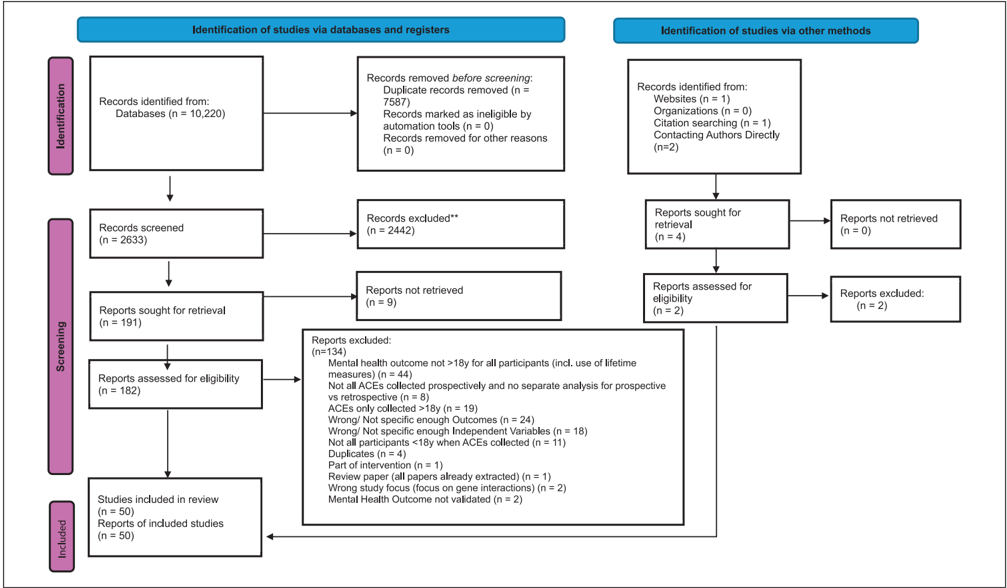
- Systematic review and meta-analysis searching 12 electronic databases for publications from 1990 onward; after double-screening 4,383 titles/abstracts, 244 studies underwent full-text screening, 62 met eligibility criteria, and 39 were meta-analyzed.
- Narrative synthesis plus random-effects meta-analyses using the “metafor” package in R; unadjusted odds ratios were used, with two-level models for PTSD and psychosis and three-level models for depression, anxiety, and suicidality.
- Study quality was assessed with the Newcastle-Ottawa Scale; moderation was examined via meta-regression for year of publication, ACE type, ACE count, location, ACE source of reporting, and study design; publication bias was assessed with funnel plots, Egger’s tests, and trim-and-fill.
Limitations
- Stated: heterogeneity and missing data prevented analysis of ACE onset age and chronicity; genetic variations were unaccounted for; most studies (76%) did not control for the same mental health outcome in childhood, limiting causal inferences; inclusion criteria excluded special subpopulations such as psychiatric inpatients or people in prison.
- Stated: 95% of included studies were from high-income countries, limiting location moderator variability; only 3 LMIC studies meant income classification could not be modeled; self-harm had only one study; no formal sensitivity analyses were conducted; effect-size conversions may have introduced bias or imprecision; no formal GRADE certainty assessment was performed.
- Evident from the text: several outcomes had few studies and wide variability, and all five models showed significant heterogeneity, so pooled estimates for PTSD, psychosis, and suicidality are less precise and generalizable than those for depression and anxiety.
Model-written summary. Check it against the paper before relying on it.
Integrity signals
Registry
Cites
Statistics
Figures
Verification
Claims the paper makes
13 Valid · 4 Not valid · 13 Not checked · 119 Own results and interpretations
Some cited sources support this claim and some don’t — read each source’s verdict below.
In the paper
“To address this, we include only prospective, longitudinal studies in which ACEs were measured in childhood and mental health outcomes assessed in adulthood, in line with recent recommendations (Baldwin et al., 2019; Lacey & Minnis, 2020).”
§ Prospective Longitudinal Associations Between Adverse Childhood Experiences and Adult Mental Health Outcomes: Systematic Review and Meta-Analysis > Background
What the sources say
- Partly supportedcites Baldwin et al., 2019 matched to “Agreement Between Prospective and Retrospective Measures of Childhood Maltreatment: A Systematic Review and Meta-analysis” (2019) sourceExperimental — accuracy not yet measured
Baldwin et al.’s Findings report poor agreement between prospective and retrospective measures of childhood maltreatment, and the Conclusions caution that the groups they identify may have different risk mechanisms. This supports the citing authors’ choice to focus on prospective measures. The paper does not recommend restricting a review to studies that assess mental health outcomes in adulthood; that restriction is the citing authors’ own study design. (LLM, conf=0.82)
- Disputedcites Lacey & Minnis, 2020 matched to “Practitioner Review: Twenty years of research with adverse childhood experience scores – Advantages, disadvantages and applications to practice” (2020) sourceExperimental — accuracy not yet measured
Our copy's Methods (p. 5) states Lacey & Minnis's paper is 'a narrative rather than systematic review' whose search used broad terms ('abuse and neglect', 'adverse childhood experiences') across clinical, maltreatment and policy literature, with no restriction to prospective designs; the review in fact devotes space to studies using retrospective ACE reporting (Limitations of ACE scores, p. 11). What the source does say is a recommendation for future work — 'Longitudinal studies, recording high quality prospective ACEs data, are crucial to ACEs research' (Recommendations, p. 22) — which supports the citing sentence's 'in line with recent recommendations' but contradicts the paraphrase's assertion that the review itself included only prospective, longitudinal studies with childhood-measured ACEs and adult outcomes. (LLM, conf=0.80)
Checked by a reasoning model — may be wrong.
plain- Asserted: passes — The authors put it forward as true.
- Checkable: passes — It can be checked against evidence.
- Load-bearing: passes — The paper’s conclusions depend on it.
- Based: passes — The paper gives a reason why it holds.
- Partly supported
Every source the paper cites for this claim was checked and supports it.
In the paper
“In addition, cumulative ACE scores have been found to have poor predictive accuracy for later life mental ill-health (Baldwin et al., 2021).”
- Also stated in: § Implications of Findings · plain
“cumulative ACE scores have been found to have poor predictive accuracy for later life mental ill-health (Baldwin et al., 2021).”
§ Prospective Longitudinal Associations Between Adverse Childhood Experiences and Adult Mental Health Outcomes: Systematic Review and Meta-Analysis > Discussion > Implications of Findings
What the sources say
- Supportedcites Baldwin et al., 2021 matched to “Population vs Individual Prediction of Poor Health From Results of Adverse Childhood Experiences Screening” (2021) source
The Results (E-Risk Study) report very poor accuracy for ACE scores in predicting mental health problems at age 18 (AUC 0.58). The Dunedin replication likewise reports very poor accuracy for mental health problems at age 45 (AUC 0.58), supporting the claim about later-life mental ill-health. (LLM, conf=0.94)
plain- Asserted: passes — The authors put it forward as true.
- Checkable: passes — It can be checked against evidence.
- Load-bearing: passes — The paper’s conclusions depend on it.
- Based: passes — The paper gives a reason why it holds.
- Also stated in: § Implications of Findings · plain
The cited sources support only part of this claim — read each source’s verdict below.
In the paper
“Fit indices were used to confirm that three-step meta-analytic models were necessary to account for any effect size dependency within studies for the models where depression, anxiety, and suicidality were outcomes (van den Noortgate et al., 2015).”
§ Prospective Longitudinal Associations Between Adverse Childhood Experiences and Adult Mental Health Outcomes: Systematic Review and Meta-Analysis > Methods > Synthesis Methods
What the sources say
- Partly supportedcites van den Noortgate et al., 2015 matched to “Meta-analysis of multiple outcomes: a multilevel approach” (2015) sourceExperimental — accuracy not yet measured
The Conclusions (page not provided) say that multiple outcomes per study can produce dependent effect sizes and that a three-level approach can account for this. The paper does not report fit indices confirming that such models were necessary for depression, anxiety, and suicidality outcomes in the citing study. (LLM, conf=0.86)
plain- Asserted: passes — The authors put it forward as true.
- Checkable: passes — It can be checked against evidence.
- Load-bearing: passes — The paper’s conclusions depend on it.
- Based: passes — The paper gives a reason why it holds.
- Partly supported
The cited sources support only part of this claim — read each source’s verdict below.
In the paper
“The rationale for this review stems from growing concerns about the validity of retrospective ACEs reporting, which dominates the literature but is vulnerable to recall bias, memory decay, and mood-congruent distortion—particularly among individuals with mental health conditions (Baldwin et al., 2019; Reuben et al., 2016).”
§ Prospective Longitudinal Associations Between Adverse Childhood Experiences and Adult Mental Health Outcomes: Systematic Review and Meta-Analysis > Background
What the sources say
- Partly supportedcites Baldwin et al., 2019 matched to “Agreement Between Prospective and Retrospective Measures of Childhood Maltreatment: A Systematic Review and Meta-analysis” (2019) sourceExperimental — accuracy not yet measured
The Discussion says memory biases can cause underreporting or overreporting of childhood maltreatment, including through forgetting and negatively biased autobiographical recall in depression. This supports the stated vulnerabilities, but the paper gives depression as an example; it does not establish that retrospective reporting is particularly vulnerable among people with mental health conditions generally. (LLM, conf=0.82)
- Supportedcites Reuben et al., 2016 matched to “Lest we forget: comparing retrospective and prospective assessments of adverse childhood experiences in the prediction of adult health” (2016) source
The Introduction says ACE research relies primarily on adults’ recollections and explains that distant memories may be difficult to retrieve, while psychopathology may increase the propensity to recall adversity. The Discussion also describes negative recollection bias associated with negative mood or psychological dysfunction. Together, these passages support the stated concerns about recall, memory decay, and mood-related distortion. (LLM, conf=0.93)
plainstates an association- Asserted: passes — The authors put it forward as true.
- Checkable: passes — It can be checked against evidence.
- Load-bearing: passes — The paper’s conclusions depend on it.
- Based: passes — The paper gives a reason why it holds.
- Partly supported
The cited sources that could be checked couldn’t confirm or dispute this claim.
In the paper
“Some longitudinal cohorts in LMICs are still in their earlier years, and adult data are not yet available for their participants”
§ Prospective Longitudinal Associations Between Adverse Childhood Experiences and Adult Mental Health Outcomes: Systematic Review and Meta-Analysis > Discussion
What the sources say
- Not matchedcites USC-Office of Population Studies Foundation, 2019
An author–year citation the paper’s reference list doesn’t settle. We don’t search these by name.
- Could not verifycites Meinck et al., 2023 matched to “Measuring Violence Against Children: A COSMIN Systematic Review of the Psychometric Properties of Child and Adolescent Self-Report Measures” (2023) sourceExperimental — accuracy not yet measured
The Results section, “Description of Studies” (page unavailable), describes the studies included in this review, while the Discussion section, “Considerations Relating to Diversity” (page unavailable), discusses validation in LMIC contexts. Neither addresses whether longitudinal cohorts in LMICs are still in their early years or lack adult participant data. Searches for longitudinal follow-up and cohorts found no passage establishing that claim. (LLM, conf=0.76)
plain- Asserted: passes — The authors put it forward as true.
- Checkable: passes — It can be checked against evidence.
- Load-bearing: passes — The paper’s conclusions depend on it.
- Based: passes — The paper gives a reason why it holds.
- Not matched
83 more claims · 3 with their cited sources checked
Create a free account to see all 149 claims and to verify the 2 references still open.
- It may state two separate claims as one. 29
- Probably not a substantial claim. 38
- Borderline: one of the tests for a substantial claim is unclear. 1
- The quote only partly states this claim. 1
Statistics that don’t add up
Each reported p-value recomputed from its test statistic and degrees of freedom, each partial η² from its F, and each ratio, mean difference or B printed with a p checked against its own confidence interval.
Rated minor: it would not touch a result — a value no result rests on, a p-value that stays on the same side of the significance level, or a conflict that is clerical, resolved elsewhere in the paper, or outside its own findings.
In the paper
“t(95) = −2.24, p = .0227”
§ Prospective Longitudinal Associations Between Adverse Childhood Experiences and Adult Mental Health Outcomes: Systematic Review and Meta-Analysis > Results > Moderator Analysis
Reported p = .0227 · recomputed p = .027
Statistics recomputed
Every reported test result, recomputed from its test statistic and degrees of freedom. A result shows as not adding up only once an independent check has confirmed it.
- Doesn’t add upt(95) = -2.24reported p = .0227 · recomputed p = .027
“t(95) = −2.24, p = .0227”
- ConsistentF(15, 81) = 4.13reported p < .0001 · recomputed p < .001
“F (15, 81) = 4.13, p < .0001”
- Consistentt(81) = 2.19reported p = .0311 · recomputed p = .031
“t(81) = 2.19, p = .0311”
- Consistentt(81) = 2.67reported p = .0092 · recomputed p = .009
“t(81) = 2.67, p = .0092”
- Consistentt(81) = 3.06reported p = .003 · recomputed p = .003
“t(81) = 3.06, p = .003”
14 more recomputed tests
Create a free account to see every test the Stats check recomputed.
Self-check
Percentages, sums and reported differences re-computed from the paper’s own numbers.
Each contradiction between two passages listed here was confirmed by an independent check.
Rated minor: it would not touch a result — a value no result rests on, a p-value that stays on the same side of the significance level, or a conflict that is clerical, resolved elsewhere in the paper, or outside its own findings.
In the paper
§ Prospective Longitudinal Associations Between Adverse Childhood Experiences and Adult Mental Health Outcomes: Systematic Review and Meta-Analysis > Results > Moderator Analysis
“β1 = −86 (−1.58; −.13)”
§ Prospective Longitudinal Associations Between Adverse Childhood Experiences and Adult Mental Health Outcomes: Systematic Review and Meta-Analysis > Results > Moderator Analysis
“t(57) = −2.35 p = .022”
Rated minor: it would not touch a result — a value no result rests on, a p-value that stays on the same side of the significance level, or a conflict that is clerical, resolved elsewhere in the paper, or outside its own findings.
In the paper
§ Prospective Longitudinal Associations Between Adverse Childhood Experiences and Adult Mental Health Outcomes: Systematic Review and Meta-Analysis > Methods > Synthesis Methods
“Using meta-regressions, we were able to assess for moderating effects of year of publication, ACE type, ACE count, location, ACE source of reporting, and study design.”
§ Prospective Longitudinal Associations Between Adverse Childhood Experiences and Adult Mental Health Outcomes: Systematic Review and Meta-Analysis > Discussion > Limitations
“As a result of this inconsistency, we were unable to examine the effect of the number of ACEs as a moderator in our meta-analysis.”
Rated minor: it would not touch a result — a value no result rests on, a p-value that stays on the same side of the significance level, or a conflict that is clerical, resolved elsewhere in the paper, or outside its own findings.
In the paper
§ Prospective Longitudinal Associations Between Adverse Childhood Experiences and Adult Mental Health Outcomes: Systematic Review and Meta-Analysis > Abstract
“study location was a significant moderator in the depression, anxiety, and PTSD models.”
§ Prospective Longitudinal Associations Between Adverse Childhood Experiences and Adult Mental Health Outcomes: Systematic Review and Meta-Analysis > Results > Moderator Analysis
“No other moderators had a significant overall model effect, but when examining location, results showed that participants in the study conducted in South America”
Citations
Cites
The PRISMA 2020 statement: An updated guideline for reporting systematic reviews
Page, M. J., McKenzie, J. E., Bossuyt, P. M., Boutron, I., Hoffmann, T. C., Mulrow, C. D., Shamseer, L., Tetzlaff, J. M., Akl, E. A., Brennan, S. E., et al. (2021) · BMJ · doi:10.1136/bmj.n71 · Cited by 108,283
Bias in meta-analysis detected by a simple, graphical test
Egger, M., Smith, G. D., Schneider, M., & Minder, C. (1997) · BMJ · doi:10.1136/bmj.315.7109.629 · Cited by 56,722 · cited 3×
“The standard Egger’s regression test further checked for publication bias in the two-level models, where effect sizes were regressed on standard errors (SEs; Egger et al., 1997).”
InfluentialConducting Meta-Analyses in R with the metafor Package
Viechtbauer, W. (2010) · Journal of Statistical Software · doi:10.18637/jss.v036.i03 · Cited by 20,464 · cited 1×
“Subgroup analyses can introduce information loss and inflated Type Ι error rates in multilevel data, whereas moderation allows for more efficient and statistically appropriate assessment of heterogeneity across study-level characteristics (Assink & Wibbelink, 2016; Viechtbauer, 2010).”
Felitti, V. J., Anda, R. F., Nordenberg, D., Williamson, D. F., Spitz, A. M., Edwards, V., Koss, M. P., & Marks, J. S. (1998) · American Journal of Preventive Medicine · doi:10.1016/s0749-3797(98)00017-8 · Cited by 18,943 · cited 5×
“These variables were chosen to reflect how ACEs are commonly grouped and conceptualized in the literature (Cavanaugh, 2016; Felitti et al., 1998), as well as to incorporate more contemporary under-standings of adversity such as bullying victimization (bully vs. other ACEs) (Arseneault, 2018;…”
InfluentialStang, A. (2010) · European Journal of Epidemiology · doi:10.1007/s10654-010-9491-z · Cited by 17,396 · cited 1×
“The NOS implements a star system and a maximum of 8 stars can be awarded (A maximum award of 1 star per item within the domains Selection and Exposure and a maximum award of 2 stars for the domain of Comparability) (Stang, 2010).”
Duval, S., & Tweedie, R. (2000) · Biometrics · doi:10.1111/j.0006-341x.2000.00455.x · Cited by 14,099 · cited 1×
“We initially proposed using the trim-and-fill method (Duval & Tweedie, 2000) to identify and correct publication bias.”
Hughes, K., Bellis, M. A., Hardcastle, K. A., Sethi, D., Butchart, A., Mikton, C., Jones, L., & Dunne, M. P. (2017) · The Lancet Public Health · doi:10.1016/s2468-2667(17)30118-4 · Cited by 5,255 · cited 1×
“In their systematic review and meta-analysis, Hughes et al. (2017) demonstrated the significant, deleterious effects of multiple ACEs (four or more) on lifelong health.”
Norman, R. E., Byambaa, M., De, R., Butchart, A., Scott, J., & Vos, T. (2012) · PLoS Medicine · doi:10.1371/journal.pmed.1001349 · Cited by 3,387 · cited 1×
“Other systematic reviews include Norman et al. (2012) and Kalmakis and Chandler (2015), whose results suggested significant associations between ACEs and various long-term mental health outcomes and health-harming behaviors, including depressive disorders, suicide attempts, PTSD, substance misuse,…”
Deeks, J. J., Macaskill, P., & Irwig, L. (2005) · Journal of Clinical Epidemiology · doi:10.1016/j.jclinepi.2005.01.016 · Cited by 2,910 · cited 1×
“However, multiple simulation studies have shown poor performance of SEs as moderators (Deeks et al., 2005; Fernández-Castilla et al., 2021; Macaskill et al., 2001; Peters et al., 2006), including when using ORs as effect sizes (Peters et al., 2006).”
Analysing data and undertaking meta‐analyses
Deeks, J. J., Higgins, J. P., Altman, D. G., & on behalf of the Cochrane Statistical Methods Group (2019) · Cochrane Handbook for Systematic Reviews of Interventions · doi:10.1002/9781119536604.ch10 · Cited by 2,672 · cited 1×
“To supplement the I 2 statistic and enhance interpretation of meta-analytic results, prediction intervals will be reported to explore the dispersion of estimates (Deeks et al., 2019).”
van Os, J., Linscott, R. J., Myin-Germeys, I., Delespaul, P., & Krabbendam, L. (2009) · Psychological Medicine · doi:10.1017/s0033291708003814 · Cited by 2,343 · cited 1×
“Similarly, psychotic-like experiences are increasingly recognized as clinically significant but remain underrepresented in longitudinal ACE research (van Os et al., 2009).”
Publication and related bias in meta-analysis
Sterne, J. A. C., Gavaghan, D., & Egger, M. (2000) · Journal of Clinical Epidemiology · doi:10.1016/s0895-4356(00)00242-0 · Cited by 2,282 · cited 1×
“…test may vary as a function of extrane-ous factors (e.g., choice of moderator, the number of studies included, high between-study heterogeneity, and the magnitude of effect sizes [including small study effect sizes]) (Fernández-Castilla et al., 2021; Peters et al., 2006; Sterne et al., 2000).”
Comparison of two methods to detect publication bias in meta-analysis.
Peters, J. L. (2006) · JAMA · doi:10.1001/jama.295.6.676 · Cited by 2,278 · cited 3×
“In contrast, some of the afore-mentioned simulation studies (Fernández-Castilla et al., 2021; Peters et al., 2006) have found inverse sample size as a moderator can outperform SE by mitigating the risk of Type Ι errors due to the independence of effect sizes and inverse sample sizes.”
Adverse childhood experiences and the risk of depressive disorders in adulthood
Chapman, D. P., Whitfield, C. L., Felitti, V. J., Dube, S. R., Edwards, V. J., & Anda, R. F. (2004) · Journal of Affective Disorders · doi:10.1016/j.jad.2003.12.013 · Cited by 2,267 · cited 1×
“…cross-sectional and longitudinal evidence indicates a heightened risk of developing psychiatric problems after exposure to ACEs, including depression (Chapman et al., 2004), anxiety disorders (Poole et al., 2017), suicidal ideation (Stansfeld et al., 2017), and psychosis (Karcher et al., 2020).”
Masten, A. S., & Cicchetti, D. (2010) · Development and Psychopathology · doi:10.1017/s0954579410000222 · Cited by 1,800 · cited 1×
“Both factors are known to influence health outcomes (English et al., 2005; Masten & Cicchetti, 2010; Schalinski et al., 2016).”
Fitting three-level meta-analytic models in R: A step-by-step tutorial
Assink, M., & Wibbelink, C. J. M. (2016) · The Quantitative Methods for Psychology · doi:10.20982/tqmp.12.3.p154 · Cited by 1,330 · cited 2×
“There is currently no direct function to conduct an Egger’s bias test in meta-analytic models with more than two levels (Assink & Wibbelink, 2016; Fernández-Castilla et al., 2021).”
A comparison of methods to detect publication bias in meta‐analysis
Macaskill, P., Walter, S. D., & Irwig, L. (2001) · Statistics in Medicine · doi:10.1002/sim.698 · Cited by 1,286 · cited 1×
“However, multiple simulation studies have shown poor performance of SEs as moderators (Deeks et al., 2005; Fernández-Castilla et al., 2021; Macaskill et al., 2001; Peters et al., 2006), including when using ORs as effect sizes (Peters et al., 2006).”
Adult psychiatric outcomes of bullying and being bullied by peers in childhood and adolescence
Copeland, W. E., Wolke, D., Angold, A., & Costello, E. J. (2013) · JAMA Psychiatry · doi:10.1001/jamapsychiatry.2013.504 · Cited by 1,247 · cited 1×
“…prevalence being used in adult measures of PTSD (e.g., Nikulina et al., 2011) or because it was grouped as an anxiety disorder alongside generalized anxiety disorder, panic disorder and obsessive-compulsive disorder without a disaggregated effect size presented (e.g., Copeland et al., 2013).”
The heterogeneity statistic I2 can be biased in small meta-analyses
von Hippel, P. T. (2015) · BMC Medical Research Methodology · doi:10.1186/s12874-015-0024-z · Cited by 1,229 · cited 1×
“However, it should be noted that some research suggests I 2 can be biased in small meta-analyses (von Hippel, 2015).”
Baldwin, J. R., Reuben, A., Newbury, J. B., & Danese, A. (2019) · JAMA Psychiatry · doi:10.1001/jamapsychiatry.2019.0097 · Cited by 1,094 · cited 2×
“…stems from growing concerns about the validity of retrospective ACEs reporting, which dominates the literature but is vulnerable to recall bias, memory decay, and mood-congruent distortion—par-ticularly among individuals with mental health conditions (Baldwin et al., 2019; Reuben et al., 2016).”
Bellis, M. A., Hughes, K., Ford, K., Ramos Rodriguez, G., Sethi, D., & Passmore, J. (2019) · The Lancet Public Health · doi:10.1016/s2468-2667(19)30145-8 · Cited by 1,032 · cited 1×
“(2022) recent umbrella review also confirmed strong, significant associations between ACEs and common mental disorders, and a review by Bellis et al. (2019) highlighted that ACEs remain a pre-ventable contributor to some of the most significant public health challenges and financial burdens on…”
Eby, L. T. D. T., Hurst, C. S., & Butts, M. M. (2008) · Cited by 926
Stanley, T. D., & Doucouliagos, H. (2014) · Research Synthesis Methods · doi:10.1002/jrsm.1095 · Cited by 916 · cited 1×
“…studies, a number of extensions to the original Egger’s regression test have been suggested (Egger et al., 1997; Fernández-Castilla et al., 2021; Stanley & Doucouliagos, 2014), including the addition of moderators such as a measure of precision of the estimates into the multilevel meta-analytic…”
Reuben, A., Moffitt, T. E., Caspi, A., Belsky, D. W., Harrington, H., Schroeder, F., Hogan, S., Ramrakha, S., Poulton, R., & Danese, A. (2016) · Journal of Child Psychology and Psychiatry · doi:10.1111/jcpp.12621 · Cited by 835 · cited 1×
“…stems from growing concerns about the validity of retrospective ACEs reporting, which dominates the literature but is vulnerable to recall bias, memory decay, and mood-congruent distortion—par-ticularly among individuals with mental health conditions (Baldwin et al., 2019; Reuben et al., 2016).”
Adjusting for publication bias in the presence of heterogeneity
Terrin, N., Schmid, C. H., Lau, J., & Olkin, I. (2003) · Statistics in Medicine · doi:10.1002/sim.1461 · Cited by 809 · cited 1×
“…for all five models (Table 7), but we recommend notable caution when seeking meaningful interpretation of the three-level models where noninde-pendence of effect sizes has been ignored in line with extant recommendations (Peters et al., 2007; Rodgers & Pustejovsky, 2021; Terrin et al., 2003).”
Peters, J. L., Sutton, A. J., Jones, D. R., Abrams, K. R., & Rushton, L. (2007) · Statistics in Medicine · doi:10.1002/sim.2889 · Cited by 716 · cited 1×
“…for all five models (Table 7), but we recommend notable caution when seeking meaningful interpretation of the three-level models where noninde-pendence of effect sizes has been ignored in line with extant recommendations (Peters et al., 2007; Rodgers & Pustejovsky, 2021; Terrin et al., 2003).”
Sterne, J. A. C., & Harbord, R. M. (2004) · The Stata Journal: Promoting communications on statistics and Stata · doi:10.1177/1536867x0400400204 · Cited by 708 · cited 1×
“We used funnel plots to graphically assess publication bias for each outcome in the meta-analysis (Sterne & Harbord, 2004).”
Health consequences of adverse childhood experiences: a systematic review
Kalmakis, K. A., & Chandler, G. E. (2015) · Journal of the American Association of Nurse Practitioners · doi:10.1002/2327-6924.12215 · Cited by 694 · cited 1×
“Other systematic reviews include Norman et al. (2012) and Kalmakis and Chandler (2015), whose results suggested significant associations between ACEs and various long-term mental health outcomes and health-harming behaviors, including depressive disorders, suicide attempts, PTSD, substance misuse,…”
The impact of adverse childhood experiences on an urban pediatric population
Burke, N. J., Hellman, J. L., Scott, B. G., Weems, C. F., & Carrion, V. G. (2011) · Child Abuse & Neglect · doi:10.1016/j.chiabu.2011.02.006 · Cited by 594 · cited 1×
“…classifications: child abuse (emotional, sexual, and physical), child neglect (emotional and physical), and household dysfunction (alcohol and/or drug abuse in the house, impris-oned family member, mother treated violently, and parental loss, separation, or divorce) (Burke et al., 2011).”
Arseneault, L. (2018) · Journal of Child Psychology and Psychiatry · doi:10.1111/jcpp.12841 · Cited by 501
Rodgers, M. A., & Pustejovsky, J. E. (2021) · Psychological Methods · doi:10.1037/met0000300 · Cited by 492 · cited 1×
“…for all five models (Table 7), but we recommend notable caution when seeking meaningful interpretation of the three-level models where noninde-pendence of effect sizes has been ignored in line with extant recommendations (Peters et al., 2007; Rodgers & Pustejovsky, 2021; Terrin et al., 2003).”
Meta-analysis of multiple outcomes: a multilevel approach
Van den Noortgate, W., López-López, J. A., Marín-Martínez, F., & Sánchez-Meca, J. (2015) · Behavior Research Methods · doi:10.3758/s13428-014-0527-2 · Cited by 450 · cited 1×
“Fit indices were used to confirm that three-step meta-analytic models were necessary to account for any effect size dependency within studies for the models where depression, anxiety, and suicidality were outcomes (van den Noortgate et al., 2015).”
Effects of Parenting Programs on Child Maltreatment Prevention: A Meta-Analysis
Chen, M., & Chan, K. L. (2016) · Trauma, Violence, & Abuse · doi:10.1177/1524838014566718 · Cited by 441 · cited 1×
“This aligns with well-established findings that parenting interventions are key factors for reducing and preventing specific ACEs such as child abuse (Asmussen et al., 2020; Chen & Chan, 2016; Di Lemma et al., 2019), which may in turn reduce the risk of later life mental illness.”
McManus, S., Gunnell, D., Cooper, C., Bebbington, P. E., Howard, L. M., Brugha, T., Jenkins, R., Hassiotis, A., Weich, S., & Appleby, L. (2019) · The Lancet Psychiatry · doi:10.1016/s2215-0366(19)30188-9 · Cited by 415 · cited 1×
“The evidence base on self-harm was especially limited, with only one study meeting inclusion criteria, despite self-harm being a common and high-burden issue in the general population (McManus et al., 2019).”
Lacey, R. E., & Minnis, H. (2020) · Journal of Child Psychology and Psychiatry · doi:10.1111/jcpp.13135 · Cited by 412 · cited 1×
“To address this, we include only prospective, longitudinal studies in which ACEs were measured in childhood and mental health outcomes assessed in adulthood, in line with recent recommendations (Baldwin et al., 2019; Lacey & Minnis, 2020).”
Methods for testing publication bias in ecological and evolutionary meta‐analyses
Nakagawa, S., Lagisz, M., Jennions, M. D., Koricheva, J., Noble, D. W. A., Parker, T. H., Sánchez‐Tójar, A., Yang, Y., & O'Dea, R. E. (2022) · Methods in Ecology and Evolution · doi:10.1111/2041-210x.13724 · Cited by 399 · cited 2×
“…test have been suggested (Egger et al., 1997; Fernández-Castilla et al., 2021; Stanley & Doucouliagos, 2014), including the addition of moderators such as a measure of precision of the estimates into the multilevel meta-analytic models to better account for heterogeneity (Nakagawa et al., 2022).”
Sahle, B. W., Reavley, N. J., Li, W., Morgan, A. J., Yap, M. B. H., Reupert, A., & Jorm, A. F. (2022) · European Child & Adolescent Psychiatry · doi:10.1007/s00787-021-01745-2 · Cited by 375 · cited 2×
“Sahle et al.’”
Newbury, J. B., Arseneault, L., Moffitt, T. E., Caspi, A., Danese, A., Baldwin, J. R., & Fisher, H. L. (2018) · Journal of Psychiatric Research · doi:10.1016/j.jpsychires.2017.09.020 · Cited by 370 · cited 3×
“…were chosen to reflect how ACEs are commonly grouped and conceptualized in the literature (Cavanaugh, 2016; Felitti et al., 1998), as well as to incorporate more contemporary under-standings of adversity such as bullying victimization (bully vs. other ACEs) (Arseneault, 2018; Vaswani, 2019).”
Schalinski, I., Teicher, M. H., Nischk, D., Hinderer, E., Müller, O., & Rockstroh, B. (2016) · BMC Psychiatry · doi:10.1186/s12888-016-1004-5 · Cited by 327 · cited 1×
“Both factors are known to influence health outcomes (English et al., 2005; Masten & Cicchetti, 2010; Schalinski et al., 2016).”
Ackard, D. M., Eisenberg, M. E., & Neumark-Sztainer, D. (2007) · The Journal of Pediatrics · doi:10.1016/j.jpeds.2007.04.034 · Cited by 327 · cited 1×
“Research suggests that after controlling for the same mental health outcome in childhood and/or adolescence, relationships between ACEs and adult mental health outcomes may no longer be significant (Ackard et al., 2007).”
Child abuse incidence and reporting by hospitals: significance of severity, class, and race.
Hampton, R. L., & Newberger, E. H. (1985) · American Journal of Public Health · doi:10.2105/ajph.75.1.56 · Cited by 315 · cited 1×
“…ACE reporting methods, including self-reports, informant reports, and official records such as court documents, each introducing distinct biases (Auersperg et al., 2019; Chan, 2008; Cunningham et al., 2016; Hampton & Newberger, 1985; Hunt et al., 2003; Kisely et al., 2018; Pinto et al., 2014).”
Ramiro, L. S., Madrid, B. J., & Brown, D. W. (2010) · Child Abuse & Neglect · doi:10.1016/j.chiabu.2010.02.012 · Cited by 314 · cited 1×
“For example, they were predominantly cross-sectional in design and measured ACEs retrospectively (e.g., LeMasters et al., 2021; Masiano et al., 2022; Ramiro et al., 2010) or they were not focused on associations with our chosen outcomes (e.g., Bhengu et al., 2020).”
Self-report bias and underreporting of depression on the BDI-II
Hunt, M., Auriemma, J., & Cashaw, A. C. A. (2003) · Journal of Personality Assessment · doi:10.1207/s15327752jpa8001_10 · Cited by 301 · cited 1×
“…ACE reporting methods, including self-reports, informant reports, and official records such as court documents, each introducing distinct biases (Auersperg et al., 2019; Chan, 2008; Cunningham et al., 2016; Hampton & Newberger, 1985; Hunt et al., 2003; Kisely et al., 2018; Pinto et al., 2014).”
Negriff, S. (2020) · Social Science & Medicine · doi:10.1016/j.socscimed.2019.112696 · Cited by 285 · cited 1×
“These were chosen as the reference categories as research suggests ACEs in the household dysfunction category may have less severe impacts on mental ill-health compared to ACEs where there is a mal-treatment component such as bullying or child abuse (Negriff, 2020).”
Nikulina, V., Widom, C. S., & Czaja, S. (2011) · American Journal of Community Psychology · doi:10.1007/s10464-010-9385-y · Cited by 260 · cited 1×
“The same could be said for PTSD, either with lifetime prevalence being used in adult measures of PTSD (e.g., Nikulina et al., 2011) or because it was grouped as an anxiety disorder alongside generalized anxiety disorder, panic disorder and obsessive-compulsive disorder without a disaggregated…”
Baldwin, J. R., Caspi, A., Meehan, A. J., Ambler, A., Arseneault, L., Fisher, H. L., Harrington, H., Matthews, T., Odgers, C. L., Poulton, R., et al. (2021) · JAMA Pediatrics · doi:10.1001/jamapediatrics.2020.5602 · Cited by 229 · cited 1×
“In addition, cumulative ACE scores have been found to have poor predictive accuracy for later life mental ill-health (Baldwin et al., 2021).”
Long-term effects of parental divorce on mental health – A meta-analysis
Auersperg, F., Vlasak, T., Ponocny, I., & Barth, A. (2019) · Journal of Psychiatric Research · doi:10.1016/j.jpsychires.2019.09.011 · Cited by 223 · cited 1×
“…ACE reporting methods, including self-reports, informant reports, and official records such as court documents, each introducing distinct biases (Auersperg et al., 2019; Chan, 2008; Cunningham et al., 2016; Hampton & Newberger, 1985; Hunt et al., 2003; Kisely et al., 2018; Pinto et al., 2014).”
Defining maltreatment chronicity: Are there differences in child outcomes?
English, D. J., Graham, J. C., Litrownik, A. J., Everson, M., & Bangdiwala, S. I. (2005) · Child Abuse & Neglect · doi:10.1016/j.chiabu.2004.08.009 · Cited by 212 · cited 1×
“Both factors are known to influence health outcomes (English et al., 2005; Masten & Cicchetti, 2010; Schalinski et al., 2016).”
Child maltreatment and mental health problems in adulthood: birth cohort study
Kisely, S., Abajobir, A. A., Mills, R., Strathearn, L., Clavarino, A., & Najman, J. M. (2018) · The British Journal of Psychiatry · doi:10.1192/bjp.2018.207 · Cited by 210 · cited 2×
“…ACE reporting methods, including self-reports, informant reports, and official records such as court documents, each introducing distinct biases (Auersperg et al., 2019; Chan, 2008; Cunningham et al., 2016; Hampton & Newberger, 1985; Hunt et al., 2003; Kisely et al., 2018; Pinto et al., 2014).”
Stapinski, L. A., Bowes, L., Wolke, D., Pearson, R. M., Mahedy, L., Button, K. S., Lewis, G., & Araya, R. (2014) · Depression and Anxiety · doi:10.1002/da.22270 · Cited by 202 · cited 2×
“For example, while some studies were included in this review that used The ALSPAC cohort to explore outcomes other than psychosis (Stapinski et al., 2014), there were other papers analyzing ALSPAC cohort data where psychotic experiences at 18 years old were included as an outcome, but the questions…”
Nadan, Y., Spilsbury, J. C., & Korbin, J. E. (2015) · Child Abuse & Neglect · doi:10.1016/j.chiabu.2014.10.021 · Cited by 200 · cited 1×
“This was decided as the study rationale, research design, research questions, analyses, and findings would be interpreted with knowledge from the UNCRC, including a universal definition of when childhood ends and detailed conceptualizations of child protection and maltreatment (Nadan et al., 2015).”
Assessment of School Anti-Bullying Interventions: A Meta-analysis of Randomized Clinical Trials
Fraguas, D., Díaz-Caneja, C. M., Ayora, M., Durán-Cutilla, M., Abregú-Crespo, R., Ezquiaga-Bravo, I., Martín-Babarro, J., & Arango, C. (2021) · JAMA Pediatrics · doi:10.1001/jamapediatrics.2020.3541 · Cited by 195 · cited 1×
“For example, Fraguas et al. (2021) conducted a meta-analysis of 69 randomized clinical trials assessing school anti-bullying interventions.”
Soares, A. L. G., Howe, L. D., Matijasevich, A., Wehrmeister, F. C., Menezes, A. M. B., & Gonçalves, H. (2016) · Child Abuse & Neglect · doi:10.1016/j.chiabu.2015.11.017 · Cited by 188 · cited 5×
“(2022) recent umbrella review also confirmed strong, significant associations between ACEs and common mental disorders, and a review by Bellis et al. (2019) highlighted that ACEs remain a pre-ventable contributor to some of the most significant public health challenges and financial burdens on healthcare systems acros…”
InfluentialTrauma-Informed Classrooms and Schools
Cavanaugh, B. J. (2016) · Beyond Behavior · doi:10.1177/107429561602500206 · Cited by 187 · cited 2×
“…the moderating effects of ACE types grouped into the main groups: Child Abuse and Neglect vs other ACEs, Household Dysfunction vs other ACEs (Cavanaugh, 2016; Felitti et al., 1998), and aligning with more recent literature that has acknowledged bullying victimization as an ACE (Arseneault,…”
Meta-analyses: how to read a funnel plot
Sedgwick, P. (2013) · BMJ · doi:10.1136/bmj.f1342 · Cited by 183 · cited 1×
“Literature recommends extreme caution using funnel plots in analyses where the number of studies is fewer than 10 due to issues of reliability and low power (Fagerland, 2015; Sedgwick, 2013) and this was acknowledged in our analysis.”
van Dam, D. S., van der Ven, E., Velthorst, E., Selten, J. P., Morgan, C., & de Haan, L. (2012) · Psychological Medicine · doi:10.1017/s0033291712000360 · Cited by 179 · cited 1×
“While these ACEs remain the most heavily researched, additional ACEs are recognized, such as being bullied (van Dam et al., 2012), community and collective violence (El Mhamdi et al., 2017), parental mortality and morbidity (Mittendorfer-Rutz et al., 2012), child marriage (Le Strat et al., 2011),…”
Bully/victims: a longitudinal, population-based cohort study of their mental health
Lereya, S. T., Copeland, W. E., Zammit, S., & Wolke, D. (2015) · European Child & Adolescent Psychiatry · doi:10.1007/s00787-015-0705-5 · Cited by 171 · cited 2×
“…“two + episodes of substantiated maltreatment” (Abajobir et al., 2017), or measures that emphasize age of ACE onset such as “bullying at 10 years old” (Lereya et al., 2015) versus measures that emphasize severity of the adversity such as “occasional” or “frequent” peer victimization (Stapinski et…”
Pinto, R., Correia, L., & Maia, Â. (2014) · Journal of Family Violence · doi:10.1007/s10896-014-9602-9 · Cited by 169 · cited 1×
“…ACE reporting methods, including self-reports, informant reports, and official records such as court documents, each introducing distinct biases (Auersperg et al., 2019; Chan, 2008; Cunningham et al., 2016; Hampton & Newberger, 1985; Hunt et al., 2003; Kisely et al., 2018; Pinto et al., 2014).”
Wolke, D., Lereya, S. T., Fisher, H. L., Lewis, G., & Zammit, S. (2014) · Psychological Medicine · doi:10.1017/s0033291713002912 · Cited by 164 · cited 1×
“…(Stapinski et al., 2014), there were other papers analyzing ALSPAC cohort data where psychotic experiences at 18 years old were included as an outcome, but the questions captured any psychotic experiences occurring between 12 and 18 years old (e.g., Wolke et al., 2014) and thus were excluded.”
Child Marriage in the United States and Its Association With Mental Health in Women
Le Strat, Y., Dubertret, C., & Le Foll, B. (2011) · Pediatrics · doi:10.1542/peds.2011-0961 · Cited by 157 · cited 1×
“…additional ACEs are recognized, such as being bullied (van Dam et al., 2012), community and collective violence (El Mhamdi et al., 2017), parental mortality and morbidity (Mittendorfer-Rutz et al., 2012), child marriage (Le Strat et al., 2011), and child trafficking (Ottisova et al., 2018).”
Poole, J. C., Dobson, K. S., & Pusch, D. (2017) · Journal of Affective Disorders · doi:10.1016/j.jad.2017.03.047 · Cited by 145 · cited 1×
“…cross-sectional and longitudinal evidence indicates a heightened risk of developing psychiatric problems after exposure to ACEs, including depression (Chapman et al., 2004), anxiety disorders (Poole et al., 2017), suicidal ideation (Stansfeld et al., 2017), and psychosis (Karcher et al., 2020).”
Dantchev, S., Hickman, M., Heron, J. E., Zammit, S., & Wolke, D. (2019) · Frontiers in Psychiatry · doi:10.3389/fpsyt.2019.00651 · Cited by 113 · cited 1×
“For example, in a study using data from the Avon Longitudinal Study of Parents and Children (ALSPAC), Dantchev et al. (2019) included the item “Have you ever hurt yourself on purpose in any way (e.g., by taking an overdose of pills, or by cutting yourself)?” to measure self-harm at 24 years.”
Estimating outcome-specific effects in meta-analyses of multiple outcomes: A simulation study
Fernández‐Castilla, B., Aloe, A. M., Declercq, L., Jamshidi, L., Beretvas, S. N., Onghena, P., & Noortgate, W. V. D. (2020) · Behavior Research Methods · doi:10.3758/s13428-020-01459-4 · Cited by 88
Björkenstam, E., Vinnerljung, B., & Hjern, A. (2017) · Journal of Affective Disorders · doi:10.1016/j.jad.2017.07.030 · Cited by 86 · cited 1×
“Study years ranged from 1996 to 2023 and sample sizes ranged from 151 (Llabre & Hadi, 2009) to 487,141 (Björkenstam et al., 2017).”
Ottisova, L., Smith, P. A., Shetty, H., Stahl, D. R., Downs, J. M., & Oram, S. (2018) · PLoS ONE · doi:10.1371/journal.pone.0192321 · Cited by 84 · cited 1×
“…additional ACEs are recognized, such as being bullied (van Dam et al., 2012), community and collective violence (El Mhamdi et al., 2017), parental mortality and morbidity (Mittendorfer-Rutz et al., 2012), child marriage (Le Strat et al., 2011), and child trafficking (Ottisova et al., 2018).”
Hughes, K., Ford, K., Kadel, R., Sharp, C. A., & Bellis, M. A. (2020) · BMJ Open · doi:10.1136/bmjopen-2019-036374 · Cited by 82 · cited 1×
“The increasing body of extant literature underscores ACEs as a significant public health problem (Sacks & Murphy, 2018), and emerging research has recognized adult mental illness as one of the largest public financial burdens associated with ACEs (Hughes et al., 2020).”
Cunningham, T., Hoy, K., & Shannon, C. (2016) · Psychosis · doi:10.1080/17522439.2015.1053969 · Cited by 80 · cited 1×
“…ACE reporting methods, including self-reports, informant reports, and official records such as court documents, each introducing distinct biases (Auersperg et al., 2019; Chan, 2008; Cunningham et al., 2016; Hampton & Newberger, 1985; Hunt et al., 2003; Kisely et al., 2018; Pinto et al., 2014).”
El Mhamdi, S., Lemieux, A., Bouanene, I., Ben Salah, A., Nakajima, M., Ben Salem, K., & al'Absi, M. (2017) · Preventive Medicine · doi:10.1016/j.ypmed.2017.02.011 · Cited by 76 · cited 1×
“…remain the most heavily researched, additional ACEs are recognized, such as being bullied (van Dam et al., 2012), community and collective violence (El Mhamdi et al., 2017), parental mortality and morbidity (Mittendorfer-Rutz et al., 2012), child marriage (Le Strat et al., 2011), and child…”
Evidence-Based Medicine and Systematic Reviews
Fagerland, M. W. (2015) · Elsevier eBooks · doi:10.1016/b978-0-12-799943-2.00012-4 · Cited by 69
Adverse childhood experiences and depression among women in rural Pakistan
LeMasters, K. H., Bates, L. M., Chung, E. O., Gallis, J. A., Hagaman, A. K., Scherer, E. M., Sikander, S., Staley, B. S., Zalla, L. C., Zivich, P. N., et al. (2021) · BMC Public Health · doi:10.1186/s12889-021-10409-4 · Cited by 67 · cited 1×
“For example, they were predominantly cross-sectional in design and measured ACEs retrospectively (e.g., LeMasters et al., 2021; Masiano et al., 2022; Ramiro et al., 2010) or they were not focused on associations with our chosen outcomes (e.g., Bhengu et al., 2020).”
Childhood adversity and midlife suicidal ideation
Stansfeld, S. A., Clark, C., Smuk, M., Power, C., Davidson, T., & Rodgers, B. (2017) · Psychological Medicine · doi:10.1017/s0033291716002336 · Cited by 66 · cited 1×
“…cross-sectional and longitudinal evidence indicates a heightened risk of developing psychiatric problems after exposure to ACEs, including depression (Chapman et al., 2004), anxiety disorders (Poole et al., 2017), suicidal ideation (Stansfeld et al., 2017), and psychosis (Karcher et al., 2020).”
Clemens, V., Berthold, O., Witt, A., Sachser, C., Brähler, E., Plener, P. L., Strauss, B. M., & Fegert, J. M. (2019) · European Psychiatry · doi:10.1016/j.eurpsy.2019.01.018 · Cited by 66 · cited 1×
“Furthermore, studies have suggested that the long-term mental health consequences associated with household-related childhood adversity can be fully mediated by the presence of childhood maltreatment (Clemens et al., 2019).”
Causal Reasoning from Longitudinal Data*
Arjas, E., & Parner, J. (2004) · Scandinavian Journal of Statistics · doi:10.1111/j.1467-9469.2004.02-134.x · Cited by 65 · cited 1×
“Despite ACEs being measured in childhood, which should have allowed for better assessment of developmental changes and the timing and chronicity of ACEs (Arjas & Parner, 2004; Salo et al., 2021), heterogeneity and missing data prevented analysis of ACE onset age and chronicity.”
Abajobir, A. A., Kisely, S., Scott, J. G., Williams, G., Clavarino, A., Strathearn, L., & Najman, J. M. (2017) · Schizophrenia Bulletin · doi:10.1093/schbul/sbw175 · Cited by 65 · cited 3×
“…studies define/conceptualize each mental health outcome (e.g., psychotic symptomatology (Boden et al., 2016) vs. 12-month nonaffective psychosis [Abajobir et al., 2017]); the ages at which ACEs and mental health data are collected; the study designs (e.g., longitudinal birth cohort studies vs.…”
InfluentialOláh, B., Fekete, Z., Kuritárné Szabó, I., & Kovács-Tóth, B. (2023) · Frontiers in Public Health · doi:10.3389/fpubh.2023.1258798 · Cited by 65 · cited 1×
“…do not assign stars to any self-reporting of exposure or outcome, we want to highlight that in the context of VAC and other childhood adversity exposures, child and adolescent self-reporting is widely regarded as a reliable method for obtaining data (Meinck et al., 2023; Oláh et al., 2023).”
Karcher, N. R., Niendam, T. A., & Barch, D. M. (2020) · Schizophrenia Research · doi:10.1016/j.schres.2020.05.045 · Cited by 65 · cited 1×
“…cross-sectional and longitudinal evidence indicates a heightened risk of developing psychiatric problems after exposure to ACEs, including depression (Chapman et al., 2004), anxiety disorders (Poole et al., 2017), suicidal ideation (Stansfeld et al., 2017), and psychosis (Karcher et al., 2020).”
Meinck, F., Neelakantan, L., Steele, B., Jochim, J., Davies, L. M., Boyes, M., Barlow, J., & Dunne, M. (2023) · Trauma, Violence, & Abuse · doi:10.1177/15248380221082152 · Cited by 61 · cited 4×
“Some longitudinal cohorts in LMICs are still in their earlier years, and adult data are not yet available for their participants, such as the nationally representative Longitudinal Cohort Study on the Filipino Child (USC-Office of Population Studies Foundation, 2019) aiming to follow 5000 children who were aged 10 in…”
InfluentialSelf-citationLlabre, M. M., & Hadi, F. (2009) · Psychosomatic Medicine · doi:10.1097/psy.0b013e3181ae6aee · Cited by 58 · cited 1×
“Study years ranged from 1996 to 2023 and sample sizes ranged from 151 (Llabre & Hadi, 2009) to 487,141 (Björkenstam et al., 2017).”
Westermair, A. L., Stoll, A. M., Greggersen, W., Kahl, K. G., Hüppe, M., & Schweiger, U. (2018) · Frontiers in Psychiatry · doi:10.3389/fpsyt.2018.00198 · Cited by 58 · cited 1×
“While we found no observable significant differences in the associations between individual ACEs and these mental health outcomes, prior literature has shown that the type of ACEs children are exposed to differentially impact long-term health outcomes (Westermair et al., 2018).”
Connolly, E. J. (2019) · Youth Violence and Juvenile Justice · doi:10.1177/1541204019833145 · Cited by 54
Thurston, C., Murray, A. L., Franchino-Olsen, H., & Meinck, F. (2023) · Systematic Reviews · doi:10.1186/s13643-023-02330-1 · Cited by 49 · cited 7×
“Search terms and a table of definitions of key concepts can be found in the appendices of our protocol (Thurston et al., 2023).”
InfluentialSelf-citationBoden, J. M., van Stockum, S., Horwood, L. J., & Fergusson, D. M. (2016) · Psychological Medicine · doi:10.1017/s0033291715002962 · Cited by 48 · cited 1×
“…could be seen in various study aspects such as the way the studies define/conceptualize each mental health outcome (e.g., psychotic symptomatology (Boden et al., 2016) vs. 12-month nonaffective psychosis [Abajobir et al., 2017]); the ages at which ACEs and mental health data are collected; the…”
Allen, S. F., Gilbody, S. M., Atkin, K. M., & Feltz-Cornelis, C. M. V. D. (2023) · Brain and Behavior · doi:10.1002/brb3.2959 · Cited by 45 · cited 1×
“…but that collected retrospective ACE data in adulthood that is, research of similar design to the original ACE study (Felitti et al., 1998) such as studies using the UK biobank data to explore associations between childhood adversity and adult mental health outcomes (S. F. Allen et al., 2023).”
Convention on the Rights of the Child
Nations, U. (2019) · United Nations essential documents series · doi:10.18356/b588432f-en · Cited by 34
Mittendorfer-Rutz, E., Rasmussen, F., & Lange, T. (2012) · PLoS ONE · doi:10.1371/journal.pone.0051585 · Cited by 29 · cited 1×
“…additional ACEs are recognized, such as being bullied (van Dam et al., 2012), community and collective violence (El Mhamdi et al., 2017), parental mortality and morbidity (Mittendorfer-Rutz et al., 2012), child marriage (Le Strat et al., 2011), and child trafficking (Ottisova et al., 2018).”
Bhengu, B. S., Tomita, A. M., Mashaphu, S., & Paruk, S. (2019) · AIDS and Behavior · doi:10.1007/s10461-019-02661-y · Cited by 27 · cited 1×
“For example, they were predominantly cross-sectional in design and measured ACEs retrospectively (e.g., LeMasters et al., 2021; Masiano et al., 2022; Ramiro et al., 2010) or they were not focused on associations with our chosen outcomes (e.g., Bhengu et al., 2020).”
Childhood adversity trajectories and violent behaviors in adolescence and early adulthood.
Salo, M., Appleton, A. A., & Tracy, M. (2022) · Journal of Interpersonal Violence · doi:10.1177/08862605211006366 · Cited by 25 · cited 1×
“Despite ACEs being measured in childhood, which should have allowed for better assessment of developmental changes and the timing and chronicity of ACEs (Arjas & Parner, 2004; Salo et al., 2021), heterogeneity and missing data prevented analysis of ACE onset age and chronicity.”
Cohorts in Low- and Middle-Income Countries: From Still Photographs to Full-Length Movies
Victora, C. G., & Barros, F. C. (2012) · Journal of Adolescent Health · doi:10.1016/j.jadohealth.2012.09.003 · Cited by 16 · cited 7×
“Most studies were conducted in HICs ( N = 59) and significantly fewer were conducted in LMICs ( N = 3).”
InfluentialMASIANO, S. P., Yu, X., Tembo, T. A., Wetzel, E., Mphande, M., Khama, I., Mkandawire, A., Chitani, M., Liwimbi, O., Udedi, M. M., et al. (2022) · Journal of Affective Disorders · doi:10.1016/j.jad.2022.06.028 · Cited by 16 · cited 1×
“For example, they were predominantly cross-sectional in design and measured ACEs retrospectively (e.g., LeMasters et al., 2021; Masiano et al., 2022; Ramiro et al., 2010) or they were not focused on associations with our chosen outcomes (e.g., Bhengu et al., 2020).”
Is ACEs Screening for Adolescent Mental Health Accurate and Fair?
Cohen, J. R., & Choi, J. W. (2022) · Prevention Science · doi:10.1007/s11121-022-01391-3 · Cited by 15 · cited 1×
“clinical utility in predicting risk of poor mental health in adolescents, it may not be as accurate or fair in predicting poor mental health outcomes across different sociodemo-graphic factors, including gender and ethnicity (Cohen & Choi, 2022).”
Costello, E. J., & Angold, A. (2016) · Developmental Psychopathology · doi:10.1002/9781119125556.devpsy103 · Cited by 13
Connolly, E. J. (2018) · Unpublished · doi:10.13140/rg.2.2.13330.76481 · Cited by 2
Research works printed but not linked: 2
- Di Lemma L. Davies A. Ford K. Hughes K. Homolova L. Gray B. Richardson G. (2019). Responding to adverse childhood experiences. Public Health Wales NHS Trust. https://phw.nhs.wales/news/responding-to-adverse-childhood-experiences-an-evidence-review/responding-to-adverse-childhood-experiences/
- Higgins J. P. Thomas J. Chandler J. Cumpston M. Li T. Page M. Welch V. (2023). Cochrane handbook for systematic reviews of interventions version 6.4. https://training.cochrane.org/handbook/current PMC10284251 31643080
Cited by
Predicting Substance Use in Young Adults: The Role of Childhood Adversity
Sinkevicius, L. V., Sakalauskaitė, S., Poškus, M. S., & Serapinas, D. (2026) · Medicina · doi:10.3390/medicina62040772 · Cited by 1
Childhood adversity and 5-HTTLPR across mental health outcomes: A transdiagnostic meta-analysis
Shivam, V. (2026) · Child Abuse & Neglect · doi:10.1016/j.chiabu.2026.107901 · Cited by 1
Karhu, E., Gurland, B., Craven, M. R. A., Lamothe, D., & Neshatian, L. (2026) · Neurogastroenterology & Motility · doi:10.1111/nmo.70243 · Cited by 1
Liu, A., & Papp, L. M. (2026) · Family Sciences · doi:10.3390/famsci2030025
Latent Profiles of ACEs and Trauma-Related Distress Predict Criminal Legal System Involvement
Atwood, M. R., & Lynch, S. M. (2026) · Journal of Aggression Maltreatment & Trauma · doi:10.1080/10926771.2026.2730189
Metadata
- Authors
- Thurston, C., Murray, A. L., Franchino-Olsen, H., Silima, M., Hemady, C. L., & Meinck, F.
- Affiliations
- University of Edinburgh (GB)
- The Ohio State University (US)
- University of the Witwatersrand (ZA)
- Youth Endowment Fund (GB)
- Corresponding author
- Thurston, Christina
- Venue
- Trauma, Violence, & Abuse
- Publisher
- SAGE Publications
- Published
- 2025-08-17
- Volume
- 27
- Issue
- 4
- Pages
- 1700-1718
- ISSN
- 1524-8380 (ISSN-L)
- 1552-8324
- PMC
- PMC13578656
- OpenAlex
- W4413270276
- Cited by
- 25
- References
- 89
- Citations by year
- 2026: 25
- FWCI
- 5.46
- Type
- journal article
- Language
- en
- Open access
- hybrid
- doi.org
- Licence
- cc-by
- creativecommons.org/licenses/by/4.0/ (vor)
- journals.sagepub.com/page/policies/text-and-data-mining-license (tdm)
- Locations
- Trauma Violence & Abuse (publishedVersion, cc-by)
- PubMed Central (publishedVersion, cc-by)
- PubMed (publishedVersion)
- Edinburgh Research Explorer (University of Edinburgh) (submittedVersion, cc-by)
- OSF Preprints (OSF Preprints) (submittedVersion)
- Funders
- HORIZON EUROPE European Research Council (852787)
- UK Research and Innovation (ES/S008101/1)
- Economic and Social Research Council (ES/P000681/1)
- Topics
- Social Sciences › Psychology › Clinical Psychology › Child Abuse and Trauma
- Social Sciences › Sociology and Political Science › Child Welfare and Adoption
- Social Sciences › Psychology › Clinical Psychology › Posttraumatic Stress Disorder Research
- Keywords
- adverse childhood experiences, adult mental health, depression, anxiety, post-traumatic stress disorder, psychotic-like experiences, suicidality, self-harm, child abuse, violence exposure, dose-response relationship, high-income countries, low- and middle-income countries
- MeSH terms
- Adverse Childhood Experiences, Adult, Anxiety, Mental Disorders, Child, Female, Humans, Male, Mental Health, Prospective Studies, Stress Disorders, Post-Traumatic, Adult Survivors of Child Abuse
About these checks
Registry, retraction, Cites and statistics results are computed, not judged, with one exception: a printed reference that no index lists is read once by a model before it counts as a citation error. Claims are extracted by a model and kept only when their quote appears verbatim in the text; each cited source is then checked, with a model’s help, for whether it says what the claim relies on. Those verdicts can be wrong — read the claim’s quote and the cited source before relying on one.
The claim verdicts this report counts are experimental: their accuracy is not yet measured.
A language model drew the claims from the paper on 2026-10-08, under version 3 of the claim definition (model deepseek-v4.1-flash, prompt extract-v3).
A second model labelled each claim on 2026-10-08 (model jev-1.13-20260917, definition revision gold-guideline-v0.2).
Cited sources are checked with a language model’s help (gpt-6-sol and qwen3.8-omni-flash).
Statistics and arithmetic are recomputed, not judged.
Confidence bands are shown only for fields calibrated on our annotated test set. None is calibrated yet, so no band is shown.
What counts as a claim ›How we measure confidence ›How we check this ›
Are you an author, or do you see a problem with this page? Request a review
Data sources
Bibliographic data: Semantic Scholar, OpenAlex, Crossref.
Contains information from the Semantic Scholar Academic Graph Datasets, made available under the ODC Attribution License (ODC-BY 1.0).
Semantic Scholar’s data is described in: Kinney, R., et al. (2023). The Semantic Scholar Open Data Platform. arXiv:2301.10140.
