

Consequences of maternal postpartum depression: A systematic review of maternal and infant outcomes
Open accessThe DOI matches its Crossref record; 182 of the 184 references it cites were found in a registry or an index; 125 of the 392 sources its claims cite were checked for support.
Abstract
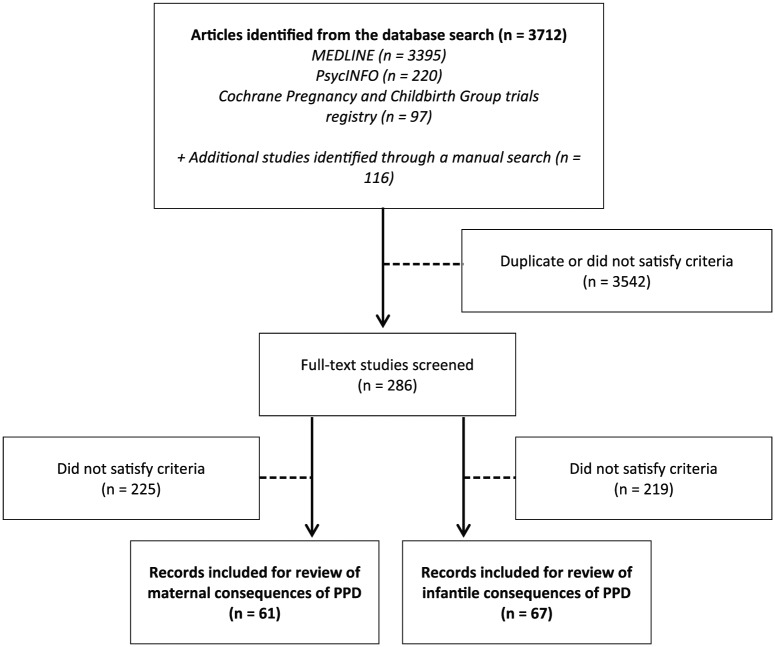
Introduction: The postpartum period represents the time of risk for the emergence of maternal postpartum depression. There are no systematic reviews of the overall maternal outcomes of maternal postpartum depression. The aim of this study was to evaluate both the infant and the maternal consequences of untreated maternal postpartum depression. Methods: We searched for studies published between 1 January 2005 and 17 August 2016, using the following databases: MEDLINE via Ovid, PsycINFO, and the Cochrane Pregnancy and Childbirth Group trials registry. Results: A total of 122 studies (out of 3712 references retrieved from bibliographic databases) were included in this systematic review. The results of the studies were synthetized into three categories: (a) the maternal consequences of postpartum depression, including physical health, psychological health, relationship, and risky behaviors; (b) the infant consequences of postpartum depression, including anthropometry, physical health, sleep, and motor, cognitive, language, emotional, social, and behavioral development; and (c) mother–child interactions, including bonding, breastfeeding, and the maternal role. Discussion: The results suggest that postpartum depression creates an environment that is not conducive to the personal development of mothers or the optimal development of a child. It therefore seems important to detect and treat depression during the postnatal period as early as possible to avoid harmful consequences.
Overview
CoChat Summary
TL;DR
This systematic review of 122 studies found that untreated maternal postpartum depression (PPD) is associated with negative maternal outcomes and adverse infant outcomes up to 3 years of age. The authors conclude that PPD creates an environment unfavorable to maternal personal development and optimal child development, supporting early detection and treatment.
Key findings
- The review included 122 eligible studies: 68 evaluated maternal consequences, 73 evaluated infant consequences, and 19 examined both. PPD prevalence across included studies ranged from 2.7% in Pakistani mothers at 18 months postpartum to 68.8% in Australian mothers at 4 months postpartum.
- Maternal PPD was linked to worse physical and psychological health, lower quality of life, relationship difficulties, and risky behaviors. For example, new-onset PPD was associated with more than double the risk of retaining at least 5 kg (OR = 2.54, 95% CI = 1.06, 6.09), and service women with PPD had higher odds of suicidality than service women without PPD (OR = 42.2, 95% CI = 28.8, 61.9).
- Infant consequences included anthropometric, health, sleep, motor, cognitive, language, emotional, social, and behavioral outcomes. Probable postnatal depression was associated with almost three times higher all-cause infant mortality up to 6 months (adjusted RR = 2.86, 95% CI = 1.58, 5.19) and almost two times higher mortality up to 12 months (adjusted RR = 1.88, 95% CI = 1.09, 3.24).
- Mother–child interactions were affected: 16 of 22 breastfeeding studies found significant negative effects of maternal depressive symptoms on breastfeeding and/or its parameters, and 11 studies showed a negative effect of maternal depression on mother-to-infant bonding.
Methods
- Systematic review following PRISMA to the extent possible; searched MEDLINE via Ovid, PsycINFO, and the Cochrane Pregnancy and Childbirth Group trials registry for studies published between 1 January 2005 and 17 August 2016, limited to human studies in English.
- Inclusion criteria were cohort, cross-sectional epidemiological, and qualitative individual studies; mothers of all ages with PPD; and health (physical or psychological) or social outcomes of PPD. Exclusion criteria were meta-analyses, systematic and nonsystematic reviews, randomized controlled trials, case studies, and studies including mothers who received treatment for PPD.
- From 3712 references retrieved, 122 studies were included. Outcomes were grouped into maternal consequences, infant consequences, and mother–child interactions, then thematically analyzed and synthesized narratively; adjusted results were used and discussed when available.
Limitations
- The authors state that study selection and data extraction were not performed using a double-blinded method, and no assessment of the studies’ methodological quality was performed.
- The authors state that the review compares heterogeneous studies using various designs (cohort vs cross-sectional) and tools to assess PPD, so potential confounding factors could be present.
- Evident from the text: PPD diagnosis and cut-off values varied widely across included studies (e.g., EPDS cut-offs of 8, 9, 10, 11, 12, 13, or 14), and the authors note that this heterogeneity makes outcomes difficult to compare.
Model-written summary. Check it against the paper before relying on it.
Integrity signals
Registry
Cites
Statistics
Figures
Verification
Claims the paper makes
103 Valid · 4 Not valid · 166 Not checked · 46 Own results and interpretations
Some cited sources support this claim and some don’t — read each source’s verdict below.
In the paper
“Two studies demonstrated that the triceps and subscapular skinfold thicknesses did not differ between infants of depressed and nondepressed mothers (one study was conducted in Belgium, Germany, Italy, Poland, and Spain;113 the other was from the United States112).”
§ Consequences of maternal postpartum depression: A systematic review of maternal and infant outcomes > Results > Infant consequences of PPD
What the sources say
- Supportedcites [113] Grote V Vik T von Kries R et al Maternal postnatal depression and child growth: a European cohort study. BMC Pediatr 2010; 10: 14. 20226021 PMC2850333 source
Table 2 (Results) reports triceps and subscapular skinfold measurements at 24 months for children of mothers with high and normal EPDS scores; the estimated differences have confidence intervals spanning zero. The Abstract’s Results state that the anthropometric indices did not differ between groups. (LLM, conf=0.94)
- Disputedcites [112] Ertel KA Koenen KC Rich-Edwards JW et al Antenatal and postpartum depressive symptoms are differentially associated with early childhood weight and adiposity. Paediatr Perinat Epidemiol 2010; 24(2): 179– 189. 20415775 PMC4106300 sourceExperimental — accuracy not yet measured
The Results report minimal difference in the combined skinfold measure (SS+TR) with antenatal depression, but higher SS+TR with postpartum depression (1.14 mm, 95% CI 0.11–2.18). Skinfolds were measured at age 3, not in infants. Thus the paper does not support the unqualified claim that skinfold thicknesses did not differ between the groups. (LLM, conf=0.86)
Checked by a reasoning model — may be wrong.
boosted- Asserted: passes — The authors put it forward as true.
- Checkable: passes — It can be checked against evidence.
- Load-bearing: unclear — It is unclear whether the paper’s conclusions depend on it.
- Based: passes — The paper gives a reason why it holds.
- Supported
At least one cited source doesn’t support this claim or points to a different paper, and none confirmed it — see the verdicts below.
In the paper
“The third study,94 conducted in Pakistan, showed that a child’s language development was affected by maternal PPD only when the father’s income was high.”
§ Consequences of maternal postpartum depression: A systematic review of maternal and infant outcomes > Results > Infant consequences of PPD
What the sources say
- Disputedcites [94] Ali NS Mahmud S Khan A et al Impact of postpartum anxiety and depression on child’s mental development from two peri-urban communities of Karachi, Pakistan: a quasi-experimental study. BMC Psychiatry 2013; 13: 274. 24148567 PMC3819469 sourceExperimental — accuracy not yet measured
The Results (Child language development, Table 4) report the opposite income pattern: children of depressed mothers had significantly higher odds of language delay when the father's income was below 3500 rupees/month. The Results also state that maternal depression had no significant impact on language development when his income was at least 3500 rupees/month. (LLM, conf=0.90)
Checked by a reasoning model — may be wrong.
plainstates a cause- Asserted: passes — The authors put it forward as true.
- Checkable: passes — It can be checked against evidence.
- Load-bearing: unclear — It is unclear whether the paper’s conclusions depend on it.
- Based: passes — The paper gives a reason why it holds.
- Disputed
Every source the paper cites for this claim was checked and supports it.
In the paper
“In multivariate logistic regression analyses, after adjustment for weight-related covariates, maternal sociodemographics, and parity, new-onset PPD was associated with more than double the risk of retaining at least 5 (OR = 2.54, 95% CI = 1.06, 6.09) kg.”
§ Consequences of maternal postpartum depression: A systematic review of maternal and infant outcomes > Results > Maternal consequences of PPD
What the sources say
- Supportedcites [67] Herring SJ Rich-Edwards JW Oken E et al Association of postpartum depression with weight retention 1 year after childbirth. Obesity 2008; 16(6): 1296– 1301. 18369338 PMC2761642 source
The Abstract reports that, after adjustment for weight-related covariates, maternal sociodemographics, and parity, new-onset postpartum depression was associated with retaining at least 5 kg at one year (OR 2.54, 95% CI 1.06–6.09). Table 2 in the discussion gives the same estimate for the fully adjusted model. (LLM, conf=0.95)
plainstates an association- Asserted: passes — The authors put it forward as true.
- Checkable: passes — It can be checked against evidence.
- Load-bearing: passes — The paper’s conclusions depend on it.
- Based: passes — The paper gives a reason why it holds.
- Supported
The cited sources support only part of this claim — read each source’s verdict below.
In the paper
“Other nonsystematic and systematic reviews have also explored specific maternal risks when mothers’ PPD is untreated, including more weight problems,18,19 alcohol and illicit drug use,20 social relationship problems,21 breastfeeding problems,22 or persistent depression23 compared with women who have received treatment.”
§ Consequences of maternal postpartum depression: A systematic review of maternal and infant outcomes > Introduction
What the sources say
- Partly supportedcites [18] Xiao RS Kroll-Desrosiers AR Goldberg RJ et al The impact of sleep, stress, and depression on postpartum weight retention: a systematic review. J Psychosom Res 2014; 77(5): 351– 358. 25306538 PMC4252881 sourceExperimental — accuracy not yet measured
The Results section (Postpartum depression; page unavailable) reports that some studies found an association between postpartum depression and weight retention, while others found no significant association. This supports the weight-problems portion linked to this citation, but the review does not compare untreated mothers with mothers who received treatment. The other listed risks are attached to other citations. (LLM, conf=0.87)
- Not checked — no full text of the sourcecites [19] Milgrom J Skouteris H Worotniuk T et al The association between ante- and postnatal depressive symptoms and obesity in both mother and child: a systematic review of the literature. Women’s Health Issues 2016; 22(3): e319– e328. 22341777 source
- Partly supportedcites [20] Chapman SLC Wu L-T. Postpartum substance use and depressive symptoms: a review. Women Health 2013; 53(5): 479– 503. 23879459 PMC3742364 sourceExperimental — accuracy not yet measured
Split into 2 atoms — 0 confirmed, 2 partially supported, 0 disputed, 0 misattributed, 0 unverifiable. Expand the claim to see per-atom verdicts.
- Partly supportedcites [21] Jones E Coast E. Social relationships and postpartum depression in South Asia: a systematic review. Int J Soc Psychiatry 2013; 59(7): 690– 700. 22851133 sourceExperimental — accuracy not yet measured
Split into 2 atoms — 0 confirmed, 2 partially supported, 0 disputed, 0 misattributed, 0 unverifiable. Expand the claim to see per-atom verdicts.
plainstates an association- Asserted: passes — The authors put it forward as true.
- Checkable: passes — It can be checked against evidence.
- Load-bearing: passes — The paper’s conclusions depend on it.
- Based: passes — The paper gives a reason why it holds.
- Partly supported
The cited sources support only part of this claim — read each source’s verdict below.
In the paper
“The two last studies evaluated postpartum weight retention (PPWR) and found that significantly more women with PPWR had higher scores on the PPD scale.35,67”
§ Consequences of maternal postpartum depression: A systematic review of maternal and infant outcomes > Results > Maternal consequences of PPD
What the sources say
- Not checked — no full text of the sourcecites [35] Biesmans K Franck E Ceulemans C et al Weight during the postpartum period: what can health care workers do. Matern Child Health J 2013; 17(6): 996– 1004. 22798141 source
- Partly supportedcites [67] Herring SJ Rich-Edwards JW Oken E et al Association of postpartum depression with weight retention 1 year after childbirth. Obesity 2008; 16(6): 1296– 1301. 18369338 PMC2761642 sourceExperimental — accuracy not yet measured
The Abstract and Discussion report a significant association between new-onset postpartum depression, defined by an EPDS score above 12, and retaining at least 5 kg one year after childbirth. They do not report that women with weight retention had higher EPDS scores overall; the significant finding is limited to new-onset postpartum depression, not antenatal depression or depression in both periods. The supplied copy gives no page numbers for these passages. (LLM, conf=0.86)
plainstates an association- Asserted: passes — The authors put it forward as true.
- Checkable: passes — It can be checked against evidence.
- Load-bearing: unclear — It is unclear whether the paper’s conclusions depend on it.
- Based: passes — The paper gives a reason why it holds.
214 more claims · 71 with their cited sources checked
Create a free account to see all 319 claims and to verify the 5 references still open.
- It may state two separate claims as one. 60
- Probably not a substantial claim. 42
- The quote only partly states this claim. 6
Claims other papers make about this one
Each is checked against this paper’s own text: does it say what the citing paper says it does?
The source backs part of the claim, not all of it — or backs it for a different population, condition or comparison.
In the citing paper
“Psychological distress among perinatal women correlates with increased maternal morbidity and mortality rates (Khalifa et al., 2016; Oates, 2003), poor infant health outcomes (Gelaye et al., 2016), and adverse early childhood developmental trajectories encompassing cognitive, emotional, and developmental delays (Slomian et al., 2019), making it a substantial public health concern.”
From Developing and validating the Sierra Leone perinatal psychological distress scale through an emic-etic approach (2025) · cites this paper as Slomian et al., 2019
Experimental — accuracy not yet measuredThe source backs part of the claim, not all of it — or backs it for a different population, condition or comparison.
In the citing paper
“This mental disorder has been shown to have negative effects on mothers' quality of life and their intimate relationships, birth outcomes, and breastfeeding likelihood, as well as long-term effects on children's cognitive and emotional development.”
From Perinatal Depression: Challenges and Opportunities (2021) · cites this paper as [25]
Experimental — accuracy not yet measuredThe cited source says what the claim attributes to it.
In the citing paper
“PPD may adversely impact mother-child bonding and contribute to adverse consequences for the infant, such as impaired cognitive, emotional, and motor development, or behavioral problems (Slomian et al., 2019).”
From PandaMom – Feasibility and acceptability of an internet- and mobile-based intervention to enhance peripartum mental well-being and to prevent postpartum depression (2024) · cites this paper as Slomian et al., 2019
The cited source says what the claim attributes to it.
In the citing paper
“Evidence shows that PPD is associated with overall poor maternal (O'Hara and McCabe, 2013; Gjerdingen and Yawn, 2007; Slomian et al., 2019) and infant health (Stein et al., 2014; Slomian et al., 2019; Hayes et al., 2013; Pawlby et al., 2009), even when the symptomatology is subclinical (Tronick and Reck, 2009; Weinberg et al., 2001).”
From App-based intervention for reducing depressive symptoms in postpartum women: Protocol for a feasibility randomized controlled trial (2023) · cites this paper as Slomian et al., 2019
The cited source says what the claim attributes to it.
In the citing paper
“PPD can have negative effects on maternal-infant bonding and interaction25; adaptation to the mothering role and confidence in providing infant care26; maternal quality of life and intimate relationships25; children's emotional, cognitive, and behavioral development27; and the father's mental health.28”
From Perinatal Depression: Challenges and Opportunities (2021) · cites this paper as [25]
1 more claim about this paper
Create a free account to see every claim other papers make about this one.
Statistics recomputed
Every reported test result, recomputed from its test statistic and degrees of freedom. A result shows as not adding up only once an independent check has confirmed it.
- Consistentχ²(2) = 6.47reported p < .05 · recomputed p = .039
“χ2(2) = 6.47, p < .05”
- Consistentχ²(1) = 5.44reported p < .025 · recomputed p = .020
“χ2(1) =5.44, p < .025”
- Consistentχ²(1) = 4.01reported p < .05 · recomputed p = .045
“χ2(1) = 4.01, p < .05”
Self-check
Percentages, sums and reported differences re-computed from the paper’s own numbers.
Each contradiction between two passages listed here was confirmed by an independent check.
Rated minor: it would not touch a result — a value no result rests on, a p-value that stays on the same side of the significance level, or a conflict that is clerical, resolved elsewhere in the paper, or outside its own findings.
In the paper
§ Consequences of maternal postpartum depression: A systematic review of maternal and infant outcomes > Results > Included studies
“The prevalence of PPD varied from 4.5% in a population of Canadian mothers at 6 weeks postpartum89 to 68.8% in a population of Australian mothers at 4 months postpartum.64”
§ Consequences of maternal postpartum depression: A systematic review of maternal and infant outcomes > Results > Maternal consequences of PPD
“Herring67 | USA Mean age: 33.0 ± 4.7 years Gender of newborns: not given | 850 | Cohort study 18 months Four groups: - None - Pregnancy only - Postpartum only - Pregnancy and postpartum | EPDS (Depressed = EPDS > 12) | 4%”
Rated minor: it would not touch a result — a value no result rests on, a p-value that stays on the same side of the significance level, or a conflict that is clerical, resolved elsewhere in the paper, or outside its own findings.
In the paper
§ Consequences of maternal postpartum depression: A systematic review of maternal and infant outcomes > Results > Infant consequences of PPD
“The third study,94 conducted in Pakistan, showed that a child’s language development was affected by maternal PPD only when the father’s income was high.”
§ Consequences of maternal postpartum depression: A systematic review of maternal and infant outcomes > Results > Infant consequences of PPD
“Among women whose husband’s income was ⩾3500 rupees/month, there was no significant impact of maternal depression on children’s language development. Children of depressed mothers whose husband’s income was <3500 rupees/month had more than a five-fold risk of delayed language development”
Rated minor: it would not touch a result — a value no result rests on, a p-value that stays on the same side of the significance level, or a conflict that is clerical, resolved elsewhere in the paper, or outside its own findings.
In the paper
§ Consequences of maternal postpartum depression: A systematic review of maternal and infant outcomes > Results > Included studies
“The majority of the studies were performed in the United States (28 of 68) and Europe (22 of 68), 10 studies were performed in Asia, and 8 studies were performed in Australia and New Zealand.”
§ Consequences of maternal postpartum depression: A systematic review of maternal and infant outcomes > Results > Maternal consequences of PPD
“Faisal-Cury38 | Brazil Mean age: 25 years Gender of newborns: not given | 644”
Rated minor: it would not touch a result — a value no result rests on, a p-value that stays on the same side of the significance level, or a conflict that is clerical, resolved elsewhere in the paper, or outside its own findings.
In the paper
§ Consequences of maternal postpartum depression: A systematic review of maternal and infant outcomes > Results > Included studies
“The number of participants ranged from 1593 to 22,118,28”
§ Consequences of maternal postpartum depression: A systematic review of maternal and infant outcomes > Results > Maternal consequences of PPD
“Do33 | USA Mean age: not given Gender of newborns: not given | 178,714 | Cohort study 6 years”
Rated minor: it would not touch a result — a value no result rests on, a p-value that stays on the same side of the significance level, or a conflict that is clerical, resolved elsewhere in the paper, or outside its own findings.
In the paper
§ Consequences of maternal postpartum depression: A systematic review of maternal and infant outcomes > Results > Mother–child interactions
“nondepressed mothers showed right-sided cradling, similar to nonstressed mothers.”
§ Consequences of maternal postpartum depression: A systematic review of maternal and infant outcomes > Results > Mother–child interactions
“The results indicated that 86% of mothers who were neither stressed nor depressed cradled to the left, and 14% cradled to the right.”
3 more findings
Create a free account to see every finding of this check.
Citations
Cites
Diagnostic and Statistical Manual of Mental Disorders
American Psychiatric Association (2013) · doi:10.1176/appi.books.9780890425596 · Cited by 116,369
Preferred Reporting Items for Systematic Reviews and Meta-Analyses: the PRISMA statement
Moher, D., Liberati, A., Tetzlaff, J., Altman, D. G., & for the PRISMA Group (2009) · BMJ · doi:10.1136/bmj.b2535 · Cited by 83,823
Preferred Reporting Items for Systematic Reviews and Meta-Analyses: The PRISMA Statement
Moher, D., Liberati, A., Tetzlaff, J., Altman, D. G., & The PRISMA Group (2009) · PLoS Medicine · doi:10.1371/journal.pmed.1000097 · Cited by 64,042
Wang, G., Ma, R., Qiao, G., Wada, K., Aizawa, Y., & Satoh, T. (2015) · Integrative Medicine International · doi:10.1159/000368408 · Cited by 18,657
Detection of Postnatal Depression: Development of the 10-item Edinburgh Postnatal Depression Scale
Cox, J. L., Holden, J. M., & Sagovsky, R. (1987) · British Journal of Psychiatry · doi:10.1192/bjp.150.6.782 · Cited by 14,183
Perinatal Depression: A Systematic Review of Prevalence and Incidence
Gavin, N. I., Gaynes, B. N., Lohr, K. N., Meltzer-Brody, S., Gartlehner, G., & Swinson, T. (2005) · Obstetrics & Gynecology · doi:10.1097/01.aog.0000183597.31630.db · Cited by 3,282
Offspring of Depressed Parents: 20 Years Later
Weissman, M. M., Wickramaratne, P., Nomura, Y., Warner, V., Pilowsky, D., & Verdeli, H. (2006) · American Journal of Psychiatry · doi:10.1176/ajp.2006.163.6.1001 · Cited by 1,059
Perinatal mental illness: Definition, description and aetiology
O'Hara, M. W., & Wisner, K. L. (2014) · Best Practice & Research Clinical Obstetrics & Gynaecology · doi:10.1016/j.bpobgyn.2013.09.002 · Cited by 986
Screening for depression during pregnancy with the edinburgh depression scale (EDDS)
Murray, D., & Cox, J. L. (1990) · Journal of Reproductive and Infant Psychology · doi:10.1080/02646839008403615 · Cited by 973
Magnitude and risk factors for postpartum symptoms: A literature review
Norhayati, M. N., Nik Hazlina, N. H., Asrenee, A. R., & Wan Emilin, W. M. A. (2015) · Journal of Affective Disorders · doi:10.1016/j.jad.2014.12.041 · Cited by 816
Research works printed but not linked: 4
- Friedman DD. 4-month infant vocal quality in mother-infant face-to-face interaction: 6-week maternal postpartum depressive symptomatology and infant gender. PhD Thesis, New York University, New York, 2005.
- Kalita KN. Developmental profile of infants born to mothers with postpartum depression and anxiety: a comparative study. J Indian Assoc Child Adolesc Ment Health 2009; 6(1): 3– 12.
- Razurel C. Comment l’éducation dispensée par les professionnels peut-elle influencer le sentiment de compétence parentale chez les mères primipares? Rouen: Université de Rouen, 2010.
- Williams TM Joy LA Travis L et al Transition to motherhood: a longitudinal study. Infant Ment Health J 1987; 8(3): 251– 265. · DOI · Paper page
Cited by
Items 1,001–1,100 of 1,517
Taifour, W., bahsass, R., Taifour, D., & Adwan, D. (2023) · Research Square · doi:10.21203/rs.3.rs-3262596/v1 · Cited by 1
Froz, C. P.-A., Vollert, B., Hansen, I., Schurig, N., Seefeld, L., Weise, V., Birdir, C., Wimberger, P., & Garthus‐Niegel, S. (2025) · Geburtshilfe und Frauenheilkunde · doi:10.1055/a-2717-7798 · Cited by 1
Minimum Wages, the Earned Income Tax Credit, and Mental Health Around Pregnancy
Stanley, B. J., & Conway, K. S. (2025) · Health Economics · doi:10.1002/hec.70071 · Cited by 2
“…have been more widely studied and are found to include detrimental effects on maternal and child outcomes (Le and Nguyen 2018; Menta et al. 2023; Slomian et al. 2019), parenting behaviors (Field 2009), food security (Noonan et al. 2016), housing (Corman et al. 2016; Curtis et al. 2014) and…”
Husbands’ knowledge and attitudes regarding postpartum depression
Aqeeli, A. M., Badr, H., & Alghamdi, S. (2025) · PeerJ · doi:10.7717/peerj.19426 · Cited by 1
“PPD is also associated with attachment issues and negative child developmental outcomes ( Saharoy et al., 2023 ; Slomian et al., 2019 ).”
InfluentialThe gendered trauma trajectories of mothers entering prison
Mitchell, S. (2024) · Probation Journal · doi:10.1177/02645505241269159 · Cited by 2
“It is a factor that is often underreported generally and is not usually assessed in connection with offending, despite the fact that it can be extremely debilitating and life changing (Slomian et al., 2019).”
Tebeka, S., & Dubertret, C. (2021) · La Presse Médicale Formation · doi:10.1016/j.lpmfor.2021.10.007 · Cited by 8
Towards a transdiagnostic approach to psychopathology in the postpartum period
Froelich, J. M., & Gerstein, E. D. (2025) · Clinical Psychology Review · doi:10.1016/j.cpr.2025.102646 · Cited by 1
Hecht, H. K., Nguyen, A.-M. N., & Harley, K. G. (2024) · Maternal and Child Health Journal · doi:10.1007/s10995-024-03997-1 · Cited by 5
“PPD is associated with subsequent depressive episodes in mothers and can have a negative impact on infant and child development (Slomian et al., 2019).”
BackgroundPaternal postnatal depression and parenting behaviours in the first year of life
Constable, R., Price, S., & Mallan, K. M. (2024) · Child Care Health and Development · doi:10.1111/cch.13219 · Cited by 2
Technology, MGBA and Mind Roles in Personality, Health, and Longevity of Humans
Aslam, D. M. (2023) · IJARCCE · doi:10.17148/ijarcce.2023.121009 · Cited by 2
Pregnancy, peripartum, and COVID-19: An updated literature review
Hosseini, M., Jahanshahlou, F., Mahmoodpoor, A., Sanaie, S., Naseri, A., Rafsanjani, M. K., Sahebari, S. S., Vaez-Gharamaleki, Y., ZehiSaadat, M., & Rahmanpour, D. (2022) · Electronic Journal of General Medicine · doi:10.29333/ejgm/12227 · Cited by 2
Increasing Postpartum Depression Screening in the Pediatric Setting
Stone, J., & Allen, L. (2021) · Carolina Journal of Interdisciplinary Medicine · doi:10.47265/cjim.v1i1.539 · Cited by 2
Editorial: Web-based and mobile-based interventions for perinatal mental health
Fonseca, A., & Motrico, E. (2023) · Frontiers in Global Women s Health · doi:10.3389/fgwh.2023.1207447 · Cited by 2
“Perinatal mental health disorders are associated with adverse outcomes for both the mother and the child (5), which translates into higher economic and societal burden (6).”
BackgroundKracht, C. L., Falkenhain, K., Flanagan, E. W., Altazan, A. D., Cabre, H. E., Kebbe, M., Woolf, E. K., Beyl, R. A., HSIA, D. S., Apolzan, J. W., et al. (2026) · JMIR Mental Health · doi:10.2196/74146 · Cited by 1
“The second consideration is that household chaos scores significantly increase after the birth of the child, which may align with the notable prevalence and impacts of postpartum depression [36].”
Fan, P., Zhang, Z., Liu, Y., & Xiong, Y. (2022) · Journal of Psychosocial Nursing and Mental Health Services · doi:10.3928/02793695-20220906-04 · Cited by 2
Pagani, L. S., Harandian, K., Necsa, B., Harbec, M.-J., & Tarabulsy, G. M. (2024) · International Journal of Environmental Research and Public Health · doi:10.3390/ijerph21030264 · Cited by 1
“Maternal and child reactivity are thus linked with negative reciprocal interactions, which involve bonding, breast-feeding, and warmly engaged and responsive care [18].”
BackgroundMethodKlimek, M., Karlsson, H., Karlsson, L., Korja, R., Nolvi, S., Häikiö, T., Tuulari, J. J., & Kataja, E. (2025) · PLoS ONE · doi:10.1371/journal.pone.0326437 · Cited by 2
“Prior to the analyses, based on the existing literature (e.g., [23,41,42] several covariates were chosen and collected via questionnaire, including monthly paternal income (as a proxy of socioeconomic status), paternal and maternal age, paternal and maternal depression and anxiety at 6 months…”
Huo, L., Yu, X., Nisar, A., Yang, L., & Li, X. (2024) · Frontiers in Psychiatry · doi:10.3389/fpsyt.2024.1478565 · Cited by 1
Currie, J., & Malinovskaya, A. (2025) · Health Economics Review · doi:10.1186/s13561-025-00671-2 · Cited by 2
Fitzpatrick, K. E., QUIGLEY, M. A., Smıth, D. J., & Kurinczuk, J. J. (2021) · Psychological Medicine · doi:10.1017/s0033291720005322 · Cited by 4
“…information to counsel women, the potential profound impact of maternal mental health problems on the woman, her infant and other family members (Slomian, Honvo, Emonts, Reginster, & Bruyere, 2019), makes it important to better understand the aetiology and triggers for such problems to help…”
Postpartum Depression: Overlap Between Symptom‐Based and Register‐Based Measures
Egsgaard, S., Bliddal, M., Kjeldsen, M. Z., Liu, X., Madsen, K. B., Mægbæk, M. L., & Munk‐Olsen, T. (2026) · Acta Psychiatrica Scandinavica · doi:10.1111/acps.70090 · Cited by 1
“Postpartum depression can have serious consequences, including impaired mother-baby bonding, risk of subsequent maternal depressive episodes, difficulties in partner relationships, and a negative impact on infant cognitive and language development [3].”
Ketamine assisted psychotherapy in postpartum mood and anxiety disorders: a limited case series
Christnacht, A., Eparwa, T. R. J., Whinkin, E., & Aggarwal, S. K. (2026) · Frontiers in Psychiatry · doi:10.3389/fpsyt.2025.1661604 · Cited by 1
Franco, P., Olhaberry, M., Muzard, A., Lara, M. A., & Cuijpers, P. J. (2022) · Depression and personality · doi:10.1007/978-3-031-13029-8_8 · Cited by 2
Belay, D. M., Leckning, B., Unger, H. W., Brown, K., Derseh, B. T., Dadi, A. F., & Guthridge, S. (2026) · BMC Pregnancy and Childbirth · doi:10.1186/s12884-026-09297-6 · Cited by 1
“These conditions can have short and long-lasting consequences for the mother, child, family, and healthcare systems [15–17].”
Marciniak, M. A., Rohde, J., Yuen, K. S. L., Binder, H., Walter, H., Wieser, M. J., Kalisch, R., Roelofs, K., & Kleim, B. (2025) · Internet Interventions · doi:10.1016/j.invent.2025.100843 · Cited by 3
“It results in decreased health of the mother, lowered quality of her relationships, and disturbed baby's cognitive, emotional, and behavioral development (Dahlberg and Aune, 2013; Feldman and Per-ret, 2023; Slomian et al., 2019).”
Letter to the Editor: A common neural correlate for affective and monetary reward
Castro, R. T. A., & Ehlert, U. (2022) · Biological Psychology · doi:10.1016/j.biopsycho.2022.108346 · Cited by 1
Postpartum Depressive Symptoms among Bangladeshi Women: A Hospital-Based Cross-Sectional Study
Saha, B. R., Tohan, M. M., Zaman, S., Moon, M. I., Islam, M. A., Howlader, M. H., Kundu, S., & Rahman, M. A. (2025) · Dr Sulaiman Al Habib Medical Journal · doi:10.4103/dshmj.dshmj_76_24 · Cited by 1
Peripartum Mental Illness in Mothers With Multiple Sclerosis Merits Neurologists' Attention
Ross, L. A. (2025) · Neurology · doi:10.1212/wnl.0000000000213366 · Cited by 1
Al-Shamali, H. F., Jackson, M., Zinchuk, N., Modanloo, S., Wong, G., Cao, B., Burback, L., Li, X., Greenshaw, A. J., & Zhang, Y. (2023) · Frontiers in Psychiatry · doi:10.3389/fpsyt.2023.1143403 · Cited by 1
The role of emotion in early learning
Lopez, L. D., & Dukes, D. (2026) · Child Development Perspectives · doi:10.1093/cdpers/aadaf012 · Cited by 1
Hu, Q., Chen, J., Ma, J., Li, Y., Xu, Y., Yue, C., & Cong, E. (2024) · Archives of Women s Mental Health · doi:10.1007/s00737-024-01466-w · Cited by 1
Speaking in Metaphors: Exploring Black Women’s Communicated Sense-Making of Postpartum Depression
Wright, K. O., Cooper, H. B., Yuan, K., Chimbaru, R. E., & Francis, D. B. (2025) · Health Communication · doi:10.1080/10410236.2025.2511874 · Cited by 3
“Regardless of ethnicity, PPD can lead to the mother’s death by suicide, harm of the child, poor relationships, and a sense of failure in maternal role expectations, and a loss of self (S. Johnson et al., 2020; Mollard, 2014; Slomian et al., 2019; Wisner et al., 2013).”
Holmes, D., Kilty, J. M., Domingue, J., Einboden, R., Chartrand, J., & Hammond, C. (2026) · Nursing Inquiry · doi:10.1111/nin.70135 · Cited by 1
“…theories of mental illness generated by childbirth and motherhood set the foundation for contemporary psychiatric diagnoses of postpartum depression, psychosis, and related mental disorders (Bell and Andersson 2016; Gilden et al. 2020; Landoni 2022; Slomian et al. 2019; VanderKruik et al. 2017).”
Treatment Preferences and Experiences Among Patients With Postpartum DepressionPreprint
Raines, C., Saacks, C. B., Chiang, T. H., Devendorf, A. R., Prilliman, C., & Stout, C. (2023) · Research Square · doi:10.21203/rs.3.rs-3346403/v1 · Cited by 1
Brief Interpersonal Psychotherapy (IPT-B) for Perinatal Depression
Swartz, H. A., Curran, M. C., & Grote, N. K. (2024) · Oxford University Press eBooks · doi:10.1093/oso/9780197652084.003.0050 · Cited by 1
Williams, P., Campbell, S., Gildner, T. E., Geisel-Zamora, S., & Thayer, Z. M. (2025) · BMJ Public Health · doi:10.1136/bmjph-2024-001017 · Cited by 4
Al-Shamali, H. F., Dong, R., Jackson, M., Burback, L., Wong, G., Cao, B., Li, X., Greenshaw, A. J., & Zhang, Y. (2025) · PLoS ONE · doi:10.1371/journal.pone.0321813 · Cited by 5
Perinatal internet-based cognitive behavioural therapy for preventing postnatal depression
Toyomoto, R., Yoshida, K., Sahker, E., Sakata, M., Luo, Y., Tajika, A., & Watanabe, N. (2022) · Cochrane Database of Systematic Reviews · doi:10.1002/14651858.cd014849 · Cited by 2
Postpartum depression and paternal-infant attachment in Iranian fathers
Salehabadei, M. Z., Amini, L., Haghani, S., & Shahr, H. S. A. (2025) · Journal of Reproductive and Infant Psychology · doi:10.1080/02646838.2025.2485120 · Cited by 2
“Fathers, like mothers who are struggling with PPD may experience impaired quality of life and social interactions, as well as a series of emotional and physical discomforts (Slomian et al., 2019; D. Wang et al., 2021).”
Scroggins, J. K., Bruce, K. E., Stuebe, A. M., Fahey, J. O., & Tully, K. P. (2024) · Midwifery · doi:10.1016/j.midw.2024.104115 · Cited by 1
Exploring the Role of Doulas in Supporting People With Perinatal Mood and Anxiety Disorders
Liddell, J. L., Garner, K. B., & Carlson, T. A. (2025) · International Journal of Childbirth · doi:10.1891/ijc-2025-0002 · Cited by 1
Maternal Fiber Intake and Perinatal Depression & Anxiety
(2024) · doi:10.1101/2024.03.24.24304719 · Cited by 1
Bante, A., Ayele, G., Alamirew, B., & Ahmed, M. (2024) · PLoS ONE · doi:10.1371/journal.pone.0305722 · Cited by 2
Pundhir, A., Gupta, M. K., & Amudhan, S. (2025) · Asian Journal of Psychiatry · doi:10.1016/j.ajp.2025.104484 · Cited by 1
Increases in benzodiazepine prescribing for postpartum anxiety during COVID-19
Adams, G. B., Steuart, S. R., Lawler, E. C., Shone, H. B., & Abraham, A. J. (2024) · Archives of Women s Mental Health · doi:10.1007/s00737-024-01488-4 · Cited by 1
Tang, Q., Li, B.-L., Sun, W., Jiang, S., Liu, Y., Xu, X., Sun, D., & Qu, M. (2025) · Brain Behavior and Immunity Integrative · doi:10.1016/j.bbii.2025.100129 · Cited by 2
Ahmad, M. A., Awar, S. A. A. R. A., Sallam, G. S., Alkaabi, M. S. N., Smetanina, D., Statsenko, Y. A., & Zaręba, K. T. (2024) · Healthcare · doi:10.3390/healthcare12060650 · Cited by 8
“PPD significantly decreases quality of life [8–10].”
Intervención psicológica breve para prevenir la depresión posparto: un estudio piloto
Mendizabal, N. V., Gómez, M. L. N., Legarra, L., & Aparicio, E. M. (2024) · Clínica Contemporánea · doi:10.5093/cc2024a16 · Cited by 3
Hosseini, N., Poh, L. L., Baranovich, D.-L., & A.Razak, N. A. (2020) · International Journal of Education, Psychology and Counseling · doi:10.35631/ijepc.5370019 · Cited by 1
Postpartum depression in Jamaica: Exploring the lived experiences.
Elmore, S. (2023) · ThinkIR: The University of Louisville's Institutional Repository (University of Louisville) · doi:10.18297/etd/4107 · Cited by 1
Zhu, L., Ji, C. F., Liu, Y., Chen, W., Liu, X., & Yang, F. (2025) · ACS Chemical Neuroscience · doi:10.1021/acschemneuro.5c00535 · Cited by 2
Loree, A. M., Santarossa, S., Coyne, P., Haley, E. N., Boulay, M., Pappas, C., Braciszewski, J. M., Miller-Matero, L. R., & Hicks, L. M. (2025) · Contemporary Clinical Trials · doi:10.1016/j.cct.2025.108032 · Cited by 3
Postpartum depression and associated factors among women visiting postnatal clinic in Ethiopia
Ousman, S. K. (2025) · The Ethiopian journal of reproductive health. · doi:10.69614/ejrh.v17i01.857 · Cited by 1
Ciriza-Barea, E., Canet, A. C., Fernández-Vegue, M. G., González, E. O., Mena, M. S., & Orenga, M. M. (2025) · Revista de Lactancia Materna · doi:10.14201/rlm.32605 · Cited by 3
Rent, S. M., Poon, K. T. C. C., Sooy-Mossey, M., Weeks, M. F., Roberts, J. C., Douglas, D., Ellestad, S. C., Lemmon, M. E., Hill, K. D., & Windom, M. O. (2025) · American Journal of Perinatology Reports · doi:10.1055/a-2504-1813 · Cited by 3
Using positive affirmation cards to increase confidence and alleviate fears in the perinatal period
Hoffmeister, A., McCreery, T., O'Connor, A., Cosgrove, K., Egan, S., & Doherty, J. (2026) · British Journal of Midwifery · doi:10.12968/bjom.2025.0121 · Cited by 1
Ariasih, R. A., & Budiharsana, M. P. (2023) · Jurnal Kesehatan Reproduksi · doi:10.58185/jkr.v13i2.45 · Cited by 9
Systematic Review of Self-Report Measures of Maternal Self-Efficacy
Jiramanee, A., Driessnack, M., & Tilden, E. L. (2022) · Journal of Obstetric, Gynecologic & Neonatal Nursing · doi:10.1016/j.jogn.2022.05.003 · Cited by 2
Jangwan, N. S., Jhangiani, P., Jain, S., Haider, S., Kumar, A., Jain, G. K., & Tewari, D. (2026) · ChemistrySelect · doi:10.1002/slct.202507173 · Cited by 1
Masters, C., Carandang, R. R., Rojina, J. A., Lewis, J. B., Ickovics, J. R., Cunningham, S. D., & Hagaman, A. K. (2025) · Journal of Affective Disorders · doi:10.1016/j.jad.2025.01.111 · Cited by 1
Benton, M., Ishikuro, M., Obara, T., Noda, A., Murakami, K., Kuriyama, S., & Ismail, K. (2024) · Preventive Medicine · doi:10.1016/j.ypmed.2024.108101 · Cited by 2
Nindrea, R. D., Ming, L. C., & Sari, N. P. (2025) · Clinical Epidemiology and Global Health · doi:10.1016/j.cegh.2025.102028 · Cited by 8
Burns, S., Jegatheeswaran, C., Barron, C., & Perlman, M. (2023) · doi:10.22541/au.168550023.36152102/v1 · Cited by 1
Sun, N., Yin, X., Qiu, L., & Gong, Y. (2026) · Tropical Medicine & International Health · doi:10.1111/tmi.70077 · Cited by 1
Osma-Zambrano, S. E., Lozano-Osma, M. D., Mojica-Perilla, M., & Redondo-Rodríguez, S. (2019) · Redalyc (Universidad Autónoma del Estado de México) · Cited by 1
Doğum sonrası dönemde cinselliği etkileyen faktörler ve sağlık profesyonellerinin sorumlulukları
Güler, E., & Erbil, N. (2022) · Androloji Bülteni · doi:10.24898/tandro.2022.54531 · Cited by 2
Perez, C. O., & D'Anna‐Hernandez, K. (2024) · Psychoneuroendocrinology · doi:10.1016/j.psyneuen.2024.106979 · Cited by 1
Effect of Postpartum Depression on Infant Safety Practices in Korea
Kwon, H., & Kim, J. (2023) · Journal of Obstetric, Gynecologic & Neonatal Nursing · doi:10.1016/j.jogn.2023.08.003 · Cited by 1
Han, E. K. L., Davis, R. E., Soukup, T., Bradbury, A., Williams, J., Lopez, M. B., Greenwood, L., Bind, R. H., Estevao, C., Osborn, T., et al. (2025) · Frontiers in Health Services · doi:10.3389/frhs.2025.1582517 · Cited by 3
Laifer, L. M., Maras, O., Sáez, G., Gervais, S. J., & Brock, R. L. (2023) · Research Square · doi:10.21203/rs.3.rs-2714781/v1
“Mother-infant bonding (i.e., the emotional tie between mother and infant; Bicking Kinsey & Hupcey, 2013), is a salient mechanism through which depression can undermine child functioning (Lefkovics et al., 2014; Slomian et al., 2019).”
Fowler, M., Solomon, P., Gregory, M. L., & Evans‐Chase, M. (2026) · Journal of Prenatal and Perinatal Psychology and Health · doi:10.62858/apphe40201 · Cited by 1
The biopsychosocial materno-semiotics framework: A holistic analytical tool for film studies
Priyadharshini, J., & Karthiga, R. K. J. (2025) · MethodsX · doi:10.1016/j.mex.2025.103279 · Cited by 8
Zeng, Z., Li, X., Bai, Y., & Gong, W. (2024) · Midwifery · doi:10.1016/j.midw.2024.104148 · Cited by 1
Kah, K., Dailey-Provost, J., Stanford, J. B., Rogers, C. R., & Schliep, K. C. (2022) · PubMed · doi:10.26054/0d-0tbc-7vhj · Cited by 3
Mari, K. E., Hoke, M. K., Darden, N., & Burris, H. H. (2025) · Journal of Perinatology · doi:10.1038/s41372-025-02476-x · Cited by 2
Jahre, L. M., Frewer, A.-L., Meyer, H., Koelkebeck, K., Iannaccone, A., Skoda, E.-M., Teufel, M., & Bäuerle, A. (2025) · BMC Public Health · doi:10.1186/s12889-025-25297-1 · Cited by 3
Factors associated with postpartum psychiatric disorders using routine administrative data
Alves, F. J. O., Castro-de-Araujo, L. F. S., Xavier, É. F. M., et al. (2022) · International Journal for Population Data Science · doi:10.23889/ijpds.v7i2.1738 · Cited by 1
Postpartum Depression During the COVID-19 Pandemic and Associated Factors: A Cross-Sectional StudyPreprint
Teruya, M. M., Carrijo, G. S., Costa, G. A. M., da Silva, M. H., de Lima, J. R. T., Costa, J. F. S. V., Strufaldi, R., & Valete, C. O. S. (2024) · medRxiv · doi:10.1101/2024.09.22.24314126
Ambient air pollution and depression: a systematic review and meta-analysis
Mohamed, H. A. S., Olstrup, H., Honore, J., Lu, S. S. M., Andersson, J., Oudin, A., Sigsgaard, T., & Schullehner, J. (2026) · Frontiers in Environmental Health · doi:10.3389/fenvh.2026.1809298
Khanam, R. A., Lazar, V. M. A., Chowdhury, N. H., Ahmed, S., Tofail, F., Khan, R., Surkan, P. J., Mohan, D., Yoshida, S., Sazawal, S., et al. (2026) · Journal of Global Health · doi:10.7189/jogh.16.04207
“The literature has documented the negative impact of maternal postpartum depression on child developmental outcomes [ 10 ].”
Nolan-Cody, H., & Scharp, K. M. (2026) · Communication Monographs · doi:10.1080/03637751.2026.2694773
Adams, Y. J., Lau, E., Agbenyo, J. S., Young, J. L., Mulroe, A., & Haas, D. M. (2026) · International Journal of Mental Health · doi:10.1080/00207411.2026.2732591
Postpartum depression in Ecuadorian women: does the quality of health care during childbirth matter?
Guaya, V., Ortiz, C. A., Pesse-Sorensen, K., Berrú, C. B. C., & Ortega, B. E. S. (2025) · Journal of Public Health Policy · doi:10.1057/s41271-025-00601-w
O que as pesquisas revelam sobre a saúde no Brasil - 5ª edição
Inovar, E. (2023) · Editora Inovar eBooks · doi:10.36926/editorainovar-978-65-5388-153-2
Breedt-Kriek, M., Bosman, H., & Moeketsi, T. D. (2026) · BJPsych International · doi:10.1192/bji.2026.10126
McKetta, S. C., Gimbrone, C., Maslowsky, J., Rudolph, K. E., Redd, S. K., & Keyes, K. M. (2026) · SSM - Mental Health · doi:10.1016/j.ssmmh.2026.100600
“People living in states that limit public funding for abortions are more likely to experience postpartum depression (Medoff, 2014), and depression symptoms during the perinatal period increase the risk of suicide (Slomian et al., 2019).”
Exploring Asymmetrical Relationships in Predicting Postpartum Depression Using Theil's-U
Banupriya, N., Sethukarasi, T., Gilda, A. J., Kalaiselvi, S., Jayabharathi, S., & P, N. S. (2025) · International Conference on Signal Processing, Computation, Electronics, Power and Telecommunication (IConSCEPT) · doi:10.1109/iconscept66142.2025.11436722
“Significant negative effects on social and marital relationships were discovered in a comprehensive analysis of women with PPD, which also had an impact on baby care and mother-infant bonding[6].”
Hironaka, A., & Watanabe, H. (2026) · Frontiers in Public Health · doi:10.3389/fpubh.2026.1891071
Social-motional challenges in children of mothers with postpartum depression
Sand, M., & Vinberg, M. (2024) · Ugeskrift for Læger · doi:10.61409/v04240261
Valla, L., Haga, S. M., Garthus‐Niegel, S., & Drozd, F. (2023) · doi:10.2196/preprints.46982
Kong, J., Nan, X., Li, X. X., & Yin, M. (2026) · Journal of Reproductive and Infant Psychology · doi:10.1080/02646838.2026.2694054
Cognitive Behavioral Therapy for Postpartum Depression: A Case Report
Noureen, S., Asad, S., Ullah, S., Abbasi, I. S., & Ahmad, S. (2023) · Journal of Innovative Sciences · doi:10.17582/journal.jis/2023/9.1.13.17 · Cited by 1
Intrapersonal communication among digital-age mothers on constructing postpartum body image
Citta, G. D., Hidayat, D., Nurhadi, Z. F., & Rina, N. (2024) · Jurnal Kajian Komunikasi · doi:10.24198/jkk.v12i1.53638 · Cited by 1
Pogogelski, J. F., Reda, S., & dos Santos, G. R. (2024) · Brazilian Journal of Health Review · doi:10.34119/bjhrv7n2-077
Metadata
- Authors
- Slomian, J., Honvo, G., Emonts, P., Reginster, J.-Y., & Bruyère, O.
- Affiliations
- University of Liège (BE)
- Centre Hospitalier Universitaire de Liège (BE)
- Corresponding author
- Slomian, Justine
- Venue
- Women's Health
- Publisher
- SAGE Publications
- Published
- 2019-01
- Volume
- 15
- Pages
- 1745506519844044-1745506519844044
- ISSN
- 1745-5057 (ISSN-L)
- 1745-5065
- PMC
- PMC6492376
- OpenAlex
- W2943494044
- Semantic Scholar
- ee946755bae03c5fb910a2191e2371c480ea04a3
- Cited by
- 1,496
- References
- 184
- Citations by year
- 2026: 183 · 2025: 275 · 2024: 320 · 2023: 272 · 2022: 219 · 2021: 152 · 2020: 64 · 2019: 10
- FWCI
- 18.19
- Type
- journal article
- Language
- en
- Update notices
- correction (2019-05-30)
- Open access
- gold
- doi.org
- Licence
- cc-by-nc
- journals.sagepub.com/page/policies/text-and-data-mining-license (tdm)
- Locations
- Women s Health (publishedVersion, cc-by-nc)
- Europe PMC (PubMed Central) (publishedVersion, cc-by-nc)
- PubMed Central (publishedVersion, cc-by-nc)
- PubMed (publishedVersion)
- DOAJ (DOAJ: Directory of Open Access Journals) (submittedVersion, cc-by-sa)
- ORBi (University of Liège) (submittedVersion)
- Topics
- Health Sciences › Medicine › Public Health, Environmental and Occupational Health › Maternal Mental Health During Pregnancy and Postpartum
- Health Sciences › Medicine › Pediatrics, Perinatology and Child Health › Maternal and Neonatal Healthcare
- Health Sciences › Medicine › Pediatrics, Perinatology and Child Health › Infant Health and Development
- Keywords
- postpartum depression, maternal outcomes, infant outcomes, mother-infant bonding, breastfeeding, maternal role, infant development, maternal physical health, maternal mental health, infant sleep
- MeSH terms
- Adult, Body Weights and Measures, Breast Feeding, Child Development, Cognition, Female, Health Status, Humans, Infant, Infant, Newborn, Language, Male, Mental Health, Mother-Child Relations, Quality of Life, Risk-Taking, Sleep, Women's Health, Depression, Postpartum
About these checks
Registry, retraction, Cites and statistics results are computed, not judged, with one exception: a printed reference that no index lists is read once by a model before it counts as a citation error. Claims are extracted by a model and kept only when their quote appears verbatim in the text; each cited source is then checked, with a model’s help, for whether it says what the claim relies on. Those verdicts can be wrong — read the claim’s quote and the cited source before relying on one.
The claim verdicts this report counts are experimental: their accuracy is not yet measured.
A language model drew the claims from the paper on 2026-10-05, under version 3 of the claim definition (model deepseek-v4.1-flash, prompt extract-v3).
A second model labelled each claim on 2026-10-05 (model jev-1.13-20260917, definition revision gold-guideline-v0.2).
Cited sources are checked with a language model’s help (gpt-6-sol).
Statistics and arithmetic are recomputed, not judged.
Confidence bands are shown only for fields calibrated on our annotated test set. None is calibrated yet, so no band is shown.
What counts as a claim ›How we measure confidence ›How we check this ›
Are you an author, or do you see a problem with this page? Request a review
Data sources
Bibliographic data: Semantic Scholar, OpenAlex, Crossref.
Contains information from the Semantic Scholar Academic Graph Datasets, made available under the ODC Attribution License (ODC-BY 1.0).
Semantic Scholar’s data is described in: Kinney, R., et al. (2023). The Semantic Scholar Open Data Platform. arXiv:2301.10140.
