

Consequences of maternal postpartum depression: A systematic review of maternal and infant outcomes
Open accessThe DOI matches its Crossref record; 182 of the 184 references it cites were found in a registry or an index; 125 of the 392 sources its claims cite were checked for support.
Abstract
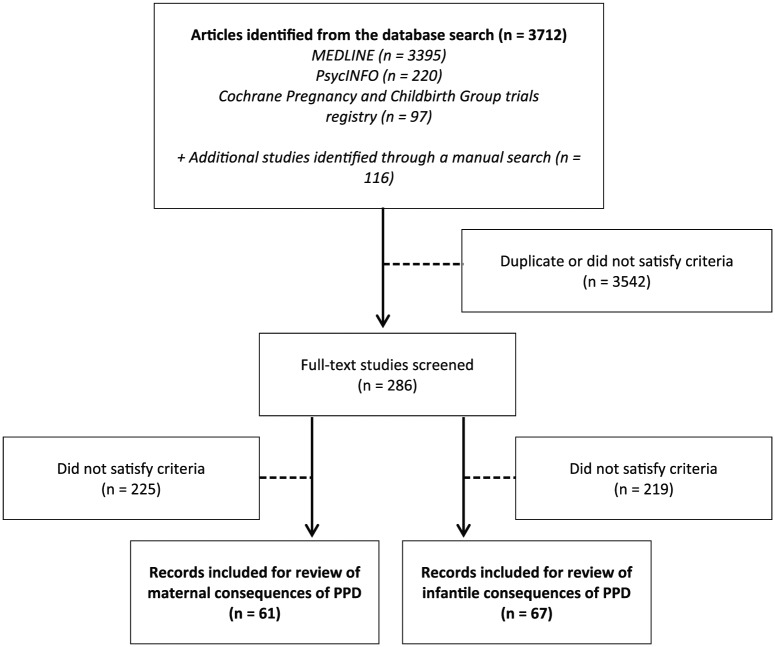
Introduction: The postpartum period represents the time of risk for the emergence of maternal postpartum depression. There are no systematic reviews of the overall maternal outcomes of maternal postpartum depression. The aim of this study was to evaluate both the infant and the maternal consequences of untreated maternal postpartum depression. Methods: We searched for studies published between 1 January 2005 and 17 August 2016, using the following databases: MEDLINE via Ovid, PsycINFO, and the Cochrane Pregnancy and Childbirth Group trials registry. Results: A total of 122 studies (out of 3712 references retrieved from bibliographic databases) were included in this systematic review. The results of the studies were synthetized into three categories: (a) the maternal consequences of postpartum depression, including physical health, psychological health, relationship, and risky behaviors; (b) the infant consequences of postpartum depression, including anthropometry, physical health, sleep, and motor, cognitive, language, emotional, social, and behavioral development; and (c) mother–child interactions, including bonding, breastfeeding, and the maternal role. Discussion: The results suggest that postpartum depression creates an environment that is not conducive to the personal development of mothers or the optimal development of a child. It therefore seems important to detect and treat depression during the postnatal period as early as possible to avoid harmful consequences.
Overview
CoChat Summary
TL;DR
This systematic review of 122 studies found that untreated maternal postpartum depression (PPD) is associated with negative maternal outcomes and adverse infant outcomes up to 3 years of age. The authors conclude that PPD creates an environment unfavorable to maternal personal development and optimal child development, supporting early detection and treatment.
Key findings
- The review included 122 eligible studies: 68 evaluated maternal consequences, 73 evaluated infant consequences, and 19 examined both. PPD prevalence across included studies ranged from 2.7% in Pakistani mothers at 18 months postpartum to 68.8% in Australian mothers at 4 months postpartum.
- Maternal PPD was linked to worse physical and psychological health, lower quality of life, relationship difficulties, and risky behaviors. For example, new-onset PPD was associated with more than double the risk of retaining at least 5 kg (OR = 2.54, 95% CI = 1.06, 6.09), and service women with PPD had higher odds of suicidality than service women without PPD (OR = 42.2, 95% CI = 28.8, 61.9).
- Infant consequences included anthropometric, health, sleep, motor, cognitive, language, emotional, social, and behavioral outcomes. Probable postnatal depression was associated with almost three times higher all-cause infant mortality up to 6 months (adjusted RR = 2.86, 95% CI = 1.58, 5.19) and almost two times higher mortality up to 12 months (adjusted RR = 1.88, 95% CI = 1.09, 3.24).
- Mother–child interactions were affected: 16 of 22 breastfeeding studies found significant negative effects of maternal depressive symptoms on breastfeeding and/or its parameters, and 11 studies showed a negative effect of maternal depression on mother-to-infant bonding.
Methods
- Systematic review following PRISMA to the extent possible; searched MEDLINE via Ovid, PsycINFO, and the Cochrane Pregnancy and Childbirth Group trials registry for studies published between 1 January 2005 and 17 August 2016, limited to human studies in English.
- Inclusion criteria were cohort, cross-sectional epidemiological, and qualitative individual studies; mothers of all ages with PPD; and health (physical or psychological) or social outcomes of PPD. Exclusion criteria were meta-analyses, systematic and nonsystematic reviews, randomized controlled trials, case studies, and studies including mothers who received treatment for PPD.
- From 3712 references retrieved, 122 studies were included. Outcomes were grouped into maternal consequences, infant consequences, and mother–child interactions, then thematically analyzed and synthesized narratively; adjusted results were used and discussed when available.
Limitations
- The authors state that study selection and data extraction were not performed using a double-blinded method, and no assessment of the studies’ methodological quality was performed.
- The authors state that the review compares heterogeneous studies using various designs (cohort vs cross-sectional) and tools to assess PPD, so potential confounding factors could be present.
- Evident from the text: PPD diagnosis and cut-off values varied widely across included studies (e.g., EPDS cut-offs of 8, 9, 10, 11, 12, 13, or 14), and the authors note that this heterogeneity makes outcomes difficult to compare.
Model-written summary. Check it against the paper before relying on it.
Integrity signals
Registry
Cites
Statistics
Figures
Verification
Claims the paper makes
103 Valid · 4 Not valid · 166 Not checked · 46 Own results and interpretations
Some cited sources support this claim and some don’t — read each source’s verdict below.
In the paper
“Two studies demonstrated that the triceps and subscapular skinfold thicknesses did not differ between infants of depressed and nondepressed mothers (one study was conducted in Belgium, Germany, Italy, Poland, and Spain;113 the other was from the United States112).”
§ Consequences of maternal postpartum depression: A systematic review of maternal and infant outcomes > Results > Infant consequences of PPD
What the sources say
- Supportedcites [113] Grote V Vik T von Kries R et al Maternal postnatal depression and child growth: a European cohort study. BMC Pediatr 2010; 10: 14. 20226021 PMC2850333 source
Table 2 (Results) reports triceps and subscapular skinfold measurements at 24 months for children of mothers with high and normal EPDS scores; the estimated differences have confidence intervals spanning zero. The Abstract’s Results state that the anthropometric indices did not differ between groups. (LLM, conf=0.94)
- Disputedcites [112] Ertel KA Koenen KC Rich-Edwards JW et al Antenatal and postpartum depressive symptoms are differentially associated with early childhood weight and adiposity. Paediatr Perinat Epidemiol 2010; 24(2): 179– 189. 20415775 PMC4106300 sourceExperimental — accuracy not yet measured
The Results report minimal difference in the combined skinfold measure (SS+TR) with antenatal depression, but higher SS+TR with postpartum depression (1.14 mm, 95% CI 0.11–2.18). Skinfolds were measured at age 3, not in infants. Thus the paper does not support the unqualified claim that skinfold thicknesses did not differ between the groups. (LLM, conf=0.86)
Checked by a reasoning model — may be wrong.
boosted- Asserted: passes — The authors put it forward as true.
- Checkable: passes — It can be checked against evidence.
- Load-bearing: unclear — It is unclear whether the paper’s conclusions depend on it.
- Based: passes — The paper gives a reason why it holds.
- Supported
At least one cited source doesn’t support this claim or points to a different paper, and none confirmed it — see the verdicts below.
In the paper
“The third study,94 conducted in Pakistan, showed that a child’s language development was affected by maternal PPD only when the father’s income was high.”
§ Consequences of maternal postpartum depression: A systematic review of maternal and infant outcomes > Results > Infant consequences of PPD
What the sources say
- Disputedcites [94] Ali NS Mahmud S Khan A et al Impact of postpartum anxiety and depression on child’s mental development from two peri-urban communities of Karachi, Pakistan: a quasi-experimental study. BMC Psychiatry 2013; 13: 274. 24148567 PMC3819469 sourceExperimental — accuracy not yet measured
The Results (Child language development, Table 4) report the opposite income pattern: children of depressed mothers had significantly higher odds of language delay when the father's income was below 3500 rupees/month. The Results also state that maternal depression had no significant impact on language development when his income was at least 3500 rupees/month. (LLM, conf=0.90)
Checked by a reasoning model — may be wrong.
plainstates a cause- Asserted: passes — The authors put it forward as true.
- Checkable: passes — It can be checked against evidence.
- Load-bearing: unclear — It is unclear whether the paper’s conclusions depend on it.
- Based: passes — The paper gives a reason why it holds.
- Disputed
Every source the paper cites for this claim was checked and supports it.
In the paper
“In multivariate logistic regression analyses, after adjustment for weight-related covariates, maternal sociodemographics, and parity, new-onset PPD was associated with more than double the risk of retaining at least 5 (OR = 2.54, 95% CI = 1.06, 6.09) kg.”
§ Consequences of maternal postpartum depression: A systematic review of maternal and infant outcomes > Results > Maternal consequences of PPD
What the sources say
- Supportedcites [67] Herring SJ Rich-Edwards JW Oken E et al Association of postpartum depression with weight retention 1 year after childbirth. Obesity 2008; 16(6): 1296– 1301. 18369338 PMC2761642 source
The Abstract reports that, after adjustment for weight-related covariates, maternal sociodemographics, and parity, new-onset postpartum depression was associated with retaining at least 5 kg at one year (OR 2.54, 95% CI 1.06–6.09). Table 2 in the discussion gives the same estimate for the fully adjusted model. (LLM, conf=0.95)
plainstates an association- Asserted: passes — The authors put it forward as true.
- Checkable: passes — It can be checked against evidence.
- Load-bearing: passes — The paper’s conclusions depend on it.
- Based: passes — The paper gives a reason why it holds.
- Supported
The cited sources support only part of this claim — read each source’s verdict below.
In the paper
“Other nonsystematic and systematic reviews have also explored specific maternal risks when mothers’ PPD is untreated, including more weight problems,18,19 alcohol and illicit drug use,20 social relationship problems,21 breastfeeding problems,22 or persistent depression23 compared with women who have received treatment.”
§ Consequences of maternal postpartum depression: A systematic review of maternal and infant outcomes > Introduction
What the sources say
- Partly supportedcites [18] Xiao RS Kroll-Desrosiers AR Goldberg RJ et al The impact of sleep, stress, and depression on postpartum weight retention: a systematic review. J Psychosom Res 2014; 77(5): 351– 358. 25306538 PMC4252881 sourceExperimental — accuracy not yet measured
The Results section (Postpartum depression; page unavailable) reports that some studies found an association between postpartum depression and weight retention, while others found no significant association. This supports the weight-problems portion linked to this citation, but the review does not compare untreated mothers with mothers who received treatment. The other listed risks are attached to other citations. (LLM, conf=0.87)
- Not checked — no full text of the sourcecites [19] Milgrom J Skouteris H Worotniuk T et al The association between ante- and postnatal depressive symptoms and obesity in both mother and child: a systematic review of the literature. Women’s Health Issues 2016; 22(3): e319– e328. 22341777 source
- Partly supportedcites [20] Chapman SLC Wu L-T. Postpartum substance use and depressive symptoms: a review. Women Health 2013; 53(5): 479– 503. 23879459 PMC3742364 sourceExperimental — accuracy not yet measured
Split into 2 atoms — 0 confirmed, 2 partially supported, 0 disputed, 0 misattributed, 0 unverifiable. Expand the claim to see per-atom verdicts.
- Partly supportedcites [21] Jones E Coast E. Social relationships and postpartum depression in South Asia: a systematic review. Int J Soc Psychiatry 2013; 59(7): 690– 700. 22851133 sourceExperimental — accuracy not yet measured
Split into 2 atoms — 0 confirmed, 2 partially supported, 0 disputed, 0 misattributed, 0 unverifiable. Expand the claim to see per-atom verdicts.
plainstates an association- Asserted: passes — The authors put it forward as true.
- Checkable: passes — It can be checked against evidence.
- Load-bearing: passes — The paper’s conclusions depend on it.
- Based: passes — The paper gives a reason why it holds.
- Partly supported
The cited sources support only part of this claim — read each source’s verdict below.
In the paper
“The two last studies evaluated postpartum weight retention (PPWR) and found that significantly more women with PPWR had higher scores on the PPD scale.35,67”
§ Consequences of maternal postpartum depression: A systematic review of maternal and infant outcomes > Results > Maternal consequences of PPD
What the sources say
- Not checked — no full text of the sourcecites [35] Biesmans K Franck E Ceulemans C et al Weight during the postpartum period: what can health care workers do. Matern Child Health J 2013; 17(6): 996– 1004. 22798141 source
- Partly supportedcites [67] Herring SJ Rich-Edwards JW Oken E et al Association of postpartum depression with weight retention 1 year after childbirth. Obesity 2008; 16(6): 1296– 1301. 18369338 PMC2761642 sourceExperimental — accuracy not yet measured
The Abstract and Discussion report a significant association between new-onset postpartum depression, defined by an EPDS score above 12, and retaining at least 5 kg one year after childbirth. They do not report that women with weight retention had higher EPDS scores overall; the significant finding is limited to new-onset postpartum depression, not antenatal depression or depression in both periods. The supplied copy gives no page numbers for these passages. (LLM, conf=0.86)
plainstates an association- Asserted: passes — The authors put it forward as true.
- Checkable: passes — It can be checked against evidence.
- Load-bearing: unclear — It is unclear whether the paper’s conclusions depend on it.
- Based: passes — The paper gives a reason why it holds.
214 more claims · 71 with their cited sources checked
Create a free account to see all 319 claims and to verify the 5 references still open.
- It may state two separate claims as one. 60
- Probably not a substantial claim. 42
- The quote only partly states this claim. 6
Claims other papers make about this one
Each is checked against this paper’s own text: does it say what the citing paper says it does?
The source backs part of the claim, not all of it — or backs it for a different population, condition or comparison.
In the citing paper
“Psychological distress among perinatal women correlates with increased maternal morbidity and mortality rates (Khalifa et al., 2016; Oates, 2003), poor infant health outcomes (Gelaye et al., 2016), and adverse early childhood developmental trajectories encompassing cognitive, emotional, and developmental delays (Slomian et al., 2019), making it a substantial public health concern.”
From Developing and validating the Sierra Leone perinatal psychological distress scale through an emic-etic approach (2025) · cites this paper as Slomian et al., 2019
Experimental — accuracy not yet measuredThe source backs part of the claim, not all of it — or backs it for a different population, condition or comparison.
In the citing paper
“This mental disorder has been shown to have negative effects on mothers' quality of life and their intimate relationships, birth outcomes, and breastfeeding likelihood, as well as long-term effects on children's cognitive and emotional development.”
From Perinatal Depression: Challenges and Opportunities (2021) · cites this paper as [25]
Experimental — accuracy not yet measuredThe cited source says what the claim attributes to it.
In the citing paper
“PPD may adversely impact mother-child bonding and contribute to adverse consequences for the infant, such as impaired cognitive, emotional, and motor development, or behavioral problems (Slomian et al., 2019).”
From PandaMom – Feasibility and acceptability of an internet- and mobile-based intervention to enhance peripartum mental well-being and to prevent postpartum depression (2024) · cites this paper as Slomian et al., 2019
The cited source says what the claim attributes to it.
In the citing paper
“Evidence shows that PPD is associated with overall poor maternal (O'Hara and McCabe, 2013; Gjerdingen and Yawn, 2007; Slomian et al., 2019) and infant health (Stein et al., 2014; Slomian et al., 2019; Hayes et al., 2013; Pawlby et al., 2009), even when the symptomatology is subclinical (Tronick and Reck, 2009; Weinberg et al., 2001).”
From App-based intervention for reducing depressive symptoms in postpartum women: Protocol for a feasibility randomized controlled trial (2023) · cites this paper as Slomian et al., 2019
The cited source says what the claim attributes to it.
In the citing paper
“PPD can have negative effects on maternal-infant bonding and interaction25; adaptation to the mothering role and confidence in providing infant care26; maternal quality of life and intimate relationships25; children's emotional, cognitive, and behavioral development27; and the father's mental health.28”
From Perinatal Depression: Challenges and Opportunities (2021) · cites this paper as [25]
1 more claim about this paper
Create a free account to see every claim other papers make about this one.
Statistics recomputed
Every reported test result, recomputed from its test statistic and degrees of freedom. A result shows as not adding up only once an independent check has confirmed it.
- Consistentχ²(2) = 6.47reported p < .05 · recomputed p = .039
“χ2(2) = 6.47, p < .05”
- Consistentχ²(1) = 5.44reported p < .025 · recomputed p = .020
“χ2(1) =5.44, p < .025”
- Consistentχ²(1) = 4.01reported p < .05 · recomputed p = .045
“χ2(1) = 4.01, p < .05”
Self-check
Percentages, sums and reported differences re-computed from the paper’s own numbers.
Each contradiction between two passages listed here was confirmed by an independent check.
Rated minor: it would not touch a result — a value no result rests on, a p-value that stays on the same side of the significance level, or a conflict that is clerical, resolved elsewhere in the paper, or outside its own findings.
In the paper
§ Consequences of maternal postpartum depression: A systematic review of maternal and infant outcomes > Results > Included studies
“The prevalence of PPD varied from 4.5% in a population of Canadian mothers at 6 weeks postpartum89 to 68.8% in a population of Australian mothers at 4 months postpartum.64”
§ Consequences of maternal postpartum depression: A systematic review of maternal and infant outcomes > Results > Maternal consequences of PPD
“Herring67 | USA Mean age: 33.0 ± 4.7 years Gender of newborns: not given | 850 | Cohort study 18 months Four groups: - None - Pregnancy only - Postpartum only - Pregnancy and postpartum | EPDS (Depressed = EPDS > 12) | 4%”
Rated minor: it would not touch a result — a value no result rests on, a p-value that stays on the same side of the significance level, or a conflict that is clerical, resolved elsewhere in the paper, or outside its own findings.
In the paper
§ Consequences of maternal postpartum depression: A systematic review of maternal and infant outcomes > Results > Infant consequences of PPD
“The third study,94 conducted in Pakistan, showed that a child’s language development was affected by maternal PPD only when the father’s income was high.”
§ Consequences of maternal postpartum depression: A systematic review of maternal and infant outcomes > Results > Infant consequences of PPD
“Among women whose husband’s income was ⩾3500 rupees/month, there was no significant impact of maternal depression on children’s language development. Children of depressed mothers whose husband’s income was <3500 rupees/month had more than a five-fold risk of delayed language development”
Rated minor: it would not touch a result — a value no result rests on, a p-value that stays on the same side of the significance level, or a conflict that is clerical, resolved elsewhere in the paper, or outside its own findings.
In the paper
§ Consequences of maternal postpartum depression: A systematic review of maternal and infant outcomes > Results > Included studies
“The majority of the studies were performed in the United States (28 of 68) and Europe (22 of 68), 10 studies were performed in Asia, and 8 studies were performed in Australia and New Zealand.”
§ Consequences of maternal postpartum depression: A systematic review of maternal and infant outcomes > Results > Maternal consequences of PPD
“Faisal-Cury38 | Brazil Mean age: 25 years Gender of newborns: not given | 644”
Rated minor: it would not touch a result — a value no result rests on, a p-value that stays on the same side of the significance level, or a conflict that is clerical, resolved elsewhere in the paper, or outside its own findings.
In the paper
§ Consequences of maternal postpartum depression: A systematic review of maternal and infant outcomes > Results > Included studies
“The number of participants ranged from 1593 to 22,118,28”
§ Consequences of maternal postpartum depression: A systematic review of maternal and infant outcomes > Results > Maternal consequences of PPD
“Do33 | USA Mean age: not given Gender of newborns: not given | 178,714 | Cohort study 6 years”
Rated minor: it would not touch a result — a value no result rests on, a p-value that stays on the same side of the significance level, or a conflict that is clerical, resolved elsewhere in the paper, or outside its own findings.
In the paper
§ Consequences of maternal postpartum depression: A systematic review of maternal and infant outcomes > Results > Mother–child interactions
“nondepressed mothers showed right-sided cradling, similar to nonstressed mothers.”
§ Consequences of maternal postpartum depression: A systematic review of maternal and infant outcomes > Results > Mother–child interactions
“The results indicated that 86% of mothers who were neither stressed nor depressed cradled to the left, and 14% cradled to the right.”
3 more findings
Create a free account to see every finding of this check.
Citations
Cites
Diagnostic and Statistical Manual of Mental Disorders
American Psychiatric Association (2013) · doi:10.1176/appi.books.9780890425596 · Cited by 116,369
Preferred Reporting Items for Systematic Reviews and Meta-Analyses: the PRISMA statement
Moher, D., Liberati, A., Tetzlaff, J., Altman, D. G., & for the PRISMA Group (2009) · BMJ · doi:10.1136/bmj.b2535 · Cited by 83,823
Preferred Reporting Items for Systematic Reviews and Meta-Analyses: The PRISMA Statement
Moher, D., Liberati, A., Tetzlaff, J., Altman, D. G., & The PRISMA Group (2009) · PLoS Medicine · doi:10.1371/journal.pmed.1000097 · Cited by 64,042
Wang, G., Ma, R., Qiao, G., Wada, K., Aizawa, Y., & Satoh, T. (2015) · Integrative Medicine International · doi:10.1159/000368408 · Cited by 18,657
Detection of Postnatal Depression: Development of the 10-item Edinburgh Postnatal Depression Scale
Cox, J. L., Holden, J. M., & Sagovsky, R. (1987) · British Journal of Psychiatry · doi:10.1192/bjp.150.6.782 · Cited by 14,183
Perinatal Depression: A Systematic Review of Prevalence and Incidence
Gavin, N. I., Gaynes, B. N., Lohr, K. N., Meltzer-Brody, S., Gartlehner, G., & Swinson, T. (2005) · Obstetrics & Gynecology · doi:10.1097/01.aog.0000183597.31630.db · Cited by 3,282
Offspring of Depressed Parents: 20 Years Later
Weissman, M. M., Wickramaratne, P., Nomura, Y., Warner, V., Pilowsky, D., & Verdeli, H. (2006) · American Journal of Psychiatry · doi:10.1176/ajp.2006.163.6.1001 · Cited by 1,059
Perinatal mental illness: Definition, description and aetiology
O'Hara, M. W., & Wisner, K. L. (2014) · Best Practice & Research Clinical Obstetrics & Gynaecology · doi:10.1016/j.bpobgyn.2013.09.002 · Cited by 986
Screening for depression during pregnancy with the edinburgh depression scale (EDDS)
Murray, D., & Cox, J. L. (1990) · Journal of Reproductive and Infant Psychology · doi:10.1080/02646839008403615 · Cited by 973
Magnitude and risk factors for postpartum symptoms: A literature review
Norhayati, M. N., Nik Hazlina, N. H., Asrenee, A. R., & Wan Emilin, W. M. A. (2015) · Journal of Affective Disorders · doi:10.1016/j.jad.2014.12.041 · Cited by 816
Research works printed but not linked: 4
- Friedman DD. 4-month infant vocal quality in mother-infant face-to-face interaction: 6-week maternal postpartum depressive symptomatology and infant gender. PhD Thesis, New York University, New York, 2005.
- Kalita KN. Developmental profile of infants born to mothers with postpartum depression and anxiety: a comparative study. J Indian Assoc Child Adolesc Ment Health 2009; 6(1): 3– 12.
- Razurel C. Comment l’éducation dispensée par les professionnels peut-elle influencer le sentiment de compétence parentale chez les mères primipares? Rouen: Université de Rouen, 2010.
- Williams TM Joy LA Travis L et al Transition to motherhood: a longitudinal study. Infant Ment Health J 1987; 8(3): 251– 265. · DOI · Paper page
Cited by
Items 1,301–1,400 of 1,517
Postpartum Depression from the Perspective of Third-Wave Psychotherapies
Hamarat, H., Fidantek, H., Özdem, M., & Ertürk, İ. Ş. (2026) · Psikiyatride Guncel Yaklasimlar - Current Approaches in Psychiatry · doi:10.18863/pgy.1636688
“…postpartum depression has been associated with lower maternal caregiving quality, breastfeeding difficulties, and attachment problems, all of which negatively impact the development of a healthy mother - infant relationship (O’Hara and McCabe 2013, Brummelte and Galea 2016, Slomian et al. 2019).”
Computer adaptive testing strategies for the Edinburgh Postnatal Depression Scale (EPDS)
Wong, E., Accortt, E. E., Choi, S. W., & Bright, T. J. (2025) · Archives of Women s Mental Health · doi:10.1007/s00737-025-01562-5
“…impair quality of life, social functioning, and may increase engagement with more risky behaviors (Chithiramohan and Eslick 2023; Feldman et al. 2009; Miller et al. 2022 ; Misri and Kendrick 2008 ; Paulson et al. 2006; Slomian et al. 2019; Trost et al. 2017 ; Zelkowitz and Milet 1996).”
Early Head Start Services Buffer the Effects of Maternal Depression on Child Development
Corallo, K. L., Carleton, R. A., Major, M. E., & DiGirolamo, A. M. (2025) · Infants & Young Children · doi:10.1097/iyc.0000000000000308
“Maternal depression is also associated with poorer postpartum physical health outcomes for mothers, such as postpartum weight retention, physical limitations, and pain (Slomian, Honvo, Emonts, Regnister, & Bruyère, 2019).”
Impact of postnatal depression on families with children under 5 years in the UKPreprint
Nassuna, S., & Bagonza, F. X. (2025) · Research Square · doi:10.21203/rs.3.rs-6739760/v1
Harm or protection? Two-sided consequences of females' susceptible responses to multiple threats
Lin, J., Cuijpers, P., Li, H., & Lei, Y. (2022) · Behavioral and Brain Sciences · doi:10.1017/s0140525x22000607
Chamanara, S., Irandoost, E., Dahmardeh, N., & Aghaamoo, S. (2026) · Journal of Psychiatric Research · doi:10.1016/j.jpsychires.2026.05.014 · Cited by 5
Chanagala, B., Chauhan, S. P., Fisher, S. D., Hoffman, M., & Frasch, M. G. (2025) · PLOS Digital Health · doi:10.1371/journal.pdig.0000773 · Cited by 1
Santarossa, S., Haley, E. N., Coyne, P., Pappas, C., Braciszewski, J. M., Miller-Matero, L. R., Zreik, M., Hicks, L. M., & Loree, A. M. (2025) · BMC Pregnancy and Childbirth · doi:10.1186/s12884-025-08383-5
“PPD adversely impacts maternal and infant health and may have longstanding impacts on a child’s language, emotional, and behavioral outcomes [4].”
Mateus, V., Guiomar, R. N. R. M., Osório, A., Schuler, A., Skalkidou, A., Lega, I., Rocha, R. R., & Cruz, S. (2026) · Developmental Psychobiology · doi:10.1002/dev.70126 · Cited by 3
Intervenções comportamentais para Depressão Pós-Parto: revisão sistemática da literatura
Gomes, L. C. (2023) · Digital Library of Theses and Dissertations (Universidade de São Paulo) · doi:10.11606/d.47.2023.tde-11042024-170404
Reis, C. S. D. J., Batista, E. S., da Silva, R. S., Bomsucesso, V. D. R., Souza, S. S., & Bandeira, A. K. D. C. (2023) · Editora Inovar eBooks · doi:10.36926/editorainovar-978-65-5388-153-2_010
Zhang, H., Jiang, Y. A., Fu, H., Zhang, L., & Zhang, G. L. (2026) · Frontiers in Medicine · doi:10.3389/fmed.2026.1828838 · Cited by 1
The Overlooked Burden: Maternal Stress in the Postpartum Period
Radoš, S. N., Žutić, M., & Kolić, L. (2025) · Springer eBooks · doi:10.1007/978-3-032-09245-8_3
Gillham, A. M., Cochran, G., Wiglesworth, A., Aubuchon-Endsley, N. L., Coser, A. D., Wilhelm, R. A., Thompson, W. K., Aupperle, R. L., Paulus, M. P., & White, E. J. (2026) · Adversity and Resilience Science · doi:10.1007/s42844-026-00197-4
Sanae, S. A. D. A., Tsutsumi, C., Seiko, R. Y. U., & Kimiyo, I. T. O. (2023) · Journal of Japan Academy of Midwifery · doi:10.3418/jjam.jjam-2023-0009 · Cited by 1
Factors associated with maternal overall Quality of Life six months postpartumPreprint
Valla, L., Helseth, S., Småstuen, M. C., Misvær, N., & Andenæs, R. (2021) · Research Square · doi:10.21203/rs.3.rs-222632/v2 · Cited by 1
Arsova, S., Toskic, A. B., & Mitrovska, S. (2026) · Obstetrics and gynecology. · doi:10.5772/intechopen.1013597 · Cited by 1
Taylor, E. L., Lugon, G., Gallo, E., Awad, C., Llauradó-Pont, J., Ayala, N., Bustamante, M., Contreras‐Rodríguez, O., Ferrer, M., Foraster, M., et al. (2026) · Research Square · doi:10.21203/rs.3.rs-10956084/v1
DOENÇAS INFECCIOSAS NA REALIDADE BRASILEIRA: UMA REVISÃO DE LITERATURA
Oliveira, G. N., da Silva, J. R. A. M., Silva, Á. B. A. A. E., Simões, L. C., Cavalcante, T. A. P., Bertini, A. D. H., Weyne, L. D., dos Santos, A. P. D. C., Amaro, L. L., & da Silva, J. N. (2023) · Editora Inovar eBooks · doi:10.36926/editorainovar-978-65-5388-153-2_008
Okamoto, M., Shakya, S., Shrestha, S., Kaneda, E., Kawada, S., & Ohishi, K. (2026) · Frontiers in Global Women s Health · doi:10.3389/fgwh.2026.1723556
The Role of Midwives on Mother's Mental Health in the First 1000 Days of Life
Aulia, D., Jayanti, R. D., Wardhana, M. P., Sembiring, E. F., Djaguna, N., Fitriana, F., & Azizah, N. (2024) · JURNAL MIDPRO · doi:10.30736/md.v15i2.490
Sipilä, M., Hakulinen, T., Heliminen, M., Klemetti, R., & Paavilainen, E. (2026) · Research Square · doi:10.21203/rs.3.rs-9577138/v1
Guedes, P. H. G., & Mendes‐Silva, A. P. (2026) · Research Square · doi:10.21203/rs.3.rs-11000702/v1
Profiling zuranolone as a treatment option for postpartum depression
Gonzalez‐Torres, C., & Sharma, V. (2026) · Expert Review of Neurotherapeutics · doi:10.1080/14737175.2026.2733192
Rullyni, N. T., Jayanti, V., & Putri, S. I. (2026) · Innovation Midwifery and Child Health Practice · doi:10.69725/imchp.v3i1.353
“This relationship is clinically important because postpartum psychological difficulties can affect maternal functioning, mother–infant interaction, breastfeeding, and infant-related outcomes (Slomian et al., 2019).”
Kjeldsen, M. Z., Bager, L., Holde, K. E. V., Munk‐Olsen, T., & Petersen, L. V. (2026) · Social Psychiatry and Psychiatric Epidemiology · doi:10.1007/s00127-026-03089-1
Polloni, L., Cavallin, F., Bua, M., Grandis, D., Schiavo, R., Villani, P. E., Lolli, E., Baraldi, E., & Trevisanuto, D. (2026) · Global Pediatrics · doi:10.1016/j.gpeds.2026.100352
Guiroy, I. M., Caicedo, B. I., Nouri, R., Kuhn, E. R., & Semple, R. J. (2025) · Journal of Technology in Behavioral Science · doi:10.1007/s41347-025-00482-6
Ye, H., Gao, B., Tian, Y., Yang, F., & Li, L. (2026) · Frontiers in Immunology · doi:10.3389/fimmu.2026.1874901
“PPD not only impairs maternal quality of life but also negatively in fl uences infant development and family functioning (3).”
AlHemyari, A. H., Alabdrabalnabi, B. A., Alotaibi, A., Alenazi, A. A., & Althwanay, A. M. (2025) · Psychiatry International · doi:10.3390/psychiatryint6040116 · Cited by 1
“…PPD has the potential to impair the bonding process, foster unsatisfactory parenting behaviors, and result in poor socioemotional and cognitive development of the child, indicating the crucial need for early identification and prompt treatment of this condition as a public health issue [53].”
Kumru, P., Hıdıroğlu, S., Sarısaltık, A., Çöğendez, E., Yılmazer, B., Erol, H., Şalva, T., & Ay, P. (2024) · Clinical and Experimental Health Sciences · doi:10.33808/clinexphealthsci.1193477
Park, W., & Kang, H. (2024) · Human Ecology Research · doi:10.6115/her.2024.050
NYIRIMANA, V., RUTAKAYILE, B., Mudenge, C., Musafili, A., Cassady, C., & Yubahwe, J. (2021) · Research Square · doi:10.21203/rs.3.rs-701678/v1
TERAPIA NUTRICIONAL EM DOENÇAS INFLAMATÓRIAS INTESTINAIS: ARTIGO DE REVISÃO
Araújo, K. T. C., Pereira, M. K. S., Honorato, P. E. O., Pires, C. D. J., Gomes, T. L., Gois, F. E. D. C., Almeida, C. T. D. S., Barbosa, M. D. D. S., Mesquita, B. C. D. S., & Nascimento, S. P. (2023) · Editora Inovar eBooks · doi:10.36926/editorainovar-978-65-5388-153-2_015
Pennington, E. L., Barner, J. C., Brown, C. M., Moczygemba, L. R., & Patel, D. A. (2025) · Maternal and Child Health Journal · doi:10.1007/s10995-025-04145-z
“Children of mothers with PPD may have reduced weight gain and reduced motor, cognitive, language, emotional, and behavioral development (Slomian et al., 2019).”
Borja, T. N., Zuccolo, P. F., Seda, L., Matijasevich, A., Polanczyk, G. V., & Fatori, D. (2026) · Archives of Women s Mental Health · doi:10.1007/s00737-026-01705-2
“PPD is known to impair mother-infant bonding and reduce maternal responsiveness (Brummelte & Galea, 2016; Slomian et al., 2019).”
Campion, J. (2022) · Oxford University Press eBooks · doi:10.1093/med/9780198861478.003.0051
Marrie, R. A., Maxwell, C. J., Bolton, J. M., Söderling, J. K., Bernstein, C. N., Krysko, K. M., McKay, K. A., Rotstein, D., Deakin-Harb, K., & Razaz, N. (2026) · Multiple Sclerosis and Related Disorders · doi:10.1016/j.msard.2026.107041 · Cited by 1
Prenatal attachment inventory during the SARS-CoV-2 pandemic
Capitani, E., Lorenzini, C., Cresti, A., Alaimo, L., & Nante, N. (2023) · Italian Journal of Gynaecology and Obstetrics · doi:10.36129/jog.2023.93
“It has also been associated with hypertension, preeclampsia and gestational diabetes [40].”
Boldrini, F., Ragni, B., Russo, C., Barni, D., & STASIO, S. D. (2023) · PubMed Central · doi:10.23750/abm.v94i4.14470
Frederiksen, M. S. (2021) · VBN Forskningsportal (Aalborg Universitet) · doi:10.54337/aau455012878
Tornyevah, L., Bosomprah, S., Sharma, A., de Jonge, A., & Henrichs, J. (2025) · Journal of Mental Health · doi:10.1080/09638237.2025.2595600
“If untreated, PPD negatively influences maternal well-being, infant development, and family functioning (Slomian et al., 2019).”
Perinatal depression and sun safety behaviors: Results of a pilot intervention trial
Anwar, O. U., Wu, Y. P., Mendoza, J. M., et al. (2025) · Preventive Medicine Reports · doi:10.1016/j.pmedr.2025.103078
“However, prenatal depression (affecting up to 40 % of pregnancies) can undermine motivation to follow recommended health practices (Jahan et al., 2021; Slomian et al., 2019).”
Norske kvinners opplevelser av hva som var hjelpsomt for tilfriskning fra fødselsdepresjon
Sætre, F., Watson, L. A., & Anda, L. G. (2025) · Tidsskrift for Norsk psykologforening · doi:10.52734/caih2538
Güneş, B., Doğan, F., Güzelçiçek, A., Bozkaya, A., & Yalçın, S. S. (2026) · Frontiers in Pediatrics · doi:10.3389/fped.2026.1863943
“Infant sex should not be construed as causal; any association likely operates through psychosocial pathways shaped by family expectations, cultural context, and maternal adjustment, and the finding could also reflect residual confounding or sampling variation (52, 53).”
Huang, X., Li, L., & Pei, L. (2025) · Research Square · doi:10.21203/rs.3.rs-6713949/v1
Roca, A., Fernández-Jarabo, N., Albero, S., Lucas, L., Pelegrí, J., Albillos, B., Cid, M., Torres, A., Solé, E., Andrés, S., et al. (2025) · Mental Health & Prevention · doi:10.1016/j.mhp.2025.200462
Abera, M., Berhane, M., Grijalva-Eternod, C. S., Abdissa, A., Abate, N., Hailu, E., Barthorp, H., Allen, E., McGrath, M., Girma, T., et al. (2024) · medRxiv · doi:10.1101/2024.04.03.24305269
Entrenched in Tradition: The Psychological Cost of Motherhood in Regions with High Son PreferencePreprint
Gan, Y. (2026) · SSRN Electronic Journal · doi:10.2139/ssrn.6175438
Aghebatbekheir, A., Mahmoodi, Z., Rahimzadeh, M., Zandifar, A., & Saeieh, S. E. (2025) · BMC Pregnancy and Childbirth · doi:10.1186/s12884-025-08523-x · Cited by 2
“In many studies, the cutoff score of the Edinburgh questionnaire, the duration of follow-up, the number of intervention sessions, and the type of intervention vary and impact the study outcomes [31].”
A review on postpartum depression and its homoeopathic management
Nivethitha, V., & Lalithaa, K. (2022) · International Journal of Homoeopathic Sciences · doi:10.33545/26164485.2022.v6.i3d.620
“ Low levels of oxytocin and unwanted early weaning [13, 22].”
BackgroundBarry, E. S., & D’Souza, L. (2024) · Journal of Clinical Sleep Medicine · doi:10.5664/jcsm.11164 · Cited by 3
“Because of the long-known negative effects of maternal depression on infant development, 3 and how common BS and RS are, 23,24,30,31 discovering whether MDS predicts, or is predicted by ISL is important.”
Büssow, A. L., Seefeld, L., Schellong, J., & Garthus‐Niegel, S. (2026) · BMC Psychiatry · doi:10.1186/s12888-026-08509-9
“Especially untreated PPD [15] is associated with poorer maternal health and can impact the child’s development [16].”
Belay, D. M., Dadi, A. F., Kassie, Y. T., Bayih, W. A., Derseh, B. T., Birhane, B. M., Leckning, B., & Guthridge, S. (2026) · Frontiers in Psychiatry · doi:10.3389/fpsyt.2026.1850017
Tornyevah, L., Henrichs, J., Sharma, A., Jonge, A. D., & Bosomprah, S. (2026) · Nursing Research and Practice · doi:10.1155/nrp/2803636
“In line with this, another study observed that PPDS’s negative efect on bonding was only apparent in the early postpartum months and disappeared by 1 year [14].”
Bandeira, D. R., Filho, E. J. D. M., Arteche, A. X., Frizzo, G. B., Mateus, V., Schütz, A., Almeida, M. L., Piccolo, L. D. R., Levandowski, D. C., & da Silva, M. A. (2025) · Psico · doi:10.15448/1980-8623.2025.1.47153
Ou, C. H. K., Hall, W. A., Rodney, P., & Stremler, R. (2021) · Research Square · doi:10.21203/rs.3.rs-734233/v1
Psychosocial Stressors and Postpartum Depressive Symptoms Are Linked to Postpartum Contraceptive Use
Dhaurali, S., Acevedo, A., Abrams, L., & Shrestha, S. (2024) · Journal of Women s Health · doi:10.1089/jwh.2023.0719
“32,34,35 This study aims to understand the association(s) between psychosocial stressors, PPD (operationalized as postpartum depressive symptoms [PDS]), and PPC utilization among postpartum individuals, using the Pregnancy Risk Assessment Monitoring System (PRAMS).”
Mental Health Care for Common Perinatal Mental Disorders: What Do Fathers Need?
Pirmohamed, J. (2020) · TSpace (University of Toronto) · Cited by 1
da Silva, A. C., Ribeiro, F. J. D. S. F., Brito, A. K. A., et al. (2024) · Caderno Pedagógico · doi:10.54033/cadpedv21n13-492
Acute Psychiatric Conditions in Pregnancy
Zafman, K. B., & Kern‐Goldberger, A. R. (2024) · Wiley eBooks · doi:10.1002/9781119820260.ch33
Prevalence of Postpartum Depression in Mothers Presenting to a Pediatric Otolaryngology Clinic
Klatzkow, H., Gitomer, S. A., John‐Larkin, C. S., Scholes, M. A., & Cooper, E. (2023) · The Laryngoscope · doi:10.1002/lary.30901 · Cited by 1
“2,3 Despite the prevalence and signi fi cance of PPD, it remains underdiagnosed.”
BackgroundMazur, L. I., Kurshina, M. V., Perova, A. Y., et al. (2025) · Медико-фармацевтический журнал «Пульс» · doi:10.26787/nydha-2686-6838-2025-27-11-66-71
Burns, S., Jegatheeswaran, C., Barron, C., & Perlman, M. (2024) · Maternal and Child Health Journal · doi:10.1007/s10995-024-03992-6
“Symptoms of maternal stress, anxiety, and depression are associated with poor physical health (Slomian et al., 2019), disrupted work performance (Napora et al., 2018), social relationship problems (Jones & Coast, 2013), and dysfunctional parenting (Crosby Budinger et al., 2013).”
Ulrich, S. M., Ghezih, S., Lux, U., & Löchner, J. (2024) · SSRN Electronic Journal · doi:10.2139/ssrn.4877301
MANTRAM FOR MAMAS: A PILOT STUDY FOR POSTPARTUM WOMEN
Smedile, R. (2023) · Digital USD (University of San Diego) · doi:10.22371/07.2023.012 · Cited by 1
Ali, G., Beigi, R., Voela, A., Lalani, N. S., Hamash, K. I., Sulaiman, S., Virani, G., Ongoji, K., Syed, H., Ali, S., et al. (2025) · Women s Reproductive Health · doi:10.1080/23293691.2025.2508983
Zavaleta‐Monestel, E., Herrera-Jiménez, L. G., González-Aguilar, K., Mora-Jiménez, J., & González, R. M. (2026) · Cureus · doi:10.7759/cureus.114673
Yasaka, T., Fujisawa, T. X., & Tomoda, A. (2026) · Frontiers in Psychiatry · doi:10.3389/fpsyt.2026.1939326
Bebus, S. M., Palmsten, K. K., Lipkind, H. S., Ackerman‐Banks, C. M., & Ahrens, K. A. (2024) · The Journal of Rural Health · doi:10.1111/jrh.12912
(2024) · doi:10.21203/rs.3.rs-5041479/v1
“Considering this critical developmental period, individuals exposed to mental health-related stressors in utero are at risk for physical, cognitive, and behavioral complications later in childhood [19].”
Ojeleye, O. A., Wilson, R. M., & Oruche, U. M. (2025) · Journal of the American Psychiatric Nurses Association · doi:10.1177/10783903251398526 · Cited by 1
“PND is shown to be associated with high levels of negative maternal behaviors, poor parenting, and disengagement from infants (Slomian et al., 2019).”
Psychopathologie et attachement dans la transition à la maternité
Guez, H. (2022) · theses.fr (ABES) · doi:10.70675/e686711fzd86ez483cza5dcz2df4f3aa4ab1
Vivências de mulheres com sofrimento psíquico no período puerperal: interpretações e significados
Mapelli, L. D. (2023) · Digital Library of Theses and Dissertations (Universidade de São Paulo) · doi:10.11606/d.22.2023.tde-02062023-152920
Xing, C., Li, G., Zhang, G., Liu, Y., Yan, M., & Liu, G. (2025) · ALPHA PSYCHIATRY · doi:10.31083/ap38795
Burayu, E. T., Terfa, T. E., Seboka, A. K., & Terefe, A. F. (2026) · Maternal Health Neonatology and Perinatology · doi:10.1186/s40748-026-00275-6
“The consequences are profound, including increased risks of postpartum depression, maternal and neonatal complications, and long-term avoidance of healthcare facilities [13].”
InfluentialPostpartum Depression: Overcoming Mental Health Challenges during Parenthood
Walls, J., Leiferman, J. A., Farewell, C. V., & Lacy, R. (2023) · Health · doi:10.4236/health.2023.157046
Mulungu, C., Moyo, L. T., Nachimata, M., Sianchapa, C., & Maseka, A. K. Y. (2025) · Open Journal of Psychiatry · doi:10.4236/ojpsych.2025.154023
Saijo, Y., Sato, Y., Shiotsuki, H., Ishikawa, T., Yoshioka, E., Nakanishi, K., Kato, Y., Nagaya, K., Takahashi, S., Ito, Y., et al. (2026) · BMC Pregnancy and Childbirth · doi:10.1186/s12884-026-09332-6
“PD affects not only mothers’ subsequent mental and physical health, and social and occupational functioning, but also the mother–child relationship, child health, and partner interaction [6].”
Medicaid Reimbursement for Maternal Depression Screening and Care for Postpartum Depression
Gordon, S. H., Lee, S., Deen, N., Cole, M. B., Feinberg, E., & Galbraith, A. A. (2025) · Archives of Pediatrics and Adolescent Medicine · doi:10.1001/jamapediatrics.2025.1790 · Cited by 3
ANOMALIAS NO CARIÓTIPO HUMANO: SÍNDROME KLINEFELTER UMA CONDIÇÃO SUBDIAGNOSTICADA
Carvalho, G. C. G., Meneses, A. P. R. D. S. A., Almeida, C. M. V. G., Matos, D., Rebêlo, E. M. G., Santos, J. S., Bastos, L. A., Alves, L. D. S., & Batista, N. J. C. (2023) · Editora Inovar eBooks · doi:10.36926/editorainovar-978-65-5388-153-2_004
Zhang, C., Jin, X., Luo, D., Xu, D. R., Liao, J., & Gong, W. (2021) · PubMed Central · doi:10.11817/j.issn.1672-7347.2021.210139 · Cited by 3
Panolan, S., & Jafar, K. (2025) · Women s Reproductive Health · doi:10.1080/23293691.2025.2582491 · Cited by 1
Scoping review of preventive interventions for postpartum depression to inform policy and planning
Alizadeh-Dibazari, Z., Nourizadeh, R., Mirghafourvand, M., Doshmangir, L., & Najmi, L. A. (2026) · Discover Mental Health · doi:10.1007/s44192-026-00371-1 · Cited by 1
“Untreated depression can lead to complications at birth, such as preterm delivery, low birth weight, and prolonged neonatal intensive care [8, 9].”
Caring beyond birth: Indonesian mothers' experiences of postpartum mental health support
Ningtyas, W. S., Fitriana, F., & Dewi, E. R. (2025) · British Journal of Midwifery · doi:10.12968/bjom.2025.0041 · Cited by 2
A 2-Day Postpartum CBT-Based Training for Nurses
Campbell, M., Haber, E., Hicks, A., & Lieshout, R. J. V. (2024) · Canadian Journal of Nursing Research · doi:10.1177/08445621241276238
“Left untreated, PPD can increase the risk of future depressive episodes and can have profound impacts on both parenting and mother-infant relationships (Slomian et al., 2019).”
BackgroundExamining Family Process among Infants and Toddlers and Implications for Maternal–Child Intervention
LaForett, D. R., Salomon, R. E., Waldrop, J. B., Martínez, M., Mandel, M. A., Wheeler, A., Okoniewski, K. C., & Beeber, L. S. (2022) · Journal of Early Intervention · doi:10.1177/10538151221131515
“Multiple recent reviews document such negative effects during birth—3 years, when children are eligible to participate in EI (Barnes & Theule, 2019; Śliwerski et al., 2020; Slomian et al., 2019).”
BackgroundWu, T., Shen, W.-Y., Chen, L.-H., Cao, B.-L., Xu, C.-Y., & Fang, Y. (2025) · World Journal of Psychiatry · doi:10.5498/wjp.v15.i11.108797
Metadata
- Authors
- Slomian, J., Honvo, G., Emonts, P., Reginster, J.-Y., & Bruyère, O.
- Affiliations
- University of Liège (BE)
- Centre Hospitalier Universitaire de Liège (BE)
- Corresponding author
- Slomian, Justine
- Venue
- Women's Health
- Publisher
- SAGE Publications
- Published
- 2019-01
- Volume
- 15
- Pages
- 1745506519844044-1745506519844044
- ISSN
- 1745-5057 (ISSN-L)
- 1745-5065
- PMC
- PMC6492376
- OpenAlex
- W2943494044
- Semantic Scholar
- ee946755bae03c5fb910a2191e2371c480ea04a3
- Cited by
- 1,496
- References
- 184
- Citations by year
- 2026: 183 · 2025: 275 · 2024: 320 · 2023: 272 · 2022: 219 · 2021: 152 · 2020: 64 · 2019: 10
- FWCI
- 18.19
- Type
- journal article
- Language
- en
- Update notices
- correction (2019-05-30)
- Open access
- gold
- doi.org
- Licence
- cc-by-nc
- journals.sagepub.com/page/policies/text-and-data-mining-license (tdm)
- Locations
- Women s Health (publishedVersion, cc-by-nc)
- Europe PMC (PubMed Central) (publishedVersion, cc-by-nc)
- PubMed Central (publishedVersion, cc-by-nc)
- PubMed (publishedVersion)
- DOAJ (DOAJ: Directory of Open Access Journals) (submittedVersion, cc-by-sa)
- ORBi (University of Liège) (submittedVersion)
- Topics
- Health Sciences › Medicine › Public Health, Environmental and Occupational Health › Maternal Mental Health During Pregnancy and Postpartum
- Health Sciences › Medicine › Pediatrics, Perinatology and Child Health › Maternal and Neonatal Healthcare
- Health Sciences › Medicine › Pediatrics, Perinatology and Child Health › Infant Health and Development
- Keywords
- postpartum depression, maternal outcomes, infant outcomes, mother-infant bonding, breastfeeding, maternal role, infant development, maternal physical health, maternal mental health, infant sleep
- MeSH terms
- Adult, Body Weights and Measures, Breast Feeding, Child Development, Cognition, Female, Health Status, Humans, Infant, Infant, Newborn, Language, Male, Mental Health, Mother-Child Relations, Quality of Life, Risk-Taking, Sleep, Women's Health, Depression, Postpartum
About these checks
Registry, retraction, Cites and statistics results are computed, not judged, with one exception: a printed reference that no index lists is read once by a model before it counts as a citation error. Claims are extracted by a model and kept only when their quote appears verbatim in the text; each cited source is then checked, with a model’s help, for whether it says what the claim relies on. Those verdicts can be wrong — read the claim’s quote and the cited source before relying on one.
The claim verdicts this report counts are experimental: their accuracy is not yet measured.
A language model drew the claims from the paper on 2026-10-05, under version 3 of the claim definition (model deepseek-v4.1-flash, prompt extract-v3).
A second model labelled each claim on 2026-10-05 (model jev-1.13-20260917, definition revision gold-guideline-v0.2).
Cited sources are checked with a language model’s help (gpt-6-sol).
Statistics and arithmetic are recomputed, not judged.
Confidence bands are shown only for fields calibrated on our annotated test set. None is calibrated yet, so no band is shown.
What counts as a claim ›How we measure confidence ›How we check this ›
Are you an author, or do you see a problem with this page? Request a review
Data sources
Bibliographic data: Semantic Scholar, OpenAlex, Crossref.
Contains information from the Semantic Scholar Academic Graph Datasets, made available under the ODC Attribution License (ODC-BY 1.0).
Semantic Scholar’s data is described in: Kinney, R., et al. (2023). The Semantic Scholar Open Data Platform. arXiv:2301.10140.
