

Understanding the acceptability of e-mental health - attitudes and expectations towards computerised self-help treatments for mental health problems
Open accessThe DOI matches its Crossref record; 22 of the 26 references it cites were found in a registry or an index.
Abstract
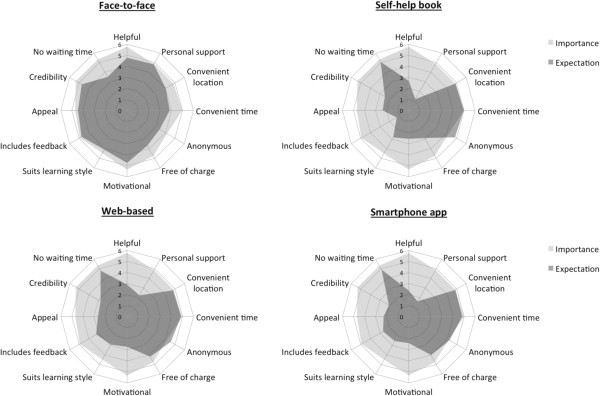
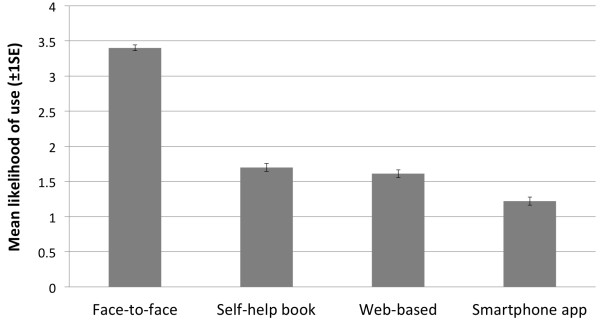
BACKGROUND: E-mental health and m-mental health include the use of technology in the prevention, treatment and aftercare of mental health problems. With the economical pressure on mental health services increasing, e-mental health and m-mental health could bridge treatment gaps, reduce waiting times for patients and deliver interventions at lower costs. However, despite the existence of numerous effective interventions, the transition of computerised interventions into care is slow. The aim of the present study was to investigate the acceptability of e-mental health and m-mental health in the general population. METHODS: An advisory group of service users identified dimensions that potentially influence an individual's decision to engage with a particular treatment for mental health problems. A large sample (N = 490) recruited through email, flyers and social media was asked to rate the acceptability of different treatment options for mental health problems on these domains. Results were analysed using repeated measures MANOVA. RESULTS: Participants rated the perceived helpfulness of an intervention, the ability to motivate users, intervention credibility, and immediate access without waiting time as most important dimensions with regard to engaging with a treatment for mental health problems. Participants expected face-to-face therapy to meet their needs on most of these dimensions. Computerised treatments and smartphone applications for mental health were reported to not meet participants' expectations on most domains. However, these interventions scored higher than face-to-face treatments on domains associated with the convenience of access. Overall, participants reported a very low likelihood of using computerised treatments for mental health in the future. CONCLUSIONS: Individuals in this study expressed negative views about computerised self-help intervention and low likelihood of use in the future. To improve the implementation and uptake, policy makers need to improve the public perception of such interventions.
Overview
The claims and statistics of this paper haven’t been checked yet.
Free: it reads the open-access text and checks the first 5 claims that cite a source we can check. Create a free account to check every claim.
Integrity signals
Registry
Cites
Statistics
Figures
Verification
Claims the paper makes
The claims and statistics of this paper haven’t been checked yet.
Free: it reads the open-access text and checks the first 5 claims that cite a source we can check. Create a free account to check every claim.
Claims other papers make about this one
Each is checked against this paper’s own text: does it say what the citing paper says it does?
The source backs part of the claim, not all of it — or backs it for a different population, condition or comparison.
In the citing paper
“The various AI-augmented applications presented in this review have achieved encouraging positive mental health outcomes, while leveraging and supporting the benefits of online platforms, including scalability, versatility, cost-effectiveness, and personalization (8, 9, 95–97).”
From Examining the role of AI technology in online mental healthcare: opportunities, challenges, and implications, a mixed-methods review (2024) · cites this paper as [9]
Experimental — accuracy not yet measuredThe cited source says what the claim attributes to it.
In the citing paper
“Previous studies have reported that many people prefer face-to-face therapy over E-MH programs [8-10], despite viewing online programs as having advantages such as convenience [8].”
In the citing paper
“Also, interventions developed and tested may not have been reported as a scientific study; a well-known phenomenon in a field that is arguably driven by commercial developers as opposed to clinical-academic researchers (Kumar et al., 2013;Meurk, Leung, Hall, Head, & Whiteford, 2016;Musiat et al., 2014).”
From eHealth interventions for family carers of people with long term illness: A promising approach? (2018) · cites this paper as Musiat et al., 2014
In the citing paper
“These methodological variations further limit the evidence about effects (and adverse events) of eHealth interventions for carers (Musiat, Goldstone, & Tarrier, 2014;Alvarez-Jimenez et al., 2014).”
From eHealth interventions for family carers of people with long term illness: A promising approach? (2018) · cites this paper as Musiat, Goldstone, & Tarrier, 2014
Self-check
Percentages, sums and reported differences re-computed from the paper’s own numbers.
The self-check needs the paper’s full text.
Citations
Cites
Computer-based psychological treatments for depression: A systematic review and meta-analysis
Richards, D., & Richardson, T. (2012) · Clinical Psychology Review · doi:10.1016/j.cpr.2012.02.004 · Cited by 1,442
Dropout from Internet‐based treatment for psychological disorders
Melville, K. M., Casey, L. M., & Kavanagh, D. J. (2010) · British Journal of Clinical Psychology · doi:10.1348/014466509x472138 · Cited by 597 · cited 1×
“Hence, this is likely to be an overestimate given the high dropout rates often observed in computerised intervention trials (for a review, see [16]).”
BackgroundInternet-administered cognitive behavior therapy for health problems: a systematic review
Cuijpers, P., van Straten, A., & Andersson, G. (2008) · Journal of Behavioral Medicine · doi:10.1007/s10865-007-9144-1 · Cited by 555
Brouwer, W., Kroeze, W., Crutzen, R., de Nooijer, J., de Vries, N. K., Brug, J., & Oenema, A. (2011) · Journal of Medical Internet Research · doi:10.2196/jmir.1639 · Cited by 455
Waller, R., & Gilbody, S. (2009) · Psychological Medicine · doi:10.1017/s0033291708004224 · Cited by 393 · cited 2×
“The authors conclude that “acceptability is high among those who make it as far as participating in studies, but initial uptake rates suggest that this may not be the whole picture” ([17], p.”
BackgroundHedman, E., Andersson, G., Ljótsson, B., Andersson, E., Rück, C., Mörtberg, E., & Lindefors, N. (2011) · PLoS ONE · doi:10.1371/journal.pone.0018001 · Cited by 285 · cited 1×
“[26,27]) and therefore could be an alternative treatment for those not willing or able to access face-to-face treatments.”
BackgroundKaltenthaler, E., Sutcliffe, P., Parry, G., Beverley, C., Rees, A., & Ferriter, M. (2008) · Psychological Medicine · doi:10.1017/s0033291707002607 · Cited by 267 · cited 1×
“Within randomised controlled trials, high acceptability of computerised mental health interventions has been reported, but these results primarily stem from individuals who completed a course of treatment [15].”
BackgroundHesser, H., Gustafsson, T., Lundén, C., Henrikson, O., Fattahi, K., Johnsson, E., Westin, V. Z., Carlbring, P., Mäki-Torkko, E., Kaldo, V., et al. (2012) · Journal of Consulting and Clinical Psychology · doi:10.1037/a0027021 · Cited by 257 · cited 1×
“medically unexplained conditions, such as tinnitus [5] or irritable bowel syndrome [6].”
BackgroundEffectiveness of E-self-help interventions for curbing adult problem drinking: a meta-analysis
Riper, H., Spek, V., Boon, B., Conijn, B., Kramer, J., Martin-Abello, K., & Smit, F. (2011) · Journal of Medical Internet Research · doi:10.2196/jmir.1691 · Cited by 240 · cited 1×
“Electronic and mobile mental health interventions (e-mental health/m-mental health) are available for depression and anxiety [1,2], eating disorders [3], substance use disorders [4], and”
BackgroundMusiat, P., & Tarrier, N. (2014) · Psychological Medicine · doi:10.1017/s0033291714000245 · Cited by 188
Self-citation
Research works printed but not linked: 3
- National Institute for Health and Clinical Excellence Depression in adults: The treatment and management of depression in adults. CG90 2009 London: National Institute for Health and Clinical Excellence 35977056
- National Institute for Health and Clinical Excellence Generalised anxiety disorder and panic disorder (with or without agoraphobia) in adults. CG113 2011 London: National Institute for Health and Clinical Excellence
- eMarketer Nearly Half of UK Consumers Will Use Smartphones This Year 2013 Retrieved November 15, 2013, from http://www.emarketer.com/Article/Nearly-Half-of-UK-Consumers-Will-Use-Smartphones-This-Year/1009956
Cited by
O’Brien (2019) · doi:10.1186/s12913-016-1423-5 · Cited by 463
Karyotaki, E., Ebert, D. D., Donkin, L., Riper, H., Twisk, J., Burger, S., Rozental, A., Lange, A., Williams, A. D., Zarski, A. C., et al. (2018) · Clinical Psychology Review · doi:10.1016/j.cpr.2018.06.007 · Cited by 303
Hennemann, S., Beutel, M. E., & Zwerenz, R. (2017) · Journal of Health Communication · doi:10.1080/10810730.2017.1284286 · Cited by 274
Ebert, D. D., Berking, M., Cuijpers, P., Lehr, D., Pörtner, M., & Baumeister, H. (2015) · Journal of Affective Disorders · doi:10.1016/j.jad.2015.01.056 · Cited by 268
Mobile mental health: a challenging research agenda
Olff, M. (2015) · European Journal of Psychotraumatology · doi:10.3402/ejpt.v6.27882 · Cited by 258
Voice analysis as an objective state marker in bipolar disorder
Faurholt-Jepsen, M., Busk, J., Frost, M., Vinberg, M., Christensen, E. M., Winther, O., Bardram, J. E., & Kessing, L. V. (2016) · Translational Psychiatry · doi:10.1038/tp.2016.123 · Cited by 236
Van Ameringen, M., Turna, J., Khalesi, Z., Pullia, K., & Patterson, B. (2017) · Depression and Anxiety · doi:10.1002/da.22657 · Cited by 234
Anxiety: There is an app for that. A systematic review of anxiety apps: SUCALA et al.
Sucala, M., Cuijpers, P., Muench, F., Cardoș, R., Soflau, R., Dobrean, A., Achimas-Cadariu, P., & David, D. (2017) · Depression and Anxiety · doi:10.1002/da.22654 · Cited by 232
Patel, S., Akhtar, A., Malins, S., Wright, N., Rowley, E., Young, E., Sampson, S., & Morriss, R. (2020) · Journal of Medical Internet Research · doi:10.2196/16228 · Cited by 190
Vis, C., Mol, M., Kleiboer, A., Bührmann, L., Finch, T., Smit, J., & Riper, H. (2018) · JMIR Mental Health · doi:10.2196/mental.9769 · Cited by 183
Eisenstadt, M., Liverpool, S., Infanti, E., Ciuvat, R. M., & Carlsson, C. (2021) · JMIR Mental Health · doi:10.2196/31170 · Cited by 182
“Moreover, MHapps are appealing to users due to advantages of cost-effectiveness, privacy, personalization features, and scope for use at any time in any location and setting [18].”
Student mental health: some answers and more questions
Brown, J. S. L. (2018) · Journal of Mental Health · doi:10.1080/09638237.2018.1470319 · Cited by 179
“Computerised interventions, usually offering CBT, offer the potential but their acceptability is problematic as take-up is low and dropout rate high (Musiat et al., 2014).”
BackgroundTitzler, I., Saruhanjan, K., Berking, M., Riper, H., & Ebert, D. D. (2018) · Internet Interventions · doi:10.1016/j.invent.2018.01.002 · Cited by 176
“However, stand-alone IMIs might not be acceptable and suitable for all patients (Ebert et al., 2015; Baumeister et al., 2014b; Baumeister et al., 2014c; Musiat et al., 2014; Apolinário-Hagen et al., 2017).”
BackgroundBarriers to older adults’ uptake of mobile-based mental health interventions
Pywell, J., Vijaykumar, S., Dodd, A., & Coventry, L. (2020) · DIGITAL HEALTH · doi:10.1177/2055207620905422 · Cited by 152
Schröder, J., Sautier, L., Kriston, L., Berger, T., Meyer, B., Späth, C., Köther, U., Nestoriuc, Y., Klein, J. P., & Moritz, S. (2015) · Journal of Affective Disorders · doi:10.1016/j.jad.2015.08.044 · Cited by 149
“One study overcame this constraint, (Musiat et al., 2014) but the authors used a priori categories, using single items they deemed relevant, rather than exploring a broader spectrum of empirically defined attitudes.”
MethodPovey, J., Mills, P. P. J. R., Dingwall, K. M., Lowell, A., Singer, J., Rotumah, D., Bennett-Levy, J., & Nagel, T. (2016) · Journal of Medical Internet Research · doi:10.2196/jmir.5314 · Cited by 121
Wallin, E. E. K., Mattsson, S., & Olsson, E. M. G. (2016) · JMIR Mental Health · doi:10.2196/mental.5324 · Cited by 136
Faurholt-Jepsen, M., Frost, M., Christensen, E. M., Bardram, J. E., Vinberg, M., & Kessing, L. V. (2020) · Psychological Medicine · doi:10.1017/s0033291719000710 · Cited by 130
Van Daele, T., Karekla, M., Kassianos, A. P., Compare, A., Haddouk, L., Salgado, J., Ebert, D. D., Trebbi, G., Bernaerts, S., Van Assche, E., et al. (2020) · Journal of Psychotherapy Integration · doi:10.1037/int0000218 · Cited by 122
Chatbots to Support Young Adults’ Mental Health: An Exploratory Study of Acceptability
Koulouri, T., Macredie, R. D., & Olakitan, D. (2022) · ACM Transactions on Interactive Intelligent Systems · doi:10.1145/3485874 · Cited by 127
Public attitudes toward guided internet-based therapies: web-based survey study
Apolinário-Hagen, J., Harrer, M., Kählke, F., Fritsche, L., Salewski, C., & Ebert, D. D. (2018) · JMIR Mental Health · doi:10.2196/10735 · Cited by 123
McCloud, T., Jones, R., Lewis, G., Bell, V., & Tsakanikos, E. (2020) · JMIR mHealth and uHealth · doi:10.2196/15418 · Cited by 118
Folker, A. P., Mathiasen, K., Lauridsen, S. M., Stenderup, E., Dozeman, E., & Folker, M. P. (2018) · Internet Interventions · doi:10.1016/j.invent.2018.02.001 · Cited by 116
“In a British study of attitudes towards iCBT in the general population it was found that web-based treatments were expected to be convenient but to have lower appeal and credibility than face-to-face therapy (Musiat et al., 2014).”
BackgroundResultSchröder, J., Berger, T., Meyer, B., Lutz, W., Hautzinger, M., Späth, C., Eichenberg, C., Klein, J. P., & Moritz, S. (2017) · Cognitive Therapy and Research · doi:10.1007/s10608-017-9850-0 · Cited by 113
“While face-to-face therapy was rated as being good across all dimensions, except for ‘application without waiting time’, ‘temporal flexibility’, and ‘application free of charge’, participants rated exactly these dimensions as being good in Internet interventions (Musiat et al. 2014).”
BackgroundWitte, N. A. J. D., Carlbring, P., Etzelmueller, A., Nordgreen, T., Karekla, M., Haddouk, L., Belmont, A., Øverland, S., Abi‐Habib, R., Bernaerts, S., et al. (2021) · Internet Interventions · doi:10.1016/j.invent.2021.100405 · Cited by 128
Norlund, F., Wallin, E., Olsson, E. M. G., Wallert, J., Burell, G., von Essen, L., & Held, C. (2018) · Journal of Medical Internet Research · doi:10.2196/jmir.9710 · Cited by 110
Are online mental health interventions for youth effective? A systematic review.
Zhou, X., Edirippulige, S., Bai, X., & Bambling, M. (2021) · Journal of Telemedicine and Telecare · doi:10.1177/1357633x211047285 · Cited by 107
eHealth interventions for family carers of people with long term illness: A promising approach?
Sin, J., Henderson, C., Spain, D., Cornelius, V., Chen, T., & Gillard, S. (2018) · Clinical Psychology Review · doi:10.1016/j.cpr.2018.01.008 · Cited by 96
“These methodological variations further limit the evidence about e ff ects (and adverse events) of eHealth interventions for carers (Musiat, Goldstone, & Tarrier, 2014; Alvarez-Jimenez et al., 2014).”
Wildeboer, G., Kelders, S. M., & van Gemert-Pijnen, J. E. W. C. (2016) · International Journal of Medical Informatics · doi:10.1016/j.ijmedinf.2016.04.005 · Cited by 98
Apolinário-Hagen, J., Kemper, J., & Stürmer, C. (2017) · JMIR Mental Health · doi:10.2196/mental.6186 · Cited by 98
Hadjistavropoulos, H. D., Nugent, M. M., Dirkse, D., & Pugh, N. (2017) · BMC Psychiatry · doi:10.1186/s12888-017-1496-7 · Cited by 94
Hidalgo-Mazzei, D., Mateu, A., Reinares, M., Matic, A., Vieta, E., & Colom, F. (2015) · Journal of Affective Disorders · doi:10.1016/j.jad.2015.08.005 · Cited by 92
Apolinário-Hagen, J., Vehreschild, V., & Alkoudmani, R. M. (2017) · JMIR Mental Health · doi:10.2196/mental.6375 · Cited by 90
“Comparisons made in the items of attitude measure were also a limitation because conventional therapies might be viewed as “benchmark” and thus Internet-based therapies as inferior [26].”
InfluentialDe Witte, N. A. J., Joris, S., Van Assche, E., & Van Daele, T. (2021) · Frontiers in Digital Health · doi:10.3389/fdgth.2021.754337 · Cited by 89
Preferences for e-mental health interventions in Germany: a discrete choice experiment
Phillips, E. A., Himmler, S. F., & Schreyögg, J. (2021) · Value in Health · doi:10.1016/j.jval.2020.09.018 · Cited by 88
Nitsch, M., Dimopoulos, C. N., Flaschberger, E., Saffran, K., Kruger, J. F., Garlock, L., Wilfley, D. E., Taylor, C. B., & Jones, M. (2016) · Journal of Medical Internet Research · doi:10.2196/jmir.4972 · Cited by 87
“However, the possibility of using the mobile app was seen as more convenient, and previous research has highlighted convenience as an important criterion for the use of digital health interventions [34].”
Grist, R., Porter, J., & Stallard, P. (2018) · JMIR Mental Health · doi:10.2196/mental.8779 · Cited by 86
“These results are encouraging as perceived helpfulness of a mental health intervention is considered a key indicator of acceptability [23] and one of the most important criterion for choosing to use a mental health intervention [24].”
BackgroundAcceptance of Mobile Mental Health Treatment Applications
Becker, D. (2016) · EUSPN/ICTH · doi:10.1016/j.procs.2016.09.036 · Cited by 79
Connolly, S. L., Hogan, T. P., Shimada, S. L., & Miller, C. J. (2020) · Journal of Technology in Behavioral Science · doi:10.1007/s41347-020-00165-4 · Cited by 95
Juarascio, A. S., Goldstein, S. P., Manasse, S. M., Forman, E. M., & Butryn, M. L. (2015) · International Journal of Medical Informatics · doi:10.1016/j.ijmedinf.2015.06.004 · Cited by 81
“The widespread accessibility of smartphones shows promise in addressing the lack of availability of traditional self-help and inperson treatments; apps can be widely disseminated and can serve as an ideal clinical management tool for both patients and clinicians [9,13,43].”
BackgroundDorow, M., Löbner, M., Pabst, A., Stein, J., & Riedel-Heller, S. G. (2018) · Frontiers in Psychiatry · doi:10.3389/fpsyt.2018.00181 · Cited by 80
Sin, J., Galeazzi, G., McGregor, E., Collom, J., Taylor, A., Barrett, B., Lawrence, V., & Henderson, C. (2020) · Journal of Medical Internet Research · doi:10.2196/20581 · Cited by 79
Early Psychosis Service User Views on Digital Technology: Qualitative Analysis
Bucci, S., Morris, R., Berry, K., Berry, N., Haddock, G., Barrowclough, C., Lewis, S., & Edge, D. (2018) · JMIR Mental Health · doi:10.2196/10091 · Cited by 78
Etzelmueller, A., Radkovsky, A., Hannig, W., Berking, M., & Ebert, D. D. (2018) · Internet Interventions · doi:10.1016/j.invent.2018.01.003 · Cited by 75
Smail-Crevier, R., Powers, G., Noel, C., & Wang, J. (2019) · Journal of Medical Internet Research · doi:10.2196/11224 · Cited by 74
Mayer, G., Gronewold, N., Alvarez, S., Bruns, B., Hilbel, T., & Schultz, J.-H. (2019) · JMIR Mental Health · doi:10.2196/14018 · Cited by 71
Gutierrez, G., Stephenson, C., Eadie, J., Asadpour, K., & Alavi, N. (2024) · Frontiers in Psychiatry · doi:10.3389/fpsyt.2024.1356773 · Cited by 71
Hidalgo-Mazzei, D., Mateu, A., Reinares, M., Undurraga, J., Bonnín, C. D. M., Sánchez-Moreno, J., Vieta, E., & Colom, F. (2015) · BMC Psychiatry · doi:10.1186/s12888-015-0437-6 · Cited by 69
Determinant Factors of Public Acceptance of Stress Management Apps: Survey Study
Apolinário-Hagen, J., Hennemann, S., Fritsche, L., Drüge, M., & Breil, B. (2019) · JMIR Mental Health · doi:10.2196/15373 · Cited by 63
Self‐stigma and the intention to seek psychological help online compared to face‐to‐face
Wallin, E., Maathz, P., Parling, T., & Hursti, T. (2018) · Journal of Clinical Psychology · doi:10.1002/jclp.22583 · Cited by 60
Gbollie, E. F., Bantjes, J. R., Jarvis, L., Swandevelder, S., Plessis, J. D., Shadwell, R., Davids, C., Gerber, R., Holland, N., & Hunt, X. (2023) · Digital Health · doi:10.1177/20552076231216559 · Cited by 100
Apolinário-Hagen, J., Fritsche, L., Bierhals, C., & Salewski, C. (2018) · Internet Interventions · doi:10.1016/j.invent.2017.12.002 · Cited by 58
A qualitative study of university students' experience of Internet‐based CBT for depression
Gericke, F., Ebert, D. D., Breet, E., Auerbach, R. P., & Bantjes, J. (2021) · Counselling and Psychotherapy Research · doi:10.1002/capr.12465 · Cited by 57
Jardine, J., Nadal, C., Robinson, S., Enrique, Á., Hanratty, M., & Doherty, G. J. (2024) · ACM Transactions on Computer-Human Interaction · doi:10.1145/3635472 · Cited by 76
Home-based telerehabilitation software systems for remote supervising: a systematic review
Hosseiniravandi, M., Kahlaee, A. H., Karim, H., Ghamkhar, L., & Safdari, R. (2020) · International Journal of Technology Assessment in Health Care · doi:10.1017/s0266462320000021 · Cited by 70
Levin, M. E., Krafft, J., & Levin, C. (2018) · Journal of American College Health · doi:10.1080/07448481.2018.1440580 · Cited by 56
Martinengo, L., Stona, A., Griva, K., Dazzan, P., Pariante, C. M., von Wangenheim, F., & Car, J. (2021) · Journal of Medical Internet Research · doi:10.2196/27619 · Cited by 68
A Depression Prevention Intervention for Adolescents in the Emergency Department
Ranney, M. L., Freeman, J. R., Connell, G., Spirito, A., Boyer, E., Walton, M., Guthrie, K. M., & Cunningham, R. M. (2016) · Journal of Adolescent Health · doi:10.1016/j.jadohealth.2016.04.008 · Cited by 53
“Others’work suggests that perceived efficacy is a major determinant of intervention engagement [37].”
Soucy, J. N., Owens, V. A. M., Hadjistavropoulos, H. D., Dirkse, D. A., & Dear, B. F. (2016) · Internet Interventions · doi:10.1016/j.invent.2016.09.003 · Cited by 50
Tonn, P., Reuter, S. C., Kuchler, I., Reinke, B., Hinkelmann, L., Stöckigt, S., Siemoneit, H., & Schulze, N. (2017) · JMIR Mental Health · doi:10.2196/mental.6802 · Cited by 46
Perceived acceptability of wearable devices for the treatment of mental health problems
Hunkin, H., King, D. L., & Zajac, I. T. (2020) · Journal of Clinical Psychology · doi:10.1002/jclp.22934 · Cited by 50
Edge, D., Watkins, E. R., Limond, J., & Mugadza, J. (2023) · Behaviour Research and Therapy · doi:10.1016/j.brat.2023.104292 · Cited by 42
Wahlstedt, E., & Ekman, B. (2016) · BMC Health Services Research · doi:10.1186/s12913-016-1581-5 · Cited by 51
Cliffe, B., Croker, A., Denne, M., & Stallard, P. (2020) · Child and Adolescent Mental Health · doi:10.1111/camh.12362 · Cited by 38
Bernecker, S. L., Williams, J. J., Caporale-Berkowitz, N. A., Wasil, A. R., & Constantino, M. J. (2020) · Journal of Medical Internet Research · doi:10.2196/17164 · Cited by 43
Wallin, E., Norlund, F., Olsson, E. M. G., Burell, G., Held, C., & Carlsson, T. (2018) · Journal of Medical Internet Research · doi:10.2196/jmir.9690 · Cited by 36
Leuchtenberg, S., Gromer, D., & Käthner, I. (2022) · Counselling and Psychotherapy Research · doi:10.1002/capr.12538 · Cited by 50
Rai, M., Vigod, S. N., & Hensel, J. M. (2016) · JMIR Mental Health · doi:10.2196/mental.6068 · Cited by 36
Women’s use of online resources and acceptance of e-mental health tools during the perinatal period
Fonseca, A., Gorayeb, R., & Canavarro, M. C. (2016) · International Journal of Medical Informatics · doi:10.1016/j.ijmedinf.2016.07.016 · Cited by 35
Views on online self-help programmes from people with eating disorders and their carers in UK
Yim, S. H., Spencer, L., Gordon, G., Allen, K. L., Musiat, P., & Schmidt, U. H. (2021) · European Journal of Public Health · doi:10.1093/eurpub/ckab046 · Cited by 35
Self-citationMaloney, C. A., Abel, W., & McLeod, H. J. (2020) · Internet Interventions · doi:10.1016/j.invent.2020.100325 · Cited by 46
Batterham, P. J., Calear, A. L., Sunderland, M., KAY‐LAMBKIN, F. J., Farrer, L. M., Christensen, H. M., & Gulliver, A. (2021) · Journal of Medical Internet Research · doi:10.2196/23029 · Cited by 42
Ethics And Legal Issues In Online Counseling Services: Counseling Principles Analysis
Ardi, Z., Putra, M. R. M., & Ifdil, I. (2017) · Jurnal psikologi pendidikan dan konseling · doi:10.26858/jpkk.v0i0.3657 · Cited by 40
Connected Mental Health: Systematic Mapping Study
(2020) · doi:10.2196/19950 · Cited by 33
Kothari, R., Barker, C., Pistrang, N., Rozental, A., Egan, S., Wade, T., Allcott-Watson, H., Andersson, G., & Shafran, R. (2019) · Journal of Behavior Therapy and Experimental Psychiatry · doi:10.1016/j.jbtep.2019.03.007 · Cited by 32
Paslakis, G., Fischer-Jacobs, J., Pape, L., Schiffer, M., Gertges, R., Tegtbur, U., Zimmermann, T., Nöhre, M., & de Zwaan, M. (2019) · Journal of Medical Internet Research · doi:10.2196/12416 · Cited by 31
Fassnacht, D. B., Ali, K., van Agteren, J. E., Iasiello, M. P., Mavrangelos, T., Furber, G., & Kyrios, M. (2022) · JMIR Mental Health · doi:10.2196/37292 · Cited by 38
Fonseca, A., Pereira, M., Araújo-Pedrosa, A., Gorayeb, R., Ramos, M. M., & Canavarro, M. C. (2018) · Cognitive and Behavioral Practice · doi:10.1016/j.cbpra.2018.02.002 · Cited by 30
Applicability of acceptance and commitment therapy-based mobile app in depression nursing
Kaipainen, K., Välkkynen, P., & Kilkku, N. (2017) · Translational Behavioral Medicine · doi:10.1007/s13142-016-0451-3 · Cited by 26
Bird, M. D., Chow, G. M., & Yang, Y. (2020) · Journal of Clinical Psychology · doi:10.1002/jclp.22956 · Cited by 47
Rahal, Z. A., Vadas, L., Manor, I., Bloch, B., & Avital, A. (2018) · Psychiatry Research · doi:10.1016/j.psychres.2018.05.026 · Cited by 33
Lamela, D., Cabral, J., Coelho, S., & Jongenelen, I. (2020) · International Journal of Medical Informatics · doi:10.1016/j.ijmedinf.2020.104076 · Cited by 27
Dunn, B. D. (2017) · Cognitive Therapy and Research · doi:10.1007/s10608-017-9831-3 · Cited by 32
Preferences of psychotherapists for blended care in Germany: a discrete choice experiment
Phillips, E. A., Himmler, S., & Schreyögg, J. (2022) · BMC Psychiatry · doi:10.1186/s12888-022-03765-x · Cited by 39
Experiences and implications of smartphone apps for depression and anxiety
Crosby, L., & Bonnington, O. (2020) · Sociology of Health & Illness · doi:10.1111/1467-9566.13076 · Cited by 35
Batterham, P. J., Calear, A. L., Sunderland, M., Kay-Lambkin, F., Farrer, L. M., & Gulliver, A. (2019) · Contemporary Clinical Trials · doi:10.1016/j.cct.2019.01.015 · Cited by 21
“Previous studies have reported that many people prefer face-to-face therapy over E-MH programs [8-10], despite viewing online programs as having advantages such as convenience [8].”
BackgroundMcCall, H. C., Sison, A. P., Burnett, J. L., Beahm, J. D., & Hadjistavropoulos, H. D. (2020) · International Journal of Environmental Research and Public Health · doi:10.3390/ijerph17176026 · Cited by 22
Apolinário-Hagen, J., Hennemann, S., Kück, C., Wodner, A., Geibel, D., Riebschläger, M., Zeißler, M., & Breil, B. (2020) · Health Services Insights · doi:10.1177/1178632920911061 · Cited by 26
Ugwuanyi, C. S., Okeke, C. I. O., & Agboeze, M. U. (2020) · Journal of Rational-Emotive & Cognitive-Behavior Therapy · doi:10.1007/s10942-020-00371-2 · Cited by 36
Stallard, P., Porter, J., & Grist, R. (2016) · JMIR Research Protocols · doi:10.2196/resprot.6525 · Cited by 24
“Clinicians have been found to have negative views about eMental health as highlighted in studies looking at clinician attitudes to computerized interventions [26,27].”
BackgroundLincke, L., Ulbrich, L., Reis, O., Wandinger, E., Brähler, E., Dück, A., & Kölch, M. (2022) · Frontiers in Psychiatry · doi:10.3389/fpsyt.2022.889555 · Cited by 24
Grünzig, S.-D., Baumeister, H., Bengel, J., Ebert, D., & Krämer, L. (2018) · Trials · doi:10.1186/s13063-018-2657-9 · Cited by 23
Do, R., Park, J.-R., Lee, S. Y., Cho, M.-J., Kim, J.-S., & Shin, M. (2019) · Psychiatry Investigation · doi:10.30773/pi.2019.07.17.4 · Cited by 34
Alhuwail, D., Albaj, R., Ahmad, F., & Aldakheel, K. (2019) · International Journal of Medical Informatics · doi:10.1016/j.ijmedinf.2019.104056 · Cited by 25
Muscara, F., Ng, O., Crossley, L. H., Lu, S., Kalisch, L., Melvin, G. A., Gronow, S., Prakash, C., & Anderson, V. A. (2020) · Digital Health · doi:10.1177/2055207620975315 · Cited by 27
Brown, J. S. L., Lisk, S. C., Carter, B., Stevelink, S. A. M., Lieshout, R. J. V., & Michelson, D. (2022) · International Journal of Environmental Research and Public Health · doi:10.3390/ijerph19052831 · Cited by 28
Peynenburg, V. A., Mehta, S., & Hadjistavropoulos, H. D. (2020) · Canadian Journal of Behavioural Science/Revue canadienne des sciences du comportement · doi:10.1037/cbs0000165 · Cited by 30
Engdahl, P., Svedberg, P., & Bejerholm, U. (2021) · BMC Psychiatry · doi:10.1186/s12888-021-03386-w · Cited by 21
Farrer, L. M., Gulliver, A., Bennett, K., & Griffiths, K. M. (2015) · Internet Interventions · doi:10.1016/j.invent.2015.07.006 · Cited by 26
Choi, I., Milne, D., Deady, M., Calvo, R. A., Harvey, S. B., & Glozier, N. (2018) · JMIR Mental Health · doi:10.2196/mental.9480 · Cited by 20
Metadata
- Authors
- Musiat, P., Goldstone, P., & Tarrier, N.
- Affiliations
- King's College London (GB)
- Corresponding author
- Musiat, Peter
- ORCID
- Musiat, Peter
- Venue
- BMC Psychiatry
- Published
- 2014-04-11
- Volume
- 14
- Issue
- 1
- Pages
- 109-109
- ISSN
- 1471-244X (ISSN-L)
- PMC
- PMC3999507
- OpenAlex
- W2034792075
- Semantic Scholar
- 614ba6f280f52e5cdee58ddae8e4f1120b91c5d5
- Cited by
- 273
- References
- 24
- Citations by year
- 2026: 8 · 2025: 18 · 2024: 18 · 2023: 25 · 2022: 29 · 2021: 35 · 2020: 33 · 2019: 22 · 2018: 39 · 2017: 14 · 2016: 19 · 2015: 10 · 2014: 3
- FWCI
- 23.74
- Type
- journal article
- Language
- en
- Open access
- gold
- doi.org
- Licence
- Locations
- BMC Psychiatry (publishedVersion, cc-by)
- Europe PMC (PubMed Central) (publishedVersion, cc-by)
- PubMed Central (publishedVersion, cc-by)
- PubMed (publishedVersion)
- Research Portal (King's College London) (publishedVersion, other-oa)
- Funders
- South London and Maudsley NHS Foundation Trust
- National Institute for Health and Care Research
- King's College London
- Topics
- Social Sciences › Psychology › Applied Psychology › Digital Mental Health Interventions
- Health Sciences › Medicine › Psychiatry and Mental health › Mental Health Treatment and Access
- Health Sciences › Medicine › Public Health, Environmental and Occupational Health › Telemedicine and Telehealth Implementation
- Keywords
- e-mental health, acceptability, attitudes toward technology, treatment uptake, perceived helpfulness, waiting time, face-to-face therapy, public perception, mental health treatment gap
- MeSH terms
- Adolescent, Adult, Aged, Attitude, Mental Disorders, Female, Humans, Male, Mental Health, Mental Health Services, Middle Aged, Patient Acceptance of Health Care, Self Care, Therapy, Computer-Assisted, Health Behavior, Remote Consultation, Young Adult
About these checks
Registry, retraction, Cites and statistics results are computed, not judged, with one exception: a printed reference that no index lists is read once by a model before it counts as a citation error. Claims are extracted by a model and kept only when their quote appears verbatim in the text; each cited source is then checked, with a model’s help, for whether it says what the claim relies on. Those verdicts can be wrong — read the claim’s quote and the cited source before relying on one.
Statistics and arithmetic are recomputed, not judged.
Confidence bands are shown only for fields calibrated on our annotated test set. None is calibrated yet, so no band is shown.
What counts as a claim ›How we measure confidence ›How we check this ›
Are you an author, or do you see a problem with this page? Request a review
Data sources
Bibliographic data: Semantic Scholar, OpenAlex, Crossref.
Contains information from the Semantic Scholar Academic Graph Datasets, made available under the ODC Attribution License (ODC-BY 1.0).
Semantic Scholar’s data is described in: Kinney, R., et al. (2023). The Semantic Scholar Open Data Platform. arXiv:2301.10140.
