

Impaired social decision making in patients with major depressive disorder
Open accessThe DOI matches its Crossref record; 78 of the 78 references it cites were found in a registry or an index.
Abstract
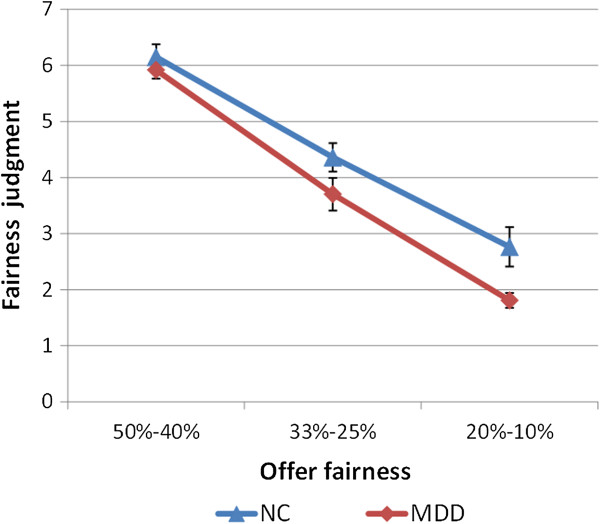
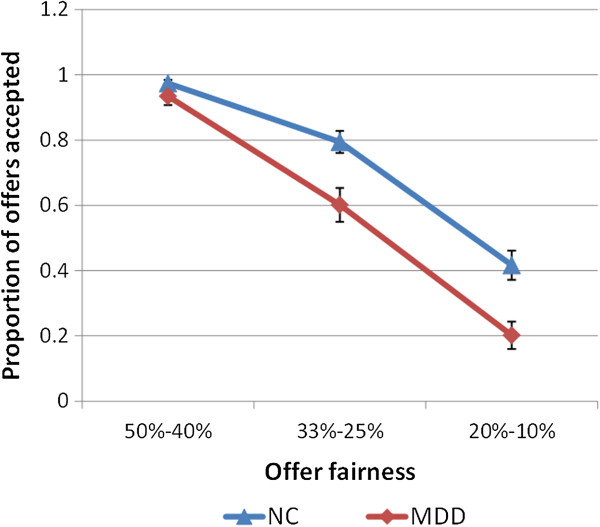
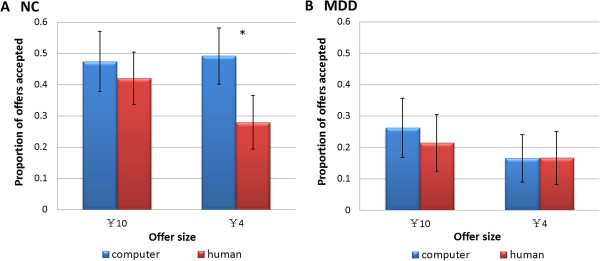
BACKGROUND: Abnormal decision-making processes have been observed in patients with major depressive disorder (MDD). However, it is unresolved whether MDD patients show abnormalities in decision making in a social interaction context, in which decisions have actual influences on both the self-interests of the decision makers per se and those of their partners. METHODS: Using a well-studied ultimatum game (UG), which is frequently used to investigate social interaction behavior, we examined whether MDD can be associated with abnormalities in social decision-making behavior by comparing the acceptance rates of MDD patients (N = 14) with those of normal controls (N = 19). RESULTS: The acceptance rates of the patients were lower than those of the normal controls. Additionally, unfair proposals were accepted at similar rates from computer partners and human partners in the MDD patients, unlike the acceptance rates in the normal controls, who were able to discriminatively treat unfair proposals from computer partners and human partners. CONCLUSIONS: Depressed patients show abnormal decision-making behavior in a social interaction context. Several possible explanations, such as increased sensitivity to fairness, negative emotional state and disturbed affective cognition, have been proposed to account for the abnormal social decision-making behavior in patients with MDD. This aberrant social decision-making behavior may provide a new perspective in the search to find biomarkers for the diagnosis and prognosis of MDD.
Overview
The claims and statistics of this paper haven’t been checked yet.
Free: it reads the open-access text and checks the first 5 claims that cite a source we can check. Create a free account to check every claim.
Integrity signals
Registry
Cites
Statistics
Figures

Verification
Claims the paper makes
The claims and statistics of this paper haven’t been checked yet.
Free: it reads the open-access text and checks the first 5 claims that cite a source we can check. Create a free account to check every claim.
Claims other papers make about this one
Each is checked against this paper’s own text: does it say what the citing paper says it does?
The cited source says what the claim attributes to it.
In the citing paper
“Although irrational economic decision making has been consistently shown in MDD (Radke et al., 2013;Scheele et al., 2013;Wang et al., 2014) with a positive relation to depression severity (Wang et al., 2014)”
From Social functioning in major depressive disorder (2016) · cites this paper as Wang et al., 2014
In the citing paper
“Using UG, Radke et al. (2013) and Wang et al. (2014) demonstrated that patients with depression rejected more unfair offers than did healthy controls”
From Social functioning in major depressive disorder (2016) · cites this paper as Wang et al. (2014)
Self-check
Percentages, sums and reported differences re-computed from the paper’s own numbers.
The self-check needs the paper’s full text.
Citations
Cites
Hamilton, M. (1960) · Journal of Neurology, Neurosurgery & Psychiatry · doi:10.1136/jnnp.23.1.56 · Cited by 32,817 · cited 1×
“Immediately before the UG task, the depressive symptoms of the participants were rated by an experienced research physician using the 24item Hamilton Depression Rating Scale (HDRS; [41]).”
MethodKessler, R. C., Chiu, W. T., Demler, O., & Walters, E. E. (2005) · Archives of General Psychiatry · doi:10.1001/archpsyc.62.6.617 · Cited by 12,052 · cited 1×
“Considering that MDD affects up to 20% of the worldwide population [11,12], the influence of the depressive state on social-economic decisions is an important research question.”
BackgroundA Theory of Fairness, Competition, and Cooperation
Fehr, E., & Schmidt, K. M. (1999) · The Quarterly Journal of Economics · doi:10.1162/003355399556151 · Cited by 11,264
Descartes’ Error. Emotion, Reason and the Human Brain. New York (Grosset/Putnam) 1994.
Damasio, A. R. (1994) · Cited by 5,841
ERC: A Theory of Equity, Reciprocity, and Competition
Bolton, G. E., & Ockenfels, A. (2000) · American Economic Review · doi:10.1257/aer.90.1.166 · Cited by 5,378 · cited 1×
“The discriminative responses for unfair proposals from computer partners and human partners argue against the equity model, which holds that subjects’ sense of fairness only depends on whether the distribution is equal [34,35], but they provide a strong evidence for the reciprocity model [36,37].”
BackgroundAn experimental analysis of ultimatum bargaining
Güth, W., Schmittberger, R., & Schwarze, B. (1982) · Journal of Economic Behavior & Organization · doi:10.1016/0167-2681(82)90011-7 · Cited by 4,816 · cited 2×
“The UG is a commonly used paradigm to study the process of decision-making in a social interaction context [16].”
BackgroundMethodDiagnostic and Statistical Manual of Mental Disorders ( DSM ‐ IV ‐ TR )
Segal, D. L. (2010) · The Corsini Encyclopedia of Psychology · doi:10.1002/9780470479216.corpsy0271 · Cited by 4,666
Behavioral Game Theory: Experiments in Strategic Interaction
Camerer, C. F. (2003) · Cited by 3,722
Bayesian t tests for accepting and rejecting the null hypothesis
Rouder, J. N., Speckman, P. L., Sun, D., Morey, R. D., & Iverson, G. (2009) · Psychonomic Bulletin & Review · doi:10.3758/pbr.16.2.225 · Cited by 3,688 · cited 1×
“To explore how likely the difference in acceptance rates between the two groups and those between human and computer proposers in each group is reliable, we conducted Bayesian t-tests for acceptance rates in different conditions using a Bayes factor calculation [68].”
MethodThe neural basis of economic decision-making in the Ultimatum Game.
Sanfey, A. G., Rilling, J. K., Aronson, J. A., Nystrom, L. E., & Cohen, J. D. (2003) · Science · doi:10.1126/science.1082976 · Cited by 3,375
The molecular neurobiology of depression
Krishnan, V., & Nestler, E. J. (2008) · Nature · doi:10.1038/nature07455 · Cited by 2,889 · cited 1×
“Considering that MDD affects up to 20% of the worldwide population [11,12], the influence of the depressive state on social-economic decisions is an important research question.”
BackgroundCognition and Depression: Current Status and Future Directions
Gotlib, I. H., & Joormann, J. (2010) · Annual Review of Clinical Psychology · doi:10.1146/annurev.clinpsy.121208.131305 · Cited by 2,420 · cited 1×
“First, this abnormal decision behavior we observed may be related to the disturbed affective cognition, which is a major characteristic of patients with MDD (for reviews, see [56-60]).”
BackgroundFalk, A., & Fischbacher, U. (2006) · Games and Economic Behavior · doi:10.1016/j.geb.2005.03.001 · Cited by 2,416 · cited 2×
“The discriminative responses for unfair proposals from computer partners and human partners argue against the equity model, which holds that subjects’ sense of fairness only depends on whether the distribution is equal [34,35], but they provide a strong evidence for the reciprocity model [36,37].”
BackgroundThe mesolimbic dopamine reward circuit in depression
Nestler, E. J., & Carlezon, W. A. (2006) · Biological Psychiatry · doi:10.1016/j.biopsych.2005.09.018 · Cited by 2,059 · cited 1×
“Finally, anhedonia and sadness are separate major characteristics of MDD; however, different pathophysiological mechanisms underlie these two symptoms [28,71].”
BackgroundA theory of sequential reciprocity
Dufwenberg, M., & Kirchsteiger, G. (2004) · Games and Economic Behavior · doi:10.1016/j.geb.2003.06.003 · Cited by 1,867 · cited 2×
“The discriminative responses for unfair proposals from computer partners and human partners argue against the equity model, which holds that subjects’ sense of fairness only depends on whether the distribution is equal [34,35], but they provide a strong evidence for the reciprocity model [36,37].”
BackgroundA Theory of Fairness, Competition and Cooperation
Fehr, E. (1998) · SSRN Electronic Journal · doi:10.2139/ssrn.106228 · Cited by 1,629
The Evolution of the Cognitive Model of Depression and Its Neurobiological Correlates
Beck, A. T. (2008) · American Journal of Psychiatry · doi:10.1176/appi.ajp.2008.08050721 · Cited by 1,537 · cited 1×
“First, this abnormal decision behavior we observed may be related to the disturbed affective cognition, which is a major characteristic of patients with MDD (for reviews, see [56-60]).”
BackgroundFeeling and thinking: the role of affect in social cognition
(2000) · Choice Reviews Online · doi:10.5860/choice.37-5959 · Cited by 1,384
Neuroeconomics: decision making and the brain
(2014) · Choice Reviews Online · doi:10.5860/choice.51-5702 · Cited by 1,009
Koenigs, M., & Grafman, J. (2009) · Behavioural Brain Research · doi:10.1016/j.bbr.2009.03.004 · Cited by 956 · cited 1×
“Abnormal structure and function in the vmPFC have been consistently reported in patients with MDD [65-67].”
BackgroundRole of serotonin in the pathophysiology of depression: focus on the serotonin transporter
Owens, M. J., & Nemeroff, C. B. (1994) · Clinical Chemistry · doi:10.1093/clinchem/40.2.288 · Cited by 929
Neuroeconomics: Decision Making and the Brain
Rushworth, M. F. S., & Walton, M. E. (2009) · Neuron · doi:10.1016/j.neuron.2009.07.005 · Cited by 658
The neural correlates of theory of mind within interpersonal interactions
Rilling, J. K., Sanfey, A. G., Aronson, J. A., Nystrom, L. E., & Cohen, J. D. (2004) · NeuroImage · doi:10.1016/j.neuroimage.2004.04.015 · Cited by 637 · cited 2×
“Researchers have found that intact social cognition, especially theory of mind, plays a critical role in distinguishing between unfair proposals from computer partners and human partners [40].”
BackgroundProcessing of facial emotion expression in major depression: a review
Bourke, C., Douglas, K., & Porter, R. (2010) · Australian & New Zealand Journal of Psychiatry · doi:10.3109/00048674.2010.496359 · Cited by 557 · cited 1×
“First, this abnormal decision behavior we observed may be related to the disturbed affective cognition, which is a major characteristic of patients with MDD (for reviews, see [56-60]).”
BackgroundTabibnia, G., Satpute, A. B., & Lieberman, M. D. (2008) · Psychological Science · doi:10.1111/j.1467-9280.2008.02091.x · Cited by 552 · cited 1×
“Neuroimaging studies have indicated that specific regions associated with deliberative processes, cognitive conflict and emotional processing, such as the insula, the dorsolateral prefrontal cortex, the anterior cingulate cortex and the amygdala [2,23,53,54], may underlie the neural basis of a responder’s decision beh…”
BackgroundSerotonin selectively influences moral judgment and behavior through effects on harm aversion
Crockett, M. J., Clark, L., Hauser, M. D., & Robbins, T. W. (2010) · Proceedings of the National Academy of Sciences · doi:10.1073/pnas.1009396107 · Cited by 526 · cited 5×
“Recent studies have found that temporally changing the baseline emotion or baseline biological states of responders also influences the ultimatum bargaining behavior [24-26].”
BackgroundInfluentialEmotion expression in human punishment behavior
Xiao, E., & Houser, D. (2005) · Proceedings of the National Academy of Sciences · doi:10.1073/pnas.0502399102 · Cited by 501 · cited 1×
“Convergent evidence from psychophysiological measures of emotional arousal [19], behavioral studies on emotional regulation [20-22] and neuroimaging studies [2,23] have documented the role of negative emotion induced by unfair proposals in explaining this rejection behavior observed in the UG.”
BackgroundFunctional neuroimaging studies of depression: The anatomy of melancholia
Drevets, W. C. (1998) · Annual Review of Medicine · doi:10.1146/annurev.med.49.1.341 · Cited by 500 · cited 2×
“All these regions have shown structural and/or functional abnormalities during depressive episodes [29,30].”
BackgroundCognitive functioning in major depression – a summary
Hammar, Å. (2009) · Frontiers in Human Neuroscience · doi:10.3389/neuro.09.026.2009 · Cited by 491 · cited 1×
“Previous studies have shown that patients with MDD have impaired cognitive function, although the conclusions are inconsistent [43].”
ResultRole of the Amygdala in Decision‐Making
BECHARA, A., DAMASIO, H., & DAMASIO, A. R. (2003) · Annals of the New York Academy of Sciences · doi:10.1111/j.1749-6632.2003.tb07094.x · Cited by 464 · cited 1×
“Emotional processes, including emotional response and feeling states, are an important factor with a prominent impact on decision making [2,3].”
BackgroundThe value of a smile: Game theory with a human face
Scharlemann, J. P. W., Eckel, C. C., Kacelnik, A., & Wilson, R. K. (2001) · Journal of Economic Psychology · doi:10.1016/s0167-4870(01)00059-9 · Cited by 452 · cited 1×
“the proposer, such as his/her physical attractiveness [44] and facial emotion [45].”
Affective state and decision-making in the Ultimatum Game
van ’t Wout, M., Kahn, R. S., Sanfey, A. G., & Aleman, A. (2006) · Experimental Brain Research · doi:10.1007/s00221-006-0346-5 · Cited by 449 · cited 5×
“Much empirical literature has illustrated the significant role of both task-related and induced emotion in decision-making behaviors in the ultimatum bargaining game [19,23,24].”
BackgroundInfluentialFacial emotion processing in major depression: a systematic review of neuroimaging findings
Stuhrmann, A., Suslow, T., & Dannlowski, U. (2011) · Biology of Mood & Anxiety Disorders · doi:10.1186/2045-5380-1-10 · Cited by 440 · cited 1×
“First, this abnormal decision behavior we observed may be related to the disturbed affective cognition, which is a major characteristic of patients with MDD (for reviews, see [56-60]).”
BackgroundSerotonin Modulates Behavioral Reactions to Unfairness
Crockett, M. J., Clark, L., Tabibnia, G., Lieberman, M. D., & Robbins, T. W. (2008) · Science · doi:10.1126/science.1155577 · Cited by 421 · cited 4×
“Other studies found that taking medications that decreased or enhanced serotonin levels could make healthy subjects less or more likely to accept unfair offers, respectively [25,26].”
BackgroundInfluentialDecreased responsiveness to reward in depression
Henriques, J. B., & Davidson, R. J. (2000) · Cognition & Emotion · doi:10.1080/02699930050117684 · Cited by 399 · cited 1×
“It has been demonstrated that sadness plays an important role in biasing decision making [19,23,24], while anhedonia is related to decreased reward sensitivity, which appears to underlie a failure to maximize potential monetary earnings [72].”
BackgroundThe Influence of Physical Attractiveness and Gender on Ultimatum Game Decisions
Solnick, S. J., & Schweitzer, M. E. (1999) · Organizational Behavior and Human Decision Processes · doi:10.1006/obhd.1999.2843 · Cited by 345 · cited 1×
“the proposer, such as his/her physical attractiveness [44] and facial emotion [45].”
BackgroundAffective Cognition and its Disruption in Mood Disorders
Elliott, R., Zahn, R., Deakin, J. F. W., & Anderson, I. M. (2011) · Neuropsychopharmacology · doi:10.1038/npp.2010.77 · Cited by 330 · cited 2×
“First, this abnormal decision behavior we observed may be related to the disturbed affective cognition, which is a major characteristic of patients with MDD (for reviews, see [56-60]).”
BackgroundPrefrontal cortex dysfunction in clinical depression
George, M. S., Ketter, T. A., & Post, R. M. (1994) · Depression · doi:10.1002/depr.3050020202 · Cited by 308 · cited 1×
“Abnormal structure and function in the vmPFC have been consistently reported in patients with MDD [65-67].”
BackgroundDecision-Making Dysfunctions in Psychiatry—Altered Homeostatic Processing?
Paulus, M. P. (2007) · Science · doi:10.1126/science.1142997 · Cited by 297 · cited 1×
“Decision making encompasses a complex set of processes that requires various higher-order cognitive functions [42].”
BackgroundFalk, A., & Fischbacher, U. (2000) · doi:10.2139/ssrn.203115 · Cited by 293
Mental state decoding abilities in clinical depression
Lee, L., Harkness, K. L., Sabbagh, M. A., & Jacobson, J. A. (2005) · Journal of Affective Disorders · doi:10.1016/j.jad.2005.02.007 · Cited by 280 · cited 1×
“Previous studies exploring the social cognition of MDD have shown that depressed subjects showed impaired ability to conjecture the intentions of others [61-63].”
BackgroundIncidental sadness biases social economic decisions in the Ultimatum Game.
Harlé, K. M., & Sanfey, A. G. (2007) · Emotion · doi:10.1037/1528-3542.7.4.876 · Cited by 268 · cited 4×
“Recent studies have found that temporally changing the baseline emotion or baseline biological states of responders also influences the ultimatum bargaining behavior [24-26].”
BackgroundResultInfluentialDistinct Regions of Prefrontal Cortex Mediate Resistance and Vulnerability to Depression
Koenigs, M., Huey, E. D., Calamia, M., Raymont, V., Tranel, D., & Grafman, J. (2008) · The Journal of Neuroscience · doi:10.1523/jneurosci.2324-08.2008 · Cited by 243 · cited 1×
“Abnormal structure and function in the vmPFC have been consistently reported in patients with MDD [65-67].”
BackgroundSensitivity to reward and punishment and the prefrontal cortex in major depression
Must, A., Szabó, Z., Bódi, N., Szász, A., Janka, Z., & Kéri, S. (2006) · Journal of Affective Disorders · doi:10.1016/j.jad.2005.12.005 · Cited by 220 · cited 2×
“Despite these important findings in MDD, all these studies have investigated people in non-social interaction contexts, in which actions only have consequences for the self-interests of the participants [4-8].”
BackgroundSerotonin and emotional processing: does it help explain antidepressant drug action?
Harmer, C. J. (2008) · Neuropharmacology · doi:10.1016/j.neuropharm.2008.06.036 · Cited by 219 · cited 3×
“A potential physiological mechanism for the decreased acceptance rate observed in MDD may be serotonin (5-HT) deficiency, which has been identified in MDD patients [27,28].”
BackgroundReappraising the Ultimatum: an fMRI Study of Emotion Regulation and Decision Making
Grecucci, A., Giorgetta, C., van't Wout, M., Bonini, N., & Sanfey, A. G. (2013) · Cerebral Cortex · doi:10.1093/cercor/bhs028 · Cited by 207 · cited 1×
“Convergent evidence from psychophysiological measures of emotional arousal [19], behavioral studies on emotional regulation [20-22] and neuroimaging studies [2,23] have documented the role of negative emotion induced by unfair proposals in explaining this rejection behavior observed in the UG.”
BackgroundPraise or blame? Affective influences on attributions for achievement.
Forgas, J. P., Bower, G. H., & Moylan, S. J. (1990) · Journal of Personality and Social Psychology · doi:10.1037//0022-3514.59.4.809 · Cited by 204 · cited 1×
“Previous studies have found that latent emotional states can alter people’s goals, attitudes, and risk perceptions, and some work, albeit limited, has been performed on how differently valenced emotions can influence social decision making [50,51].”
BackgroundDecision-making and risk aversion among depressive adults
Smoski, M. J., Lynch, T. R., Rosenthal, M. Z., Cheavens, J. S., Chapman, A. L., & Krishnan, R. R. (2008) · Journal of Behavior Therapy and Experimental Psychiatry · doi:10.1016/j.jbtep.2008.01.004 · Cited by 198 · cited 2×
“Despite these important findings in MDD, all these studies have investigated people in non-social interaction contexts, in which actions only have consequences for the self-interests of the participants [4-8].”
BackgroundImpaired flexible decision-making in major depressive disorder
Cella, M., Dymond, S., & Cooper, A. (2010) · Journal of Affective Disorders · doi:10.1016/j.jad.2009.11.013 · Cited by 192 · cited 2×
“Despite these important findings in MDD, all these studies have investigated people in non-social interaction contexts, in which actions only have consequences for the self-interests of the participants [4-8].”
BackgroundDecision making and neuropsychiatry
Rahman, S., Sahakian, B. J., Cardinal, R. N., Rogers, R. D., & Robbins, T. W. (2001) · Trends in Cognitive Sciences · doi:10.1016/s1364-6613(00)01650-8 · Cited by 179 · cited 1×
“Many psychiatric disorders are related to one or more abnormal decision-making processes [73,74].”
BackgroundTrait-Related Decision-Making Impairment in the Three Phases of Bipolar Disorder
Adida, M., Jollant, F., Clark, L., Besnier, N., Guillaume, S., Kaladjian, A., Mazzola‐Pomietto, P., Jeanningros, R., Goodwin, G. M., Azorin, J., et al. (2011) · Biological Psychiatry · doi:10.1016/j.biopsych.2011.01.018 · Cited by 173 · cited 2×
“Despite these important findings in MDD, all these studies have investigated people in non-social interaction contexts, in which actions only have consequences for the self-interests of the participants [4-8].”
BackgroundDeficit in theory of mind is a risk for relapse of major depression
Inoue, Y., Yamada, K., & Kanba, S. (2006) · Journal of Affective Disorders · doi:10.1016/j.jad.2006.04.018 · Cited by 170 · cited 1×
“Previous studies exploring the social cognition of MDD have shown that depressed subjects showed impaired ability to conjecture the intentions of others [61-63].”
BackgroundExecutive function, mentalizing and humor in major depression
UEKERMANN, J., CHANNON, S., LEHMKÄMPER, C., ABDEL-HAMID, M., VOLLMOELLER, W., & DAUM, I. (2008) · Journal of the International Neuropsychological Society · doi:10.1017/s1355617708080016 · Cited by 147 · cited 1×
“Previous studies exploring the social cognition of MDD have shown that depressed subjects showed impaired ability to conjecture the intentions of others [61-63].”
BackgroundThe influence of emotion regulation on social interactive decision-making.
van't Wout, M., Chang, L. J., & Sanfey, A. G. (2010) · Emotion · doi:10.1037/a0020069 · Cited by 144 · cited 1×
“Convergent evidence from psychophysiological measures of emotional arousal [19], behavioral studies on emotional regulation [20-22] and neuroimaging studies [2,23] have documented the role of negative emotion induced by unfair proposals in explaining this rejection behavior observed in the UG.”
BackgroundNeuroeconomics: A Bridge for Translational Research
Sharp, C., Monterosso, J., & Montague, P. R. (2012) · Biological Psychiatry · doi:10.1016/j.biopsych.2012.02.029 · Cited by 139 · cited 1×
“Ecologically valid social decision-making paradigms such as the ultimatum game (UG) may help identify suboptimal choices associated with MDD and, thus, may provide a potential bridge for translation research in MDD [13-15].”
BackgroundThe impact of depression on social economic decision making
Harlé, K. M., Allen, J. J. B., & Sanfey, A. G. (2010) · Journal of Abnormal Psychology · doi:10.1037/a0018612 · Cited by 134 · cited 5×
“In the only study that reported higher acceptance rates in a depressed group, the participants were recruited from an undergraduate student sample and were typically young, unmedicated patients, and 4 out of 15 had subthreshold MDD [32].”
BackgroundResultInfluentialLimbic Justice—Amygdala Involvement in Immediate Rejection in the Ultimatum Game
Gospic, K., Mohlin, E., Fransson, P., Petrovic, P., Johannesson, M., & Ingvar, M. (2011) · PLoS Biology · doi:10.1371/journal.pbio.1001054 · Cited by 133 · cited 4×
“In addition, unfair offers elicited activity in brain areas related to emotion, such as insula and amygdala [2,23].”
BackgroundInfluentialReward and Social Valuation Deficits following Ventromedial Prefrontal Damage
Moretti, L., Dragone, D., & di Pellegrino, G. (2009) · Journal of Cognitive Neuroscience · doi:10.1162/jocn.2009.21011 · Cited by 107 · cited 4×
“involve social exchanges with other individuals and a certain division of economic outcomes among them [10].”
BackgroundResultInfluentialThe impact of anxiety on social decision-making: Behavioral and electrodermal findings
Wu, T., Luo, Y., Broster, L. S., Gu, R., & Luo, Y. (2012) · Social Neuroscience · doi:10.1080/17470919.2012.694372 · Cited by 99 · cited 1×
“Fourth, depression is often accompanied by symptoms of anxiety, which also has an impact on ultimatum bargaining behaviors [70].”
BackgroundEquity or intention: it is the thought that counts
Nelson, W. R. (2002) · Journal of Economic Behavior & Organization · doi:10.1016/s0167-2681(01)00245-1 · Cited by 94 · cited 1×
“This indicates that decisions in the UG depend not only on material gains but also on considerations of other agents’ outcomes and intentions [39].”
BackgroundImpaired cognition and decision-making in bipolar depression but no ‘affective bias’ evident
RUBINSZTEIN, J. S., MICHAEL, A., UNDERWOOD, B. R., TEMPEST, M., & SAHAKIAN, B. J. (2006) · Psychological Medicine · doi:10.1017/s0033291705006689 · Cited by 80
Competing with peers: Mentalizing-related brain activity reflects what is at stake
Halko, M., Hlushchuk, Y., Hari, R., & Schürmann, M. (2009) · NeuroImage · doi:10.1016/j.neuroimage.2009.01.063 · Cited by 76 · cited 1×
“The type of presentation of human proposers we used had been successfully used in a previous UG study [46].”
MethodA negative emotional and economic judgment bias in major depression
Scheele, D., Mihov, Y., Schwederski, O., Maier, W., & Hurlemann, R. (2013) · European Archives of Psychiatry and Clinical Neuroscience · doi:10.1007/s00406-013-0392-5 · Cited by 67 · cited 7×
“However, in a recent study Scheele et al. (2013) found that compared with healthy controls depressed patients rejected significantly more moderately unfair offers in the UG and rated emotional stimuli as more negative [13].”
BackgroundResultInfluentialBetter to give than to take? Interactive social decision-making in severe major depressive disorder
Destoop, M., Schrijvers, D., De Grave, C., Sabbe, B., & De Bruijn, E. R. A. (2012) · Journal of Affective Disorders · doi:10.1016/j.jad.2011.12.010 · Cited by 66 · cited 5×
“(2012) found no significant difference in acceptance rate between severe MDD patients and their healthy controls, although their patients showed a numerically lower acceptance rate [33].”
BackgroundResultInfluentialThe Value of a Smile: Game Theory with a Human Face
Eckel, C. C., Wilson, R. K., Scharlemann, J. P. W., & Kacelnik, A. (2001) · Sussex Research Online (University of Sussex) · Cited by 62
Ultimatum bargaining behavior of people affected by schizophrenia
Agay, N., Kron, S., Carmel, Z., Mendlovic, S., & Levkovitz, Y. (2007) · Psychiatry Research · doi:10.1016/j.psychres.2006.03.026 · Cited by 60 · cited 5×
“Both decreased and increased acceptance rates by depressed patients have been reported [13,31-33].”
BackgroundMethodResultInfluentialEmanuele, E., Brondino, N., Bertona, M., Re, S., & Geroldi, D. (2008) · Neuroscience Letters · doi:10.1016/j.neulet.2008.04.006 · Cited by 59
Honesty mediates the relationship between serotonin and reaction to unfairness
Takahashi, H., Takano, H., Camerer, C. F., Ideno, T., Okubo, S., Matsui, H., Tamari, Y., Takemura, K., Arakawa, R., Kodaka, F., et al. (2012) · Proceedings of the National Academy of Sciences · doi:10.1073/pnas.1118687109 · Cited by 47 · cited 3×
“This explanation is consistent with the speculation that a person’s sense of justice is a prerequisite for the rejection of unfair offers [49].”
BackgroundResultRadke, S., Güroğlu, B., & de Bruijn, E. R. A. (2012) · PLoS ONE · doi:10.1371/journal.pone.0031491 · Cited by 45 · cited 1×
“The reciprocity model posits that a strong reciprocator will punish norm violation behavior to consolidate fairness norms in the social group [36,37], but when the distributor is a computer, the social quality of the interaction is missing, and thus, the reciprocity effect disappears [38].”
BackgroundMeyer-Lindenberg, A. (2008) · Science · doi:10.1126/science.1162908 · Cited by 43
Regret and the negative evaluation of decision outcomes in major depression
Chase, H. W., Camille, N., Michael, A., Bullmore, E. T., Robbins, T. W., & Sahakian, B. J. (2010) · Cognitive Affective & Behavioral Neuroscience · doi:10.3758/cabn.10.3.406 · Cited by 41
Interactive decision-making in people with schizotypal traits: A game theory approach
van 't Wout, M., & Sanfey, A. G. (2011) · Psychiatry Research · doi:10.1016/j.psychres.2010.05.013 · Cited by 37 · cited 1×
“Discussion The goal of this study was to examine whether patients with major depressive disorder show abnormalities in decision-making behavior in a social interaction context, in which their decisions influence both the self-interests of the decision makers per se and those of their partners [48], by investigating th…”
BackgroundAmygdala Lesion Profoundly Alters Altruistic Punishment
Scheele, D., Mihov, Y., Kendrick, K. M., Feinstein, J. S., Reich, H., Maier, W., & Hurlemann, R. (2012) · Biological Psychiatry · doi:10.1016/j.biopsych.2012.01.028 · Cited by 29 · cited 1×
“Neuroimaging studies have indicated that specific regions associated with deliberative processes, cognitive conflict and emotional processing, such as the insula, the dorsolateral prefrontal cortex, the anterior cingulate cortex and the amygdala [2,23,53,54], may underlie the neural basis of a responder’s decision beh…”
BackgroundShamay‐Tsoory, S., Suleiman, R., Aharon‐Peretz, J., Gohary, R., & Hirschberger, G. (2012) · Journal of the International Neuropsychological Society · doi:10.1017/s1355617712001257 · Cited by 18 · cited 1×
“comparable with several previous studies [23,47].”
The effects of cooperative agent behavior on human cooperativeness
van Wissen, A., van Diggelen, J., & Dignum, V. (2009) · Adaptive Agents and Multi-Agents Systems · doi:10.65109/ulru2121 · Cited by 17
The Usefulness of Neuroeconomics for the Study of Depression Across Adolescence into Adulthood
Ernst, M. (2012) · Biological Psychiatry · doi:10.1016/j.biopsych.2012.02.027 · Cited by 17 · cited 1×
“Ecologically valid social decision-making paradigms such as the ultimatum game (UG) may help identify suboptimal choices associated with MDD and, thus, may provide a potential bridge for translation research in MDD [13-15].”
Background[The anatomy of depression in light of evidence from neuroimaging studies].
Jaracz, J. (2008) · PubMed · Cited by 15
(2000)
Cited by
Social functioning in major depressive disorder
Kupferberg, A., Bicks, L., & Hasler, G. (2016) · Neuroscience & Biobehavioral Reviews · doi:10.1016/j.neubiorev.2016.07.002 · Cited by 663
“Using UG, Radke et al. (2013) and Wang et al. (2014) demonstrated that patients with depression rejected more unfair offers than did healthy controls, and patients with recurrent depression even over-sanctioned unfair proposals in the UG both at the beginning and after 6 weeks of inpatient…”
Kupferberg, A., & Hasler, G. (2023) · Journal of Affective Disorders Reports · doi:10.1016/j.jadr.2023.100631 · Cited by 170
Kato, T. A., Hashimoto, R., Hayakawa, K., Kubo, H., Watabe, M., Teo, A. R., & Kanba, S. (2016) · Psychiatry and Clinical Neurosciences · doi:10.1111/pcn.12360 · Cited by 86
A review of neuroeconomic gameplay in psychiatric disorders
Robson, S. E., Repetto, L., Gountouna, V., & Nicodemus, K. K. (2019) · Molecular Psychiatry · doi:10.1038/s41380-019-0405-5 · Cited by 83
“…AA Reduced reward sensitivity RR React negatively to unfairness [30, 32] Aversion to negative interaction AA No change with computer vs. human [28] Poor social/cognitive integration AA/RV No BOLD in nucleus accumbens and dorsal caudate for fairer offers [30] Decreased processing of fairness…”
InfluentialHinterbuchinger, B., Kaltenboeck, A., Baumgartner, J. S., Mossaheb, N., & Friedrich, F. (2018) · Cognitive Neuropsychiatry · doi:10.1080/13546805.2018.1453791 · Cited by 46
Metadata
- Authors
- Wang, Y., Zhou, Y., Li, S., Wang, P., Wu, G.-W., & Liu, Z.-N.
- Affiliations
- Chinese Academy of Sciences (CN)
- Second Xiangya Hospital of Central South University (CN)
- Corresponding author
- Zhou, Yuan
- Venue
- BMC Psychiatry
- Published
- 2014-01-23
- Volume
- 14
- Issue
- 1
- Pages
- 18-18
- ISSN
- 1471-244X (ISSN-L)
- PMC
- PMC3904421
- OpenAlex
- W2102420923
- Cited by
- 53
- References
- 77
- Citations by year
- 2026: 2 · 2025: 4 · 2024: 4 · 2023: 7 · 2022: 3 · 2021: 7 · 2020: 4 · 2019: 2 · 2018: 3 · 2017: 5 · 2016: 3 · 2015: 9
- FWCI
- 3.16
- Type
- journal article
- Language
- en
- Open access
- gold
- doi.org
- Licence
- Locations
- BMC Psychiatry (publishedVersion, cc-by)
- Europe PMC (PubMed Central) (publishedVersion, cc-by)
- PubMed Central (publishedVersion, cc-by)
- PubMed (publishedVersion)
- Institutional Repository of Institute of Psychology, Chinese Academy of Sciences (Institute of Psychology, Chinese Academy of Sciences) (submittedVersion)
- Funders
- National Natural Science Foundation of China (30900487)
- Chinese Academy of Sciences
- Young Scientists Fund
- National Key Research and Development Program of China
- Institute of Psychology, Chinese Academy of Sciences
- Topics
- Life Sciences › Neuroscience › Cognitive Neuroscience › Neural and Behavioral Psychology Studies
- Health Sciences › Medicine › Pharmacology (medical) › Treatment of Major Depression
- Social Sciences › Decision Sciences › General Decision Sciences › Decision-Making and Behavioral Economics
- Keywords
- major depressive disorder, social decision-making, ultimatum game, acceptance rate, affective cognition, biomarkers, social interaction
- MeSH terms
- Adult, China, Decision Making, Major Depressive Disorder, Emotions, Female, Humans, Male, Social Behavior Disorders, Psychological Distance
About these checks
Registry, retraction, Cites and statistics results are computed, not judged, with one exception: a printed reference that no index lists is read once by a model before it counts as a citation error. Claims are extracted by a model and kept only when their quote appears verbatim in the text; each cited source is then checked, with a model’s help, for whether it says what the claim relies on. Those verdicts can be wrong — read the claim’s quote and the cited source before relying on one.
Statistics and arithmetic are recomputed, not judged.
Confidence bands are shown only for fields calibrated on our annotated test set. None is calibrated yet, so no band is shown.
What counts as a claim ›How we measure confidence ›How we check this ›
Are you an author, or do you see a problem with this page? Request a review
Data sources
Bibliographic data: Semantic Scholar, OpenAlex, Crossref.
Contains information from the Semantic Scholar Academic Graph Datasets, made available under the ODC Attribution License (ODC-BY 1.0).
Semantic Scholar’s data is described in: Kinney, R., et al. (2023). The Semantic Scholar Open Data Platform. arXiv:2301.10140.
