

A systematic review and meta-analysis of randomised controlled trials of peer support for people with severe mental illness
Open accessThe DOI matches its Crossref record; 61 of the 62 references it cites were found in a registry or an index.
Abstract
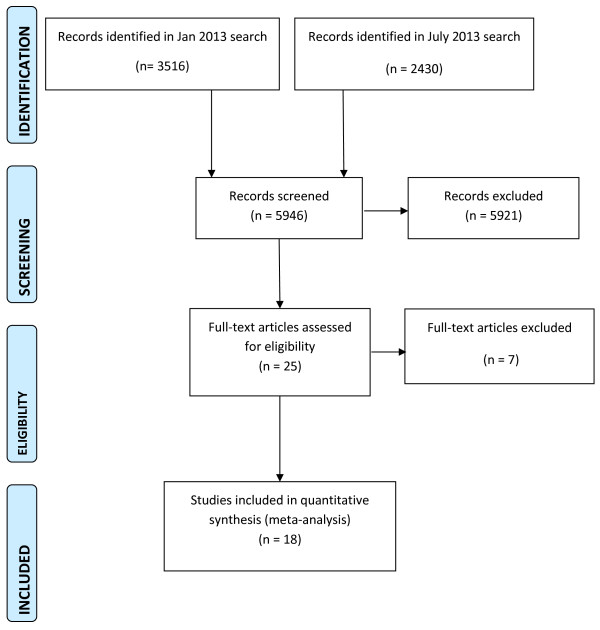
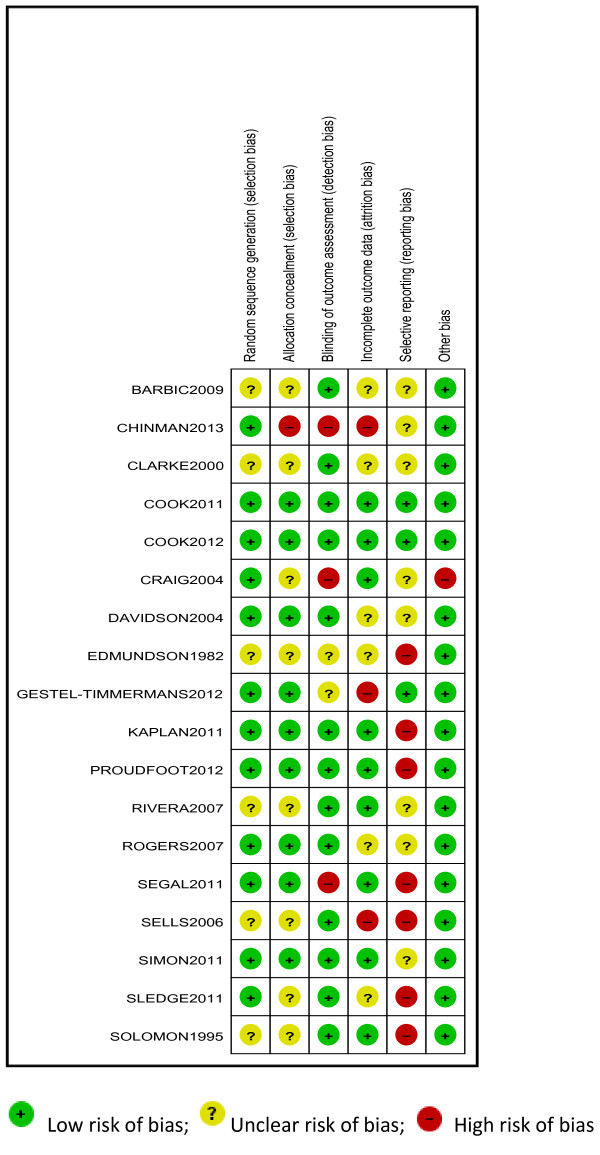
BACKGROUND: Little is known about whether peer support improves outcomes for people with severe mental illness. METHOD: A systematic review and meta-analysis was conducted. Cochrane CENTRAL Register, Medline, Embase, PsycINFO, and CINAHL were searched to July 2013 without restriction by publication status. Randomised trials of non-residential peer support interventions were included. Trial interventions were categorised and analysed separately as: mutual peer support, peer support services, or peer delivered mental health services. Meta-analyses were performed where possible, and studies were assessed for bias and the quality of evidence described. RESULTS: Eighteen trials including 5597 participants were included. These comprised four trials of mutual support programmes, eleven trials of peer support services, and three trials of peer-delivered services. There was substantial variation between trials in participants' characteristics and programme content. Outcomes were incompletely reported; there was high risk of bias. From small numbers of studies in the analyses it was possible to conduct, there was little or no evidence that peer support was associated with positive effects on hospitalisation, overall symptoms or satisfaction with services. There was some evidence that peer support was associated with positive effects on measures of hope, recovery and empowerment at and beyond the end of the intervention, although this was not consistent within or across different types of peer support. CONCLUSIONS: Despite the promotion and uptake of peer support internationally, there is little evidence from current trials about the effects of peer support for people with severe mental illness. Although there are few positive findings, this review has important implications for policy and practice: current evidence does not support recommendations or mandatory requirements from policy makers for mental health services to provide peer support programmes. Further peer support programmes should be implemented within the context of high quality research projects wherever possible. Deficiencies in the conduct and reporting of existing trials exemplify difficulties in the evaluation of complex interventions.
Overview
The claims and statistics of this paper haven’t been checked yet.
Free: it reads the open-access text and checks the first 5 claims that cite a source we can check. Create a free account to check every claim.
Integrity signals
Registry
Cites
Statistics
Figures
Verification
Claims the paper makes
The claims and statistics of this paper haven’t been checked yet.
Free: it reads the open-access text and checks the first 5 claims that cite a source we can check. Create a free account to check every claim.
Claims other papers make about this one
Each is checked against this paper’s own text: does it say what the citing paper says it does?
The source backs part of the claim, not all of it — or backs it for a different population, condition or comparison.
In the citing paper
“Reviews of peer interventions for persons with serious mental illnesses, usually incorporating a small but significant number of individuals with BD, have demonstrated modest evidence from RCTs and other controlled studies suggesting that there are important improvements in self‐efficacy and reduction in self‐stigma.106, 107, 108, 109”
From Canadian Network for Mood and Anxiety Treatments ( CANMAT ) and International Society for Bipolar Disorders ( ISBD ) 2018 guidelines for the management of patients with bipolar disorder (2018) · cites this paper as [106]
Experimental — accuracy not yet measuredThe source backs part of the claim, not all of it — or backs it for a different population, condition or comparison.
In the citing paper
“Studies have reported the benefits of peer-led intervention programs in various settings, including prisons.52, 56–58”
From Psychosocial Interventions for Prisoners with Mental and Substance Use Disorders: A Systematic Review (2022) · cites this paper as [58]
Experimental — accuracy not yet measured
Self-check
Percentages, sums and reported differences re-computed from the paper’s own numbers.
The self-check needs the paper’s full text.
Citations
Cites
The Cochrane Collaboration's tool for assessing risk of bias in randomised trials
Higgins, J. P. T., Altman, D. G., Gotzsche, P. C., Juni, P., Moher, D., Oxman, A. D., Savovic, J., Schulz, K. F., Weeks, L., Sterne, J. A. C., et al. (2011) · BMJ · doi:10.1136/bmj.d5928 · Cited by 33,817
Kytle, J., & Bandura, A. (1978) · Contemporary Sociology · doi:10.2307/2065952 · Cited by 25,422
Dermyshi, E., Wang, Y., Yan, C., Hong, W., Qiu, G., Gong, X., & Zhang, T. (2017) · Neonatology · doi:10.1159/000454668 · Cited by 24,451
A theory of social comparison processes
Festinger, L. (1954) · Human Relations · doi:10.1177/001872675400700202 · Cited by 20,926 · cited 1×
“This is consistent with psychological theories of change: peers’ social proximity to the people they are supporting may enhance their value as pro-social models [4] and promote motivation to achieve recovery by providing an upward social comparison [5].”
BackgroundCONSORT 2010 Statement: updated guidelines for reporting parallel group randomised trials
the CONSORT Group, Schulz, K. F., Altman, D. G., & Moher, D. (2010) · BMC Medicine · doi:10.1186/1741-7015-8-18 · Cited by 13,371
Grading quality of evidence and strength of recommendations
(2004) · BMJ · doi:10.1136/bmj.328.7454.1490 · Cited by 8,477 · cited 2×
“Meta-analysis was conducted using RevMan and a summary of results was prepared using the GRADE system [26], which is a structured assessment of confidence in the evidence for individual outcomes attending: threats to internal validity, inconsistency, indirectness, imprecision, and reporting bias.”
BackgroundMethodLeamy, M., Bird, V., Boutillier, C. L., Williams, J., & Slade, M. (2011) · British Journal of Psychiatry · doi:10.1192/bjp.bp.110.083733 · Cited by 3,038 · cited 1×
“selfrated recovery, hope and empowerment [53].”
Evaluating non-randomised intervention studies
Deeks, J., Dinnes, J., D'Amico, R., Sowden, A., Sakarovitch, C., Song, F., Petticrew, M., & Altman, D. (2003) · Health Technology Assessment · doi:10.3310/hta7270 · Cited by 2,907 · cited 1×
“In line with best practice guidelines for systematic reviews [54], we have not sought to supplement existing randomised trial evidence by including non-randomised trials in our review [55].”
Process evaluation in randomised controlled trials of complex interventions
Oakley, A., Strange, V., Bonell, C., Allen, E., & Stephenson, J. (2006) · BMJ · doi:10.1136/bmj.332.7538.413 · Cited by 1,247
A review of the literature on peer support in mental health services
Repper, J., & Carter, T. (2011) · Journal of Mental Health · doi:10.3109/09638237.2011.583947 · Cited by 1,103 · cited 3×
“However, they often accentuate positive findings from poor quality evidence, highlighting “limited but promising evidence,” [20] the “potential to drive through recovery-focused changes in services,” [21] and the possibility for peer-provided mental health services “without detrimental effect” [24] or “with no evidenc…”
Background
Research works printed but not linked: 10
- Mead S Defining Peer Support 2003 Web resource: http://www.intentionalpeersupport.org/documents/DefiningPeerSupport.pdf
- Halvorson A Whitter M Approaches to Recovery-Oriented Systems of Care at the State and Local Levels: Three Case Studies 2009 Rockville, MD: Center for Substance Abuse Treatment, Substance Abuse and Mental Health Services Administration
- The Royal College of Psychiatrists Social Inclusion Scoping Group Mental Health and Social Inclusion: Making Psychiatry and Mental Health Services Fit for the 21st Century 2009 London: Royal College of Psychiatrists
- Scottish Recovery Network The role and potential development of peer support services 2005 Glasgow: Scottish Recovery Network
- Minnesota Department of Human Services “Certified peer support services” 2013 Web Resource: http://www.mhcsn.org/certified-peer-specialist/
- Repper J Peer support workers: theory and practice 2013 London: Centre for Mental Health
- NCCMH Schizophrenia: Core Interventions in the Treatment and Management of Schizophrenia in Adults in Primary and Secondary Care. Updated ed Leicester and London: The British Psychological Society and the Royal College of Psychiatrists In press 20704054
- Reeves BD Higgins J Wells J Wells G Higgins J, Green S Chapter 13: including non-randomised studies Cochrane Handbook for Systematic reviews of Interventions v.5.1.0 2011 Cochrane Collaboration Web resource: http://www.cochrane-handbook.org
- New Freedom Commission on Mental Health Achieving the promise: transforming mental health care in America. Final report 2003 MD: Department of Health and Human Services DHHS pub no SMA-03-3832
- Perkins R Repper J Rinaldi M Brown H Recovery Colleges: Implementing Recovery through Organisational Change (ImROC) briefing paper 2012 London: Centre for Mental Health
Cited by
Items 401–500 of 673
Yokoyama, K., Miyajima, R., Morimoto, T., Ichihara‐Takeda, S., Yoshino, J., Matsuyama, K., & Ikeda, N. (2021) · Community Mental Health Journal · doi:10.1007/s10597-021-00793-x · Cited by 4
Empowerment and Inclusion: The Introduction of Peer Workers into the Workforce
Shepherd, G., & Repper, J. (2016) · Springer eBooks · doi:10.1007/978-3-319-27839-1_34 · Cited by 4
Sozialpsychiatrie: Trends und Herausforderungen
Gruber, D., Böhm, M., Wallner, M., & Koren, G. (2017) · Springer eBooks · doi:10.1007/978-3-662-54626-0_9 · Cited by 4
Hart, T. (2016) · Figshare · Cited by 4
Gough, H. (2016) · UEA Digital Repository (University of East Anglia) · Cited by 5
Self-disclosure in mental health services
Lovell, J. F. (2017) · White Rose eTheses Online (University of Leeds, The University of Sheffield, University of York) · Cited by 5
Mullineaux, L. (2017) · UEA Digital Repository (University of East Anglia) · Cited by 4
Mental Health Equity in Higher Education: The Role of Policy, Policing, and Visible Inclusion
Abelson, S. (2022) · Deep Blue (University of Michigan) · doi:10.7302/4667 · Cited by 4
Devane, C., Jenkins, E., McAuliffe, C., Wuerth, K. C., & Barbic, S. P. (2025) · BMJ Open · doi:10.1136/bmjopen-2024-094356 · Cited by 3
Turner, B. J., McKnight, B., Senay, Z., & Barbic, S. P. (2025) · International Journal of Mental Health Nursing · doi:10.1111/inm.70158 · Cited by 3
“…improve treatment engagement and retention (Chinman et al. 2014), and increase hope and empowerment (Lloyd-Evans et al. 2014), though evidence of its efficacy in reducing functional impairment, improving overall quality of life and reducing hospitalisations is mixed (Lloyd-Evans et al. 2014).”
Moran, G. S., Goldfarb, Y., Ben-Dor, I. A., Grundman, S. H., Kalha, J., Baillie, D. W. H., Kwebiiha, E., Mahlke, C., Ramesh, M., Slade, M., et al. (2025) · Journal of Occupational Rehabilitation · doi:10.1007/s10926-025-10320-4 · Cited by 3
“Mental health peer support has been increasingly implemented and studied in high-income countries such as USA [19, 20], UK [9, 21–23], Europe [24, 25], Israel [26, 27], Australia and New Zealand [28–31].”
Feasibility of Katatagan Plus as a mental health early intervention for at-risk youth
Co, T. A. C., Hechanova, M. R. M., Castro, E. D. B., Yusay, C. T. C., & Egusquiza, F. R. (2026) · Journal of Child and Adolescent Mental Health · doi:10.2989/17280583.2025.2580472 · Cited by 3
“Future studies should examine facilitator effects more systematically and consider testing peer-led delivery models, as systematic reviews suggest that youth peer-support programs are positively associated with empowerment, hope, and recovery (Lloyd-Evans et al., 2014; Lyons et al., 2021).”
Pro, G. C., Brown, C. C., Johnson, O., Montgomery, B. E. E., & Zaller, N. D. (2023) · Community Mental Health Journal · doi:10.1007/s10597-023-01168-0 · Cited by 3
Barr, K. R., Townsend, M. L., & Grenyer, B. F. S. (2023) · Health & Social Care in the Community · doi:10.1155/2023/5398996 · Cited by 3
“Previous research on peer support predominately focuses on consumer peer workers and their role in supporting consumers with severe mental illness [11, 12].”
BackgroundPapathanasiou, C., & Kougioumtzi, A. (2024) · Mental Health Science · doi:10.1002/mhs2.86 · Cited by 3
“…management is either equivalently effective or, in some cases, more effective than traditional case management (delivered by professionals) at improving beneficiaries' health outcomes (Bellamy et al., 2017; Chinman et al., 2014; Fuhr et al., 2014; Lloyd ‐ Evans et al., 2014; Pitt et al., 2013).”
Walde, P., & Vӧllm, B. (2024) · Psychiatrische Praxis · doi:10.1055/a-2490-6896 · Cited by 3
“[20].”
InfluentialPsychiatry after Kraepelin: Ambition Images Practices 1926-2026
Ikkos, G., & Becker, T. (2026) · Springer eBooks · doi:10.1007/978-3-032-09475-9 · Cited by 3
Cheng, K.-Y., & Yen, C.-F. (2022) · International Journal of Environmental Research and Public Health · doi:10.3390/ijerph19159124 · Cited by 3
“The diversity of service settings and absence of compatible control groups under blinded assessments in past studies of peer support services may explain such inconsistent results in term of analyzing group data [12,13].”
ResultKane, L., Walker, L., Eberhardt, J., Portman, R. M., Proctor, E., Poulter, H. L., & O’Neill, C. (2024) · Health Expectations · doi:10.1111/hex.70084 · Cited by 3
Alles kann – nichts muss? Genesungsbegleitung (Peer-Support) auf akutpsychiatrischen Stationen
Stolz, C., Oster, A., Czernin, K., Baumgartner, J. S., Junghanss, J., & Mahler, L. (2024) · Psychiatrische Praxis · doi:10.1055/a-2447-6831 · Cited by 3
“Die im Rahmen dieser Studie berichtete Wirkung von Genesungsbegleitung auf vermehrte Hoffnung, Ak tivität und Selbstwirksamkeit von Patient:innen, sowie Förderung von Verständnis und Vertrauen durch ähnliche Erfahrungen, ist auch durch frühere Studien bereits belegt [6–9 , 20 ].”
Outcomes of experts by experience in (mental) health care and social domain: a scoping review
Erp, N. V., Karbouniaris, S., Keuzenkamp, S., Metze, R. N., & van der Zwet, R. J. M. (2025) · Journal of Social Intervention Theory and Practice · doi:10.54431/jsi.840 · Cited by 3
Clermont, D., Gilmer, T., Burgos, J. L., Berliant, E., & Ojeda, V. D. (2020) · Health Equity · doi:10.1089/heq.2020.0014 · Cited by 3
“and PS may improve health and social outcomes by raising self-efficacy and self-confidence.(60,61) In addition, those receiving PS exhibit a higher likelihood of returning for annual visits, reductions in risky sexual behavior, and increased self-reported empowerment.”
BackgroundFrom education to empowerment: Redesigning the role of students in college health promotion
Moore, A. (2021) · Journal of American College Health · doi:10.1080/07448481.2021.1920603 · Cited by 3
Peer Support and Mental Health: A Review of the Evidence
Evans, M. (2023) · Springer eBooks · doi:10.1007/978-3-031-29042-8_5 · Cited by 3
Honary, M., Lee, J., Bull, C., Wang, J., & Helal, S. (2020) · IEEE Annual International Computer Software and Applications Conference (COMPSAC) · doi:10.1109/compsac48688.2020.0-184 · Cited by 3
“Peer-support offered through community mental health services is increasingly accepted [16].”
BackgroundMaharaj, L. (2015) · DUT Open Scholar (Durban University of Technology) · doi:10.51415/10321/1407 · Cited by 3
Medikamentfrie tiltak i psykisk helsevern (systematisk litteratursøk med sortering)
Fønhus, M. S., Fretheim, A., & Johansen, M. (2016) · NORA - Norwegian Open Research Archives · Cited by 3
Emerging as a worker : mental health service users' transformation through volunteering
Fegan, C. (2014) · SHURA (Sheffield Hallam University Research Archive) (Sheffield Hallam University) · Cited by 3
Mental health nursing: is Rome burning?
White, E. G., & Brooker, C. (2020) · British Journal of Mental Health Nursing · doi:10.12968/bjmh.2020.0015 · Cited by 3
González, R. Z. (2021) · Repositorio Institucional de la Universidad de Burgos (University of Burgos) · doi:10.36443/10259/5863 · Cited by 4
Watson, E. (2020) · Nottingham ePrints (University of Nottingham) · Cited by 3
Pan, D., Sánchez, J., Vispoel, W., Wadsworth, J. S., Duys, D. K., & Estrada‐Hernández, N. (2021) · doi:10.17077/etd.005872 · Cited by 3
Alohan, D. I., Wade, R. M., Harper, G. W., Newman, A., Doraivelu, K., & Hussen, S. A. (2025) · AIDS and Behavior · doi:10.1007/s10461-025-04780-1 · Cited by 2
Tremblett, S., Ellenbogen, S., Wadden, E., Koparan, L., Traverse, C., & Muise, M. (2025) · Human Services Organizations Management Leadership & Governance · doi:10.1080/23303131.2025.2544678 · Cited by 2
“The literature includes several efforts to determine whether the provision of peer support improves mental health symptomatology; results were inconsistent (Chinman et al., 2014; Lloyd-Evans et al., 2014).”
Agyapong, V. I. O., Shalaby, R., Agyapong, B., Mao, W., Owusu, E., Elgendy, H. E., Eboreime, E., Silverstone, P. H., Chue, P. S., Li, X., et al. (2025) · JMIR Mental Health · doi:10.2196/81760 · Cited by 2
“Although peer support may positively affect psychosocial outcomes such as empowerment and perceived recovery [25], its effect on clinical service usage outcomes (eg, LOS, readmissions) has been inconsistent.”
Lawn, S., Rattray, M., Fuss, B., Shelby‐James, T., Byrne, L., Worley, P., Manger, S., Harris, G., Guy, B., Álvarez, A., et al. (2025) · Administration and Policy in Mental Health and Mental Health Services Research · doi:10.1007/s10488-025-01479-2 · Cited by 2
“A review of RCTs across diverse setting types (Lloyd-Evans et al., 2014) found mixed results, largely due to heterogeneity in methods and contexts, small sample sizes, and deficiencies in reporting.”
An umbrella review of systematic reviews of peer support work in criminal justice settings
Mahon, D. (2025) · Journal of Forensic Practice · doi:10.1108/jfp-06-2025-0061 · Cited by 2
Papa, J., Choi, Y. N., Nault, E., Nelson, S. M., Fineberg, S. K., & Tusiani-Eng, P. (2026) · Personality and Mental Health · doi:10.1002/pmh.70057 · Cited by 2
What Does Research Tell Us About Peer Support, Its Strengths and Potential Risks?
Poulsen, C. H., & Eplov, L. F. (2026) · Springer eBooks · doi:10.1007/978-3-032-09475-9_24 · Cited by 2
Brener, L., Caruana, T., Horwitz, R., Bryant, J., Stirling, R., Lang, R., Wright, T., Treloar, C., & von Hippel, C. (2026) · International Journal of Drug Policy · doi:10.1016/j.drugpo.2026.105325 · Cited by 2
Ancet, P. (2024) · La nouvelle revue - Éducation et société inclusives · doi:10.3917/nresi.098.0013 · Cited by 2
Platt, L., Guise, A., Hosseini, P., Bowgett, K., Murphy, M., Cudjoe, M., Annand, P., Hudson, M. ‘., Yankah, M. E. D., Menezes, D., et al. (2026) · BMJ Open · doi:10.1136/bmjopen-2025-107422 · Cited by 2
“We tried to adjust for imbalances, but there may be unmeasured confounders.”
Keuzenkamp, S., & van Hoorn, E. (2022) · Journal of Social Intervention Theory and Practice · doi:10.54431/jsi.698 · Cited by 2
Zhou, N., Ren, F., Shi, G., & Wang, J. (2023) · OMEGA - Journal of Death and Dying · doi:10.1177/00302228231154844 · Cited by 2
Peer Support on A College Campus at An Indian University
Srinivasan, S. P., Char, S., Samuel Prithiv J, & Ramachandran, P. (2023) · doi:10.7176/jep/14-23-06 · Cited by 2
Mental healthcare and addiction services in Poland: a (hi)story of attraction and rejection
Klingemann, J. I., Bieńkowski, P., Misiak, B., & Samochowiec, J. (2024) · International Review of Psychiatry · doi:10.1080/09540261.2024.2427819 · Cited by 2
“Nevertheless, the results of ongoing studies on the efficacy of PSWs do not clearly demonstrate improvements in clinical outcomes (Chinman et al., 2014; Cooper et al., 2024; Gillard et al., 2022; Lloyd-Evans et al., 2014; White et al., 2020).”
Use of Peer-Based Interventions in the Field of Eating Disorders
Patmore, J. M., & Ranzenhofer, L. M. (2024) · Springer eBooks · doi:10.1007/978-3-031-46096-8_86 · Cited by 2
Ziegenhagen, J., Krämer, U. M., Fehler, G., Ruiz‐Pérez, G., Schmidt, D., Cubellis, L., Küsel, M., & von Peter, S. (2025) · Research Involvement and Engagement · doi:10.1186/s40900-025-00720-4 · Cited by 2
Bunn, M., Graunke, M., Liu, X., Adebayo, N., Izquierdo, S., Sunkel, C., & Cook, J. Α. (2025) · PLOS mental health. · doi:10.1371/journal.pmen.0000359 · Cited by 2
Guise, A., Annand, P., Hosseini, P., Hudson, S., Rathod, S. D., & Platt, L. (2025) · Sociology of Health & Illness · doi:10.1111/1467-9566.70136 · Cited by 2
Co-Production of Digital Mental Health Technologies To Support Individuals in Mental Health Crisis
Brannelly, T., Trenoweth, S., & Tuck, J. (2022) · Bournemouth University Research Online (Bournemouth University) · doi:10.1108/mhsi-04-2022-0019 · Cited by 2
Implementing a peer support programme in a regional mental health service: A personal journey
Vilic, G., Lloyd, C., & Tse, S. S.-K. (2016) · International Journal of Therapy and Rehabilitation · doi:10.12968/ijtr.2016.23.1.42 · Cited by 2
Schizophrenia and design: the expectation gaps with a vulnerable user group
Lindberg, S. (2019) · interactions · doi:10.1145/3337775 · Cited by 2
Álvarez, M. L. (2020) · Revista de la Asociación Española de Neuropsiquiatría · doi:10.4321/s0211-57352020000100003 · Cited by 2
Valentine, A. M., Walker, R., & Nicholson, J. (2021) · Advances in Mental Health · doi:10.1080/18387357.2021.2012089 · Cited by 2
“…status, increase health-promoting behaviours, and reduce the utilization of emergency services in persons with mental illness (Bellamy, Schmutte, & Davidson, 2017), the benefit of peer-delivered services on clinical outcomes is less well supported (Lloyd-Evans et al., 2014; Pitt et al., 2013).”
BackgroundThe Role of Peer Support in Recovery from Psychiatric Symptoms: A Moderation Analysis
Addo, R., Ginder, V., & Nedegaard, R. (2022) · Community Mental Health Journal · doi:10.1007/s10597-021-00923-5 · Cited by 2
“Furthermore, the mechanisms through which recovery outcomes are achieved have not been documented in the literature (Hendryx et al., 2009; King & Simmons, 2018; Lloyd-Evans et al., 2014; Solomon, 2004).”
BackgroundVersorgungsstrukturen in der Psychiatrie
Kallert, T. W., Gühne, U., Harter, C., Lang, F. U., Puschner, B., Riedel-Heller, S. G., Weisbrod, M., Becker, T. M., & Wulf Rössler, A. (2017) · Springer eBooks · doi:10.1007/978-3-662-49295-6_54 · Cited by 2
Use of Peer-Based Interventions in the Field of Eating Disorders
Patmore, J. M., & Ranzenhofer, L. M. (2023) · Springer eBooks · doi:10.1007/978-3-030-97416-9_86-1 · Cited by 2
Tomberg, T. (2014) · DSpace repository (University of Tartu) · Cited by 2
Petznick, C. N. (2015) · QSpace (Queen's University Library) · Cited by 2
Mental health and recovery : experiences of peer support workers employed in mental health services
Mackin, M. (2019) · London Met Repository (London Metropolitan University) · Cited by 2
Bailie, H. A. (2016) · Nottingham ePrints (University of Nottingham) · Cited by 2
Exploring the Dual Role of Consumer and Provider in Substance Use Peer Support Workers
Williams, C. (2020) · ScholarWorks (Walden University) · Cited by 2
Personality Disorder Services: Rapid Review
McCartan, C. J., & Davidson, G. (2020) · Research Portal (Queen's University Belfast) · Cited by 2
Robjant, K. (2021) · KOPS (University of Konstanz) · Cited by 2
Peers as humans in the loop in digital mental health
Patel, A., & Lara, E. I. (2025) · Nature Medicine · doi:10.1038/s41591-025-03755-y · Cited by 2
Cantrell, A., Bulgarelli, M., & Ashimi, J. (2016) · Occupational Therapy in Mental Health · doi:10.1080/0164212x.2015.1111789 · Cited by 1
“The evidence base for these views have been challenged by a recent systematic review but it was concluded, with limited confidence, that hope, empowerment, and recovery are improved (Lloyd-Evans et al., 2014).”
BackgroundServant Leadership-Informed Peer Support
Mahon, D., & Griffin, M. (2022) · Emerald Group Publishing Limited eBooks · doi:10.1108/978-1-80382-429-120221005 · Cited by 1
Lequin, P., Suter, C., Mazallon, R., Brodard, R., Empson, L. A., Robalo, B. T., Conus, P., Nguyen, A., & Favrod, J. (2023) · Frontiers in Psychiatry · doi:10.3389/fpsyt.2023.1244433 · Cited by 1
“These benefits have been reported in other studies to be even more important during hospitalizations, specifically associated with traumatic, coercive, and isolating experiences (3, 4, 6, 19).”
BackgroundGonzalez-Garcia, X., Moreno-Sancho, M. L., Roa-Díez, P., Caceres-Tejeiro, Y., Flowers, S.-L. D., de Montes, C. G., Bennasar‐Veny, M., García-Toro, M., & Yáñez, A. M. (2024) · BMC Psychiatry · doi:10.1186/s12888-024-06094-3 · Cited by 1
Componentes nucleares y efectividad de los grupos de ayuda mutua: Una revisión sistemática
Agudelo‐Hernández, F., Andrade, R. M. R., Guapacha-Montoya, M., & Álvarez, A. B. G. (2024) · Tesis Psicológica · doi:10.37511/tesis.v18n2a5 · Cited by 1
Eigene Krisen- und Behandlungserfahrungen unter psychiatrischem Fachpersonal – Bedeutung und Umgang
Brieger, A., Ponew, A., Lust, C., Speerforck, S., Stuetzle, S., & von Peter, S. (2025) · Der Nervenarzt · doi:10.1007/s00115-025-01815-9 · Cited by 1
Exploring the attitudes of mental health professionals toward recovery and peer support in Taiwan
Chang, Y., Huang, M.-W., Chuang, T.-H., & Hsu, S. (2025) · BMC Psychiatry · doi:10.1186/s12888-025-06705-7 · Cited by 1
TOMIZAWA, R., Furiya, Y., & Gappmayer, G. (2025) · Asian Journal of Occupational Therapy · doi:10.11596/asiajot.21.19 · Cited by 1
Nath, B., Desai, R., Cook, J. M., Dziura, J. D., Davis‐Plourde, K. L., Youins, R., Guy, K., Pavlo, A. J., Smith, P. E., Smith, P. D., et al. (2025) · BMJ Open · doi:10.1136/bmjopen-2025-103775 · Cited by 1
Abdelraof, A. S. E., Elhay, E. S. A., Awad, S., & Abdelraof, A. I. (2025) · Assiut Scientific Nursing Journal · doi:10.21608/asnj.2025.381132.2073 · Cited by 1
Mutamba, B. B., Rai, S., Semakula, L., Cappo, D., Asher, L., Gwaikolo, W., & Kohrt, B. A. (2025) · Pilot and Feasibility Studies · doi:10.1186/s40814-025-01684-8 · Cited by 1
“Peer support is reported to have benefits such as reduced hospitalization and better recovery outcomes for persons with serious mental illness [25, 27].”
Lasalvia, A., Bodini, L., Fin, V., & Bonetto, C. (2025) · BMC Health Services Research · doi:10.1186/s12913-025-13407-z · Cited by 1
Predictive factors for referral to a peer support worker in psychosocial rehabilitation centers
Monnier, R., Plasse, J., Haesebaert, F., Gouache, B., Legros-Lafarge, É., Guillard-Bouhet, N., Bralet, M., Franck, N., Khattech, D., Barbalat, G., et al. (2025) · Frontiers in Psychiatry · doi:10.3389/fpsyt.2025.1648718 · Cited by 1
Musgrave, G., Gross, S., & Carney, D. (2024) · WestminsterResearch (University of Westminster) · Cited by 1
Smolina, N. S., & Ryabuhina, V. I. (2026) · Социодинамика · doi:10.25136/2409-7144.2026.1.77413 · Cited by 1
A qualitative analysis of role-play exercises in the training of mental health peer support workers
Gómez-Morales, F., & Eiroá‐Orosa, F. J. (2026) · The Journal of Mental Health Training Education and Practice · doi:10.1108/jmhtep-06-2025-0063 · Cited by 1
Warren, A. (2026) · Frontiers in Psychiatry · doi:10.3389/fpsyt.2026.1863015 · Cited by 1
“…designed to foster meaningful social engagement (25, 64); peer support approaches that promote shared lived experience and social connectedness (81); social prescribing, which links individuals to community resources and social activities (77); and broader community-based programs that…”
Pirkis, J., Whiteford, H., Jorm, T., Harris, M., Reavley, N. J., Siskind, D. J., Bassilios, B., Diminic, S., Robinson, J., Carstensen, G., et al. (2014) · Cited by 1
Mohr, D., Rosén, L. A., Dik, B. J., Richards, T., & Biringen, Z. C. (2015) · Digital Collections of Colorado (Colorado State University) · doi:10.25675/3.020702 · Cited by 1
Recovery-Related Brief Interventions for Psychosis
Shepherd, G. (2016) · Springer eBooks · doi:10.1007/978-3-319-30521-9_9 · Cited by 1
Wickedness in Design of e-Health Systems for People Diagnosed with Schizophrenia
Lindberg, S. (2017) · Lecture notes in business information processing · doi:10.1007/978-3-319-64695-4_10 · Cited by 1
Promoting recovery through peer provided interventions -Rajah Experience
Kavitha, M. A., & Pfizer, N. (2019) · Kerala Journal of Psychiatry · doi:10.30834/kjp.32.1.2019.172 · Cited by 1
Jackson, S., Walker, J. S., & Seibel, C. L. (2015) · PDXScholar (Portland State University) · Cited by 1
Peer Mentors in the Emergency Department
Mullinax, S., & Wilson, M. P. (2021) · Springer eBooks · doi:10.1007/978-3-030-52520-0_22 · Cited by 1
Sozial- und Gemeindepsychiatrie, psychiatrisch-psychotherapeutische Rehabilitation
Becker, T. M., Gühne, U., Riedel-Heller, S. G., & Berger, M. (2019) · Elsevier eBooks · doi:10.1016/b978-3-437-22485-0.00007-5 · Cited by 1
Mental Challenges as Constitutive of Marginalisation?
Rose, D. S. (2022) · The politics of mental health and illness · doi:10.1007/978-3-031-07551-3_2 · Cited by 1
Albers, W. M. M., Nijssen, Y. A. M., Roeg, D. P. K., van Weeghel, J., & Bongers, I. M. B. (2022) · Frontiers in Psychiatry · doi:10.3389/fpsyt.2022.956133 · Cited by 1
“First, experts-by-experience adopted a strengths-based approach more than the other professionals (41), which can empower and instill hope in clients.”
BackgroundAufsuchende, integrative und peergestützte Behandlungsansätze bei Therapieresistenz
Schwarz, J., & Weinmann, S. (2022) · Springer eBooks · doi:10.1007/978-3-662-65734-8_31 · Cited by 1
Toward Effective Teaching: What Teachers Need to Know About Anxiety and Bipolar Disorder
Zaky, H. (2023) · European journal of applied sciences · doi:10.14738/aivp.111.12874 · Cited by 1
Clark, M. (2024) · Social Work and Social Sciences Review · doi:10.1921/swssr.v25i1.2292 · Cited by 1
“The concern with the nature of relationships in mental health care has also emerged in the work on employing peer workers in the sector (Lloyd-Evans et al., 2014; Gillard et al., 2017; Gillard, 2019).”
BackgroundGuevara, A. M. M., Johnson, S. L., Wall, C., & Lopez, K. (2024) · Prevention Science · doi:10.1007/s11121-024-01675-w · Cited by 1
Self-citationHistorical changes in mental health practice
Rose, N. (2025) · Oxford University Press eBooks · doi:10.1093/med/9780198898818.003.0002 · Cited by 1
Efficacité des interventions par les pairs-aidants : état des connaissances
Cervello, S., & Bulinge, M. (2020) · Elsevier eBooks · doi:10.1016/b978-2-294-77119-4.00008-0 · Cited by 1
Metadata
- Authors
- Lloyd-Evans, B., Mayo-Wilson, E., Harrison, B., Istead, H., Brown, E., Pilling, S., Johnson, S., & Kendall, T.
- Affiliations
- University College London (GB)
- University of the West of England (GB)
- Sheffield Health and Social Care NHS Foundation Trust (GB)
- Venue
- BMC Psychiatry
- Published
- 2014-02-14
- Volume
- 14
- Issue
- 1
- Pages
- 39-39
- ISSN
- 1471-244X (ISSN-L)
- PMC
- PMC3933205
- OpenAlex
- W1989263398
- Cited by
- 558
- References
- 62
- Citations by year
- 2026: 20 · 2025: 41 · 2024: 47 · 2023: 64 · 2022: 64 · 2021: 67 · 2020: 60 · 2019: 53 · 2018: 40 · 2017: 39 · 2016: 36 · 2015: 14 · 2014: 13
- FWCI
- 5.75
- Type
- journal article
- Language
- en
- Open access
- gold
- doi.org
- Licence
- Locations
- BMC Psychiatry (publishedVersion, cc-by)
- Europe PMC (PubMed Central) (publishedVersion, cc-by)
- PubMed Central (publishedVersion, cc-by)
- PubMed (publishedVersion)
- Minerva Access (University of Melbourne) (submittedVersion, cc-by)
- UCL Discovery (University College London) (submittedVersion)
- Figshare (submittedVersion, cc-by)
- Funders
- National Institute for Health and Care Research (RP-PG-0109-10078)
- Programme Grants for Applied Research (RP-PG-0109-10078)
- Topics
- Health Sciences › Health Professions › General Health Professions › Mental Health and Patient Involvement
- Social Sciences › Psychology › Clinical Psychology › Psychiatric care and mental health services
- Health Sciences › Medicine › Psychiatry and Mental health › Mental Health Treatment and Access
- Keywords
- peer support, severe mental illness, peer support services, hospitalization, symptom severity, service satisfaction, hope, recovery, empowerment, complex interventions, trial quality
- MeSH terms
- Adult, Mental Disorders, Counseling, Female, Humans, Male, Mental Health Services, Peer Group, Social Support, Randomized Controlled Trials as Topic
About these checks
Registry, retraction, Cites and statistics results are computed, not judged, with one exception: a printed reference that no index lists is read once by a model before it counts as a citation error. Claims are extracted by a model and kept only when their quote appears verbatim in the text; each cited source is then checked, with a model’s help, for whether it says what the claim relies on. Those verdicts can be wrong — read the claim’s quote and the cited source before relying on one.
Statistics and arithmetic are recomputed, not judged.
Confidence bands are shown only for fields calibrated on our annotated test set. None is calibrated yet, so no band is shown.
What counts as a claim ›How we measure confidence ›How we check this ›
Are you an author, or do you see a problem with this page? Request a review
Data sources
Bibliographic data: Semantic Scholar, OpenAlex, Crossref.
Contains information from the Semantic Scholar Academic Graph Datasets, made available under the ODC Attribution License (ODC-BY 1.0).
Semantic Scholar’s data is described in: Kinney, R., et al. (2023). The Semantic Scholar Open Data Platform. arXiv:2301.10140.
