

A systematic review and meta-analysis of randomised controlled trials of peer support for people with severe mental illness
Open accessThe DOI matches its Crossref record; 61 of the 62 references it cites were found in a registry or an index.
Abstract
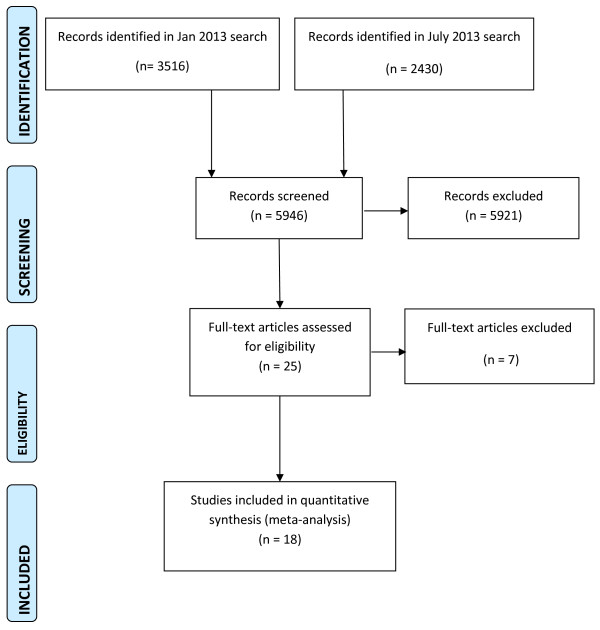
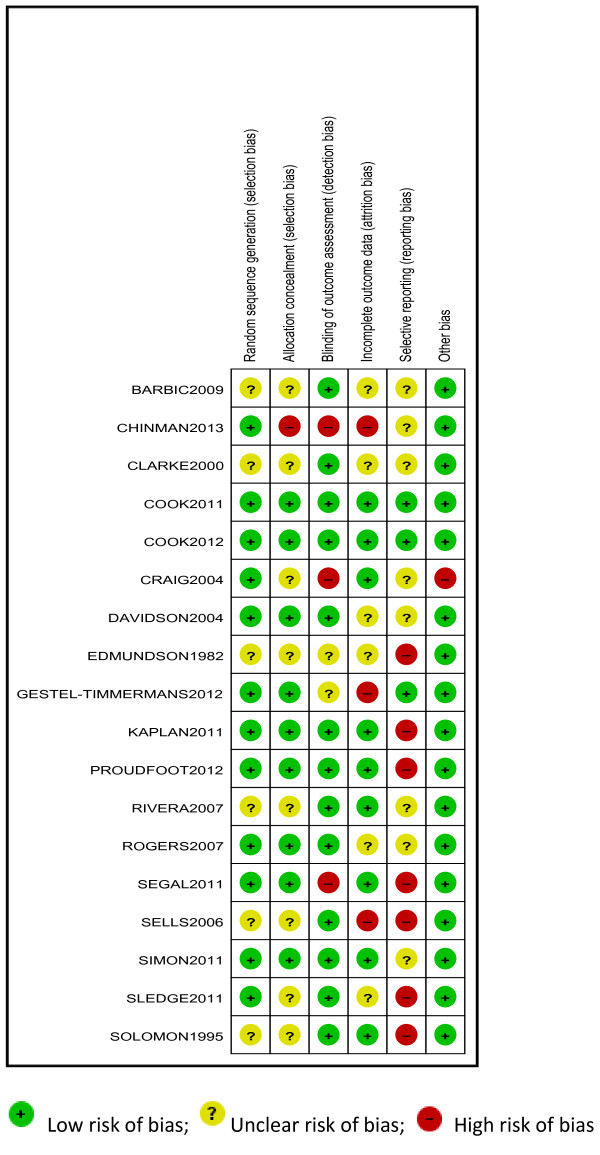
BACKGROUND: Little is known about whether peer support improves outcomes for people with severe mental illness. METHOD: A systematic review and meta-analysis was conducted. Cochrane CENTRAL Register, Medline, Embase, PsycINFO, and CINAHL were searched to July 2013 without restriction by publication status. Randomised trials of non-residential peer support interventions were included. Trial interventions were categorised and analysed separately as: mutual peer support, peer support services, or peer delivered mental health services. Meta-analyses were performed where possible, and studies were assessed for bias and the quality of evidence described. RESULTS: Eighteen trials including 5597 participants were included. These comprised four trials of mutual support programmes, eleven trials of peer support services, and three trials of peer-delivered services. There was substantial variation between trials in participants' characteristics and programme content. Outcomes were incompletely reported; there was high risk of bias. From small numbers of studies in the analyses it was possible to conduct, there was little or no evidence that peer support was associated with positive effects on hospitalisation, overall symptoms or satisfaction with services. There was some evidence that peer support was associated with positive effects on measures of hope, recovery and empowerment at and beyond the end of the intervention, although this was not consistent within or across different types of peer support. CONCLUSIONS: Despite the promotion and uptake of peer support internationally, there is little evidence from current trials about the effects of peer support for people with severe mental illness. Although there are few positive findings, this review has important implications for policy and practice: current evidence does not support recommendations or mandatory requirements from policy makers for mental health services to provide peer support programmes. Further peer support programmes should be implemented within the context of high quality research projects wherever possible. Deficiencies in the conduct and reporting of existing trials exemplify difficulties in the evaluation of complex interventions.
Overview
The claims and statistics of this paper haven’t been checked yet.
Free: it reads the open-access text and checks the first 5 claims that cite a source we can check. Create a free account to check every claim.
Integrity signals
Registry
Cites
Statistics
Figures
Verification
Claims the paper makes
The claims and statistics of this paper haven’t been checked yet.
Free: it reads the open-access text and checks the first 5 claims that cite a source we can check. Create a free account to check every claim.
Claims other papers make about this one
Each is checked against this paper’s own text: does it say what the citing paper says it does?
The source backs part of the claim, not all of it — or backs it for a different population, condition or comparison.
In the citing paper
“Reviews of peer interventions for persons with serious mental illnesses, usually incorporating a small but significant number of individuals with BD, have demonstrated modest evidence from RCTs and other controlled studies suggesting that there are important improvements in self‐efficacy and reduction in self‐stigma.106, 107, 108, 109”
From Canadian Network for Mood and Anxiety Treatments ( CANMAT ) and International Society for Bipolar Disorders ( ISBD ) 2018 guidelines for the management of patients with bipolar disorder (2018) · cites this paper as [106]
Experimental — accuracy not yet measuredThe source backs part of the claim, not all of it — or backs it for a different population, condition or comparison.
In the citing paper
“Studies have reported the benefits of peer-led intervention programs in various settings, including prisons.52, 56–58”
From Psychosocial Interventions for Prisoners with Mental and Substance Use Disorders: A Systematic Review (2022) · cites this paper as [58]
Experimental — accuracy not yet measured
Self-check
Percentages, sums and reported differences re-computed from the paper’s own numbers.
The self-check needs the paper’s full text.
Citations
Cites
The Cochrane Collaboration's tool for assessing risk of bias in randomised trials
Higgins, J. P. T., Altman, D. G., Gotzsche, P. C., Juni, P., Moher, D., Oxman, A. D., Savovic, J., Schulz, K. F., Weeks, L., Sterne, J. A. C., et al. (2011) · BMJ · doi:10.1136/bmj.d5928 · Cited by 33,817
Kytle, J., & Bandura, A. (1978) · Contemporary Sociology · doi:10.2307/2065952 · Cited by 25,422
Dermyshi, E., Wang, Y., Yan, C., Hong, W., Qiu, G., Gong, X., & Zhang, T. (2017) · Neonatology · doi:10.1159/000454668 · Cited by 24,451
A theory of social comparison processes
Festinger, L. (1954) · Human Relations · doi:10.1177/001872675400700202 · Cited by 20,926 · cited 1×
“This is consistent with psychological theories of change: peers’ social proximity to the people they are supporting may enhance their value as pro-social models [4] and promote motivation to achieve recovery by providing an upward social comparison [5].”
BackgroundCONSORT 2010 Statement: updated guidelines for reporting parallel group randomised trials
the CONSORT Group, Schulz, K. F., Altman, D. G., & Moher, D. (2010) · BMC Medicine · doi:10.1186/1741-7015-8-18 · Cited by 13,371
Grading quality of evidence and strength of recommendations
(2004) · BMJ · doi:10.1136/bmj.328.7454.1490 · Cited by 8,477 · cited 2×
“Meta-analysis was conducted using RevMan and a summary of results was prepared using the GRADE system [26], which is a structured assessment of confidence in the evidence for individual outcomes attending: threats to internal validity, inconsistency, indirectness, imprecision, and reporting bias.”
BackgroundMethodLeamy, M., Bird, V., Boutillier, C. L., Williams, J., & Slade, M. (2011) · British Journal of Psychiatry · doi:10.1192/bjp.bp.110.083733 · Cited by 3,038 · cited 1×
“selfrated recovery, hope and empowerment [53].”
Evaluating non-randomised intervention studies
Deeks, J., Dinnes, J., D'Amico, R., Sowden, A., Sakarovitch, C., Song, F., Petticrew, M., & Altman, D. (2003) · Health Technology Assessment · doi:10.3310/hta7270 · Cited by 2,907 · cited 1×
“In line with best practice guidelines for systematic reviews [54], we have not sought to supplement existing randomised trial evidence by including non-randomised trials in our review [55].”
Process evaluation in randomised controlled trials of complex interventions
Oakley, A., Strange, V., Bonell, C., Allen, E., & Stephenson, J. (2006) · BMJ · doi:10.1136/bmj.332.7538.413 · Cited by 1,247
A review of the literature on peer support in mental health services
Repper, J., & Carter, T. (2011) · Journal of Mental Health · doi:10.3109/09638237.2011.583947 · Cited by 1,103 · cited 3×
“However, they often accentuate positive findings from poor quality evidence, highlighting “limited but promising evidence,” [20] the “potential to drive through recovery-focused changes in services,” [21] and the possibility for peer-provided mental health services “without detrimental effect” [24] or “with no evidenc…”
Background
Research works printed but not linked: 10
- Mead S Defining Peer Support 2003 Web resource: http://www.intentionalpeersupport.org/documents/DefiningPeerSupport.pdf
- Halvorson A Whitter M Approaches to Recovery-Oriented Systems of Care at the State and Local Levels: Three Case Studies 2009 Rockville, MD: Center for Substance Abuse Treatment, Substance Abuse and Mental Health Services Administration
- The Royal College of Psychiatrists Social Inclusion Scoping Group Mental Health and Social Inclusion: Making Psychiatry and Mental Health Services Fit for the 21st Century 2009 London: Royal College of Psychiatrists
- Scottish Recovery Network The role and potential development of peer support services 2005 Glasgow: Scottish Recovery Network
- Minnesota Department of Human Services “Certified peer support services” 2013 Web Resource: http://www.mhcsn.org/certified-peer-specialist/
- Repper J Peer support workers: theory and practice 2013 London: Centre for Mental Health
- NCCMH Schizophrenia: Core Interventions in the Treatment and Management of Schizophrenia in Adults in Primary and Secondary Care. Updated ed Leicester and London: The British Psychological Society and the Royal College of Psychiatrists In press 20704054
- Reeves BD Higgins J Wells J Wells G Higgins J, Green S Chapter 13: including non-randomised studies Cochrane Handbook for Systematic reviews of Interventions v.5.1.0 2011 Cochrane Collaboration Web resource: http://www.cochrane-handbook.org
- New Freedom Commission on Mental Health Achieving the promise: transforming mental health care in America. Final report 2003 MD: Department of Health and Human Services DHHS pub no SMA-03-3832
- Perkins R Repper J Rinaldi M Brown H Recovery Colleges: Implementing Recovery through Organisational Change (ImROC) briefing paper 2012 London: Centre for Mental Health
Cited by
Items 601–673 of 673
Piat, M., Wainwright, M., Sofouli, E., Vachon, B., Deslauriers, T., Préfontaine, C., & Frati, F. (2021) · Figshare · doi:10.6084/m9.figshare.14545075
Banfield, M., Morse, A. R., & Gulliver, A. (2020) · Figshare · doi:10.6084/m9.figshare.11986656
Banfield, M., Morse, A. R., & Gulliver, A. (2020) · Figshare · doi:10.6084/m9.figshare.11986671
Simmons, M. B., Cartner, S., MacDonald, R., Whitson, S., Bailey, A. P., & Brown, E. (2024) · Figshare · doi:10.6084/m9.figshare.26577488
Self-citationSchlichthorst, M., Ozols, I., Reifels, L., & Morgan, A. (2020) · Figshare · doi:10.6084/m9.figshare.12798858
James, K., Brooks, H. L., Susanti, H., Waddingham, J., Irmansyah, I., Keliat, B.-A., Utomo, B., Rose, D., Colucci, E., & Lovell, K. (2020) · Figshare · doi:10.6084/m9.figshare.11967120
Simmons, M. B., Cartner, S., MacDonald, R., Whitson, S., Bailey, A. P., & Brown, E. (2024) · Figshare · doi:10.6084/m9.figshare.26577485
Self-citationLyons, N., Cooper, C., & Lloyd‐Evans, B. (2021) · Figshare · doi:10.6084/m9.figshare.14833336
Self-citationSchlichthorst, M., Ozols, I., Reifels, L., & Morgan, A. (2020) · Figshare · doi:10.6084/m9.figshare.12798861
Krumm, S., Haun, M., Hiller, S., Charles, A., Kalha, J., Niwemuhwezi, J., Nixdorf, R., Puschner, B., Ryan, G. K., Shamba, D., et al. (2022) · London School of Hygiene & Tropical Medicine · doi:10.6084/m9.figshare.21077837
Krumm, S., Haun, M., Hiller, S., Charles, A., Kalha, J., Niwemuhwezi, J., Nixdorf, R., Puschner, B., Ryan, G. K., Shamba, D., et al. (2022) · Figshare · doi:10.6084/m9.figshare.21077834
Simmons, M. B., Cartner, S., MacDonald, R., Whitson, S., Bailey, A. P., & Brown, E. (2024) · Figshare · doi:10.6084/m9.figshare.26577482
Self-citationPyle, M., Loftus, L., Emsley, R., Freeman, D. H., Gillard, S., Gumley, A. I., Sierpatowska, J., Wood, L., O’Connor, R. C., Pfeiffer, P. N., et al. (2024) · Figshare · doi:10.6084/m9.figshare.26197452
Greenwood, J., Hurley, M., McGregor, A. H., McCourt, O., & Jones, F. (2022) · Figshare · doi:10.6084/m9.figshare.19654491
Piat, M., Wainwright, M., Sofouli, E., Vachon, B., Deslauriers, T., Préfontaine, C., & Frati, F. (2021) · Figshare · doi:10.6084/m9.figshare.14545081
Marks, J., Foster, R., Gibson, S. L., Simpson, A., Rinaldi, M., Repper, J., Worner, J., Patel, S., Lucock, M., USSHER, M. H., et al. (2021) · Figshare · doi:10.6084/m9.figshare.16305486
Marks, J., Foster, R., Gibson, S. L., Simpson, A., Rinaldi, M., Repper, J., Worner, J., Patel, S., Lucock, M., USSHER, M. H., et al. (2021) · Figshare · doi:10.6084/m9.figshare.16305480
James, K., Brooks, H. L., Susanti, H., Waddingham, J., Irmansyah, I., Keliat, B.-A., Utomo, B., Rose, D., Colucci, E., & Lovell, K. (2020) · Figshare · doi:10.6084/m9.figshare.11967138
Greenwood, J., Hurley, M., McGregor, A. H., McCourt, O., & Jones, F. (2022) · Figshare · doi:10.6084/m9.figshare.19654488
Marks, J., Foster, R., Gibson, S. L., Simpson, A., Rinaldi, M., Repper, J., Worner, J., Patel, S., Lucock, M., Ussher, M., et al. (2021) · Figshare · doi:10.6084/m9.figshare.16305474
Simmons, M. B., Cartner, S., MacDonald, R., Whitson, S., Bailey, A. P., & Brown, E. (2024) · Figshare · doi:10.6084/m9.figshare.26577491
Self-citationSimmons, M. B., Cartner, S., MacDonald, R., Whitson, S., Bailey, A. P., & Brown, E. (2024) · Figshare · doi:10.6084/m9.figshare.26577479
Self-citationOnline Peer Support for Parents of Children with Long-Term Conditions: A Randomised Pilot Trial
Walsh, K. R. D. (2023) · UCL Discovery (University College London)
Kopra, R., & Kolehmainen, K. (2024) · Theseus (Ammattikorkeakoulujen)
Navigating institutional logics: an ethnography of mental health peer support worker implementation
Charles, A. (2025) · Nottingham ePrints (University of Nottingham)
Psychological impacts of engaging in a peer-trainer role in an overdose prevention program
Marshall, C. (2017) · eScholarship@McGill (McGill) · doi:10.82308/9659 · Cited by 1
Incarner le rétablissement ::les pairs praticiens en santé mentale
Suter, C. (2020) · ArODES (HES-SO (https://www.hes-so.ch/))
Watson, A. A. (2024) · White Rose eTheses Online (University of Leeds, The University of Sheffield, University of York)
Schel, S. H. H. (2024) · Radboud Repository (Radboud University)
Programa de acogida a un Centro de Día, realizado por usuarios con Trastorno Mental Grave.
Fernandez Santamaría, N., & García Martínez, C. (2024) · Zaguan (Universidad de Zaragoza)
Erfarenheter och utmaningar i rollen som peer-supporter
Lovheden, T., & Wall Bäfving, A. (2021) · Lund University Publications Student Papers (Lund University)
Kovalsky, J. (2018) · MacSphere (McMaster University) · doi:10.71548/7761
An evaluation of a peer support depression group intervention
Dlamini, T., Usman, J., Turner, J., & Painter, J. (2023) · SHURA (Sheffield Hallam University Research Archive) (Sheffield Hallam University)
Understanding perinatal mental health peer support in the third sector using critical realism
McLeish, J. (2022) · City Research Online (City University London)
منابع جستجوی اطلاعات سلامت زنان
سبزواری, س., نصرآبادی, ع. ن., & نگاهبان بنابی, ط. (n.d.) · Research Information System of Ardabil University of Medical Sciences (Ardabil University of Medical Sciences)
Kokemusasiantuntijoiden näkemyksiä omasta roolistaan mielenterveystyössä
Louhisalmi, J., & Saarimaa, M. (2017) · Theseus (Ammattikorkeakoulujen)
„Það er alltaf von“ Innri og ytri hindranir sem skapast geta vegna geðrænna vandkvæða
1991, Þ. Þ. (2015) · Skemman
Badouin Finegold, J. (2025) · Refubium (Universitätsbibliothek der Freien Universität Berlin) · doi:10.17169/refubium-47609
Morales, J. E., & Thomas, A. A. (2025) · Springer eBooks · doi:10.1007/978-3-031-57159-6_67-1
Providing formal mental health peer support: what does that mean for peer supporters?
Burke, E. (2017) · Research Explorer (The University of Manchester)
Wood, L. (2017) · Research Explorer (The University of Manchester)
Efficacy of peer support in people diagnosed with bipolar disorder. A systematic review
Pérez, P. G. (2023) · e_Buah
Seppänen, S., & Aho, A. L. (2024) · Tampere University Institutional Repository (Tampere University)
Addressing mental health through community-centered approaches: A comparative study
O'Sullivan, C. P. (2026) · International Journal of Advanced Community Medicine · doi:10.33545/comed.2026.v9.i3.a.448
Superusers’ Engagement in Online Mental Health Forums
Liberty, C. (2026) · Lancaster EPrints (Lancaster University) · doi:10.17635/lancaster/thesis/3174
Pelot, M. (2026) · PDXScholar (Portland State University) · doi:10.15760/etd.4115
Eșanu, M., van Ee, E., Prins, V., Al‐Rabadi, M., Potgieter, L., & Lommen, M. J. J. (2026) · Clinical Psychology & Psychotherapy · doi:10.1002/cpp.70274
Witzmann, M., Auer, E., & Prommersberger, M. (2026) · Prävention und Gesundheitsförderung · doi:10.1007/s11553-026-01318-8
Genesungsbegleitung in der Forensischen Psychiatrie
Benz, C. (2024) · Ros Dok Rostocker Dokumentenserver (Universitätsbibliothek Rostock) · doi:10.18453/rosdok_id00005365
Yim, M., Kim, H., Lee, S., Jo, E., & Hur, J. (2026) · JMIR mhealth and uhealth · doi:10.2196/76028
“Participation in these groups has been associated with reduced depressive symptoms [18,19], improvements in quality of life [20], decreased feelings of loneliness [21], and overall reductions in mental health problems [22,23].”
Boertien, D., & van Weeghel, J. (2021) · Bohn Stafleu van Loghum eBooks · doi:10.1007/978-90-368-2586-3_20
Voimavaralähtöisen etävertaistukiryhmän pilotointi näkövammaisten yhdistyksessä
Mauko, I. (2026) · Theseus (Ammattikorkeakoulujen)
Lyu, M., Fan, Y.-J., & Li, C.-H. (2026) · BMC Psychology · doi:10.1186/s40359-026-04819-5
“…social threat, validating lived experience through mutual understanding, and offering a non-stigmatizing environment for rehearsing interpersonal skills and rebuilding relational confidence, which are functions inherently difficult to replicate within professionally mediated support alone [44].”
Pınar, Y., & Pınar, N. K. (2026) · Humanities and Social Sciences Communications · doi:10.1057/s41599-026-07769-w
Morton, E., Kcomt, A., & Michalak, E. E. (2026) · Journal of Affective Disorders · doi:10.1016/j.jad.2026.122126
Rathod, S. D., Guise, A., Annand, P., Hosseini, P., Legood, R., Menezes, D., Williamson, E., Luchenski, S. A., Aldridge, R. W., Story, A., et al. (2026) · Public Health Research · doi:10.3310/gjlp2929
The role of reduced sense of isolation in group-format PTSD treatment
Joss, D., Comeau, A., Rea, H. S., Rajan, A., Sweezy, M., & Schuman‐Olivier, Z. (2026) · Scientific Reports · doi:10.1038/s41598-026-62570-8
“A meta-analysis of k = 18 RCTs with a total of N = 5,597 participants with severe mental illness (schizophrenia spectrum or bipolar disorder) showed peer support enhanced patients’ senses of hope and empowerment 51 .”
Peer-led group support: an umbrella review across physical and mental health conditions
Abo‐Rass, F., Nakash, O., Friedman, L., O’Neill, P., & Torres, M. (2026) · Journal of Mental Health · doi:10.1080/09638237.2026.2695015
Günther, F., & Hünefeld, L. (2026) · Humanities and Social Sciences Communications · doi:10.1057/s41599-026-08647-1
“Prior reviews have reported mixed but sometimes bene fi cial effects of peer support on empowerment, self-esteem, and peer-led stigma-focused interventions show small reductions in internalized stigma (Jambawo et al., 2024; Lloyd-Evans et al., 2014; Repper and Carter, 2011; Sun et al., 2022).”
Kotera, Y., Newby, C., Charles, A., Ingall, B.-R., Uneno, Y., Ng, F., Sutton, A. J., Gray, L. J., Smith, E., Watson, E., et al. (2026) · medRxiv · doi:10.64898/2026.08.06.26359669
Bergen‐Cico, D., Ramon, A. E., Felleman, B. I., & Possemato, K. (2026) · Contemporary Clinical Trials · doi:10.1016/j.cct.2026.108451
McAlister, K. L., Huffman, L. G., Jewell, C. C., Childs, A. W., Cox, E., & Huberty, J. (2026) · JMIR Formative Research · doi:10.2196/108377
Formats of co-laborating: Shared epistemic work as catalytic practice
Bieler, P., Bister, M. D., & Schmid, C. (2021) · Berliner Blätter
Scoping Review of Social Support Group Approach for Stroke Survivors
Saini, M. K. (2024) · Indian Journal of Nursing Sciences
Impulsando el apoyo entre iguales en salud mental: estudio sobre el impacto de la formación
González, R. Z., Pérez, A. M., Barbero, F. L., & Muñoz, R. C. (2025) · Repositorio Institucional de la Universidad de Burgos (University of Burgos)
Assessment of Key Elements of Peer support among persons with severe Mental Illness
Tyagi, S., & Chavan, B. S. (2024) · Delhi Psychiatry Journal · doi:10.5005/dpj-11077-27_01_10
Сергеевна, С. Н., & Игоревна, Р. В. (2026) · Социодинамика
Kaambwa, B., Fuss, B., Woods, T.-J., Rattray, M., Shelby‐James, T., Kaine, C., & Lawn, S. (2026) · BMJ Open · doi:10.1136/bmjopen-2025-112132
Baker, A. L., McCarter, K., Brophy, L., Castle, D., Kelly, P. J., Cocks, N., McKinlay, M. L., Brasier, C., Borland, R., Bonevski, B., et al. (2022) · doi:10.3389/fpsyt.2022.869169.s001
Lawrence, H., Boxall, N., Proud, C., Rae, M., & Thomson, L. (2026) · International Journal of Forensic Mental Health · doi:10.1177/14999013261505891
Metadata
- Authors
- Lloyd-Evans, B., Mayo-Wilson, E., Harrison, B., Istead, H., Brown, E., Pilling, S., Johnson, S., & Kendall, T.
- Affiliations
- University College London (GB)
- University of the West of England (GB)
- Sheffield Health and Social Care NHS Foundation Trust (GB)
- Venue
- BMC Psychiatry
- Published
- 2014-02-14
- Volume
- 14
- Issue
- 1
- Pages
- 39-39
- ISSN
- 1471-244X (ISSN-L)
- PMC
- PMC3933205
- OpenAlex
- W1989263398
- Cited by
- 558
- References
- 62
- Citations by year
- 2026: 20 · 2025: 41 · 2024: 47 · 2023: 64 · 2022: 64 · 2021: 67 · 2020: 60 · 2019: 53 · 2018: 40 · 2017: 39 · 2016: 36 · 2015: 14 · 2014: 13
- FWCI
- 5.75
- Type
- journal article
- Language
- en
- Open access
- gold
- doi.org
- Licence
- Locations
- BMC Psychiatry (publishedVersion, cc-by)
- Europe PMC (PubMed Central) (publishedVersion, cc-by)
- PubMed Central (publishedVersion, cc-by)
- PubMed (publishedVersion)
- Minerva Access (University of Melbourne) (submittedVersion, cc-by)
- UCL Discovery (University College London) (submittedVersion)
- Figshare (submittedVersion, cc-by)
- Funders
- National Institute for Health and Care Research (RP-PG-0109-10078)
- Programme Grants for Applied Research (RP-PG-0109-10078)
- Topics
- Health Sciences › Health Professions › General Health Professions › Mental Health and Patient Involvement
- Social Sciences › Psychology › Clinical Psychology › Psychiatric care and mental health services
- Health Sciences › Medicine › Psychiatry and Mental health › Mental Health Treatment and Access
- Keywords
- peer support, severe mental illness, peer support services, hospitalization, symptom severity, service satisfaction, hope, recovery, empowerment, complex interventions, trial quality
- MeSH terms
- Adult, Mental Disorders, Counseling, Female, Humans, Male, Mental Health Services, Peer Group, Social Support, Randomized Controlled Trials as Topic
About these checks
Registry, retraction, Cites and statistics results are computed, not judged, with one exception: a printed reference that no index lists is read once by a model before it counts as a citation error. Claims are extracted by a model and kept only when their quote appears verbatim in the text; each cited source is then checked, with a model’s help, for whether it says what the claim relies on. Those verdicts can be wrong — read the claim’s quote and the cited source before relying on one.
Statistics and arithmetic are recomputed, not judged.
Confidence bands are shown only for fields calibrated on our annotated test set. None is calibrated yet, so no band is shown.
What counts as a claim ›How we measure confidence ›How we check this ›
Are you an author, or do you see a problem with this page? Request a review
Data sources
Bibliographic data: Semantic Scholar, OpenAlex, Crossref.
Contains information from the Semantic Scholar Academic Graph Datasets, made available under the ODC Attribution License (ODC-BY 1.0).
Semantic Scholar’s data is described in: Kinney, R., et al. (2023). The Semantic Scholar Open Data Platform. arXiv:2301.10140.
