

What factors are associated with recent intimate partner violence? findings from the WHO multi-country study on women's health and domestic violence
Open accessThe DOI matches its Crossref record; 41 of the 42 references it cites were found in a registry or an index, and 1 are not checked yet; 5 of the 24 sources its claims cite were checked for support.
Abstract
BACKGROUND: Intimate partner violence (IPV) against women is a global public health and human rights concern. Despite a growing body of research into risk factors for IPV, methodological differences limit the extent to which comparisons can be made between studies. We used data from ten countries included in the WHO Multi-country Study on Women's Health and Domestic Violence to identify factors that are consistently associated with abuse across sites, in order to inform the design of IPV prevention programs. METHODS: Standardised population-based household surveys were done between 2000 and 2003. One woman aged 15-49 years was randomly selected from each sampled household. Those who had ever had a male partner were asked about their experiences of physically and sexually violent acts. We performed multivariate logistic regression to identify predictors of physical and/or sexual partner violence within the past 12 months. RESULTS: Despite wide variations in the prevalence of IPV, many factors affected IPV risk similarly across sites. Secondary education, high SES, and formal marriage offered protection, while alcohol abuse, cohabitation, young age, attitudes supportive of wife beating, having outside sexual partners, experiencing childhood abuse, growing up with domestic violence, and experiencing or perpetrating other forms of violence in adulthood, increased the risk of IPV. The strength of the association was greatest when both the woman and her partner had the risk factor. CONCLUSIONS: IPV prevention programs should increase focus on transforming gender norms and attitudes, addressing childhood abuse, and reducing harmful drinking. Development initiatives to improve access to education for girls and boys may also have an important role in violence prevention.
Verified 2026-11-25 · 1 reference not checked yet
Overview
CoChat Summary
TL;DR
This WHO multi-country study used standardized household survey data from 10 countries and 15 sites to identify factors consistently associated with past-year physical and/or sexual intimate partner violence (IPV) among ever-partnered women. It found secondary education, high socioeconomic status, and formal marriage were protective, while alcohol abuse, cohabitation, young age, attitudes supportive of wife beating, outside sexual partners, childhood abuse, growing up with domestic violence, and other violence in adulthood increased risk, often most strongly when both partners had the factor.
Key findings
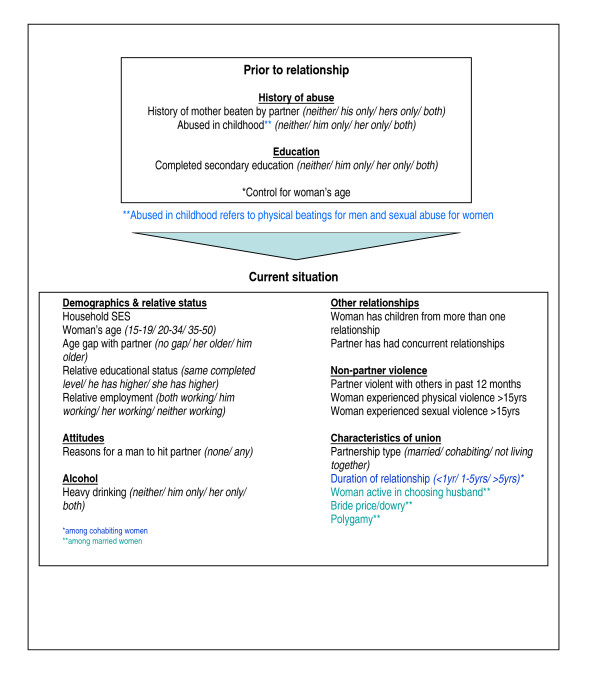
- Secondary education (or primary in Bangladesh, Ethiopia, and Tanzania) completed by both partners was protective in 12/14 sites (10 significant), and high SES was protective in 14 sites (8 significant comparing highest to lowest status).
- Alcohol problems in either or both partners were associated with higher IPV: him 14/14 sites (12 significant), her 10/11 (5 significant), both 11/11 (7 significant); attitudes supportive of wife beating were associated with increased IPV in 13/15 sites (8 significant).
- Prior abuse was consistently associated with IPV: reported abuse of the woman’s mother, partner’s mother, or both increased risk in all sites (10 significant for women, 10 for partners, 12 for both); childhood sexual abuse of the woman, childhood beatings of her partner, or both increased risk (15/15 for partners, all significant; 13/15 for women and both, 10 significant).
- Cohabitation without formal marriage increased IPV in 10/12 sites (3 significant); younger women aged 15–19 and 20–35 had increased risk in all sites (significant in 12); polygamy increased risk in all 6 sites where practiced (3 significant).
Methods
- Standardized population-based household surveys were conducted between 2000 and 2003 in Bangladesh, Brazil, Ethiopia, Japan, Namibia, Peru, Republic of Tanzania, Samoa, Serbia and Montenegro, and Thailand; one woman aged 15–49 was randomly selected per household, with 24,097 women interviewed and 19,517 ever-partnered women asked about partner violence.
- The outcome compared women reporting any physical and/or sexual partner violence in the past 12 months with women reporting no partner violence; women with lifetime but not past-year violence were excluded. Analyses included 15,207 women for “prior to relationship” models and 15,058 for “current situation” models.
- Multivariate logistic regression was run separately by site, with prior-to-relationship and current-situation variables modeled separately; ORs of 0.95–1.05 were considered no association, ≥1.05 risk factors, and ≤0.95 protective factors, with significance at 5%.
Limitations
- The paper states that the cross-sectional design limits conclusions about temporality or causality, although separating early-life and current characteristics clarifies temporality for some factors.
- The paper states that only women were interviewed, so partner characteristics rely on women’s reports and refer to the current or most recent partner, who may not be the perpetrator; any resulting misclassification would bias results toward the null.
- The text makes evident that small numbers in extreme exposure categories produced wide confidence intervals for some abuse-related ORs, and many site-specific associations were non-significant or varied in direction, so consistency is based on patterns across sites rather than uniform statistical significance.
Model-written summary. Check it against the paper before relying on it.
Integrity signals
Registry
Cites
Statistics
Figures
Verification
Claims the paper makes
3 Valid · 0 Not valid · 13 Not checked · 62 Own results and interpretations
Every source the paper cites for this claim was checked and supports it.
In the paper
“Higher socioeconomic status is generally associated with lower levels of physical and/or sexual partner violence.”
§ What factors are associated with recent intimate partner violence? findings from the WHO multi-country study on women's health and domestic violence > Discussion
What the sources say
- Supportedcites [27] Vyas S Watts C How does economic empowerment affect women's risk of intimate partner violence in low and middle income country settings?: A systematic review of published evidence J Int Dev 2009 21 577 602 10.1002/jid.1500 source
Section 4 (Discussion) says higher household socioeconomic status, measured by assets, is predominantly protective against intimate partner violence. Section 3.1 reports lower physical and/or sexual violence in several higher-wealth groups, while also noting null and contrary findings; the claim's word “generally” accommodates that variation. Page numbers are not provided for these passages. (LLM, conf=0.88)
plainstates an association- Asserted: passes — The authors put it forward as true.
- Checkable: passes — It can be checked against evidence.
- Load-bearing: passes — The paper’s conclusions depend on it.
- Based: passes — The paper gives a reason why it holds.
- Supported
A result the paper reports from its own data — it cites no other source for it, so there is none to check. The quote shows it is in the paper.
In the paper
“There was no consistent pattern of association between IPV and relative employment status.”
§ What factors are associated with recent intimate partner violence? findings from the WHO multi-country study on women's health and domestic violence > Results > Current situation model
plain- Asserted: passes — The authors put it forward as true.
- Checkable: passes — It can be checked against evidence.
- Load-bearing: unclear — It is unclear whether the paper’s conclusions depend on it.
- Based: passes — The paper gives a reason why it holds.
A result the paper reports from its own data — it cites no other source for it, so there is none to check. The quote shows it is in the paper.
In the paper
“Secondary education, high SES, and formal marriage offered protection, while alcohol abuse, cohabitation, young age, attitudes supportive of wife beating, having outside sexual partners, experiencing childhood abuse, growing up with domestic violence, and experiencing or perpetrating other forms of violence in adulthood, increased the risk of IPV.”
§ What factors are associated with recent intimate partner violence? findings from the WHO multi-country study on women's health and domestic violence > Abstract > Results
plainstates a cause- Asserted: passes — The authors put it forward as true.
- Checkable: passes — It can be checked against evidence.
- Load-bearing: passes — The paper’s conclusions depend on it.
- Based: passes — The paper gives a reason why it holds.
A result the paper reports from its own data — it cites no other source for it, so there is none to check. The quote shows it is in the paper.
In the paper
“In all sites odds of IPV were higher in relationships where one or both partners had problems with alcohol, compared to relationships where neither of them did (him 14/14, 12 significant; her 10/11, 5 significant; both 11/11, 7 significant).”
§ What factors are associated with recent intimate partner violence? findings from the WHO multi-country study on women's health and domestic violence > Results > Current situation model
plainstates an association- Asserted: passes — The authors put it forward as true.
- Checkable: passes — It can be checked against evidence.
- Load-bearing: passes — The paper’s conclusions depend on it.
- Based: passes — The paper gives a reason why it holds.
56 more claims
Create a free account to see all 78 claims and to verify the 3 references still open.
- It may state two separate claims as one. 8
- Probably not a substantial claim. 9
Self-check
Percentages, sums and reported differences re-computed from the paper’s own numbers.
Each contradiction between two passages listed here was confirmed by an independent check.
Rated minor: it would not touch a result — a value no result rests on, a p-value that stays on the same side of the significance level, or a conflict that is clerical, resolved elsewhere in the paper, or outside its own findings.
In the paper
§ What factors are associated with recent intimate partner violence? findings from the WHO multi-country study on women's health and domestic violence > Results > Prior to relationship
“15/15 sites for partners, all significant”
§ What factors are associated with recent intimate partner violence? findings from the WHO multi-country study on women's health and domestic violence > Results
“| 7 | 2.5 (1.4 - 4.3) | 5 | 1.6 (0.89 - 2.8) |”
Rated minor: it would not touch a result — a value no result rests on, a p-value that stays on the same side of the significance level, or a conflict that is clerical, resolved elsewhere in the paper, or outside its own findings.
In the paper
§ What factors are associated with recent intimate partner violence? findings from the WHO multi-country study on women's health and domestic violence > Results > Prior to relationship
“reports of abuse of the woman's mother, her partners' mother, or both (compared to no known reported abuse of either mother) being associated with increased risk of IPV in all sites”
§ What factors are associated with recent intimate partner violence? findings from the WHO multi-country study on women's health and domestic violence > Results
“| 4 | 2.5 (1.1 - 5.5) | 2 | 0.47 (0.06 - 4.0) | 2 | 2.2 (0.93 - 5.3) |”
Citations
Cites
The world report on violence and health
Krug, E. G., Mercy, J. A., Dahlberg, L. L., & Zwi, A. B. (2002) · The Lancet · doi:10.1016/s0140-6736(02)11133-0 · Cited by 9,110 · cited 1×
“The consistent association between IPV and other forms of violence against women also point to the need for integrated responses to violence across sectors and programmes [30,31].”
BackgroundMultilevel analysis techniques and applications
Hox, J. J., Moerbeek, M., & van de Schoot, R. (2002) · Cited by 6,886
Garcia-Moreno, C., Jansen, H. A., Ellsberg, M., Heise, L., & Watts, C. H. (2006) · The Lancet · doi:10.1016/s0140-6736(06)69523-8 · Cited by 3,176
Self-citationBehind Closed Doors: Violence in the American Family.
Boudouris, J., Straus, M. A., Gelles, R. J., & Steinmetz, S. K. (1982) · Contemporary Sociology · doi:10.2307/2068814 · Cited by 3,088
Hox, J., Moerbeek, M., & van de Schoot, R. (2002) · doi:10.4324/9781410604118 · Cited by 2,419
Violence Against Women: An Integrated, Ecological Framework
HEISE, L. L. (1998) · Violence Against Women · doi:10.1177/1077801298004003002 · Cited by 2,042
Self-citationIntimate partner violence: causes and prevention
Jewkes, R. (2002) · The Lancet · doi:10.1016/s0140-6736(02)08357-5 · Cited by 1,993
Ellsberg, M., Jansen, H. A., Heise, L., Watts, C. H., & Garcia-Moreno, C. (2008) · The Lancet · doi:10.1016/s0140-6736(08)60522-x · Cited by 1,820 · cited 1×
“In addition to being a concern in its own right, IPV is associated with a range of adverse physical, mental, sexual and reproductive health outcomes [2-8].”
BackgroundSelf-citationDunkle, K. L., Jewkes, R. K., Brown, H. C., Gray, G. E., McIntryre, J. A., & Harlow, S. D. (2004) · The Lancet · doi:10.1016/s0140-6736(04)16098-4 · Cited by 1,323 · cited 1×
“In addition to being a concern in its own right, IPV is associated with a range of adverse physical, mental, sexual and reproductive health outcomes [2-8].”
BackgroundIntimate partner physical abuse perpetration and victimization risk factors: A meta-analytic review
Stith, S. M., Smith, D. B., Penn, C. E., Ward, D. B., & Tritt, D. (2004) · Aggression and Violent Behavior · doi:10.1016/j.avb.2003.09.001 · Cited by 1,082 · cited 1×
“Studies in various countries have identified a range of factors that influence IPV risk [9-13], but in some cases, protective factors in one setting may be ineffective or actually increase risk in another [14].”
Background
Research works printed but not linked: 4
- Kishor S Johnson K Profiling domestic violence: A multicountry study 2004 Calverton, Maryland, USA: ORC Macro
- DoH South Africa Demographic and Health Survey 1998: final report 2002 Pretoria: Department of Health
- Harvey A Garcia Moreno C Butchart A Primary prevention of intimate partner violence and sexual violence: Background paper for WHO expert meeting May 2-3, 2007 2007 Geneva: World Health Organization, Department of Violence and Injuy Prevention and Disability
- Counts D Brown J Campbell J Sanctions and Sanctuary 1992 Boulder: Westview Press
Cited by
Items 1,101–1,200 of 1,413
Şimşek, Ü., Özkök, A., KILIBOZ, T., Garbioğlu, A., & Karbeyaz, K. (2026) · Medicine · doi:10.1097/md.0000000000047158 · Cited by 1
“[20,21] Low educational attainment, in particular, may reduce a woman’s ability to achieve economic independence and exacerbate power imbalances within relationships, thereby increasing the risk of partner violence.”
Ahmad, J., Dassi, A., & Nasreen, A. (2026) · Global Social Welfare · doi:10.1007/s40609-026-00440-x · Cited by 1
Al-Masaeid, M. (2026) · Journal of Economic Studies · doi:10.1108/jes-11-2025-0873 · Cited by 4
Davidson, N., Booij, A., & Ward, C. L. (2026) · Journal of Family Violence · doi:10.1007/s10896-026-01082-5 · Cited by 1
Tanyos, A., Willoughby, B., Hopkins, C. Q., Diress, G., Jiang, H., Jenkinson, R., MacLean, S. J., & Laslett, A. (2026) · Addiction · doi:10.1111/add.70540 · Cited by 4
Cortes, N. (2013) · UWM Digital Commons (University of Wisconsin–Milwaukee) · Cited by 1
Violence against women and girls 5 Addressing violence against women: a call to action
García‐Moreno, C., Zimmerman, C., Morris-Gehring, A., Heise, L., Amin, A., Abrahams, N., Ontoya, O. M., & Kilonzo, P. B.-D. N. (2015) · Cited by 1
Self-citationYoung adult mothers and intimate partner violence
Nash, S. P. (2016) · OhioLink ETD Center (Ohio Library and Information Network) · Cited by 1
An Overview of Women’s Health in the Arab World
Alquaiz, A. M., & Kazi, A. (2020) · Springer eBooks · doi:10.1007/978-3-319-74365-3_2-1 · Cited by 1
Karabulut, V. (2020) · Dusunen Adam The Journal of Psychiatry and Neurological Sciences · doi:10.14744/dajpns.2020.00077 · Cited by 3
“Among the individual risk factors for domestic violence were young age (13,14), poverty (13-15), low level of education (15-17), risk factors in early life (witnessing domestic violence and abuse as a child, maltreatment in childhood) (18-20), and alcohol/substance abuse (21,22).”
BackgroundSpousal Violence in Rural Nepal: Prevalence and Risk Factors
Paudel, M. (2021) · Journal of Population and Development · doi:10.3126/jpd.v2i1.43484 · Cited by 1
Nishat, K. J., & Rahman, M. S. (2017) · Advances in electronic government, digital divide, and regional development book series · doi:10.4018/978-1-5225-3018-3.ch014 · Cited by 3
Spousal Violence Against Women in the UAE Society
(2020) · المجلة العربية لعلم الاجتماع · doi:10.21608/ajsj.2020.102899 · Cited by 1
5 Preventing Domestic Violence: An International Overview
Pauls, M., Warthe, D. G., & Winterdyk, J. A. (2017) · CRC Press eBooks · doi:10.1201/9781315314211-6 · Cited by 1
How to Identify Sexual Assault and Intimate Partner Violence in Your ED
Sampsel, K. (2022) · First10EM blog · doi:10.51684/firs.127984 · Cited by 1
Violence against Women by Addicted Husbands in Iraq
Al-Musawy, J., Nashtar, S. B., Hussein, H. S., et al. (2022) · Open Access Macedonian Journal of Medical Sciences · doi:10.3889/oamjms.2022.9120 · Cited by 1
“5% of women without addicted husbands, this finding agrees with other study conducted by the WHO in multicountries [39], [40], which revealed that previous exposure of abuse was strongly associated with the occurrence of intimate partner violence, and this means that they are at high risk to a repetition of violence i…”
ResultViolencia de pareja y desarrollo infantil temprano
Alemann, C., Daga, G., Leer, J., & Bóo, F. L. (2022) · Revista Panamericana de Salud Pública · doi:10.26633/rpsp.2022.195 · Cited by 4
Adhikari, S. P., Maldonado-Rodriguez, N., Smirl, J. D., Boyle, Q., Mason, K., & van Donkelaar, P. (2023) · Springer eBooks · doi:10.1007/978-3-031-31547-3_40 · Cited by 1
Adane, M., Kloos, H., Mezemir, Y., Muche, A., & Amsalu, E. (2023) · BMC Women's Health · doi:10.1186/s12905-023-02530-w · Cited by 1
“was defined as any act of slapping a housemaid or throwing something at her, pushing or shoving her or pulling her hair, kicking or dragging her, beating her, punching her with a fist or with something else that could hurt her, choking or burning and threatening her with a weapon [26, 27].”
BackgroundPrevalence and Predictors of Physical Abuse of Women in Uganda and Malawi
Tesfaye, M., Ndlovu, A. V., Thompson, E., & Sofo, S. (2024) · Canadian Journal of Educational and Social Studies · doi:10.53103/cjess.v4i1.211 · Cited by 4
Fox, S., Holly, J., & Allwright, L. (2024) · Journal of Gender-Based Violence · doi:10.1332/23986808y2024d000000022 · Cited by 3
Oliveira, M. R., Madeiro, A. P., do Nascimento, F. F., Andrade, J. X., Rodrigues, M. T. P., & Mascarenhas, M. D. M. (2024) · Revista Brasileira de Epidemiologia · doi:10.1590/1980-549720240030.2 · Cited by 1
Intimate Partner Violence Predicts Child Marriage and Pregnancy Among Adolescents in Malawi
Swain, S., Kidman, R. C., Breton, E., Kawalazira, R. C., & Kohler, H. (2024) · Journal of Interpersonal Violence · doi:10.1177/08862605241270074 · Cited by 3
“The association between child marriages and IPV may stem from spousal age gaps, power imbalances, and traditional patriarchal norms (Abramsky et al., 2011; Hayati et al., 2011; Santhya et al., 2010; UNICEF, 2014a, 2014b; Weitzman, 2014).”
Ghelichkhani, F., Moghadam, Z. B., Zareiyan, A., & Namazi, M. (2024) · International Journal of Gynecology & Obstetrics · doi:10.1002/ijgo.15907 · Cited by 2
“17,47,48 Insufficient income and inflation impose extreme pressure on couples and increase the risk of marital conflict, tension, and violence.”
Spousal age differences and women’s contraceptive use in sub-Saharan Africa
Kyei, P. S., & Bawah, A. A. (2024) · Contraception and Reproductive Medicine · doi:10.1186/s40834-024-00306-7 · Cited by 1
“Women in age-disparate relationships are also at greater risk of intimate partner violence [22, 23].”
BackgroundOyedele, O., & Shinedima, N. (2024) · SAGE Open · doi:10.1177/21582440241285555 · Cited by 2
“…married, culture/traditional norms and phenomena, decision-making capacity, religion, employment status, occupation, marital status and wealth status (Abramsky et al., 2011; Ahinkorah et al., 2018; Bazargan-Hejazi et al., 2013; Chilanga et al., 2020; Siahaan et al., 2022; Willie et al., 2018).”
Fell, S. C., & Ramón, J. P. J. (2024) · Reflexión Política · doi:10.29375/01240781.4995 · Cited by 2
Nandi, A. K., Sarkar, B., Huda, M. N., Chandio, N., Rahaman, K. S., & Arora, A. (2024) · Behavioral Sciences · doi:10.3390/bs14111012 · Cited by 2
“Women who had tolerant attitudes towards wife beating were more likely to experience IPV in 13 out of 15 research locations, as reported by the WHO [18].”
Overlooked and underserved: how healthcare fails men in the pursuit of equity
Schulz, R. J., Ofner, H., Nyírády, P., Rajwa, P., Weiss, J., Shariat, S. F., & Fazekas, T. (2024) · Current Opinion in Urology · doi:10.1097/mou.0000000000001257 · Cited by 1
Agde, Z. D., Magnus, J. H., Assefa, N., & Wordofa, M. A. (2025) · International Journal of Environmental Research and Public Health · doi:10.3390/ijerph22020197 · Cited by 4
“Research indicates that cultural norms and societal acceptance play a critical role in the prevalence of IPV [7,18,53].”
Domestic violence: a survey on norms and impacts, AI detection approaches, and existing datasets
Mah, S. X., Jusoh, S., & Alfawareh, H. M. (2025) · Knowledge and Information Systems · doi:10.1007/s10115-025-02420-7 · Cited by 1
Głomb, K., Sekulak, M., Augustyn, A., & Michałkiewicz, N. (2025) · Psychology Crime and Law · doi:10.1080/1068316x.2025.2529443 · Cited by 4
Cyber-intimate partner violence (C-IPV) and its risk factors among women in Malaysia
Ahmad, Y., & Razali, S. (2025) · PLoS ONE · doi:10.1371/journal.pone.0327978 · Cited by 6
Fry, R. J., Rodgers, S., Orford, S., Morgan, J. S., & Fone, D. L. (2017) · International Journal for Population Data Science · doi:10.23889/ijpds.v1i1.342 · Cited by 1
Mobile Application for Survivors of Domestic Violence
Neelam, V. (2018) · Digital Archive @ GSU · doi:10.57709/12005400 · Cited by 2
Vadysinghe, A. N., Edussuriya, D. H., & Lakma, M. R. Y. (2018) · Arab Journal of Forensic Sciences and Forensic Medicine · doi:10.26735/16586794.2018.029 · Cited by 1
“This study confirms, to a certain extent, the findings in the literature which indicate that education gives protection against IPV [31-34].”
BackgroundResultWomen’s Autonomy and Spousal Violence in India: An Analysis of NFHS–3 Data
Ghosh, B. N., & Pasupuleti, S. S. R. (2019) · Springer eBooks · doi:10.1007/978-981-13-0387-6_10 · Cited by 1
Social Acceptability and Prevalence of Violence Against Women
Medilo, C. G. (2015) · Journal of Educational and Human Resource Development (JEHRD) · doi:10.61569/hgrevk74 · Cited by 1
Uyar, M., Öztürk, E. N. Y., & Şahin, T. K. (2019) · Turkish Bulletin of Hygiene and Experimental Biology · doi:10.5505/turkhijyen.2018.62593 · Cited by 1
“Literatüre baktığımızda düşük sosyoekonomik düzey, düşük eğitim seviyesi, genç yaş grubunda olma, alkol/madde kötüye kullanımı, yabancı olma, azınlık olma gibi faktörlerin hem şiddete uğrama hem de şiddet uygulama açısından risk faktörü olarak kabul edildiği görülmektedir (16-19).”
The US Mental Health Care System’s Response to Intimate Partner Violence: A Call to Action
Langhinrichsen‐Rohling, J., Selwyn, C. N., Lathan, E. C., & Schneider, M. B. (2020) · Springer eBooks · doi:10.1007/978-3-319-62122-7_140-1 · Cited by 1
Mowafy, M. A. (2020) · Indian Journal of Forensic Medicine & Toxicology · doi:10.37506/ijfmt.v14i3.10718 · Cited by 1
Female intimate partner violence in Zimbabwe: does empowerment matter?
Muchemwa, M., & Odimegwu, C. O. (2021) · SN Social Sciences · doi:10.1007/s43545-021-00228-0 · Cited by 1
“However, some studies argue that the empowerment of females through improved education has served as a tool for accelerating violence instead of reducing it (Jewkes, 2002; Castro et al. 2008; Abramsky et al. 2011; Zacarias et al. 2012).”
BackgroundDostanic, N., Stamenković, Ž., Maksimović, N., Djeric, A., & Djikanović, B. (2021) · Srpski arhiv za celokupno lekarstvo · doi:10.2298/sarh210405079d · Cited by 1
“According to the socio-ecological model, violence is a result of the interaction of four groups of factors that appear at the individual, partner’s, community and society level [8, 9].”
BackgroundDomestic Violence in Pregnant Women and Their Types. Case Study in Bali, Indonesia
Rahyani, N. K. Y., Mahayati, N. M. D., Darmapatni, M. W. G., & Armini, N. W. (2021) · IntechOpen eBooks · doi:10.5772/intechopen.98669 · Cited by 2
Violence and Women’s Health in Africa
Williams, T. M. (2021) · Springer eBooks · doi:10.1007/978-3-030-28099-4_101 · Cited by 2
Structural Violence: Social and Political Factors in Understanding Violence
Whittington, R., McGuire, J., & Peres, M. F. T. (2020) · Cambridge University Press eBooks · doi:10.1017/9781139086486.006 · Cited by 1
An Overview of Women’s Health in the Arab World
Alquaiz, A. M., & Kazi, A. (2021) · Springer eBooks · doi:10.1007/978-3-030-36811-1_2 · Cited by 1
Tracing the roots of generalized anxiety disorder; Domestic Violence & Abuse
Siddiqui, M. I., Kazi, K. A., Qadri, J. A., Rajput, A. H., Pandhiani, H., & Memon, M. A. (2021) · International Journal of Women Empowerment · doi:10.29052/2413-4252.v7.i1.2021.6-10 · Cited by 3
Intimate Partner Violence and Victims
Gopalan, R. T. (2022) · Springer eBooks · doi:10.1007/978-3-031-12930-8_5 · Cited by 2
Effects of Interpersonal Crime on Victims
Hamilton-Giachritsis, C. E., & sleath, E. (2017) · Wiley eBooks · doi:10.1002/9781394259281.ch5 · Cited by 1
Violência doméstica entre adolescentes escolares no município de São Paulo
Ralo, J. M. (2013) · Digital Library of Theses and Dissertations (Universidade de São Paulo) · doi:10.11606/d.6.2013.tde-06112013-111715 · Cited by 1
Sardaryan, Y., Thompson, M., & Kagan, S. H. (2013) · Cited by 3
Shumba, C. S. (2015) · Unisa Institutional Repository (University of South Africa) · Cited by 1
Smith, K. M. Z. (2015) · Human Biology · Cited by 1
Lysova, A. V. (2015) · TSpace (University of Toronto) · Cited by 1
Amuyunzu–Nyamongo, M. (2014) · OpenDocs (Institute of Development Studies) · doi:10.35648/20.500.12413/11781/ii114 · Cited by 2
“The Municipal level group (formally referred to as the Urban Nutrition Working Group - UNWG) is also the NICK action research group, and has membership drawn from the Ministries of Health (4); Municipality of Mombasa (3); Gender, Children and Social Development (1); Education (1); Office of the President (1); Agricult…”
BackgroundInfluentialEstablishing and supporting the Mombasa Urban Nutrition Working Group
Amuyunzu–Nyamongo, M., & Lang'o, D. (2012) · OpenDocs (Institute of Development Studies) · doi:10.35648/20.500.12413/11781/ii105 · Cited by 1
"Suffering in silence": a qualitative inquiry of sexual violence against married women in Ghana
Apatinga, G. A. (2019) · Memorial University Research Repository (Memorial University) · Cited by 9
Pearsall, P. (2017) · SHAREOK (University of Oklahoma; Oklahoma State University; Central Oklahoma University) · Cited by 1
Help-Seeking Behaviours of Bhutanesse Women Subjected to Intimate Partner Violence (IPV)
Choden, P. (2019) · Queensland University of Technology · doi:10.5204/thesis.eprints.133983 · Cited by 2
Queen Bees and Domestic Violence: Patrilocal Marriage in TajikistanPreprint
Turaeva, M., & Becker, C. M. (2016) · SSRN Electronic Journal · doi:10.2139/ssrn.2862096 · Cited by 2
Haufiku, J. (2019) · ResearchSpace (University of KwaZulu-Natal) · Cited by 1
Machine Learning Analysis of Non-Marital Sexual Violence in IndiaPreprint
Raj, A., Dehingia, N., Singh, A., et al. (2020) · SSRN Electronic Journal · doi:10.2139/ssrn.3756829 · Cited by 1
Education is a Remedy for Domestic Violence: Evidence from a Schooling Law ChangePreprint
Abdurahimov, R., & Akyol, P. (2018) · SSRN Electronic Journal · doi:10.2139/ssrn.3280153 · Cited by 3
“(2008) and Abramsky et al. (2011)). Understanding the causal relationship between education and domestic violence has important policy consequences. In a recent study, Erten and Keskin (2018) (hereafter EK), investigate the effect of education on the prevalence of domestic violence by utilizing a change in compulsory…”
MethodInterventions for Perpetration of Intimate Partner Violence
Stover, C. S., & Carlson, M. (2017) · Wiley eBooks · doi:10.1002/9781119057574.whbva076 · Cited by 2
Psychological Violence and Associated Factors Among Housemaid’s in Northwest Ethiopia.Preprint
Azanaw, K., Gelagay, A. A., & Lakew, A. M. (2020) · doi:10.21203/rs.3.rs-52769/v1 · Cited by 1
“Comparable nding was obtained from a study conducted in western Ethiopia ,northwest Ethiopia, Eastern Sudan, rural Vietnam and WHO multicounty study showed that women who had low educational status were more likely experience domestic violence[9, 10, 17, 18, 20, 23, 24].”
ResultIntimate Partner Violence against Women: Prevalence, Formal Reporting, and Risk Factors in Chile
Facusse, T. B. S., Contreras-Urbina, M., & Inchauste, G. (2022) · World Bank policy research working paper · doi:10.1596/1813-9450-10016 · Cited by 5
“…studies from different countries, while others are context-dependent and may vary across countries and even within the same country, for example, between urban and rural areas (Naved et al., 2005; Abramsky et al. 2011; Fulu et al., 2013; Koening et al., 2013; Jewkes et al., 2017; Ram et al., 2019).”
BackgroundMaguele, M. S. B. (2021) · ResearchSpace (University of KwaZulu-Natal) · doi:10.29086/10413/22862 · Cited by 2
Mwita, W. C., Mitao, M. P., Antony, C., Adinan, H., Ngiga, S. J., Mtuy, T. B., Leyaro, B. J., & Msuya, S. E. (2024) · Research Square · doi:10.21203/rs.3.rs-4650024/v1 · Cited by 1
Głomb, K., Sekulak, M., Augustyn, A., & Michałkiewicz, N. (2024) · Research Square · doi:10.21203/rs.3.rs-5017608/v1 · Cited by 1
Mboya, G. O. (2025) · medRxiv · doi:10.64898/2025.12.15.25342247 · Cited by 1
Alsayed, Z. H. (2013) · OpenGrey (Institut de l'Information Scientifique et Technique) · Cited by 1
Saile, R. (2015) · Publikationen an der Universität Bielefeld (Universität Bielefeld) · Cited by 2
The Association Between Violence and Victimization in Civil Psychiatric Patients
Pritchard, A. (2013) · Summit (Simon Fraser University)
Preventing Domestic Violence Via Education in Cloud Computing Service
Lin, C. Y., Shao, P.-C., & Singh, S. (2013) · Springer proceedings in complexity · doi:10.1007/978-94-007-7308-0_21
Pillai, P., & Holmes, A. E. (2015)
Davis, D. M. (2013) · doi:10.17077/etd.ikqf1jaj · Cited by 2
“According to Abramsky et al. (2011), several factors are associated with intimate partner violence.”
Terry, M. S. (2013) · Illinois Digital Environment for Access to Learning and Scholarship (University of Illinois at Urbana-Champaign)
Osulah, W. T. (2014) · University of Nairobi Research Archive (University of Nairobi)
More than mothers: aligning indicators with women's lives
Cypel, M., & Keshavjee, S. H. (2012)
Wilson, K. S. (2015) · ResearchWorks at the University of Washington (University of Washington)
Macklem, G. L. (2013) · Springer eBooks · doi:10.1007/978-1-4614-8609-1_14
Aspectos relevantes de la violencia intrafamiliar en la administración de la salud
Iglesia, J. A. A., Guerrero, I., Pérez, N. S. G., et al. (2013)
Bernardi, J., Day, A., & Bowen, E. (2015) · International Journal of Offender Therapy and Comparative Criminology · doi:10.1177/0306624x15609558
“Although a large number of risk factors are known to be associated with IPV (see Abramsky et al., 2011), key risk factors consistent with the World Health Organization’s bio-psycho-social conceptualization of the violent offending pathway include familyof-origin IPV, abusive fathering, trait anger,…”
BackgroundFlores, R., Ceccon, I., Nazareth, S., et al. (2014)
Tlapek, S. (2015) · Open Scholarship Institutional Repository (Washington University in St. Louis) · doi:10.7936/k7542kv5 · Cited by 2
Brown, L. (2016) · ThinkIR: The University of Louisville's Institutional Repository (University of Louisville) · doi:10.18297/etd/2394
Jill, R. (2013) · University of the Western Cape Electronic Theses and Dissertations Repository (University of the Western Cape) · Cited by 1
Schineanu, A. B. (2013) · eSpace (Curtin University) · Cited by 1
Brighton, R. M. (2016) · Research Online (University of Wollongong)
Carlos, J., Bermúdez, M. P., & Buela‐Casal, G. (2014)
Osifo, J. A., Fawole, O. I., Adejimi, A. A., & Sigbeku, O. A. (2016) · African Population Studies · doi:10.11564/30-2-859 · Cited by 1
Thomas, A. R. (2016) · NDSU Repository (North Dakota State University)
Does Education Affect Time Preference?Preprint
Bharati, T., & Chin, S. (2016) · SSRN Electronic Journal · doi:10.2139/ssrn.2880879 · Cited by 3
Preventing Domestic Violence: An International Overview
PAULS, D. G. W. M. (2017) · Routledge eBooks · doi:10.1201/9781315314211-15
Nguyen, A. H. (2016) · Digital Commons - University of South Florida (University of South Florida)
Metadata
- Authors
- Abramsky, T., Watts, C. H., Garcia-Moreno, C., Devries, K., Kiss, L., Ellsberg, M., Jansen, H. A., & Heise, L.
- Affiliations
- London School of Hygiene & Tropical Medicine (GB)
- International Center for Research on Women (US)
- Corresponding author
- Abramsky, Tanya
- Venue
- BMC Public Health
- Published
- 2011-02-16
- Volume
- 11
- Issue
- 1
- Pages
- 109-109
- ISSN
- 1471-2458 (ISSN-L)
- PMC
- PMC3049145
- OpenAlex
- W2146316233
- Semantic Scholar
- 124d14c4c5378026a820318c409f305314e161d1
- Cited by
- 1,413
- References
- 42
- Citations by year
- 2026: 66 · 2025: 85 · 2024: 102 · 2023: 96 · 2022: 108 · 2021: 133 · 2020: 137 · 2019: 105 · 2018: 103 · 2017: 106 · 2016: 95 · 2015: 89 · 2014: 75 · 2013: 69 · 2012: 28
- FWCI
- 60.57
- Type
- journal article
- Language
- en
- Open access
- gold
- doi.org
- Licence
- Locations
- BMC Public Health (publishedVersion, cc-by)
- PubMed Central (publishedVersion, cc-by)
- PubMed (publishedVersion)
- LSHTM Research Online (London School of Hygiene and Tropical Medicine) (acceptedVersion)
- DOAJ (DOAJ: Directory of Open Access Journals) (submittedVersion)
- Funders
- Rockefeller Foundation
- Styrelsen för Internationellt Utvecklingssamarbete
- United Nations Fund for Population Activities
- Mahidol University
- Umeå Universitet
- Universidade de São Paulo
- Uppsala Universitet
- Addis Ababa University
- Universidade Federal de Pernambuco
- Universidade de Pernambuco
- International Centre for Diarrhoeal Disease Research, Bangladesh
- Topics
- Social Sciences › Health › Intimate Partner and Family Violence
- Health Sciences › Medicine › Geriatrics and Gerontology › Elder Abuse and Neglect
- Social Sciences › Gender Studies › Sexual Assault and Victimization Studies
- Keywords
- intimate partner violence, domestic violence against women, risk factors, physical violence, sexual violence, alcohol abuse, childhood abuse, gender norms, IPV prevention, secondary education, socioeconomic status, cohabitation
- MeSH terms
- Adolescent, Adult, Data Collection, Female, Humans, Middle Aged, Risk Factors, Rural Population, Sexual Partners, Urban Population, World Health Organization, Logistic Models, Domestic Violence, Battered Women, Internationality, Young Adult
About these checks
Registry, retraction, Cites and statistics results are computed, not judged, with one exception: a printed reference that no index lists is read once by a model before it counts as a citation error. Claims are extracted by a model and kept only when their quote appears verbatim in the text; each cited source is then checked, with a model’s help, for whether it says what the claim relies on. Those verdicts can be wrong — read the claim’s quote and the cited source before relying on one.
The claim verdicts this report counts are experimental: their accuracy is not yet measured.
A language model drew the claims from the paper on 2026-10-10, under version 3 of the claim definition (model deepseek-v4.1-flash, prompt extract-v3).
A second model labelled each claim on 2026-10-10 (model jev-1.13-20260917, definition revision gold-guideline-v0.2).
Cited sources are checked with a language model’s help (gpt-6-sol).
Statistics and arithmetic are recomputed, not judged.
Confidence bands are shown only for fields calibrated on our annotated test set. None is calibrated yet, so no band is shown.
What counts as a claim ›How we measure confidence ›How we check this ›
Are you an author, or do you see a problem with this page? Request a review
Data sources
Bibliographic data: Semantic Scholar, OpenAlex, Crossref.
Contains information from the Semantic Scholar Academic Graph Datasets, made available under the ODC Attribution License (ODC-BY 1.0).
Semantic Scholar’s data is described in: Kinney, R., et al. (2023). The Semantic Scholar Open Data Platform. arXiv:2301.10140.
