

What factors are associated with recent intimate partner violence? findings from the WHO multi-country study on women's health and domestic violence
Open accessThe DOI matches its Crossref record; 41 of the 42 references it cites were found in a registry or an index, and 1 are not checked yet; 5 of the 24 sources its claims cite were checked for support.
Abstract
BACKGROUND: Intimate partner violence (IPV) against women is a global public health and human rights concern. Despite a growing body of research into risk factors for IPV, methodological differences limit the extent to which comparisons can be made between studies. We used data from ten countries included in the WHO Multi-country Study on Women's Health and Domestic Violence to identify factors that are consistently associated with abuse across sites, in order to inform the design of IPV prevention programs. METHODS: Standardised population-based household surveys were done between 2000 and 2003. One woman aged 15-49 years was randomly selected from each sampled household. Those who had ever had a male partner were asked about their experiences of physically and sexually violent acts. We performed multivariate logistic regression to identify predictors of physical and/or sexual partner violence within the past 12 months. RESULTS: Despite wide variations in the prevalence of IPV, many factors affected IPV risk similarly across sites. Secondary education, high SES, and formal marriage offered protection, while alcohol abuse, cohabitation, young age, attitudes supportive of wife beating, having outside sexual partners, experiencing childhood abuse, growing up with domestic violence, and experiencing or perpetrating other forms of violence in adulthood, increased the risk of IPV. The strength of the association was greatest when both the woman and her partner had the risk factor. CONCLUSIONS: IPV prevention programs should increase focus on transforming gender norms and attitudes, addressing childhood abuse, and reducing harmful drinking. Development initiatives to improve access to education for girls and boys may also have an important role in violence prevention.
Verified 2026-11-25 · 1 reference not checked yet
Overview
CoChat Summary
TL;DR
This WHO multi-country study used standardized household survey data from 10 countries and 15 sites to identify factors consistently associated with past-year physical and/or sexual intimate partner violence (IPV) among ever-partnered women. It found secondary education, high socioeconomic status, and formal marriage were protective, while alcohol abuse, cohabitation, young age, attitudes supportive of wife beating, outside sexual partners, childhood abuse, growing up with domestic violence, and other violence in adulthood increased risk, often most strongly when both partners had the factor.
Key findings
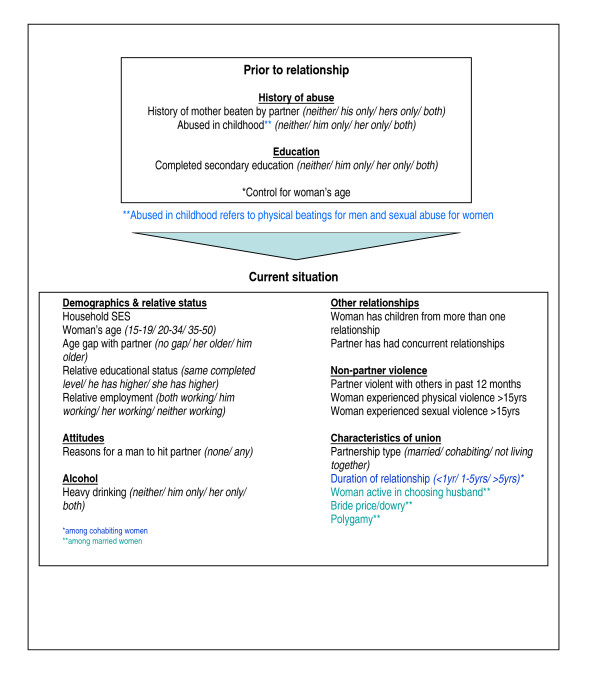
- Secondary education (or primary in Bangladesh, Ethiopia, and Tanzania) completed by both partners was protective in 12/14 sites (10 significant), and high SES was protective in 14 sites (8 significant comparing highest to lowest status).
- Alcohol problems in either or both partners were associated with higher IPV: him 14/14 sites (12 significant), her 10/11 (5 significant), both 11/11 (7 significant); attitudes supportive of wife beating were associated with increased IPV in 13/15 sites (8 significant).
- Prior abuse was consistently associated with IPV: reported abuse of the woman’s mother, partner’s mother, or both increased risk in all sites (10 significant for women, 10 for partners, 12 for both); childhood sexual abuse of the woman, childhood beatings of her partner, or both increased risk (15/15 for partners, all significant; 13/15 for women and both, 10 significant).
- Cohabitation without formal marriage increased IPV in 10/12 sites (3 significant); younger women aged 15–19 and 20–35 had increased risk in all sites (significant in 12); polygamy increased risk in all 6 sites where practiced (3 significant).
Methods
- Standardized population-based household surveys were conducted between 2000 and 2003 in Bangladesh, Brazil, Ethiopia, Japan, Namibia, Peru, Republic of Tanzania, Samoa, Serbia and Montenegro, and Thailand; one woman aged 15–49 was randomly selected per household, with 24,097 women interviewed and 19,517 ever-partnered women asked about partner violence.
- The outcome compared women reporting any physical and/or sexual partner violence in the past 12 months with women reporting no partner violence; women with lifetime but not past-year violence were excluded. Analyses included 15,207 women for “prior to relationship” models and 15,058 for “current situation” models.
- Multivariate logistic regression was run separately by site, with prior-to-relationship and current-situation variables modeled separately; ORs of 0.95–1.05 were considered no association, ≥1.05 risk factors, and ≤0.95 protective factors, with significance at 5%.
Limitations
- The paper states that the cross-sectional design limits conclusions about temporality or causality, although separating early-life and current characteristics clarifies temporality for some factors.
- The paper states that only women were interviewed, so partner characteristics rely on women’s reports and refer to the current or most recent partner, who may not be the perpetrator; any resulting misclassification would bias results toward the null.
- The text makes evident that small numbers in extreme exposure categories produced wide confidence intervals for some abuse-related ORs, and many site-specific associations were non-significant or varied in direction, so consistency is based on patterns across sites rather than uniform statistical significance.
Model-written summary. Check it against the paper before relying on it.
Integrity signals
Registry
Cites
Statistics
Figures
Verification
Claims the paper makes
3 Valid · 0 Not valid · 13 Not checked · 62 Own results and interpretations
Every source the paper cites for this claim was checked and supports it.
In the paper
“Higher socioeconomic status is generally associated with lower levels of physical and/or sexual partner violence.”
§ What factors are associated with recent intimate partner violence? findings from the WHO multi-country study on women's health and domestic violence > Discussion
What the sources say
- Supportedcites [27] Vyas S Watts C How does economic empowerment affect women's risk of intimate partner violence in low and middle income country settings?: A systematic review of published evidence J Int Dev 2009 21 577 602 10.1002/jid.1500 source
Section 4 (Discussion) says higher household socioeconomic status, measured by assets, is predominantly protective against intimate partner violence. Section 3.1 reports lower physical and/or sexual violence in several higher-wealth groups, while also noting null and contrary findings; the claim's word “generally” accommodates that variation. Page numbers are not provided for these passages. (LLM, conf=0.88)
plainstates an association- Asserted: passes — The authors put it forward as true.
- Checkable: passes — It can be checked against evidence.
- Load-bearing: passes — The paper’s conclusions depend on it.
- Based: passes — The paper gives a reason why it holds.
- Supported
A result the paper reports from its own data — it cites no other source for it, so there is none to check. The quote shows it is in the paper.
In the paper
“There was no consistent pattern of association between IPV and relative employment status.”
§ What factors are associated with recent intimate partner violence? findings from the WHO multi-country study on women's health and domestic violence > Results > Current situation model
plain- Asserted: passes — The authors put it forward as true.
- Checkable: passes — It can be checked against evidence.
- Load-bearing: unclear — It is unclear whether the paper’s conclusions depend on it.
- Based: passes — The paper gives a reason why it holds.
A result the paper reports from its own data — it cites no other source for it, so there is none to check. The quote shows it is in the paper.
In the paper
“Secondary education, high SES, and formal marriage offered protection, while alcohol abuse, cohabitation, young age, attitudes supportive of wife beating, having outside sexual partners, experiencing childhood abuse, growing up with domestic violence, and experiencing or perpetrating other forms of violence in adulthood, increased the risk of IPV.”
§ What factors are associated with recent intimate partner violence? findings from the WHO multi-country study on women's health and domestic violence > Abstract > Results
plainstates a cause- Asserted: passes — The authors put it forward as true.
- Checkable: passes — It can be checked against evidence.
- Load-bearing: passes — The paper’s conclusions depend on it.
- Based: passes — The paper gives a reason why it holds.
A result the paper reports from its own data — it cites no other source for it, so there is none to check. The quote shows it is in the paper.
In the paper
“In all sites odds of IPV were higher in relationships where one or both partners had problems with alcohol, compared to relationships where neither of them did (him 14/14, 12 significant; her 10/11, 5 significant; both 11/11, 7 significant).”
§ What factors are associated with recent intimate partner violence? findings from the WHO multi-country study on women's health and domestic violence > Results > Current situation model
plainstates an association- Asserted: passes — The authors put it forward as true.
- Checkable: passes — It can be checked against evidence.
- Load-bearing: passes — The paper’s conclusions depend on it.
- Based: passes — The paper gives a reason why it holds.
56 more claims
Create a free account to see all 78 claims and to verify the 3 references still open.
- It may state two separate claims as one. 8
- Probably not a substantial claim. 9
Self-check
Percentages, sums and reported differences re-computed from the paper’s own numbers.
Each contradiction between two passages listed here was confirmed by an independent check.
Rated minor: it would not touch a result — a value no result rests on, a p-value that stays on the same side of the significance level, or a conflict that is clerical, resolved elsewhere in the paper, or outside its own findings.
In the paper
§ What factors are associated with recent intimate partner violence? findings from the WHO multi-country study on women's health and domestic violence > Results > Prior to relationship
“15/15 sites for partners, all significant”
§ What factors are associated with recent intimate partner violence? findings from the WHO multi-country study on women's health and domestic violence > Results
“| 7 | 2.5 (1.4 - 4.3) | 5 | 1.6 (0.89 - 2.8) |”
Rated minor: it would not touch a result — a value no result rests on, a p-value that stays on the same side of the significance level, or a conflict that is clerical, resolved elsewhere in the paper, or outside its own findings.
In the paper
§ What factors are associated with recent intimate partner violence? findings from the WHO multi-country study on women's health and domestic violence > Results > Prior to relationship
“reports of abuse of the woman's mother, her partners' mother, or both (compared to no known reported abuse of either mother) being associated with increased risk of IPV in all sites”
§ What factors are associated with recent intimate partner violence? findings from the WHO multi-country study on women's health and domestic violence > Results
“| 4 | 2.5 (1.1 - 5.5) | 2 | 0.47 (0.06 - 4.0) | 2 | 2.2 (0.93 - 5.3) |”
Citations
Cites
The world report on violence and health
Krug, E. G., Mercy, J. A., Dahlberg, L. L., & Zwi, A. B. (2002) · The Lancet · doi:10.1016/s0140-6736(02)11133-0 · Cited by 9,110 · cited 1×
“The consistent association between IPV and other forms of violence against women also point to the need for integrated responses to violence across sectors and programmes [30,31].”
BackgroundMultilevel analysis techniques and applications
Hox, J. J., Moerbeek, M., & van de Schoot, R. (2002) · Cited by 6,886
Garcia-Moreno, C., Jansen, H. A., Ellsberg, M., Heise, L., & Watts, C. H. (2006) · The Lancet · doi:10.1016/s0140-6736(06)69523-8 · Cited by 3,176
Self-citationBehind Closed Doors: Violence in the American Family.
Boudouris, J., Straus, M. A., Gelles, R. J., & Steinmetz, S. K. (1982) · Contemporary Sociology · doi:10.2307/2068814 · Cited by 3,088
Hox, J., Moerbeek, M., & van de Schoot, R. (2002) · doi:10.4324/9781410604118 · Cited by 2,419
Violence Against Women: An Integrated, Ecological Framework
HEISE, L. L. (1998) · Violence Against Women · doi:10.1177/1077801298004003002 · Cited by 2,042
Self-citationIntimate partner violence: causes and prevention
Jewkes, R. (2002) · The Lancet · doi:10.1016/s0140-6736(02)08357-5 · Cited by 1,993
Ellsberg, M., Jansen, H. A., Heise, L., Watts, C. H., & Garcia-Moreno, C. (2008) · The Lancet · doi:10.1016/s0140-6736(08)60522-x · Cited by 1,820 · cited 1×
“In addition to being a concern in its own right, IPV is associated with a range of adverse physical, mental, sexual and reproductive health outcomes [2-8].”
BackgroundSelf-citationDunkle, K. L., Jewkes, R. K., Brown, H. C., Gray, G. E., McIntryre, J. A., & Harlow, S. D. (2004) · The Lancet · doi:10.1016/s0140-6736(04)16098-4 · Cited by 1,323 · cited 1×
“In addition to being a concern in its own right, IPV is associated with a range of adverse physical, mental, sexual and reproductive health outcomes [2-8].”
BackgroundIntimate partner physical abuse perpetration and victimization risk factors: A meta-analytic review
Stith, S. M., Smith, D. B., Penn, C. E., Ward, D. B., & Tritt, D. (2004) · Aggression and Violent Behavior · doi:10.1016/j.avb.2003.09.001 · Cited by 1,082 · cited 1×
“Studies in various countries have identified a range of factors that influence IPV risk [9-13], but in some cases, protective factors in one setting may be ineffective or actually increase risk in another [14].”
Background
Research works printed but not linked: 4
- Kishor S Johnson K Profiling domestic violence: A multicountry study 2004 Calverton, Maryland, USA: ORC Macro
- DoH South Africa Demographic and Health Survey 1998: final report 2002 Pretoria: Department of Health
- Harvey A Garcia Moreno C Butchart A Primary prevention of intimate partner violence and sexual violence: Background paper for WHO expert meeting May 2-3, 2007 2007 Geneva: World Health Organization, Department of Violence and Injuy Prevention and Disability
- Counts D Brown J Campbell J Sanctions and Sanctuary 1992 Boulder: Westview Press
Cited by
Items 801–900 of 1,413
Hosen, M. Z. (2023) · Heliyon · doi:10.1016/j.heliyon.2023.e20061 · Cited by 6
“The increase in poverty and inequalities due to the pandemic and lockdown might cause rising rapes [74,75].”
BackgroundKoning, S. M. (2024) · Population Research and Policy Review · doi:10.1007/s11113-023-09855-2 · Cited by 9
“Trauma-mediated mechanisms underlying IPV risk similarly operates through social ties within communities and families, including through intergenerational family violence and learned coping mechanisms, such as avoidance (Abramsky et al., 2011; Jeyaseelan et al., 2004).”
Xue, J., Lin, K., Li, L., Wang, H. H., & Sun, I. Y. (2024) · Journal of Interpersonal Violence · doi:10.1177/08862605241233266 · Cited by 8
“…linked to men’s perpetration of intimate partner violence (IPV) and women’s experiences of such violence, particularly physical and sexual abuse (Abramsky et al., 2011; Ali et al., 2011; Allen & Devitt, 2012; Fanslow et al., 2010; Fulu et al., 2013; Hu et al., 2019; Nabors & Jasinski, 2009;…”
BackgroundSilima, M., Christofides, N. J., Franchino-Olsen, H., Woollett, N., & Meinck, F. (2024) · BMJ Open · doi:10.1136/bmjopen-2024-086478 · Cited by 7
Victims but Also Perpetrators: Women’s Experiences of Partner Violence
Lysova, A. V. (2016) · Springer eBooks · doi:10.1007/978-3-319-08398-8_19 · Cited by 12
KABUL EDİLMEMESİ GEREKEN TOPLUMSAL BİR GERÇEK: YAKIN PARTNER ŞİDDETİ
Bulut, M., Aslan, R., & Arslantaş, H. (2020) · Sakarya Medical Journal · doi:10.31832/smj.681134 · Cited by 5
Unmet Interpersonal Needs Contribute to Accepting Attitudes towards Intimate Partner Violence
Smith, P. N., Basu, N., Wolford‐Clevenger, C., Schuler, K. R., Marie, L., Kuhlman, S. T. W., & Boone, S. D. (2020) · Journal of Aggression Maltreatment & Trauma · doi:10.1080/10926771.2020.1821855 · Cited by 11
“Some static risk factors include family of origin violence, childhood abuse, and marginalized identities (e.g., low income, disabled, and sexual minority; Abramsky et al., 2011; MacQueen, 2016; O’Keefe, 1998; Riggs et al., 2000; Stith et al., 2004).”
BackgroundTreves-Kagan, S., Peterman, A., Gottfredson, N. C., Villaveces, A., Moracco, K. E., & Maman, S. (2020) · Journal of Family Violence · doi:10.1007/s10896-020-00218-5 · Cited by 9
Gender-based violence amid the COVID-19 pandemic : a critical reflection on the global response
Gutura, P., & Nunlall, R. (2020) · UpSpace Institutional Repository (University of Pretoria) · Cited by 14
Forty, J. (2021) · Journal of Biosocial Science · doi:10.1017/s0021932021000559 · Cited by 8
Yalçın, S. U., Zonp, Z., Dinç, S., & Bilgin, H. (2022) · Journal of Nursing Management · doi:10.1111/jonm.13673 · Cited by 6
Gilchrist, G., Landau, S., Dheensa, S., Henderson, J., Johnson, A., Love, B., Potts, L. C., Radcliffe, P., Zenasni, Z., Parrott, S., et al. (2022) · Pilot and Feasibility Studies · doi:10.1186/s40814-022-01116-x · Cited by 8
Sinha, D., Srivastava, S., Muhammad, T., & Kumar, P. P. (2023) · BMC Women s Health · doi:10.1186/s12905-023-02252-z · Cited by 7
Cluver, L. D., Jochim, J., Mapukata, Y., Wittesaele, C., Shenderovich, Y., Mafuya, S., Roberts, K. J. S., Banougnin, B. H., Sherr, L., & Toska, E. (2023) · Child Care Health and Development · doi:10.1111/cch.13138 · Cited by 8
“…and positive future ideation are predictive of improved lifetime employment, earnings, better birth spacing, reduced intimate partner violence, HIV incidence and better child health (Abramsky et al., 2011; Balaj et al., 2021; Gadoth & Heymann, 2020; Schultz, 2002; Vandemoortele & Delamonica, 2000).”
BackgroundNguyen, T. T., Ha, L., Nguyen, L. H., Vu, L. G., Do, H., Boyer, L., Fond, G. B., Auquier, P., Latkin, C. A., Ho, C. S. H., et al. (2023) · Frontiers in Public Health · doi:10.3389/fpubh.2023.1105018 · Cited by 7
“The third paper in our list evaluated the risk factors affecting IPV against women (33).”
BackgroundKelly, J. T. D., Ekhator-Mobayode, U. E., Hanmer, L. C., Rubin, A. H., & Arango, D. J. (2024) · The Journal of Development Studies · doi:10.1080/00220388.2024.2376134 · Cited by 8
“For instance, childhood experiences of witnessing violence and partner alcohol or drug use are significant and powerful risk factors for women ’ s experiences of violence (Abramsky et al., 2011; Ellsberg et al., 2020; Feseha et al., 2012; Tlapek, 2015; Wachter et al., 2018).”
Rahnavardi, M., Shayan, A., Chamani, S. R., et al. (2019) · Journal of Health and Care · doi:10.29252/jhc.21.1.44 · Cited by 6
Berger-Polsky, A., Daoud, N., Sergienko, R., Sheiner, E., Shoham‐Vardi, I., & Bilenko, N. (2019) · Health Care For Women International · doi:10.1080/07399332.2019.1639708 · Cited by 6
“Also, our dataset does not include factors shown to mediate the impact of polygamy on birth outcomes, including mental health (Shepard, 2013), marital satisfaction and family functioning (Al-Krenawi et al., 2011), IPV (Abramsky et al., 2011; Dude, 2011; Hassouneh-Phillips, 2001; Ilika, Okonkwo, & Adogu, 2002), and soc…”
BackgroundInfluentialLearning Gender-based Attitudes in The Bahamas
Fielding, W. J., & Ballance, V. C. F. (2019) · International Journal of Bahamian Studies · doi:10.15362/ijbs.v25i0.339 · Cited by 6
“Gender-based violence has been the subject of global and regional research (QuaminaAiyejina & Brathwaite, 2005) that has examined the phenomenon from many angles, including the determination of factors which heighten the risk of its occurrence (Abramsky et al., 2011).”
BackgroundWalsh, L., Slesnick, N., & Wong, J. D. (2019) · Substance Use & Misuse · doi:10.1080/10826084.2019.1696825 · Cited by 9
“It is well established in the literature that childhood experiences of abuse and/or witnessing IPV as a child are related to experiencing IPV as an adult (Abramsky et al., 2011; Bensley, Van Eenwyk, & Simmons, 2003; Thompson et al., 2006).”
BackgroundMale High School Sport Participation and Intimate Partner Violence Perpetration in Adulthood
Eitle, D. J., Swinford, S. P., & Klonsinski, A. (2020) · Sociology of Sport Journal · doi:10.1123/ssj.2019-0185 · Cited by 8
Ali, T. S., Sami, N., Saeed, A. A., & Ali, P. A. (2020) · Nursing Open · doi:10.1002/nop2.660 · Cited by 6
“These include poor general health, injury, chronic pain, acquired immune deficiency syndrome (AIDS), sexually transmitted infections (STI), vaginal bleeding and lacerations, unwanted pregnancy, dyspareunia, urinary tract infections (UTI) (Abramsky et al., 2011; Watts & Mayhew, 2004) and reproductive tract infections (…”
BackgroundNapoli, I. D., Carnevale, S., Esposito, C., Block, R., Arcidiacono, C., & Procentese, F. (2020) · International Journal of Environmental Research and Public Health · doi:10.3390/ijerph17217910 · Cited by 7
“[36] suggested that a protective factor against IPV risk is completing secondary education, whereas primary education alone fails to confer similar benefits.”
BackgroundMagnusson, F. L., Rogathi, J. J., Sigalla, G. N., Manongi, R. N., Rasch, V., Gammeltoft, T. M., & Meyrowitsch, D. W. (2021) · Acta Obstetricia Et Gynecologica Scandinavica · doi:10.1111/aogs.14062 · Cited by 8
Ragetlie, R., Sano, Y., Hounkpatin, W. A., & Luginaah, I. (2021) · Global Public Health · doi:10.1080/17441692.2021.2011944 · Cited by 6
“Poverty, low socioeconomic status, unemployment, and financial distress have all been shown to increase the risk of IPV (Abramsky et al., 2011; Benson & Fox, 2004; Fox et al., 2002; Jewkes, 2002; Lucero et al., 2016; Matjasko et al., 2013; Peralta & Tuttle, 2013).”
BackgroundRoland, N., Ahogbehossou, Y., Hatem, G., Yacini, L., Feldmann, L., Saurel‐Cubizolles, M., & Bardou, M. (2022) · Health & Social Care in the Community · doi:10.1111/hsc.13797 · Cited by 16
Poix, S., Ibrahim, N., Scriver, S., Raghavendra, S., Duvvury, N., & Elmusharaf, K. (2022) · Women s Health · doi:10.1177/17455057221123998 · Cited by 11
Puig-Amores, I., Gordillo, I. C., & Parra, G. M.-M. (2022) · International Journal of Environmental Research and Public Health · doi:10.3390/ijerph192215340 · Cited by 13
La Violencia de Género y el Feminicidio. Comparación del Perfil de los Agresores
Pineda, D., Galán, M., Martínez-Martínez, A., Antonio, P. J., & Álvarez, J. L. G. (2024) · Anuario de Psicología Jurídica · doi:10.5093/apj2024a3 · Cited by 14
Jackson, A., & Shannon, L. M. (2015) · Women & Health · doi:10.1080/03630242.2015.1061090 · Cited by 8
“2005), cohabitation (Abramsky et al. 2011), urban residency (Lown and Vega 2001), and relationship status (e.”
BackgroundInfluentialSalisbury, M. E., & Dentato, M. P. (2015) · Journal of Human Behavior in the Social Environment · doi:10.1080/10911359.2015.1052911 · Cited by 9
“…has highlighted various risk factors for domestic violence including age, education level of both partners, number of children, alcohol and drug use, community norms, violence in either partner’s family of origin, and childhood experiences of violence (Abramsky et al., 2011; Kiss et al., 2012).”
Simón, T. Y., & Aznar, C. T. (2015) · Revista Española de Medicina Legal · doi:10.1016/j.reml.2015.02.003 · Cited by 6
Sivagurunathan, M., Packham, T., Dimopoulos, L., Murray, R., Madden, K., & MacDermid, J. C. (2017) · Journal of Hand Therapy · doi:10.1016/j.jht.2017.11.042 · Cited by 9
Ceccon, R. F., & Meneghel, S. N. (2015) · PubMed · Cited by 7
The Impacts of Domestic Violence on Workers and the Workplace
Rayner-Thomas, M. M. (2013) · ResearchSpace (University of Auckland) · Cited by 16
Understanding the Gendered Self: Implications from EI Theory, EI Self, and the BEVI
Pendleton, C. (2014) · JMU Scholoraly Commons (James Madison University) · Cited by 6
Polygyny and Women’s Status: Myths and Evidence
Pesando, L. M. (2020) · Encyclopedia of the UN sustainable development goals · doi:10.1007/978-3-319-70060-1_141-1 · Cited by 7
“In line with the above, Muldoon et al. (2011) found evidence of excess HIV risk behavior among men involved in polygynous relationships in the Jinja site in Eastern Uganda.”
BackgroundInfluentialMarketing Gender Norms: A Social Media Experiment in IndiaPreprint
Donati, D., Orozco-Olvera, V., & Rao, N. M. (2022) · SSRN Electronic Journal · doi:10.2139/ssrn.4158065 · Cited by 5
Using Social Media to Change Gender Norms: An Experiment within Facebook Messenger in India
Donati, D., Orozco-Olvera, V., & Rao, N. (2022) · World Bank, Washington, DC eBooks · doi:10.1596/1813-9450-10199 · Cited by 13
“Regressive gender norms perpetuate VAW and gender discrimination, since the acts are justified by established beliefs and attitudes (Abramsky et al. 2011; Flood and Pease 2009).”
BackgroundTadesse, G., Nakie, G., Rtbey, G., Tinsae, T., Fentahun, S., Andualem, F., Kelebie, M. A., Wassie, Y. A., Tsegaw, T. K., & Kibralew, G. (2025) · Archives of Public Health · doi:10.1186/s13690-025-01736-8 · Cited by 6
“Furthermore, witnessing maternal abuse [26, 27], pregnancy status [28], partner’s educational and occupational status [29], place of residence [30], and media exposure [31, 32] have all been significantly associated with IPV.”
Alkan, Ö., & KILINÇ, A. (2025) · Archives of Psychiatric Nursing · doi:10.1016/j.apnu.2025.151993 · Cited by 6
Amirroud, M. M., Ramezankhani, A., Ghaffari, M., & Soori, H. (2022) · Journal of Population and Social Studies · doi:10.25133/jpssv312023.003 · Cited by 5
Sowan, W. (2023) · Family Relations · doi:10.1111/fare.12939 · Cited by 9
Reyal, H. P., Perera, M. N., & Guruge, G. N. D. (2024) · BMC Public Health · doi:10.1186/s12889-024-18893-0 · Cited by 15
“Intracluster correlation coefficient (ICC) was determined as 0.04 considering similar studies [22, 23].”
BackgroundMethodInfluentialJaureguizar, J., Santamaría, M. D., Pérez, N. G., & Redondo, I. (2024) · Journal of Interpersonal Violence · doi:10.1177/08862605241294240 · Cited by 9
“…these attitudes are formed at an early age, and considering their influence on aggressive behaviors toward partners in adolescents and young adults (Abramsky et al., 2011; Machado et al., 2010; Muñoz-Rivas et al., 2011; Próspero, 2007; Sears et al., 2007; Slep et al., 2001; Taylor & Mouzos, 2006;…”
Asiamah, N., Sarpong, E., Baidoo, U. Y., Eku, E., Aidoo, I. K., Doamekpor, E., Khan, H. T. A., Danquah, E., Yarfi, C., Baffoe, R. S., et al. (2024) · BMC Psychology · doi:10.1186/s40359-024-02163-0 · Cited by 6
Damtew, S. A., Shiferaw, S., Seme, A., et al. (2024) · BMC Pregnancy and Childbirth · doi:10.1186/s12884-024-06947-5 · Cited by 5
Tan, R. K. J., Campbell, L., Azevedo, V., Patrão, A. L., dos Reis, A. P., Bravo, R. G., Olumide, A. O., Adebayo, E., Osiberu, A. A., Francis, J. M., et al. (2024) · Journal of Aggression Maltreatment & Trauma · doi:10.1080/10926771.2024.2431731 · Cited by 6
“…in the context of IPV includes actions such as being slapped, having something thrown at a person, being pushed or shoved, being hit with a fist, being kicked, dragged or beaten up, being choked or burnt, or using or the threat of using a weapon against someone (Abramsky et al., 2011; WHO, 2005).”
Ngcobo, N. (2015) · Agenda · doi:10.1080/10130950.2015.1056586 · Cited by 9
“Abramsky et al (2011) further purport that intimate partner violence against women is a global human rights and public health concern.”
BackgroundInversion of traditional gender roles and intimate partner violence against pregnant women
Ribeiro, M. R. C., da Sílva, A. A. M., Schraiber, L. B., Murray, J., Alves, M. T. S. S. D. B. E., Batista, R. F. L., Rodrigues, L. D. S., Bettiol, H., Cavalli, R. D. C., & Barbieri, M. A. (2020) · Cadernos de Saúde Pública · doi:10.1590/0102-311x00113919 · Cited by 5
Kalk, T., Shrestha, B., Shrestha, P. N., Ferguson, G., Bergenfeld, I., Robbin, Z., & Clark, C. J. (2020) · Global Public Health · doi:10.1080/17441692.2020.1833959 · Cited by 5
“Additionally, the findings connecting financial challenges with alcohol use are consistent with studies that identify financial hardship as an instigator for marital conflict, stress, and partner violence (Abramsky et al., 2011; Loi et al., 1999).”
ResultPartner Violence During Pregnancy and its Affecting Factors a Province in Eastern Turkey
Pirinçci, E., Çelebi, E., & Durmus, A. (2020) · Nigerian Journal of Clinical Practice · doi:10.4103/njcp.njcp_104_19 · Cited by 6
Huber‐Krum, S., Miedema, S. S., Shortt, J. W., Villaveces, A., & Kress, H. C. (2021) · Child Abuse & Neglect · doi:10.1016/j.chiabu.2021.105381 · Cited by 5
Risk factors for intimate partner violence among native and immigrant male partners in Sweden
Stjernqvist, J., Petersson, J., & Strand, S. J. M. (2022) · Nordic Journal of Criminology · doi:10.1080/2578983x.2022.2051306 · Cited by 7
“Furthermore, a household’s low socioeconomic status can increase the risk of IPV as financial stress can lead to frustration and a feeling of inadequacy in men, as cultural norms designate them as the household provider (Abramsky et al., 2011; Heise, 1998).”
BackgroundIntersectional approaches to gender-based violence in universities
Gangoli, G., & Jones, C. (2022) · Routledge eBooks · doi:10.4324/9781003252474-5 · Cited by 8
In their own voices- understanding GBV in Zimbabwe: Evidence from a survivors perspective
Siziba, E., Mapuva, J., Bowora, J., Samukange, T., & Gomo, M. (2022) · Journal of African Studies and Development · doi:10.5897/jasd2022.0665 · Cited by 1
“Studies on the causes of GBV (Saffitz, 2010; Abramsky et al., 2011; Fulu et al., 2013; Fleming et al., 2015; Fidan and Bui, 2016; Finley, 2016; Farver and Hamieh, 2016) and effects (Lang et al., 2011; WHO, 2013; Wagman et al., 2015; Shamu et al., 2013; Decker et al., 2014) are vast and cover both…”
BackgroundA Descriptive Systematic Review of Food Insecurity and Intimate Partner Violence in Southern Africa
Macassa, G., Francisco, J. D. C., Militao, E. M. A., & Soares, J. J. F. (2022) · Women · doi:10.3390/women2040036 · Cited by 4
Gordillo, I. C., Parra, G. M.-M., & Puig-Amores, I. (2023) · Healthcare · doi:10.3390/healthcare11111639 · Cited by 10
“In relation to this, various studies [51,52] have shown that men who tend to accept violence are those who also tend to commit more acts of abuse towards their partner, thus adopting the role of the aggressor more easily.”
BackgroundCommunity perceptions of causes of violence against young women in Botswana: fuzzy cognitive mapping
Sarmiento, I., Field, M., Kgakole, L., Molatlhwa, P., Girish, I., Andersson, N., & Cockcroft, A. (2024) · Vulnerable Children and Youth Studies · doi:10.1080/17450128.2023.2262413 · Cited by 5
Impact of laws prohibiting domestic violence on wasting in early childhood
Bhuwania, P., Raub, A., Sprague, A., Martín, A. H.-S., Bose, B., Kidman, R. C., Nandi, A., Behrman, J. R., & Heymann, J. S. (2024) · PLoS ONE · doi:10.1371/journal.pone.0301224 · Cited by 7
“While exposure to domestic violence is shaped by many factors, including early marriage, educational attainment, and family resources, among others [20, 21], governments have important roles to play by legally prohibiting domestic violence and ensuring both the availability of protection for women…”
BackgroundDimbuene, Z. T., Ahinkorah, B. O., & Amugsi, D. (2025) · PLOS Global Public Health · doi:10.1371/journal.pgph.0001645 · Cited by 6
“At the national level, findings were in line with previous studies [10,39,69].”
Kaukinen, C. E., Powers, R. A., & Meyer, S. (2016) · Journal of Child Custody · doi:10.1080/15379418.2016.1204581 · Cited by 10
“Understanding the occurrence of CEDV in the context of other risk factors is especially pertinent as research consistently identifies parental alcohol use as a risk factor for domestic violence (Abramsky et al., 2011; J. Friend, Langhinrichsen-Rohling, & Eichold, 2011) and maternal depression and self-medication as im…”
BackgroundInfluentialAddressing the workplace effects of intimate partner violence
Widiss, D. A. (2018) · Routledge eBooks · doi:10.4324/9781315194868-6 · Cited by 5
Ramos, J. M., Rodríguez, A., Sánchez, A., & Mena, A. C. (2018) · Clínica y Salud · doi:10.5093/clysa2018a8 · Cited by 12
Prevalence of Domestic Violence Against Married Women in Turkey and Associated Risk Factors
Tanrıverdi, G., Çapık, C., & Gürsoy, M. Y. (2018) · Turkiye Klinikleri Journal of Medical Sciences · doi:10.5336/medsci.2017-58822 · Cited by 5
Rodney, R., Gastaldo, D., Trotz, D. A., & Crooks, C. V. (2021) · Journal of Interpersonal Violence · doi:10.1177/08862605211043585 · Cited by 11
“violence illustrate that some adolescents who are exposed to domestic violence in their familial home are at greater risk of perpetrating and/or being a victim of dating violence (Abramsky et al., 2011; Capaldi et al., 2012; Flood & Pease, 2009; WHO, 2009; Wolfe et al., 2009), where some research has found that adoles…”
BackgroundResultEmpowering Midwives and Obstetric Nurses
Ray, A. (2021) · IntechOpen eBooks · doi:10.5772/intechopen.78934 · Cited by 6
Thulin, E. J., Heinze, J. E., & Zimmerman, M. A. (2021) · Journal of Interpersonal Violence · doi:10.1177/08862605211050104 · Cited by 6
“…changes over time (Abramsky et al., 2011; Peterman et al., 2015); relationship type, with those who are married or separated being at greater risk (Abramsky et al., 2011; Tran et al., 2016); and education level and household socioeconomic status, as lower levels of education and socioeconomic…”
BackgroundGupta, G., Sachdeva, A., Kumar, M. T., & Singh, M. (2022) · The International Journal of Psychiatry in Medicine · doi:10.1177/00912174211053726 · Cited by 7
Afari, B. A., Enos, J. Y., Alangea, D. O., et al. (2022) · PLOS Global Public Health · doi:10.1371/journal.pgph.0000376 · Cited by 5
“The reported prevalence of IPV in Ghana, though higher than in other countries in the west Africa subregion, is within the 15% to 71% range estimated for low- and middle-income countries, obtained from the WHO multi-country study on women’s health and domestic violence [17].”
BackgroundShetty, V. K., Priyanka, S., Kumar, M., Akhila, C., Sreenivas, J., & Raghavan, V. (2020) · INDIAN JOURNAL OF MENTAL HEALTH AND NEUROSCIENCES · doi:10.32746/ijmhns.2020.v3.i2.45 · Cited by 5
Foláyan, M. O., Oloniniyi, I. O., Nwakamma, I. J., Stevens-Murphy, E.-J., Undelikwo, G., & Lusher, J. M. (2022) · BMC Public Health · doi:10.1186/s12889-022-14186-6 · Cited by 6
“IPV is an expression of relational power, dominance and control and thus, where there is the endorsement of traditional masculinity ideology, the risk for IPV is high where such dominance can be expressed like in male/female relationships and younger/older person relationships [77].”
BackgroundBashford-Squires, S., Gibson, L. M., & Nyashanu, M. (2022) · World sustainability series · doi:10.1007/978-3-031-12326-9_22 · Cited by 7
Intimate partner violence influence on deliveries assisted by skilled health personnel
Refaat, A. H. (2013) · SAGE Open Medicine · doi:10.1177/2050312113508388 · Cited by 5
Carlson, M., Kamimura, A., Trinh, H. N., Mo, W., Yamawaki, N., Bhattacharya, H., Nguyen, H. T. V., Makomenaw, A., Birkholz, R., & Olson, L. M. (2015) · Public Policy and Administration Research · Cited by 8
Effect of an intervention on attitudes towards domestic violence among Iranian girls.
Ekhtiari, Y. S., Shojaeizadeh, D., Foroushani, A. R., Ghofranipour, F. F., & Ahmadis, B. (2014) · PubMed · Cited by 10
Embracing the Complexity of Partner Violence from a Violent Events Perspective
Lysova, A. V. (2016) · Journal of Family Violence · doi:10.1007/s10896-016-9865-4 · Cited by 7
Zark, L., Hammond, S., Williams, A., & Pilgrim, J. (2019) · Zeitschrift für Rechtsmedizin · doi:10.1007/s00414-019-02000-9 · Cited by 5
Coparenting of fathers in residential substance use treatment
Stover, C. S., & Farrell, D. M. (2019) · Advances in Dual Diagnosis · doi:10.1108/add-12-2018-0025 · Cited by 5
Diale, B. M. (2014) · Mediterranean Journal of Social Sciences · doi:10.5901/mjss.2014.v5n16p506 · Cited by 5
“There is considerable research available on the needs, effects and experiences of women affected by domestic violence (Abramsky et al. 2011; García-Moreno, et al. 2005).”
BackgroundSanmani, L., Sheppard, Z. A., & Chapman, C. (2013) · International Journal of STD & AIDS · doi:10.1177/0956462412472799 · Cited by 5
Ali, T. S. (2011) · Figshare · Cited by 12
Women’s experience of violence in the aftermath of the Black Saturday bushfires
Parkinson, D. (2017) · Figshare · doi:10.4225/03/58b61debeaaa9 · Cited by 6
“A strong association between alcohol and violence has been identified in the domestic violence literature (Abramsky et al., 2011; Braaf, 2012; Foran & O'Leary, 2008; Livingston, 2011).”
BackgroundComo dialogar com homens autores de violência contra mulheres? Etnografia de um grupo reflexivo
Billand, J. (2016) · Digital Library of Theses and Dissertations (Universidade de São Paulo) · doi:10.11606/t.5.2017.tde-06022017-094542 · Cited by 53
Does Alcohol Cause Violence and Aggression?
Brown, W. C., & Leonard, K. E. (2017) · Wiley eBooks · doi:10.1002/9781119057574.whbva029 · Cited by 12
Coping Strategies of Women Intimate Partner Violence Survivors: Perspectives of Service Providers
Mansa, M. (2020) · HARVEST (University of Saskatchewan) · Cited by 7
Temesgen, T., Roba, K. T., Dheresa, M., et al. (2019) · Research Square · doi:10.21203/rs.2.14281/v1 · Cited by 5
The influence of socioeconomic and cultural factors on emotional violence in gender-based abuse
Patel, P., Xavier, A. F., Longchar, S., & Shrestha, S. (2025) · Global Public Health · doi:10.1080/17441692.2025.2514522 · Cited by 7
“These results support the notion that economic empowerment and financial balance are key factors in mitigating emotional violence risk, as seen in similar studies (Abramsky et al., 2011; García-Moreno et al., 2006; Heise, 2011).”
Koly, K. N., Muzaffar, R., Nessa, Z., Billah, M. A., Rasheed, S., & Kapilashrami, A. (2025) · International Journal for Equity in Health · doi:10.1186/s12939-025-02572-6 · Cited by 7
“It also included individual health status; health care utilisation, incidence of IPV utilising World Health Organization’s standardised study questionnaire [47]; and screened for mental health status using Generalised Anxiety Disorder-7 (GAD-7) and the Patient Health Questionnaire-9 (PHQ-9).”
Akbary, M. F., Taqaddausi, M. T., Han, L., & Jiang, Q. (2025) · Journal of Interpersonal Violence · doi:10.1177/08862605251398457 · Cited by 7
Determinants of Intimate Partner Physical Violence Against Women in Türkiye: A Rural–Urban Analysis
Ünver, Ş. (2026) · Journal of Forensic Psychology Research and Practice · doi:10.1080/24732850.2026.2634899 · Cited by 6
“…violence during childhood, substance abuse (Heise & Garcia-Moreno, 2002), personality disorders, and the acceptance of violence (for instance, the belief that it is permissible for a man to physically assault his spouse or partner), as well as a history of domestic abuse (Abramsky et al., 2011).”
Violence Against Children in Latin America and the Caribbean
Bott, S., Guedes, A. C., Hege-Tobasía, C., et al. (2017) · Routledge eBooks · doi:10.4324/9781351248433-9 · Cited by 4
Turunç, G., & Kisbu‐Sakarya, Y. (2021) · Journal of Interpersonal Violence · doi:10.1177/08862605211058212 · Cited by 6
“Findings from multiple countries showed that men’s justification of DV is one of the most significant predictors of men’s actual perpetration of DV (Abramsky et al., 2011; Flood & Pease, 2009; Hindin et al., 2008; Stith et al., 2004).”
BackgroundZiaei, S., Antu, J. F., Mamun, M. A., Parvin, K., & Naved, R. T. (2023) · Journal of Interpersonal Violence · doi:10.1177/08862605231188062 · Cited by 5
“Based on the present literature (Abramsky et al., 2011; Naved & Persson, 2005; Naved et al., 2017) and the availability of the data the following variables were selected as possible correlates of DV during pregnancy and in 10-and 18-year follow-ups: Women’s years of education (continuous), age…”
Kuchukhidze, S., Panagiotoglou, D., Boily, M., Diabaté, S., Eaton, J. W., Stöckl, H., Mbofana, F., Wanyenze, R. K., & Maheu‐Giroux, M. (2023) · PLOS Global Public Health · doi:10.1371/journal.pgph.0002146 · Cited by 6
Agero, G., Bedane, K. H., Segni, M. T., Kaso, A. W., Ayato, A. N., Bedada, D. B., & Mieso, A. E. (2024) · BioMed Research International · doi:10.1155/2024/2044708 · Cited by 5
Dimbuene, Z. T., Ahinkorah, B. O., & Amugsi, D. A. (2024) · PLoS ONE · doi:10.1371/journal.pone.0302627 · Cited by 4
Fatemeh, M. T., Maryam, N., & Mokhtari, L. (2024) · Midwifery · doi:10.1016/j.midw.2024.104108 · Cited by 4
Cénat, J. M., Amédée, L. M., Onesi, O., Darius, W. P., Barara, R., Villarreal, D. G., Farahi, S. M. M. M., Labelle, P., & Hébert, M. (2024) · Trauma Violence & Abuse · doi:10.1177/15248380241271345 · Cited by 8
“Scientific literature has shown that married people have a lower risk of violence because they are less likely to be in contact with several partners (Abramsky et al., 2011; Sardinha et al., 2022).”
Agde, Z. D., Magnus, J. H., Assefa, N., & Wordofa, M. A. (2025) · PLoS ONE · doi:10.1371/journal.pone.0317667 · Cited by 5
Metadata
- Authors
- Abramsky, T., Watts, C. H., Garcia-Moreno, C., Devries, K., Kiss, L., Ellsberg, M., Jansen, H. A., & Heise, L.
- Affiliations
- London School of Hygiene & Tropical Medicine (GB)
- International Center for Research on Women (US)
- Corresponding author
- Abramsky, Tanya
- Venue
- BMC Public Health
- Published
- 2011-02-16
- Volume
- 11
- Issue
- 1
- Pages
- 109-109
- ISSN
- 1471-2458 (ISSN-L)
- PMC
- PMC3049145
- OpenAlex
- W2146316233
- Semantic Scholar
- 124d14c4c5378026a820318c409f305314e161d1
- Cited by
- 1,413
- References
- 42
- Citations by year
- 2026: 66 · 2025: 85 · 2024: 102 · 2023: 96 · 2022: 108 · 2021: 133 · 2020: 137 · 2019: 105 · 2018: 103 · 2017: 106 · 2016: 95 · 2015: 89 · 2014: 75 · 2013: 69 · 2012: 28
- FWCI
- 60.57
- Type
- journal article
- Language
- en
- Open access
- gold
- doi.org
- Licence
- Locations
- BMC Public Health (publishedVersion, cc-by)
- PubMed Central (publishedVersion, cc-by)
- PubMed (publishedVersion)
- LSHTM Research Online (London School of Hygiene and Tropical Medicine) (acceptedVersion)
- DOAJ (DOAJ: Directory of Open Access Journals) (submittedVersion)
- Funders
- Rockefeller Foundation
- Styrelsen för Internationellt Utvecklingssamarbete
- United Nations Fund for Population Activities
- Mahidol University
- Umeå Universitet
- Universidade de São Paulo
- Uppsala Universitet
- Addis Ababa University
- Universidade Federal de Pernambuco
- Universidade de Pernambuco
- International Centre for Diarrhoeal Disease Research, Bangladesh
- Topics
- Social Sciences › Health › Intimate Partner and Family Violence
- Health Sciences › Medicine › Geriatrics and Gerontology › Elder Abuse and Neglect
- Social Sciences › Gender Studies › Sexual Assault and Victimization Studies
- Keywords
- intimate partner violence, domestic violence against women, risk factors, physical violence, sexual violence, alcohol abuse, childhood abuse, gender norms, IPV prevention, secondary education, socioeconomic status, cohabitation
- MeSH terms
- Adolescent, Adult, Data Collection, Female, Humans, Middle Aged, Risk Factors, Rural Population, Sexual Partners, Urban Population, World Health Organization, Logistic Models, Domestic Violence, Battered Women, Internationality, Young Adult
About these checks
Registry, retraction, Cites and statistics results are computed, not judged, with one exception: a printed reference that no index lists is read once by a model before it counts as a citation error. Claims are extracted by a model and kept only when their quote appears verbatim in the text; each cited source is then checked, with a model’s help, for whether it says what the claim relies on. Those verdicts can be wrong — read the claim’s quote and the cited source before relying on one.
The claim verdicts this report counts are experimental: their accuracy is not yet measured.
A language model drew the claims from the paper on 2026-10-10, under version 3 of the claim definition (model deepseek-v4.1-flash, prompt extract-v3).
A second model labelled each claim on 2026-10-10 (model jev-1.13-20260917, definition revision gold-guideline-v0.2).
Cited sources are checked with a language model’s help (gpt-6-sol).
Statistics and arithmetic are recomputed, not judged.
Confidence bands are shown only for fields calibrated on our annotated test set. None is calibrated yet, so no band is shown.
What counts as a claim ›How we measure confidence ›How we check this ›
Are you an author, or do you see a problem with this page? Request a review
Data sources
Bibliographic data: Semantic Scholar, OpenAlex, Crossref.
Contains information from the Semantic Scholar Academic Graph Datasets, made available under the ODC Attribution License (ODC-BY 1.0).
Semantic Scholar’s data is described in: Kinney, R., et al. (2023). The Semantic Scholar Open Data Platform. arXiv:2301.10140.
