

What factors are associated with recent intimate partner violence? findings from the WHO multi-country study on women's health and domestic violence
Open accessThe DOI matches its Crossref record; 42 of the 42 references it cites were found in a registry or an index; 5 of the 24 sources its claims cite were checked for support.
Abstract
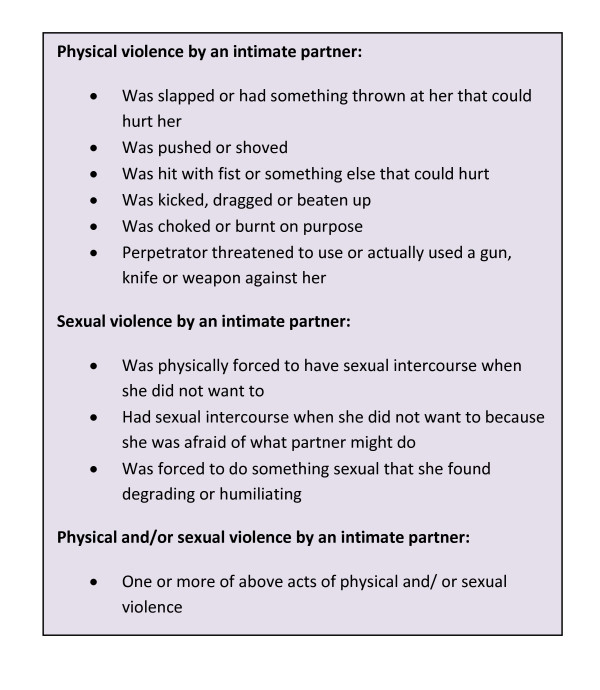
BACKGROUND: Intimate partner violence (IPV) against women is a global public health and human rights concern. Despite a growing body of research into risk factors for IPV, methodological differences limit the extent to which comparisons can be made between studies. We used data from ten countries included in the WHO Multi-country Study on Women's Health and Domestic Violence to identify factors that are consistently associated with abuse across sites, in order to inform the design of IPV prevention programs. METHODS: Standardised population-based household surveys were done between 2000 and 2003. One woman aged 15-49 years was randomly selected from each sampled household. Those who had ever had a male partner were asked about their experiences of physically and sexually violent acts. We performed multivariate logistic regression to identify predictors of physical and/or sexual partner violence within the past 12 months. RESULTS: Despite wide variations in the prevalence of IPV, many factors affected IPV risk similarly across sites. Secondary education, high SES, and formal marriage offered protection, while alcohol abuse, cohabitation, young age, attitudes supportive of wife beating, having outside sexual partners, experiencing childhood abuse, growing up with domestic violence, and experiencing or perpetrating other forms of violence in adulthood, increased the risk of IPV. The strength of the association was greatest when both the woman and her partner had the risk factor. CONCLUSIONS: IPV prevention programs should increase focus on transforming gender norms and attitudes, addressing childhood abuse, and reducing harmful drinking. Development initiatives to improve access to education for girls and boys may also have an important role in violence prevention.
Overview
CoChat Summary
TL;DR
This WHO multi-country study used standardized household survey data from 10 countries and 15 sites to identify factors consistently associated with past-year physical and/or sexual intimate partner violence (IPV) among ever-partnered women. It found secondary education, high socioeconomic status, and formal marriage were protective, while alcohol abuse, cohabitation, young age, attitudes supportive of wife beating, outside sexual partners, childhood abuse, growing up with domestic violence, and other violence in adulthood increased risk, often most strongly when both partners had the factor.
Key findings
- Secondary education (or primary in Bangladesh, Ethiopia, and Tanzania) completed by both partners was protective in 12/14 sites (10 significant), and high SES was protective in 14 sites (8 significant comparing highest to lowest status).
- Alcohol problems in either or both partners were associated with higher IPV: him 14/14 sites (12 significant), her 10/11 (5 significant), both 11/11 (7 significant); attitudes supportive of wife beating were associated with increased IPV in 13/15 sites (8 significant).
- Prior abuse was consistently associated with IPV: reported abuse of the woman’s mother, partner’s mother, or both increased risk in all sites (10 significant for women, 10 for partners, 12 for both); childhood sexual abuse of the woman, childhood beatings of her partner, or both increased risk (15/15 for partners, all significant; 13/15 for women and both, 10 significant).
- Cohabitation without formal marriage increased IPV in 10/12 sites (3 significant); younger women aged 15–19 and 20–35 had increased risk in all sites (significant in 12); polygamy increased risk in all 6 sites where practiced (3 significant).
Methods
- Standardized population-based household surveys were conducted between 2000 and 2003 in Bangladesh, Brazil, Ethiopia, Japan, Namibia, Peru, Republic of Tanzania, Samoa, Serbia and Montenegro, and Thailand; one woman aged 15–49 was randomly selected per household, with 24,097 women interviewed and 19,517 ever-partnered women asked about partner violence.
- The outcome compared women reporting any physical and/or sexual partner violence in the past 12 months with women reporting no partner violence; women with lifetime but not past-year violence were excluded. Analyses included 15,207 women for “prior to relationship” models and 15,058 for “current situation” models.
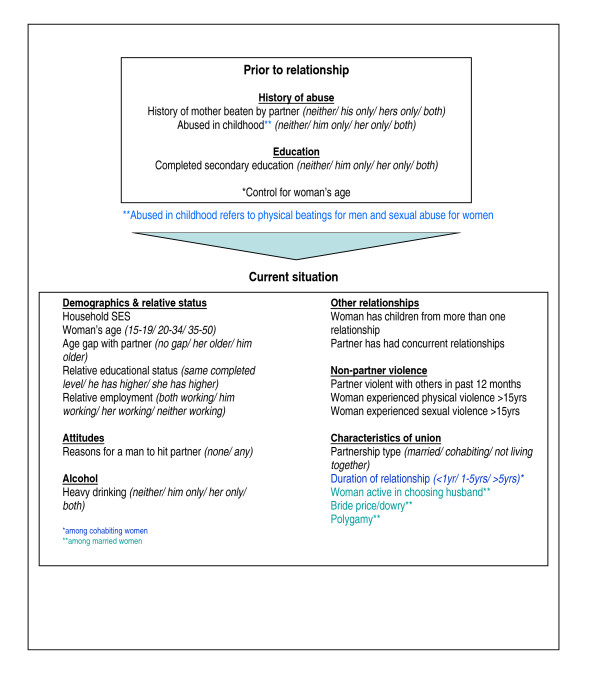
- Multivariate logistic regression was run separately by site, with prior-to-relationship and current-situation variables modeled separately; ORs of 0.95–1.05 were considered no association, ≥1.05 risk factors, and ≤0.95 protective factors, with significance at 5%.
Limitations
- The paper states that the cross-sectional design limits conclusions about temporality or causality, although separating early-life and current characteristics clarifies temporality for some factors.
- The paper states that only women were interviewed, so partner characteristics rely on women’s reports and refer to the current or most recent partner, who may not be the perpetrator; any resulting misclassification would bias results toward the null.
- The text makes evident that small numbers in extreme exposure categories produced wide confidence intervals for some abuse-related ORs, and many site-specific associations were non-significant or varied in direction, so consistency is based on patterns across sites rather than uniform statistical significance.
Model-written summary. Check it against the paper before relying on it.
Integrity signals
Registry
Cites
Statistics
Figures
Verification
Claims the paper makes
3 Valid · 0 Not valid · 13 Not checked · 62 Own results and interpretations
Every source the paper cites for this claim was checked and supports it.
In the paper
“Higher socioeconomic status is generally associated with lower levels of physical and/or sexual partner violence.”
§ What factors are associated with recent intimate partner violence? findings from the WHO multi-country study on women's health and domestic violence > Discussion
What the sources say
- Supportedcites [27] Vyas S, Watts C: How does economic empowerment affect women's risk of intimate partner violence in low and middle income country settings?: A systematic review of published evidence. J Int Dev. 2009, 21: 577-602. 10.1002/jid.1500. source
Section 4 (Discussion) says higher household socioeconomic status, measured by assets, is predominantly protective against intimate partner violence. Section 3.1 reports lower physical and/or sexual violence in several higher-wealth groups, while also noting null and contrary findings; the claim's word “generally” accommodates that variation. Page numbers are not provided for these passages. (LLM, conf=0.88)
plainstates an association- Asserted: passes — The authors put it forward as true.
- Checkable: passes — It can be checked against evidence.
- Load-bearing: passes — The paper’s conclusions depend on it.
- Based: passes — The paper gives a reason why it holds.
- Supported
A result the paper reports from its own data — it cites no other source for it, so there is none to check. The quote shows it is in the paper.
In the paper
“There was no consistent pattern of association between IPV and relative employment status.”
§ What factors are associated with recent intimate partner violence? findings from the WHO multi-country study on women's health and domestic violence > Results > Current situation model
plain- Asserted: passes — The authors put it forward as true.
- Checkable: passes — It can be checked against evidence.
- Load-bearing: unclear — It is unclear whether the paper’s conclusions depend on it.
- Based: passes — The paper gives a reason why it holds.
A result the paper reports from its own data — it cites no other source for it, so there is none to check. The quote shows it is in the paper.
In the paper
“Secondary education, high SES, and formal marriage offered protection, while alcohol abuse, cohabitation, young age, attitudes supportive of wife beating, having outside sexual partners, experiencing childhood abuse, growing up with domestic violence, and experiencing or perpetrating other forms of violence in adulthood, increased the risk of IPV.”
§ What factors are associated with recent intimate partner violence? findings from the WHO multi-country study on women's health and domestic violence > Abstract > Results
plainstates a cause- Asserted: passes — The authors put it forward as true.
- Checkable: passes — It can be checked against evidence.
- Load-bearing: passes — The paper’s conclusions depend on it.
- Based: passes — The paper gives a reason why it holds.
A result the paper reports from its own data — it cites no other source for it, so there is none to check. The quote shows it is in the paper.
In the paper
“In all sites odds of IPV were higher in relationships where one or both partners had problems with alcohol, compared to relationships where neither of them did (him 14/14, 12 significant; her 10/11, 5 significant; both 11/11, 7 significant).”
§ What factors are associated with recent intimate partner violence? findings from the WHO multi-country study on women's health and domestic violence > Results > Current situation model
plainstates an association- Asserted: passes — The authors put it forward as true.
- Checkable: passes — It can be checked against evidence.
- Load-bearing: passes — The paper’s conclusions depend on it.
- Based: passes — The paper gives a reason why it holds.
56 more claims
Create a free account to see all 78 claims and to verify the 3 references still open.
- It may state two separate claims as one. 8
- Probably not a substantial claim. 9
Self-check
Percentages, sums and reported differences re-computed from the paper’s own numbers.
Each contradiction between two passages listed here was confirmed by an independent check.
Rated minor: it would not touch a result — a value no result rests on, a p-value that stays on the same side of the significance level, or a conflict that is clerical, resolved elsewhere in the paper, or outside its own findings.
In the paper
§ What factors are associated with recent intimate partner violence? findings from the WHO multi-country study on women's health and domestic violence > Results > Prior to relationship
“15/15 sites for partners, all significant”
§ What factors are associated with recent intimate partner violence? findings from the WHO multi-country study on women's health and domestic violence > Results
“| 7 | 2.5 (1.4 - 4.3) | 5 | 1.6 (0.89 - 2.8) |”
Rated minor: it would not touch a result — a value no result rests on, a p-value that stays on the same side of the significance level, or a conflict that is clerical, resolved elsewhere in the paper, or outside its own findings.
In the paper
§ What factors are associated with recent intimate partner violence? findings from the WHO multi-country study on women's health and domestic violence > Results > Prior to relationship
“reports of abuse of the woman's mother, her partners' mother, or both (compared to no known reported abuse of either mother) being associated with increased risk of IPV in all sites”
§ What factors are associated with recent intimate partner violence? findings from the WHO multi-country study on women's health and domestic violence > Results
“| 4 | 2.5 (1.1 - 5.5) | 2 | 0.47 (0.06 - 4.0) | 2 | 2.2 (0.93 - 5.3) |”
Citations
Cites
The world report on violence and health
Krug, E. G., Mercy, J. A., Dahlberg, L. L., & Zwi, A. B. (2002) · The Lancet · doi:10.1016/s0140-6736(02)11133-0 · Cited by 9,110 · cited 1×
“The consistent association between IPV and other forms of violence against women also point to the need for integrated responses to violence across sectors and programmes [30,31].”
BackgroundMultilevel analysis techniques and applications
Hox, J. J., Moerbeek, M., & van de Schoot, R. (2002) · Cited by 6,728
Garcia-Moreno, C., Jansen, H. A., Ellsberg, M., Heise, L., & Watts, C. H. (2006) · The Lancet · doi:10.1016/s0140-6736(06)69523-8 · Cited by 3,176
Self-citationBehind Closed Doors: Violence in the American Family.
Boudouris, J., Straus, M. A., Gelles, R. J., & Steinmetz, S. K. (1982) · Contemporary Sociology · doi:10.2307/2068814 · Cited by 3,088
Hox, J., Moerbeek, M., & van de Schoot, R. (2002) · doi:10.4324/9781410604118 · Cited by 2,419
Violence Against Women: An Integrated, Ecological Framework
HEISE, L. L. (1998) · Violence Against Women · doi:10.1177/1077801298004003002 · Cited by 2,042
Self-citationIntimate partner violence: causes and prevention
Jewkes, R. (2002) · The Lancet · doi:10.1016/s0140-6736(02)08357-5 · Cited by 1,993
Ellsberg, M., Jansen, H. A., Heise, L., Watts, C. H., & Garcia-Moreno, C. (2008) · The Lancet · doi:10.1016/s0140-6736(08)60522-x · Cited by 1,820 · cited 1×
“In addition to being a concern in its own right, IPV is associated with a range of adverse physical, mental, sexual and reproductive health outcomes [2-8].”
BackgroundSelf-citationDunkle, K. L., Jewkes, R. K., Brown, H. C., Gray, G. E., McIntryre, J. A., & Harlow, S. D. (2004) · The Lancet · doi:10.1016/s0140-6736(04)16098-4 · Cited by 1,323 · cited 1×
“In addition to being a concern in its own right, IPV is associated with a range of adverse physical, mental, sexual and reproductive health outcomes [2-8].”
BackgroundIntimate partner physical abuse perpetration and victimization risk factors: A meta-analytic review
Stith, S. M., Smith, D. B., Penn, C. E., Ward, D. B., & Tritt, D. (2004) · Aggression and Violent Behavior · doi:10.1016/j.avb.2003.09.001 · Cited by 1,082 · cited 1×
“Studies in various countries have identified a range of factors that influence IPV risk [9-13], but in some cases, protective factors in one setting may be ineffective or actually increase risk in another [14].”
Background
Research works printed but not linked: 4
- Kishor S, Johnson K: Profiling domestic violence: A multicountry study. 2004, Calverton, Maryland, USA: ORC Macro
- DoH: South Africa Demographic and Health Survey 1998: final report. 2002, Pretoria: Department of Health
- Harvey A, Garcia Moreno C, Butchart A: Primary prevention of intimate partner violence and sexual violence: Background paper for WHO expert meeting May 2-3, 2007. 2007, Geneva: World Health Organization, Department of Violence and Injuy Prevention and Disability
- Counts D, Brown J, Campbell J: Sanctions and Sanctuary. 1992, Boulder: Westview Press
Cited by
Prevention of violence against women and girls: what does the evidence say?
Ellsberg, M., Arango, D. J., Morton, M., Gennari, F., Kiplesund, S., Contreras, M., & Watts, C. (2015) · The Lancet · doi:10.1016/s0140-6736(14)61703-7 · Cited by 875
Self-citationWhite, A. (2013) · Alcohol Research: Current Reviews · doi:10.35946/arcr.v35.2.11 · Cited by 807
“Other multinational studies have shown that odds of IPV were greater where one or both partners had alcohol problems (Abramsky et al. 2011) and that aggression severity was significantly higher if one or both partners had been drinking when the aggression occurred (Graham et al.”
A systematic review of the correlates of violence against sex workers
Deering, K. N., Amin, A., Shoveller, J., Nesbitt, A., Garcia-Moreno, C., Duff, P., Argento, E., & Shannon, K. (2014) · American Journal of Public Health · doi:10.2105/ajph.2014.301909 · Cited by 611
Devries, K. M., Child, J. C., Bacchus, L. J., Mak, J., Falder, G., Graham, K., Watts, C., & Heise, L. (2014) · Addiction · doi:10.1111/add.12393 · Cited by 551
“Twenty-six studies were from the United States, four samples from Peru [46,48], three from Brazil [46,48], two from New Zealand [52,53], Thailand [48] and Tanzania [48] and one study was drawn from each of Argentina [46] Australia [54], Belize [46], Canada [46], Chile [55], Columbia [56], Costa Rica [46], Ethiopia [48…”
BackgroundSelf-citationFulu, E., Jewkes, R., Roselli, T., & Garcia-Moreno, C. (2013) · The Lancet Global Health · doi:10.1016/s2214-109x(13)70074-3 · Cited by 523
Addressing violence against women: a call to action
García-Moreno, C., Zimmerman, C., Morris-Gehring, A., Heise, L., Amin, A., Abrahams, N., Montoya, O., Bhate-Deosthali, P., Kilonzo, N., & Watts, C. (2015) · The Lancet · doi:10.1016/s0140-6736(14)61830-4 · Cited by 483
Self-citationViolence against women and mental health
Oram, S., Khalifeh, H., & Howard, L. M. (2017) · The Lancet Psychiatry · doi:10.1016/s2215-0366(16)30261-9 · Cited by 474
Adolescence and the next generation
Patton, G. C., Olsson, C. A., Skirbekk, V., Saffery, R., Wlodek, M. E., Azzopardi, P. S., Stonawski, M., Rasmussen, B., Spry, E., Francis, K., et al. (2018) · Nature · doi:10.1038/nature25759 · Cited by 385
Stöckl, H., March, L., Pallitto, C., & Garcia-Moreno, C. (2014) · BMC Public Health · doi:10.1186/1471-2458-14-751 · Cited by 361
“IPV and attitudes favoring wife beating were important risk factors for IPV [29].”
BackgroundMethodInfluentialSelf-citationGuedes, A., Bott, S., Garcia-Moreno, C., & Colombini, M. (2016) · Global Health Action · doi:10.3402/gha.v9.31516 · Cited by 355
“Worldwide, women whose father beat their mother are significantly more likely to report partner violence than other women (40, 57).”
BackgroundSelf-citationChild marriage and intimate partner violence: a comparative study of 34 countries
Kidman, R. (2016) · International Journal of Epidemiology · doi:10.1093/ije/dyw225 · Cited by 346
“They are more likely, for example, to believe that husbands can be justified in beating their wives –a belief that places them at higher risk for IPV.(18,22,26) Moreover, child marriages are typically arranged by the family, and young girls have no input into the choice of spouse.”
BackgroundOram, S., Fisher, H. L., Minnis, H., Seedat, S., Walby, S., Hegarty, K., Rouf, K., Angénieux, C., Callard, F., Chandra, P. S., et al. (2022) · The Lancet Psychiatry · doi:10.1016/s2215-0366(22)00008-6 · Cited by 331
Buller, A. M., Peterman, A., Ranganathan, M., Bleile, A., Hidrobo, M., & Heise, L. (2018) · The World Bank Research Observer · doi:10.1093/wbro/lky002 · Cited by 295
“…and women’s risk of IPV (Gage 2005; Foran and O’Leary 2008; Graham et al. 2008; Hindin, Kishor, and Ansara 2008; Dalal, Rahman, and Jansson 2009; Abramsky et al. 2011); one systematic review pools the results of 11 studies and finds that harmful use of alcohol is associated with a 4.6-fold…”
BackgroundInfluentialSelf-citationNeighborhood Environment and Intimate Partner Violence: A Systematic Review
Beyer, K., Wallis, A. B., & Hamberger, L. K. (2015) · Trauma, Violence, & Abuse · doi:10.1177/1524838013515758 · Cited by 294
The State of Adolescent Sexual and Reproductive Health
Liang, M., Simelane, S., Fortuny Fillo, G., Chalasani, S., Weny, K., Salazar Canelos, P., Jenkins, L., Moller, A.-B., Chandra-Mouli, V., Say, L., et al. (2019) · Journal of Adolescent Health · doi:10.1016/j.jadohealth.2019.09.015 · Cited by 290
Domestic and sexual violence against patients with severe mental illness
Khalifeh, H., Moran, P., Borschmann, R., Dean, K., Hart, C., Hogg, J., Osborn, D., Johnson, S., & Howard, L. M. (2015) · Psychological Medicine · doi:10.1017/s0033291714001962 · Cited by 280
“…confounders, which were identified a priori from the literature, were: age, sex, ethnicity, educational attainment, employment, lone adult in household, child(ren) in household, housing tenure and small area multiple deprivation index (Walby & Allen, 2004; Abramsky et al. 2011; ONS, 2013).”
BackgroundIntimate partner violence against women and the Nordic paradox
Gracia, E., & Merlo, J. (2016) · Social Science & Medicine · doi:10.1016/j.socscimed.2016.03.040 · Cited by 267
“…studies in low and middle-income countries find that women’s increased economic or educational status may either protect them or increase their risk of IPV victimization, depending on the cultural and interpersonal context (Abramsky et al., 2011; Heise, 2011; Jewkes, 2002; Vyas and Watts, 2009).”
BackgroundA Systematic Review of Interventions for Preventing Adolescent Intimate Partner Violence
De Koker, P., Mathews, C., Zuch, M., Bastien, S., & Mason-Jones, A. J. (2014) · Journal of Adolescent Health · doi:10.1016/j.jadohealth.2013.08.008 · Cited by 243
Coll, C. V. N., Ewerling, F., García-Moreno, C., Hellwig, F., & Barros, A. J. D. (2020) · BMJ Global Health · doi:10.1136/bmjgh-2019-002208 · Cited by 240
Self-citationSardinha, L., & Nájera Catalán, H. E. (2018) · PLOS ONE · doi:10.1371/journal.pone.0206101 · Cited by 238
Fulu, E., Miedema, S., Roselli, T., McCook, S., Chan, K. L., Haardörfer, R., Jewkes, R., Fulu, E., Jewkes, R., Warner, X., et al. (2017) · The Lancet Global Health · doi:10.1016/s2214-109x(17)30103-1 · Cited by 236
Fleming, P. J., McCleary-Sills, J., Morton, M., Levtov, R., Heilman, B., & Barker, G. (2015) · PLOS ONE · doi:10.1371/journal.pone.0118639 · Cited by 236
“Most international survey research on IPV, women’s rights, and gender equity focuses on women, or has limited data on men’s attitudes and behaviors [3,28].”
BackgroundHeath, R. (2014) · World Development · doi:10.1016/j.worlddev.2013.10.028 · Cited by 229
“search has also found that education and higher age at marriage are associated with less domestic violence even if a woman does not work outside the home (Abramsky et al. 2011; Koenig, Ahmed, Hossain, and Mozumder 2003; Jejeebhoy and Cook 1997), so I also expect that β2 > 0 in both equations.”
Women decision-making capacity and intimate partner violence among women in sub-Saharan Africa
Ahinkorah, B. O., Dickson, K. S., & Seidu, A.-A. (2018) · Archives of Public Health · doi:10.1186/s13690-018-0253-9 · Cited by 215
“Background Violence against women is a common form of human rights violation, and intimate partner violence (IPV) appears to be the most significant component of violence [1, 2].”
BackgroundLeonard, K. E., & Quigley, B. M. (2017) · Drug and Alcohol Review · doi:10.1111/dar.12434 · Cited by 212
Gibbs, A., Jewkes, R., Willan, S., & Washington, L. (2018) · PLOS ONE · doi:10.1371/journal.pone.0204956 · Cited by 213
Gender-Based Violence Against Adolescent and Young Adult Women in Low- and Middle-Income Countries
Decker, M. R., Latimore, A. D., Yasutake, S., Haviland, M., Ahmed, S., Blum, R. W., Sonenstein, F., & Astone, N. M. (2015) · Journal of Adolescent Health · doi:10.1016/j.jadohealth.2014.09.003 · Cited by 209
McCloskey, L. A., Boonzaier, F., Steinbrenner, S. Y., & Hunter, T. (2016) · Partner Abuse · doi:10.1891/1946-6560.7.3.277 · Cited by 203
“300 McCloskey et al. 2010).”
BackgroundInfluentialPotter, L. C., Morris, R., Hegarty, K., García-Moreno, C., & Feder, G. (2021) · International Journal of Epidemiology · doi:10.1093/ije/dyaa220 · Cited by 198
“We adjusted for site, age group, current partner status and education; further potential confounders such as alcohol abuse or experience of child abuse could also be explored.(33) This study is also limited by its focus on women aged 15– 49 years.”
MethodSelf-citationDoes economic empowerment protect women from intimate partner violence?
Dalal, K. (2011) · Journal of Injury and Violence Research · doi:10.5249/jivr.v3i1.76 · Cited by 192
Maxwell, L., Devries, K., Zionts, D., Alhusen, J. L., & Campbell, J. (2015) · PLOS ONE · doi:10.1371/journal.pone.0118234 · Cited by 186
“Women may be unlikely both because of the fear of increased violence and because of the stigma associated with reporting [54,57].”
BackgroundSelf-citationOgum Alangea, D., Addo-Lartey, A. A., Sikweyiya, Y., Chirwa, E. D., Coker-Appiah, D., Jewkes, R., & Adanu, R. M. K. (2018) · PLOS ONE · doi:10.1371/journal.pone.0200874 · Cited by 187
Jewkes, R., Fulu, E., Tabassam Naved, R., Chirwa, E., Dunkle, K., Haardörfer, R., Garcia-Moreno, C., & on behalf of the UN Multi-country Study on Men and Violence Study Team (2017) · PLOS Medicine · doi:10.1371/journal.pmed.1002381 · Cited by 180
Self-citationViolence Against Women: Globalizing the Integrated Ecological Model
Fulu, E., & Miedema, S. (2015) · Violence Against Women · doi:10.1177/1077801215596244 · Cited by 178
Problem Gambling and Intimate Partner Violence: A Systematic Review and Meta-Analysis
Dowling, N., Suomi, A., Jackson, A., Lavis, T., Patford, J., Cockman, S., Thomas, S., Bellringer, M., Koziol-Mclain, J., Battersby, M., et al. (2016) · Trauma, Violence, & Abuse · doi:10.1177/1524838014561269 · Cited by 171
“’’ Numerous cross-sectional studies have identified a range of social, family, and individual factors associated with IPV victimization and perpetration (Abramsky et al., 2011; Capaldi, Knoble, Shortt, & Kim, 2012; Fulu et al., 2013; Stith, Smith, Penn, Ward, & Tritt, 2004; World Health Organization, 2002).”
BackgroundThe European Journal of Psychology Applied to Legal Context
Marco, M., Gracia, E., Tomás, J. M., & López‐Quílez, A. (2016) · Cited by 162
Increases in Intimate Partner Violence During COVID-19: Prevalence and Correlates
Peitzmeier, S. M., Fedina, L., Ashwell, L., Herrenkohl, T. I., & Tolman, R. (2022) · Journal of Interpersonal Violence · doi:10.1177/08862605211052586 · Cited by 160
“Specifically, we use theWorld Health Organization’s (WHO) conceptual framework of risk factors commonly associated with IPV (Abramsky et al., 2011) as well as socioecological perspectives of IPV that emphasize the multilevel nature of risk and protection (Hardesty & Ogolsky, 2020).”
MethodKapiga, S., Harvey, S., Muhammad, A. K., Stöckl, H., Mshana, G., Hashim, R., Hansen, C., Lees, S., & Watts, C. (2017) · BMC Public Health · doi:10.1186/s12889-017-4119-9 · Cited by 150
Self-citationThe dark triad and intimate partner violence
Carton, H., & Egan, V. (2017) · Personality and Individual Differences · doi:10.1016/j.paid.2016.09.040 · Cited by 155
“Contents lists available at ScienceDirect Personality and Individual Differences j ourna l homepage: www.e lsev ie r .com/ locate /pa id elements of the behaviour (Campbell, 2002; Campbell et al., 2002; Abramsky et al., 2011).”
MethodCash transfers, polygamy, and intimate partner violence: Experimental evidence from Mali
Heath, R., Hidrobo, M., & Roy, S. (2019) · Journal of Development Economics · doi:10.1016/j.jdeveco.2019.102410 · Cited by 196
“Evidence from diverse contexts in Sub-Saharan Africa – including Mali – shows positive associations between polygamous marriage and prevalence of IPV (Bove and Valeggia 2009; Jewkes, Levin, and PennKekana 2002; Karamagi et al. 2006; Abramsky et al. 2011; González-Brenes 2004; Kimuna and Djamba 2008; Hayes and van Baak…”
BackgroundSchaefer, R., Gregson, S., Eaton, J. W., Mugurungi, O. M., Rhead, R. D., Takaruza, A., Maswera, R., & Nyamukapa, C. A. (2017) · AIDS · doi:10.1097/qad.0000000000001506 · Cited by 159
“Moreover, age-disparate sexual relationships are often characterised by socio-economic asymmetries, which can leave young women unable to negotiate condom use or vulnerable to forced sex [5,6].”
BackgroundSocial norms and women's risk of intimate partner violence in Nepal
Clark, C. J., Ferguson, G., Shrestha, B., Shrestha, P. N., Oakes, J. M., Gupta, J., McGhee, S., Cheong, Y. F., & Yount, K. M. (2018) · Social Science & Medicine · doi:10.1016/j.socscimed.2018.02.017 · Cited by 170
“In addition to the social norms findings, this study reinforces the well-established relationship between men's educational attainment and women's lower risk of IPV (Abramsky et al., 2011; Atteraya et al., 2015; Ghimire et al., 2015; Ghimire and Samuels, 2017) and the positive link between household financial stress o…”
BackgroundInfluentialGender, Power, and Intimate Partner Violence: A Study on Couples From Rural Malawi
Conroy, A. A. (2013) · Journal of Interpersonal Violence · doi:10.1177/0886260513505907 · Cited by 181
“Following the steps of Abramsky et al. (2011), income and educational differences between partners were also modeled as 3-level categorical variables where 0 equals no difference, 1 equals higher female values, and 3 equals higher male values.”
BackgroundMethodInfluentialSaile, R., Neuner, F., Ertl, V., & Catani, C. (2013) · Social Science & Medicine · doi:10.1016/j.socscimed.2013.02.046 · Cited by 172
“A number of studies around the world have demonstrated that female victims of childhood maltreatment are at increased risk of becoming victims of physical and sexual violence in adult intimate relationships when controlling for socio-demographic variables such as age, educational level, and socioeconomic status (Abram…”
BackgroundResultAbeya, S. G., Afework, M. F., & Worku, A. (2011) · BMC Public Health · doi:10.1186/1471-2458-11-913 · Cited by 173
“This clearly indicates that male behaviors commonly associated with ‘traditional’ masculinity, which is strongly associated with IPVAW [50].”
BackgroundPeterman, A., Bleck, J. R., & Palermo, T. (2015) · Journal of Adolescent Health · doi:10.1016/j.jadohealth.2015.08.008 · Cited by 167
Violence as a public health problem: An ecological study of 169 countries
Wolf, A., Gray, R., & Fazel, S. (2013) · Social Science & Medicine · doi:10.1016/j.socscimed.2013.12.006 · Cited by 163
“Alcohol has been associated with violent crime, and with domestic violence in particular (Abramsky et al., 2011); in addition to the direct effects of alcohol on violence, inequality could lead to higher consumption, which in turn leads to further increased rates of violence.”
Abramsky, T., Lees, S. S., Stöckl, H., Harvey, S. E., Kapinga, I., Ranganathan, M., Mshana, G. H., & Kapiga, S. (2019) · BMC Public Health · doi:10.1186/s12889-019-7454-1 · Cited by 176
Self-citationMurray, L. K., Kane, J. C., Glass, N., Skavenski van Wyk, S., Melendez, F., Paul, R., Kmett Danielson, C., Murray, S. M., Mayeya, J., Simenda, F., et al. (2020) · PLOS Medicine · doi:10.1371/journal.pmed.1003056 · Cited by 139
“Children that grow up in violent homes have an increased risk of being victims or perpetrators of violence in their own adult intimate relationships [14,15].”
BackgroundKhalifeh, H., Oram, S., Osborn, D., Howard, L. M., & Johnson, S. (2016) · International Review of Psychiatry · doi:10.1080/09540261.2016.1223608 · Cited by 138
“This was based on the World Health Organization’s violence conceptual framework (Krug, 2002), and on past research on key risk factors for violence in the general population and among people with SMI (Abramsky et al., 2011; Maniglio, 2009; Witt, van Dorn, & Fazel, 2013).”
MethodAlcohol interventions, alcohol policy and intimate partner violence: a systematic review
Wilson, I. M., Graham, K., & Taft, A. (2014) · BMC Public Health · doi:10.1186/1471-2458-14-881 · Cited by 137
“On the other hand, to the extent that IPV is associated with heavier consumption [78,81] and heavier consumption is more likely to occur in licensed premises, [82-84] a stronger association might be expected for on-premise drinking.”
BackgroundChoenni, V., Hammink, A., & van de Mheen, D. (2017) · Trauma, Violence, & Abuse · doi:10.1177/1524838015589253 · Cited by 131
“Common risk factors for perpetration are unemployment and/or low education of the perpetrator’s partner, young age of the perpetrator, attitudes supportive of IPV, childhood experiences of IPV or CM, and perpetrating other forms of violence (Abramsky et al., 2011; Kyriacou et al., 1999).”
BackgroundHeat wave and the risk of intimate partner violence
Sanz-Barbero, B., Linares, C., Vives-Cases, C., González, J. L., López-Ossorio, J. J., & Díaz, J. (2018) · Science of The Total Environment · doi:10.1016/j.scitotenv.2018.06.368 · Cited by 131
Hossain, M., Zimmerman, C., Kiss, L., Kone, D., Bakayoko-Topolska, M., Manan K A, D., Lehmann, H., & Watts, C. (2014) · BMJ Open · doi:10.1136/bmjopen-2013-003644 · Cited by 130
Self-citationHossain, M., Zimmerman, C., Kiss, L., Abramsky, T., Kone, D., Bakayoko-Topolska, M., Annan, J., Lehmann, H., & Watts, C. (2014) · BMC Public Health · doi:10.1186/1471-2458-14-339 · Cited by 129
“Multi-faceted prevention programming has been developed to target risk factors associated with women’s experiences of intimate partner violence (such as alcohol abuse, young age, attitudes supportive of wife beating, multiple sexual partners outside marriage, experiences of childhood abuse and witnessing IPV as a chil…”
Self-citationFerrari, G., Agnew-Davies, R., Bailey, J., Howard, L., Howarth, E., Peters, T. J., Sardinha, L., & Feder, G. S. (2016) · Global Health Action · doi:10.3402/gha.v9.29890 · Cited by 127
Child Marriage and Intimate Partner Violence in Rural Bangladesh: A Longitudinal Multilevel Analysis
Yount, K. M., Crandall, A., Cheong, Y. F., Osypuk, T. L., Bates, L. M., Naved, R. T., & Schuler, S. R. (2016) · Demography · doi:10.1007/s13524-016-0520-8 · Cited by 165
“…including growing up in poverty, having parents with less schooling, low personal schooling attainment, and having witnessed father-to-mother IPV (Abramsky et al. 2011; Bates et al. 2004; Erulkar 2013; Hadi 2000, 2005; Koenig et al. 2003; Le et al. 2014; Naved and Persson 2005, 2010; Rahman et…”
BackgroundHegarty, K. L., O’Doherty, L. J., Chondros, P., Valpied, J., Taft, A. J., Astbury, J., Brown, S. J., Gold, L., Taket, A., Feder, G. S., et al. (2013) · Journal of Interpersonal Violence · doi:10.1177/0886260512454722 · Cited by 126
“Our findings from the baseline survey, similar to other studies (Abramsky et al., 2011; Campbell, 2002), show participants report different types of abuse during their lifetime, and generally have poor mental health and quality of life (especially the social component on the WHOQOL-Bref).”
BackgroundResultFonseka, R. W., Minnis, A. M., & Gomez, A. M. (2015) · PLOS ONE · doi:10.1371/journal.pone.0136321 · Cited by 121
Peterman, A., Neijhoft, A. (., Cook, S., & Palermo, T. M. (2017) · Health Policy and Planning · doi:10.1093/heapol/czx033 · Cited by 122
“Violence experienced in childhood is also of concern because of its intergenerational nature, whereby violent behaviours are typically normalized in childhood, putting children who experience or witness violence at a higher risk of experience and perpetration in adulthood (Abramsky et al. 2011; Fulu et al. 2013; Flemi…”
BackgroundInfluentialAfifi, T. O., Henriksen, C. A., Asmundson, G. J. G., & Sareen, J. (2012) · Journal of Nervous & Mental Disease · doi:10.1097/nmd.0b013e3182613f64 · Cited by 117
“Similarly, data from the World Health Organizations multicountry study indicated that IPV against women was especially high if both themale and female partner had problems with alcohol (Abramsky et al., 2011).”
MethodGoodson, A., & Hayes, B. E. (2018) · Journal of Interpersonal Violence · doi:10.1177/0886260518794508 · Cited by 140
“Cross-national studies have demonstrated a wide range of factors can increase the risk of IPV in developing nations, including childhood/adolescent sexual abuse, generational IPV, lower levels of education, and household alcohol abuse (Abramsky et al., 2011; VanderEnde, Yount, Dynes, & Sibley, 2012).”
BackgroundInfluentialHorn, R., Puffer, E. S., Roesch, E., & Lehmann, H. (2014) · Conflict and Health · doi:10.1186/1752-1505-8-12 · Cited by 142
“Studies of the effects of micro-credit programmes aimed at empowering women h ave found mixed results in terms of the impact on IPV [45], with some finding that economic empowerment protects women from IPV whilst others report that women’s adoption of non-tradit ional roles creates tension in the home and precipitates…”
BackgroundResultGender norms and intimate partner violence
González, L., & Rodríguez‐Planas, N. (2020) · Journal of Economic Behavior & Organization · doi:10.1016/j.jebo.2020.07.024 · Cited by 151
The interplay between substance use and intimate partner violence perpetration: A meta-ethnography
Gilchrist, G., Dennis, F., Radcliffe, P., Henderson, J., Howard, L. M., & Gadd, D. (2018) · International Journal of Drug Policy · doi:10.1016/j.drugpo.2018.12.009 · Cited by 146
“Studies have shown higher rates of IPV perpetration by men who use alcohol and/or drugs than those who do not from general population samples (e.g. Abramsky et al., 2011; Smith, Homish, Leonard, & Cornelius, 2012).”
BackgroundKwagala, B., Wandera, S. O., Ndugga, P., & Kabagenyi, A. (2013) · BMC Public Health · doi:10.1186/1471-2458-13-1112 · Cited by 127
“Studies elsewhere in: South Africa [38], Ethiopia [22,39], Rwanda [30], Botswana [39], China [40], Nepal [35], Indonesia [41], Poland [42], USA [43] and WHO multi-country study [23] confirmed the relationship between alcohol drinking and intimate partner physical violence.”
BackgroundResultInfluentialNabaggala, M. S., Reddy, T., & Manda, S. (2021) · BMC Women s Health · doi:10.1186/s12905-021-01286-5 · Cited by 138
“Furthermore, rather than providing an appraisal and a summary of IPV prevalence data as in [41, 46, 47], our study has synthesized evidence of the association of IPV against women and rural–urban residence and literacy, some of the two major risk factors of spousal violence against women in sub-Saharan Africa using re…”
BackgroundMethodAhinkorah, B. O. (2021) · SSM - Population Health · doi:10.1016/j.ssmph.2021.100729 · Cited by 125
Hayati, E. N., Högberg, U., Hakimi, M., Ellsberg, M. C., & Emmelin, M. (2011) · BMC Women's Health · doi:10.1186/1472-6874-11-52 · Cited by 110
“Previous studies of domestic violence have found a significant association between domestic violence and alcohol use [5].”
BackgroundResultInfluentialSelf-citationPitpitan, E. V., Kalichman, S. C., Eaton, L. A., Cain, D. N., Sikkema, K. J., Skinner, D. G., Watt, M. H., & Pieterse, D. (2012) · Journal of Behavioral Medicine · doi:10.1007/s10865-012-9423-3 · Cited by 118
“Further, data from the WHO multi-country study on women’s health and domestic violence showed that across countries alcohol use was a robust correlate with experiences of violence (Abramsky et al., 2011).”
Understanding Domestic Violence in India During COVID-19: a Routine Activity Approach
Krishnakumar, A., & Verma, S. (2021) · Asian Journal of Criminology · doi:10.1007/s11417-020-09340-1 · Cited by 137
Stöckl, H., Hassan, A., Ranganathan, M., & Hatcher, A. M. (2021) · BMC Women s Health · doi:10.1186/s12905-021-01363-9 · Cited by 125
“The study is cross-sectional in nature, thereby not allowing us to make any claims regarding causality, and it is well established that factors around economic empowerment of women can both be a cause as well as a consequence of IPV [18].”
BackgroundAbramsky, T., Devries, K., Kiss, L., Francisco, L., Nakuti, J., Musuya, T., Kyegombe, N., Starmann, E., Kaye, D., Michau, L., et al. (2012) · Trials · doi:10.1186/1745-6215-13-96 · Cited by 106
“Research has shown that women who believe that there are circumstances where a man can be violent towards their partner are more likely to experience IPV[20], and there is also evidence that women in less equitable relationships are at increased risk of HIV.”
BackgroundSelf-citationDoku, D. T., & Asante, K. O. (2015) · BMC Women s Health · doi:10.1186/s12905-015-0276-0 · Cited by 111
“The power of male superiority as reflected in studies showed that large percentages of both men and women believe that male violence against women are acceptable under different circumstances [7, 8, 15].”
BackgroundWomen's Wealth and Intimate Partner Violence: Insights from Ecuador and Ghana
Oduro, A. D., Deere, C. D., & Catanzarite, Z. B. (2015) · Feminist Economics · doi:10.1080/13545701.2014.997774 · Cited by 114
“Another limitation of our study is that we did not collect information on all the variables that have shown to be important predictors of IPV, such as male alcohol consumption or each partner’s family history of abuse (Abramsky et al. 2011; Heise 2011).”
BackgroundMethodResultInfluentialAbramsky, T., Devries, K. M., Michau, L., Nakuti, J., Musuya, T., Kiss, L., Kyegombe, N., & Watts, C. H. (2016) · BMC Public Health · doi:10.1186/s12889-016-3018-9 · Cited by 123
Self-citationThe sustainable development goals, violence and women’s and children’s health
García‐Moreno, C., & Amin, A. (2016) · Bulletin of the World Health Organization · doi:10.2471/blt.16.172205 · Cited by 103
Self-citationGracia, E., & Tomás, J. M. (2014) · Violence Against Women · doi:10.1177/1077801213520577 · Cited by 101
“…place of residence—of victim-blaming attitudes, because a sizable body of research has found associations between these variables and a range of attitudes toward PVAW (e.g., Abramsky et al., 2011; Hindin, 2003; Lawoko, 2006, 2008; Uthman et al., 2009b; West & Wandrei, 2002; Worden & Carlson, 2005).”
BackgroundKapiga, S., Harvey, S. E., Mshana, G. H., Hansen, C. H., Mtolela, G. J., Madaha, F., Hashim, R., Kapinga, I., Mosha, N. R., Abramsky, T., et al. (2019) · The Lancet Global Health · doi:10.1016/s2214-109x(19)30316-x · Cited by 100
“24,25 However, other studies suggest that microfinance can potentially increase intimate partner violence by challeng - ing established gender norms and male authority.”
Self-citationMental ill health in structural pathways to women’s experiences of intimate partner violence
Machisa, M. T., Christofides, N., & Jewkes, R. (2017) · PLOS ONE · doi:10.1371/journal.pone.0175240 · Cited by 94
Colombini, M., Dockerty, C., & Mayhew, S. (2017) · Studies in Family Planning · doi:10.1111/sifp.12021 · Cited by 114
Focus on: women and the costs of alcohol use
Wilsnack, S. (2013) · Alcohol Research: Current Reviews · doi:10.35946/arcr.v35.2.12 · Cited by 93
“Other multinational studies have shown that odds of IPV were greater where one or both partners had alcohol problems (Abramsky et al. 2011) and that aggression severity was significantly higher if one or both partners had been drinking when the aggression occurred (Graham et al. 2011).”
BackgroundFerrari, G., Agnew-Davies, R., Bailey, J., Howard, L., Howarth, E., Peters, T. J., Sardinha, L., & Feder, G. (2014) · Global Health Action · doi:10.3402/gha.v7.25519 · Cited by 91
“In this study, we aim to 1) characterise the demography and mental health of women who access specialist domestic violence and abuse (DVA) services in England and Wales; 2) investigate associations between the severity of abuse and measures of mental and physical health and quality of life, taking into account importa…”
BackgroundMethodRetractedKyegombe, N., Abramsky, T., Devries, K. M., Starmann, E., Michau, L., Nakuti, J., Musuya, T., Heise, L., & Watts, C. (2014) · Journal of the International AIDS Society · doi:10.7448/ias.17.1.19232 · Cited by 91
Self-citationPuente-Martínez, A., Landa, S. U., Echeburúa, E., & Páez, D. (2015) · Anales de Psicología · doi:10.6018/analesps.32.1.189161 · Cited by 210
Intimate partner violence and mental health in Bolivia
Meekers, D., Pallin, S. C., & Hutchinson, P. (2013) · BMC Women's Health · doi:10.1186/1472-6874-13-28 · Cited by 90
“By contrast, differences in age and education between partners typically have weak or inconsistent associations with women’s risk of domestic violence [7,24,27,32].”
BackgroundHampanda, K. (2016) · Social Science & Medicine · doi:10.1016/j.socscimed.2016.02.011 · Cited by 102
Gender-based violence against adolescent girls in humanitarian settings: a review of the evidence
Stark, L., Seff, I., & Reis, C. (2020) · The Lancet Child & Adolescent Health · doi:10.1016/s2352-4642(20)30245-5 · Cited by 120
Economic violence against women: A case in Turkey
Alkan, Ö., ÖZAR, Ş., & Ünver, Ş. (2021) · PLoS ONE · doi:10.1371/journal.pone.0248630 · Cited by 133
“Development initiatives to improve the access of girls and boys to education may play a significant role in the prevention of violence [94].”
BackgroundWomen Veterans and Intimate Partner Violence: Current State of Knowledge and Future Directions
Gerber, M. R., Iverson, K. M., Dichter, M. E., Klap, R., & Latta, R. E. (2014) · Journal of Women's Health · doi:10.1089/jwh.2013.4513 · Cited by 85
Choperena, A. I., & Calvete, E. (2016) · Youth & Society · doi:10.1177/0044118x16632138 · Cited by 124
“Intimate partner violence (IPV) has been identified as a serious, worldwide human rights, and public health concern (Abramsky et al., 2011) because of its negative direct and indirect outcomes, which affect both the women and their children.”
BackgroundKerman, K. T., & Betrus, P. A. (2018) · Trauma Violence & Abuse · doi:10.1177/1524838018781104 · Cited by 140
“…2009; Koenig, Stephenson, Ahmed, Jejeebhoy, & Campbell, 2006), whereas women with a higher level of education and married couples with relatively equivalent education levels are less likely to experience violence (Abramsky et al., 2011; Dalal, Rahman, & Jansson, 2009; Ellsberg et al., 2008).”
BackgroundInfluentialCorrelates of intimate partner violence among married women in Uganda: a cross-sectional survey
Gubi, D., Nansubuga, E., & Wandera, S. O. (2020) · BMC Public Health · doi:10.1186/s12889-020-09123-4 · Cited by 89
“Studies in Bolivia, the United States [22], the WHO multi-country study [48] and Uganda [41, 49] support the relationship between age and IPV.”
BackgroundHayati, E. N., Eriksson, M., Hakimi, M., Högberg, U., & Emmelin, M. (2013) · Global Health Action · doi:10.3402/gha.v6i0.18894 · Cited by 100
Nybergh, L., Taft, C., Enander, V., & Krantz, G. (2013) · BMC Public Health · doi:10.1186/1471-2458-13-845 · Cited by 117
Shamu, S., Abrahams, N., Zarowsky, C., Shefer, T., & Temmerman, M. (2013) · Tropical Medicine & International Health · doi:10.1111/tmi.12078 · Cited by 106
Fageeh, W. (2014) · BMJ Open · doi:10.1136/bmjopen-2013-004242 · Cited by 106
“In another report, the authors found that a reduction in DV risk was associated with secondary education for the woman and her partner; there was less consistent evidence of a protective effect of primary education.(22) Women who reported DV were likely to report that their spouses had completed at least primary or se…”
ResultKouyoumdjian, F. G., Calzavara, L. M., Bondy, S. J., O’Campo, P., Serwadda, D., Nalugoda, F., Kagaayi, J., Kigozi, G., Wawer, M., & Gray, R. (2013) · BMC Public Health · doi:10.1186/1471-2458-13-566 · Cited by 81
“Since characteristics and experiences in early life may cause some of the characteristics and experiences in adulthood, and specifically, risk factors for IPV in adulthood may be on the causal pathway from early factors to IPV [13], risk variables were separated into early factors and contemporary factors, with early…”
BackgroundVyas, S., & Heise, L. (2016) · International Journal of Public Health · doi:10.1007/s00038-016-0876-y · Cited by 91
“consistent with other population-based studies from Tanzania (McCloskey et al. 2005; Abramsky et al. 2011).”
ResultSelf-citationViolence against women: prevalence and risk factors in Turkish sample
Şen, S., & Bolsoy, N. (2017) · BMC Women s Health · doi:10.1186/s12905-017-0454-3 · Cited by 99
“Although the region where the study was conducted is located in the western part of Turkey, the results of the present study share similarity with the other studies conducted throughout the country since most of the women living in shatter settlement migrated to this region from eastern Turkey [10, 11, 17, 23, 24, 31].”
BackgroundResult
Metadata
- Authors
- Abramsky, T., Watts, C. H., Garcia-Moreno, C., Devries, K., Kiss, L., Ellsberg, M., Jansen, H. A., & Heise, L.
- Affiliations
- London School of Hygiene & Tropical Medicine (GB)
- International Center for Research on Women (US)
- Corresponding author
- Abramsky, Tanya
- Venue
- BMC Public Health
- Published
- 2011-02-16
- Volume
- 11
- Issue
- 1
- Pages
- 109-109
- ISSN
- 1471-2458 (ISSN-L)
- PMC
- PMC3049145
- OpenAlex
- W2146316233
- Semantic Scholar
- 124d14c4c5378026a820318c409f305314e161d1
- Cited by
- 1,413
- References
- 42
- Citations by year
- 2026: 66 · 2025: 85 · 2024: 102 · 2023: 96 · 2022: 108 · 2021: 133 · 2020: 137 · 2019: 105 · 2018: 103 · 2017: 106 · 2016: 95 · 2015: 89 · 2014: 75 · 2013: 69 · 2012: 28
- FWCI
- 60.57
- Type
- journal article
- Language
- en
- Open access
- gold
- doi.org
- Licence
- Locations
- BMC Public Health (publishedVersion, cc-by)
- PubMed Central (publishedVersion, cc-by)
- PubMed (publishedVersion)
- LSHTM Research Online (London School of Hygiene and Tropical Medicine) (acceptedVersion)
- DOAJ (DOAJ: Directory of Open Access Journals) (submittedVersion)
- Funders
- Rockefeller Foundation
- Styrelsen för Internationellt Utvecklingssamarbete
- United Nations Fund for Population Activities
- Mahidol University
- Umeå Universitet
- Universidade de São Paulo
- Uppsala Universitet
- Addis Ababa University
- Universidade Federal de Pernambuco
- Universidade de Pernambuco
- International Centre for Diarrhoeal Disease Research, Bangladesh
- Topics
- Social Sciences › Health › Intimate Partner and Family Violence
- Health Sciences › Medicine › Geriatrics and Gerontology › Elder Abuse and Neglect
- Social Sciences › Gender Studies › Sexual Assault and Victimization Studies
- Keywords
- intimate partner violence, domestic violence against women, risk factors, physical violence, sexual violence, alcohol abuse, childhood abuse, gender norms, IPV prevention, secondary education, socioeconomic status, cohabitation
- MeSH terms
- Adolescent, Adult, Data Collection, Female, Humans, Middle Aged, Risk Factors, Rural Population, Sexual Partners, Urban Population, World Health Organization, Logistic Models, Domestic Violence, Battered Women, Internationality, Young Adult
About these checks
Registry, retraction, Cites and statistics results are computed, not judged, with one exception: a printed reference that no index lists is read once by a model before it counts as a citation error. Claims are extracted by a model and kept only when their quote appears verbatim in the text; each cited source is then checked, with a model’s help, for whether it says what the claim relies on. Those verdicts can be wrong — read the claim’s quote and the cited source before relying on one.
The claim verdicts this report counts are experimental: their accuracy is not yet measured.
A language model drew the claims from the paper on 2026-10-10, under version 3 of the claim definition (model deepseek-v4.1-flash, prompt extract-v3).
A second model labelled each claim on 2026-10-10 (model jev-1.13-20260917, definition revision gold-guideline-v0.2).
Cited sources are checked with a language model’s help (gpt-6-sol).
Statistics and arithmetic are recomputed, not judged.
Confidence bands are shown only for fields calibrated on our annotated test set. None is calibrated yet, so no band is shown.
What counts as a claim ›How we measure confidence ›How we check this ›
Are you an author, or do you see a problem with this page? Request a review
Data sources
Bibliographic data: Semantic Scholar, OpenAlex, Crossref.
Contains information from the Semantic Scholar Academic Graph Datasets, made available under the ODC Attribution License (ODC-BY 1.0).
Semantic Scholar’s data is described in: Kinney, R., et al. (2023). The Semantic Scholar Open Data Platform. arXiv:2301.10140.
