

What factors are associated with recent intimate partner violence? findings from the WHO multi-country study on women's health and domestic violence
Open accessThe DOI matches its Crossref record; 41 of the 42 references it cites were found in a registry or an index, and 1 are not checked yet; 5 of the 24 sources its claims cite were checked for support.
Abstract
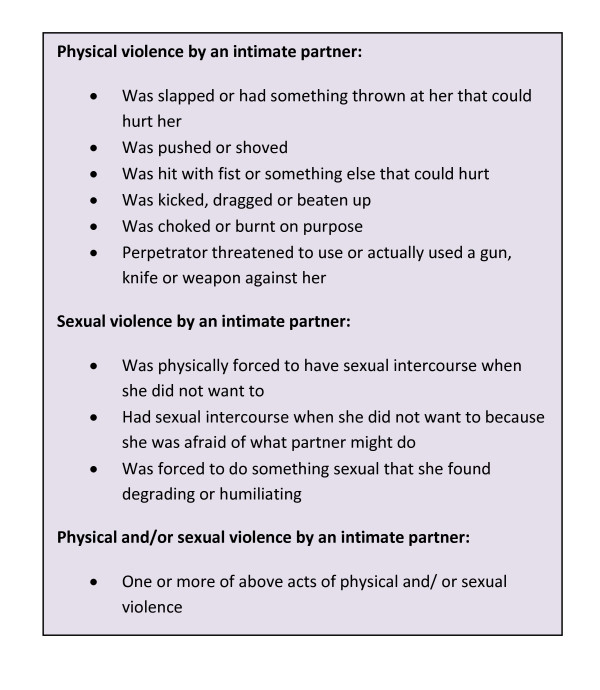
BACKGROUND: Intimate partner violence (IPV) against women is a global public health and human rights concern. Despite a growing body of research into risk factors for IPV, methodological differences limit the extent to which comparisons can be made between studies. We used data from ten countries included in the WHO Multi-country Study on Women's Health and Domestic Violence to identify factors that are consistently associated with abuse across sites, in order to inform the design of IPV prevention programs. METHODS: Standardised population-based household surveys were done between 2000 and 2003. One woman aged 15-49 years was randomly selected from each sampled household. Those who had ever had a male partner were asked about their experiences of physically and sexually violent acts. We performed multivariate logistic regression to identify predictors of physical and/or sexual partner violence within the past 12 months. RESULTS: Despite wide variations in the prevalence of IPV, many factors affected IPV risk similarly across sites. Secondary education, high SES, and formal marriage offered protection, while alcohol abuse, cohabitation, young age, attitudes supportive of wife beating, having outside sexual partners, experiencing childhood abuse, growing up with domestic violence, and experiencing or perpetrating other forms of violence in adulthood, increased the risk of IPV. The strength of the association was greatest when both the woman and her partner had the risk factor. CONCLUSIONS: IPV prevention programs should increase focus on transforming gender norms and attitudes, addressing childhood abuse, and reducing harmful drinking. Development initiatives to improve access to education for girls and boys may also have an important role in violence prevention.
Verified 2026-11-25 · 1 reference not checked yet
Overview
CoChat Summary
TL;DR
This WHO multi-country study used standardized household survey data from 10 countries and 15 sites to identify factors consistently associated with past-year physical and/or sexual intimate partner violence (IPV) among ever-partnered women. It found secondary education, high socioeconomic status, and formal marriage were protective, while alcohol abuse, cohabitation, young age, attitudes supportive of wife beating, outside sexual partners, childhood abuse, growing up with domestic violence, and other violence in adulthood increased risk, often most strongly when both partners had the factor.
Key findings
- Secondary education (or primary in Bangladesh, Ethiopia, and Tanzania) completed by both partners was protective in 12/14 sites (10 significant), and high SES was protective in 14 sites (8 significant comparing highest to lowest status).
- Alcohol problems in either or both partners were associated with higher IPV: him 14/14 sites (12 significant), her 10/11 (5 significant), both 11/11 (7 significant); attitudes supportive of wife beating were associated with increased IPV in 13/15 sites (8 significant).
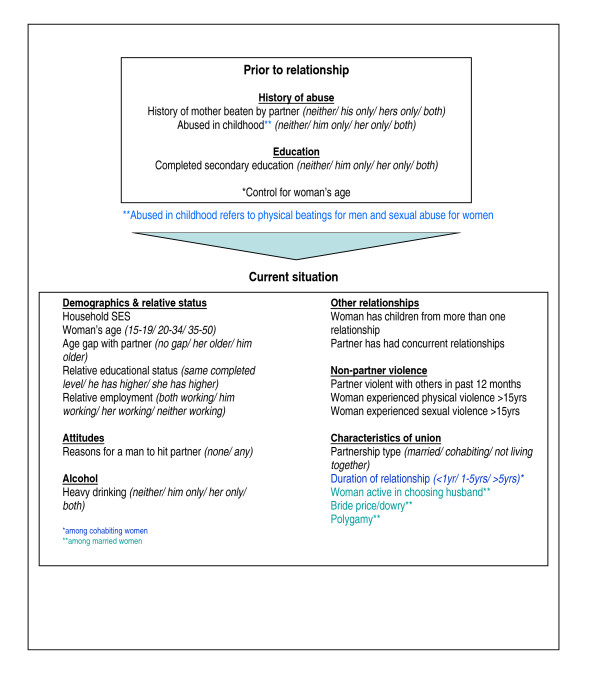
- Prior abuse was consistently associated with IPV: reported abuse of the woman’s mother, partner’s mother, or both increased risk in all sites (10 significant for women, 10 for partners, 12 for both); childhood sexual abuse of the woman, childhood beatings of her partner, or both increased risk (15/15 for partners, all significant; 13/15 for women and both, 10 significant).
- Cohabitation without formal marriage increased IPV in 10/12 sites (3 significant); younger women aged 15–19 and 20–35 had increased risk in all sites (significant in 12); polygamy increased risk in all 6 sites where practiced (3 significant).
Methods
- Standardized population-based household surveys were conducted between 2000 and 2003 in Bangladesh, Brazil, Ethiopia, Japan, Namibia, Peru, Republic of Tanzania, Samoa, Serbia and Montenegro, and Thailand; one woman aged 15–49 was randomly selected per household, with 24,097 women interviewed and 19,517 ever-partnered women asked about partner violence.
- The outcome compared women reporting any physical and/or sexual partner violence in the past 12 months with women reporting no partner violence; women with lifetime but not past-year violence were excluded. Analyses included 15,207 women for “prior to relationship” models and 15,058 for “current situation” models.
- Multivariate logistic regression was run separately by site, with prior-to-relationship and current-situation variables modeled separately; ORs of 0.95–1.05 were considered no association, ≥1.05 risk factors, and ≤0.95 protective factors, with significance at 5%.
Limitations
- The paper states that the cross-sectional design limits conclusions about temporality or causality, although separating early-life and current characteristics clarifies temporality for some factors.
- The paper states that only women were interviewed, so partner characteristics rely on women’s reports and refer to the current or most recent partner, who may not be the perpetrator; any resulting misclassification would bias results toward the null.
- The text makes evident that small numbers in extreme exposure categories produced wide confidence intervals for some abuse-related ORs, and many site-specific associations were non-significant or varied in direction, so consistency is based on patterns across sites rather than uniform statistical significance.
Model-written summary. Check it against the paper before relying on it.
Integrity signals
Registry
Cites
Statistics
Figures
Verification
Claims the paper makes
3 Valid · 0 Not valid · 13 Not checked · 62 Own results and interpretations
Every source the paper cites for this claim was checked and supports it.
In the paper
“Higher socioeconomic status is generally associated with lower levels of physical and/or sexual partner violence.”
§ What factors are associated with recent intimate partner violence? findings from the WHO multi-country study on women's health and domestic violence > Discussion
What the sources say
- Supportedcites [27] Vyas S Watts C How does economic empowerment affect women's risk of intimate partner violence in low and middle income country settings?: A systematic review of published evidence J Int Dev 2009 21 577 602 10.1002/jid.1500 source
Section 4 (Discussion) says higher household socioeconomic status, measured by assets, is predominantly protective against intimate partner violence. Section 3.1 reports lower physical and/or sexual violence in several higher-wealth groups, while also noting null and contrary findings; the claim's word “generally” accommodates that variation. Page numbers are not provided for these passages. (LLM, conf=0.88)
plainstates an association- Asserted: passes — The authors put it forward as true.
- Checkable: passes — It can be checked against evidence.
- Load-bearing: passes — The paper’s conclusions depend on it.
- Based: passes — The paper gives a reason why it holds.
- Supported
A result the paper reports from its own data — it cites no other source for it, so there is none to check. The quote shows it is in the paper.
In the paper
“There was no consistent pattern of association between IPV and relative employment status.”
§ What factors are associated with recent intimate partner violence? findings from the WHO multi-country study on women's health and domestic violence > Results > Current situation model
plain- Asserted: passes — The authors put it forward as true.
- Checkable: passes — It can be checked against evidence.
- Load-bearing: unclear — It is unclear whether the paper’s conclusions depend on it.
- Based: passes — The paper gives a reason why it holds.
A result the paper reports from its own data — it cites no other source for it, so there is none to check. The quote shows it is in the paper.
In the paper
“Secondary education, high SES, and formal marriage offered protection, while alcohol abuse, cohabitation, young age, attitudes supportive of wife beating, having outside sexual partners, experiencing childhood abuse, growing up with domestic violence, and experiencing or perpetrating other forms of violence in adulthood, increased the risk of IPV.”
§ What factors are associated with recent intimate partner violence? findings from the WHO multi-country study on women's health and domestic violence > Abstract > Results
plainstates a cause- Asserted: passes — The authors put it forward as true.
- Checkable: passes — It can be checked against evidence.
- Load-bearing: passes — The paper’s conclusions depend on it.
- Based: passes — The paper gives a reason why it holds.
A result the paper reports from its own data — it cites no other source for it, so there is none to check. The quote shows it is in the paper.
In the paper
“In all sites odds of IPV were higher in relationships where one or both partners had problems with alcohol, compared to relationships where neither of them did (him 14/14, 12 significant; her 10/11, 5 significant; both 11/11, 7 significant).”
§ What factors are associated with recent intimate partner violence? findings from the WHO multi-country study on women's health and domestic violence > Results > Current situation model
plainstates an association- Asserted: passes — The authors put it forward as true.
- Checkable: passes — It can be checked against evidence.
- Load-bearing: passes — The paper’s conclusions depend on it.
- Based: passes — The paper gives a reason why it holds.
56 more claims
Create a free account to see all 78 claims and to verify the 3 references still open.
- It may state two separate claims as one. 8
- Probably not a substantial claim. 9
Self-check
Percentages, sums and reported differences re-computed from the paper’s own numbers.
Each contradiction between two passages listed here was confirmed by an independent check.
Rated minor: it would not touch a result — a value no result rests on, a p-value that stays on the same side of the significance level, or a conflict that is clerical, resolved elsewhere in the paper, or outside its own findings.
In the paper
§ What factors are associated with recent intimate partner violence? findings from the WHO multi-country study on women's health and domestic violence > Results > Prior to relationship
“15/15 sites for partners, all significant”
§ What factors are associated with recent intimate partner violence? findings from the WHO multi-country study on women's health and domestic violence > Results
“| 7 | 2.5 (1.4 - 4.3) | 5 | 1.6 (0.89 - 2.8) |”
Rated minor: it would not touch a result — a value no result rests on, a p-value that stays on the same side of the significance level, or a conflict that is clerical, resolved elsewhere in the paper, or outside its own findings.
In the paper
§ What factors are associated with recent intimate partner violence? findings from the WHO multi-country study on women's health and domestic violence > Results > Prior to relationship
“reports of abuse of the woman's mother, her partners' mother, or both (compared to no known reported abuse of either mother) being associated with increased risk of IPV in all sites”
§ What factors are associated with recent intimate partner violence? findings from the WHO multi-country study on women's health and domestic violence > Results
“| 4 | 2.5 (1.1 - 5.5) | 2 | 0.47 (0.06 - 4.0) | 2 | 2.2 (0.93 - 5.3) |”
Citations
Cites
The world report on violence and health
Krug, E. G., Mercy, J. A., Dahlberg, L. L., & Zwi, A. B. (2002) · The Lancet · doi:10.1016/s0140-6736(02)11133-0 · Cited by 9,110 · cited 1×
“The consistent association between IPV and other forms of violence against women also point to the need for integrated responses to violence across sectors and programmes [30,31].”
BackgroundMultilevel analysis techniques and applications
Hox, J. J., Moerbeek, M., & van de Schoot, R. (2002) · Cited by 6,886
Garcia-Moreno, C., Jansen, H. A., Ellsberg, M., Heise, L., & Watts, C. H. (2006) · The Lancet · doi:10.1016/s0140-6736(06)69523-8 · Cited by 3,176
Self-citationBehind Closed Doors: Violence in the American Family.
Boudouris, J., Straus, M. A., Gelles, R. J., & Steinmetz, S. K. (1982) · Contemporary Sociology · doi:10.2307/2068814 · Cited by 3,088
Hox, J., Moerbeek, M., & van de Schoot, R. (2002) · doi:10.4324/9781410604118 · Cited by 2,419
Violence Against Women: An Integrated, Ecological Framework
HEISE, L. L. (1998) · Violence Against Women · doi:10.1177/1077801298004003002 · Cited by 2,042
Self-citationIntimate partner violence: causes and prevention
Jewkes, R. (2002) · The Lancet · doi:10.1016/s0140-6736(02)08357-5 · Cited by 1,993
Ellsberg, M., Jansen, H. A., Heise, L., Watts, C. H., & Garcia-Moreno, C. (2008) · The Lancet · doi:10.1016/s0140-6736(08)60522-x · Cited by 1,820 · cited 1×
“In addition to being a concern in its own right, IPV is associated with a range of adverse physical, mental, sexual and reproductive health outcomes [2-8].”
BackgroundSelf-citationDunkle, K. L., Jewkes, R. K., Brown, H. C., Gray, G. E., McIntryre, J. A., & Harlow, S. D. (2004) · The Lancet · doi:10.1016/s0140-6736(04)16098-4 · Cited by 1,323 · cited 1×
“In addition to being a concern in its own right, IPV is associated with a range of adverse physical, mental, sexual and reproductive health outcomes [2-8].”
BackgroundIntimate partner physical abuse perpetration and victimization risk factors: A meta-analytic review
Stith, S. M., Smith, D. B., Penn, C. E., Ward, D. B., & Tritt, D. (2004) · Aggression and Violent Behavior · doi:10.1016/j.avb.2003.09.001 · Cited by 1,082 · cited 1×
“Studies in various countries have identified a range of factors that influence IPV risk [9-13], but in some cases, protective factors in one setting may be ineffective or actually increase risk in another [14].”
Background
Research works printed but not linked: 4
- Kishor S Johnson K Profiling domestic violence: A multicountry study 2004 Calverton, Maryland, USA: ORC Macro
- DoH South Africa Demographic and Health Survey 1998: final report 2002 Pretoria: Department of Health
- Harvey A Garcia Moreno C Butchart A Primary prevention of intimate partner violence and sexual violence: Background paper for WHO expert meeting May 2-3, 2007 2007 Geneva: World Health Organization, Department of Violence and Injuy Prevention and Disability
- Counts D Brown J Campbell J Sanctions and Sanctuary 1992 Boulder: Westview Press
Cited by
Items 601–700 of 1,413
Experience and attitude of rural women to IPV in Nigeria
Balogun, M. O., Fawole, O. I., Owoaje, E., & Adedokun, B. (2013) · Journal of Public Health · doi:10.1007/s10389-013-0564-9 · Cited by 14
Health consequences of domestic violence against women in Serbia
Mijatović-Jovanović, V., Čanković, S., Milijašević, D., Ukropina, S., Jovanovic, M., & Čanković, D. (2018) · Vojnosanitetski pregled · doi:10.2298/vsp171130054m · Cited by 22
Velloza, J., Davies, L. D., Ensminger, A. L., Theofelus, F. M., Andjamba, H., Kamuingona, R., Massetti, G. M., Coomer, R., Forster, N., & O’Malley, G. (2022) · Journal of Interpersonal Violence · doi:10.1177/08862605211073107 · Cited by 18
“…be applicable to lower resource contexts with different gender norms, different underlying violence prevalence and levels of community violence, and varying legal definitions and reporting guidelines for IPV (Abramsky et al., 2011; Dartnall & Jewkes, 2013; Fulu et al., 2017; Guedes et al., 2016).”
BackgroundBhatt, B., Bhatt, N., Karki, A., Giri, G., Baaniya, B., Neupane, B., Bogati, S., Mahaju, S., Poudel, A., Pokharel, S., et al. (2023) · Heliyon · doi:10.1016/j.heliyon.2023.e20117 · Cited by 20
“At an individual level, risk factors include young age, low education level, socioeconomic disadvantage, alcoholism, exposure to IPV during childhood, and development of negative attitudes toward women from an early age, among others [13 – 15].”
BackgroundEmotional violence within intimate partner violence against Turkish women in rural and urban areas
Alkan, Ö., & Demïr, A. (2025) · BMC Public Health · doi:10.1186/s12889-025-22009-7 · Cited by 18
“Physical or sexual violence experiences of women above 15 by someone other than their spouses/partners have been specified to be a risk factor for intimate partner violence [135].”
Mathias, A. K. R. D. A., Bedone, A. J., Osis, M. J. M. D., et al. (2013) · International Journal of Gynecology & Obstetrics · doi:10.1016/j.ijgo.2012.12.019 · Cited by 13
“In the WHO multi-country study, not being in a formal relationship and being young were risk factors for IPV [19].”
BackgroundHusband/Partner Intoxication and Intimate Partner Violence Against Women in the Philippines
Kerridge, B. T., & Tran, P. (2016) · Asia Pacific Journal of Public Health · doi:10.1177/1010539516656779 · Cited by 15
Yousuf, S., McLone, S. G., Mason, M., Snow, L., Gall, C., & Sheehan, K. (2017) · The Journal of Trauma: Injury, Infection, and Critical Care · doi:10.1097/ta.0000000000001578 · Cited by 13
Herath, T., Guruge, D., Fernando, M., Jayarathna, S. P. A. P. K., & Senarathna, L. (2018) · BMC Public Health · doi:10.1186/s12889-018-5914-7 · Cited by 21
Azanaw, K. A., Gelagay, A. A., Lakew, A. M., & Teshome, D. F. (2019) · International Journal of Reproductive Medicine · doi:10.1155/2019/8109898 · Cited by 14
“is nding is supported by other studies [12, 18, 19].”
ResultYusuf, R. A., Dongarwar, D., Yusuf, Z. I., & Salihu, H. M. (2019) · International Journal of Maternal and Child Health and AIDS · doi:10.21106/ijma.323 · Cited by 13
“1,3,4,6,12,14,19 To our knowledge, ours is the first study to delineate new characteristics associated with IPV victims not reported in prior literature.”
BackgroundSánchez-Prada, A., Álvarez, C. D., Fiol, E. B., Ferreiro-Basurto, V., & Pérez, V. A. F. (2020) · International Journal of Environmental Research and Public Health · doi:10.3390/ijerph17176055 · Cited by 20
Hicks, M. H., Mohsin, M., Silove, D. M., Fisher, J., Moussa, B., Steel, Z., Nancarrow, H., Nadar, N., Klein, L. A., Hassoun, F., et al. (2021) · PLoS ONE · doi:10.1371/journal.pone.0255105 · Cited by 15
Daughters-In-Law and Domestic Violence: Patrilocal Marriage in Tajikistan
Turaeva, M., & Becker, C. M. (2022) · Feminist Economics · doi:10.1080/13545701.2022.2060518 · Cited by 18
Aboagye, R. G., Seidu, A., Peprah, P., Asiamah-Asare, B. K. Y., Addo, I. Y., & Ahinkorah, B. O. (2022) · International Health · doi:10.1093/inthealth/ihac075 · Cited by 16
“This study is motivated by Abramsky et al.’s 4 observation that developing effective IPV prevention programs requires identifying risk factors: both those that are direct causes of IPV and those that point to common characteristics of victims and/or perpetrators, allowing for appropriate tailoring and targeting of ser…”
BackgroundResultInfluentialFactores asociados a violencia doméstica en mujeres mexicanas vistas en primer nivel atención
Ambriz-Mora, M. I., Zonana-Nacach, A., & Anzaldo-Campos, M. C. (2015) · Medicina de Familia SEMERGEN · doi:10.1016/j.semerg.2014.07.004 · Cited by 16
“Las pre-guntas que incluyen violencia física son: ¿Le ha pegado con el pu˜no o con la mano?, ¿Le ha sacudido o zarandeado?, ¿Le ha torcido el brazo?, ¿Le ha pateado?, ¿Le ha empujado a « » « » navaja, cuchillo o machete?, ¿Le ha quemado con un cigarro u otra sustancia?, ¿Le ha amenazado con alguna…”
Billand, J., & Paiva, V. S. F. (2017) · Ciência & Saúde Coletiva · doi:10.1590/1413-81232017229.13742016 · Cited by 29
Djikanović, B., Stamenković, Ž., Bjegovic-Mikanovic, V. M., Vuković, D., Gordeev, V. S., & Maksimović, N. (2017) · International Journal of Public Health · doi:10.1007/s00038-017-1033-y · Cited by 17
Cunha, O. S., & Gonçalves, R. A. (2017) · International Journal of Offender Therapy and Comparative Criminology · doi:10.1177/0306624x17741070 · Cited by 16
“Mental health issues related to substance abuse, alcohol, and other illicit drugs were also addressed in several studies (e.g., Abramsky et al., 2011; Harris, Hilton, & Rice, 2011).”
BackgroundExploring Intimate Partner Violence Among Women Attending Malaysian Primary Care Clinics
Othman, S. B., Yuen, C. W., Zain, N. M., & Samad, A. A. (2019) · Journal of Interpersonal Violence · doi:10.1177/0886260519839426 · Cited by 18
“These include young age, low education status of either partner, low socioeconomic status, substance or alcohol use (Abramsky et al., 2011; Ali, Ali, Khuwaja, & Nanji, 2014; Ali & Bustamante, 2007; Pandey, Dutt, & Banerjee, 2009), smoking status (Ali et al., 2014), and attitudes that condone…”
BackgroundInfluentialA Network Analysis of Domestic Violence Beliefs Among Young Adults in India
Rodríguez, A. L., Stephens, D. P., Brewe, E. T., Ramarao, I., & Madhivanan, P. (2019) · Journal of Interpersonal Violence · doi:10.1177/0886260519889923 · Cited by 17
Unmet health care needs among children of mothers exposed to violence
King, C., & Khanijahani, A. (2020) · Child Abuse & Neglect · doi:10.1016/j.chiabu.2020.104363 · Cited by 15
Sigbeku, O. A., Fawole, O. I., & Ogunniyan, T. (2015) · PubMed Central · Cited by 14
Mills, C. P., Hill, H. M., & Johnson, J. A. (2017) · Violence Against Women · doi:10.1177/1077801216686219 · Cited by 21
“Email: chmaikamills@gmail.com regardless of race, ethnicity, religion, sexual orientation, or socioeconomic status (Abramsky et al., 2011; Smith & Segal, 2014).”
BackgroundROCHE, A. M., Kostadinov, V., & Fischer, J. (2017) · Wiley eBooks · doi:10.1002/9781118993811.ch15 · Cited by 20
Kisliuk, N., LaPointe, S., Young, S. L., Prencipe, L., Luchemba, P., Lukongo, T. M., & Palermo, T. (2024) · Global Public Health · doi:10.1080/17441692.2024.2409369 · Cited by 14
“Drivers of IPV include gender norms and poverty-related stressors (Abramsky et al., 2011; González & Rodríguez-Planas, 2020).”
Blofield, M., Filgueira, F., Deere, C. D., Eichner, M., Eydal, G. B., Parreñas, R. S., Pillai, N., Rosenbluth, F. M., Rostgaard, T., Welchman, L., et al. (2018) · Cambridge University Press eBooks · doi:10.1017/9781108399661.004 · Cited by 54
Bott, S., Ruiz-Celis, A. P., Mendoza, J. A., & Guedes, A. C. (2022) · BMC Public Health · doi:10.1186/s12889-022-14453-6 · Cited by 20
“preventing women from seeing friends and family) [69, 70, 79] and women’s histories of child marriage [80] have not been widely explored in research on violent discipline of children.”
BackgroundAhinkorah, B. O., Aboagye, R. G., Seidu, A., Frimpong, J. B., Hagan, J. E., Budu, E., & Yaya, S. (2023) · BMJ Open · doi:10.1136/bmjopen-2021-059236 · Cited by 12
Morelli, M., Nappa, M. R., Chirumbolo, A., Wright, P. J., Pabian, S., Baiocco, R., Costabile, A., Longobardi, E., & Cattelino, E. (2024) · Health Communication · doi:10.1080/10410236.2024.2304495 · Cited by 15
“One aim of the present study is the furtherance of this vital public health goal (Abramsky et al., 2011; Breiding et al., 2008; Xu et al., 2005).”
Ratanatharathorn, A. D., Quan, L., Koenen, K. C., Chibnik, L. B., Weisskopf, M. G., Slopen, N. B., & Roberts, A. L. (2024) · Translational Psychiatry · doi:10.1038/s41398-024-02814-1 · Cited by 13
DOMESTIC VIOLENCE AMONG WOMEN ATTENDING TO PYCHIATRIC OUTPATIENT CLINIC
Kurt, E., Küpeli, N. Y., Sönmez, E., Bulut, N. S., & Akvardar, Y. (2016) · Nöro Psikiyatri Arşivi · doi:10.29399/npa.14812 · Cited by 20
“DSÖ, genç yaşın, alkol kullanım sorununun, resmi evlilik olmamasının, erkeğin birden fazla evliliğinin, çocuklukta cinsel istismarın, kadının ya da erkeğin annesinde istismar varlığının ve AİŞ’le büyümenin eş şiddeti riskini arttırdığını saptamıştır (27).”
An update on intimate partner violence and mental health
Rioli, G., Sgarbi, C., Moretti, V., Sinisi, A., Fazio, L. D., Giambalvo, N., Ferrari, S., & Galeazzi, G. M. (2017) · Minerva Psychiatry · doi:10.23736/s0391-1772.17.01943-4 · Cited by 14
“53, 54 With reference to the different types of iPV, in a sample of dissociative disorders outpatients, Webermann et al. found that physical and emotional child abuse were associated with the risk of committing physical iPV, while childhood witnessing of domestic violence and childhood neglect were…”
Kumwenda, M., Corbett, E. L., Choko, A. T., Chikovore, J., Kaswaswa, K., Mwapasa, M., Sambakunsi, R., Gutteberg, T. J., Gordon, S. B., Munthali, A., et al. (2019) · PLoS ONE · doi:10.1371/journal.pone.0217534 · Cited by 13
“These results are not different with those reported from facility-based testing since test-related reactions are mostly directed towards test results and not the mode of testing [42,43].”
BackgroundResultMeasurement of violence against women and disability: protocol for a scoping review
Meyer, S. R., Lasater, M. E., Lee, L., & García‐Moreno, C. (2020) · BMJ Open · doi:10.1136/bmjopen-2020-040104 · Cited by 16
Self-citationAssociations of Women’s Substance Dependency Symptoms With Intimate Partner Violence
Feingold, A., & Capaldi, D. M. (2014) · Partner Abuse · doi:10.1891/1946-6560.5.2.152 · Cited by 14
“…of associations between substance abuse and IPV in women, such as between women’s substance abuse and (a) their victimization by physical IPV (e.g., Abramsky et al., 2011; La Flair et al., 2012; Testa, Livingston, & Leonard, 2003), (b) their perpetration of physical IPV (e.g., Martino, Collins, &…”
BackgroundAgreement on Reporting Intimate Partner Violence Among Nepalese Couples: A Cross-Sectional Study
Yoshikawa, K., Shakya, T. M., Poudel, K. C., & Jimba, M. (2018) · Journal of Interpersonal Violence · doi:10.1177/0886260518788371 · Cited by 13
“…abuse, child abuse, and positive attitudes regarding violence have been found to increase the risk of being a victim or perpetrator of violence (Abramsky et al., 2011; Capaldi, Knoble, Shortt, & Kim, 2012; Stockman et al., 2014; WHO & London School of Hygiene and Tropical Medicine, 2010;…”
BackgroundWheeler, J., Hutchinson, P., & Leyton, A. (2020) · Journal of Interpersonal Violence · doi:10.1177/0886260519898441 · Cited by 16
“Moreover, previous literature has also found that women are more likely to experience violence in communities where there are norms and attitudes that are accepting of wife-beating (Abramsky et al., 2011; Koenig et al., 2006).”
McDougal, L., Silverman, J. G., Singh, A., & Raj, A. (2020) · EClinicalMedicine · doi:10.1016/j.eclinm.2020.100414 · Cited by 13
Sánchez-Prada, A., Álvarez, C. D., Fiol, E. B., Ferreiro-Basurto, V., & Pérez, V. A. F. (2020) · PLoS ONE · doi:10.1371/journal.pone.0241392 · Cited by 15
Khoei, E. M., Rimaz, S., Korte, J. E., Back, S. E., Brady, K. T., Abad, M., & Shamsalizadeh, N. (2015) · PubMed Central · Cited by 11
Area-Level Normative Social Context and Intimate Partner Physical Violence in Mozambique
Cau, B. M. (2017) · Journal of Interpersonal Violence · doi:10.1177/0886260517704960 · Cited by 19
“Previous studies in developing countries have indicated that women who marry at a young age are more likely to experience intimate partner violence than their peers (Abramsky et al., 2011; Jensen & Thornton, 2003; Jesmin, 2015; Shamu, Abrahams, Temmerman, Musekiwa, & Zarowsky, 2011).”
BackgroundGender Norms and Intimate Partner ViolencePreprint
González, L., & Rodríguez‐Planas, N. (2021) · SSRN Electronic Journal · doi:10.2139/ssrn.3892578 · Cited by 13
Valadez, J. J., Jeffery, C., Davis, R. H., Ouma, J., Lwanga, S. K., & Moxon, S. G. (2014) · PLoS ONE · doi:10.1371/journal.pone.0093083 · Cited by 15
“Future studies will have to consider the motivations behind condom use at first and subsequent sexual acts; and need to take into account that not all sexual encounters are consensual [41].”
BackgroundBachwenkizi, J., Mohamed, H., Funsan, P., Rweyemamu, D. R., Nelson, W., Shao, M., Kaijage, H., Muyumbana, N., Salehe, S. S., Mwelange, L. P., et al. (2023) · Hygiene and Environmental Health Advances · doi:10.1016/j.heha.2023.100063 · Cited by 14
Kheirallah, K. A., Elbarazi, I., Alrawashdeh, A., Al-Saleh, A., Megdadi, M. A., Obeidat, S., Elfauri, K. A., & Al-Mistarehi, A.-H. W. (2023) · Journal of Medicine and Life · doi:10.25122/jml-2023-0111 · Cited by 15
“DV affects the social, sexual, and reproductive health aspects of millions of women and families [1, 3].”
BackgroundInfluentialKulak, J. A., Heavey, S. C., Marsack, L., & Leonard, K. E. (2025) · Substance Abuse and Rehabilitation · doi:10.2147/sar.s462382 · Cited by 27
Gender, alcohol and intimate partner violence: Qualitative comparative study
Holmila, M. J., Beccaria, F., Ibanga, A., Graham, K., Hettige, S. T., Magri, R., Munné, M. I., Plant, M. L., Rolando, S., & Tumwesigye, N. M. (2014) · Drugs Education Prevention and Policy · doi:10.3109/09687637.2014.911245 · Cited by 16
Lila, M., Gracia, E., Catalá-Miñana, A., Santirso, F. A., & Romero‐Martínez, Á. (2016) · Universitas Psychologica · doi:10.11144/javeriana.upsy15-4.caai · Cited by 13
Wilson, I. M., Eurenius, E., Lindkvist, M., Edin, K. E., & Edvardsson, K. (2018) · Midwifery · doi:10.1016/j.midw.2018.10.019 · Cited by 14
Anikwe, C. C., Umeononihu, O. S., Anikwe, I. H., Ikeoha, C. C., Eleje, G. U., Ewah, R. L., Okorochukwu, B. C., Nwokoye, B. I., Ogah, C. O., & Okoroafor, F. . (2021) · SAGE Open Nursing · doi:10.1177/23779608211052356 · Cited by 11
“Our study showed a significant association between being young among the student and having witnessed IPV which is corroborated by the findings from earlier studies (Abramsky et al., 2011; Carmona-Torres et al., 2018).”
ResultDifferent predictors of intimate partner and natal family violence against women
Campbell, O. L. K., & Mace, R. H. (2022) · Evolution Medicine and Public Health · doi:10.1093/emph/eoac019 · Cited by 11
“Sexual conflict theory predicts several IPV patterns that are observed: younger women, who are more fertile, are at greater risk [9]; wealthier and more educated individuals—who in the case of men have recourse to other forms of mate retention, such as greater resources, and in the case of women…”
Oseni, T. I. A., Salam, T. O., Ilori, T., & Momoh, M. O. (2022) · African Journal of Primary Health Care & Family Medicine · doi:10.4102/phcfm.v14i1.3147 · Cited by 18
A Spatial Latent Gaussian Model for Intimate Partner Violence Against Men in Africa
Tsiko, R. G. (2015) · Journal of Family Violence · doi:10.1007/s10896-015-9784-9 · Cited by 16
“together Bas if married,^ since Brownridge (2008) and Abramsky et al. (2008) found a high association between cohabiting relationships and domestic violence compared to marital ones.”
BackgroundArgento, E., Shannon, K., Nguyen, P., Dobrer, S., Chettiar, J., & Deering, K. (2015) · Drug and Alcohol Dependence · doi:10.1016/j.drugalcdep.2015.10.022 · Cited by 15
Fredland, N., McFARLANE, J. M., Symes, L., Maddoux, J. A., Pennings, J. S., Paulson, R. M., Binder, B. K., & Gilroy, H. (2015) · Nursing Outlook · doi:10.1016/j.outlook.2015.10.005 · Cited by 15
“Abused mothers who experience IPV may have been victimized in their own childhood, either physically or sexually, or have been neglected by parents/guardians, who themselves may have been exposed to IPV in their childhood homes (Abramsky et al., 2011; Cannon et al., 2010; Felitti et al., 1998).”
BackgroundRejection of the Gender and Equal Opportunities Bill in Nigeria
Makinde, O. A., Onyemelukwe, C., Williams, A. O., Oyediran, K. A., & Odimegwu, C. O. (2017) · Gender in Management An International Journal · doi:10.1108/gm-02-2017-0023 · Cited by 12
Professionals’ Awareness of Sexual Abuse in Late Life: An Exploratory Survey
Alon, S., Tuma, N., Band‐Winterstein, T., & Goldblatt, H. (2017) · Journal of the American Psychiatric Nurses Association · doi:10.1177/1078390317712598 · Cited by 14
“…with the dynamics of control, and it occurs due to three factors: spouses’ personal characteristics and childhood history, which might include sexual abuse, spousal relationship dynamics, and the general social construction (Abramsky et al., 2011; Tenkorang, Owusu, Yeboah, & Bannerman, 2013).”
BackgroundGlobalization and Theorizing Intimate Partner Violence from the Global South
Miedema, S. S., & Fulu, E. (2018) · Springer eBooks · doi:10.1007/978-3-319-65021-0_41 · Cited by 17
Gender-Based Violence in Senegal: its Catalysts and Connections from a Community Perspective
Werwie, T. R., Hildon, Z. J., Camara, A. D., Mbengue, O. K., Vondrasek, C., Mbaye, M., Mills, H., Kumoji, E. K., & Babalola, S. O. (2019) · Journal of Family Violence · doi:10.1007/s10896-019-00058-y · Cited by 17
“It comes as no surprise that the study of GBVand interventions aimed to eliminate it predominantly focus on services available for women, in relation to intimate male partners (Abramsky et al. 2011; Ellsberg et al. 2008; Fleming et al. 2015a; Garcia-Moreno et al. 2006).”
BackgroundDomestic Violence During Women’s Life in Developing Countries
Christaki, V., Orovou, E., Dagla, M., Sarantaki, A., Moriati, S., Kirkou, G., & Antoniou, E. (2023) · Materia Socio Medica · doi:10.5455/msm.2023.35.58-64 · Cited by 23
The Political Economy of Domestic Violence in a Mumbai Slum: An Ethnographic Analysis
Ghosh, S. (2015) · Journal of Interdisciplinary Economics · doi:10.1177/0260107915582297 · Cited by 11
“1 Cross-country surveys of domestic violence indicate that while violence against female partners is prevalent across all groups, women living in poverty disproportionately experience domestic violence (Abramsky et al., 2011; Abrahams & Jewkes, 2005; Burazeri et al., 2005; Ellesberg et al., 1999; Flake, 2005; Kishor &…”
BackgroundHajian, S., Kasaeinia, S., & Doulabi, M. A. (2018) · Iranian Journal of Psychiatry and Behavioral Sciences · doi:10.5812/ijpbs.13091 · Cited by 13
The prevalence and patterns of exposure to interpersonal violence among men and women in Estonia
Lippus, H., Soo, K., Laanpere, M., Yount, K. M., Part, K., Ringmets, I., Ainsaar, M., & Karro, H. (2020) · PLoS ONE · doi:10.1371/journal.pone.0237562 · Cited by 17
“Exposure to violence in childhood has been associated previously with both higher rates of revictimization and higher risk of violence perpetration [10,39].”
BackgroundResultSymes, L., McFarlane, J., Maddoux, J., & Fredland, N. (2020) · Violence Against Women · doi:10.1177/1077801219841444 · Cited by 10
“That women who experienced childhood abuse are at greater risk for partner violence is well established (Abramsky et al., 2011; Arias, 2004; Gomez & Speizer, 2009).”
BackgroundÇatak, B., Öner, C., Sütlü, S., & Kilinc, S. (2016) · Pakistan Journal of Medical Sciences · doi:10.12669/pjms.325.10078 · Cited by 15
Üniversite Öğrencilerinde Kadına Yönelik Şiddetle İlgili Etmenlerin İncelenmesi
Tektaş, P., Yildiz, N., Kanbay, Y., IŞIK, E., & Aslan, Ö. (2020) · Artvin Çoruh Üniversitesi Uluslararası Sosyal Bilimler Dergisi · doi:10.22466/acusbd.695562 · Cited by 12
Salawu, M. M., Okedare, O. O., Reed, E., Kiene, S. M., & Fawole, O. I. (2021) · Violence Against Women · doi:10.1177/10778012211058223 · Cited by 12
The Dynamics of Intimate Relationships and Violent Victimization Among Young Women
Kusunoki, Y., Bevilacqua, K., & Barber, J. S. (2022) · Journal of Interpersonal Violence · doi:10.1177/08862605221106131 · Cited by 16
“The presence of children from a prior partner may create family boundary ambiguity, which can decrease relationship quality and stability (Stewart, 2005) and increase stress and conflict (Berger & Bzostek, 2014; Boss & Greenberg, 1984), leading to IPV (Abramsky et al., 2011).”
BackgroundIntimate partner violence among women in Togo: a generalised structural equation modeling approach
Simon, D. J., & Tokpovi, V. C. K. (2024) · BMJ Open · doi:10.1136/bmjopen-2023-077273 · Cited by 14
Shanmugam, D., Hou, K., & Pierson, E. (2024) · npj Women s Health · doi:10.1038/s44294-024-00011-5 · Cited by 25
Andualem, F., Nakie, G., Rtbey, G., Melkam, M., Tinsae, T., Kibralew, G., Mengistie, B. A., Tadesse, G., Gedef, G. M., & Fentahun, S. (2025) · BMC Public Health · doi:10.1186/s12889-025-23004-8 · Cited by 11
“Widowed and divorced women may also be subjected to surveillance and restrictions from former partners or male family members [4, 14].”
Draxler, H., Hjärthag, F., & Almqvist, K. (2019) · Child Care in Practice · doi:10.1080/13575279.2018.1463968 · Cited by 9
“Intimate partner violence (IPV) can appear in many guises—including physical, psychological and sexual abuse and economic deprivation—and its prevalence varies among societies and in different societal contexts (Abramsky et al., 2011; Garcia-Moreno, Jansen, Ellsberg, Heise, & Watts, 2006).”
BackgroundPriestley, S. R., & Lee, K. A. (2019) · Journal of Interpersonal Violence · doi:10.1177/0886260519854553 · Cited by 11
“Where unemployment is high, and particularly where women’s partners are unemployed, the risk of IPV is also high (Abramsky et al., 2011).”
BackgroundNaved, R. T., Mamun, M. A., Parvin, K., Willan, S., Gibbs, A., & Jewkes, R. K. (2021) · Global Health Action · doi:10.1080/16549716.2020.1868960 · Cited by 11
“However, work is not always empowering for women, it may also expose women to WPV and exploitation, and in highly patriarchal societies backlash against women’s employment may escalate IPV [7,8].”
BackgroundThe Association between Early Marriage and Intimate Partner Violence in Egypt
Verma, S., & Nair, V. V. (2021) · Journal of Loss and Trauma · doi:10.1080/15325024.2021.2006970 · Cited by 13
“IPV is recognized as a public health concern (Hassan et al., 2004) and a violation of human rights (Abramsky et al., 2011).”
BackgroundHome drinking during and post‐COVID ‐19: Why the silence on domestic violence?
Wilson, I. M., Lightowlers, C., & Bryant, L. (2022) · Drug and Alcohol Review · doi:10.1111/dar.13572 · Cited by 15
Ramsoomar, L., Gibbs, A., Chirwa, E., Machisa, M., Alangea, D. O., Addo-Lartey, A., Dunkle, K., & Jewkes, R. (2023) · BMJ Open · doi:10.1136/bmjopen-2022-063730 · Cited by 11
Nwafor, J. A., Chamdimba, E., Ajayi, A. I., Ushie, B. A., Munthali, A., Thakwalakwa, C., & Kabiru, C. W. (2023) · Reproductive Health · doi:10.1186/s12978-023-01606-y · Cited by 14
“Contrary to previous studies [37, 38], our study shows that PPAs with secondary education had higher odds of IPV than those with no education/primary education.”
ResultBeattie, T., Kabuti, R., Beksinska, A., Babu, H., Kungu, M., Champions, T. M. F. S., Shah, P., Nyariki, E., Nyamweya, C., Okumu, M., et al. (2023) · International Journal of Environmental Research and Public Health · doi:10.3390/ijerph20116046 · Cited by 14
“We developed a conceptual framework (Figure 1) based on a life course perspective [32] to explore the associations of recent physical or sexual violence with distal and proximate exposure variables, drawing on current theories about risk factors and drivers of violence [4,33].”
MethodRees, S. J., Mohsin, M., Tay, A. K., Thorpe, R., Murray, S., Savio, E., Fonseca, M., Tol, W. A., & Silove, D. M. (2016) · BMJ Global Health · doi:10.1136/bmjgh-2015-000025 · Cited by 14
“A subsidiary finding from that inquiry was that dowry obligations showed no association with suicide attempts among women.(16) 17 It is possible, however, that problems associated with bride price contribute to more general and common forms of mental distress among women, as suggested by preliminary data we have gathe…”
BackgroundNelson, J. R., & Lund, E. M. (2017) · Springer eBooks · doi:10.1007/978-3-319-56901-7_9 · Cited by 18
Subjective Social Standing and Conflict Tactics Among Young Kenyan Men
Goodman, M. L., Serag, H., Raimer-Goodman, L. A., Keiser, P. H., & Gitari, S. (2017) · American Journal of Community Psychology · doi:10.1002/ajcp.12159 · Cited by 10
Jiwatram-Negrón, T., & El‐Bassel, N. (2018) · Women & Health · doi:10.1080/03630242.2018.1544967 · Cited by 11
“…mechanisms (Capaldi et al. 2012; El-Bassel et al. 2005; Foran and O’Leary 2008), though some research suggests varying relationships between different measures of socio-economic status (SES) and prevalence and type of violence experienced (Abramsky et al. 2011; Koenig et al. 2006; Xu et al. 2005).”
BackgroundResultNikparvar, F., Stith, S. M., Spencer, C. M., & Panaghi, L. (2018) · Journal of Interpersonal Violence · doi:10.1177/0886260518815714 · Cited by 12
“Previous research on IPV has shown that perpetrating one type of IPV is highly associated with perpetrating other types of IPV, as well as being the victim of the same form of IPV (Abramsky et al., 2011; Bookwala et al., 2005).”
MethodPTSD and Attitudes Toward Guns Following Interpersonal Trauma
Wamser‐Nanney, R. A., Nanney, J. T., & Constans, J. I. (2019) · Journal of Interpersonal Violence · doi:10.1177/0886260519829766 · Cited by 10
“For instance, perceptions regarding domestic violence and acceptance of rape myths are tied to an increased likelihood of engaging in these violent behaviors (Abramsky et al., 2011; Canan, Jozkowski, & Crawford, 2018; Wegner, Abbey, Pierce, Pegram, & Woerner, 2015).”
BackgroundLyons, V. H., Kernic, M. A., Rowhani‐Rahbar, A., Holt, V. L., & Carone, M. (2019) · Injury Epidemiology · doi:10.1186/s40621-019-0215-x · Cited by 10
Ojifinni, O. O., Maposa, I., & Ibisomi, L. (2021) · BMC Women s Health · doi:10.1186/s12905-021-01421-2 · Cited by 11
Alemi, Q., Stempel, C., Montgomery, S., Koga, P. M., Smith, V. J., Baek, K., Fisher, C. C., & Malika, N. M. (2021) · Violence Against Women · doi:10.1177/10778012211051398 · Cited by 11
“More research examining IPV risk factors and direct causes are needed in order to design effective prevention programs that point to common characteristics of victims and their perpetrators (Abramsky et al., 2011).”
BackgroundEllsberg, M. C., Quintanilla, M., & Ugarte, W. J. (2022) · Global Public Health · doi:10.1080/17441692.2022.2038652 · Cited by 14
“…analysis of the 2016 dataset, we included women aged 50 – 64, and explored a broad range of potential risk and protective factors for IPV based on fi ndings from international research as well as previous research in Nicaragua (Abramsky et al., 2011; Ellsberg et al., 1999; Heise & Kotsadam, 2015).”
Self-citationPsychiatric rehabilitation in Latin America: challenges and opportunities
Uribe-Restrepo, J. M., Escobar, M.-L., & Cubillos, L. (2016) · Epidemiology and Psychiatric Sciences · doi:10.1017/s2045796016000846 · Cited by 10
“Harmful use of alcohol has also been identified as a major risk factor in the region; the average consumption of alcohol in Latin America is 50% higher than worldwide consumption (Rehm & Monteiro, 2005), and men’s alcohol abuse increases the likelihood of intimate partner violence (Abramsky et al. 2011).”
National study on domestic violence against women in Tonga
Jansen, H. A. F. M., Fua, S. J., Blake, B. E., & 'Ilolahia, G. R. (2012) · Cited by 23
Self-citationKhatir, A. G., Ge, T., Ariyo, T., & Jiang, Q. (2024) · BMJ Open · doi:10.1136/bmjopen-2023-075957 · Cited by 12
“24 Cultural norms and childhood exposure to IPV between parents can foster an attitude accepting of wife beating in adult-hood.”
BackgroundWebster, K., Ward, A. C., Diemer, K., Flood, M., Powell, A., Forster, K., & Honey, N. (2018) · Australian Journal of Social Issues · doi:10.1002/ajs4.56 · Cited by 11
Small, E., Nikolova, S., Childress, S., & Logie, C. H. (2022) · International Journal of Qualitative Studies in Education · doi:10.1080/09518398.2022.2035450 · Cited by 13
“” Research indicates that alcohol use is linked with violence and HIV risk (e.g. Abramsky et al., 2011; Kalichman et al., 2009; Pitpitan et al., 2013; Weinhardt & Carey, 2000).”
BackgroundMethodStopping Gender-based Violence in Higher Education: Policy, Practice, and Partnerships
Humphreys, C. J., & Towl, G. J. (2022) · Routledge eBooks · doi:10.4324/9781003252474 · Cited by 20
A Web Model of Domestic Violence and Abuse in Muslim Communities—A Multi Perspective IPA Approach
Chowdhury, R., & Winder, B. (2022) · Social Sciences · doi:10.3390/socsci11080354 · Cited by 17
“Domestic violence and abuse (DVA) occur across all faith communities (Abramsky et al. 2011).”
BackgroundKaggiah, A., Wilson, K., Richardson, B. A., Kinuthia, J., Farquhar, C., & McClelland, R. S. (2022) · PLoS ONE · doi:10.1371/journal.pone.0272640 · Cited by 11
“There is evidence suggesting that alcohol use among women predisposes them to IPV [7, 12, 13].”
BackgroundResultInfluentialBukuluki, P., Kisaakye, P., Wandiembe, S. P., Bulenzi-Gulere, G., Mulindwa, B., Bazira, D., Letiyo, E., Namirembe, H. N. L., Schmidt, I., Kakande, P. N., et al. (2023) · EClinicalMedicine · doi:10.1016/j.eclinm.2023.101846 · Cited by 12
“50 However, the results show that having no access to information and having no perception of risk to GBV are associated with not knowing someone who experienced GBV during the COVID-19 pandemic.”
Skandro, S., Abio, A., Bärnighausen, T., & Wilson, M. L. (2023) · Archives of Women s Mental Health · doi:10.1007/s00737-023-01376-3 · Cited by 11
“…income, living in a disadvantaged neighborhood, different types of stress (financial, work-related, interpersonal), being divorced or separated Abramsky et al. (2011), depression and disability Ogum Alangea et al. (2018), low level of acculturation, peer group pressure and peers who are also…”
BackgroundResultInfluential
Metadata
- Authors
- Abramsky, T., Watts, C. H., Garcia-Moreno, C., Devries, K., Kiss, L., Ellsberg, M., Jansen, H. A., & Heise, L.
- Affiliations
- London School of Hygiene & Tropical Medicine (GB)
- International Center for Research on Women (US)
- Corresponding author
- Abramsky, Tanya
- Venue
- BMC Public Health
- Published
- 2011-02-16
- Volume
- 11
- Issue
- 1
- Pages
- 109-109
- ISSN
- 1471-2458 (ISSN-L)
- PMC
- PMC3049145
- OpenAlex
- W2146316233
- Semantic Scholar
- 124d14c4c5378026a820318c409f305314e161d1
- Cited by
- 1,413
- References
- 42
- Citations by year
- 2026: 66 · 2025: 85 · 2024: 102 · 2023: 96 · 2022: 108 · 2021: 133 · 2020: 137 · 2019: 105 · 2018: 103 · 2017: 106 · 2016: 95 · 2015: 89 · 2014: 75 · 2013: 69 · 2012: 28
- FWCI
- 60.57
- Type
- journal article
- Language
- en
- Open access
- gold
- doi.org
- Licence
- Locations
- BMC Public Health (publishedVersion, cc-by)
- PubMed Central (publishedVersion, cc-by)
- PubMed (publishedVersion)
- LSHTM Research Online (London School of Hygiene and Tropical Medicine) (acceptedVersion)
- DOAJ (DOAJ: Directory of Open Access Journals) (submittedVersion)
- Funders
- Rockefeller Foundation
- Styrelsen för Internationellt Utvecklingssamarbete
- United Nations Fund for Population Activities
- Mahidol University
- Umeå Universitet
- Universidade de São Paulo
- Uppsala Universitet
- Addis Ababa University
- Universidade Federal de Pernambuco
- Universidade de Pernambuco
- International Centre for Diarrhoeal Disease Research, Bangladesh
- Topics
- Social Sciences › Health › Intimate Partner and Family Violence
- Health Sciences › Medicine › Geriatrics and Gerontology › Elder Abuse and Neglect
- Social Sciences › Gender Studies › Sexual Assault and Victimization Studies
- Keywords
- intimate partner violence, domestic violence against women, risk factors, physical violence, sexual violence, alcohol abuse, childhood abuse, gender norms, IPV prevention, secondary education, socioeconomic status, cohabitation
- MeSH terms
- Adolescent, Adult, Data Collection, Female, Humans, Middle Aged, Risk Factors, Rural Population, Sexual Partners, Urban Population, World Health Organization, Logistic Models, Domestic Violence, Battered Women, Internationality, Young Adult
About these checks
Registry, retraction, Cites and statistics results are computed, not judged, with one exception: a printed reference that no index lists is read once by a model before it counts as a citation error. Claims are extracted by a model and kept only when their quote appears verbatim in the text; each cited source is then checked, with a model’s help, for whether it says what the claim relies on. Those verdicts can be wrong — read the claim’s quote and the cited source before relying on one.
The claim verdicts this report counts are experimental: their accuracy is not yet measured.
A language model drew the claims from the paper on 2026-10-10, under version 3 of the claim definition (model deepseek-v4.1-flash, prompt extract-v3).
A second model labelled each claim on 2026-10-10 (model jev-1.13-20260917, definition revision gold-guideline-v0.2).
Cited sources are checked with a language model’s help (gpt-6-sol).
Statistics and arithmetic are recomputed, not judged.
Confidence bands are shown only for fields calibrated on our annotated test set. None is calibrated yet, so no band is shown.
What counts as a claim ›How we measure confidence ›How we check this ›
Are you an author, or do you see a problem with this page? Request a review
Data sources
Bibliographic data: Semantic Scholar, OpenAlex, Crossref.
Contains information from the Semantic Scholar Academic Graph Datasets, made available under the ODC Attribution License (ODC-BY 1.0).
Semantic Scholar’s data is described in: Kinney, R., et al. (2023). The Semantic Scholar Open Data Platform. arXiv:2301.10140.
