

What factors are associated with recent intimate partner violence? findings from the WHO multi-country study on women's health and domestic violence
Open accessThe DOI matches its Crossref record; 41 of the 42 references it cites were found in a registry or an index, and 1 are not checked yet; 5 of the 24 sources its claims cite were checked for support.
Abstract
BACKGROUND: Intimate partner violence (IPV) against women is a global public health and human rights concern. Despite a growing body of research into risk factors for IPV, methodological differences limit the extent to which comparisons can be made between studies. We used data from ten countries included in the WHO Multi-country Study on Women's Health and Domestic Violence to identify factors that are consistently associated with abuse across sites, in order to inform the design of IPV prevention programs. METHODS: Standardised population-based household surveys were done between 2000 and 2003. One woman aged 15-49 years was randomly selected from each sampled household. Those who had ever had a male partner were asked about their experiences of physically and sexually violent acts. We performed multivariate logistic regression to identify predictors of physical and/or sexual partner violence within the past 12 months. RESULTS: Despite wide variations in the prevalence of IPV, many factors affected IPV risk similarly across sites. Secondary education, high SES, and formal marriage offered protection, while alcohol abuse, cohabitation, young age, attitudes supportive of wife beating, having outside sexual partners, experiencing childhood abuse, growing up with domestic violence, and experiencing or perpetrating other forms of violence in adulthood, increased the risk of IPV. The strength of the association was greatest when both the woman and her partner had the risk factor. CONCLUSIONS: IPV prevention programs should increase focus on transforming gender norms and attitudes, addressing childhood abuse, and reducing harmful drinking. Development initiatives to improve access to education for girls and boys may also have an important role in violence prevention.
Verified 2026-11-25 · 1 reference not checked yet
Overview
CoChat Summary
TL;DR
This WHO multi-country study used standardized household survey data from 10 countries and 15 sites to identify factors consistently associated with past-year physical and/or sexual intimate partner violence (IPV) among ever-partnered women. It found secondary education, high socioeconomic status, and formal marriage were protective, while alcohol abuse, cohabitation, young age, attitudes supportive of wife beating, outside sexual partners, childhood abuse, growing up with domestic violence, and other violence in adulthood increased risk, often most strongly when both partners had the factor.
Key findings
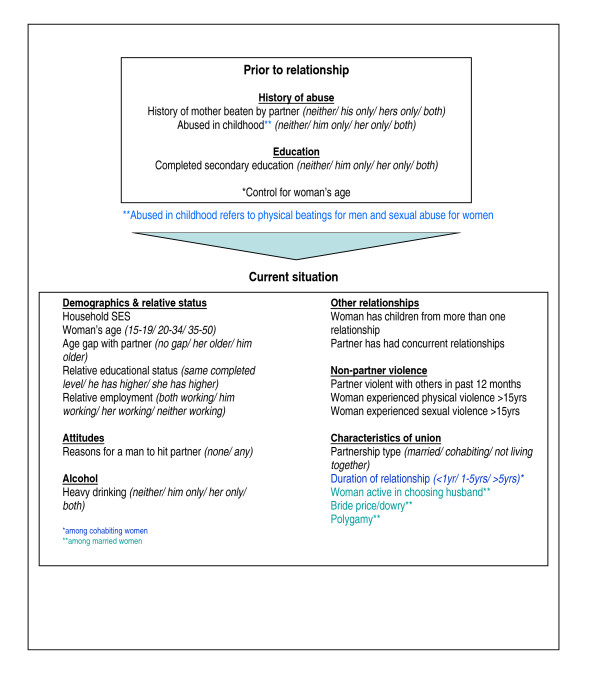
- Secondary education (or primary in Bangladesh, Ethiopia, and Tanzania) completed by both partners was protective in 12/14 sites (10 significant), and high SES was protective in 14 sites (8 significant comparing highest to lowest status).
- Alcohol problems in either or both partners were associated with higher IPV: him 14/14 sites (12 significant), her 10/11 (5 significant), both 11/11 (7 significant); attitudes supportive of wife beating were associated with increased IPV in 13/15 sites (8 significant).
- Prior abuse was consistently associated with IPV: reported abuse of the woman’s mother, partner’s mother, or both increased risk in all sites (10 significant for women, 10 for partners, 12 for both); childhood sexual abuse of the woman, childhood beatings of her partner, or both increased risk (15/15 for partners, all significant; 13/15 for women and both, 10 significant).
- Cohabitation without formal marriage increased IPV in 10/12 sites (3 significant); younger women aged 15–19 and 20–35 had increased risk in all sites (significant in 12); polygamy increased risk in all 6 sites where practiced (3 significant).
Methods
- Standardized population-based household surveys were conducted between 2000 and 2003 in Bangladesh, Brazil, Ethiopia, Japan, Namibia, Peru, Republic of Tanzania, Samoa, Serbia and Montenegro, and Thailand; one woman aged 15–49 was randomly selected per household, with 24,097 women interviewed and 19,517 ever-partnered women asked about partner violence.
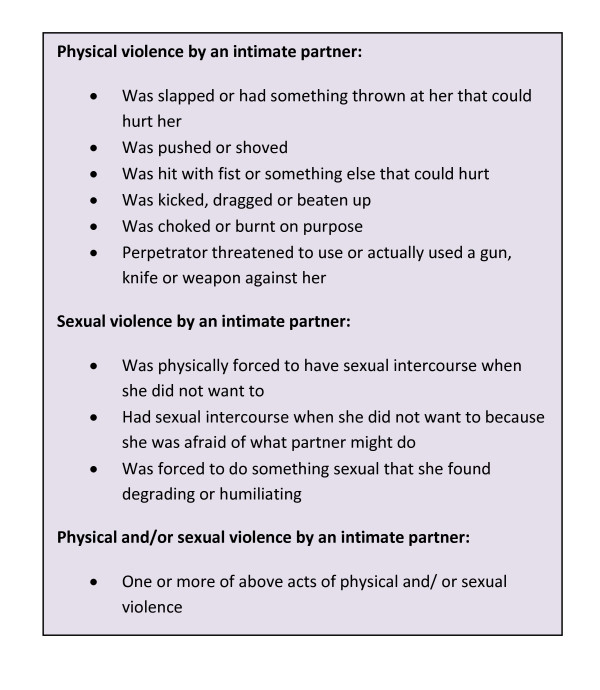
- The outcome compared women reporting any physical and/or sexual partner violence in the past 12 months with women reporting no partner violence; women with lifetime but not past-year violence were excluded. Analyses included 15,207 women for “prior to relationship” models and 15,058 for “current situation” models.
- Multivariate logistic regression was run separately by site, with prior-to-relationship and current-situation variables modeled separately; ORs of 0.95–1.05 were considered no association, ≥1.05 risk factors, and ≤0.95 protective factors, with significance at 5%.
Limitations
- The paper states that the cross-sectional design limits conclusions about temporality or causality, although separating early-life and current characteristics clarifies temporality for some factors.
- The paper states that only women were interviewed, so partner characteristics rely on women’s reports and refer to the current or most recent partner, who may not be the perpetrator; any resulting misclassification would bias results toward the null.
- The text makes evident that small numbers in extreme exposure categories produced wide confidence intervals for some abuse-related ORs, and many site-specific associations were non-significant or varied in direction, so consistency is based on patterns across sites rather than uniform statistical significance.
Model-written summary. Check it against the paper before relying on it.
Integrity signals
Registry
Cites
Statistics
Figures
Verification
Claims the paper makes
3 Valid · 0 Not valid · 13 Not checked · 62 Own results and interpretations
Every source the paper cites for this claim was checked and supports it.
In the paper
“Higher socioeconomic status is generally associated with lower levels of physical and/or sexual partner violence.”
§ What factors are associated with recent intimate partner violence? findings from the WHO multi-country study on women's health and domestic violence > Discussion
What the sources say
- Supportedcites [27] Vyas S Watts C How does economic empowerment affect women's risk of intimate partner violence in low and middle income country settings?: A systematic review of published evidence J Int Dev 2009 21 577 602 10.1002/jid.1500 source
Section 4 (Discussion) says higher household socioeconomic status, measured by assets, is predominantly protective against intimate partner violence. Section 3.1 reports lower physical and/or sexual violence in several higher-wealth groups, while also noting null and contrary findings; the claim's word “generally” accommodates that variation. Page numbers are not provided for these passages. (LLM, conf=0.88)
plainstates an association- Asserted: passes — The authors put it forward as true.
- Checkable: passes — It can be checked against evidence.
- Load-bearing: passes — The paper’s conclusions depend on it.
- Based: passes — The paper gives a reason why it holds.
- Supported
A result the paper reports from its own data — it cites no other source for it, so there is none to check. The quote shows it is in the paper.
In the paper
“There was no consistent pattern of association between IPV and relative employment status.”
§ What factors are associated with recent intimate partner violence? findings from the WHO multi-country study on women's health and domestic violence > Results > Current situation model
plain- Asserted: passes — The authors put it forward as true.
- Checkable: passes — It can be checked against evidence.
- Load-bearing: unclear — It is unclear whether the paper’s conclusions depend on it.
- Based: passes — The paper gives a reason why it holds.
A result the paper reports from its own data — it cites no other source for it, so there is none to check. The quote shows it is in the paper.
In the paper
“Secondary education, high SES, and formal marriage offered protection, while alcohol abuse, cohabitation, young age, attitudes supportive of wife beating, having outside sexual partners, experiencing childhood abuse, growing up with domestic violence, and experiencing or perpetrating other forms of violence in adulthood, increased the risk of IPV.”
§ What factors are associated with recent intimate partner violence? findings from the WHO multi-country study on women's health and domestic violence > Abstract > Results
plainstates a cause- Asserted: passes — The authors put it forward as true.
- Checkable: passes — It can be checked against evidence.
- Load-bearing: passes — The paper’s conclusions depend on it.
- Based: passes — The paper gives a reason why it holds.
A result the paper reports from its own data — it cites no other source for it, so there is none to check. The quote shows it is in the paper.
In the paper
“In all sites odds of IPV were higher in relationships where one or both partners had problems with alcohol, compared to relationships where neither of them did (him 14/14, 12 significant; her 10/11, 5 significant; both 11/11, 7 significant).”
§ What factors are associated with recent intimate partner violence? findings from the WHO multi-country study on women's health and domestic violence > Results > Current situation model
plainstates an association- Asserted: passes — The authors put it forward as true.
- Checkable: passes — It can be checked against evidence.
- Load-bearing: passes — The paper’s conclusions depend on it.
- Based: passes — The paper gives a reason why it holds.
56 more claims
Create a free account to see all 78 claims and to verify the 3 references still open.
- It may state two separate claims as one. 8
- Probably not a substantial claim. 9
Self-check
Percentages, sums and reported differences re-computed from the paper’s own numbers.
Each contradiction between two passages listed here was confirmed by an independent check.
Rated minor: it would not touch a result — a value no result rests on, a p-value that stays on the same side of the significance level, or a conflict that is clerical, resolved elsewhere in the paper, or outside its own findings.
In the paper
§ What factors are associated with recent intimate partner violence? findings from the WHO multi-country study on women's health and domestic violence > Results > Prior to relationship
“15/15 sites for partners, all significant”
§ What factors are associated with recent intimate partner violence? findings from the WHO multi-country study on women's health and domestic violence > Results
“| 7 | 2.5 (1.4 - 4.3) | 5 | 1.6 (0.89 - 2.8) |”
Rated minor: it would not touch a result — a value no result rests on, a p-value that stays on the same side of the significance level, or a conflict that is clerical, resolved elsewhere in the paper, or outside its own findings.
In the paper
§ What factors are associated with recent intimate partner violence? findings from the WHO multi-country study on women's health and domestic violence > Results > Prior to relationship
“reports of abuse of the woman's mother, her partners' mother, or both (compared to no known reported abuse of either mother) being associated with increased risk of IPV in all sites”
§ What factors are associated with recent intimate partner violence? findings from the WHO multi-country study on women's health and domestic violence > Results
“| 4 | 2.5 (1.1 - 5.5) | 2 | 0.47 (0.06 - 4.0) | 2 | 2.2 (0.93 - 5.3) |”
Citations
Cites
The world report on violence and health
Krug, E. G., Mercy, J. A., Dahlberg, L. L., & Zwi, A. B. (2002) · The Lancet · doi:10.1016/s0140-6736(02)11133-0 · Cited by 9,110 · cited 1×
“The consistent association between IPV and other forms of violence against women also point to the need for integrated responses to violence across sectors and programmes [30,31].”
BackgroundMultilevel analysis techniques and applications
Hox, J. J., Moerbeek, M., & van de Schoot, R. (2002) · Cited by 6,886
Garcia-Moreno, C., Jansen, H. A., Ellsberg, M., Heise, L., & Watts, C. H. (2006) · The Lancet · doi:10.1016/s0140-6736(06)69523-8 · Cited by 3,176
Self-citationBehind Closed Doors: Violence in the American Family.
Boudouris, J., Straus, M. A., Gelles, R. J., & Steinmetz, S. K. (1982) · Contemporary Sociology · doi:10.2307/2068814 · Cited by 3,088
Hox, J., Moerbeek, M., & van de Schoot, R. (2002) · doi:10.4324/9781410604118 · Cited by 2,419
Violence Against Women: An Integrated, Ecological Framework
HEISE, L. L. (1998) · Violence Against Women · doi:10.1177/1077801298004003002 · Cited by 2,042
Self-citationIntimate partner violence: causes and prevention
Jewkes, R. (2002) · The Lancet · doi:10.1016/s0140-6736(02)08357-5 · Cited by 1,993
Ellsberg, M., Jansen, H. A., Heise, L., Watts, C. H., & Garcia-Moreno, C. (2008) · The Lancet · doi:10.1016/s0140-6736(08)60522-x · Cited by 1,820 · cited 1×
“In addition to being a concern in its own right, IPV is associated with a range of adverse physical, mental, sexual and reproductive health outcomes [2-8].”
BackgroundSelf-citationDunkle, K. L., Jewkes, R. K., Brown, H. C., Gray, G. E., McIntryre, J. A., & Harlow, S. D. (2004) · The Lancet · doi:10.1016/s0140-6736(04)16098-4 · Cited by 1,323 · cited 1×
“In addition to being a concern in its own right, IPV is associated with a range of adverse physical, mental, sexual and reproductive health outcomes [2-8].”
BackgroundIntimate partner physical abuse perpetration and victimization risk factors: A meta-analytic review
Stith, S. M., Smith, D. B., Penn, C. E., Ward, D. B., & Tritt, D. (2004) · Aggression and Violent Behavior · doi:10.1016/j.avb.2003.09.001 · Cited by 1,082 · cited 1×
“Studies in various countries have identified a range of factors that influence IPV risk [9-13], but in some cases, protective factors in one setting may be ineffective or actually increase risk in another [14].”
Background
Research works printed but not linked: 4
- Kishor S Johnson K Profiling domestic violence: A multicountry study 2004 Calverton, Maryland, USA: ORC Macro
- DoH South Africa Demographic and Health Survey 1998: final report 2002 Pretoria: Department of Health
- Harvey A Garcia Moreno C Butchart A Primary prevention of intimate partner violence and sexual violence: Background paper for WHO expert meeting May 2-3, 2007 2007 Geneva: World Health Organization, Department of Violence and Injuy Prevention and Disability
- Counts D Brown J Campbell J Sanctions and Sanctuary 1992 Boulder: Westview Press
Cited by
Items 1,301–1,400 of 1,413
Historic Risk Factors for Domestic Violence
Lamade, R. V., Grabanski, C. R., & Seidman, H. R. (2024) · Springer eBooks · doi:10.1007/978-3-030-85493-5_770-1
Damtew, S. A., Atinafu, N. T., Gidey, M. Y., et al. (2024) · Research Square · doi:10.21203/rs.3.rs-4230980/v1
Damtew, S. A., Atinafu, N. T., Gidey, M. Y., et al. (2024) · Research Square · doi:10.21203/rs.3.rs-4385442/v1
Oliveira, M. R., Madeiro, A. P., do Nascimento, F. F., Andrade, J. X., Rodrigues, M. T. P., & Mascarenhas, M. D. M. (2024) · Revista Brasileira de Epidemiologia · doi:10.1590/1980-549720240030
“While intimate partner violence is acknowledged to transcend social classes, races, religions, educational levels, and even occur during pregnancy, there is consensus that certain factors can contribute to aggression, including alcohol intake 1,10,24,27,28,30 .”
BackgroundBravo, S. Y. C., & Torres, S. A. H. (2024) · Universidad Peruana de Ciencias Aplicadas (UPC) · doi:10.19083/tesis/672272
Moubarak, P., Malaeb, D. N., Sakr, F., Dabbous, M., Fekih‐Romdhane, F., Hallit, S. R., & Obeïd, S. (2024) · Research Square · doi:10.21203/rs.3.rs-4705094/v1 · Cited by 1
Dakua, M., Mudi, P. K., Karmakar, R., & Pradhan, M. R. (2024) · Partner Abuse · doi:10.1891/pa-2022-0059
Aguiar, A., Cordeiro, D. S., Gaio, R., Soares, S., Vieira, M., Pinto, M. S. D. S., & Duarte, R. (2024) · Journal of Public Health · doi:10.1093/pubmed/fdae258 · Cited by 1
Rodriguez, C. M., Pu, D. F., Conchell, R., Gonzalez, S., & Modanesi, E. (2024) · Violence and Victims · doi:10.1891/vv-2024-0069
Time-of-day effects on disclosure of intimate partner violence
Theiss, K. (2026) · Journal of Development Economics · doi:10.1016/j.jdeveco.2026.103860 · Cited by 2
Rafin, R., Dehingia, N., Plazaola-Castaño, J., & Raj, A. (2024) · The Lancet Global Health · doi:10.1016/s2214-109x(24)00278-x · Cited by 1
Singh, S., Sharma, P., Singh, R. R., Tripathi, S. K., & Yadav, P. K. (2024) · Journal of Family Medicine and Primary Care · doi:10.4103/jfmpc.jfmpc_555_24 · Cited by 2
Martínez, J. A. A., & López, E. C. (2024) · Revista internacional de investigación en ciencias sociales · doi:10.18004/riics.2024.diciembre.245
Silva, H. S. D., McEwan, T. E., & Shepherd, S. M. (2025) · Journal of Population Research · doi:10.1007/s12546-025-09361-6 · Cited by 2
“…prior victimisation experiences (by other perpetrators, child abuse or witnessing parental abuse as a child), mental health issues, social isolation, substance abuse, financial issues and a lower education or employment status (Abramsky et al., 2011; Capaldi et al., 2012 ; Romans et al., 2007).”
Examining Alcohol Related Consequences in Undergraduate Sorority Women
Cortez, V. L. (2020) · University of North Texas Digital Library (University of North Texas) · doi:10.12794/metadc1752357
Agde, Z. D., Magnus, J. H., Assefa, N., & Wordofa, M. A. (2025) · Frontiers in Public Health · doi:10.3389/fpubh.2025.1506459
Rosenbaum, J. E. (2025) · Frontiers in Education · doi:10.3389/feduc.2025.1435730
Shamu, S., Shamu, P., & Machisa, M. (2025) · BMC Public Health · doi:10.1186/s12889-025-22310-5 · Cited by 1
What Determines Tolerance of Intimate Partner Violence Against Women? Evidence from Pakistan
Bari, K., Ali, S. A., Gillani, A. A., & Vohra, N. (2025) · Violence and Gender · doi:10.1089/vio.2024.0032
“Abramsky et al. (2011) also use data from 10 countries to identify factors that are consistently associated with IPV.”
The Hidden Face of Domestic Violence: Economic Abuse of Women and Its Impact on Family
Al-Naama, K. J., & Al-Ahmadi, H. A. M. (2025) · Gulf Studies · doi:10.1007/978-981-96-3412-5_23
Al-Masaeid, M. (2025) · SSRN Electronic Journal · doi:10.2139/ssrn.5360933
Uncorking Violence: Husband's Alcohol Consumption as a Predictor of Domestic Abuse Severity in IndiaPreprint
Chanu, N. P., & Elangbam, R. S. (2025) · SSRN Electronic Journal · doi:10.2139/ssrn.5393995
Daruwalla, N., Gautam, S., Khandekar, G., D’Souza, V., Pantvaidya, S., & Osrin, D. (2025) · Springer eBooks · doi:10.1007/978-981-96-6553-2_5
ARISOY, A. (2025) · Karamanoğlu Mehmetbey Üniversitesi Sosyal Ve Ekonomik Araştırmalar Dergisi · doi:10.18493/kmusekad.1563858 · Cited by 1
“Şiddetin sıklığının yanı sıra mağdurun yaşı, eğitim düzeyi, sosyoekonomik durumu gibi faktörler de dağılımını etkileyebilmektedir (Abramsky et al., 2011).”
The Sounds of Silence: Making Sense of the Domestic Abuse
Al-Naama, K. J. (2025) · Gulf Studies · doi:10.1007/978-981-96-7392-6_6
Kaisi, L. A., Khwepeya, M., Tsai, T., Goffat, W. H., Changole, J., Njala, F., Gondwe, K. W., & Tembo, A. K. (2025) · Research Square · doi:10.21203/rs.3.rs-7331950/v1
Martín, M. Á. R. (2025) · Estudios Penales y Criminológicos · doi:10.15304/epc.46.10390 · Cited by 3
Abramsky, T., Hameed, S., Musenze, J. B., Witt, A., Mugooda, H., Opito, D., Awino, E., Pinto, G., Namy, S., Nakuti, J., et al. (2025) · BMC Public Health · doi:10.1186/s12889-025-24178-x
“This is particularly pertinent since these ‘excluded’ subgroups may also be those most vulnerable to IPV [51].”
Self-citationHow social norms influence processes of change related to an economic intervention in Bangladesh
Lokot, M., Sultana, N., Hidrobo, M., Hoddinott, J. F., Roy, S., & Ranganathan, M. (2025) · SSM - Qualitative Research in Health · doi:10.1016/j.ssmqr.2025.100651 · Cited by 1
Wu, Y., Chua, K., McManus, S., Morgan, Z. L., & Oram, S. (2025) · medRxiv · doi:10.1101/2025.10.08.25337602
Subedi, G., Atkinson-Sheppard, S., & Karki, R. D. (2025) · Sociological Bulletin · doi:10.1177/00380229251380788
“Similar policy prescriptions were, for example, offered from the findings of the WHO multi-country study (Abramsky et al., 2011) and the studies conducted in Ethiopia (Mekonnen & Balemual, 2023) in rural Bangladesh (Bates et al., 2004).”
Gender Power Dynamics and Experience of Emotional Spousal Violence among Women in India
Pradhan, M. R., & De, P. (2025) · Canadian Studies in Population · doi:10.1007/s42650-025-00099-3
“Women with a supportive attitude toward wife-beating faced an increased risk of IPV (Abramsky et al., 2011).”
Sanders, C. E., & Jenkins, S. R. (2025) · Current Psychology · doi:10.1007/s12144-025-08413-7
“People with less education and lower socioeconomic status may have more stressors, less access to resources for stress relief, and more risk for aggression involvement (Abramsky et al., 2011).”
Mwita, W. C., Mitao, M. P., Anthony, C., Adinani, H., Ngiga, S. J., Mtuy, T. B., Leyaro, B. J., & Msuya, S. E. (2025) · Journal of Human Behavior in the Social Environment · doi:10.1080/10911359.2025.2573802 · Cited by 1
Gilchrist, G., Dheensa, S., Johnson, A., Henderson, J., Radcliffe, P., Stephens-Lewis, D., Gadd, D., Love, B., Landau, S., Potts, L., et al. (2025) · Programme Grants for Applied Research · doi:10.3310/aarr6611 · Cited by 3
Wu, H. (2025) · Journal of Population Economics · doi:10.1007/s00148-025-01137-9 · Cited by 2
“Researchers have suggested a number of risk factors for IPV (Abramsky et al. 2011; Heise 1998; Heise and Kotsadam 2015), and many have found that attitudes toward IPV—as measured by whether a person agrees that a husband is justified in beating his wife under some hypothetical circumstances—tend to…”
Ahmed, S., & Munshi, M. M. (2025) · Khulna University Studies · doi:10.53808/kus.2025.22.02.1355-ss
“This result matches the findings with Johnson and Das (2009), Chan (2009), and Abramsky et al. (2011).”
Yürek, E., Altundağ, İ., Eren, H. İ., Usta, T., Yıldız, E., & Satılmış, D. (2025) · Psychiatry Research · doi:10.1016/j.psychres.2025.116862 · Cited by 3
Blomqvist, E. (2013) · Uppsala University Publications (Uppsala University)
Capasso, A., Skipalska, H., Guttmacher, S. J., Tikhonovsky, N. G., Navario, P., & Castillo, T. P. (2021) · Figshare · doi:10.6084/m9.figshare.14479994
Reyal, H. P., Perera, M. N., & Guruge, G. N. D. (2024) · Figshare · doi:10.6084/m9.figshare.25910153
Reyal, H. P., Perera, M. N., & Guruge, G. N. D. (2024) · Figshare · doi:10.6084/m9.figshare.26726147
Stöckl, H., Hassan, A., Ranganathan, M., & M. Hatcher, A. (2021) · Figshare · doi:10.6084/m9.figshare.14775651
Foláyan, M. O., Oloniniyi, I. O., Nwakamma, I. J., Stevens-Murphy, E.-J., Undelikwo, G., & Lusher, J. M. (2022) · Figshare · doi:10.6084/m9.figshare.21151411
Abramsky, T., Harvey, S. E., Mosha, N. R., Mtolela, G. J., Gibbs, A., Mshana, G. H., Lees, S., Kapiga, S., & Stöckl, H. (2022) · Figshare · doi:10.6084/m9.figshare.19607448
Self-citationAbramsky, T., Harvey, S. E., Mosha, N. R., Mtolela, G. J., Gibbs, A., Mshana, G. H., Lees, S., Kapiga, S., & Stöckl, H. (2022) · Figshare · doi:10.6084/m9.figshare.19607445
Self-citationReyal, H. P., Perera, M. N., & Guruge, G. N. D. (2024) · Figshare · doi:10.6084/m9.figshare.26726150
Adane, M., Kloos, H., Mezemir, Y., Muche, A., & Amsalu, E. (2024) · Figshare · doi:10.6084/m9.figshare.26617048
Reyal, H. P., Perera, M. N., & Guruge, G. N. D. (2024) · Figshare · doi:10.6084/m9.figshare.25910029
Ojifinni, O. O., Maposa, I., & Ibisomi, L. (2021) · Figshare · doi:10.6084/m9.figshare.15122322
Foláyan, M. O., Oloniniyi, I. O., Nwakamma, I. J., Stevens-Murphy, E.-J., Undelikwo, G., & Lusher, J. M. (2022) · Figshare · doi:10.6084/m9.figshare.21151408
Abramsky, T., Harvey, S. E., Mosha, N. R., Mtolela, G. J., Gibbs, A., Mshana, G. H., Lees, S., Kapiga, S., & Stöckl, H. (2022) · Figshare · doi:10.6084/m9.figshare.19607451
Self-citationAhmed, D. S., AboElela, A. M., Ismail, S. S., Almowafy, A. A., & Abou-Elyazid, H. (2024) · Figshare · doi:10.6084/m9.figshare.26756416
Ahmed, D. S., AboElela, A. M., Ismail, S. S., Almowafy, A. A., & Abou-Elyazid, H. (2024) · Figshare · doi:10.6084/m9.figshare.26756419
Nabaggala, M. S., Reddy, T., & Manda, S. (2021) · Figshare · doi:10.6084/m9.figshare.14411548
Nabaggala, M. S., Reddy, T., & Manda, S. (2021) · Figshare · doi:10.6084/m9.figshare.14411545
Pienaar, S., Slemming, W., & Machisa, M. (2025) · PLOS Global Public Health · doi:10.1371/journal.pgph.0005390 · Cited by 1
“This definition highlights that while distinct, economic IPV frequently co-occurs with physical, sexual, and emotional forms of intimate partner violence [9].”
Jiwani, Z., Drylewski, G., Maté, H., Sharma, S., Barzilai, E., Goldberg, S. B., Thapa, S., Walsh, K., & Steele, M. (2025) · Journal of Family Violence · doi:10.1007/s10896-025-01018-5 · Cited by 2
“ACEs have been linked to IPV victimization (Abramsky et al., 2011; Ehrensaft et al., 2003; Walker & Wamser-Nanney, 2023) and perpetration (Capaldi et al., 2012; Lee et al., 2022; Widom et al., 2008), including perpetration by women (McGrath et al., 2024), in several studies around the world.”
Zhang, J., Pan, C., & Du, G. (2025) · Journal of Child and Adolescent Psychopharmacology · doi:10.1177/10445463251407896 · Cited by 1
“Depression in childhood often persists into adult-hood (Copeland et al., 2021), and loneliness is a frequent symptom during this period (Abramsky et al., 2011).”
von Thadden, A., Baier, D., Kröger, C. B., & Kliem, S. (2026) · Journal of Interpersonal Violence · doi:10.1177/08862605251404878
Ghaffari, S. F., Vaillancourt‐Morel, M., Nekoolaltak, M., Hashemzadeh, M., & Farnam, F. (2026) · Reproductive Health · doi:10.1186/s12978-025-02262-0
Perception of Service Providers on Help-Seeking Among Women Exposed to Intimate Partner Violence
Cherian, J., & Francis, S. (2025) · Rajagiri Journal of Social Development · doi:10.5958/2583-7087.2025.00011.6
Makandi, M., Beňová, L., Gebremedhin, S., Mohammed, Z., Votruba, N., Tabana, H., Dadi, A., & Asefa, A. (2026) · Sexual & Reproductive Healthcare · doi:10.1016/j.srhc.2026.101199 · Cited by 1
Sánchez, O. D. R., Rodrigues, L., Tanaka, É. Z., Borrego, N. G., & Surita, F. G. (2026) · Ciência & Saúde Coletiva · doi:10.1590/1413-81232026312.17332024esp
Sen, R., Ao, M., & Paira, K. (2026) · Global Social Welfare · doi:10.1007/s40609-026-00451-8 · Cited by 1
Suubi, K., Norström, F., Kiwanuka, S. N., & Namatovu, F. (2026) · Global Health Action · doi:10.1080/16549716.2026.2640684
“Sociodemographic variables were selected based on prior literature demonstrating their relevance to help-GLOBAL seeking behaviour among survivors of violence [24,49].”
da Cunha, A. P., da Mota, J. C., & Bastos, F. I. (2026) · JMIR Public Health and Surveillance · doi:10.2196/94922
“Similar patterns of violence clustering have been reported in multicountry studies examining violence and psychosocial variables [37,43,44].”
Angelini, E. C., Michelangeli, A., & Tkach, K. (2026) · Violence Against Women · doi:10.1177/10778012261428411
Yadollahi, M., Mansouri, S. A., & Sohrabizadeh, S. (2026) · Journal of Interpersonal Violence · doi:10.1177/08862605261428113
Unveiling the Shadows: A Comprehensive Analysis of Intimate Partner Violence in India
Chowdhury, I. R., Taneja, B., & Singh, S. (2026) · Emerald Group Publishing Limited eBooks · doi:10.1108/978-1-80686-255-920261001
Sánchez, O. D. R., Tanaka, É. Z., Rodrigues, L., Daluia, N. Q., & Surita, F. G. (2026) · International Journal of Gynecology & Obstetrics · doi:10.1002/ijgo.70934
Um, S., Suong, S., Sieng, C., Heng, S., Ku, G. M., & Heng, S. (2026) · PLoS ONE · doi:10.1371/journal.pone.0329981 · Cited by 1
“Globally, research has consistently identified low levels of education, poverty, rural residence, and partner alcohol use as significant predictors of IPV [16–18].”
Sabri, B., Basa, L., Khan, N. A., Tahir, M. A., Khan, M. A., & Khan, M. N. (2026) · Journal of Ethnic & Cultural Diversity in Social Work · doi:10.1080/15313204.2026.2654440
Who Is at Risk? Analyzing the Drivers of Intimate Partner Violence Against Women in Turkey
Türkkan, T., Hatipoğlu, E., YÜCEL, İ., Kulakaç, N., Sipahi, F., & Zeybek, H. İ. (2026) · Partner Abuse · doi:10.1891/pa-2025-0019
Gonzalez, V. V. (2026) · Violence Against Women · doi:10.1177/10778012261425172
Looking Forward: Toward a Violence-Free Future for Women
Thinnakkakath, G. (2026) · IGI Global eBooks · doi:10.4018/979-8-2600-1328-1.ch003
Mossie, T. B., Fenta, H. M., Tadesse, M., & Dagnaw, A. T. (2026) · PLoS ONE · doi:10.1371/journal.pone.0331422 · Cited by 1
“A couple of existing evidences revealed that partner alcohol consumption is associated with IPV against women [7,8,16].”
Azene, Z. N., Dachew, B. A., Reilly, N. M., Damtew, S. A., & MacPhail, C. L. (2026) · PLoS ONE · doi:10.1371/journal.pone.0347323 · Cited by 1
“Women who responded “yes” to at least one of these items were classified as having experienced AN-IPV; those who answered “no” to all items were considered not to have experienced AN-IPV [58].”
Agde, Z. D., Tirore, L. L., Gutema, H., Abageda, M., Agafari, G. B., Magnus, J. H., Assefa, N., & Wordofa, M. A. (2026) · BMC Women s Health · doi:10.1186/s12905-026-04507-x · Cited by 1
“Existing literature has evidenced that attitudes that condone wife-beating are highly correlated with IPV [33, 34].”
Calilung, D., Alejandro, A., & Alibudbud, R. C. (2026) · Research Square · doi:10.21203/rs.3.rs-9556661/v1
The Economic Impacts of Gender-Based Violence and Harassment
Adams, A., & Nix, E. (2026) · Annual Review of Economics · doi:10.1146/annurev-economics-051624-062754
Kouakou, C. R. C., Mbaiamnodji, S. T., Guay, S., Ouellet, F., & Poder, T. G. (2026) · Archives of Public Health · doi:10.1186/s13690-026-01945-9
“Covariate selection was grounded in a dual strategy of theoretical relevance and empirical evidence from established literature on the determinants of IPV [40, 41].”
Gyan, S. E., Owuor, P. M., Naidoo, K., & Boateng, G. O. (2026) · AIDS and Behavior · doi:10.1007/s10461-026-05152-z
Agbo, P. E., Changkat, L. L., Momoh, M. C., Mohamed, S. O., Bawa, D. B., Musa, R., Chinedu, O. S., Olabamiji, A., Agbo, E. F., & Abdulmumuni, L. A. (2026) · Journal of Biosciences and Medicines · doi:10.4236/jbm.2026.145019
Narrative review of domestic violence and related issues
Radojević, N., Ivana, C. S., Suad, S., Batric, V., & Subramanian, S. V. (2026) · Bratislavské lekárske listy/Bratislava medical journal · doi:10.1007/s44411-026-00666-3
Şen, A. A., & Şen, B. (2026) · İmgelem · doi:10.53791/imgelem.1925960 · Cited by 3
Pradhan, M. R., & Chari, H. (2026) · Journal of Interpersonal Violence · doi:10.1177/08862605261451860
“…that women who supported their husbands’ affirmative attitudes toward violence were more likely to experience various forms of IPV than those who rejected such attitudes (Aboagye et al., 2021; Abramsky et al., 2011; Alio et al., 2011; Mondal & Paul, 2021; Stith et al., 2004; Tlapek, 2015).”
Islam, A., Haque, M., & Chowdhury, M. S. (2026) · BMJ Open · doi:10.1136/bmjopen-2025-106731
Yadav, S., & Yadav, S. (2024) · Antyajaa Indian Journal of Women and Social Change · doi:10.1177/24556327261454454
“Additionally, age, education, occupation, income and socioeconomic position differences between husband and wife are all strongly linked to IPV (Abramsky et al., 2011; Dalal & Lindqvist, 2012; Kabeer, 2005).”
amin, D. H., Mohammed, M. A., Aziz, E. H., Mohammad, P. J., Mohammed, V. A., Hussein, P. F., Kareem, E. M., Faqe-Salih, R. K., & Vukovich, M. M. (2026) · Discover Public Health · doi:10.1186/s12982-026-02215-3
“For example, Abramsky et al. reported that among women, attitudes supportive of using physical violence against women are a predictor of IPV [37].”
Reiter, J. E., Perkins, N. H., Brzezinski, E., Shadik, J. A., Lang, L., & Schwab, Z. (2026) · Journal of Human Behavior in the Social Environment · doi:10.1080/10911359.2026.2685852
Determinants of Lethal and Sexual Violence Against Women: A Cross-Country Analysis of OECD Countries
Lacalle-Calderón, M., Cepeda, I., & Zorita, C. M. D. I. (2026) · Journal of Interpersonal Violence · doi:10.1177/08862605261458423
“…protections against domestic violence and gender inequality and/or discrimination, social norms of acceptance of VaW, and diversity/ethnic minority (Abramsky et al., 2011; Alesina et al., 2021; Anderberg et al., 2016; Drazanova, 2019; Heise & Kotsadam, 2015; Kadir et al., 2020; Mannell et al.,…”
InfluentialWomen’s empowerment and experience of marital control in sub-Saharan Africa
Aboagye, R. G., Osborne, A., Okyere, J., Essuman, M. A., Aderoju, Y. B. G., Akombi-Inyang, B. J., & Ahinkorah, B. O. (2026) · Reproductive Health · doi:10.1186/s12978-026-02376-z · Cited by 1
“Male partners’ controlling behaviours are a prelude to IPV, as evidenced by a World Health Organization (WHO)'s multi-country study in 2011, which reported that male partners are more likely to use violence than less controlling ones [15].”
Tanyos, A., Jiang, H., Jenkinson, R., MacLean, S. J., & Laslett, A. (2026) · Journal of Family Violence · doi:10.1007/s10896-026-01140-y
Ryu, C., Byun, J., & 염윤호 (2026) · Journal of Interpersonal Violence · doi:10.1177/08862605261467692
Causes of Domestic Violence Against Women Through the Lenses of Young Kuwaiti Adults
Al-Rasheed, M. (2026) · Journal of Interpersonal Violence · doi:10.1177/08862605261467688
Chiang, L. F., Picchetti, V., Howard, A. L., Apondi, R., Wasula, L., Cheptoris, J., Aluzimbi, G., Hegle, J., Stamatakis, C. E., Logan, J. E., et al. (2026) · Journal of Interpersonal Violence · doi:10.1177/08862605261459056
Do Neighborhoods Still Matter? A 30-Year Follow-up to the Miles-Doan Study
Ranjan, S., Green, R., Wongchanapai, P., et al. (2026) · Violence Against Women · doi:10.1177/10778012261468276
Agustini (2026) · Sinergi International Journal of Psychology · doi:10.61194/psychology.v4i2.1061
“…psychological care, social support, and economic empowerment. https://journal.sinergi.or.id/index.php/Psychology individual, relational, community, and sociocultural risk factors (Abramsky et al., 2011; Devries et al., 2013; Ellsberg et al., 2008; Heise, 1998; World Health Organization, 2021).”
Khan, S., & Klasen, S. (2026) · Feminist Economics · doi:10.1080/13545701.2026.2628781
“This finding corresponds with a large body of evidence that men’s alcohol abuse increases women’s risk of experiencing DV, including an analysis of WHO multi-country study data (Kishor and Johnson 2004; Hindin, Kishor, and Ansara 2008; Abramsky et al. 2011).”
Metadata
- Authors
- Abramsky, T., Watts, C. H., Garcia-Moreno, C., Devries, K., Kiss, L., Ellsberg, M., Jansen, H. A., & Heise, L.
- Affiliations
- London School of Hygiene & Tropical Medicine (GB)
- International Center for Research on Women (US)
- Corresponding author
- Abramsky, Tanya
- Venue
- BMC Public Health
- Published
- 2011-02-16
- Volume
- 11
- Issue
- 1
- Pages
- 109-109
- ISSN
- 1471-2458 (ISSN-L)
- PMC
- PMC3049145
- OpenAlex
- W2146316233
- Semantic Scholar
- 124d14c4c5378026a820318c409f305314e161d1
- Cited by
- 1,413
- References
- 42
- Citations by year
- 2026: 66 · 2025: 85 · 2024: 102 · 2023: 96 · 2022: 108 · 2021: 133 · 2020: 137 · 2019: 105 · 2018: 103 · 2017: 106 · 2016: 95 · 2015: 89 · 2014: 75 · 2013: 69 · 2012: 28
- FWCI
- 60.57
- Type
- journal article
- Language
- en
- Open access
- gold
- doi.org
- Licence
- Locations
- BMC Public Health (publishedVersion, cc-by)
- PubMed Central (publishedVersion, cc-by)
- PubMed (publishedVersion)
- LSHTM Research Online (London School of Hygiene and Tropical Medicine) (acceptedVersion)
- DOAJ (DOAJ: Directory of Open Access Journals) (submittedVersion)
- Funders
- Rockefeller Foundation
- Styrelsen för Internationellt Utvecklingssamarbete
- United Nations Fund for Population Activities
- Mahidol University
- Umeå Universitet
- Universidade de São Paulo
- Uppsala Universitet
- Addis Ababa University
- Universidade Federal de Pernambuco
- Universidade de Pernambuco
- International Centre for Diarrhoeal Disease Research, Bangladesh
- Topics
- Social Sciences › Health › Intimate Partner and Family Violence
- Health Sciences › Medicine › Geriatrics and Gerontology › Elder Abuse and Neglect
- Social Sciences › Gender Studies › Sexual Assault and Victimization Studies
- Keywords
- intimate partner violence, domestic violence against women, risk factors, physical violence, sexual violence, alcohol abuse, childhood abuse, gender norms, IPV prevention, secondary education, socioeconomic status, cohabitation
- MeSH terms
- Adolescent, Adult, Data Collection, Female, Humans, Middle Aged, Risk Factors, Rural Population, Sexual Partners, Urban Population, World Health Organization, Logistic Models, Domestic Violence, Battered Women, Internationality, Young Adult
About these checks
Registry, retraction, Cites and statistics results are computed, not judged, with one exception: a printed reference that no index lists is read once by a model before it counts as a citation error. Claims are extracted by a model and kept only when their quote appears verbatim in the text; each cited source is then checked, with a model’s help, for whether it says what the claim relies on. Those verdicts can be wrong — read the claim’s quote and the cited source before relying on one.
The claim verdicts this report counts are experimental: their accuracy is not yet measured.
A language model drew the claims from the paper on 2026-10-10, under version 3 of the claim definition (model deepseek-v4.1-flash, prompt extract-v3).
A second model labelled each claim on 2026-10-10 (model jev-1.13-20260917, definition revision gold-guideline-v0.2).
Cited sources are checked with a language model’s help (gpt-6-sol).
Statistics and arithmetic are recomputed, not judged.
Confidence bands are shown only for fields calibrated on our annotated test set. None is calibrated yet, so no band is shown.
What counts as a claim ›How we measure confidence ›How we check this ›
Are you an author, or do you see a problem with this page? Request a review
Data sources
Bibliographic data: Semantic Scholar, OpenAlex, Crossref.
Contains information from the Semantic Scholar Academic Graph Datasets, made available under the ODC Attribution License (ODC-BY 1.0).
Semantic Scholar’s data is described in: Kinney, R., et al. (2023). The Semantic Scholar Open Data Platform. arXiv:2301.10140.
