

The ProActivetrial protocol – a randomised controlled trial of the efficacy of a family-based, domiciliary intervention programme to increase physical activity among individuals at high risk of diabetes [ISRCTN61323766]
Open accessThe DOI matches its Crossref record; 56 of the 58 references it cites were found in a registry or an index.
Abstract
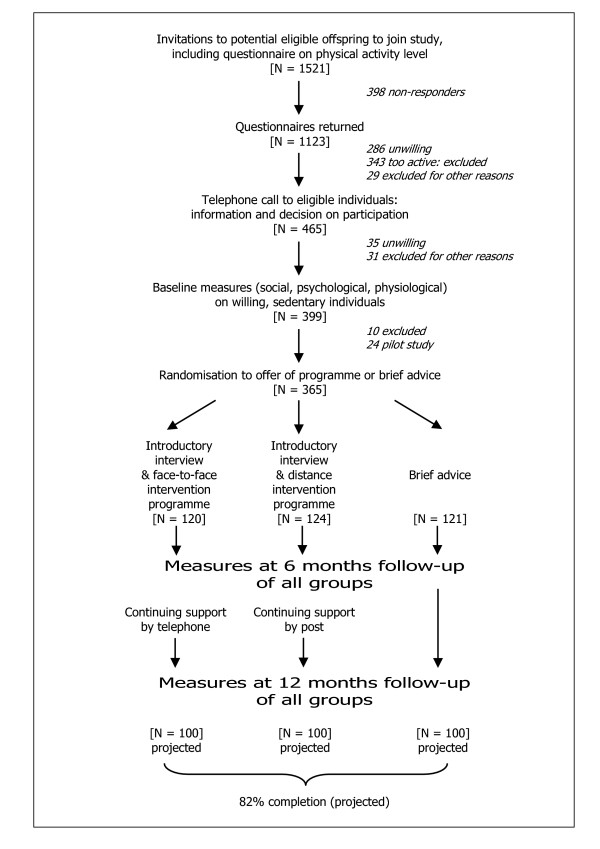
Background: Increasing prevalence of obesity and disorders associated with sedentary living constitute a major global public health problem. While previous evaluations of interventions to increase physical activity have involved communities or individuals with established disease, less attention has been given to interventions for individuals at risk of disease. Methods/design: ProActiveaims to evaluate the efficacy of a theoretical, evidence- and family-based intervention programme to increase physical activity in a sedentary population, defined as being at-risk through having a parental family history of diabetes. Primary care diabetes or family history registers were used to recruit 365 individuals aged 30–50 years, screened for activity level. Participants were assigned by central randomisation to three intervention programmes: brief written advice (comparison group), or a psychologically based behavioural change programme, delivered either by telephone (distance group) or face-to-face in the family home over one year. The protocol-driven intervention programme is delivered by trained facilitators, and aims to support increases in physical activity through the introduction and facilitation of a range of self-regulatory skills (e.g. goal setting). The primary outcome is daytime energy expenditure and its ratio to resting energy expenditure, measured at baseline and one year using individually calibrated heart rate monitoring. Secondary measures include self-report of individual and family activity, psychological mediators of behaviour change, physiological and biochemical correlates, acceptability, and costs, measured at baseline, six months and one year. The primary intention to treat analysis will compare groups at one-year post randomisation. Estimation of the impact on diabetes incidence will be modelled using data from a parallel ten-year cohort study using similar measures. Discussion: ProActiveis the first efficacy trial of an intervention programme to promote physical activity in a defined high-risk group accessible through primary care. The intervention programme is based on psychological theory and evidence; it introduces and facilitates the use of self-regulatory skills to support behaviour change and maintenance. The trial addresses a range of methodological weaknesses in the field by careful specification and quality assurance of the intervention programme, precise characterisation of participants, year-long follow-up and objective measurement of physical activity. Due to report in 2005, ProActivewill provide estimates of the extent to which this approach could assist at-risk groups who could benefit from changes in behaviours affecting health, and inform future pragmatic trials.
Overview
The claims and statistics of this paper haven’t been checked yet.
Free: it reads the open-access text and checks the first 5 claims that cite a source we can check. Create a free account to check every claim.
Integrity signals
Registry
Cites
Statistics
Figures
Verification
Claims the paper makes
The claims and statistics of this paper haven’t been checked yet.
Free: it reads the open-access text and checks the first 5 claims that cite a source we can check. Create a free account to check every claim.
Claims other papers make about this one
Each is checked against this paper’s own text: does it say what the citing paper says it does?
The cited source says what the claim attributes to it.
In the citing paper
“Fewer RCTs solely targeted PA behavior in individuals with or at risk of developing type 2 diabetes ( 279 , 284 , 285 ).”
From Exercise and Type 2 Diabetes (2010) · cites this paper as [279]
Self-check
Percentages, sums and reported differences re-computed from the paper’s own numbers.
The self-check needs the paper’s full text.
Citations
Cites
The theory of planned behavior
Ajzen, I. (1991) · Organizational Behavior and Human Decision Processes · doi:10.1016/0749-5978(91)90020-t · Cited by 90,587
Reduction in the incidence of type 2 diabetes with lifestyle intervention or metformin
(2002) · New England Journal of Medicine · doi:10.1056/nejmoa012512 · Cited by 19,011
SF-36 health survey: Manual and interpretation guide
Ware, J. (2003) · Medical Entomology and Zoology · Cited by 11,424
Tuomilehto, J., Lindström, J., Eriksson, J. G., Valle, T. T., Hämäläinen, H., Ilanne-Parikka, P., Keinänen-Kiukaanniemi, S., Laakso, M., Louheranta, A., Rastas, M., et al. (2001) · New England Journal of Medicine · doi:10.1056/nejm200105033441801 · Cited by 10,873 · cited 1×
“Three trials among individuals with impaired glucose tolerance in China [14], Finland [15] and USA [16], have established that intensive approaches to lifestyle changes including physical activity can delay progression to diabetes by 58% over three years [15,16] and possibly longer [14].”
‘Small Changes' to Diet and Physical Activity Behaviors for Weight Management
Hills, A. P., Byrne, N. M., Lindstrom, R., & Hill, J. O. (2013) · Obesity Facts · doi:10.1159/000345030 · Cited by 9,493
Pan, X.-R., Li, G.-W., Hu, Y.-H., Wang, J.-X., Yang, W.-Y., An, Z.-X., Hu, Z.-X., Juan-Lin, Xiao, J.-Z., Cao, H.-B., et al. (1997) · Diabetes Care · doi:10.2337/diacare.20.4.537 · Cited by 4,320
A simple method to assess exercise behavior in the community.
Godin, G., & Shephard, R. J. (1985) · PubMed · Cited by 3,824
Framework for design and evaluation of complex interventions to improve health
Campbell, M. (2000) · BMJ · doi:10.1136/bmj.321.7262.694 · Cited by 3,474
Marteau, T. M., & Bekker, H. (1992) · British Journal of Clinical Psychology · doi:10.1111/j.2044-8260.1992.tb00997.x · Cited by 3,238
Revision of the Physical Activity Readiness Questionnaire (PAR-Q).
Thomas, S. G., Reading, J., & Shephard, R. J. (1992) · PubMed · Cited by 2,347
Bayesian Approaches to Clinical Trials and Health‐Care Evaluation
Spiegelhalter, D. J., Abrams, K. R., & Myles, J. P. (2003) · Wiley eBooks · doi:10.1002/0470092602 · Cited by 1,673
Self-citationPhysical activity and incidence of non-insulin-dependent diabetes mellitus in women
Manson, J. E., Stampfer, M. J., Colditz, G. A., Willett, W. C., Rosner, B., Hennekens, C. H., Speizer, F. E., Rimm, E. B., & Krolewski, A. S. (1991) · The Lancet · doi:10.1016/0140-6736(91)90664-b · Cited by 1,164
Variations in population health status: results from a United Kingdom national questionnaire survey
Kind, P., Dolan, P., Gudex, C., & Williams, A. (1998) · BMJ · doi:10.1136/bmj.316.7133.736 · Cited by 1,059
Predicting and Explaining Intentions and Behavior: How Well Are We Doing?
Sutton, S. (1998) · Journal of Applied Social Psychology · doi:10.1111/j.1559-1816.1998.tb01679.x · Cited by 1,026
Self-citationTurner‐Bowker, D. M., DeRosa, M., & Ware, J. E. (2008) · eScholarship@UMassChan · Cited by 954
Hardeman, W., Johnston, M., Johnston, D., Bonetti, D., Wareham, N., & Kinmonth, A. L. (2002) · Psychology & Health · doi:10.1080/08870440290013644a · Cited by 884
Self-citationSaris, W. H. M., Blair, S. N., Van Baak, M. A., Eaton, S. B., Davies, P. S. W., Di Pietro, L., Fogelholm, M., Rissanen, A., Schoeller, D., Swinburn, B., et al. (2003) · Obesity Reviews · doi:10.1046/j.1467-789x.2003.00101.x · Cited by 865
Wareham, N. J., Jakes, R. W., Rennie, K. L., Schuit, J., Mitchell, J., Hennings, S., & Day, N. E. (2003) · Public Health Nutrition · doi:10.1079/phn2002439 · Cited by 850
Self-citationIncreasing physical activity: a quantitative synthesis
DISHMAN, R. K., & BUCKWORTH, J. (1996) · Medicine & Science in Sports & Exercise · doi:10.1097/00005768-199606000-00010 · Cited by 674
[The Da Qing IGT and Diabetes study].
Ayame, H. (2005) · PubMed · Cited by 658
Does physical activity prevent weight gain – a systematic review
Fogelholm, M., & Kukkonen‐Harjula, K. (2000) · Obesity Reviews · doi:10.1046/j.1467-789x.2000.00016.x · Cited by 598
Physical activity behavior change: Issues in adoption and maintenance.
Marcus, B. H., Forsyth, L. H., Stone, E. J., Dubbert, P. M., McKenzie, T. L., Dunn, A. L., & Blair, S. N. (2000) · Health Psychology · doi:10.1037/0278-6133.19.suppl1.32 · Cited by 568
A Controlled Trial of Physician Counseling to Promote the Adoption of Physical Activity
Calfas, K. J., Long, B. J., Sallis, J. F., Wooten, W. J., Pratt, M., & Patrick, K. (1996) · Preventive Medicine · doi:10.1006/pmed.1996.0050 · Cited by 565
Kinmonth, A. L., Woodcock, A., Griffin, S., Spiegal, N., & Campbell, M. J. (1998) · BMJ · doi:10.1136/bmj.317.7167.1202 · Cited by 474
Self-citationBrage, S., Brage, N., Franks, P. W., Ekelund, U., Wong, M.-Y., Andersen, L. B., Froberg, K., & Wareham, N. J. (2004) · Journal of Applied Physiology · doi:10.1152/japplphysiol.00703.2003 · Cited by 473
Self-citationGoal Setting as a Strategy for Health Behavior Change
Strecher, V. J., Seijts, G. H., Kok, G. J., Latham, G. P., Glasgow, R., DeVellis, B., Meertens, R. M., & Bulger, D. W. (1995) · Health Education Quarterly · doi:10.1177/109019819502200207 · Cited by 445
Physical activity assessed by activity monitor and doubly labeled water in children
EKELUND, U., SJÖSTRÖM, M., YNGVE, A., POORTVLIET, E., NILSSON, A., FROBERG, K., WEDDERKOPP, N., & WESTERTERP, K. (2001) · Medicine & Science in Sports & Exercise · doi:10.1097/00005768-200102000-00017 · Cited by 441
Self-citationValidity and repeatability of the EPIC-Norfolk Physical Activity Questionnaire
Wareham, N. J., Jakes, R. W., Rennie, K. L., Mitchell, J., Hennings, S., & Day, N. E. (2002) · International Journal of Epidemiology · doi:10.1093/ije/31.1.168 · Cited by 435
Self-citationMcLean, N., Griffin, S., Toney, K., & Hardeman, W. (2003) · International Journal of Obesity · doi:10.1038/sj.ijo.0802383 · Cited by 418
Self-citationPhysical exercise habit: on the conceptualization and formation of habitual health behaviours
Aarts, H., Paulussen, T., & Schaalma, H. (1997) · Health Education Research · doi:10.1093/her/12.3.363 · Cited by 417
Wood, D. A., Kinmonth, A. L., Davies, G. A., Yarwood, J., Thompson, S. G., Pyke, S. D. M., Kok, Y., Cramb, R., Le Guen, C., Marteau, T. M., et al. (1994) · BMJ · doi:10.1136/bmj.308.6924.313 · Cited by 379
Self-citationDescriptive Epidemiology of Body Weight and Weight Change in U.S. Adults
Williamson, D. F. (1993) · Annals of Internal Medicine · doi:10.7326/0003-4819-119-7_part_2-199310011-00004 · Cited by 366
Padgett, D., Mumford, E., Hynes, M., & Carter, R. (1988) · Journal of Clinical Epidemiology · doi:10.1016/0895-4356(88)90040-6 · Cited by 322
Bayesian Approaches to Clinical Trials and Health-Care Evaluation
Best, M. A. (2005) · Journal of the Royal Statistical Society Series A: Statistics in Society · doi:10.1111/j.1467-985x.2004.00347_17.x · Cited by 303
Hardeman, W., Griffin, S., Johnston, M., Kinmonth, A., & Wareham, N. (2000) · International Journal of Obesity · doi:10.1038/sj.ijo.0801100 · Cited by 283
Self-citationWareham, N. J., & Rennie, K. L. (1998) · PubMed · Cited by 256
Self-citationSix-month physical activity and fitness changes in Project Active, a randomized trial
DUNN, A. L., GARCIA, M. E., MARCUS, B. H., KAMPERT, J. B., KOHL, H. W., & BLAIR, S. N. (1998) · Medicine & Science in Sports & Exercise · doi:10.1097/00005768-199807000-00009 · Cited by 183
Fasting proinsulin concentrations predict the development of type 2 diabetes.
Wareham, N. J., Byrne, C. D., Williams, R., Day, N. E., & Hales, C. N. (1999) · Diabetes Care · doi:10.2337/diacare.22.2.262 · Cited by 173
Self-citationEffects of interventions in health care settings on physical activity or cardiorespiratory fitness
Simons-Morton, D. G., Calfas, K. J., Oldenburg, B., & Burton, N. W. (1998) · American Journal of Preventive Medicine · doi:10.1016/s0749-3797(98)00078-6 · Cited by 151
Rennie, K. L., & Wareham, N. J. (1998) · Public Health Nutrition · doi:10.1079/phn19980043 · Cited by 117
Self-citationLuepker, R. V. (2004) · Cited by 111
Wareham, N. J., Hennings, S. J., Prentice, A. M., & Day, N. E. (1997) · British Journal of Nutrition · doi:10.1079/bjn19970207 · Cited by 111
Self-citationKING, A. C., SALLIS, J. F., DUNN, A. L., SIMONS-MORTON, D. G., ALBRIGHT, C. A., COHEN, S., REJESKI, W. J., MARCUS, B. H., & CODAY, M. C. (1998) · Medicine & Science in Sports & Exercise · doi:10.1097/00005768-199807000-00011 · Cited by 108
Wareham, N. J., Wong, M.-Y., & Day, N. E. (2000) · American Journal of Epidemiology · doi:10.1093/aje/152.2.132 · Cited by 99
Self-citationSargeant, L. A., Wareham, N. J., & Khaw, K. (2000) · International Journal of Obesity · doi:10.1038/sj.ijo.0801383 · Cited by 98
Self-citationDurrington, P. N., Kok-Kiong, Y., Kinmonth, A. L., Boutillier, C. L., Pyke, S., Marteau, T. M., Cramb, R., Thompson, S. G., Wood, D., Kinmouth, A., et al. (1994) · Europe PMC (PubMed Central) · Cited by 97
Self-citationMeasurement error in epidemiology: the design of validation studies II: bivariate situation
Wong, M. Y., Day, N. E., & Wareham, N. J. (1999) · Statistics in Medicine · doi:10.1002/(sici)1097-0258(19991115)18:21<2831::aid-sim282>3.0.co;2-3 · Cited by 88
Effectiveness of physical activity promotion schemes in primary care: A review
Riddoch, C., Ribera, A. P., & Cooper, A. R. (1998) · Bristol Research (University of Bristol) · Cited by 87
A combined heart rate and movement sensor: proof of concept and preliminary testing study
Rennie, K., Rowsell, T., Jebb, S., Holburn, D., & Wareham, N. (2000) · European Journal of Clinical Nutrition · doi:10.1038/sj.ejcn.1600973 · Cited by 83
Self-citationCost-Effectiveness of the Primary Prevention of Non-Insulin Dependent Diabetes Mellitus
Segal, L., Dalton, A. C., & Richardson, J. (1998) · Health Promotion International · doi:10.1093/heapro/13.3.197 · Cited by 63
The Evidence Base for Diabetes Care
Herman, W. H., Kinmonth, A. L., Wareham, N. J., & Williams, R. (2010) · The Evidence Base for Diabetes Care · doi:10.1002/9780470682807.ch1 · Cited by 50
Self-citationThe Evidence Base for Diabetes Care
(2002) · Wiley eBooks · doi:10.1002/0470846585 · Cited by 42
Changing Diet and Exercise Behaviors in Individuals at Risk for Weight Gain
Wing, R. R. (1995) · Obesity Research · doi:10.1002/j.1550-8528.1995.tb00474.x · Cited by 30
A Research Information Sheet for Practices (RISP): a tool to facilitate research participation
Bateman, H. (2002) · Family Practice · doi:10.1093/fampra/19.6.691 · Cited by 19
Hamman, R. F. (2002) · Wiley eBooks · doi:10.1002/0470846585.ch6 · Cited by 15
Dunn, A. L., Blair, S. N., Rejeski, W. J., & Simons‐Morton, D. G. (1999) · Medicine & Science in Sports & Exercise · doi:10.1097/00005768-199905001-02040 · Cited by 1
Research works printed but not linked: 6
- Murray CJ Lopez AD Global burden of disease 1996 Cambridge, Mass., Harvard University Press
- Sallis JF Owen N Physical activity and behavioural medicine Behavioral Medicine & Health Psychology 1998 Thousand Oaks, California, Sage Publications, USA
- Griffin SJ Kinmonth AL Skinner C Kelly J Educational and psychosocial interventions for adults with diabetes 1999 London, British Diabetic Association
- Organization World Health Definition, diagnosis and classification of diabetes mellitus and its complications: report of a World Health Organisation Collaborations. 1999 Geneva, WHO
- Authority Allied Dunbar/Health Education Allied Dunbar National Fitness Survey: A Summary of the Major Findings and Messages from the Allied Dunbar National Fitness Survey 1992 London, HEA/Sports Council
- Netten A Curtis L Unit Costs of Health and Social Care 2003 2003 Kent, UK, Personal Social Services Research Unit, University of Kent
Cited by
Process evaluation of complex interventions: Medical Research Council guidance
Moore, G. F., Audrey, S., Barker, M., Bond, L., Bonell, C., Hardeman, W., Moore, L., O'Cathain, A., Tinati, T., Wight, D., et al. (2015) · BMJ · doi:10.1136/bmj.h1258 · Cited by 6,204
Self-citationColberg, S. R., Sigal, R. J., Fernhall, B., Regensteiner, J. G., Blissmer, B. J., Rubin, R. R., Chasan-Taber, L., Albright, A. L., & Braun, B. (2010) · Diabetes Care · doi:10.2337/dc10-9990 · Cited by 1,955
Interventions to promote walking: systematic review
Ogilvie, D., Foster, C. E., Rothnie, H., Cavill, N., Hamilton, V., Fitzsimons, C. F., & Mutrie, N. (2007) · BMJ · doi:10.1136/bmj.39198.722720.be · Cited by 695
(2010) · Medicine & Science in Sports & Exercise · doi:10.1249/mss.0b013e3181eeb61c · Cited by 567
Hurling, R., Catt, M., De Boni, M., Fairley, B. W., Hurst, T., Murray, P., Richardson, A., & Sodhi, J. S. (2007) · Journal of Medical Internet Research · doi:10.2196/jmir.9.2.e7 · Cited by 536
Metadata
- Authors
- Williams, K., Prevost, A. T., Griffin, S., Hardeman, W., Hollingworth, W., Spiegelhalter, D., Sutton, S., Ekelund, U., Wareham, N., & Kinmonth, A. L.
- Affiliations
- University of Cambridge (GB)
- University of Washington (US)
- MRC Biostatistics Unit (GB)
- MRC Epidemiology Unit (GB)
- Corresponding author
- Kinmonth, Ann Louise
- ORCID
- Venue
- BMC Public Health
- Published
- 2004-10-18
- Volume
- 4
- Issue
- 1
- Pages
- 48-48
- ISSN
- 1471-2458 (ISSN-L)
- PMC
- PMC526256
- OpenAlex
- W1503011998
- Cited by
- 72
- References
- 58
- Citations by year
- 2022: 1 · 2018: 1 · 2017: 2 · 2016: 1 · 2015: 4 · 2014: 3 · 2013: 6 · 2012: 4
- FWCI
- 3.29
- Type
- journal article
- Language
- en
- Open access
- gold
- doi.org
- Licence
- Locations
- BMC Public Health (publishedVersion, cc-by)
- PubMed Central (publishedVersion, cc-by)
- PubMed (publishedVersion)
- UEA Digital Repository (University of East Anglia) (acceptedVersion)
- DOAJ (DOAJ: Directory of Open Access Journals) (submittedVersion)
- Research Portal (King's College London) (submittedVersion, other-oa)
- Spiral (Imperial College London) (submittedVersion, cc-by)
- Apollo (University of Cambridge) (submittedVersion)
- Funders
- Royal College of General Practitioners
- Diabetes UK
- Medical Research Council
- Topics
- Health Sciences › Medicine › Public Health, Environmental and Occupational Health › Physical Activity and Health
- Social Sciences › Psychology › Applied Psychology › Behavioral Health and Interventions
- Health Sciences › Health Professions › General Health Professions › Mobile Health and mHealth Applications
- Keywords
- physical activity promotion, diabetes prevention, family intervention, sedentary behavior, family history of diabetes, self-regulation skills, goal setting, behavior change, telephone-delivered intervention, heart rate monitoring, energy expenditure, primary care, treatment acceptability, cost analysis
- MeSH terms
- Adult, Behavior Therapy, Counseling, Diabetes Mellitus, Type 2, Energy Metabolism, England, Family Health, Humans, Middle Aged, Motor Activity, Obesity, Parents, Patient Education as Topic, Primary Prevention, Risk Factors, Program Evaluation, Treatment Outcome
About these checks
Registry, retraction, Cites and statistics results are computed, not judged, with one exception: a printed reference that no index lists is read once by a model before it counts as a citation error. Claims are extracted by a model and kept only when their quote appears verbatim in the text; each cited source is then checked, with a model’s help, for whether it says what the claim relies on. Those verdicts can be wrong — read the claim’s quote and the cited source before relying on one.
Statistics and arithmetic are recomputed, not judged.
Confidence bands are shown only for fields calibrated on our annotated test set. None is calibrated yet, so no band is shown.
What counts as a claim ›How we measure confidence ›How we check this ›
Are you an author, or do you see a problem with this page? Request a review
Data sources
Bibliographic data: Semantic Scholar, OpenAlex, Crossref.
Contains information from the Semantic Scholar Academic Graph Datasets, made available under the ODC Attribution License (ODC-BY 1.0).
Semantic Scholar’s data is described in: Kinney, R., et al. (2023). The Semantic Scholar Open Data Platform. arXiv:2301.10140.
