

The DOI matches its Crossref record; 60 of the 62 references it cites were found in a registry or an index; 1 of the 58 sources its claims cite were checked for support.
Staying at work with chronic nonspecific musculoskeletal pain: a qualitative study of workers' experiences
Open accessAbstract
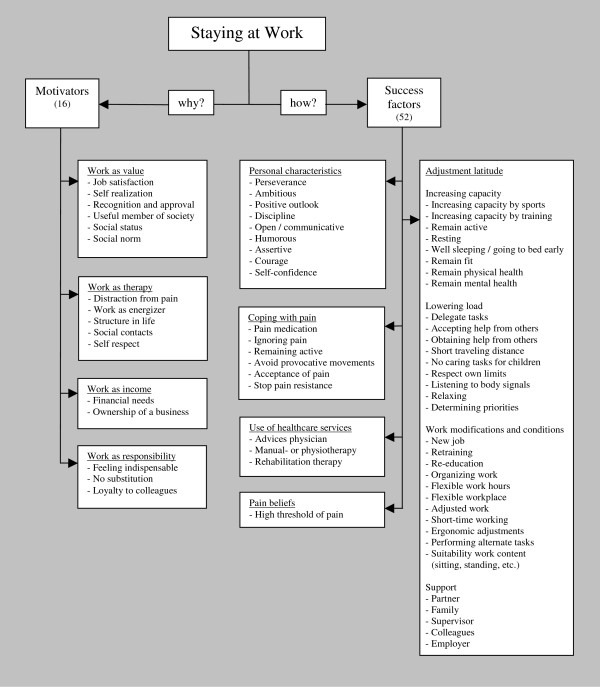
BACKGROUND: Many people with chronic nonspecific musculoskeletal pain (CMP) have decreased work ability. The majority, however, stays at work despite their pain. Knowledge about workers who stay at work despite chronic pain is limited, narrowing our views on work participation. The aim of this study was to explore why people with CMP stay at work despite pain (motivators) and how they manage to maintain working (success factors). METHODS: A semi-structured interview was conducted among 21 subjects who stay at work despite CMP. Participants were included through purposeful sampling. Interviews were audio-recorded, transcribed verbatim, and imported into computer software Atlas.ti. Data was analyzed by means of thematic analysis. The interviews consisted of open questions such as: "Why are you working with pain?" or "How do you manage working while having pain?" RESULTS: A total of 16 motivators and 52 success factors emerged in the interviews. Motivators were categorized into four themes: work as value, work as therapy, work as income generator, and work as responsibility. Success factors were categorized into five themes: personal characteristics, adjustment latitude, coping with pain, use of healthcare services, and pain beliefs. CONCLUSIONS: Personal characteristics, well-developed self-management skills, and motivation to work may be considered to be important success factors and prerequisites for staying at work, resulting in behaviors promoting staying at work such as: raising adjustment latitude, changing pain-coping strategies, organizing modifications and conditions at work, finding access to healthcare services, and asking for support. Motivators and success factors for staying at work may be used for interventions in rehabilitation and occupational medicine, to prevent absenteeism, or to promote a sustainable return to work. This qualitative study has evoked new hypotheses about staying at work; quantitative studies on staying at work are needed to obtain further evidence.
Overview
AI snapshot
Written from the paper’s full text.
TL;DR
This qualitative study explored why workers with chronic nonspecific musculoskeletal pain (CMP) stay at work despite pain and how they manage to do so. It identified 16 motivators and 52 success factors, organized into four motivator themes and five success-factor themes.
Key findings
- Among 21 workers with CMP (9 male, 12 female), interviews yielded 16 motivators grouped as work as value, work as therapy, work as income generator, and work as responsibility.
- Interviews also yielded 52 success factors grouped as personal characteristics, adjustment latitude, coping with pain, use of healthcare services, and pain beliefs.
- Participants had mean current pain intensity 4.5 (SD 1.9) and average pain 5.3 (SD 1.7) on an 11-point NRS; mean Pain Disability Index was 20.3 (SD 8.2), and mean occupational PDI was 3.7 (SD 1.5).
- Most participants had pain for more than 5 years (18/21, 86%) and no work absence due to CMP in the previous year (17/21, 81%).
Methods
- Individual semi-structured interviews lasting 45–90 minutes were conducted with 21 participants with CMP, recruited by purposeful sampling from the “Working with Pain” study; inclusion required CMP >6 months, age 20–60, employment ≥20 hours/week for 12 months prior, and CMP-related absence ≤5% of potential working hours.
- Interviews were audio-recorded, transcribed verbatim, imported into Atlas.ti, and analyzed using thematic analysis guided by the questions “why” and “how”; coding was done independently by the first and second authors, with consultation and peer debriefing.
- Data collection continued until saturation, which was reached after 21 participants; pain intensity was measured with an 11-point numeric rating scale and disability with the Pain Disability Index.
Limitations
- Stated by the authors: no participants aged 20–30 were included, and most had pain for more than 5 years, so conclusions may be less generalizable to younger people or those with a shorter pain history.
- Stated by the authors: the Dutch social security system is relatively generous, so generalization to countries with less generous systems is uncertain; participants were selected because they stayed at work despite CMP, and their mean occupational PDI was 3.7, so results cannot simply be generalized to return-to-work populations, and comparison with workers who did not stay at work would have strengthened the results.
- Evident from the text: recruitment through newspaper and patient-association announcements may have selected a self-motivated sample, and the qualitative cross-sectional design cannot establish causal relationships.
Model-written summary. Check it against the paper before relying on it.
Integrity signals
Registry
Cites
Statistics
Figures
Verification
Claims the paper makes
52 Own result · 29 Not checked yet · 22 Own method · 20 Own interpretation · 1 Supported so far · 1 No basis given
The sources with a verdict support this claim; the rest weren’t checked yet, have no full text we could read, or their verdicts aren’t rated yet.
In the paper
“Other studies show that modifications at work for employees with work disabilities lower the levels of absenteeism [44,45].”
§ Staying at work with chronic nonspecific musculoskeletal pain: a qualitative study of workers' experiences > Discussion > How
What the sources say
- Supportedcites [44] Krause N, Frank JW, Dasinger LK, Sullivan TJ, Sinclair SJ: Determinants of duration of disability and return-to-work after work-related injury and illness: challenges for future research. Am J Ind Med. 2001, 40: 464-484. 10.1002/ajim.1116. source
The Variable Effect on Work Disability section lists modified-work programs as shortening work disability and says workplace modifications and accommodations help reduce it. In the paper’s return-to-work context, shorter disability duration supports the paraphrase that these modifications reduce time absent from work. No page number is available in our copy. (LLM, conf=0.87)
- Not checked yetcites [45] Nordqvist C, Holmqvist C, Alexanderson K: Views of laypersons on the role employers play in return to work when sick-listed. J Occup Rehabil. 2003, 13: 11-20. 10.1023/A:1021841722613. source
plaindirect- Asserted: passes — The authors put it forward as true.
- Checkable: passes — It can be checked against evidence.
- Load-bearing: unclear — It is unclear whether the paper’s conclusions depend on it.
- Based: passes — The paper gives a reason why it holds.
- Supported
A result the paper reports from its own data — it cites no other source for it, so there is none to check. The quote shows it is in the paper.
In the paper
“The second research question,”
§ Staying at work with chronic nonspecific musculoskeletal pain: a qualitative study of workers' experiences > Discussion > How
plain- Asserted: passes — The authors put it forward as true.
- Checkable: passes — It can be checked against evidence.
- Load-bearing: passes — The paper’s conclusions depend on it.
- Based: passes — The paper gives a reason why it holds.
- Rests on an assumption: Workers who stay at work despite chronic nonspecific musculoskeletal pain are a successful group.
A result the paper reports from its own data — it cites no other source for it, so there is none to check. The quote shows it is in the paper.
In the paper
“Diminished capacity for spare time activities such as sports, gardening, or social events was one.”
§ Staying at work with chronic nonspecific musculoskeletal pain: a qualitative study of workers' experiences > Results > Success factors for staying at work
plaindirect- Asserted: passes — The authors put it forward as true.
- Checkable: passes — It can be checked against evidence.
- Load-bearing: unclear — It is unclear whether the paper’s conclusions depend on it.
- Based: passes — The paper gives a reason why it holds.
A result the paper reports from its own data — it cites no other source for it, so there is none to check. The quote shows it is in the paper.
In the paper
“A few participants said their threshold of pain diminished as the pain lasted longer.”
§ Staying at work with chronic nonspecific musculoskeletal pain: a qualitative study of workers' experiences > Results > Success factors for staying at work
plaindirect- Asserted: passes — The authors put it forward as true.
- Checkable: passes — It can be checked against evidence.
- Load-bearing: unclear — It is unclear whether the paper’s conclusions depend on it.
- Based: passes — The paper gives a reason why it holds.
A result the paper reports from its own data — it cites no other source for it, so there is none to check. The quote shows it is in the paper.
In the paper
“Participants who stay at work with pain placed a high value on working.”
§ Staying at work with chronic nonspecific musculoskeletal pain: a qualitative study of workers' experiences > Discussion > Why
plain- Asserted: passes — The authors put it forward as true.
- Checkable: passes — It can be checked against evidence.
- Load-bearing: passes — The paper’s conclusions depend on it.
- Based: passes — The paper gives a reason why it holds.
A result the paper reports from its own data — it cites no other source for it, so there is none to check. The quote shows it is in the paper.
In the paper
“For most participants a secure income appeared to be a strong motivator to stay at work with CMP.”
§ Staying at work with chronic nonspecific musculoskeletal pain: a qualitative study of workers' experiences > Results > Motivators for staying at work
hedgedconditional- Asserted: passes — The authors put it forward as true.
- Checkable: passes — It can be checked against evidence.
- Load-bearing: unclear — It is unclear whether the paper’s conclusions depend on it.
- Based: passes — The paper gives a reason why it holds.
A result the paper reports from its own data — it cites no other source for it, so there is none to check. The quote shows it is in the paper.
In the paper
“But there were perceived negative consequences of staying at work despite pain.”
§ Staying at work with chronic nonspecific musculoskeletal pain: a qualitative study of workers' experiences > Results > Success factors for staying at work
plain- Asserted: passes — The authors put it forward as true.
- Checkable: passes — It can be checked against evidence.
- Load-bearing: unclear — It is unclear whether the paper’s conclusions depend on it.
- Based: passes — The paper gives a reason why it holds.
A result the paper reports from its own data — it cites no other source for it, so there is none to check. The quote shows it is in the paper.
In the paper
“A large majority of the participants mentioned adjustment latitude as a powerful success factor for SAW.”
§ Staying at work with chronic nonspecific musculoskeletal pain: a qualitative study of workers' experiences > Results > Success factors for staying at work
plaindirect- Asserted: passes — The authors put it forward as true.
- Checkable: passes — It can be checked against evidence.
- Load-bearing: passes — The paper’s conclusions depend on it.
- Based: passes — The paper gives a reason why it holds.
A result the paper reports from its own data — it cites no other source for it, so there is none to check. The quote shows it is in the paper.
In the paper
“The first research question in our study,”
§ Staying at work with chronic nonspecific musculoskeletal pain: a qualitative study of workers' experiences > Discussion > Why
plain- Asserted: passes — The authors put it forward as true.
- Checkable: passes — It can be checked against evidence.
- Load-bearing: passes — The paper’s conclusions depend on it.
- Based: passes — The paper gives a reason why it holds.
- Rests on an assumption: Workers who stay at work despite chronic nonspecific musculoskeletal pain are a successful group.
A result the paper reports from its own data — it cites no other source for it, so there is none to check. The quote shows it is in the paper.
In the paper
“Work distracted from the pain.”
§ Staying at work with chronic nonspecific musculoskeletal pain: a qualitative study of workers' experiences > Results > Motivators for staying at work
plaindirect- Asserted: passes — The authors put it forward as true.
- Checkable: passes — It can be checked against evidence.
- Load-bearing: passes — The paper’s conclusions depend on it.
- Based: passes — The paper gives a reason why it holds.
A result the paper reports from its own data — it cites no other source for it, so there is none to check. The quote shows it is in the paper.
In the paper
“For a plausible explanation of how this higher threshold of pain came about, participants referred to the length of time they had had the pain.”
§ Staying at work with chronic nonspecific musculoskeletal pain: a qualitative study of workers' experiences > Results > Success factors for staying at work
plaindirect- Asserted: passes — The authors put it forward as true.
- Checkable: passes — It can be checked against evidence.
- Load-bearing: unclear — It is unclear whether the paper’s conclusions depend on it.
- Based: passes — The paper gives a reason why it holds.
A result the paper reports from its own data — it cites no other source for it, so there is none to check. The quote shows it is in the paper.
In the paper
“Job satisfaction was often stated as a strong motivator for SAW.”
§ Staying at work with chronic nonspecific musculoskeletal pain: a qualitative study of workers' experiences > Results > Motivators for staying at work
boosteddirect- Asserted: passes — The authors put it forward as true.
- Checkable: passes — It can be checked against evidence.
- Load-bearing: unclear — It is unclear whether the paper’s conclusions depend on it.
- Based: passes — The paper gives a reason why it holds.
A result the paper reports from its own data — it cites no other source for it, so there is none to check. The quote shows it is in the paper.
In the paper
“Pain reduction as a result of medication resulted in better sleep during the night.”
§ Staying at work with chronic nonspecific musculoskeletal pain: a qualitative study of workers' experiences > Results > Success factors for staying at work
plaindirect- Asserted: passes — The authors put it forward as true.
- Checkable: passes — It can be checked against evidence.
- Load-bearing: unclear — It is unclear whether the paper’s conclusions depend on it.
- Based: passes — The paper gives a reason why it holds.
A result the paper reports from its own data — it cites no other source for it, so there is none to check. The quote shows it is in the paper.
In the paper
“Motivators were categorized into four themes: work as value, work as therapy, work as income generator, and work as responsibility.”
§ Staying at work with chronic nonspecific musculoskeletal pain: a qualitative study of workers' experiences > Abstract > Results
plain- Asserted: passes — The authors put it forward as true.
- Checkable: passes — It can be checked against evidence.
- Load-bearing: passes — The paper’s conclusions depend on it.
- Based: passes — The paper gives a reason why it holds.
A result the paper reports from its own data — it cites no other source for it, so there is none to check. The quote shows it is in the paper.
In the paper
“And, finally, there was an increased level of pain.”
§ Staying at work with chronic nonspecific musculoskeletal pain: a qualitative study of workers' experiences > Results > Success factors for staying at work
plaindirect- Asserted: passes — The authors put it forward as true.
- Checkable: passes — It can be checked against evidence.
- Load-bearing: unclear — It is unclear whether the paper’s conclusions depend on it.
- Based: passes — The paper gives a reason why it holds.
A result the paper reports from its own data — it cites no other source for it, so there is none to check. The quote shows it is in the paper.
In the paper
“Loyalty to colleagues appeared to be a significant motivator for SAW.”
§ Staying at work with chronic nonspecific musculoskeletal pain: a qualitative study of workers' experiences > Results > Motivators for staying at work
hedgedconditional- Asserted: passes — The authors put it forward as true.
- Checkable: passes — It can be checked against evidence.
- Load-bearing: unclear — It is unclear whether the paper’s conclusions depend on it.
- Based: passes — The paper gives a reason why it holds.
A result the paper reports from its own data — it cites no other source for it, so there is none to check. The quote shows it is in the paper.
In the paper
“And it was experienced as facilitating a positive outlook.”
§ Staying at work with chronic nonspecific musculoskeletal pain: a qualitative study of workers' experiences > Results > Success factors for staying at work
plaindirect- Asserted: passes — The authors put it forward as true.
- Checkable: passes — It can be checked against evidence.
- Load-bearing: unclear — It is unclear whether the paper’s conclusions depend on it.
- Based: passes — The paper gives a reason why it holds.
A result the paper reports from its own data — it cites no other source for it, so there is none to check. The quote shows it is in the paper.
In the paper
“Participants in our study were willing to change in order to reach their goal: staying at work.”
§ Staying at work with chronic nonspecific musculoskeletal pain: a qualitative study of workers' experiences > Discussion > Why
plain- Asserted: passes — The authors put it forward as true.
- Checkable: passes — It can be checked against evidence.
- Load-bearing: passes — The paper’s conclusions depend on it.
- Based: passes — The paper gives a reason why it holds.
A result the paper reports from its own data — it cites no other source for it, so there is none to check. The quote shows it is in the paper.
In the paper
“Ignoring the pain was mentioned by some participants as a strategy to control the pain.”
§ Staying at work with chronic nonspecific musculoskeletal pain: a qualitative study of workers' experiences > Results > Success factors for staying at work
plain- Asserted: passes — The authors put it forward as true.
- Checkable: passes — It can be checked against evidence.
- Load-bearing: unclear — It is unclear whether the paper’s conclusions depend on it.
- Based: passes — The paper gives a reason why it holds.
A result the paper reports from its own data — it cites no other source for it, so there is none to check. The quote shows it is in the paper.
In the paper
“And there was also frustration.”
§ Staying at work with chronic nonspecific musculoskeletal pain: a qualitative study of workers' experiences > Results > Success factors for staying at work
plaindirectSingle case- Asserted: passes — The authors put it forward as true.
- Checkable: passes — It can be checked against evidence.
- Load-bearing: unclear — It is unclear whether the paper’s conclusions depend on it.
- Based: passes — The paper gives a reason why it holds.
A result the paper reports from its own data — it cites no other source for it, so there is none to check. The quote shows it is in the paper.
In the paper
“Success factors were categorized into five themes: personal characteristics, adjustment latitude, coping with pain, use of healthcare services, and pain beliefs.”
§ Staying at work with chronic nonspecific musculoskeletal pain: a qualitative study of workers' experiences > Abstract > Results
plain- Asserted: passes — The authors put it forward as true.
- Checkable: passes — It can be checked against evidence.
- Load-bearing: passes — The paper’s conclusions depend on it.
- Based: passes — The paper gives a reason why it holds.
A result the paper reports from its own data — it cites no other source for it, so there is none to check. The quote shows it is in the paper.
In the paper
“Many participants stressed that pain acceptance was a successful strategy to stay at work.”
§ Staying at work with chronic nonspecific musculoskeletal pain: a qualitative study of workers' experiences > Results > Success factors for staying at work
plaindirect- Asserted: passes — The authors put it forward as true.
- Checkable: passes — It can be checked against evidence.
- Load-bearing: passes — The paper’s conclusions depend on it.
- Based: passes — The paper gives a reason why it holds.
A result the paper reports from its own data — it cites no other source for it, so there is none to check. The quote shows it is in the paper.
In the paper
“Moreover, in many cases the pain medication did not help soothe the pain at all.”
§ Staying at work with chronic nonspecific musculoskeletal pain: a qualitative study of workers' experiences > Results > Success factors for staying at work
plain- Asserted: passes — The authors put it forward as true.
- Checkable: passes — It can be checked against evidence.
- Load-bearing: unclear — It is unclear whether the paper’s conclusions depend on it.
- Based: passes — The paper gives a reason why it holds.
A result the paper reports from its own data — it cites no other source for it, so there is none to check. The quote shows it is in the paper.
In the paper
“The effect of pain medication varied.”
§ Staying at work with chronic nonspecific musculoskeletal pain: a qualitative study of workers' experiences > Results > Success factors for staying at work
plain- Asserted: passes — The authors put it forward as true.
- Checkable: passes — It can be checked against evidence.
- Load-bearing: unclear — It is unclear whether the paper’s conclusions depend on it.
- Based: passes — The paper gives a reason why it holds.
A result the paper reports from its own data — it cites no other source for it, so there is none to check. The quote shows it is in the paper.
In the paper
“And then there was fatigue.”
§ Staying at work with chronic nonspecific musculoskeletal pain: a qualitative study of workers' experiences > Results > Success factors for staying at work
plaindirectSingle case- Asserted: passes — The authors put it forward as true.
- Checkable: passes — It can be checked against evidence.
- Load-bearing: unclear — It is unclear whether the paper’s conclusions depend on it.
- Based: passes — The paper gives a reason why it holds.
A result the paper reports from its own data — it cites no other source for it, so there is none to check. The quote shows it is in the paper.
In the paper
“In our study, it seemed that the lives of participants who”
§ Staying at work with chronic nonspecific musculoskeletal pain: a qualitative study of workers' experiences > Discussion > How
hedged- Asserted: passes — The authors put it forward as true.
- Checkable: passes — It can be checked against evidence.
- Load-bearing: passes — The paper’s conclusions depend on it.
- Based: passes — The paper gives a reason why it holds.
A result the paper reports from its own data — it cites no other source for it, so there is none to check. The quote shows it is in the paper.
In the paper
“Moreover, the majority of participants had experienced pain for more than five years.”
§ Staying at work with chronic nonspecific musculoskeletal pain: a qualitative study of workers' experiences > Discussion > Strengths and limitations of the study
plain- Asserted: passes — The authors put it forward as true.
- Checkable: passes — It can be checked against evidence.
- Load-bearing: passes — The paper’s conclusions depend on it.
- Based: passes — The paper gives a reason why it holds.
A result the paper reports from its own data — it cites no other source for it, so there is none to check. The quote shows it is in the paper.
In the paper
“Our study supported these findings: participants reported that moderation of work, making it more suitable to their capacity, turned out to be an important factor in SAW.”
§ Staying at work with chronic nonspecific musculoskeletal pain: a qualitative study of workers' experiences > Discussion > How
plaincorrelational- Asserted: passes — The authors put it forward as true.
- Checkable: passes — It can be checked against evidence.
- Load-bearing: passes — The paper’s conclusions depend on it.
- Based: passes — The paper gives a reason why it holds.
A result the paper reports from its own data — it cites no other source for it, so there is none to check. The quote shows it is in the paper.
In the paper
“Sometimes help had been offered and accepted from others.”
§ Staying at work with chronic nonspecific musculoskeletal pain: a qualitative study of workers' experiences > Discussion > How
plain- Asserted: passes — The authors put it forward as true.
- Checkable: passes — It can be checked against evidence.
- Load-bearing: unclear — It is unclear whether the paper’s conclusions depend on it.
- Based: passes — The paper gives a reason why it holds.
A result the paper reports from its own data — it cites no other source for it, so there is none to check. The quote shows it is in the paper.
In the paper
“The pain had not been”
§ Staying at work with chronic nonspecific musculoskeletal pain: a qualitative study of workers' experiences > Discussion > How
plain- Asserted: passes — The authors put it forward as true.
- Checkable: passes — It can be checked against evidence.
- Load-bearing: passes — The paper’s conclusions depend on it.
- Based: passes — The paper gives a reason why it holds.
A result the paper reports from its own data — it cites no other source for it, so there is none to check. The quote shows it is in the paper.
In the paper
“Participants in our study experienced many motivators and success factors for SAW.”
§ Staying at work with chronic nonspecific musculoskeletal pain: a qualitative study of workers' experiences > Conclusions
plain- Asserted: passes — The authors put it forward as true.
- Checkable: passes — It can be checked against evidence.
- Load-bearing: passes — The paper’s conclusions depend on it.
- Based: passes — The paper gives a reason why it holds.
- Rests on an assumption: Workers who stay at work despite chronic nonspecific musculoskeletal pain are a successful group.
None of the sources cited for this claim have been checked yet.
In the paper
“Qualitative research on staying at work (SAW) has focused primarily on successful working strategies for women with fibromyalgia [9,10].”
§ Staying at work with chronic nonspecific musculoskeletal pain: a qualitative study of workers' experiences > Background
What the sources say
- Not checked yetcites [9] Liedberg GM, Henriksson CM: Factors of importance for work disability in women with fibromyalgia: an interview study. Arthritis Rheum. 2002, 47: 266-274. 10.1002/art.10454. source
- Not checked yetcites [10] Lofgren M, Ekholm J, Ohman A: 'A constant struggle': successful strategies of women in work despite fibromyalgia. Disabil Rehabil. 2006, 28: 447-455. 10.1080/09638280500197891. source
plain- Asserted: passes — The authors put it forward as true.
- Checkable: passes — It can be checked against evidence.
- Load-bearing: passes — The paper’s conclusions depend on it.
- Based: passes — The paper gives a reason why it holds.
None of the sources cited for this claim have been checked yet.
In the paper
“However, the majority (60-70%) of workers with CMP stays at work despite pain and without sick leave [3-6].”
§ Staying at work with chronic nonspecific musculoskeletal pain: a qualitative study of workers' experiences > Background
What the sources say
- Not checked yetcites [3] Picavet HS, Schouten JS: Musculoskeletal pain in the Netherlands: prevalences, consequences and risk groups, the DMC(3)-study. Pain. 2003, 102: 167-178. 10.1016/s0304-3959(02)00372-x. source
- Not checked yetcites [4] Blyth FM, March LM, Nicholas MK, Cousins MJ: Chronic pain, work performance and litigation. Pain. 2003, 103: 41-47. 10.1016/S0304-3959(02)00380-9. source
- Not checked yetcites [5] Breivik H, Collett B, Ventafridda V, Cohen R, Gallacher D: Survey of chronic pain in Europe: prevalence, impact on daily life, and treatment. Eur J Pain. 2006, 10: 287-333. 10.1016/j.ejpain.2005.06.009. source
- Not checked yetcites [6] IJzelenberg W, Burdorf A: Patterns of care for low back pain in a working population. Spine (Phila Pa 1976). 2004, 29: 1362-1368. 10.1097/01.BRS.0000127188.58944.1E. source
plain- Asserted: passes — The authors put it forward as true.
- Checkable: passes — It can be checked against evidence.
- Load-bearing: passes — The paper’s conclusions depend on it.
- Based: passes — The paper gives a reason why it holds.
A conclusion the paper draws from its own results — it cites no other source for it, so there is none to check. The quote shows it is in the paper.
In the paper
“Personal characteristics, well-developed self-management skills, and motivation to work may be considered to be important success factors and prerequisites for staying at work”
§ Staying at work with chronic nonspecific musculoskeletal pain: a qualitative study of workers' experiences > Abstract > Conclusions
hedgedconditional- Asserted: passes — The authors put it forward as true.
- Checkable: passes — It can be checked against evidence.
- Load-bearing: passes — The paper’s conclusions depend on it.
- Based: passes — The paper gives a reason why it holds.
None of the sources cited for this claim have been checked yet.
In the paper
“Strong motivation helped to strive for aims in life [27,29].”
§ Staying at work with chronic nonspecific musculoskeletal pain: a qualitative study of workers' experiences > Discussion > Why
What the sources say
- Not checked yetcites [27] Berglind H, Gerner U: Motivation and return to work among the long-term sicklisted: an action theory perspective. Disabil Rehabil. 2002, 24: 719-726. 10.1080/09638280210124301. source
- Not checked yetcites [29] Nicholson N: Absence Behaviour and Attendance Motivation: a Conceptual Synthesis. JMS. 1977, 14: 231-252.
plaindirect- Asserted: passes — The authors put it forward as true.
- Checkable: passes — It can be checked against evidence.
- Load-bearing: passes — The paper’s conclusions depend on it.
- Based: passes — The paper gives a reason why it holds.
A conclusion the paper draws from its own results — it cites no other source for it, so there is none to check. The quote shows it is in the paper.
In the paper
“A strong motivation to stay working set off behaviors such as increasing adjustment latitude, improving pain-coping strategies, organizing work modifications or better working conditions, accepting healthcare treatment, and seeking support.”
§ Staying at work with chronic nonspecific musculoskeletal pain: a qualitative study of workers' experiences > Discussion > Why
plaindirect- Asserted: passes — The authors put it forward as true.
- Checkable: passes — It can be checked against evidence.
- Load-bearing: passes — The paper’s conclusions depend on it.
- Based: passes — The paper gives a reason why it holds.
What the paper did — it cites no source for this, so there is none to check. The quote shows it is in the paper.
In the paper
“After interviewing 21 participants, data collection stopped, having reached saturation.”
§ Staying at work with chronic nonspecific musculoskeletal pain: a qualitative study of workers' experiences > Methods > Data analysis
plainn = 21- Asserted: passes — The authors put it forward as true.
- Checkable: passes — It can be checked against evidence.
- Load-bearing: passes — The paper’s conclusions depend on it.
- Based: passes — The paper gives a reason why it holds.
None of the sources cited for this claim have been checked yet.
In the paper
“Even so, there is a possibility that many absentees did have the intrinsic motivation to stay at work, but failed to find or put into practice the strategies needed [27,36].”
§ Staying at work with chronic nonspecific musculoskeletal pain: a qualitative study of workers' experiences > Discussion > Why
What the sources say
- Not checked yetcites [27] Berglind H, Gerner U: Motivation and return to work among the long-term sicklisted: an action theory perspective. Disabil Rehabil. 2002, 24: 719-726. 10.1080/09638280210124301. source
- Not checked yetcites [36] Hansson M, Bostrom C, Harms-Ringdahl K: Sickness absence and sickness attendance--what people with neck or back pain think. Soc Sci Med. 2006, 62: 2183-2195. 10.1016/j.socscimed.2005.10.002. source
hedgedconditional- Asserted: passes — The authors put it forward as true.
- Checkable: passes — It can be checked against evidence.
- Load-bearing: passes — The paper’s conclusions depend on it.
- Based: passes — The paper gives a reason why it holds.
A conclusion the paper draws from its own results — it cites no other source for it, so there is none to check. The quote shows it is in the paper.
In the paper
“resulting in behaviors promoting staying at work such as: raising adjustment latitude, changing pain-coping strategies, organizing modifications and conditions at work, finding access to healthcare services, and asking for support.”
§ Staying at work with chronic nonspecific musculoskeletal pain: a qualitative study of workers' experiences > Abstract > Conclusions
plaindirect- Asserted: passes — The authors put it forward as true.
- Checkable: passes — It can be checked against evidence.
- Load-bearing: passes — The paper’s conclusions depend on it.
- Based: passes — The paper gives a reason why it holds.
A conclusion the paper draws from its own results — it cites no other source for it, so there is none to check. The quote shows it is in the paper.
In the paper
“Since not every workplace offers a high adjustment latitude, it seems likely that good working conditions contribute to a successful SAW.”
§ Staying at work with chronic nonspecific musculoskeletal pain: a qualitative study of workers' experiences > Results > Success factors for staying at work
hedgedconditional- Asserted: passes — The authors put it forward as true.
- Checkable: passes — It can be checked against evidence.
- Load-bearing: unclear — It is unclear whether the paper’s conclusions depend on it.
- Based: passes — The paper gives a reason why it holds.
A conclusion the paper draws from its own results — it cites no other source for it, so there is none to check. The quote shows it is in the paper.
In the paper
“As a result, the conclusions may be less suitable for generalization in cases of younger people and cases of people with a shorter history of pain.”
§ Staying at work with chronic nonspecific musculoskeletal pain: a qualitative study of workers' experiences > Discussion > Strengths and limitations of the study
hedged- Asserted: passes — The authors put it forward as true.
- Checkable: passes — It can be checked against evidence.
- Load-bearing: passes — The paper’s conclusions depend on it.
- Based: passes — The paper gives a reason why it holds.
A conclusion the paper draws from its own results — it cites no other source for it, so there is none to check. The quote shows it is in the paper.
In the paper
“Therefore, the results of this study cannot simply be generalized to RTW populations.”
§ Staying at work with chronic nonspecific musculoskeletal pain: a qualitative study of workers' experiences > Discussion > Strengths and limitations of the study
plain- Asserted: passes — The authors put it forward as true.
- Checkable: passes — It can be checked against evidence.
- Load-bearing: passes — The paper’s conclusions depend on it.
- Based: passes — The paper gives a reason why it holds.
What the paper did — it cites no source for this, so there is none to check. The quote shows it is in the paper.
In the paper
“To increase credibility and transferability of the results, we have created a varied sample.”
§ Staying at work with chronic nonspecific musculoskeletal pain: a qualitative study of workers' experiences > Discussion > Strengths and limitations of the study
plaindirect- Asserted: passes — The authors put it forward as true.
- Checkable: passes — It can be checked against evidence.
- Load-bearing: passes — The paper’s conclusions depend on it.
- Based: passes — The paper gives a reason why it holds.
A conclusion the paper draws from its own results — it cites no other source for it, so there is none to check. The quote shows it is in the paper.
In the paper
“Behavioral changes and competency resulting in SAW can be taught or trained by a clinician.”
§ Staying at work with chronic nonspecific musculoskeletal pain: a qualitative study of workers' experiences > Conclusions
plaindirect- Asserted: passes — The authors put it forward as true.
- Checkable: passes — It can be checked against evidence.
- Load-bearing: passes — The paper’s conclusions depend on it.
- Based: passes — The paper gives a reason why it holds.
In the paper
“Participants in our study mostly resembled the Adjusted-worker profile and the Eager-worker profile.”
§ Staying at work with chronic nonspecific musculoskeletal pain: a qualitative study of workers' experiences > Discussion > How
What the sources say
- Not checked yetcites [40] Boot CR, van Exel NJ, van der Gulden JW: "My lung disease won't go away, it's there to stay": profiles of adaptation to functional limitations in workers with asthma and COPD. J Occup Rehabil. 2009, 19: 284-292. 10.1007/s10926-009-9185-0. source
plain- Asserted: passes — The authors put it forward as true.
- Checkable: passes — It can be checked against evidence.
- Load-bearing: passes — The paper’s conclusions depend on it.
- Based: passes — The paper gives a reason why it holds.
A conclusion the paper draws from its own results — it cites no other source for it, so there is none to check. The quote shows it is in the paper.
In the paper
“Participants' personal characteristics had contributed to the power of self-management.”
§ Staying at work with chronic nonspecific musculoskeletal pain: a qualitative study of workers' experiences > Discussion > How
plaindirect- Asserted: passes — The authors put it forward as true.
- Checkable: passes — It can be checked against evidence.
- Load-bearing: passes — The paper’s conclusions depend on it.
- Based: passes — The paper gives a reason why it holds.
In the paper
“Nevertheless, compared to working populations in other European countries, the amount of people working despite their pain is very similar: an average of 74% indicated that pain did not interfere with employment [5].”
§ Staying at work with chronic nonspecific musculoskeletal pain: a qualitative study of workers' experiences > Discussion > Strengths and limitations of the study
What the sources say
- Not checked yetcites [5] Breivik H, Collett B, Ventafridda V, Cohen R, Gallacher D: Survey of chronic pain in Europe: prevalence, impact on daily life, and treatment. Eur J Pain. 2006, 10: 287-333. 10.1016/j.ejpain.2005.06.009. source
plain- Asserted: passes — The authors put it forward as true.
- Checkable: passes — It can be checked against evidence.
- Load-bearing: unclear — It is unclear whether the paper’s conclusions depend on it.
- Based: passes — The paper gives a reason why it holds.
In the paper
“A high adjustment latitude”
§ Staying at work with chronic nonspecific musculoskeletal pain: a qualitative study of workers' experiences > Discussion > How
What the sources say
- Not checked yetcites [36] Hansson M, Bostrom C, Harms-Ringdahl K: Sickness absence and sickness attendance--what people with neck or back pain think. Soc Sci Med. 2006, 62: 2183-2195. 10.1016/j.socscimed.2005.10.002. source
plaindirect- Asserted: passes — The authors put it forward as true.
- Checkable: passes — It can be checked against evidence.
- Load-bearing: passes — The paper’s conclusions depend on it.
- Based: passes — The paper gives a reason why it holds.
A conclusion the paper draws from its own results — it cites no other source for it, so there is none to check. The quote shows it is in the paper.
In the paper
“Personal characteristics, well-developed self-management skills, and the drive to work may be seen as important success factors and prerequisites for SAW.”
§ Staying at work with chronic nonspecific musculoskeletal pain: a qualitative study of workers' experiences > Conclusions
hedgedconditional- Asserted: passes — The authors put it forward as true.
- Checkable: passes — It can be checked against evidence.
- Load-bearing: passes — The paper’s conclusions depend on it.
- Based: passes — The paper gives a reason why it holds.
- Rests on an assumption: Workers who stay at work despite chronic nonspecific musculoskeletal pain are a successful group.
In the paper
“This self-manager profile presented above resembles the profile of”
§ Staying at work with chronic nonspecific musculoskeletal pain: a qualitative study of workers' experiences > Discussion > How
What the sources say
- Not checked yetcites [38] Turk DC, Rudy TE: Toward an empirically derived taxonomy of chronic pain patients: integration of psychological assessment data. J Consult Clin Psychol. 1988, 56: 233-238. source
plaincorrelational- Asserted: passes — The authors put it forward as true.
- Checkable: passes — It can be checked against evidence.
- Load-bearing: unclear — It is unclear whether the paper’s conclusions depend on it.
- Based: passes — The paper gives a reason why it holds.
A conclusion the paper draws from its own results — it cites no other source for it, so there is none to check. The quote shows it is in the paper.
In the paper
“Working conditions, such as flexible work hours or workplaces with high adjustment latitude, may be helpful for avoiding absenteeism.”
§ Staying at work with chronic nonspecific musculoskeletal pain: a qualitative study of workers' experiences > Conclusions
hedgedconditional- Asserted: passes — The authors put it forward as true.
- Checkable: passes — It can be checked against evidence.
- Load-bearing: passes — The paper’s conclusions depend on it.
- Based: passes — The paper gives a reason why it holds.
In the paper
“Success factors experienced by workers who stay at work in our study match the opposites of these different profile types for work absence and disability.”
§ Staying at work with chronic nonspecific musculoskeletal pain: a qualitative study of workers' experiences > Discussion > How
What the sources say
- Not checked yetcites [41] Shaw WS, Linton SJ, Pransky G: Reducing sickness absence from work due to low back pain: how well do intervention strategies match modifiable risk factors?. J Occup Rehabil. 2006, 16: 591-605. 10.1007/s10926-006-9061-0. source
plaincorrelational- Asserted: passes — The authors put it forward as true.
- Checkable: passes — It can be checked against evidence.
- Load-bearing: passes — The paper’s conclusions depend on it.
- Based: passes — The paper gives a reason why it holds.
A conclusion the paper draws from its own results — it cites no other source for it, so there is none to check. The quote shows it is in the paper.
In the paper
“However, self-management can also be taught.”
§ Staying at work with chronic nonspecific musculoskeletal pain: a qualitative study of workers' experiences > Discussion > How
plain- Asserted: passes — The authors put it forward as true.
- Checkable: passes — It can be checked against evidence.
- Load-bearing: passes — The paper’s conclusions depend on it.
- Based: passes — The paper gives a reason why it holds.
A conclusion the paper draws from its own results — it cites no other source for it, so there is none to check. The quote shows it is in the paper.
In the paper
“This may explain why participants reported only a moderate level of work disability, while the pain intensity had been substantial (Table 1).”
§ Staying at work with chronic nonspecific musculoskeletal pain: a qualitative study of workers' experiences > Discussion > How
hedgedconditional- Asserted: passes — The authors put it forward as true.
- Checkable: passes — It can be checked against evidence.
- Load-bearing: passes — The paper’s conclusions depend on it.
- Based: passes — The paper gives a reason why it holds.
What the paper did — it cites no source for this, so there is none to check. The quote shows it is in the paper.
In the paper
“Unfortunately, in our study we had to do without participants between the ages of 20 and 30.”
§ Staying at work with chronic nonspecific musculoskeletal pain: a qualitative study of workers' experiences > Discussion > Strengths and limitations of the study
plain- Asserted: passes — The authors put it forward as true.
- Checkable: passes — It can be checked against evidence.
- Load-bearing: passes — The paper’s conclusions depend on it.
- Based: passes — The paper gives a reason why it holds.
In the paper
“It has been concluded in the literature that a low level of adjustment latitude at work may mean a risk factor for sickness absence [43].”
§ Staying at work with chronic nonspecific musculoskeletal pain: a qualitative study of workers' experiences > Discussion > How
What the sources say
- Not checked yetcites [43] Hultin H, Hallqvist J, Alexanderson K, Johansson G, Lindholm C, Lundberg I, Moller J: Low level of adjustment latitude--a risk factor for sickness absence. Eur J Public Health. 2010, 20: 682-688. 10.1093/eurpub/ckp240. source
hedgedconditional- Asserted: passes — The authors put it forward as true.
- Checkable: passes — It can be checked against evidence.
- Load-bearing: unclear — It is unclear whether the paper’s conclusions depend on it.
- Based: passes — The paper gives a reason why it holds.
- It may state two separate claims as one. 40
- Probably not a substantial claim. 39
A result the paper reports from its own data — it cites no other source for it, so there is none to check. The quote shows it is in the paper.
In the paper
“Participants stated that SAW had both positive and negative consequences.”
§ Staying at work with chronic nonspecific musculoskeletal pain: a qualitative study of workers' experiences > Results > Success factors for staying at work
plaindirect- Asserted: passes — The authors put it forward as true.
- Checkable: passes — It can be checked against evidence.
- Load-bearing: unclear — It is unclear whether the paper’s conclusions depend on it.
- Based: passes — The paper gives a reason why it holds.
It may state two separate claims as one.
A result the paper reports from its own data — it cites no other source for it, so there is none to check. The quote shows it is in the paper.
In the paper
“Many participants experienced their work as being a place for healing and recovering. They indicated that work increased their mental and physical well-being.”
§ Staying at work with chronic nonspecific musculoskeletal pain: a qualitative study of workers' experiences > Results > Motivators for staying at work
plaindirect- Asserted: passes — The authors put it forward as true.
- Checkable: passes — It can be checked against evidence.
- Load-bearing: passes — The paper’s conclusions depend on it.
- Based: passes — The paper gives a reason why it holds.
It may state two separate claims as one.
A result the paper reports from its own data — it cites no other source for it, so there is none to check. The quote shows it is in the paper.
In the paper
“Remaining active was experienced as promoting coping style for SAW by most of the participants, preventing deconditioning.”
§ Staying at work with chronic nonspecific musculoskeletal pain: a qualitative study of workers' experiences > Results > Success factors for staying at work
plaindirect- Asserted: passes — The authors put it forward as true.
- Checkable: passes — It can be checked against evidence.
- Load-bearing: passes — The paper’s conclusions depend on it.
- Based: passes — The paper gives a reason why it holds.
It may state two separate claims as one.
The paper states this without a source or data behind it here, so there is nothing to check it against. The quote shows it is in the paper.
In the paper
“Within the group of participants the answers turned out to be divergent.”
§ Staying at work with chronic nonspecific musculoskeletal pain: a qualitative study of workers' experiences > Results
plain- Asserted: passes — The authors put it forward as true.
- Checkable: passes — It can be checked against evidence.
- Load-bearing: fails — The paper’s conclusions may not depend on it.
- Based: passes — The paper gives a reason why it holds.
Probably not a substantial claim. The paper’s conclusions may not depend on it.
A result the paper reports from its own data — it cites no other source for it, so there is none to check. The quote shows it is in the paper.
In the paper
“Other participants avoided provocative movements, carefully taking notice of the pain and understanding the heightening pain level as a signal to stop overworking themselves.”
§ Staying at work with chronic nonspecific musculoskeletal pain: a qualitative study of workers' experiences > Results > Success factors for staying at work
plaindirect- Asserted: passes — The authors put it forward as true.
- Checkable: passes — It can be checked against evidence.
- Load-bearing: passes — The paper’s conclusions depend on it.
- Based: passes — The paper gives a reason why it holds.
It may state two separate claims as one.
A result the paper reports from its own data — it cites no other source for it, so there is none to check. The quote shows it is in the paper.
In the paper
“A negative effect on one's private life and decreased quality of work was another.”
§ Staying at work with chronic nonspecific musculoskeletal pain: a qualitative study of workers' experiences > Results > Success factors for staying at work
plaindirect- Asserted: passes — The authors put it forward as true.
- Checkable: passes — It can be checked against evidence.
- Load-bearing: unclear — It is unclear whether the paper’s conclusions depend on it.
- Based: passes — The paper gives a reason why it holds.
It may state two separate claims as one.
A result the paper reports from its own data — it cites no other source for it, so there is none to check. The quote shows it is in the paper.
In the paper
“It appeared that modifications at work enabled workers with CMP to stay at work, and that these modifications were made at different levels: by changing jobs, by retraining to fulfill alternative tasks, and by organizing their work in terms of flexible working hours, more flexible work, adjusted work, short-time working, ergonomic adjustments, or having a more suitable work content.”
§ Staying at work with chronic nonspecific musculoskeletal pain: a qualitative study of workers' experiences > Results > Success factors for staying at work
hedgeddirect- Asserted: passes — The authors put it forward as true.
- Checkable: passes — It can be checked against evidence.
- Load-bearing: passes — The paper’s conclusions depend on it.
- Based: passes — The paper gives a reason why it holds.
It may state two separate claims as one.
A result the paper reports from its own data — it cites no other source for it, so there is none to check. The quote shows it is in the paper.
In the paper
“Most participants had strong feelings of responsibility and kept on working despite pain.”
§ Staying at work with chronic nonspecific musculoskeletal pain: a qualitative study of workers' experiences > Results > Motivators for staying at work
plain- Asserted: passes — The authors put it forward as true.
- Checkable: passes — It can be checked against evidence.
- Load-bearing: passes — The paper’s conclusions depend on it.
- Based: passes — The paper gives a reason why it holds.
It may state two separate claims as one.
A result the paper reports from its own data — it cites no other source for it, so there is none to check. The quote shows it is in the paper.
In the paper
“Although some participants indicated that they were disappointed in healthcare, others stated that healthcare services helped them to stay at work.”
§ Staying at work with chronic nonspecific musculoskeletal pain: a qualitative study of workers' experiences > Results > Success factors for staying at work
hedgeddirect- Asserted: passes — The authors put it forward as true.
- Checkable: passes — It can be checked against evidence.
- Load-bearing: unclear — It is unclear whether the paper’s conclusions depend on it.
- Based: passes — The paper gives a reason why it holds.
It may state two separate claims as one.
A result the paper reports from its own data — it cites no other source for it, so there is none to check. The quote shows it is in the paper.
In the paper
“Being communicative, assertive, or self-confident helped participants to ask for support, to set their limits, to balance load and capacity, to communicate their needs to the employer, and to initiate work modifications.”
§ Staying at work with chronic nonspecific musculoskeletal pain: a qualitative study of workers' experiences > Results > Success factors for staying at work
plaindirect- Asserted: passes — The authors put it forward as true.
- Checkable: passes — It can be checked against evidence.
- Load-bearing: passes — The paper’s conclusions depend on it.
- Based: passes — The paper gives a reason why it holds.
It may state two separate claims as one.
A result the paper reports from its own data — it cites no other source for it, so there is none to check. The quote shows it is in the paper.
In the paper
“Being at work generated social contacts; it may prevent feelings of loneliness.”
§ Staying at work with chronic nonspecific musculoskeletal pain: a qualitative study of workers' experiences > Results > Motivators for staying at work
hedgedconditional- Asserted: passes — The authors put it forward as true.
- Checkable: passes — It can be checked against evidence.
- Load-bearing: unclear — It is unclear whether the paper’s conclusions depend on it.
- Based: passes — The paper gives a reason why it holds.
It may state two separate claims as one.
A result the paper reports from its own data — it cites no other source for it, so there is none to check. The quote shows it is in the paper.
In the paper
“Support from others was often mentioned as a success factor for SAW, for instance, with the spouse or children taking over housework, the extended family helping with the babysitting, and the manager or the employer allowing flexible working hours.”
§ Staying at work with chronic nonspecific musculoskeletal pain: a qualitative study of workers' experiences > Results > Success factors for staying at work
plaincorrelational- Asserted: passes — The authors put it forward as true.
- Checkable: passes — It can be checked against evidence.
- Load-bearing: passes — The paper’s conclusions depend on it.
- Based: passes — The paper gives a reason why it holds.
It may state two separate claims as one.
A result the paper reports from its own data — it cites no other source for it, so there is none to check. The quote shows it is in the paper.
In the paper
“Most motivators for SAW were labeled as positive (Figure 1), and were seen as stimulants for participants to stay at work.”
§ Staying at work with chronic nonspecific musculoskeletal pain: a qualitative study of workers' experiences > Results > Success factors for staying at work
plaindirect- Asserted: passes — The authors put it forward as true.
- Checkable: passes — It can be checked against evidence.
- Load-bearing: unclear — It is unclear whether the paper’s conclusions depend on it.
- Based: passes — The paper gives a reason why it holds.
It may state two separate claims as one.
A result the paper reports from its own data — it cites no other source for it, so there is none to check. The quote shows it is in the paper.
In the paper
“Participants reported a variety of styles in coping with pain: some promoting and others hindering SAW.”
§ Staying at work with chronic nonspecific musculoskeletal pain: a qualitative study of workers' experiences > Results > Success factors for staying at work
plaindirect- Asserted: passes — The authors put it forward as true.
- Checkable: passes — It can be checked against evidence.
- Load-bearing: passes — The paper’s conclusions depend on it.
- Based: passes — The paper gives a reason why it holds.
It may state two separate claims as one.
A result the paper reports from its own data — it cites no other source for it, so there is none to check. The quote shows it is in the paper.
In the paper
“In their work, participants found recognition and approval, self-realization, and self-respect.”
§ Staying at work with chronic nonspecific musculoskeletal pain: a qualitative study of workers' experiences > Results > Motivators for staying at work
plain- Asserted: passes — The authors put it forward as true.
- Checkable: passes — It can be checked against evidence.
- Load-bearing: passes — The paper’s conclusions depend on it.
- Based: passes — The paper gives a reason why it holds.
It may state two separate claims as one.
A result the paper reports from its own data — it cites no other source for it, so there is none to check. The quote shows it is in the paper.
In the paper
“Most participants were able to answer this question, revealing their personal success factor in the process:”
§ Staying at work with chronic nonspecific musculoskeletal pain: a qualitative study of workers' experiences > Results > Success factors for staying at work
plain- Asserted: passes — The authors put it forward as true.
- Checkable: passes — It can be checked against evidence.
- Load-bearing: passes — The paper’s conclusions depend on it.
- Based: passes — The paper gives a reason why it holds.
Probably not a substantial claim. It may state two separate claims as one.
- Rests on an assumption: Workers who stay at work despite chronic nonspecific musculoskeletal pain are a successful group.
A result the paper reports from its own data — it cites no other source for it, so there is none to check. The quote shows it is in the paper.
In the paper
“Most participants evaluated their threshold of pain as above average, which enabled them to act despite pain.”
§ Staying at work with chronic nonspecific musculoskeletal pain: a qualitative study of workers' experiences > Results > Success factors for staying at work
plaindirect- Asserted: passes — The authors put it forward as true.
- Checkable: passes — It can be checked against evidence.
- Load-bearing: passes — The paper’s conclusions depend on it.
- Based: passes — The paper gives a reason why it holds.
It may state two separate claims as one.
A result the paper reports from its own data — it cites no other source for it, so there is none to check. The quote shows it is in the paper.
In the paper
“Reassuring advice by physicians to keep exercising despite pain, manual therapy or physiotherapy, and rehabilitation therapy all made it easier for participants to stay at work.”
§ Staying at work with chronic nonspecific musculoskeletal pain: a qualitative study of workers' experiences > Results > Success factors for staying at work
plaindirect- Asserted: passes — The authors put it forward as true.
- Checkable: passes — It can be checked against evidence.
- Load-bearing: passes — The paper’s conclusions depend on it.
- Based: passes — The paper gives a reason why it holds.
It may state two separate claims as one.
A result the paper reports from its own data — it cites no other source for it, so there is none to check. The quote shows it is in the paper.
In the paper
“A total of 16 motivators and 52 success factors emerged in the interviews.”
- Also stated in: § Results · plain
“A total of four themes of motivators (work as value, work as therapy, work as income generator and work as responsibility) and five themes of success factors (personal characteristics, adjustment latitude, coping with pain, use of healthcare services, and pain beliefs) were recorded in the interviews.”
§ Staying at work with chronic nonspecific musculoskeletal pain: a qualitative study of workers' experiences > Abstract > Results
plain- Asserted: passes — The authors put it forward as true.
- Checkable: passes — It can be checked against evidence.
- Load-bearing: passes — The paper’s conclusions depend on it.
- Based: passes — The paper gives a reason why it holds.
It may state two separate claims as one.
- Also stated in: § Results · plain
A result the paper reports from its own data — it cites no other source for it, so there is none to check. The quote shows it is in the paper.
In the paper
“Apparently, their pain did not lead to strong disability; the score on the occupational parameter of the PDI was on average 3.7 (scale 0-10), indicating an almost moderate level of occupational disability.”
§ Staying at work with chronic nonspecific musculoskeletal pain: a qualitative study of workers' experiences > Discussion > Strengths and limitations of the study
hedged- Asserted: passes — The authors put it forward as true.
- Checkable: passes — It can be checked against evidence.
- Load-bearing: passes — The paper’s conclusions depend on it.
- Based: passes — The paper gives a reason why it holds.
It may state two separate claims as one.
A result the paper reports from its own data — it cites no other source for it, so there is none to check. The quote shows it is in the paper.
In the paper
“Participants had taken upon themselves the responsibility to change and had taken chances at the appropriate moment.”
§ Staying at work with chronic nonspecific musculoskeletal pain: a qualitative study of workers' experiences > Discussion > How
plain- Asserted: passes — The authors put it forward as true.
- Checkable: passes — It can be checked against evidence.
- Load-bearing: passes — The paper’s conclusions depend on it.
- Based: passes — The paper gives a reason why it holds.
It may state two separate claims as one.
A result the paper reports from its own data — it cites no other source for it, so there is none to check. The quote shows it is in the paper.
In the paper
“Most participants appeared to self-manage their challenges, take responsibility for themselves, and scored high on self-efficacy, although this did not always mean that they had been acting entirely on their own.”
§ Staying at work with chronic nonspecific musculoskeletal pain: a qualitative study of workers' experiences > Discussion > How
hedged- Asserted: passes — The authors put it forward as true.
- Checkable: passes — It can be checked against evidence.
- Load-bearing: passes — The paper’s conclusions depend on it.
- Based: passes — The paper gives a reason why it holds.
It may state two separate claims as one.
In the paper
“Our results indicate that a variety of factors are relevant for SAW, which is in accordance with the disability prevention management model of Loisel and colleagues [32].”
§ Staying at work with chronic nonspecific musculoskeletal pain: a qualitative study of workers' experiences > Discussion > How
What the sources say
- Not checked yetcites [32] Loisel P, Durand MJ, Berthelette D, Vezina N, Baril R, Gagnon D, Lariviere C, Tremblay C: Disability prevention - New paradigm for the management of occupational back pain. Disease Management & Health Outcomes. 2001, 9: 351-360. 10.2165/00115677-200109070-00001. source
hedgedcorrelational- Asserted: passes — The authors put it forward as true.
- Checkable: passes — It can be checked against evidence.
- Load-bearing: unclear — It is unclear whether the paper’s conclusions depend on it.
- Based: passes — The paper gives a reason why it holds.
It may state two separate claims as one.
A result the paper reports from its own data — it cites no other source for it, so there is none to check. The quote shows it is in the paper.
In the paper
“Those behaviors promoting SAW were: increasing adjustment latitude, improving coping strategies, organizing work modifications, making use of healthcare services, and asking for support.”
§ Staying at work with chronic nonspecific musculoskeletal pain: a qualitative study of workers' experiences > Conclusions
plaindirect- Asserted: passes — The authors put it forward as true.
- Checkable: passes — It can be checked against evidence.
- Load-bearing: passes — The paper’s conclusions depend on it.
- Based: passes — The paper gives a reason why it holds.
It may state two separate claims as one.
- Rests on an assumption: Workers who stay at work despite chronic nonspecific musculoskeletal pain are a successful group.
None of the sources cited for this claim have been checked yet.
In the paper
“The influence of CMP on the degree of employee absenteeism and disability allowances is high [1-3].”
§ Staying at work with chronic nonspecific musculoskeletal pain: a qualitative study of workers' experiences > Background
What the sources say
- Not checked yetcites [1] Andersson GBJ: Epidemiological features of chronic low-back pain. Lancet. 1999, 354: 581-585. 10.1016/S0140-6736(99)01312-4. source
- Not checked yetcites [2] Bloch FS, Prins R: Social security, work incapacity, and reintegration. Who returns to work and why. A six country study on work incapacity & reintegration. Edited by: Bloch FS, Prins R. 2000, New Brunswick: Transaction Publishers, 5: 9-25.
- Not checked yetcites [3] Picavet HS, Schouten JS: Musculoskeletal pain in the Netherlands: prevalences, consequences and risk groups, the DMC(3)-study. Pain. 2003, 102: 167-178. 10.1016/s0304-3959(02)00372-x. source
plaindirect- Asserted: passes — The authors put it forward as true.
- Checkable: passes — It can be checked against evidence.
- Load-bearing: fails — The paper’s conclusions may not depend on it.
- Based: passes — The paper gives a reason why it holds.
Probably not a substantial claim. The paper’s conclusions may not depend on it.
In the paper
“A purposeful sampling strategy was used to ensure that the sample consisted of a rich mixture of different perspectives according to gender, age, social background, and occupation [13].”
§ Staying at work with chronic nonspecific musculoskeletal pain: a qualitative study of workers' experiences > Methods > Subjects
What the sources say
- Not checked yetcites [13] Malterud K: Qualitative research: standards, challenges, and guidelines. Lancet. 2001, 358: 483-488. 10.1016/S0140-6736(01)05627-6. source
plaindirectn = 21- Asserted: passes — The authors put it forward as true.
- Checkable: passes — It can be checked against evidence.
- Load-bearing: fails — The paper’s conclusions may not depend on it.
- Based: passes — The paper gives a reason why it holds.
Probably not a substantial claim. The paper’s conclusions may not depend on it.
None of the sources cited for this claim have been checked yet.
In the paper
“Other authors agree that further exploration into this underreported and unknown group is needed [11,12].”
§ Staying at work with chronic nonspecific musculoskeletal pain: a qualitative study of workers' experiences > Background
What the sources say
- Not checked yetcites [11] Engstrom LG, Janson S: Predictors of work presence--sickness absence in a salutogenic perspective. Work. 2009, 33: 287-295. source
- Not checked yetcites [12] Turk DC, Okifuji A: Psychological factors in chronic pain: evolution and revolution. J Consult Clin Psychol. 2002, 70: 678-690. source
plain- Asserted: passes — The authors put it forward as true.
- Checkable: passes — It can be checked against evidence.
- Load-bearing: fails — The paper’s conclusions may not depend on it.
- Based: passes — The paper gives a reason why it holds.
Probably not a substantial claim. The paper’s conclusions may not depend on it.
None of the sources cited for this claim have been checked yet.
In the paper
“This is not unique for CMP, for in cases of chronic disorders such as rheumatoid arthritis, diabetes mellitus, or COPD and asthma, most people also stay at work [7,8].”
§ Staying at work with chronic nonspecific musculoskeletal pain: a qualitative study of workers' experiences > Background
What the sources say
- Not checked yetcites [7] Backman CL: Employment and work disability in rheumatoid arthritis. Curr Opin Rheumatol. 2004, 16: 148-152. 10.1097/00002281-200403000-00014. source
- Not checked yetcites [8] Varekamp I, Verbeek JH, van Dijk FJ: How can we help employees with chronic diseases to stay at work? A review of interventions aimed at job retention and based on an empowerment perspective. Int Arch Occup Environ Health. 2006, 80: 87-97. 10.1007/s00420-006-0112-9. source
plain- Asserted: passes — The authors put it forward as true.
- Checkable: passes — It can be checked against evidence.
- Load-bearing: fails — The paper’s conclusions may not depend on it.
- Based: passes — The paper gives a reason why it holds.
Probably not a substantial claim. The paper’s conclusions may not depend on it.
None of the sources cited for this claim have been checked yet.
In the paper
“Validity and utility of the 11-point NRS is sufficient and it is responsive to changes in individuals [20-22].”
§ Staying at work with chronic nonspecific musculoskeletal pain: a qualitative study of workers' experiences > Methods > Subjects
What the sources say
- Not checked yetcites [20] Jensen MP, Karoly P, Braver S: The Measurement of Clinical Pain Intensity - a Comparison of 6 Methods. Pain. 1986, 27: 117-126. 10.1016/0304-3959(86)90228-9. source
- Not checked yetcites [21] Farrar JT, Young JP, LaMoreaux L, Werth JL, Poole RM: Clinical importance of changes in chronic pain intensity measured on an 11-point numerical pain rating scale. Pain. 2001, 94: 149-158. 10.1016/S0304-3959(01)00349-9. source
- Not checked yetcites [22] Childs JD, Piva SR, Fritz JM: Responsiveness of the numeric pain rating scale in patients with low back pain. Spine (Phila Pa 1976). 2005, 30: 1331-1334. 10.1097/01.brs.0000164099.92112.29. source
plain- Asserted: passes — The authors put it forward as true.
- Checkable: passes — It can be checked against evidence.
- Load-bearing: fails — The paper’s conclusions may not depend on it.
- Based: passes — The paper gives a reason why it holds.
Probably not a substantial claim. The paper’s conclusions may not depend on it. It may state two separate claims as one.
What the paper did — it cites no source for this, so there is none to check. The quote shows it is in the paper.
In the paper
“Topics of relevance were developed at an expert meeting attended by occupational, rehabilitation, and insurance physicians; a healthcare psychologist; an expert on labor; and a patient representative.”
§ Staying at work with chronic nonspecific musculoskeletal pain: a qualitative study of workers' experiences > Methods > The interview
plain- Asserted: passes — The authors put it forward as true.
- Checkable: passes — It can be checked against evidence.
- Load-bearing: fails — The paper’s conclusions may not depend on it.
- Based: passes — The paper gives a reason why it holds.
Probably not a substantial claim. The paper’s conclusions may not depend on it.
What the paper did — it cites no source for this, so there is none to check. The quote shows it is in the paper.
In the paper
“These topics were tested in a trial by way of seven interviews, after which the interview guide was altered slightly, and some new topics were added (Additional file 1: Questions 4, 17, 18, 20, and 29).”
§ Staying at work with chronic nonspecific musculoskeletal pain: a qualitative study of workers' experiences > Methods > The interview
plain- Asserted: passes — The authors put it forward as true.
- Checkable: passes — It can be checked against evidence.
- Load-bearing: fails — The paper’s conclusions may not depend on it.
- Based: passes — The paper gives a reason why it holds.
Probably not a substantial claim. The paper’s conclusions may not depend on it. It may state two separate claims as one.
What the paper did — it cites no source for this, so there is none to check. The quote shows it is in the paper.
In the paper
“The background of the second author, who had a great deal of experience in work and health research, was complementary to the knowledge of the first author. This gave us the opportunity to analyze the data from different perspectives.”
§ Staying at work with chronic nonspecific musculoskeletal pain: a qualitative study of workers' experiences > Methods > Measures for validity
plaindirect- Asserted: passes — The authors put it forward as true.
- Checkable: passes — It can be checked against evidence.
- Load-bearing: fails — The paper’s conclusions may not depend on it.
- Based: passes — The paper gives a reason why it holds.
Probably not a substantial claim. The paper’s conclusions may not depend on it. It may state two separate claims as one.
A conclusion the paper draws from its own results — it cites no other source for it, so there is none to check. The quote shows it is in the paper.
In the paper
“Feeling the desire to stay at work may be recognized as being an important success factor and a prerequisite for SAW despite pain.”
§ Staying at work with chronic nonspecific musculoskeletal pain: a qualitative study of workers' experiences > Discussion > Why
hedgedconditional- Asserted: passes — The authors put it forward as true.
- Checkable: passes — It can be checked against evidence.
- Load-bearing: passes — The paper’s conclusions depend on it.
- Based: passes — The paper gives a reason why it holds.
It may state two separate claims as one.
What the paper did — it cites no source for this, so there is none to check. The quote shows it is in the paper.
In the paper
“Agreement was reached on the naming and defining of the preliminary emerged codes.”
§ Staying at work with chronic nonspecific musculoskeletal pain: a qualitative study of workers' experiences > Methods > Data analysis
plain- Asserted: passes — The authors put it forward as true.
- Checkable: passes — It can be checked against evidence.
- Load-bearing: fails — The paper’s conclusions may not depend on it.
- Based: passes — The paper gives a reason why it holds.
Probably not a substantial claim. The paper’s conclusions may not depend on it.
In the paper
“The sample was considered saturated when no new themes emerged from the gathered data [34].”
§ Staying at work with chronic nonspecific musculoskeletal pain: a qualitative study of workers' experiences > Methods > Data analysis
What the sources say
- Not checked yetcites [34] Kuper A, Reeves S, Levinson W: An introduction to reading and appraising qualitative research. BMJ. 2008, 337: a288-10.1136/bmj.a288. source
plainn = 21- Asserted: passes — The authors put it forward as true.
- Checkable: passes — It can be checked against evidence.
- Load-bearing: passes — The paper’s conclusions depend on it.
- Based: passes — The paper gives a reason why it holds.
Probably not a substantial claim.
What the paper did — it cites no source for this, so there is none to check. The quote shows it is in the paper.
In the paper
“An experienced psychologist was consulted about the coding.”
§ Staying at work with chronic nonspecific musculoskeletal pain: a qualitative study of workers' experiences > Methods > Data analysis
plain- Asserted: passes — The authors put it forward as true.
- Checkable: passes — It can be checked against evidence.
- Load-bearing: fails — The paper’s conclusions may not depend on it.
- Based: passes — The paper gives a reason why it holds.
Probably not a substantial claim. The paper’s conclusions may not depend on it.
A conclusion the paper draws from its own results — it cites no other source for it, so there is none to check. The quote shows it is in the paper.
In the paper
“In general, participants in our study felt the need to stay at work, which seemed to encourage them to find ways to be able to stay at work.”
§ Staying at work with chronic nonspecific musculoskeletal pain: a qualitative study of workers' experiences > Discussion > Why
hedgedconditional- Asserted: passes — The authors put it forward as true.
- Checkable: passes — It can be checked against evidence.
- Load-bearing: passes — The paper’s conclusions depend on it.
- Based: passes — The paper gives a reason why it holds.
It may state two separate claims as one.
In the paper
“Peer debriefing, audit trail, and verbatim quotes were used to ensure that participants' personal perceptions were analyzed, and not the personal beliefs of the investigators [33].”
§ Staying at work with chronic nonspecific musculoskeletal pain: a qualitative study of workers' experiences > Methods > Data analysis
What the sources say
- Not checked yetcites [33] Giacomini MK, Cook DJ: Users' guides to the medical literature: XXIII. Qualitative research in health care A. Are the results of the study valid? Evidence-Based Medicine Working Group. JAMA. 2000, 284: 357-362. 10.1001/jama.284.3.357. source
plaindirect- Asserted: passes — The authors put it forward as true.
- Checkable: passes — It can be checked against evidence.
- Load-bearing: fails — The paper’s conclusions may not depend on it.
- Based: passes — The paper gives a reason why it holds.
Probably not a substantial claim. The paper’s conclusions may not depend on it.
What the paper did — it cites no source for this, so there is none to check. The quote shows it is in the paper.
In the paper
“To avoid this risk, feedback on objectivity was given by an experienced psychologist during three pilot interviews, conducted independently from the study sample.”
§ Staying at work with chronic nonspecific musculoskeletal pain: a qualitative study of workers' experiences > Methods > Measures for validity
plain- Asserted: passes — The authors put it forward as true.
- Checkable: passes — It can be checked against evidence.
- Load-bearing: fails — The paper’s conclusions may not depend on it.
- Based: passes — The paper gives a reason why it holds.
Probably not a substantial claim. The paper’s conclusions may not depend on it. It may state two separate claims as one.
What the paper did — it cites no source for this, so there is none to check. The quote shows it is in the paper.
In the paper
“At first, the transcribed interviews were read and open-coded by the first and second author, independently.”
§ Staying at work with chronic nonspecific musculoskeletal pain: a qualitative study of workers' experiences > Methods > Data analysis
plain- Asserted: passes — The authors put it forward as true.
- Checkable: passes — It can be checked against evidence.
- Load-bearing: fails — The paper’s conclusions may not depend on it.
- Based: passes — The paper gives a reason why it holds.
Probably not a substantial claim. The paper’s conclusions may not depend on it.
What the paper did — it cites no source for this, so there is none to check. The quote shows it is in the paper.
In the paper
“Anonymity, confidentiality, and the right to withdraw from the study at all times were guaranteed.”
§ Staying at work with chronic nonspecific musculoskeletal pain: a qualitative study of workers' experiences > Methods > Subjects
plain- Asserted: passes — The authors put it forward as true.
- Checkable: passes — It can be checked against evidence.
- Load-bearing: fails — The paper’s conclusions may not depend on it.
- Based: passes — The paper gives a reason why it holds.
Probably not a substantial claim. The paper’s conclusions may not depend on it. It may state two separate claims as one.
What the paper did — it cites no source for this, so there is none to check. The quote shows it is in the paper.
In the paper
“For that reason, no explicit theoretical framework was used in the construction of the interview so as to enable participants to speak for themselves without theoretical constraints imposed by the interviewer and also to set no limitations on the interviewer's mindset.”
§ Staying at work with chronic nonspecific musculoskeletal pain: a qualitative study of workers' experiences > Methods > The interview
plain- Asserted: passes — The authors put it forward as true.
- Checkable: passes — It can be checked against evidence.
- Load-bearing: passes — The paper’s conclusions depend on it.
- Based: passes — The paper gives a reason why it holds.
Probably not a substantial claim. It may state two separate claims as one.
In the paper
“Linton and Buer have suggested enlisting the help of workers who managed to successfully cope with CMP to”
§ Staying at work with chronic nonspecific musculoskeletal pain: a qualitative study of workers' experiences > Discussion > How
What the sources say
- Not checked yetcites [37] Linton SJ, Buer N: Working despite pain: Factors associated with work attendance versus dysfunction. Int J Behav Med. 1995, 2: 252-262. 10.1207/s15327558ijbm0203_4. source
hedged- Asserted: passes — The authors put it forward as true.
- Checkable: passes — It can be checked against evidence.
- Load-bearing: fails — The paper’s conclusions may not depend on it.
- Based: passes — The paper gives a reason why it holds.
Probably not a substantial claim. The paper’s conclusions may not depend on it.
In the paper
“Reliability and validity of the PDI are supported by the literature [24].”
§ Staying at work with chronic nonspecific musculoskeletal pain: a qualitative study of workers' experiences > Methods > Subjects
What the sources say
- Not checked yetcites [24] Tait RC, Chibnall JT, Krause S: The Pain Disability Index: psychometric properties. Pain. 1990, 40: 171-182. 10.1016/0304-3959(90)90068-O. source
plain- Asserted: passes — The authors put it forward as true.
- Checkable: passes — It can be checked against evidence.
- Load-bearing: fails — The paper’s conclusions may not depend on it.
- Based: passes — The paper gives a reason why it holds.
Probably not a substantial claim. The paper’s conclusions may not depend on it.
What the paper did — it cites no source for this, so there is none to check. The quote shows it is in the paper.
In the paper
“The analyses were completed by the interviewer in close collaboration with the second author (SB).”
§ Staying at work with chronic nonspecific musculoskeletal pain: a qualitative study of workers' experiences > Methods > Data analysis
plain- Asserted: passes — The authors put it forward as true.
- Checkable: passes — It can be checked against evidence.
- Load-bearing: fails — The paper’s conclusions may not depend on it.
- Based: passes — The paper gives a reason why it holds.
Probably not a substantial claim. The paper’s conclusions may not depend on it.
What the paper did — it cites no source for this, so there is none to check. The quote shows it is in the paper.
In the paper
“In a further attempt to minimize the risk of observer bias, the interviews were also analyzed by the second author.”
§ Staying at work with chronic nonspecific musculoskeletal pain: a qualitative study of workers' experiences > Methods > Measures for validity
plain- Asserted: passes — The authors put it forward as true.
- Checkable: passes — It can be checked against evidence.
- Load-bearing: fails — The paper’s conclusions may not depend on it.
- Based: passes — The paper gives a reason why it holds.
Probably not a substantial claim. The paper’s conclusions may not depend on it.
None of the sources cited for this claim have been checked yet.
In the paper
“Contrary to what was investigated in our study, workers who were not able to stay at work may have other motives in life, overpowering the motivation to stay working [27,29].”
§ Staying at work with chronic nonspecific musculoskeletal pain: a qualitative study of workers' experiences > Discussion > Why
What the sources say
- Not checked yetcites [27] Berglind H, Gerner U: Motivation and return to work among the long-term sicklisted: an action theory perspective. Disabil Rehabil. 2002, 24: 719-726. 10.1080/09638280210124301. source
- Not checked yetcites [29] Nicholson N: Absence Behaviour and Attendance Motivation: a Conceptual Synthesis. JMS. 1977, 14: 231-252.
hedgedconditional- Asserted: passes — The authors put it forward as true.
- Checkable: passes — It can be checked against evidence.
- Load-bearing: fails — The paper’s conclusions may not depend on it.
- Based: passes — The paper gives a reason why it holds.
Probably not a substantial claim. The paper’s conclusions may not depend on it.
What the paper did — it cites no source for this, so there is none to check. The quote shows it is in the paper.
In the paper
“All participants signed an informed consent form.”
§ Staying at work with chronic nonspecific musculoskeletal pain: a qualitative study of workers' experiences > Methods > Subjects
plain- Asserted: passes — The authors put it forward as true.
- Checkable: passes — It can be checked against evidence.
- Load-bearing: fails — The paper’s conclusions may not depend on it.
- Based: passes — The paper gives a reason why it holds.
Probably not a substantial claim. The paper’s conclusions may not depend on it.
What the paper did — it cites no source for this, so there is none to check. The quote shows it is in the paper.
In the paper
“The transcribed text was verified and corrected by the interviewer.”
§ Staying at work with chronic nonspecific musculoskeletal pain: a qualitative study of workers' experiences > Methods > Data analysis
plain- Asserted: passes — The authors put it forward as true.
- Checkable: passes — It can be checked against evidence.
- Load-bearing: fails — The paper’s conclusions may not depend on it.
- Based: passes — The paper gives a reason why it holds.
Probably not a substantial claim. The paper’s conclusions may not depend on it.
What the paper did — it cites no source for this, so there is none to check. The quote shows it is in the paper.
In the paper
“The interview guide guaranteed that no information was overlooked, whereas the semi-structured format also made allowances for spontaneous interaction.”
§ Staying at work with chronic nonspecific musculoskeletal pain: a qualitative study of workers' experiences > Methods > The interview
plaindirect- Asserted: passes — The authors put it forward as true.
- Checkable: passes — It can be checked against evidence.
- Load-bearing: fails — The paper’s conclusions may not depend on it.
- Based: passes — The paper gives a reason why it holds.
Probably not a substantial claim. The paper’s conclusions may not depend on it. It may state two separate claims as one.
What the paper did — it cites no source for this, so there is none to check. The quote shows it is in the paper.
In the paper
“The first author, who did the interviews, has worked in a rehabilitation clinic for 12 years, and so was familiar with the phenomenon of chronic pain management. This experience made communication with the participants easier.”
§ Staying at work with chronic nonspecific musculoskeletal pain: a qualitative study of workers' experiences > Methods > Measures for validity
plaindirect- Asserted: passes — The authors put it forward as true.
- Checkable: passes — It can be checked against evidence.
- Load-bearing: fails — The paper’s conclusions may not depend on it.
- Based: passes — The paper gives a reason why it holds.
Probably not a substantial claim. The paper’s conclusions may not depend on it.
A conclusion the paper draws from its own results — it cites no other source for it, so there is none to check. The quote shows it is in the paper.
In the paper
“It is obvious, however, that many success factors identified in our study can be put into practice by the workers themselves; yet sometimes people need help in finding alternative behaviors in order to stay working.”
§ Staying at work with chronic nonspecific musculoskeletal pain: a qualitative study of workers' experiences > Discussion > Why
plainconditional- Asserted: passes — The authors put it forward as true.
- Checkable: passes — It can be checked against evidence.
- Load-bearing: passes — The paper’s conclusions depend on it.
- Based: passes — The paper gives a reason why it holds.
It may state two separate claims as one.
What the paper did — it cites no source for this, so there is none to check. The quote shows it is in the paper.
In the paper
“Data were analyzed continuously until the point of saturation was reached.”
§ Staying at work with chronic nonspecific musculoskeletal pain: a qualitative study of workers' experiences > Methods > Data analysis
plainn = 21- Asserted: passes — The authors put it forward as true.
- Checkable: passes — It can be checked against evidence.
- Load-bearing: passes — The paper’s conclusions depend on it.
- Based: passes — The paper gives a reason why it holds.
Probably not a substantial claim.
A conclusion the paper draws from its own results — it cites no other source for it, so there is none to check. The quote shows it is in the paper.
In the paper
“People without the appropriate motivation or personal characteristics for promoting coping are bound to have more difficulties finding or developing strategies promoting RTW or SAW.”
§ Staying at work with chronic nonspecific musculoskeletal pain: a qualitative study of workers' experiences > Discussion > Why
boosteddirect- Asserted: passes — The authors put it forward as true.
- Checkable: fails — It may be too vague to check against evidence.
- Load-bearing: passes — The paper’s conclusions depend on it.
- Based: fails — The paper may give no reason why it holds.
Probably not a substantial claim. It may be too vague to check against evidence. The paper may give no reason why it holds.
What the paper did — it cites no source for this, so there is none to check. The quote shows it is in the paper.
In the paper
“The study was judged and approved by the Medical Ethical Committee of the University Medical Center of Groningen.”
§ Staying at work with chronic nonspecific musculoskeletal pain: a qualitative study of workers' experiences > Methods > Subjects
plain- Asserted: passes — The authors put it forward as true.
- Checkable: passes — It can be checked against evidence.
- Load-bearing: fails — The paper’s conclusions may not depend on it.
- Based: passes — The paper gives a reason why it holds.
Probably not a substantial claim. The paper’s conclusions may not depend on it.
A conclusion the paper draws from its own results — it cites no other source for it, so there is none to check. The quote shows it is in the paper.
In the paper
“Strategies and competency leading to SAW can be trained or taught.”
§ Staying at work with chronic nonspecific musculoskeletal pain: a qualitative study of workers' experiences > Discussion > Why
plaindirect- Asserted: passes — The authors put it forward as true.
- Checkable: fails — It may be too vague to check against evidence.
- Load-bearing: passes — The paper’s conclusions depend on it.
- Based: passes — The paper gives a reason why it holds.
Probably not a substantial claim. It may be too vague to check against evidence.
What the paper did — it cites no source for this, so there is none to check. The quote shows it is in the paper.
In the paper
“The strength of our study is that it offers an overview of many motivators and success factors for SAW as experienced by participants with CMP.”
§ Staying at work with chronic nonspecific musculoskeletal pain: a qualitative study of workers' experiences > Discussion > Strengths and limitations of the study
plain- Asserted: passes — The authors put it forward as true.
- Checkable: passes — It can be checked against evidence.
- Load-bearing: passes — The paper’s conclusions depend on it.
- Based: passes — The paper gives a reason why it holds.
Probably not a substantial claim.
A conclusion the paper draws from its own results — it cites no other source for it, so there is none to check. The quote shows it is in the paper.
In the paper
“These behaviors are modifiable and can be influenced by the workers themselves.”
§ Staying at work with chronic nonspecific musculoskeletal pain: a qualitative study of workers' experiences > Conclusions
plaindirect- Asserted: passes — The authors put it forward as true.
- Checkable: passes — It can be checked against evidence.
- Load-bearing: passes — The paper’s conclusions depend on it.
- Based: passes — The paper gives a reason why it holds.
It may state two separate claims as one.
None of the sources cited for this claim have been checked yet.
In the paper
“Since workers aged over 45 years more frequently call in sick, our sample still seems to be representative [3,58].”
§ Staying at work with chronic nonspecific musculoskeletal pain: a qualitative study of workers' experiences > Discussion > Strengths and limitations of the study
What the sources say
- Not checked yetcites [3] Picavet HS, Schouten JS: Musculoskeletal pain in the Netherlands: prevalences, consequences and risk groups, the DMC(3)-study. Pain. 2003, 102: 167-178. 10.1016/s0304-3959(02)00372-x. source
- Not checked yetcites [58] Broersen JP, de Zwart BC, van Dijk FJ, Meijman TF, van Veldhoven M: Health complaints and working conditions experienced in relation to work and age. Occup Environ Med. 1996, 53: 51-57. 10.1136/oem.53.1.51. source
hedgeddirect- Asserted: passes — The authors put it forward as true.
- Checkable: passes — It can be checked against evidence.
- Load-bearing: unclear — It is unclear whether the paper’s conclusions depend on it.
- Based: passes — The paper gives a reason why it holds.
It may state two separate claims as one.
A conclusion the paper draws from its own results — it cites no other source for it, so there is none to check. The quote shows it is in the paper.
In the paper
“It is difficult to fit all self-experienced determinants for SAW retrieved in our study into one of these models, although models which stress the multi-causality of work participation seem to be the most suitable.”
§ Staying at work with chronic nonspecific musculoskeletal pain: a qualitative study of workers' experiences > Discussion > How
hedged- Asserted: passes — The authors put it forward as true.
- Checkable: passes — It can be checked against evidence.
- Load-bearing: passes — The paper’s conclusions depend on it.
- Based: passes — The paper gives a reason why it holds.
It may state two separate claims as one.
In the paper
“The themes of motivation”
§ Staying at work with chronic nonspecific musculoskeletal pain: a qualitative study of workers' experiences > Discussion > How
What the sources say
- Not checked yetcites [42] Johansson G, Lundberg I: Adjustment latitude and attendance requirements as determinants of sickness absence or attendance. Empirical tests of the illness flexibility model. Soc Sci Med. 2004, 58: 1857-1868. 10.1016/S0277-9536(03)00407-6. source
plain- Asserted: passes — The authors put it forward as true.
- Checkable: passes — It can be checked against evidence.
- Load-bearing: fails — The paper’s conclusions may not depend on it.
- Based: passes — The paper gives a reason why it holds.
Probably not a substantial claim. The paper’s conclusions may not depend on it.
None of the sources cited for this claim have been checked yet.
In the paper
“Attention was paid to credibility, transferability, dependability and confirmability [33,57].”
§ Staying at work with chronic nonspecific musculoskeletal pain: a qualitative study of workers' experiences > Discussion > Strengths and limitations of the study
What the sources say
- Not checked yetcites [33] Giacomini MK, Cook DJ: Users' guides to the medical literature: XXIII. Qualitative research in health care A. Are the results of the study valid? Evidence-Based Medicine Working Group. JAMA. 2000, 284: 357-362. 10.1001/jama.284.3.357. source
- Not checked yetcites [57] Mays N, Pope C: Qualitative research in health care. Assessing quality in qualitative research. BMJ. 2000, 320: 50-52. 10.1136/bmj.320.7226.50. source
plain- Asserted: passes — The authors put it forward as true.
- Checkable: passes — It can be checked against evidence.
- Load-bearing: fails — The paper’s conclusions may not depend on it.
- Based: passes — The paper gives a reason why it holds.
Probably not a substantial claim. The paper’s conclusions may not depend on it.
What the paper did — it cites no source for this, so there is none to check. The quote shows it is in the paper.
In the paper
“A comparison with workers who were not able to stay at work would have lent more weight to the results.”
§ Staying at work with chronic nonspecific musculoskeletal pain: a qualitative study of workers' experiences > Discussion > Strengths and limitations of the study
hedgedconditional- Asserted: passes — The authors put it forward as true.
- Checkable: fails — It may be too vague to check against evidence.
- Load-bearing: fails — The paper’s conclusions may not depend on it.
- Based: passes — The paper gives a reason why it holds.
Probably not a substantial claim. It may be too vague to check against evidence. The paper’s conclusions may not depend on it.
None of the sources cited for this claim have been checked yet.
In the paper
“Sick leave has been linked to motivation [26,27,29,42,50,51], to stress and coping [25,52], to the balance between work demands and capacity [28,31], to adaptation [30], or to a combination of these [32].”
§ Staying at work with chronic nonspecific musculoskeletal pain: a qualitative study of workers' experiences > Discussion > How
What the sources say
- Not checked yetcites [26] Aronsson G, Gustafsson K: Sickness presenteeism: prevalence, attendance-pressure factors, and an outline of a model for research. J Occup Environ Med. 2005, 47: 958-966. 10.1097/01.jom.0000177219.75677.17. source
- Not checked yetcites [27] Berglind H, Gerner U: Motivation and return to work among the long-term sicklisted: an action theory perspective. Disabil Rehabil. 2002, 24: 719-726. 10.1080/09638280210124301. source
- Not checked yetcites [29] Nicholson N: Absence Behaviour and Attendance Motivation: a Conceptual Synthesis. JMS. 1977, 14: 231-252.
- Not checked yetcites [42] Johansson G, Lundberg I: Adjustment latitude and attendance requirements as determinants of sickness absence or attendance. Empirical tests of the illness flexibility model. Soc Sci Med. 2004, 58: 1857-1868. 10.1016/S0277-9536(03)00407-6. source
- Not checked yetcites [50] Rhodes S, Steers R: A systematic approach to diagnosing employee absenteeism. Employee Relations. 1993, 3: 17-22. source
- Not checked yetcites [51] Thulesius HO, Grahn BE: Reincentivizing--a new theory of work and work absence. BMC Health Serv Res. 2007, 7: 100-10.1186/1472-6963-7-100. source
- Not checked yetcites [25] Antonovsky A: Health, Stress, and Coping: new perspectives on mental and physical health. 1979, San Francisco: Jossey-Bass
- Not checked yetcites [52] French JR, Caplan RD: Organizational stress and individual strain. The failure of success. Edited by: Marrow AJ. 1972, New York: Amacon, 31-66.
- Not checked yetcites [28] Karasek RA: Job Demands, Job Decision Latitude, and Mental Strain - Implications for Job Redesign. Adm Sci Q. 1979, 24: 285-308. 10.2307/2392498. source
- Not checked yetcites [31] van Dijk FJH, Dormolen M, Kompier MAJ, Meijman TF: Re-evaluation of the model work demands-capacity (in Dutch). Tijdschrift voor Sociale Gezondheidszorg. 1990, 68: 3-10.
plaincorrelational- Asserted: passes — The authors put it forward as true.
- Checkable: passes — It can be checked against evidence.
- Load-bearing: fails — The paper’s conclusions may not depend on it.
- Based: passes — The paper gives a reason why it holds.
Probably not a substantial claim. The paper’s conclusions may not depend on it. It may state two separate claims as one.
In the paper
“It appeared, however, that these successful workers only had a few suggestions and often were not fully aware of their own coping strategies [37].”
§ Staying at work with chronic nonspecific musculoskeletal pain: a qualitative study of workers' experiences > Discussion > How
What the sources say
- Not checked yetcites [37] Linton SJ, Buer N: Working despite pain: Factors associated with work attendance versus dysfunction. Int J Behav Med. 1995, 2: 252-262. 10.1207/s15327558ijbm0203_4. source
hedged- Asserted: passes — The authors put it forward as true.
- Checkable: passes — It can be checked against evidence.
- Load-bearing: passes — The paper’s conclusions depend on it.
- Based: passes — The paper gives a reason why it holds.
It may state two separate claims as one.
A conclusion the paper draws from its own results — it cites no other source for it, so there is none to check. The quote shows it is in the paper.
In the paper
“Whether generalization of these results to countries with less generous social security systems is possible is uncertain: the relative weight of financial incentives may be stronger.”
§ Staying at work with chronic nonspecific musculoskeletal pain: a qualitative study of workers' experiences > Discussion > Strengths and limitations of the study
hedgedconditional- Asserted: passes — The authors put it forward as true.
- Checkable: passes — It can be checked against evidence.
- Load-bearing: fails — The paper’s conclusions may not depend on it.
- Based: fails — The paper may give no reason why it holds.
Probably not a substantial claim. The paper’s conclusions may not depend on it. The paper may give no reason why it holds. It may state two separate claims as one.
- Rests on an assumption: The Dutch social security system is relatively generous.
None of the sources cited for this claim have been checked yet.
In the paper
“Recent studies indicate that in addition to workers' personal factors (workers' characteristics, health, and medical care), environmental factors such as job characteristics, work modifications, involved stakeholders, and the compensation system are of upmost importance for SAW and RTW [54-56].”
§ Staying at work with chronic nonspecific musculoskeletal pain: a qualitative study of workers' experiences > Discussion > How
What the sources say
- Not checked yetcites [54] Anema JR, Schellart AJ, Cassidy JD, Loisel P, Veerman TJ, van der Beek AJ: Can cross country differences in return-to-work after chronic occupational back pain be explained? An exploratory analysis on disability policies in a six country cohort study. J Occup Rehabil. 2009, 19: 419-426. 10.1007/s10926-009-9202-3. source
- Not checked yetcites [55] Loisel P, Buchbinder R, Hazard R, Keller R, Scheel I, van Tulder M, Webster B: Prevention of work disability due to musculoskeletal disorders: the challenge of implementing evidence. J Occup Rehabil. 2005, 15: 507-524. 10.1007/s10926-005-8031-2. source
- Not checked yetcites [56] Carroll C, Rick J, Pilgrim H, Cameron J, Hillage J: Workplace involvement improves return to work rates among employees with back pain on long-term sick leave: a systematic review of the effectiveness and cost-effectiveness of interventions. Disabil Rehabil. 2010, 32: 607-621. 10.3109/09638280903186301. source
hedgedcorrelational- Asserted: passes — The authors put it forward as true.
- Checkable: passes — It can be checked against evidence.
- Load-bearing: fails — The paper’s conclusions may not depend on it.
- Based: passes — The paper gives a reason why it holds.
Probably not a substantial claim. The paper’s conclusions may not depend on it.
In the paper
“Many workers were ready to accept the idea that the pain might never disappear and they were willing to learn how to deal with this reality [49].”
§ Staying at work with chronic nonspecific musculoskeletal pain: a qualitative study of workers' experiences > Discussion > How
What the sources say
- Not checked yetcites [49] Coutu MF, Baril R, Durand MJ, Cote D, Rouleau A, Cadieux G: Transforming the meaning of pain: an important step for the return to work. Work. 2010, 35: 209-219. source
plain- Asserted: passes — The authors put it forward as true.
- Checkable: passes — It can be checked against evidence.
- Load-bearing: unclear — It is unclear whether the paper’s conclusions depend on it.
- Based: passes — The paper gives a reason why it holds.
It may state two separate claims as one.
None of the sources cited for this claim have been checked yet.
In the paper
“In present-day pain management programs, pain acceptance is increasingly achieved by paying less attention to the pain by focusing on themes that are really important in life [47,48].”
§ Staying at work with chronic nonspecific musculoskeletal pain: a qualitative study of workers' experiences > Discussion > How
What the sources say
- Not checked yetcites [47] Hayes SC, Strosahl KD, Kelly GW: Acceptance and Comitment Therapy: An Experimental Approach to behavior change. 1999, New York: The Guilford Press
- Not checked yetcites [48] Vowles KE, McCracken LM: Acceptance and values-based action in chronic pain: a study of treatment effectiveness and process. J Consult Clin Psychol. 2008, 76: 397-407. source
plaindirect- Asserted: passes — The authors put it forward as true.
- Checkable: passes — It can be checked against evidence.
- Load-bearing: passes — The paper’s conclusions depend on it.
- Based: passes — The paper gives a reason why it holds.
Probably not a substantial claim.
The paper relies on this without support.
Knowledge about workers who stay at work despite chronic pain is limited.
“Knowledge about workers who stay at work despite chronic pain is limited, narrowing our views on work participation.”
“Understanding workers who stay at work despite pain is limited.”
The paper relies on this without support.
A qualitative study of SAW in working men and women with CMP is not yet available.
“However, a qualitative study of SAW in working men and women with CMP is not yet available.”
The paper relies on this without support.
Each explanatory model of sick leave and work attendance has shortcomings.
“Each model seems to have shortcomings.”
The paper relies on this without support.
The Dutch social security system is relatively generous.
“In the Netherlands the system of social security is a relatively generous one.”
The paper relies on this without support.
Workers who stay at work despite chronic nonspecific musculoskeletal pain are a successful group.
“Because of the aim of our study, which was to learn from a successful group of workers, we selected workers who worked despite CMP.”
Claims other papers make about this one
Each is checked against this paper’s own text: does it say what the citing paper says it does?
The source backs part of the claim, not all of it — or backs it for a different population, condition or comparison.
In the citing paper
“Employment is associated with both economical and psychological well-being for patients with chronic pain.28–32”
From Does work have to be so painful? A review of the literature examining the effects of fibromyalgia on the working experience from the patient perspective (2020) · cites this paper as [28]
Experimental — accuracy not yet measured
Self-check
Percentages, sums and reported differences re-computed from the paper’s own numbers.
Rated major: it would touch a result — a value a result rests on, reported and recomputed p-values on opposite sides of the significance level, two passages that conflict with no sign which is right, or a cited work retracted before this paper was published.
In the paper
“| Pain intensity NRS average b | 5.3 (1.7) | | | | 1-4 | | 2 | 10 | | 5-7 | | 12 | 57 | | 8-10 | | 7 | 33 |”
§ Staying at work with chronic nonspecific musculoskeletal pain: a qualitative study of workers' experiences > Methods > Subjects
Reported 5.3 · recomputed 5.619048
Rated minor: it would not touch a result — a value no result rests on, a p-value that stays on the same side of the significance level, or a conflict that is clerical, resolved elsewhere in the paper, or outside its own findings.
In the paper
“| Journalist | | 1 | 4 |”
§ Staying at work with chronic nonspecific musculoskeletal pain: a qualitative study of workers' experiences > Methods > Subjects
Reported 4 · recomputed 4.761905
Citations
Cites
Using thematic analysis in psychology
Braun, V., & Clarke, V. (2006) · Qualitative Research in Psychology · doi:10.1191/1478088706qp063oa · Cited by 194,414
(1980) · Medical Entomology and Zoology · Cited by 25,810
Job Demands, Job Decision Latitude, and Mental Strain: Implications for Job Redesign
Karasek, R. A. (1979) · Administrative Science Quarterly · doi:10.2307/2392498 · Cited by 12,597 · cited 2×
“Sick leave has been linked to motivation [26,27,29,42,50,51], to stress and coping [25,52], to the balance between work demands and capacity [28,31], to adaptation [30], or to a combination of these [32].”
Background(1999) · Cited by 5,934
Farrar, J. T., Young, J. P., LaMoreaux, L., Werth, J. L., & Poole, M. R. (2001) · Pain · doi:10.1016/s0304-3959(01)00349-9 · Cited by 5,808 · cited 1×
“Validity and utility of the 11-point NRS is sufficient and it is responsive to changes in individuals [ 20-22 ].”
BackgroundSurvey of chronic pain in Europe: Prevalence, impact on daily life, and treatment
Breivik, H., Collett, B., Ventafridda, V., Cohen, R., & Gallacher, D. (2006) · European Journal of Pain · doi:10.1016/j.ejpain.2005.06.009 · Cited by 5,486 · cited 2×
“Nevertheless, compared to working populations in other European countries, the amount of people working despite their pain is very similar: an average of 74% indicated that pain did not interfere with employment [5].”
BackgroundQualitative research: standards, challenges, and guidelines
Malterud, K. (2001) · The Lancet · doi:10.1016/s0140-6736(01)05627-6 · Cited by 5,014 · cited 2×
“A purposeful sampling strategy was used to ensure that the sample consisted of a rich mixture of different perspectives according to gender, age, social background, and occupation [13].”
MethodQualitative research in health care: Assessing quality in qualitative research
Mays, N. (2000) · BMJ · doi:10.1136/bmj.320.7226.50 · Cited by 3,742
The measurement of clinical pain intensity: a comparison of six methods
Jensen, M. P., Karoly, P., & Braver, S. (1986) · Pain · doi:10.1016/0304-3959(86)90228-9 · Cited by 3,275 · cited 1×
“Validity and utility of the 11-point NRS is sufficient and it is responsive to changes in individuals [ 20-22 ].”
BackgroundEpidemiological features of chronic low-back pain
Andersson, G. B. (1999) · The Lancet · doi:10.1016/s0140-6736(99)01312-4 · Cited by 3,181 · cited 1×
“The influence of CMP on the degree of employee absenteeism and disability allowances is high [1-3].”
Background
Research works printed but not linked: 4
- Bloch FS, Prins R: Social security, work incapacity, and reintegration. Who returns to work and why. A six country study on work incapacity & reintegration. Edited by: Bloch FS, Prins R. 2000, New Brunswick: Transaction Publishers, 5: 9-25.
- Central Statistics office: Sickness absence stabilizing last years. 2010, Dutch: Centraal Bureau voor Statistiek. Ziekteverzuim laatste jaren stabiel. CBS-publications
- Engers AJ, Koke A, Torenbeek M: Nederlandse Dataset Pijnrevalidatie. 2007, Hoensbroek: Stichting Revalidatie Limburg
- Antonovsky A: Health, Stress, and Coping: new perspectives on mental and physical health. 1979, San Francisco: Jossey-Bass
Cited by
Sorted by citations
Ruhle, S. A., Breitsohl, H., Aboagye, E., Baba, V. V., Biron, C., Leal, C. C., Dietz, C., Ferreira, A. I., Gerich, J., Johns, G., et al. (2019) · European Journal of Work and Organizational Psychology · doi:10.1080/1359432x.2019.1704734 · Cited by 225
Musculoskeletal disorders among construction workers: a one-year follow-up study
Boschman, J. S., van der Molen, H. F., Sluiter, J. K., et al. (2012) · BMC Musculoskeletal Disorders · doi:10.1186/1471-2474-13-196 · Cited by 164
Patients’ experiences of chronic non-malignant musculoskeletal pain: a qualitative systematic review
Toye, F., Seers, K., Allcock, N., Briggs, M., Carr, E., Andrews, J., & Barker, K. (2013) · British Journal of General Practice · doi:10.3399/bjgp13x675412 · Cited by 156
“I need to show that I am not like I think there is an essential difference between my pain and theirs, but as long as other people with pain I’ve a somewhat doubtful diagnosis, the only difference is that I complain more: (32, 37, 38, 64, 86, 94, 114) I become the person who has pain because I need or want to have pai…”
BackgroundHome-Based Telework and Presenteeism Across Europe
Steidelmüller, C., Meyer, S.-C., & Müller, G. (2020) · Journal of Occupational and Environmental Medicine · doi:10.1097/jom.0000000000001992 · Cited by 120
“Furthermore, individuals may receive recognition through their work and support by their colleagues and supervisors.(31,32) We can conclude that the motives and mechanisms that explain why teleworking is associated with presenteeism can vary according to specific illnesses and situations.”
BackgroundMaking Pain Research More Inclusive: Why and How
Janevic, M. R., Mathur, V. A., Booker, S. Q., Moraís, C. A., Meints, S. M., Yeager, K. A., & Meghani, S. H. (2021) · Journal of Pain · doi:10.1016/j.jpain.2021.10.004 · Cited by 128
Metadata
- Authors
- de Vries, H. J., Brouwer, S., Groothoff, J. W., Geertzen, J. H., & Reneman, M. F.
- Affiliations
- University Medical Center Groningen (NL)
- Venue
- BMC Musculoskeletal Disorders
- Published
- 2011-06-03
- Volume
- 12
- Issue
- 1
- Pages
- 126-126
- ISSN
- 1471-2474 (ISSN-L)
- PMC
- PMC3121659
- OpenAlex
- W2022479636
- Semantic Scholar
- c353fa2ec1746815f4f9b6f47a4be3ebb5bcf16a
- Cited by
- 123
- References
- 62
- Citations by year
- 2026: 2 · 2025: 5 · 2024: 3 · 2023: 8 · 2022: 4 · 2021: 12 · 2020: 14 · 2019: 9 · 2018: 7 · 2017: 7 · 2016: 10 · 2015: 13 · 2014: 8 · 2013: 9 · 2012: 9
- FWCI
- 6.32
- Type
- journal article
- Language
- en
- Open access
- gold
- doi.org
- Licence
- Locations
- BMC Musculoskeletal Disorders (publishedVersion, cc-by)
- PubMed Central (publishedVersion, cc-by)
- PubMed (publishedVersion)
- University of Groningen research database (University of Groningen / Centre for Information Technology) (publishedVersion, cc-by)
- DOAJ (DOAJ: Directory of Open Access Journals) (submittedVersion)
- University of Groningen research database (University of Groningen / Centre for Information Technology) (submittedVersion, cc-by)
- Funders
- Instituut Gak
- Topics
- Health Sciences › Health Professions › Physical Therapy, Sports Therapy and Rehabilitation › Musculoskeletal pain and rehabilitation
- Health Sciences › Medicine › Public Health, Environmental and Occupational Health › Workplace Health and Well-being
- Health Sciences › Health Professions › Physical Therapy, Sports Therapy and Rehabilitation › Medical Practices and Rehabilitation
- Keywords
- work participation, return to work, employee motivation, pain coping, self-management, pain beliefs, health care utilization, work modification, absenteeism prevention, occupational medicine
- MeSH terms
- Absenteeism, Adaptation, Psychological, Adult, Chronic Disease, Employment, Female, Humans, Income, Interviews as Topic, Job Satisfaction, Health Knowledge, Attitudes, Practice, Male, Middle Aged, Motivation, Musculoskeletal Diseases, Netherlands, Pain, Social Desirability, Social Responsibility, Health Behavior, Occupational Health, Pain Threshold, Qualitative Research, Young Adult, Pain Management
About these checks
Registry, retraction, Cites and statistics results are computed, not judged, with one exception: a printed reference that no index lists is read once by a model before it counts as a citation error. Claims are extracted by a model and kept only when their quote appears verbatim in the text; each cited source is then checked, with a model’s help, for whether it says what the claim relies on. Those verdicts can be wrong — read the claim’s quote and the cited source before relying on one.
A language model drew the claims from the paper on 2026-10-10, under version 3 of the claim definition (model deepseek-v4.1-flash, prompt extract-v3).
A second model labelled each claim on 2026-10-10 (model jev-1.13-20260917, definition revision gold-guideline-v0.2).
Cited sources are checked with a language model’s help (gpt-6-sol).
Statistics and arithmetic are recomputed, not judged.
Confidence bands are shown only for fields calibrated on our annotated test set. None is calibrated yet, so no band is shown.
What counts as a claim ›How we measure confidence ›How we check this ›
Are you an author, or do you see a problem with this page? Request a review
