

Commensal Clostridia: leading players in the maintenance of gut homeostasis
Open accessThe DOI matches its Crossref record; 104 of the 104 references it cites were found in a registry or an index.
Abstract
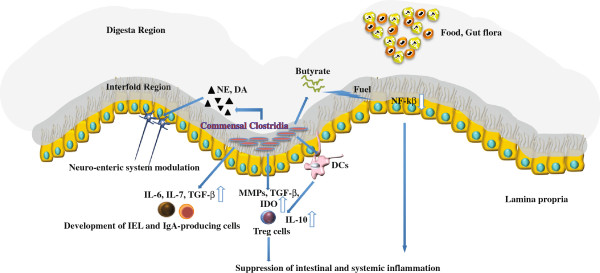
The gastrointestinal tract is a complex and dynamic network where an intricate and mutualistic symbiosis modulates the relationship between the host and the microbiota in order to establish and ensure gut homeostasis. Commensal Clostridia consist of gram-positive, rod-shaped bacteria in the phylum Firmicutes and make up a substantial part of the total bacteria in the gut microbiota. They start to colonize the intestine of breastfed infants during the first month of life and populate a specific region in the intestinal mucosa in close relationship with intestinal cells. This position allows them to participate as crucial factors in modulating physiologic, metabolic and immune processes in the gut during the entire lifespan, by interacting with the other resident microbe populations, but also by providing specific and essential functions. This review focus on what is currently known regarding the role of commensal Clostridia in the maintenance of overall gut function, as well as touch on their potential contribution in the unfavorable alteration of microbiota composition (dysbiosis) that has been implicated in several gastrointestinal disorders. Commensal Clostridia are strongly involved in the maintenance of overall gut function. This leads to important translational implications in regard to the prevention and treatment of dysbiosis, to drug efficacy and toxicity, and to the development of therapies that may modulate the composition of the microflora, capitalizing on the key role of commensal Clostridia, with the end goal of promoting gut health.
Overview
The claims and statistics of this paper haven’t been checked yet.
Free: it reads the open-access text and checks the first 5 claims that cite a source we can check. Create a free account to check every claim.
Integrity signals
Registry
Cites
Statistics
Figures
Verification
Claims the paper makes
The claims and statistics of this paper haven’t been checked yet.
Free: it reads the open-access text and checks the first 5 claims that cite a source we can check. Create a free account to check every claim.
Claims other papers make about this one
Each is checked against this paper’s own text: does it say what the citing paper says it does?
In the citing paper
“Furthermore, increased Bifidobacteria and Lactobacilli, which are linked to decreased diet-induced obesity and improved insulin sensitivity have been further supported by soy-protein consumption [165,166,167].”
From Impact of Protein Intake in Older Adults with Sarcopenia and Obesity: A Gut Microbiota Perspective (2020) · cites this paper as [166]
Self-check
Percentages, sums and reported differences re-computed from the paper’s own numbers.
The self-check needs the paper’s full text.
Citations
Cites
Diversity of the Human Intestinal Microbial Flora
Eckburg, P. B., Bik, E. M., Bernstein, C. N., Purdom, E., Dethlefsen, L., Sargent, M., Gill, S. R., Nelson, K. E., & Relman, D. A. (2005) · Science · doi:10.1126/science.1110591 · Cited by 7,913 · cited 2×
“; licensee BioMed Centr Commons Attribution License (http://creativec reproduction in any medium, provided the or in culture-independent molecular techniques, by the analysis of phylogenetic arrays, next generation 16S rRNA sequencing and metagenome sequencing derived from human mucosal biopsies, luminal contents and…”
BackgroundObesity alters gut microbial ecology
Ley, R. E., Bäckhed, F., Turnbaugh, P., Lozupone, C. A., Knight, R. D., & Gordon, J. I. (2005) · Proceedings of the National Academy of Sciences · doi:10.1073/pnas.0504978102 · Cited by 6,176 · cited 1×
“; licensee BioMed Centr Commons Attribution License (http://creativec reproduction in any medium, provided the or in culture-independent molecular techniques, by the analysis of phylogenetic arrays, next generation 16S rRNA sequencing and metagenome sequencing derived from human mucosal biopsies, luminal contents and…”
BackgroundHost-Bacterial Mutualism in the Human Intestine
Bäckhed, F., Ley, R. E., Sonnenburg, J. L., Peterson, D. A., & Gordon, J. I. (2005) · Science · doi:10.1126/science.1104816 · Cited by 5,277 · cited 2×
“An intricate and mutualistic symbiosis modulates the relationship between the host and the gut microbiota [11,18,19].”
BackgroundMetagenomic Analysis of the Human Distal Gut Microbiome
Gill, S. R., Pop, M., DeBoy, R. T., Eckburg, P. B., Turnbaugh, P. J., Samuel, B. S., Gordon, J. I., Relman, D. A., Fraser-Liggett, C. M., & Nelson, K. E. (2006) · Science · doi:10.1126/science.1124234 · Cited by 4,699 · cited 2×
“; licensee BioMed Centr Commons Attribution License (http://creativec reproduction in any medium, provided the or in culture-independent molecular techniques, by the analysis of phylogenetic arrays, next generation 16S rRNA sequencing and metagenome sequencing derived from human mucosal biopsies, luminal contents and…”
BackgroundFrank, D. N., St. Amand, A. L., Feldman, R. A., Boedeker, E. C., Harpaz, N., & Pace, N. R. (2007) · Proceedings of the National Academy of Sciences · doi:10.1073/pnas.0706625104 · Cited by 4,611 · cited 4×
“; licensee BioMed Centr Commons Attribution License (http://creativec reproduction in any medium, provided the or in culture-independent molecular techniques, by the analysis of phylogenetic arrays, next generation 16S rRNA sequencing and metagenome sequencing derived from human mucosal biopsies, luminal contents and…”
BackgroundInfluentialSokol, H., Pigneur, B., Watterlot, L., Lakhdari, O., Bermúdez-Humarán, L. G., Gratadoux, J.-J., Blugeon, S., Bridonneau, C., Furet, J.-P., Corthier, G., et al. (2008) · Proceedings of the National Academy of Sciences · doi:10.1073/pnas.0804812105 · Cited by 4,413 · cited 2×
“cluster IV, increases IL-10 production from peripheral blood mononuclear cells in vitro [98].”
BackgroundGut microbiota in health and disease
Sekirov, I., Russell, S. L., Antunes, L. C. M., & Finlay, B. B. (2010) · Physiological Reviews · doi:10.1152/physrev.00045.2009 · Cited by 4,182
Induction of Colonic Regulatory T Cells by Indigenous Clostridium Species
Atarashi, K., Tanoue, T., Shima, T., Imaoka, A., Kuwahara, T., Momose, Y., Cheng, G., Yamasaki, S., Saito, T., Ohba, Y., et al. (2011) · Science · doi:10.1126/science.1198469 · Cited by 3,752 · cited 20×
“Moreover, even the colonization with altered Schaedler flora (ASF), which includes Clostridium clostridioforme, leads to the accumulation of Tregs within the colon [97].”
BackgroundInfluentialEcological and Evolutionary Forces Shaping Microbial Diversity in the Human Intestine
Ley, R. E., Peterson, D. A., & Gordon, J. I. (2006) · Cell · doi:10.1016/j.cell.2006.02.017 · Cited by 3,358 · cited 1×
“; licensee BioMed Centr Commons Attribution License (http://creativec reproduction in any medium, provided the or in culture-independent molecular techniques, by the analysis of phylogenetic arrays, next generation 16S rRNA sequencing and metagenome sequencing derived from human mucosal biopsies, luminal contents and…”
BackgroundTopping, D. L., & Clifton, P. M. (2001) · Physiological Reviews · doi:10.1152/physrev.2001.81.3.1031 · Cited by 3,091 · cited 7×
“Dysregulation of any of the aforementioned components have been implicated, not only in the pathogenesis of IBD, but in many other GI disorders, including infectious enterocolitis, IBS, small intestinal bowel overgrowth, celiac sprue, hepatic fibrosis, atopic manifestations and food intolerance [34-36].”
BackgroundInfluential
Cited by
Items 701–785 of 785
Métodos alternativos de control de las infecciones por nematodos gastrointestinales en ganado ovino
de Agüero, V. C. G. (2023) · Buleria (Universidad de León) · doi:10.18002/10612/17496
Mining the Metabolic Capacity of Clostridium sporogenes Aided by Machine Learning
Ouyang, H., Xu, Z., Hong, J., Malroy, J., Qian, L., Ji, S., & Zhu, X. (2024) · Angewandte Chemie · doi:10.1002/ange.202319925
Burmistrova, A. L., Cazaux, M. E., & Filippova, Y. Y. (2024) · Экспериментальная и клиническая гастроэнтерология · doi:10.31146/1682-8658-ecg-217-9-49-55
Additional file 3 of Gut microbiome signatures linked to HIV-1 reservoir size and viremia control
Borgognone, A., Noguera-Julián, M., Oriol-Tordera, B., Noël‐Romas, L., Ruiz‐Riol, M., Guillén, Y., Parera, M., Casadellà, M., Duran-Castells, C., Puertas, M. C., et al. (2022) · Figshare · doi:10.6084/m9.figshare.19581798
Additional file 4 of Gut microbiome signatures linked to HIV-1 reservoir size and viremia control
Borgognone, A., Noguera-Julián, M., Oriol-Tordera, B., Noël‐Romas, L., Ruiz‐Riol, M., Guillén, Y., Parera, M., Casadellà, M., Duran-Castells, C., Puertas, M. C., et al. (2022) · Figshare · doi:10.6084/m9.figshare.19581801
Deng, L., Tay, H., Peng, G., Lee, J. W. J., & Tan, K. S. W. (2021) · Figshare · doi:10.6084/m9.figshare.14670550
Amato, K. R., Jiang, H., Kuthyar, S., Rubenstein, E., Kirk, V. A., & Pebsworth, P. A. (2023) · Journal of Behavior and Feeding · doi:10.32870/jbf.v2i4.34
Tryptamine, ADAS and microbiome in Parkinson's disease
Paley, E. L. (2024) · Elsevier eBooks · doi:10.1016/b978-0-443-28830-2.00016-6
Gunanegara, R. F., Dewanto, A., & Sunarti, S. (2024) · Malaysian Journal of Nutrition · doi:10.31246/mjn-2024-0012
Fitch, M. N. (2017) · University of North Texas Digital Library (University of North Texas) · doi:10.12794/metadc984173
Zhang, F., Hu, W., Zhao, X., Fu, B., Lin, Y., Xie, C., Yang, R., Fu, Y., Tan, W., & Ye, L. (2026) · Chinese Journal of Natural Medicines · doi:10.1016/s1875-5364(26)61197-1
Therapeutic Role of Probiotics in Regulating Mental Health: Gut-Brain Cross-Talk
Tungare, K., Khan, N., Gurav, P., Sonani, V., Ravichandran, V., Jha, P., & Jobby, R. (2025) · Journal of Environmental Pathology Toxicology and Oncology · doi:10.1615/jenvironpatholtoxicoloncol.2025058417
Hou, D., Liu, Y., Lin, H., Gu, J., Qian, J., Wang, S., Chen, Y., Ju, D., & Zeng, X. (2025) · Journal of Molecular Biology · doi:10.1016/j.jmb.2025.169594
Additional file 2 of Gut microbiome signatures linked to HIV-1 reservoir size and viremia control
Borgognone, A., Noguera-Julián, M., Oriol-Tordera, B., Noël‐Romas, L., Ruiz‐Riol, M., Guillén, Y., Parera, M., Casadellà, M., Duran-Castells, C., Puertas, M. C., et al. (2022) · Figshare · doi:10.6084/m9.figshare.19581792
Sargsian, S., Mondragón-Palomino, O., Lejeune, A., Ercelen, D., Jin, W.-B., Varghese, A., Lim, Y. A. L., Guo, C., Loke, P., & Cadwell, K. (2024) · Figshare · doi:10.6084/m9.figshare.25800964
Burckhardt, J. C., Chong, D., Pett, N., & Tropini, C. (2023) · Figshare · doi:10.6084/m9.figshare.22618630
Burckhardt, J. C., Chong, D., Pett, N., & Tropini, C. (2023) · Figshare · doi:10.6084/m9.figshare.22618624
Gao, R., Tian, S., Wang, J., & Zhu, W. (2021) · Figshare · doi:10.6084/m9.figshare.15145605
Burckhardt, J. C., Chong, D., Pett, N., & Tropini, C. (2023) · Figshare · doi:10.6084/m9.figshare.22618627
Ganci, M., Suleyman, E., Butt, H., & Ball, M. (2022) · Figshare · doi:10.6084/m9.figshare.19696022
Sargsian, S., Mondragón-Palomino, O., Lejeune, A., Ercelen, D., Jin, W.-B., Varghese, A., Lim, Y. A. L., Guo, C., Loke, P., & Cadwell, K. (2024) · Figshare · doi:10.6084/m9.figshare.25801099
Burckhardt, J. C., Chong, D., Pett, N., & Tropini, C. (2023) · Figshare · doi:10.6084/m9.figshare.22618639
Burckhardt, J. C., Chong, D., Pett, N., & Tropini, C. (2023) · Figshare · doi:10.6084/m9.figshare.22618642
Burckhardt, J. C., Chong, D., Pett, N., & Tropini, C. (2023) · Figshare · doi:10.6084/m9.figshare.22618645
Sargsian, S., Mondragón-Palomino, O., Lejeune, A., Ercelen, D., Jin, W.-B., Varghese, A., Lim, Y. A. L., Guo, C., Loke, P., & Cadwell, K. (2024) · Figshare · doi:10.6084/m9.figshare.26718633
Burckhardt, J. C., Chong, D., Pett, N., & Tropini, C. (2023) · Figshare · doi:10.6084/m9.figshare.22618633
Burckhardt, J. C., Chong, D., Pett, N., & Tropini, C. (2023) · Figshare · doi:10.6084/m9.figshare.22618648
Μοριακή ταυτοποίηση τοξικών μικροοργανισμών σε περιβαλλοντολογικά δείγματα της λίμνης Κάρλα
Τζιόγκα, Λ. (2018) · University of Thessaly Institutional Repository (University of Thessaly) · doi:10.26253/heal.uth.5563
Burckhardt, J. C., Chong, D., Pett, N., & Tropini, C. (2023) · Figshare · doi:10.6084/m9.figshare.22618636
Liu, J., Stewart, S. N., Robinson, K., Yang, Q., Lyu, W., Whitmore, M. A., & Zhang, G. (2021) · Figshare · doi:10.6084/m9.figshare.13939917
Butera, A. (2020) · IRIS Research product catalog (Sapienza University of Rome) · Cited by 2
Pin Viso, N. D. (2021) · Repositorio Digital Institucional de la Universidad de Buenos Aires (Universidad de Buenos Aires)
Duijster, J. W. (2022) · Leiden Repository (Leiden University)
Guillén-Watson, R. (2021) · Investigative News in Education (Universidad de Costa Rica)
Martínez González, J. L. (2021) · Corpus Université Laval (Université Laval)
Unterer, M., Deng, L., & München, T. U. (2024)
Aamer, N., Asim, M. N., Vollmer, S., & Dengel, A. (2025) · bioRxiv (Cold Spring Harbor Laboratory) · doi:10.64898/2025.12.11.693657
ROLE OF GUT MICROBIOTA IN GENERALIZED ANXIETY DISORDER
Rabbia, V. (2023) · MacSphere (McMaster University) · doi:10.71548/17116
Li, J.-H., Luo, C., Lou, F., Zhang, X., Duan, J., Wei, Z., Hu, X.-J., Tu, P.-G., Du, X.-Z., Zhong, R., et al. (2026) · Animal Microbiome · doi:10.1186/s42523-026-00525-0
“Although the exact function of Clostridium_sensu_stricto_1 remains unclear, this genus commonly colonizes the intestines of breastfed infants early in life [64], and it is significantly reduced in IBD model mice and necrotizing enterocolitis rats [65, 66], which in in line with our result.”
Nikitina, D. (2024) · Lithuanian University of Health Sciences
Xie, Y., Wang, R., Liu, X., Du, Q., Mo, S., Liu, Q., Yang, G., Fan, Z., & Li, J. (2026) · BMC Microbiology · doi:10.1186/s12866-026-04902-2
“Compared with reference genomes of GTDB, almost half of the macaque MAGs were potential novel species, primarily belonging to classes Clostridia and Bacilli, which played key roles in the maintenance of overall gut function [65, 66].”
Jiang, H., Wang, Y., Zhang, N., Zhao, Y., Sui, Y., & Xue, H. (2026) · Journal of the World Aquaculture Society · doi:10.1111/jwas.70088
“Clostridia, which had the strongest influence in the lotus-crayfish co-culture, play crucial roles in regulating gut physiology, metabolism, and immune response through interactions with other resident microbial populations (Lopetuso et al., 2013).”
Schönherr-Hellec, S. (2017) · theses.fr (ABES) · doi:10.70675/e404b5bdz72e8z4530z8638ze08f4b2f41f8
Maamar, S. B. (2016) · theses.fr (ABES) · doi:10.70675/6f44b970z040ez4f3ezb3eez451fdd257c6b
“This genus is often associated with mammalian gut habitats or soil (Lopetuso et al., 2013) and Clostridium perfringens has been proposed as an indicator of fecal pollution (Araujo et al., 2004; Mueller-Spitz et al., 2010).”
BackgroundSchmitt, C. C. (2016) · theses.fr (ABES) · doi:10.70675/a1cd5d6azf620z4554z9020zdff30c94abab · Cited by 2
Epidémiologie, circulation, colonisation du parasite entérique unicellulaire Blastocystis sp.
Cian, A. (2016) · theses.fr (ABES) · doi:10.70675/9fd94c43z6dbfz4b91zb974z79e9bd66207f · Cited by 2
Koyun, O. Y., Rowland, E. E., Lourenco, J. M., Griswold, K. E., Baloyi, J. J., Fluharty, F. L., Pringle, T. D., Stelzleni, A. M., Stewart, R. L., & Callaway, T. R. (2026) · Microorganisms · doi:10.3390/microorganisms14040802
“In animal as well as human GIT, Clostridium species are able to digest starch or indigestible/complex polysaccharides, and VFAs (e.g., acetate, propionate, and butyrate) that they produce provide benefits to the host by being used as energy sources by epithelial cells in the GIT [64,66].”
Furbeyre, H. (2017) · theses.fr (ABES) · doi:10.70675/9f6329dbzbd44z4160z8542z4b08e20e84e4 · Cited by 1
Rational and evolution-based engineering of Clostridium phytofermentans
Cerisy, T. (2017) · theses.fr (ABES) · doi:10.70675/ba4ffb3dz82f1z43fez8109zfb8d38661aaf
Teissier, T. (2019) · theses.fr (ABES) · doi:10.70675/f49bc069z5ee6z4c49zb46fz0a1413dbba95
Ruminococcins C, a new family of sactipeptides as alternatives to conventional antibiotics
Roblin, C. (2020) · theses.fr (ABES) · doi:10.70675/c81cae65z543dz4e89zaf75z08dcc8788e81
Sabancı, K. (2024) · IYTE GCRIS Database (Izmir Institute of Technology)
Montout, L. A. (2023) · theses.fr (ABES) · doi:10.70675/c4721674z8ee4z4f7bz8f68z68e66e432f7c · Cited by 1
Anjou, C. (2024) · theses.fr (ABES) · doi:10.70675/c7a04701z3642z41d0z9676z624773925baf
Mariaule, V. (2024) · theses.fr (ABES) · doi:10.70675/1d41e841zf788z4dd7z8784zc26304e24ea1
Metabolic machinery and pathways of the HMMS
Hou, Y. (2026) · Elsevier eBooks · doi:10.1016/b978-0-443-31402-5.00008-6
Huang, Y., & Cheng, W.-H. (2026) · Biological Trace Element Research · doi:10.1007/s12011-026-05106-5
Wang, C., Xu, Z., Ma, M., Fu, Z., & Yao, K. (2026) · Molecular Nutrition & Food Research · doi:10.1002/mnfr.70487
“Conversely, specific substances produced by Romboutsi a, such as indole derivatives, might promote inflammation [ 50 ].”
Diversity of the instestinal microbiota of patients with different clinical profiles
Danelus, L. P., Magrini, F. E., Sophiatti, I. V. M., Dutra, P. H., Brambilla, E., & Paesi, S. (2026) · Gene Reports · doi:10.1016/j.genrep.2026.102566
Lapiro, J. L., Srisomboon, Y., Law, K., & O’Grady, S. M. (2026) · American Journal of Physiology-Cell Physiology · doi:10.1152/ajpcell.00223.2026
Zhou, G., Liu, Y., Pu, X., Ning, Q., Guo, X., Wang, L., Zhong, Y., Wang, G., Guo, X., & Wang, M. (2026) · Veterinary Sciences · doi:10.3390/vetsci13070663
“Peptostreptococcaceae includes several taxa known for their involvement in protein fermentation and amino acid metabolism [39], which may relate to the protein-rich nature of broccoli byproducts.”
Oladipupo, A. A., Kelly, A. M., Davis, D. A., Beck, B. H., Roy, L. A., & Bruce, T. J. (2026) · Aquaculture Fish and Fisheries · doi:10.1002/aff2.70273
Cambara, J. C. O., Cuber, P., Khattak, F., Lebre, P. H., Galgano, S., Houdijk, J. G. M., Smallman, D., Estridge, P., Allen, M. J., Short, F., et al. (2026) · Frontiers in Microbiology · doi:10.3389/fmicb.2026.1868730
“Overall, the microbial profile across samples revealed a clear pre-dominance of the class Clostridia , accounting for approximately 71% of the total reads across all dietary groups (Figures 1A,B), reflecting a mature and metabolically stable gut ecosystem (Lopetuso et al., 2013).”
Endoplasmic reticulum stress in the logic of ulcerative colitis development
Московцев, А. А., Zaichenko, D. M., Astafeva, I. R., Morozov, S. G., Папышева, О. В., Харитонова, Л. А., & Babayan, M. L. (2026) · Экспериментальная и клиническая гастроэнтерология · doi:10.31146/1682-8658-ecg-245-1-99-108
Sall, I., Foxall, R. L., Felth, L. C., Gaur, A., Whistler, J. L., & Whistler, C. A. (2026) · Gut Microbes · doi:10.1080/19490976.2026.2691347
“…during late self-administration and post-morphine--correlated strongly with composite compulsivity scores (Figure 6A), as did Clostridium (ASV_143), which was also a biomarker of the most compulsive mice during extinction, raising suspicions of its potential role 86,125 in “disease” progression.”
Colcetta, B., Kohler, T. L., Câmara, M. M. T., Silva, G. D. S., Piotrowski, D., Hammes, A. C., Kaufmann, C., Rohloff, N., Nunes, R. V., Duarte, C. R. D. A., et al. (2026) · Revista Brasileira de Zootecnia · doi:10.37496/rbz5520250087
Stimbiotic Concept Development: The Optimisation Use of Dietary Fibre in Monogastric Animals
González‐Ortiz, G., & Bedford, M. R. (2026) · Animal Science Cases · doi:10.1079/animalsciencecases.2026.0015
Liang, W., Tang, L., Fan, J., Huang, R., Chen, J., & LiChun, Q. (2026) · Nutrients · doi:10.3390/nu18142390
“Clostridia-and Lachnospiraceae-related taxa are often associated with anaerobic fermentation and short-chain fatty acid production [56,57].”
O'Loughlin, J. M., Allen‐Vercoe, E., McNay, C., Windsor, S., Horsfall, L., & Burgess, K. E. (2026) · Microbiology Resource Announcements · doi:10.1128/mra.01445-25
Wu, Y.-Y., Yu, L.-E., & Lin, Y. (2026) · Cogent Food & Agriculture · doi:10.1080/23311932.2026.2687206 · Cited by 1
El-Bassyouni, H. T., Zarouk, W. A., Eldeen, G. N., Elkalla, W. S., Sokkar, M. F., Lotfy, R. S., & Mansour, N. M. (2026) · Gene Reports · doi:10.1016/j.genrep.2026.102623
Ji, F., Wang, S., Wang, L., Zhao, Y., Zhong, J., Wang, R., Qu, J., Lu, Y., Yuan, N., & Zhang, Q. (2026) · Frontiers in Nutrition · doi:10.3389/fnut.2026.1873000
“Bacteroides , which can modulate mucosal antiviral immunity (61), and Clostridium , a mainstay of intestinal immune homeostasis (69), increased, whereas adverse-outcome taxa declined— Veillonella , linked to opportunistic infection and dysbiosis (70), and Actinomyces , implicated in inflammatory…”
Lawal, A. S., Oladele, P. O., Johnson, T. A., Adeola, O., & Ajuwon, K. M. (2026) · Journal of Animal Science · doi:10.1093/jas/skag271
Full Issue: Volume 14, Number 1, Fall 2020
(2020) · Touro Scholar (Touro College)
Simonelli, N., Oyenes, F. B., Assandri, M. H., Florencia, M., M, R. S. G., Araceli, P. J., Peruzzo, P. J., Serradell, M. D. L. Á., Tanisawa, K., & Medrano, M. (2026) · Carbohydrate Research · doi:10.1016/j.carres.2026.110104
Vrieze, L. D., Aerts, J. A., & Masschelein, J. (2026) · Molecular Biology and Evolution · doi:10.1093/molbev/msag247
Hussein, D. K., El‐Shiekh, R. A., Okba, M. M., Abou-Hussein, D. R., Nagaty, H. A., El-Kashoury, E.-S. A., & Attia, H. (2026) · Food Bioscience · doi:10.1016/j.fbio.2026.110200
Doty, C., Brady, D. J., Barb, J. J., Thompson, S. L., Rincon, N., Browning, B., Kelly, D. L., Bennett, M. E., Elmer, G., Leggio, L., et al. (2026) · bioRxiv (Cold Spring Harbor Laboratory) · doi:10.64898/2026.10.09.758026
Unique features of EIGHT fold—Proteins with the most complex 8 3 knotted topology
Możajew, M., Sikora, M., Fortunka, M., Perlinska, A. P., Kluza, A., Niewieczerzał, S., da Silva, F. B., Łukaszewicz, M., Sikorska, J. A., Mikulska, L. J., et al. (2026) · Proceedings of the National Academy of Sciences · doi:10.1073/pnas.2523017123
“Species from Clostridia class consist of strictly obligate anaerobes commonly found in human and animal gut microbiomes, where they ferment polysaccharides into short-chain fatty acids (e.g. butyrate) that support colonocyte energy and gut barrier integrity (64, 65).”
Kaur, M. K. K., Allahbadia, M. G., & MD, D. M. S. (2025) · Obesity Research - Open Journal · doi:10.17140/oroj.2025.v11.i01.pp19-45.1417
Metadata
- Authors
- Lopetuso, L. R., Scaldaferri, F., Petito, V., & Gasbarrini, A.
- Affiliations
- Agostino Gemelli University Polyclinic (IT)
- Corresponding author
- Lopetuso, Loris R
- Venue
- Gut Pathogens
- Published
- 2013
- Volume
- 5
- Issue
- 1
- Pages
- 23
- ISSN
- 1757-4749 (ISSN-L)
- PMC
- PMC3751348
- OpenAlex
- W2112738213
- Cited by
- 753
- References
- 103
- Citations by year
- 2026: 39 · 2025: 68 · 2024: 64 · 2023: 61 · 2022: 89 · 2021: 105 · 2020: 91 · 2019: 79 · 2018: 68 · 2017: 33 · 2016: 28 · 2015: 18 · 2014: 10
- FWCI
- 8.37
- Type
- journal article
- Language
- en
- Open access
- gold
- doi.org
- Licence
- cc-by
- Locations
- Gut Pathogens (publishedVersion, cc-by)
- Europe PMC (PubMed Central) (publishedVersion, cc-by)
- PubMed Central (publishedVersion, cc-by)
- PubMed (publishedVersion)
- PubliCatt (Università Cattolica del Sacro Cuore) (submittedVersion, other-oa)
- Topics
- Life Sciences › Biochemistry, Genetics and Molecular Biology › Molecular Biology › Gut microbiota and health
- Health Sciences › Medicine › Infectious Diseases › Clostridium difficile and Clostridium perfringens research
- Life Sciences › Agricultural and Biological Sciences › Food Science › Probiotics and Fermented Foods
- Keywords
- intestinal homeostasis, gut microbiota, Firmicutes, host-microbe symbiosis, intestinal colonization, infant gut colonization, dysbiosis, gastrointestinal diseases, gut health, drug efficacy and toxicity, microbiota-based therapy
About these checks
Registry, retraction, Cites and statistics results are computed, not judged, with one exception: a printed reference that no index lists is read once by a model before it counts as a citation error. Claims are extracted by a model and kept only when their quote appears verbatim in the text; each cited source is then checked, with a model’s help, for whether it says what the claim relies on. Those verdicts can be wrong — read the claim’s quote and the cited source before relying on one.
Statistics and arithmetic are recomputed, not judged.
Confidence bands are shown only for fields calibrated on our annotated test set. None is calibrated yet, so no band is shown.
What counts as a claim ›How we measure confidence ›How we check this ›
Are you an author, or do you see a problem with this page? Request a review
Data sources
Bibliographic data: Semantic Scholar, OpenAlex, Crossref.
Contains information from the Semantic Scholar Academic Graph Datasets, made available under the ODC Attribution License (ODC-BY 1.0).
Semantic Scholar’s data is described in: Kinney, R., et al. (2023). The Semantic Scholar Open Data Platform. arXiv:2301.10140.
