

Commensal Clostridia: leading players in the maintenance of gut homeostasis
Open accessThe DOI matches its Crossref record; 104 of the 104 references it cites were found in a registry or an index.
Abstract
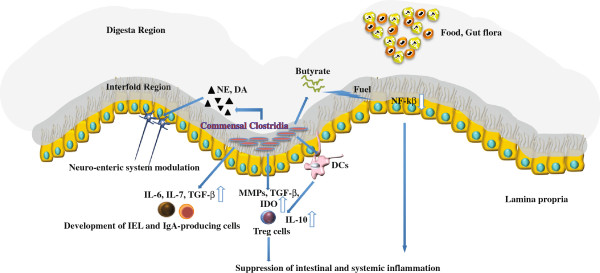
The gastrointestinal tract is a complex and dynamic network where an intricate and mutualistic symbiosis modulates the relationship between the host and the microbiota in order to establish and ensure gut homeostasis. Commensal Clostridia consist of gram-positive, rod-shaped bacteria in the phylum Firmicutes and make up a substantial part of the total bacteria in the gut microbiota. They start to colonize the intestine of breastfed infants during the first month of life and populate a specific region in the intestinal mucosa in close relationship with intestinal cells. This position allows them to participate as crucial factors in modulating physiologic, metabolic and immune processes in the gut during the entire lifespan, by interacting with the other resident microbe populations, but also by providing specific and essential functions. This review focus on what is currently known regarding the role of commensal Clostridia in the maintenance of overall gut function, as well as touch on their potential contribution in the unfavorable alteration of microbiota composition (dysbiosis) that has been implicated in several gastrointestinal disorders. Commensal Clostridia are strongly involved in the maintenance of overall gut function. This leads to important translational implications in regard to the prevention and treatment of dysbiosis, to drug efficacy and toxicity, and to the development of therapies that may modulate the composition of the microflora, capitalizing on the key role of commensal Clostridia, with the end goal of promoting gut health.
Overview
The claims and statistics of this paper haven’t been checked yet.
Free: it reads the open-access text and checks the first 5 claims that cite a source we can check. Create a free account to check every claim.
Integrity signals
Registry
Cites
Statistics
Figures
Verification
Claims the paper makes
The claims and statistics of this paper haven’t been checked yet.
Free: it reads the open-access text and checks the first 5 claims that cite a source we can check. Create a free account to check every claim.
Claims other papers make about this one
Each is checked against this paper’s own text: does it say what the citing paper says it does?
In the citing paper
“Furthermore, increased Bifidobacteria and Lactobacilli, which are linked to decreased diet-induced obesity and improved insulin sensitivity have been further supported by soy-protein consumption [165,166,167].”
From Impact of Protein Intake in Older Adults with Sarcopenia and Obesity: A Gut Microbiota Perspective (2020) · cites this paper as [166]
Self-check
Percentages, sums and reported differences re-computed from the paper’s own numbers.
The self-check needs the paper’s full text.
Citations
Cites
Diversity of the Human Intestinal Microbial Flora
Eckburg, P. B., Bik, E. M., Bernstein, C. N., Purdom, E., Dethlefsen, L., Sargent, M., Gill, S. R., Nelson, K. E., & Relman, D. A. (2005) · Science · doi:10.1126/science.1110591 · Cited by 7,913 · cited 2×
“; licensee BioMed Centr Commons Attribution License (http://creativec reproduction in any medium, provided the or in culture-independent molecular techniques, by the analysis of phylogenetic arrays, next generation 16S rRNA sequencing and metagenome sequencing derived from human mucosal biopsies, luminal contents and…”
BackgroundObesity alters gut microbial ecology
Ley, R. E., Bäckhed, F., Turnbaugh, P., Lozupone, C. A., Knight, R. D., & Gordon, J. I. (2005) · Proceedings of the National Academy of Sciences · doi:10.1073/pnas.0504978102 · Cited by 6,176 · cited 1×
“; licensee BioMed Centr Commons Attribution License (http://creativec reproduction in any medium, provided the or in culture-independent molecular techniques, by the analysis of phylogenetic arrays, next generation 16S rRNA sequencing and metagenome sequencing derived from human mucosal biopsies, luminal contents and…”
BackgroundHost-Bacterial Mutualism in the Human Intestine
Bäckhed, F., Ley, R. E., Sonnenburg, J. L., Peterson, D. A., & Gordon, J. I. (2005) · Science · doi:10.1126/science.1104816 · Cited by 5,277 · cited 2×
“An intricate and mutualistic symbiosis modulates the relationship between the host and the gut microbiota [11,18,19].”
BackgroundMetagenomic Analysis of the Human Distal Gut Microbiome
Gill, S. R., Pop, M., DeBoy, R. T., Eckburg, P. B., Turnbaugh, P. J., Samuel, B. S., Gordon, J. I., Relman, D. A., Fraser-Liggett, C. M., & Nelson, K. E. (2006) · Science · doi:10.1126/science.1124234 · Cited by 4,699 · cited 2×
“; licensee BioMed Centr Commons Attribution License (http://creativec reproduction in any medium, provided the or in culture-independent molecular techniques, by the analysis of phylogenetic arrays, next generation 16S rRNA sequencing and metagenome sequencing derived from human mucosal biopsies, luminal contents and…”
BackgroundFrank, D. N., St. Amand, A. L., Feldman, R. A., Boedeker, E. C., Harpaz, N., & Pace, N. R. (2007) · Proceedings of the National Academy of Sciences · doi:10.1073/pnas.0706625104 · Cited by 4,611 · cited 4×
“; licensee BioMed Centr Commons Attribution License (http://creativec reproduction in any medium, provided the or in culture-independent molecular techniques, by the analysis of phylogenetic arrays, next generation 16S rRNA sequencing and metagenome sequencing derived from human mucosal biopsies, luminal contents and…”
BackgroundInfluentialSokol, H., Pigneur, B., Watterlot, L., Lakhdari, O., Bermúdez-Humarán, L. G., Gratadoux, J.-J., Blugeon, S., Bridonneau, C., Furet, J.-P., Corthier, G., et al. (2008) · Proceedings of the National Academy of Sciences · doi:10.1073/pnas.0804812105 · Cited by 4,413 · cited 2×
“cluster IV, increases IL-10 production from peripheral blood mononuclear cells in vitro [98].”
BackgroundGut microbiota in health and disease
Sekirov, I., Russell, S. L., Antunes, L. C. M., & Finlay, B. B. (2010) · Physiological Reviews · doi:10.1152/physrev.00045.2009 · Cited by 4,182
Induction of Colonic Regulatory T Cells by Indigenous Clostridium Species
Atarashi, K., Tanoue, T., Shima, T., Imaoka, A., Kuwahara, T., Momose, Y., Cheng, G., Yamasaki, S., Saito, T., Ohba, Y., et al. (2011) · Science · doi:10.1126/science.1198469 · Cited by 3,752 · cited 20×
“Moreover, even the colonization with altered Schaedler flora (ASF), which includes Clostridium clostridioforme, leads to the accumulation of Tregs within the colon [97].”
BackgroundInfluentialEcological and Evolutionary Forces Shaping Microbial Diversity in the Human Intestine
Ley, R. E., Peterson, D. A., & Gordon, J. I. (2006) · Cell · doi:10.1016/j.cell.2006.02.017 · Cited by 3,358 · cited 1×
“; licensee BioMed Centr Commons Attribution License (http://creativec reproduction in any medium, provided the or in culture-independent molecular techniques, by the analysis of phylogenetic arrays, next generation 16S rRNA sequencing and metagenome sequencing derived from human mucosal biopsies, luminal contents and…”
BackgroundTopping, D. L., & Clifton, P. M. (2001) · Physiological Reviews · doi:10.1152/physrev.2001.81.3.1031 · Cited by 3,091 · cited 7×
“Dysregulation of any of the aforementioned components have been implicated, not only in the pathogenesis of IBD, but in many other GI disorders, including infectious enterocolitis, IBS, small intestinal bowel overgrowth, celiac sprue, hepatic fibrosis, atopic manifestations and food intolerance [34-36].”
BackgroundInfluential
Cited by
Items 501–600 of 785
In-vitro digestion and fermentation of cranberry extracts rich in cell wall oligo/polysaccharides
Karboune, S., Davis, E. J., Fliss, I., & Andreani, E. S. (2022) · Journal of Functional Foods · doi:10.1016/j.jff.2022.105039 · Cited by 9
Wang, J., Xia, S., Fan, H., Shao, J., Tang, T., Li, Y., Sun, W., Jia, X., Chen, S., & Lai, S. (2022) · Microorganisms · doi:10.3390/microorganisms10050841 · Cited by 12
“Therefore, our results are opposite to those of Con [51]; in our study, the abundance of Clostridium in the large intestine region is low, which may deplete key anti-inflammatory metabolites or other cell related immunomodulatory microflora [52], and the members”
ResultYan, X., Liu, H., Pan, S., Tan, B., Zhang, S., Liu, H., Chi, S., Yang, Q., Yang, Y., & Dong, X. (2022) · Aquaculture · doi:10.1016/j.aquaculture.2022.739121 · Cited by 9
Sarkar, P., Kandimalla, R., Bhattacharya, A., Romi, W., Dehingia, M., Kalita, M. C., Talukdar, N. C., Talukdar, R., & Khan, M. R. (2023) · Microorganisms · doi:10.3390/microorganisms11061501 · Cited by 9
“The Clostridial clusters have been reported to be associated with both good and bad effects on the host [44].”
BackgroundUrubschurov, V., Stroebel, C., Günther, E., Romanowski, K., Büsing, K., & Zeyner, A. (2019) · Journal of Animal Physiology and Animal Nutrition · doi:10.1111/jpn.13079 · Cited by 9
Taco-Masias, A. A., Fernandez-Aristi, A. R., Cornejo‐Tapia, A., Aguilar-Luis, M. Á., del Valle, L. J., Silva-Caso, W. G., Zavaleta-Gavidia, V., Weilg, P., Cornejo-Pacherres, H., Bazán-Mayra, J. E., et al. (2020) · PeerJ · doi:10.7717/peerj.9964 · Cited by 11
“that provides substrates from products of fermentation acting as an impressive anti-inflammatory agent by avoiding the activation of the transcription factor, NF-κB (Lopetuso et al., 2013; Sun & Kato, 2016).”
BackgroundRazak, S. A., Bauman, J. M., Marsh, T. L., & Scribner, K. T. (2022) · Microorganisms · doi:10.3390/microorganisms10051005 · Cited by 10
“exhibit the ability to form endo‐ spores, which offers this bacteria ecological advantages for survival under adverse condi‐ tions [80,81] Comprehensive studies on adverse effects of antibiotic use to the gut microbiomes were reported in other fish species [5,37,39] and in humans [33].”
BackgroundChronic mesenteric ischemia-induced intestinal dysbiosis resolved after revascularization
Munley, J. A., Nagpal, R., Hanson, N. C., Mirzaie, A., Laquian, L., Mohr, A. M., Efron, P. A., Arnaoutakis, D. J., & Cooper, M. A. (2023) · Journal of Vascular Surgery Cases, Innovations and Techniques · doi:10.1016/j.jvscit.2022.101084 · Cited by 8
Worsley, S. F., Lee, C. Z., Versteegh, M. A., Burke, T. A., Komdeur, J., Dugdale, H. L., & Richardson, D. S. (2025) · ISME Communications · doi:10.1093/ismeco/ycaf138 · Cited by 8
Xu, J., Chen, H., Yu, Y.-Y., Chen, T., Wang, Y., Xue, W., Zheng, J., Liu, J., & Zhai, W. (2025) · Cell Reports Medicine · doi:10.1016/j.xcrm.2025.102410 · Cited by 14
“13 The abundance of Lachnospiraceae can be altered by changes in diet.”
Zhu, H., Wang, H., Zhang, Q., Bai, J.-F., Wang, M., Du, S.-Y., & Zhang, Y. (2025) · World Journal of Gastroenterology · doi:10.3748/wjg.v31.i40.112637 · Cited by 8
“Dysosmobacter has been suggested to exert potential anti-inflammatory effects, whereas Intestinimonas is a butyrate-producing genus that supports mucosal barrier integrity and modulates gut motility[34,35].”
Beale, D. J., Nguyen, T. V., Dyall, T. R., van de Kamp, J., Bissett, A. B., Hewitt, L., & Small, A. H. (2025) · Frontiers in Veterinary Science · doi:10.3389/fvets.2025.1496946 · Cited by 8
Lindsell, H. B., Williams, N. C., Magistro, D., Corsetti, M., Walton, G., & Hunter, K. A. (2025) · Neurogastroenterology & Motility · doi:10.1111/nmo.70004 · Cited by 8
Olejníková, P., Kaszonyi, A., Šimkovič, M., Lakatoš, B., Kaliňák, M., Valachovičová, M., & Bírošová, L. (2017) · Acta Alimentaria · doi:10.1556/066.2017.46.1.8 · Cited by 8
Shen, W., Yu, Y., Zhou, R., Song, N., Liu, R., & Bu, Y. (2021) · Environmental Engineering Science · doi:10.1089/ees.2020.0432 · Cited by 8
“Clostridium sensu stricto is a beneficial bacterium that produces short-chain fatty acids through anaerobic fermentation that prevent intestinal inflammation (Lopetuso et al. , 2013) FIG.”
Insights into the Role of Commensal-Specific T Cells in Intestinal Inflammation
Gehlhaar, A., Inala, A., Llivichuzhca-Loja, D., Silva, T. N., Adegboye, C., O’Connell, A. E., & Konnikova, L. (2022) · Journal of Inflammation Research · doi:10.2147/jir.s288288 · Cited by 9
“By isolating 17 strains from human microbiota, Atarshi et al 2013 found that Clostridium can elicit a cytokine response through the production of short-chain fatty acids that induce TGF-β, which contributes to the specific development of colonic Tregs in mice.(54,55)”
BackgroundResultInfluentialZhang, D., Zhao, L., He, Q., Adam, A. A., He, K., Li, L., Zhang, X., Luo, J., Luo, W., Li, Z., et al. (2022) · Aquaculture · doi:10.1016/j.aquaculture.2022.738951 · Cited by 8
Coles, M. E., Graham, B. D., Latorre, J. D., Petrone-García, V. M., Hernández-Velasco, X., Castellanos-Huerta, I., Sun, X., Hargis, B. M., El-Ashram, S. A., Shehata, A. A., et al. (2023) · Food and Nutrition Sciences · doi:10.4236/fns.2023.143016 · Cited by 13
Tsuruta, T., Sonoyama, K., Miyamoto, T., Nguyen, Q. D., Mizote, A., Teraoka, M., & Nishino, N. (2023) · Molecular Nutrition & Food Research · doi:10.1002/mnfr.202200389 · Cited by 11
Nurliyani, N., Kandarina, B. I., Kusuma, S., Trisnasari, Y. D., & Prabawati, F. (2014) · Journal of Food and Nutrition Research · doi:10.12691/jfnr-2-12-24 · Cited by 8
“The gastrointestinal tract is a complex and dynamic network where an intricate and mutualistic symbiosis modulates the relationship between the host and the microbiota in order to establish and ensure gut homeostasis [1].”
BackgroundSchlatter, D., Schillinger, W. F., Bary, A. I., Sharratt, B. S., & Paulitz, T. C. (2018) · Atmospheric Environment · doi:10.1016/j.atmosenv.2018.04.030 · Cited by 8
Koyanagi, Y., Suzuki, R., Ihara, K., Miyagi, H., Isogai, H., Yoneyama, H., & Isogai, E. (2019) · Pathogens and Disease · doi:10.1093/femspd/ftz036 · Cited by 8
Low-moisture food matrices as probiotic carriers
Marcial-Coba, M. S., Knøchel, S., & Nielsen, D. S. (2019) · FEMS Microbiology Letters · doi:10.1093/femsle/fnz006s · Cited by 8
Ramírez-Moreno, F. J., Gómez‐Oliván, L. M., Islas‐Flores, H., García-Medina, S., Garrido, J. F. A., & Hernández-Soto, L. M. (2023) · The Science of The Total Environment · doi:10.1016/j.scitotenv.2023.164057 · Cited by 9
Dicks, L. M. T., Deane, S. M., & Grobbelaar, M. J. (2022) · Probiotics and Antimicrobial Proteins · doi:10.1007/s12602-022-09925-5 · Cited by 12
“1 3 considered advantageous, as cell numbers of pathogenic species from the Clostridium XI cluster were replaced by members of the Clostridium sensu stricto cluster, a cluster that has been documented for its gut-modulating abilities [76, 77].”
BackgroundEnterococcus faecalis provides protection during scavenging in carrion crow (Corvus corone)
Hu, B., 中国科学院动物研究所中国科学院动物生态与保护生物学重点实验室, 北., Wang, J.-M., Zhang, Q., Xu, J., Xing, Y.-N., Wang, B., Han, S., He, H., 中国科学院大学生命科学学院, 北. 1., et al. (2023) · 动物学研究 · doi:10.24272/j.issn.2095-8137.2023.320 · Cited by 8
“Evidence suggests that these bacteria may impact host weight and health through energy metabolism and immune regulation (Lopetuso et al., 2013).”
BackgroundHorill, S., Zhou, X., & Jin, W. (2025) · Journal of Clinical Anesthesia · doi:10.1016/j.jclinane.2025.111801 · Cited by 7
DiBenedetto, N., Donnelly-Morell, M. L., Kumamoto, C. A., & Shen, A. (2026) · Nature Communications · doi:10.1038/s41467-026-68411-6 · Cited by 7
Immunonutrients and intestinal microbiota: a gap in the literature
Nascimento, M. D. A., Pimenta, N. D. M. A., Polastri, V. A. D. M. P., Chamon, R. C., & Figueiredo, M. S. (2023) · Critical Reviews in Food Science and Nutrition · doi:10.1080/10408398.2023.2260468 · Cited by 7
“…with the increase in IgA production, increases the tolerogenic response and reduces the damage caused by inflammatory processes (Franca et al. 2021; Lopetuso et al. 2013) In addition, it has the biochemical barrier arising from its metabolism: the metabolites produced have bacteriocins that…”
Niu, Y., Chen, Y., Liu, J., Yulan, L., Xiao, S., Yang, C., Yang, T., & Huan, W. (2024) · Frontiers in Veterinary Science · doi:10.3389/fvets.2024.1346922 · Cited by 7
“Clostridium_sensu_stricto_1 is a kind of intestinal symbiotic bacteria in the weaning period, which can be colonized in the intestine of newborns within 1 month after birth (45).”
BackgroundOlson, E. G., Dittoe, D. K., Chatman, C. C., Majumder, E. L. ‐., & Ricke, S. C. (2024) · PLoS ONE · doi:10.1371/journal.pone.0303856 · Cited by 7
Fo, X., Pei, M., Liu, P.-J., Zhu, F., Zhang, Y., & Mu, X. (2024) · Scientific Reports · doi:10.1038/s41598-024-65869-6 · Cited by 7
“Bacteroidetes is one of the phyla that plays an important role in maintaining the homeostasis and health of the human intestine 35 .”
BackgroundSulfoglycolysis sustains Eubacterium rectale in low-fiber diets
Sharma, M., Pudlo, N. A., Järvå, M. A., Kaur, A., John, A., Burchill, L., Lingford, J. P., Epa, R., Abayakoon, P., Scott, N. E., et al. (2025) · Journal of Biological Chemistry · doi:10.1016/j.jbc.2025.108320 · Cited by 7
“%) of the total bacteria in the gut (14).”
Caecal microbiota of chickens fed diets containing propolis
Eyng, C., Murakami, A. E., Pedroso, A. A., Duarte, C. R. D. A., & Picoli, K. P. (2016) · Journal of Animal Physiology and Animal Nutrition · doi:10.1111/jpn.12570 · Cited by 7
“It is important to consider that some Clostridia groups possess pathogenic species, such as Clostridium perfringens (Lopetuso et al., 2013), which can be affected by polyphenol of grape seed extract in broiler diets (Viveros et al., 2011).”
BackgroundChirikian, D., Awsare, S., Fitzgibbon, J. H., & Lee, L. (2021) · IDCases · doi:10.1016/j.idcr.2021.e01189 · Cited by 7
“The genus Clostridium is composed of gram-positive, anaerobic, pore-forming bacilli with many species playing a commensal role n the human gastrointestinal tract [5].”
BackgroundAssessment of cecal microbiota modulation from piglet dietary supplementation with copper
Paganin, A. C. L., Monzani, P. S., Carazzolle, M. F., Araújo, R. B., González-Esquerra, R., Haese, D., Kill, J. L., Rezende, G. S., de Lima, C. G., Malavazi, I., et al. (2023) · BMC Microbiology · doi:10.1186/s12866-023-02826-9 · Cited by 7
Duo, H., Yang, Y., Zhang, G., Chen, Y., Cao, Y., Luo, L., Pan, H., & Ye, Q. (2024) · Frontiers in Pharmacology · doi:10.3389/fphar.2024.1430724 · Cited by 7
“This observed safety pro fi le of Vowst might be predictable since spore-forming Firmicutes bacteria are abundant in healthy microbiomes (Lopetuso et al., 2013).”
BackgroundGhotbi, M., Stajich, J., Dallas, J. W., Rurik, A. J., Cummins, C., Vargas‐Gastélum, L., Ghotbi, M., Spatafora, J. W., Kelly, K., Alexander, N. R., et al. (2025) · The ISME Journal · doi:10.1093/ismejo/wraf150 · Cited by 8
“Similarly, Clostridium genus contributes to gut function by producing beneficial metabolites such as butyrate [90,100],which are essential for host metabolic and immune pr ocesses throughout the lifespan [100, 101].”
Role of probiotics and prebiotics in digestion, metabolism, and immunity
Kurian, S. J., Baral, T., Miraj, S. S., & Rao, M. (2022) · Elsevier eBooks · doi:10.1016/b978-0-12-821232-5.00026-4 · Cited by 10
Dang, C., Zhao, K., Xun, Y., Feng, L., Zhang, D., Cui, L., Cui, Y., Jia, X., & Wang, S. (2022) · Current Microbiology · doi:10.1007/s00284-022-02906-5 · Cited by 7
“In addition, LP N1115 reduced the relative abundance of Clostridium_XI, which is beneficial because infection with Clostridium difficile, which belongs to Clostridium cluster XI, can lead to sepsis and death[34, 35].”
BackgroundMarathe, N. P., Shetty, S. A., Lanjekar, V. B., Rasane, M. H., Ranade, D. R., & Shouche, Y. S. (2014) · Gut Pathogens · doi:10.1186/1757-4749-6-30 · Cited by 8
Noble, T. H., Truong, H. H., Rombenso, A., Simon, C. J., Wade, N. M., & Wynne, J. W. (2021) · Applied Microbiology and Biotechnology · doi:10.1007/s00253-020-11052-6 · Cited by 7
Multiple classes and isoforms of the RNA polymerase recycling motor protein HelD
(2021) · doi:10.1002/mbo3.1251 · Cited by 7
Multiple classes and isoforms of the RNA polymerase recycling motor protein HelD
Larsen, J. S., Miller, M., Oakley, A. J., Dixon, N. E., & Lewis, P. J. (2021) · doi:10.1101/2021.08.18.456904 · Cited by 7
New high-specificity fibers with strong and consistent responses across individuals.
Costa, M. A. D. C., Zhao, X.-R., Komura, D., Carbonero, E. R., Choque-Delgado, G. T., Tunçil, Y. E., Cipriani, T., Román-Ochoa, Y., Hamaker, B., & Cantu-Jungles, T. (2025) · Food & Function · doi:10.1039/d5fo02728d · Cited by 4
Duquesnoy, M., & Chassaing, B. (2026) · Gut Microbes · doi:10.1080/19490976.2026.2612804 · Cited by 7
“55,56 SCFAs are produced by microbial fermentation of substrates such as mucus, and their presence has been shown to upregulate Muc2, the primary mucin in the colon.”
Dudun, A. A., Chesnokova, D. V., Voinova, V. V., Bonartsev, A. P., & Bonartseva, G. A. (2023) · Polymers · doi:10.3390/polym15173649 · Cited by 6
“In fact, most me bers of the Clostridia class in the gut microbiota play a commensal role and maintain homeostasis of the organism [41].”
BackgroundOxygen and Metabolism: Digesting Determinants of Antibiotic Susceptibility in the Gut
Heinzinger, L. R., Johnson, A., Wurster, J. I., Nilson, R., Penumutchu, S., & Belenky, P. A. (2020) · iScience · doi:10.1016/j.isci.2020.101875 · Cited by 6
“…proves detrimental to the host because commensal Clostridia play a key role in short-chain fatty acid fermentation, colonization resistance, immunological tolerance, and cross-feeding within the gut (Rivera-Chávez et al., 2016; Pyrde et al., 2002; Golan and Epstein 2012; Lopetuso et al., 2013).”
BackgroundKowalczyk, P. K., Strzępa, A., & Szczepanik, M. (2021) · Pharmacological Reports · doi:10.1007/s43440-021-00217-3 · Cited by 9
“Altered microbiota composition, characterized by the decreased level of Clostridium cluster IV, may directly or indirectly (through SCFAs) alter the inflammatory response and the subsequent development of the neonatal immune system.”
BackgroundHair cortisol, cortisone and DHEA concentrations and the composition of microbiota in toddlers
Koskinen, M. K., Aatsinki, A., Kortesluoma, S., Mustonen, P., Munukka, E., Lukkarinen, M. M., Perasto, L., Keskitalo, A., Karlsson, H., & Karlsson, L. (2023) · Psychoneuroendocrinology · doi:10.1016/j.psyneuen.2023.106309 · Cited by 6
“Interestingly, the members of class Clostridia take part in many physiological processes in the gut (Lopetuso et al., 2013).”
Parasitosis by Fasciola hepatica and Variations in Gut Microbiota in School-Aged Children from Peru
Silva-Caso, W. G., Carrillo‐Ng, H., Aguilar-Luis, M. Á., Tarazona-Castro, Y., del Valle, L. J., Tinco-Valdez, C., Palomares-Reyes, C., Urteaga, N., Bazán-Mayra, J. E., & del Valle-Mendoza, J. (2024) · Microorganisms · doi:10.3390/microorganisms12020371 · Cited by 6
“The genus of commensal bacteria Clostridium has multiple important metabolic functions through the release of butyrate, which is an essential metabolite for colonocytes [45].”
Altered gut microbiota in Taiwanese A97S predominant transthyretin amyloidosis with polyneuropathy
Chen, C., Tseng, P., Hsueh, H., Chiang, M., Tzeng, S., Chiang, T., Wu, M., Hsieh, S., & Chao, C. (2024) · Scientific Reports · doi:10.1038/s41598-024-56984-5 · Cited by 6
“Clostridia populates specific regions at the intestinal mucosa in close relationship with intestinal cells 36 , and this position allows them to continuously crosstalk with gut cells and participate in modulating physiologic, metabolic and immune processes in the gut 37 .”
BackgroundNiu, Y., Zhang, R., Yang, C., He, J., & Wang, T. (2024) · Journal of Animal Science · doi:10.1093/jas/skae140 · Cited by 6
Álvarez-Izquierdo, M., Fiallos, E., Cociancic, P., Esteban, J. G., Muñoz-Antolí, C., & Toledo, R. (2022) · Parasitology · doi:10.1017/s0031182022001366 · Cited by 6
“Several strains of Clostridia have been identified as main actors in the maintenance of intestinal homoeostasis, due to their role in the protection of the intestine against the colonization of pathogens, as a mediator of the development of the host’s immune system and as a modulator of the immunological tolerance (Lo…”
Song, Y., Wen, S., Li, F., Fischer-Tlustos, A. J., He, Z., Guan, L. L., & Steele, M. A. (2022) · Frontiers in Microbiology · doi:10.3389/fmicb.2022.1035331 · Cited by 8
“, 2003), as well as enhance epithelial tight junctions, provide energy to epithelial cells (Lopetuso et al., 2013), and regulate immune system development (Arpaia et al.”
BackgroundAboshady, H. M., Choury, A., Montout, L., Félicité, Y., Godard, X., & Bambou, J. (2023) · Scientific Reports · doi:10.1038/s41598-023-29096-9 · Cited by 6
Intestinal Bacteria as Powerful Trapping Lifeforms for the Elimination of Radioactive Cesium
Saito, K., Kuroda, K., Suzuki, R., Kino, Y., Sekine, T., Shinoda, H., Yamashiro, H., Fukuda, T., Kobayashi, J., Abe, Y., et al. (2019) · Frontiers in Veterinary Science · doi:10.3389/fvets.2019.00070 · Cited by 6
Model selection in biological networks using a graphical EM algorithm
Hassen, H. B., Masmoudi, K., & Masmoudi, A. (2019) · Neurocomputing · doi:10.1016/j.neucom.2019.03.047 · Cited by 6
Tong, Y., Liao, Z., Yang, Q., Chen, X., Zeng, D., Yang, C., Ma, H., Hu, T., & Lv, M. (2021) · Aquaculture Reports · doi:10.1016/j.aqrep.2021.100647 · Cited by 6
Mora-Ortiz, M., Oregioni, A., & Claus, S. P. (2019) · bioRxiv (Cold Spring Harbor Laboratory) · doi:10.1101/836114 · Cited by 9
Mountzouris, K. C. (2021) · Elsevier eBooks · doi:10.1016/b978-0-12-818766-1.00378-0 · Cited by 13
Oki, K., Ward, J. A., Ward, S. M., Plamper, M. L., Henderson, C. G., Mayer, T. A., Caldwell, A. R., & Leon, L. R. (2023) · Journal of Applied Physiology · doi:10.1152/japplphysiol.00368.2023 · Cited by 5
The Impact of Allicin on the Growth of Clostridium spp. in the Digestive Track of Quails
Makuch, A., Ziomek, M., Sapała, M., Drabik, K., Batkowska, J., Domaradzki, P., Patyra, E., & Grenda, T. (2025) · Animals · doi:10.3390/ani15070906 · Cited by 5
“Significant recent advances, especially in the field of metagenomics and next-generation sequencing, have made it possible to identify four types of bacteria that make up the vast majority of the intestinal microbiota [14].”
Viso, N. P., Redondo, E. A., Redondo, L. M., Carrasco, J. M. D., Farber, M. D., & Fernández-Miyakawa, M. E. (2025) · Poultry Science · doi:10.1016/j.psj.2025.105260 · Cited by 5
“The Ruminococcaceae family includes non-pathogenic bacteria associated with preventing inflammatory diseases (Lopetuso et al., 2013).”
Wei, Q., Wang, H., Liu, Y., Wang, F., Wu, X., Xu, C., Cui, G., & Xiang, J. (2025) · Frontiers in Neurology · doi:10.3389/fneur.2025.1658162 · Cited by 6
Loss of PI3Kδ Activity Drives Autoimmune Colitis by Impairing Extrathymic Treg Differentiation
Lim, E. L., Qian, Y., Sugihara, F., Tanaka, A., & Sakaguchi, S. (2025) · European Journal of Immunology · doi:10.1002/eji.70069 · Cited by 5
Català‐Moll, F., Blázquez-Bondia, C., Farré-Badia, J., Torres, F., Manzardo, C., Bonfill, E., Curran, A., Domingo, P., Podzamczer, D., Sanmartín, L. F., et al. (2026) · Nature Communications · doi:10.1038/s41467-026-69846-7 · Cited by 5
Guo, Z., Chen, F., Chen, Y., Liu, C., Li, S., & Chen, P. (2022) · Microbiology Spectrum · doi:10.1128/spectrum.02183-22 · Cited by 5
“Clostridia play a vital role in the maintenance of gut homeostasis (36).”
BackgroundEmerging alternatives against Clostridioides difficile infection
Romero-Rodríguez, A., de la Peña, C. M., Troncoso-Cotal, S., Guzmán, C., & Sánchez, S. (2022) · Anaerobe · doi:10.1016/j.anaerobe.2022.102638 · Cited by 5
The role of the fecal microbiota in inflammatory bowel disease
Khalaf, R., Sciberras, M., & Ellul, P. (2024) · European Journal of Gastroenterology & Hepatology · doi:10.1097/meg.0000000000002818 · Cited by 5
“In addition, elevated Clostridium IV and XIVa are associated with resistance to atopy and intestinal inflammation [50,52].”
Microbial Neuro-Immune Interactions and the Pathophysiology of IBD
Aguilera, M., & Melgar, S. (2016) · InTech eBooks · doi:10.5772/64832 · Cited by 7
“[188] Lopetuso LR, Scaldaferri F, Petito V, Gasbarrini A.”
BackgroundBouilloud, M., Galan, M., Dubois, A., Diagne, C. A., Marianneau, P., Roche, B., & Charbonnel, N. (2023) · Peer Community Journal · doi:10.24072/pcjournal.243 · Cited by 5
Sugimoto, M., Watanabe, T., Takaoka, M., Suzuki, K., Murakami, T., Murakami, N., & Sumikawa, S. (2021) · Fermentation · doi:10.3390/fermentation7020055 · Cited by 5
Franca, G. M., da Cruz, G. S., Morais, R. P., Dias, A. K. C., Araújo, M. E. D. S., Moreira, L. M., & Soares, A. L. F. (2021) · Revista Ibero-Americana de Humanidades, Ciências e Educação · doi:10.51891/rease.v7i9.2134 · Cited by 15
Zhang, Z., Jiang, C., Xing, Y.-Q., Yang, T., Zou, L., Jia, Z., Zhao, L., Han, X., Qu, X., Zhang, Z., et al. (2025) · Nutrition & Metabolism · doi:10.1186/s12986-025-00922-3 · Cited by 4
“Clostridium bacteria play a key role in maintaining intestinal barrier integrity and regulating host metabolism by producing SCFAs, especially butyrate, which is utilized by enterocytes to maintain gut health [52].”
Mady, E. A., El‐Husseiny, H. M., Makioka‐Itaya, Y., Ishikawa, S., Inoüe, R., Li, C., Yamamoto, Y., & Nagaoka, K. (2025) · Biomedicine & Pharmacotherapy · doi:10.1016/j.biopha.2025.118513 · Cited by 4
He, M., Zhang, J., Liu, F., Sun, Y., Li, T., Cai, A., Zhang, J., Jing, W., Liu, J., Liu, Y., et al. (2025) · Food Bioscience · doi:10.1016/j.fbio.2025.107580 · Cited by 4
Tian, Y., Chen, Z., Lv, J., Jin, Y., Lee, O., Kuhnert, N., Yang, S., Jiang, Z., & Fu, X. (2025) · Trends in Food Science & Technology · doi:10.1016/j.tifs.2025.105344 · Cited by 4
Arhire, A. I., Papuc, T., Ioacără, S., Pîrcălăbioru, G. G., & Barbu, C. G. (2025) · Biomedical Reports · doi:10.3892/br.2025.2074 · Cited by 4
“Decreased levels of Firmicutes (comprising strains of Clostridium and Eubacterium ) may pose a risk to the host as this phylum encompasses numerous producers of the short‑chain fatty acid (SCFA) butyrate (23).”
Deng, W., Li, C., Huang, Y., Liu, C., Li, R., Li, T., Wu, D., He, Y., Li, D., Yang, S., et al. (2025) · Communications Biology · doi:10.1038/s42003-025-08943-7 · Cited by 5
Krutskikh, E. P., Babenkova, P. I., Nesterova, V. V., Tsvetkova, A. D., Burakova, I. Y., & Gureev, A. P. (2025) · Exploration of Neuroprotective Therapy · doi:10.37349/ent.2025.1004122 · Cited by 4
Manfreda, C., Ghidini, S., Fuschi, A., Remondini, D., Guarneri, F., Alborali, G. L., Fernández‐Trapote, E., Cobo-Díaz, J. F., Álvarez‐Ordóñez, A., & Ianieri, A. (2025) · Veterinary Microbiology · doi:10.1016/j.vetmic.2025.110820 · Cited by 4
Galeano-Garcia, G. S., Chen, T., Engen, P. A., Keshavarzian, A., Hamaker, B. R., & Cantu-Jungles, T. M. (2025) · Nutrients · doi:10.3390/nu17243904 · Cited by 5
Yu, Q., Huang, C., Bao, P., Li, N., Zhang, M., Wang, T., Ma, C., Deng, J., Cao, X., Jia, J., et al. (2026) · Animal Microbiome · doi:10.1186/s42523-025-00479-9 · Cited by 4
“Considering that it belongs to the Clostridium group with probiotic potential and plays a key role in SCFA synthesis [40, 41], its increase abundance could improve the intestinal metabolic environment and enhance immune regulation by elevating SCFA levels in the gut.”
Mining the Metabolic Capacity of Clostridium sporogenes Aided by Machine Learning
Ouyang, H., Xu, Z., Hong, J., Malroy, J., Qian, L., Ji, S., & Zhu, X. (2024) · Angewandte Chemie International Edition · doi:10.1002/anie.202319925 · Cited by 4
Almatani, M. F., Rompato, G., Stewart, E. C., Hayden, M., Case, J., Rice, S., Hintze, K. J., & Benninghoff, A. D. (2025) · Nutrients · doi:10.3390/nu17132201 · Cited by 4
“In contrast, Clostridiaceae, specifically, Clostridium sensu stricto 1 , a group of bacteria that includes pathogenic species, like C. perfringens and C. tetani [38,39], was reduced in the BRB group, potentially reflecting a health-promoting shift.”
Puspita, A. E., Pangastuti, A., Listyawati, S., & Sari, S. L. A. (2024) · Applied food biotechnology · doi:10.22037/afb.v11i1.44643 · Cited by 5
Chioccioli, S., Rocchetti, G., Ruzzolini, J., Urciuoli, S., Vitali, F., Bartolucci, G., Pallecchi, M., Caderni, G., Filippo, C. D., Nediani, C., et al. (2024) · Antioxidants · doi:10.3390/antiox13060724 · Cited by 4
“In particular, Oscillibacter has been shown to have anti-inflammatory functions and play crucial roles in the maintenance of mucosal homeostasis in humans and mice [22,23].”
Cerva, C., de Lima, F. S., Varela, A. P. M., Breyer, G. M., Vicenzi, J. M., Bertagnolli, A. C., Klain, V., Siqueira, F. M., & Mayer, F. Q. (2025) · Tuberculosis · doi:10.1016/j.tube.2025.102652 · Cited by 4
Impact of Intensive Care Unit Nutrition on the Microbiome and Patient Outcomes
Serbanescu, M. A., Silva, M. D., & Zaky, A. (2023) · Anesthesiology Clinics · doi:10.1016/j.anclin.2022.10.007 · Cited by 5
Šalic, Š., Sieber, A., Barbaria, S., Vasilyev, A., Papadimou, E., Milosavljevic, N., Klapholz, B., Sivapalan, R., Collingwood, T. N., Henley, T., et al. (2021) · bioRxiv (Cold Spring Harbor Laboratory) · doi:10.1101/2021.03.15.435463 · Cited by 4
“Remarkably, four of these six are from Clostridium species – a commensal genus well-adapted to function in the 37°C environment of the mammalian gut (Lopetuso et al., 2013).”
BackgroundMellouk, A., Mahmood, T., Jlali, M., Vieco-Saiz, N., Michel, V., Cozannet, P., Özbek, S., Mercier, Y., Devillard, E., & Consuegra, J. (2024) · Animal nutrition · doi:10.1016/j.aninu.2024.01.005 · Cited by 3
“These genera play an important role in gut homeostasis and animal health (Lopetuso et al., 2013; Parada et al., 2019).”
BackgroundRegulatory T‐Cells During Pregnancy Relate to Women's Own Childhood History of Microbial Exposure
Fox, M. M., Hassan, A., Wiley, K. S., Kwon, D., & Knorr, D. A. (2025) · American Journal of Human Biology · doi:10.1002/ajhb.70013 · Cited by 3
“…dogs), Peptostreptococcaceae , and Coprococcus (Azad et al. 2013), all of which are taxa that include typical, commensal gut microbes (Manos 2022; Lopetuso et al. 2013; Liu et al. 2024; Azcarate-Peril et al. 2021), but they can also function as pathobionts (Jennings et al. 2024), with context…”
Gao, S., Xiao, A. Y., Zou, S., Li, T., Deng, H., & Wang, Y. (2025) · Food & Function · doi:10.1039/d4fo04366a · Cited by 3
He, K., Han, C., Liu, C., & Zhang, L. (2025) · Animals · doi:10.3390/ani15121742 · Cited by 3
“Some studies have demonstrated that gut Firmicutes can produce byproducts through fermentation, such as short-chain fatty acids, that are directly absorbed through the host bowel wall [35,108–110].”
Wunjuntuk, K., Tajasuwan, L., Kettawan, A., Rungruang, T., Prombutara, P., Prangthip, P., Chaisri, A., Nirmal, N. P., & Kettawan, A. K. (2025) · Food Science & Nutrition · doi:10.1002/fsn3.70554 · Cited by 3
“…phyla, including Bacteroidota, Actinobacteria, and Verrucomicrobia, were significantly depleted, reflecting compromised mucosal barrier function, reduced short-chain fatty acid (SCFA) production, and an overall proinflammatory microbial shift (Li, Peng, Ding, et al. 2023; Lopetuso et al. 2013).”
Zheng, Z., Sun, S., Zhu, J., Jiang, Q., Shen, J., Zhen, H., Guan, H., Wang, W., Hu, X., Zhang, F., et al. (2025) · Advances in Radiation Oncology · doi:10.1016/j.adro.2025.101968 · Cited by 3
The relation between gut microbiota, brain structure and cognitive function in metabolic syndrome
Zhao, W., Zhou, X., Cai, H., Tang, T. A., Shen, Y., Sun, Z., Zhu, J., & Yu, Y. (2025) · Brain Behavior and Immunity · doi:10.1016/j.bbi.2025.106209 · Cited by 5
Li, J., Wei, Z., Lou, F., Zhang, X., Duan, J., Luo, C., Hu, X., Tu, P., Liu, L., Zhong, R., et al. (2024) · Microorganisms · doi:10.3390/microorganisms12071371 · Cited by 3
“Therefore, changing intestinal microbiota such as adding probiotics or using fecal microbiota transplantation (FMT) may address the low birth weight of piglets.”
BackgroundLee, J., Park, S. J., Park, Y. J., Jeong, S., Song, J., Kim, H. J., Chang, J., Kim, K. H., Kim, J. S., Oh, Y. H., et al. (2024) · Archives of Osteoporosis · doi:10.1007/s11657-024-01438-8 · Cited by 4
Metadata
- Authors
- Lopetuso, L. R., Scaldaferri, F., Petito, V., & Gasbarrini, A.
- Affiliations
- Agostino Gemelli University Polyclinic (IT)
- Corresponding author
- Lopetuso, Loris R
- Venue
- Gut Pathogens
- Published
- 2013
- Volume
- 5
- Issue
- 1
- Pages
- 23
- ISSN
- 1757-4749 (ISSN-L)
- PMC
- PMC3751348
- OpenAlex
- W2112738213
- Cited by
- 753
- References
- 103
- Citations by year
- 2026: 39 · 2025: 68 · 2024: 64 · 2023: 61 · 2022: 89 · 2021: 105 · 2020: 91 · 2019: 79 · 2018: 68 · 2017: 33 · 2016: 28 · 2015: 18 · 2014: 10
- FWCI
- 8.37
- Type
- journal article
- Language
- en
- Open access
- gold
- doi.org
- Licence
- cc-by
- Locations
- Gut Pathogens (publishedVersion, cc-by)
- Europe PMC (PubMed Central) (publishedVersion, cc-by)
- PubMed Central (publishedVersion, cc-by)
- PubMed (publishedVersion)
- PubliCatt (Università Cattolica del Sacro Cuore) (submittedVersion, other-oa)
- Topics
- Life Sciences › Biochemistry, Genetics and Molecular Biology › Molecular Biology › Gut microbiota and health
- Health Sciences › Medicine › Infectious Diseases › Clostridium difficile and Clostridium perfringens research
- Life Sciences › Agricultural and Biological Sciences › Food Science › Probiotics and Fermented Foods
- Keywords
- intestinal homeostasis, gut microbiota, Firmicutes, host-microbe symbiosis, intestinal colonization, infant gut colonization, dysbiosis, gastrointestinal diseases, gut health, drug efficacy and toxicity, microbiota-based therapy
About these checks
Registry, retraction, Cites and statistics results are computed, not judged, with one exception: a printed reference that no index lists is read once by a model before it counts as a citation error. Claims are extracted by a model and kept only when their quote appears verbatim in the text; each cited source is then checked, with a model’s help, for whether it says what the claim relies on. Those verdicts can be wrong — read the claim’s quote and the cited source before relying on one.
Statistics and arithmetic are recomputed, not judged.
Confidence bands are shown only for fields calibrated on our annotated test set. None is calibrated yet, so no band is shown.
What counts as a claim ›How we measure confidence ›How we check this ›
Are you an author, or do you see a problem with this page? Request a review
Data sources
Bibliographic data: Semantic Scholar, OpenAlex, Crossref.
Contains information from the Semantic Scholar Academic Graph Datasets, made available under the ODC Attribution License (ODC-BY 1.0).
Semantic Scholar’s data is described in: Kinney, R., et al. (2023). The Semantic Scholar Open Data Platform. arXiv:2301.10140.
