

Effectiveness of a psycho-educational intervention for expecting parents to prevent postpartum parenting stress, depression and anxiety: A randomized controlled trial.
Open accessThe DOI matches its Crossref record; 104 of the 106 references it cites were found in a registry or an index; 14 of the 110 sources its claims cite were checked for support.
Abstract
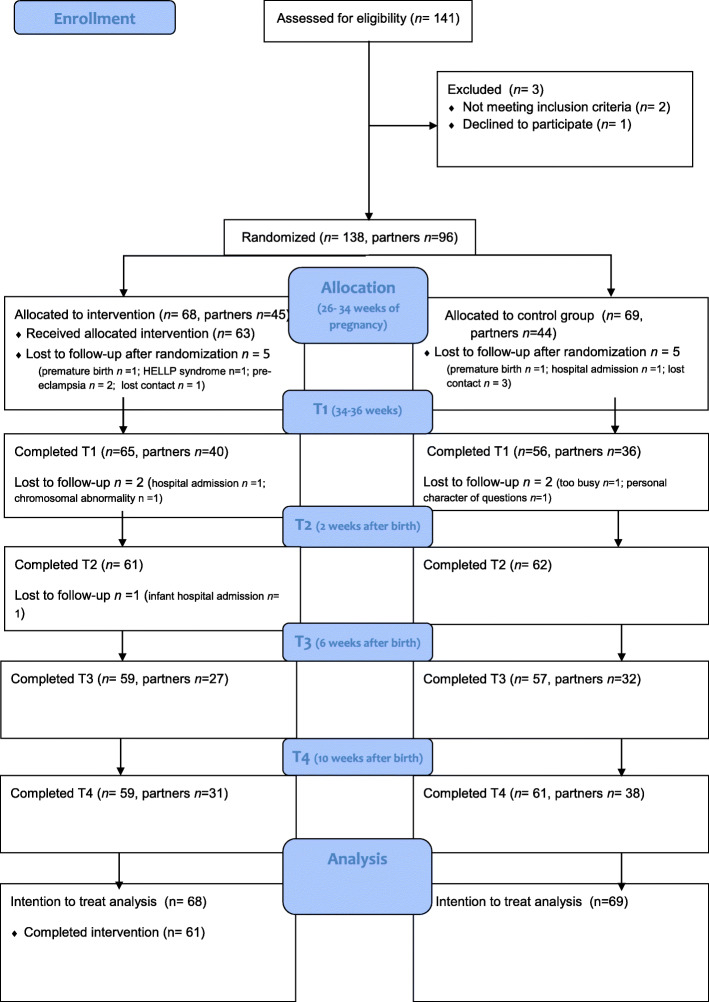
BACKGROUND: The first months postpartum can be challenging for parents, leading to elevated symptoms of parenting stress, depression and anxiety. In turn, distressed parents are at higher risk for providing suboptimal quality of caregiving. As psychoeducational interventions can be effective in reducing psychological distress, the goal of this randomized controlled trial was to examine the effectiveness of low-intensity universal psychoeducational program to prevent postpartum parenting stress, and to enhance parental well-being and caregiving quality. METHOD: Between 26 and 34 weeks of pregnancy, 138 pregnant women and 96 partners were randomized to the intervention or a waitlist control group. The intervention consisted of a booklet, a video, a home visit, and a telephone call. Information was provided on (1) sensitive responsiveness, adapting to the parental role, and attending to own needs; (2) crying patterns; (3) feeding (arrangements); and (4) sleeping (arrangements). The primary outcome was parenting stress postpartum. Secondary outcomes were additional measures of distress (depression and anxiety), parental well-being, and caregiving quality. RESULTS: Both groups showed a rise in distress after birth. No between-group differences were observed on parenting stress, nor on the secondary outcomes. The intervention was rated as useful and of added value by the parents. CONCLUSION: This study offered no evidence that our universal prevention program was effective in decreasing parental distress or in increasing caregiving quality. However, parents found aspects of the intervention useful. More research is needed, including a longer period of follow-up as well as observational measures of parents' responsiveness. TRIAL REGISTRATION: This trial has been registered on 15 September 2016 in the Netherlands National Trial Register, ID: NTR6065, https://www.trialregister.nl/trial/5782 .
Overview
CoChat Summary
TL;DR
This randomized controlled trial found that a low-intensity universal psychoeducational intervention for expecting parents did not reduce postpartum parenting stress, depression, anxiety, or improve caregiving quality in the first 10 weeks after birth. Parents nevertheless rated the intervention as useful, especially the information booklet.
Key findings
- In the main analyses, there was no effect of the intervention on postpartum parenting stress at 6 weeks (T3) or 10 weeks (T4), and no significant intervention × gender or intervention × prenatal state interactions.
- The intervention also showed no effect on secondary outcomes: depressive symptoms, anxiety symptoms, satisfaction with the parenting role, self-efficacy, sleep quality and quantity, bonding, breastfeeding duration, or room-sharing duration.
- Both groups showed a rise in distress from baseline to 6 weeks postpartum, followed by a return to baseline by 10 weeks postpartum.
- For infant-care outcomes, there was one significant difference: 16.2% of mothers in the intervention group reported problems with infant feeding during daytime at 6 weeks postpartum, versus 6.9% in the control group (p = .05).
- Uptake was high: 98.5% of mothers read the booklet and watched the video before birth; among partners, 85.7% read the booklet and 92.9% watched the video. 55.6% of mothers and 32.1% of partners used the information daily or several times a week after birth.
Methods
- Design: Two-arm randomized controlled trial with parallel intervention and waitlist control groups; block randomization stratified by birth order and partner participation, with blinding not possible.
- Sample/data: 138 pregnant women and 96 partners in the Netherlands, recruited between November 2016 and February 2018; inclusion at <34 weeks’ gestation with no severe pregnancy complications.
- Main analysis: Outcomes were assessed online at baseline (T0), 34–36 weeks (T1), 2 weeks postpartum (T2), 6 weeks postpartum (T3), and 10 weeks postpartum (T4); the main analysis used multilevel linear modelling (MLM), focusing on T3 and repeating analyses at T4 for robustness.
Limitations
- The paper states that the sample was relatively well-educated and had relatively high income, which decreases generalizability.
- The study was followed only until 10 weeks after birth, so effects later in the first year could have been missed.
- The paper notes it did not measure parental use of external support services and relied heavily on self-report measures; it also says observational measures of responsiveness would be useful.
Model-written summary. Check it against the paper before relying on it.
Integrity signals
Registry
Cites
Statistics
Figures
Verification
Claims the paper makes
13 Valid · 0 Not valid · 46 Not checked · 52 Own results and interpretations
The cited sources support only part of this claim — read each source’s verdict below.
In the paper
“Furthermore, much less is known about universally applicable interventions that target all pregnant women, without pre-existing symptomatology or risk factors [56, 58].”
§ Effectiveness of a psycho-educational intervention for expecting parents to prevent postpartum parenting stress, depression and anxiety: a randomized controlled trial > Universal, selected and indicated prevention of parental distress
What the sources say
- Not checked yetcites [56] Sockol LE A systematic review and meta-analysis of interpersonal psychotherapy for perinatal women J Aff Dis. 2018 232 316 328 10.1016/j.jad.2018.01.018 29501991 source
- Partly supportedcites [58] Evans K Morrell CJ Spiby H Systematic review and meta-analysis of non-pharmalogical interventions to reduce the symptoms of mild to moderate anxiety in pregnant women J Adv Nurs 2018 74 289 309 10.1111/jan.13456 28921612 sourceExperimental — accuracy not yet measured
Our copy supports only the empirical backdrop, not the gap statement as framed. 'Participants and eligibility screening' records that included studies recruited women from general pregnant populations OR women with obstetric, social or psychological symptoms or risk factors, and that recruitment issues 'highlighted limitations to the reach, generalisability and relevance of the findings'; 'Participants' notes only seven studies recruited from a general pregnant population. However, the review's own scope is women with symptoms of mild to moderate anxiety (Background: effectiveness 'has not yet been determined'; CONCLUSION: results inconclusive, insufficient evidence for overall conclusions), and no passage states that much less is known about universally applicable interventions for pregnant women without pre-existing symptomatology or risk factors. That comparative knowledge-gap claim, and the asymptomatic/universal population it refers to, are not this paper's finding. (LLM, conf=0.62)
plain- Asserted: passes — The authors put it forward as true.
- Checkable: passes — It can be checked against evidence.
- Load-bearing: passes — The paper’s conclusions depend on it.
- Based: passes — The paper gives a reason why it holds.
The cited sources support only part of this claim — read each source’s verdict below.
In the paper
“However, much is unknown about the effectiveness of preventive interventions on other forms of distress beyond depression, such as anxiety and general stress [56, 58].”
§ Effectiveness of a psycho-educational intervention for expecting parents to prevent postpartum parenting stress, depression and anxiety: a randomized controlled trial > Universal, selected and indicated prevention of parental distress
What the sources say
- Not checked yetcites [56] Sockol LE A systematic review and meta-analysis of interpersonal psychotherapy for perinatal women J Aff Dis. 2018 232 316 328 10.1016/j.jad.2018.01.018 29501991 source
- Partly supportedcites [58] Evans K Morrell CJ Spiby H Systematic review and meta-analysis of non-pharmalogical interventions to reduce the symptoms of mild to moderate anxiety in pregnant women J Adv Nurs 2018 74 289 309 10.1111/jan.13456 28921612 sourceExperimental — accuracy not yet measured
Our copy supports the anxiety half of the claim in the pregnancy context: the Introduction (Accepted Article) states 'the evidence of the effectiveness of interventions for mild to moderate symptoms of anxiety in pregnancy has not yet been determined (Ryan 2013, Glover 2014) and further research is required', and the Conclusion states the review 'found insufficient evidence to draw overall conclusions regarding the benefit of non-pharmacological interventions for pregnant women with anxiety'. Two parts are not supported: the review's scope is anxiety only — stress appears merely as a secondary outcome in six included studies (Outcome measures), so nothing is said about effectiveness on 'general stress'; and the interventions are framed as reducing existing mild-to-moderate anxiety symptoms (with prevention discussed only as prevention of postnatal depression, requiring 1-year follow-up, per Morrell et al. 2016), not as 'preventive interventions' on distress outcomes. (LLM, conf=0.75)
plain- Asserted: passes — The authors put it forward as true.
- Checkable: passes — It can be checked against evidence.
- Load-bearing: passes — The paper’s conclusions depend on it.
- Based: passes — The paper gives a reason why it holds.
The cited sources support only part of this claim — read each source’s verdict below.
In the paper
“The proposed mechanism behind the associations between parental parenting distress and child outcomes is that parental distress negatively affects the quality of parenting [19–21].”
§ Effectiveness of a psycho-educational intervention for expecting parents to prevent postpartum parenting stress, depression and anxiety: a randomized controlled trial > Parental distress and quality of care
What the sources say
- Not checked yetcites [19] Crnic KA Gaze C Hoffman C Cumulative parenting stress across the preschool period: relations to maternal parenting and child behaviour at age 5 Inf Child Dev 2005 14 117 132 10.1002/icd.384 source
- Partly supportedcites [20] Koss KJ Gunnar MR Annual research review: early adversity, the hypothalamic–pituitary–adrenocortical axis, and child psychopathology J Child Psychol Psych 2018 59 327 346 10.1111/jcpp.12784 PMC5771995 28714126 sourceExperimental — accuracy not yet measured
In the 'Maternal Depression' subsection our copy states that 'Parental depression may also disrupt the family context through heightened conflict and less responsive parenting,' and treats caregiving quality as tracking parental depression ('depression and thus caregiving quality waxes and wanes across development'). The 'Family Adversity and Parenting Quality' section likewise reports reduced maternal warmth, heightened maternal negativity and less responsiveness as consequences of adverse family conditions. So the direction of the claim is in the source, but the source hedges it ('may also disrupt') and bounds it to parental depression/family adversity rather than stating as a settled fact that parental distress negatively affects parenting quality; the general, unhedged form of the citing sentence is not stated in our copy. (LLM, conf=0.72)
- Not checked yetcites [21] Stein A Pearson RM Goodman SH Rapa E Rahman A McCallum M Howard LM Pariante CM Effects of perinatal mental disorders on the fetus and child Lancet 2014 384 1800 1819 10.1016/S0140-6736(14)61277-0 25455250 source
plainstates a cause- Asserted: passes — The authors put it forward as true.
- Checkable: passes — It can be checked against evidence.
- Load-bearing: passes — The paper’s conclusions depend on it.
- Based: passes — The paper gives a reason why it holds.
The cited sources support only part of this claim — read each source’s verdict below.
In the paper
“Meta-analytic evidence indicates that brief psychoeducational interventions aimed at providing information can be effective in reducing symptoms of psychological distress [17].”
§ Effectiveness of a psycho-educational intervention for expecting parents to prevent postpartum parenting stress, depression and anxiety: a randomized controlled trial > Abstract > Trial registration
What the sources say
- Partly supportedcites [17] Donker T Griffiths KM Cuijpers P Christensen H Psychoeducation for anxiety, depression, and psychological distress: a meta-analysis BMC Med 2009 7 79 10.1186/1741-7015-7-79 20015347 PMC2805686 sourceExperimental — accuracy not yet measured
The Abstract Conclusions and Discussion Main findings sections of our copy state that 'brief passive psychoeducational interventions for depression and psychological distress can reduce symptoms', with a pooled post-intervention effect of d = 0.20 (95% CI 0.01-0.40; P = 0.04) across four comparisons — supporting a hedged 'can be effective' claim for information-provision (passive) interventions. However, the significant pooled effect is driven by depression trials: the Results ('Effects of the psychoeducational interventions at post-test and follow-up') report that the single study targeting psychological distress found no significant difference (d = 0.04), and the Discussion notes this study 'did not find significant effects'. So the part of the claim isolating reduction of psychological-distress symptoms specifically is not supported by this source's own analyses, which address depression and distress only in combination. (LLM, conf=0.72)
hedgedstates a cause- Asserted: passes — The authors put it forward as true.
- Checkable: passes — It can be checked against evidence.
- Load-bearing: passes — The paper’s conclusions depend on it.
- Based: passes — The paper gives a reason why it holds.
- Partly supported
The cited sources support only part of this claim — read each source’s verdict below.
In the paper
“Parental sensitivity is important for a range of child outcomes, including the formation of a secure attachment relationship between infants and their parents, social competence, regulatory capacities, and lower stress levels (e.g. [22–28]).”
§ Effectiveness of a psycho-educational intervention for expecting parents to prevent postpartum parenting stress, depression and anxiety: a randomized controlled trial > Parental distress and quality of care
What the sources say
- Not checked yetcites [22] Bakermans-Kranenburg MJ Van IJzendoorn MH Juffer F Less is more: meta-analyses of sensitivity and attachment interventions in early childhood Psychol Bull 2003 129 195 215 10.1037/0033-2909.129.2.195 12696839 source
- Not checked yetcites [23] De Wolff MS Van IJzendoorn MH Sensitivity and attachment: a meta-analysis on parental antecedents of infant attachment Soc Res Child Dev 1997 68 571 591 10.1111/j.1467-8624.1997.tb04218.x 9306636 source
- Partly supportedcites [24] Fearon RP Bakermans-Kranenburg MJ van Ijzendoorn MH Lapsley A Roisman GI The significance of insecure attachment and disorganization in the development of children’s externalizing behavior: a meta-analytic study Child Dev 2010 81 435 456 10.1111/j.1467-8624.2009.01405.x 20438450 sourceExperimental — accuracy not yet measured
In its discussion of attachment mechanisms (page unavailable), the paper describes responsive caregiving in secure relationships and discusses prosocial behavior and emotion regulation as possible pathways. It does not establish that parental sensitivity produces every listed outcome, particularly lower stress levels; stress and arousal regulation are presented as possibilities that have received less attention. (LLM, conf=0.83)
- Not checked yetcites [25] Groh AM Roisman GI Van IJzendoorn MH Bakermans-Kranenburg MJ Fearon RP The significance of insecure and disorganized attachment for children’s internalizing symptoms: a meta-analytic study Child Dev 2012 83 591 610 10.1111/j.1467-8624.2011.01711.x 22235928 source
- Not checked yetcites [26] Isabella RA Belsky J Von Eye A Origins of infant-mother attachment: an examination of interactional synchrony during the infant’s first year Dev Psych 1989 25 12 21 10.1037/0012-1649.25.1.12 source
- Not checked yetcites [27] Smeekens S Riksen-Walraven JM Van Bakel HJA Multiple determinants of externalizing behavior in 5-year-olds: a longitudinal model J Abn Child Psychol 2007 35 347 361 10.1007/s10802-006-9095-y PMC1915644 17243016 source
- Not checked yetcites [28] Sroufe AL Attachment and development: a prospective, longitudinal study from birth to adulthood Attach & Hum Dev. 2005 7 349 367 10.1080/14616730500365928 16332580 source
plainstates an association- Asserted: passes — The authors put it forward as true.
- Checkable: passes — It can be checked against evidence.
- Load-bearing: passes — The paper’s conclusions depend on it.
- Based: passes — The paper gives a reason why it holds.
42 more claims · 6 with their cited sources checked
Create a free account to see all 111 claims and to verify the 96 references still open.
- Probably not a substantial claim. 39
- It may state two separate claims as one. 39
Self-check
Percentages, sums and reported differences re-computed from the paper’s own numbers.
Each contradiction between two passages listed here was confirmed by an independent check.
Rated minor: it would not touch a result — a value no result rests on, a p-value that stays on the same side of the significance level, or a conflict that is clerical, resolved elsewhere in the paper, or outside its own findings.
In the paper
§ Effectiveness of a psycho-educational intervention for expecting parents to prevent postpartum parenting stress, depression and anxiety: a randomized controlled trial > Abstract > Method
“Between 26 and 34 weeks of pregnancy, 138 pregnant women and 96 partners were randomized to the intervention or a waitlist control group.”
§ Effectiveness of a psycho-educational intervention for expecting parents to prevent postpartum parenting stress, depression and anxiety: a randomized controlled trial > Results > Descriptives
“We included 138 women (68 in the intervention group and 69 in the control group) and 96 partners (48 in the intervention and 48 in the control group).”
Rated minor: it would not touch a result — a value no result rests on, a p-value that stays on the same side of the significance level, or a conflict that is clerical, resolved elsewhere in the paper, or outside its own findings.
In the paper
§ Effectiveness of a psycho-educational intervention for expecting parents to prevent postpartum parenting stress, depression and anxiety: a randomized controlled trial > Results > Parental distress
“At baseline, 5 mothers in the intervention group (3.3%) scored above the cut-off for depression (10 or more on the EPDS) and 8 mothers in the control group (12.1%).”
Citations
Cites
Tabachnick, B. G., & Fidell, L. S. (1983) · Cited by 80,058
The Pittsburgh Sleep Quality Index: a new instrument for psychiatric practice and research
Buysse, D. J., Reynolds, C. F., Monk, T. H., Berman, S. R., & Kupfer, D. J. (1989) · Psychiatry Research · doi:10.1016/0165-1781(89)90047-4 · Cited by 35,234
Detection of Postnatal Depression: Development of the 10-item Edinburgh Postnatal Depression Scale
Cox, J. L., Holden, J. M., & Sagovsky, R. (1987) · British Journal of Psychiatry · doi:10.1192/bjp.150.6.782 · Cited by 14,183
The validity of the Hospital Anxiety and Depression Scale
Bjelland, I., Dahl, A. A., Haug, T. T., & Neckelmann, D. (2002) · Journal of Psychosomatic Research · doi:10.1016/s0022-3999(01)00296-3 · Cited by 9,779
Attachment styles among young adults: A test of a four-category model.
Bartholomew, K., & Horowitz, L. M. (1991) · Journal of Personality and Social Psychology · doi:10.1037//0022-3514.61.2.226 · Cited by 8,384
Breastfeeding in the 21st century: epidemiology, mechanisms, and lifelong effect
Victora, C. G., Bahl, R., Barros, A. J. D., França, G. V. A., Horton, S., Krasevec, J., Murch, S., Sankar, M. J., Walker, N., & Rollins, N. C. (2016) · The Lancet · doi:10.1016/s0140-6736(15)01024-7 · Cited by 8,040
(1998) · Cited by 3,968
Maternal Depression and Child Psychopathology: A Meta-Analytic Review
Goodman, S. H., Rouse, M. H., Connell, A. M., Broth, M. R., Hall, C. M., & Heyward, D. (2011) · Clinical Child and Family Psychology Review · doi:10.1007/s10567-010-0080-1 · Cited by 2,621
Sensitivity and attachment: A meta-analysis on parental antecedents of infant attachment
De Wolff, M. S., & van Ijzendoorn, M. H. (1997) · Child Development · doi:10.1111/j.1467-8624.1997.tb04218.x · Cited by 2,526
Effects of perinatal mental disorders on the fetus and child
Stein, A., Pearson, R. M., Goodman, S. H., Rapa, E., Rahman, A., McCallum, M., Howard, L. M., & Pariante, C. M. (2014) · The Lancet · doi:10.1016/s0140-6736(14)61277-0 · Cited by 2,166
RUSBULT, C. E., MARTZ, J. M., & AGNEW, C. R. (1998) · Personal Relationships · doi:10.1111/j.1475-6811.1998.tb00177.x · Cited by 2,161
SPINHOVEN, P., ORMEL, J., SLOEKERS, P. P. A., KEMPEN, G. I. J. M., SPECKENS, A. E. M., & HEMERT, A. M. V. (1997) · Psychological Medicine · doi:10.1017/s0033291796004382 · Cited by 2,158
Less is more: meta-analyses of sensitivity and attachment interventions in early childhood
Bakermans-Kranenburg, M. J., van IJzendoorn, M. H., & Juffer, F. (2003) · Psychological Bulletin · doi:10.1037/0033-2909.129.2.195 · Cited by 1,883
Attachment and development: A prospective, longitudinal study from birth to adulthood
Sroufe, L. A. (2005) · Attachment & Human Development · doi:10.1080/14616730500365928 · Cited by 1,685
Prevalence of antenatal and postnatal anxiety: Systematic review and meta-analysis
Dennis, C.-L., Falah-Hassani, K., & Shiri, R. (2017) · British Journal of Psychiatry · doi:10.1192/bjp.bp.116.187179 · Cited by 1,491
Fearon, R. P., Bakermans-Kranenburg, M. J., Van IJzendoorn, M. H., Lapsley, A.-M., & Roisman, G. I. (2010) · Child Development · doi:10.1111/j.1467-8624.2009.01405.x · Cited by 1,326
The course of anxiety and depression through pregnancy and the postpartum in a community sample
Heron, J., O'Connor, T. G., Evans, J., Golding, J., & Glover, V. (2004) · Journal of Affective Disorders · doi:10.1016/j.jad.2003.08.004 · Cited by 1,151
The Determinants of Parenting Behavior
Abidin, R. R. (1992) · Journal of Clinical Child Psychology · doi:10.1207/s15374424jccp2104_12 · Cited by 1,116
Abidin, R. R. (1995) · Medical Entomology and Zoology · Cited by 926
Kontos, E., Blake, K. D., Chou, W.-Y. S., & Prestin, A. (2014) · Journal of Medical Internet Research · doi:10.2196/jmir.3117 · Cited by 917
Risk factors for antenatal depression, postnatal depression and parenting stress
Leigh, B., & Milgrom, J. (2008) · BMC Psychiatry · doi:10.1186/1471-244x-8-24 · Cited by 893
Crnic, K. A., Gaze, C., & Hoffman, C. (2005) · Infant and Child Development · doi:10.1002/icd.384 · Cited by 853 · cited 1×
“As parenting stress is suggested to provide the child with a more negative, less predictive, and chaotic environment, these environmental circumstances can negatively affect the child’s own stress levels and subsequent neurocognitive development, but also prevent the child from a stimulating environment necessary for…”
BackgroundBreastfeeding and intelligence: a systematic review and meta-analysis
Horta, B. L., Loret de Mola, C., & Victora, C. G. (2015) · Acta Paediatrica · doi:10.1111/apa.13139 · Cited by 767
Panter‐Brick, C., Burgess, A., Eggerman, M., McAllister, F., Pruett, K., & Leckman, J. F. (2014) · Journal of Child Psychology and Psychiatry · doi:10.1111/jcpp.12280 · Cited by 737
Paulson, J. F., Dauber, S., & Leiferman, J. A. (2006) · Pediatrics · doi:10.1542/peds.2005-2948 · Cited by 706
Groh, A. M., Roisman, G. I., van IJzendoorn, M. H., Bakermans-Kranenburg, M. J., & Fearon, R. P. (2012) · Child Development · doi:10.1111/j.1467-8624.2011.01711.x · Cited by 638
Validation of the Edinburgh Depression Scale during pregnancy
Bergink, V., Kooistra, L., Lambregtse-van den Berg, M. P., Wijnen, H., Bunevicius, R., van Baar, A., & Pop, V. (2011) · Journal of Psychosomatic Research · doi:10.1016/j.jpsychores.2010.07.008 · Cited by 601
Moon, R. Y., TASK FORCE ON SUDDEN INFANT DEATH SYNDROME, Darnall, R. A., Feldman-Winter, L., Goodstein, M. H., & Hauck, F. R. (2016) · Pediatrics · doi:10.1542/peds.2016-2940 · Cited by 583
Olssøn, I., Mykletun, A., & Dahl, A. A. (2005) · BMC Psychiatry · doi:10.1186/1471-244x-5-46 · Cited by 580
Diagnosing postpartum depression in mothers and fathers: whatever happened to anxiety?
Matthey, S., Barnett, B., Howie, P., & Kavanagh, D. J. (2003) · Journal of Affective Disorders · doi:10.1016/s0165-0327(02)00012-5 · Cited by 547
The assessment of parent-to-infant attachment: Development of a self-report questionnaire instrument
Condon, J. T., & Corkindale, C. J. (1998) · Journal of Reproductive and Infant Psychology · doi:10.1080/02646839808404558 · Cited by 546
Matthey, S., Henshaw, C., Elliott, S., & Barnett, B. (2006) · Archives of Women's Mental Health · doi:10.1007/s00737-006-0152-x · Cited by 544
Psychoeducation for depression, anxiety and psychological distress: a meta-analysis
Donker, T., Griffiths, K. M., Cuijpers, P., & Christensen, H. (2009) · BMC Medicine · doi:10.1186/1741-7015-7-79 · Cited by 542
Self-citationBrennan, P. A., Hammen, C. L., Andersen, M. J., Bor, W., Najman, J. M., & Williams, G. M. (2000) · Developmental Psychology · doi:10.1037//0012-1649.36.6.759 · Cited by 519
Breastfeeding and depression: A systematic review of the literature
Dias, C. C., & Figueiredo, B. (2015) · Journal of Affective Disorders · doi:10.1016/j.jad.2014.09.022 · Cited by 515
US Preventive Services Task Force, Curry, S. J., Krist, A. H., Owens, D. K., Barry, M. J., Caughey, A. B., Davidson, K. W., Doubeni, C. A., Epling, J. W., Grossman, D. C., et al. (2019) · JAMA · doi:10.1001/jama.2019.0007 · Cited by 494
Koss, K. J., & Gunnar, M. R. (2018) · Journal of Child Psychology and Psychiatry · doi:10.1111/jcpp.12784 · Cited by 489
Drivers of human development: How relationships and context shape learning and development 1
Osher, D., Cantor, P., Berg, J., Steyer, L., & Rose, T. (2020) · Applied Developmental Science · doi:10.1080/10888691.2017.1398650 · Cited by 484 · cited 1×
“This bond has been defined as the tie from parent to infant that facilitates parent-infant proximity and caregiving behavior, such as warmth and sensitivity [30, 31].”
BackgroundSleep Patterns and Fatigue in New Mothers and Fathers
Gay, C. L., Lee, K. A., & Lee, S.-Y. (2004) · Biological Research For Nursing · doi:10.1177/1099800403262142 · Cited by 434 · cited 1×
“This is in line with earlier research [59, 101].”
ResultRevision of the Parenting Stress Index
Loyd, B. H., & Abidin, R. R. (1985) · Journal of Pediatric Psychology · doi:10.1093/jpepsy/10.2.169 · Cited by 424
Sockol, L. E. (2015) · Journal of Affective Disorders · doi:10.1016/j.jad.2015.01.052 · Cited by 395
Parental diary of infant cry and fuss behaviour.
Barr, R. G., Kramer, M. S., Boisjoly, C., McVey-White, L., & Pless, I. B. (1988) · Archives of Disease in Childhood · doi:10.1136/adc.63.4.380 · Cited by 362 · cited 1×
“Also, direct measures of infant behavior should be added, such as a registration of infant crying patterns, to monitor potential effects of the intervention on infant behavior [99].”
BackgroundIsabella, R. A., Belsky, J., & von Eye, A. (1989) · Developmental Psychology · doi:10.1037//0012-1649.25.1.12 · Cited by 333
Postnatal anxiety prevalence, predictors and effects on development: A narrative review
Field, T. (2018) · Infant Behavior and Development · doi:10.1016/j.infbeh.2018.02.005 · Cited by 327
A systematic review of the effects of postnatal maternal anxiety on children
Glasheen, C., Richardson, G. A., & Fabio, A. (2010) · Archives of Women's Mental Health · doi:10.1007/s00737-009-0109-y · Cited by 321
Understanding and Improving the Validity of Self-Report of Parenting
Morsbach, S. K., & Prinz, R. J. (2006) · Clinical Child and Family Psychology Review · doi:10.1007/s10567-006-0001-5 · Cited by 302
Characteristics of the Edinburgh post natal depression scale in The Netherlands
Pop, V. J., Komproe, I. H., & van Son, M. J. (1992) · Journal of Affective Disorders · doi:10.1016/0165-0327(92)90041-4 · Cited by 286 · cited 2×
“Abbreviations AAP: American Academy of Pediatrics; ECR: Experiences in Close Relationships Questionnaire; EPDS: Edinburgh Postnatal Depression Scale; HADS: Hospital Anxiety and Depression Scale; IMS: The Investment Model Scale; MLM: Multilevel Lineair Modeling; MPAS: Maternal Postnatal Attachment Scale; PSI: Parenting…”
MethodJones, J. D., Cassidy, J., & Shaver, P. R. (2015) · Personality and Social Psychology Review · doi:10.1177/1088868314541858 · Cited by 280
The Normal Crying Curve: What Do We Really Know?
Barr, R. G. (1990) · Developmental Medicine & Child Neurology · doi:10.1111/j.1469-8749.1990.tb16949.x · Cited by 269
A Controlled Trial of the Father's Role in Breastfeeding Promotion
Pisacane, A., Continisio, G. I., Aldinucci, M., D'Amora, S., & Continisio, P. (2005) · Pediatrics · doi:10.1542/peds.2005-0479 · Cited by 269
The effects of paternal depression on child and adolescent outcomes: A systematic review
Sweeney, S., & MacBeth, A. (2016) · Journal of Affective Disorders · doi:10.1016/j.jad.2016.05.073 · Cited by 257
Feldman, R., Eidelman, A. I., & Rotenberg, N. (2004) · Child Development · doi:10.1111/j.1467-8624.2004.00816.x · Cited by 253
Yelland, J., Sutherland, G., & Brown, S. J. (2010) · BMC Public Health · doi:10.1186/1471-2458-10-771 · Cited by 230
Bedsharing, Roomsharing, and Sudden Infant Death Syndrome in Scotland: A Case-control Study
Tappin, D., Ecob, R., & Brooke, H. (2005) · The Journal of Pediatrics · doi:10.1016/j.jpeds.2005.01.035 · Cited by 223
Selecting the Best Items for a Short-Form of the Experiences in Close Relationships Questionnaire
Lafontaine, M.-F., Brassard, A., Lussier, Y., Valois, P., Shaver, P. R., & Johnson, S. M. (2016) · European Journal of Psychological Assessment · doi:10.1027/1015-5759/a000243 · Cited by 220
McKenna, J. J., Ball, H. L., & Gettler, L. T. (2007) · American Journal of Physical Anthropology · doi:10.1002/ajpa.20736 · Cited by 219
Austin, M.-P., Frilingos, M., Lumley, J., Hadzi-Pavlovic, D., Roncolato, W., Acland, S., Saint, K., Segal, N., & Parker, G. (2008) · Journal of Affective Disorders · doi:10.1016/j.jad.2007.04.001 · Cited by 212
McCoy, S. J. B., Beal, J. M., Shipman, S. B. M., Payton, M. E., & Watson, G. H. (2006) · PubMed · Cited by 204
Breastfeeding, Bed‐Sharing, and Infant Sleep
Ball, H. L. (2003) · Birth · doi:10.1046/j.1523-536x.2003.00243.x · Cited by 202
van Bussel, J. C. H., Spitz, B., & Demyttenaere, K. (2010) · Archives of Women's Mental Health · doi:10.1007/s00737-009-0140-z · Cited by 199
de Cock, E. S. A., Henrichs, J., Klimstra, T. A., Janneke B. M. Maas, A., Vreeswijk, C. M. J. M., Meeus, W. H. J., & van Bakel, H. J. A. (2017) · Journal of Child and Family Studies · doi:10.1007/s10826-017-0679-7 · Cited by 199
Perinatal Maternal Depressive Symptoms as an Issue for Population Health
Meaney, M. J. (2018) · American Journal of Psychiatry · doi:10.1176/appi.ajp.2018.17091031 · Cited by 194
Adult attachment style and parental responsiveness during a stressful event
Edelstein, R. S., Alexander, K. W., Shaver, P. R., Schaaf, J. M., Quas, J. A., Lovas, G. S., & Goodman, G. S. (2004) · Attachment & Human Development · doi:10.1080/146167303100001659584 · Cited by 181
Breastfeeding and the mother–infant relationship—A review
JANSEN, J., de Weerth, C., & Riksen‐Walraven, J. M. (2008) · Developmental Review · doi:10.1016/j.dr.2008.07.001 · Cited by 170 · cited 1×
“This bond has been defined as the tie from parent to infant that facilitates parent-infant proximity and caregiving behavior, such as warmth and sensitivity [30, 31].”
BackgroundContinuous feelings of love? The parental bond from pregnancy to toddlerhood.
de Cock, E. S. A., Henrichs, J., Vreeswijk, C. M. J. M., Maas, A. J. B. M., Rijk, C. H. A. M., & van Bakel, H. J. A. (2016) · Journal of Family Psychology · doi:10.1037/fam0000138 · Cited by 165 · cited 2×
“Lower quality of the parent-infant bond has been related to problems in children’s socio-emotional development [29, 32].”
BackgroundA systematic review and meta-analysis of interpersonal psychotherapy for perinatal women
Sockol, L. E. (2018) · Journal of Affective Disorders · doi:10.1016/j.jad.2018.01.018 · Cited by 158
Preventing postpartum depression: A meta-analytic review
Sockol, L. E., Epperson, C. N., & Barber, J. P. (2013) · Clinical Psychology Review · doi:10.1016/j.cpr.2013.10.004 · Cited by 157
Education and Support for Fathers Improves Breastfeeding Rates: A Randomized Controlled Trial
Maycock, B., Binns, C. W., Dhaliwal, S., Tohotoa, J., Hauck, Y., Burns, S., & Howat, P. (2013) · Journal of Human Lactation · doi:10.1177/0890334413484387 · Cited by 153
Preventing early infant sleep and crying problems and postnatal depression: A randomized trial
Hiscock, H., Cook, F., Bayer, J., Le, H. N., Mensah, F., Cann, W., Symon, B., & St James-Roberts, I. (2014) · Pediatrics · doi:10.1542/peds.2013-1886 · Cited by 147
Trajectories of mothers’ and fathers’ depressive symptoms from pregnancy to 24 months postpartum
Kiviruusu, O., Pietikäinen, J. T., Kylliäinen, A., Pölkki, P., Saarenpää-Heikkilä, O., Marttunen, M., Paunio, T., & Paavonen, E. J. (2020) · Journal of Affective Disorders · doi:10.1016/j.jad.2019.09.038 · Cited by 143
Mason, Z. S., Briggs, R. D., & Silver, E. J. (2011) · Journal of Reproductive and Infant Psychology · doi:10.1080/02646838.2011.629994 · Cited by 141
Multiple Determinants of Externalizing Behavior in 5-Year-Olds: A Longitudinal Model
Smeekens, S., Riksen-Walraven, J. M., & van Bakel, H. J. A. (2007) · Journal of Abnormal Child Psychology · doi:10.1007/s10802-006-9095-y · Cited by 124
Impact of Maternal Anxiety on Breastfeeding Outcomes: A Systematic Review
Hoff, C. E., Movva, N., Rosen Vollmar, A. K., & Pérez-Escamilla, R. (2019) · Advances in Nutrition · doi:10.1093/advances/nmy132 · Cited by 122
Screening for postpartum depression in an inner-city population
Morris-Rush, J. K., Freda, M. C., & Bernstein, P. S. (2003) · American Journal of Obstetrics and Gynecology · doi:10.1067/mob.2003.279 · Cited by 120
Paternal Mental Health and Socioemotional and Behavioral Development in Their Children
Kvalevaag, A. L., Ramchandani, P. G., Hove, O., Assmus, J., Eberhard-Gran, M., & Biringer, E. (2013) · Pediatrics · doi:10.1542/peds.2012-0804 · Cited by 111 · cited 2×
“Given the associations between parental symptomatology and the quality of parenting and, subsequently, child development [16, 61, 62, 65], there is a need for preventive interventions that are applicable to all expecting parents, both mothers and fathers, independent of pre-existing risk factors or symptomatology.”
BackgroundSelf-esteem and relationship satisfaction during the transition to motherhood.
van Scheppingen, M. A., Denissen, J. J. A., Chung, J. M., Tambs, K., & Bleidorn, W. (2018) · Journal of Personality and Social Psychology · doi:10.1037/pspp0000156 · Cited by 107 · cited 1×
“This results in lowered self-efficacy [3] and reduced self-esteem [4].”
BackgroundSelf-citationPredictors of Postpartum Depression in Partnered Mothers and Fathers from a Longitudinal Cohort
The APrON Team, Leung, B. M. Y., Letourneau, N. L., Giesbrecht, G. F., Ntanda, H. N., & Hart, M. J. (2016) · Community Mental Health Journal · doi:10.1007/s10597-016-0060-0 · Cited by 106
Mamma Mia – A randomized controlled trial of an internet-based intervention for perinatal depression
Haga, S. M., Drozd, F., Lisøy, C., Wentzel-Larsen, T., & Slinning, K. (2019) · Psychological Medicine · doi:10.1017/s0033291718002544 · Cited by 99
Beijers, R., Riksen‐Walraven, J. M., & de Weerth, C. (2012) · Stress · doi:10.3109/10253890.2012.742057 · Cited by 98 · cited 1×
“Also, the availability of the parents seems to help buffering the infant’s distress [42, 43], and facilitates the breastfeeding process [44–46].”
BackgroundSelf-citationLaw, K. H., Dimmock, J., Guelfi, K. J., Nguyen, T., Gucciardi, D., & Jackson, B. (2019) · Applied Psychology: Health and Well-Being · doi:10.1111/aphw.12147 · Cited by 93
Risk factors for antenatal anxiety: A systematic review of the literature
Bayrampour, H., Vinturache, A., Hetherington, E., Lorenzetti, D. L., & Tough, S. (2018) · Journal of Reproductive and Infant Psychology · doi:10.1080/02646838.2018.1492097 · Cited by 83
The influence of bed-sharing on infant physiology, breastfeeding and behaviour: A systematic review
Baddock, S. A., Purnell, M., Blair, P. S., Pease, A. S., Elder, D. E., & Galland, B. C. (2018) · Sleep Medicine Reviews · doi:10.1016/j.smrv.2018.10.007 · Cited by 80
Bittner, A., Peukert, J., Zimmermann, C., Junge-Hoffmeister, J., Parker, L. S., Stöbel-Richter, Y., & Weidner, K. (2014) · Journal of Perinatal & Neonatal Nursing · doi:10.1097/jpn.0000000000000027 · Cited by 77 · cited 2×
“[47, 48] or on mothers who belong to certain risk groups for developing a disorder (selected prevention; e.”
BackgroundHenshaw, E. J., Cooper, M. A., Jaramillo, M., Lamp, J. M., Jones, A. L., & Wood, T. L. (2018) · Maternal and Child Health Journal · doi:10.1007/s10995-018-2565-3 · Cited by 76 · cited 3×
“[1] showed among a sample of parents varying in income, education, and ethnicity; having access to much information does not necessarily reduce stress.”
BackgroundThe effectiveness of antenatal interventions to prevent postnatal depression in high-risk women
Clatworthy, J. (2012) · Journal of Affective Disorders · doi:10.1016/j.jad.2011.02.029 · Cited by 75
Attachment and Close Relationships
Feeney, J. A., Noller, P., & Roberts, N. (2000) · Sage eBooks · doi:10.4135/9781452220437.n14 · Cited by 75
Jan Conradi, H., Gerlsma, C., Duijn, M. V., & Jonge, P. D. (2006) · The European Journal of Psychiatry · doi:10.4321/s0213-61632006000400006 · Cited by 71 · cited 1×
“Attachment style of the parents To control for possible insecure attachment styles of the parents (which can impact on their caregiving quality [87, 88];, parental attachment style was measured with the short form of the Experiences in Close Relationships Questionnaire (ECR- short form [89]; Dutch translation [90]).”
MethodHughes, C., T. Devine, R., Foley, S., D. Ribner, A., Mesman, J., & Blair, C. (2020) · Journal of Affective Disorders · doi:10.1016/j.jad.2020.01.133 · Cited by 67
Tollenaar, M. S., Beijers, R., Jansen, J., Riksen‐Walraven, J. M., & de Weerth, C. (2011) · Psychoneuroendocrinology · doi:10.1016/j.psyneuen.2011.03.017 · Cited by 49
Self-citationMurray, L., Fearon, P., & Cooper, P. (2015) · Identifying Perinatal Depression and Anxiety · doi:10.1002/9781118509722.ch9 · Cited by 45 · cited 2×
“Given the associations between parental symptomatology and the quality of parenting and, subsequently, child development [16, 61, 62, 65], there is a need for preventive interventions that are applicable to all expecting parents, both mothers and fathers, independent of pre-existing risk factors or symptomatology.”
BackgroundTissera, H., Auger, É., Séguin, L., Kramer, M. S., & Lydon, J. E. (2020) · Psychology and Health · doi:10.1080/08870446.2020.1766040 · Cited by 43
Cook, F., Bayer, J., Le, H. N., Mensah, F., Cann, W., & Hiscock, H. (2012) · BMC Pediatrics · doi:10.1186/1471-2431-12-13 · Cited by 40 · cited 1×
“Perception of squality and quantity Perception of sleep quality and quantity were measured with two items of the Pittsburgh Sleep Quality Index (PSQI [83]; see also [84]).”
MethodMissler, M., Donker, T., Beijers, R., Ciharova, M., Moyse, C., de Vries, R., Denissen, J., & van Straten, A. (2021) · BMC Pregnancy and Childbirth · doi:10.1186/s12884-021-03752-2 · Cited by 40
Self-citationCan Early Intervention Improve Maternal Well-Being? Evidence from a Randomized Controlled Trial
Doyle, O., Delaney, L., O’Farrelly, C., Fitzpatrick, N., & Daly, M. (2017) · PLOS ONE · doi:10.1371/journal.pone.0169829 · Cited by 35
Enhancing resilience in the transition to parenthood: a thematic analysis of parents’ perspectives
Young, C., Roberts, R., & Ward, L. (2020) · Journal of Reproductive and Infant Psychology · doi:10.1080/02646838.2020.1724916 · Cited by 34
Evans, K., Morrell, C. J., & Spiby, H. (2018) · Journal of Advanced Nursing · doi:10.1111/jan.13456 · Cited by 33 · cited 4×
“Furthermore, much less is known about universally applicable interventions that target all pregnant women, without pre-existing symptomatology or risk factors [56, 58].”
BackgroundInfluentialMissler, M. A., Beijers, R., Denissen, J. J. A., & van Straten, A. (2018) · Trials · doi:10.1186/s13063-017-2348-y · Cited by 27
Self-citationHindering resilience in the transition to parenthood: a thematic analysis of parents’ perspectives
Young, C., Roberts, R., & Ward, L. (2020) · Journal of Reproductive and Infant Psychology · doi:10.1080/02646838.2020.1757630 · Cited by 26 · cited 2×
“There is especially a need for reliable and evidence-based information [2].”
BackgroundPrenatal Predictors of Postnatal Quality of Caregiving Behavior in Mothers and Fathers
Hechler, C., Beijers, R., Riksen-Walraven, M., & de Weerth, C. (2019) · Parenting · doi:10.1080/15295192.2019.1556010 · Cited by 24
Self-citationWajid, A., Kingston, D. E., Bright, K. S., Mughal, M. K., Charrois, E. M., & Giallo, R. (2019) · Journal of Affective Disorders · doi:10.1016/j.jad.2019.11.138 · Cited by 19
The work–home interface: The role of home-based predictors of burnout among mothers
Missler, M. A., Stroebe, M., & Laan, G. V. D. (2013) · Family Science · doi:10.1080/19424620.2013.871740 · Cited by 16 · cited 2×
“As has been done before, four items were added to the scale (see [66, 73]).”
BackgroundSelf-citationCrossover and work-home interference
Montgomery, A., Peeters, M. C. W., Schaufeli, W. B., & Panagopoulou, E. P. (2008) · The Irish Journal of Psychology · doi:10.1080/03033910.2008.10446274 · Cited by 11 · cited 1×
“items of The Investment Model Scale (IMS [93]; Dutch translation: [94]).”
Sharing a Room: Updated Recommendations for a Safe Infant Sleeping Environment.
Rollins, J. A. (2018) · PubMed · Cited by 5
Research works printed but not linked: 4
- World Health Organization 10 facts on breastfeeding 2017
- De Brock AJLL Vermulst AA Gerris JRM Abidin RR Nijmeegse ouderlijke stress index: meetinstrument voor de vaststelling van stress bij opvoeders 1992 Lisse Swets & Zeitlinger
- Missler MA, Donker T, Beijers R, Ciharova M, Moyse C, De Vries R, Denissen J, Van Straten A. (Submitted). Preventing postpartum maternal distress: a systematic review and meta-analysis of psychological interventions. PMC8017784 33794828
- Statistics Netherlands The Netherlands leads Europe in internet access 2018
Cited by
Postpartum Depression and Maternal Care: Exploring the Complex Effects on Mothers and Infants
Saharoy, R., Potdukhe, A., Wanjari, M., & Taksande, A. B. (2023) · Cureus · doi:10.7759/cureus.41381 · Cited by 191
“By increasing their knowledge about PPD, mothers can recognize their symptoms, seek help sooner, and make informed decisions about their mental health [55].”
BackgroundLau, Y., Cheng, J.-Y., Wong, S.-H., Yen, K.-Y., & Cheng, L.-J. (2021) · World Journal of Psychiatry · doi:10.5498/wjp.v11.i4.133 · Cited by 68
Fernandes, D. V., Monteiro, F., Canavarro, M. C., & Moreira, H. (2022) · Mindfulness · doi:10.1007/s12671-022-02016-0 · Cited by 42
“, 2018), increase the likelihood of poorer quality caregiving (Missler et al., 2020), and impair mother-infant bonding (Nordahl et al.”
BackgroundMotrico, E., Bina, R., Kassianos, A. P., Le, H., Mateus, V., Öztekin, D. C., Muñoz, M. D. L. F. R., Moreno-Peral, P., & Cerón, S. C. (2023) · General Hospital Psychiatry · doi:10.1016/j.genhosppsych.2023.03.007 · Cited by 51
Neo, H. S., Tan, J. H., Ang, W. H. D., & Lau, Y. (2022) · Journal of Psychosomatic Research · doi:10.1016/j.jpsychores.2022.110790 · Cited by 32
Metadata
- Authors
- Missler, M., van Straten, A., Denissen, J., Donker, T., & Beijers, R.
- Affiliations
- Utrecht University (NL)
- University of Freiburg (DE)
- Radboud University Nijmegen (NL)
- Corresponding author
- Missler, Marjolein
- Venue
- BMC Pregnancy and Childbirth
- Published
- 2020-10-31
- Volume
- 20
- Issue
- 1
- Pages
- 658-658
- ISSN
- 1471-2393 (ISSN-L)
- PMC
- PMC7603696
- OpenAlex
- W3095623395
- Cited by
- 66
- References
- 106
- Citations by year
- 2026: 10 · 2025: 10 · 2024: 13 · 2023: 15 · 2022: 11 · 2021: 7
- FWCI
- 6.19
- Type
- journal article
- Language
- en
- Open access
- gold
- doi.org
- Licence
- cc-by
- creativecommons.org/licenses/by/4.0/ (tdm)
- creativecommons.org/licenses/by/4.0/ (vor)
- Locations
- BMC Pregnancy and Childbirth (publishedVersion, cc-by)
- PubMed Central (publishedVersion, cc-by)
- PubMed (publishedVersion)
- VU Research Portal (publishedVersion, other-oa)
- DOAJ (DOAJ: Directory of Open Access Journals) (submittedVersion, cc-by-sa)
- Utrecht University Repository (Utrecht University) (submittedVersion, other-oa)
- FreiDok plus (Universitätsbibliothek Freiburg) (submittedVersion)
- Radboud Repository (Radboud University) (submittedVersion)
- Radboud Repository (Radboud University) (submittedVersion, other-oa)
- Data Archiving and Networked Services (DANS) (submittedVersion, other-oa)
- Funders
- Nederlandse Organisatie voor Wetenschappelijk Onderzoek (406.14.106)
- Topics
- Health Sciences › Medicine › Public Health, Environmental and Occupational Health › Maternal Mental Health During Pregnancy and Postpartum
- Health Sciences › Medicine › Pediatrics, Perinatology and Child Health › Infant Health and Development
- Health Sciences › Medicine › Pediatrics, Perinatology and Child Health › Maternal and Neonatal Healthcare
- Keywords
- postpartum depression, postpartum anxiety, psychoeducational intervention, universal prevention programs, expectant parents, parental well-being, caregiving quality, sensitive responsiveness, infant crying, low-intensity intervention
- MeSH terms
- Psychological Distress, Adult, Anxiety, Depression, Feasibility Studies, Female, House Calls, Humans, Infant Welfare, Infant, Newborn, Male, Netherlands, Pamphlets, Parent-Child Relations, Parents, Personal Satisfaction, Pregnancy, Telephone, Parenting, Self Efficacy, Postpartum Period, Prenatal Education
About these checks
Registry, retraction, Cites and statistics results are computed, not judged, with one exception: a printed reference that no index lists is read once by a model before it counts as a citation error. Claims are extracted by a model and kept only when their quote appears verbatim in the text; each cited source is then checked, with a model’s help, for whether it says what the claim relies on. Those verdicts can be wrong — read the claim’s quote and the cited source before relying on one.
The claim verdicts this report counts are experimental: their accuracy is not yet measured.
A language model drew the claims from the paper on 2026-10-11, under version 3 of the claim definition (model deepseek-v4.1-flash, prompt extract-v3).
A second model labelled each claim on 2026-10-11 (model jev-1.13-20260917, definition revision gold-guideline-v0.2).
Cited sources are checked with a language model’s help (qwen3.8-omni-flash and gpt-6-sol).
Statistics and arithmetic are recomputed, not judged.
Confidence bands are shown only for fields calibrated on our annotated test set. None is calibrated yet, so no band is shown.
What counts as a claim ›How we measure confidence ›How we check this ›
Are you an author, or do you see a problem with this page? Request a review
Data sources
Bibliographic data: Semantic Scholar, OpenAlex, Crossref.
Contains information from the Semantic Scholar Academic Graph Datasets, made available under the ODC Attribution License (ODC-BY 1.0).
Semantic Scholar’s data is described in: Kinney, R., et al. (2023). The Semantic Scholar Open Data Platform. arXiv:2301.10140.
