

Depression, anxiety, PTSD, and OCD after stillbirth: a systematic review
Open accessThe DOI matches its Crossref record; 66 of the 68 references it cites were found in a registry or an index; 41 of the 157 sources its claims cite were checked for support.
Abstract
Background: This systematic review aimed to provide an updated summary of studies investigating depression, anxiety, post-traumatic stress disorder (PTSD), and obsessive-compulsive disorder (OCD) in parents after stillbirth (from 20 weeks gestational age until birth). Methods: A literature search was conducted in the databases Web of Science and PsychINFO. Main inclusion criteria were 1) peer-reviewed, quantitative, English-language articles published from 1980; (2) studies investigating depression, anxiety, PTSD, or OCD among parents following stillbirth; and (3) studies defining stillbirth as equal to or after 20 weeks of gestation. Results: Thirteen quantitative, peer-reviewed articles were eligible for inclusion. Selected articles investigated depression, anxiety, and PTSD, while no studies on OCD met our inclusion criteria. The majority of studies investigated women, while only two studies included men. The results indicated heightened short- and long-term levels of depression, anxiety, and PTSD in parents after stillbirth compared to those of parents with live birth. Studies investigating predictors found that social support, marital status, negative appraisals, and variables related to care and management after stillbirth affected levels of symptoms. Conclusions: Parents who experience stillbirth have a considerably higher risk of reporting symptoms of depression, anxiety, and PTSD compared with parents with live births. More longitudinal studies are needed to increase our knowledge of how symptoms develop over time, and more research on fathers, transgender, non-binary and gender fluid individuals is needed. Research on the association between stillbirth and OCD is also warranted. Knowledge of the severity of anxiety, depression, and PTSD after stillbirth, and predictors associated with symptom severity could provide healthcare professionals with valuable information on how to provide beneficial postpartum care.
Overview
CoChat Summary
## TL;DR
This systematic review of 13 quantitative studies found that stillbirth is associated with higher short- and some long-term symptoms of depression, anxiety, and PTSD in parents compared with live birth. No eligible studies on OCD were found, and the evidence base was limited by small, heterogeneous, mostly women-only studies.
## Key findings
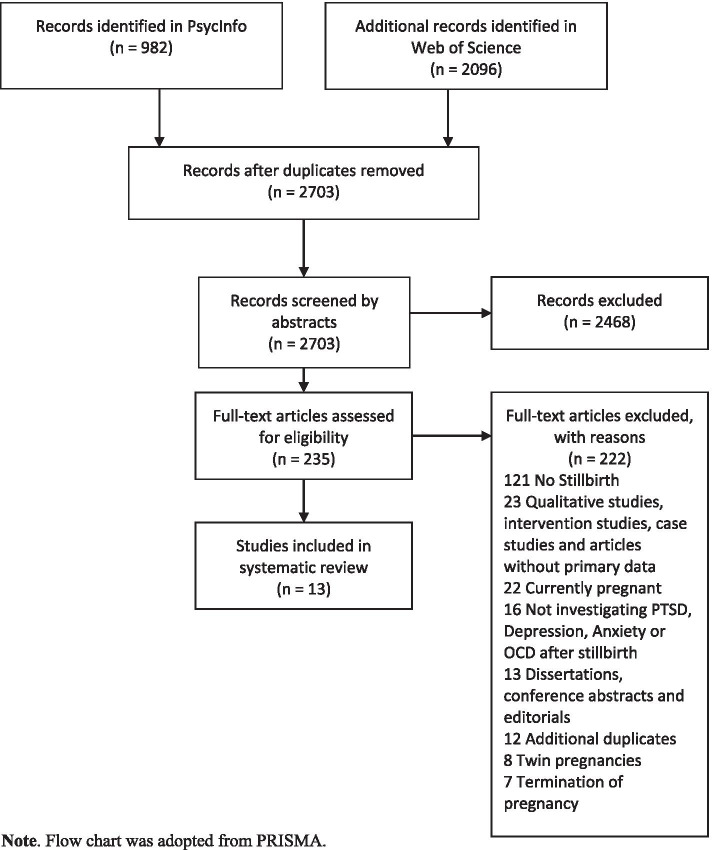
- 13 peer-reviewed quantitative studies met inclusion criteria; 12 examined depression, 8 anxiety, 4 PTSD, and 0 OCD.
- Across studies with controls, parents after stillbirth had higher symptom levels; reported effect sizes ranged from RRs 1.74 to 6.70.
- Depression findings included, for example, mothers with stillbirth having ORadj = 5.34 for depression at 3.5 years, and one study reporting depression odds of 2.75 within 1 year of stillbirth.
- Anxiety and PTSD were also elevated: one study found ORadj = 2.29 for anxiety diagnosis within 1 year, and another found RR = 4.36 for PTSD diagnosis; one study reported 60% of mothers met PTSD diagnostic criteria.
- Predictors of greater symptom severity included marital status, social/professional support, negative cognitions/appraisals, and care-related factors such as waiting >25 h after diagnosis before birth and not seeing/holding the baby as desired.
## Methods
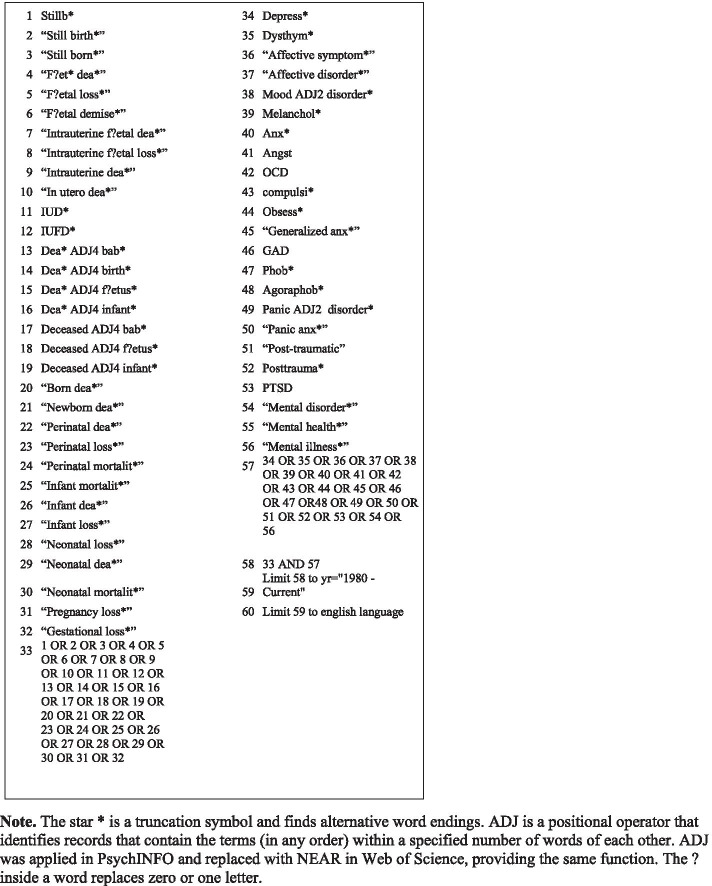
- Systematic review of peer-reviewed, quantitative, English-language studies published from 1980 onward, using PRISMA guidance and a pre-planned protocol.
- Searches were conducted in PsychINFO and Web of Science on August 28, 2020, plus reference-list screening; stillbirth was defined as fetal death at ≥20 gestational weeks until birth.
- Two reviewers independently screened records, extracted data, and assessed study quality with the Kmet checklist; due to heterogeneity and small number of studies, the data were not suited for meta-analysis.
## Limitations
- The review states that the literature was limited by different measurement instruments, a paucity of longitudinal studies, lack of research in LMICs, few studies including men, and frequent grouping of different perinatal losses.
- The authors state their search was limited to English-language articles in two databases (PsychINFO and Web of Science), so relevant studies may have been missed.
- Evident from the text: most studies were small, cross-sectional, and women-only, several used the same data sources, and follow-up was at most 30 months in the longitudinal studies, limiting causal and long-term inference.
Model-written summary. Check it against the paper before relying on it.
Integrity signals
Registry
Cites
Statistics
Figures
Verification
Claims the paper makes
31 Valid · 4 Not valid · 68 Not checked · 118 Own results and interpretations
Every source the paper cites for this claim was checked and supports it.
In the paper
“SB is also found to increase the risk of depression and anxiety symptoms in subsequent pregnancies [23].”
§ Depression, anxiety, PTSD, and OCD after stillbirth: a systematic review > Background
What the sources say
- Supportedcites [23] Gravensteen IK Jacobsen E-M Sandset PM Helgadottir LB Radestad I Sandvik L Anxiety, depression and relationship satisfaction in the pregnancy following stillbirth and after the birth of a live-born baby: a prospective study BMC Pregnancy Childbirth 2018 18 41 29361916 PMC5781321 source
The Results report higher prevalence of both anxiety and depression among women pregnant after stillbirth than among women with a previous live birth or previously nulliparous women. The paper’s Conclusions likewise state that both were more prevalent in pregnancies following stillbirth. (LLM, conf=0.94)
plainstates a cause- Asserted: passes — The authors put it forward as true.
- Checkable: passes — It can be checked against evidence.
- Load-bearing: unclear — It is unclear whether the paper’s conclusions depend on it.
- Based: passes — The paper gives a reason why it holds.
- Supported
The cited sources support only part of this claim — read each source’s verdict below.
In the paper
“Overall, these reviews report adverse short- and long-term psychological outcomes in parents following SB.”
§ Depression, anxiety, PTSD, and OCD after stillbirth: a systematic review > Background > Previous reviews on stillbirth and mental health
What the sources say
- Supportedcites [10] Burden C Bradley S Storey C Ellis A Heazell AEP Downe S From grief, guilt pain and stigma to hope and pride - a systematic review and meta-analysis of mixed-method research of the psychosocial impact of stillbirth BMC Pregnancy Childbirth. 2016 16 9 26785915 PMC4719709 source
The Abstract’s Results report negative psychological symptoms after bereavement and in subsequent pregnancies. The Discussion’s Main findings describe profound long-term detrimental psychological impacts on parents. Together, these support adverse short- and long-term outcomes following stillbirth; page numbers are not provided in the supplied passages. (LLM, conf=0.93)
- Not checked — no full text of the sourcecites [14] Badenhorst W Riches S Turton P Hughes P The psychological effects of stillbirth and neonatal death on fathers: systematic review J Psychosom Obstet Gynecol 2006 27 245 256 17225626 source
- Partly supportedcites [24] Campbell-Jackson L Horsch A The psychological impact of stillbirth on women: a systematic review Illn Crisis Loss 2014 22 237 256 sourceExperimental — accuracy not yet measured
The Abstract reports adverse psychological symptoms in mothers during the first months after stillbirth, with symptoms persisting for up to three years in some. The Introduction specifies that this review covers mothers, so it does not establish the same short- and long-term outcomes for parents generally, including fathers. (LLM, conf=0.86)
- Partly supportedcites [25] Due C Chiarolli S Riggs DW The impact of pregnancy loss on men’s health and wellbeing: a systematic review BMC Pregnancy Childbirth 2017 17 380 29141591 PMC5688642 sourceExperimental — accuracy not yet measured
The Results (Outcomes of quantitative and mixed methods studies; page unavailable) report grief, depression, stress and anxiety in men and women after pregnancy loss, with men’s symptoms generally less enduring. But the review covers pregnancy loss broadly, with most studied losses occurring before 20 weeks; it does not establish adverse short- and long-term outcomes specifically for parents following stillbirth. (LLM, conf=0.84)
- Supportedcites [26] Ellis A Chebsey C Storey C Bradley S Jackson S Flenady V Systematic review to understand and improve care after stillbirth: a review of parents’ and healthcare professionals’ experiences BMC Pregnancy Childbirth 2016 16 16 26810220 PMC4727309 source
The Background (page not provided) describes short- and long-term negative outcomes after stillbirth, including prolonged psychological problems in bereaved parents and severe grief symptoms years later. This supports the citing sentence’s broad summary. (LLM, conf=0.91)
- Not checked — no full text of the sourcecites [27] de Graaff LF Honig A van Pampus MG Stramrood CAI Preventing post-traumatic stress disorder following childbirth and traumatic birth experiences: a systematic review Acta Obstet Gynecol Scand 2018 97 648 656 29336486 source
- Supportedcites [28] Hennegan JM Henderson J Redshaw M Contact with the baby following stillbirth and parental mental health and well-being: a systematic review BMJ Open 2015 5 e008616 26614620 PMC4663431 source
The Introduction describes stillbirth as traumatic for women and their partners and says parents’ grief and distress are documented. The Introduction’s ‘Outcome and moderator selection’ section discusses short- and long-term distress, including anxiety and other mental health issues; the Results describe studies assessing outcomes from a few months to many years after stillbirth. Page numbers are not available in our copy. (LLM, conf=0.87)
plainstates a cause- Asserted: passes — The authors put it forward as true.
- Checkable: passes — It can be checked against evidence.
- Load-bearing: passes — The paper’s conclusions depend on it.
- Based: passes — The paper gives a reason why it holds.
- Supported
Every source the paper cites for this claim was checked and supports it.
In the paper
“one-third of women with previous SB reported post-traumatic stress disorder (PTSD) symptoms above clinical cut-off when assessed 5–18 years after SB.”
§ Depression, anxiety, PTSD, and OCD after stillbirth: a systematic review > Background
What the sources say
- Supportedcites [22] Gravensteen IK Helgadóttir LB Jacobsen E-M Rådestad I Sandset PM Ekeberg Ø Women’s experiences in relation to stillbirth and risk factors for long-term post-traumatic stress symptoms: a retrospective study BMJ Open 2013 3 e003323 24154514 PMC3808779 source
The Conclusions state that one in three women had a clinically significant level of post-traumatic stress symptoms 5–18 years after stillbirth. Table 4 reports 31 of 98 women (31.6%) above the clinical symptom cut-off. This is distinct from the higher possible-PTSD threshold, reached by 13.3%. (LLM, conf=0.92)
plainstates an association- Asserted: passes — The authors put it forward as true.
- Checkable: passes — It can be checked against evidence.
- Load-bearing: unclear — It is unclear whether the paper’s conclusions depend on it.
- Based: passes — The paper gives a reason why it holds.
- Supported
Every source the paper cites for this claim was checked and supports it.
In the paper
“SB is associated with various adverse psychosocial outcomes in parents [10].”
§ Depression, anxiety, PTSD, and OCD after stillbirth: a systematic review > Background
What the sources say
- Supportedcites [10] Burden C Bradley S Storey C Ellis A Heazell AEP Downe S From grief, guilt pain and stigma to hope and pride - a systematic review and meta-analysis of mixed-method research of the psychosocial impact of stillbirth BMC Pregnancy Childbirth. 2016 16 9 26785915 PMC4719709 source
The Discussion (Main findings) states that stillbirth often has long-term detrimental psychological and social impacts on parents. The Results (Themes) describe examples including grief suppression, relationship difficulties, and stigmatisation, supporting the broad claim of various adverse psychosocial outcomes. (LLM, conf=0.94)
plainstates an association- Asserted: passes — The authors put it forward as true.
- Checkable: passes — It can be checked against evidence.
- Load-bearing: passes — The paper’s conclusions depend on it.
- Based: passes — The paper gives a reason why it holds.
- Supported
Every source the paper cites for this claim was checked and supports it.
In the paper
“As major transitional periods, including pregnancy and childbirth, have been associated with the onset or exacerbation of OCD symptoms [29]”
§ Depression, anxiety, PTSD, and OCD after stillbirth: a systematic review > Background > Previous reviews on stillbirth and mental health
What the sources say
- Supportedcites [29] House SJ Tripathi SP Knight BT Morris N Newport DJ Stowe ZN Obsessive-compulsive disorder in pregnancy and the postpartum period: course of illness and obstetrical outcome Archives Women’s Mental Health 2016 19 3 10 PMC4715787 26173597 source
The Introduction says pregnancy and childbirth are major life events associated with increased vulnerability to developing obsessional problems. It also describes the postpartum period as a possible window of symptom exacerbation. The paper’s own prospective cohort showed largely stable symptoms, but that does not negate the qualified association stated in the claim. (LLM, conf=0.90)
plainstates an association- Asserted: passes — The authors put it forward as true.
- Checkable: passes — It can be checked against evidence.
- Load-bearing: passes — The paper’s conclusions depend on it.
- Based: passes — The paper gives a reason why it holds.
- Supported
133 more claims · 18 with their cited sources checked
Create a free account to see all 221 claims and to verify the 1 reference still open.
- Probably not a substantial claim. 35
- It may state two separate claims as one. 63
Citations
Cites
Preferred Reporting Items for Systematic Reviews and Meta-Analyses: the PRISMA statement
Moher, D., Liberati, A., Tetzlaff, J., Altman, D. G., & for the PRISMA Group (2009) · BMJ · doi:10.1136/bmj.b2535 · Cited by 83,823
Preferred Reporting Items for Systematic Reviews and Meta-Analyses: The PRISMA Statement
Moher, D., Liberati, A., Tetzlaff, J., Altman, D. G., & The PRISMA Group (2009) · PLoS Medicine · doi:10.1371/journal.pmed.1000097 · Cited by 64,042
Preferred reporting items for systematic reviews and meta-analyses: The PRISMA statement
Moher, D., Liberati, A., Tetzlaff, J., Altman, D. G., & the PRISMA Group* (2009) · Annals of Internal Medicine · doi:10.7326/0003-4819-151-4-200908180-00135 · Cited by 37,554
Rayyan-a web and mobile app for systematic reviews.
Ouzzani, M., Hammady, H., Fedorowicz, Z., & Elmagarmid, A. (2016) · Systematic Reviews · doi:10.1186/s13643-016-0384-4 · Cited by 26,092 · cited 2×
“Search results were transferred to the internet-based program Rayyan QCRI [33] after duplicates were removed.”
MethodWang, G., Ma, R., Qiao, G., Wada, K., Aizawa, Y., & Satoh, T. (2015) · Integrative Medicine International · doi:10.1159/000368408 · Cited by 18,657
The weirdest people in the world?
Henrich, J., Heine, S. J., & Norenzayan, A. (2010) · Behavioral and Brain Sciences · doi:10.1017/s0140525x0999152x · Cited by 12,641 · cited 1×
“Lastly, the majority of the articles identified in this review (n = 12) were conducted in Western, Educated, Industrialized, Rich, and Democratic (WEIRD) societies [61].”
Effect size estimates: Current use, calculations, and interpretation.
Fritz, C. O., Morris, P. E., & Richler, J. J. (2012) · Journal of Experimental Psychology: General · doi:10.1037/a0024338 · Cited by 5,199 · cited 1×
“Small-sample studies are generally more prone to bias, and the relatively large confidence intervals presented in these studies suggest high uncertainty around the point estimates [47, 48].”
BackgroundWEIRD languages have misled us, too
Majid, A., & Levinson, S. C. (2010) · Behavioral and Brain Sciences · doi:10.1017/s0140525x1000018x · Cited by 4,076
Foa, E. B., Cashman, L., Jaycox, L., & Perry, K. (1997) · Psychological Assessment · doi:10.1037/1040-3590.9.4.445 · Cited by 2,709 · cited 1×
“Chung and Reed [35] found that 60% of their sample met the diagnostic criteria for PTSD when assessed with the Posttraumatic Diagnostic Scale (PDS [46]).”
International Classification of Diseases, 10th Revision
(2018) · The SAGE Encyclopedia of Intellectual and Developmental Disorders · doi:10.4135/9781483392271.n276 · Cited by 1,917
GRADE guidelines: 5. Rating the quality of evidence—publication bias
Guyatt, G. H., Oxman, A. D., Montori, V., Vist, G., Kunz, R., Brozek, J., Alonso-Coello, P., Djulbegovic, B., Atkins, D., Falck-Ytter, Y., et al. (2011) · Journal of Clinical Epidemiology · doi:10.1016/j.jclinepi.2011.01.011 · Cited by 1,819 · cited 1×
“Small-sample studies are generally more prone to bias, and the relatively large confidence intervals presented in these studies suggest high uncertainty around the point estimates [47, 48].”
BackgroundStandard Quality Assessment Criteria for Evaluating Primary Research Papers from a Variety of Fields
Kmet, L. M., Cook, L. S., & Lee, R. C. (2004) · University of Alberta Library · doi:10.7939/r37m04f16 · Cited by 1,682
Maternal and fetal risk factors for stillbirth: population based study
Gardosi, J., Madurasinghe, V., Williams, M., Malik, A., & Francis, A. (2013) · BMJ · doi:10.1136/bmj.f108 · Cited by 941 · cited 1×
“For example, one study [58] found an elevated risk for SB in women with a history of mental health problems compared to controls with no previous mental illness.”
BackgroundMental Health Service Provision in Low- and Middle-Income Countries
Rathod, S., Pinninti, N., Irfan, M., Gorczynski, P., Rathod, P., Gega, L., & Naeem, F. (2017) · Health Services Insights · doi:10.1177/1178632917694350 · Cited by 866 · cited 1×
“If this is the case, parents who experienced SB in these countries could lack professional support and follow up, which in turn could lead to a greater negative impact on parental mental health than identified in this review [62].”
BackgroundStillbirths: economic and psychosocial consequences
Heazell, A. E. P., Siassakos, D., Blencowe, H., Burden, C., Bhutta, Z. A., Cacciatore, J., Dang, N., Das, J., Flenady, V., Gold, K. J., et al. (2016) · The Lancet · doi:10.1016/s0140-6736(15)00836-3 · Cited by 807 · cited 1×
“In a survey conducted for the Lancet stillbirth series in 2016, it was found that women who experienced SB felt stigmatized, socially isolated, and less valued by society [51].”
BackgroundStillbirths: Where? When? Why? How to make the data count?
Lawn, J. E., Blencowe, H., Pattinson, R., Cousens, S., Kumar, R., Ibiebele, I., Gardosi, J., Day, L. T., & Stanton, C. (2011) · The Lancet · doi:10.1016/s0140-6736(10)62187-3 · Cited by 785 · cited 1×
“The prevalence varies significantly between high- and low−/middleincome countries (LMICs), as 98% of stillbirths occur in the latter [9].”
Backgroundthe GAPPS Review Group, Lawn, J. E., Gravett, M. G., Nunes, T. M., Rubens, C. E., & Stanton, C. (2010) · BMC Pregnancy and Childbirth · doi:10.1186/1471-2393-10-s1-s1 · Cited by 784
Manual for the State-Trait Anxiety Inventory STAI (Form Y) ("Self-Evaluation Questionnaire")
Spielberger, C. D. (1983) · Cited by 558
Burden, C., Bradley, S., Storey, C., Ellis, A., Heazell, A. E. P., Downe, S., Cacciatore, J., & Siassakos, D. (2016) · BMC Pregnancy and Childbirth · doi:10.1186/s12884-016-0800-8 · Cited by 445 · cited 5×
“However, for some parents, these symptoms may become pathological and long-lasting [10, 20, 21].”
BackgroundInfluentialThe prevalence and correlates of psychiatric comorbidity in individuals with complicated grief
Simon, N. M., Shear, K. M., Thompson, E. H., Zalta, A. K., Perlman, C., Reynolds, C. F., Frank, E., Melhem, N. M., & Silowash, R. (2007) · Comprehensive Psychiatry · doi:10.1016/j.comppsych.2007.05.002 · Cited by 333 · cited 1×
“Another potential limitation was that articles solely focusing on grief as the primary outcome were excluded, as grief and depression may co-occur [63].”
BackgroundEllis, A., Chebsey, C., Storey, C., Bradley, S., Jackson, S., Flenady, V., Heazell, A., & Siassakos, D. (2016) · BMC Pregnancy and Childbirth · doi:10.1186/s12884-016-0806-2 · Cited by 322
Stillbirth as risk factor for depression and anxiety in the subsequent pregnancy: cohort study
Hughes, P. M., Turton, P., & Evans, C. D. H. (1999) · BMJ · doi:10.1136/bmj.318.7200.1721 · Cited by 260 · cited 1×
“For instance, studies suggest that depression and anxiety may be prevalent and prolonged in the pregnancy following SB and that pregnant women may be more vulnerable to depression and anxiety [23, 31].”
BackgroundObst, K. L., Due, C., Oxlad, M., & Middleton, P. (2020) · BMC Pregnancy and Childbirth · doi:10.1186/s12884-019-2677-9 · Cited by 222 · cited 2×
“The few studies investigating men’s reactions after SB suggest that paternal and maternal reactions might differ [10, 59].”
BackgroundRadestad, I., Steineck, G., Nordin, C., & Sjogren, B. (1996) · BMJ · doi:10.1136/bmj.312.7045.1505 · Cited by 204 · cited 4×
“[40] found a higher prevalence of anxiety in women that had to wait more than 25 h after diagnosis of death in utero until the onset of birth, compared to women with less delay.”
BackgroundInfluentialPsychological effects of stillbirth
Cacciatore, J. (2013) · Seminars in Fetal and Neonatal Medicine · doi:10.1016/j.siny.2012.09.001 · Cited by 188 · cited 1×
“However, for some parents, these symptoms may become pathological and long-lasting [10, 20, 21].”
BackgroundBoelen, P. A., van den Bout, J., & de Keijser, J. (2003) · American Journal of Psychiatry · doi:10.1176/appi.ajp.160.7.1339 · Cited by 178
Brander, G., Pérez-Vigil, A., Larsson, H., & Mataix-Cols, D. (2016) · Neuroscience & Biobehavioral Reviews · doi:10.1016/j.neubiorev.2016.03.011 · Cited by 172 · cited 1×
“As traumatic experiences, life transitions, and pregnancy or birth complications are considered risk factors for developing OCD [54, 55], more research is warranted to clarify the association between SB and OCD.”
Backgroundde Graaff, L. F., Honig, A., van Pampus, M. G., & Stramrood, C. A. I. (2018) · Acta Obstetricia et Gynecologica Scandinavica · doi:10.1111/aogs.13291 · Cited by 166
Onset and Exacerbation of Obsessive-Compulsive Disorder in Pregnancy and the Postpartum Period
Forray, A., Focseneanu, M., Pittman, B., McDougle, C. J., & Epperson, C. N. (2010) · The Journal of Clinical Psychiatry · doi:10.4088/jcp.09m05381blu · Cited by 155 · cited 1×
“As traumatic experiences, life transitions, and pregnancy or birth complications are considered risk factors for developing OCD [54, 55], more research is warranted to clarify the association between SB and OCD.”
BackgroundKorteweg, F., Gordijn, S., Timmer, A., Erwich, J., Bergman, K., Bouman, K., Ravise, J., Heringa, M., & Holm, J. (2006) · BJOG: An International Journal of Obstetrics & Gynaecology · doi:10.1111/j.1471-0528.2006.00881.x · Cited by 152 · cited 1×
“However, various definitions exist, with numerous SB classification systems in the literature [6, 7].”
BackgroundBoyle, F. M., Vance, J. C., Najman, J. M., & Thearle, M. J. (1996) · Social Science & Medicine · doi:10.1016/0277-9536(96)00039-1 · Cited by 148 · cited 10×
“The longitudinal studies found symptoms of depression, anxiety, and PTSD to be at its highest the closer to the stillbirth they were measured, with a declining trajectory with time [2, 5, 36].”
BackgroundInfluentialThe impact of pregnancy loss on men’s health and wellbeing: a systematic review
Due, C., Chiarolli, S., & Riggs, D. W. (2017) · BMC Pregnancy and Childbirth · doi:10.1186/s12884-017-1560-9 · Cited by 140 · cited 2×
“This is highlighted as a common trend within this field [14, 25] and prevents the current review from drawing firm conclusions about potential gender differences in mental health outcomes after SB.”
BackgroundMeeting the needs of parents after a stillbirth or neonatal death
Flenady, V, Boyle, F., Koopmans, L., Wilson, T., Stones, W., & Cacciatore, J. (2014) · BJOG: An International Journal of Obstetrics & Gynaecology · doi:10.1111/1471-0528.13009 · Cited by 138 · cited 1×
“Parents may have spent months preparing for the infant’s birth, leaving them shocked to learn of their child’s death [14, 15].”
BackgroundThe psychological effects of stillbirth and neonatal death on fathers: Systematic review
Badenhorst, W., Riches, S., Turton, P., & Hughes, P. (2006) · Journal of Psychosomatic Obstetrics & Gynecology · doi:10.1080/01674820600870327 · Cited by 125 · cited 2×
“Parents may have spent months preparing for the infant’s birth, leaving them shocked to learn of their child’s death [14, 15].”
BackgroundThe Scope and Impact of Perinatal Loss: Current Status and Future Directions.
Bennett, S. M., Litz, B. T., Lee, B. S., & Maguen, S. (2005) · Professional Psychology: Research and Practice · doi:10.1037/0735-7028.36.2.180 · Cited by 115 · cited 3×
“In parallel, parents can feel alone, as others might lack the understanding that their loss is significant, or avoid talking about the stillborn [13].”
BackgroundDaugirdaitė, V., van den Akker, O., & Purewal, S. (2015) · Journal of Pregnancy · doi:10.1155/2015/646345 · Cited by 109 · cited 1×
“A history of mental health problems is considered one of many risk factors of SB [57].”
BackgroundCouple distress after sudden infant or perinatal death: A 30‐month follow up
Vance, J., Boyle, F., Najman, J., & Thearle, M. (2002) · Journal of Paediatrics and Child Health · doi:10.1046/j.1440-1754.2002.00008.x · Cited by 105 · cited 1×
“However, for some parents, these symptoms may become pathological and long-lasting [10, 20, 21].”
BackgroundEffects of Support Groups on Post Traumatic Stress Responses in Women Experiencing Stillbirth
Cacciatore, J. (2007) · OMEGA - Journal of Death and Dying · doi:10.2190/m447-1x11-6566-8042 · Cited by 100 · cited 1×
“Stress, anxiety, and depression symptoms are common immediate reactions to SB [17, 19].”
BackgroundVance, J. C., Najman, J. M., Thearle, M. J., Embelton, G., Foster, W. J., & Boyle, F. M. (1995) · Pediatrics · doi:10.1542/peds.96.5.933 · Cited by 97 · cited 10×
“The longitudinal studies found symptoms of depression, anxiety, and PTSD to be at its highest the closer to the stillbirth they were measured, with a declining trajectory with time [2, 5, 36].”
BackgroundResultInfluentialGravensteen, I. K., Jacobsen, E.-M., Sandset, P. M., Helgadottir, L. B., Rådestad, I., Sandvik, L., & Ekeberg, Ø. (2018) · BMC Pregnancy and Childbirth · doi:10.1186/s12884-018-1666-8 · Cited by 90 · cited 2×
“For instance, studies suggest that depression and anxiety may be prevalent and prolonged in the pregnancy following SB and that pregnant women may be more vulnerable to depression and anxiety [23, 31].”
BackgroundLong-term outcomes for mothers who have or have not held their stillborn baby
Rådestad, I., Surkan, P. J., Steineck, G., Cnattingius, S., Onelöv, E., & Dickman, P. W. (2009) · Midwifery · doi:10.1016/j.midw.2007.03.005 · Cited by 85 · cited 3×
“[41] investigated whether having held the stillborn or not was associated with levels of anxiety.”
BackgroundResultThe psychological, social, and economic impact of stillbirth on families
Murphy, S., & Cacciatore, J. (2017) · Seminars in Fetal and Neonatal Medicine · doi:10.1016/j.siny.2017.02.002 · Cited by 82 · cited 2×
“Stress, anxiety, and depression symptoms are common immediate reactions to SB [17, 19].”
BackgroundRecovering from stillbirth: the effects of making and sharing memories on maternal mental health
Crawley, R., Lomax, S., & Ayers, S. (2013) · Journal of Reproductive and Infant Psychology · doi:10.1080/02646838.2013.795216 · Cited by 73 · cited 8×
“Predictors Social and professional support Three studies [3, 36, 43] found social and professional support to influence the association between SB and depression, anxiety, and PTSD.”
BackgroundInfluentialGravensteen, I. K., Helgadóttir, L. B., Jacobsen, E.-M., Rådestad, I., Sandset, P. M., & Ekeberg, Ø. (2013) · BMJ Open · doi:10.1136/bmjopen-2013-003323 · Cited by 72 · cited 1×
“[22], one-third of women with previous SB reported post-traumatic stress disorder (PTSD) symptoms above clinical cut-off when assessed 5–18 years after SB.”
BackgroundLisy, K., Peters, M. D. J., Riitano, D., Jordan, Z., & Aromataris, E. (2016) · Birth · doi:10.1111/birt.12217 · Cited by 70 · cited 1×
“This may suggest variability in how parents react to holding the stillborn and that health care providers should respect individual preferences, a point also identified in a qualitative synthesis of qualitative studies on parents’ experience following SB [50].”
BackgroundKingdon, C., Givens, J. L., O'Donnell, E., & Turner, M. (2015) · Birth · doi:10.1111/birt.12176 · Cited by 69 · cited 1×
“Inconclusive findings are in accordance with previous systematic reviews on the effect of holding versus not holding the stillborn [28, 49].”
ResultAnxiety and vulnerability in parents following the death of an infant
DYREGROV, A., & MATTHIESEN, S. B. (1987) · Scandinavian Journal of Psychology · doi:10.1111/j.1467-9450.1987.tb00901.x · Cited by 58 · cited 1×
“Different types of perinatal loss may affect parents in different ways [2, 4, 5, 52].”
BackgroundChung, M. C., & Reed, J. (2017) · Psychiatric Quarterly · doi:10.1007/s11126-016-9446-y · Cited by 57 · cited 14×
“The study by Chung and Reed [35] found that mothers who had experienced SB had significantly higher anxiety mean scores than controls.”
BackgroundInfluentialHouse, S. J., Tripathi, S. P., Knight, B. T., Morris, N., Newport, D. J., & Stowe, Z. N. (2016) · Archives of Women's Mental Health · doi:10.1007/s00737-015-0542-z · Cited by 56 · cited 1×
“As major transitional periods, including pregnancy and childbirth, have been associated with the onset or exacerbation of OCD symptoms [29], a systematic review of research examining the association between SB and OCD is warranted.”
BackgroundThe psychological impact of stillbirth on women: a systematic review
Campbell-Jackson, L., & Horsch, A. (2014) · Illness, Crisis & Loss · doi:10.2190/il.22.3.d · Cited by 55 · cited 5×
“Similarly, another review included additional measures of grief, drug and alcohol use, marital satisfaction, and well-being [24].”
BackgroundInfluentialThearle, M. J., Vance, J. C., Najman, J. M., Embelton, G., & Foster, W. J. (1995) · OMEGA - Journal of Death and Dying · doi:10.2190/baxy-48au-petw-4mq3 · Cited by 46 · cited 7×
“[4] found significantly more symptoms of depression in both mothers and fathers compared to those in matched control groups.”
BackgroundResultInfluentialWhen a baby dies: a systematic review of experimental interventions for women after stillbirth
Huberty, J. L., Matthews, J., Leiferman, J., Hermer, J., & Cacciatore, J. (2017) · Reproductive Sciences · doi:10.1177/1933719116670518 · Cited by 46
Depressive symptomatology and grief in Spanish women who have suffered a perinatal loss
Ridaura, I., Penelo, E., & Raich, R. (2017) · Psicothema · doi:10.7334/psicothema2016.151 · Cited by 46 · cited 1×
“Parents may have different psychological reactions in pregnancies with known fetal abnormalities or complications, as they are informed of the fetus’s health condition and thus can prepare for the loss [32].”
BackgroundLewkowitz, A. K., Rosenbloom, J. I., Keller, M., López, J. D., Macones, G. A., Olsen, M. A., & Cahill, A. G. (2019) · American Journal of Obstetrics and Gynecology · doi:10.1016/j.ajog.2019.06.027 · Cited by 46
Hennegan, J. M., Henderson, J., & Redshaw, M. (2015) · BMJ Open · doi:10.1136/bmjopen-2015-008616 · Cited by 44 · cited 1×
“Inconclusive findings are in accordance with previous systematic reviews on the effect of holding versus not holding the stillborn [28, 49].”
ResultEtiology of stillbirth at term: a 10-year cohort study
Walsh, C. A., Vallerie, A. M., & Baxi, L. (2008) · The Journal of Maternal-Fetal & Neonatal Medicine · doi:10.1080/14767050802086669 · Cited by 43 · cited 1×
“, miscarriage), SB can occur close to full-term [11], and often without previous signs or obvious reasons [12].”
BackgroundKokou-Kpolou, K., Megalakaki, O., & Nieuviarts, N. (2018) · Journal of Affective Disorders · doi:10.1016/j.jad.2018.08.063 · Cited by 43 · cited 2×
“For instance, maladaptive cognitions about the self or the world were associated with more symptoms of depression [37] and PTSD [36].”
BackgroundCondemning Self, Condemning Other: Blame and Mental Health in Women Suffering Stillbirth
Cacciatore, J., Frøen, J. F., & Killian, M. (2013) · Journal of Mental Health Counseling · doi:10.17744/mehc.35.4.15427g822442h11m · Cited by 41 · cited 1×
“The potential absence of social support can contribute to perceiving one’s emotional reactions as invalid or shameful [16], which may intensify the mourning process [17, 18].”
BackgroundAnxiety disorders and obsessive compulsive disorder 9 months after perinatal loss
Gold, K. J., Boggs, M. E., Muzik, M., & Sen, A. (2014) · General Hospital Psychiatry · doi:10.1016/j.genhosppsych.2014.09.008 · Cited by 40 · cited 3×
“Fourth, although a comprehensive search strategy was employed, only one study on OCD following SB was identified [53].”
BackgroundInfluentialEvents after Stillbirth in Relation to Maternal Depressive Symptoms: A Brief Report
Surkan, P. J., Rådestad, I., Cnattingius, S., Steineck, G., & Dickman, P. W. (2008) · Birth · doi:10.1111/j.1523-536x.2008.00229.x · Cited by 37 · cited 3×
“Healthcare workers could also encourage the mother to collect concrete tokens of remembrance, as elevated risks of depression and anxiety were found in women who had not collected such items [40, 42].”
BackgroundMethodDilemmas Related to Pregnancy Loss
Robinson, G. E. (2011) · Journal of Nervous & Mental Disease · doi:10.1097/nmd.0b013e318225f31e · Cited by 31
Social support after stillbirth for prevention of maternal depression
SURKAN, P. J., RÅDESTAD, I., CNATTINGIUS, S., STEINECK, G., & DICKMAN, P. W. (2009) · Acta Obstetricia et Gynecologica Scandinavica · doi:10.3109/00016340903317974 · Cited by 23 · cited 4×
“Predictors Social and professional support Three studies [3, 36, 43] found social and professional support to influence the association between SB and depression, anxiety, and PTSD.”
BackgroundInfluentialSurkan, P. J., Sakyi, K., Strobino, D. M., Mehra, S., Labrique, A., Ali, H., Ullah, B., Wu, L., Klemm, R., Rashid, M., et al. (2016) · Annals of Epidemiology · doi:10.1016/j.annepidem.2016.06.001 · Cited by 15 · cited 1×
“Interestingly, the study that found the lowest risk of depression across all studies in the present review investigated only married participants who had experienced SB compared with married women who experienced live birth [39].”
BackgroundAbajobir, A. A., Alati, R., Kisely, S., & Najman, J. M. (2017) · Ethiopian Journal of Health Sciences · doi:10.4314/ejhs.v27i4.6 · Cited by 15 · cited 1×
“Thus, absence of longitudinal studies investigating long-term consequences in parents after SB is a general problem within this research field [56].”
BackgroundAddressing Stillbirth in India Must Include Men
Roberts, L., Montgomery, S., Ganesh, G., Kaur, H. P., & Singh, R. (2017) · Issues in Mental Health Nursing · doi:10.1080/01612840.2017.1294220 · Cited by 14 · cited 1×
“For example, men tend to exhibit avoidance behavior to a greater extent than women [25] and can have difficulties in reaching out to receive help from support services [59, 60].”
Background(1995) · doi:10.1002/1097-0355(199522)16:2<80::aid-imhj2280160203>3.0.co;2-j
Research works printed but not linked: 2
- Unicef A Neglected Tragedy. The Global Burden of Stillbirths 2020
- Horsch A Jacobs I McKenzie-McHarg K Cognitive predictors and risk factors of maternal posttraumatic stress disorder following stillbirth: a longitudinal study J Reprod Infant Psychol 2015 33 E22 E23
Cited by
Pregnancy loss: Consequences for mental health
Cuenca-Gómez, D. (2023) · Frontiers in Global Women s Health · doi:10.3389/fgwh.2022.1032212 · Cited by 172
The Trauma of Perinatal Loss: A Scoping Review
Berry, S. N. (2022) · Trauma Care · doi:10.3390/traumacare2030032 · Cited by 52
“Researchers in Australia, Europe, and the United States measuring symptoms of trauma in men and women following miscarriage, stillbirth, and neonatal death have reported that between 30 and 60% of the participants meet the clinical criteria for PTSD [7,13,14].”
BackgroundInfluentialPerinatal depression and risk of maternal cardiovascular disease: a Swedish nationwide study
Lu, D., Valdimarsdóttir, U. A., Wei, D., Chen, Y., Andreassen, O. A., Fang, F., László, K. D., & Bränn, E. (2024) · European Heart Journal · doi:10.1093/eurheartj/ehae170 · Cited by 40
“Adverse pregnancy outcomes may be used to inform future risk of CVD 4,5 in women and have been associated with higher risks of PND 23,24 ; therefore, the risk of CVD might be different between PND women with or without adverse pregnancy outcomes.”
BackgroundDepression and post-traumatic stress disorder after perinatal loss in fathers: a systematic review
Lamon, L., De Hert, M., Detraux, J., & Hompes, T. (2022) · European Psychiatry · doi:10.1192/j.eurpsy.2022.2326 · Cited by 23
“showed that in parents who experience stillbirth, the risk of reporting symptoms of depression or post-traumatic stress disorder (PTSD) is higher, compared to parents who did not experience stillbirth [14].”
BackgroundSilver, R. M., & Reddy, U. M. (2024) · American Journal of Obstetrics and Gynecology · doi:10.1016/j.ajog.2024.05.042 · Cited by 29
Metadata
- Authors
- Westby, C. L., Erlandsen, A. R., Nilsen, S. A., Visted, E., & Thimm, J. C.
- Affiliations
- Senter for Krisepsykologi (NO)
- NORCE Research AS (NO)
- University of Bergen (NO)
- Corresponding author
- Thimm, Jens C.
- Venue
- BMC Pregnancy and Childbirth
- Published
- 2021-11-18
- Volume
- 21
- Issue
- 1
- Pages
- 782-782
- ISSN
- 1471-2393 (ISSN-L)
- PMC
- PMC8600867
- OpenAlex
- W3211537925
- Cited by
- 148
- References
- 68
- Citations by year
- 2026: 48 · 2025: 42 · 2024: 32 · 2023: 15 · 2022: 11
- FWCI
- 1.67
- Type
- journal article
- Language
- en
- Open access
- gold
- doi.org
- Licence
- cc-by
- creativecommons.org/licenses/by/4.0 (tdm)
- creativecommons.org/licenses/by/4.0 (vor)
- Locations
- BMC Pregnancy and Childbirth (publishedVersion, cc-by)
- PubMed Central (publishedVersion, cc-by)
- PubMed (publishedVersion)
- NORA - Norwegian Open Research Archives (submittedVersion, cc-by)
- DOAJ (DOAJ: Directory of Open Access Journals) (submittedVersion, cc-by-sa)
- Topics
- Social Sciences › Psychology › Clinical Psychology › Grief, Bereavement, and Mental Health
- Health Sciences › Medicine › Public Health, Environmental and Occupational Health › Maternal Mental Health During Pregnancy and Postpartum
- Health Sciences › Medicine › Pediatrics, Perinatology and Child Health › Global Maternal and Child Health
- Keywords
- stillbirth, depression, anxiety, post-traumatic stress disorder, obsessive-compulsive disorder, parents, postpartum mental health, social support, marital status, negative appraisals, postpartum care, fathers
- MeSH terms
- Anxiety, Depression, Female, Humans, Male, Obsessive-Compulsive Disorder, Parents, Pregnancy, Stress Disorders, Post-Traumatic, Stillbirth
About these checks
Registry, retraction, Cites and statistics results are computed, not judged, with one exception: a printed reference that no index lists is read once by a model before it counts as a citation error. Claims are extracted by a model and kept only when their quote appears verbatim in the text; each cited source is then checked, with a model’s help, for whether it says what the claim relies on. Those verdicts can be wrong — read the claim’s quote and the cited source before relying on one.
The claim verdicts this report counts are experimental: their accuracy is not yet measured.
A language model drew the claims from the paper on 2026-10-09, under version 3 of the claim definition (model deepseek-v4.1-flash, prompt extract-v3).
A second model labelled each claim on 2026-10-09 (model jev-1.13-20260917, definition revision gold-guideline-v0.2).
Cited sources are checked with a language model’s help (gpt-6-sol).
Statistics and arithmetic are recomputed, not judged.
Confidence bands are shown only for fields calibrated on our annotated test set. None is calibrated yet, so no band is shown.
What counts as a claim ›How we measure confidence ›How we check this ›
Are you an author, or do you see a problem with this page? Request a review
Data sources
Bibliographic data: Semantic Scholar, OpenAlex, Crossref.
Contains information from the Semantic Scholar Academic Graph Datasets, made available under the ODC Attribution License (ODC-BY 1.0).
Semantic Scholar’s data is described in: Kinney, R., et al. (2023). The Semantic Scholar Open Data Platform. arXiv:2301.10140.
