

Finding My Way: protocol of a randomised controlled trial evaluating an internet self-help program for cancer-related distress
Open accessThe DOI matches its Crossref record; 44 of the 44 references it cites were found in a registry or an index.
Abstract
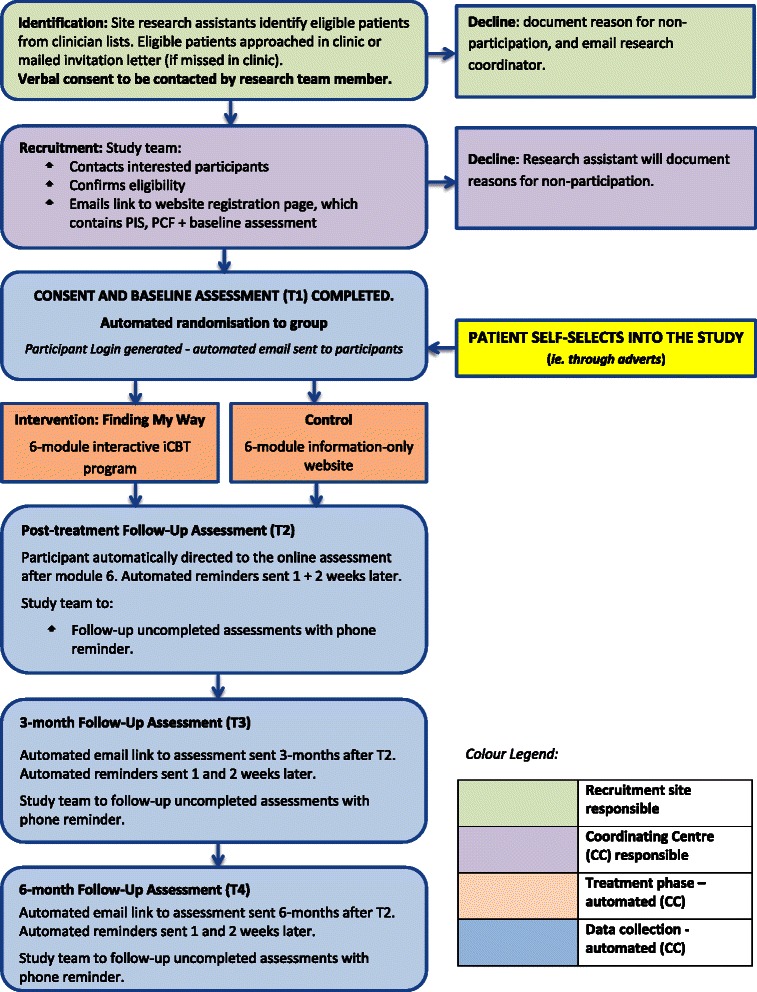
BACKGROUND: A cancer diagnosis elicits greater distress than any other medical diagnosis, and yet very few studies have evaluated the efficacy of structured online self-help therapeutic programs to alleviate this distress. This study aims to assess the efficacy over time of an internet Cognitive Behaviour Therapy (iCBT) intervention ('Finding My Way') in improving distress, coping and quality of life for individuals with a recent diagnosis of early stage cancer of any type. METHODS/DESIGN: The study is a multi-site Randomised Controlled Trial (RCT) seeking to enrol 188 participants who will be randomised to either the Finding My Way Intervention or an attention-control condition. Both conditions are delivered online; with 6 modules released once per week, and an additional booster module released one month after program-completion. Participants complete online questionnaires on 4 occasions: at baseline (immediately prior to accessing the modules); post-treatment (immediately after program-completion); then three and six months later. Primary outcomes are general distress and cancer-specific distress, with secondary outcomes including Health-Related Quality of Life (HRQoL), coping, health service utilisation, intervention adherence, and user satisfaction. A range of baseline measures will be assessed as potential moderators of outcomes. Eligible participants are individuals recently diagnosed with any type of cancer, being treated with curative intent, aged over 18 years with sufficient English language literacy, internet access and an active email account and phone number. Participants are blinded to treatment group allocation. Randomisation is computer generated and stratified by gender. DISCUSSION: Compared to the few prior published studies, Finding My Way will be the first adequately powered trial to offer an iCBT intervention to curatively treated patients of heterogeneous cancer types in the immediate post-diagnosis/treatment period. If found efficacious, Finding My Way will assist with overcoming common barriers to face-to-face therapy in a cost-effective and accessible way, thus helping to reduce distress after cancer diagnosis and consequently decrease the cancer burden for individuals and the health system. TRIAL REGISTRATION: Australian New Zealand Clinical Trials Registry ACTRN12613000001796 16.10.13.
Overview
The claims and statistics of this paper haven’t been checked yet.
Free: it reads the open-access text and checks the first 5 claims that cite a source we can check. Create a free account to check every claim.
Integrity signals
Registry
Cites
Statistics
Figures
Verification
Claims the paper makes
The claims and statistics of this paper haven’t been checked yet.
Free: it reads the open-access text and checks the first 5 claims that cite a source we can check. Create a free account to check every claim.
Claims other papers make about this one
Each is checked against this paper’s own text: does it say what the citing paper says it does?
The source backs part of the claim, not all of it — or backs it for a different population, condition or comparison.
In the citing paper
“However research does not appear to provide strong support for this hypothesis, with similar rates of engagement evident in studies which delivered the intervention earlier.”
From e-TC: Development and pilot testing of a web-based intervention to reduce anxiety and depression in survivors of testicular cancer (2017) · cites this paper as Beatty et al., 2015
Experimental — accuracy not yet measured
Self-check
Percentages, sums and reported differences re-computed from the paper’s own numbers.
The self-check needs the paper’s full text.
Citations
Cites
CONSORT 2010 Statement: updated guidelines for reporting parallel group randomised trials
the CONSORT Group, Schulz, K. F., Altman, D. G., & Moher, D. (2010) · BMC Medicine · doi:10.1186/1741-7015-8-18 · Cited by 13,371
Gratz, K. L., & Roemer, L. (2004) · Journal of Psychopathology and Behavioral Assessment · doi:10.1023/b:joba.0000007455.08539.94 · Cited by 8,942
Moher, D., Hopewell, S., Schulz, K. F., Montori, V., Gotzsche, P. C., Devereaux, P. J., Elbourne, D., Egger, M., & Altman, D. G. (2010) · BMJ · doi:10.1136/bmj.c869 · Cited by 8,883
Sherbourne, C. D., & Stewart, A. L. (1991) · Social Science & Medicine · doi:10.1016/0277-9536(91)90150-b · Cited by 6,643 · cited 2×
“Availability of social support is assessed using the 20item Medical Outcome Study Social Support Survey [38], which consists of four subscales: emotional/informational, tangible, affectionate, and positive social interactions, with availability of the support type listed in each item rated on a 5-point scale (1 = none…”
MethodMediators and Moderators of Treatment Effects in Randomized Clinical Trials
Kraemer, H. C., Wilson, G. T., Fairburn, C. G., & Agras, W. S. (2002) · Archives of General Psychiatry · doi:10.1001/archpsyc.59.10.877 · Cited by 2,562 · cited 3×
“Indeed, it has been suggested that results of treatment trials are often weak because moderators of treatment are not examined, thus they should be part and parcel of any treatment study [30]; however, few studies have specifically examined moderators of psycho-oncology interventions.”
BackgroundInfluentialReliability and validity of a brief instrument for assessing post-traumatic stress disorder
Foa, E. B., Riggs, D. S., Dancu, C. V., & Rothbaum, B. O. (1993) · Journal of Traumatic Stress · doi:10.1002/jts.2490060405 · Cited by 2,537
Miller, S. M. (1987) · Journal of Personality and Social Psychology · doi:10.1037//0022-3514.52.2.345 · Cited by 1,139 · cited 1×
“Information seeking preferences in terms of the type and amount of cancer information sought by patients is measured by the Miller Behavioral Style Scale scale [39].”
MethodA Guide to Treatments that Work
Nathan, P. E., & Gorman, J. M. (2007) · Oxford University Press eBooks · doi:10.1093/med/9780195304145.001.0001 · Cited by 1,082
High levels of untreated distress and fatigue in cancer patients
Carlson, L. E., Angen, M., Cullum, J., Goodey, E., Koopmans, J., Lamont, L., MacRae, J. H., Martin, M., Pelletier, G., Robinson, J., et al. (2004) · British Journal of Cancer · doi:10.1038/sj.bjc.6601887 · Cited by 939 · cited 1×
“Research has consistently found that 30 to 40 per cent of recently diagnosed patients experience clinically significant depressive or anxiety disorders [2,3].”
BackgroundEmotionally expressive coping predicts psychological and physical adjustment to breast cancer
Stanton, A. L., Danoff-Burg, S., Cameron, C. L., Bishop, M., Collins, C. A., Kirk, S. B., Sworowski, L. A., & Twillman, R. (2000) · Journal of Consulting and Clinical Psychology · doi:10.1037/0022-006x.68.5.875 · Cited by 800 · cited 1×
“For the present study, factors that have been previously shown to predict distress will be examined for their potential to moderate the effects of the intervention; namely, availability of social support, cognitive vulnerability to distress, and motivation to seek information [8,31].”
BackgroundDefining Internet-Supported Therapeutic Interventions
Barak, A., Klein, B., & Proudfoot, J. G. (2009) · Annals of Behavioral Medicine · doi:10.1007/s12160-009-9130-7 · Cited by 731 · cited 1×
“Such interventions tend to be highly structured into modules, are derived from theory (predominantly cognitive behaviour therapy), and have been adapted from existing evidence-based print-resources or face-to-face therapy [21].”
BackgroundA guide to treatments that work
(2015) · Oxford Clinical Psychology · doi:10.1093/med:psych/9780195304145.001.0001 · Cited by 647 · cited 1×
“Consistent with research on face-to-face therapy, internet Cognitive Behaviour Therapy (iCBT) interventions have the largest evidence base for efficacy in improving both mental health conditions [22] and, increasingly, coping with chronic physical health conditions [17,18].”
BackgroundOsborn, R. L., Demoncada, A. C., & Feuerstein, M. (2006) · The International Journal of Psychiatry in Medicine · doi:10.2190/eufn-rv1k-y3tr-fk0l · Cited by 621 · cited 3×
“In contrast to the previous three programs which all depended on group-support as a key feature, our study tested an individual self-guided web-based intervention for newly diagnosed patients that was independent of moderators and peer-support components, and was therefore consistent with the large evidence base for C…”
BackgroundResultMajor depression after breast cancer: a review of epidemiology and treatment
Fann, J. R., Thomas-Rich, A. M., Katon, W. J., Cowley, D., Pepping, M., McGregor, B. A., & Gralow, J. (2008) · General Hospital Psychiatry · doi:10.1016/j.genhosppsych.2007.10.008 · Cited by 586 · cited 1×
“Despite this, distress and psychiatric disorders among cancer patients often go under-recognised and untreated [7].”
BackgroundInternet-administered cognitive behavior therapy for health problems: a systematic review
Cuijpers, P., van Straten, A., & Andersson, G. (2008) · Journal of Behavioral Medicine · doi:10.1007/s10865-007-9144-1 · Cited by 555 · cited 3×
“One such innovative method of increasing patient access to supportive care is through internet-based provision of psychosocial services [16-18].”
BackgroundMethodNewman, M. G., Szkodny, L. E., Llera, S. J., & Przeworski, A. (2011) · Clinical Psychology Review · doi:10.1016/j.cpr.2010.09.008 · Cited by 480 · cited 1×
“Since 2000 a plethora of randomised controlled trials and systematic reviews have examined internet-based interventions for both psychological [19,20] and physical [17,18] health complaints.”
BackgroundClinical practice guidelines for the psychosocial care of adults with cancer
Turner, J., Zapart, S., Pedersen, K., Rankin, N., Luxford, K., & Fletcher, J. (2005) · Psycho-Oncology · doi:10.1002/pon.897 · Cited by 451 · cited 1×
“Background Despite improvements in treatment and survival rates, a cancer diagnosis continues to elicit greater distress than any other medical diagnosis [1].”
BackgroundHedeker, D., Gibbons, R. D., & Waternaux, C. (1999) · Journal of Educational and Behavioral Statistics · doi:10.3102/10769986024001070 · Cited by 410
The Mini-MAC: Further Development of the Mental Adjustment to Cancer Scale
Watson, M., Law, M. G., Santos, M. D., Greer, S., Baruch, J., & Bliss, J. (1994) · Journal of Psychosocial Oncology · doi:10.1300/j077v12n03_03 · Cited by 382
Griffiths, K. M., Farrer, L., & Christensen, H. (2010) · Medical Journal of Australia · doi:10.5694/j.1326-5377.2010.tb03685.x · Cited by 303 · cited 1×
“Since 2000 a plethora of randomised controlled trials and systematic reviews have examined internet-based interventions for both psychological [19,20] and physical [17,18] health complaints.”
BackgroundEmotional Distress: The Sixth Vital Sign in Cancer Care
Bultz, B. D., & Carlson, L. E. (2005) · Journal of Clinical Oncology · doi:10.1200/jco.2005.02.3259 · Cited by 287 · cited 1×
“Consequently, distress management within the first 12 months after diagnosis has been recognised as an integral component of a patient’s clinical treatment [5,6].”
BackgroundEducation and peer discussion group interventions and adjustment to breast cancer
Helgeson, V. S., Cohen, S., Schulz, R., & Yasko, J. (1999) · Archives of General Psychiatry · doi:10.1001/archpsyc.56.4.340 · Cited by 287 · cited 1×
“Interventions tested have included those based on Cognitive Behavioural Therapy (CBT) [9], Supportive Expressive Therapy (SET) [10], psycho-educational programs [11], mindfulness-based therapy [12], and peersupport groups [13].”
MethodFoley, E., Baillie, A., Huxter, M., Price, M., & Sinclair, E. (2010) · Journal of Consulting and Clinical Psychology · doi:10.1037/a0017566 · Cited by 268
Household use of information technology
Queensland (2006) · Cited by 256
Beatty, L., & Lambert, S. (2013) · Clinical Psychology Review · doi:10.1016/j.cpr.2013.03.004 · Cited by 244 · cited 4×
“One such innovative method of increasing patient access to supportive care is through internet-based provision of psychosocial services [16-18].”
BackgroundMethodInfluentialSelf-citationHack, T. F., & Degner, L. F. (2004) · Psycho-Oncology · doi:10.1002/pon.739 · Cited by 244 · cited 2×
“Intervention research has focused on developing and evaluating interventions that target the known psychological predictors of maladjustment [8], namely, low social support, prior anxiety and depression (vulnerability to distress), and maladaptive coping, particularly repression of emotions, helplessness/hopelessness,…”
BackgroundRandomized pilot of a self-guided internet coping group for women with early-stage breast cancer
Owen, J. E., Klapow, J. C., Roth, D. L., Shuster, J. L., Bellis, J., Meredith, R., & Tucker, D. C. (2005) · Annals of Behavioral Medicine · doi:10.1207/s15324796abm3001_7 · Cited by 192 · cited 3×
“However, the evidence-base for selfguided iCBT-based psychological therapy in cancer is only now emerging [25-28].”
BackgroundQuality of life of Danish women: Population-based norms for the EORTC QLQ-C30
Klee, M., Groenvold, M., & Machin, D. (1997) · Quality of Life Research · doi:10.1023/a:1026461310761 · Cited by 173 · cited 1×
“HRQOL is measured using the European Organisation for Research and Treatment of Cancer Quality of Life Core Questionnaire [35], a 30-item comprehensive health related quality of life assessment for cancer patients which yields a global QOL score, and five functional subscales (physical, emotional, social, role, cognit…”
MethodKaldo, V., Levin, S., Widarsson, J., Buhrman, M., Larsen, H.-C., & Andersson, G. (2008) · Behavior Therapy · doi:10.1016/j.beth.2007.10.003 · Cited by 162 · cited 1×
“0 at each time point [43], 94 participants per group are required, summing to a total sample of 188 participants.”
BackgroundWilson, H. A., & Gutierrez, L. (2014) · Criminal Justice and Behavior · doi:10.1177/0093854813500958 · Cited by 159
Classen, C. C., Kraemer, H. C., Blasey, C., Giese‐Davis, J., Koopman, C., Palesh, O. G., Atkinson, A., DiMiceli, S., Stonisch‐Riggs, G., Westendorp, J., et al. (2008) · Psycho-Oncology · doi:10.1002/pon.1280 · Cited by 119 · cited 2×
“Interventions tested have included those based on Cognitive Behavioural Therapy (CBT) [9], Supportive Expressive Therapy (SET) [10], psycho-educational programs [11], mindfulness-based therapy [12], and peersupport groups [13].”
MethodZimmermann, T., Heinrichs, N., & Baucom, D. H. (2007) · Annals of Behavioral Medicine · doi:10.1007/bf02874548 · Cited by 107 · cited 2×
“Interventions tested have included those based on Cognitive Behavioural Therapy (CBT) [9], Supportive Expressive Therapy (SET) [10], psycho-educational programs [11], mindfulness-based therapy [12], and peersupport groups [13].”
BackgroundMethodProject onward: an innovative e-health intervention for cancer survivors
Duffecy, J., Sanford, S., Wagner, L., Begale, M., Nawacki, E., & Mohr, D. C. (2013) · Psycho-Oncology · doi:10.1002/pon.3075 · Cited by 89 · cited 2×
“However, the evidence-base for selfguided iCBT-based psychological therapy in cancer is only now emerging [25-28].”
BackgroundMethodAn online stress management workbook for breast cancer
Carpenter, K. M., Stoner, S. A., Schmitz, K., McGregor, B. A., & Doorenbos, A. Z. (2014) · Journal of Behavioral Medicine · doi:10.1007/s10865-012-9481-6 · Cited by 80 · cited 3×
“The larger study [26] found the intervention was efficacious in”
BackgroundBoyes, A. W., Girgis, A., Zucca, A. C., & Lecathelinais, C. (2009) · Medical Journal of Australia · doi:10.5694/j.1326-5377.2009.tb02479.x · Cited by 79
Beatty, L. J., Koczwara, B., Rice, J., & Wade, T. D. (2010) · Medical Journal of Australia · doi:10.5694/j.1326-5377.2010.tb03932.x · Cited by 56
Self-citationEvaluation of New Multimedia Formats for Cancer Communications
Bader, J. L., & Strickman-Stein, N. (2003) · Journal of Medical Internet Research · doi:10.2196/jmir.5.3.e16 · Cited by 54
Predicting worries about health after breast cancer surgery
Wade, T. D., Nehmy, T., & Koczwara, B. (2005) · Psycho-Oncology · doi:10.1002/pon.866 · Cited by 46 · cited 1×
“Second, even when psychosocial services are offered in urban settings, research suggests that less than 25% of Australians attend [15], with low attendance attributed to a variety of barriers including: personal barriers, such as ongoing stigma associated with seeking mental health assistance [16,17], and illness-rela…”
BackgroundSelf-citationOxford Guide to Low Intensity CBT Interventions
(2015) · Oxford Clinical Psychology · doi:10.1093/med:psych/9780199590117.001.0001 · Cited by 40
Beatty, L., Koczwara, B., & Wade, T. (2011) · E-Journal of Applied Psychology · doi:10.7790/ejap.v7i2.256 · Cited by 30 · cited 2×
“Our research group was the first to pilot test a 6-week iCBT program for people with any type of early stage/ curatively treated cancer, and designed to be delivered soon after diagnosis [25].”
BackgroundMethodSelf-citationCompliance with a self‐care manual in guided self‐change for bulimia nervosa
Thiels, C., Schmidt, U., Troop, N., Treasure, J., & Garthe, R. (2001) · European Eating Disorders Review · doi:10.1002/erv.370 · Cited by 23 · cited 1×
“First, the self-help compliance scale [41] measures participant self-reported engagement with program’s (i) information, (ii) worksheets, and (iii) weekly time usage.”
BackgroundIncreasing access and effectiveness: using the internet to deliver low intensity CBT
Christensen, H. (2010) · Oxford Guide to Low Intensity CBT Interventions · doi:10.1093/med:psych/9780199590117.003.0004 · Cited by 21 · cited 2×
“One such innovative method of increasing patient access to supportive care is through internet-based provision of psychosocial services [16-18].”
BackgroundMethodAn effectiveness study of a CBT group program for women with breast cancer
Beatty, L., & Koczwara, B. (2010) · Clinical Psychologist · doi:10.1080/13284207.2010.500307 · Cited by 18 · cited 1×
“Interventions tested have included those based on Cognitive Behavioural Therapy (CBT) [9], Supportive Expressive Therapy (SET) [10], psycho-educational programs [11], mindfulness-based therapy [12], and peersupport groups [13].”
MethodSelf-citationThe prevalence of psychological distress by cancer site
Zabora, J., BrintzenhofeSzoc, K., Curbow, B., Hooker, C., & Piantadosi, S. (2001) · Psycho-Oncology · doi:10.1002/1099-1611(200101/02)10:1<19::aid-pon501>3.0.co;2-6 · cited 1×
“Research has consistently found that 30 to 40 per cent of recently diagnosed patients experience clinically significant depressive or anxiety disorders [2,3].”
Background
Research works printed but not linked: 3
- Cancer Australia, Cancer Council Australia Review of national cancer control activity in Australia 2010 Canberra Cancer Australia
- Lovibond SH Lovibond PH Manual for the Depression Anxiety Stress Scales (DASS) 1995 Sydney University of New South Wales
- Australian Bureau of Statistics 1989–1990 National health survey users’ guide, (Cat No. 4363.0) 1991 Canberra ABS
Cited by
Ugalde, A., Haynes, K., Boltong, A., White, V., Krishnasamy, M., Schofield, P., Aranda, S., & Livingston, P. (2017) · Patient Education and Counseling · doi:10.1016/j.pec.2016.12.009 · Cited by 53
Nahm, E., Zhu, S., Bellantoni, M. F., Keldsen, L., Russomanno, V., Rietschel, M., Majid, T., Son, H., & Smith, L. (2019) · Telemedicine Journal and e-Health · doi:10.1089/tmj.2018.0184 · Cited by 58
“54 Some trials that applied this approach in online settings 55,56 reported effectiveness of the booster interventions.”
Beatty, L., Kemp, E., Binnion, C., Turner, J., Milne, D., Butow, P., Lambert, S., Yates, P., Yip, D., & Koczwara, B. (2017) · Supportive Care in Cancer · doi:10.1007/s00520-017-3591-1 · Cited by 46
“The study was a randomised clinical trial examining a CBTbased online psychological intervention Finding My Way (FMW) versus an online attention-control, aiming to reduce cancer-related distress in recently diagnosed individuals undergoing treatment with curative intent [5].”
BackgroundMethodInfluentialSelf-citationOnline information and support needs of women with advanced breast cancer: a qualitative analysis
Kemp, E., Koczwara, B., Butow, P., Turner, J., Girgis, A., Schofield, P., Hulbert-Williams, N., Levesque, J., Spence, D., Vatandoust, S., et al. (2018) · Supportive Care in Cancer · doi:10.1007/s00520-018-4206-1 · Cited by 43
“While web-based therapy is yet to be tested in ABC, our group developed and extensively tested a web-based psychological intervention for early-stage cancer patients [9].”
BackgroundMethodSelf-citationBeatty, L., Kemp, E., Coll, J. R., Turner, J., Butow, P., Milne, D., Yates, P., Lambert, S., Wootten, A., Yip, D., et al. (2019) · Supportive Care in Cancer · doi:10.1007/s00520-018-4526-1 · Cited by 40
“Full details of this control condition have been previously published [22].”
BackgroundMethodInfluentialSelf-citation
Metadata
- Authors
- on behalf of the Finding My Way study investigators, Beatty, L., Kemp, E., Wade, T., & Koczwara, B.
- Affiliations
- Flinders University (AU)
- Corresponding author
- Beatty, Lisa
- Venue
- BMC Cancer
- Published
- 2015-04-30
- Volume
- 15
- Issue
- 1
- Pages
- 328-328
- ISSN
- 1471-2407 (ISSN-L)
- PMC
- PMC4415348
- OpenAlex
- W1966487682
- Cited by
- 16
- References
- 44
- Citations by year
- 2023: 1 · 2022: 2 · 2021: 2 · 2019: 1 · 2018: 4 · 2017: 5 · 2016: 1
- FWCI
- 5.39
- Type
- journal article
- Language
- en
- Open access
- gold
- doi.org
- Locations
- BMC Cancer (publishedVersion, cc-by)
- PubMed Central (publishedVersion, cc-by)
- PubMed (publishedVersion)
- QUT ePrints (Queensland University of Technology) (submittedVersion, cc-by)
- Adelaide Research & Scholarship (AR&S) (University of Adelaide) (submittedVersion, cc-by)
- Flinders Academic Commons (Flinders University) (submittedVersion)
- eScholarship@McGill (McGill) (submittedVersion)
- Flinders Academic Commons (Flinders University) (submittedVersion, cc-by)
- Funders
- McGill University
- Queensland University of Technology
- Peter MacCallum Cancer Centre
- Medical Research Council
- National Health and Medical Research Council (1042942)
- Topics
- Social Sciences › Psychology › Applied Psychology › Digital Mental Health Interventions
- Health Sciences › Medicine › Oncology › Cancer survivorship and care
- Social Sciences › Psychology › Clinical Psychology › Mindfulness and Compassion Interventions
- Keywords
- cancer-related distress, internet-based cognitive behavioral therapy, online self-help intervention, early-stage cancer, health-related quality of life, coping, intervention adherence, user satisfaction, health care utilization
- MeSH terms
- Aged, Australia, Female, Humans, Male, Neoplasms, New Zealand, Surveys and Questionnaires, Stress, Psychological, Health Behavior, Cognitive Behavioral Therapy, Treatment Outcome, Internet
About these checks
Registry, retraction, Cites and statistics results are computed, not judged, with one exception: a printed reference that no index lists is read once by a model before it counts as a citation error. Claims are extracted by a model and kept only when their quote appears verbatim in the text; each cited source is then checked, with a model’s help, for whether it says what the claim relies on. Those verdicts can be wrong — read the claim’s quote and the cited source before relying on one.
Statistics and arithmetic are recomputed, not judged.
Confidence bands are shown only for fields calibrated on our annotated test set. None is calibrated yet, so no band is shown.
What counts as a claim ›How we measure confidence ›How we check this ›
Are you an author, or do you see a problem with this page? Request a review
Data sources
Bibliographic data: Semantic Scholar, OpenAlex, Crossref.
Contains information from the Semantic Scholar Academic Graph Datasets, made available under the ODC Attribution License (ODC-BY 1.0).
Semantic Scholar’s data is described in: Kinney, R., et al. (2023). The Semantic Scholar Open Data Platform. arXiv:2301.10140.
