

Parental care influences leukocyte telomere length with gender specificity in parents and offsprings
Open accessThe DOI matches its Crossref record; 46 of the 47 references it cites were found in a registry or an index.
Abstract
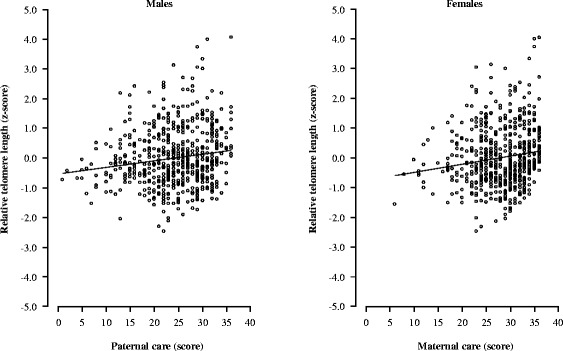
BACKGROUND: There have been several reports suggesting that adverse childhood experiences such as physical maltreatment and long institutionalization influence telomere length. However, there has been no study examining the relationship of telomere length with variations in parental rearing. In the present study, we examined the relationship of leukocyte telomere length with parental rearing in healthy subjects. METHODS: The subjects were 581 unrelated healthy Japanese subjects. Perceived parental rearing was assessed by the Parental Bonding Instrument consisting of the care and protection factors. Leukocyte relative telomere length was determined by a quantitative real-time PCR method for a ratio of telomere/single copy gene. RESULTS: In the multiple regression analyses, shorter telomere length in males was related to lower scores of paternal care (β = 0.139, p < 0.05), while that in females was related to lower scores of maternal care (β = 0.195, p < 0.01). CONCLUSION: The present study suggests that there is linear relationship between parental care and telomere length which covers both lower and higher ends of parental care, and that the effects of parental care on telomere length are gender-specific in parents and offsprings.
Overview
The claims and statistics of this paper haven’t been checked yet.
Free: it reads the open-access text and checks the first 5 claims that cite a source we can check. Create a free account to check every claim.
Integrity signals
Registry
Cites
Statistics
Figures
Verification
Claims the paper makes
The claims and statistics of this paper haven’t been checked yet.
Free: it reads the open-access text and checks the first 5 claims that cite a source we can check. Create a free account to check every claim.
Claims other papers make about this one
Each is checked against this paper’s own text: does it say what the citing paper says it does?
The cited source says what the claim attributes to it.
In the citing paper
“higher quality parental care is associated with longer TL in young adults (ages between 20–29y) (Enokido et al., 2014)”
From Telomere trajectories from early adolescence to adulthood following early institutionalization: Protective effects of foster care in the Bucharest Early Intervention Project (2026) · cites this paper as Enokido et al., 2014
Self-check
Percentages, sums and reported differences re-computed from the paper’s own numbers.
The self-check needs the paper’s full text.
Citations
Cites
A parental bonding instrument.
Parker, G., Tupling, H., & Brown, L. B. (1979) · British Journal of Medical Psychology · doi:10.1111/j.2044-8341.1979.tb02487.x · Cited by 3,788
The making & breaking of affectional bonds
Bowlby, J. (1979) · Medical Entomology and Zoology · Cited by 3,624
Telomere measurement by quantitative PCR
Cawthon, R. M. (2002) · Nucleic Acids Research · doi:10.1093/nar/30.10.e47 · Cited by 3,487 · cited 1×
“Leukocyte relative telomere length, assessed by a ratio of telomere/single copy gene with the mean data from the triplicate runs, was determined by a quantitative real-time PCR method of Cawthon [30] with the several modifications [28].”
MethodLiu, D., Diorio, J., Tannenbaum, B., Caldji, C., Francis, D., Freedman, A., Sharma, S., Pearson, D., Plotsky, P. M., & Meaney, M. J. (1997) · Science · doi:10.1126/science.277.5332.1659 · Cited by 3,170 · cited 1×
“It was reported that mice reared under the condition of low maternal care or maternal separation displayed impaired negative feedback sensitivity to glucocorticoid, and consequently increased adrenocorticotropic hormone and corticosterone response to acute stress [31,32].”
BackgroundAccelerated telomere shortening in response to life stress
Epel, E. S., Blackburn, E. H., Lin, J., Dhabhar, F. S., Adler, N. E., Morrow, J. D., & Cawthon, R. M. (2004) · Proceedings of the National Academy of Sciences · doi:10.1073/pnas.0407162101 · Cited by 3,002
Bowlby (1977) · doi:10.1192/bjp.130.3.201 · Cited by 2,844
Switching and Signaling at the Telomere
Blackburn, E. H. (2001) · Cell · doi:10.1016/s0092-8674(01)00492-5 · Cited by 2,107 · cited 3×
“Background Telomeres are repetitive DNA sequences (TTAGGG)n located at the ends of chromosomes and play a crucial role in preventing chromosome fusion and in maintaining genome stability [1,2].”
Association between telomere length in blood and mortality in people aged 60 years or older
Cawthon, R. M., Smith, K. R., O'Brien, E., Sivatchenko, A., & Kerber, R. A. (2003) · The Lancet · doi:10.1016/s0140-6736(03)12384-7 · Cited by 1,761 · cited 1×
“of diabetic nephropathy in patients with type 1 diabetes [5], dementia in post-stroke patients [6], and mortality [7].”
BackgroundBrouilette, S. W., Moore, J. S., McMahon, A. D., Thompson, J. R., Ford, I., Shepherd, J., Packard, C. J., & Samani, N. J. (2007) · The Lancet · doi:10.1016/s0140-6736(07)60071-3 · Cited by 745
Plotsky, P. M., Thrivikraman, K. V., Nemeroff, C. B., Caldji, C., Sharma, S., & Meaney, M. J. (2005) · Neuropsychopharmacology · doi:10.1038/sj.npp.1300769 · Cited by 522 · cited 1×
“It was reported that mice reared under the condition of low maternal care or maternal separation displayed impaired negative feedback sensitivity to glucocorticoid, and consequently increased adrenocorticotropic hormone and corticosterone response to acute stress [31,32].”
BackgroundShalev, I., Moffitt, T. E., Sugden, K., Williams, B., Houts, R. M., Danese, A., Mill, J., Arseneault, L., & Caspi, A. (2013) · Molecular Psychiatry · doi:10.1038/mp.2012.32 · Cited by 489 · cited 2×
“Recent studies have focused on the association between telomere length and early-life environment, and these studies have suggested that adverse experiences such as physical abuse and long institutionalization accelerate telomere length shortening [8,13,14], with inconsistent”
BackgroundResultCell aging in relation to stress arousal and cardiovascular disease risk factors
Epel, E. S., Lin, J., Wilhelm, F. H., Wolkowitz, O. M., Cawthon, R., Adler, N. E., Dolbier, C., Mendes, W. B., & Blackburn, E. H. (2006) · Psychoneuroendocrinology · doi:10.1016/j.psyneuen.2005.08.011 · Cited by 450 · cited 1×
“In vivo, elevated urinary nocturnal cortisol levels [37] and increased cortisol response to stress test [38] were associated with shorter telomere length in healthy women.”
BackgroundIs Telomere Length a Biomarker of Aging? A Review
Mather, K. A., Jorm, A. F., Parslow, R. A., & Christensen, H. (2011) · The Journals of Gerontology Series A: Biological Sciences and Medical Sciences · doi:10.1093/gerona/glq180 · Cited by 441 · cited 6×
“On the other hands, these personality traits have been reported to be associated with overeating and smoking [39-42] which accelerate telomere shortening [2].”
BackgroundInfluentialShortened Telomere Length Is Associated with Increased Risk of Cancer: A Meta-Analysis
Ma, H., Zhou, Z., Wei, S., Liu, Z., Pooley, K. A., Dunning, A. M., Svenson, U., Roos, G., Hosgood, H. D., Shen, M., et al. (2011) · PLoS ONE · doi:10.1371/journal.pone.0020466 · Cited by 376 · cited 1×
“Prospective studies have shown that shorter telomere length is a predictor of coronary heart disease [3], cancer [4], progression”
BackgroundThe stability of the Parental Bonding Instrument over a 20-year period
WILHELM, K., NIVEN, H., PARKER, G., & HADZI-PAVLOVIC, D. (2005) · Psychological Medicine · doi:10.1017/s0033291704003538 · Cited by 367 · cited 1×
“In addition, long-term stability of the PBI scores was shown in a 20-year follow-up study [44].”
BackgroundReduced telomerase activity in human T lymphocytes exposed to cortisol
Choi, J., Fauce, S. R., & Effros, R. B. (2008) · Brain, Behavior, and Immunity · doi:10.1016/j.bbi.2007.12.004 · Cited by 352 · cited 1×
“Meanwhile, an in vitro study showed that exposure of human T lymphocytes to cortisol caused a reduction in telomerase activity [36].”
BackgroundTelomeres and early-life stress: an overview
Price, L. H., Kao, H.-T., Burgers, D. E., Carpenter, L. L., & Tyrka, A. R. (2013) · Biological Psychiatry · doi:10.1016/j.biopsych.2012.06.025 · Cited by 339 · cited 4×
“Recent studies have focused on the association between telomere length and early-life environment, and these studies have suggested that adverse experiences such as physical abuse and long institutionalization accelerate telomere length shortening [8,13,14], with inconsistent”
BackgroundResultInfluentialParental reports of depressives
Parker, G. (1981) · Journal of Affective Disorders · doi:10.1016/0165-0327(81)90038-0 · Cited by 330 · cited 2×
“Strongly influenced by attachment theory [18], Parker et al. [19] developed the Parental Bonding Instrument (PBI), which assesses perceived rearing attitudes of subject’s parents during the first 16 years.”
BackgroundTelomere length and early severe social deprivation: linking early adversity and cellular aging
Drury, S. S., Theall, K., Gleason, M. M., Smyke, A. T., De Vivo, I., Wong, J. Y. Y., Fox, N. A., Zeanah, C. H., & Nelson, C. A. (2012) · Molecular Psychiatry · doi:10.1038/mp.2011.53 · Cited by 316 · cited 2×
“Recent studies have focused on the association between telomere length and early-life environment, and these studies have suggested that adverse experiences such as physical abuse and long institutionalization accelerate telomere length shortening [8,13,14], with inconsistent”
BackgroundResultTelomere length predicts poststroke mortality, dementia, and cognitive decline
Martin-Ruiz, C., Dickinson, H. O., Keys, B., Rowan, E., Kenny, R. A., & Von Zglinicki, T. (2006) · Annals of Neurology · doi:10.1002/ana.20869 · Cited by 261 · cited 1×
“of diabetic nephropathy in patients with type 1 diabetes [5], dementia in post-stroke patients [6], and mortality [7].”
BackgroundDoes cellular aging relate to patterns of allostasis?
Tomiyama, A. J., O'Donovan, A., Lin, J., Puterman, E., Lazaro, A., Chan, J., Dhabhar, F. S., Wolkowitz, O., Kirschbaum, C., Blackburn, E., et al. (2012) · Physiology & Behavior · doi:10.1016/j.physbeh.2011.11.016 · Cited by 204 · cited 1×
“In vivo, elevated urinary nocturnal cortisol levels [37] and increased cortisol response to stress test [38] were associated with shorter telomere length in healthy women.”
BackgroundEisenberg, D. T. A., Hayes, M. G., & Kuzawa, C. W. (2012) · Proceedings of the National Academy of Sciences · doi:10.1073/pnas.1202092109 · Cited by 194
Weischer, M., Bojesen, S. E., & Nordestgaard, B. G. (2014) · PLoS Genetics · doi:10.1371/journal.pgen.1004191 · Cited by 167 · cited 1×
“It has been reported that telomere length is influenced by a wide range of factors such as age, gender, race, smoking, physical activity, socioeconomic status, obesity, multivitamin intake, alcohol consumption, and hormone replacement therapy [2], although findings are inconsistent [9].”
BackgroundO’Donovan, A., Lin, J., Dhabhar, F. S., Wolkowitz, O., Tillie, J. M., Blackburn, E., & Epel, E. (2009) · Brain Behavior and Immunity · doi:10.1016/j.bbi.2008.11.006 · Cited by 161
Asok, A., Bernard, K., Roth, T. L., Rosen, J. B., & Dozier, M. (2013) · Development and Psychopathology · doi:10.1017/s0954579413000011 · Cited by 128
Pomerleau, C. S., Pomerleau, O. F., Flessland, K. A., & Basson, S. M. (1992) · Journal of Substance Abuse · doi:10.1016/0899-3289(92)90014-o · Cited by 123 · cited 1×
“On the other hands, these personality traits have been reported to be associated with overeating and smoking [39-42] which accelerate telomere shortening [2].”
BackgroundTelomere length and progression of diabetic nephropathy in patients with type 1 diabetes
Fyhrquist, F., Tiitu, A., Saijonmaa, O., Forsblom, C., Groop, P. ‐., & on behalf of the FinnDiane Study Group (2010) · Journal of Internal Medicine · doi:10.1111/j.1365-2796.2009.02139.x · Cited by 112
No Correlation Between Childhood Maltreatment and Telomere Length
Glass, D., Parts, L., Knowles, D., Aviv, A., & Spector, T. D. (2010) · Biological Psychiatry · doi:10.1016/j.biopsych.2010.02.026 · Cited by 76
Engert, V., Efanov, S. I., Dedovic, K., Dagher, A., & Pruessner, J. C. (2010) · Psychopharmacology · doi:10.1007/s00213-010-1918-4 · Cited by 65 · cited 1×
“In human, subjects with low parental care assessed by the PBI exhibited increased corticotropin-releasing factor in cerebrospinal fluid [33], increased cortisol awaking response [34], and increased cortisol response to stress test [35].”
BackgroundAdult Attachment and Early Parental Experiences in Patients With Crohn's Disease
Agostini, A., Rizzello, F., Ravegnani, G., Gionchetti, P., Tambasco, R., Straforini, G., Ercolani, M., & Campieri, M. (2010) · Psychosomatics · doi:10.1016/s0033-3182(10)70687-3 · Cited by 62
No association between mean telomere length and life stress observed in a 30 year birth cohort
Jodczyk, S., Fergusson, D. M., Horwood, L. J., Pearson, J. F., & Kennedy, M. A. (2014) · PLoS ONE · doi:10.1371/journal.pone.0097102 · Cited by 62 · cited 1×
“findings [15,16].”
Hostility and Cellular Aging in Men from the Whitehall II Cohort
Brydon, L., Lin, J., Butcher, L., Hamer, M., Erusalimsky, J. D., Blackburn, E. H., & Steptoe, A. (2012) · Biological Psychiatry · doi:10.1016/j.biopsych.2011.08.020 · Cited by 59 · cited 1×
“In relation to psychological factors, shorter leukocyte telomere length is associated with current life stress [10] and personality traits such as pessimism [11] and hostility [12].”
BackgroundInfluences of parental rearing on the personality traits of healthy Japanese
Oshino, S., Suzuki, A., Ishii, G., & Otani, K. (2007) · Comprehensive Psychiatry · doi:10.1016/j.comppsych.2007.04.008 · Cited by 58 · cited 4×
“Our previous studies showed that parental rearing by the same-gender parents had greater impacts on personality traits of harm avoidance and interpersonal sensitivity in healthy subjects [20,21].”
BackgroundInfluentialSelf-citationPersonality dimensions in bulimia nervosa, binge eating disorder, and obesity
Peterson, C. B., Thuras, P., Ackard, D. M., Mitchell, J. E., Berg, K., Sandager, N., Wonderlich, S. A., Pederson, M. W., & Crow, S. J. (2010) · Comprehensive Psychiatry · doi:10.1016/j.comppsych.2009.03.003 · Cited by 58 · cited 1×
“On the other hands, these personality traits have been reported to be associated with overeating and smoking [39-42] which accelerate telomere shortening [2].”
BackgroundInvestigating the Association Between Early Life Parental Care and Stress Responsivity in Adulthood
Engert, V., Buss, C., Khalili-Mahani, N., Wadiwalla, M., Dedovic, K., & Pruessner, J. C. (2010) · Developmental Neuropsychology · doi:10.1080/87565641.2010.494752 · Cited by 49 · cited 1×
“In human, subjects with low parental care assessed by the PBI exhibited increased corticotropin-releasing factor in cerebrospinal fluid [33], increased cortisol awaking response [34], and increased cortisol response to stress test [35].”
BackgroundLee, R. J., Gollan, J., Kasckow, J., Geracioti, T., & Coccaro, E. F. (2006) · Neuropsychopharmacology · doi:10.1038/sj.npp.1301104 · Cited by 44 · cited 1×
“In human, subjects with low parental care assessed by the PBI exhibited increased corticotropin-releasing factor in cerebrospinal fluid [33], increased cortisol awaking response [34], and increased cortisol response to stress test [35].”
BackgroundParental Bonding and Inflammatory Bowel Disease
Agostini, A., Rizzello, F., Ravegnani, G., Gionchetti, P., Tambasco, R., Ercolani, M., & Campieri, M. (2010) · Psychosomatics · doi:10.1176/appi.psy.51.1.14 · Cited by 39 · cited 1×
“Meanwhile, low care and high protection assessed by the PBI are shown to be associated with physical diseases such as coronary heart disease [23], gastroesophageal reflux disease [24], Crohn’s disease [25], and inflammatory bowel disease [26].”
BackgroundInterpersonal sensitivity predicts bulimic symptomatology cross-sectionally and longitudinally
Hamann, D. M., Wonderlich-Tierney, A. L., & Wal, J. S. V. (2009) · Eating Behaviors · doi:10.1016/j.eatbeh.2009.01.001 · Cited by 32
Dysfunctional Parenting Styles Increase Interpersonal Sensitivity in Healthy Subjects
Otani, K., Suzuki, A., Shibuya, N., Matsumoto, Y., & Kamata, M. (2009) · The Journal of Nervous and Mental Disease · doi:10.1097/nmd.0b013e3181c29a4c · Cited by 31 · cited 4×
“Our previous studies showed that parental rearing by the same-gender parents had greater impacts on personality traits of harm avoidance and interpersonal sensitivity in healthy subjects [20,21].”
BackgroundInfluentialSelf-citationQuality of Parental Emotional Care and Calculated Risk for Coronary Heart Disease
Almeida, N. D., Loucks, E. B., Kubzansky, L., Pruessner, J., Maselko, J., Meaney, M. J., & Buka, S. L. (2010) · Psychosomatic Medicine · doi:10.1097/psy.0b013e3181c925cb · Cited by 29 · cited 1×
“Meanwhile, low care and high protection assessed by the PBI are shown to be associated with physical diseases such as coronary heart disease [23], gastroesophageal reflux disease [24], Crohn’s disease [25], and inflammatory bowel disease [26].”
BackgroundParental overprotection increases sociotropy with gender specificity in parents and recipients
Otani, K., Suzuki, A., Kamata, M., Matsumoto, Y., Shibuya, N., Sadahiro, R., & Enokido, M. (2011) · Journal of Affective Disorders · doi:10.1016/j.jad.2011.09.033 · Cited by 28 · cited 3×
“, personality traits [20], interpersonal sensitivity [21], and cognitive vulnerability to depression [22].”
BackgroundSelf-citationRelationship Between Leukocyte Telomere Length and Personality Traits in Healthy Subjects
Sadahiro, R., Suzuki, A., Enokido, M., Matsumoto, Y., Shibuya, N., Kamata, M., Goto, K., & Otani, K. (2015) · European Psychiatry · doi:10.1016/j.eurpsy.2014.03.003 · Cited by 25 · cited 3×
“Two-hundred seven subjects (36%) out of the present sample overlapped with the subjects of our previous study which examined the relationship between telomere length and personality traits [28].”
BackgroundMethodResultSelf-citationPsychosocial Predictors of Nicotine Dependence among Women during Their Mid‐Sixties
Brook, J. S., Zhang, C., Brook, D. W., Koppel, J., & Whiteman, M. (2012) · American Journal on Addictions · doi:10.1111/j.1521-0391.2012.00237.x · Cited by 12
Gastroesophageal Reflux Disease: Attachment Style and Parental Bonding
Ercolani, M., Farinelli, M., Trombini, E., & Bortolotti, M. (2004) · Perceptual and Motor Skills · doi:10.2466/pms.99.1.211-222 · Cited by 5 · cited 1×
“Meanwhile, low care and high protection assessed by the PBI are shown to be associated with physical diseases such as coronary heart disease [23], gastroesophageal reflux disease [24], Crohn’s disease [25], and inflammatory bowel disease [26].”
BackgroundGASTROESOPHAGEAL REFLUX DISEASE: ATTACHMENT STYLE AND PARENTAL BONDING
Ercolani, M. (2004) · Perceptual and Motor Skills · doi:10.2466/pms.99.5.211-222 · Cited by 2
940 – Association Between Leukocyte Telomere Length And Personality Traits
Sadahiro, R., Suzuki, A., Masanori, E., Matsumoto, Y., Shibuya, N., Kamata, M., & Otani, K. (2013) · European Psychiatry · doi:10.1016/s0924-9338(13)76091-7 · Cited by 1
Self-citation
Research works printed but not linked: 2
- First MB Spitzer RL Gibbon M Williams JBM Structured Clinical Interview for DSM-IV Axis I disorders - Clinician Version 1997 Washington DC American Psychiatric Association
- Ogawa M A study on reliability and validity of Japanese version of PBI (Parental Bonding Instrument) Seishinkachiryogaku 1981 6 1193 1201
Cited by
Lang, J., McKie, J., Smith, H., McLaughlin, A., Gillberg, C., Shiels, P. G., & Minnis, H. (2020) · European Child & Adolescent Psychiatry · doi:10.1007/s00787-019-01329-1 · Cited by 121
Effects of early-life competition and maternal nutrition on telomere lengths in wild meerkats
Cram, D. L., Monaghan, P., Gillespie, R., & Clutton-Brock, T. H. (2017) · Proceedings of the Royal Society B Biological Sciences · doi:10.1098/rspb.2017.1383 · Cited by 99
Enlow, M. B., Bollati, V., Sideridis, G. D., Flom, J. D., Hoxha, M., Hacker, M. R., & Wright, R. J. (2018) · Psychoneuroendocrinology · doi:10.1016/j.psyneuen.2018.05.025 · Cited by 72
“, internalizing disorders, parental caregiving quality, family violence exposure) on telomere attrition have been documented, with males more susceptible in many, but not all studies (Drury et al., 2015; Enokido et al., 2014; Moller et al., 2009; Shalev et al., 2014; Zalli et al., 2014).”
BackgroundRosa, M. J., Hsu, H.-H. L., Just, A. C., Brennan, K. J., Bloomquist, T., Kloog, I., Pantic, I., Mercado García, A., Wilson, A., Coull, B. A., et al. (2019) · Environmental Research · doi:10.1016/j.envres.2019.03.003 · Cited by 63
The long-term impact of adverse caregiving environments on epigenetic modifications and telomeres
Blaze, J., Asok, A., & Roth, T. L. (2015) · Frontiers in Behavioral Neuroscience · doi:10.3389/fnbeh.2015.00079 · Cited by 61
Metadata
- Authors
- Enokido, M., Suzuki, A., Sadahiro, R., Matsumoto, Y., Kuwahata, F., Takahashi, N., Goto, K., & Otani, K.
- Affiliations
- Yamagata University (JP)
- Corresponding author
- Suzuki, Akihito
- Venue
- BMC Psychiatry
- Published
- 2014-10-03
- Volume
- 14
- Issue
- 1
- Pages
- 277-277
- ISSN
- 1471-244X (ISSN-L)
- PMC
- PMC4189738
- OpenAlex
- W1963978168
- Cited by
- 33
- References
- 47
- Citations by year
- 2026: 1 · 2025: 3 · 2024: 3 · 2023: 1 · 2022: 2 · 2021: 8 · 2020: 3 · 2019: 2 · 2018: 3 · 2017: 5 · 2016: 1 · 2015: 1
- FWCI
- 1.56
- Type
- journal article
- Language
- en
- Open access
- gold
- doi.org
- Locations
- BMC Psychiatry (publishedVersion, cc-by)
- Europe PMC (PubMed Central) (publishedVersion, cc-by)
- PubMed Central (publishedVersion, cc-by)
- PubMed (publishedVersion)
- Funders
- Ministry of Education, Culture, Sports, Science and Technology
- Topics
- Life Sciences › Biochemistry, Genetics and Molecular Biology › Cell Biology › Telomeres, Telomerase, and Senescence
- Social Sciences › Psychology › Clinical Psychology › Child Abuse and Trauma
- Social Sciences › Demography › Family Dynamics and Relationships
- Keywords
- leukocyte telomere length, parenting, parental care, paternal care, maternal care, gender differences, Parental Bonding Instrument, care and protection
- MeSH terms
- Child, Child Rearing, Female, Humans, Leukocytes, Male, Parent-Child Relations, Parents, Sex Characteristics, Sex Factors, Telomere, Asian People, Young Adult, Healthy Volunteers
About these checks
Registry, retraction, Cites and statistics results are computed, not judged, with one exception: a printed reference that no index lists is read once by a model before it counts as a citation error. Claims are extracted by a model and kept only when their quote appears verbatim in the text; each cited source is then checked, with a model’s help, for whether it says what the claim relies on. Those verdicts can be wrong — read the claim’s quote and the cited source before relying on one.
Statistics and arithmetic are recomputed, not judged.
Confidence bands are shown only for fields calibrated on our annotated test set. None is calibrated yet, so no band is shown.
What counts as a claim ›How we measure confidence ›How we check this ›
Are you an author, or do you see a problem with this page? Request a review
Data sources
Bibliographic data: Semantic Scholar, OpenAlex, Crossref.
Contains information from the Semantic Scholar Academic Graph Datasets, made available under the ODC Attribution License (ODC-BY 1.0).
Semantic Scholar’s data is described in: Kinney, R., et al. (2023). The Semantic Scholar Open Data Platform. arXiv:2301.10140.
