

Fear of depression recurrence among individuals with remitted depression: a qualitative interview study
Open accessPublished version of a preprint
The DOI matches its Crossref record; 59 of the 60 references it cites were found in a registry or an index, and 1 are not checked yet; 18 of the 54 sources its claims cite were checked for support.
Abstract
Background: Major Depressive Disorder (MDD) is a prevalent psychiatric condition and the largest contributor to disability worldwide. MDD is highly recurrent, yet little is known about the mechanisms that occur following a Major Depressive Episode (MDE) and underlie recurrence. We explored the concept of fear of depression recurrence (FoDR) and its impact on daily functioning among individuals in remission from MDD. Methods: 30 participants (83% female; 37% White; Mage = 27.7, SD = 8.96) underwent semi-structured qualitative interviews. The interviews explored participants’ experiences of FoDR including the frequency, severity, content, triggers, and impact of fears and associated coping strategies. We used content analysis to analyze the transcriptions. Results: Most participants (73%) reported having FoDR, with varying frequency, severity, and duration of fears. The triggers and content of participants’ fears often mirrored the symptoms (e.g., low mood, anhedonia) and consequences (e.g., job loss, social withdrawal) endured during past MDEs. Some participants reported a minimal impact of FoDR on daily functioning, whereas others reported a positive (e.g., personal growth) or negative (e.g., increased anxiety) influence. Limitations: Our sample size did not allow for explorations of differences in FoDR across unique MDD subtypes or sociocultural factors. Conclusions: The concept of FoDR may present a window into understanding the unique cognitive and behavioural changes that occur following MDD remission and underlie depression recurrence. Future research should aim to identify underlying individual differences and characteristics of the disorder that may influence the presence and impact of FoDR. Finally, a FoDR measure should be developed so that associations between FoDR and recurrence risk, depressive symptoms, and other indices of functioning can be determined. © The Author(s) 2024.
Verified 2026-11-22 · 1 reference not checked yet
Overview
CoChat Summary
## TL;DR
This qualitative interview study found that fear of depression recurrence (FoDR) was common among adults in remission from major depressive disorder, with 73% of the 30 participants reporting it. FoDR often mirrored participants’ prior depression symptoms, triggers, and consequences, and it could have little, negative, or positive effects on daily functioning.
## Key findings
- Among 30 participants (83% female; 37% White; mean age 27.7 years), 22 (73%) reported FoDR.
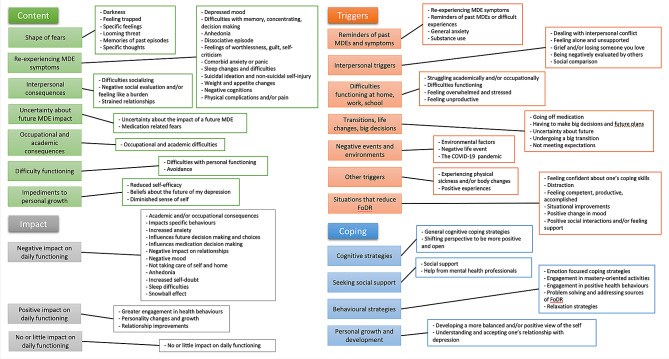
- FoDR often resembled prior MDE experiences: the most frequent triggers were re-experiencing MDE symptoms (n = 73, 83%) and reminders of past MDEs or difficult life experiences (n = 40, 60%).
- Common feared content included depressed mood (n = 42, 70%), sleep difficulties (n = 25, 57%), social withdrawal/difficulties socializing (n = 43, 63%), and negative social evaluation/burdening others (n = 32, 53%).
- FoDR’s impact varied: 50% reported little or no impact; others reported increased anxiety (n = 23, 57%), negative mood changes (n = 21, 47%), academic/occupational consequences (n = 16, 33%), and positive changes such as greater health behaviors (n = 28, 40%) and personal growth (n = 17, 30%).
## Methods
- Semi-structured qualitative interviews were conducted with English-speaking adults over 18 years old who were in remission from MDD; remission was defined as being symptom-free for at least 2 months.
- The final sample was 30 participants; 51 phone screenings were completed, 36 were eligible, 3 did not complete the study, and 3 were excluded for current depressive symptoms.
- Interviews lasted 60–90 minutes, were conducted via Zoom between October 2020 and January 2021, transcribed verbatim, and analyzed using inductive content analysis by the first two authors.
## Limitations
- The paper states that the sample size did not allow subgroup analyses by MDD subtype or sociocultural factors.
- The authors note that all interviews were online, which may have affected how candidly participants spoke.
- The text also makes evident that some participants may have had current minimal depressive symptoms despite screening, and that the study lacked a quantitative intercoder reliability estimate; both could limit interpretation, and the paper explicitly says current symptoms may have confounded FoDR experiences.
Model-written summary. Check it against the paper before relying on it.
Integrity signals
Registry
Cites
Statistics
Figures
Verification
Claims the paper makes
16 Valid · 1 Not valid · 11 Not checked · 72 Own results and interpretations
Every source the paper cites for this claim was checked and supports it.
In the paper
“Contrary to the fear of cancer recurrence literature, participants in this study did not report fears related to dying, experiencing physical pain, and undergoing treatments (e.g., chemotherapy) [54].”
§ Fear of depression recurrence among individuals with remitted depression: a qualitative interview study > Discussion
What the sources say
- Supportedcites [54] Thewes B Lebel S Seguin Leclair C Butow P A qualitative exploration of fear of cancer recurrence (FCR) amongst Australian and Canadian breast cancer survivors Support Care Cancer 2016 24 2269 76 10.1007/s00520-015-3025-x 26581900 PMC4805701 source
The citation supports the contrast with the fear-of-cancer-recurrence literature, not the citing authors’ observation about their own participants. In “Worst fears,” the source reports fear of death and dying, pain and suffering, and having to undergo treatment again, including chemotherapy. (LLM, conf=0.93)
plain- Asserted: passes — The authors put it forward as true.
- Checkable: passes — It can be checked against evidence.
- Load-bearing: passes — The paper’s conclusions depend on it.
- Based: passes — The paper gives a reason why it holds.
- Rests on an assumption not shown here.
- Supported
Every source the paper cites for this claim was checked and supports it.
In the paper
“Indeed, the presence of residual symptoms is a well-established and robust predictor of MDE recurrence [10], providing support that the present fears around past depressive symptoms and consequences may signify risk for relapse.”
§ Fear of depression recurrence among individuals with remitted depression: a qualitative interview study > Discussion
What the sources say
- Supportedcites [10] Buckman JE Underwood A Clarke K Saunders R Hollon S Fearon P Risk factors for relapse and recurrence of depression in adults and how they operate: a four-phase systematic review and meta-synthesis Clin Psych Rev 2018 64 13 38 10.1016/j.cpr.2018.07.005 PMC6237833 30075313 source
The Study 1 Results report strong evidence across five reviews that residual symptoms after treatment predict relapse or recurrence. The Study 2 Results specifically state that every study assessing residual symptoms found an association with increased risk of recurrence. (LLM, conf=0.94)
boostedstates an association- Asserted: passes — The authors put it forward as true.
- Checkable: passes — It can be checked against evidence.
- Load-bearing: passes — The paper’s conclusions depend on it.
- Based: passes — The paper gives a reason why it holds.
- Supported
A result the paper reports from its own data — it cites no other source for it, so there is none to check. The quote shows it is in the paper.
In the paper
“For the 17 participants reporting a history of having two or more MDEs, 13 endorsed FoDR whereas four did not.”
§ Fear of depression recurrence among individuals with remitted depression: a qualitative interview study > Results > Qualitative findings
plainn = 17- Asserted: passes — The authors put it forward as true.
- Checkable: passes — It can be checked against evidence.
- Load-bearing: unclear — It is unclear whether the paper’s conclusions depend on it.
- Based: passes — The paper gives a reason why it holds.
A result the paper reports from its own data — it cites no other source for it, so there is none to check. The quote shows it is in the paper.
In the paper
“Among the 10 participants who reported having one past MDE, seven reported FoDR and three did not.”
§ Fear of depression recurrence among individuals with remitted depression: a qualitative interview study > Results > Qualitative findings
plainn = 10- Asserted: passes — The authors put it forward as true.
- Checkable: passes — It can be checked against evidence.
- Load-bearing: unclear — It is unclear whether the paper’s conclusions depend on it.
- Based: passes — The paper gives a reason why it holds.
A result the paper reports from its own data — it cites no other source for it, so there is none to check. The quote shows it is in the paper.
In the paper
“Both the triggers and content of participants’ FoDR were linked to the triggers, symptoms, and consequences of their past MDEs.”
§ Fear of depression recurrence among individuals with remitted depression: a qualitative interview study > Discussion
plainstates an association- Asserted: passes — The authors put it forward as true.
- Checkable: passes — It can be checked against evidence.
- Load-bearing: passes — The paper’s conclusions depend on it.
- Based: passes — The paper gives a reason why it holds.
- Rests on an assumption not shown here.
25 more claims
Create a free account to see all 100 claims and to verify the 1 reference still open.
- Probably not a substantial claim. 46
- It may state two separate claims as one. 46
Citations
Cites
Diagnostic and Statistical Manual of Mental Disorders
American Psychiatric Association (2013) · doi:10.1176/appi.books.9780890425596 · Cited by 116,369
The PHQ-9: Validity of a brief depression severity measure
Kroenke, K., Spitzer, R. L., & Williams, J. B. W. (2001) · Journal of General Internal Medicine · doi:10.1046/j.1525-1497.2001.016009606.x · Cited by 44,910
Tong, A., Sainsbury, P., & Craig, J. (2007) · International Journal for Quality in Health Care · doi:10.1093/intqhc/mzm042 · Cited by 42,509
Depression and quality of life in older persons: A review
Sivertsen, H., Bjørkløf, G. H., Engedal, K., Selbæk, G., & Helvik, A.-S. (2015) · Dementia and Geriatric Cognitive Disorders · doi:10.1159/000437299 · Cited by 14,152
Phenomenological research methods
Moustakas, C. (1994) · doi:10.4135/9781412995658 · Cited by 13,919 · cited 1×
“We used a social constructivist framework to guide this phenomenological study, given the important influence of culture, past experiences, social interaction, and context on an individuals’ beliefs about, and experiences with, MDD [26–28].”
MethodStandards for Reporting Qualitative Research: A Synthesis of Recommendations
O’Brien, B. C., Harris, I. B., Beckman, T. J., Reed, D. A., & Cook, D. A. (2014) · Academic Medicine · doi:10.1097/acm.0000000000000388 · Cited by 12,211 · cited 2×
“The pre-planned methodology was designed and reported in accordance with the Consolidated Criteria for Reporting Qualitative Research checklist (COREQ) [29] and the Standards for Reporting Qualitative Research (SRQR) [30].”
Method(1998) · PubMed · Cited by 10,216
Content analysis and thematic analysis: Implications for conducting a qualitative descriptive study
Vaismoradi, M., Turunen, H., & Bondas, T. (2013) · Nursing & Health Sciences · doi:10.1111/nhs.12048 · Cited by 8,327 · cited 1×
“We used a content analysis approach to analyze the transcribed interview data, whereby repeated ideas and key concepts are labelled, coded, and categorized inductively from the data and integrated with existing literature [49, 50].”
MethodDevelopment of the World Health Organization WHOQOL-BREF Quality of Life Assessment
THE WHOQOL GROUP (1998) · Psychological Medicine · doi:10.1017/s0033291798006667 · Cited by 7,933 · cited 2×
“These domains have adequate internal consistency and test re-test reliability [41].”
BackgroundMethodBeck, A. T., Steer, R. A., & Brown, G. (2011) · PsycTESTS Dataset · doi:10.1037/t00742-000 · Cited by 7,535
The PHQ-8 as a measure of current depression in the general population
Kroenke, K., Strine, T. W., Spitzer, R. L., Williams, J. B. W., Berry, J. T., & Mokdad, A. H. (2009) · Journal of Affective Disorders · doi:10.1016/j.jad.2008.06.026 · Cited by 5,121 · cited 1×
“Patient Health Questionnaire– 8 (PHQ-8) [35].”
Skevington, S. M., Lotfy, M., & O'Connell, K. A. (2004) · Quality of Life Research · doi:10.1023/b:qure.0000018486.91360.00 · Cited by 4,686 · cited 1×
“World Health Organization Quality of Life Instrument-BREF (WHOQOL-BREF) [40, 41].”
MethodAre We There Yet? Data Saturation in Qualitative Research
Fusch, P., & Ness, L. (2015) · The Qualitative Report · doi:10.46743/2160-3715/2015.2281 · Cited by 4,460
Lecrubier, Y., Sheehan, D., Weiller, E., Amorim, P., Bonora, I., Sheehan, K. H., Janavs, J., & Dunbar, G. (1997) · European Psychiatry · doi:10.1016/s0924-9338(97)83296-8 · Cited by 3,513 · cited 1×
“Psychometric evaluations of the MINI report satisfactory interrater reliability and concurrent validity with the Composite International Diagnostic Interview [34].”
MethodKessler, R. C., Petukhova, M., Sampson, N. A., Zaslavsky, A. M., & Wittchen, H. (2012) · International Journal of Methods in Psychiatric Research · doi:10.1002/mpr.1359 · Cited by 2,947 · cited 3×
“…semi-structured interviews to: [1] identify whether remitted depressed individuals experience FoDR and evaluate the severity, frequency, triggers, and content of these fears; [2] explore how people respond to and cope with these fears; and [3] understand the impact of FoDR on daily functioning.”
BackgroundContent analysis: Method, applications, and issues
Downe‐Wamboldt, B. (1992) · Health Care for Women International · doi:10.1080/07399339209516006 · Cited by 2,682 · cited 1×
“Content analysis enables the systematic and objec-tive description and quantification of novel phenomena [51].”
BackgroundSheehan, D., Lecrubier, Y., Harnett Sheehan, K., Janavs, J., Weiller, E., Keskiner, A., Schinka, J., Knapp, E., Sheehan, M., & Dunbar, G. (1997) · European Psychiatry · doi:10.1016/s0924-9338(97)83297-x · Cited by 2,149 · cited 1×
“Mini International Neuropsychiatric Interview Version 7.0.2 (MINI) [32, 33].”
MethodInfluentialPsychometric properties of the Beck Depression Inventory-II: a comprehensive review
Wang, Y.-P., & Gorenstein, C. (2013) · Revista Brasileira de Psiquiatria · doi:10.1590/1516-4446-2012-1048 · Cited by 1,577 · cited 1×
“The BDI-II has excellent internal consistency and test re-test reliability [43].”
MethodConfirmation of the dimensional structure of the scl-90: A study in construct validation
Derogatis, L. R., & Cleary, P. A. (1977) · Journal of Clinical Psychology · doi:10.1002/1097-4679(197710)33:4<981::aid-jclp2270330412>3.0.co;2-0 · Cited by 1,563
Fear of cancer recurrence in adult cancer survivors: a systematic review of quantitative studies
Simard, S., Thewes, B., Humphris, G., Dixon, M., Hayden, C., Mireskandari, S., & Ozakinci, G. (2013) · Journal of Cancer Survivorship · doi:10.1007/s11764-013-0272-z · Cited by 1,217 · cited 1×
“Positive influences of FIR in cancer have also been reported including serving as a motivator to better manage one’s illness through self-care, positive coping, and symptom monitoring [13, 19].”
BackgroundQualitative Research: Data Collection, Analysis, and Management
Sutton, J., & Austin, Z. (2015) · The Canadian Journal of Hospital Pharmacy · doi:10.4212/cjhp.v68i3.1456 · Cited by 1,167 · cited 1×
“We used a social constructivist framework to guide this phenomenological study, given the important influence of culture, past experiences, social interaction, and context on an individuals’ beliefs about, and experiences with, MDD [26–28].”
MethodThe Corsini encyclopedia of psychology
(2010) · Choice Reviews Online · doi:10.5860/choice.47-6008 · Cited by 1,082
Risk for recurrence in depression
Burcusa, S. L., & Iacono, W. G. (2007) · Clinical Psychology Review · doi:10.1016/j.cpr.2007.02.005 · Cited by 1,023 · cited 5×
“…with one’s past MDE; [2] a current and/or lifetime history of bipolar disorder I or II, a psychotic disorder (except if part of MDD), or a pervasive developmental disorder; and [3] a past or current comorbid Axis-1 disorder deemed to be one’s primary mental health diagnosis other than MDD.”
BackgroundInfluentialPrevalence and clinical course of depression: a review
Richards, D. (2011) · Clinical Psychology Review · doi:10.1016/j.cpr.2011.07.004 · Cited by 623 · cited 1×
“Achieving full remission from depression is complex, and research investigating the course of depression is often criticized for a lack of consensus about key points of change within the depression cycle [55, 56].”
BackgroundPopulation-based study of first onset and chronicity in major depressive disorder
Eaton, W. W., Shao, H., Nestadt, G., Lee, B. H., Bienvenu, O. J., & Zandi, P. (2008) · Archives of General Psychiatry · doi:10.1001/archpsyc.65.5.513 · Cited by 612
Simard, S., & Savard, J. (2009) · Supportive Care in Cancer · doi:10.1007/s00520-008-0444-y · Cited by 608 · cited 1×
“Our interview guide (see Additional File 1) was developed in our laboratory and inspired by existing FIR questionnaires and qualitative interview guides [45, 46].”
MethodLebel, S., Ozakinci, G., Humphris, G., Mutsaers, B., Thewes, B., Prins, J., Dinkel, A., Butow, P., & on behalf of the University of Ottawa Fear of Cancer Recurrence Colloquium attendees (2016) · Supportive Care in Cancer · doi:10.1007/s00520-016-3272-5 · Cited by 586 · cited 1×
“Fear of illness recurrence (FIR) is defined as concern, fear, or worry that one’s illness will eventually return [12].”
BackgroundDerogatis, L. R., & Unger, R. (2010) · The Corsini Encyclopedia of Psychology · doi:10.1002/9780470479216.corpsy0970 · Cited by 488 · cited 1×
“Symptom Checklist 90– Revised (SCL-90-R) [37, 38].”
Prospective biomarkers of major depressive disorder: A systematic review and meta-analysis
Kennis, M., Gerritsen, L., van Dalen, M., Williams, A., Cuijpers, P., & Bockting, C. (2020) · Molecular Psychiatry · doi:10.1038/s41380-019-0585-z · Cited by 435 · cited 2×
“A review exploring prospective biomarkers (e.g., hormones, oxidative stress) in MDD recurrence found that cortisol significantly increased odds for MDD onset and relapse [6].”
BackgroundThe Symptom Check-List-90-R (SCL-90-R): A German validation study
Schmitz, N., Hartkamp, N., Kiuse, J., Franke, G. H., Reister, G., & Tress, W. (2000) · Quality of Life Research · doi:10.1023/a:1008931926181 · Cited by 430 · cited 1×
“The SCL-90-R has good internal reliability and high concurrent validity [39].”
BackgroundBuckman, J. E. J., Underwood, A., Clarke, K., Saunders, R., Hollon, S. D., Fearon, P., & Pilling, S. (2018) · Clinical Psychology Review · doi:10.1016/j.cpr.2018.07.005 · Cited by 398 · cited 2×
“Research on recurrence risk factors have identified that residual symptoms, anxiety disorders, childhood maltreatment, and previous MDEs are some of the strongest prognostic factors in recurrent depression [10].”
BackgroundScreening and comorbidity of clinical levels of fear of cancer recurrence
Simard, S., & Savard, J. (2015) · Journal of Cancer Survivorship · doi:10.1007/s11764-015-0424-4 · Cited by 329 · cited 1×
“Our interview guide (see Additional File 1) was developed in our laboratory and inspired by existing FIR questionnaires and qualitative interview guides [45, 46].”
MethodFear of progression in chronic diseases
Herschbach, P., Berg, P., Dankert, A., Duran, G., Engst-Hastreiter, U., Waadt, S., Keller, M., Ukat, R., & Henrich, G. (2005) · Journal of Psychosomatic Research · doi:10.1016/j.jpsychores.2005.02.007 · Cited by 312
Bockting, C. L., Hollon, S. D., Jarrett, R. B., Kuyken, W., & Dobson, K. (2015) · Clinical Psychology Review · doi:10.1016/j.cpr.2015.02.003 · Cited by 295 · cited 1×
“The existing literature focuses on identifying individual factors (e.g., genetic vulnerability) and evaluating the role of treatment in predicting future MDEs [3, 9].”
BackgroundRecurrence in major depression: A conceptual analysis
Monroe, S. M., & Harkness, K. L. (2011) · Psychological Review · doi:10.1037/a0025190 · Cited by 225 · cited 1×
“These indicators, however, do not provide insight into the cognitive and behavioral changes that occur following MDE remission and underlie future recurrence [7].”
Backgroundthe FCR Study Advisory Committee, Thewes, B., Butow, P., Bell, M. L., Beith, J., Stuart-Harris, R., Grossi, M., Capp, A., & Dalley, D. (2012) · Supportive Care in Cancer · doi:10.1007/s00520-011-1371-x · Cited by 213
Partial remission, residual symptoms, and relapse in depression
Paykel, E. S. (2008) · Dialogues in Clinical Neuroscience · doi:10.31887/dcns.2008.10.4/espaykel · Cited by 194 · cited 1×
“These findings support the idea that deficits in functioning and other longstanding consequences of MDEs (i.e., changes in self-perception) may remit slower than acute MDE symptoms and contribute to the resurgence of residual symptoms and MDE recurrence through means of FoDR [57, 58].”
Backgroundde Zwart, P. L., Jeronimus, B. F., & de Jonge, P. (2019) · Epidemiology and Psychiatric Sciences · doi:10.1017/s2045796018000227 · Cited by 189 · cited 1×
“Achieving full remission from depression is complex, and research investigating the course of depression is often criticized for a lack of consensus about key points of change within the depression cycle [55, 56].”
BackgroundFear of recurrence in long‐term testicular cancer survivors
Skaali, T., Fosså, S. D., Bremnes, R., Dahl, O., Haaland, C. F., Hauge, E. R., Klepp, O. N., Oldenburg, J., Wist, E., & Dahl, A. A. (2009) · Psycho-Oncology · doi:10.1002/pon.1437 · Cited by 180 · cited 1×
“Fear of cancer recurrence has been associated with greater depression and anxiety symptoms, reduced quality of life, reduced engagement in social activities, and limited coping [13, 17, 62, 63].”
BackgroundRelapse rates after psychotherapy for depression – stable long-term effects? A meta-analysis
Steinert, C., Hofmann, M., Kruse, J., & Leichsenring, F. (2014) · Journal of Affective Disorders · doi:10.1016/j.jad.2014.06.043 · Cited by 172 · cited 1×
“MDD is considered a chronic condition as approximately 50–85% of individuals who have had at least one Major Depressive Episode (MDE) experience a second, with this percentage increasing for individuals with multiple past MDEs [3–5].”
BackgroundAlmeida, S. N., Elliott, R., Silva, E. R., & Sales, C. M. D. (2019) · Clinical Psychology Review · doi:10.1016/j.cpr.2018.12.001 · Cited by 116 · cited 4×
“Positive influences of FIR in cancer have also been reported including serving as a motivator to better manage one’s illness through self-care, positive coping, and symptom monitoring [13, 19].”
BackgroundInfluentialMutsaers, B., Jones, G., Rutkowski, N., Tomei, C., Séguin Leclair, C., Petricone-Westwood, D., Simard, S., & Lebel, S. (2016) · Supportive Care in Cancer · doi:10.1007/s00520-016-3248-5 · Cited by 109 · cited 1×
“Fear of cancer recurrence has been associated with greater depression and anxiety symptoms, reduced quality of life, reduced engagement in social activities, and limited coping [13, 17, 62, 63].”
BackgroundThewes, B., Lebel, S., Seguin Leclair, C., & Butow, P. (2016) · Supportive Care in Cancer · doi:10.1007/s00520-015-3025-x · Cited by 104 · cited 2×
“Contrary to the fear of cancer recurrence literature, participants in this study did not report fears related to dying, experiencing physical pain, and undergoing treatments (e.g., chemotherapy) [54].”
BackgroundResultRemission in depressed outpatients: More than just symptom resolution?
Zimmerman, M., McGlinchey, J. B., Posternak, M. A., Friedman, M., Boerescu, D., & Attiullah, N. (2008) · Journal of Psychiatric Research · doi:10.1016/j.jpsychires.2007.09.004 · Cited by 98 · cited 1×
“These findings support the idea that deficits in functioning and other longstanding consequences of MDEs (i.e., changes in self-perception) may remit slower than acute MDE symptoms and contribute to the resurgence of residual symptoms and MDE recurrence through means of FoDR [57, 58].”
BackgroundMaund, E., Dewar-Haggart, R., Williams, S., Bowers, H., Geraghty, A. W. A., Leydon, G., May, C., Dawson, S., & Kendrick, T. (2019) · Journal of Affective Disorders · doi:10.1016/j.jad.2018.10.107 · Cited by 90 · cited 1×
“In MDD, some individuals have endorsed FIR following the discontinuation of antidepressants [23–25].”
BackgroundFear of recurrence and beliefs about preventing recurrence in persons who have suffered a stroke
Townend, E., Tinson, D., Kwan, J., & Sharpe, M. (2006) · Journal of Psychosomatic Research · doi:10.1016/j.jpsychores.2006.09.006 · Cited by 85 · cited 1×
“FIR has been widely studied in cancer and other chronic health conditions and is associated with greater avoidance of illness reminders (e.g., medical appointments), disregarding symptom changes, and social withdrawal [13–16].”
BackgroundLeydon, G. M., Rodgers, L., & Kendrick, T. (2007) · Family Practice · doi:10.1093/fampra/cmm069 · Cited by 85
Liu, J., Peh, C.-X., Simard, S., Griva, K., & Mahendran, R. (2018) · Journal of Psychosomatic Research · doi:10.1016/j.jpsychores.2018.06.004 · Cited by 72 · cited 2×
“FIR in cancer is associated with lower mood, greater depression and anxiety, reduced quality of life, and lower engagement in health behaviours [17–20].”
BackgroundEffects of the Experience of Depression: Application of Focus Group and Survey Methodologies
Coyne, J. C., & Calarco, M. M. (1995) · Psychiatry · doi:10.1080/00332747.1995.11024722 · Cited by 66 · cited 3×
“Similar impacts of FoDR on functioning and self-perceptions were described by Coyne et al. [11] who found that living through an MDE provided some participants with a renewed sense of strength, whereas others felt pres-sured to continuously manage their mental health and reduce risk taking.”
BackgroundInfluentialSéguin Leclair, C., Lebel, S., & Westmaas, J. L. (2019) · Health Psychology · doi:10.1037/hea0000754 · Cited by 61
Examining Mental Health through Social Constructionism
O’Reilly, M. J., & Lester, J. N. (2017) · The Language of Mental Health · doi:10.1007/978-3-319-60095-6 · Cited by 58
Is depression a chronic mental illness?
Monroe, S. M., & Harkness, K. L. (2012) · Psychological Medicine · doi:10.1017/s0033291711002066 · Cited by 52 · cited 1×
“These concerns include overreliance on cross-sectional methodologies, a lack of consensus on what constitutes recurrence, and grouping all individuals with MDD together instead of differentiating subgroups using key characteristics of the disorder (e.g., single verse recurrent episodes) [3, 6–8].”
BackgroundSkärsäter, I., Dencker, K., Häggström, L., & Fridlund, B. (2003) · International Journal of Nursing Studies · doi:10.1016/s0020-7489(02)00044-5 · Cited by 51 · cited 1×
“Similar coping strategies have been reported in other qualitative studies of depression [59–61].”
ResultFear of recurrence: Results of a randomized trial of relapse detection in schizophrenia
Gumley, A. I., MacBeth, A., Reilly, J. D., O'Grady, M., White, R. G., McLeod, H., Schwannauer, M., & Power, K. G. (2015) · British Journal of Clinical Psychology · doi:10.1111/bjc.12060 · Cited by 46 · cited 1×
“Studies of psychotic disorders have reported that FIR significantly predicted future relapse and was associated with increased positive psychotic symptoms, depression, anxiety, and greater use of maladaptive coping strategies (e.g., reassurance seeking) [21, 22].”
BackgroundSkärsäter, I., Dencker, K., Bergbom, I., Häggström, L., & Fridlund, B. (2003) · Issues in Mental Health Nursing · doi:10.1080/01612840305313 · Cited by 46
Noble, A. J., Baisch, S., Covey, J., Mukerji, N., Nath, F., & Schenk, T. (2011) · Neurosurgery · doi:10.1227/neu.0b013e318216047e · Cited by 35
Perceptions of Depression among Never-Depressed and Recovered-Depressed People
Kirk, L., Haaga, D. A. F., Solomon, A., & Brody, C. (2000) · Cognitive Therapy and Research · doi:10.1023/a:1005518229707 · Cited by 25 · cited 1×
“In MDD, some individuals have endorsed FIR following the discontinuation of antidepressants [23–25].”
BackgroundJamalamadaka, T., Griffith, E., Steer, H., & Salkovskis, P. (2020) · British Journal of Clinical Psychology · doi:10.1111/bjc.12253 · Cited by 15 · cited 1×
“Studies of psychotic disorders have reported that FIR significantly predicted future relapse and was associated with increased positive psychotic symptoms, depression, anxiety, and greater use of maladaptive coping strategies (e.g., reassurance seeking) [21, 22].”
BackgroundAkbar, H. M. D., Sarman, S., & Hadiansyah, M. I. (2021) · Jurnal Pengabdian UntukMu NegeRI · doi:10.37859/jpumri.v5i1.2212 · Cited by 9
(2017) · Canadian Journal of Counselling and Psychotherapy · Cited by 9
Research works printed but not linked: 3
- World Health Organization Depression and other common mental disorders: global health estimates 2017 Geneva World Health Organization 1 24
- Creswell JW, Poth C. Qualitative Inquiry & Research Design: choosing among five approaches. 3rd ed. SAGE Publications Inc: California; 2015.
- Corp I IMP SPSS Statistics for Macintosh, Version 28.0 2021 Armonk, NY IBM Corp
Cited by
Mitochondrial dysfunction in depression: Mechanisms and targeted therapy strategies
Xue, X., Li, K., Jiang, B., Zou, W., & Wang, L. (2025) · Asian Journal of Psychiatry · doi:10.1016/j.ajp.2025.104694 · Cited by 22
Latifian, M., Arshi, M., Alipour, F., Harouni, G. G., & Islam, S. M. S. (2024) · BMC Psychiatry · doi:10.1186/s12888-024-06139-7 · Cited by 6
Role of primary care in depression relapse: a qualitative study
Moriarty, A. S., Williams, E., McMillan, D., Gilbody, S. M., & Chew-Graham, C. A. (2024) · British Journal of General Practice · doi:10.3399/bjgp.2024.0384 · Cited by 2
Coutts‐Bain, D., Sharpe, L., & Hunt, C. J. (2025) · British Journal of Clinical Psychology · doi:10.1111/bjc.12536
“This is a significant gap in the literature as people with disordered eating, anxiety, obsessive–compulsive and mood conditions also experience FORP (Coutts-Bain et al., 2025; Gumuchian et al., 2024).”
Gumuchian, S. T., Boyle, A., Kennedy, G., Wong, S. F., & Ellenbogen, M. A. (2025) · Cognitive Behaviour Therapy · doi:10.1080/16506073.2025.2500981 · Cited by 1
“FoDR has been associated with behaviour changes including increased hypervigilance to symptom changes, less risk taking, altered occupational or academic decision making, and reduced social engagement (Coutts-Bain et al., 2023; Coyne & Calarco, 1995; Gumuchian et al., 2024).”
InfluentialSelf-citation
Metadata
- Authors
- Gumuchian, S. T., Boyle, A., Hazel, L. H., & Ellenbogen, M. A.
- Affiliations
- Concordia University (CA)
- Corresponding author
- Gumuchian, Stephanie T.
- Venue
- BMC Psychiatry
- Published
- 2024-02-21
- Volume
- 24
- Issue
- 1
- Pages
- 152-152
- ISSN
- 1471-244X (ISSN-L)
- PMC
- PMC10882790
- OpenAlex
- W4391993517
- Cited by
- 6
- References
- 60
- Citations by year
- 2026: 1 · 2025: 3 · 2024: 2
- FWCI
- 2.44
- Type
- journal article
- Language
- en
- Open access
- gold
- doi.org
- Licence
- cc-by
- creativecommons.org/licenses/by/4.0 (tdm)
- creativecommons.org/licenses/by/4.0 (vor)
- Locations
- BMC Psychiatry (publishedVersion, cc-by)
- Research Square (acceptedVersion, cc-by)
- PubMed Central (publishedVersion, cc-by)
- PubMed (publishedVersion)
- DOAJ (DOAJ: Directory of Open Access Journals) (submittedVersion, cc-by-sa)
- Funders
- Canadian Institutes of Health Research (#378786)
- Topics
- Social Sciences › Psychology › Experimental and Cognitive Psychology › Anxiety, Depression, Psychometrics, Treatment, Cognitive Processes
- Health Sciences › Medicine › Pharmacology (medical) › Treatment of Major Depression
- Health Sciences › Medicine › Psychiatry and Mental health › Mental Health Treatment and Access
- Keywords
- remitted depression, major depressive disorder, depression recurrence, coping strategies, daily functioning, anxiety, anhedonia
- MeSH terms
- Adult, Depression, Major Depressive Disorder, Fear, Female, Humans, Male, Recurrence, Qualitative Research, Anhedonia
About these checks
Registry, retraction, Cites and statistics results are computed, not judged, with one exception: a printed reference that no index lists is read once by a model before it counts as a citation error. Claims are extracted by a model and kept only when their quote appears verbatim in the text; each cited source is then checked, with a model’s help, for whether it says what the claim relies on. Those verdicts can be wrong — read the claim’s quote and the cited source before relying on one.
The claim verdicts this report counts are experimental: their accuracy is not yet measured.
A language model drew the claims from the paper on 2026-10-11, under version 3 of the claim definition (model deepseek-v4.1-flash, prompt extract-v3).
A second model labelled each claim on 2026-10-11 (model jev-1.13-20260917, definition revision gold-guideline-v0.2).
Cited sources are checked with a language model’s help (gpt-6-sol).
Statistics and arithmetic are recomputed, not judged.
Confidence bands are shown only for fields calibrated on our annotated test set. None is calibrated yet, so no band is shown.
What counts as a claim ›How we measure confidence ›How we check this ›
Are you an author, or do you see a problem with this page? Request a review
Data sources
Bibliographic data: Semantic Scholar, OpenAlex, Crossref.
Contains information from the Semantic Scholar Academic Graph Datasets, made available under the ODC Attribution License (ODC-BY 1.0).
Semantic Scholar’s data is described in: Kinney, R., et al. (2023). The Semantic Scholar Open Data Platform. arXiv:2301.10140.
