

Outcomes of an adapted prolonged exposure psychotherapy for people with early phase psychosis, substance misuse, and a history of adversity: the PE + trial
Open accessThe DOI matches its Crossref record; 47 of the 48 references it cites were found in a registry or an index, and 1 are not checked yet; 6 of the 23 sources its claims cite were checked for support.
Abstract
Background: Several adversity-focused treatment trials have reported improvements to adversity sequelae (e.g., PTSD symptoms) and decreases in psychotic symptoms among individuals with psychotic disorders. Yet, no trials have examined the impact of adversity-focused treatment on substance use or examined the outcomes among an early phase psychosis population. These gaps in both the research literature and clinical practice have resulted in less knowledge about the outcomes of adversity-focused treatment at this stage of illness, including the impact on substance use. Methods: The outcomes of an adapted prolonged exposure protocol (PE+) among an early phase psychosis population were examined using a multiple-baseline design. Nineteen adults with a psychotic disorder, current substance misuse, and a history of adversity were recruited from an early psychosis program. Participants were randomized to treatment start time and participated in a 15-session course of PE + therapy. Ten assessments were completed focusing on primary outcomes (i.e., adversity sequelae, negative psychotic symptoms, substance misuse) and secondary outcomes (i.e., functioning, hopelessness, experiential avoidance). The Reliable Change Index (RCI) was used to establish whether there were clinically significant changes to primary or secondary outcomes. Results: Half or more of treatment completers experienced clinically significant changes to most domains of adversity sequelae, no participants experienced improvements in negative psychotic symptoms, and substance misuse increased for several participants. In terms of secondary outcomes, functioning and experiential avoidance were improved for a number of participants, while hopelessness decreased for only one participant. Participants reported high satisfaction with the PE + treatment, and exposure and coping skills were rated as the most helpful elements of treatment. Conclusions: Reductions in adversity sequelae were observed following PE + treatment, suggesting that adversity-focused treatment may be beneficial for an early psychosis population. Yet, few positive changes to psychotic symptoms or substance use were observed. Further integrating treatment strategies for psychosis and substance use into PE + may be required to effectively treat the links between psychosis, adversity sequelae, and substance use. Future studies should make efforts to integrate substance use strategies into adversity treatment trials for people with psychotic disorders. Trial registration: Clinicaltrials.gov, NCT04546178; registration posted 11/09/2020, https://clinicaltrials.gov/ct2/show/NCT04546178?term=NCT04546178&draw=2&rank=1. © The Author(s) 2024.
Verified 2026-11-22 · 1 reference not checked yet
Overview
CoChat Summary
## TL;DR
This pilot PE+ trial tested an adapted 15-session prolonged exposure protocol for 19 adults in an early psychosis program who had psychotic disorders, current substance misuse, and adversity histories. It found clinically significant improvements in many adversity-related symptoms, but little change in negative psychotic symptoms and mixed or worsening substance-use outcomes.
## Key findings
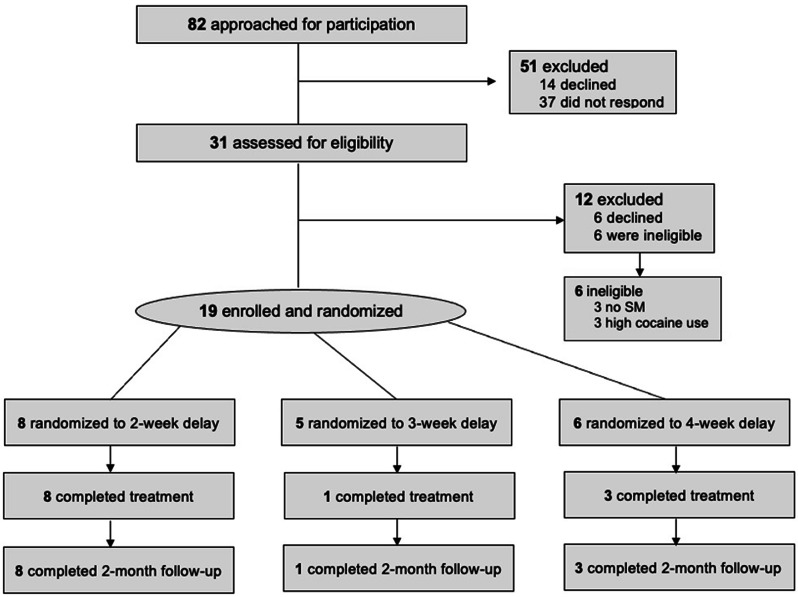
- Of the 19 participants, 15 started treatment and 12 completed it; 4 dropped out during baseline and 3 during treatment, and no serious adverse events were reported.
- By follow-up, 83% of participants showed improvement or clinically significant change on the TSC-40 total score, and 58% achieved clinically significant change; 58.3% achieved clinically significant change on the abbreviated PCL-5.
- For secondary outcomes, 33% experienced clinically significant improvement in experiential avoidance and 46.7% improved in functioning, but only 6.7% showed meaningful change in hopelessness.
- Psychosis and substance use changed little overall: no participants improved in negative psychotic symptoms, 2 participants (16.7%) improved in positive psychotic symptoms, and substance misuse increased for several participants; the authors report 16.7% (2/12) had clinically significant improvement in substance use by follow-up, while 40% (6/15) had temporary substance-use improvements during the study that were not maintained.
## Methods
- Multiple-baseline design with randomization to a 2-, 3-, or 4-week delay before treatment; 10 assessments were completed across baseline, treatment, and follow-up.
- Recruited 19 adults from the Nova Scotia Early Psychosis Program; inclusion required age 19–35, schizophrenia-spectrum diagnosis within 5 years, current substance misuse, and a history of adversity affecting life.
- Participants received 15 weekly 90-minute PE+ sessions, an adapted prolonged exposure protocol with psychoeducation, DBT-informed coping skills, imaginal exposure, in vivo exposure, and relapse prevention; analysis used a stringent intent-to-treat approach with Reliable Change Index and descriptive treatment-fidelity/feedback summaries.
## Limitations
- The paper states that the results are limited by sample size and limited diversity of race and culture.
- The small sample is also evident in the design: inferential statistics were not deemed appropriate, and the study relied on clinically significant change rather than statistical testing.
- Evidence of generalizability limits is also evident from the setting and sample: participants were recruited from one early psychosis program in Halifax, and most participants were white.
Model-written summary. Check it against the paper before relying on it.
Integrity signals
Registry
Cites
Statistics
Figures
Verification
Claims the paper makes
4 Valid · 1 Not valid · 9 Not checked · 21 Own results and interpretations
The cited sources that could be checked couldn’t confirm or dispute this claim.
In the paper
“several studies have suggested that psychosis itself can function as an AE for individuals with PDs [5–8], resulting in similarly poor outcomes.”
§ Outcomes of an adapted prolonged exposure psychotherapy for people with early phase psychosis, substance misuse, and a history of adversity: the PE + trial > Introduction
What the sources say
- Not checked — no full text of the sourcecites [5] Mueser K, Lu W, Rosenberg S, Wolfe R. The trauma of psychosis: posttraumatic stress disorder and recent onset psychosis. Schizophr Res. 2010;116(2–3):217–27. 19939633 source
- Not checked — no full text of the sourcecites [6] Bendall S, Alvarez-Jimenez M, Hulbert CA, McGorry PD, Jackson HJ. Childhood trauma increases the risk of post-traumatic stress disorder in response to first-episode psychosis. Aust N Z J Psychiatry. 2012;46(1):35–9. 22247091 source
- Could not verifycites [7] Bak M, Krabbendam L, Janssen I, de Graaf R, Vollebergh W, van Os J. Early trauma may increase the risk for psychotic experiences by impacting on emotional response and perception of control. Acta Psychiatr Scand. 2005;112(5):360–6. 16223423 sourceExperimental — accuracy not yet measured
The Introduction and Trauma and distress sections examine whether early trauma is associated with distress during psychotic experiences in a general-population sample. They do not say that psychosis itself functions as an adverse event for people with psychotic disorders or that it leads to similarly poor outcomes. I searched for psychosis as a traumatic or adverse event and for outcomes attributed to it. (LLM, conf=0.73)
- Not checked — no full text of the sourcecites [8] Tarrier N, Picken A. Co-morbid PTSD and suicidality in individuals with schizophrenia and substance and alcohol abuse. Soc Psychiatry Psychiatr Epidemiol. 2011;46(11):1079–86. 20711764 source
hedgedstates a cause- Asserted: passes — The authors put it forward as true.
- Checkable: passes — It can be checked against evidence.
- Load-bearing: passes — The paper’s conclusions depend on it.
- Based: passes — The paper gives a reason why it holds.
The sources with a verdict support this claim; the rest weren’t checked yet, have no full text we could read, or their verdicts aren’t rated yet.
In the paper
“Previous studies have found more negative outcomes for those individuals with psychotic disorders (PDs) and a history of adverse events (AEs), both in terms of course of illness (e.g., more distressing hallucinations, greater risk of suicide) [1, 2] and treatment outcomes (e.g., fewer treatment goals met, slower improvement) [3, 4].”
§ Outcomes of an adapted prolonged exposure psychotherapy for people with early phase psychosis, substance misuse, and a history of adversity: the PE + trial > Introduction
What the sources say
- Supportedcites [1] Steel C, Haddock G, Tarrier N, Picken A, Barrowclough C. Auditory hallucinations and posttraumatic stress disorder within schizophrenia and substance abuse. J Nerv Ment Dis. 2011;199(9):709–11. 21878787 source
The Discussion reports that participants with comorbid PTSD experienced significantly more distressing auditory hallucinations. This supports the illness-course example for which this paper is cited; the separate treatment-outcome examples are attributed to other citations. (LLM, conf=0.88)
- Not checked — no full text of the sourcecites [2] Hassan AN, Stuart EA, De Luca V. Childhood maltreatment increases the risk of suicide attempt in schizophrenia. Schizophr Res. 2016;176(2):572–7. 27236409 source
- Supportedcites [3] Aas M, Andreassen OA, Aminoff SR, Færden A, Romm KL, Nesvåg R et al. A history of childhood trauma is associated with slower improvement rates: findings from a one-year follow-up study of patients with a first-episode psychosis. BMC Psychiatry. 2016;16(1). PMC4855869 27146044 source
This source supports the slower-improvement example in the treatment-outcomes portion of the citing sentence. Its Discussion and Conclusions report that patients with first-episode psychosis and a history of childhood trauma had slower improvement over the first year of treatment. The other examples have separate citations and are not attributed to this source alone. (LLM, conf=0.92)
- Not checked — no full text of the sourcecites [4] Jones N, Godzikovskaya J, Zhao Z, Vasquez A, Gilbert A, Davidson L. Intersecting disadvantage: unpacking poor outcomes within early intervention in psychosis services. Early Interv Psychiatry. 2019;13(3):488–94. 29076244 source
plainstates an association- Asserted: passes — The authors put it forward as true.
- Checkable: passes — It can be checked against evidence.
- Load-bearing: passes — The paper’s conclusions depend on it.
- Based: passes — The paper gives a reason why it holds.
- Supported
The cited sources support only part of this claim — read each source’s verdict below.
In the paper
“Keen and colleagues [42] reported that 63% of their participants with psychotic symptoms achieved CSC to AE sequelae during their longer protocol (median number of sessions = 41)”
§ Outcomes of an adapted prolonged exposure psychotherapy for people with early phase psychosis, substance misuse, and a history of adversity: the PE + trial > Discussion
What the sources say
- Partly supportedcites [42] Keen N, Hunter E, Peters E. Integrated trauma-focused cognitive-behavioural therapy for post traumatic stress and psychotic symptoms: a case series study using Imaginal reprocessing strategies. Front Psychiatry. 2017;8:92–92. 28620323 PMC5451497 sourceExperimental — accuracy not yet measured
The Results (Changes during Therapy; page unavailable) report that 63% (5 of 8) of participants completing post-therapy assessments showed reliable improvement in post-traumatic symptoms. The Results (Therapy and Assessment Attrition; page unavailable) give a median of 41 sessions. The paper measures statistically reliable change, not clinically significant change, and the 63% figure concerns post-traumatic symptoms specifically rather than adversity sequelae generally. (LLM, conf=0.88)
plain- Asserted: passes — The authors put it forward as true.
- Checkable: passes — It can be checked against evidence.
- Load-bearing: unclear — It is unclear whether the paper’s conclusions depend on it.
- Based: passes — The paper gives a reason why it holds.
- Partly supported
A result the paper reports from its own data — it cites no other source for it, so there is none to check. The quote shows it is in the paper.
In the paper
“substance misuse increased for several participants”
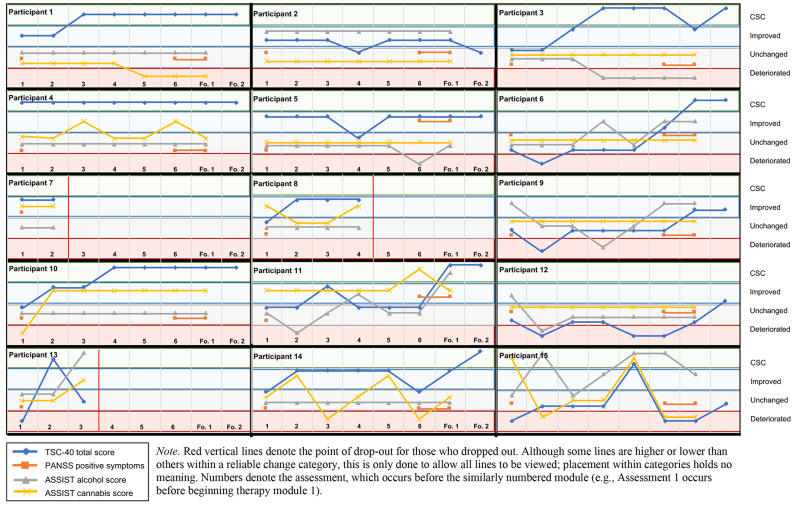
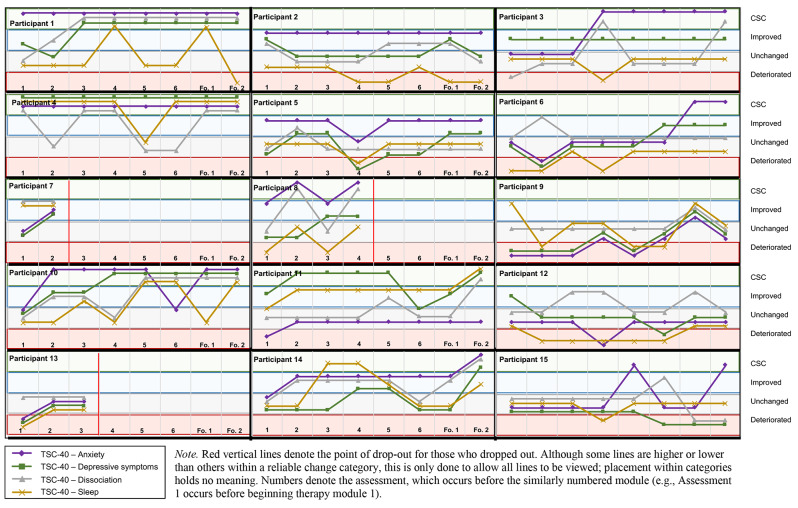
- Also stated in: § Symptom outcomes Table 2 lists the baseline, post-therapy, and follow-up symptom measurements. When reviewing individual changes using the RCI (see Fig. 2), a pattern emerges. Most participants (83%) experienced an amelioration in overall AE-related psychopathology (improvement or CSC) on the TSC-40 by follow-up (Δmeans = 20.9), with 58% achieving CSC. The course of improvement was often one involving temporary improvements or deteriorations on an upward trajectory. Symptoms appeared to consistently improve after Module 3, the imaginal exposure-focused module. When examining specific domains of the TSC-40 results (see Fig. 3), half or more of the participants achieved CSC on dissociation and anxiety, and just under 50% achieved CSC on the depressive symptom domain. However, the courses across participants varied significantly–dissociation had a similar pattern to the TSC-40 total score, increasing and returning to baseline before increasing again, whereas anxiety and depressive symptoms stayed consistent once an amelioration had occurred, although there were more early deteriorations from baseline observed at assessment 1 compared to dissociation and TSC-40 total scores. Sleep appeared to improve little, deteriorating or remaining unchanged for most participants. The results of the abbreviated PCL-5 also suggested improvement; 58.3% of participants achieved CSC by follow-up. Participants who experienced improvements in PCL-5 scores typically maintained those improvements over time. The PANSS positive symptoms (Δmeans = 5.8) improved for two participants (16.7%) and that change was maintained at follow-up, but there were no changes to negative psychotic symptoms for any participants. In terms of the proposed mechanisms, only one participant experiencing improvement to hopelessness (8%), although there was clinically significant improvement to experiential avoidance for a third of treatment completers (n = 4), despite somewhat limited change to group means from baseline (Δmeans = 8.9). Group-level alcohol scores did not appear to vary substantially at follow-up (Δmeans = 1.4), but on an individual level, four participants experienced ameliorations to their alcohol use by follow-up (50%), although only one met criteria for CSC (12.5%). However, four participants experienced increases in alcohol use scores (deteriorations) throughout the study, although these increases were temporary for three participants; the fourth maintained the increase at follow-up. Similarly, four participants experienced increases in cannabis scores (26.7%); two participants maintained the increased use by the follow-up period (16.7%), one returned to their baseline score (8.3%), and one experienced improvement (8.3%). The cannabis group mean marginally shifted (Δmeans = 2.5). Although not used as frequently as cannabis or alcohol, there was an amelioration to hallucinogen use by follow-up for 71% of the sample of treatment completers who used hallucinogens (n = 5), while no changes were observed to cocaine or sedative scores at any time, and a brief amelioration for one participant using amphetamines before returning to their baseline score. · plain
“four participants experienced increases in alcohol use scores (deteriorations) throughout the study”
- Also stated in: § Discussion · plain
“SM deteriorated in several cases”
§ Outcomes of an adapted prolonged exposure psychotherapy for people with early phase psychosis, substance misuse, and a history of adversity: the PE + trial > Abstract > Results
plainstates a causen = 4- Asserted: passes — The authors put it forward as true.
- Checkable: passes — It can be checked against evidence.
- Load-bearing: passes — The paper’s conclusions depend on it.
- Based: passes — The paper gives a reason why it holds.
- Also stated in: § Symptom outcomes Table 2 lists the baseline, post-therapy, and follow-up symptom measurements. When reviewing individual changes using the RCI (see Fig. 2), a pattern emerges. Most participants (83%) experienced an amelioration in overall AE-related psychopathology (improvement or CSC) on the TSC-40 by follow-up (Δmeans = 20.9), with 58% achieving CSC. The course of improvement was often one involving temporary improvements or deteriorations on an upward trajectory. Symptoms appeared to consistently improve after Module 3, the imaginal exposure-focused module. When examining specific domains of the TSC-40 results (see Fig. 3), half or more of the participants achieved CSC on dissociation and anxiety, and just under 50% achieved CSC on the depressive symptom domain. However, the courses across participants varied significantly–dissociation had a similar pattern to the TSC-40 total score, increasing and returning to baseline before increasing again, whereas anxiety and depressive symptoms stayed consistent once an amelioration had occurred, although there were more early deteriorations from baseline observed at assessment 1 compared to dissociation and TSC-40 total scores. Sleep appeared to improve little, deteriorating or remaining unchanged for most participants. The results of the abbreviated PCL-5 also suggested improvement; 58.3% of participants achieved CSC by follow-up. Participants who experienced improvements in PCL-5 scores typically maintained those improvements over time. The PANSS positive symptoms (Δmeans = 5.8) improved for two participants (16.7%) and that change was maintained at follow-up, but there were no changes to negative psychotic symptoms for any participants. In terms of the proposed mechanisms, only one participant experiencing improvement to hopelessness (8%), although there was clinically significant improvement to experiential avoidance for a third of treatment completers (n = 4), despite somewhat limited change to group means from baseline (Δmeans = 8.9). Group-level alcohol scores did not appear to vary substantially at follow-up (Δmeans = 1.4), but on an individual level, four participants experienced ameliorations to their alcohol use by follow-up (50%), although only one met criteria for CSC (12.5%). However, four participants experienced increases in alcohol use scores (deteriorations) throughout the study, although these increases were temporary for three participants; the fourth maintained the increase at follow-up. Similarly, four participants experienced increases in cannabis scores (26.7%); two participants maintained the increased use by the follow-up period (16.7%), one returned to their baseline score (8.3%), and one experienced improvement (8.3%). The cannabis group mean marginally shifted (Δmeans = 2.5). Although not used as frequently as cannabis or alcohol, there was an amelioration to hallucinogen use by follow-up for 71% of the sample of treatment completers who used hallucinogens (n = 5), while no changes were observed to cocaine or sedative scores at any time, and a brief amelioration for one participant using amphetamines before returning to their baseline score. · plain
A result the paper reports from its own data — it cites no other source for it, so there is none to check. The quote shows it is in the paper.
In the paper
“no deteriorations in psychotic symptoms were observed”
- Also stated in: § Conclusions and future directions · plain
“importantly, psychotic symptoms did not worsen despite the exposure component”
§ Outcomes of an adapted prolonged exposure psychotherapy for people with early phase psychosis, substance misuse, and a history of adversity: the PE + trial > Discussion
plain- Asserted: passes — The authors put it forward as true.
- Checkable: passes — It can be checked against evidence.
- Load-bearing: passes — The paper’s conclusions depend on it.
- Based: passes — The paper gives a reason why it holds.
- Also stated in: § Conclusions and future directions · plain
13 more claims
Create a free account to see all 35 claims and every source verdict.
- Probably not a substantial claim. 6
- It may state two separate claims as one. 12
- The quote only partly states this claim. 1
Citations
Cites
The Positive and Negative Syndrome Scale (PANSS) for schizophrenia.
Kay, S. R., Fiszbein, A., & Opler, L. A. (1987) · Schizophrenia Bulletin · doi:10.1093/schbul/13.2.261 · Cited by 21,378 · cited 1×
“The three primary outcome measures included the Trauma Symptom Checklist-40 (TSC-40) [27], Positive and Negative Syndrome Scale (PANSS) [28], and the WHO ASSIST [25].”
MethodJacobson, N. S., & Truax, P. (1991) · Journal of Consulting and Clinical Psychology · doi:10.1037/0022-006x.59.1.12 · Cited by 7,770 · cited 1×
“We used the Reliable Change Index (RCI) [39] to assess change from baseline— all metrics used to establish the degree of required change can be found at clinicaltrials.gov (NCT04546178).”
MethodThe measurement of pessimism: the hopelessness scale
Beck, A. T., Weissman, A., Lester, D., & Trexler, L. (1974) · Journal of Consulting and Clinical Psychology · doi:10.1037/h0037562 · Cited by 5,494 · cited 1×
“The Beck Hopelessness Scale (BHS) [29, 30] measured hopelessness, while the Brief Experiential Avoidance Questionnaire (BEAQ) [31] measured experiential avoidance.”
MethodGroup, W. A. W. (2002) · Addiction · doi:10.1046/j.1360-0443.2002.00185.x · Cited by 1,982
Foa, E. B., Rothbaum, B. O., Riggs, D. S., & Murdock, T. B. (1991) · Journal of Consulting and Clinical Psychology · doi:10.1037/0022-006x.59.5.715 · Cited by 1,444 · cited 1×
“PE, an evidence-based intervention for PTSD, uses exposure to reduce avoidance of both internal and external AE reminders to reduce distress and increase functioning [17–19].”
MethodMorosini, P. L., Magliano, L., Brambilla, L., Ugolini, S., & Pioli, R. (2000) · PubMed · Cited by 1,168
Morosini, P. L., Magliano, L., Brambilla, L., Ugolini, S., & Pioli, R. (2000) · Acta Psychiatrica Scandinavica · doi:10.1034/j.1600-0447.2000.101004323.x · Cited by 1,097
A meta-analytic review of prolonged exposure for posttraumatic stress disorder
Powers, M. B., Halpern, J. M., Ferenschak, M. P., Gillihan, S. J., & Foa, E. B. (2010) · Clinical Psychology Review · doi:10.1016/j.cpr.2010.04.007 · Cited by 1,005
Borrelli, B., Sepinwall, D., Ernst, D., Bellg, A. J., Czajkowski, S., Breger, R., DeFrancesco, C., Levesque, C., Sharp, D. L., Ogedegbe, G., et al. (2005) · Journal of Consulting and Clinical Psychology · doi:10.1037/0022-006x.73.5.852 · Cited by 803 · cited 1×
“This robust approach is not always used [50, 51].”
MethodPerepletchikova, F., Treat, T. A., & Kazdin, A. E. (2007) · Journal of Consulting and Clinical Psychology · doi:10.1037/0022-006x.75.6.829 · Cited by 533 · cited 1×
“This robust approach is not always used [50, 51].”
MethodKratochwill, T. R., & Levin, J. R. (2010) · Psychological Methods · doi:10.1037/a0017736 · Cited by 494 · cited 1×
“The PE + study used a multiple baseline design, which included a 2–4-week baseline measurement period functioning as a control against which to compare the measurements collected during and post-intervention [23, 24].”
MethodSexual abuse trauma among professional women: Validating the Trauma Symptom Checklist-40 (TSC-40)
Elliott, D. M., & Briere, J. (1992) · Child Abuse & Neglect · doi:10.1016/0145-2134(92)90048-v · Cited by 490 · cited 1×
“The three primary outcome measures included the Trauma Symptom Checklist-40 (TSC-40) [27], Positive and Negative Syndrome Scale (PANSS) [28], and the WHO ASSIST [25].”
MethodThe brief experiential avoidance questionnaire: Development and initial validation
Gámez, W., Chmielewski, M., Kotov, R., Ruggero, C., Suzuki, N., & Watson, D. (2014) · Psychological Assessment · doi:10.1037/a0034473 · Cited by 450 · cited 1×
“The Beck Hopelessness Scale (BHS) [29, 30] measured hopelessness, while the Brief Experiential Avoidance Questionnaire (BEAQ) [31] measured experiential avoidance.”
MethodFoa, E. B., & McLean, C. P. (2016) · Annual Review of Clinical Psychology · doi:10.1146/annurev-clinpsy-021815-093533 · Cited by 360 · cited 1×
“PE, an evidence-based intervention for PTSD, uses exposure to reduce avoidance of both internal and external AE reminders to reduce distress and increase functioning [17–19].”
Methodvan den Berg, D. P. G., de Bont, P. A. J. M., van der Vleugel, B. M., de Roos, C., de Jongh, A., Van Minnen, A., & van der Gaag, M. (2015) · JAMA Psychiatry · doi:10.1001/jamapsychiatry.2014.2637 · Cited by 341 · cited 3×
“Preliminary evidence suggests that PE treatment reduces symptoms of psychosis and PTSD, and does not lead to symptom exacerbation [15, 20].”
BackgroundSubstance abuse in schizophrenia: a review of the literature and a study of correlates in Sweden
Cantor-Graae, E., Nordström, L. G., & McNeil, T. F. (2001) · Schizophrenia Research · doi:10.1016/s0920-9964(00)00114-6 · Cited by 261 · cited 1×
“However, substance misuse (SM) is a very common comorbid issue for people with PDs and a history of AEs, with quite elevated prevalence rates [12].”
BackgroundHuppert, J. D., Bufka, L. F., Barlow, D. H., Gorman, J. M., Shear, M. K., & Woods, S. W. (2001) · Journal of Consulting and Clinical Psychology · doi:10.1037/0022-006x.69.5.747 · Cited by 249 · cited 1×
“The overall mean adherence rating was 82% (SD = 15%), considered adherent [40].”
BackgroundInvestigation of abbreviated 4 and 8 item versions of the PTSD Checklist 5
Price, M., Szafranski, D. D., van Stolk-Cooke, K., & Gros, D. F. (2016) · Psychiatry Research · doi:10.1016/j.psychres.2016.03.014 · Cited by 242 · cited 1×
“The Social and Occupational Functioning Assessment Questionnaire (SOFAS) [32] measured functioning, the Clinical Global Impression – Severity (CGI-S) and CGI – Improvement (CGI-I) [33] examined symptom severity, and the 8-item PTSD Checklist for DSM-5 (PCL-5) [34, 35] assessed PTSD symptoms.”
Methodvan den Berg, D. P. G., de Bont, P. A. J. M., van der Vleugel, B. M., de Roos, C., de Jongh, A., van Minnen, A., & van der Gaag, M. (2016) · Schizophrenia Bulletin · doi:10.1093/schbul/sbv172 · Cited by 153 · cited 3×
“Preliminary evidence suggests that PE treatment reduces symptoms of psychosis and PTSD, and does not lead to symptom exacerbation [15, 20].”
BackgroundThe trauma of psychosis: Posttraumatic stress disorder and recent onset psychosis
Mueser, K. T., Lu, W., Rosenberg, S. D., & Wolfe, R. (2010) · Schizophrenia Research · doi:10.1016/j.schres.2009.10.025 · Cited by 146 · cited 1×
“In addition, several studies have suggested that psychosis itself can function as an AE for individuals with PDs [5–8], resulting in similarly poor outcomes.”
BackgroundBrand, R. M., McEnery, C., Rossell, S. L., Bendall, S., & Thomas, N. (2017) · Schizophrenia Research · doi:10.1016/j.schres.2017.08.037 · Cited by 144 · cited 1×
“In contrast, there were fewer improvements to positive psychotic symptoms in the PE + study than in other studies, where small effects were found in pre-post analyses, although negative symptoms remained unchanged in multiple trials [43].”
ResultBak, M., Krabbendam, L., Janssen, I., de Graaf, R., Vollebergh, W., & van Os, J. (2005) · Acta Psychiatrica Scandinavica · doi:10.1111/j.1600-0447.2005.00646.x · Cited by 118
Oei, T. P. S., & Green, A. L. (2008) · Professional Psychology: Research and Practice · doi:10.1037/0735-7028.39.4.435 · Cited by 109 · cited 1×
“Finally, the Satisfaction with Therapy subscale of the Satisfaction with Therapy and Therapist Scale – Revised (STTS-R) [36] was administered; participants were asked seven questions about their satisfaction with treatment (e.g., treatment needs were met) ranging from “Strongly disagree” (1) to…”
MethodBendall, S., Alvarez-Jimenez, M., Hulbert, C. A., McGorry, P. D., & Jackson, H. J. (2012) · Australian & New Zealand Journal of Psychiatry · doi:10.1177/0004867411430877 · Cited by 94
Carr, S., Hardy, A., & Fornells‐Ambrojo, M. (2018) · European Journal of Psychotraumatology · doi:10.1080/20008198.2018.1512265 · Cited by 91
Aas, M., Andreassen, O. A., Aminoff, S. R., Færden, A., Romm, K. L., Nesvåg, R., Berg, A. O., Simonsen, C., Agartz, I., & Melle, I. (2016) · BMC Psychiatry · doi:10.1186/s12888-016-0827-4 · Cited by 88 · cited 1×
“…outcomes for those individuals with psychotic disorders (PDs) and a history of adverse events (AEs), both in terms of course of illness (e.g., more distressing hallucinations, greater risk of suicide) [1, 2] and treatment outcomes (e.g., fewer treatment goals met, slower improvement) [3, 4].”
BackgroundSteel, C., Hardy, A., Smith, B., Wykes, T., Rose, S., Enright, S., Hardcastle, M., Landau, S., Baksh, M. F., Gottlieb, J. D., et al. (2017) · Psychological Medicine · doi:10.1017/s0033291716002117 · Cited by 66 · cited 1×
“Several studies have examined the efficacy of an AE-focused treatment, prolonged exposure (PE), in a PD population [15, 16].”
BackgroundBack, S. E., Foa, E. B., Killeen, T. K., Mills, K. L., Teesson, M., Cotton, B. D., Carroll, K. M., & Brady, K. T. (2014) · doi:10.1093/med:psych/9780199334513.001.0001 · Cited by 65
Gairns, S., Alvarez‐Jimenez, M., Hulbert, C., McGorry, P., & Bendall, S. (2015) · Early Intervention in Psychiatry · doi:10.1111/eip.12065 · Cited by 60 · cited 2×
“…previous adversity-focused trials among people with chronic psychosis similarly observed few psychotic symptom exacerbations [20], a consistent barrier to the delivery of adversity-focused treatments among patients with psychotic disorders is clinician fear of psychotic symptom exacerbation [9].”
BackgroundKeen, N., Hunter, E. C. M., & Peters, E. (2017) · Frontiers in Psychiatry · doi:10.3389/fpsyt.2017.00092 · Cited by 53 · cited 1×
“Keen and colleagues [42] reported that 63% of their participants with psychotic symptoms achieved CSC to AE sequelae during their longer protocol (median number of sessions = 41), while van den Berg and colleagues [15] found that more than 56% of their participants with chronic psychosis no longer…”
BackgroundBeck Hopelessness Scale: Exploring its Dimensionality in Patients with Schizophrenia
Kao, Y., Liu, Y., & Lu, C.-W. (2011) · Psychiatric Quarterly · doi:10.1007/s11126-011-9196-9 · Cited by 44 · cited 1×
“The Beck Hopelessness Scale (BHS) [29, 30] measured hopelessness, while the Brief Experiential Avoidance Questionnaire (BEAQ) [31] measured experiential avoidance.”
MethodChildhood maltreatment increases the risk of suicide attempt in schizophrenia
Hassan, A. N., Stuart, E. A., & De Luca, V. (2016) · Schizophrenia Research · doi:10.1016/j.schres.2016.05.012 · Cited by 44 · cited 1×
“…outcomes for those individuals with psychotic disorders (PDs) and a history of adverse events (AEs), both in terms of course of illness (e.g., more distressing hallucinations, greater risk of suicide) [1, 2] and treatment outcomes (e.g., fewer treatment goals met, slower improvement) [3, 4].”
BackgroundTong, J., Simpson, K., Álvarez‐Jiménez, M., & Bendall, S. (2018) · Early Intervention in Psychiatry · doi:10.1111/eip.12761 · Cited by 41 · cited 1×
“Participants were satisfied with the quality of treatment and found the PE + treatment helpful to achieve their goals, which aligns with previous participant experiences with adversity-focused treatments [41].”
ResultImpact of childhood adversities on the short-term course of illness in psychotic spectrum disorders
Schalinski, I., Fischer, Y., & Rockstroh, B. (2015) · Psychiatry Research · doi:10.1016/j.psychres.2015.04.052 · Cited by 39 · cited 1×
“Due to the significant impacts of AEs on illness course and treat-ment, there has been a consistent call in the literature to develop adversity-focused interventions for people with PDs and a history of AEs to improve outcomes for this group [9–11].”
BackgroundCo-morbid PTSD and suicidality in individuals with schizophrenia and substance and alcohol abuse
Tarrier, N., & Picken, A. (2011) · Social Psychiatry and Psychiatric Epidemiology · doi:10.1007/s00127-010-0277-0 · Cited by 33 · cited 1×
“In addition, several studies have suggested that psychosis itself can function as an AE for individuals with PDs [5–8], resulting in similarly poor outcomes.”
BackgroundBeck, J. S. (2010) · Wiley eBooks · doi:10.1002/9780470479216.corpsy0198 · Cited by 29
Intersecting disadvantage: Unpacking poor outcomes within early intervention in psychosis services
Jones, N., Godzikovskaya, J., Zhao, Z., Vasquez, A., Gilbert, A., & Davidson, L. (2019) · Early Intervention in Psychiatry · doi:10.1111/eip.12508 · Cited by 27 · cited 1×
“…outcomes for those individuals with psychotic disorders (PDs) and a history of adverse events (AEs), both in terms of course of illness (e.g., more distressing hallucinations, greater risk of suicide) [1, 2] and treatment outcomes (e.g., fewer treatment goals met, slower improvement) [3, 4].”
BackgroundA Test of Whether Coping Styles Moderate the Effect of PTSD Symptoms on Alcohol Outcomes
Grosso, J. A., Kimbrel, N. A., Dolan, S., Meyer, E. C., Kruse, M. I., Gulliver, S. B., & Morissette, S. B. (2014) · Journal of Traumatic Stress · doi:10.1002/jts.21943 · Cited by 23 · cited 1×
“Moreover, the literature on substance use motives (e.g., to cope, improve mood) related to AEs [47, 48] suggests that a greater understanding of the function of substance use within the AE-SM-EPP relationship may allow for more explicit targeting within future interventions.”
BackgroundEarly Psychosis and Trauma-Related Disorders: Clinical Practice Guidelines and Future Directions
Cragin, C. A., Straus, M. B., Blacker, D., Tully, L. M., & Niendam, T. A. (2017) · Frontiers in Psychiatry · doi:10.3389/fpsyt.2017.00033 · Cited by 23 · cited 2×
“Taken together, the above literature, along with recent preliminary clinical guidelines for adversity-focused treatments for people with PDs [14], suggest the need for an integrated psychological treatment capable of simultaneously addressing AE sequelae, SM, and psychotic symptoms.”
BackgroundResultAuditory Hallucinations and Posttraumatic Stress Disorder Within Schizophrenia and Substance Abuse
Steel, C., Haddock, G., Tarrier, N., Picken, A., & Barrowclough, C. (2011) · Journal of Nervous & Mental Disease · doi:10.1097/nmd.0b013e318229d6e8 · Cited by 21 · cited 1×
“…outcomes for those individuals with psychotic disorders (PDs) and a history of adverse events (AEs), both in terms of course of illness (e.g., more distressing hallucinations, greater risk of suicide) [1, 2] and treatment outcomes (e.g., fewer treatment goals met, slower improvement) [3, 4].”
BackgroundFirst Episode Psychosis, Substance Abuse and Prognosis: A Systematic Review
Archie, S., & Gyomorey, K. (2009) · Current Psychiatry Reviews · doi:10.2174/157340009788971074 · Cited by 20 · cited 1×
“Yet, SM is rarely considered in the presence of AEs, despite its similarly deleterious impact on psychotic symptoms and outcomes of treatment [13] and its relationship with AEs sequelae (e.g., PTSD symptoms, depressive symptoms).”
BackgroundPeirce, J. M., Schacht, R. L., & Brooner, R. K. (2020) · Journal of Traumatic Stress · doi:10.1002/jts.22546 · Cited by 20 · cited 1×
“…sample, SM was more frequently unchanged or worsened than improved, suggesting even more direct targeting of substance use may be required to change use in a group with psychosis and a history of AEs, especially because PE treatment in non-psychosis populations did not result in SM increases [46].”
BackgroundWood, H. J., Babusci, C., Bendall, S., Sarpal, D. K., & Jones, N. (2023) · Psychiatric Services · doi:10.1176/appi.ps.20220624 · Cited by 18 · cited 1×
“Moreover, a recent study examining unmet clinical needs in early psychosis programs across five countries highlighted the necessity of developing tailored adversity-focused treatments for people with EPP [21], suggesting a gap in both the research literature and clinical practice.”
BackgroundNg, L. C., Petruzzi, L. J., Greene, M. C., Mueser, K. T., Borba, C. P. C., & Henderson, D. C. (2016) · Journal of Nervous & Mental Disease · doi:10.1097/nmd.0000000000000523 · Cited by 17
Brand, R. M., Hardy, A., Bendall, S., & Thomas, N. (2020) · Clinical Psychologist · doi:10.1111/cp.12202 · Cited by 8 · cited 1×
“Brand and colleagues [49] suggested that the acceptability and efficacy of a stabilization phase should be examined; although acceptable to our participants, no changes to psychopathology scores were observed immediately following this phase.”
BackgroundAtasoy, P., Lambe, L. J., DeGrace, S., Cosman, T., Romero‐Sanchiz, P., & Stewart, S. H. (2023) · International Journal of Mental Health and Addiction · doi:10.1007/s11469-023-01190-z · Cited by 3 · cited 1×
“Moreover, the literature on substance use motives (e.g., to cope, improve mood) related to AEs [47, 48] suggests that a greater understanding of the function of substance use within the AE-SM-EPP relationship may allow for more explicit targeting within future interventions.”
BackgroundSelf-citationPatterson, V. C., Tibbo, P. G., Stewart, S. H., Town, J. M., Crocker, C. E., Ursuliak, Z., Lee, S., Morrison, J., Abidi, S., Dempster, K., et al. (2022) · Frontiers in Psychology · doi:10.3389/fpsyg.2022.1012776 · Cited by 1 · cited 1×
“The protocol of this study, which includes a detailed discussion of the methodology and intervention components, was published previously [22].”
MethodSelf-citationSatisfaction With Therapy and Therapist Scale—Revised
Oei, T. P. S., & Green, A. L. (2008) · PsycTESTS Dataset · doi:10.1037/t01862-000
Research works printed but not linked: 4
- Guy W. Clinical global impression. Assessment manual for psychopharmacology. Rockville, MD: US Department of Health, Education, and Welfare; 1976.
- Linehan M. DBT Skills Training Manual: Second Edition. 2nd ed. New York, NY, US: Guilford Press; 2014.
- Sherrill A, Zwiebach L, Burton M, Fenlon E, Rauch SA, Rothbaum B. Emory University prolonged exposure (PE) consultant training program supplemental materials. Emory University; 2020. pp. 1–46.
- Beck A, Rector N, Stolar N, Grant P, Schizophrenia. Cognitive theory, research, and therapy. New York, NY, US: Guilford Press; 2011.
Cited by
Trauma-Focused Treatment in Early and Lifetime Psychosis: A Scoping Review
Jankowski, S. E., Bennett, R., Tao, B., Neria, Y., Dixon, L. B., Wainberg, M. L., Sweetland, A. C., & Patel, S. R. (2025) · Schizophrenia Bulletin · doi:10.1093/schbul/sbaf202 · Cited by 7
“33,46 44–47,28, 29 Of”
Metadata
- Authors
- Patterson, V. C., Tibbo, P. G., Stewart, S. H., Town, J., Crocker, C. E., Ursuliak, Z., Lee, S., Morrison, J., Abidi, S., Dempster, K., Alexiadis, M., Henderson, N., & Pencer, A.
- Affiliations
- Dalhousie University (CA)
- Nova Scotia Health Authority (CA)
- Corresponding author
- Patterson, Victoria C
- ORCID
- Venue
- BMC Psychiatry
- Published
- 2024-10-14
- Volume
- 24
- Issue
- 1
- Pages
- 684-684
- ISSN
- 1471-244X (ISSN-L)
- PMC
- PMC11479562
- OpenAlex
- W4403394103
- Cited by
- 1
- References
- 48
- Citations by year
- 2025: 1
- FWCI
- 0.50
- Type
- journal article
- Language
- en
- Open access
- gold
- doi.org
- Licence
- cc-by
- creativecommons.org/licenses/by/4.0 (tdm)
- creativecommons.org/licenses/by/4.0 (vor)
- Locations
- BMC Psychiatry (publishedVersion, cc-by)
- PubMed Central (publishedVersion, cc-by)
- PubMed (publishedVersion)
- DOAJ (DOAJ: Directory of Open Access Journals) (submittedVersion, cc-by-sa)
- Funders
- Research Nova Scotia (2022-2410)
- Killam Trusts
- QEII Foundation (1025210)
- Topics
- Social Sciences › Psychology › Clinical Psychology › Posttraumatic Stress Disorder Research
- Health Sciences › Medicine › Psychiatry and Mental health › Schizophrenia research and treatment
- Social Sciences › Psychology › Clinical Psychology › Psychotherapy Techniques and Applications
- Keywords
- prolonged exposure therapy, early psychosis, substance abuse, post-traumatic stress disorder, negative psychotic symptoms, experiential avoidance, hopelessness, treatment outcomes, treatment satisfaction
- MeSH terms
- Adult, Female, Humans, Implosive Therapy, Male, Psychotic Disorders, Treatment Outcome, Outcome Assessment, Health Care, Substance-Related Disorders, Young Adult
About these checks
Registry, retraction, Cites and statistics results are computed, not judged, with one exception: a printed reference that no index lists is read once by a model before it counts as a citation error. Claims are extracted by a model and kept only when their quote appears verbatim in the text; each cited source is then checked, with a model’s help, for whether it says what the claim relies on. Those verdicts can be wrong — read the claim’s quote and the cited source before relying on one.
The claim verdicts this report counts are experimental: their accuracy is not yet measured.
A language model drew the claims from the paper on 2026-10-11, under version 3 of the claim definition (model deepseek-v4.1-flash, prompt extract-v3).
A second model labelled each claim on 2026-10-11 (model jev-1.13-20260917, definition revision gold-guideline-v0.2).
Cited sources are checked with a language model’s help (gpt-6-sol).
Statistics and arithmetic are recomputed, not judged.
Confidence bands are shown only for fields calibrated on our annotated test set. None is calibrated yet, so no band is shown.
What counts as a claim ›How we measure confidence ›How we check this ›
Are you an author, or do you see a problem with this page? Request a review
Data sources
Bibliographic data: Semantic Scholar, OpenAlex, Crossref.
Contains information from the Semantic Scholar Academic Graph Datasets, made available under the ODC Attribution License (ODC-BY 1.0).
Semantic Scholar’s data is described in: Kinney, R., et al. (2023). The Semantic Scholar Open Data Platform. arXiv:2301.10140.
