

From adoption to interaction: examining human-GenAI engagement patterns, ethical tensions, and educational trade-offs in nursing education
Open accessThe DOI matches its Crossref record; 46 of the 60 references it cites were found in a registry or an index; 17 of the 28 sources its claims cite were checked for support.
Abstract
While generative AI (GenAI) tools such as DeepSeek are increasingly embedded in higher education, existing research has predominantly focused on accuracy, bias, and adoption, with limited attention to the nature of human–GenAI interaction in learning. This study examines how nursing students interact with GenAI and how distinct interaction patterns shape cognitive, behavioral, and affective outcomes, as well as ethical risks in professional training contexts. A cross-sectional mixed-methods design was employed, integrating a rapid review, survey data ( n = 401), and qualitative interviews ( n = 30). Quantitative data were analyzed using descriptive statistics, correlations, and regression, while qualitative data underwent thematic analysis to identify recurring interaction patterns. Four dominant interaction patterns emerged: (1) passive consumption, characterized by uncritical acceptance of outputs; (2) efficiency-driven use, where GenAI functions as a productivity shortcut; (3) dependent interaction, reflecting overreliance and reduced self-directed learning; and (4) critical engagement, involving verification and reflective use. These patterns are associated with divergent outcomes. Efficiency-driven and dependent interactions were associated with greater perceived task efficiency and performance, but were also associated with lower critical thinking, reduced motivation, and increased academic dishonesty. In contrast, critical engagement supports deeper learning but demands higher AI literacy and effort. Ethical risks—including misinformation, fabricated references, and misalignment with clinical standards—are most pronounced under passive and dependent use. The findings suggest that educational outcomes are shaped not merely by GenAI adoption but by interaction quality. This study advances a shift toward interaction-centered frameworks, emphasizing the need for structured, critical, and ethically grounded GenAI engagement in higher education.
Overview
CoChat Summary
TL;DR
In a cross-sectional mixed-methods study of 401 nursing students plus 30 interviews, four human–GenAI interaction patterns emerged: passive consumption, efficiency-driven use, dependency, and critical engagement. Efficiency and dependency were linked to perceived productivity but also lower critical thinking and motivation and higher academic-integrity risk, while critical engagement showed the most adaptive outcomes but was least practiced.
Key findings
- Four interaction dimensions explained 68.4% of total variance: passive interaction (M = 3.85, SD = 0.88), efficiency interaction (M = 4.12, SD = 0.78), dependency interaction (M = 3.92, SD = 0.89), and critical engagement (M = 3.68, SD = 0.82); awareness was M = 4.02, SD = 0.81, and usage intention M = 4.12, SD = 0.78.
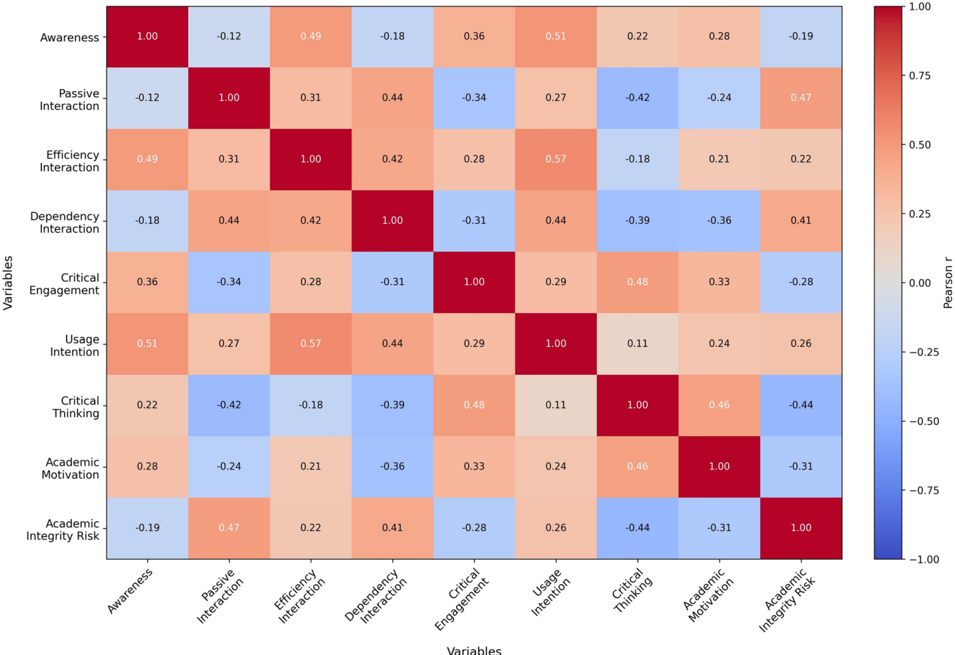
- Usage intention was predicted by awareness (β = 0.38), efficiency interaction (β = 0.41, strongest), dependency interaction (β = 0.22), and critical engagement (β = 0.12), with R² = 0.52; efficiency interaction correlated most strongly with usage intention (r = 0.57, p < 0.001), while dependency correlated negatively with critical engagement (r = −0.31, p < 0.001).
- For educational outcomes, critical thinking was positively predicted by critical engagement (β = 0.46) and negatively by passive (β = −0.34), efficiency (β = −0.12), and dependency (β = −0.29) interactions (R² = 0.48); academic motivation was positively predicted by efficiency (β = 0.18) and critical engagement (β = 0.29) and negatively by passive (β = −0.21) and dependency (β = −0.33) interactions (R² = 0.42).
- Academic-integrity risk was positively predicted by passive (β = 0.41), dependency (β = 0.37), and efficiency (β = 0.22) interactions, and negatively by critical engagement (β = −0.28; R² = 0.51); dependency mediated the relationship between efficiency interaction and critical thinking (indirect effect β = −0.15, p < 0.001).
Methods
- Triangulated mixed-methods cross-sectional design with three phases: a rapid review following PRISMA-ScR, a quantitative survey (n = 401), and structured qualitative interviews (n = 30).
- Setting was Youjiang Medical University for Nationalities in Guangxi, China; the target population was 1,946 nursing graduate students, with simple random sampling and proportionate allocation, a Raosoft minimum of 321 (95% confidence, 5% margin), increased by 25% to 401; qualitative participants were purposively sampled to data saturation.
- Rapid review searched PubMed/MEDLINE, Scopus, Web of Science, ScienceDirect, and SpringerLink from January 2023 to March 2026, identifying 4,117 records, 95 eligible studies, and 9 DeepSeek-specific studies; quantitative analysis used SPSS v29 descriptive statistics, correlations, multiple regression, one-way ANOVA, and PROCESS Model 4 mediation, while interviews used thematic analysis and findings were triangulated.
Limitations
- The paper does not include a dedicated limitations section; it states that the rapid review did not conduct a formal methodological quality appraisal or risk-of-bias assessment because the aim was evidence mapping rather than intervention synthesis.
- Evident from the text: the cross-sectional design and self-report survey cannot establish causality, and the mediation finding is described as “preliminary evidence.”
- Evident from the text: data come from one institution and a specific population of nursing graduate students, with qualitative findings from 30 interviews and rapid-review screening conducted by one researcher with 20% verification by a second reviewer.
Model-written summary. Check it against the paper before relying on it.
Integrity signals
Registry
Cites
Statistics
Figures
Verification
Claims the paper makes
9 Valid · 2 Not valid · 2 Not checked · 122 Own results and interpretations
The cited sources support only part of this claim — read each source’s verdict below.
In the paper
“Despite China’s leadership in AI innovation, vulnerabilities in interaction practices within nursing education remain insufficiently understood [40, 44].”
§ From adoption to interaction: examining human-GenAI engagement patterns, ethical tensions, and educational trade-offs in nursing education > Introduction
What the sources say
- Partly supportedcites [40] Ni Z, Peng R, Zheng X, Xie P. Embracing the future: Integrating ChatGPT into China’s nursing education system. Int J Nurs Sci. 2024;11(2):295–9. 10.1016/j.ijnss.2024.03.006. 38707690 PMC11064564 sourceExperimental — accuracy not yet measured
The section “Optimizing ChatGPT for responsible use in nursing education” says oversight of ChatGPT use in Chinese institutions is insufficient and warns of student misuse. The Conclusion calls for further study of ChatGPT’s long-term impact. Neither passage establishes China’s leadership in AI innovation or specifically says that vulnerabilities in interaction practices remain insufficiently understood; page numbers were not provided. (LLM, conf=0.82)
- Partly supportedcites [44] Shen M. Prompts, privacy, and personalized learning: integrating AI in nursing education via prompt engineering for care-plan development. BMC Nurs. 2025. 10.1186/s12912-025-03115-8. PMC12042552 40301862 sourceExperimental — accuracy not yet measured
The Introduction > Background (page unavailable) says that research on how students use prompt engineering in nursing care planning is lacking and that applications of Chinese-language GenAI in nursing education remain understudied. It describes several high-performing Mandarin-language models, but does not establish China’s leadership in AI innovation. (LLM, conf=0.84)
plain- Asserted: passes — The authors put it forward as true.
- Checkable: passes — It can be checked against evidence.
- Load-bearing: passes — The paper’s conclusions depend on it.
- Based: passes — The paper gives a reason why it holds.
- Partly supported
The cited sources support only part of this claim — read each source’s verdict below.
In the paper
“However, the absence of standardized ethical and pedagogical frameworks means that students must navigate these technologies through their own interaction practices, often without guidance [29, 39, 42].”
§ From adoption to interaction: examining human-GenAI engagement patterns, ethical tensions, and educational trade-offs in nursing education > Introduction
What the sources say
- Partly supportedcites [29] Hu M, Wang Y, Liu Y, Cai B, Kong F, Zheng Q, Zhao D, Gao G, Hui Z. Artificial intelligence in nursing decision-making: A bibliometric analysis of trends and impacts. Nurs Rep. 2025;15(6):198. 10.3390/nursrep15060198. 40559489 PMC12195644 sourceExperimental — accuracy not yet measured
The Discussion (page unavailable) reports gaps in research on AI ethics in nursing, which lends limited support to the claim of an ethical gap. It does not establish that standardized ethical or pedagogical frameworks are absent, or that students navigate AI through their own practices without guidance. (LLM, conf=0.76)
- Not checked — no full text of the sourcecites [39] Nashwan AJ, Abujaber AA, Abdalrahim MS. Embracing artificial intelligence in nursing education: A cross-sectional study of nursing students’ attitudes. Evid Based Nurs. 2025;28(1):23–30. 10.1136/ebnurs-2023-103888. 38228384 source
- Not checked yetcites [42] Rajah AS, Sardauna ZM, Ladan MA. Exploring the experience and perception of artificial intelligence utilization among students of Department of Nursing, Bayero University Kano. Real Nurs J. 2024;7(3):220–8. 10.34302/rinnj.07.03.220. source
Checked before — its earlier verdict is held back until a new check runs.
plainstates a cause- Asserted: passes — The authors put it forward as true.
- Checkable: passes — It can be checked against evidence.
- Load-bearing: passes — The paper’s conclusions depend on it.
- Based: passes — The paper gives a reason why it holds.
- Partly supported
The cited sources support only part of this claim — read each source’s verdict below.
In the paper
“This pattern suggests the externalization of cognitive work to AI systems, echoing concerns that generative AI may weaken self-regulated learning and independent problem-solving when used as a substitute rather than a scaffold [5, 19, 38].”
§ From adoption to interaction: examining human-GenAI engagement patterns, ethical tensions, and educational trade-offs in nursing education > Results and discussion > Dominant patterns of student interaction with DeepSeek in terms of awareness, engagement, and usage tendencies
What the sources say
- Could not verifycites [5] Baashar Y, et al. Toward predicting student’s academic performance using artificial neural networks (ANNs). Appl Sci. 2022;12(21):11136. 10.3390/app122111136. sourceExperimental — accuracy not yet measured
The Introduction (p. 1) and Conclusions (p. 12) address holographic waveguides and AR image quality, not learning outcomes. Searches for generative AI, self-regulated learning, independent problem-solving, and externalized cognitive work found no passage addressing the attributed concern. (LLM, conf=0.78)
- Not checked — no full text of the sourcecites [19] Ehmke SD, Bridges J, Patel SE. Self-perceived knowledge, skills, and attitude of nursing faculty on generative artificial intelligence in nursing education: A descriptive, cross-sectional study. Teach Learn Nurs. 2025. 10.1016/j.teln.2024.12.008. source
- Partly supportedcites [38] Naseer MA, Saeed S, Afzal A, Ali S, Malik MGR. Navigating the integration of artificial intelligence in the medical education curriculum: A mixed-methods study exploring the perspectives of medical students and faculty in Pakistan. BMC Med Educ. 2025;25(1):273. 10.1186/s12909-025-06487-6. 39979912 PMC11844081 sourceExperimental — accuracy not yet measured
In Results, under “Theme-specific insights: faculty perspectives” (page unavailable), faculty caution that over-reliance on AI could undermine critical thinking and problem-solving, and recommend using it as a supplement rather than a replacement. The paper does not say that such use weakens self-regulated learning; its Results instead describe AI as potentially useful for self-directed learning. (LLM, conf=0.84)
hedgedstates a possible cause- Asserted: passes — The authors put it forward as true.
- Checkable: passes — It can be checked against evidence.
- Load-bearing: passes — The paper’s conclusions depend on it.
- Based: passes — The paper gives a reason why it holds.
- Could not verify
The cited sources support only part of this claim — read each source’s verdict below.
In the paper
“The difference between awareness and critical engagement suggests that knowledge about AI risks does not automatically translate into responsible interaction practices, reinforcing arguments for stronger AI literacy and pedagogical scaffolding [6, 17, 28].”
§ From adoption to interaction: examining human-GenAI engagement patterns, ethical tensions, and educational trade-offs in nursing education > Results and discussion > Dominant patterns of student interaction with DeepSeek in terms of awareness, engagement, and usage tendencies
What the sources say
- Not checked — no full text of the sourcecites [6] Bahari G. The implementation of artificial intelligence in nursing education and its psychological impact on nursing students: a cross-sectional study. Nurse Educ Today. 2025. 10.1016/S0260691725002527. 40544672 source
- Partly supportedcites [17] Dehghani M, Kazemi R, Shahbazi S. Challenges in implementing artificial intelligence for nursing education: A systematic review. Educ Res Med Sci. 2025;14(2):e162371. 10.5812/erms-162371. sourceExperimental — accuracy not yet measured
Our copy supports the second half of the citing sentence — the arguments for stronger AI literacy and pedagogical scaffolding: the Discussion (7) states that excessive reliance on AI 'can lead to a reduction in knowledge and a superficial understanding among students' and hinders critical thinking, so 'educators and instructors must design and implement structured programs', and 7.2 Recommendations call for comprehensive training programs covering ethical and technological concerns; 6.5 (Human Challenges) lists 'insufficient awareness and training regarding AI'. However, no passage states the knowledge-practice gap the claim attributes to this source — that knowledge about AI risks does not automatically translate into responsible interaction practices. If anything, the Abstract frames it the other way ('a lack of awareness regarding the limitations of these tools may lead to financial and human losses'), treating more awareness as the remedy rather than as insufficient. The specific awareness-vs-critical-engagement contrast is not made in our copy. (LLM, conf=0.65)
- Partly supportedcites [28] Han S, Kang HS, Gimber P, Lim S. Nursing students’ perceptions and use of generative artificial intelligence in nursing education. Nurs Rep. 2025;15(2):68. 10.3390/nursrep15020068. 39997804 PMC11858139 sourceExperimental — accuracy not yet measured
Results §3.4 reports that nursing students recognized risks including inaccuracy, bias, and plagiarism. Discussion §4.2 calls for critical evaluation, ethical use, AI literacy, and clear guidelines. The paper does not establish a gap between students’ risk awareness and their actual interaction practices, so that part of the claim remains an inference. (LLM, conf=0.82)
hedged- Asserted: passes — The authors put it forward as true.
- Checkable: passes — It can be checked against evidence.
- Load-bearing: passes — The paper’s conclusions depend on it.
- Based: passes — The paper gives a reason why it holds.
The cited sources support only part of this claim — read each source’s verdict below.
In the paper
“This finding reinforces concerns that unchecked AI use can encourage passive learning and cognitive offloading, particularly in environments where rapid completion of tasks is rewarded more strongly than reflective practice [15, 16, 37].”
§ From adoption to interaction: examining human-GenAI engagement patterns, ethical tensions, and educational trade-offs in nursing education > Results and discussion > Dominant patterns of student interaction with DeepSeek in terms of awareness, engagement, and usage tendencies
What the sources say
- Could not verifycites [15] De Gagne JC. The state of artificial intelligence in nursing education: Past, present, and future directions. Int J Environ Res Public Health. 2023;20(5):4256. 10.3390/ijerph20054256. 36981790 PMC10049425 sourceExperimental — accuracy not yet measured
The Introduction and Discussion (pages not provided) address AI models for municipal solid waste management, not human learning. Searches for passive learning, cognitive offloading, and incentives for rapid task completion found no passage addressing the attributed concern. (LLM, conf=0.76)
- Partly supportedcites [16] De Gagne JC, et al. Cyberethics in nursing education: Ethical implications of artificial intelligence. Nurs Ethics. 2023;30(7–8):1035–45. 10.1177/09697330231172879. 37803810 sourceExperimental — accuracy not yet measured
Our copy supports the core of the claim: in 'Cyberethics in the context of AI integration' it flags 'the risk of excessive reliance on AI for learning and decision-making, the potential overuse or misuse of AI technologies', and in 'Autonomy: Who assumes the role of decision-maker...' it describes entrusting Gen AI with 'a substantial portion of the problem-solving process, thus rendering solutions more readily accessible' and 'an acceptance of AI-provided answers without critical evaluation', plus 'Practice recommendations' stressing that Gen AI 'is a learning tool, not a replacement for critical thinking'. However, the claim's qualifier — that this occurs 'particularly in environments where rapid completion of tasks is rewarded more strongly than reflective practice' — appears nowhere in our copy (searched: cognitive offloading, passive learning, time pressure, rapid task completion vs reflective practice); the paper's only 'rapid' references concern Gen AI's speed of content generation and the rapid transformation of nursing education, not an incentive structure. That contextual condition is therefore unsupported by this source. (LLM, conf=0.72)
- Could not verifycites [37] Mousavi Baigi SF, Sarbaz M, Ghaddaripouri K, Ghaddaripouri M, Mousavi AS, Kimiafar K. Attitudes, knowledge, and skills towards artificial intelligence among healthcare students: A systematic review. Health Sci Rep. 2023;6(3):e1138. 10.1002/hsr2.1138. 36923372 PMC10009305 sourceExperimental — accuracy not yet measured
The Introduction recommends training in critical evaluation of AI, and the discussion of students’ skills calls for education in using AI tools critically; neither addresses passive learning or cognitive offloading. Searches for those terms and for the contrast between rapid task completion and reflective practice found no supporting passage in our copy. Page numbers were not supplied for these sections. (LLM, conf=0.76)
plainstates a possible cause- Asserted: passes — The authors put it forward as true.
- Checkable: passes — It can be checked against evidence.
- Load-bearing: passes — The paper’s conclusions depend on it.
- Based: passes — The paper gives a reason why it holds.
- Could not verify
88 more claims · 1 with their cited sources checked
Create a free account to see all 135 claims and to verify the 2 references still open.
- It may state two separate claims as one. 33
- Probably not a substantial claim. 16
- The quote only partly states this claim. 1
Statistics recomputed
Every reported test result, recomputed from its test statistic and degrees of freedom. A result shows as not adding up only once an independent check has confirmed it.
- ConsistentF(4, 396) = 107.63reported p < .001 · recomputed p < .001
“F(4,396) = 107.63, p < .001”
Self-check
Percentages, sums and reported differences re-computed from the paper’s own numbers.
Each contradiction between two passages listed here was confirmed by an independent check.
Rated major: it would touch a result — a value a result rests on, reported and recomputed p-values on opposite sides of the significance level, two passages that conflict with no sign which is right, or a cited work retracted before this paper was published.
In the paper
§ From adoption to interaction: examining human-GenAI engagement patterns, ethical tensions, and educational trade-offs in nursing education > Abstract
“Efficiency-driven and dependent interactions were associated with greater perceived task efficiency and performance, but were also associated with lower critical thinking, reduced motivation, and increased academic dishonesty.”
§ From adoption to interaction: examining human-GenAI engagement patterns, ethical tensions, and educational trade-offs in nursing education > Results and discussion > Interaction patterns influence educational outcomes across cognitive, behavioral, and affective dimensions
“| Academic Motivation | Efficiency Interaction | 0.18 | 0.04 | 4.12 | <0.001*** | [0.09, 0.27] | Positive influence |”
Rated minor: it would not touch a result — a value no result rests on, a p-value that stays on the same side of the significance level, or a conflict that is clerical, resolved elsewhere in the paper, or outside its own findings.
In the paper
“| Critical Engagement | 0.12 | 0.03 | 2.94 | 0.003** | Weak but significant predictor |”
§ From adoption to interaction: examining human-GenAI engagement patterns, ethical tensions, and educational trade-offs in nursing education > Results and discussion > Dominant patterns of student interaction with DeepSeek in terms of awareness, engagement, and usage tendencies
Reported 2.94 · recomputed 4
Citations
Cites
DeepSeek-R1: Incentivizing Reasoning Capability in LLMs via Reinforcement Learning
DeepSeek-AI, Guo, D., Yang, D., Zhang, H., Song, J., Wang, P., Zhu, Q., Xu, R., Zhang, R., Ma, S., et al. (2025) · arXiv · doi:10.48550/arxiv.2501.12948 · Cited by 18,918 · cited 1×
“…these abilities were further boosted by the use of reinforcement learning techniques, such as DeepSeek-R1, which was developed to improve the quality of reasoning and problem-solving performance by leveraging reinforcement learning instead of only conventional supervised fine-tuning [25].”
Self-citationArtificial Intelligence in Education: A Review
Chen, L., Chen, P., & Lin, Z. (2020) · IEEE Access · doi:10.1109/access.2020.2988510 · Cited by 4,133
Foundation models for generalist medical artificial intelligence
Moor, M., Banerjee, O., Abad, Z. S. H., Krumholz, H. M., Leskovec, J., Topol, E. J., & Rajpurkar, P. (2023) · Nature · doi:10.1038/s41586-023-05881-4 · Cited by 2,028 · cited 1×
“…and supporting clinical decision-making, has led to the identification of foundation models as a new class of generalist medical AI systems that can bring together biomedical knowledge, clinical reasoning, language understanding, and decision support across a wide range of medical specialties [36].”
ChatGPT and other large language models are double-edged swords
Shen, Y., Heacock, L., Elias, J., Hentel, K. D., Reig, B., Shih, G., & Moy, L. (2023) · Radiology · doi:10.1148/radiol.230163 · Cited by 1,008 · cited 5×
“Similarly, the global artificial intelligence market in healthcare is projected to exceed USD 180 billion by 2030, reflecting the accelerating integration of AI into healthcare education and professional practice [43].”
InfluentialChatGPT listed as author on research papers: many scientists disapprove
Stokel-Walker, C. (2023) · Nature · doi:10.1038/d41586-023-00107-z · Cited by 868 · cited 1×
“This reflects broader concerns that large language models can encourage acceptance-based learning by presenting inaccurate information in a confident and coherent form [47, 49].”
ChatGPT and the rise of large language models: the new AI-driven infodemic threat in public health
De Angelis, L., Baglivo, F., Arzilli, G., Privitera, G. P., Ferragina, P., Tozzi, A. E., & Rizzo, C. (2023) · Frontiers in Public Health · doi:10.3389/fpubh.2023.1166120 · Cited by 708 · cited 1×
“Nevertheless, concerns remain regarding hallucinated information, fabricated references, misinformation, and the rapid dissemination of inaccurate health information, giving rise to what has been described as an AI-driven “infodemic” in healthcare and public health [14].”
ChatGPT and the Rise of Large Language Models: The New AI-Driven Infodemic Threat in Public Health
De Angelis, L., Baglivo, F., Arzilli, G., Privitera, G. P., Ferragina, P., Tozzi, A. E., & Rizzo, C. (2023) · doi:10.2139/ssrn.4352931 · Cited by 708
Open artificial intelligence platforms in nursing education: Tools for academic progress or abuse?
O’Connor, S., & ChatGPT (2023) · Nurse Education in Practice · doi:10.1016/j.nepr.2022.103537 · Cited by 585 · cited 2×
“Students’ concern that AI-assisted learning could weaken clinical judgment resonates with the warnings of O’Connor [41] and Shin et al. [45], who argue that uncritical reliance on AI may undermine the formation of sound professional reasoning.”
Bozkurt, A., Karadeniz, A., Baneres, D., Guerrero-Roldán, A. E., & Rodríguez, M. E. (2021) · Sustainability · doi:10.3390/su13020800 · Cited by 362
Mousavi Baigi, S. F., Sarbaz, M., Ghaddaripouri, K., Ghaddaripouri, M., Mousavi, A. S., & Kimiafar, K. (2023) · Health Science Reports · doi:10.1002/hsr2.1138 · Cited by 255 · cited 2×
“This supports literature arguing that generative AI can foster dependence and reduce learner autonomy if not framed as a support tool rather than a substitute for active learning [19, 37, 38].”
Cascella, M., Semeraro, F., Montomoli, J., Bellini, V., Piazza, O., & Bignami, E. (2024) · Journal of Medical Systems · doi:10.1007/s10916-024-02045-3 · Cited by 219 · cited 1×
“In a short span, LLMs have advanced from basic conversational tools to complex educational aids that can provide clinical explanations, summarize scientific research, facilitate evidence-based learning and conduct simulated clinical reasoning exercises [8].”
Castonguay, A., Farthing, P., Davies, S., Vogelsang, L., Kleib, M., Risling, T., & Green, N. (2023) · Nurse Education Today · doi:10.1016/j.nedt.2023.105916 · Cited by 203 · cited 1×
“This finding appears consistent with previous work highlighting generative AI as a tool for efficiency, immediate feedback, and learning support [9, 13, 21].”
The state of artificial intelligence in nursing education: past, present, and future directions
De Gagne, J. C. (2023) · International Journal of Environmental Research and Public Health · doi:10.3390/ijerph20064884 · Cited by 191 · cited 1×
“This finding reinforces concerns that unchecked AI use can encourage passive learning and cognitive offloading, particularly in environments where rapid completion of tasks is rewarded more strongly than reflective practice [15, 16, 37].”
Choi, E. P. H., Lee, J. J., Ho, M.-H., Kwok, J. Y. Y., & Lok, K. Y. W. (2023) · Nurse Education Today · doi:10.1016/j.nedt.2023.105796 · Cited by 172 · cited 1×
“Scholars caution that generative AI’s potential to foster misin-formation, over-reliance, and reduced critical judgment could undermine the ethical foundations of nursing education if left unchecked [12].”
Mesko, B. (2023) · Journal of Medical Internet Research · doi:10.2196/48392 · Cited by 154 · cited 1×
“Current discourse has largely emphasized concerns related to accuracy, bias, plagiarism, academic integrity, and professional accountability [16, 32, 34, 53].”
Eppler, M., Ganjavi, C., Ramacciotti, L. S., Piazza, P., Rodler, S., Checcucci, E., Gomez Rivas, J., Kowalewski, K. F., Belenchón, I. R., Puliatti, S., et al. (2024) · European Urology · doi:10.1016/j.eururo.2023.10.014 · Cited by 117 · cited 1×
“…80% of university students have used generative AI tools for academic purposes, while healthcare and nursing students increasingly utilize large language models for literature searches, concept clarification, assignment preparation, clinical reasoning exercises, and examination review [20, 23, 28].”
The Pros and Cons of Using ChatGPT in Medical Education: A Scoping Review
Mohammad, B., Supti, T., Alzubaidi, M., Shah, H., Alam, T., Shah, Z., & Househ, M. (2023) · Studies in Health Technology and Informatics · doi:10.3233/shti230580 · Cited by 114 · cited 1×
“The first involved efficiency versus academic integrity, as students reported that the ease of obtaining polished outputs could normalize shortcut learning and reduce originality, echoing concerns raised by Alsadhan et al. [3] and Mohammad et al. [35].”
Temsah, A., Alhasan, K., Altamimi, I., Jamal, A., Al-Eyadhy, A., Malki, K. H., & Temsah, M.-H. (2025) · Cureus · doi:10.7759/cureus.79221 · Cited by 112 · cited 3×
“Likewise, review-oriented works such as Allen [2], Desmedt [18], and Temsah et al. [48] place DeepSeek within the broader AI transformation in higher education and healthcare.”
Srinivasan, M., Venugopal, A., Venkatesan, L., & Kumar, R. (2024) · JMIR Nursing · doi:10.2196/52105 · Cited by 96
Cyberethics in nursing education: Ethical implications of artificial intelligence
De Gagne, J. C., Hwang, H., & Jung, D. (2024) · Nursing Ethics · doi:10.1177/09697330231201901 · Cited by 93
Toward Predicting Student’s Academic Performance Using Artificial Neural Networks (ANNs)
Baashar, Y., Alkawsi, G., Mustafa, A., Alkahtani, A. A., Alsariera, Y. A., Ali, A. Q., Hashim, W., & Tiong, S. K. (2022) · Applied Sciences · doi:10.3390/app12031289 · Cited by 91
The ChatGPT effect and transforming nursing education with generative AI: Discussion paper
Gosak, L., Pruinelli, L., Topaz, M., & Štiglic, G. (2024) · Nurse Education in Practice · doi:10.1016/j.nepr.2024.103888 · Cited by 89 · cited 2×
“This pattern is consistent with prior studies showing that both functional usefulness and AI literacy drive acceptance and integration of generative AI tools [17, 23].”
Hwang, G.-J., Tang, K.-Y., & Tu, Y.-F. (2024) · Interactive Learning Environments · doi:10.1080/10494820.2022.2086579 · Cited by 87 · cited 3×
“Such a pattern is pedagogically significant because efficiency gains may coexist with shallower processing, reduced metacognitive monitoring, and lower conceptual depth [30, 43].”
Nursing Students’ Perceptions and Use of Generative Artificial Intelligence in Nursing Education
Han, S., Kang, H. S., Gimber, P., & Lim, S. (2025) · Nursing Reports · doi:10.3390/nursrep15020068 · Cited by 86 · cited 5×
“…80% of university students have used generative AI tools for academic purposes, while healthcare and nursing students increasingly utilize large language models for literature searches, concept clarification, assignment preparation, clinical reasoning exercises, and examination review [20, 23, 28].”
InfluentialShen, M., Shen, Y., Liu, F., & Jin, J. (2025) · BMC Nursing · doi:10.1186/s12912-025-03115-8 · Cited by 76
Tseng, L.-P., Huang, L.-P., & Chen, W.-R. (2025) · Nurse Education Today · doi:10.1016/j.nedt.2025.106570 · Cited by 75 · cited 1×
“This reflects broader concerns that large language models can encourage acceptance-based learning by presenting inaccurate information in a confident and coherent form [47, 49].”
The Contribution of Artificial Intelligence in Nursing Education: A Scoping Review of the Literature
Cucci, F., Marasciulo, D., Romani, M., Soldano, G., Cascio, D., De Nunzio, G., Caldararo, C., Rubbi, I., Vitale, E., Lupo, R., et al. (2025) · Nursing Reports · doi:10.3390/nursrep15080283 · Cited by 60 · cited 2×
“This finding appears consistent with previous work highlighting generative AI as a tool for efficiency, immediate feedback, and learning support [9, 13, 21].”
Naseer, M. A., Saeed, S., Afzal, A., Ali, S., & Malik, M. G. R. (2025) · BMC Medical Education · doi:10.1186/s12909-024-06552-2 · Cited by 60 · cited 3×
“This supports concerns in the literature that growing dependence on AI can normalize convenience-based learning while eroding independent reasoning and self-regulatory habits [5, 19, 38].”
Shin, H., De Gagne, J. C., Kim, S. S., & Hong, M. (2024) · CIN: Computers, Informatics, Nursing · doi:10.1097/cin.0000000000001177 · Cited by 47
Sallam, M., Alasfoor, I. M., Khalid, S. W., Al-Mulla, R. I., Al‐Farajat, A., Mijwil, M. M., Zahrawi, R., Sallam, M., Egger, J., & Al‐Adwan, A. S. (2025) · Narra J · doi:10.52225/narra.v5i1.2371 · Cited by 46
Ordu, Y., & Çalışkan, N. (2023) · Nurse Education in Practice · doi:10.1016/j.nepr.2023.103593 · Cited by 41
Habib, M. M., Hoodbhoy, Z., & Siddiqui, M. A. R. (2024) · PLOS Digital Health · doi:10.1371/journal.pdig.0000443 · Cited by 41 · cited 2×
“This is consistent with literature showing that perceived utility is a major driver of AI adoption in educational settings [27, 28].”
Embracing the future: Integrating ChatGPT into China’s nursing education system
Ni, Z., Peng, R., Zheng, X., & Xie, P. (2024) · International Journal of Nursing Sciences · doi:10.1016/j.ijnss.2024.03.006 · Cited by 35 · cited 4×
“Nursing schools have increasingly adopted generative AI applications to support personalized learning, virtual tutoring, documentation training, and clinical decision-support exercises, creating new opportunities as well as emerging ethical and pedagogical challenges [39, 40, 44].”
InfluentialThe opportunities and challenges of adopting ChatGPT in medical research
Alsadhan, A., Al-Anezi, F., Almohanna, A., Alnaim, N., Alzahrani, H., Shinawi, R., AboAlsamh, H., Bakhshwain, A., Alenazy, M., Arif, W., et al. (2023) · Frontiers in Medicine · doi:10.3389/fmed.2023.1259640 · Cited by 31
Solano Meza, J. K., Orjuela Yepes, D., Rodrigo-Ilarri, J., & Rodrigo-Clavero, M.-E. (2023) · International Journal of Environmental Research and Public Health · doi:10.3390/ijerph20054256 · Cited by 24
Yan, Z., Fan, K.-Q., Zhang, Q., Wu, X., Chen, Y., Wu, X., Yu, T., Su, N., Zou, Y., Chi, H., et al. (2025) · World Journal of Urology · doi:10.1007/s00345-025-05757-4 · Cited by 24
Ehmke, S., Bridges, J., & Patel, S. E. (2025) · Teaching and learning in nursing · doi:10.1016/j.teln.2025.01.029 · Cited by 24
Gill, G. S., Tsai, J., Moxam, J., Sanghvi, H. A., & Gupta, S. (2024) · Cureus · doi:10.7759/cureus.69612 · Cited by 22 · cited 1×
“0, Gemini Advanced, and DeepSeek, for instance, have shown promising results on ophthalmology knowledge tests and clinical reasoning exercises, with certain models outperforming others in terms of reasoning accuracy, factual correctness, and consistency [22, 31].”
ChatGPT and other AI tools put students at risk of plagiarism allegations, MDU warns
Graham, A. (2023) · BMJ · doi:10.1136/bmj.p1133 · Cited by 20 · cited 3×
“Such concerns mirror broader debates in health-care, where transparency, trust, and explainability remain unresolved challenges [24].”
Alquennah, A. N., Trabelsi, M., Rayane, K., et al. (2021) · Sustainability · doi:10.3390/su13158119 · Cited by 17
Abdelwahab, S. I., Taha, M. M. E., Farasani, A., Jerah, A. A., Abdullah, S. M., Aljahdali, I. A., Oraibi, B., Alfaifi, H. A., Alzahrani, A. H., Oraibi, O., et al. (2025) · Teaching and Learning in Nursing · doi:10.1016/j.teln.2024.11.018 · Cited by 14 · cited 1×
“Persistent concerns regarding bias, misinfor-mation, dishonesty, and overreliance highlight the need to move beyond evaluating AI outputs toward understanding interaction dynamics [1, 4].”
Image Quality for Near-Eye Display Based on Holographic Waveguides
Solomashenko, A., Lushnikov, D., Shishova, M., Afanaseva, O., & Zlokazov, E. (2022) · Applied Sciences · doi:10.3390/app122111136 · Cited by 13
The rise of AI in healthcare education: DeepSeek and GPT-4o take on the 2024 Taiwan Pharmacist Exam
Wang, Y.-M., & Chen, T.-J. (2025) · Journal of the Chinese Medical Association · doi:10.1097/jcma.0000000000001220 · Cited by 13 · cited 3×
“Since its public release, DeepSeek has attracted widespread adoption across Chinese universities because of its strong Chinese-language reasoning capability, open-source architecture, and competitive performance compared with other large language models in academic and healthcare tasks [2, 50, 51].”
Extended reality for enhancing communication skills in nursing education: a scoping review
Li, X., Wei, R., Slatyer, S., & Rappa, N. A. (2025) · Teaching and learning in nursing · doi:10.1016/j.teln.2025.01.012 · Cited by 13 · cited 1×
“Current discourse has largely emphasized concerns related to accuracy, bias, plagiarism, academic integrity, and professional accountability [16, 32, 34, 53].”
Lv, J., Xu, Y., Jiang, M., Lv, Y., Sun, J., Lu, J., Wang, L., & Wang, H. (2025) · Journal of the American Medical Informatics Association · doi:10.1093/jamia/ocaf109 · Cited by 12
Artificial Intelligence in Nursing Decision-Making: A Bibliometric Analysis of Trends and Impacts
Hu, M., Wang, Y., Liu, Y., Cai, B., Kong, F., Zheng, Q., Zhao, D., Gao, G., & Hui, Z. (2025) · Nursing Reports · doi:10.3390/nursrep15060198 · Cited by 11 · cited 2×
“Quantitative data were analyzed using SPSS version 29.”
Best practices in scholarly publishing for promotion or tenure: Avoiding predatory journals
Hulsey, T., Carpenter, R., Carter-Templeton, H., Oermann, M. H., Keener, T. A., & Maramba, P. (2023) · Journal of Professional Nursing · doi:10.1016/j.profnurs.2023.01.002 · Cited by 11
Bahari, G., Alenazi, L., & Alkathiri, A. M. (2025) · Nurse Education Today · doi:10.1016/j.nedt.2025.106816 · Cited by 10 · cited 3×
“Such students appeared to balance convenience with professional caution, aligning with emerging frameworks on AI literacy that stress verification, contextual judgment, and responsible interpretation [6, 28].”
Gurbuz, S., Bahar, H., Yavuz, U., Keskin, A., Karslioglu, B., & Solak, Y. (2025) · Arthroplasty Today · doi:10.1016/j.artd.2025.101730 · Cited by 9
Karataş, G., & Karataş, M. E. (2026) · Strabismus · doi:10.1080/09273972.2025.2536782 · Cited by 7 · cited 1×
“0, Gemini Advanced, and DeepSeek, for instance, have shown promising results on ophthalmology knowledge tests and clinical reasoning exercises, with certain models outperforming others in terms of reasoning accuracy, factual correctness, and consistency [22, 31].”
Allen, R. (2025) · American Journal of STEM Education · doi:10.32674/10bz2d04 · Cited by 6
Challenges in Implementing Artificial Intelligence for Nursing Education: A Systematic Review
Dehghani, M., Pourasad, M. H., & Khezri, H. (2025) · Educational Research in Medical Sciences · doi:10.5812/ermsj-162371 · Cited by 6 · cited 2×
“The difference between awareness and critical engagement suggests that knowledge about AI risks does not automatically translate into responsible interaction practices, reinforcing arguments for stronger AI literacy and pedagogical scaffolding [6, 17, 28].”
Developing a Multimodal Monitoring System for Geriatric Depression: A Feasibility Study
Cho, Y., Lim, K., Lee, S., Kim, Y., Kim, M.-J., Kim, C. O., Kim, Y., & Kim, H. (2022) · CIN Computers Informatics Nursing · doi:10.1097/cin.0000000000000925 · Cited by 5
Azizoğlu, F., & Terzi, B. (2024) · Sağlık Bilimleri Üniversitesi Hemşirelik Dergisi · doi:10.48071/sbuhemsirelik.1467622 · Cited by 3 · cited 1×
“Persistent concerns regarding bias, misinfor-mation, dishonesty, and overreliance highlight the need to move beyond evaluating AI outputs toward understanding interaction dynamics [1, 4].”
Trialing DeepSeek, the new kid on the artificial intelligence block
Desmedt, C. P., & Forsyth, F. (2025) · European Journal of Cardiovascular Nursing · doi:10.1093/eurjcn/zvaf087 · Cited by 2 · cited 1×
“Likewise, review-oriented works such as Allen [2], Desmedt [18], and Temsah et al. [48] place DeepSeek within the broader AI transformation in higher education and healthcare.”
Application prospects of DeepSeek in nursing theoretical teaching
Cheng, L. (2025) · Advances in Engineering Innovation · doi:10.54254/2977-3903/2025.21625 · Cited by 1 · cited 1×
“Studies by Cheng [10] and Lv et al. [33] suggest that DeepSeek may support nursing theory instruction and documentation processes, while comparative studies by Gurbuz [26], Wang and Chen [50], Yan et al. [51], and Yao et al. [52] show that the model performs competitively in selected educational…”
NurValues: Real-World Nursing Values Evaluation for Large Language Models in Clinical Context
Yao, B., Li, Q., Zhang, Y., Yang, S., Zhang, B., Tiwari, P., & Qin, J. (2025) · arXiv · doi:10.48550/arxiv.2505.08734 · Cited by 1
Alcindor, M. L. (2025) · Evidence Based Nursing · doi:10.1136/ebnurs-2023-103888 · Cited by 1
Findings From Oral Communicative Competence During Simulation Among Nursing Students
Hernández-Rodríguez, J. E., Cilleros-Pino, L., Díaz-Hernández, M., Hernández-Flores, C. N., Medina-Castellano, C. D., & Montesdeoca-Ramírez, D. C. (2025) · Teaching and Learning in Nursing · doi:10.1016/j.teln.2024.12.008 · Cited by 1
Rajah, A. S., Sardauna, Z. M., & Ladan, M. A. (2024) · REAL in Nursing Journal · doi:10.32883/rnj.v7i3.3158 · Cited by 1
Research works printed but not linked: 1
- Zgambo M, Chimwaza W, Maalman RS. Artificial intelligence and academic integrity in nursing education. Nurse Educ Today. 2025;138:106041. 10.1016/j.nedt.2025.106041. 40517666 · doi:10.1016/j.nedt.2025.106041
Metadata
- Authors
- Yang, M., Long, J., He, Y., Meng, R., Ling, C., Long, Q., & Wen, J.
- Affiliations
- Philippine Women's University (PH)
- Xinjiang University of Science and Technology (CN)
- Youjiang Medical College for Nationalities (CN)
- Corresponding author
- Yang, Meichun
- Long, Qijun
- Wen, Jianjun
- Venue
- BMC Nursing
- Published
- 2026-07-31
- Volume
- 25
- Issue
- 1
- ISSN
- 1472-6955 (ISSN-L)
- PMC
- PMC13536568
- OpenAlex
- W7171939638
- Cited by
- 0
- References
- 47
- FWCI
- 0.00
- Type
- journal article
- Language
- en
- Open access
- gold
- doi.org
- Licence
- cc-by
- creativecommons.org/licenses/by/4.0 (tdm)
- creativecommons.org/licenses/by/4.0 (vor, 32 d)
- Locations
- BMC Nursing (publishedVersion, cc-by)
- PubMed (publishedVersion)
- PubMed Central (publishedVersion, cc-by)
- DOAJ (DOAJ: Directory of Open Access Journals) (submittedVersion)
- Figshare (cc-by)
- Topics
- Health Sciences › Medicine › Health Informatics › Artificial Intelligence in Healthcare and Education
- Social Sciences › Education › Artificial Intelligence in Education
- Physical Sciences › Computer Science › Artificial Intelligence › Ethics and Social Impacts of AI
- Keywords
- generative AI in education, nursing students, interaction patterns, critical engagement, overreliance on AI, academic dishonesty, AI literacy, critical thinking, motivation, misinformation, ethical risks, DeepSeek, nursing education
About these checks
Registry, retraction, Cites and statistics results are computed, not judged, with one exception: a printed reference that no index lists is read once by a model before it counts as a citation error. Claims are extracted by a model and kept only when their quote appears verbatim in the text; each cited source is then checked, with a model’s help, for whether it says what the claim relies on. Those verdicts can be wrong — read the claim’s quote and the cited source before relying on one.
The claim verdicts this report counts are experimental: their accuracy is not yet measured.
A language model drew the claims from the paper on 2026-10-10, under version 3 of the claim definition (model deepseek-v4.1-flash, prompt extract-v3).
A second model labelled each claim on 2026-10-10 (model jev-1.13-20260917, definition revision gold-guideline-v0.2).
Cited sources are checked with a language model’s help (gpt-6-sol and qwen3.8-omni-flash).
Statistics and arithmetic are recomputed, not judged.
Confidence bands are shown only for fields calibrated on our annotated test set. None is calibrated yet, so no band is shown.
What counts as a claim ›How we measure confidence ›How we check this ›
Are you an author, or do you see a problem with this page? Request a review
Data sources
Bibliographic data: Semantic Scholar, OpenAlex, Crossref.
Contains information from the Semantic Scholar Academic Graph Datasets, made available under the ODC Attribution License (ODC-BY 1.0).
Semantic Scholar’s data is described in: Kinney, R., et al. (2023). The Semantic Scholar Open Data Platform. arXiv:2301.10140.
