

The DOI matches its Crossref record; 55 of the 55 references it cites were found in a registry or an index.
Social media use in healthcare: A systematic review of effects on patients and on their relationship with healthcare professionals
Open accessAbstract
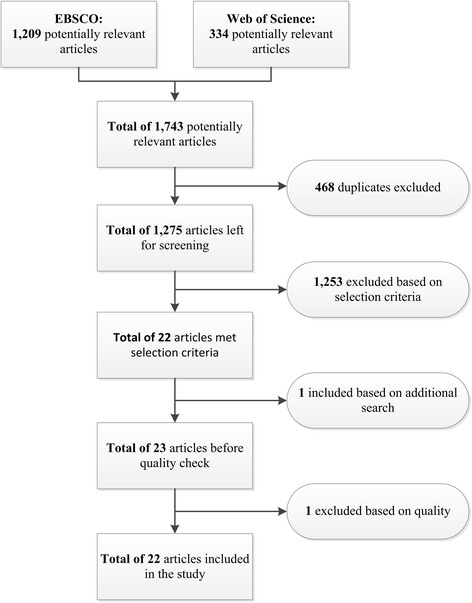
BACKGROUND: Since the emergence of social media in 2004, a growing percentage of patients use this technology for health related reasons. To reflect on the alleged beneficial and potentially harmful effects of social media use by patients, the aim of this paper is to provide an overview of the extant literature on the effects of social media use for health related reasons on patients and their relationship with healthcare professionals. METHODS: We conducted a systematic literature review on empirical research regarding the effects of social media use by patients for health related reasons. The papers we included met the following selection criteria: (1) published in a peer-reviewed journal, (2) written in English, (3) full text available to the researcher, (4) contain primary empirical data, (5) the users of social media are patients, (6) the effects of patients using social media are clearly stated, (7) satisfy established quality criteria. RESULTS: Initially, a total of 1,743 articles were identified from which 22 were included in the study. From these articles six categories of patients' use of social media were identified, namely: emotional, information, esteem, network support, social comparison and emotional expression. The types of use were found to lead to seven identified types of effects on patients, namely improved self-management and control, enhanced psychological well-being, and enhanced subjective well-being, diminished subjective well-being, addiction to social media, loss of privacy, and being targeted for promotion. Social media use by patients was found to affect the healthcare professional and patient relationship, by leading to more equal communication between the patient and healthcare professional, increased switching of doctors, harmonious relationships, and suboptimal interaction between the patient and healthcare professional. CONCLUSIONS: Our review provides insights into the emerging utilization of social media in healthcare. In particular, it identifies types of use by patients as well as the effects of such use, which may differ between patients and doctors. Accordingly, our results framework and propositions can serve to guide future research, and they also have practical implications for healthcare providers and policy makers.
Overview
The claims and statistics of this paper haven’t been checked yet.
Run the check — free, no account needed. It reads the open-access text and checks the sources it cites.
Integrity signals
Registry
Cites
Statistics
Figures
Verification
Claims the paper makes
The claims and statistics of this paper haven’t been checked yet.
Run the check — free, no account needed. It reads the open-access text and checks the sources it cites.
Claims other papers make about this one
Each is checked against this paper’s own text: does it say what the citing paper says it does?
The source backs part of the claim, not all of it — or backs it for a different population, condition or comparison.
In the citing paper
“Health promotion on social media also encouraged patients to seek medical attention more willingly [11].”
From Social Media Use Among Parents and Caregivers of Children With Rare Genetic Diseases: Scoping Review (2025) · cites this paper as [11]
Experimental — accuracy not yet measuredThe source backs part of the claim, not all of it — or backs it for a different population, condition or comparison.
In the citing paper
“Most patients discuss information they have found online with their health care provider”
From Social Media Use Among Parents and Caregivers of Children With Rare Genetic Diseases: Scoping Review (2025) · cites this paper as [11]
Experimental — accuracy not yet measuredThe source backs part of the claim, not all of it — or backs it for a different population, condition or comparison.
In the citing paper
“however, physicians often react negatively to discussions involving information sourced from social media [11-13].”
From Social Media Use Among Parents and Caregivers of Children With Rare Genetic Diseases: Scoping Review (2025) · cites this paper as [11]
Experimental — accuracy not yet measuredThe cited source says what the claim attributes to it.
In the citing paper
“Prior literature has highlighted both benefits and risks of social media in healthcare,4–13 but there remains limited understanding of how generational perspectives shape views of professionalism in healthcare social media use.”
From Evaluating perceptions of social media professionalism by healthcare workers (2026) · cites this paper as [5]
The cited source says what the claim attributes to it.
In the citing paper
“Social media use is also related to shorter relationships with health care providers, as online discussions prompted patients to seek specific providers [11].”
From Social Media Use Among Parents and Caregivers of Children With Rare Genetic Diseases: Scoping Review (2025) · cites this paper as [11]
The cited source says what the claim attributes to it.
In the citing paper
“social media empowers patients to be more informed and involved in their own care”
From Social Media Use Among Parents and Caregivers of Children With Rare Genetic Diseases: Scoping Review (2025) · cites this paper as [11]
The cited source says what the claim attributes to it.
In the citing paper
“allowing for improved communication with medical professionals [11,12].”
From Social Media Use Among Parents and Caregivers of Children With Rare Genetic Diseases: Scoping Review (2025) · cites this paper as [11]
The check wasn’t confident either way, so it gives no verdict — never disputed.
In the citing paper
“popularity of SM has also been embraced by health care professionals (HCPs) [5].”
From Dangers and Benefits of Social Media on E-Professionalism of Health Care Professionals: Scoping Review (2021) · cites this paper as [5]
Experimental — accuracy not yet measured
Self-check
Percentages, sums and reported differences re-computed from the paper’s own numbers.
The self-check needs the paper’s full text.
Citations
Cites
Preferred Reporting Items for Systematic Reviews and Meta-Analyses: the PRISMA statement
Moher, D., Liberati, A., Tetzlaff, J., Altman, D. G., & for the PRISMA Group (2009) · BMJ · doi:10.1136/bmj.b2535 · Cited by 83,823
Preferred reporting items for systematic reviews and meta-analyses: the PRISMA Statement.
(2009) · PubMed Central · Cited by 44,859
Users of the world, unite! The challenges and opportunities of Social Media
Kaplan, A. M., & Haenlein, M. (2010) · Business Horizons · doi:10.1016/j.bushor.2009.09.003 · Cited by 17,875 · cited 4×
“Among other uses, blogs can be used as personals diaries to express thoughts, feelings, and stories [9].”
BackgroundMethodInfluentialHappiness is everything, or is it? Explorations on the meaning of psychological well-being.
Ryff, C. D. (1989) · Journal of Personality and Social Psychology · doi:10.1037/0022-3514.57.6.1069 · Cited by 14,847 · cited 2×
“Moreover, “self-actualizers are described as having strong feelings of empathy and affection for all human beings and as being capable of greater love, deeper friendship, and more complete identification with others” [33].”
BackgroundPower, politics, and MIS implementation
Markus, M. L. (1983) · Communications of the ACM · doi:10.1145/358141.358148 · Cited by 2,224 · cited 1×
“According to the political variant of the interaction theory [49], “a product of the interaction of system”
BackgroundSocial capital, self-esteem, and use of online social network sites: A longitudinal analysis.
Steinfield, C., Ellison, N. B., & Lampe, C. (2008) · Journal of Applied Developmental Psychology · doi:10.1016/j.appdev.2008.07.002 · Cited by 1,919
Social Support Measurement and Intervention
(2000) · Oxford University Press eBooks · doi:10.1093/med:psych/9780195126709.001.0001 · Cited by 1,887 · cited 1×
“process of interaction in relationships which is intended to improve coping, esteem, belonging, and competence through actual or perceived exchanges of psychosocial resources” [19].”
BackgroundStandard Quality Assessment Criteria for Evaluating Primary Research Papers from a Variety of Fields
Kmet, L. M., Cook, L. S., & Lee, R. C. (2004) · University of Alberta Library · doi:10.7939/r37m04f16 · Cited by 1,682 · cited 3×
“The articles were assessed on their quality by using the standard quality assessment criteria as identified by [12].”
MethodInfluentialThe health-related functions of social support
Schaefer, C. A., Coyne, J. C., & Lazarus, R. S. (1981) · Journal of Behavioral Medicine · doi:10.1007/bf00846149 · Cited by 1,326 · cited 2×
“Social support is represented through five different categories and four of these categories were found to be common types of social media use by patients for health related purposes [18].”
BackgroundThe decision and the organization
MacDougall, C. D., & Wilson, H. (1965) · Marzani & Munsell eBooks · Cited by 1,149
Research works printed but not linked: 4
- Williams J. A new roadmap for healthcare business success. J Healthc Financ Manage Assoc. 2011;65(5):62–9.
- Mattson M, Hall JG. Health as communication nexus: A service-learning approach. Dubuque: Kendall Hunt; 2011.
- Sahoo FM, Mohapatra L. Psychological well-Being in professional groups. J Indian Acad Appl Psychol. 2009;35(2):211–7.
- Simon HA. Decision and organization. Amsterdam: North-Holland Publishing; 1972.
Cited by
Sorted by citations
Items 501–600 of 825
Barberá, M. G., Puche, J. F. M., Delsors-Merida-Nicolich, E., Royloa, C. T., Sánchez, J. A., Muñoz, P. Á. A., & Torroja, M. S. (2021) · Revista Clínica de Medicina de Familia · doi:10.55783/rcmf.140303 · Cited by 2
Diabetes in Old Age: Particularities and Specifics
Weber, P., Weberová, D., & Meluzínová, H. (2023) · IntechOpen eBooks · doi:10.5772/intechopen.1002479 · Cited by 2
The Development Of The Use Of Social Media Marketing Rs: How Far Has It Been?
Ongko, T. (2023) · Jurnal Indonesia Sosial Teknologi · doi:10.59141/jist.v4i11.793 · Cited by 2
“…that have been set by RS so that the selection of platforms is more in line with the goals set by RS. (Richter, Muhlestein, & Wilks, 2014) (Smailhodzic, Hooijsma, Boonstra, & Langley, 2016) It is necessary to determine the target that will be targeted, for example, young age is very…”
BackgroundResultDecoding Online Teeth Whitening Videos and Social Media Complexities
Αντωνιάδου, Μ., Tzortzakaki, A. S., Chatzidaki, Z., & Αντωνιάδου, Μ. (2024) · Online Journal of Dentistry & Oral Health · doi:10.33552/ojdoh.2024.07.000674 · Cited by 3
Personal Illness Experience in Russian Social Media: Between Willingness to Share and Stigmatization
Dudina, V. I., Judina, D. I., & Platonov, K. (2019) · Lecture notes in computer science · doi:10.1007/978-3-030-34770-3_4 · Cited by 2
Ducci, G. (2020) · SALUTE E SOCIETÀ · doi:10.3280/ses2020-001010 · Cited by 2
Ottwell, R., Hartwell, M. L., Beswick, T., Rogers, T., Ivy, H., Goodman, M., & Vassar, M. B. (2020) · JMIR Dermatology · doi:10.2196/24124 · Cited by 2
Altinok, K., Erdsiek, F., Yılmaz-Aslan, Y., & Brzoska, P. (2021) · BMC Health Services Research · doi:10.1186/s12913-021-07354-8 · Cited by 2
“Taking into account guidelines and recommendations for the analysis of data from social media and secondary data analysis, no further ethical endorsement was required for this analysis [18, 19, 32, 33].”
BackgroundMethodA critical analysis of the social media policies in Ontario's healthcare system
Zakkar, M. A., Meyer, S. B., & Janes, C. R. (2021) · International Journal of Health Governance · doi:10.1108/ijhg-03-2021-0032 · Cited by 2
The Impact of Social Media on Daily Medical Practice in the Middle East and North Africa
Labaki, C., Rassy, E., & Ghosn, M. G. (2021) · The Annals of Thoracic Surgery · doi:10.1016/j.athoracsur.2020.11.075 · Cited by 2
Giroux, C. M., Sikora, L., Bussières, A., Ellaway, R., & Thomas, A. (2021) · doi:10.31219/osf.io/te3h5 · Cited by 2
Decoding Online Teeth Whitening Videos: Navigating Social Media ComplexitiesPreprint
Tziovara, P., Tzortzakaki, A. S., Chatzidaki, Z., & Αντωνιάδου, Μ. (2024) · Preprints.org · doi:10.20944/preprints202401.0630.v1 · Cited by 2
Rheumatology on Reddit: A Descriptive AnalysisPreprint
Madrid-García, A., & Barbancho, B. M. (2024) · Research Square · doi:10.21203/rs.3.rs-4450516/v1 · Cited by 2
Social Media in Health Care: A Double-edged Weapon
Naik, S. B. (2025) · APIK Journal of Internal Medicine · doi:10.4103/ajim.ajim_9_25 · Cited by 2
Evaluating perceptions of social media professionalism by healthcare workers
Dalton, C., Sarwar, Z., Garwe, T., & Hunter, C. J. (2026) · DIGITAL HEALTH · doi:10.1177/20552076251411281 · Cited by 1
Darginavičienė, D., Gedrimė, L., Dautarienė, B., & Kučinskienė, A. (2022) · Health Sciences · doi:10.35988/sm-hs.2022.071 · Cited by 1
B2, K. J. P. P. (2021) · Indian Journal of Forensic Medicine & Toxicology · doi:10.37506/ijfmt.v15i1.13440 · Cited by 2
What's trending: An analysis of posts by TikTok users undergoing orthodontic treatment
Murray, C., Riordan, D., Murray, D. M., & Singh, P. (2022) · BDJ In Practice · doi:10.1038/s41404-022-1710-2 · Cited by 1
Third Party Reproduction – What’s Trending on Instagram?
Peyser, A., Wede, K., & Mullin, C. M. (2023) · JBRA · doi:10.5935/1518-0557.20230033 · Cited by 1
Navigating a rapidly changing information and communication landscape amidst “infodemics”
Cuyvers, J., Passanante, A., Pertwee, E., Paterson, P., Lin, L. K., & Larson, H. J. (2023) · Elsevier eBooks · doi:10.1016/b978-0-323-90945-7.00023-3 · Cited by 1
ANALYSIS OF INSTAGRAM POSTS ABOUT ORTHOGNATHIC SURGERY: A METHODOLOGICAL STUDY
Eberliköse, H., AKBARİHAMED, R., & Karasu, H. A. (2023) · ADO Klinik Bilimler Dergisi · doi:10.54617/adoklinikbilimler.1325423 · Cited by 1
Baquiran, C. A. C., Bucao, R. B. I., Bulaong, G. J. S. A., Esguerra, M. D., Flores, A. E., & Joaquin, M. C. B. (2023) · Globus An International Journal of Management & IT · doi:10.46360/globus.mgt.120231007 · Cited by 1
TikTok talks teeth: a quantitative and qualitative analysis of fixed appliance related TikTok videos
Mei, L., Wang, Z., Guo, O., Zhang, L., & Guan, G. (2024) · Australasian Orthodontic Journal · doi:10.2478/aoj-2024-0005 · Cited by 1
The impact of alopecia areata on patients' daily lives: A study using social media in France
Barbarot, S., Reguiai, Z., Voillot, P., Malaab, J., Schück, S., & Tamzali, A. (2024) · JEADV Clinical Practice · doi:10.1002/jvc2.539 · Cited by 1
Jeltsch, C., & Berger‐Höger, B. (2024) · Zeitschrift für Evidenz Fortbildung und Qualität im Gesundheitswesen · doi:10.1016/j.zefq.2024.09.001 · Cited by 1
Ahmet, S., Balcı, A. S., Atik, B. K., Topçu, H., & Kırgız, A. (2025) · Lasers in Medical Science · doi:10.1007/s10103-025-04299-w · Cited by 1
Discourse patterns of affective stance in paediatric online consultative encounters
Olajimbiti, E. O., & Ayoola, S. O. (2025) · Language and Semiotic Studies · doi:10.1515/lass-2024-0054 · Cited by 1
Gombos, H. M. H., Krogstad, T., Bjørknes, M. R., Sletvold, H., Hagen, M., & Svensberg, K. (2025) · Exploratory Research in Clinical and Social Pharmacy · doi:10.1016/j.rcsop.2025.100611 · Cited by 1
“Many people share their experiences or opinions in online comment sections, 18 and customers may rely on the experiences of relatives and friends.”
Administrative Considerations in Providing Patient-Centered Care in the Digital Age
Silverman, M. (2025) · Springer eBooks · doi:10.1007/978-3-031-85546-7_20 · Cited by 1
Social marketing and digital health misinformation: Bibliometric analysis of a decade of research
de Assis, W. M., & Pascuci, L. M. (2025) · International Review on Public and Nonprofit Marketing · doi:10.1007/s12208-025-00446-9 · Cited by 1
“However, although social media can support users, supplement offline information, and empower patients, the spread of false or misleading information on these platforms presents a significant threat to public health (Smailhodzic et al., 2016).”
Ethical transgressions among healthcare professionals in South Africa from 2014 to 2023
Pontarelli, M. A., Gezu, Y., Nortjé, M., Truong, G., Ravi, N., Baldassarre, A. J., Hoffmann, W. A., & Nortjé, N. (2025) · Health SA Gesondheid · doi:10.4102/hsag.v30i0.3053 · Cited by 1
“The spread of misinformation through increased social media use has resulted in patients reporting suboptimal interactions during healthcare visits and an increase in patients switching who they seek care from (Smailhodzic et al. 2016).”
Mackie, S. L., Arun, P., Padmanabhan, V., Arjona‐Sánchez, Á., & Kullman, J. A. (2025) · Rheumatology Advances in Practice · doi:10.1093/rap/rkaf140 · Cited by 1
“Furthermore, patients may join online health communities to seek emotional support and to understand lived experiences that differ from those typically provided by their HCPs [25].”
Melhem, S. J., Almomani, H., Mousa, R., Alefan, Q., Mazrouei, N. A., Mohammed, B. A., Amrani, I., Darwish, R. M., Tubeileh, R., Alrashdan, Y., et al. (2025) · Exploratory Research in Clinical and Social Pharmacy · doi:10.1016/j.rcsop.2025.100697 · Cited by 1
“5 Maximizing the impact of pharmacists online requires more than individual effort.”
#Cartilage: TikTok Videos on Cartilage Surgery Demonstrate Low Quality and Limited Educational Value
Kayali, M. K. D. E., Bürck, L. V., Fahy, S., Getgood, A. M. J., Bartek, B., Jung, T., & Oehme, S. (2025) · Cartilage · doi:10.1177/19476035251408206 · Cited by 1
“13 18-23 This issue is particularly relevant for TikTok (ByteDance Ltd., Beijing, China), a rapidly expanding platform where medical content is widely shared yet largely unregulated.”
Evaluating the Content, Quality, and Reliability of Migraine-related Videos on TikTok in China
Guo, Y., Ma, Z., Xue, J., Zhou, X., Wang, L., & Dong, C. (2025) · CIN Computers Informatics Nursing · doi:10.1097/cin.0000000000001380 · Cited by 1
Swipe, watch, learn? An analysis of TikTok as a source of patient education on spondylolisthesis
Akta, C., Kayali, M. K. D. E., Schönnagel, L., Bürck, L. V., Muellner, M., Schömig, F., Pumberger, M., & Folkerts, T. (2026) · Brain and Spine · doi:10.1016/j.bas.2026.105960 · Cited by 1
“Over the past decade, social media has become a central medium for the dissemination of health-related information (Smailhodzic et al., 2016; Sylvia Chou et al., 2020; Rodrigues et al., 2024; Wharton et al., 2025).”
Youth Engagement with Social Media Skits for Health Awareness in Nigeria
Olumuji, E. O., & Akerele, I. (2025) · De-centre Journal of Interdisciplinary Studies · doi:10.36615/chctt594 · Cited by 1
“…patients and foster their autonomy while complementing the information provided by healthcare professionals and by providing psychosocial support (Smailhodzic et al., 2016) Gharamani, et al. (2022) assert that social media in health promotions campaign is of high importance to health educators,…”
Kheirandish, S., Javadzadeh, H., Mahmoodi, M., Mousavi, S. H., & Abbasi, H. (2026) · BMC Public Health · doi:10.1186/s12889-026-26315-6 · Cited by 1
Bayarassou, O., & Zhu, V. (2026) · International Journal of Pharmaceutical and Healthcare Marketing · doi:10.1108/ijphm-09-2025-0201 · Cited by 1
Zhu, Y., Xie, Q., & Zhao, X. (2026) · Health Communication · doi:10.1080/10410236.2026.2634889 · Cited by 1
TÜRKÇE YOUTUBE VİDEOLARINDA İMMÜNOTERAPİ: KALİTE, GÜVENİRLİK VE BİLGİ İÇERİĞİNİN DEĞERLENDİRİLMESİ
Seyyar, M., & Şahin, E. (2026) · Acta Medica Nicomedia · doi:10.53446/actamednicomedia.1850758 · Cited by 1
Mazzucato, M., Savastano, M., & Iudici, A. (2026) · Behavioral Sciences · doi:10.3390/bs16030357 · Cited by 1
“In parallel, training pathways for health-care professionals may benefit from incorporating competencies related to digital health promotion and to the psychological mechanisms that underlie effective and problematic digital engagement (Smailhodzic et al., 2016).”
Suter, M. B., D’Antona, R., Mazza, M., Francavilla, E., Messi, A., Maurya, A., Padhi, S., & Valsecchi, D. (2026) · JMIR Cancer · doi:10.2196/73371 · Cited by 2
“This aligns with previous research that indicated that patients are increasingly turning to online platforms for emotional and informational support [16, 30].”
Ethical considerations of social media use for surgeons
Fong, C., Park, K., Rosen, C. B., Ferreres, A. R., & McDonald, M. (2026) · Surgical Endoscopy · doi:10.1007/s00464-026-12770-0 · Cited by 1
“Patients could utilize images and videos outlining the results to either convey a realistic sense of what is to come or, if not properly reviewed, come away with unrealistic expectations of heavily edited images [20].”
#KneeOsteotomy: Evaluation of the Quality and Educational Value of TikTok Videos
Kayali, M. K. D. E., Bürck, L. V., Fahy, S., Getgood, A. M. J., Bartek, B., Jung, T., & Oehme, S. (2026) · Orthopaedic Journal of Sports Medicine · doi:10.1177/23259671261428460 · Cited by 1
“50 Despite this potential benefit, studies indicate that only a small fraction of medically oriented SM content is produced by board-certified professionals.”
Yılmaz, N. A., Akkoçan, B. A., Akkoçan, O., & Ulucan, S. E. (2026) · Healthcare · doi:10.3390/healthcare14101376 · Cited by 1
“…established parameter exists for formal a priori sample size calculation in hashtag-based Instagram content analyses using Top Posts sampling, the sample size was determined pragmatically based on feasibility and consistency with the upper range of comparable dental social media studies [3,6,12].”
Hamdan, R. H. B., Alwadi, M. A. M., Alsadhan, S. A., & AlJameel, A. H. (2026) · BMC Public Health · doi:10.1186/s12889-026-27951-8 · Cited by 1
Analysis of cervical cancer content on Instagram
Rodrigues, L. O., Pantoja, L. J. D., de Araújo, B. G., Barbosa, N. G., Gozzo, T. D. O., Gomes-Sponholz, F. A., & Mendes, L. M. C. (2026) · Cogitare Enfermagem · doi:10.1590/ce.v31i0.101891en · Cited by 1
Cassalia, F., Danese, A., D’Acunto, C., Russo, A., Zengarini, C., Plaça, M. L., Ciolfi, C., Scolaro, F., Stanganelli, I., Cusano, F., et al. (2026) · Dermatology Practical & Conceptual · doi:10.5826/dpc.1602a6556 · Cited by 1
Automatic Classification of Forum Posts: A Finnish Online Health Discussion Forum Case
Gencoglu, O. (2017) · World Congress on Medical Physics and Biomedical Engineering, September 7 - 12, 2009, Munich, Germany · doi:10.1007/978-981-10-5122-7_43 · Cited by 1
Ontology for Facebook in Relation to Ibn Khaldun Ethics: A Systematic Review
Najid, M. H. M., Zulkifli, Z., & Othman, R. (2018) · The Turkish Online Journal of Design Art and Communication · doi:10.7456/1080sse/151 · Cited by 1
Alakhrass, H., Alenazi, W., & Al-Akhrass, S. K. (2020) · Health · doi:10.4236/health.2020.122011 · Cited by 1
“It can also be used to communicate health care advice, promote a healthy lifestyle, and communicate medical emergencies as well as facilitate post-clinical communications [1].”
BackgroundInfluentialAufa, B. A., Djawas, F. A., & Sulistiadi, W. (2020) · International Conference on Informatics, Multimedia, Cyber and Information System (ICIMCIS) · doi:10.1109/icimcis51567.2020.9354294 · Cited by 1
“(2016) and Ventola (2014) found the impact of hospitals’ social media for the providers' and individuals’ perspectives [11], [15].”
BackgroundHitelesség és bizonytalanság a kommunikációban a COVID-19 idején
Hetesi, E., & Juhász, Z. (2021) · Közösségi Kapcsolódások - tanulmányok kultúráról és oktatásról · doi:10.14232/kapocs.2021.1-2.146-160 · Cited by 1
Role of Digital Media in Spreading Covid-19 Awareness- Structural Equation Modelling based Study
(2021) · International Journal of Advanced Trends in Computer Science and Engineering · doi:10.30534/ijatcse/2021/281042021 · Cited by 1
“Another study to examine the accessibility and role of digital media to disseminate healthcare information was conducted by [20].”
BackgroundAlslakhi, M. H. R., Öz, U., & Sin, C. (2022) · Applied Nanoscience · doi:10.1007/s13204-021-02116-8 · Cited by 1
RetractedInfluence of Health Social Networks on Healthcare: A Systematic Literature Review
Makena, N., & Adebesin, F. (2022) · EPiC series in computing · doi:10.29007/pcw4 · Cited by 1
Akrout, M., Amdouni, H., Feriani, A., Kourda, M., & Abid, L. (2022) · Lecture notes in computer science · doi:10.1007/978-3-031-23223-7_4 · Cited by 1
The Role of Social Media in Cosmetic Dermatology
Fernandes, S. M. B., Ravi, S. S., Shah, S. M., Iqbal, M. M., Vaniyawala, V. D., & Shaikh, M. (2022) · Mathews Journal of Dermatology · doi:10.30654/mjde.10017 · Cited by 1
“Studies show that this is going towards improved patient well-being [15].”
BackgroundMajdizadeh, G., Kazami, F., Eghtesad, S., Mohajerani, M., Mirali, Z., & Movahhedi, A. (2022) · Studies in Medical Sciences · doi:10.52547/umj.33.5.379 · Cited by 1
YouTube® en español como fuente de información para pacientes con hepatitis autoinmune
Moreno, C. E. L., Múñoz, Ó., Fernández-Ávila, D. G., Correa, J. E. B., Aranguren, H. C., & Avila, F. A. (2023) · Revista de Gastroenterología de México · doi:10.1016/j.rgmx.2023.03.006 · Cited by 1
“Exhaustividad, mediana (RIC) 4 (3-5) 4 (3-5) 2 (1.”
Social media as a new platform for nutritional and health messages
Campbell, J. L., & Bogueva, D. (2023) · Elsevier eBooks · doi:10.1016/b978-0-323-85615-7.00019-7 · Cited by 1
YouTube® in Spanish as an information source for patients with autoimmune hepatitis
Moreno, C. E. L., Múñoz, Ó., Fernández-Ávila, D. G., Correa, J. E. B., Aranguren, H. C., & Ávila, F. (2023) · Revista de Gastroenterología de México (English Edition) · doi:10.1016/j.rgmxen.2023.03.007 · Cited by 1
Swarm Intelligence Analysis of Healthcare Prediction Techniques Based on Social Media Data
Kandasamy, M., Shanmugam, R., Chhabhadiya, T. V., Adesara, H. K., & Sunnapu, P. (2023) · Advances in healthcare information systems and administration book series · doi:10.4018/978-1-6684-6894-4.ch006 · Cited by 1
MEDICAL INFORMATION SHARING IN ONLINE SOCIAL MEDIA
Ades, A. S., & Ades, A. S. (2023) · Journal of Southwest Jiaotong University · doi:10.35741/issn.0258-2724.58.4.11 · Cited by 1
van Capelleveen, M. C., & Slot, D. E. (2023) · International Journal of Dental Hygiene · doi:10.1111/idh.12764 · Cited by 1
Iskandar, K., Hallit, S. R., Haddad, C., Irfan, M., Fekih‐Romdhane, F., Jabeen, R., Cherfane, M., Makhoul, E., Akel, M., Khatib, S. E., et al. (2023) · Pharmacy Education · doi:10.46542/pe.2023.231.676692 · Cited by 1
Apomediation and Disintermediation: YouTube Prescribers on Fad Diets
Castillo-Abdul, B., Blanco‐Herrero, D., & Romero-Rodríguez, L. M. (2023) · The Open Public Health Journal · doi:10.2174/0118749445258342231019095822 · Cited by 1
Measuring Health Information-Seeking Behavior: The Online Self-care Scale
Bertolazzi, A., Lombi, L., & Terraneo, M. (2023) · SALUTE E SOCIETÀ · doi:10.3280/ses2023-003013 · Cited by 2
Soboń, M. (2023) · Procedia Computer Science · doi:10.1016/j.procs.2023.10.055 · Cited by 1
Sivasegaran, S., & Hanafi, N. S. (2023) · Malaysian Family Physician · doi:10.51866/oa.428 · Cited by 1
Montero-Liberona, C., Abuín-Penas, J., & Vilches-González, H. (2024) · Vivat Academia · doi:10.15178/va.2024.157.e1535 · Cited by 1
Mi día a día con una ostomía: el rol del paciente influencer en Instagram
García, A. M., Buitrago, Á., & Martínez-Sanz, R. (2024) · Contratexto · doi:10.26439/contratexto2024.n41.6851 · Cited by 1
“Con este acercamiento a su lado más personal, se pretende la identificación, lo cual lleva a que el receptor lo perciba como realista y, en consecuencia, brinde su confianza (Smailhodzic et al., 2016).”
BackgroundMasson, M., Roose, P., Sallaberry, C., Bessagnet, M.-N., Parc, A. L., & Agerri, R. (2024) · Social Network Analysis and Mining · doi:10.1007/s13278-024-01282-1 · Cited by 1
Malhotra, A. K., Vereen, R. J., Gautham, K. S., King, B., & Mitra, S. (2024) · Newborn · doi:10.5005/jp-journals-11002-0108 · Cited by 1
Qureshi, T., Fatima, K., Sennimalai, K., & Kharbanda, O. P. (2025) · Cureus · doi:10.7759/cureus.78164 · Cited by 2
Use of TikTok by nutrition healthcare professionals: a pilot analysis of the Italian context
Scaioli, G., Bert, F., Durbano, A., Pivi, A., Moro, G. L., & Siliquini, R. (2025) · Discover Public Health · doi:10.1186/s12982-025-00455-3 · Cited by 1
“They respect the “canons” of this platform (short videos usually follow specific trends) to broaden their audience [6, 12–15].”
Sood, A., Hui, Y., Turnbull, S., Silva, K. D., Bhaskaran, A., Campbell, T. G., Bennett, R. G., Wong, M. S., & Kumar, S. (2025) · Journal of Arrhythmia · doi:10.1002/joa3.70026 · Cited by 1
“5,33 However, the skills necessary to utilize technology and navigate the Internet add additional barriers that may impair patients' ability to access useful information, a concept coined ‘electronic health literacy’.”
The US healthcare system facilitates medical conspiracy theories: A call to action
Bobier, C., & Obeid, J. (2025) · Ethics Medicine and Public Health · doi:10.1016/j.jemep.2025.101090 · Cited by 1
Evaluation of video content quality on PCSK9 inhibitors in social media
David-Pardo, D. G., Correa, J. E. B., Herrera-Leaño, N., Calvo-Betancourt, L. S., Múñoz, Ó., Fernández-Ávila, D. G., & Peña, Á. A. G. (2025) · Clínica e Investigación en Arteriosclerosis · doi:10.1016/j.arteri.2025.500829 · Cited by 1
Digital Dialogs on Rhesus Incompatibility: A Thematic Analysis of Web-Based Parental Narratives
Çeri, A., & Gültekin, N. D. (2025) · Transfusion Medicine and Hemotherapy · doi:10.1159/000547554 · Cited by 1
Leg pains in CHD: a distressing symptom of a wider problem
Hutchinson, S., Crossland, D. S., Chaudhry, B., & Coats, L. (2018) · Cardiology in the Young · doi:10.1017/s104795111800094x · Cited by 1
“The relationship with the healthcare professional is generally viewed by patients as a clinical one, where the professional provides expertise and treatment based on medical knowledge, but not first-hand experience.(23,24) Although patient groups can offer practical and emotional support between patients with similar…”
BackgroundMeasuring Relevant Information in Health Social Network Conversations and Clinical Diagnosis Cases
Moreira, A., Alonso-Calvo, R., Muñoz, A., & Crespo, J. (2018) · International Journal of Environmental Research and Public Health · doi:10.3390/ijerph15122787 · Cited by 1
“On the other hand, patients are actively using health networks available [4] that empower patients in terms of: emotional support, information about their disease, social comparison, or emotional expression (e.”
BackgroundAsgari, P., & Nazari, E. (2019) · Frontiers in Health Informatics · doi:10.30699/fhi.v8i1.182 · Cited by 1
Survey of patients with cystic fibrosis and caregivers decisions regarding CFTR modulators
George, A., Smith, B. A., Sawicki, G. S., & Goetz, D. (2020) · Pediatric Pulmonology · doi:10.1002/ppul.24926 · Cited by 1
“Furthermore, influences from family and social media affect the decision‐making process in health care, especially with regard to starting new medications.(4,5)”
BackgroundFedonnikov, A., Andriyanova, E. A., & Grishechkina, N. V. (2020) · Archiv Euromedica · doi:10.35630/2199-885x/2020/10/3.22 · Cited by 1
Community Detection in a Patient-Centric Social Network
Bissoyi, S., & Patra, M. R. (2020) · Advances in intelligent systems and computing · doi:10.1007/978-981-15-7394-1_17 · Cited by 1
Social Media als Datenquelle für Studien in den Pflege- und Gesundheitswissenschaften
Lauberger, J., & Lühnen, J. (2021) · Pflege · doi:10.1024/1012-5302/a000795 · Cited by 1
Shyagali, T. R., Rathore, A., Gupta, A., Tiwari, A., Kapoor, S., & Goyal, P. (2021) · The Journal of Indian Orthodontic Society · doi:10.1177/03015742211026249 · Cited by 1
Health Communication During the COVID-19 Pandemic in Hungary
Juhász, Z., & Hetesi, E. (2021) · Advances in marketing, customer relationship management, and e-services book series · doi:10.4018/978-1-7998-7263-4.ch007 · Cited by 1
Digital Data in Lupus: Metrics and Future Directions
Simard, J. F., Chaichian, Y., & Falasinnu, T. (2021) · Springer eBooks · doi:10.1007/978-3-030-73303-2_10 · Cited by 1
Pastuszak, A. W., Patel, D. P., Jenkins, L. C., Hsieh, T., Yafi, F. A., Mumford, S. L., Mulhall, J. P., & Hotaling, J. M. (2021) · The Journal of Sexual Medicine · doi:10.1016/j.jsxm.2021.10.003 · Cited by 1
Pandemic Information Dissemination Web Application: A Manual Design for Everyone
Jáuregui, O. N., & Téllez, L. A. Q. (2022) · International Journal of Computational Science Information Technology and Control Engineering · doi:10.5121/ijcsitce.2022.9101 · Cited by 1
“Nowadays, health professionals can communicate with each other in different parts of the world [13].”
Professional experience placements
Arnott, N., Eslick, M. M., & Podham, M. (2021) · Cambridge University Press eBooks · doi:10.1017/9781009003469.014 · Cited by 1
Knowledge of Social Media Users about COVID-19 and its Challenges: A Mixed Methods Study
Asadi, H., Garavand, A., Mokhayeri, Y., Rad, E. H., Gavyar, S. K. H., Torki, A., Ahmadi, P., Dezfooli, R. F. N., & Mohseni, M. (2022) · Shiraz E-Medical Journal · doi:10.5812/semj-119889 · Cited by 1
“With the worldwide development of information technology and the internet, social media as one of the main tools providing information and knowledge in healthcare has increased rapidly (17, 18).”
BackgroundHealth Communication During the COVID-19 Pandemic in Hungary
Juhász, Z., & Hetesi, E. (2022) · IGI Global eBooks · doi:10.4018/978-1-6684-7145-6.ch018 · Cited by 1
Odiboh, O. O., OMOKITI, O., Ekanem, T., & Oyedepo, T. (2022) · Journal of e-Health Management · doi:10.5171/2022.426434
Jamil, A., Shahzad, A., Tauseef, M., Akram, S., & Arsalan, S. A. (2022) · The Healer Journal of Physiotherapy and Rehabilitation Sciences · doi:10.55735/hjprs.v2i3.100 · Cited by 3
“More than 4 years 48 (14) 55 (17) 103 (32)”
de Mattos, C. X., & Cabral, I. E. (2023) · Online Brazilian Journal of Nursing · doi:10.17665/1676-4285.20236666 · Cited by 1
“Há evidências de que as mídias sociais melhoram a relação dos pacientes com os profissionais de saúde, mas o engajamento de enfermeira(o)s ainda é muito pequeno, quando comparado à potencialidade proporcionada pelas comunidades que se reúnem nessas mídias (2) .”
BackgroundAn mHealth Walking Intervention for Pregnant Women with Obesity
Senek, M. (2018) · Sheffield Hallam University · doi:10.7190/shu-thesis-00181 · Cited by 1
“The review found that this behaviour was linked to anxiety (143).”
Background
Metadata
- Authors
- Smailhodzic, E., Hooijsma, W., Boonstra, A., & Langley, D. J.
- Affiliations
- University of Groningen (NL)
- Netherlands Organisation for Applied Scientific Research (NL)
- Venue
- BMC Health Services Research
- Published
- 2016-08-26
- Volume
- 16
- Issue
- 1
- Pages
- 442-442
- ISSN
- 1472-6963 (ISSN-L)
- PMC
- PMC5000484
- OpenAlex
- W2512433998
- Cited by
- 827
- References
- 55
- Citations by year
- 2026: 75 · 2025: 107 · 2024: 107 · 2023: 99 · 2022: 111 · 2021: 127 · 2020: 96 · 2019: 61 · 2018: 29 · 2017: 14
- FWCI
- 6.51
- Type
- journal article
- Language
- en
- Open access
- gold
- doi.org
- Licence
- cc-by
- Locations
- BMC Health Services Research (publishedVersion, cc-by)
- PubMed Central (publishedVersion, cc-by)
- PubMed (publishedVersion)
- Data Archiving and Networked Services (DANS) (acceptedVersion)
- TNO Repository (submittedVersion)
- University of Groningen research database (University of Groningen / Centre for Information Technology) (submittedVersion, cc-by)
- Repository hosted by TU Delft Library (TU Delft) (submittedVersion)
- Topics
- Social Sciences › Health › Social Media in Health Education
- Health Sciences › Health Professions › General Health Professions › Health Literacy and Information Accessibility
- Social Sciences › Sociology and Political Science › Impact of Technology on Adolescents
- Keywords
- social media use, patient self-management, psychological well-being, subjective well-being, social media addiction, privacy loss, social comparison, network support, patient-physician communication
- MeSH terms
- Female, Health Personnel, Humans, Male, Professional-Patient Relations, Self Care, Consumer Health Information, Social Media
About these checks
Registry, retraction, Cites and statistics results are computed, not judged, with one exception: a printed reference that no index lists is read once by a model before it counts as a citation error. Claims are extracted by a model and kept only when their quote appears verbatim in the text; each cited source is then checked, with a model’s help, for whether it says what the claim relies on. Those verdicts can be wrong — read the claim’s quote and the cited source before relying on one.
Statistics and arithmetic are recomputed, not judged.
Confidence bands are shown only for fields calibrated on our annotated test set. None is calibrated yet, so no band is shown.
What counts as a claim ›How we measure confidence ›How we check this ›
Are you an author, or do you see a problem with this page? Request a review
