

The DOI matches its Crossref record; 55 of the 55 references it cites were found in a registry or an index.
Social media use in healthcare: A systematic review of effects on patients and on their relationship with healthcare professionals
Open accessAbstract
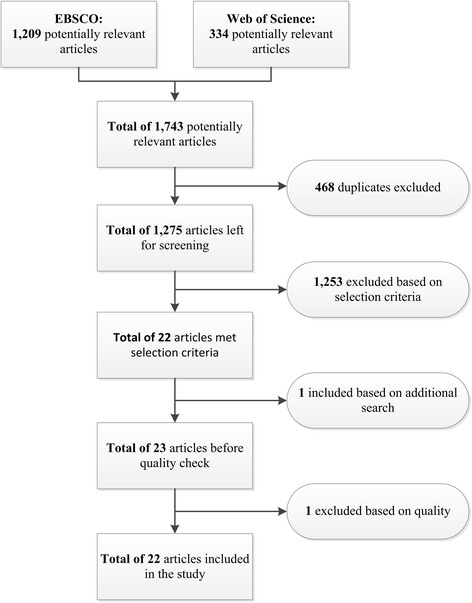
BACKGROUND: Since the emergence of social media in 2004, a growing percentage of patients use this technology for health related reasons. To reflect on the alleged beneficial and potentially harmful effects of social media use by patients, the aim of this paper is to provide an overview of the extant literature on the effects of social media use for health related reasons on patients and their relationship with healthcare professionals. METHODS: We conducted a systematic literature review on empirical research regarding the effects of social media use by patients for health related reasons. The papers we included met the following selection criteria: (1) published in a peer-reviewed journal, (2) written in English, (3) full text available to the researcher, (4) contain primary empirical data, (5) the users of social media are patients, (6) the effects of patients using social media are clearly stated, (7) satisfy established quality criteria. RESULTS: Initially, a total of 1,743 articles were identified from which 22 were included in the study. From these articles six categories of patients' use of social media were identified, namely: emotional, information, esteem, network support, social comparison and emotional expression. The types of use were found to lead to seven identified types of effects on patients, namely improved self-management and control, enhanced psychological well-being, and enhanced subjective well-being, diminished subjective well-being, addiction to social media, loss of privacy, and being targeted for promotion. Social media use by patients was found to affect the healthcare professional and patient relationship, by leading to more equal communication between the patient and healthcare professional, increased switching of doctors, harmonious relationships, and suboptimal interaction between the patient and healthcare professional. CONCLUSIONS: Our review provides insights into the emerging utilization of social media in healthcare. In particular, it identifies types of use by patients as well as the effects of such use, which may differ between patients and doctors. Accordingly, our results framework and propositions can serve to guide future research, and they also have practical implications for healthcare providers and policy makers.
Overview
The claims and statistics of this paper haven’t been checked yet.
Run the check — free, no account needed. It reads the open-access text and checks the sources it cites.
Integrity signals
Registry
Cites
Statistics
Figures
Verification
Claims the paper makes
The claims and statistics of this paper haven’t been checked yet.
Run the check — free, no account needed. It reads the open-access text and checks the sources it cites.
Claims other papers make about this one
Each is checked against this paper’s own text: does it say what the citing paper says it does?
The source backs part of the claim, not all of it — or backs it for a different population, condition or comparison.
In the citing paper
“Health promotion on social media also encouraged patients to seek medical attention more willingly [11].”
From Social Media Use Among Parents and Caregivers of Children With Rare Genetic Diseases: Scoping Review (2025) · cites this paper as [11]
Experimental — accuracy not yet measuredThe source backs part of the claim, not all of it — or backs it for a different population, condition or comparison.
In the citing paper
“Most patients discuss information they have found online with their health care provider”
From Social Media Use Among Parents and Caregivers of Children With Rare Genetic Diseases: Scoping Review (2025) · cites this paper as [11]
Experimental — accuracy not yet measuredThe source backs part of the claim, not all of it — or backs it for a different population, condition or comparison.
In the citing paper
“however, physicians often react negatively to discussions involving information sourced from social media [11-13].”
From Social Media Use Among Parents and Caregivers of Children With Rare Genetic Diseases: Scoping Review (2025) · cites this paper as [11]
Experimental — accuracy not yet measuredThe cited source says what the claim attributes to it.
In the citing paper
“Prior literature has highlighted both benefits and risks of social media in healthcare,4–13 but there remains limited understanding of how generational perspectives shape views of professionalism in healthcare social media use.”
From Evaluating perceptions of social media professionalism by healthcare workers (2026) · cites this paper as [5]
The cited source says what the claim attributes to it.
In the citing paper
“Social media use is also related to shorter relationships with health care providers, as online discussions prompted patients to seek specific providers [11].”
From Social Media Use Among Parents and Caregivers of Children With Rare Genetic Diseases: Scoping Review (2025) · cites this paper as [11]
The cited source says what the claim attributes to it.
In the citing paper
“social media empowers patients to be more informed and involved in their own care”
From Social Media Use Among Parents and Caregivers of Children With Rare Genetic Diseases: Scoping Review (2025) · cites this paper as [11]
The cited source says what the claim attributes to it.
In the citing paper
“allowing for improved communication with medical professionals [11,12].”
From Social Media Use Among Parents and Caregivers of Children With Rare Genetic Diseases: Scoping Review (2025) · cites this paper as [11]
The check wasn’t confident either way, so it gives no verdict — never disputed.
In the citing paper
“popularity of SM has also been embraced by health care professionals (HCPs) [5].”
From Dangers and Benefits of Social Media on E-Professionalism of Health Care Professionals: Scoping Review (2021) · cites this paper as [5]
Experimental — accuracy not yet measured
Self-check
Percentages, sums and reported differences re-computed from the paper’s own numbers.
The self-check needs the paper’s full text.
Citations
Cites
Preferred Reporting Items for Systematic Reviews and Meta-Analyses: the PRISMA statement
Moher, D., Liberati, A., Tetzlaff, J., Altman, D. G., & for the PRISMA Group (2009) · BMJ · doi:10.1136/bmj.b2535 · Cited by 83,823
Preferred reporting items for systematic reviews and meta-analyses: the PRISMA Statement.
(2009) · PubMed Central · Cited by 44,859
Users of the world, unite! The challenges and opportunities of Social Media
Kaplan, A. M., & Haenlein, M. (2010) · Business Horizons · doi:10.1016/j.bushor.2009.09.003 · Cited by 17,875 · cited 4×
“Among other uses, blogs can be used as personals diaries to express thoughts, feelings, and stories [9].”
BackgroundMethodInfluentialHappiness is everything, or is it? Explorations on the meaning of psychological well-being.
Ryff, C. D. (1989) · Journal of Personality and Social Psychology · doi:10.1037/0022-3514.57.6.1069 · Cited by 14,847 · cited 2×
“Moreover, “self-actualizers are described as having strong feelings of empathy and affection for all human beings and as being capable of greater love, deeper friendship, and more complete identification with others” [33].”
BackgroundPower, politics, and MIS implementation
Markus, M. L. (1983) · Communications of the ACM · doi:10.1145/358141.358148 · Cited by 2,224 · cited 1×
“According to the political variant of the interaction theory [49], “a product of the interaction of system”
BackgroundSocial capital, self-esteem, and use of online social network sites: A longitudinal analysis.
Steinfield, C., Ellison, N. B., & Lampe, C. (2008) · Journal of Applied Developmental Psychology · doi:10.1016/j.appdev.2008.07.002 · Cited by 1,919
Social Support Measurement and Intervention
(2000) · Oxford University Press eBooks · doi:10.1093/med:psych/9780195126709.001.0001 · Cited by 1,887 · cited 1×
“process of interaction in relationships which is intended to improve coping, esteem, belonging, and competence through actual or perceived exchanges of psychosocial resources” [19].”
BackgroundStandard Quality Assessment Criteria for Evaluating Primary Research Papers from a Variety of Fields
Kmet, L. M., Cook, L. S., & Lee, R. C. (2004) · University of Alberta Library · doi:10.7939/r37m04f16 · Cited by 1,682 · cited 3×
“The articles were assessed on their quality by using the standard quality assessment criteria as identified by [12].”
MethodInfluentialThe health-related functions of social support
Schaefer, C. A., Coyne, J. C., & Lazarus, R. S. (1981) · Journal of Behavioral Medicine · doi:10.1007/bf00846149 · Cited by 1,326 · cited 2×
“Social support is represented through five different categories and four of these categories were found to be common types of social media use by patients for health related purposes [18].”
BackgroundThe decision and the organization
MacDougall, C. D., & Wilson, H. (1965) · Marzani & Munsell eBooks · Cited by 1,149
Research works printed but not linked: 4
- Williams J. A new roadmap for healthcare business success. J Healthc Financ Manage Assoc. 2011;65(5):62–9.
- Mattson M, Hall JG. Health as communication nexus: A service-learning approach. Dubuque: Kendall Hunt; 2011.
- Sahoo FM, Mohapatra L. Psychological well-Being in professional groups. J Indian Acad Appl Psychol. 2009;35(2):211–7.
- Simon HA. Decision and organization. Amsterdam: North-Holland Publishing; 1972.
Cited by
Sorted by citations
Items 701–800 of 825
Valades, M. T., Fernandez-Lazaro, C. I., Lara-Abelenda, F. J., Montero-Torres, M., Cuberta, I., Ortega, M. A., Álvarez‐Mon, M., & Álvarez-Mon, M. Á. (2024) · doi:10.2196/preprints.67473
Fischbein, R. L., Welsh, H., Ernst-Milner, S., Adik, A., & Nicholas, L. (2024) · Midwifery · doi:10.1016/j.midw.2024.104216
An, M. H., Kim, M.-G., Kim, J., Chang, S., Lee, D. Y., & Park, R. W. (2024) · doi:10.2196/preprints.69023
The Issue Publics' De-Pathologization Strategies on Social Media
刘, 子. (2024) · Global Journal of Media Studies · doi:10.26599/gjms.2024.9330040
Characteristics of rheumatic patients who consult digital information sources
Germain, M. P. I., Ávila, P., Fara, N., Pretini, J., Gaona, M. E., Pissani, P., Saavedra, M. A., Aquino, V., Echazu, M. E., Laffont, M., et al. (2024) · Revista Colombiana de Reumatología (English Edition) · doi:10.1016/j.rcreue.2024.11.003
Reddit users’ perspectives on radiofrequency ablation: A data analysis
Furtado-Pessoa-de-Mendonca, L., Encalada, S., Mosquera‐Moscoso, J., Cascio, M. A., Hallo‐Carrasco, A., Eldrige, J. S., & Hunt, C. (2024) · Interventional Pain Medicine · doi:10.1016/j.inpm.2024.100535
Alshammari, S. M., Alsaif, B. E., & Hamid, A. A. (2024) · International Conference on Developments in eSystems Engineering (DeSE) · doi:10.1109/dese63988.2024.10911891
“Lately, social media usage in healthcare has recognized many implications of patients using social media for healthcare-related reasons within the healthcare system, and sometimes it can aid patients [13,14].”
Social Media Engagement Among Oculoplastic Surgeons in India: Patterns and Perceptions
Nair, A. (2025) · Cureus · doi:10.7759/cureus.80710
“…regarding diseases, treatment options, surgical videos, recovery, and healing times as well as patient testimonials, social media has clearly become an important source of information that allows patients to better prepare and understand their visits to the clinic and subsequent procedures [7].”
Can Watching a Surgical Operation From Youtube Videos Be Educational: An Observational Study
Geçkil, N. (2025) · Niğde Tıp Dergisi · doi:10.70846/nigdetip.1612150
Comparative Quality Analysis of Bullous Pemphigoid Information Across Six Social Media Platforms
Alkurdi, E., Li, R., Alkurdi, D., Alani, O., Patel, P., & Schwager, Z. A. (2025) · Cureus · doi:10.7759/cureus.81163
“These high DISCERN scores suggest YouTube’s effectiveness in delivering detailed and reliable health information through video content, likely due to the platform's capacity for longer, in-depth presentations [11].”
Vulnerabilidade e empoderamento: a experiência de consumidoras de pílulas contraceptivas hormonais
de Moraes, T. A., & de Abreu, N. R. (2025) · ReMark - Revista Brasileira de Marketing · doi:10.5585/2025.22729
Moroz, T., Taylor, M., Schmitt, P., Donovan, D. J., & Nori, M. (2025) · Future Rare Diseases · doi:10.1080/23995270.2025.2499402
Hidradenitis Suppurativa and Reddit: Assessing Gaps in Patient Education
Vaidyula, V. R., Ouellette, S., Lathrop, C., & Wassef, C. (2025) · Cureus · doi:10.7759/cureus.83736
“As a result, patients often turn to health-related social media and online forums for additional educational, emotional, and social support [4].”
Falcon, R. M. G., Babaran, H. G., Caragay, B. D. B., Cruz, R. P. S., Ferrer, A. N. A., Gonzalez, B. A. Q., & Isip-Tan, I. T. (2025) · Endocrine · doi:10.1007/s12020-025-04255-2
“Moreover, online platforms such as social media enable easier accessibility to networking opportunities between patients and caregivers, alike [12, 13].”
Valades, M. T., Fernandez-Lazaro, C. I., Lara-Abelenda, F. J., Montero-Torres, M., Cuberta, I., Ortega, M. A., Álvarez‐Mon, M., & Álvarez-Mon, M. Á. (2025) · JMIR Infodemiology · doi:10.2196/67473
“The active engagement of health care professionals and institutions on these platforms can help counteract misinfor-mation and provide trustworthy resources, particularly in digital environments where false information spreads rapidly [120,121].”
Silva, T. C., de Carvalho, A. G., Tholl, A. D., Rodríguez‐Borrego, M. A., López‐Soto, P. J., & Viegas, S. M. D. F. (2021) · Saúde em Debate · doi:10.1590/0103-1104202113117
Ahmed, E. M. (2025) · International Journal of Scientific and Management Research · doi:10.37502/ijsmr.2025.8517
“To maintain the quality and reliability of health information published via CVS Health's social media channels, the company must establish stringent content verification systems that combine human monitoring and AI (Smailhodzic et al., 2016).”
Bsoul, A. A. Y., Al-Maghaireh, D., Alsaqer, K., & Basyouni, N. (2025) · Palestinian medical and pharmaceutical journal/Palestinian medical & pharmaceutical journal · doi:10.59049/2790-0231.10.4.2514
Overcoming Health Fears: How do online peers help patients with chronic pain?
Rueger, J., Dolfsma, W. A., & Aalbers, R. (2025) · Social Science & Medicine · doi:10.1016/j.socscimed.2025.118297
Metformin and vitamin B12 deficiency - own observations from clinical practice
Weberová, D., Weber, P., & Meluzínová, H. (2025) · Klinická farmakologie a farmacie · doi:10.36290/far.2025.033
Lumbar Disc Surgery: Advances in the Last Few Decades
Abdelgawaad, A. S. (2025) · IntechOpen eBooks · doi:10.5772/intechopen.1010585
mHealth Continuance Behaviour Among People Living with HIV in Developing Countries: A Rapid Review
Odoke, W., & Ruhiu, S. (2025) · IST-Africa Conference (IST-Africa) · doi:10.23919/ist-africa67297.2025.11060568
Mohyeldin, M., Mohamed, F. O., Molina, M., Towfig, M. F., Mustafa, A., Elhussein, A. H., Alamin, F., Khaja, M., & Jadhav, P. (2025) · Cureus · doi:10.7759/cureus.87907 · Cited by 3
“…while NLP techniques, including sentiment analysis and topic modeling, have shown promise in analyzing patient-reported outcomes and social media data in other disease contexts [35,36], their specific application to understanding quality of life in HCM patients remains an area for future research.”
InfluentialExploring experiences of orthognathic surgery: A Reddit-based content analysis
Ngo, M. V., Jensen, E. D., & Meade, M. J. (2025) · Journal of the World Federation of Orthodontists · doi:10.1016/j.ejwf.2025.06.001
Şentürk, E. E., & Adıgüzel, M. N. (2025) · Erciyes İletişim Dergisi · doi:10.17680/erciyesiletisim.1633240 · Cited by 1
Morales, J., & Elias, C. A. E. (2025) · Clinical Practice and Epidemiology in Mental Health · doi:10.2174/0117450179393541250722062947
Govindaswamy, C., Bhargav, A. V. S., & Kumar, M. S. N. (2025) · Indian Journal of Psychiatric Nursing · doi:10.4103/iopn.iopn_4_24
Welcome to the EndoHood: A Scoping Review of Social Media Spaces for those with Endometriosis
Gamlin, C., & Swift, E. (2025) · Current Women s Health Reviews · doi:10.2174/0115734048376005250630124032
Jerrentrup, M. T., Besgen, V., & Sekundo, W. (2025) · Die Ophthalmologie · doi:10.1007/s00347-025-02286-8
Funnell, E. L., Martin-Key, N. A., Tomasik, J., & Bahn, S. (2025) · PLOS mental health. · doi:10.1371/journal.pmen.0000274
“However, given the changing relationship between the individual and healthcare providers in the digital age [11,12], it is important to re-evaluate the potential drivers of formal help-seeking.”
Requena‐Mullor, J. M., Garau, E., Quintas‐Soriano, C., López-Rodríguez, M. D., & Castro, A. A. (2025) · Computing · doi:10.1007/s00607-025-01551-7
“Social media provide a powerful avenue for health promotion, enabling communication between the public, patients, researchers, and health professionals, which can potentially improve health outcomes [54], but see [4].”
MFAKES: A Method for Fake News Analysis in Healthcare Area Focusing on COVID-19
dos Santos, S. C., de Elias, E. M., Marques, J., & da Cunha, A. M. (2025) · SN Computer Science · doi:10.1007/s42979-025-04373-8
Aasen, E. M., Vestgarden, L. A., & Dahl, B. M. (2025) · Journal of Advanced Nursing · doi:10.1111/jan.70241
Facilitators and barriers to care among individuals with osteogenesis imperfecta
Guo, S., Gedeon, F., Wiese, A. D., Qian, J. H., Morales, J. M., Shepherd, W. S., Colombo, G. M., Ayers, K., Cho, H., Rork, W. C., et al. (2025) · Psychology and Health · doi:10.1080/08870446.2025.2571593
“Social media was also brought up amongst caregivers as something that can increase knowledge and help foster a sense of community among those with OI; despite these noted benefits, online misinformation is a serious concern (Smailhodzic et al., 2016) and warrants further study.”
Building Trust and Engagement: Mapping Social Media’s Role in Digital Healthcare Communication
Ahuja, V., Kaur, R., Tabeck, P. S., Pande, N., & Singh, N. P. (2025) · Journal of Relationship Marketing · doi:10.1080/15332667.2025.2569127
Representations of Mohs surgery on social media
Momin, F., Gurram, A., Dowdle, T. S., & Wagner, R. F. (2025) · Baylor University Medical Center Proceedings · doi:10.1080/08998280.2025.2571332
Mapping the Patient Journey in the Digital Age
Quinn, C. E. (2025) · Springer eBooks · doi:10.1007/978-3-032-07745-5_5
À l’avant-garde du care pour la prévention du suicide grâce au numérique
Leloup, M., Notredame, C.-É., & Morgiève, M. (2025) · Soins Psychiatrie · doi:10.1016/j.spsy.2025.09.007
Lee, H. Y., Wang, K., Johnson, K., Malele, K. P., Han, A., Choi, E. Y., & Sleep-Frankel, M. (2025) · Advances in studies of aging and health · doi:10.1007/978-3-031-98964-3_12
Başal, M., Karalinç, T., & Bekun, F. V. (2025) · Journal of economic and administrative sciences. · doi:10.1108/jeas-03-2025-0129
McNally, K., Báez, J. C., & Goldkind, L. (2025) · Families in Society The Journal of Contemporary Social Services · doi:10.1177/10443894251359325
‘In my experience …’: The use of the word experience in peer online forums for mental health
Cermakova, A. L., Semino, E., Tusting, K., Caton, N., Coole, M., Glossop, Z., Jones, S. H., Lodge, C., Marshall, P., Rakić, T., et al. (2025) · Digital Health · doi:10.1177/20552076251385593
Parental decision making regarding level of newborn screening participation in the homebirth setting
Platt, D. M., Ikenberry, M., & Loman, B. (2025) · Journal of Community Genetics · doi:10.1007/s12687-025-00844-w
“…of information reflects recent trends in how Americans access news and educate themselves about a variety of healthcare topics, such as vaccines and pregnancy (Madathil et al. 2015; Stellefson et al. 2020; Smailhodzic et al. 2016); however, the ultimate cause for this steep increase is unknown.”
A Clinical Perspective On Social Media
(2024) · Emerald Group Publishing Limited eBooks · doi:10.1108/979-8-88730-594-320251017
Signorini, M., Minichetti, P., Fontani, S., Pasculli, M., Vatteroni, G., Trombadori, C. M. L., Cardano, G., Pediconi, F., on behalf of Breast Imaging Section of, S. I. R. M., Calabrese, M., et al. (2025) · Journal of Medical Imaging and Interventional Radiology · doi:10.1007/s44326-025-00087-6
Presentation of Health on Social Media: A Systematic Review
Atalay, H. N., ARSLAN, D., Aslan, Y., & Sevim, E. (2025) · International Journal of Health Management and Tourism · doi:10.31201/ijhmt.1744269
Dornelles, A. L., Santiago, F. R., Pelegrini, G. A., Giordani, C. B., Simionato, T. M., Ternopilski, S. K., & Mello, M. (2025) · Jornal Vascular Brasileiro · doi:10.1590/1677-5449.202500421
Digital marketing in attracting new patients: cross-sectional study in a vascular surgery office
Dornelles, A. L., Santiago, F. R., Pelegrini, G. A., Giordani, C. B., Simionato, T. M., Ternopilski, S. K., & Mello, M. (2025) · Jornal Vascular Brasileiro · doi:10.1590/1677-5449.202500422
“Desde o surgimento das redes sociais, uma porcentagem crescente de pacientes utiliza essa tecnologia para questões relacionadas à saúde 8,9 .”
Yoon, S., Wee, S. S. H., Lee, V. S. Y., Lin, J., & Thumboo, J. (2021) · Figshare · doi:10.6084/m9.figshare.14913701
Nguyen, M. P., Tariq, A., Hinchcliff, R., & Dunne, M. P. (2023) · Figshare · doi:10.6084/m9.figshare.24022687
Yoon, S., Wee, S. S. H., Lee, V. S. Y., Lin, J., & Thumboo, J. (2021) · Figshare · doi:10.6084/m9.figshare.14913698
Ni, Z., Zhu, L., Li, S., Zhang, Y., & Zhao, R. (2024) · Figshare · doi:10.6084/m9.figshare.26673480
Guraya, S. S., Guraya, S. Y., & Yusoff, M.-H. (2021) · Figshare · doi:10.6084/m9.figshare.14955984
Ni, Z., Zhu, L., Li, S., Zhang, Y., & Zhao, R. (2024) · Figshare · doi:10.6084/m9.figshare.26673477
Chérrez-Ojeda, I., Vera, C., Vanegas, E., Gallardo, J. C., Félix, M., Espinoza-Fuentes, F., Chedraui, P., Gavilanes, A. W. D., & Mata, V. L. (2020) · Figshare · doi:10.6084/m9.figshare.12331682
Fayn, M.-G., Garets, V. D., & Rivière, A. (2021) · Figshare · doi:10.6084/m9.figshare.16608944
Olsacher, A., Bade, C., Ehlers, J., Freitag, B., & Fehring, L. (2024) · Figshare · doi:10.6084/m9.figshare.26588865
Chu, D., Xueyan, B. A. I., & Guo, F. (2025) · doi:10.2196/preprints.83900
Shu, Q., Wang, B., & Su, X. (2025) · SSRN Electronic Journal · doi:10.2139/ssrn.5637927
Harding, D., & Ballard-Ridley, S. (2025) · Clinics in Integrated Care · doi:10.1016/j.intcar.2025.100289
Quality and Content Analysis of Pes Planus Exercises Videos on YouTube
Aktaş, A., Tüfek, M. T., & Taş, S. (2025) · Clinical and Experimental Health Sciences · doi:10.33808/clinexphealthsci.1559919
“The unrestricted availability of information on various topics has led to information overload and the possibility of misinformation (10).”
Social media platforms for ethical post-publication promotion
Zimba, O., Fedorchenko, Y., & Koçyiğit, B. F. (2026) · Clinical Rheumatology · doi:10.1007/s10067-025-07909-8
“Such an advantage aids in disseminating scientific discoveries in understandable terms and concepts [12].”
Yin, M., & Xiao, Q. (2026) · Behaviour and Information Technology · doi:10.1080/0144929x.2025.2610804
“…et al. 2011), aiding those with self-stigma in accessing health information and support within communities (Horgan and Sweeney 2010), reducing uncertainty perception and anxiety, and playing an increasingly important role in their health outcomes and subjective well-being (Smailhodzic et al. 2016).”
Jiang, L., Yang, Y., Wang, X., Zhang, G., Li, K., Wang, J., & Li, D. (2026) · Research Square · doi:10.21203/rs.3.rs-8544008/v1
Online Discourse of Deep Brain Stimulation for Movement Disorders: A Content Analysis of Reddit.
Grafton, P., Spinelli, R., Morris, D. R., & Pilitsis, J. G. (2026) · Neuromodulation (Malden, Mass.) · doi:10.1016/j.neurom.2025.12.003
Siuda, P., & Matuszewski, P. (2026) · Harm Reduction Journal · doi:10.1186/s12954-026-01424-y
“First, user-generated content is typically perceived as more relatable and emotionally engaging, especially when presented in the form of personal experience or storytelling [21, 22].”
Jiao, Z., & Yu, X. (2026) · Digital Health · doi:10.1177/20552076261425323
“16 A review has shown that users often experience anxiety and uncertainty during the initial stage of online health information-seeking, but gain con fi dence and clarity as the search progresses — a pattern consistent with a three-stage model of information-search behavior.”
Long, Y., Zhong, L., & Huang, V. (2026) · BMC Psychology · doi:10.1186/s40359-026-04276-0
“For instance, doctors and patients utilize social media for social comparisons and emotional expressions, gaining insights into their health recovery and the effectiveness of treatments [24].”
Srinivasan, S., Baskaran, R., Mukhopadhyay, S., & Patel, M. A. (2026) · doi:10.2196/preprints.93822
Marelić, M., Viskić, J., Sedak, K., Majer, M., & Rukavina, T. V. (2026) · BMC Medical Ethics · doi:10.1186/s12910-026-01427-1
“Within the population of practising HCPs, results are similar to those in the student body [8, 20–22].”
Awareness, Attitude, and Usage of Digital Health among Medical Students – A Malaysian Perspective
Attalla, S. M., Singh, K. K. M., Ibrahim, J., Attalla, O., Ruhi, S., & Kumar, K. A. (2025) · GLOBAL JOURNAL OF MEDICAL STUDENTS · doi:10.25259/gjms_27_2025
Dawson, A. C., & Barreto, S. G. (2026) · Asia-Pacific Journal of Clinical Oncology · doi:10.1111/ajco.70094
“Social media has proven to be a real-time source of first-hand data, which can be used to better understand the patient experience in the healthcare context [ 9 ].”
Evaluation of video content quality on PCSK9 inhibitors in social media
David-Pardo, D. G., Barahona-Correa, J. E., Herrera-Leaño, N., Calvo-Betancourt, L. S., VELANDIA, O. S. C. A. R. M. A. U. R. I. C. I. O. M., Fernandez-Ávila, D. G., & Peña, Á. A. G. (2026) · Clínica e Investigación en Arteriosclerosis (English Edition) · doi:10.1016/j.artere.2026.500829
Bai, X., & Yang, L. (2026) · Educational Gerontology · doi:10.1080/03601277.2026.2649355
Gehlen, T., Joost, T., Youssef, Y., Graef, F., Amini, D. A., Inanc, Y., Busse, A., & Back, D. A. (2026) · Discover Public Health · doi:10.1186/s12982-026-01766-9
Alotaibi, R. N., Alarifi, L., Mahzari, R., & Alsalule, S. (2026) · International Journal of Dental Hygiene · doi:10.1111/idh.70067
Musio, F. M. (2026) · The Linacre Quarterly · doi:10.1177/00243639261435860
THE PHENOMENON OF CYBERCHONDRIA AND MISINFORMATION ON ONLINE MEDICAL FORUMS
Helbin, P., Gralec, A., Tryczyński, P., Wrona, J., Sałak, J., Ożga, S., Donocik, W., & Szlachetka, K. (2026) · International Journal of Innovative Technologies in Social Science · doi:10.31435/ijitss.1(49).2026.5590
Wrona, J., Tryczyński, P., Sałak, J., Helbin, P., Gralec, A., Ożga, S., Donocik, W., & Spirkowicz, A. (2026) · International Journal of Innovative Technologies in Social Science · doi:10.31435/ijitss.1(49).2026.5681
“The objective of this review is to evaluate the socio-technical dynamics of modern healthcare by examining the most relevant literature and key clinical studies published over the last two decades (Smailhodzic et al., 2016; Song et al., 2025).”
InfluentialZhang, X., Mai, Y., Li, C., Li, Z., Zhao, L., & Peng, J. (2026) · Medicine · doi:10.1097/md.0000000000048400
“[30] No significant difference in video quality or reliability was identified between TikTok and Bilibili in this study, suggesting increasing similarity in content across the 2 platforms.”
Artificial intelligence in quality of life (QOL) assessment for oral cancer patients
Jayasinghe, R. M., Attygalla, A. M., Kanmodi, K. K., & Jayasinghe, R. D. (2026) · Elsevier eBooks · doi:10.1016/b978-0-443-34423-7.00006-7
Does Quality of Prenatal Care for Black Birthing Women Impact Social Media Use?
George, N., Reynolds, S., de Long, R., Ahmed, R., Kacica, M. A., & Manganello, J. A. (2026) · Maternal and Child Health Journal · doi:10.1007/s10995-026-04267-y
“Many birthing people use social media platforms to access information, share experiences, and obtain emotional support (Smailhodzic et al., 2016; Zhu et al., 2019 ; Serçekuş et al., 2021).”
The effect of social media on the initiation or aggravation of facial acne in young Iraqi females
Abdullah, G. A., JASIM, M. S., & OLEWE, A. T. (2026) · Chirurgia · doi:10.23736/s0394-9508.25.05932-7
Jernigan, A., Hinkle, N. M., Monroe, J. J., Shibata, D., & Solsky, I. (2026) · The American Surgeon · doi:10.1177/00031348261451726
“22 This was largely influenced by the patient experiences depicted in the videos (ie, whether they were positive or negative experiences).”
Hao, Z., Yuan, M., Zhong, Z., Yan, M., Gao, Y., Mou, L., Song, C., Yang, K., Zhou, J., Liu, J., et al. (2026) · Frontiers in Communication · doi:10.3389/fcomm.2026.1816274
Beyond the Drapes: A Content Analysis of Anesthesia on Instagram
Karuppiah, N., Jain, S., Ghani, L., & Jaramillo, I. (2026) · Anesthesia & Analgesia · doi:10.1213/ane.0000000000008068
Buchbinder, M., Gayathri, S., Lee, V. R., & Lazard, A. (2026) · doi:10.2196/preprints.100762
Ko, J., Meyer, K., & Wang, J. (2026) · JMIR Nursing · doi:10.2196/85818
“Online support communities provide caregivers with accessible platforms for social support, including information seeking, emotional support, and shared decision-making [19-21].”
Hamdoyo, A., Antonio, F., & Tengor, J. R. S. (2026) · International Journal of Environmental Research and Public Health · doi:10.3390/ijerph23060718
“This accelerated circulation of health knowledge advances informed self-care while simultaneously heightening exposure toward fragmented or alarming material that promotes reassurance-seeking and health anxiety among digitally active youth [3,4].”
Srinivasan, S., Baskaran, R., Mukhopadhyay, S., & Patel, M. A. (2026) · JMIR Diabetes · doi:10.2196/93822
“However, most of the population now uses social media posts, videos, infographics, and other interactive formats when obtaining health information [42,43].”
Ercengiz, M., Makas, S., Bayraktar, M., Şata, M., & Uğur, E. (2026) · BMC Psychology · doi:10.1186/s40359-026-04961-0
Fajariah, I., Mundakir, Sukadiono, & Wiliyanarti, P. F. (2025) · Global Journal of Health Administration · doi:10.30651/gjha.v1i2.27539
“According to (Smailhodzic et al., 2016), patients use social media to obtain more information about their medical conditions, gain greater knowledge about treatment options, receive social support, and interact with other patients.”
Social media use for healthcare professionals in South Africa: The do’s and don’ts
Rabe, M. (2026) · South African Family Practice · doi:10.4102/safp.v68i1.6319
TikTok as a source of patient information for orthodontics and orthognathic surgery
Shirazi, M. R. A., Javed, T., Mheissen, S., & Ahmed, F. (2026) · APOS Trends in Orthodontics · doi:10.25259/apos_315_2025
Pediatrics-related social media: is there an advantage in their use?
Delgado, L. A., Pereira, C. G., Azevedo, C. B., Batista, J. E., & Meireles, C. (2026) · Pediatric Oncall · doi:10.7199/ped.oncall.2027.34
Metadata
- Authors
- Smailhodzic, E., Hooijsma, W., Boonstra, A., & Langley, D. J.
- Affiliations
- University of Groningen (NL)
- Netherlands Organisation for Applied Scientific Research (NL)
- Venue
- BMC Health Services Research
- Published
- 2016-08-26
- Volume
- 16
- Issue
- 1
- Pages
- 442-442
- ISSN
- 1472-6963 (ISSN-L)
- PMC
- PMC5000484
- OpenAlex
- W2512433998
- Cited by
- 827
- References
- 55
- Citations by year
- 2026: 75 · 2025: 107 · 2024: 107 · 2023: 99 · 2022: 111 · 2021: 127 · 2020: 96 · 2019: 61 · 2018: 29 · 2017: 14
- FWCI
- 6.51
- Type
- journal article
- Language
- en
- Open access
- gold
- doi.org
- Licence
- cc-by
- Locations
- BMC Health Services Research (publishedVersion, cc-by)
- PubMed Central (publishedVersion, cc-by)
- PubMed (publishedVersion)
- Data Archiving and Networked Services (DANS) (acceptedVersion)
- TNO Repository (submittedVersion)
- University of Groningen research database (University of Groningen / Centre for Information Technology) (submittedVersion, cc-by)
- Repository hosted by TU Delft Library (TU Delft) (submittedVersion)
- Topics
- Social Sciences › Health › Social Media in Health Education
- Health Sciences › Health Professions › General Health Professions › Health Literacy and Information Accessibility
- Social Sciences › Sociology and Political Science › Impact of Technology on Adolescents
- Keywords
- social media use, patient self-management, psychological well-being, subjective well-being, social media addiction, privacy loss, social comparison, network support, patient-physician communication
- MeSH terms
- Female, Health Personnel, Humans, Male, Professional-Patient Relations, Self Care, Consumer Health Information, Social Media
About these checks
Registry, retraction, Cites and statistics results are computed, not judged, with one exception: a printed reference that no index lists is read once by a model before it counts as a citation error. Claims are extracted by a model and kept only when their quote appears verbatim in the text; each cited source is then checked, with a model’s help, for whether it says what the claim relies on. Those verdicts can be wrong — read the claim’s quote and the cited source before relying on one.
Statistics and arithmetic are recomputed, not judged.
Confidence bands are shown only for fields calibrated on our annotated test set. None is calibrated yet, so no band is shown.
What counts as a claim ›How we measure confidence ›How we check this ›
Are you an author, or do you see a problem with this page? Request a review
